
Penny Dreadfuls, 1927 · page 4 of 42
Doctoral Thesis Cover Page — page 4: what you’re looking at
What you’re looking at
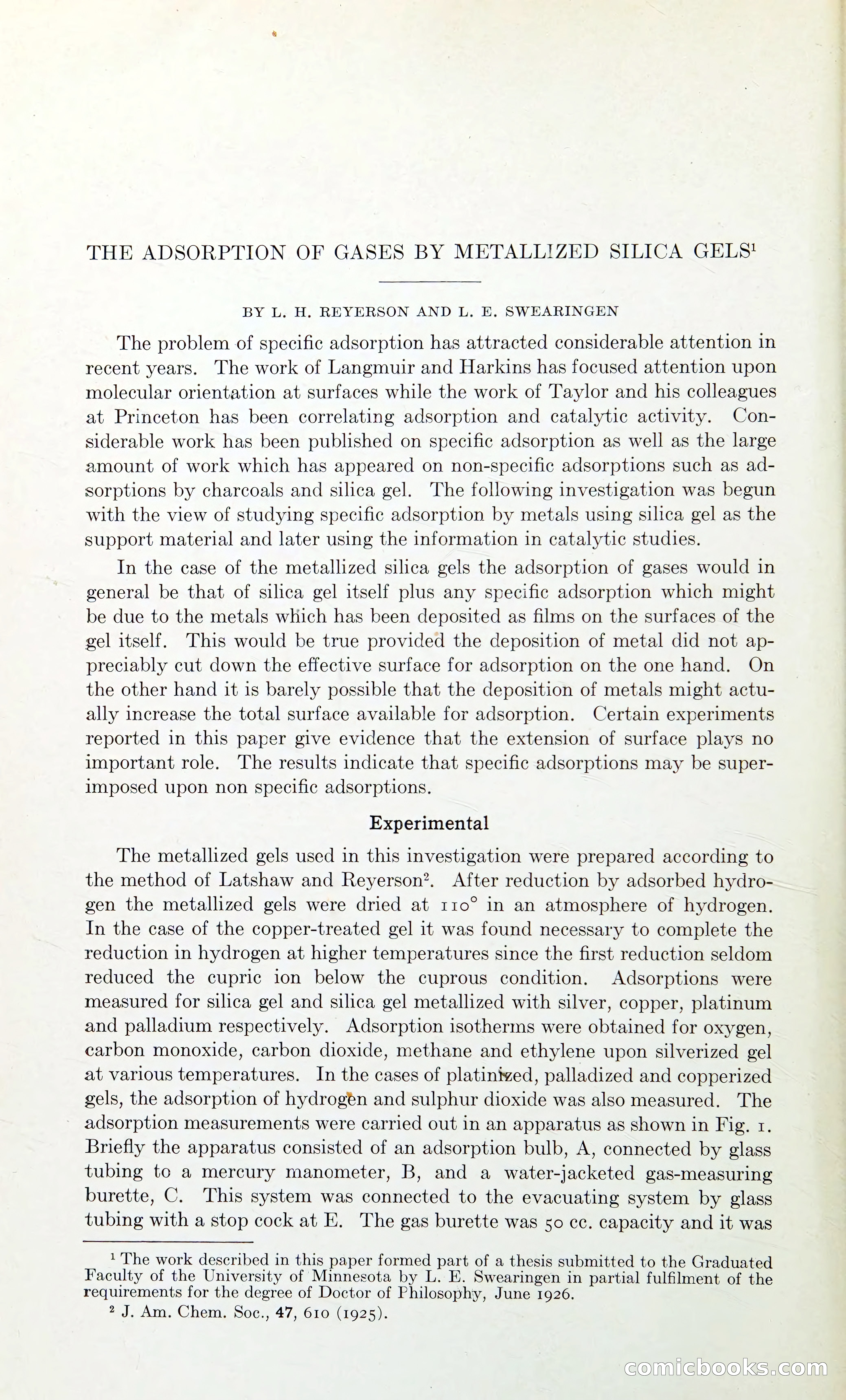
This is a running prose page—specifically, the opening of a scientific research paper, not a Victorian penny dreadful. The page contains the title "The Adsorption of Gases by Metallized Silica Gels" by L. H. Reyerson and L. E. Swearingen, followed by an introduction discussing previous work on molecular adsorption by researchers like Langmuir and Taylor, then an "Experimental" section describing the materials and apparatus used in their investigation of how metal-coated silica gels absorb various gases.
📄 Transcribed text from this page (OCR, searchable)
Machine-transcribed from the original scan — historical spelling and the odd misread are preserved.
THE ADSORPTION OF GASES BY METALLIZED SILICA GELS! BY L. H. REYERSON AND L. E. SWEARINGEN The problem of specific adsorption has attracted considerable attention in recent years. The work of Langmuir and Harkins has focused attention upon molecular orientation at surfaces while the work of Taylor and his colleagues at Princeton has been correlating adsorption and catalytic activity. Con- siderable work has been published on specific adsorption as well as the large amount of work which has appeared on non-specific adsorptions such as ad- sorptions by charcoals and silica gel. The following investigation was begun with the view of studying specific adsorption by metals using silica gel as the support material and later using the information in catalytic studies. In the case of the metallized silica gels the adsorption of gases would in general be that of silica gel itself plus any specific adsorption which might be due to the metals which has been deposited as films on the surfaces of the gel itself. This would be true provided the deposition of metal did not ap- preciably cut down the effective surface for adsorption on the one hand. On the other hand it is barely possible that the deposition of metals might actu- ally increase the total surface available for adsorption. Certain experiments reported in this paper give evidence that the extension of surface plays no important role. The results indicate that specific adsorptions may be super- imposed upon non specific adsorptions. Experimental The metallized gels used in this investigation were prepared according to the method of Latshaw and Reyerson’. After reduction by adsorbed hydro- gen the metallized gels were dried at 110° in an atmosphere of hydrogen. In the case of the copper-treated gel it was found necessary to complete the reduction in hydrogen at higher temperatures since the first reduction seldom reduced the cupric ion below the cuprous condition. Adsorptions were measured for silica gel and silica gel metallized with silver, copper, platinum and palladium respectively. Adsorption isotherms were obtained for oxygen, carbon monoxide, carbon dioxide, methane and ethylene upon silverized gel at various temperatures. In the cases of platinived, palladized and copperized gels, the adsorption of hydrogén and sulphur dioxide was also measured. The adsorption measurements were carried out in an apparatus as shown in Fig. 1. Briefly the apparatus consisted of an adsorption bulb, A, connected by glass tubing to a mercury manometer, B, and a water-jacketed gas-measuring burette, C. This system was connected to the evacuating system by glass tubing with a stop cock at E. The gas burette was 50 cc. capacity and it was ‘The work described in this paper formed part of a thesis submitted to the Graduated Faculty of the University of Minnesota by L. E. Swearingen in partial fulfilment of the requirements for the degree of Doctor of Philosophy, June 1926. 2 J. Am. Chem. Soc., 47, 610 (1925). CONNIE LOOOL<S 0) (C(O)