
Penny Dreadfuls, 1927 · page 7 of 42
Doctoral Thesis Cover Page — page 7: what you’re looking at
What you’re looking at
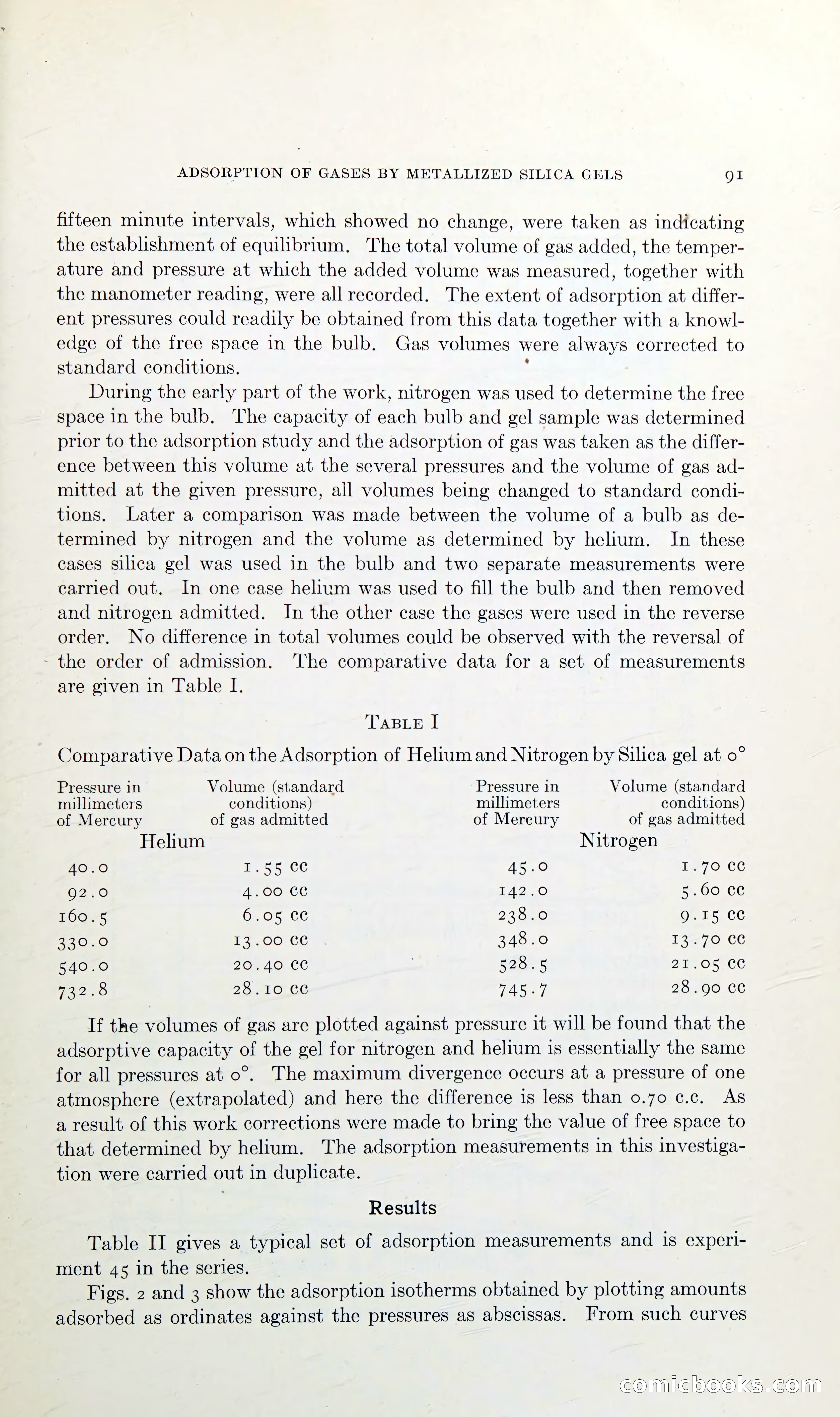
This is a page of running prose from a scientific research paper, not a Victorian penny dreadful. The text describes experimental methodology for measuring gas adsorption on silica gels, including detailed procedures for determining free space in laboratory equipment using nitrogen and helium, comparative data presented in a table, and initial results. The page appears to be numbered 91 and discusses how different gases behave similarly when adsorbed at various pressures.
📄 Transcribed text from this page (OCR, searchable)
Machine-transcribed from the original scan — historical spelling and the odd misread are preserved.
ADSORPTION OF GASES BY METALLIZED SILICA GELS QI fifteen minute intervals, which showed no change, were taken as indicating the establishment of equilibrium, The total volume of gas added, the temper- ature and pressure at which the added volume was measured, together with the manometer reading, were all recorded. The extent of adsorption at differ- ent pressures could readily be obtained from this data together with a knowl- edge of the free space in the bulb. Gas volumes were always corrected to standard conditions. . During the early part of the work, nitrogen was used to determine the free space in the bulb. The capacity of each bulb and gel sample was determined prior to the adsorption study and the adsorption of gas was taken as the differ- ence between this volume at the several pressures and the volume of gas ad- mitted at the given pressure, all volumes being changed to standard condi- tions. Later a comparison was made between the volume of a bulb as de- termined by nitrogen and the volume as determined by helium. In these cases silica gel was used in the bulb and two separate measurements were carried out. In one case helium was used to fill the bulb and then removed and nitrogen admitted. In the other case the gases were used in the reverse order. No difference in total volumes could be observed with the reversal of - the order of admission. The comparative data for a set of measurements are given in Table I. TABLE I Comparative Data on the Adsorption of Helium and Nitrogen by Silica gel at o° Pressure in Volume (standard Pressure in Volume (standard millimeters conditions) millimeters conditions) of Mercury of gas admitted of Mercury of gas admitted Helium Nitrogen 40.0 os CE At © ae Cole 02,0 4. 00-CC 1A 2:0 5.60 ce 160.5 GO..08 CE 238.0 OEE CC 220.0 £2200) Ce 348.0 [2270 CC 540-0 2G LO CC | e250 8 ZF -Os-EC Fa2.o 28.10 ce TAS 28,..00 CC If the volumes of gas are plotted against pressure it will be found that the adsorptive capacity of the gel for nitrogen and helium is essentially the same for all pressures at o°. The maximum divergence occurs at a pressure of one atmosphere (extrapolated) and here the difference is less than 0.70 c.c. As a result of this work corrections were made to bring the value of free space to that determined by helium. The adsorption measurements in this investiga- tion were carried out in duplicate. Results Table II gives a typical set of adsorption measurements and is experl- ment 4s in the series. Figs. 2 and 3 show the adsorption isotherms obtained by plotting amounts adsorbed as ordinates against the pressures as abscissas. From such curves (COMA @) lNOOKS (CO)