
Penny Dreadfuls, 1927 · page 35 of 42
Doctoral Thesis Cover Page — page 35: what you’re looking at
What you’re looking at
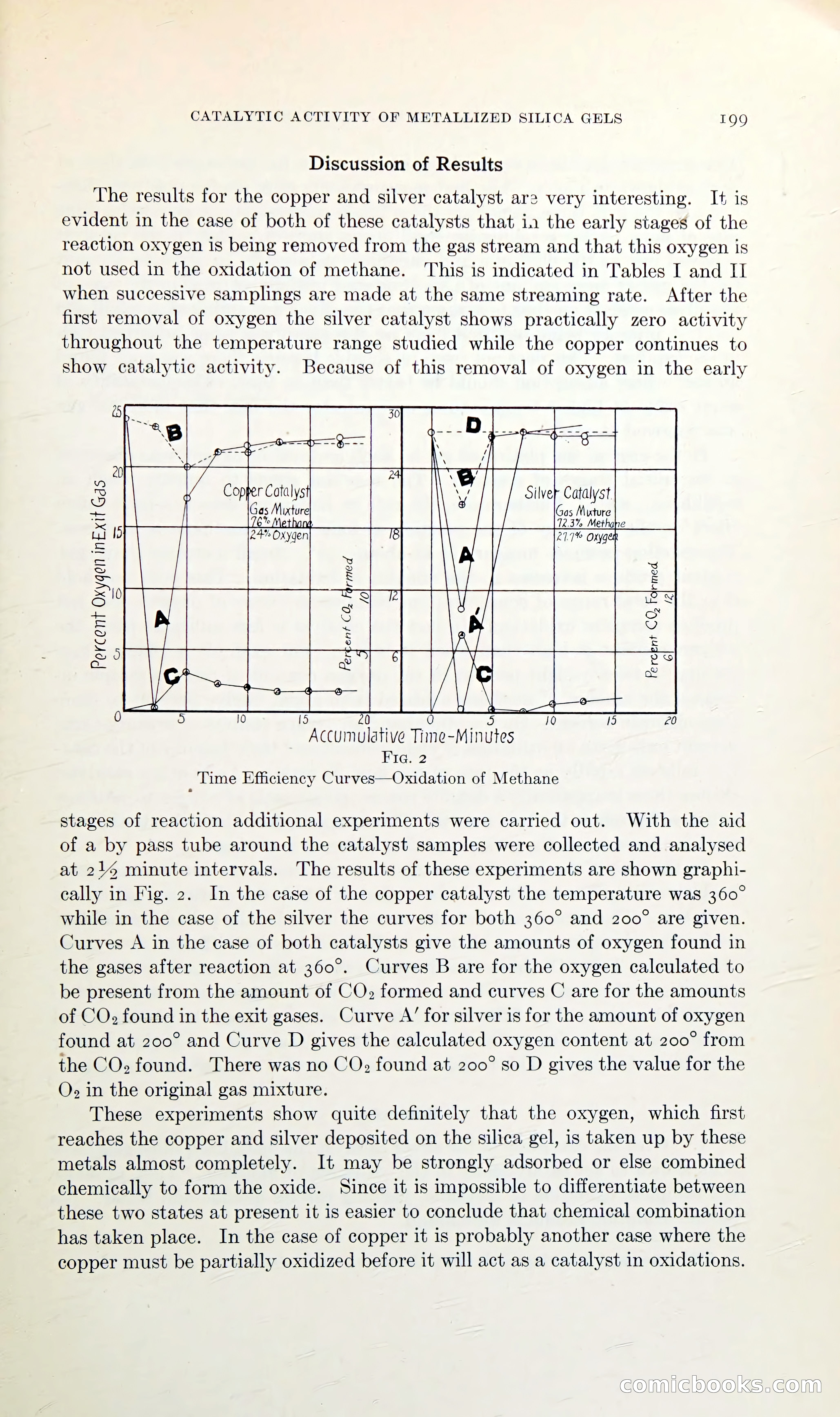
This is a page of scientific prose from an academic or technical journal article, not a Victorian penny dreadful. The visible text discusses experimental results on the catalytic properties of copper and silver deposited on silica gels, specifically their behavior during methane oxidation. The page includes a two-part graph (Fig. 2) showing "Time Efficiency Curves" plotting oxygen content against accumulative time in minutes, with multiple curves representing different measurements and temperatures. The prose explains that oxygen is initially removed from the gas stream by these metal catalysts, with the silver catalyst subsequently showing no activity while copper retains catalytic function.
📄 Transcribed text from this page (OCR, searchable)
Machine-transcribed from the original scan — historical spelling and the odd misread are preserved.
CATALYTIC ACTIVITY OF METALLIZED SILICA GELS IQQ Discussion of Results The results for the copper and silver catalyst ar2 very interesting. It is evident in the case of both of these catalysts that ia the early stages of the reaction oxygen is being removed from the gas stream and that this oxygen is not used in the oxidation of methane. This is indicated in Tables I and II when successive samplings are made at the same streaming rate. After the first removal of oxygen the silver catalyst shows practically zero activity throughout the temperature range studied while the copper continues to show catalytic activity. Because of this removal of oxygen in the early Vs 24 ‘ < : Copper Catalys y Catalyst | Gas Mixture Gas Muture 6% Methan 72.3% Methahe 20 Ww oO uy, a >< ; ; bi 1) 24% Oxygen B / 21.7% OXyged } ng i = 2 ¥ = x E =) d rs Ss e X ram ‘ 2 SS = Sf O Ley) - (4) a © on ae RS : S 2 g @ oO 10 15 0 10 15 2 Q », Accumulative Time-Minutes Fig. 2 Time Efficiency Curves—Oxidation of Methane £0 stages of reaction additional experiments were carried out. With the aid of a by pass tube around the catalyst samples were collected and analysed at 21% minute intervals. The results of these experiments are shown graphi- cally in Fig. 2. In the case of the copper catalyst the temperature was 360° while in the case of the silver the curves for both 360° and 200° are given. Curves A in the case of both catalysts give the amounts of oxygen found in the gases after reaction at 360°. Curves B are for the oxygen calculated to be present from the amount of CO, formed and curves C are for the amounts of CO, found in the exit gases. Curve A’ for silver is for the amount of oxygen found at 200° and Curve D gives the calculated oxygen content at 200° from the CO. found. There was no CO, found at 200° so D gives the value for the O, in the original gas mixture. These experiments show quite definitely that the oxygen, which first reaches the copper and silver deposited on the silica gel, is taken up by these metals almost completely. It may be strongly adsorbed or else combined chemically to form the oxide. Since it is impossible to differentiate between these two states at present it is easier to conclude that chemical combination has taken place. In the case of copper it is probably another case where the copper must be partially oxidized before it will act as a catalyst in oxidations. (COINA @) lNOOKS (C(O)