
Penny Dreadfuls, 1927 · page 19 of 42
Doctoral Thesis Cover Page — page 19: what you’re looking at
What you’re looking at
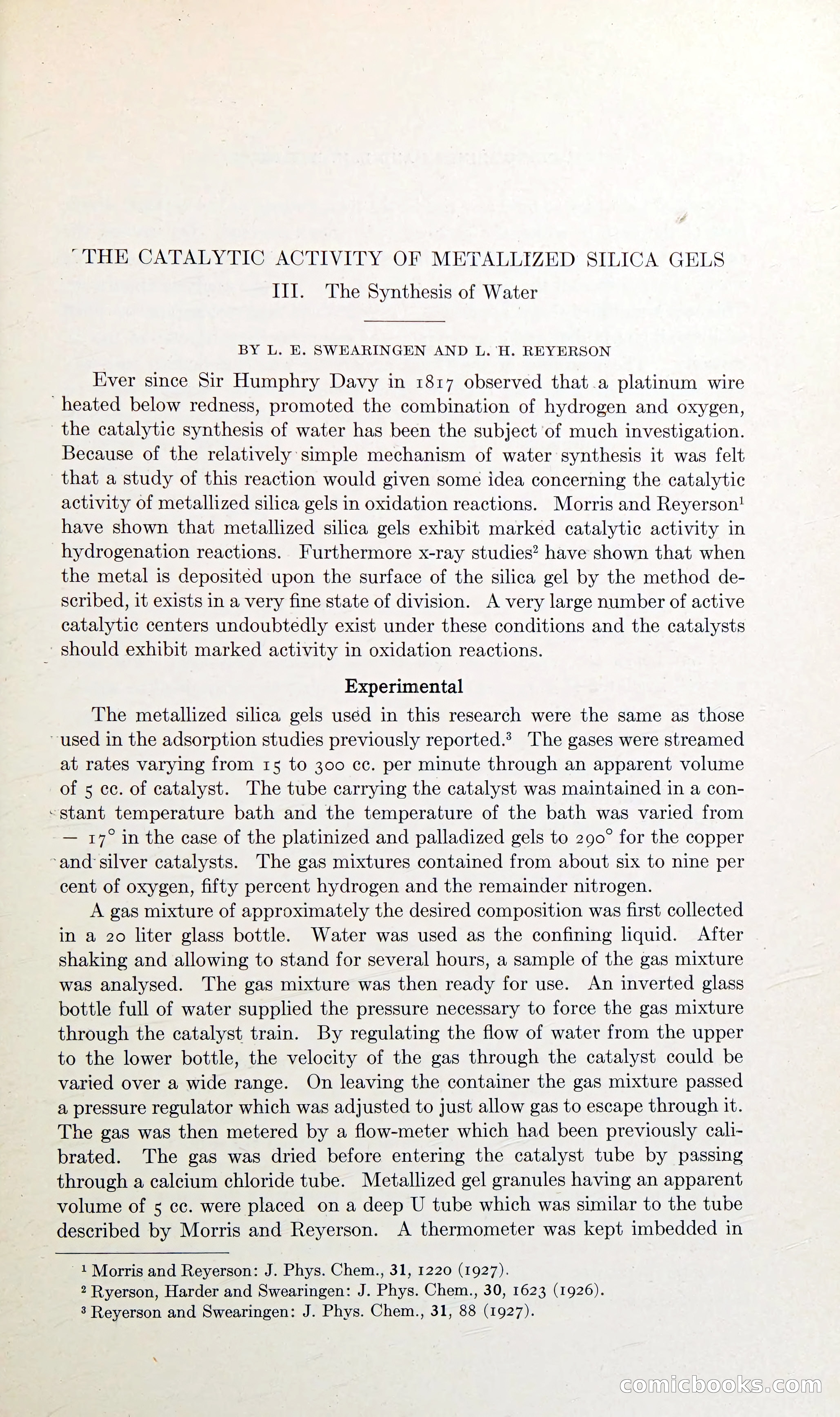
This is a page of scientific research text, not a Victorian penny dreadful. It appears to be from an early 20th-century chemistry journal article titled "The Catalytic Activity of Metallized Silica Gels III: The Synthesis of Water" by L. E. Swearingen and L. H. Reyerson. The page contains the introduction and experimental methodology sections describing how the authors used metallized silica gel catalysts to study the chemical synthesis of water from hydrogen and oxygen gases, including detailed technical procedures for their apparatus and measurements.
📄 Transcribed text from this page (OCR, searchable)
Machine-transcribed from the original scan — historical spelling and the odd misread are preserved.
ProteCATADYTI@ ACTIVITY*OF METALLIZED SILICA GELS | Ill. The Synthesis of Water BY L. E. SWEARINGEN AND L.'H. REYERSON Ever since Sir Humphry Davy in 1817 observed that.a platinum wire heated below redness, promoted the combination of hydrogen and oxygen, the catalytic synthesis of water has been the subject of much investigation. Because of the relatively simple mechanism of water synthesis it was felt that a study of this reaction would given some idea concerning the catalytic activity of metallized silica gels in oxidation reactions. Morris and Reyerson! have shown that metallized silica gels exhibit marked catalytic activity in hydrogenation reactions. Furthermore x-ray studies? have shown that when the metal is deposited upon the surface of the silica gel by the method de- scribed, it exists in a very fine state of division. A very large number of active catalytic centers undoubtedly exist under these conditions and the catalysts ~ should exhibit marked activity in oxidation reactions. Experimental The metallized silica gels uséd in this research were the same as those ~used in the adsorption studies previously reported.? The gases were streamed at rates varying from 15 to 300 cc. per minute through an apparent volume of 5 cc. of catalyst. The tube carrying the catalyst was maintained in a con- ~stant temperature bath and the temperature of the bath was varied from — 17° in the case of the platinized and palladized gels to 290° for the copper ‘and silver catalysts. The gas mixtures contained from about six to nine per cent of oxygen, fifty percent hydrogen and the remainder nitrogen. A gas mixture of approximately the desired composition was first collected in a 20 liter glass bottle. Water was used as the confining liquid. After shaking and allowing to stand for several hours, a sample of the gas mixture was analysed. The gas mixture was then ready for use. An inverted glass bottle full of water supplied the pressure necessary to force the gas mixture through the catalyst train. By regulating the flow of water from the upper to the lower bottle, the velocity of the gas through the catalyst could be varied over a wide range. On leaving the container the gas mixture passed a pressure regulator which was adjusted to just allow gas to escape through it. The gas was then metered by a flow-meter which had been previously cali- brated. The gas was dried before entering the catalyst tube by passing through a calcium chloride tube. Metallized gel granules having an apparent volume of 5 cc. were placed on a deep U tube which was similar to the tube described by Morris and Reyerson. A thermometer was kept imbedded in -1 Morris and Reyerson: J. Phys. Chem., 31, 1220 (1927). 2 Ryerson, Harder and Swearingen: J. Phys. Chem., 30, 1623 (1926). 3 Reyerson and Swearingen: J. Phys. Chem., 31, 88 (1927). COMMICLO© @) 6S (C(O)