
A complete issue · 52 pages · 1929
Life — May 17, 1929
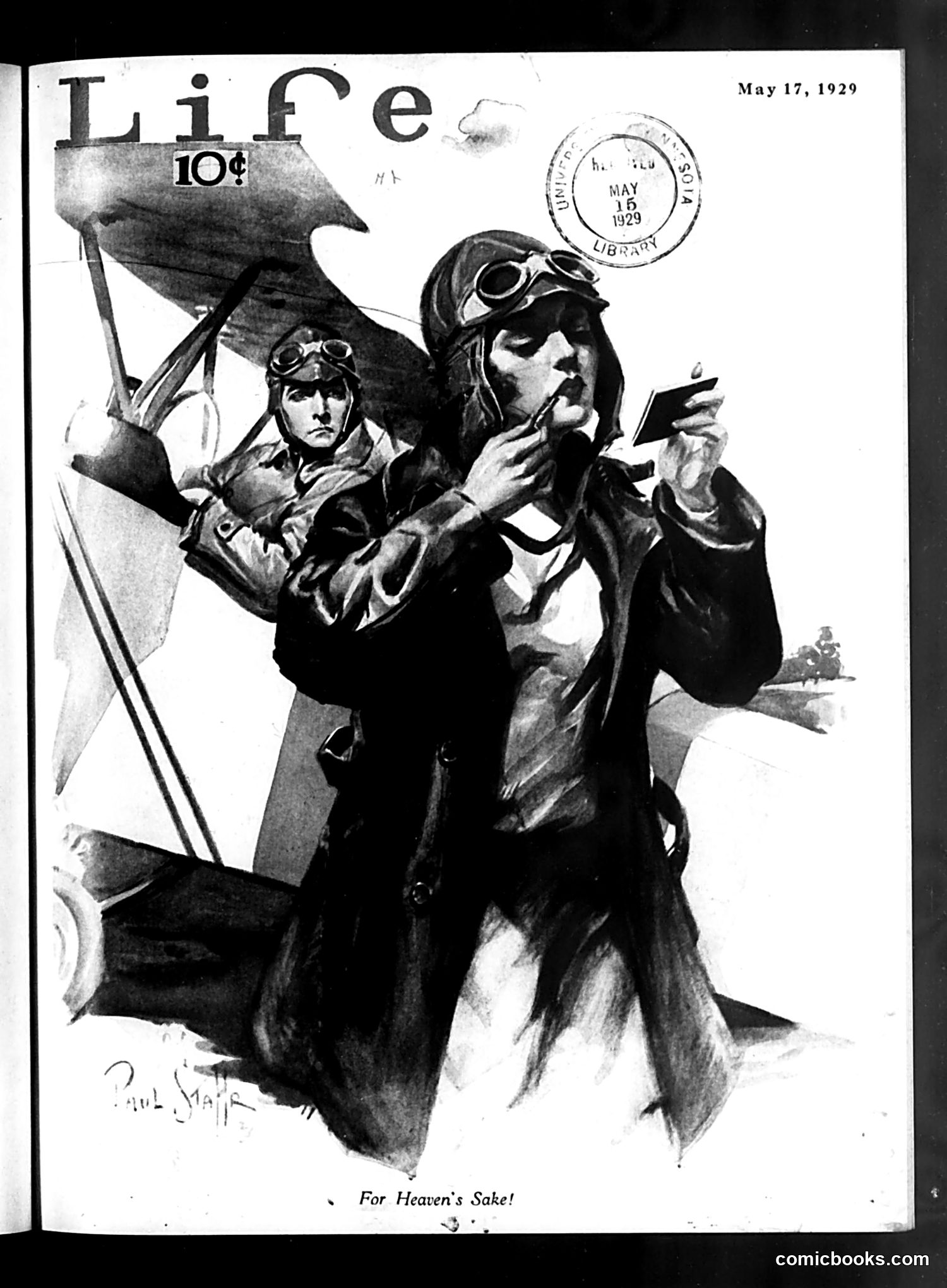
This satirical cover depicts two aviators in flying gear examining what appears to be a map or document, with an airplane visible in the background. The caption reads "For Heaven's Sake!" The cartoon likely references the intense competition and public fascination with aviation during the late 1920s. This era saw numerous record-breaking flights and aviation rivalries capturing public attention. The exaggerated, concerned expressions and the exclamatory caption suggest satire about the dangers or absurdity of aviation pursuits during this period. The two figures appear to be meant as stock aviator types rather than specific identifiable individuals, typical of Life's satirical approach. The sketch style and composition emphasize drama and humor around aviation culture at this time.
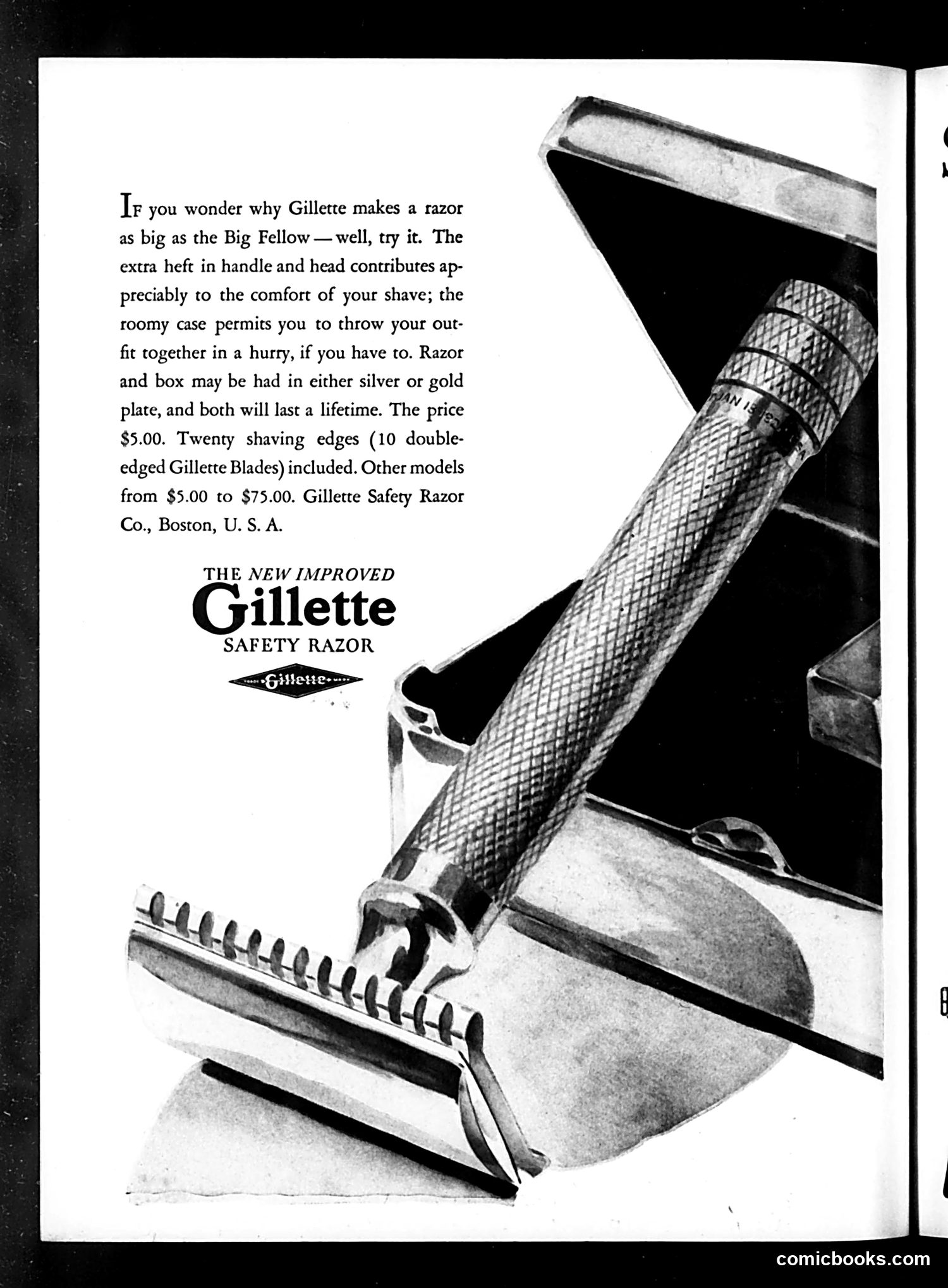
This page is **primarily an advertisement**, not satirical content. It promotes "The New Improved Gillette Safety Razor" manufactured by Gillette Safety Razor Co. in Boston. The ad emphasizes the razor's larger size ("Big Fellow") compared to standard models, claiming the extra heft and spacious case provide shaving comfort and convenience. It notes the product comes in silver or gold plating, includes twenty double-edged blades, and costs $5.00, with other models ranging from $5 to $75. There is **no political satire or cartoon** on this page—it is straightforward commercial marketing using a product photograph to showcase the razor's design and packaging appeal to potential male consumers.
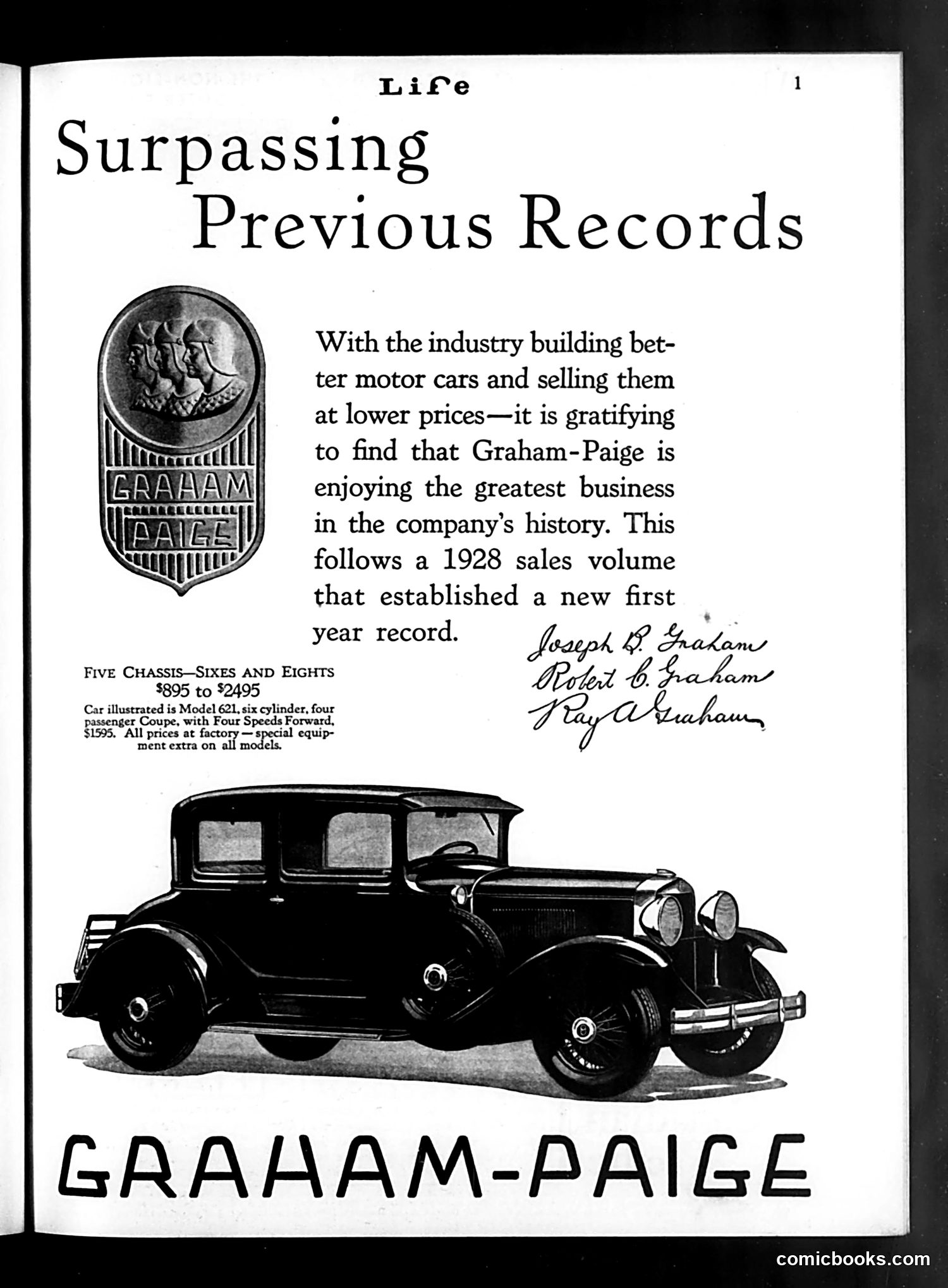
This is not a satirical cartoon but rather a straightforward **automobile advertisement** from Life magazine's "Life" section (page 1). The ad celebrates Graham-Paige's record-breaking 1928 sales performance, presenting it as a success story during a period of improved manufacturing and lower prices. The company emphasizes their "greatest business" achievement while the industry produces better cars at reduced costs. The ad features the Graham-Paige logo, three signatures (likely company executives Joseph A. Graham, Robert C. Graham, and Ray A. Graham), and an illustration of their Model 621 automobile—a six-cylinder, four-passenger coupe priced $895-$2495. This represents typical period advertising celebrating American industrial achievement and capitalist competition.
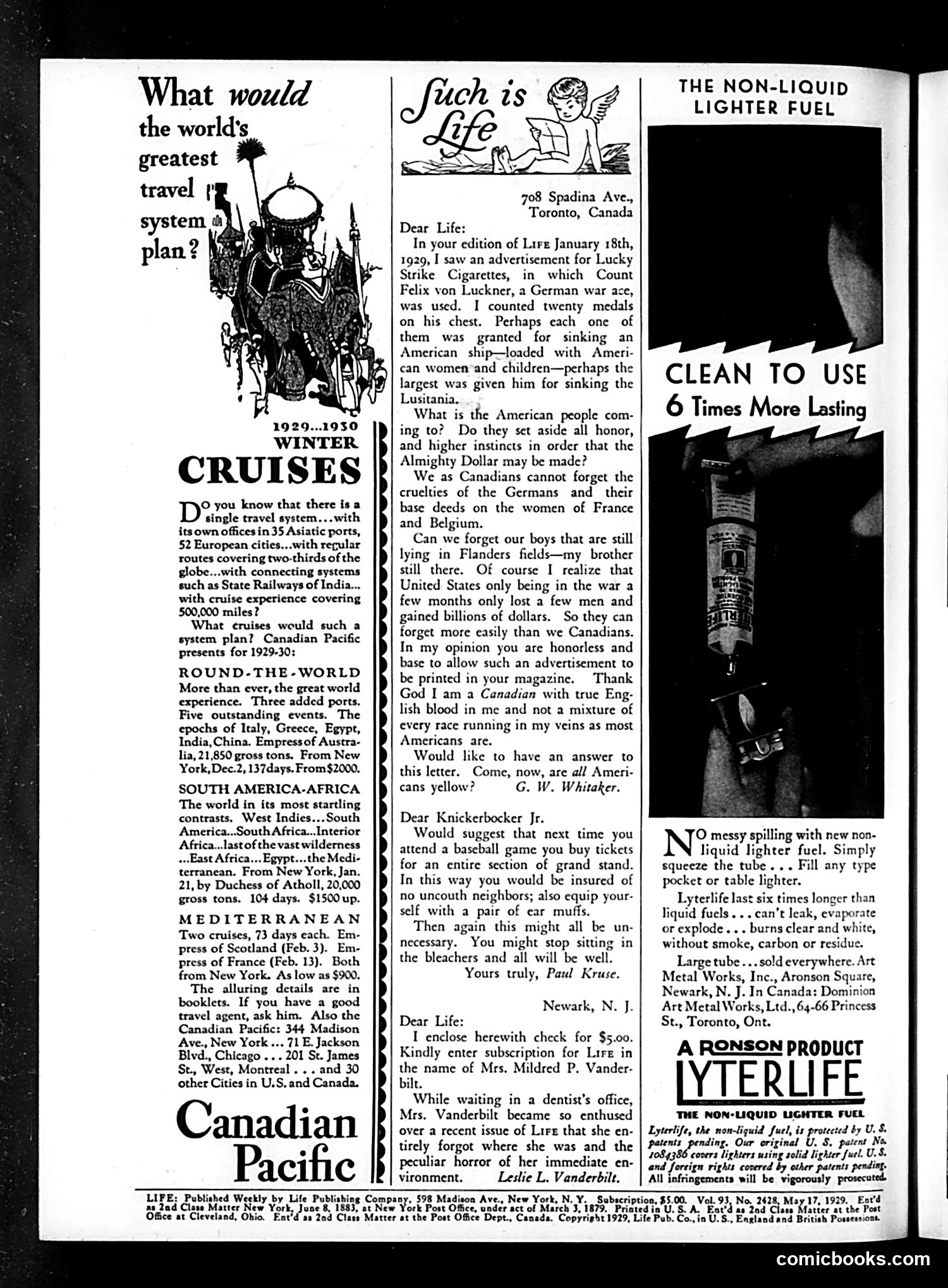
This page consists primarily of **advertisements and reader letters** rather than editorial cartoons. The left side advertises **Canadian Pacific cruises** (1929-1930), promoting round-the-world and South America-Africa voyages—typical luxury travel marketing of the era. The right side features **"Such is Life,"** a letters-to-the-editor section. One Canadian reader, G.W. Whitaker, expresses outrage that *Life* magazine ran a Lucky Strike cigarette ad featuring **Count Felix von Luckner**, a German WWI naval officer. Whitaker argues this is dishonorable—Americans should remember the war's casualties, particularly the *Lusitania* sinking. The exchange reveals post-WWI tensions and differing American-Canadian attitudes toward German war figures. The **Lyterelite lighter fuel advertisement** occupies the remaining space.
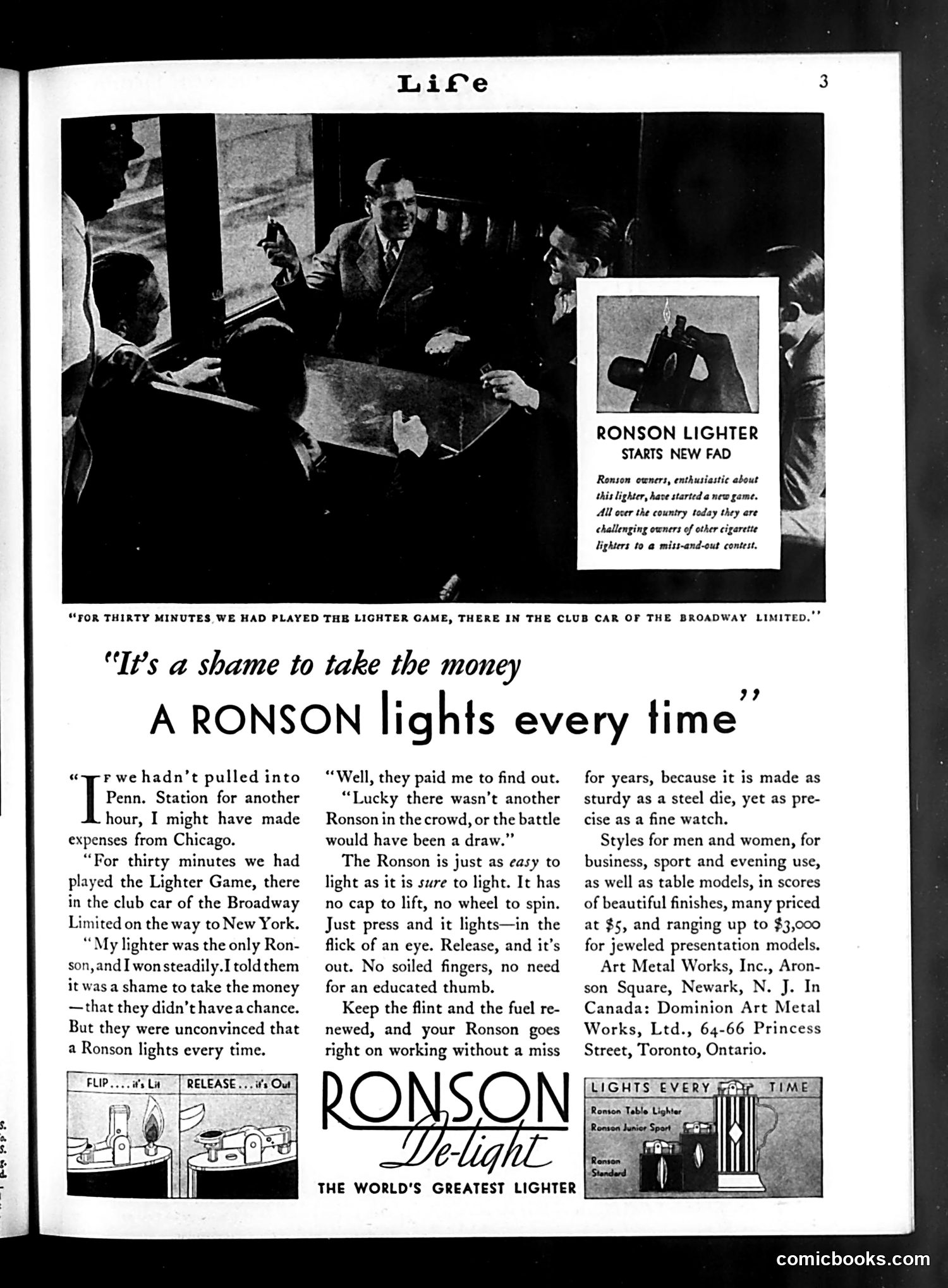
This page is primarily **advertising, not satire or political commentary**. It's a Ronson lighter advertisement from Life magazine. The main image shows men in a club car playing a "Lighter Game"—apparently a contest where they test different lighters' reliability. The testimonial describes how a Ronson lighter performed flawlessly during a 30-minute game, while competitors' lighters failed. The advertisement's humor is gentle and commercial: the tagline "It's a shame to take the money / A RONSON lights every time" plays on the idea that winning a lighter-testing competition with a Ronson is almost unfair—the product is so reliable it feels like cheating. This reflects early 20th-century advertising style, using relatable scenarios and gentle humor to promote consumer goods, rather than political satire.
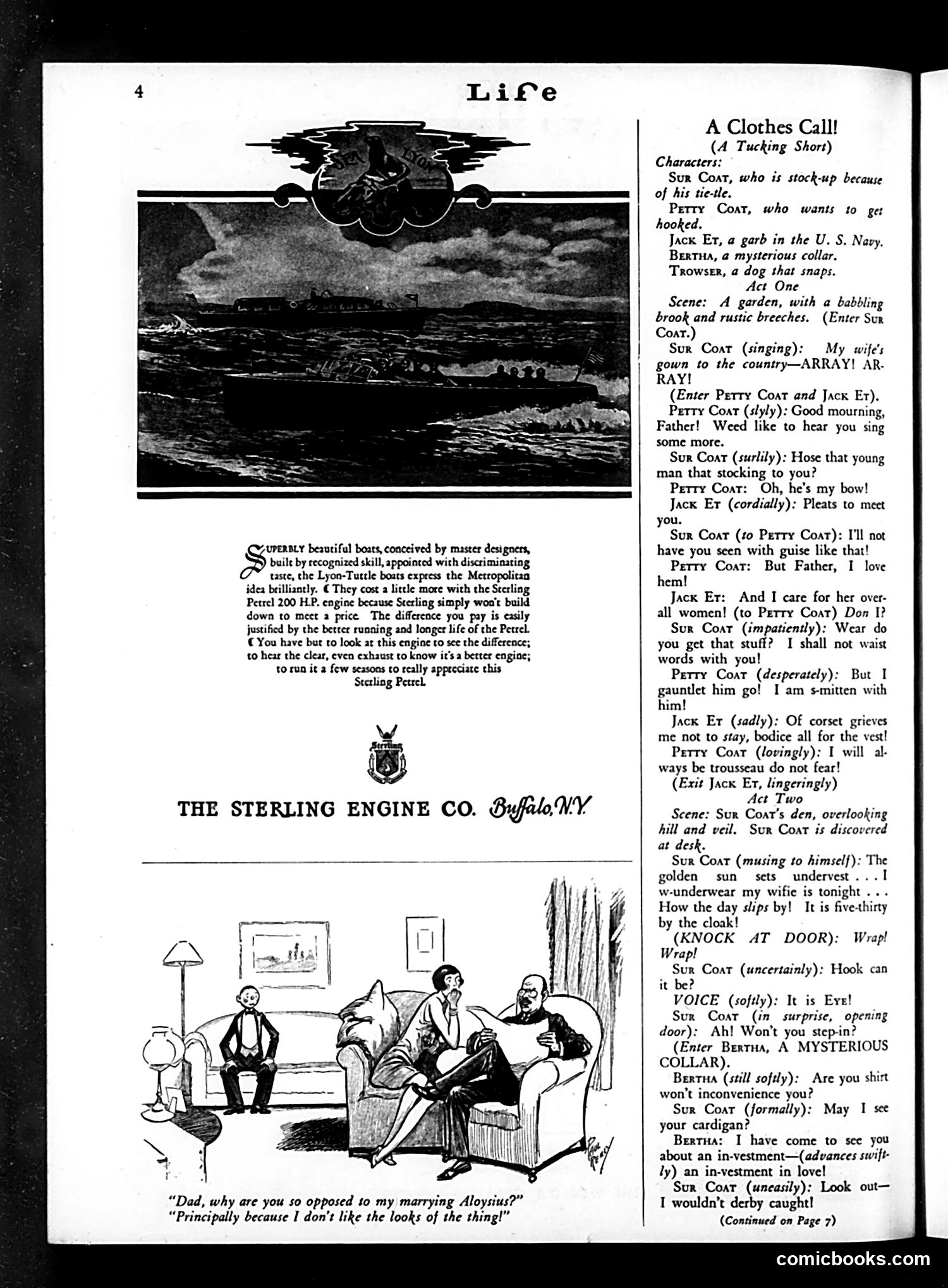
This page contains two distinct elements: **Upper portion:** An advertisement for Sterling Engine Company (Buffalo, NY), featuring a photograph of a boat and descriptive text about marine engines. **Lower portion:** "A Clothes Call," a comedic theatrical sketch. The cartoon illustration shows three men in a living room, with the caption: "Dad, why are you so opposed to my marrying Aloysius? Principally because I don't like the looks of the thing!" The sketch satirizes paternal disapproval of a suitor, playing on the father's dismissive attitude toward the prospective son-in-law. The humor derives from the father's shallow objection—judging the man purely on appearance rather than character or circumstances. This reflects early 20th-century domestic comedy conventions, poking fun at both generational conflict and superficial social judgments about courtship and marriage prospects.
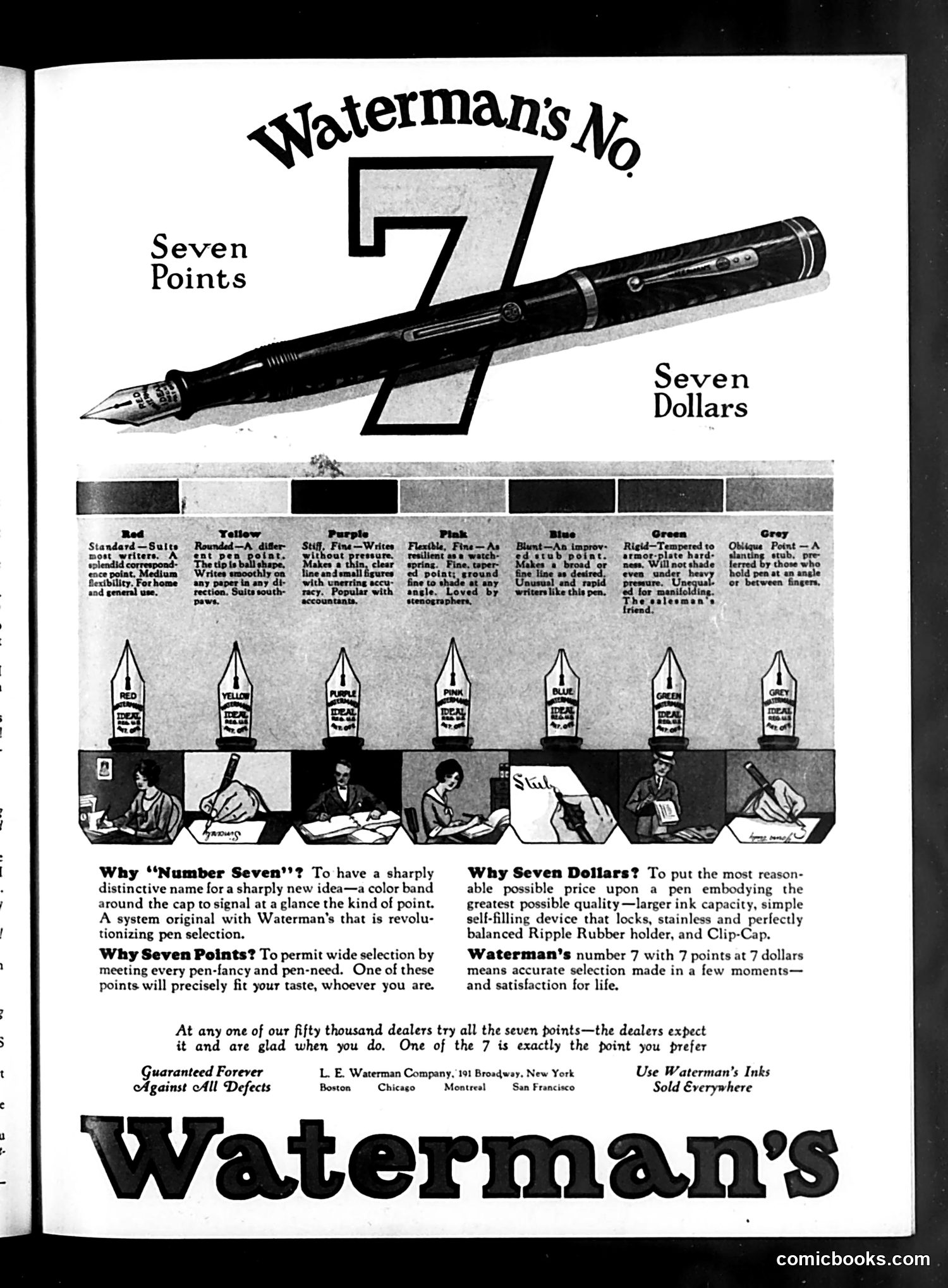
This is a **Waterman's fountain pen advertisement**, not political satire. The page promotes "Waterman's No. 7" pen, priced at seven dollars with seven different nib points. The "seven" theme is the marketing hook: seven nib options allow customers to find their preferred writing style. The lower section shows seven illustrated vignettes of different professions using pens—businesspeople, accountants, writers, and others—to demonstrate universal utility. The tagline promises "accurate selection made in a few moments—and satisfaction for life." This reflects early 20th-century consumer marketing: offering customization and professional endorsement to justify premium pricing. No political figures or satire are present. This is straightforward commercial advertising from Life magazine's classified section.
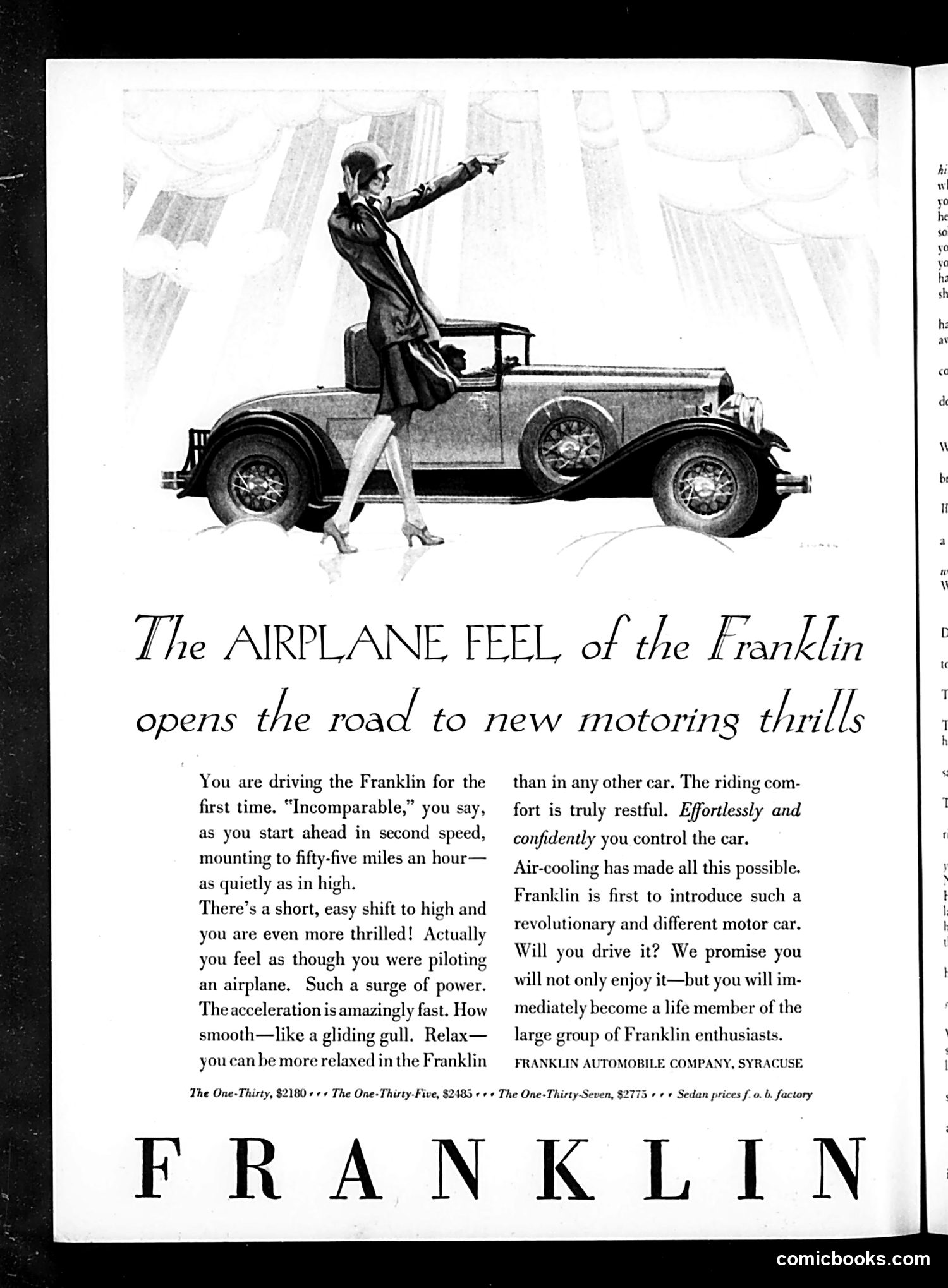
This is primarily a **car advertisement**, not political satire. It promotes the Franklin automobile, manufactured in Syracuse, New York, highlighting its air-cooling system as a revolutionary feature. The ad uses aspirational imagery: a well-dressed woman in 1920s fashion stands on a Franklin automobile, pointing ahead like a pilot. The accompanying text compares driving the Franklin to "piloting an airplane"—positioning the car as modern, powerful, and thrilling. The "airplane feel" reference emphasizes speed and smooth acceleration ("effortlessly and confidently you control the car"). The ad promises buyers will join an exclusive community of "Franklin enthusiasts." This reflects 1920s marketing tactics: equating automobiles with cutting-edge aviation technology to appeal to consumers seeking status and excitement.
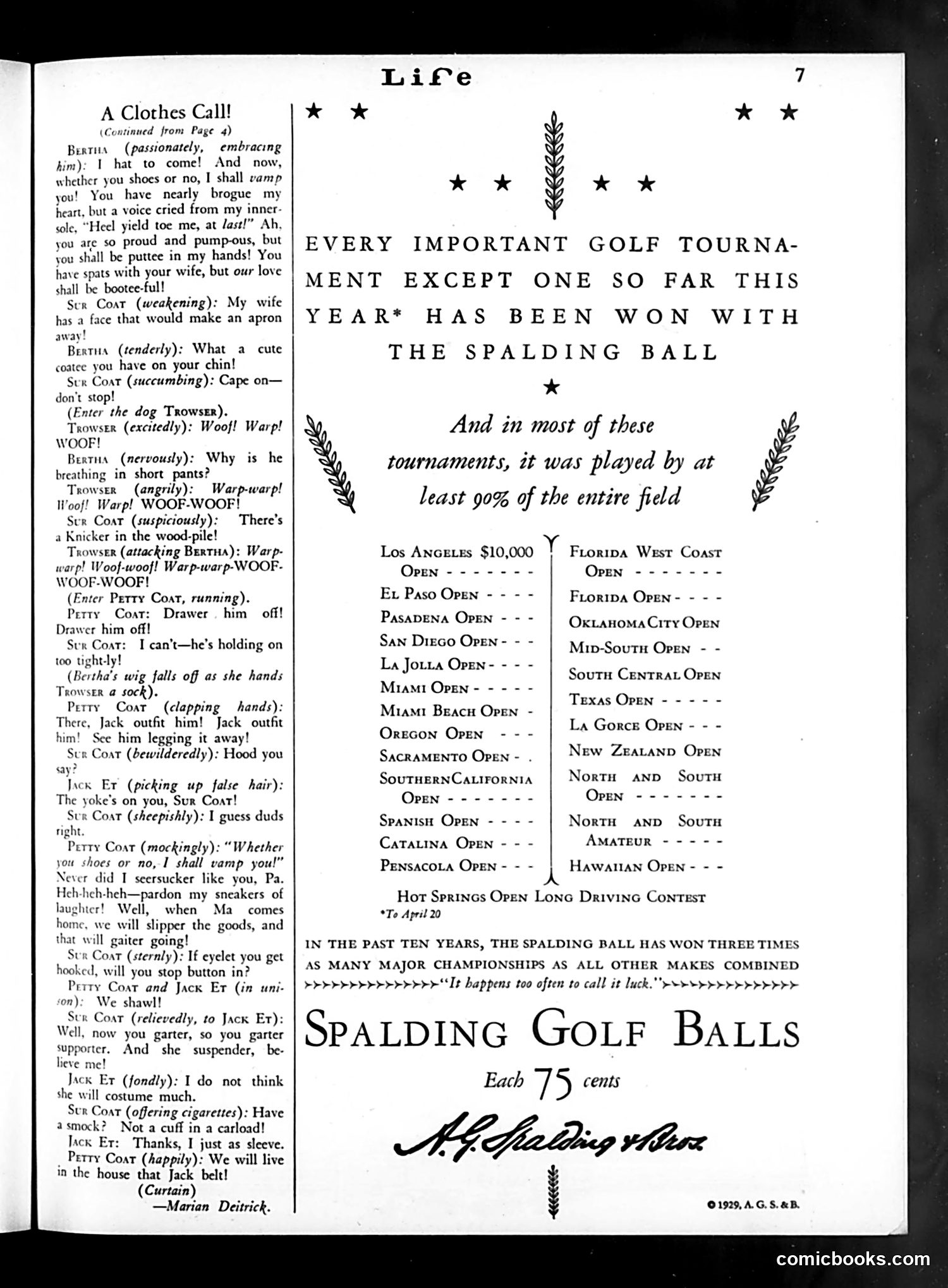
This page is primarily **advertising for Spalding Golf Balls**, not a political cartoon. The left column contains a comedic play called "A Clothes Call!" featuring characters named Bertha, Sue Coat, Towser (a dog), Petty Coat, and Jack Er engaging in domestic banter about shoes and clothing. The main advertisement emphasizes that Spalding golf balls dominated tournament play that year, winning "every important golf tournament except one." It lists dozens of tournaments (Los Angeles Open, Pasadena Open, etc.) and claims the Spalding ball won "three times as many major championships as all other makes combined" in the past decade. The ad concludes with a pitch: **"Spalding Golf Balls — Each 75 cents"** with A.G. Spalding & Bros.' signature. This is straightforward early-20th-century sports marketing using competitive statistics as selling points.
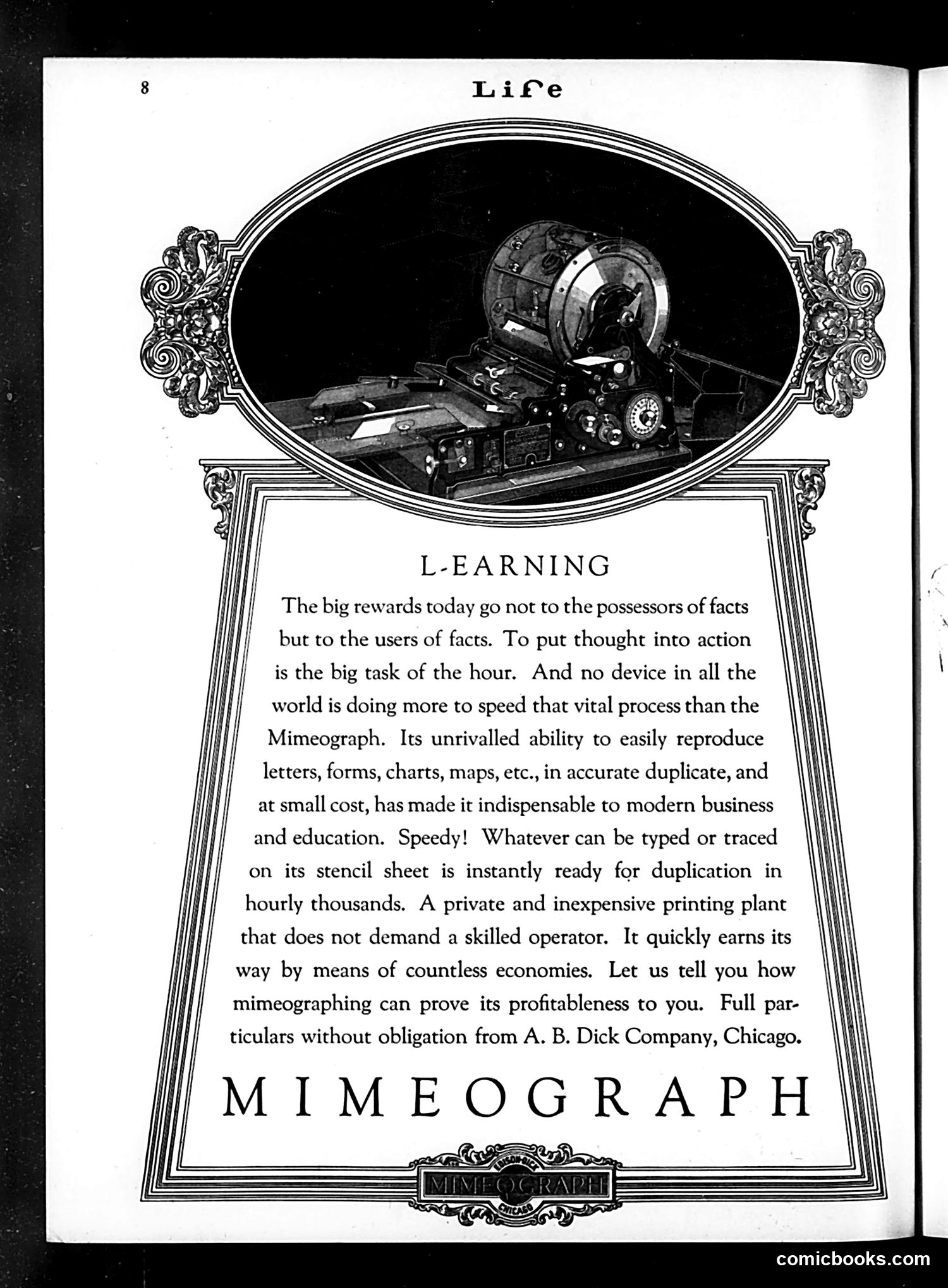
This is a **full-page advertisement**, not editorial content or satire. It promotes the "Mimeograph" machine, manufactured by A. B. Dick Company of Chicago. The ad's argument is purely commercial: it claims mimeographs enable rapid, inexpensive document duplication—turning "thought into action" by quickly reproducing letters, forms, charts, and maps. The device requires no skilled operator and pays for itself through economies of scale. The ornate oval frame contains an image of the actual mimeograph machine. The ad emphasizes speed and accessibility ("private and inexpensive printing plant"), positioning the device as essential to modern business and education. There is **no political satire or cartoon here**—merely early twentieth-century industrial marketing rhetoric emphasizing mechanical efficiency and democratized printing technology.
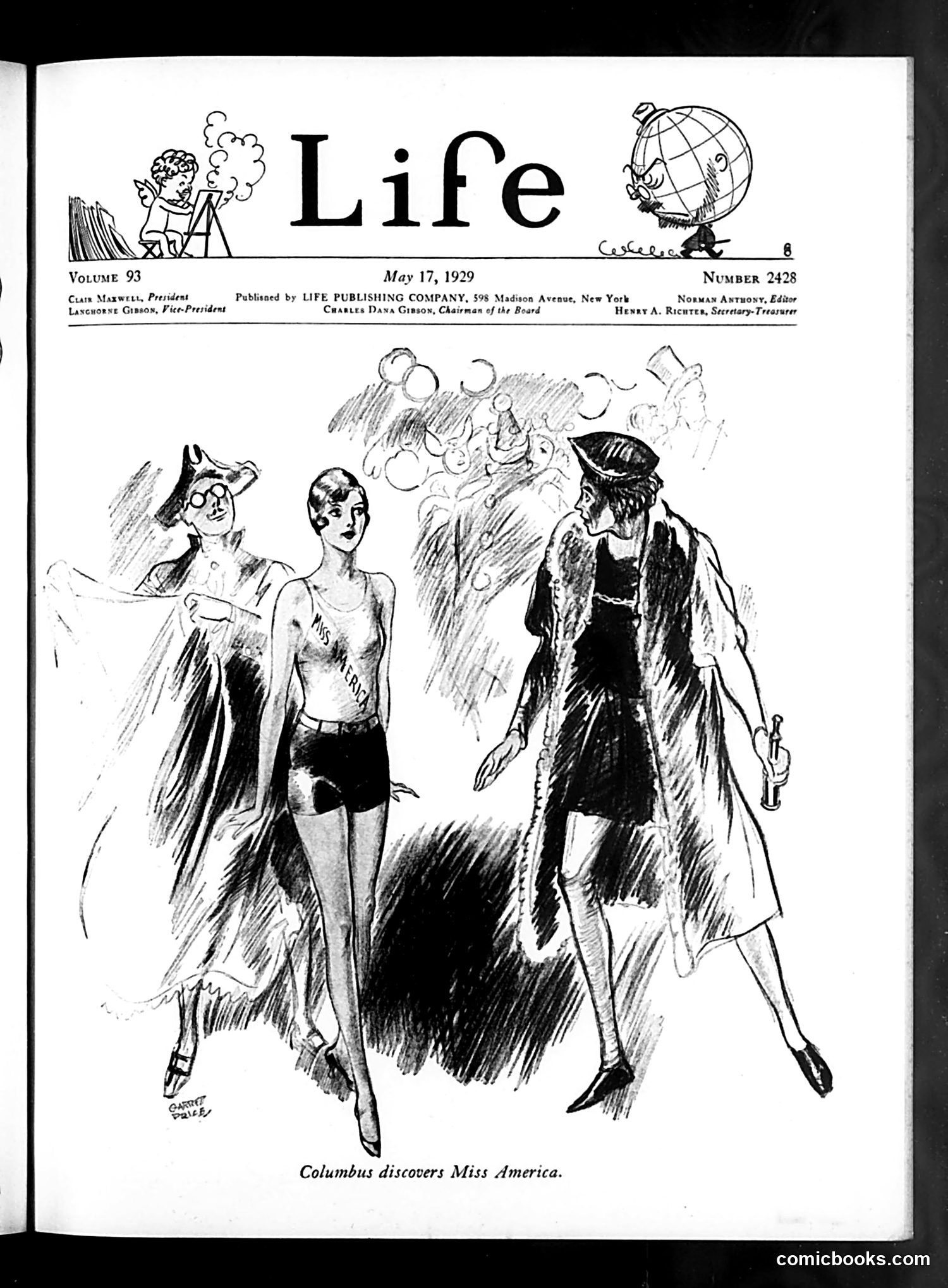
This satirical illustration depicts three fashionably dressed 1920s women with the caption "Columbus discovers Miss America." The joke plays on the historical discovery narrative: just as Columbus "discovered" America in 1492, the cartoonist suggests that modern beauty pageants or the "Miss America" ideal represent a contemporary "discovery" of American femininity. The women wear revealing 1920s flapper-style clothing and have the stylized features typical of Jazz Age illustrations. The satire likely mocks both the commercialization of female beauty pageants and perhaps the shallow materialism of contemporary American culture during the prosperous 1920s. The reference positions feminine beauty standards as America's defining export or achievement.
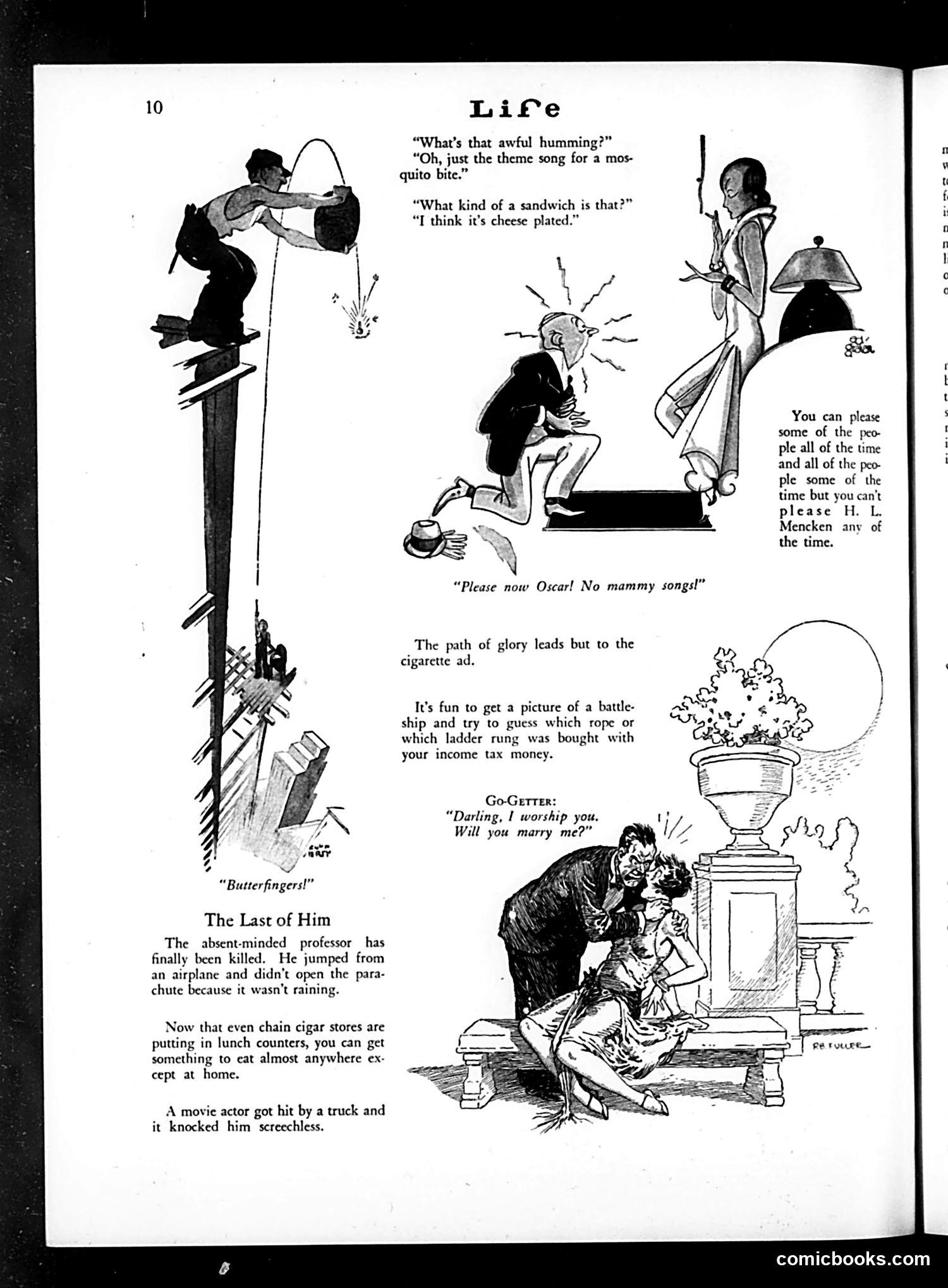
This page contains several satirical cartoons and jokes typical of Life's humor format. The top section mocks domestic life—a couple fishing from a precarious perch, with dialogue about mosquito bites and cheese sandwiches. Another cartoon shows someone being struck by a serving platter, captioned "Please now Oscar! No mammy songs!"—likely referencing minstrelsy or racial entertainment stereotypes common to the era. The bottom section titled "The Last of Him" jokes about an absent-minded professor who jumped from an airplane without a parachute. The final cartoon depicts a "Go-Getter" courting a woman by a garden urn, playing on period dating conventions. The overall tone satirizes modern life, romantic pursuits, and social absurdities without specific political targeting.
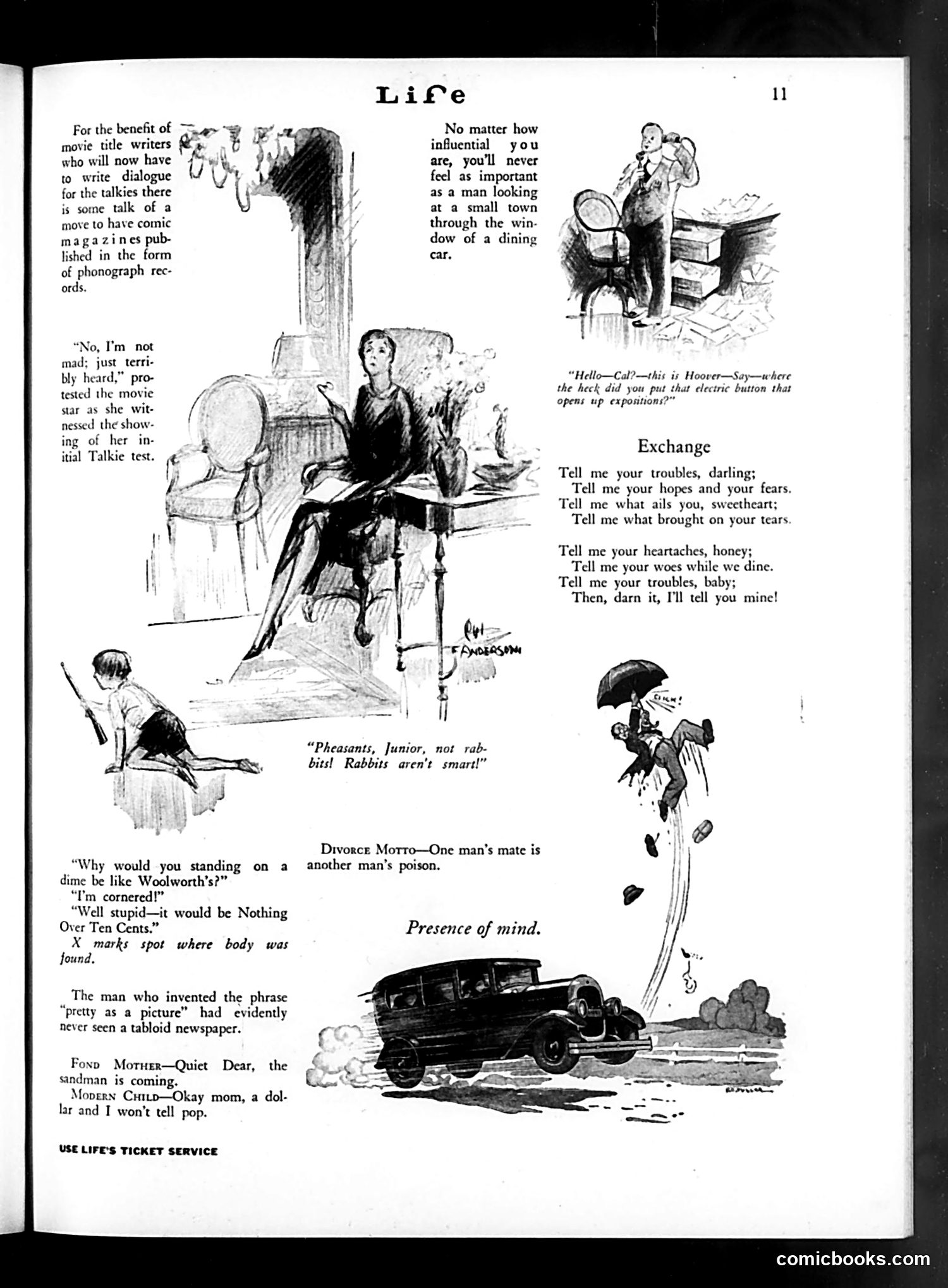
This page contains several unrelated comic vignettes satirizing early 20th-century life: **Top section**: A joke about movie "talkie" technology—a writer tested an actress as a potential voice for sound films, finding her unsuitable. **Middle cartoons**: Humorous domestic and social situations, including a joke about rabbits being "smart" and a divorce motto ("One man's mate is another man's poison"). **"Exchange" poem**: A romantic verse about couples sharing troubles and secrets while dining. **Bottom cartoon "Presence of Mind"**: Depicts a car accident scenario where someone demonstrates composure—likely satirizing overconfidence or absurd responses to crisis. The page exemplifies Life's satirical approach to modern conveniences (sound film, automobiles) and contemporary social behaviors, using humor to comment on technology adoption and human folly.
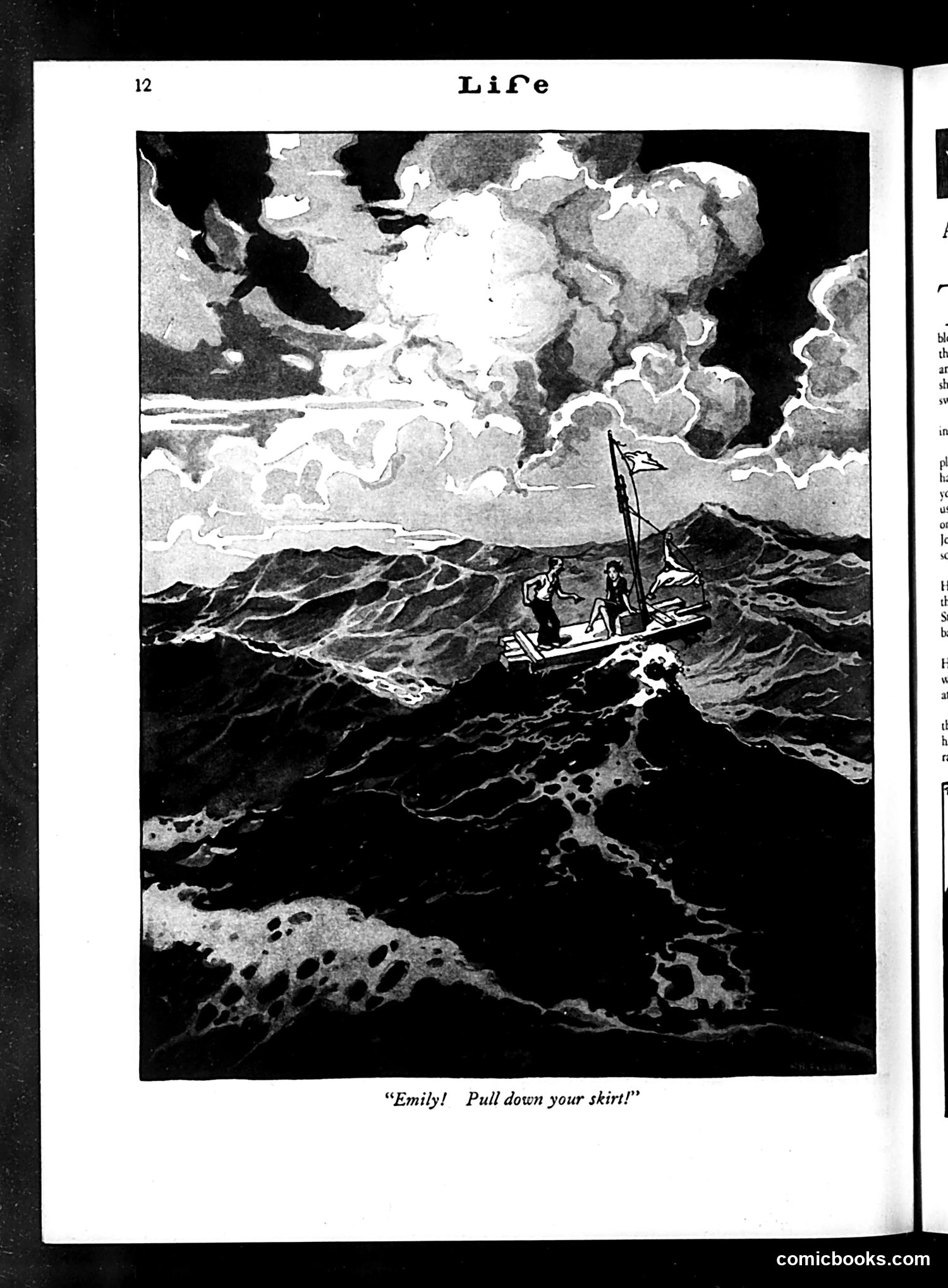
This is a single-panel cartoon from *Life* magazine showing a small boat with two figures in rough seas beneath dramatic storm clouds. One figure holds a flag while the other stands nearby. The caption reads: "Emily! Pull down your skirt!" The humor appears to be a classic early 20th-century joke playing on Victorian-era propriety and gender norms. A woman named Emily is so distracted or alarmed by the dangerous storm and turbulent seas that she's apparently forgotten her modesty—her skirt has blown up or she's lost awareness of her appearance. The male companion's urgent command prioritizes her respectability over the actual maritime danger they're facing, satirizing how obsessively society policed women's propriety even in life-threatening situations. The cartoon mocks exaggerated social priorities of the era.
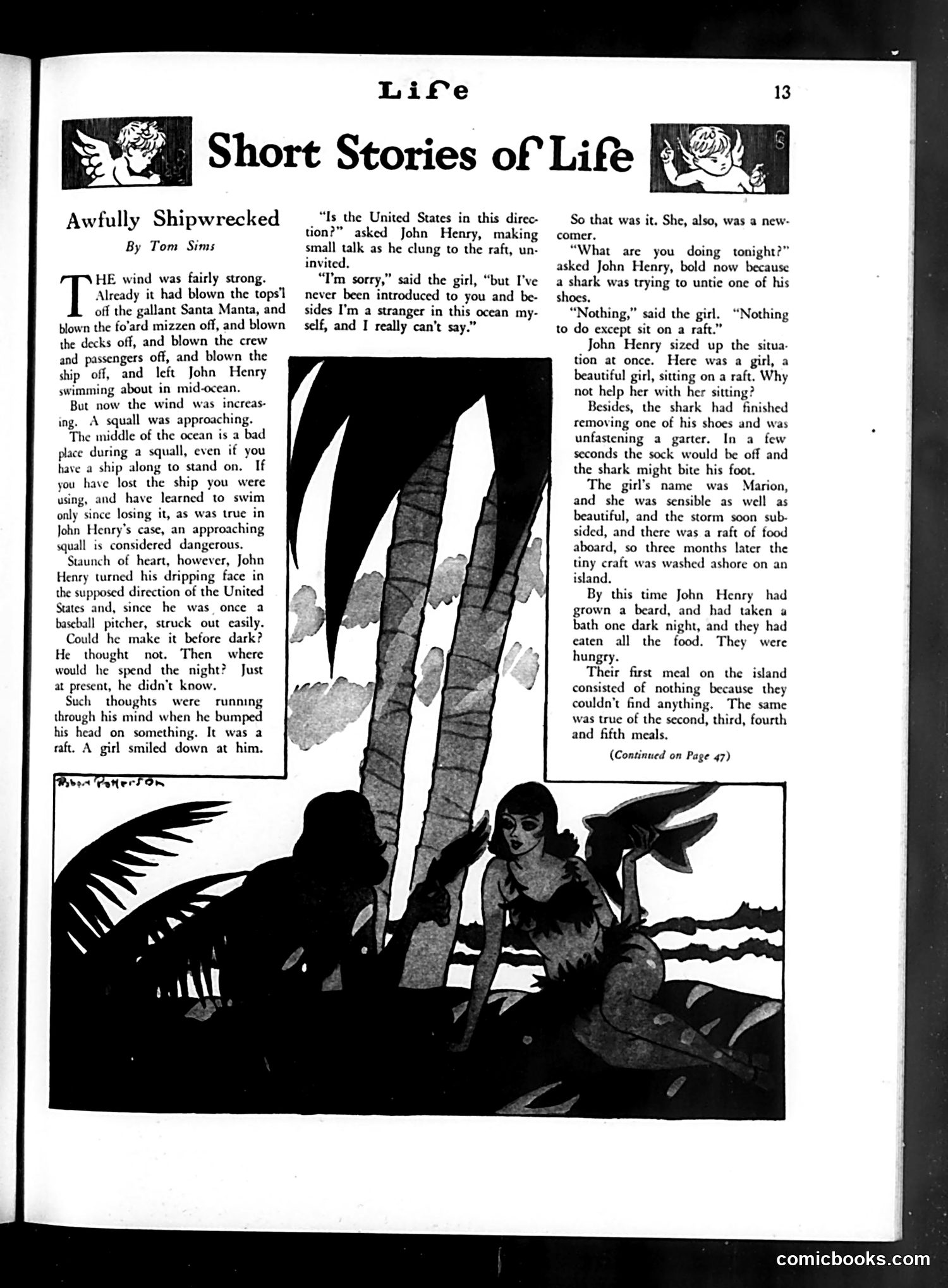
This is a short romantic/adventure story rather than political satire. John Henry, a baseball pitcher, survives a shipwreck of the Santa Manta and finds himself swimming in the ocean. He encounters Marion, a beautiful girl also clinging to a raft. The narrative explores their survival situation with light humor—Marion is practical (refusing his help with her sitting position to avoid a shark), and John Henry is somewhat hapless and confused about their circumstances. The story appears to be serialized fiction (marked "Continued on Page 47"), typical of Life magazine's entertainment content. The illustration shows the two survivors on a palm-tree raft. This is straightforward adventure-romance storytelling, not political commentary.
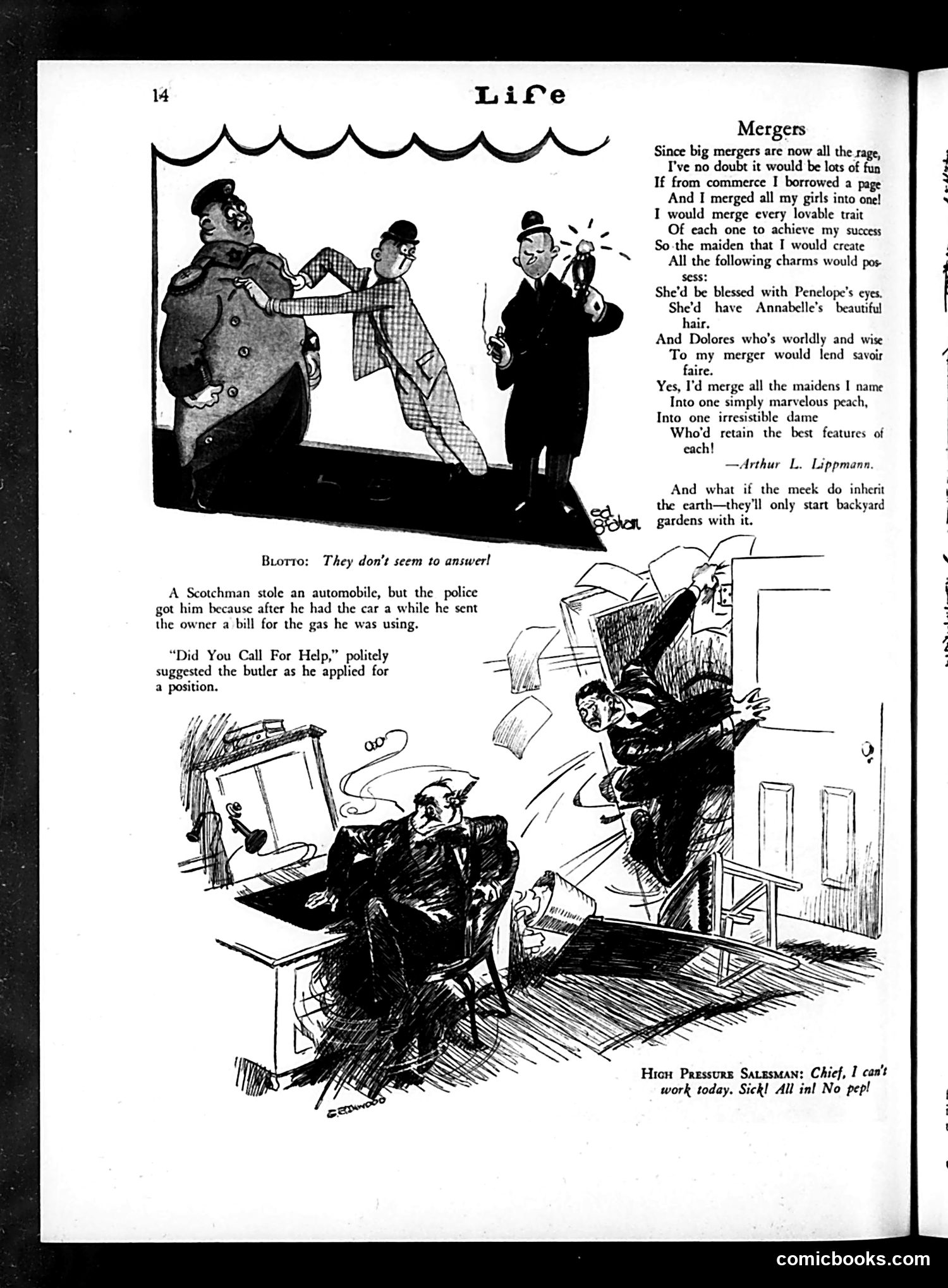
This page contains two satirical cartoons mocking contemporary business practices. The top cartoon, captioned "They don't seem to answer!", depicts three men appearing to attempt communication with an unresponsive figure, likely satirizing the then-current trend of corporate mergers. The accompanying poem by Arthur L. Lippmann playfully imagines merging all desirable female traits into one "perfect woman." The lower cartoon shows a Scotsman who stole a car, receiving a bill for gas from the owner—a joke about unexpected consequences and petty vindictiveness. The bottom illustration depicts a high-pressure salesman claiming to be "sick" and unable to work, with his chief rejecting excuses. This satirizes aggressive sales tactics and the pressure salesmen faced in early 20th-century business culture. Both cartoons mock commercial excess and workplace absurdities of the era.
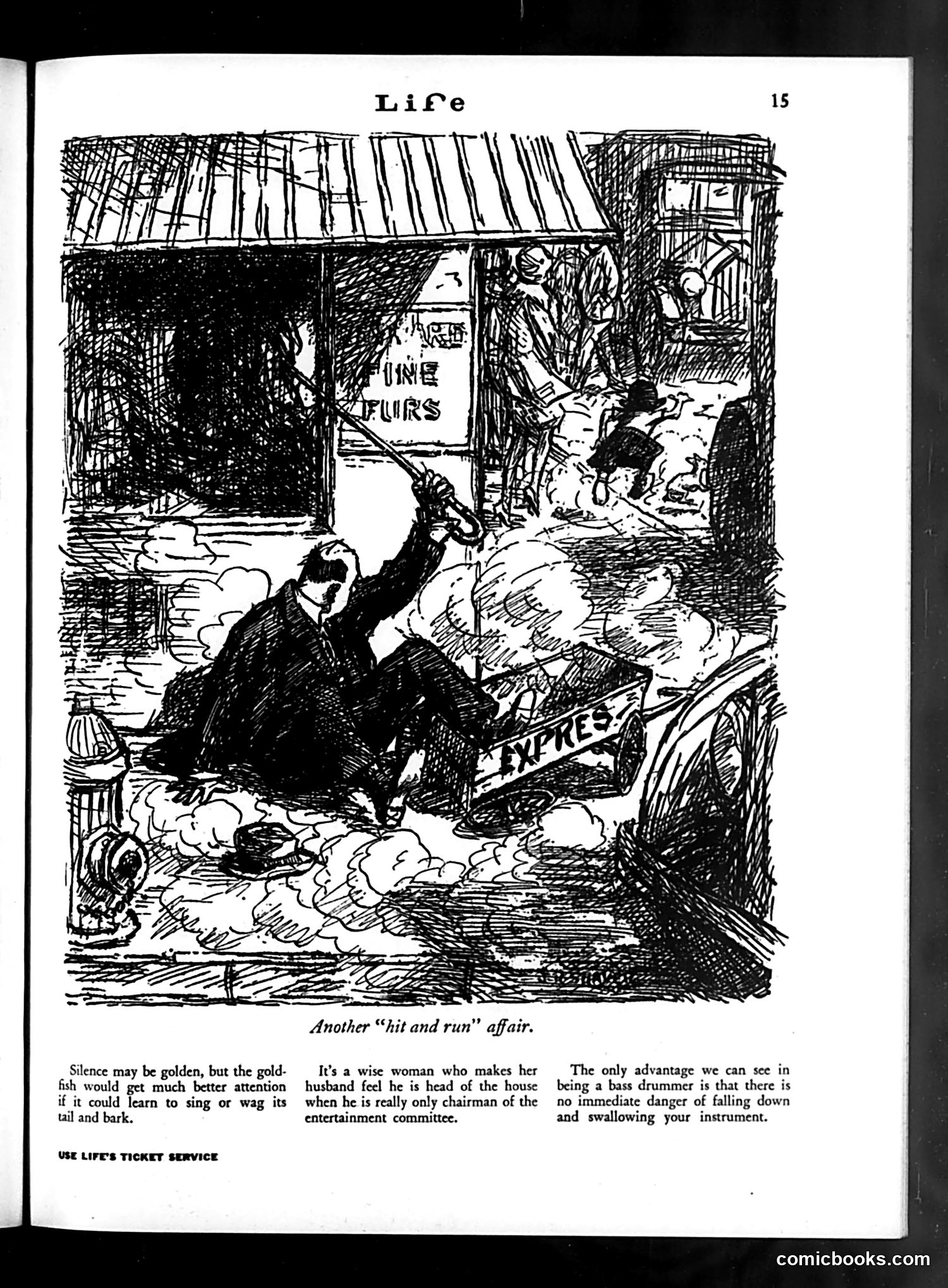
This is a satirical illustration titled "Another 'hit and run' affair," depicting what appears to be a delivery mishap or accident scene. A man in formal attire has apparently crashed into a storefront (marked "UNE FURS" and "EXPRESS"), causing considerable damage and debris. The three accompanying captions are social commentary on different topics: the first jokes about silent fish and attention-seeking; the second satirizes wives manipulating husbands into thinking they control household decisions; the third humorously notes that bass drummers face unique occupational hazards. The illustration's title "hit and run" suggests commentary on careless behavior or irresponsibility, though the specific historical context remains unclear without additional publication information.
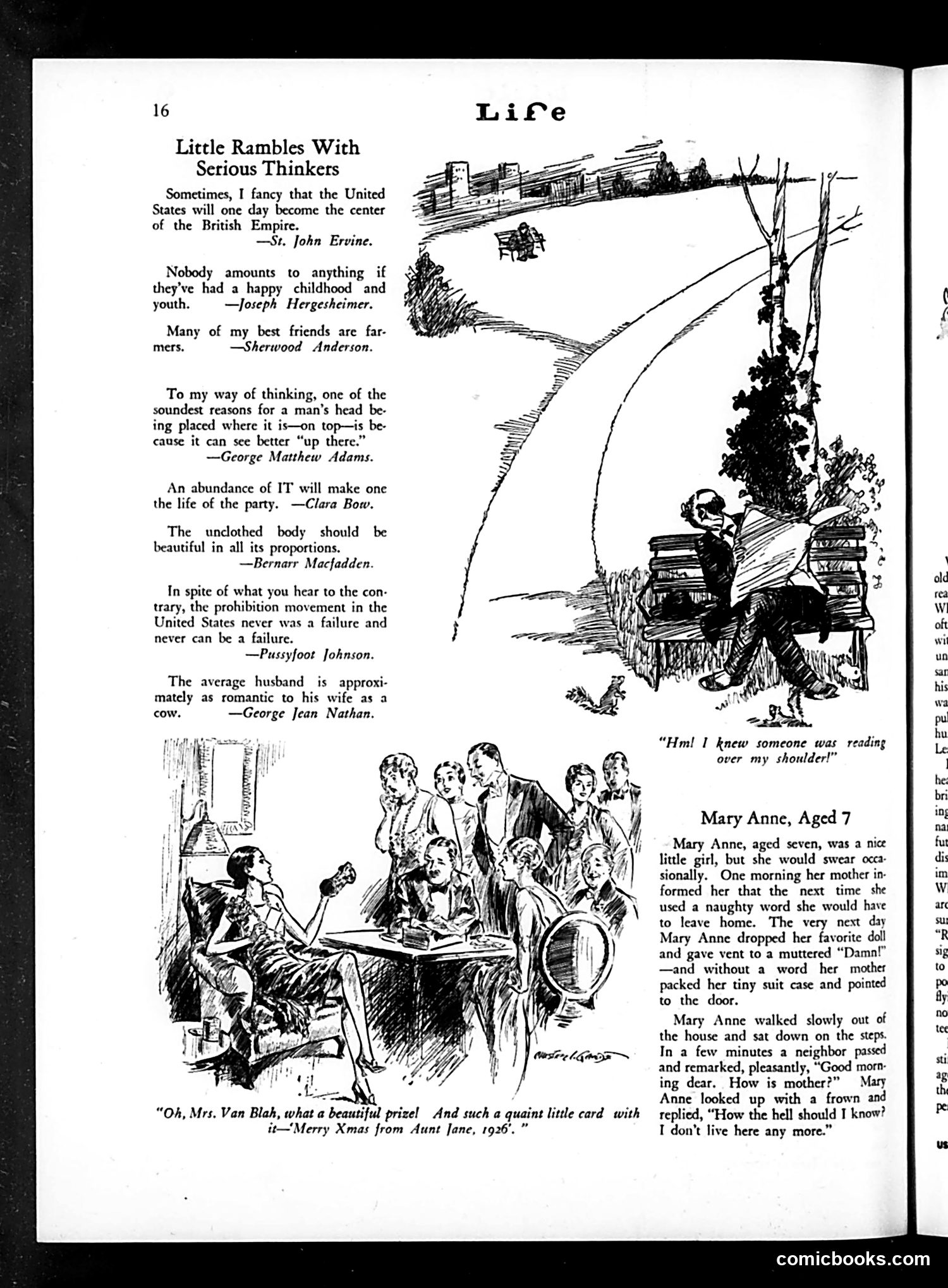
This page combines philosophical quotes ("Little Rambles With Serious Thinkers") with two illustrated stories. **Top illustration**: A figure reads on a bench beneath bare trees and a distant train, captioned "Hm! I knew someone was reading over my shoulder!"—a joke about intrusive privacy. **Bottom illustration and story**: Depicts "Mary Anne, Aged 7," a narrative about a misbehaving child. The cartoon shows Mary Anne surrounded by adults (possibly at a family gathering or holiday event), relating an incident where she used profanity, prompting her to run away threatening never to return. The caption references a 1926 Christmas card from "Aunt Jane," suggesting this reflects period anxieties about childhood behavior and parental discipline during the 1920s-30s. Both pieces humorously address social embarrassment and awkward moments.
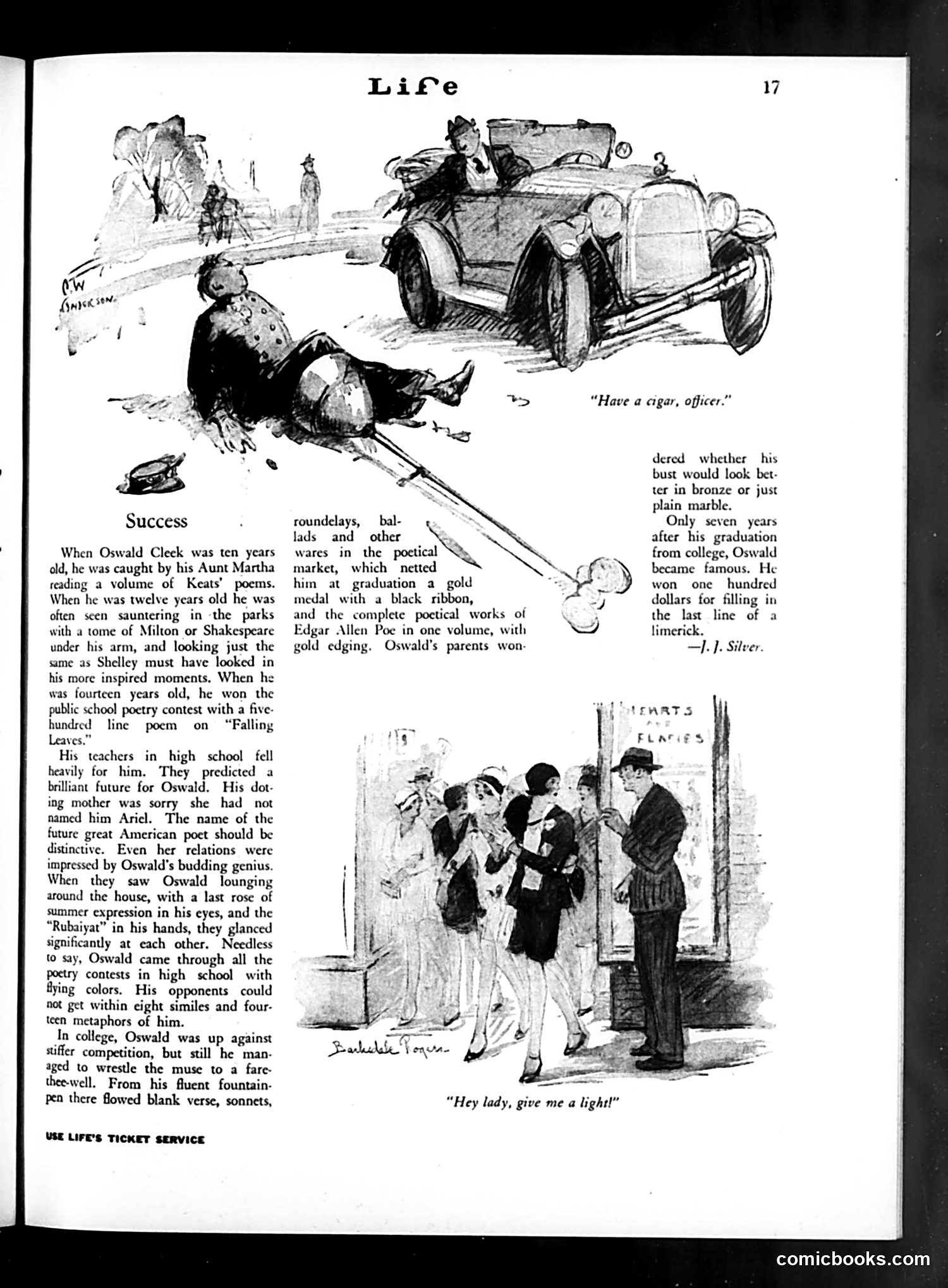
This page contains a biographical article about Oswald Cleck, a young poet who showed early literary promise. The top cartoon depicts a policeman struck by a car, captioned "Have a cigar, officer"—likely satirizing wealthy or privileged individuals who casually offer bribes or treats to authority figures. The bottom cartoon shows a man at a door asking "Hey lady, give me a light!"—presumably a humorous reference to someone seeking a light for a cigarette from a woman, playing on social awkwardness or impertinence. The article's text discusses Cleck's poetic achievements and academic success, but the cartoons appear unrelated to the biographical content, suggesting they're separate satirical commentary on social behavior and class dynamics typical of Life magazine's humor style.
This page contains a humorous column of brief, anecdotal news items from various American cities, presented without illustrations. The humor derives from absurd or ironic everyday situations: - A Chicago elephant contracts pneumonia under Prohibition - New York savages behave more politely than college students - A brewery closes due to bootleggers - An artificial leg becomes a romantic token - A man pours ice water on a colleague during Assembly debate - Various mishaps involving masquerades, airplane parking fees, and shoplifting The satire critiques 1920s American society—Prohibition's absurdities, gender relations, bureaucratic regulations, and urban life's contradictions. These brief items mock both ordinary people's foolishness and institutional hypocrisy, using deadpan delivery for comedic effect.
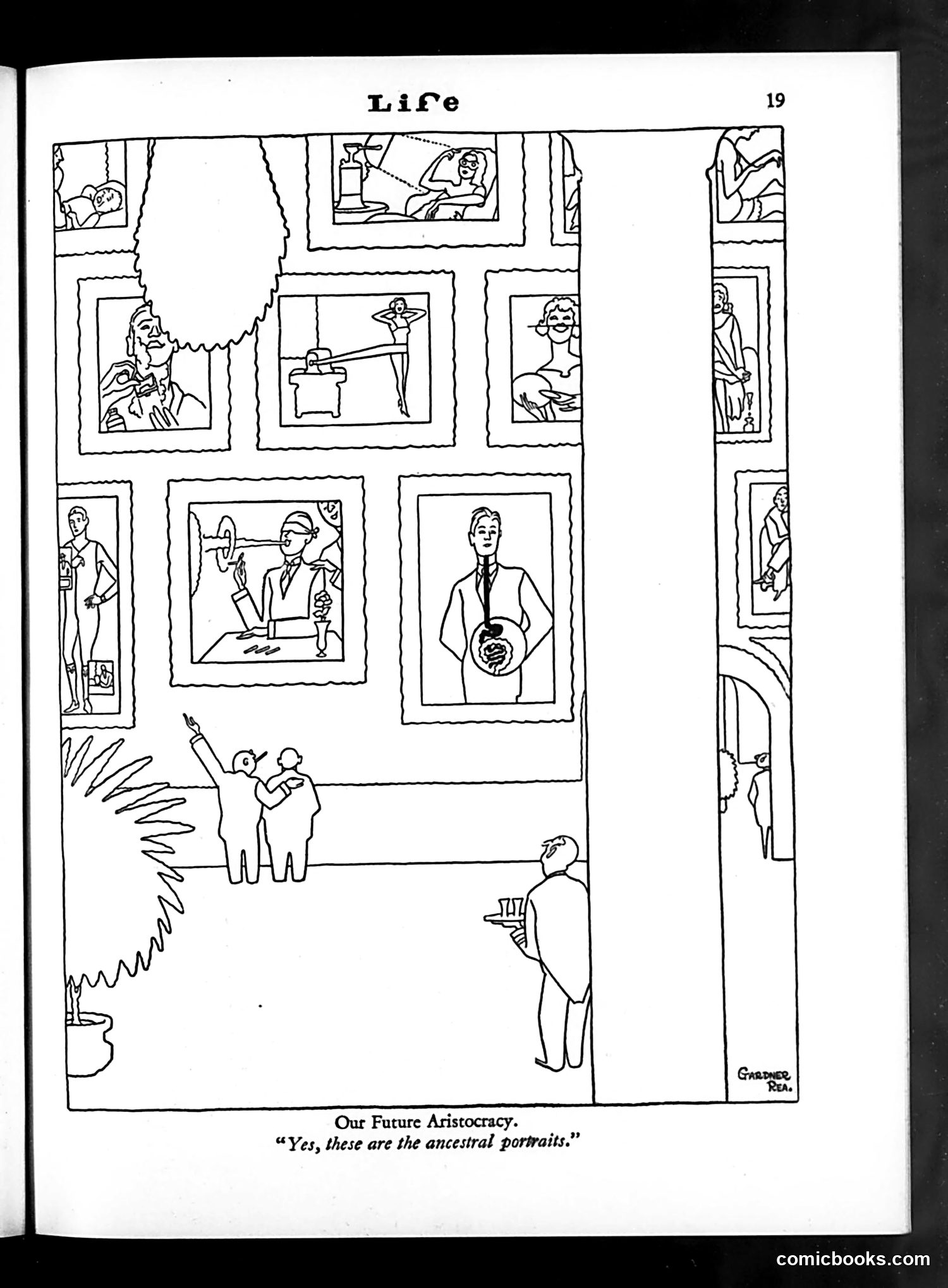
This single-panel cartoon satirizes wealth inequality and the emergence of a new hereditary elite. The caption reads: "Yes, these are the ancestral portraits." The joke shows a wealthy man displaying portraits of various working-class professionals—a doctor, nurse, factory worker, musician, athlete, and others—as if they were his ancestors. This is satirical because these are *not* his actual forebears but rather servants or employees of lower social standing. The cartoon mocks the idea that a future "aristocracy" might consist of wealthy individuals whose power derives not from noble bloodlines but from employing or controlling working people. It critiques emerging class stratification and suggests that capitalism creates a new form of aristocracy based on wealth rather than traditional nobility.
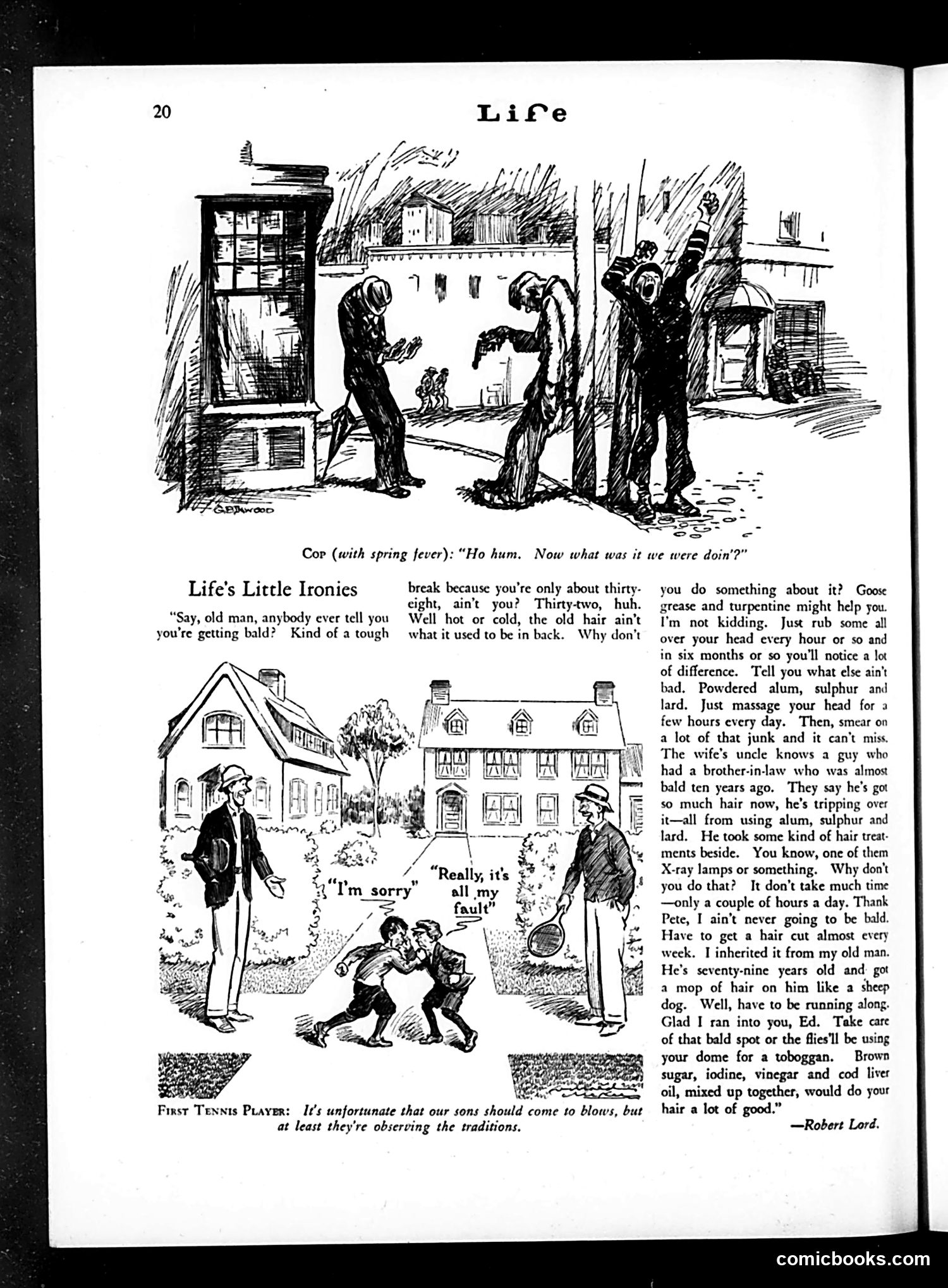
This page contains three satirical pieces mocking early 20th-century social awkwardness and absurdity. **Top cartoon**: A cop with "spring fever" has forgotten what he's supposed to be doing—commentary on seasonal distraction and workplace laziness. **"Life's Little Ironies"**: A rambling monologue by a man dispensing unsolicited, contradictory baldness "cures" (goose grease, turpentine, alum, sulphur, lard, X-ray lamps, brown sugar, iodine, vinegar, cod liver oil) to an uncomfortable bald man. The satire ridicules both quack remedies and the social rudeness of commenting on someone's appearance—the speaker boasts about his own hair inheritance while offering dubious folk treatments. **"First Tennis Player"**: Two boys fighting while their father observes approvingly, saying it's "unfortunate" but at least they're "observing the traditions." This mocks parental attitudes that view violent masculine competition as character-building tradition worth preserving despite the harm. All three pieces target social pretension and illogical behavior with dry humor typical of early Life magazine satire.
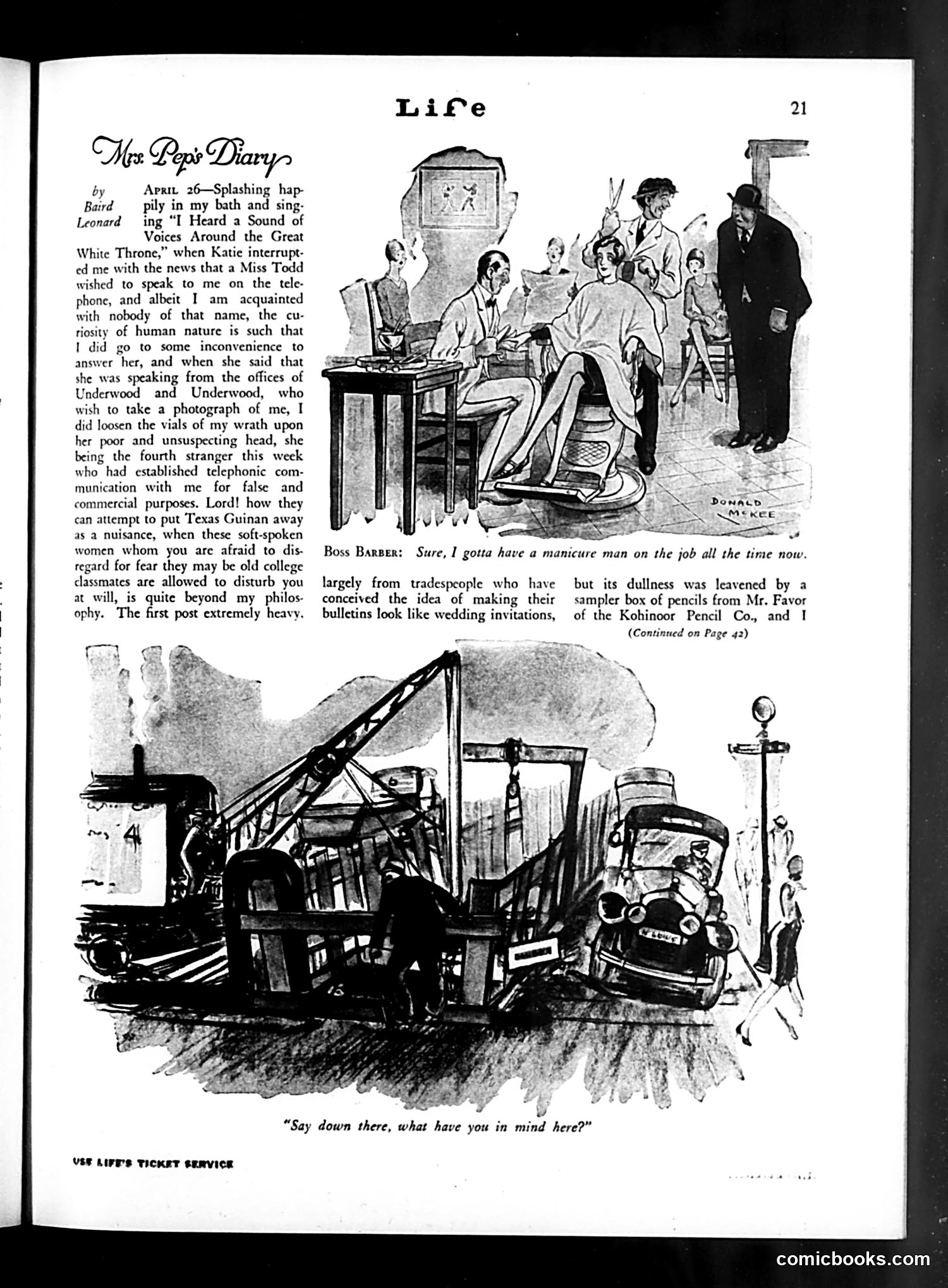
This page contains two satirical cartoons by Baird Leonard reflecting early-20th-century urban annoyances. **Top cartoon**: A boss discusses hiring a "manicure man" with a barber, referencing the emerging service economy and personal grooming culture of the 1920s. **Bottom cartoon**: Shows construction workers or laborers, with the caption "Say down there, what have you in mind here?"—likely satirizing miscommunication or confusion on work sites. **The diary text** complains about unsolicited phone calls from photographers (Underwood and Underwood) and commercial solicitors interrupting daily life. The author humorously contrasts this annoyance with references to Texas Guinan (a famous speakeasy hostess of the Prohibition era) and receives pencil samples in the mail. The satire targets how aggressive commercial marketing and telemarketing were becoming intrusive nuisances in modern American life—a surprisingly contemporary complaint for 1920s readers.
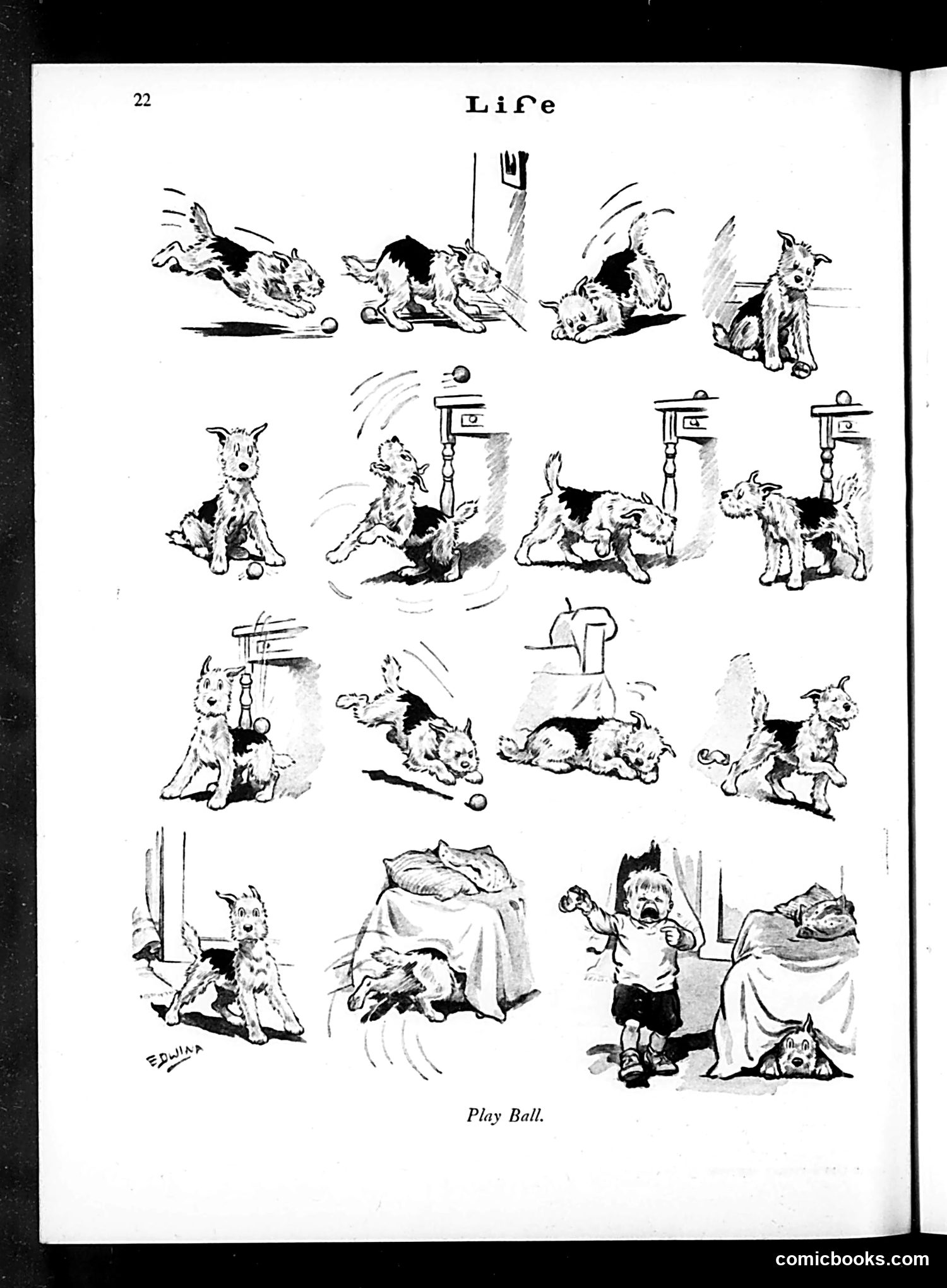
This page from *Life* magazine presents a series of humorous sketches titled "Play Ball," depicting dogs engaged in various activities with a ball. The illustrations show dogs in different scenarios: chasing, catching, fetching, playing with children, and interacting around household objects like chairs and baskets. The cartoon appears to be a simple, observational humor piece about dogs' universal love of ball play—a relatable domestic subject requiring no specific political or social commentary. The sketches showcase different dog breeds and temperaments, with the artist (signed "DULAC") capturing the enthusiasm and chaos typical of dogs pursuing balls. This is straightforward comic entertainment rather than satirical commentary, using anthropomorphic animal behavior for gentle amusement.
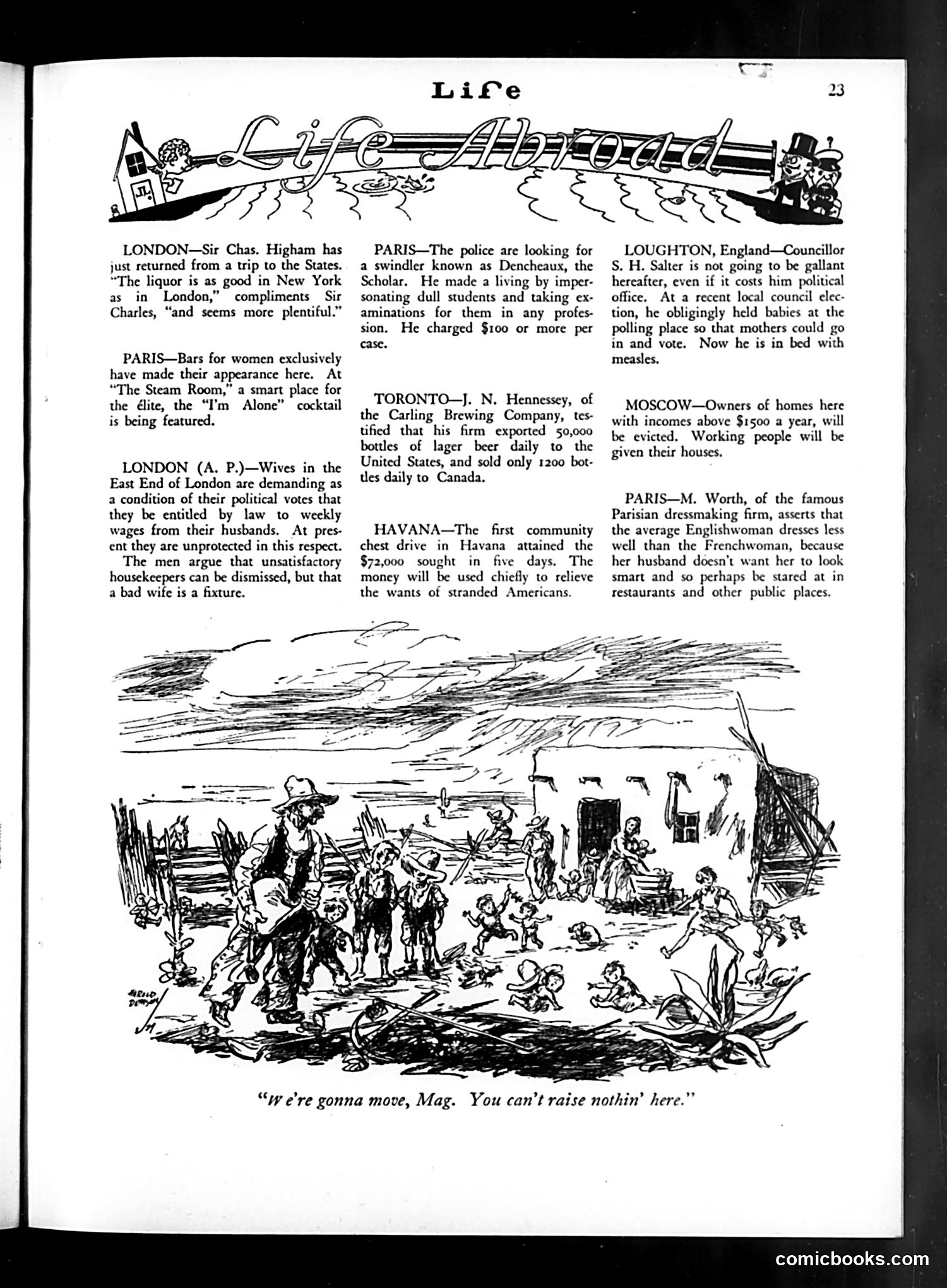
This page from *Life* magazine contains international news briefs and a cartoon satirizing rural poverty during what appears to be the Prohibition era (references to liquor exports, "I'm Alone" cocktail). The main cartoon depicts a destitute farming family preparing to relocate, with the caption "we're gonna move, Mag. You can't raise nothin' here." The sketch shows impoverished conditions—sparse land, ramshackle shelter, barefoot children—illustrating Depression-era agricultural failure and forced migration. The surrounding "Life Abroad" briefs offer satirical contrasts: wealthy London socialites enjoying plentiful liquor, Parisians patronizing exclusive women's bars, while simultaneously reporting economic hardship (Moscow evictions, stranded Americans in Havana needing relief). The juxtaposition critiques global inequality and the disconnect between cosmopolitan leisure and widespread destitution—the cartoon's central theme of rural American displacement.
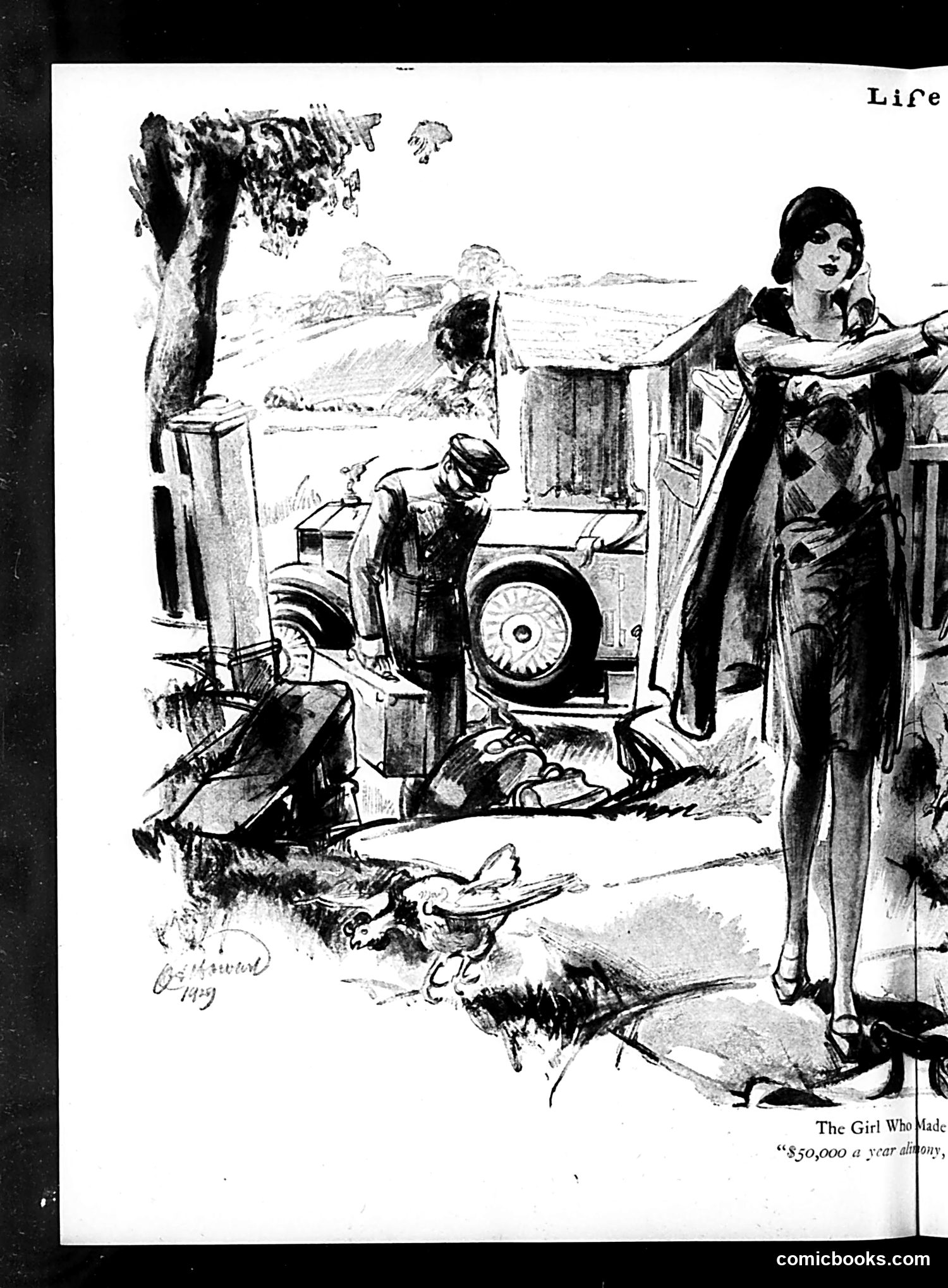
This appears to be a satirical illustration from *Life* magazine titled "The Girl Who Made '$50,000 a year' anyway" (text visible at bottom right). The cartoon depicts a wealthy woman in fashionable 1920s dress standing beside a broken-down automobile, with what appears to be a male chauffeur or mechanic examining the vehicle. The rural setting and damaged car suggest this is commentary on female earning power or independence during the Jazz Age. The incomplete caption suggests the humor involves irony about how this woman achieved her substantial income—likely mocking either inherited wealth, marriage, or some other non-traditional female income source, rather than through genuine professional work. The automobile breakdown may symbolize the fragility or questionable legitimacy of her financial status. The exact satirical target remains unclear without the complete caption.
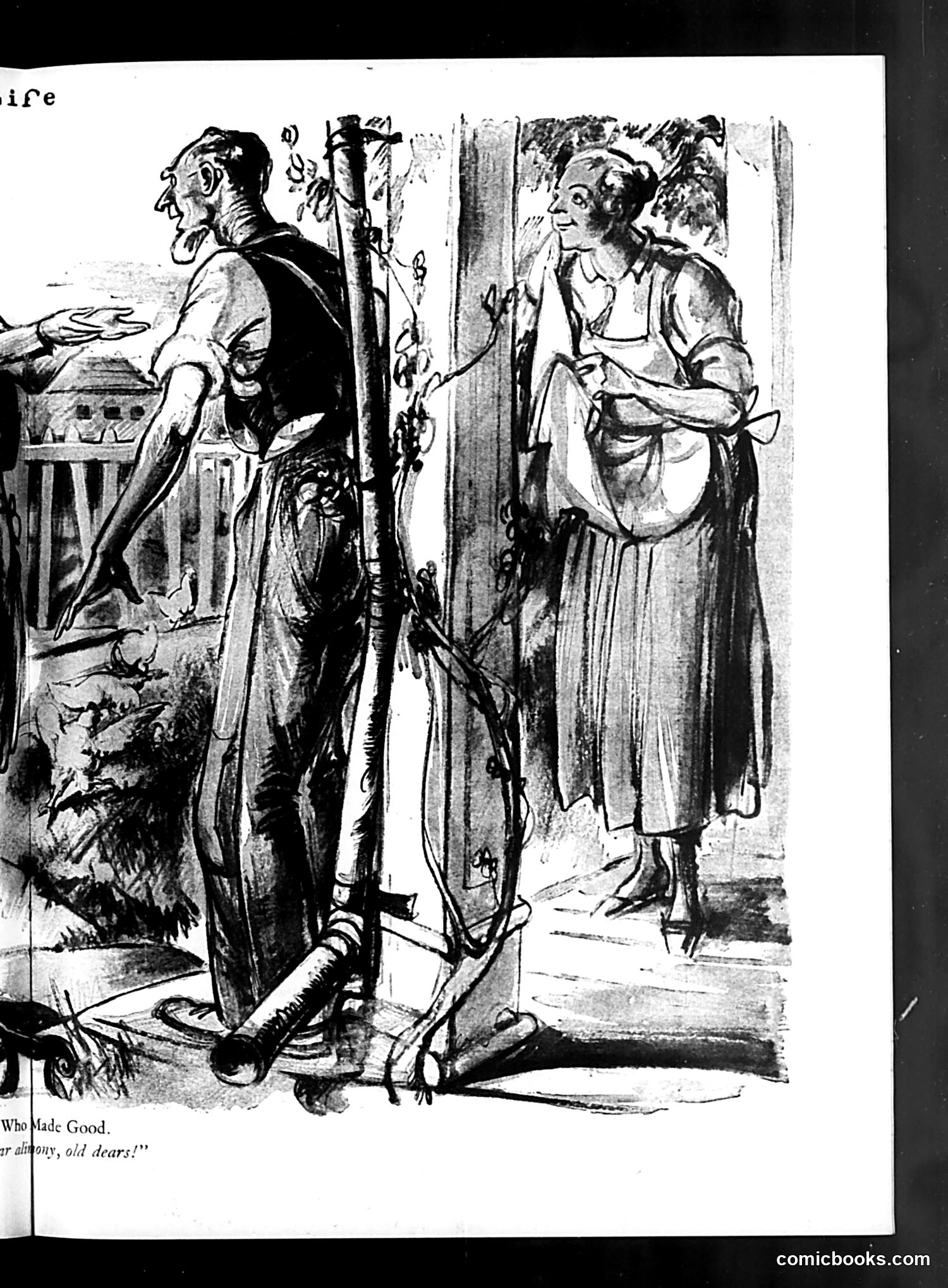
This appears to be a satirical cartoon from *Life* magazine depicting two figures in what looks like a domestic or servant scenario. On the left is a man with exaggerated features holding a long pole or staff, facing a woman on the right who appears to be a servant or housekeeper. The caption reads "Who Made Good," suggesting social commentary on class mobility or success. The specific identities of the figures are unclear from the image alone, though the caricatured style and domestic setting suggest this may reference contemporary public figures or social types. Without additional context about the publication date or accompanying articles, the precise satirical target remains uncertain, though the cartoon appears to critique class relations or social advancement of the era.
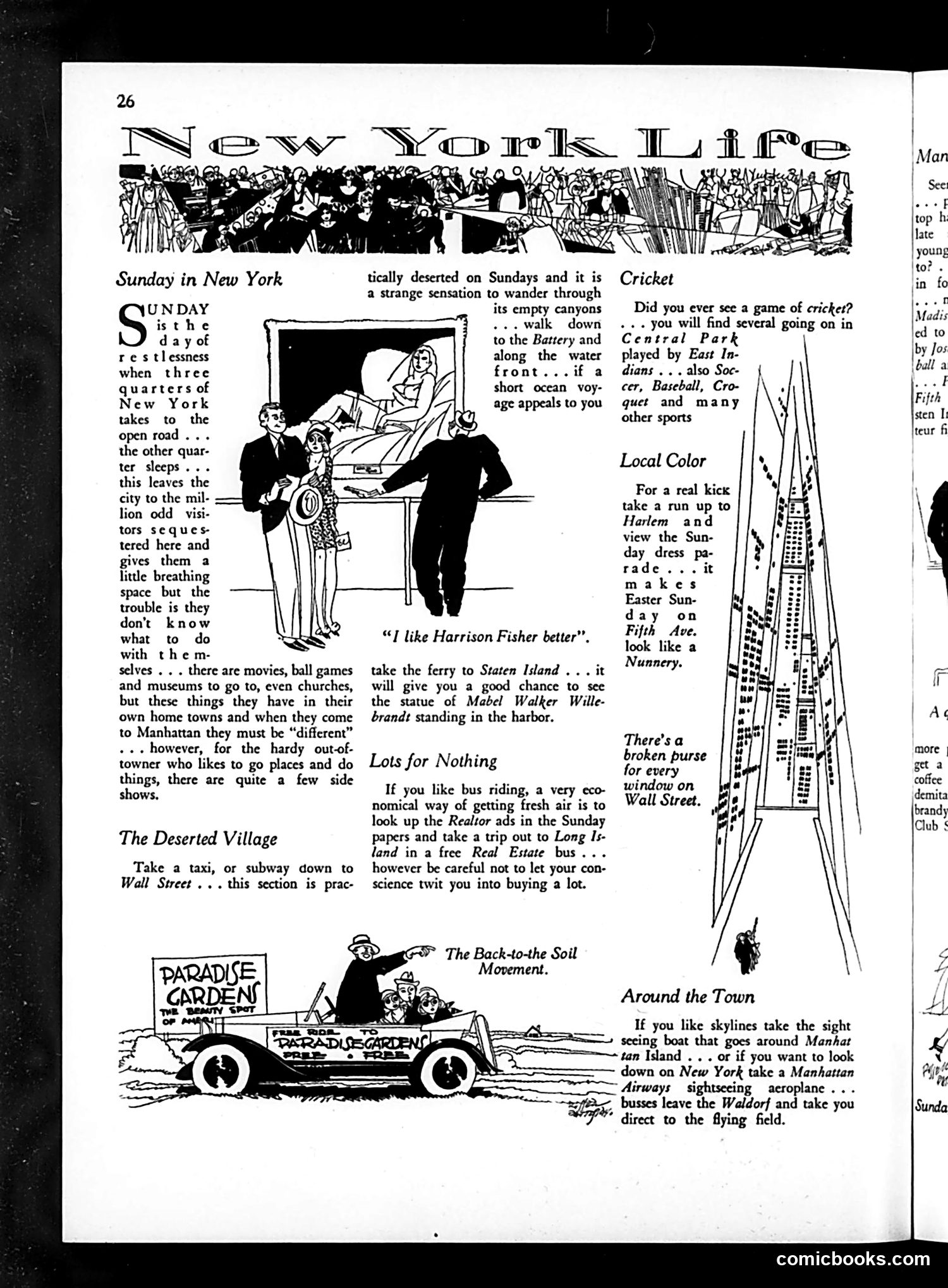
This page satirizes the restlessness and indecision of tourists and out-of-towners visiting New York City on Sundays. The humor targets the contradiction that visitors feel compelled to do something "different" than their hometowns offer, yet struggle to find worthwhile activities. The satire includes barbed jabs at specific destinations: Wall Street as a "deserted village," a joke about seeing Mabel Walker Willebrandt's statue in the harbor (unclear reference, likely a political figure), and a dismissive comment about real-estate buses encouraging impulse lot purchases. The "Local Color" section mocks Harlem's Sunday dress parade as superior to Fifth Avenue's Easter display—likely expressing the magazine's mid-1920s cultural attitudes. The cartoon illustration of "Paradise Garden" promotes back-to-soil movement ideology, a period concern about industrialization. Overall, the page gently ridicules tourist confusion while offering tongue-in-cheek suggestions for spending Sundays in Manhattan.
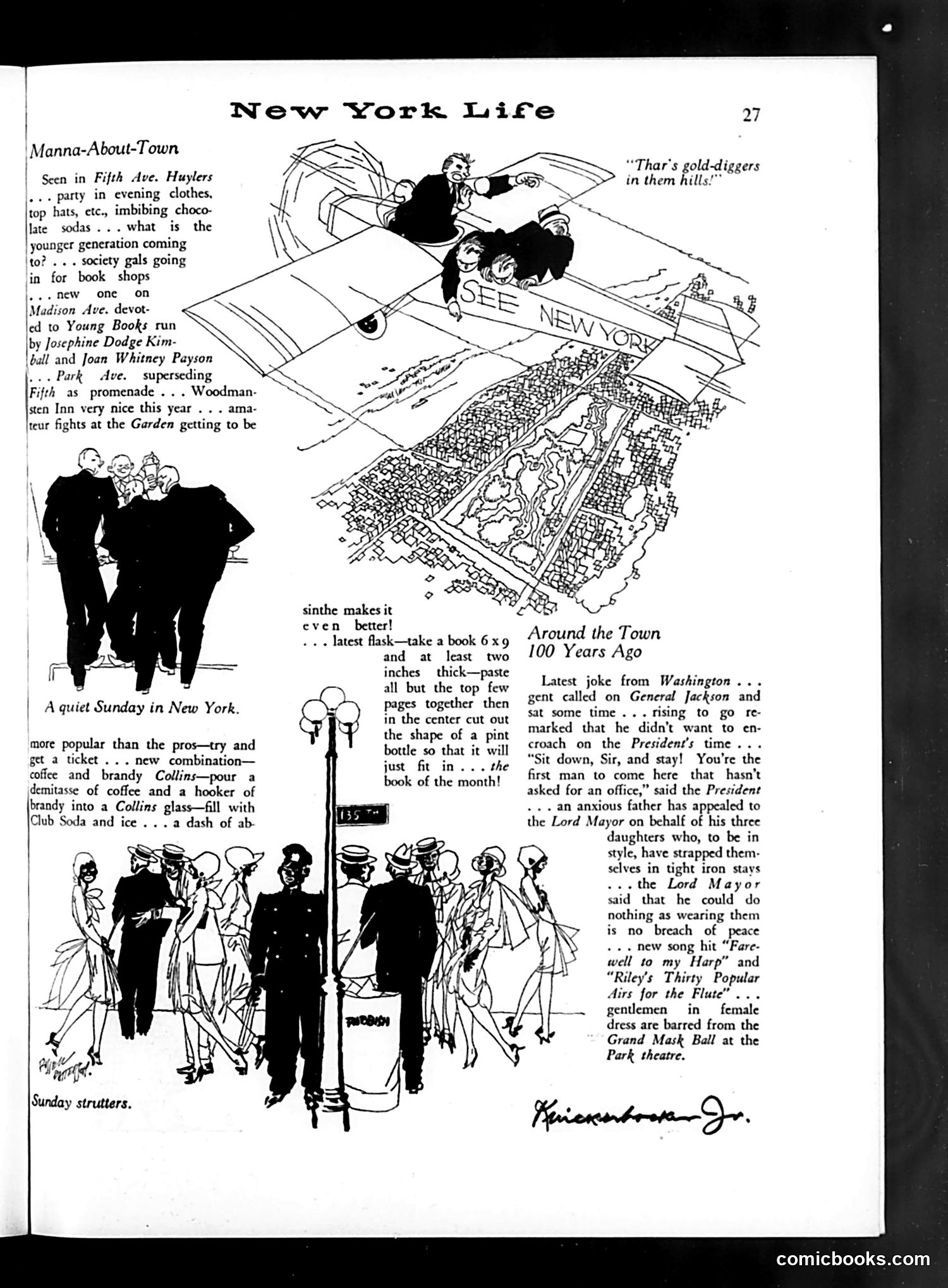
This page satirizes 1920s high-society trends and youth culture. The "Manna-About-Town" column mocks wealthy New Yorkers: young socialites drinking chocolate sodas in evening wear, society women opening bookshops, and the fashionable migration from Fifth Avenue to Park Avenue as the elite's preferred promenade. The most cutting joke describes a hidden flask disguised as a thick book—a direct reference to Prohibition-era bootlegging. By hollowing out a book to conceal alcohol, wealthy New Yorkers openly flouted the law while maintaining respectability. The cartoon "A quiet Sunday in New York" depicts well-dressed couples strolling—contrasting sharply with "Sunday strutters" below, showing different social classes on display. The "100 Years Ago" section provides historical humor by contrasting past manners (General Jackson's surprise at meeting someone who didn't seek office) with present concerns (tight corsets, female-dressed gentlemen at balls). The page captures Jazz Age social anxieties: generational rebellion, Prohibition hypocrisy, and shifting class markers.
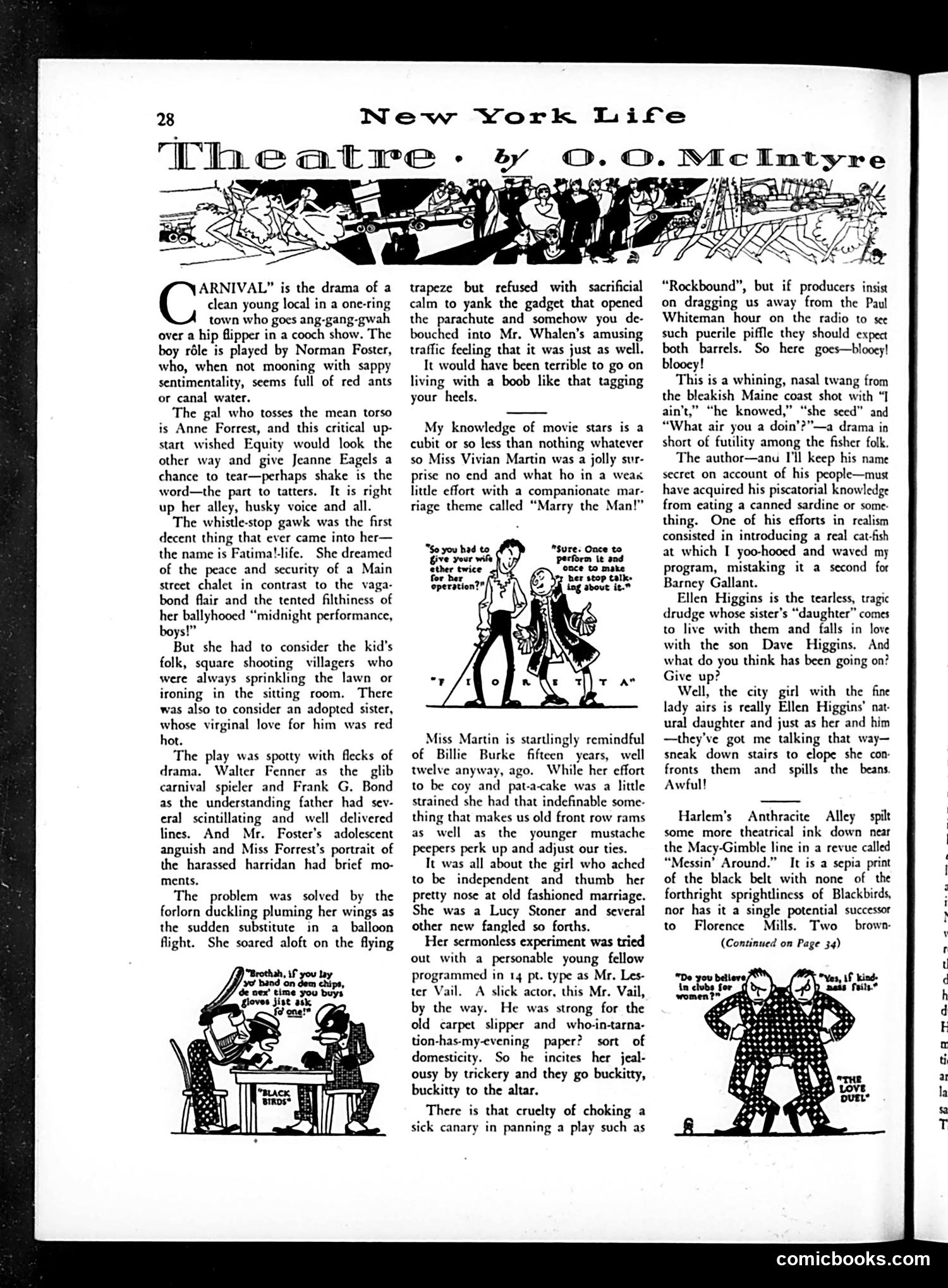
This is a theatre criticism column by O.O. McIntyre reviewing three stage productions. The cartoons and illustrations are largely decorative, depicting generic theatrical scenes rather than specific political commentary. **Content summary:** McIntyre reviews "Carnival" (starring Norman Foster and Anne Forrest), criticizing it as melodramatic drivel about a carnival dancer. He praises supporting actors but finds the plot absurd—particularly the climactic balloon scene. "Marry the Man!" starring Vivian Martin receives mixed praise: Martin reminds him of a younger Billie Burke, and the plot about a "Lucy Stoner" (reference to Lucy Stone, women's independence advocate) who rejects traditional marriage amuses him, though he finds it ultimately silly. "Rockbound" gets harsh dismissal as Maine-dialect melodrama so bad the author supposedly used a real catfish as a prop, which McIntyre mistook for part of the set. The column is satirical theatre criticism using exaggerated language ("bloocy! blooey!") typical of 1920s entertainment journalism—mocking contemporary theatre's pretensions rather than addressing politics.
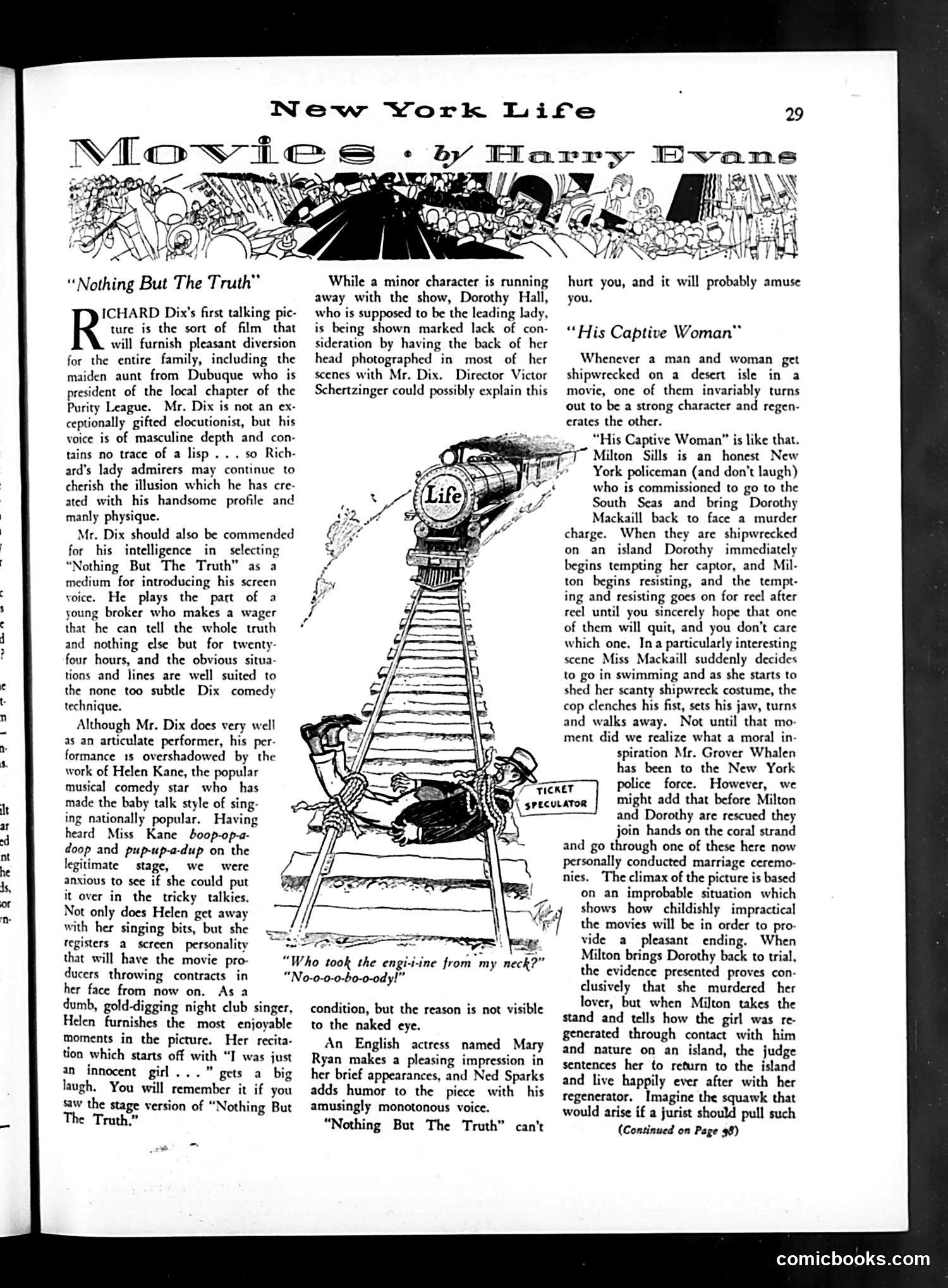
This page reviews two early talking pictures from around 1929-1930. The main illustration shows a train, referencing a plot point or comedic scene. **"Nothing But The Truth"** stars Richard Dix in his talkie debut. The reviewer praises his deep, masculine voice while gently mocking his acting as "none too subtle." Helen Kane—famous for her "baby talk" singing style ("boop-oop-a-doop")—nearly steals the film playing a "dumb, gold-digging night club singer," a stock character type. The reviewer jokes that leading lady Dorothy Hall barely appears on screen except from behind, suggesting directorial neglect. **"His Captive Woman"** follows a familiar movie formula: shipwrecked couple on a desert island where one "regenerates" the other morally. The humor references NYC Police Commissioner Grover Whalen's reputation for moral rectitude—even a fictional cop resisting temptation supposedly owes this to Whalen's influence. The review gently mocks the predictable plot while acknowledging the film provides harmless entertainment. Both reviews reflect 1920s attitudes toward romance, morality, and cinema conventions that modern audiences would find quaint or stereotypical.
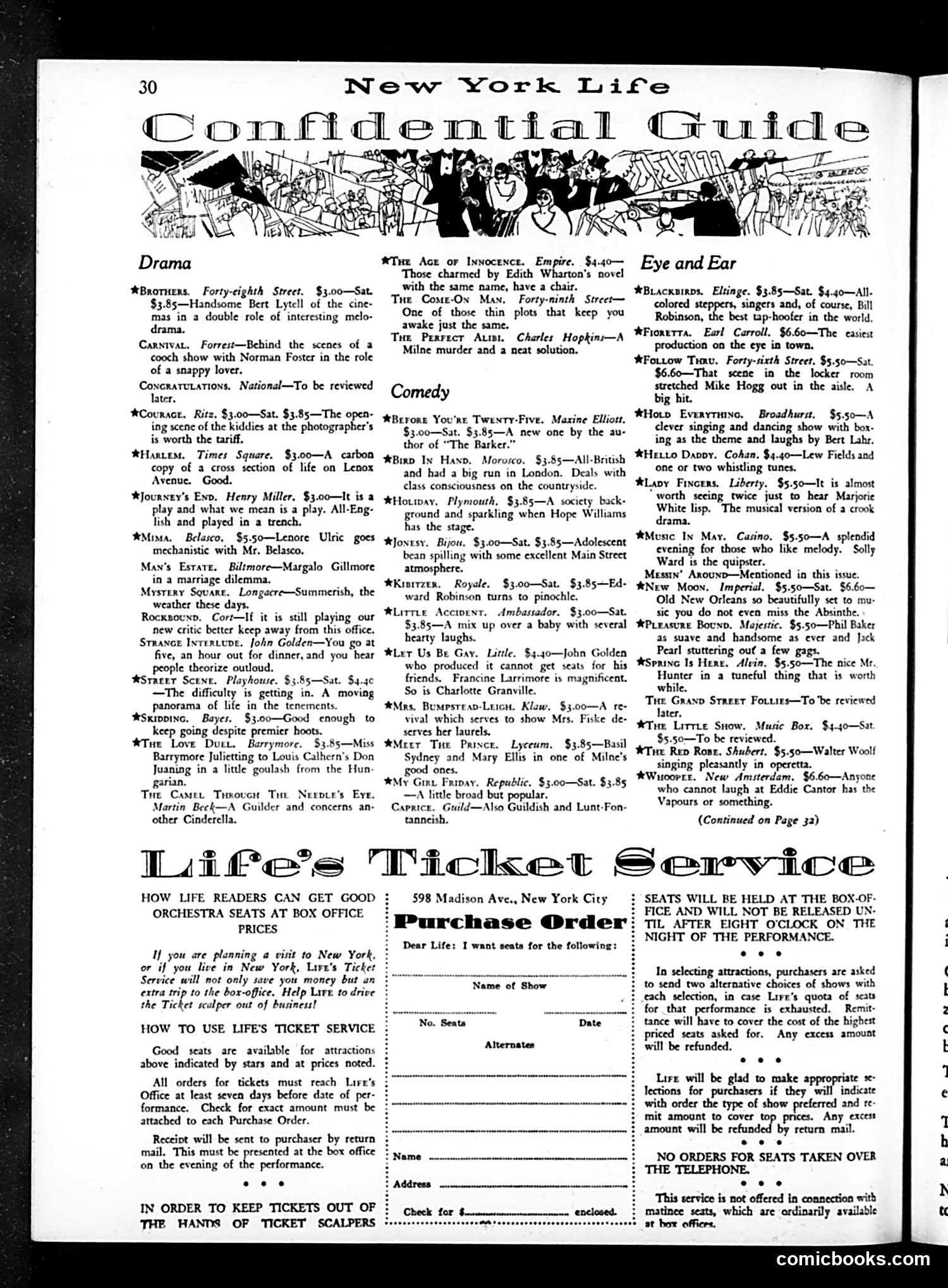
This page is primarily **theater listings and advertising**, not political satire. It's from *Life* magazine's "Confidential Guide" section reviewing Broadway shows circa the 1920s. The content consists of: 1. **Drama and Comedy reviews** — Brief critical notices of plays at various theaters (Brothers, Harlem, Journey's End, etc.), with ticket prices and cast members noted. Reviews are tersely sarcastic ("It is a play and what we mean is a play"). 2. **"Eye and Ear" section** — Reviews of musical revues and variety shows, including performances by Bill Robinson and Lew Fields. 3. **Life's Ticket Service advertisement** — Information on how readers could purchase theater seats through the magazine. The humor is mild and contemporary — poking fun at thin plots, dated material, and audience reactions rather than addressing political issues. This reflects *Life*'s primary function as entertainment and lifestyle commentary for New York's theater-going public.
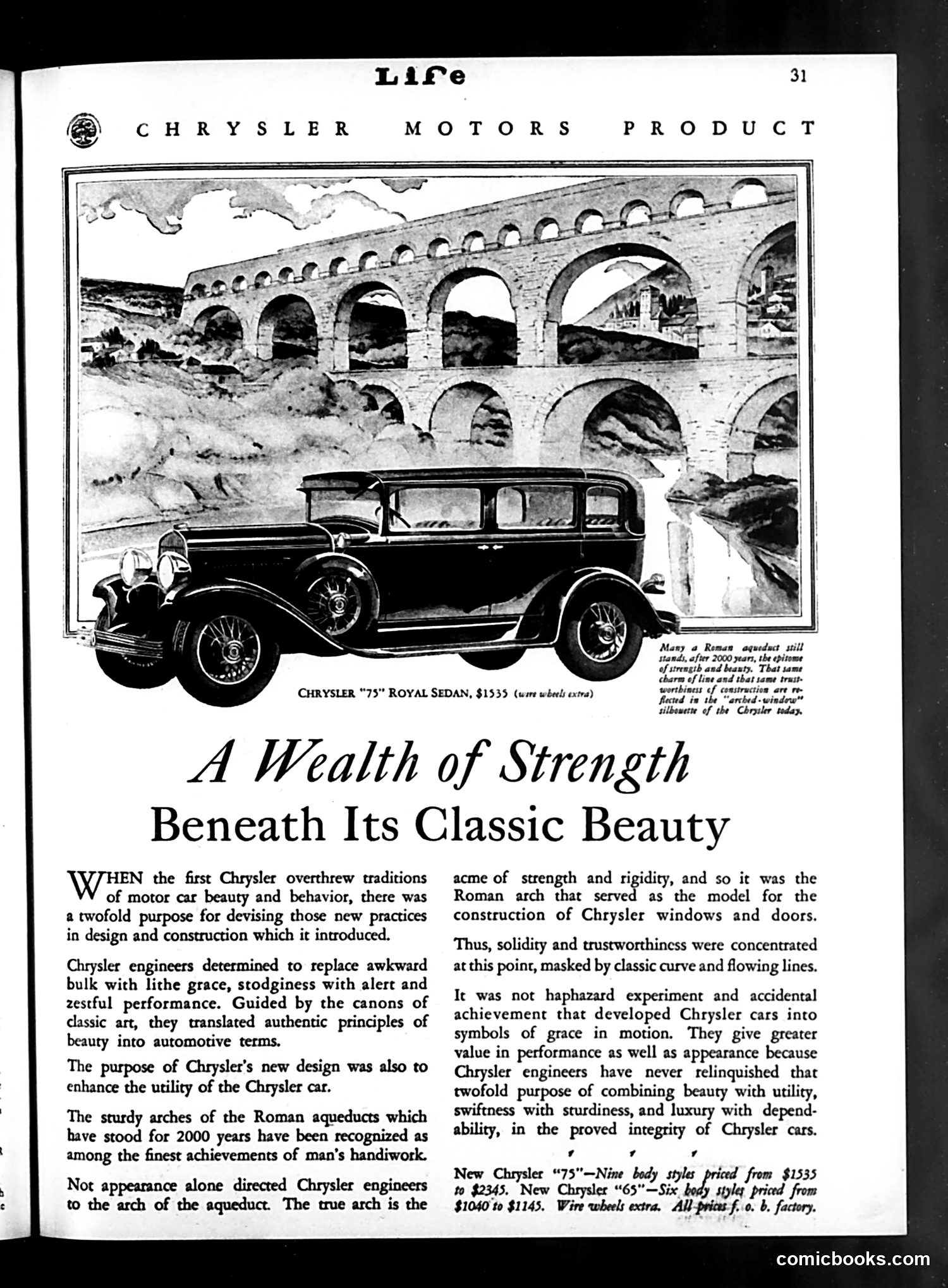
This is **not a cartoon or satire**, but a **Chrysler automobile advertisement** from Life magazine (page 31). The ad compares the Chrysler "75" Royal Sedan ($1535) to Roman aqueducts, arguing that both combine beauty with structural integrity. The image shows a 1920s-era sedan positioned before a photograph of an ancient Roman arch bridge, establishing a visual metaphor. The advertising copy claims Chrysler engineers deliberately modeled the car's window arches on Roman engineering principles—prioritizing both aesthetic "grace" and functional "strength and rigidity." The ad emphasizes that this wasn't accidental but intentional design philosophy: combining "beauty with utility, swiftness with sturdiness." For modern readers: this represents early automotive marketing that justified premium pricing ($1535 was substantial in the 1920s) by associating cars with timeless classical architecture and human achievement. It's corporate branding through cultural aspiration rather than product specification.
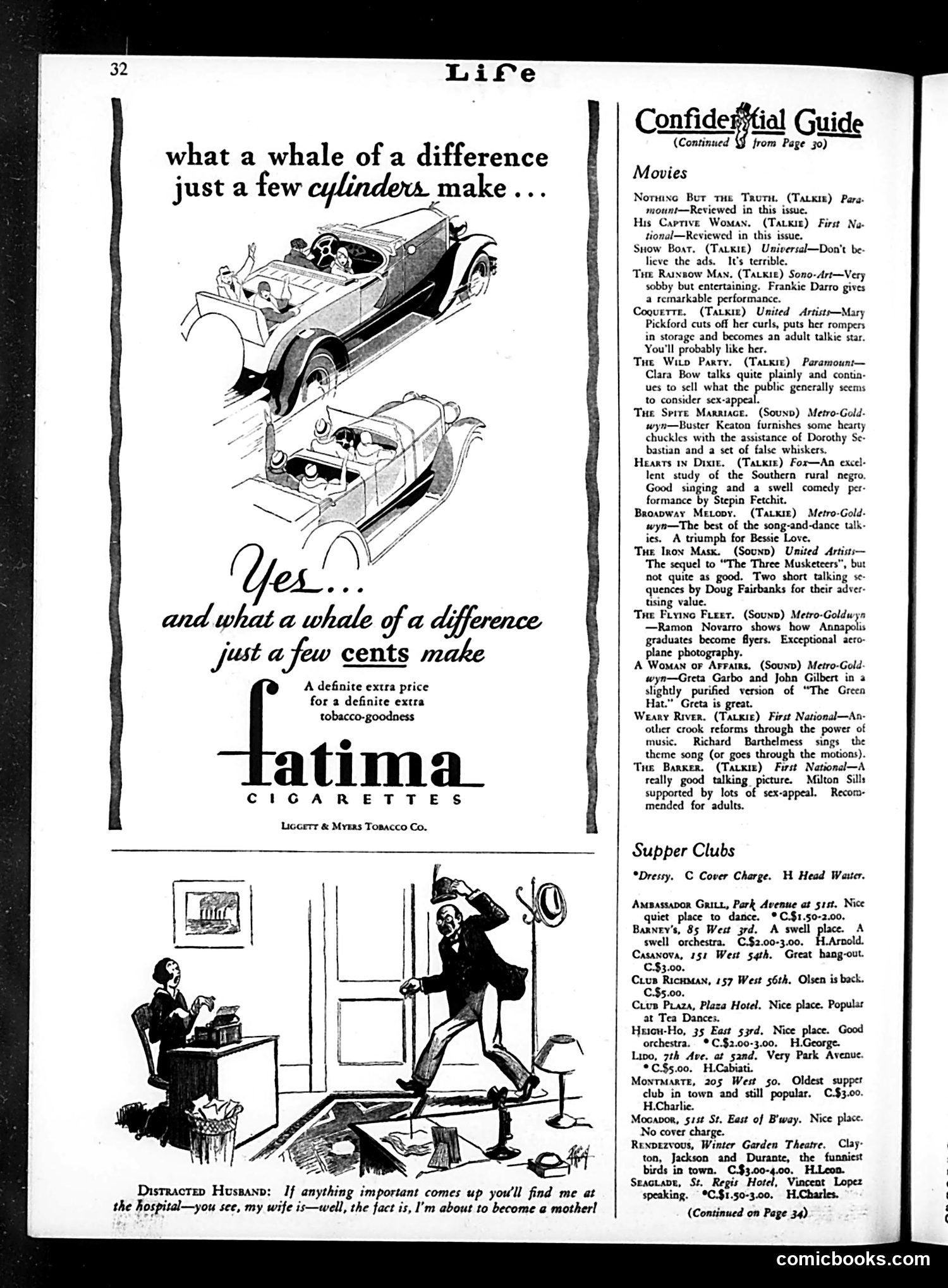
This page is dominated by a **cigarette advertisement** for Latima brand, not political satire. The ad uses a visual pun comparing two cars: a larger multi-cylinder vehicle versus a smaller one. The joke: just as a few extra cylinders dramatically improve a car's performance, a few extra cents buys superior tobacco quality in Latima cigarettes. Below the ad is a separate cartoon captioned "Distracted Husband," depicting a man told his wife is at the hospital becoming a mother—a domestic humor gag about his absent-mindedness during this momentous occasion. The right column contains entertainment reviews (mostly talking pictures and supper clubs), typical Life magazine content from the late 1920s era when sound film was novel.
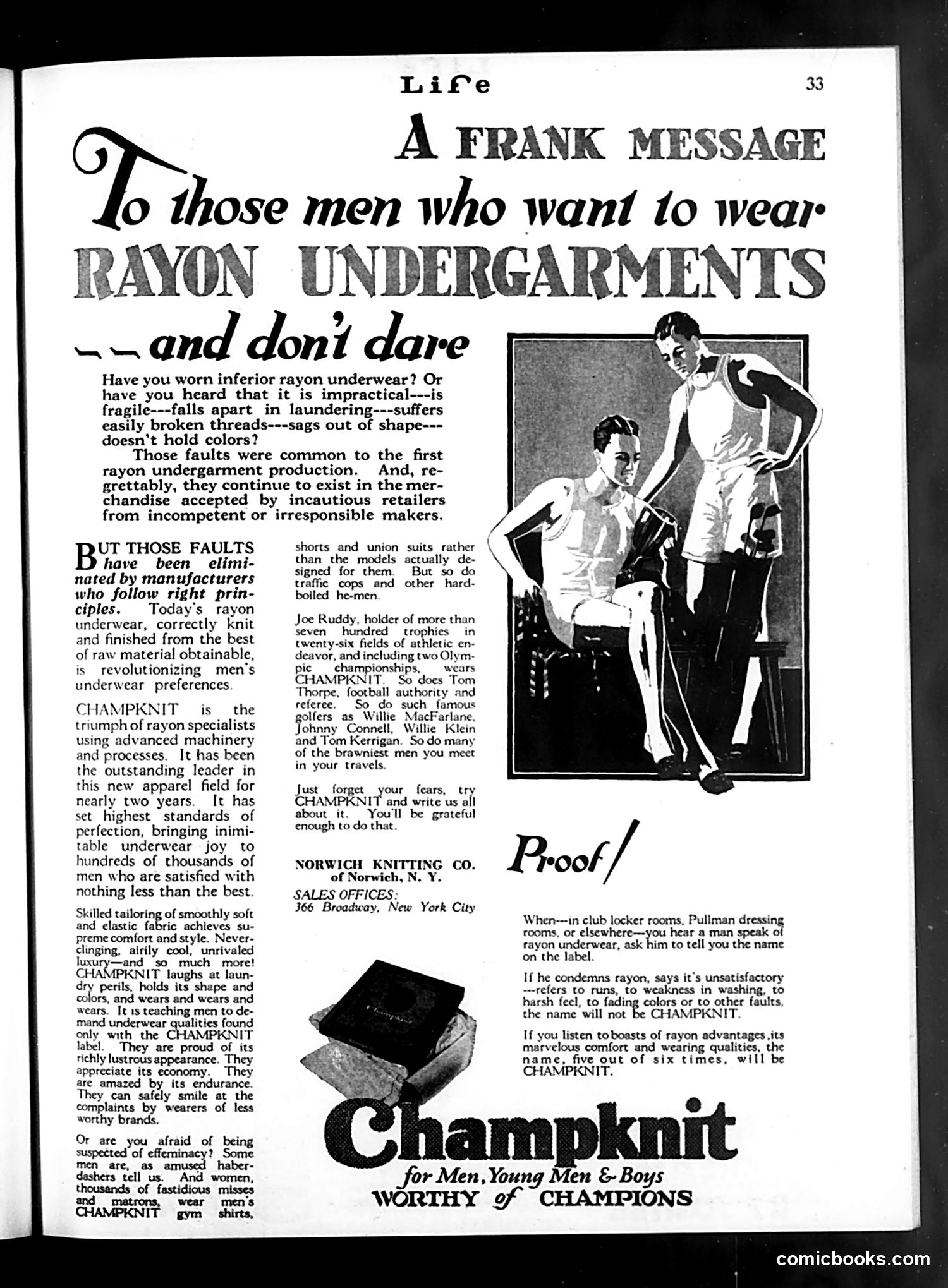
This is primarily an advertisement for Championit brand rayon undergarments, not a political cartoon. The page features "A Frank Message" promoting rayon underwear to men. The advertisement includes photographs of athletes and claims that famous men—including Joe Ruddy (described as a trophy holder in twenty-six athletic fields), Tom Thorpe (football authority), Willie MacFarlane (golfer), Johnny Connell, Willie Klein, and Tom Kerrigan—wear Championit brand underwear. The ad's humor derives from its earnest, almost defensive tone, addressing common concerns about rayon undergarments (fraying, color fading, loss of shape) while name-dropping celebrities as endorsement. The "Proof!" section encourages readers to ask men about their underwear brands, suggesting this was an emerging consumer market where rayon was still novel and required consumer reassurance.
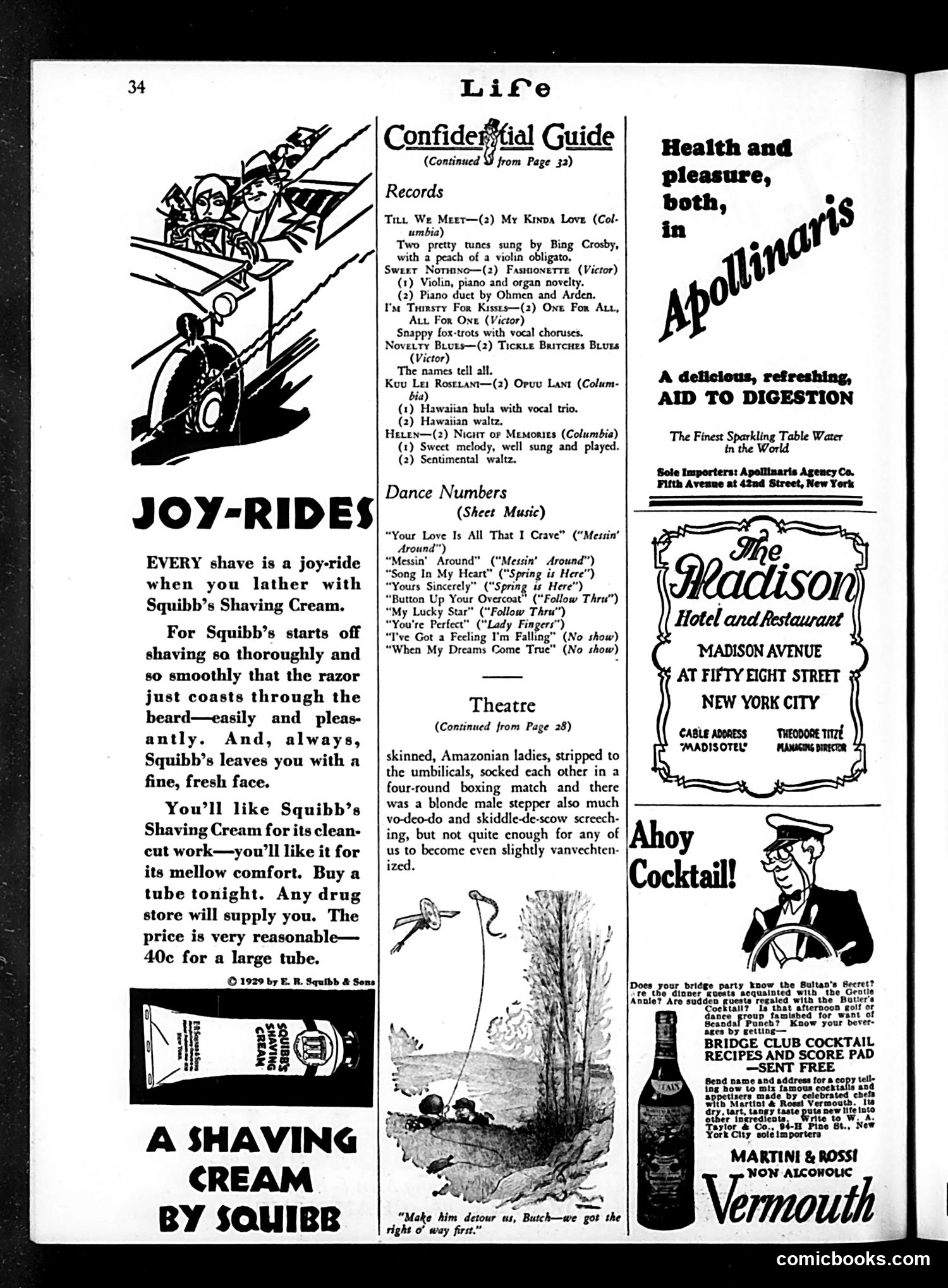
This page is primarily **advertising**, not satirical content. The dominant feature is a Squibb Shaving Cream advertisement using the "joy-ride" metaphor—comparing a smooth shave to an exciting automobile ride, a timely comparison in the car-obsessed 1920s. The ad promises effortless shaving and a "fresh face." The cartoon illustration shows a car full of gleeful passengers, visualizing the advertiser's claim that shaving with Squibb is thrilling and pleasurable. The page also contains what appears to be entertainment listings (records, dance numbers, theater reviews) and additional product advertisements for Apollinaris sparkling water, The Madison Hotel, Bridge Club cocktails, and Martini & Rossi vermouth—typical of Life's mixed advertising and content model during this period. There is no apparent political satire on this page.
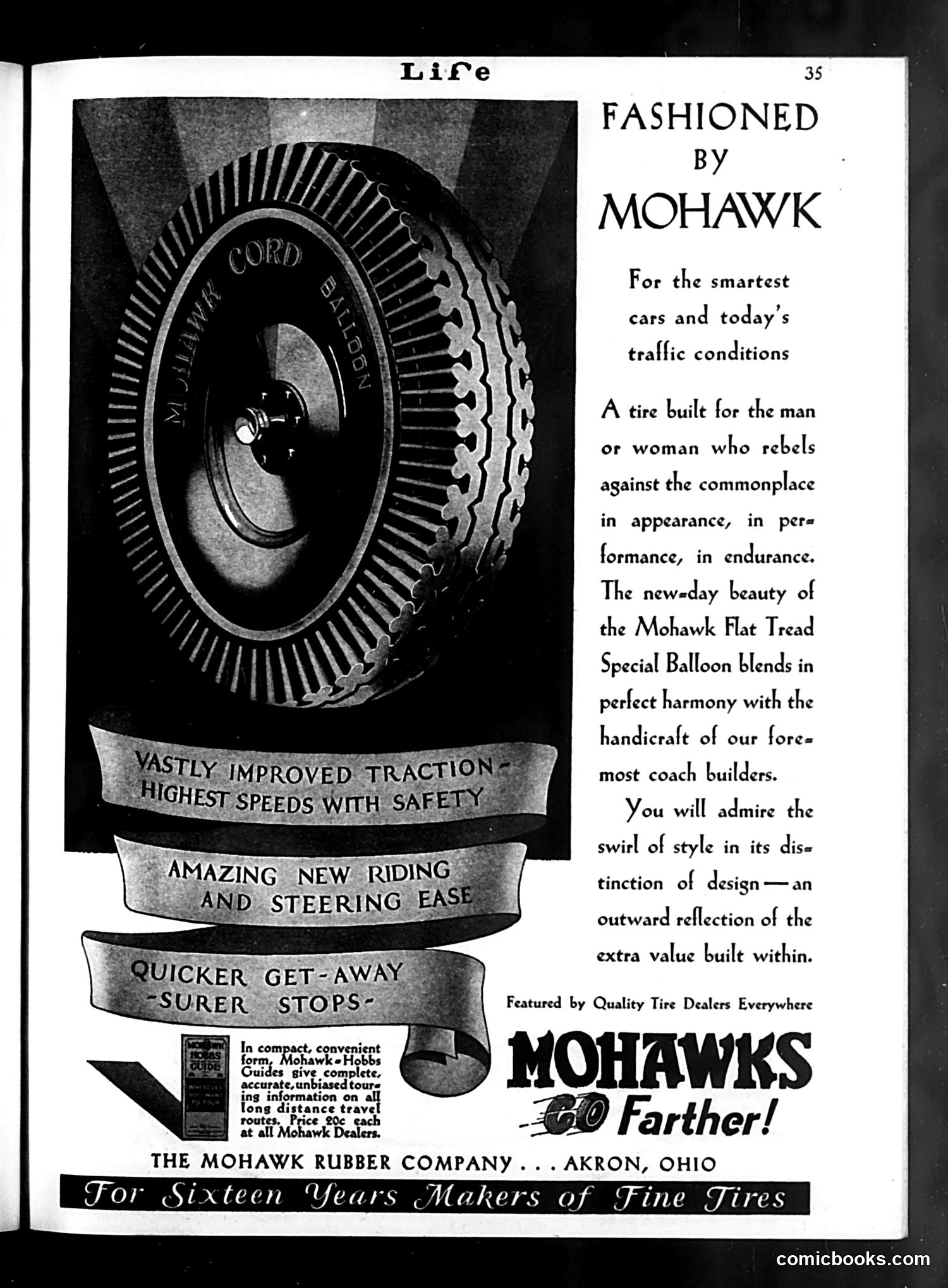
This is **not a cartoon or satire**—it's a **straight advertisement** for Mohawk tires, placed in Life magazine (page 35). The ad promotes the "Mohawk Flat Tread Special Balloon" tire, marketing it to upscale consumers who want distinction and performance. The language targets a specific demographic: those who "rebel against the commonplace" in style and quality. The large tire photograph dominates, emphasizing design features like improved traction and steering ease. Notable details: The ad mentions "coach builders," suggesting luxury automobiles of the era (1920s-30s), and references Mohawk's travel guides as a promotional tool. The tagline "Go Farther!" is the company's slogan. This reflects period advertising's emphasis on conspicuous consumption and lifestyle branding rather than technical specifications alone.
This is a subscription promotion for *Life* magazine, not political satire. The cartoon depicts a cheerful character fishing, with a life preserver as the central image—a visual pun on the magazine's title. The "cute little coupon" offers relief from common frustrations: missing issues, disappointing newsstand trips, and general sadness ("from the blues"). The coupon itself shows someone mailing payment to subscribe for 10 weeks. The message is straightforward marketing: subscribing to *Life* solves the problem of unreliable newsstand availability and ensures regular delivery. The design credits Philip S. Singer of the Stanley E. Gunnison Company, suggesting this is professional advertising copy from the early-to-mid 20th century.
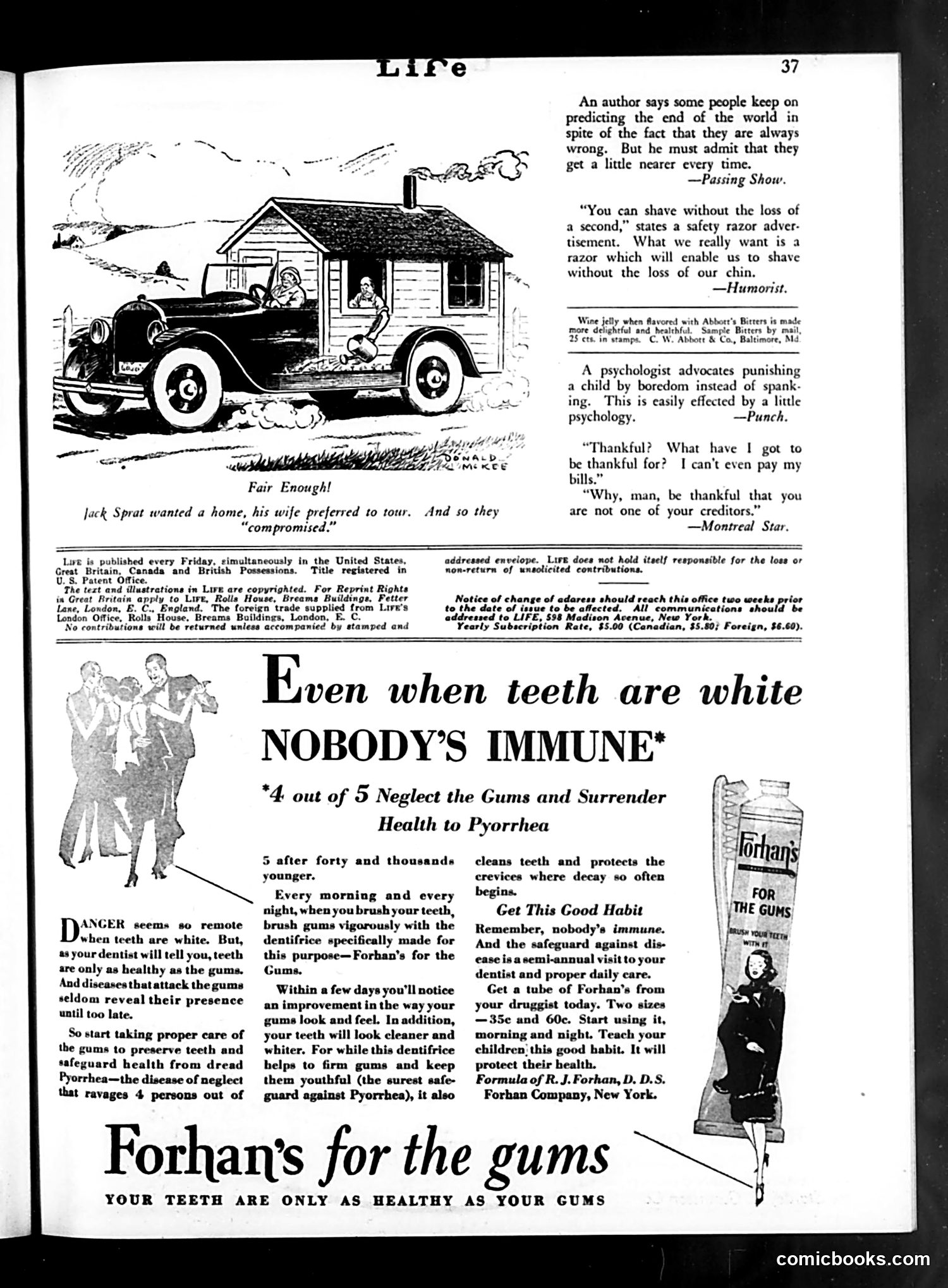
This page combines satirical humor pieces with a dental health advertisement. The main cartoon depicts "Jack Sprat" and his wife—referencing the nursery rhyme about a couple with opposite preferences—who "compromised" on housing by combining a car and cottage. The joke satirizes marital compromise: rather than one spouse getting a home or the other getting travel, they created an impractical hybrid vehicle-house. The surrounding text consists of witty one-liners from various publications (Punch, Montreal Star, Humorist), typical of Life's format of reprinting humorous observations about everyday frustrations—world-end predictions, shaving accidents, child psychology. The lower half features a Forhan's toothpaste advertisement warning that four of five people neglect gum health, risking pyorrhea (a gum disease). The ad emphasizes that white teeth hide unhealthy gums—a public health message common in early-20th-century advertising.
This page contains film reviews and advertisements, not political cartoons. The main content discusses two talking pictures ("talkies"): **"His Captive Woman"** — criticized as melodramatic, featuring a murder trial told primarily through narrative voice-over. The reviewer notes the film wastes actor Sills's talent by not fully utilizing his voice acting. **"The Trial of Mary Dugan"** — praised for its frank dialogue about adult topics (euphemistically called "the facts of life"), which contemporary reviewers felt warranted adult-only attendance. The review notes the film adaptation simplified the original play's structure, where the audience served as the jury; the film removes this innovative device. Norma Shearer leads, supported by H.B. Warner and others. The page also advertises French tourist destinations and the Elysée Hotel in New York. There is no political satire or cartooning on this page—it is a standard entertainment/travel section.
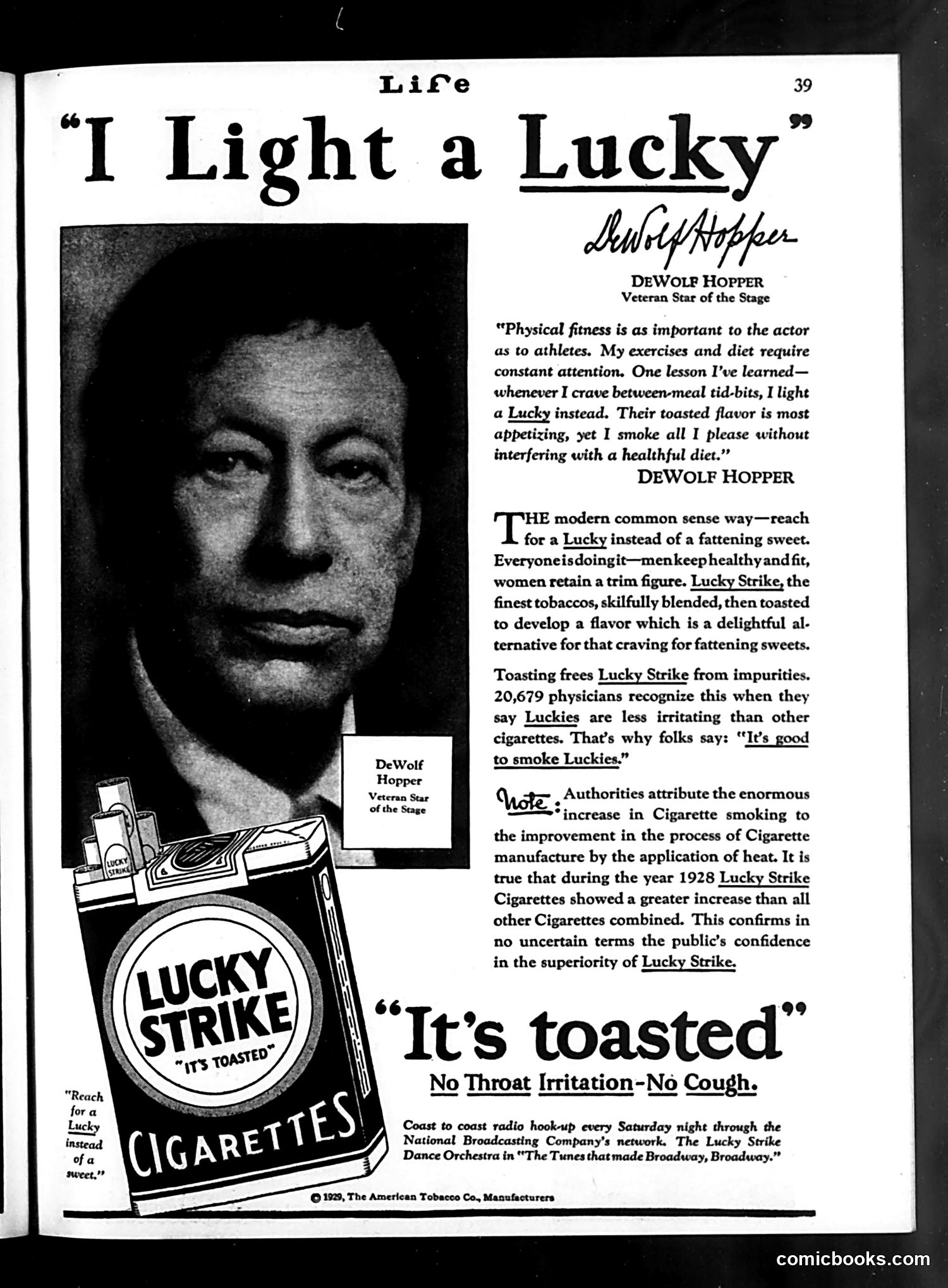
This is a **cigarette advertisement**, not satire—it's a genuine 1929 Lucky Strike ad featuring actor DeWolf Hopper. The page promotes cigarettes as a **diet aid**. The pitch: smoke Lucky Strikes instead of eating sweets to stay fit and trim. This reflects 1920s-30s marketing that positioned smoking as healthful and appetite-suppressing. Key claims made: - Toasting removes impurities; "20,679 physicians" endorse them as less irritating - No throat irritation or cough - A healthy alternative to fattening snacks - The brand showed explosive sales growth in 1928 **Why it's shocking today**: This represents pre-regulation tobacco advertising that made explicit health and diet claims. Modern readers will recognize these as objectively false health claims that would be illegal under current FDA rules. The page exemplifies how cigarettes were openly marketed as beneficial to fitness and wellbeing before the surgeon general's warnings (1964) and advertising restrictions.
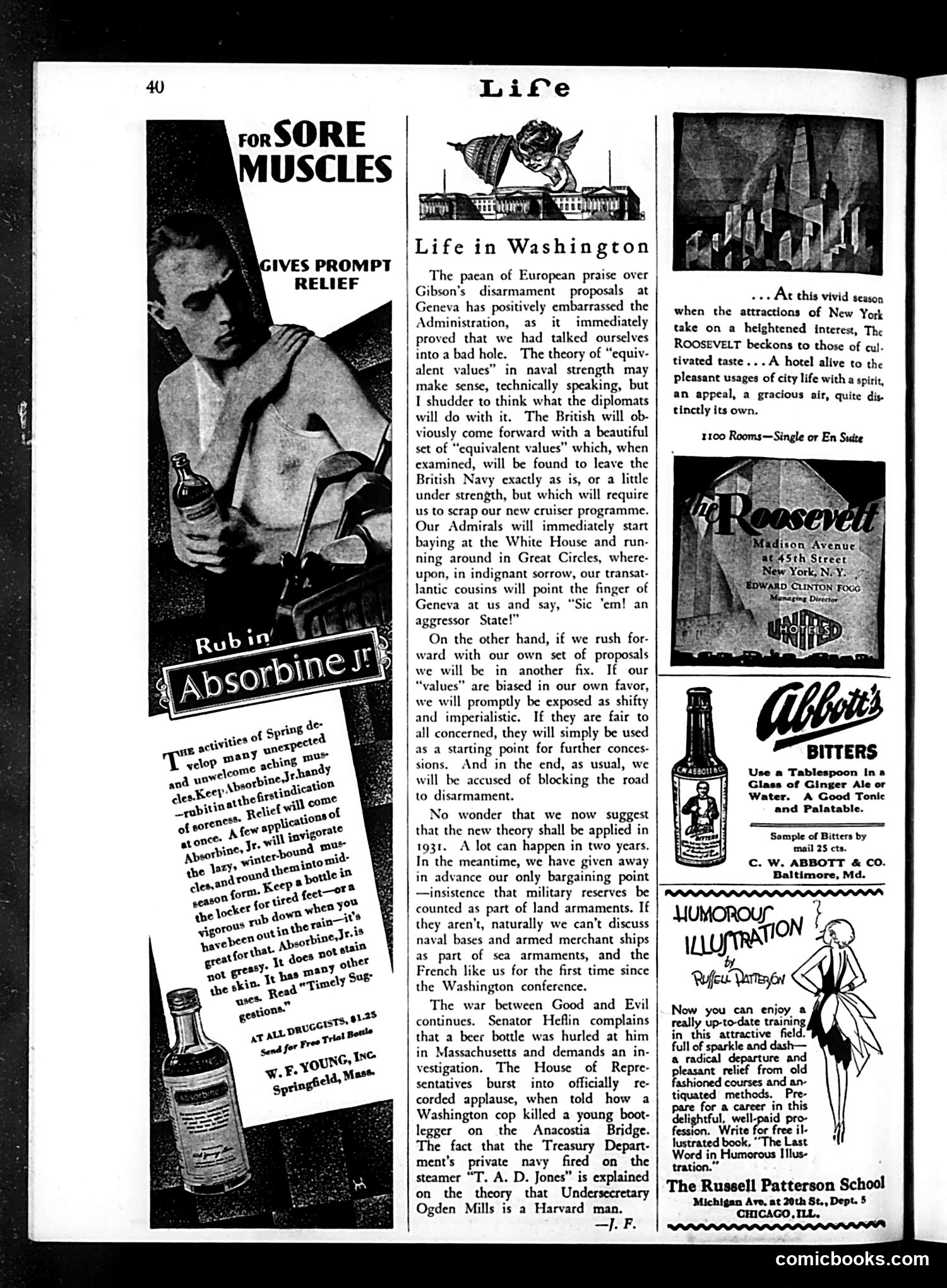
This column satirizes the futility and contradictions of 1930s naval disarmament diplomacy. The author (J.F.) mocks negotiations over "equivalent values" in naval strength, particularly criticizing how the U.S. appears trapped: propose fair terms and be exposed as imperialistic; propose biased terms and face accusations of blocking disarmament. The piece ridicules American hypocrisy regarding Prohibition enforcement. While diplomats debate peace, the government celebrates a Washington cop killing a bootlegger on the Anacostia Bridge, and the Treasury Department's private navy fires on a steamer. The author attributes this last incident cynically to Undersecretary Ogden Mills being "a Harvard man"—implying elite privilege excuses government violence. The satire highlights the contradiction between America's moral posturing in disarmament talks and its domestic lawlessness and violence during Prohibition.
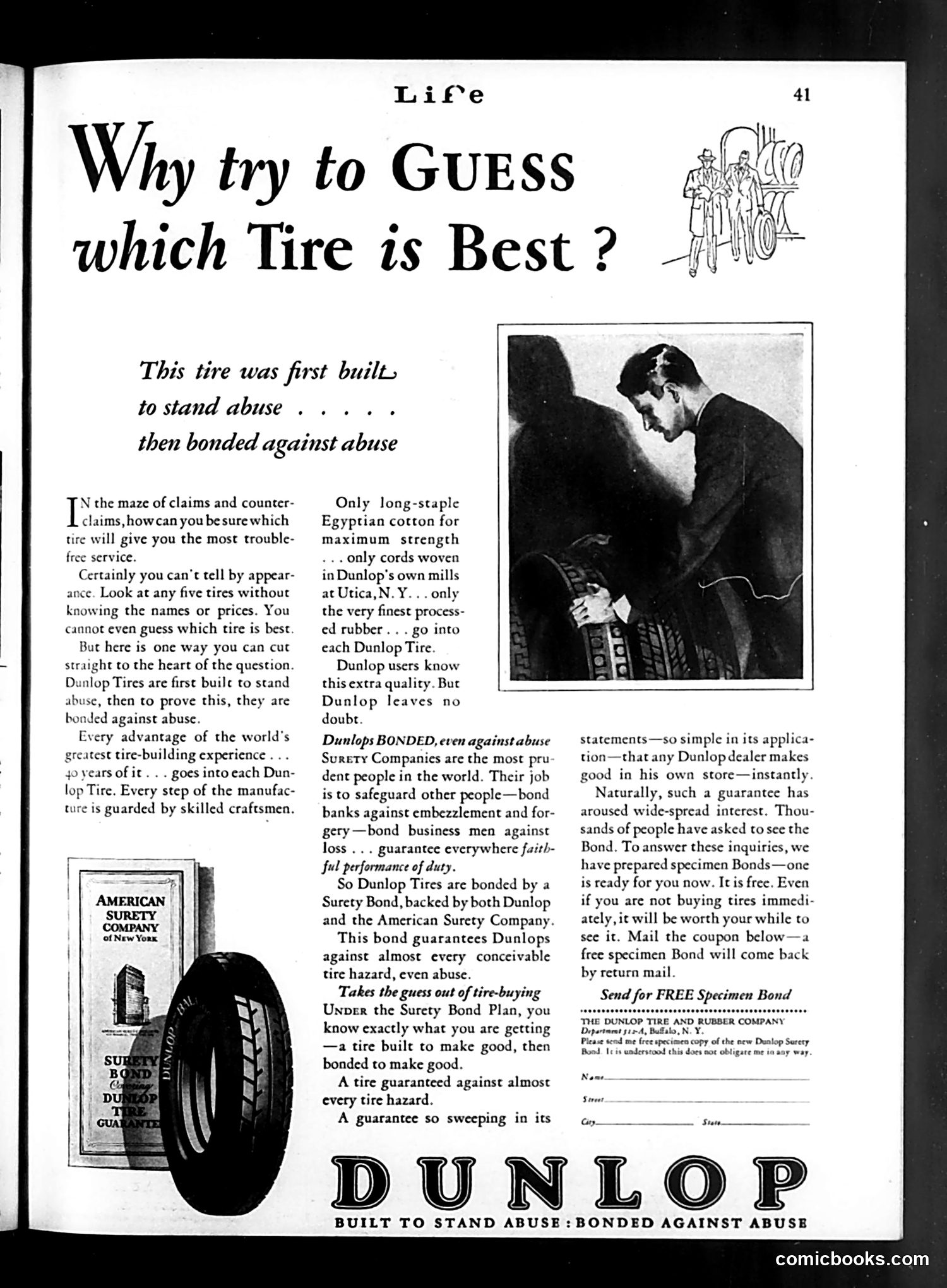
This is a full-page **advertisement**, not satire or cartoon commentary. It's a commercial pitch for Dunlop tires using an innovative marketing strategy for the era. **The Pitch:** Dunlop addresses consumer confusion about tire quality—you can't judge tires by appearance alone. Their solution: they back their product with a **Surety Bond**, underwritten by the American Surety Company. This legal guarantee promises performance against "almost every conceivable tire hazard, even abuse." **The Strategy:** By invoking the trustworthiness of surety companies (which bond banks and businesses), Dunlop transfers credibility from a financial institution to a rubber product. The ad emphasizes quality ingredients (Egyptian cotton, premium rubber) and manufacturing oversight, then clinches the argument with formal insurance backing. **The Modern Reader Context:** This represents early mass-market consumer protection advertising—using third-party financial guarantees to build brand trust during an era when consumer product reliability was genuinely uncertain and unregulated.
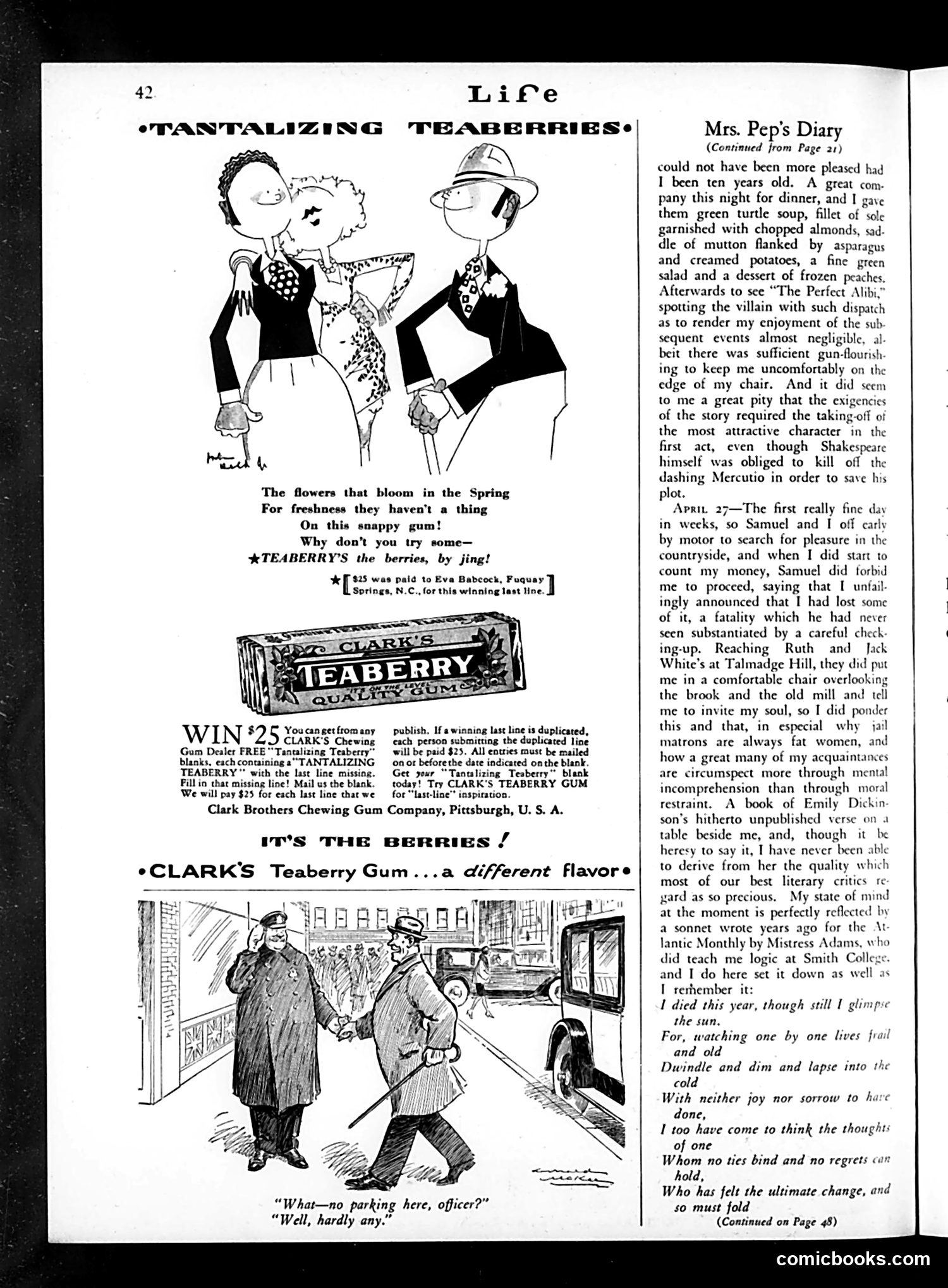
This page contains **advertising and a diary column** rather than political satire. The dominant content is a **Teaberry gum advertisement** promoting a contest where consumers fill in missing lines of jingles for prizes (up to $25). The cartoon shows stylized figures enjoying the product, using period slang ("by jing"). Below is a street scene cartoon captioned "What—no parking here, officer? / Well, hardly any"—a mild joke about urban congestion and parking scarcity, likely reflecting 1920s-era concerns about automobiles overcrowding city streets. The right column continues **"Mrs. Pep's Diary,"** a society/lifestyle column documenting a wealthy woman's dinner party, theater outing, and countryside excursion. It includes literary references (Shakespeare, Emily Dickinson) and reflects upper-class domestic concerns of the era. The page is primarily **commercial and lifestyle-focused** rather than satirical or political.
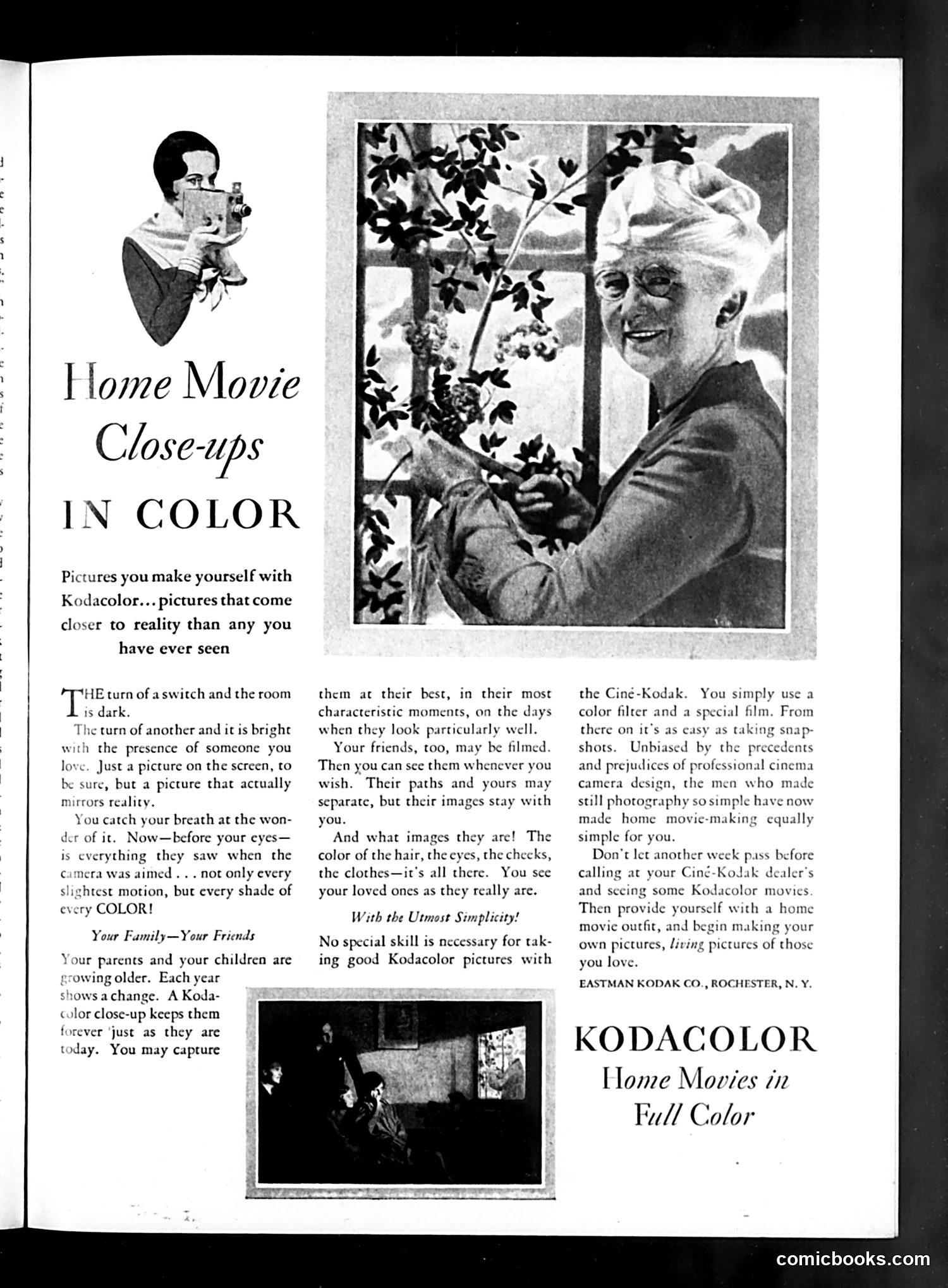
This is a **Kodak advertisement**, not political satire. It promotes Kodacolor film for home movie cameras, emphasizing color photography's emotional appeal to families. The page features two photographs: an elderly woman with plants and a family watching a home movie projection. The text uses sentimental language about preserving loved ones—parents aging, children growing, friends separating—arguing that color film captures reality more faithfully than black-and-white. The appeal is nostalgic and domestic: "living pictures of those you love." The advertisement stresses simplicity ("no special skill necessary") to make professional-quality color filmmaking accessible to ordinary consumers. This reflects mid-20th-century marketing strategy targeting middle-class family life and the emerging consumer technology boom. There is no political content or satire present on this page.
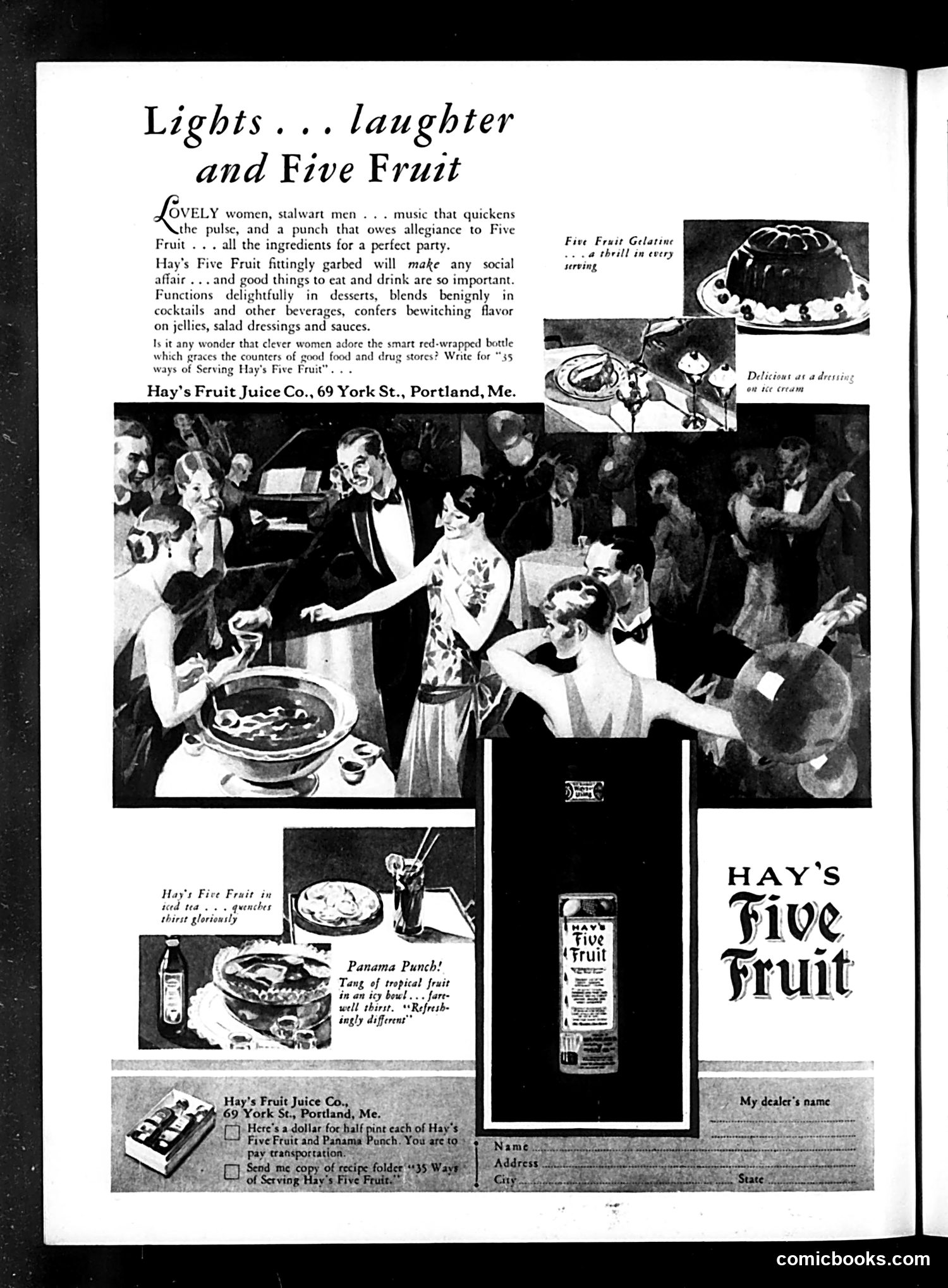
This is not political satire but rather a **commercial advertisement** for Hay's Five Fruit juice product from Portland, Maine. The page depicts an idealized 1920s-30s cocktail party scene with "lovely women" and "stalwart men" enjoying music and punch. The ad emphasizes the product's versatility in desserts, cocktails, jellies, and salad dressings—positioning it as essential to successful entertaining. The social messaging reflects period gender expectations: "clever women" are praised for purchasing the product, which apparently signals sophistication and good taste. The accompanying product photos show gelatine desserts and a "Panama Punch" drink. The bottom section includes a mail-in coupon offering recipes and promotional materials, a typical direct-response advertising technique of the era. This is straightforward commercial marketing rather than editorial satire.
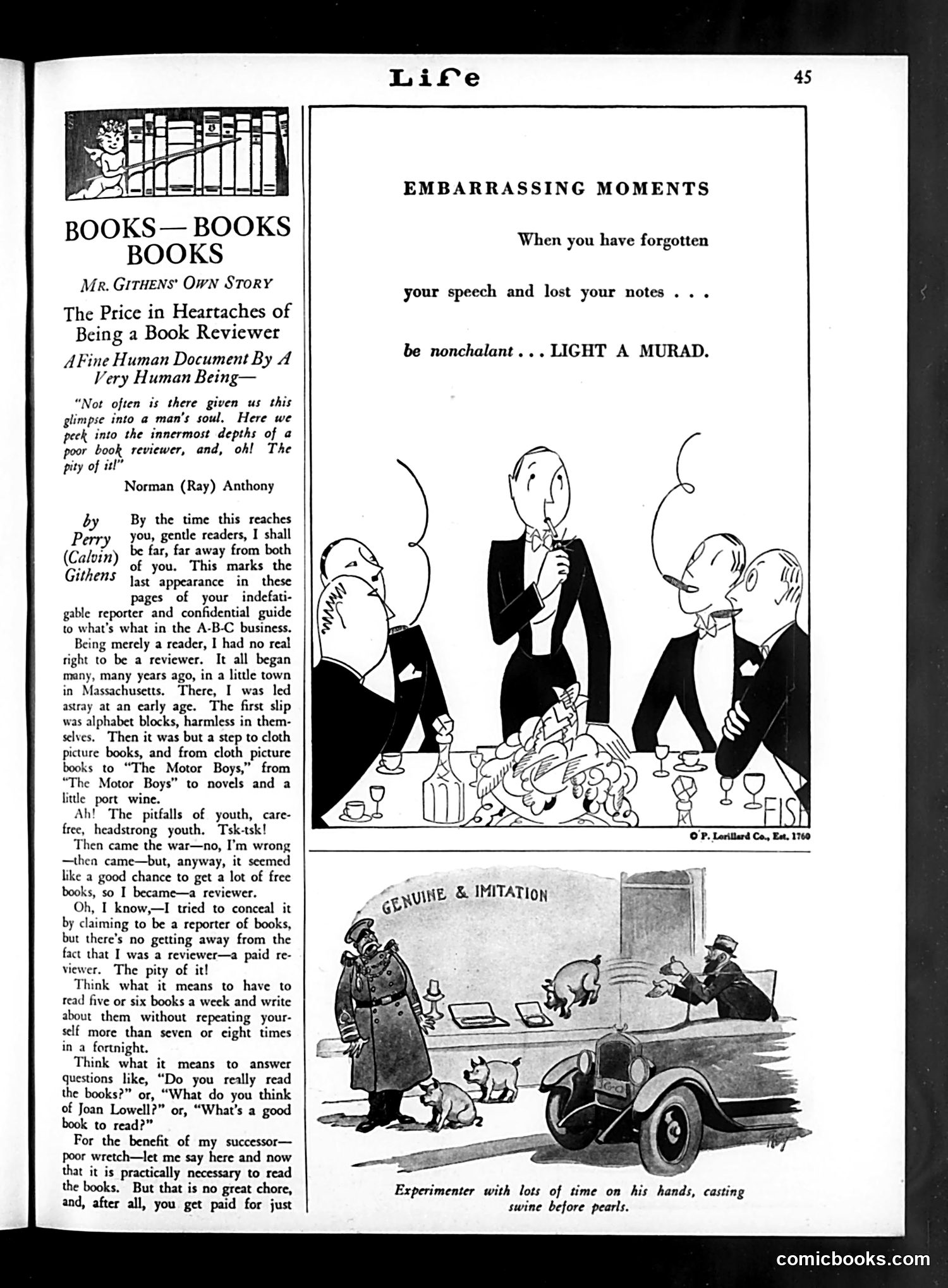
This *Life* magazine page satirizes the exhausting, underappreciated work of book reviewers through a first-person essay by Perry (Calvin) Githens, announced as his final column. **The Main Satire:** Githens humorously chronicles how he accidentally became a paid book reviewer—starting innocently with childhood alphabet blocks, progressing to novels and port wine, then seizing the opportunity during wartime to get free books. He then deadpans the grueling reality: reading 5-6 books weekly and writing about them repeatedly without repetition, while fielding ignorant questions ("Do you really read the books?"). **The Cartoons:** The top cartoon shows embarrassed men at a formal dinner—illustrating the "Embarrassing Moments" feature about forgetting your speech, with the solution being lighting a Murad cigarette (an advertisement). The bottom cartoon depicts a man with time-wasting experiments, reinforcing the theme of impractical leisure. The piece mocks both the reviewer's thankless position and readers' dismissive attitudes toward criticism as mere paid work requiring minimal actual engagement with literature.
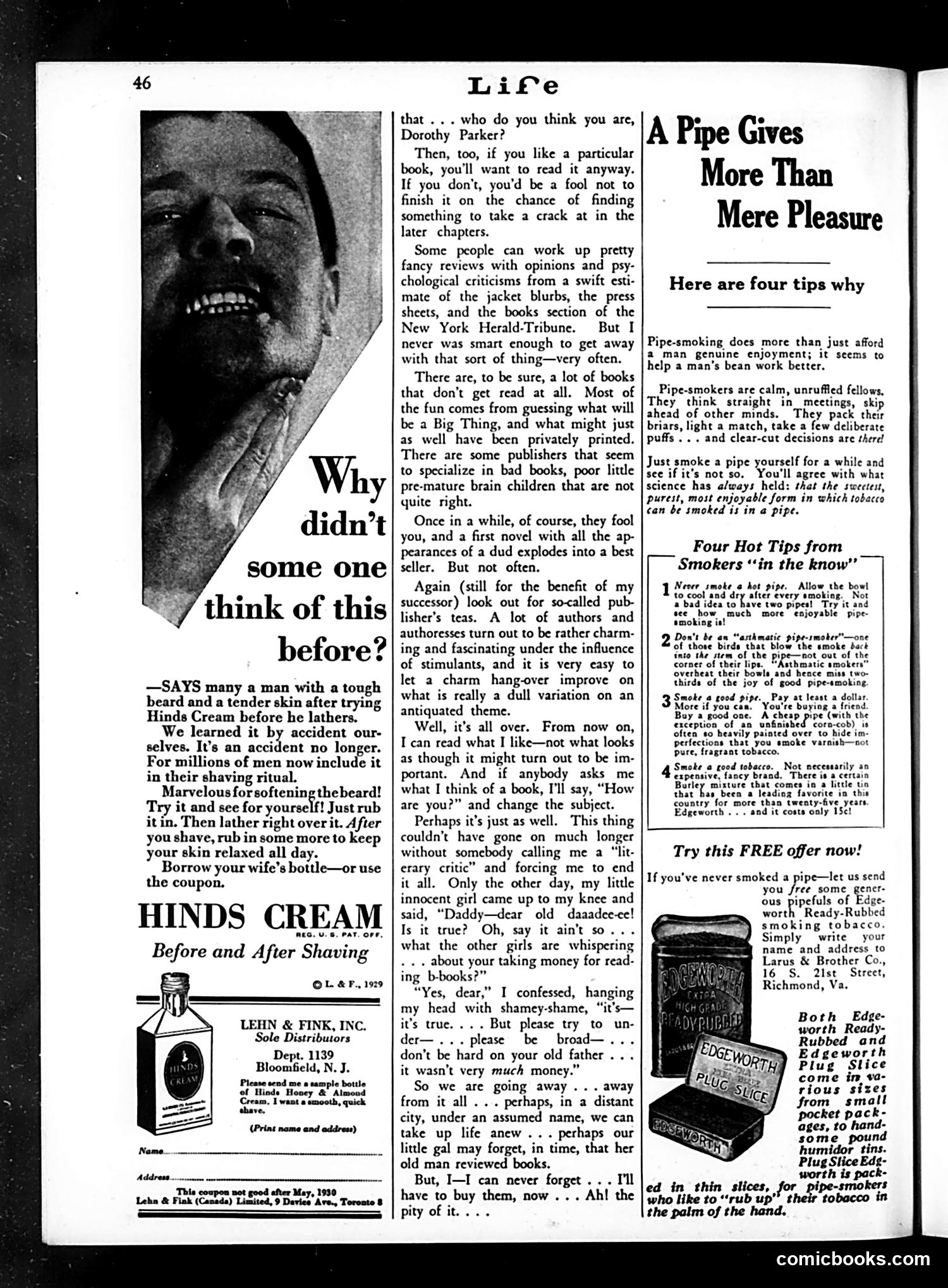
This page contains two distinct elements: **advertising** (Hinds Cream shaving product, bottom left) and **editorial content** (a humorous column about book reviewing, center/right). The main piece is a satirical essay by someone retiring from book criticism. The author admits he never actually read books thoroughly—just jacket blurbs and press sheets—yet still reviewed them. He's leaving the profession before being exposed as a "literary critic" (used mockingly). The humor lies in the confession that professional book reviewers often fake expertise, skimming rather than reading. His daughter's innocent question about taking "money for reading b-books" becomes the final humiliation. The column mocks both pretentious book critics and the publishing industry that enables them. By 1929 (when this appeared), such satirical jabs at intellectual posturing were common in *Life* magazine's comedic commentary on American culture and social hypocrisy.
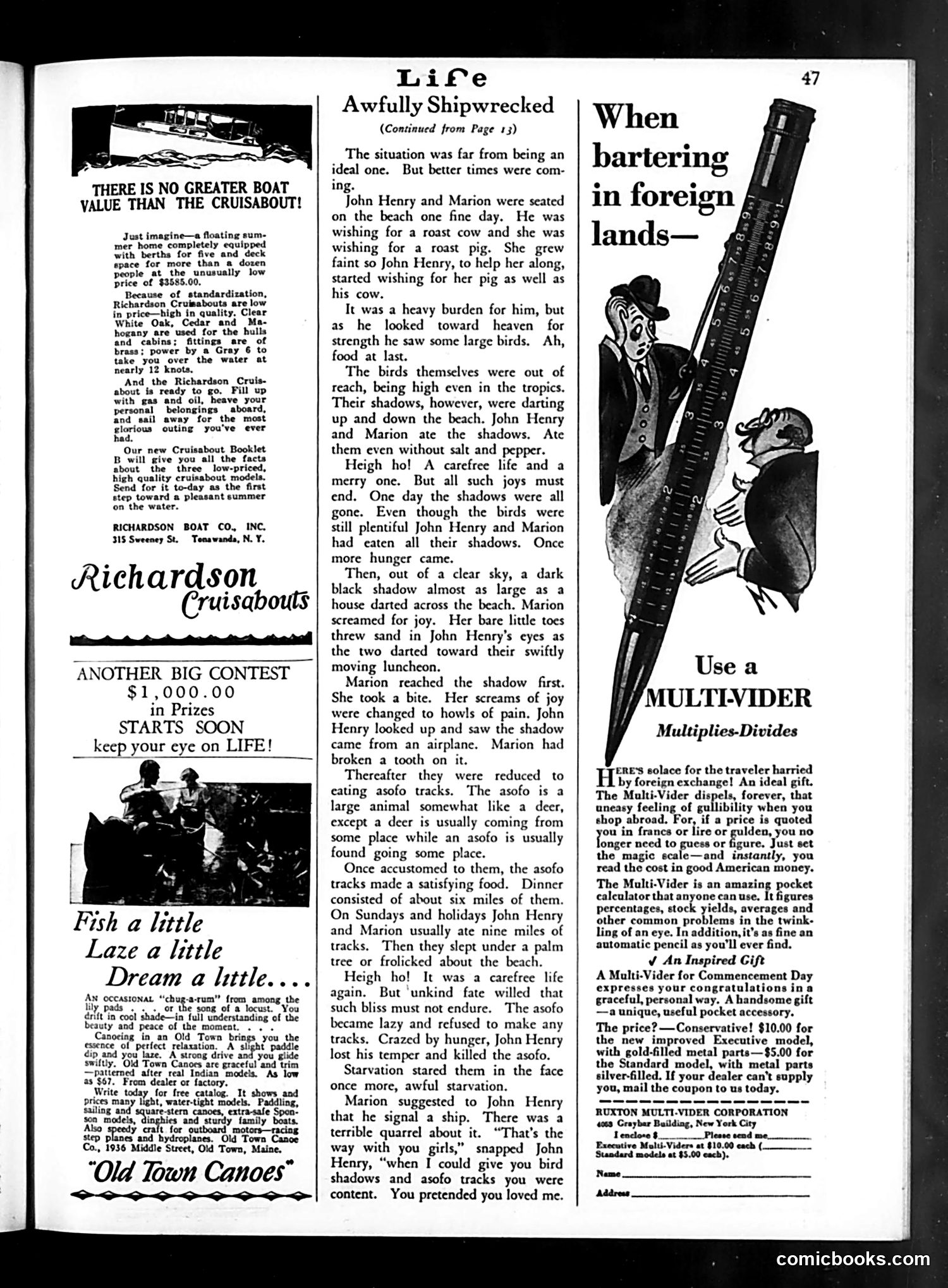
This page contains primarily **advertisements** for boats and canoes (Richardson Cruisabouts, Old Town Canoes) mixed with a **serialized humorous story** titled "Awfully Shipwrecked." The story itself is **satirical fiction** about two shipwrecked people, John Henry and Marion, surviving on a tropical island. The satire lies in the absurdist humor: starving castaways attempt to eat bird *shadows* instead of actual birds, then break teeth on an airplane's shadow, and later subsist on eating the *tracks* of an animal called an "asofo"—playing on the desperation and illogic of survival situations. The cartoon elements are minimal; the humor is primarily textual rather than visual. The accompanying illustrations show people relaxing in boats/canoes, reinforcing the advertisements' leisure-lifestyle messaging. This represents **Depression-era humor**—making light of hardship and scarcity through absurdist logic, a common comedic strategy during economically difficult times.
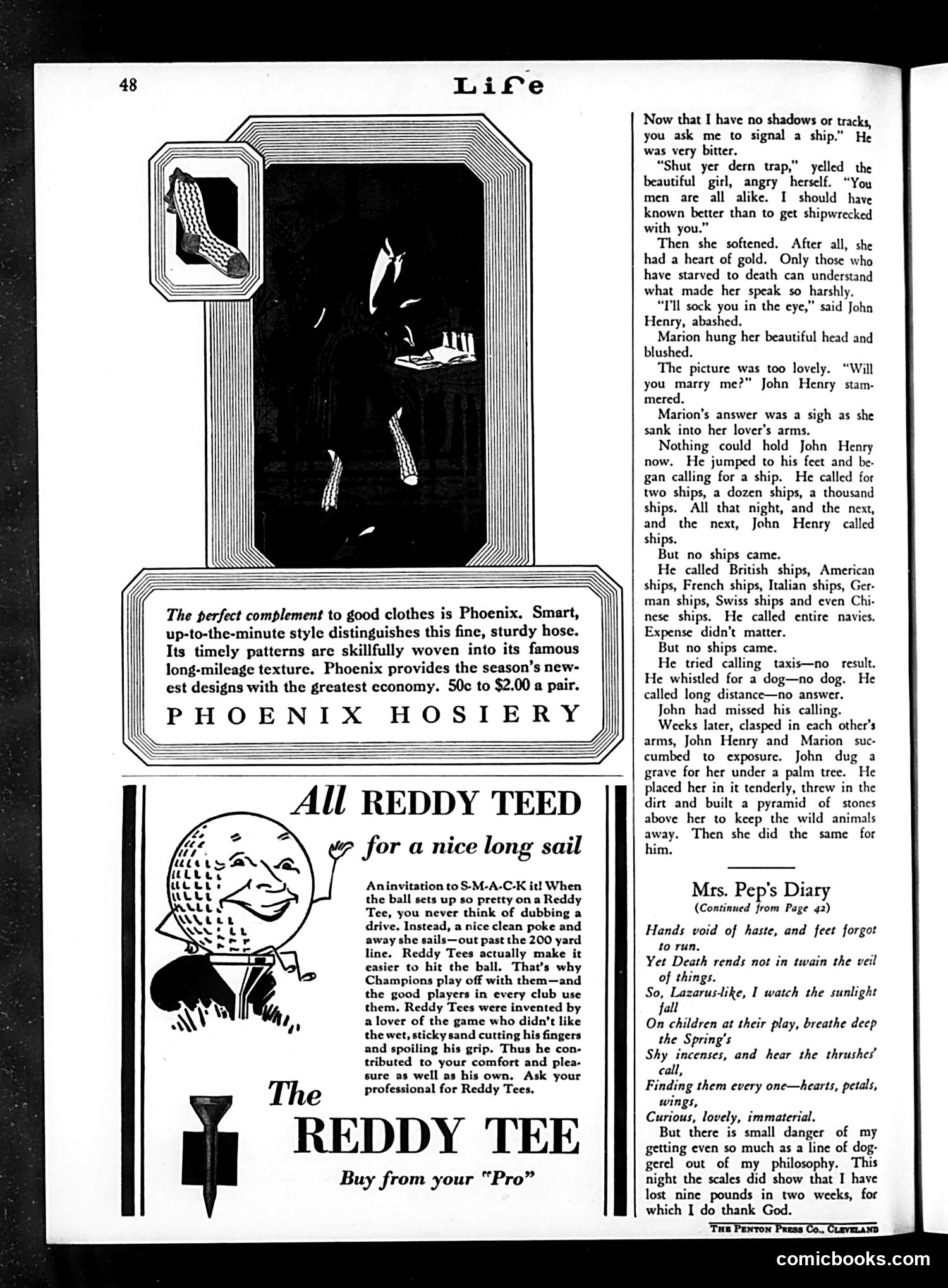
This page contains **advertising and serialized fiction**, not political satire. The main content is a melodramatic romantic story about two shipwrecked lovers, John Henry and Marion. The narrative is intentionally overwrought—featuring angry quarrels, tender reconciliations, and ultimately both characters dying of exposure on a desert island. This appears to be satirizing the overwrought sentimentality of popular serialized fiction and silent film plots of the era, with exaggerated emotional swings and tragic endings. The advertisements promote **Phoenix Hosiery** (stockings) and **Reddy Tees** (golf equipment), typical consumer goods marketed in Life magazine. "Mrs. Pep's Diary" (continued from an earlier page) is a philosophical poem about mortality and nature, seemingly unrelated to the page's other content. The overall effect suggests Life mixed serious literature, satire of popular melodrama, and conventional advertising—typical of the magazine's format as a general-interest publication.
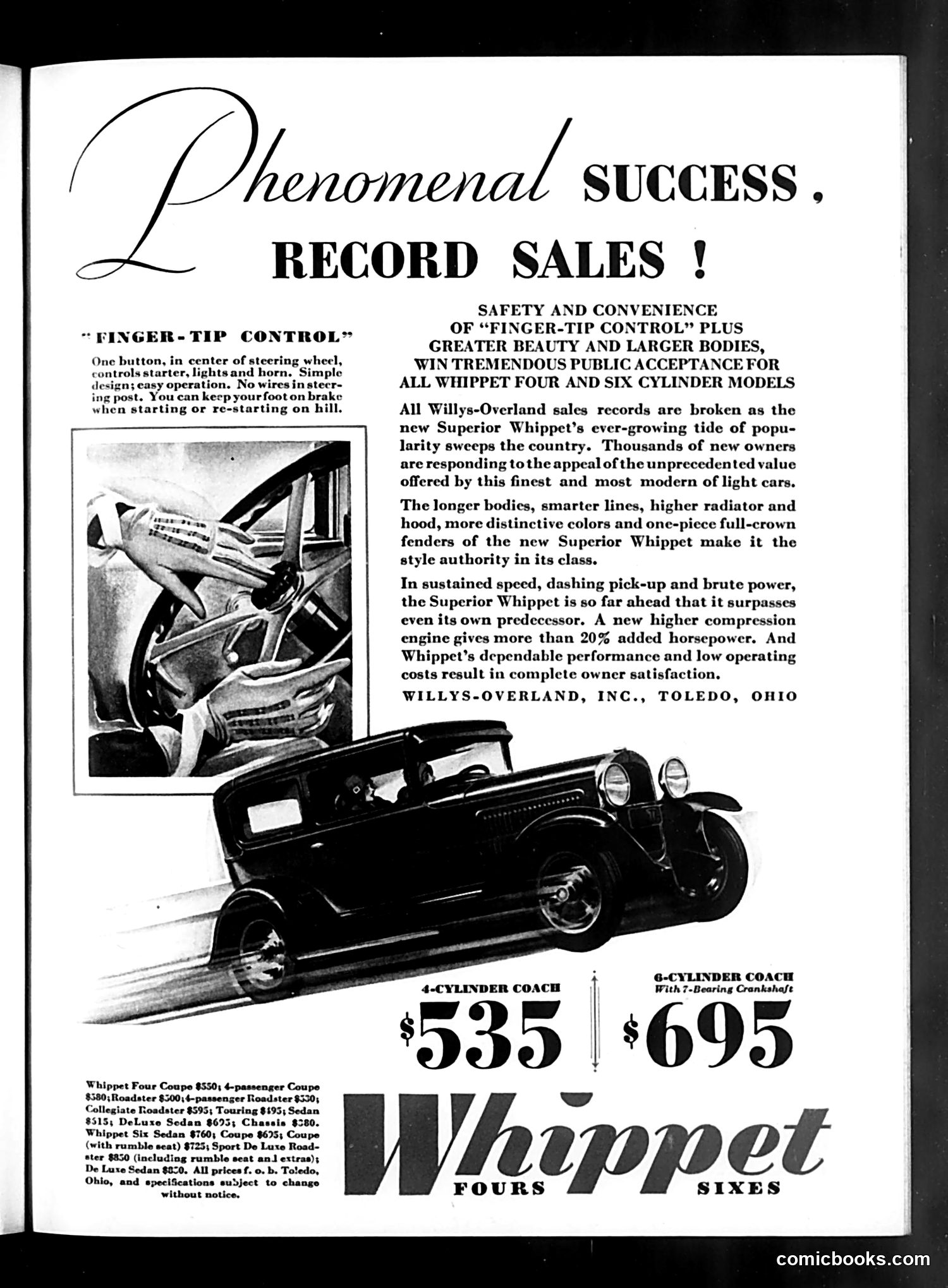
This is **not a political cartoon or satire**, but rather a straight automobile advertisement from *Life* magazine (likely 1920s era, based on styling and prices). The page promotes the "Superior Whippet," a light car manufactured by Willys-Overland of Toledo, Ohio. The advertisement highlights: - **"Finger-tip control"**: A steering wheel button that operates the starter, lights, and horn—marketed as a modern safety and convenience feature - **Performance claims**: The new engine provides 20% more horsepower than its predecessor - **Style and design**: Longer bodies, distinctive colors, and full-crown fenders - **Affordability**: Four-cylinder models starting at $535; six-cylinder at $695 The advertisement targets middle-class buyers seeking reliable, affordable transportation with modern conveniences. The inset photograph shows the steering wheel control mechanism—the era's technological innovation. There is no satire or hidden political message; this is period advertising aimed at demonstrating the Whippet's superiority in a competitive market.
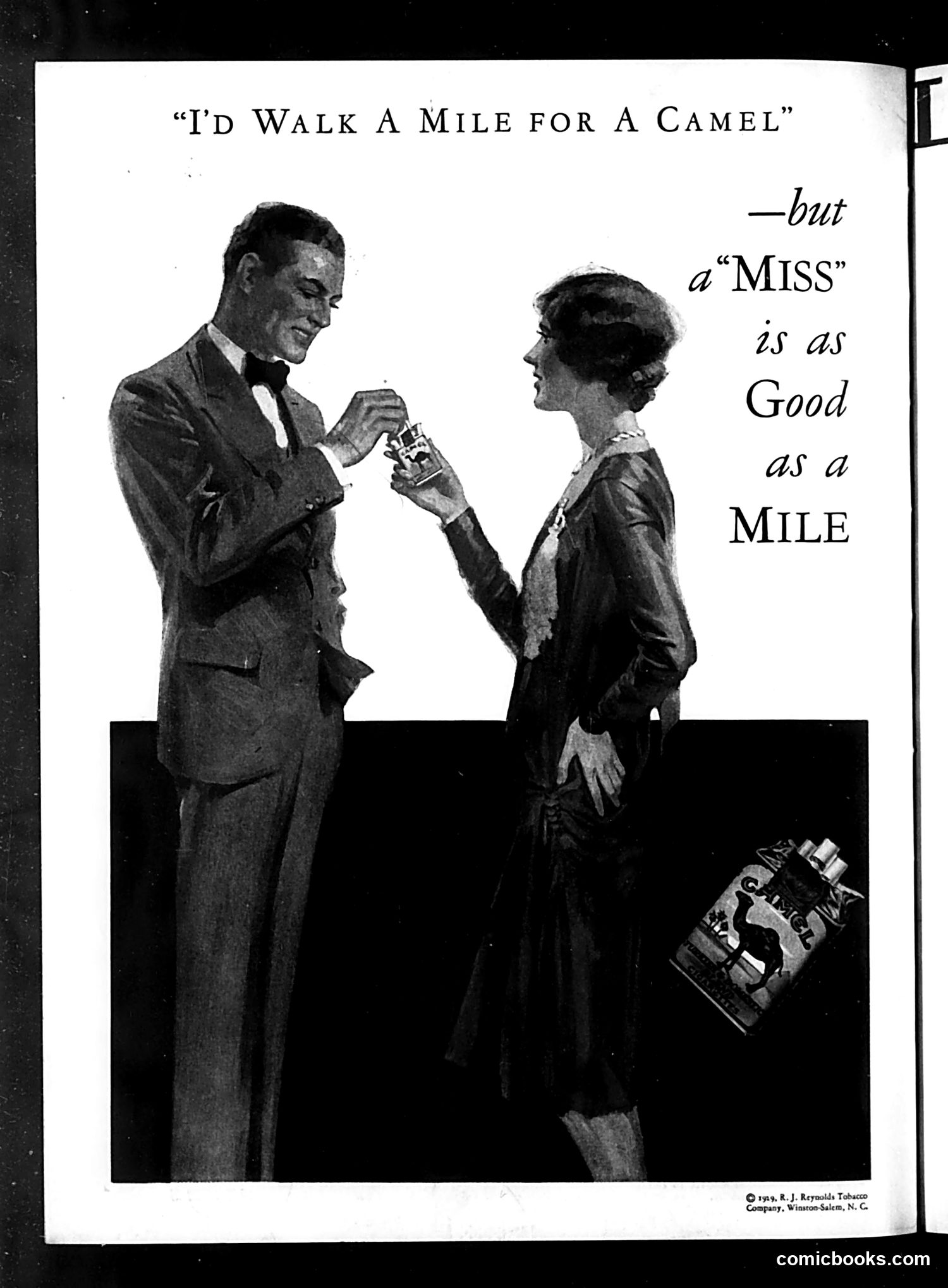
This is a **Camel cigarette advertisement** from R.J. Reynolds Tobacco Company, not political satire. The page plays on the famous Camel slogan "I'd Walk a Mile for a Camel." The ad depicts a well-dressed man offering a cigarette to an elegantly dressed woman. The text's joke pivots on the word "Miss"—suggesting that while someone might walk a mile for a Camel cigarette, a "Miss" (a woman) is equally worthwhile. The implication is that Camel cigarettes are so desirable they're comparable to romantic companionship. This reflects early-20th-century advertising that used suggestive gender dynamics and sophistication appeals to market cigarettes. The imagery and messaging would be considered patronizing by modern standards, but it was typical advertising strategy of that era.