
Life, 1929-05-17 · page 31 of 52
Life — May 17, 1929 — page 31: what you’re looking at
What you’re looking at
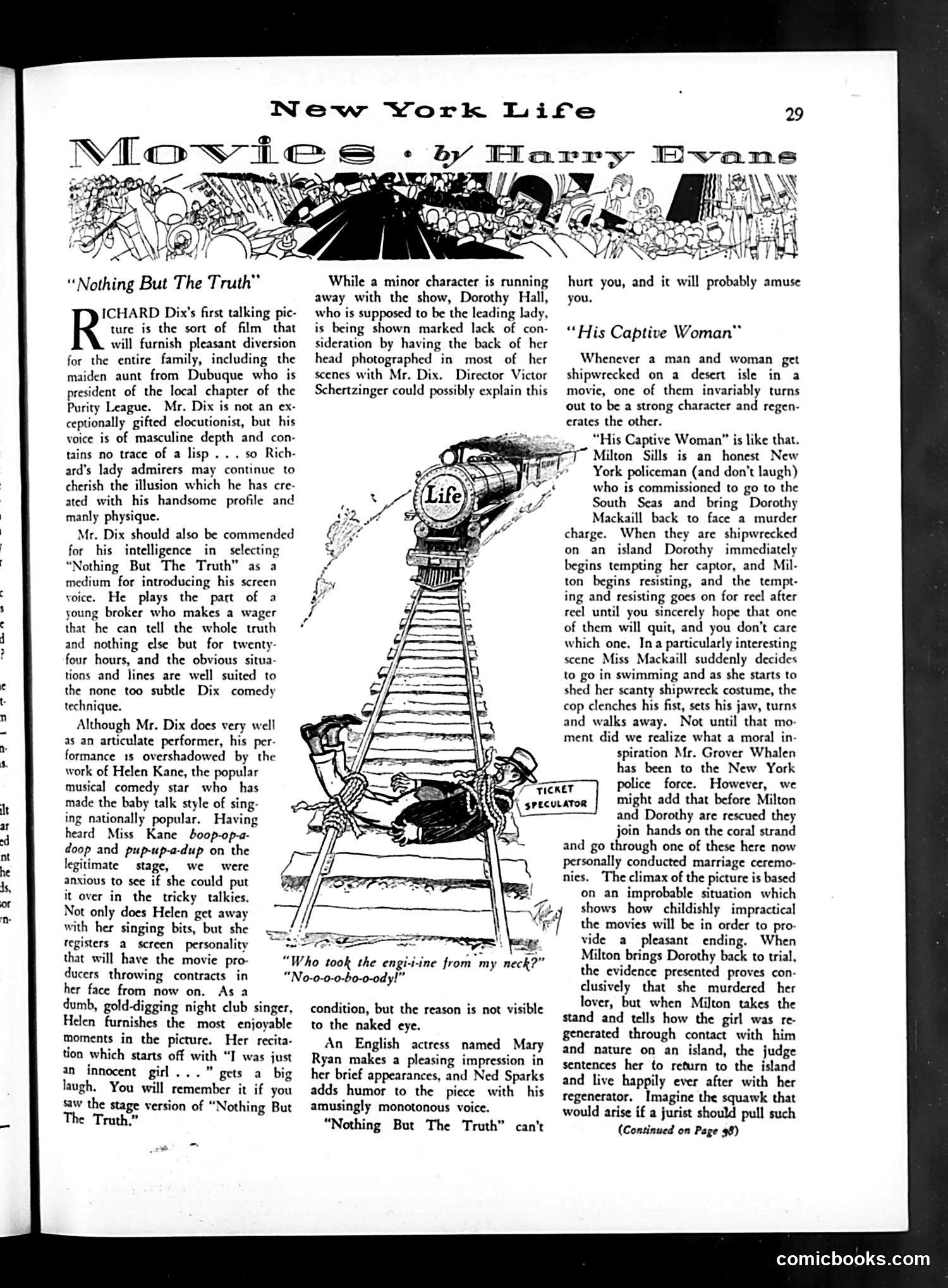
This page reviews two early talking pictures from around 1929-1930. The main illustration shows a train, referencing a plot point or comedic scene. **"Nothing But The Truth"** stars Richard Dix in his talkie debut. The reviewer praises his deep, masculine voice while gently mocking his acting as "none too subtle." Helen Kane—famous for her "baby talk" singing style ("boop-oop-a-doop")—nearly steals the film playing a "dumb, gold-digging night club singer," a stock character type. The reviewer jokes that leading lady Dorothy Hall barely appears on screen except from behind, suggesting directorial neglect. **"His Captive Woman"** follows a familiar movie formula: shipwrecked couple on a desert island where one "regenerates" the other morally. The humor references NYC Police Commissioner Grover Whalen's reputation for moral rectitude—even a fictional cop resisting temptation supposedly owes this to Whalen's influence. The review gently mocks the predictable plot while acknowledging the film provides harmless entertainment. Both reviews reflect 1920s attitudes toward romance, morality, and cinema conventions that modern audiences would find quaint or stereotypical.
📄 Transcribed text from this page (OCR, searchable)
Machine-transcribed from the original scan — historical spelling and the odd misread are preserved.
New York Life “Nothing But The Truth” ICHARD Dix’s first talking pic- R ture is the sort of film that will furnish pleasant diversion for the entire family, including the maiden aunt from Dubuque who is president of the local chapter of the Purity League. Mr. Dix is not an ex- ceptionally gifted elocutionist, but his voice is of masculine depth and con- tains no trace of a lisp .. . so Rich- ard’s lady admirers may continue to cherish the illusion which he has cre- ated with his handsome profile and manly physique. Mr. Dix should also be commended for his intelligence in selecting “Nothing But The Truth” as a medium for introducing his screen voice. He plays the part of a young broker who makes a wager that he can tell the whole truth and nothing else but for twenty- four hours, and the obvious situa- tions and lines are well suited to the none too subtle Dix comedy technique. Although Mr. Dix does very well as an articulate performer, his per- formance 1s overshadowed by the work of Helen Kane, the popular musical comedy star who has made the baby talk style of sing- ing nationally popular. Having heard Miss Kane boop-op-a- doop and pup-up-a-dup on the legitimate stage, we were anxious to see if she could put it over in the tricky talkies. Not only does Helen get away with her singing bits, but she tegisters a screen personality that will have the movie pro- ducers throwing contracts in her face from now on. As a dumb, gold-digging night club singer, Helen furnishes the most enjoyable moments in the picture. Her recita- tion which starts off with “I was just an innocent girl...” gets a big laugh. You will remember it if you saw the stage version of “Nothing But The Truth.” While a minor character is running away with the show, Dorothy Hall, who is supposed to be the leading lady, is being shown marked lack of con- sideration by having the back of her head photographed in most of her scenes with Mr. Dix. Director Victor Schertzinger could possibly explain this “Who took the engi-i-ine from my neck?’ “No-0-0-0-b0-0-ody!” condition, but the reason is not visible to the naked eye. An English actress named Mary Ryan makes a pleasing impression in her brief appearances, and Ned Sparks adds humor to the piece with his amusingly monotonous voice. “Nothing But The Truth” can’t 29 a fe ay A by) NUS hurt you, and it will probably amuse you. “His Captive Woman" Whenever a man and woman get shipwrecked on a desert isle in a movie, one of them invariably turns out to be a strong character and regen- erates the other. “His Captive Woman” is like that. —T~ Milton Sills is an honest New York policeman (and don't laugh) who is commissioned to go to the South Seas and bring Dorothy Mackaill back to face a murder charge. When they are shipwrecked on an island Dorothy immediately begins tempting her captor, and Mil- ton begins resisting, and the tempt- ing and resisting goes on for reel after reel until you sincerely hope that one of them will quit, and you don’t care which one. Ina particularly interesting scene Miss Mackaill suddenly decides to go in swimming and as she starts to shed her scanty shipwreck costume, the cop clenches his fist, sets his jaw, turns and walks away. Not until that mo- ment did we realize what a moral in- spiration Mr. Grover Whalen has been to the New York police force. However, we might add that before Milton and Dorothy are rescued they join hands on the coral strand and go through one of these here now personally conducted marriage ceremo- nies. The climax of the picture is based on an improbable situation which shows how childishly impractical the movies will be in order to pro- vide a pleasant ending. When Milton brings Dorothy back to trial, the evidence presented proves con- clusively that she murdered her lover, but when Milton takes the stand and tells how the girl was re- generated through contact with him and nature on an island, the judge sentences her to return to the island and live happily ever after with her regenerator. Imagine the squawk that would arise if a jurist should pull such (Continued on Page $8) comicbooks.com