
A complete issue · 36 pages · 1929
Life — March 1, 1929
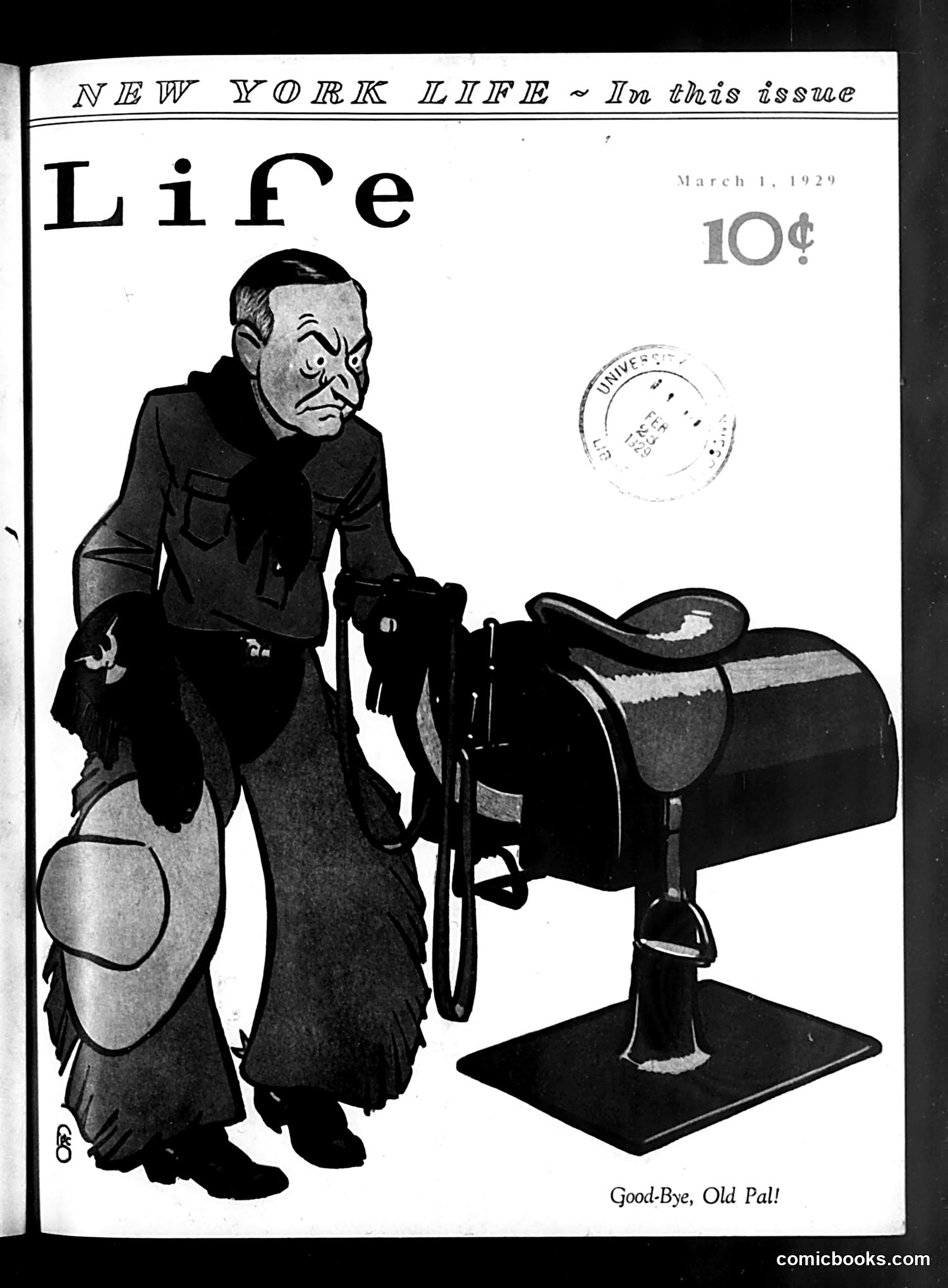
This Life magazine cover from March 1, 1929 depicts a man with an exaggerated, scowling face saying goodbye to a saddled horse. The caption reads "Good-Bye, Old Pal!" The cartoon appears to satirize the decline of horse-based transportation, likely referencing the automotive revolution that was rapidly displacing horses in American life during the 1920s. The man's grotesque expression suggests bitterness or resignation about this technological shift. The specific identity of the caricatured figure is unclear from the image alone, though the exaggerated facial features were typical of Life's satirical style. The joke works on a general level—mocking those reluctant to accept modern progress, or conversely, lamenting the obsolescence of traditional ways as automobiles dominated American society.
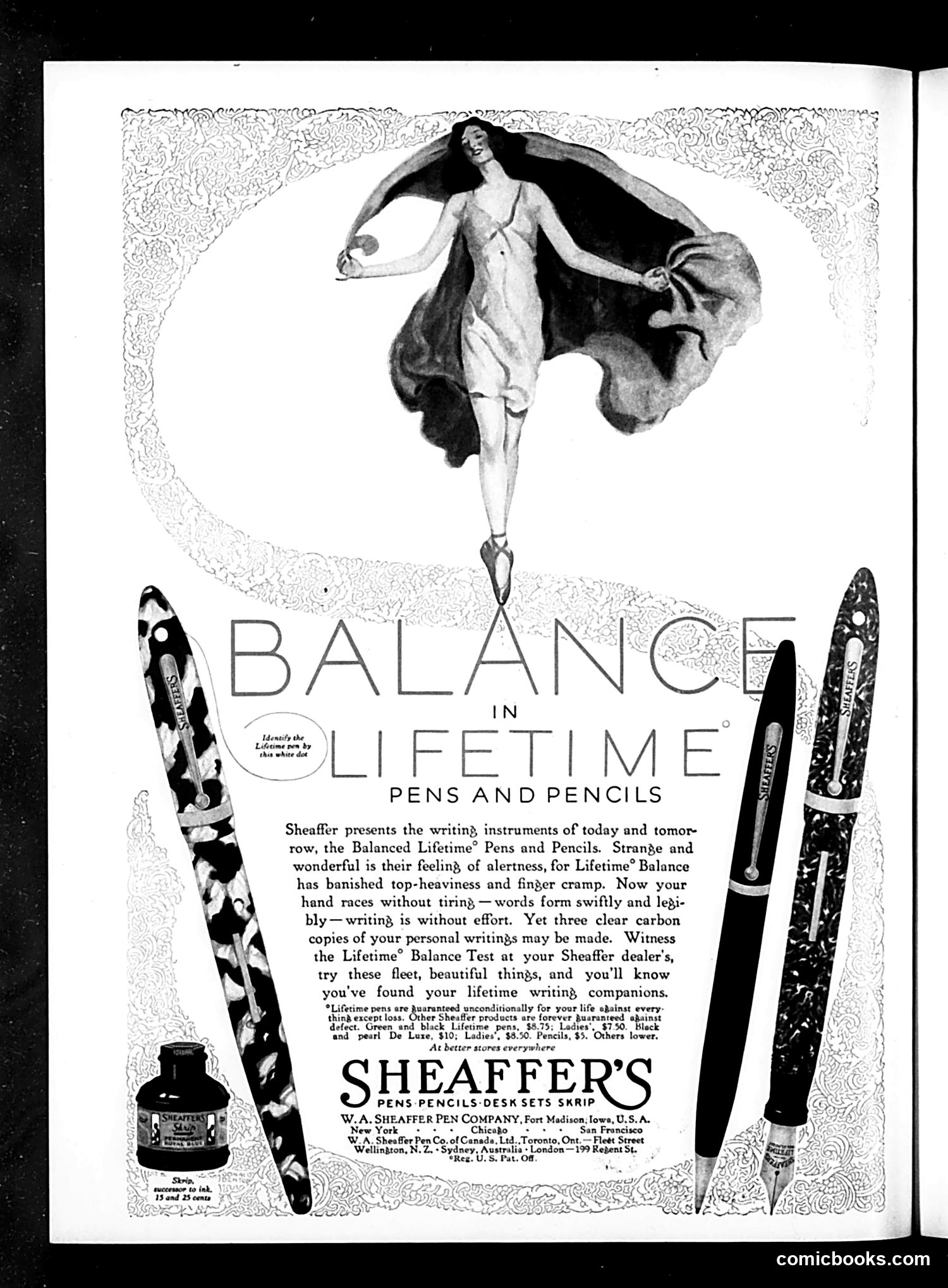
This page is primarily **advertising, not political satire**. It's a Sheaffer pens and pencils advertisement from an era when Life magazine included substantial commercial content. The central image shows a stylized female figure in classical ballet pose, depicted as balanced on the tip of a pen nib. This visual metaphor illustrates the product's core marketing claim: "Balance in Lifetime"—that Sheaffer's writing instruments are so well-balanced they eliminate hand fatigue and cramping. The decorative border and art deco styling are typical of 1920s-30s advertising design. The multiple pen styles displayed (with ornamental patterns) emphasize product variety. The text promises that writing with these pens requires minimal effort and that users can produce three carbon copies while writing. This is straightforward product marketing using an artistic metaphor, not editorial commentary.
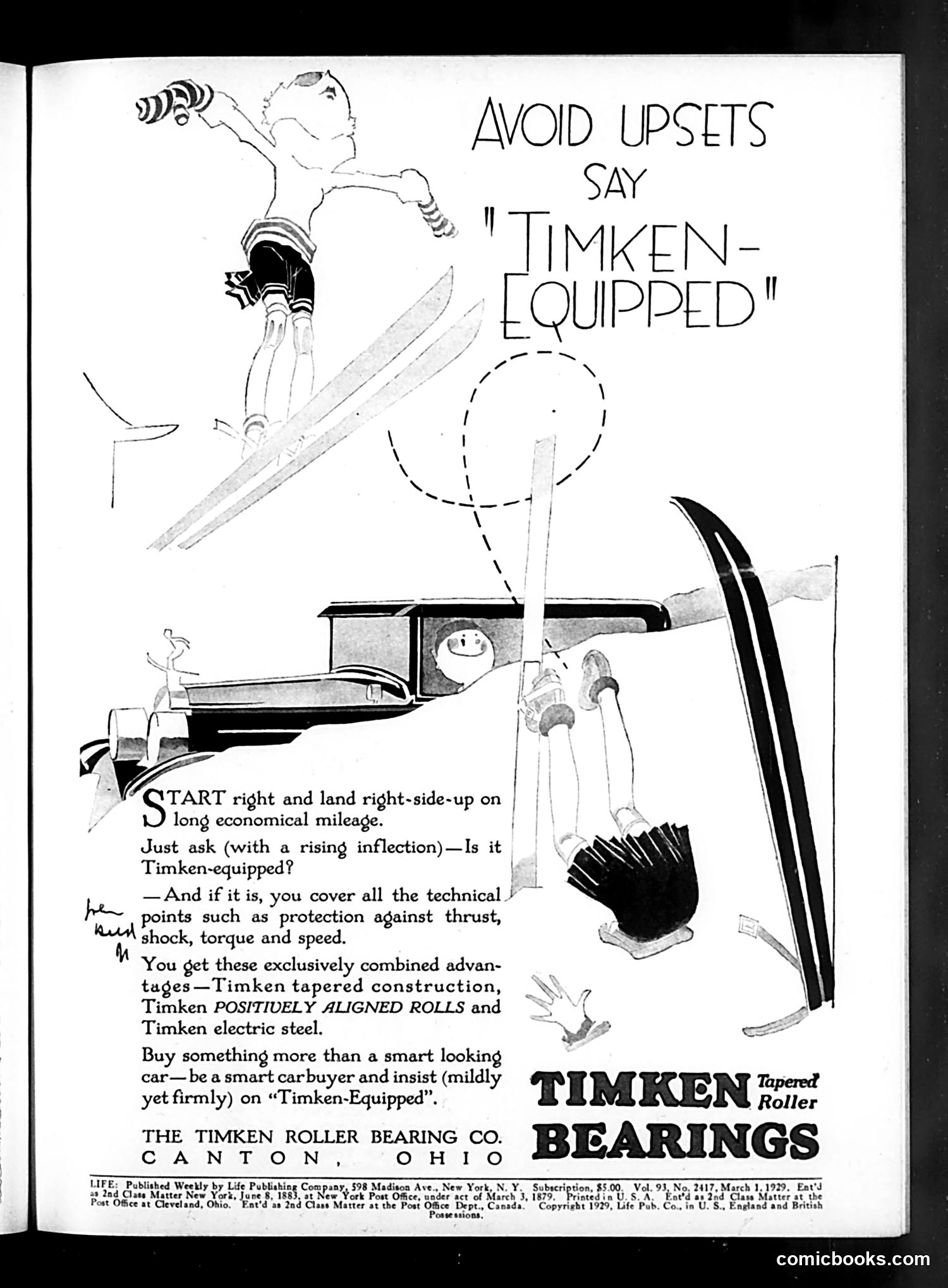
This is primarily a **Timken Roller Bearings advertisement** from Life magazine (March 1, 1929), not political satire. The ad uses humor to promote Timken bearings for automobiles. The cartoon depicts a dramatic car crash scene—a vehicle has flipped upside-down after what appears to be a collision or accident. The joke advises consumers to "avoid upsets" by purchasing "Timken-equipped" cars. The ad's copy sarcastically suggests that if your car is Timken-equipped, it will handle "thrust, shock, torque and speed" to protect against such disasters. The humor targets car buyers by implying that without Timken bearings, accidents and "upsets" are inevitable. This reflects 1920s advertising practices: using exaggerated scenarios and gentle mockery to sell automotive safety components.
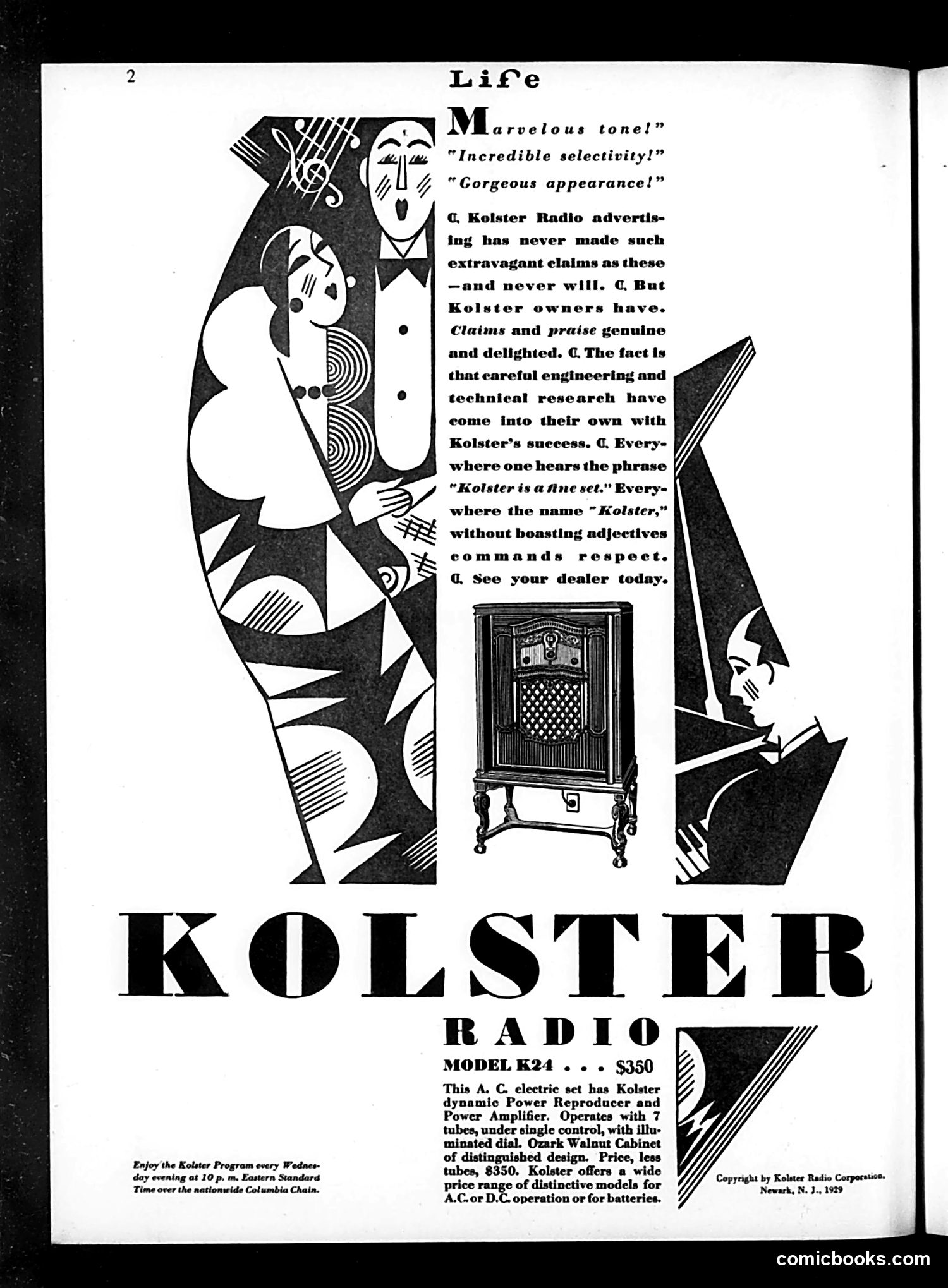
This is primarily a **Kolster Radio advertisement**, not political satire. The page uses Art Deco styling typical of late 1920s design. The advertisement features stylized, geometric figures flanking a radio set (Model K24, priced at $350). The figures appear to be fashionable people of the era, rendered in modernist art style rather than caricature. The text mocks competitors' exaggerated advertising claims ("Marvelous tone!" "Incredible selectivity!") while asserting Kolster's reliability comes from "careful engineering and technical research" rather than hype. It positions Kolster as the respectable choice: the brand name itself "commands respect." The Art Deco imagery and claims reflect 1920s consumer culture, emphasizing technological sophistication and modern taste as selling points.
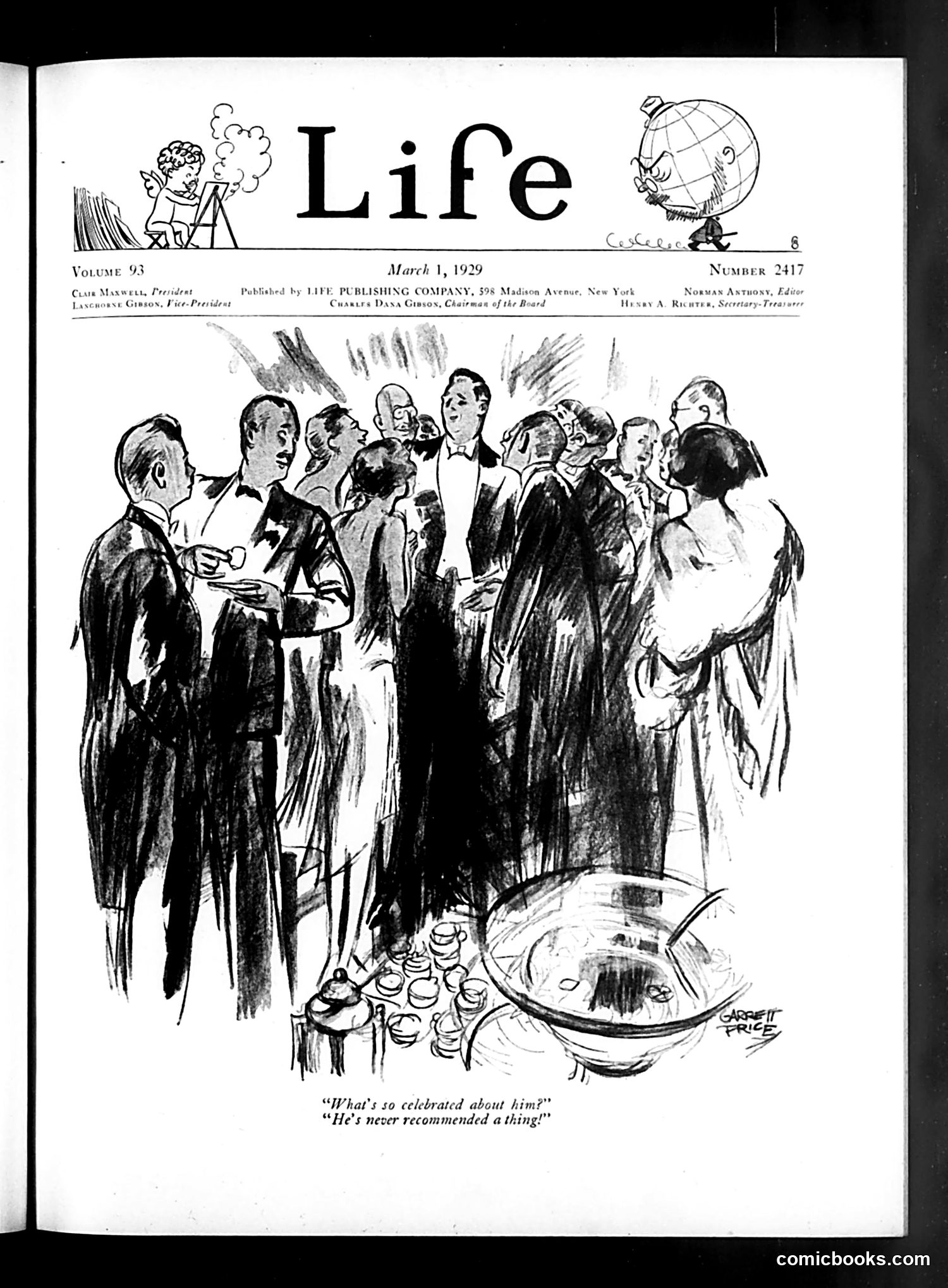
This cartoon satirizes a celebrated public figure whose fame rests entirely on reputation rather than actual accomplishment. The gathering of well-dressed socialites around an empty punch bowl suggests a celebrated guest of honor who has done nothing noteworthy to warrant the attention. The joke—"What's so celebrated about him?" / "He's never recommended a thing!"—appears to mock someone famous for passivity or lack of substantive contribution. The caption's emphasis on "never recommended" suggests criticism of a prominent person who avoids taking positions or endorsing causes, yet maintains celebrity status. Without additional context, the specific identity remains unclear, though this reflects 1920s concerns about celebrity divorced from genuine merit or action.
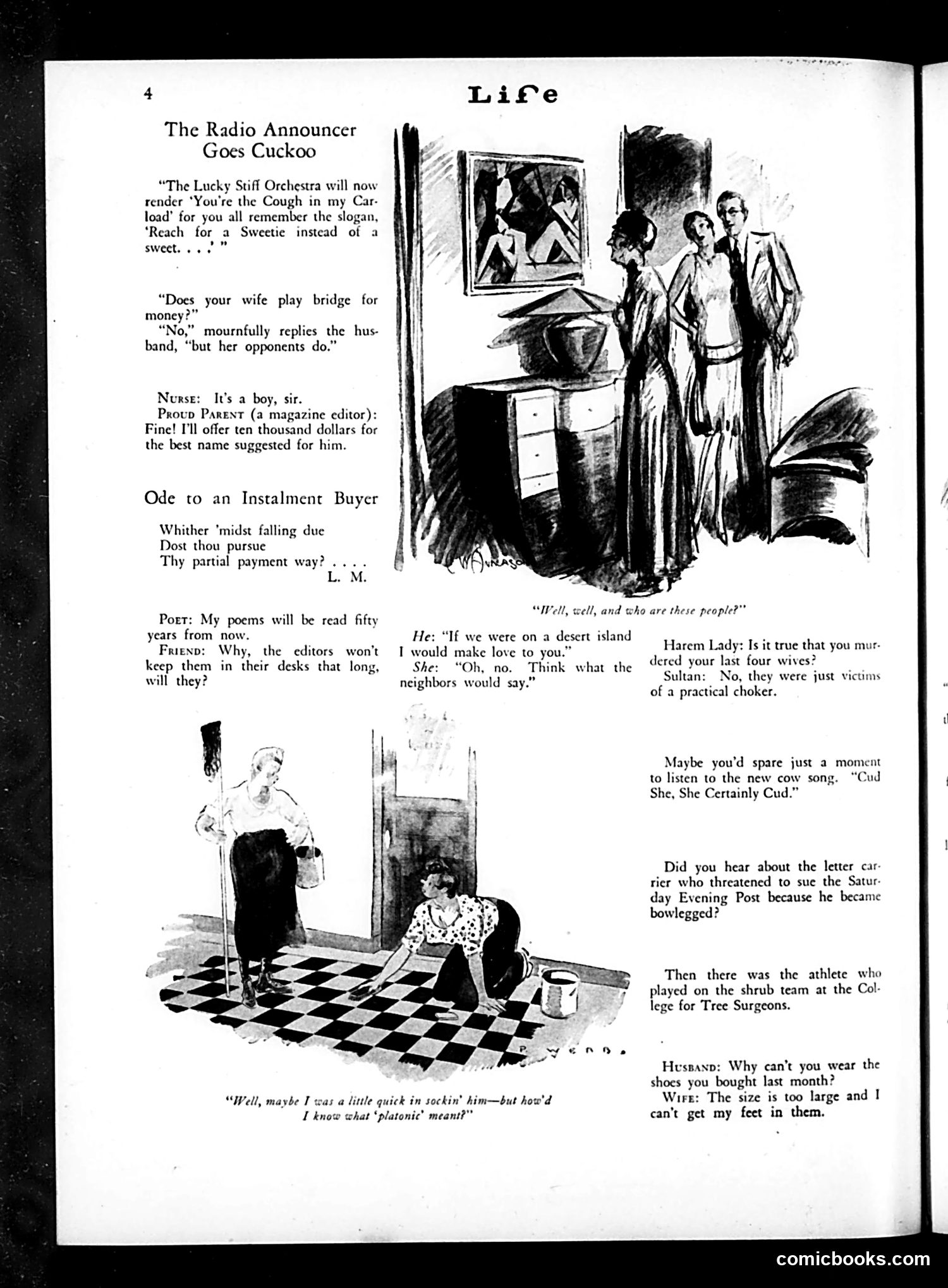
This page contains several brief humorous anecdotes and two cartoon illustrations typical of Life's satirical humor circa early-to-mid 20th century. The cartoons illustrate domestic and social situations: one shows a couple viewing artwork with guests, captioned about "platonic intent"; another depicts a woman scrubbing floors while a man stands nearby. The text includes jokes about radio advertising ("Lucky Stiff Orchestra"), bridge-playing wives, a nurse announcing a baby's birth, installment buying debt, and marital disagreements about shoes and clothing. The humor reflects common domestic friction points of the era: marital finances, women's leisure activities (bridge), consumer debt from installment plans, and gendered expectations around housework and clothing purchases. The satire gently mocks both spouses' perspectives on these everyday conflicts.
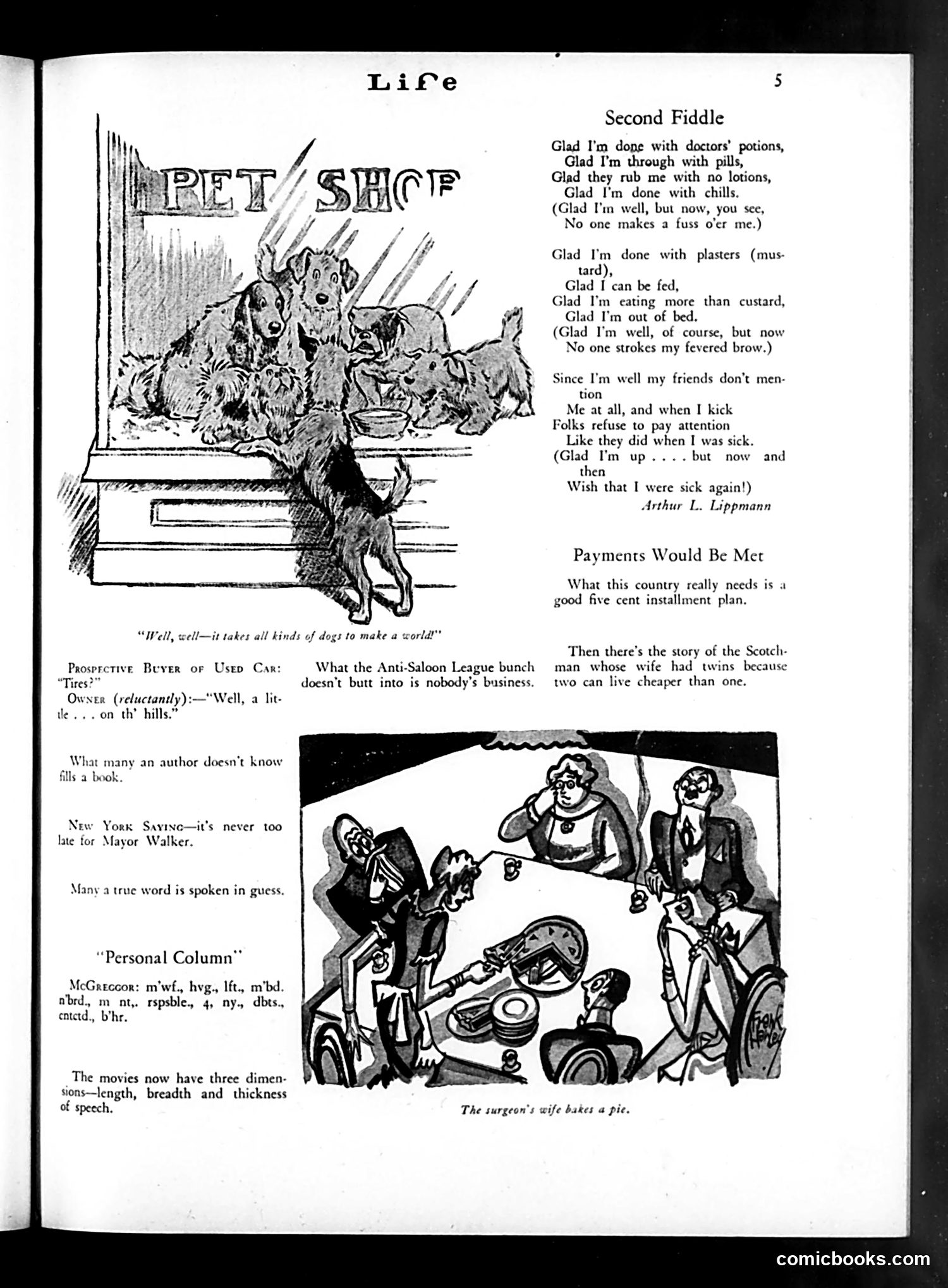
**Left side:** A humorous illustration shows a dog looking at a pet shop window displaying various animals. The caption "Well, well—it takes all kinds of dogs to make a world" satirizes the diversity of pets available for purchase, suggesting that even shop owners recognize life's variety. **Right side:** "Second Fiddle" by Arthur L. Lippmann is a poem from a sick person's perspective, complaining that friends ignore them once they've recovered—they received attention while ill but are now neglected. It's dark humor about how sympathy disappears with good health. **Bottom cartoon:** Depicts what appears to be a social gathering around a table, captioned "The surgeon's wife bakes a pie," likely satirizing domestic or social pretension, though the specific reference is unclear without additional context.
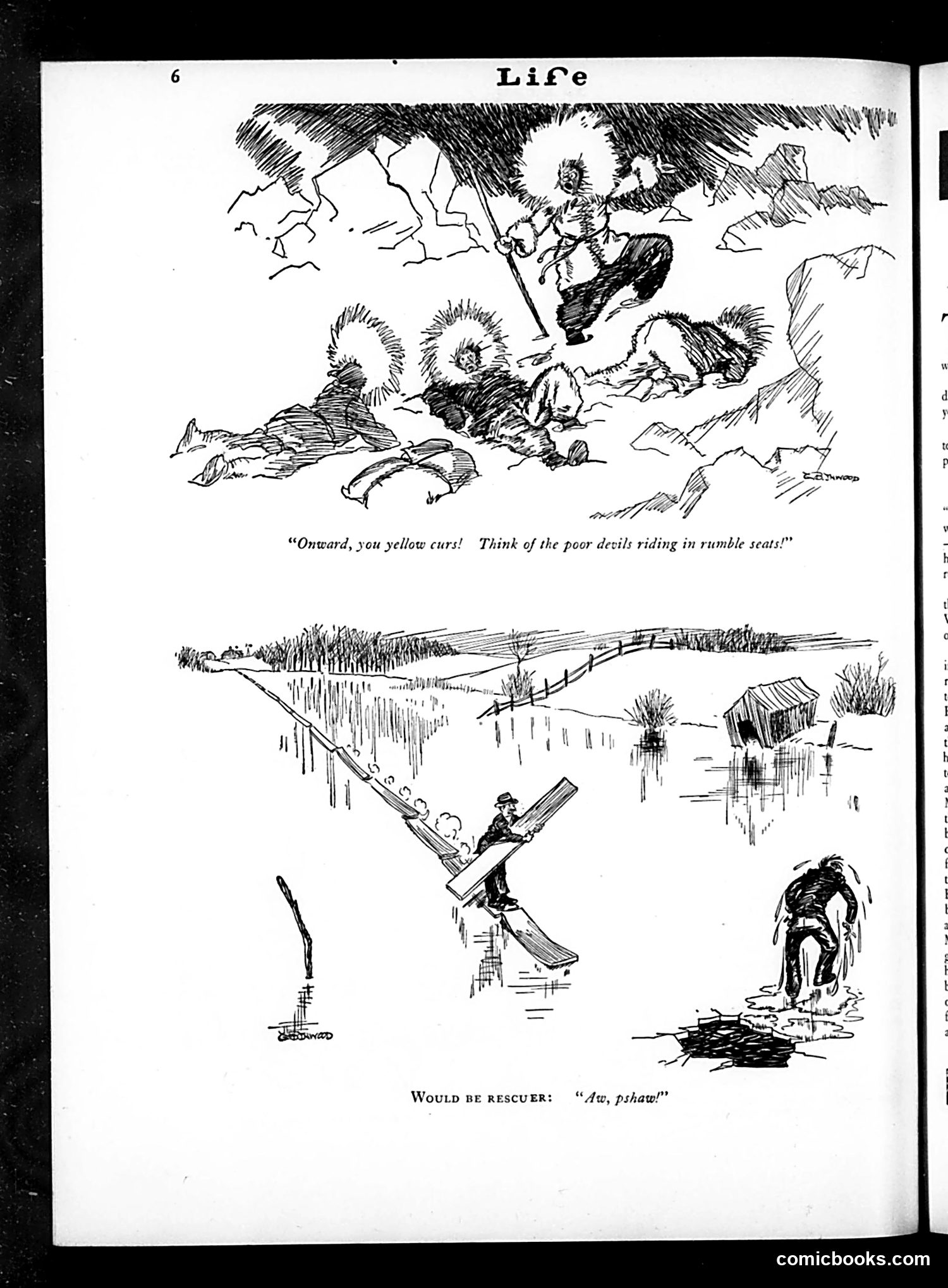
This page contains two cartoon panels satirizing reckless driving behavior. **Top panel:** Shows a car accident with passengers thrown about violently. The caption reads: "Onward, you yellow curs! Think of the poor devils riding in rumble seats!" This mocks drivers who speed recklessly while passengers—particularly those in the exposed rumble seats (rear-mounted seating popular in 1920s-30s cars)—face danger. The "yellow curs" insult suggests cowardice disguised as bravado. **Bottom panel:** Titled "Would be rescuer: 'Aw, pshaw!'" depicts someone attempting to help a person in water, apparently during a flooding or drowning scenario. The rescuer's dismissive attitude ("Aw, pshaw!") contrasts with the desperate situation. Both cartoons mock indifference to danger and suffering—one through reckless driving, the other through halfhearted rescue attempts. The satire targets callousness and false bravado.
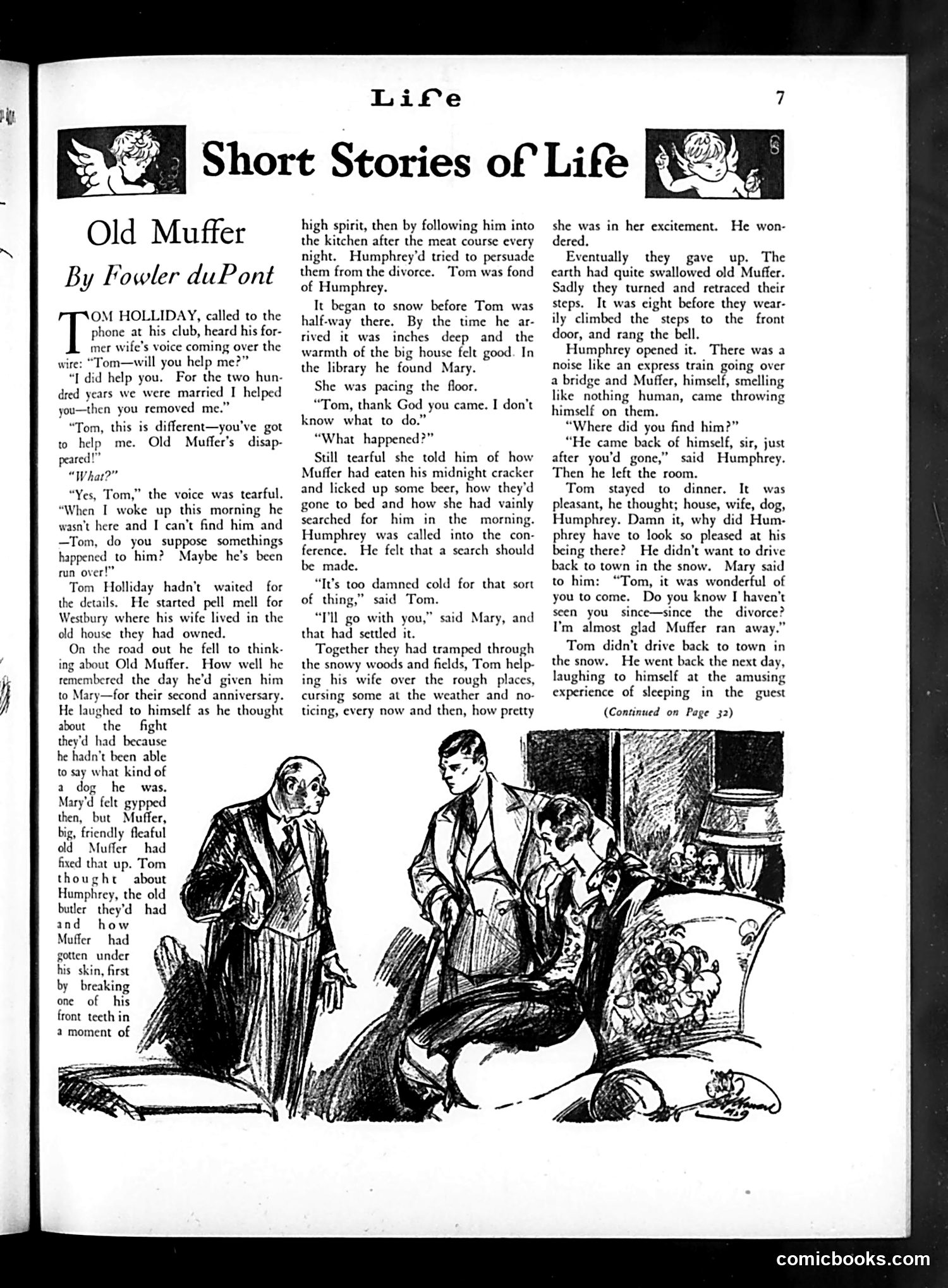
This is a humorous short story about marital discord, not political satire. The narrative concerns Tom Holliday, whose wife Mary calls him "Old Muffer" because he disappeared on their wedding night—a source of long-standing marital tension. The story's humor derives from domestic life: Tom left to help his brother, Mary thought he'd abandoned her, and years later when he finally returns home, their dog Humphrey eats their prized possession (Old Muffer the dog). The couple eventually reunites and laughs about the absurd situation. The accompanying illustration shows three figures in what appears to be a home interior, likely depicting a key moment in the reconciliation. The satire targets marriage mishaps and miscommunication rather than political figures.
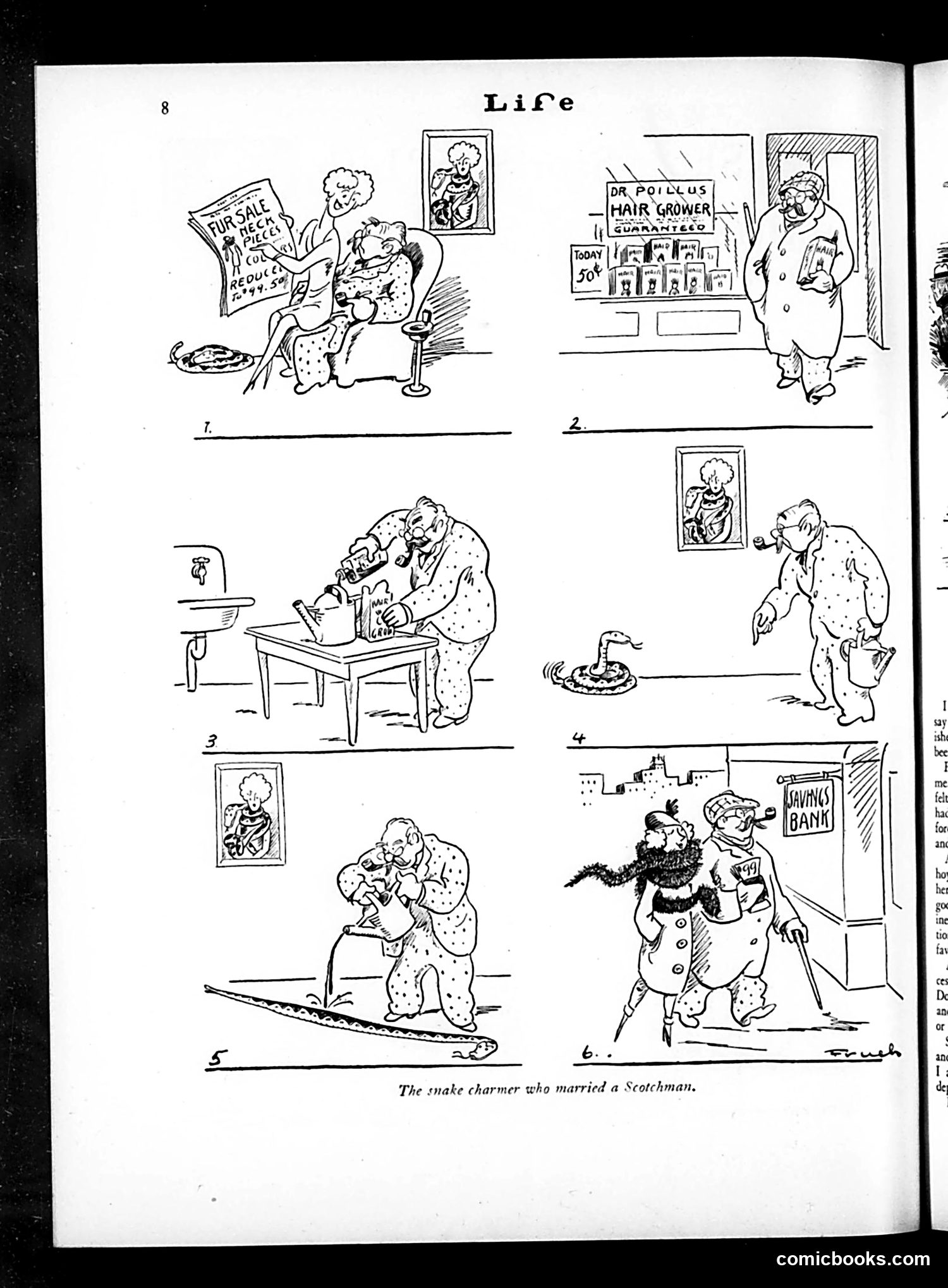
This six-panel comic strip satirizes married life through visual puns. Panel 1 shows a woman advertising "Fur Sale" while holding a newspaper—likely referencing both actual fur sales and marital discord. Panel 2 depicts a charlatan selling "Dr. Poiclus Hair Grower" (a fake patent medicine). Panels 3-5 show a man apparently struggling with domestic tasks and laundry. Panel 6 shows the couple at a Savings Bank, suggesting financial concerns. The title's punchline appears to reference the difficulty of "charming" a Scotsman (stereotyped as thrifty/stubborn) into marriage. The overall humor derives from depicting everyday marital frustrations—financial strain, household work, failed remedies—through slapstick situations typical of early 20th-century Life magazine humor.
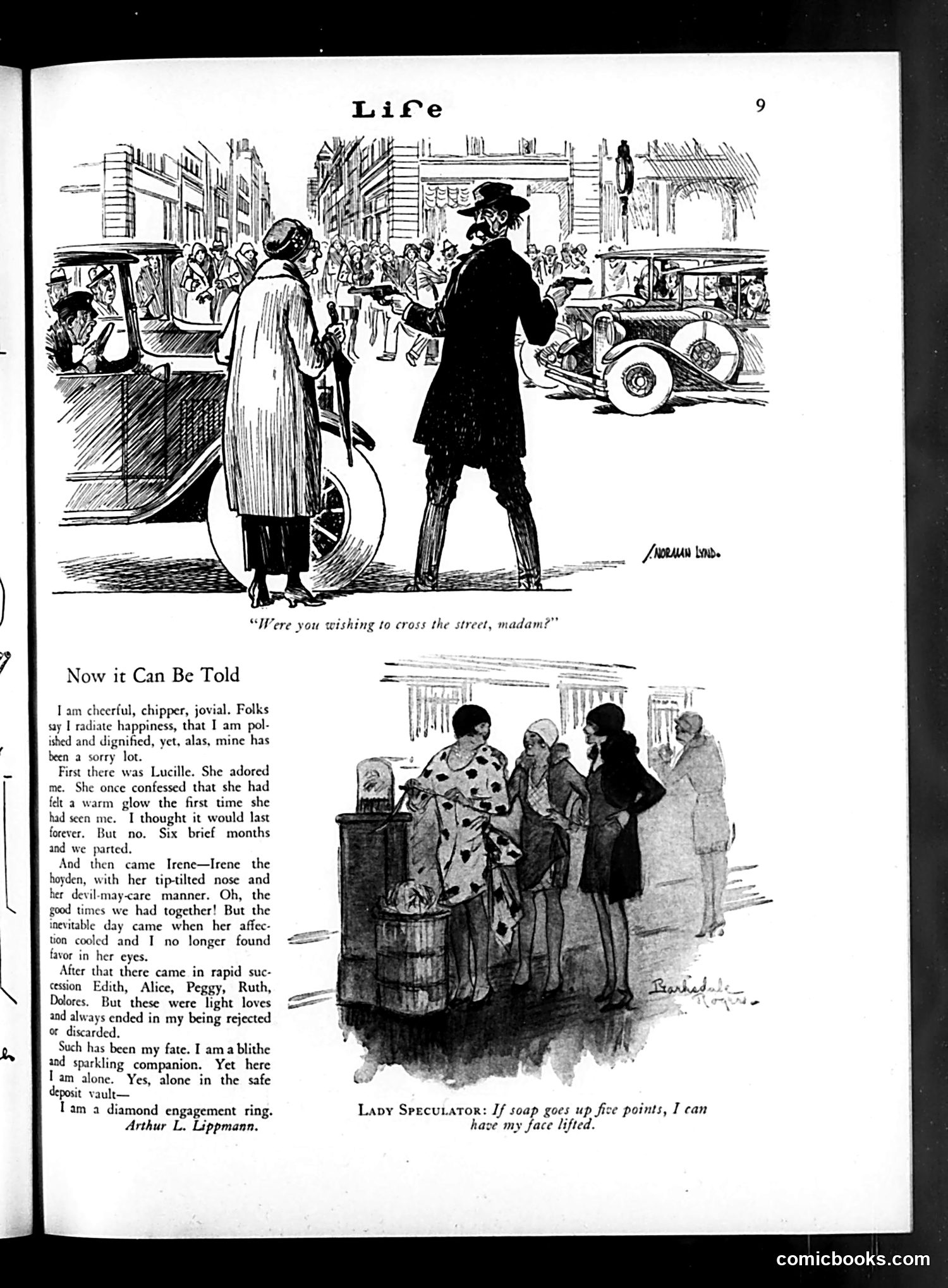
**Top Cartoon:** A street scene showing a uniformed policeman offering to help a woman cross the street, with the caption "Were you wishing to cross the street, madam?" The satire appears to mock overly formal or exaggerated chivalry from authority figures—the policeman's elaborate courtesy seems absurd given the mundane situation. **Bottom Cartoon:** Women discussing cosmetics, with one saying "If soap goes up five points, I can haze my face lifted." This jokes about women's obsession with beauty treatments and cosmetics during economic inflation—suggesting they'd sacrifice other necessities to maintain their appearance. **Text Section:** Arthur L. Lippmann's humorous autobiographical piece "Now it Can Be Told" recounts his romantic history in self-deprecating, sentimental terms, typical of Life's lighter humor content from this era.
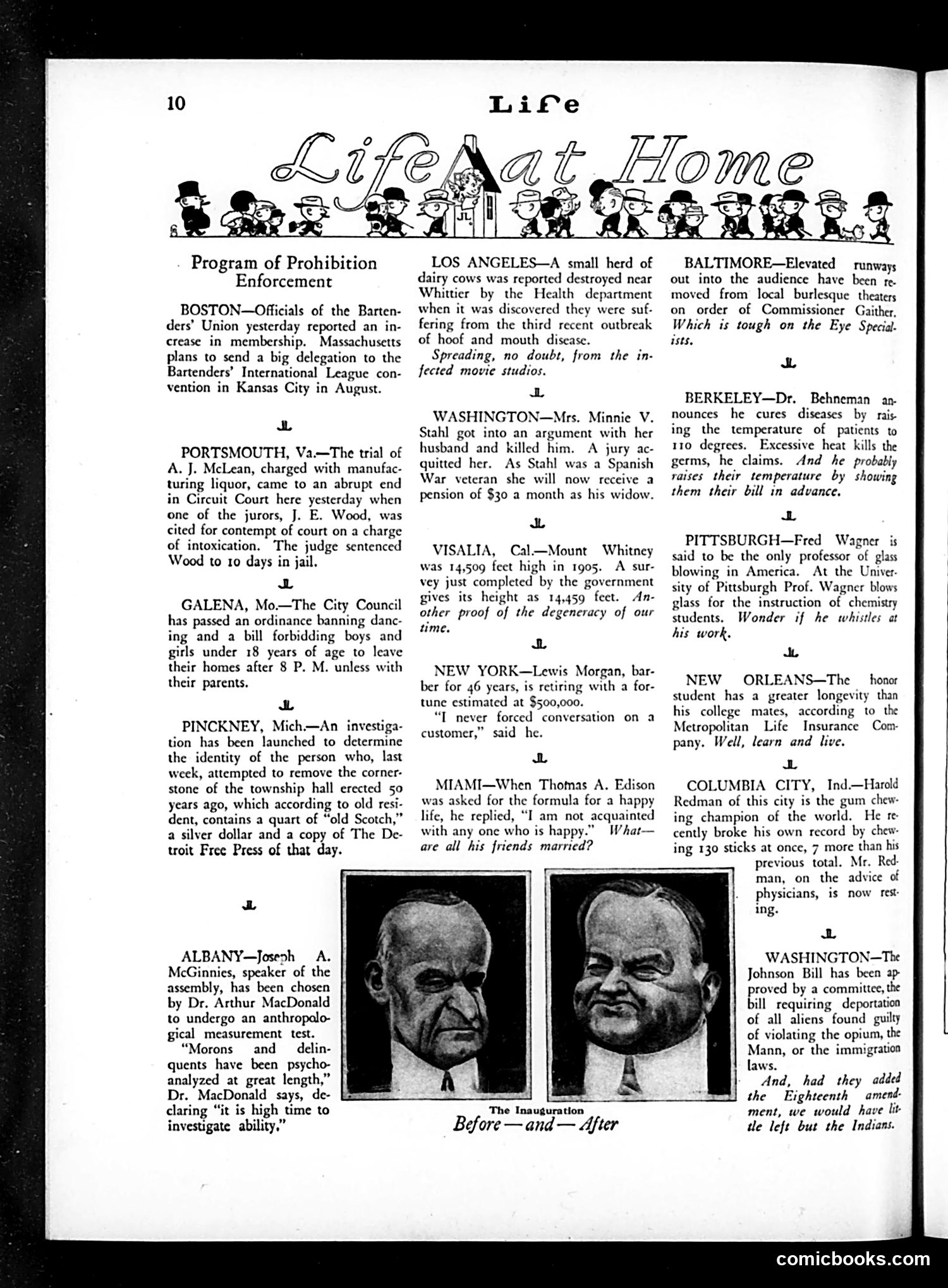
This page from *Life* magazine contains a two-panel political cartoon labeled "Before—and—After" showing facial transformation. The caption refers to "The Inauguration," indicating this satirizes a president's appearance following his swearing-in. The joke appears to be that the presidency visibly ages or changes a leader—the "before" image shows one facial appearance, while the "after" shows noticeably different features, likely exaggerated through caricature. Without the specific date visible, I cannot identify which president is depicted, but the concept satirizes how the demands of high office are said to age presidents prematurely or otherwise transform them. The surrounding text contains unrelated brief news items from various American cities.
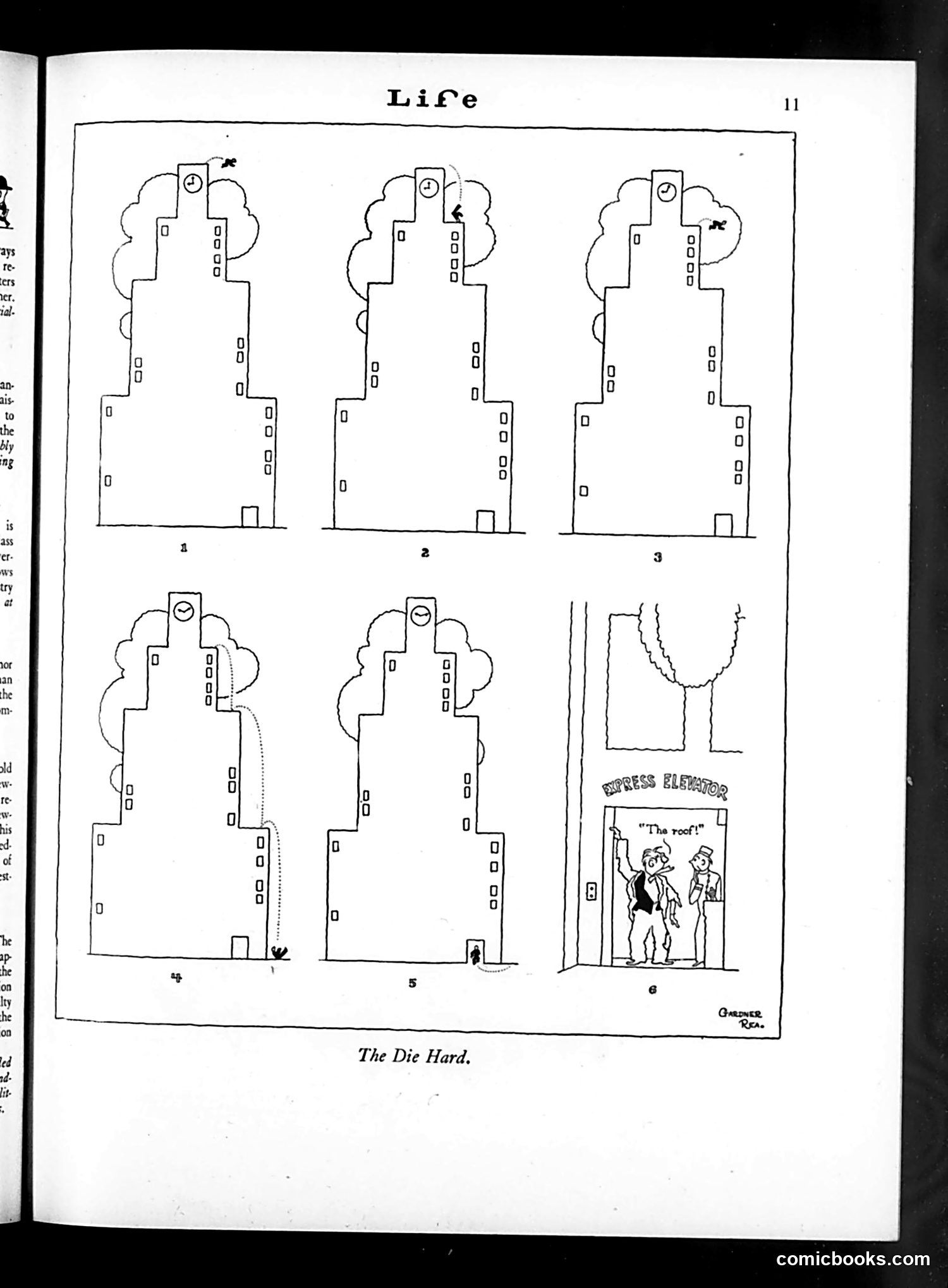
This page presents six numbered diagrams of tall buildings with anthropomorphized heads at the top, showing progressively deteriorating conditions. Diagrams 1-5 depict increasingly damaged structures with windows marked as vacant or broken, suggesting economic decline or abandonment. Diagram 6 shows an "Express Elevator" cartoon where two figures discuss "the roof," implying suicide—a dark commentary on financial ruin. The title "The Die Hard" references someone stubbornly resistant to change or collapse. This appears to satirize buildings or businesses refusing to modernize or adapt during economic hardship (likely the Great Depression era, given Life's satirical focus). The progression visualizes how obstinate resistance leads to inevitable, catastrophic failure.
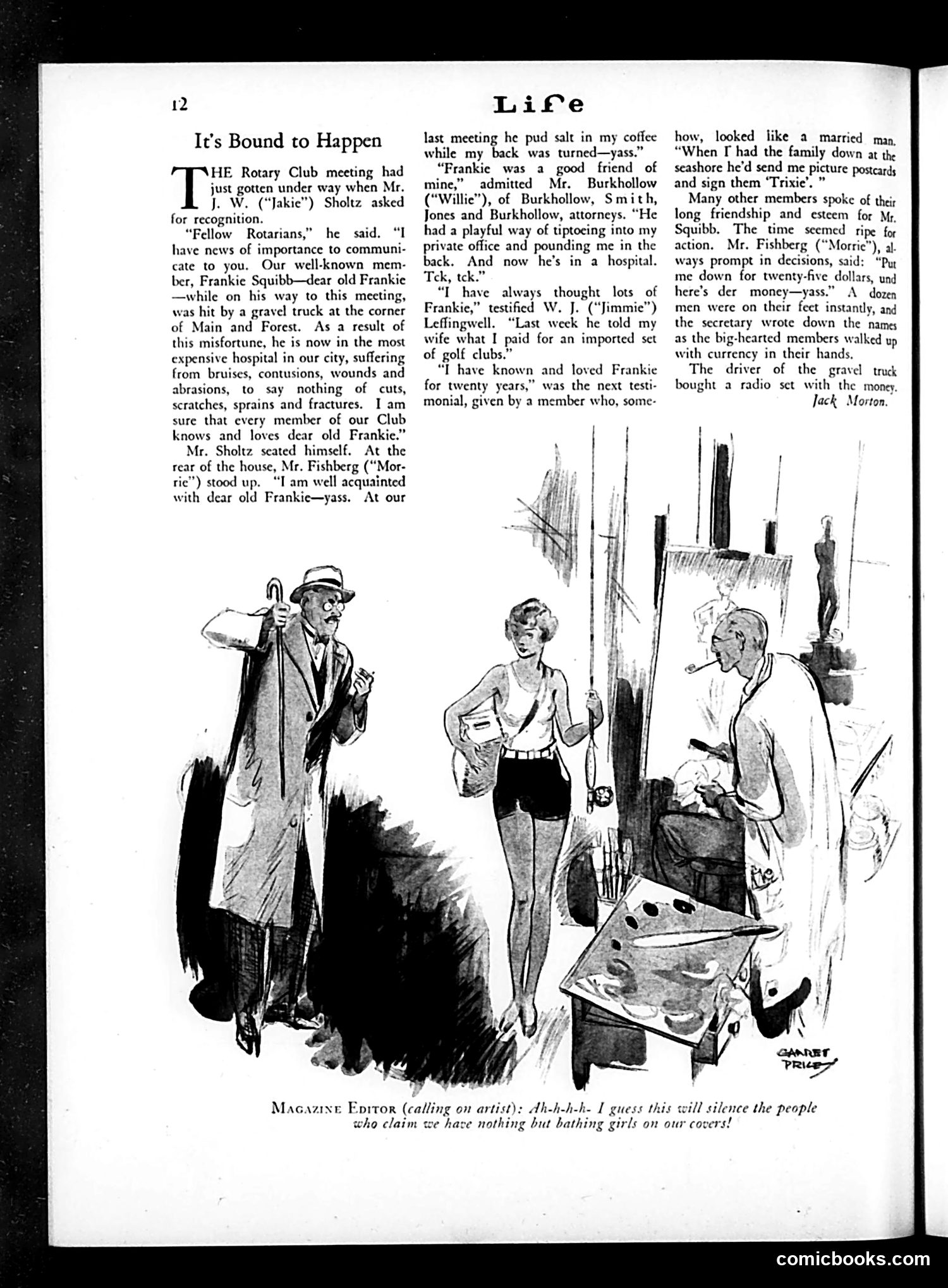
This page satirizes a Rotary Club meeting discussing an injured member, Frankie Squibb, hit by a gravel truck. Club members testify to Frankie's good character and generosity—he loaned money, gave golf clubs, and sent postcards from vacations. The bottom cartoon mocks magazine editors' defensive claims about their cover imagery. The "Magazine Editor (calling on artist)" states that publishing bathing girls on covers will silence critics who say magazines feature "nothing but bathing girls." The visual irony is obvious: the artist is literally surrounded by scantily-clad women in beach/artistic settings, contradicting the editor's claim. The satire targets both editorial hypocrisy and the magazine industry's reliance on sexualized imagery while denying it.
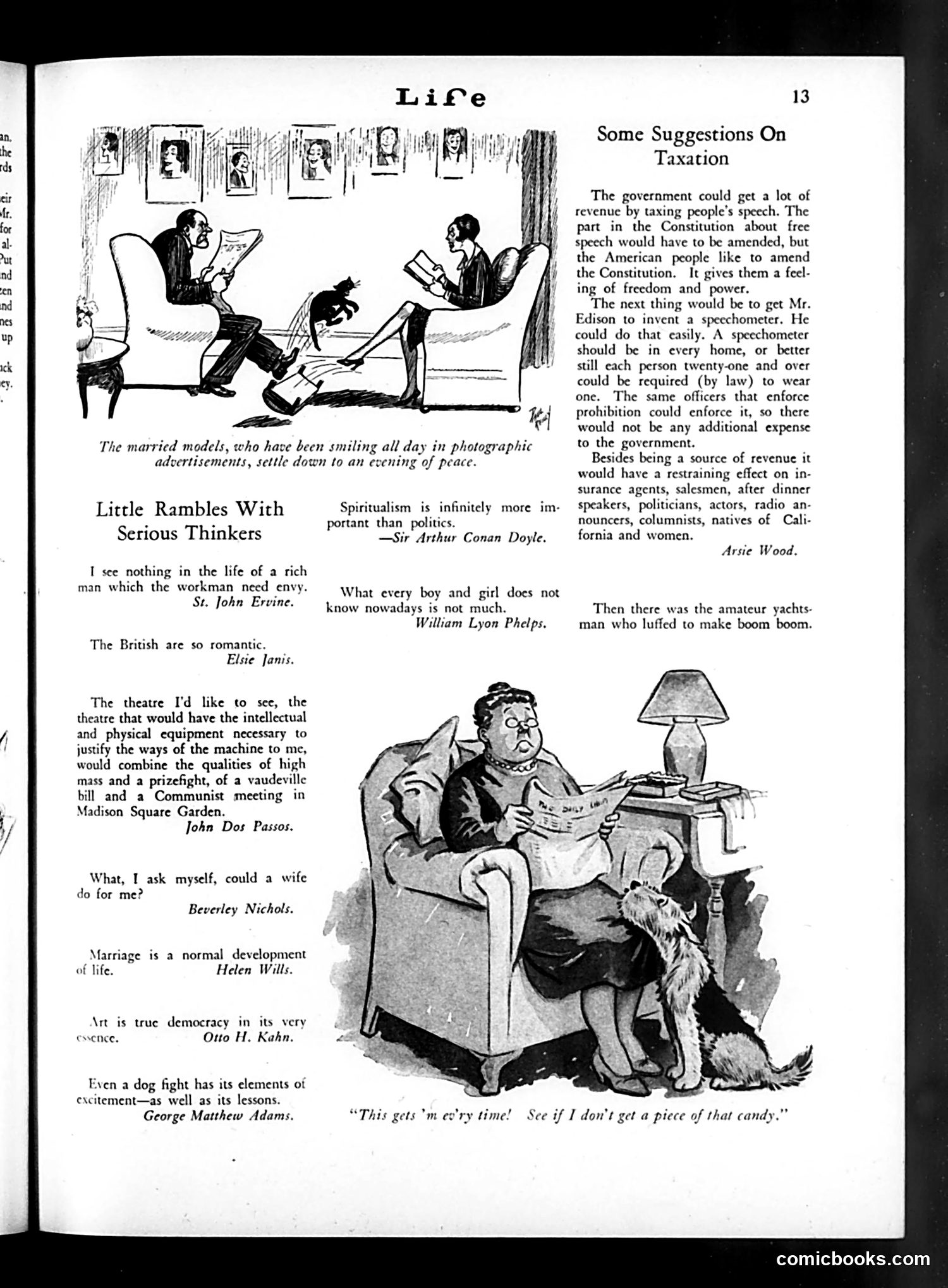
The top cartoon depicts a domestic scene where a man reads while a woman relaxes—both appearing content. The caption satirizes this as "The married models, who have been smiling all day in photographic advertisements, settle down to an evening of peace." This mocks advertising culture of the era, which presented idealized domestic scenes featuring models. The joke suggests these picture-perfect moments were artificial performances for commercial purposes, contrasting the staged happiness with actual married life. The lower cartoon shows a portly man in an armchair reading, with a dog at his feet, captioned about candy—likely a humorous domestic complaint about a wife's nagging or domestic demands. The page combines these visual jokes with various philosophical quotes about marriage, romance, and human nature, reflecting Life's satirical approach to American social conventions.
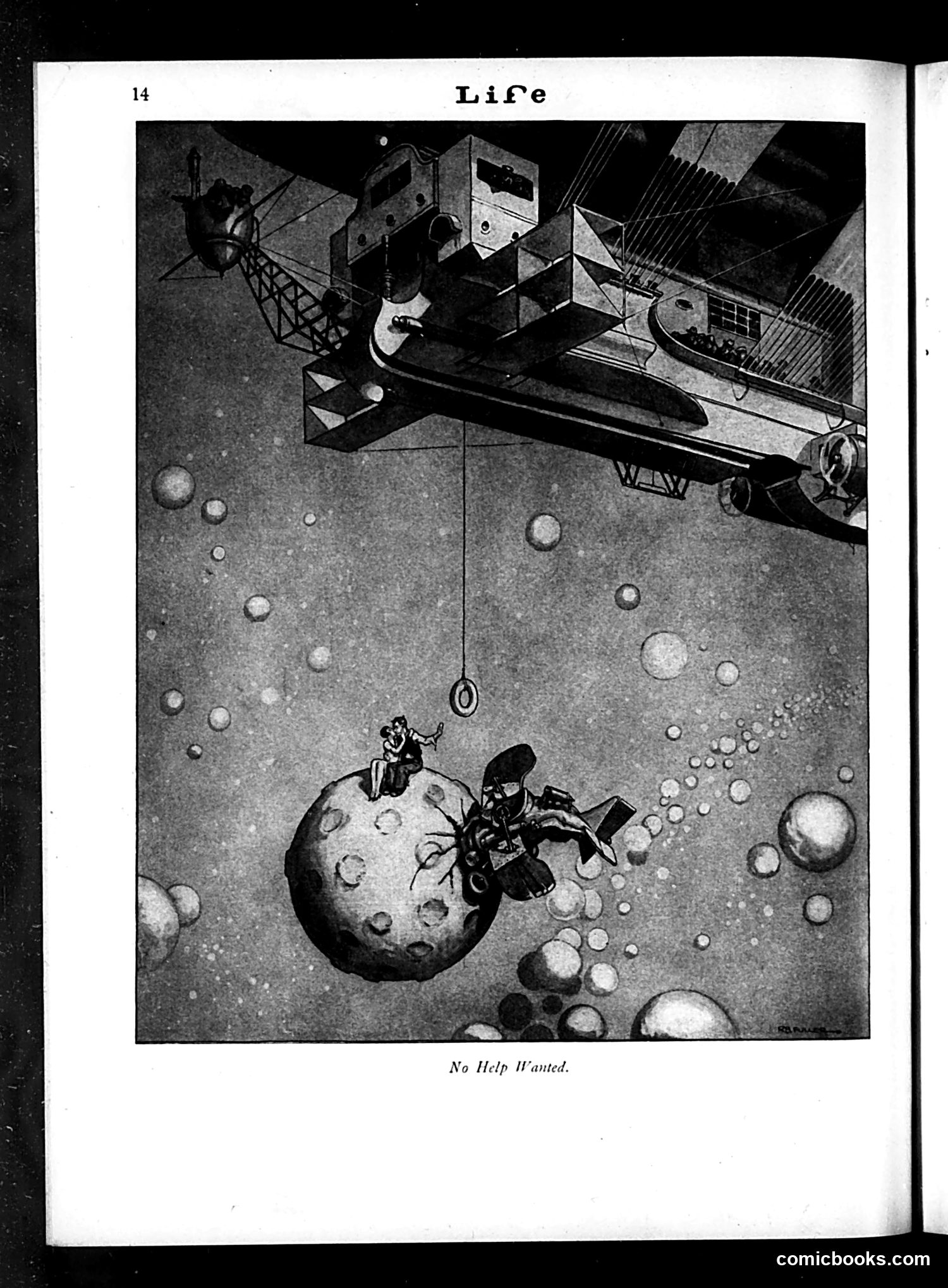
This is a science fiction illustration titled "No Help Wanted" depicting an underwater or alien scene. Two figures in spacesuits appear to be exploring a cratered planetary body surrounded by floating spheres of various sizes. A spacecraft with mechanical appendages hovers above them. The caption's meaning is unclear without additional context. It could be satirizing: - Labor conditions or employment discrimination (the "no help wanted" sign reference) - Space exploration ambitions - Colonial expansion into new territories The illustration style suggests this is from an early-to-mid 20th century Life magazine issue. However, without knowing the specific date or accompanying article text, I cannot definitively identify what contemporary political or social issue this cartoon addresses. The satire likely commented on something topical to its publication date.
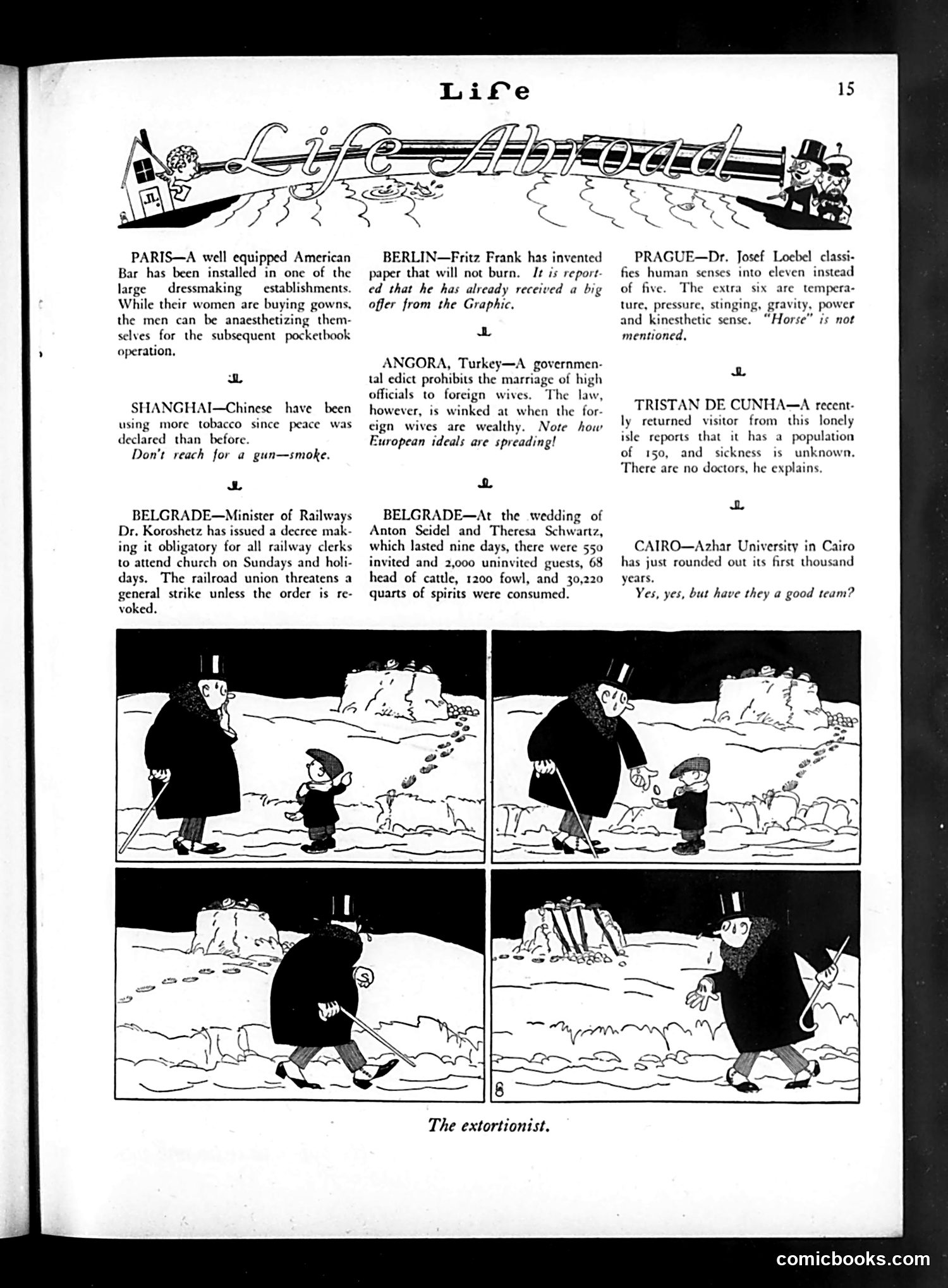
This four-panel comic depicts a wealthy man in formal dress being progressively extorted by a small child in a snowy landscape. In each panel, the child demands payment (indicated by the child's gestures), and the man complies by surrendering his possessions—first his cane, then his coat, and finally his hat and remaining belongings. The satire targets exploitation through coercion. The reversal of power—a helpless wealthy figure victimized by a powerless child—creates dark humor about forced redistribution or blackmail. The title "The Extortionist" ironically labels the child the criminal, though the visual clearly shows the man as the victim being systematically stripped of his assets through intimidation, likely commentary on taxation, political pressure, or corrupt dealings of the era.
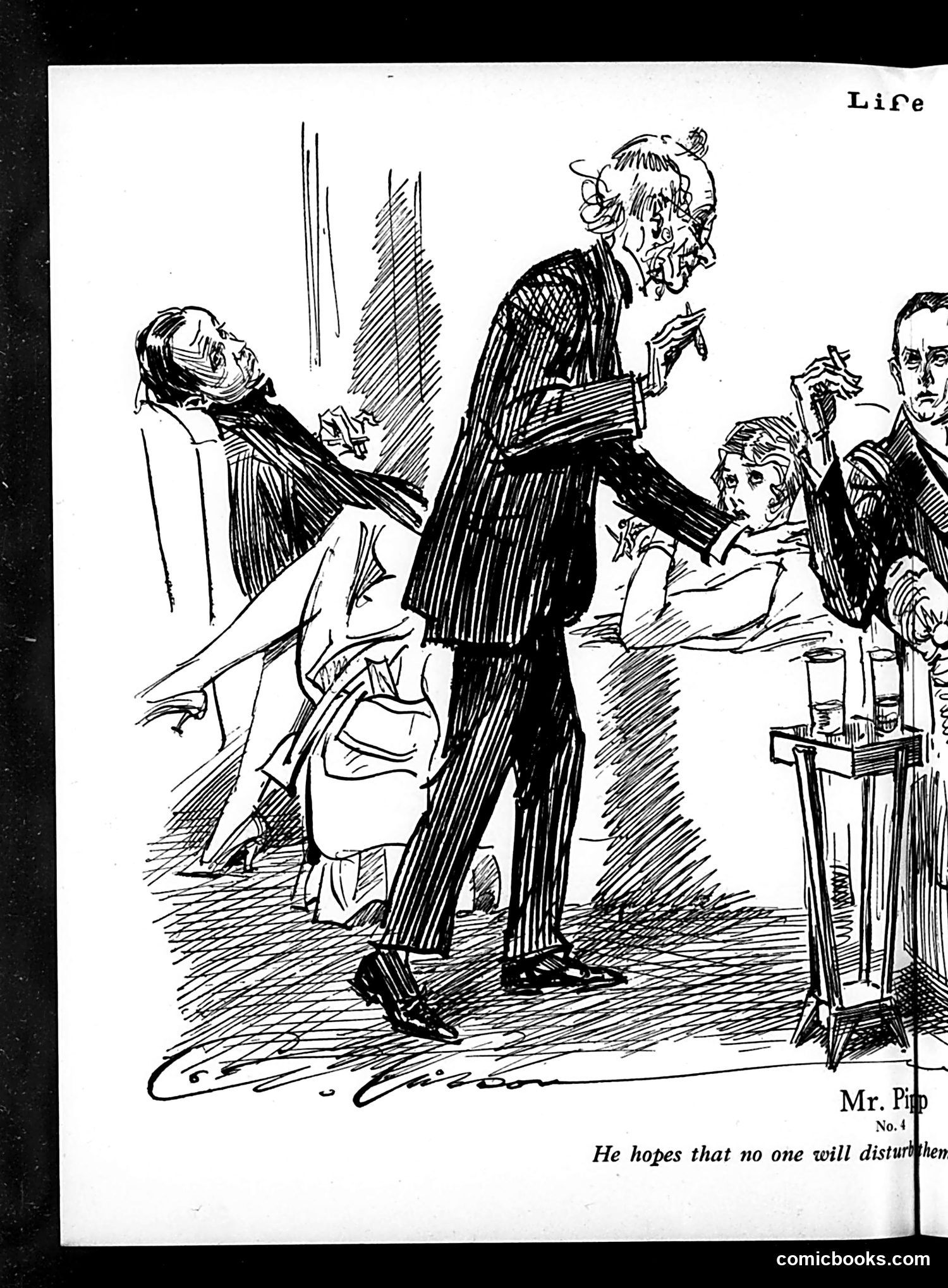
This is a satirical cartoon labeled "Mr. Pip, No. 4" with the caption "He hopes that no one will disturb them." The cartoon depicts a tall, thin gentleman in formal dress (top hat and suit) standing amid a group of socialites at what appears to be a party or social gathering. The humor seems to derive from an awkward or compromising social situation—the gentleman appears anxious about maintaining discretion regarding whatever is occurring around him. Without additional context about who "Mr. Pip" is or what specific scandal or social behavior is being mocked, the exact target of the satire remains unclear. The cartoon likely references a recognizable public figure or social type from the era, but this identity cannot be determined from the image alone.
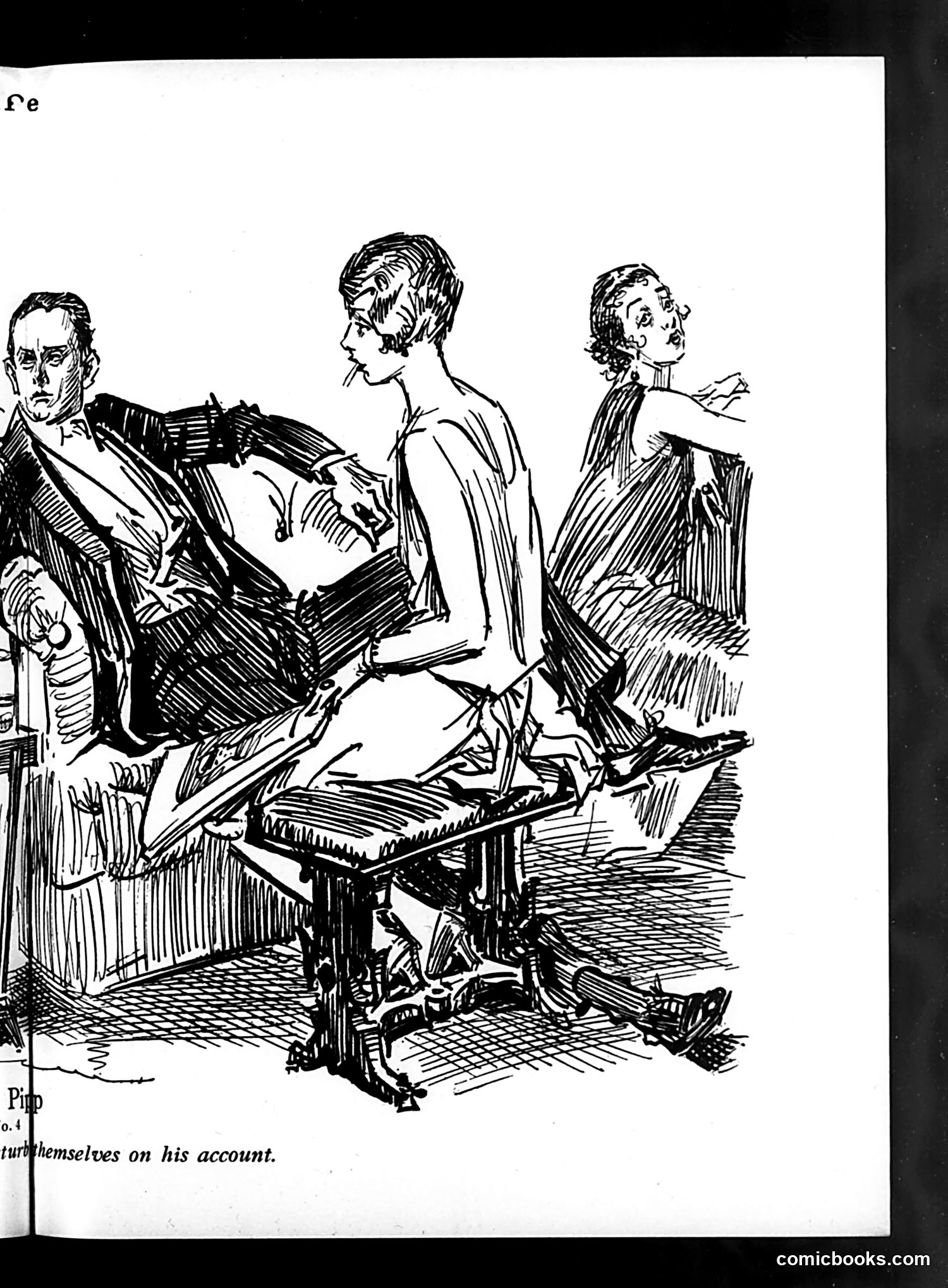
This is a satirical drawing showing three well-dressed figures in what appears to be a social or professional setting. The visible caption fragment reads "...ture themselves on his account," suggesting the cartoon critiques people who boast about or take credit for someone else's actions or reputation. The sketch depicts formal 1910s-era clothing and styling. Without the complete caption or additional context, the specific political or social figures being mocked cannot be definitively identified. The satire appears to target social pretension—people presenting themselves favorably based on association with someone more prominent or accomplished rather than their own merit. The drawing style is characteristic of *Life* magazine's satirical illustration approach from that era.
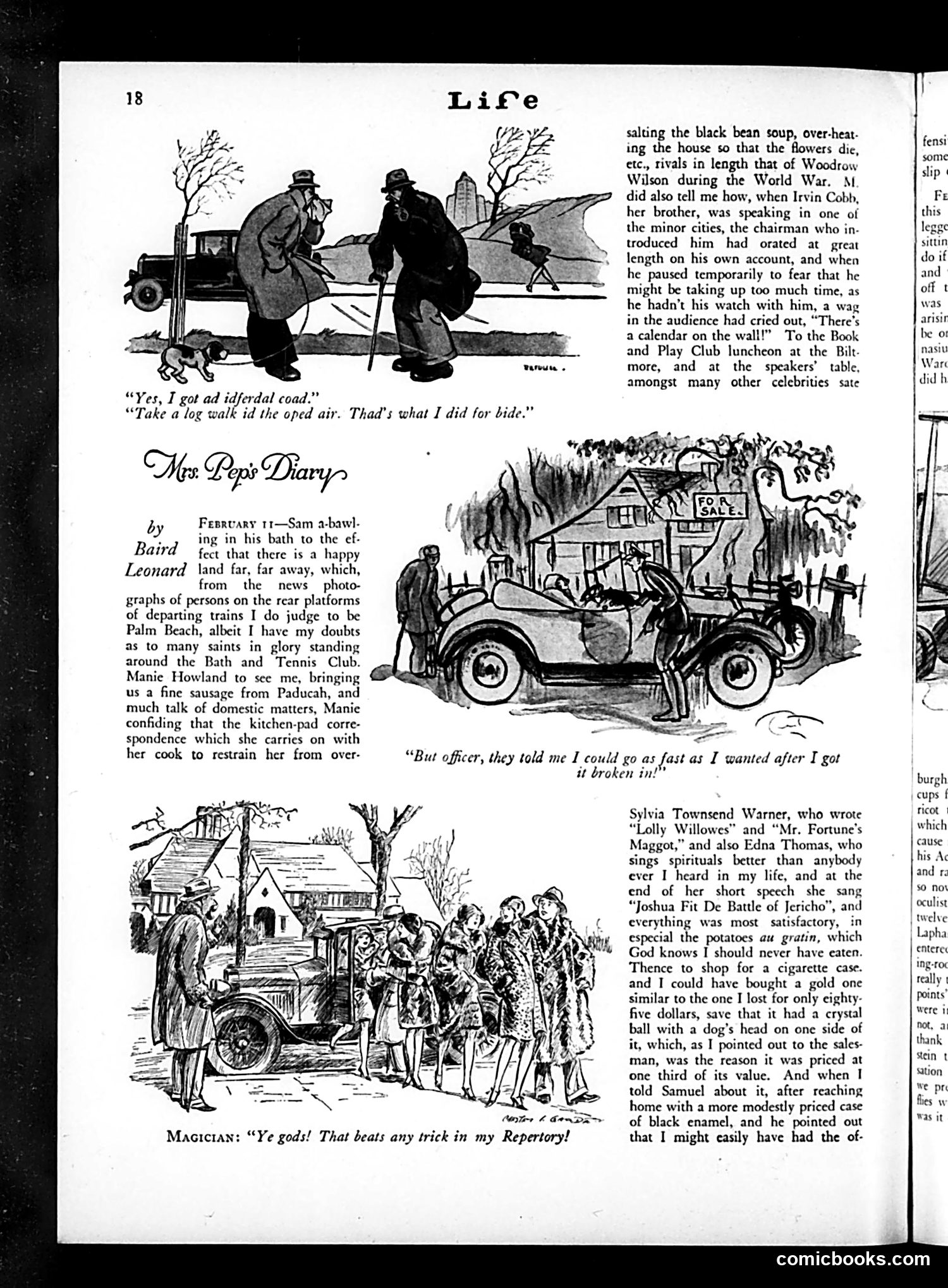
This page from *Life* magazine contains satirical content from February 1924, presented as "Mrs. Pep's Diary" by Baird Leonard. **The cartoons illustrate domestic complaints:** The top cartoon shows a man complaining about a "dreadful road" to his companion—the joke being he took a long walk in open air, which he claims was his contribution. The middle cartoon depicts a broken-down car outside a junk/salvage shop, with the driver telling a police officer he was told he could "go as fast as I wanted after I got it broken in"—satirizing post-WWI consumer culture and poor automobile quality. The bottom cartoon shows a magician performing tricks, captioning "That beats any trick in my Repertory!"—context unclear from this excerpt. **The diary text** humorously catalogs domestic annoyances (overheating a house, kitchen correspondence with servants) and social observations from a literary luncheon featuring speakers including Sylvia Townsend Warner and Edna Thomas. The satire targets everyday marital frustrations and the absurdities of 1920s social life and consumer products.
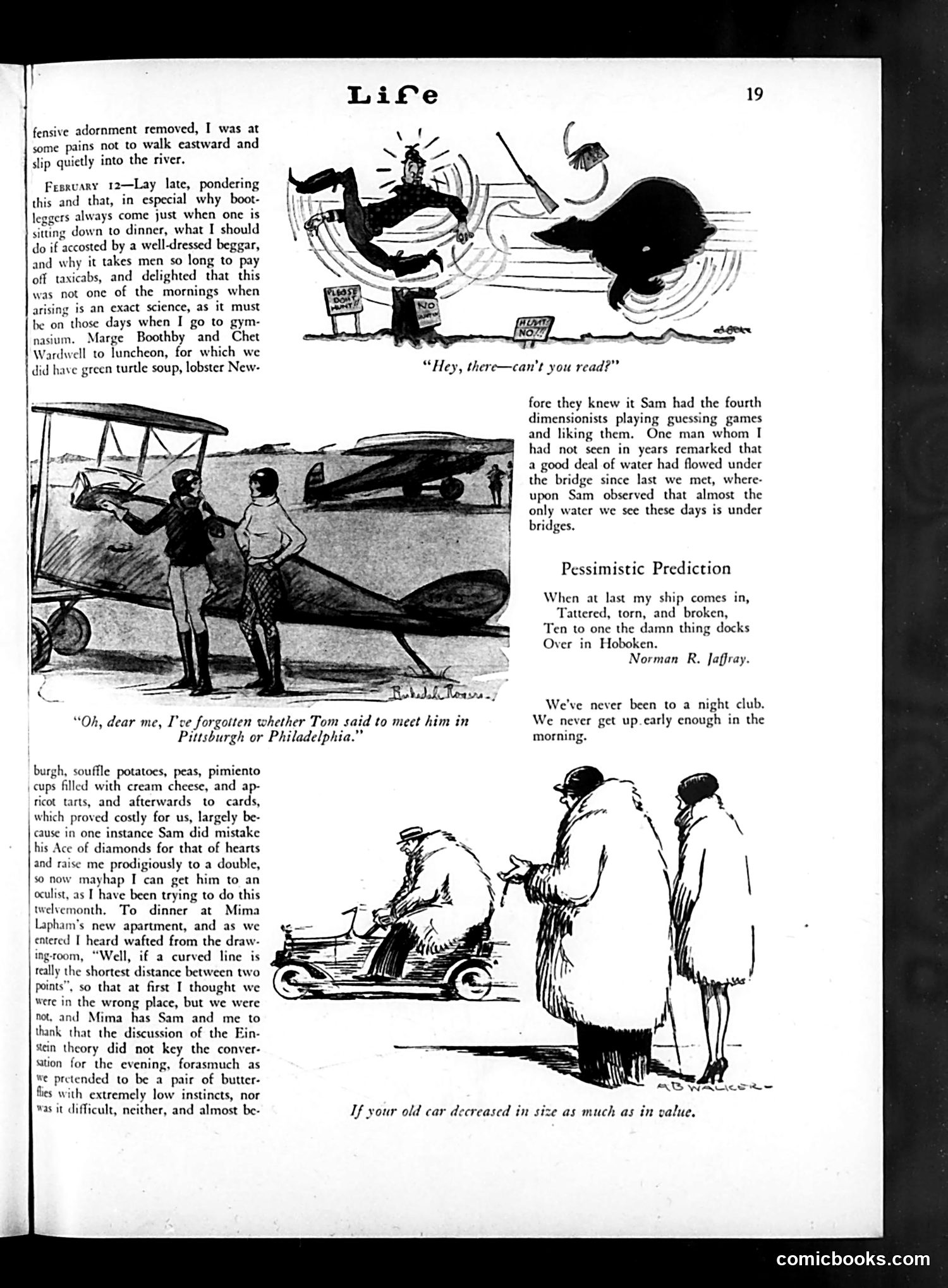
This page from *Life* magazine presents satirical observations on 1920s upper-middle-class urban life. **Top cartoons:** The first shows a woman at a typewriter being startled by a man falling through a window—a visual gag about domestic interruptions. The second depicts someone confused about meeting locations (Pittsburgh vs. Philadelphia)—poking fun at social forgetfulness. **Main text:** A diary entry chronicles trivial concerns: bootleggers arriving at dinner (Prohibition-era smuggling), tipping taxi drivers, and an evening where Einstein's relativity theory becomes dinner conversation before the narrator and companion pretend to be "butterflies" to redirect discussion—satire of intellectualism among the wealthy. **"Pessimistic Prediction" poem:** Mocks the phrase "when my ship comes in" (success/wealth) by suggesting it will arrive broken and docked in unfashionable Hoboken, New Jersey—cynical about American prosperity. **Bottom cartoon:** Shows well-dressed people with a decrepit car, captioning the irony that the vehicle has lost more in value than in size—Depression-era humor about economic decline and status symbols.
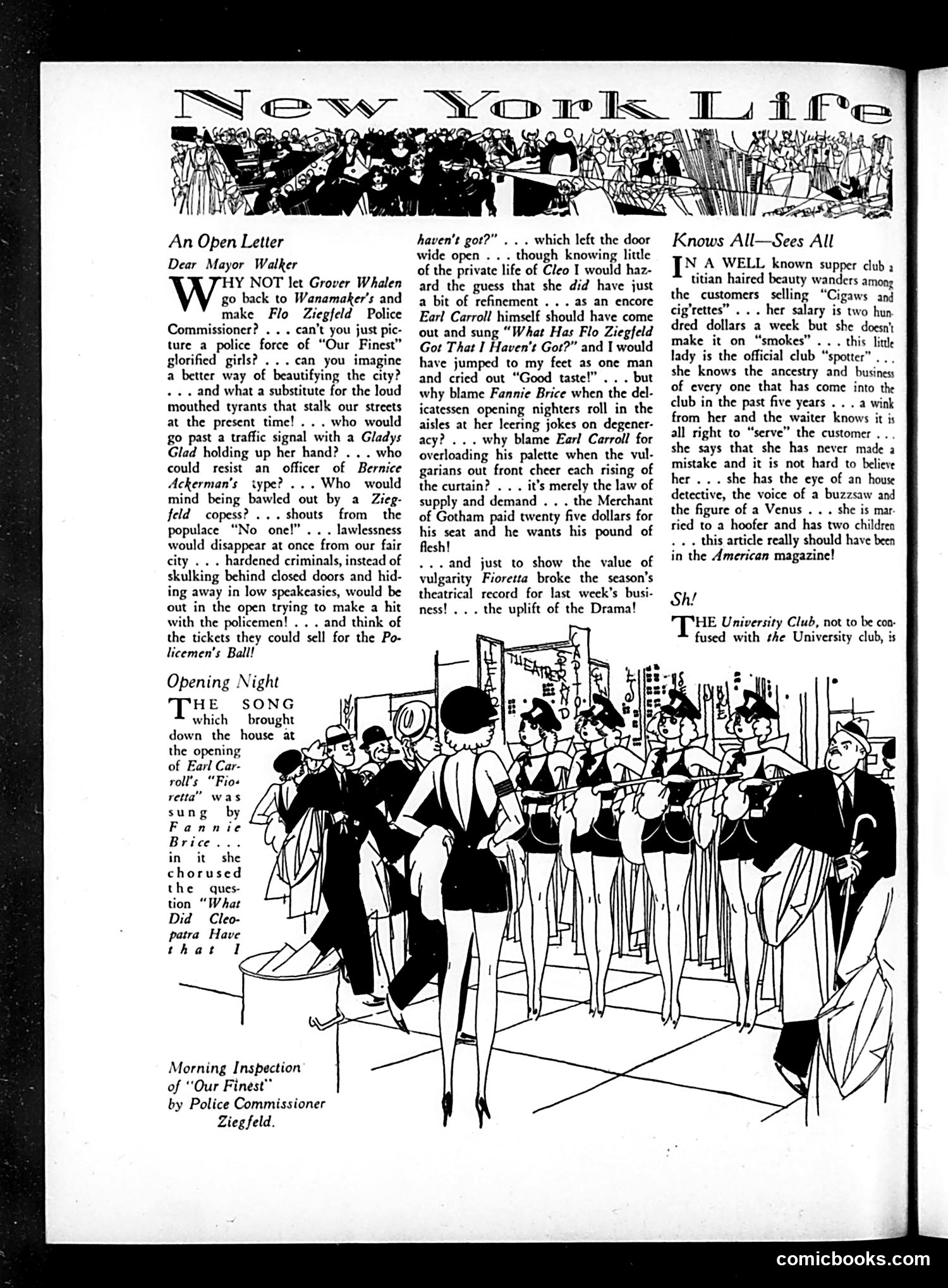
This page satirizes 1920s New York nightlife and civic management. The "Open Letter" mocks Mayor Jimmy Walker's administration by sarcastically proposing Police Commissioner Grover Whalen be replaced by theatrical impresario Flo Ziegfeld—suggesting he staff the police force with Ziegfeld's chorus girls. The joke exposes the city's moral hypocrisy: rather than reduce crime, beautiful female officers would distract criminals into committing offenses openly. The cartoon below illustrates this absurdist premise: women in scanty Ziegfeld attire conducting a police "Morning Inspection." A secondary satire criticizes Earl Carroll's theatrical revue "Fioretta" for vulgar content (Fannie Brice's suggestive song about Cleopatra), arguing that audiences' demand for lowbrow entertainment drives supply—blame the public, not the performers. The page mocks both civic corruption and Jazz Age excess, suggesting New York's leadership prioritized spectacle over governance.
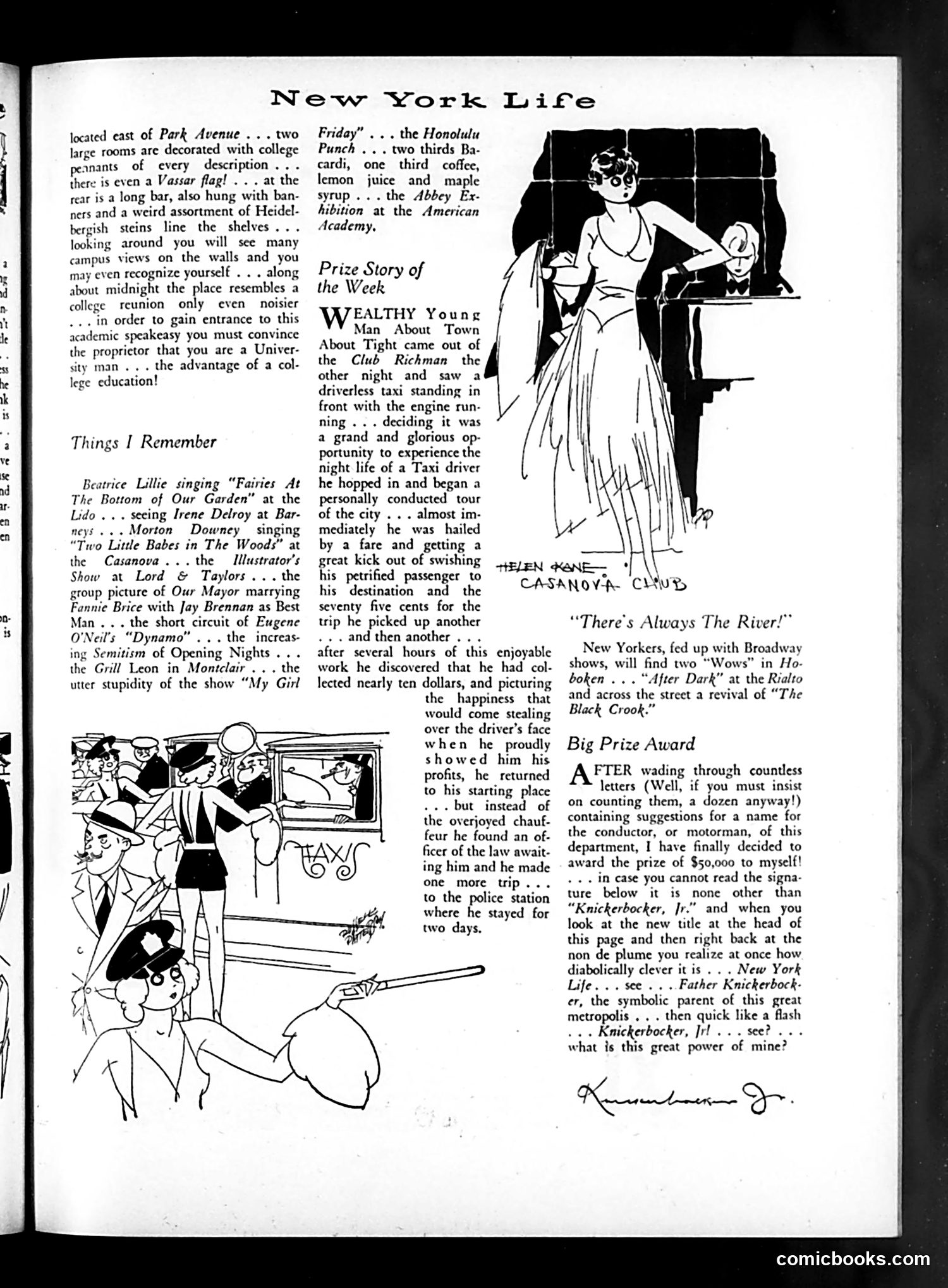
This Life magazine page satirizes 1920s Manhattan nightlife and culture through three sections: **Top illustration**: A speakeasy disguised as a college-themed bar near Park Avenue. The satire targets Prohibition-era establishments that required patrons to prove university affiliation for entry—mocking both the pretentious gatekeeping and the absurdity of enforcement during the alcohol ban. **"Prize Story of the Week"**: A humorous anecdote about a wealthy "young man about town" who impulsively steals a taxi for a joyride. Thinking himself clever, he poses as a cabbie, collects fares, and plans to surprise the actual driver with "profits"—only to be arrested. The joke mocks his oblivious entitlement and naïveté. **Bottom section**: Commentary on Broadway theater and a tongue-in-cheek announcement that the author (signing as "Knickerbocker, Jr.") has awarded himself a $50,000 prize for naming this department. It's self-aware satire playing on "Father Knickerbocker," the symbolic personification of New York City, establishing the author's self-appointed authority over Manhattan life commentary.
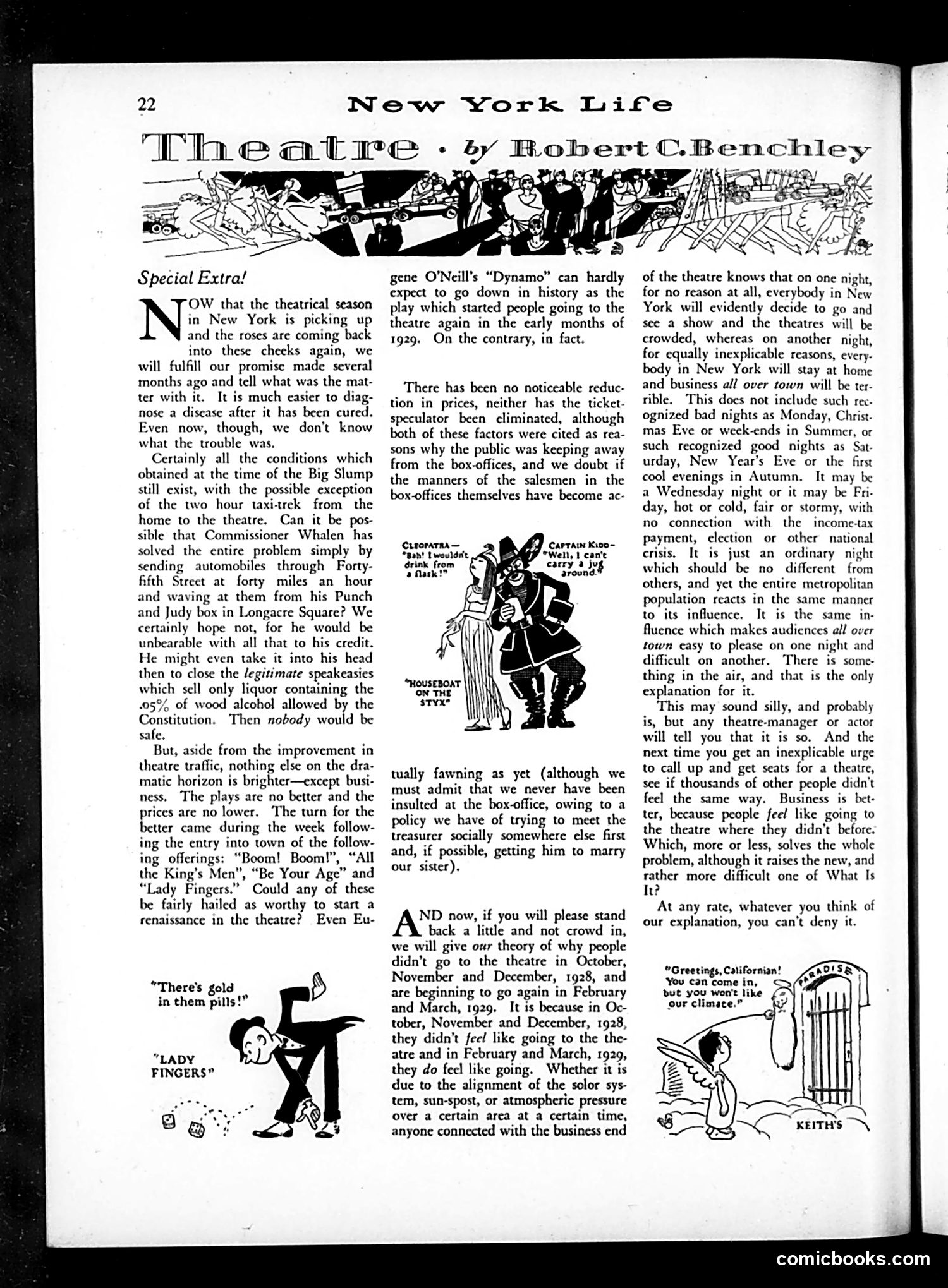
This is Robert C. Benchley's humorous theatre column from *Life* magazine (circa 1929), analyzing why Broadway experienced a slump in late 1928 but recovered by early 1929. **The Satire's Points:** The column mockingly examines supposed causes for the theatre's decline—traffic congestion, high prices, ticket speculation, rude box-office staff—only to dismiss them all. Benchley's actual "theory" is deliberately absurd: people simply didn't *feel* like going to the theatre in October-December 1928, but did in February-March 1929, for no rational reason whatsoever (possibly solar alignment or atmospheric pressure). **The Small Cartoons:** "Lady Fingers" depicts a performer with pills, punning on the title. "Cleopatra" and "Captain Kidd" show period-costume characters. "Keith's" advertises a cinema. **The Joke:** Benchley brilliantly satirizes business analysis by offering a tautological "explanation"—people went when they wanted to go—disguised as insider wisdom, mocking both theatre industry pretensions and economic explanations for the recent stock market crash.
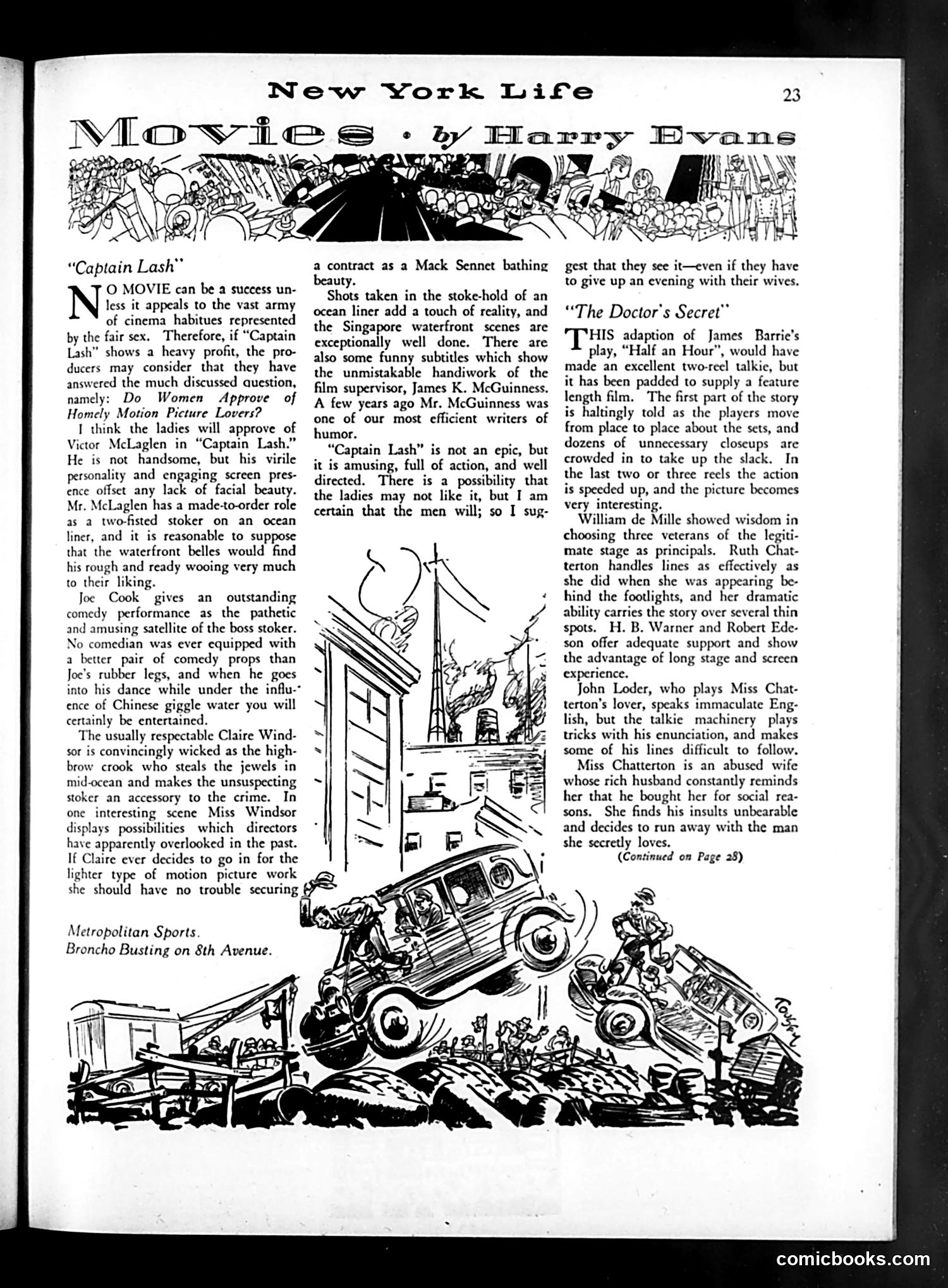
This page reviews three films for a 1920s audience. The main illustrated cartoons are humorous visual gags: **"Captain Lash"** review discusses whether homely leading man Victor McLaglen appeals to female moviegoers—a genuine industry concern of the era. The text argues his "virile personality" compensates for lack of beauty. Joe Cook's "rubber legs" comedy and Claire Windsor's villainy are praised. The illustrations show slapstick action typical of silent films—a car crash sequence and characters in physical comedy. **"The Doctor's Secret"** adapts James M. Barrie's play, criticized for padding a two-reel story into feature length. It stars stage veterans Ruth Chatterton (an abused wife), H.B. Warner, and Robert Edeson. The review notes early sound film's technical problems—John Loder's "enunciation" is distorted by primitive microphone technology. The cartoons visualize the physical comedy and melodrama these silent and early-talkie films featured, targeting the broad audience—particularly women—that studios courted.
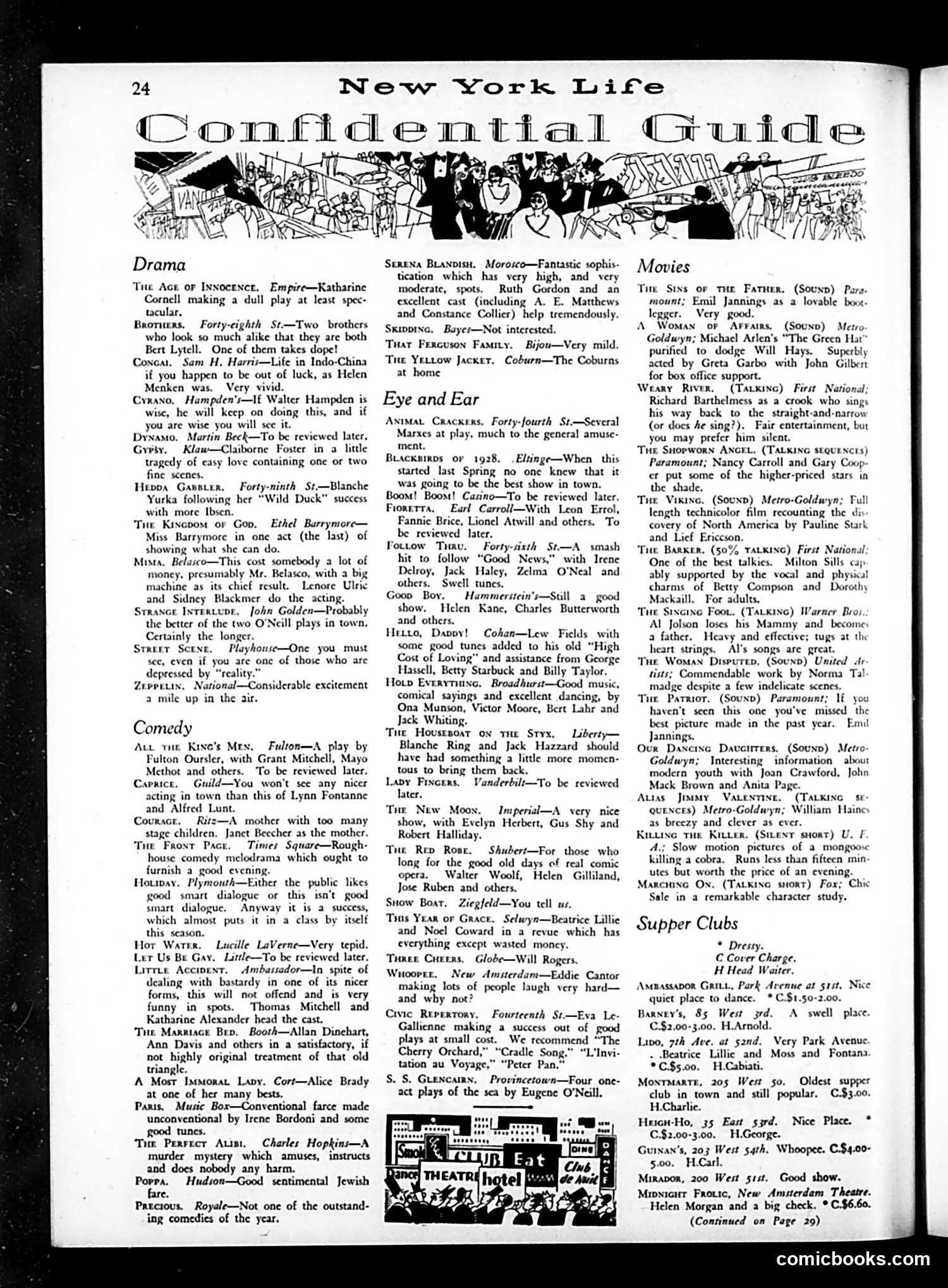
This is a **theater and entertainment review page** from Life magazine, not a political cartoon. The page contains capsule reviews of Broadway plays, comedies, musicals, and supper clubs circa the 1920s. The content reflects entertainment criticism of the era, mentioning prominent performers like Katharine Cornell, Ethel Barrymore, and the Marx Brothers. Reviews are brief and punchy—typical of Life's satirical, witty house style. Notable is the **casual frankness**: reviewers note when shows are dull, expensive failures, or morally questionable (references to "bastardy"). The tone assumes readers know Broadway intimately. The small advertisement at bottom depicts a theater marquee, reinforcing the entertainment focus. This page demonstrates how Life mixed theatrical satire with genuine entertainment journalism, speaking to New York's educated, theater-going audience of the 1920s.
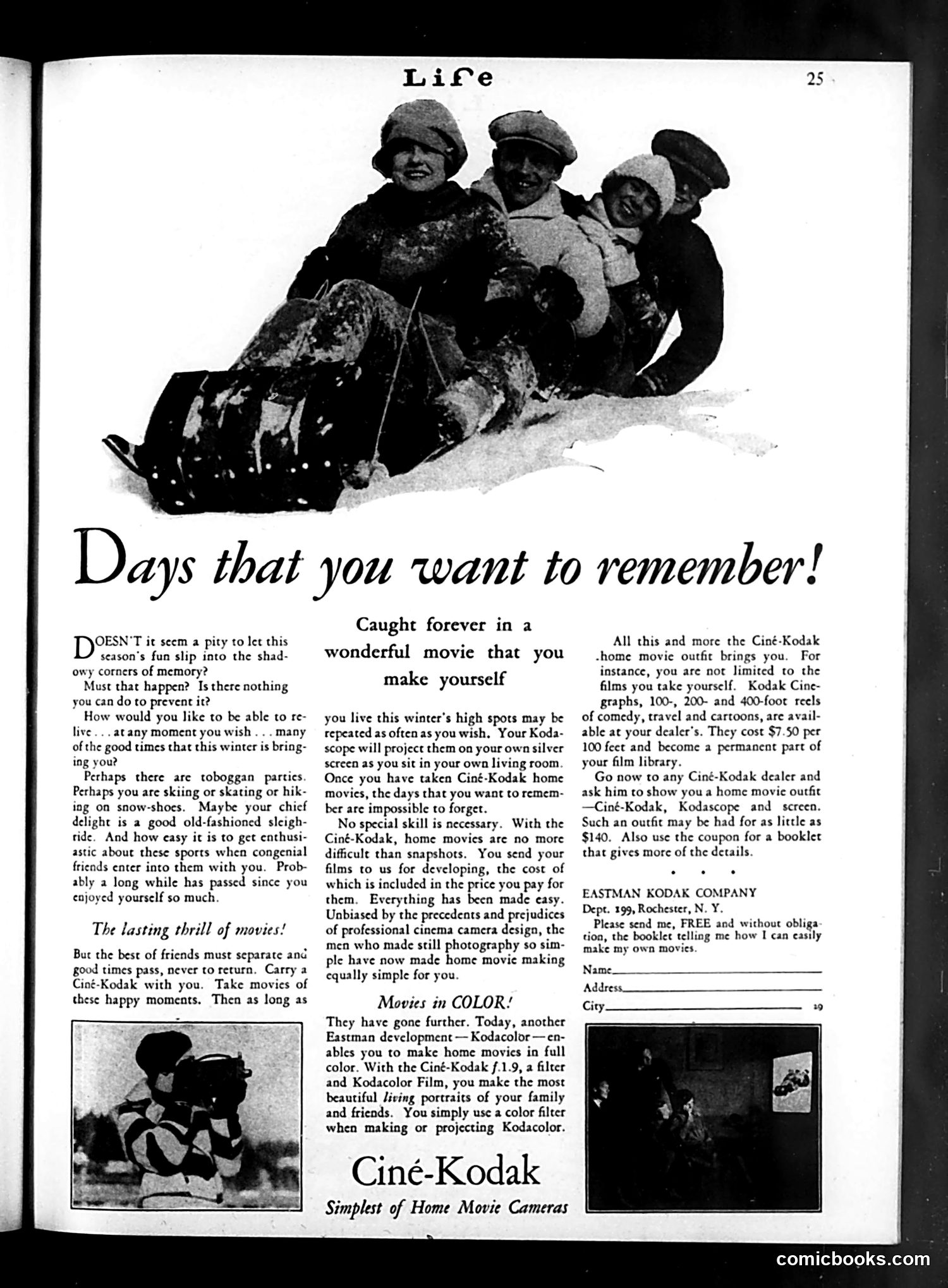
This is primarily a **product advertisement**, not a political cartoon. It promotes Eastman Kodak's home movie camera system to the American middle class. The page shows four people sledding down a snowy hill—a leisure scene representing the "days that you want to remember." The ad's pitch is straightforward: purchase a Ciné-Kodak camera to film winter activities (sledding, skiing, skating) so you can relive these moments indefinitely through home projection. The social context reflects **interwar consumer culture**: the assumption that families with disposable income should document and preserve their recreational moments. The ad emphasizes ease ("no special skill necessary") and accessibility, positioning home moviemaking as a democratized version of professional cinema. Notable is the mention of **Kodacolor film**—color home movies were a cutting-edge luxury. The $140 price tag (substantial for the era) indicates this product targeted affluent consumers. There is no satire or political commentary visible—this is a straightforward commercial appeal to nostalgia, family bonding, and technological progress.
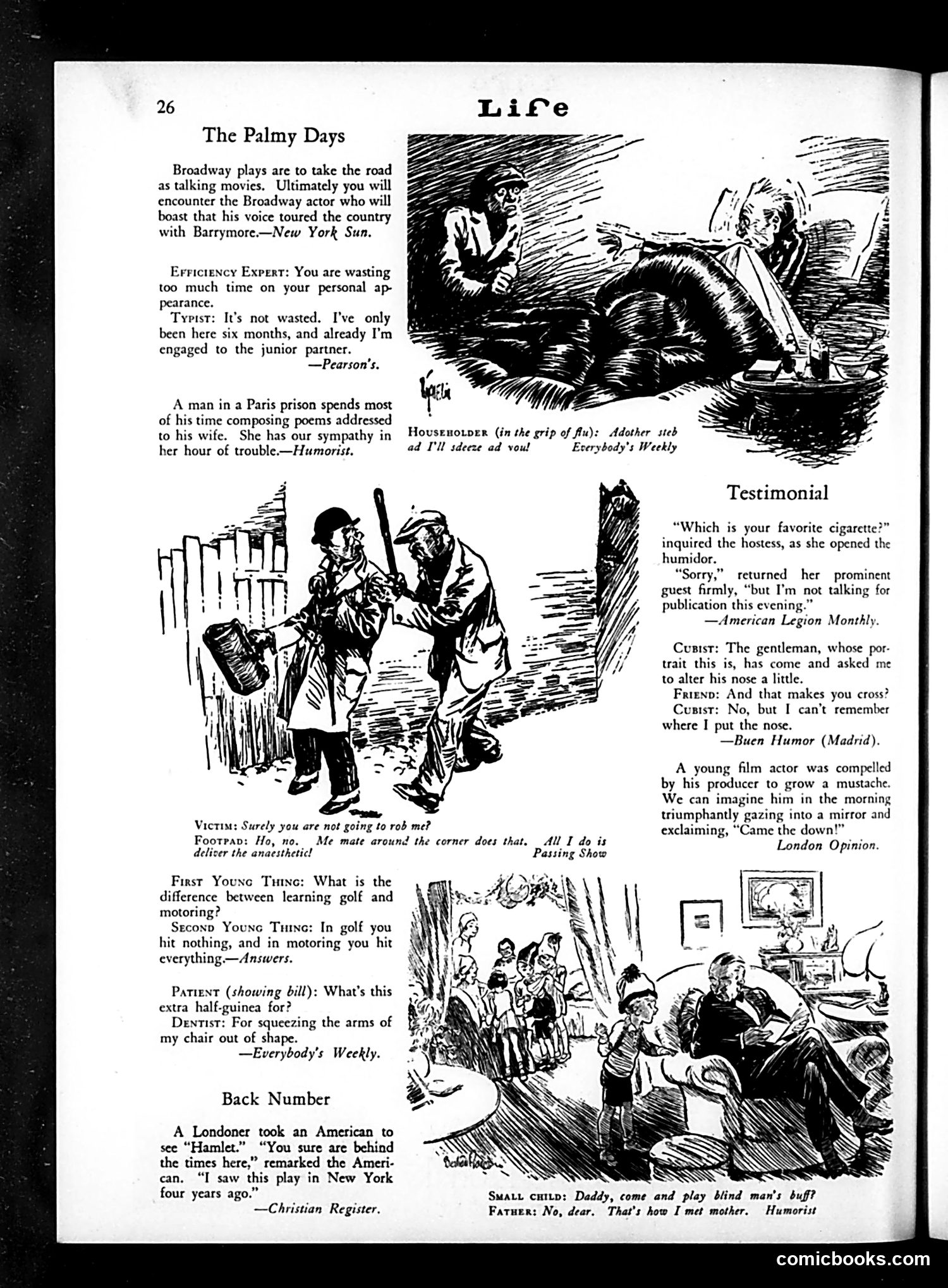
This page collects brief jokes and cartoons satirizing early 20th-century society. Key pieces include: **"The Palmy Days"**: References Broadway's transition to talking films, joking that actors will boast their voices "toured the country" with famous actor Barrymore—mocking the emerging film industry and actors' egos during cinema's sound revolution. **The cartoons** depict everyday absurdities: a typist prioritizing appearance over work; a householder with flu complaining about disruptions; a would-be robber merely delivering anesthetic (for a dentist's robbery); a dentist charging extra for chair damage from anxious patients gripping it. **"Testimonial"**: A guest refusing to endorse cigarettes, mocking celebrities' commercial endorsements. The page's humor targets workplace dynamics, medical practices, crime, and emerging consumer culture—reflecting concerns about efficiency, courtship, professional conduct, and commercialism typical of interwar America.
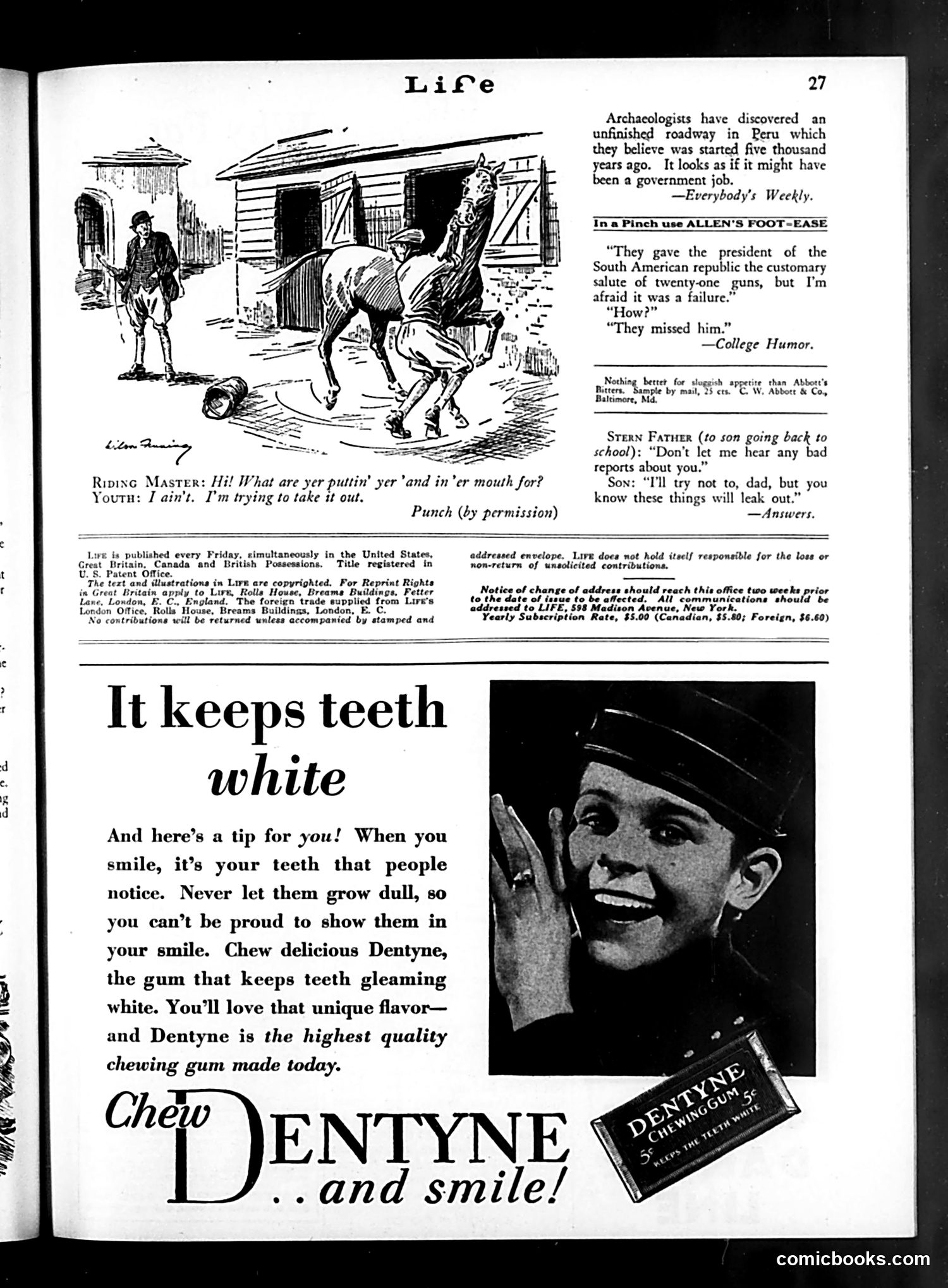
This page contains **humor snippets and advertising** rather than political cartoons. The main cartoon depicts a **riding master instructing a youth** on horseback—the youth claims he's trying to remove his hand from the horse's mouth, not insert it. The humor plays on the absurdity of the situation. The text jokes mock **government inefficiency** (an unfinished Peruvian road started 5,000 years ago "looks like a government job") and **assassination attempts** (a South American president receives a 21-gun salute but "they missed him"). The bulk of the page is a **Dentyne chewing gum advertisement** featuring a smiling man's photograph and copy emphasizing teeth whiteness and the gum's "unique flavor." The page reflects early 20th-century American humor: lighthearted mockery of bureaucracy and incompetence, combined with commercial advertising that dominated magazines of this era.
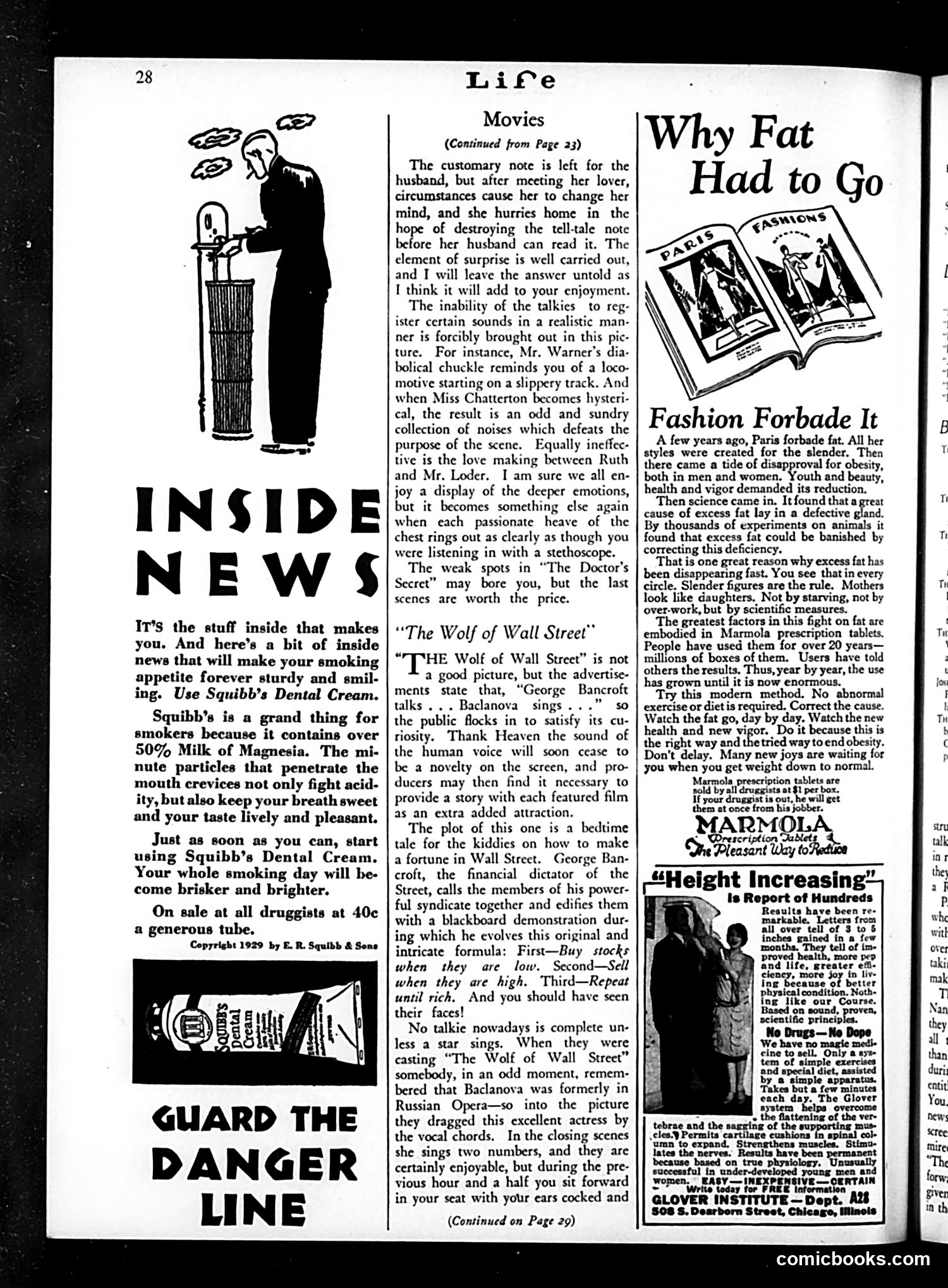
This page contains **movie reviews** and **advertising**, not political cartoons. The small cartoon (top left) illustrates a Squibb's Dental Cream advertisement, showing a man discarding something into a trash bin—a simple visual gag about oral hygiene for smokers. The substantive content critiques early **"talking pictures"** (talkies). The reviewer complains that: - Sound technology is crude and unrealistic (a character's laugh sounds like a locomotive) - Romantic scenes become absurd when every breath is audible - Studios cast singers like Baclanova simply because they can sing, regardless of story quality - The financial advice in "The Wolf of Wall Street" (buy low, sell high) is comically simplistic The page also advertises a weight-loss product (**Marmola**), referencing that "Paris forbade fat" and claiming science can reduce excess weight through gland correction—typical 1920s advertising pseudoscience. The overall tone is satirical about cinema's awkward transition from silent to sound film.
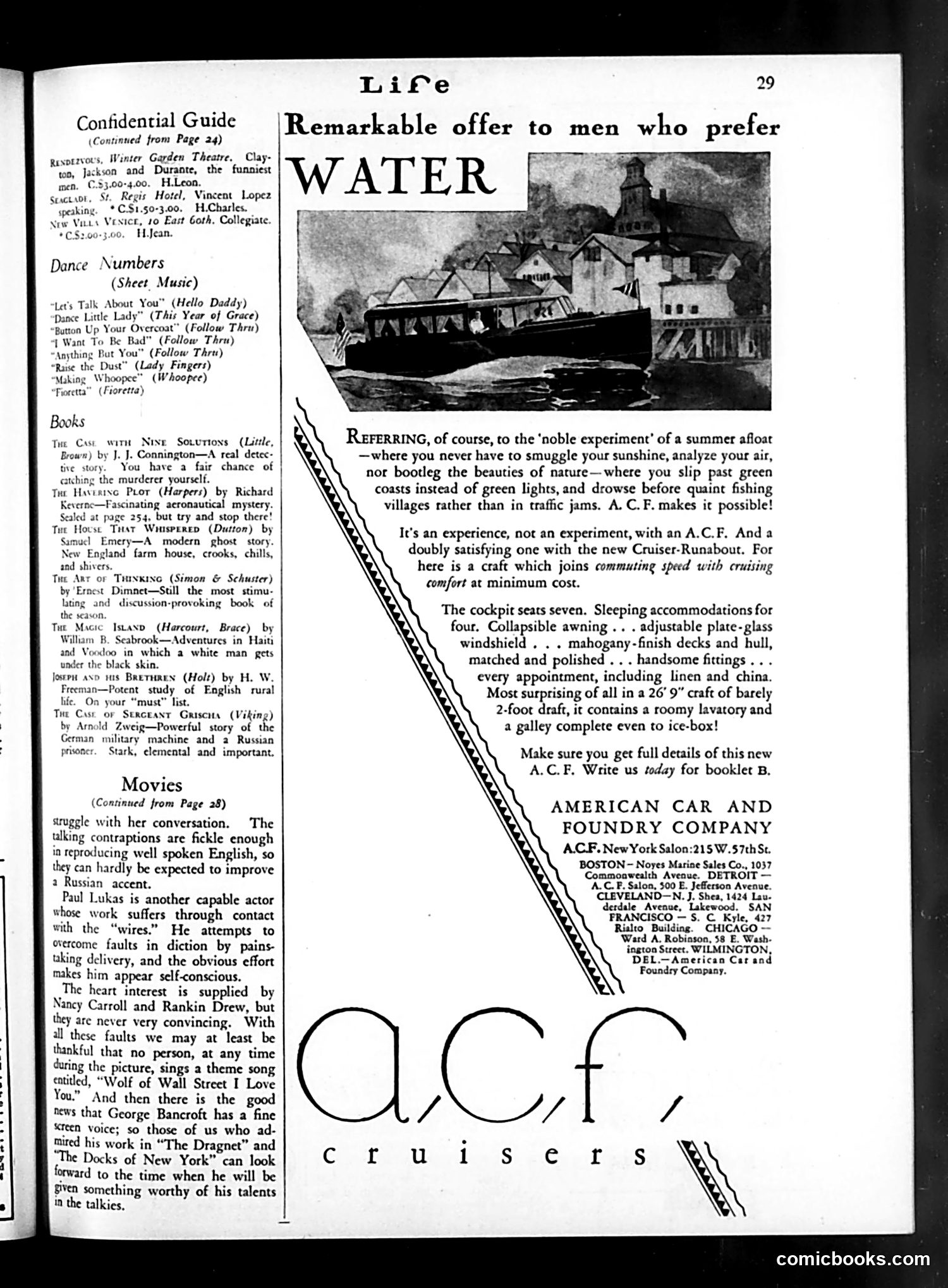
This page is primarily **advertising and entertainment listings**, not political satire. The main content includes: **Left column**: Theater/entertainment guides listing Broadway shows, dance numbers, book reviews, and movie criticism from the late 1920s. The movies section critiques early "talking pictures" (talkies), noting technical problems with sound reproduction—particularly an actress struggling with a Russian accent and actors whose diction faults are exposed by the new technology. **Right side**: A large advertisement for A.C.F. (American Car and Foundry Company) promoting a luxury motorboat called the "Cruiser-Runabout." The ad cleverly references Prohibition ("the 'noble experiment'") by joking that boating lets you avoid "smuggling your sunshine" and "bootleg[ging] the beauties of nature"—euphemisms playing on the illegal alcohol trade during Prohibition. **"A.C.F. Cruisers"** (bottom): Appears to be a decorative section header for additional advertising. The page reflects 1920s consumer culture and emerging sound-film technology rather than political commentary.
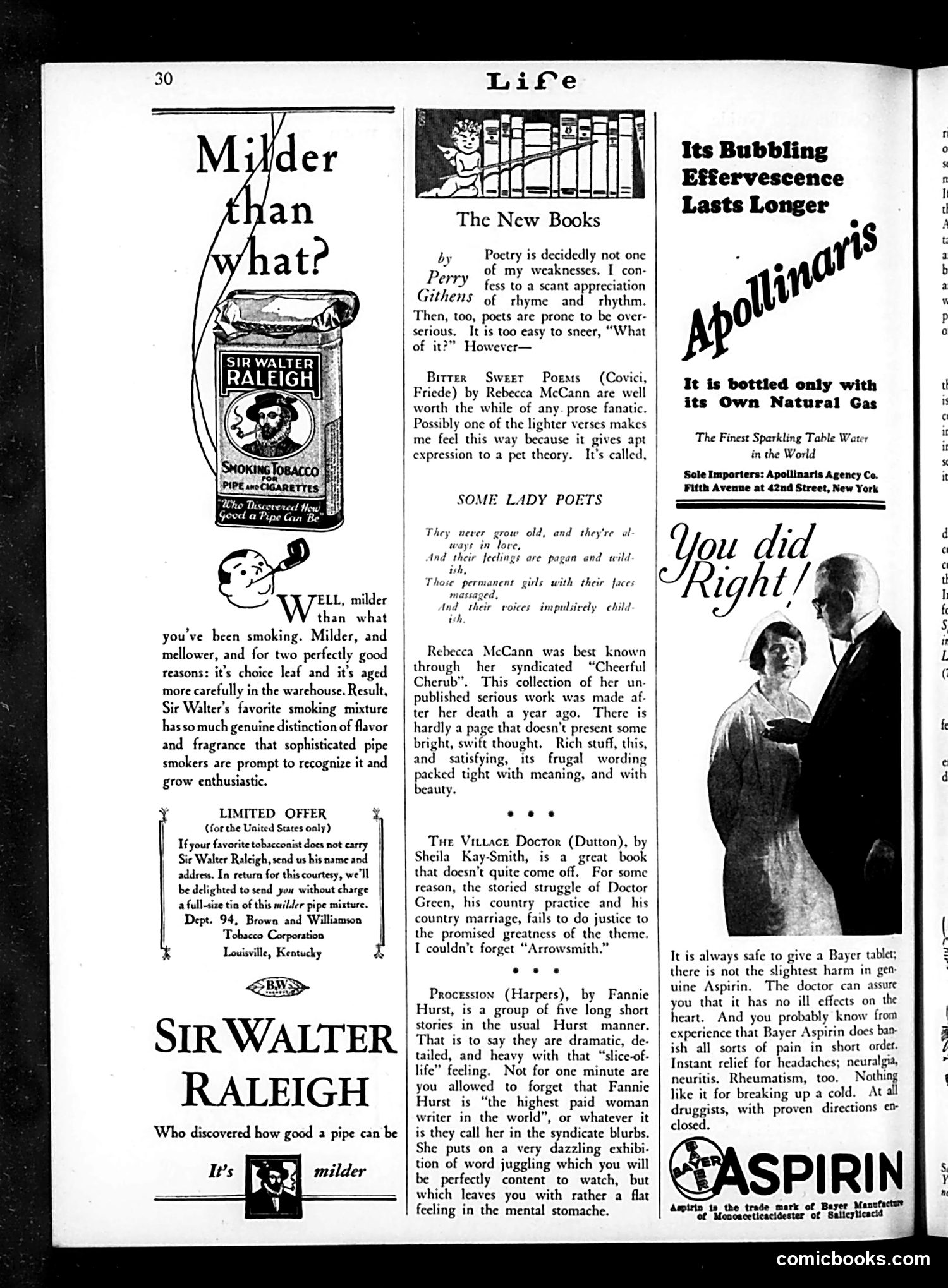
This page is primarily **advertising**, not satire or political commentary. The dominant content consists of three commercial advertisements: 1. **Sir Walter Raleigh Pipe Tobacco**: Uses a historical reference to Sir Walter Raleigh (who popularized tobacco in England) to market a "milder" smoking mixture. The ad emphasizes quality leaf and careful aging. 2. **Apollinaris Sparkling Water**: Markets itself as the finest sparkling table water, bottled with "natural gas." 3. **Bayer Aspirin**: Reassures consumers about safety, emphasizing it causes no heart damage—a significant concern in this era before modern drug testing standards. The smaller middle section is a book review column discussing poetry collections by Rebecca McCann and novels by Sheila Kay-Smith and Fannie Hurst. There is **no political cartoon or satire** on this page. It represents typical 1920s-30s Life magazine content: advertising mixed with literary criticism, reflecting commercial interests of the era.
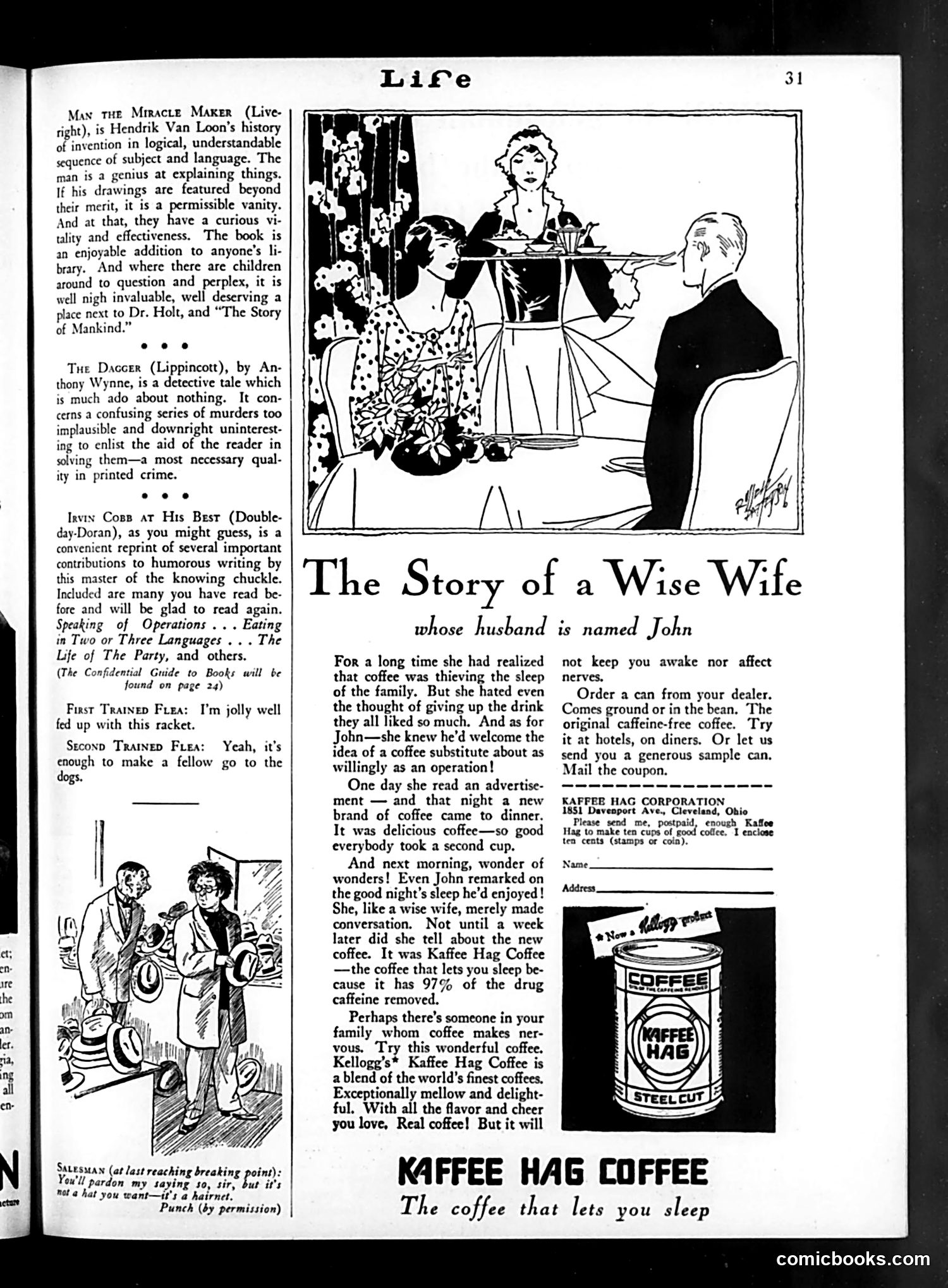
This page mixes book reviews with a full-page advertisement disguised as an editorial story. **The Main Content:** "The Story of a Wise Wife" is a Kaffee Hag Coffee advertisement presented as domestic advice. A wife solves her family's sleep problems by secretly switching to decaffeinated coffee. The "joke" is that her husband John doesn't notice the substitution—he simply sleeps better and attributes it to the coffee's quality, not realizing the caffeine has been removed. The narrative frames this deception as wifely wisdom. **The Satire:** The ad satirizes both gender roles and advertising itself. The "wise wife" manipulates her husband for his own good, while the advertisement uses narrative storytelling rather than direct sales pitch—a technique common in early 20th-century marketing that blurred editorial and advertising content. **The Smaller Comics:** Include two British humor pieces about unemployed workers and a salesman's frustration, reprinted from *Punch* magazine. The page reflects 1920s-30s advertising conventions where lifestyle narratives were used to normalize products.
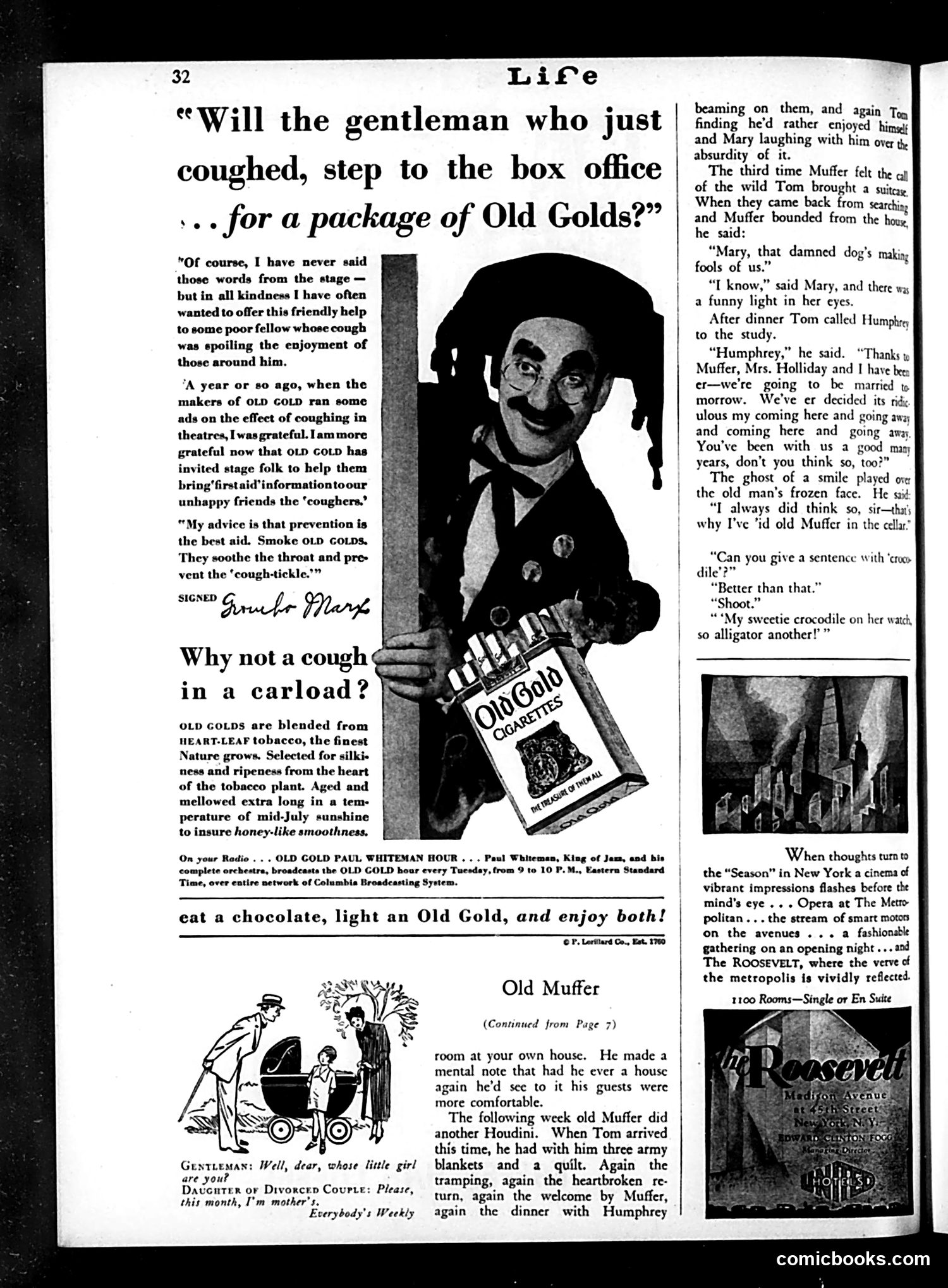
This page mixes advertising with fiction. The dominant feature is a large **Old Gold cigarette advertisement** featuring an actor (signed by "Director Marx," likely a stage director) endorsing the product. The ad uses a theatrical angle: it invites stage performers to help spread the message that Old Gold cigarettes soothe coughs—framing smoking as a *solution* to coughing in theaters, which disturbs audiences. This is darkly ironic product placement by modern standards. Below is a serialized story called "Old Muffer" (continued from page 7) about an elderly servant and domestic drama involving characters named Tom, Mary, and Humphrey. The page also advertises The Roosevelt hotel in New York and radio programming featuring Paul Whiteman's orchestra. The satire and humor are embedded in the cigarette ad's absurd logic: suggesting smoking *prevents* coughs rather than causing them—a marketing strategy that exploits public concern about theater etiquette to sell cigarettes.
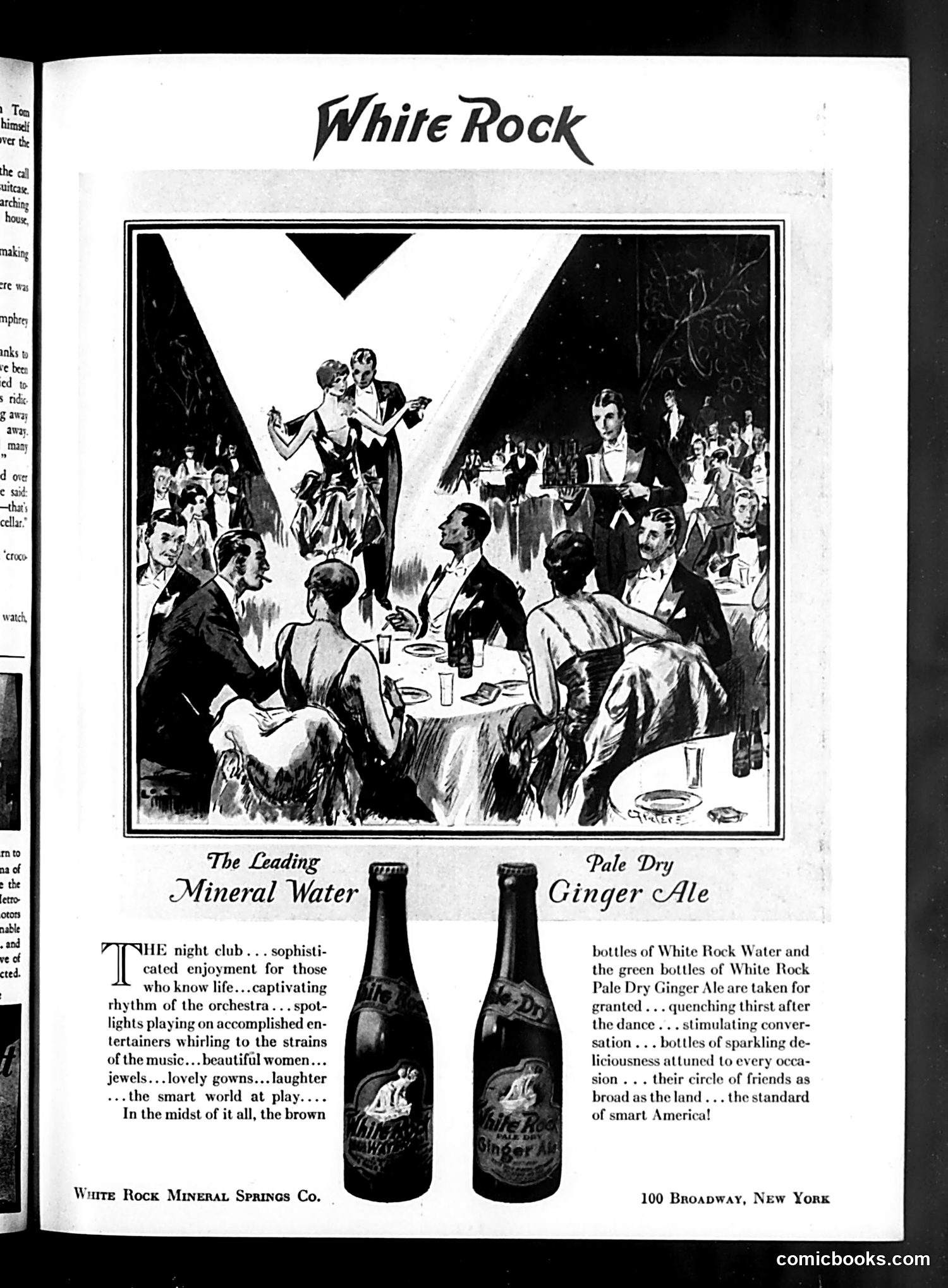
This is a **product advertisement**, not political satire. It promotes White Rock Mineral Water and Pale Dry Ginger Ale to upscale consumers. The illustration depicts a sophisticated 1920s nightclub scene—the Jazz Age setting Life's wealthy readership would recognize and aspire to. Well-dressed men and women in formal attire dine and dance while an orchestra performs, with spotlights illuminating entertainers on a stage. The advertisement's appeal is purely **aspirational**: by consuming White Rock products, ordinary Americans can identify with "the smart world at play" and achieve the status of this glamorous crowd. The text emphasizes sophistication, elegance, and social standards. There is no political commentary or satirical critique visible. This represents Life magazine's advertising revenue model—using sophisticated imagery to sell consumer goods to middle and upper-class readers during the prosperous 1920s.
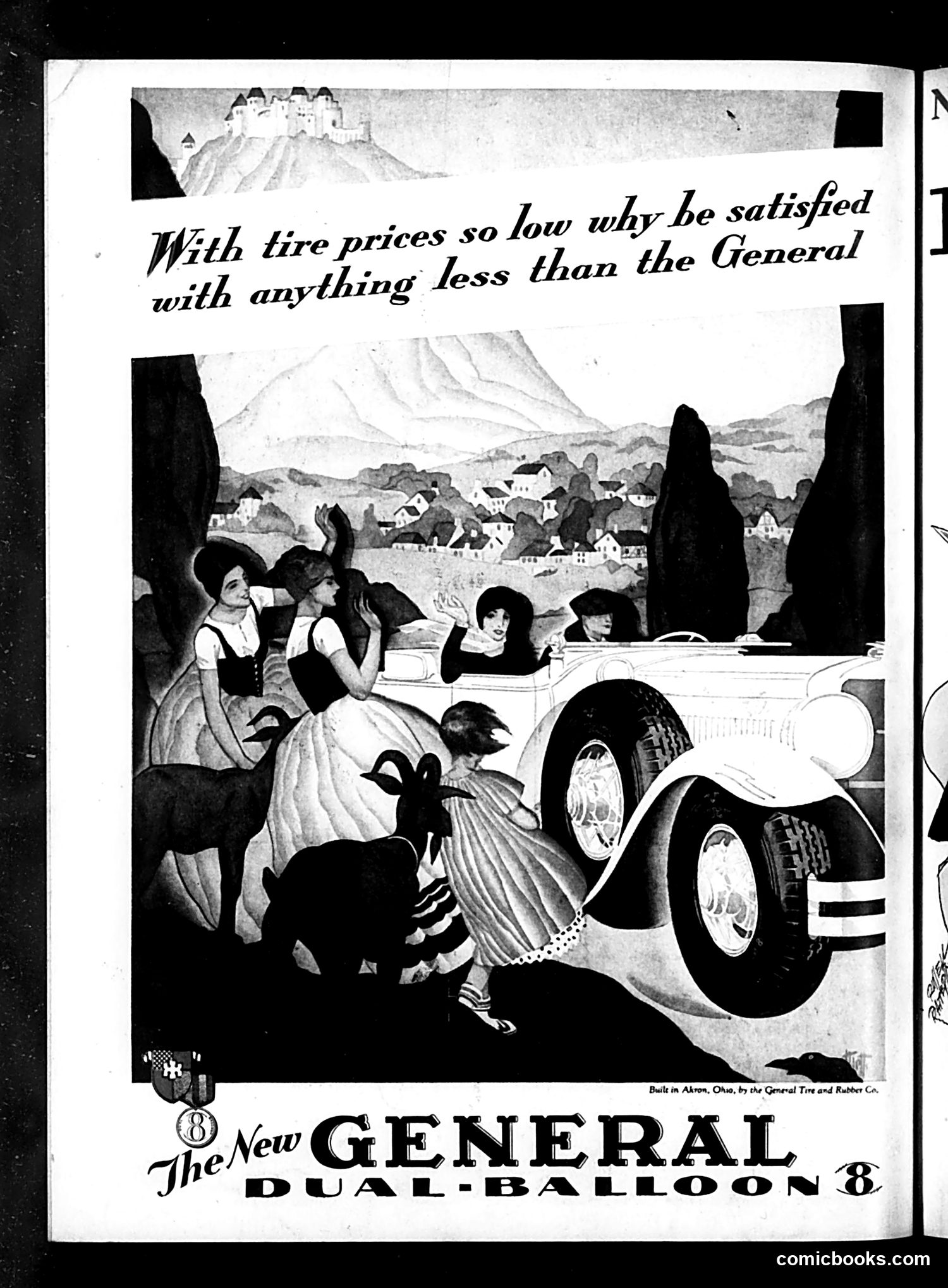
This is a **General Tire and Rubber Company advertisement**, not political satire. The ad uses a European Alpine village setting with well-dressed women admiring a luxury automobile equipped with General "Dual-Balloon" brand tires. The marketing message is straightforward: "With tire prices so low why be satisfied with anything less than the General" — positioning General as the premium choice despite competitive pricing. The elegant illustration (women in fashionable 1920s-30s attire, mountainous backdrop, quality automobile) suggests that General tires represent both affordability and sophistication. This is corporate advertising leveraging lifestyle imagery to sell tires, not editorial commentary on political or social issues.