
Life, 1929-03-01 · page 25 of 36
Life — March 1, 1929 — page 25: what you’re looking at
What you’re looking at
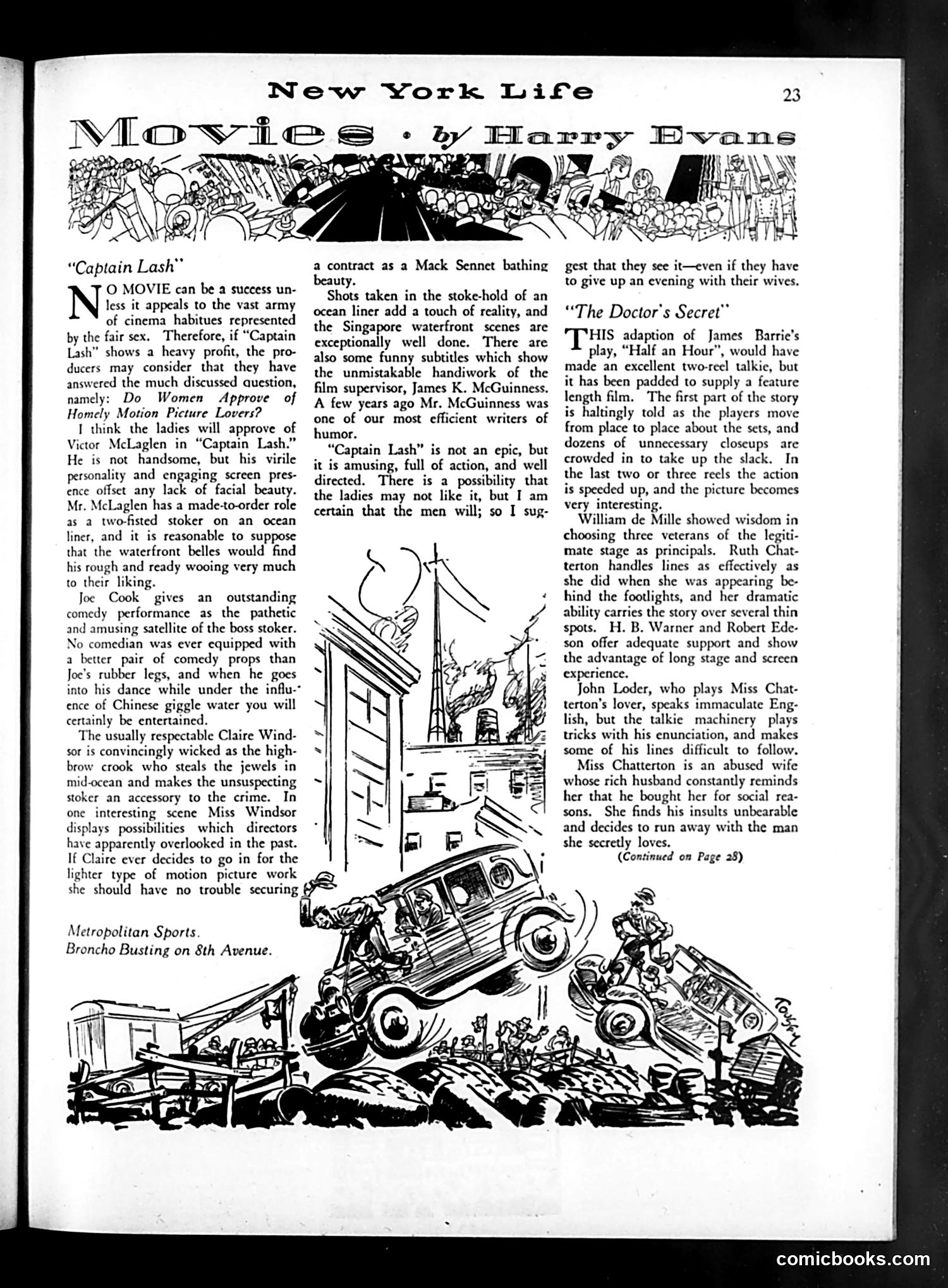
This page reviews three films for a 1920s audience. The main illustrated cartoons are humorous visual gags: **"Captain Lash"** review discusses whether homely leading man Victor McLaglen appeals to female moviegoers—a genuine industry concern of the era. The text argues his "virile personality" compensates for lack of beauty. Joe Cook's "rubber legs" comedy and Claire Windsor's villainy are praised. The illustrations show slapstick action typical of silent films—a car crash sequence and characters in physical comedy. **"The Doctor's Secret"** adapts James M. Barrie's play, criticized for padding a two-reel story into feature length. It stars stage veterans Ruth Chatterton (an abused wife), H.B. Warner, and Robert Edeson. The review notes early sound film's technical problems—John Loder's "enunciation" is distorted by primitive microphone technology. The cartoons visualize the physical comedy and melodrama these silent and early-talkie films featured, targeting the broad audience—particularly women—that studios courted.
📄 Transcribed text from this page (OCR, searchable)
Machine-transcribed from the original scan — historical spelling and the odd misread are preserved.
New York Life “Captain Lash” O MOVIE can be a success un- less it appeals to the vast army of cinema habitues represented by the fair sex. Therefore, if “Captain Lash” shows a heavy profit, the pro- ducers may consider that they have answered the much discussed question, namely: Do Women Approve of Homely Motion Picture Lovers? I think the ladies will approve of Victor McLaglen in “Captain Lash.” He is not handsome, but his virile personality and engaging screen pres- ence offset any lack of facial beauty. Mr. McLaglen has a made-to-order role as a two-fisted stoker on an ocean liner, and it is reasonable to suppose that the waterfront belles would find his rough and ready wooing very much to their liking. Joe Cook gives an outstanding comedy performance as the pathetic and amusing satellite of the boss stoker. No comedian was ever equipped with a better pair of comedy props than Joe's rubber legs, and when he goes into his dance while under the influ-” ence of Chinese giggle water you will certainly be entertained. The usually respectable Claire Wind- sor is convincingly wicked as the high- brow crook who steals the jewels in mid-ocean and makes the unsuspecting stoker an accessory to the crime. In one interesting scene Miss Windsor displays possibilities which directors have apparently overlooked in the past. If Claire ever decides to go in for the lighter type of motion picture work a contract as a Mack Sennet bathing beauty. Shots taken in the stoke-hold of an ocean liner add a touch of reality, and the Singapore waterfront scenes are exceptionally well done. There are also some funny subtitles which show the unmistakable handiwork of the film supervisor, James K. McGuinness. A few years ago Mr. McGuinness was one of our most efficient writers of humor. “Captain Lash” is not an epic, but it is amusing, full of action, and well directed. There is a possibility that the ladies may not like it, but I am certain that the men will; so I sug- she should have no trouble securing (= Metropolitan Sports. Broncho Busting on 8th Avenue. 23 Prry Hwans \\eaN Sy +) gest that they see it—even if they have to give up an evening with their wives. “The Doctor's Secret” THis adaption of James Barrie's play, “Half an Hour”, would have made an excellent two-reel talkie, but it has been padded to supply a feature length film, The first part of the story is haltingly told as the players move from place to place about the sets, and dozens of unnecessary closeups are crowded in to take up the slack. In the last two or three reels the action is speeded up, and the picture becomes very interesting. William de Mille showed wisdom in choosing three veterans of the legiti- mate stage as principals. Ruth Chat- terton handles lines as effectively as she did when she was appearing be- hind the footlights, and her dramatic ability carries the story over several thin spots. H. B. Warner and Robert Ede- son offer adequate support and show the advantage of long stage and screen experience. John Loder, who plays Miss Chat- terton’s lover, speaks immaculate Eng- lish, but the talkie machinery plays tricks with his enunciation, and makes some of his lines difficult to follow. Miss Chatterton is an abused wife whose rich husband constantly reminds her that he bought her for social rea- sons. She finds his insults unbearable and decides to run away with the man she secretly loves. (Continued on Page 28) comicbooks.com