
Life, 1929-03-01 · page 24 of 36
Life — March 1, 1929 — page 24: what you’re looking at
What you’re looking at
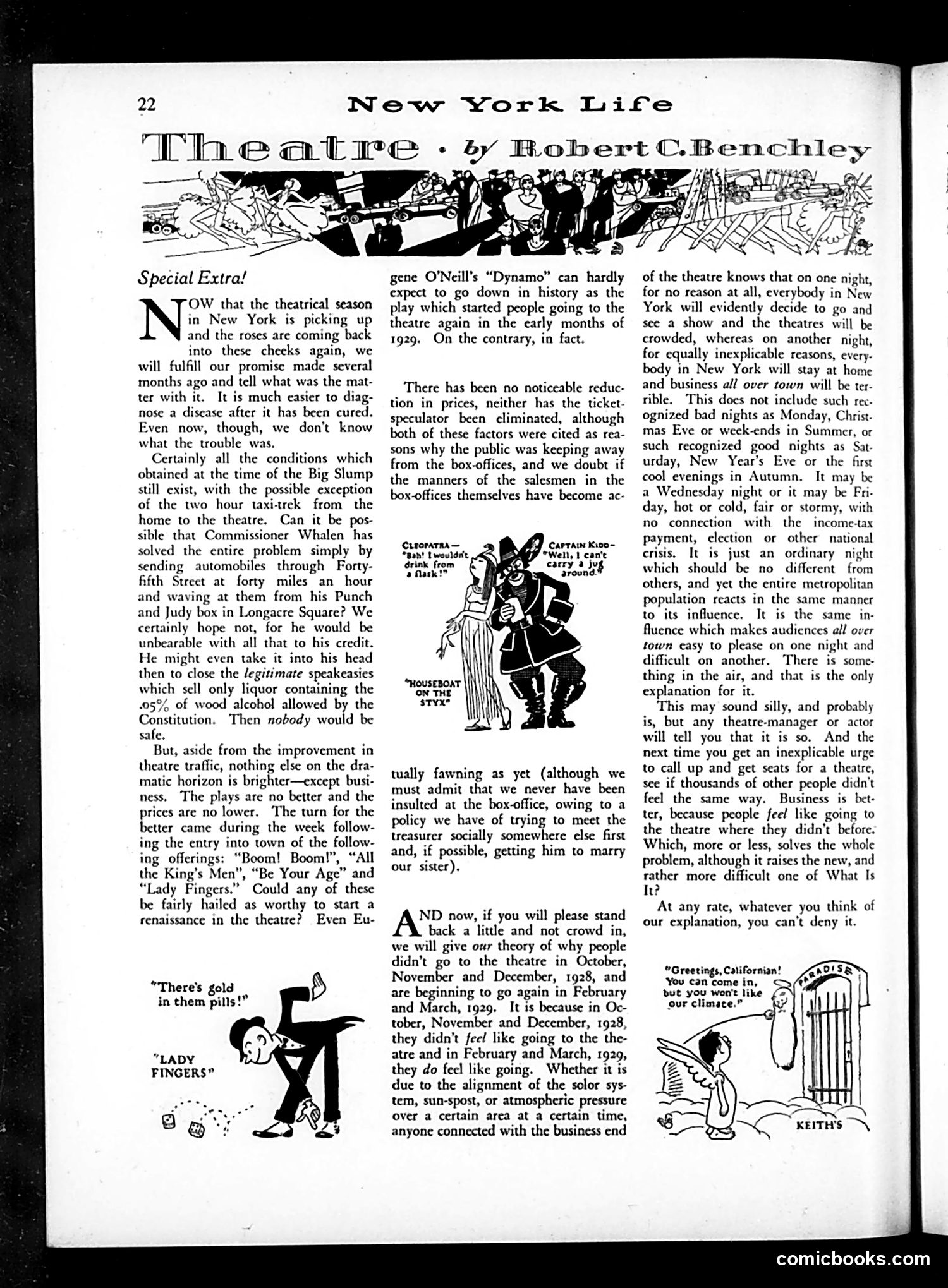
This is Robert C. Benchley's humorous theatre column from *Life* magazine (circa 1929), analyzing why Broadway experienced a slump in late 1928 but recovered by early 1929. **The Satire's Points:** The column mockingly examines supposed causes for the theatre's decline—traffic congestion, high prices, ticket speculation, rude box-office staff—only to dismiss them all. Benchley's actual "theory" is deliberately absurd: people simply didn't *feel* like going to the theatre in October-December 1928, but did in February-March 1929, for no rational reason whatsoever (possibly solar alignment or atmospheric pressure). **The Small Cartoons:** "Lady Fingers" depicts a performer with pills, punning on the title. "Cleopatra" and "Captain Kidd" show period-costume characters. "Keith's" advertises a cinema. **The Joke:** Benchley brilliantly satirizes business analysis by offering a tautological "explanation"—people went when they wanted to go—disguised as insider wisdom, mocking both theatre industry pretensions and economic explanations for the recent stock market crash.
📄 Transcribed text from this page (OCR, searchable)
Machine-transcribed from the original scan — historical spelling and the odd misread are preserved.
22 Special Extra! OW that the theatrical season N: New York is picking up and the roses are coming back into these cheeks again, we will fulfill our promise made several months ago and tell what was the mat- ter with it. It is much easier to diag- nose a disease after it has been cured. Even now, though, we don’t know what the trouble was. Certainly all the conditions which obtained at the time of the Big Slump still exist, with the possible exception of the two hour taxi-trek from the home to the theatre. Can it be pos- sible that Commissioner Whalen has solved the entire problem simply by sending automobiles through Forty- fifth Street at forty miles an hour and waving at them from his Punch and Judy box in Longacre Square? We certainly hope not, for he would be unbearable with all that to his credit. He might even take it into his head then to close the legitimate speakeasies which sell only liquor containing the 05% of wood alcohol allowed by the Constitution. Then nobody would be safe. But, aside from the improvement in theatre traffic, nothing else on the dra- matic horizon is brighter—except busi- ness. The plays are no better and the prices are no lower. The turn for the better came during the week follow- ing the entry into town of the follow- ing offerings: “Boom! Boom!”, “All the King’s Men”, “Be Your Age” and “Lady Fingers.” Could any of these be fairly hailed as worthy to start a renaissance in the theatre? Even Eu- “There's gold ss in them pills!” “LADY FINGERS” gene O'Neill's “Dynamo” can hardly expect to go down in history as the play which started people going to the theatre again in the early months of 1929. On the contrary, in fact. There has been no noticeable reduc- tion in prices, neither has the ticket- speculator been eliminated, although both of these factors were cited as rea- sons why the public was keeping away from the box-offices, and we doubt if the manners of the salesmen in the box-offices themselves have become ac- tually fawning as yet (although we must admit that we never have been insulted at the box-office, owing to a policy we have of trying to meet the treasurer socially somewhere else first and, if possible, getting him to marry our sister). ND now, if you will please stand back a little and not crowd in, we will give our theory of why people didn’t go to the theatre in October, November and December, 1928, and are beginning to go again in February and March, 1929. It is because in Oc- tober, November and December, 1928, they didn’t fee! like going to the the- atre and in February and March, 1929, they do feel like going. Whether it is due to the alignment of the solor sys- tem, sun-spost, or atmospheric pressure over a certain area at a certain time, anyone connected with the business end New York Life Benchley = Sept df aI EWEEK of the theatre knows that on one night, for no reason at all, everybody in New York will evidently decide to go and see a show and the theatres will be crowded, whereas on another night, for equally inexplicable reasons, every- body in New York will stay at home and business all over town will be ter- rible. This does not include such rec- ognized bad nights as Monday, Christ- mas Eve or week-ends in Summer, or such recognized good nights as Sat- urday, New Year’s Eve or the first cool evenings in Autumn. It may be a Wednesday night or it may be Fri- day, hot or cold, fair or stormy, with no connection with the income-tax payment, election or other national crisis. It is just an ordinary night which should be no different from others, and yet the entire metropolitan population reacts in the same manner to its influence. It is the same in- fluence which makes audiences all over town casy to please on one night and difficult on another. There is some- thing in the air, and that is the only explanation for it. This may sound silly, and probably is, but any theatre-manager or actor will tell you that it is so. And the next time you get an inexplicable urge to call up and get seats for a theatre, see if thousands of other people didn’t feel the same way. Business is bet- ter, because people feel like going to the theatre where they didn’t before. Which, more or less, solves the whole problem, although it raises the new, and rather more difficult one of What Is It? At any rate, whatever you think of our explanation, you can’t deny it. "Greetings, Californian! ‘You can come in, but you won't like our climate.” comicbooks.com