
A complete issue · 34 pages · 1928
Life — March 15, 1928
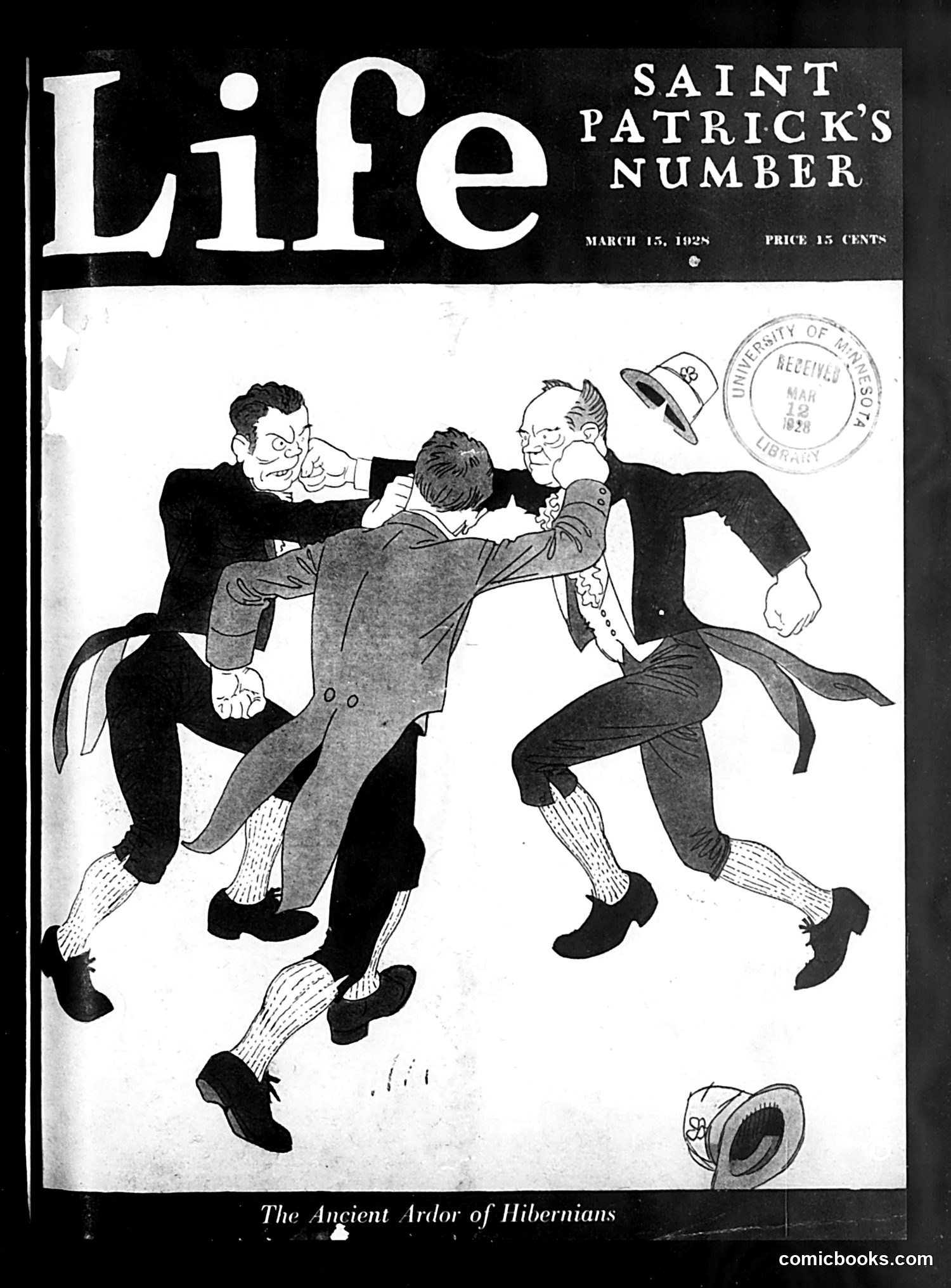
This is a *Life* magazine cover from March 15, 1928, marking Saint Patrick's Day. The cartoon depicts three exaggerated male figures engaged in a brawl—punching and grappling with each other. The caption "The Ancient Ardor of Hibernians" plays on ethnic stereotypes about Irish people ("Hibernians"). The satire relies on a well-worn early 20th-century stereotype portraying Irish immigrants and Irish-Americans as prone to fighting and rowdiness, particularly around alcohol consumption (which Saint Patrick's Day celebrations involved). The comic exaggeration of the brawl reinforces this caricature, suggesting this was considered typical Irish behavior worthy of humorous commentary. By modern standards, this represents overtly offensive ethnic stereotyping presented as lighthearted humor.
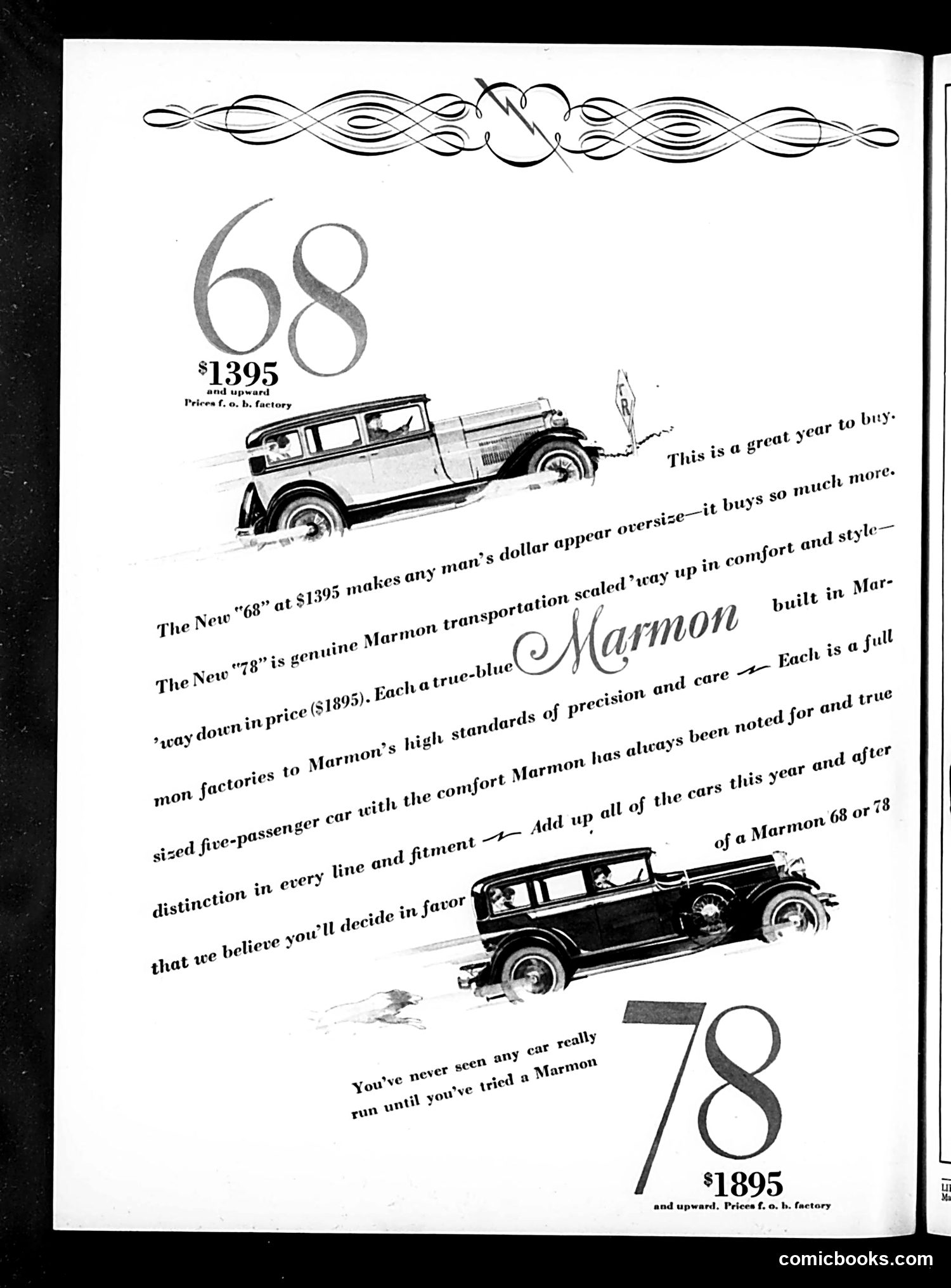
This is **not a political cartoon or satire**—it's a **automobile advertisement** for Marmon cars, circa 1920s-1930s based on styling. The page promotes two Marmon models: - The "68" at $1,395 - The "78" at $1,895 The ad emphasizes Marmon's quality manufacturing standards and value proposition: that spending more on a Marmon provides better comfort, style, and precision engineering than cheaper competitors. The phrase "You've never seen any car really run until you've tried a Marmon" is a sales claim about the vehicle's performance. The decorative car illustrations and flowing text layout are typical period advertising design. There is no political commentary or satire present—this is straightforward commercial promotion appealing to buyers seeking mid-range automobiles.
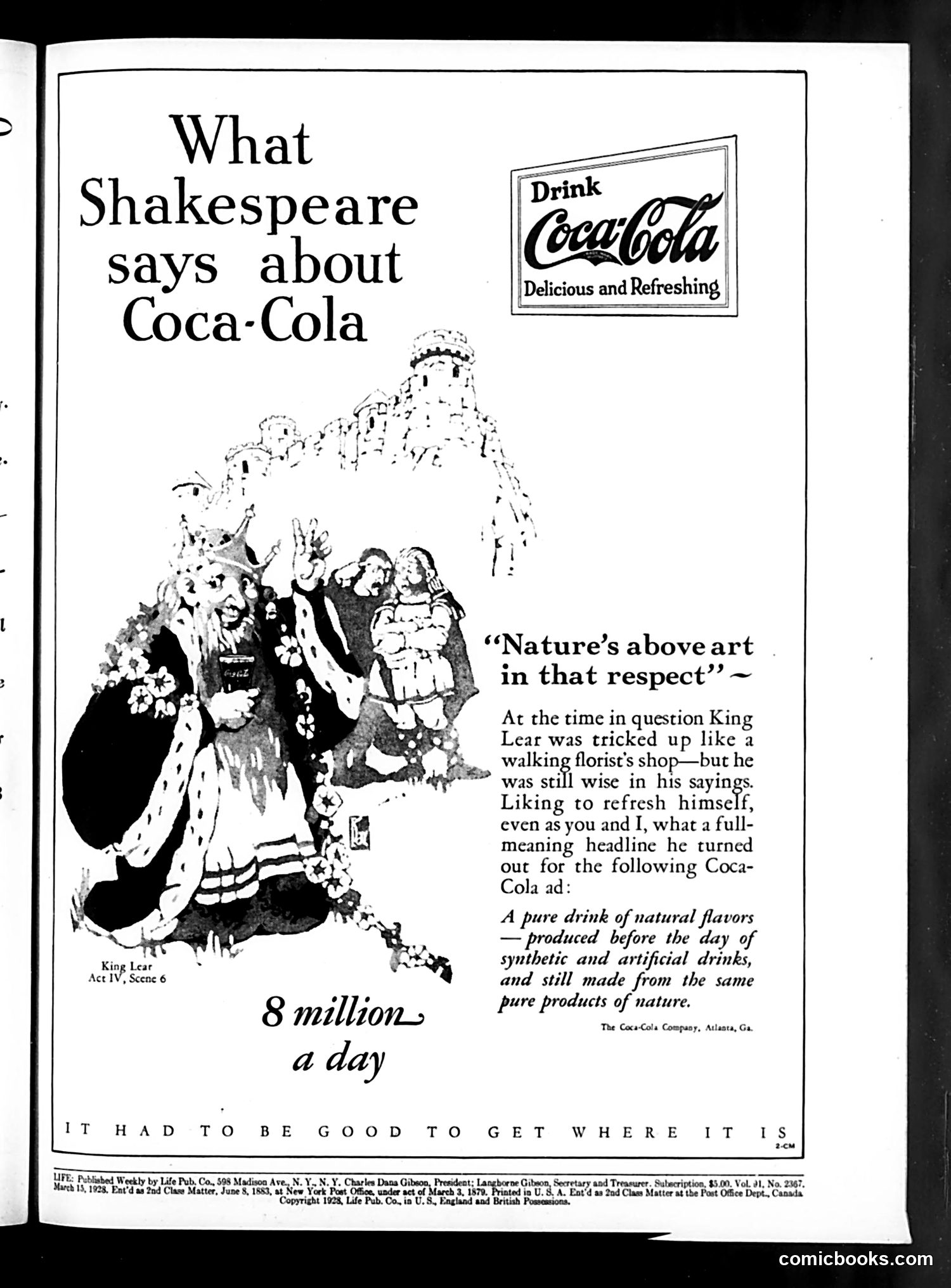
This is a **Coca-Cola advertisement** disguised as satirical commentary, published in *Life* magazine (dated March 15, 1928, based on the footer). The ad humorously attributes a fake Shakespeare quote to King Lear, claiming the Bard endorsed Coca-Cola as a "pure drink of natural flavors." The illustration shows King Lear in his traditional royal garb surrounded by flowers, positioned as if endorsing the product. The satire works on two levels: it mocks both Shakespeare scholarship (misquoting the Bard) and advertising's tendency to invoke classical authority to sell modern products. The phrase "8 million a day" boasts of Coca-Cola's sales volume. The bottom tagline—"It had to be good to get where it is"—drives home the commercial message: popularity proves quality. This represents early 20th-century advertising's creative appropriation of high culture to market consumer goods.
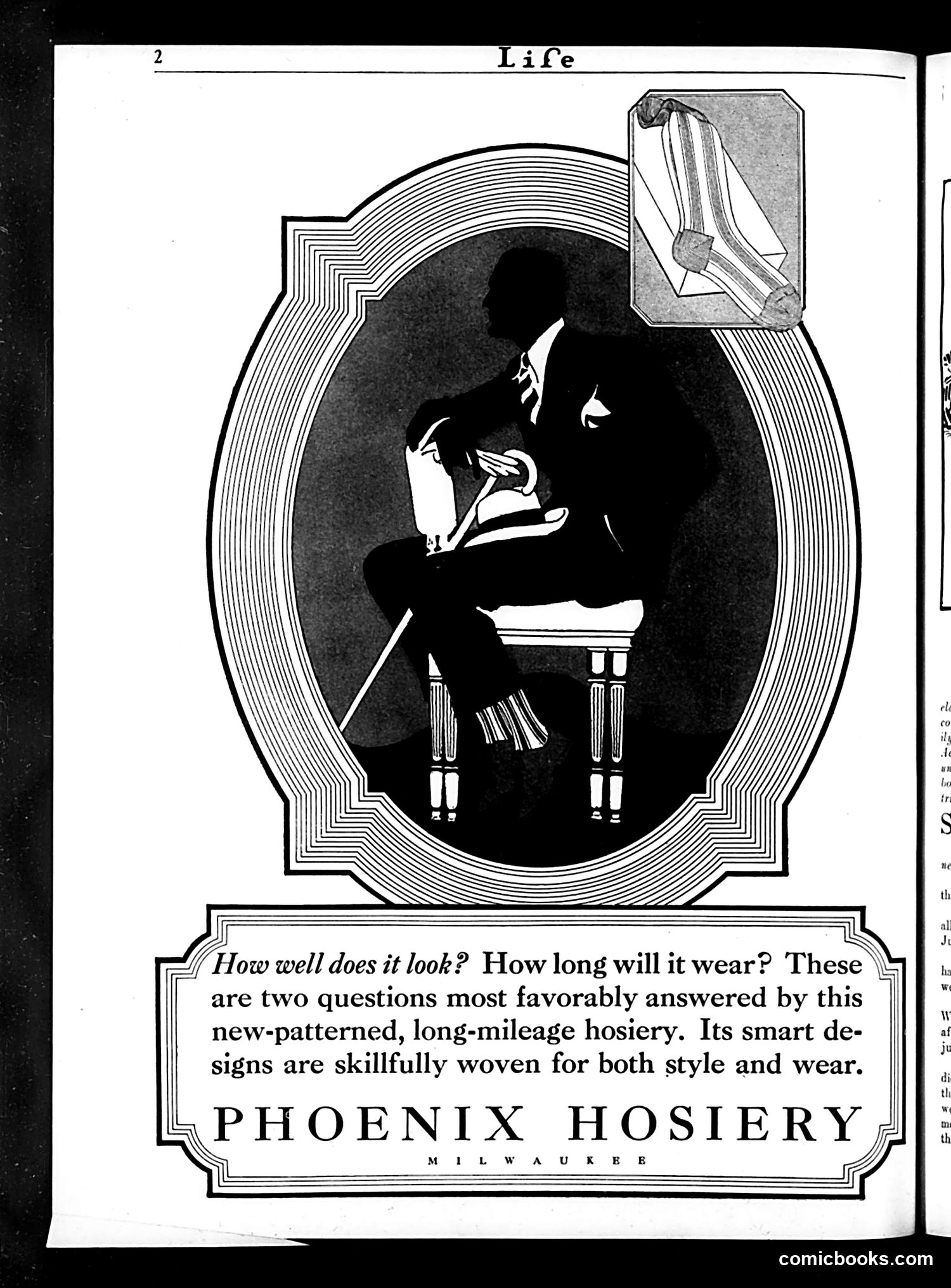
This page is primarily **advertising, not satire or political commentary**. The image shows a silhouette of a woman sitting at a vanity mirror, examining her appearance—a common aesthetic concern of the era. The inset illustration (upper right) depicts hosiery with visible seams and reinforced heel and toe areas. The ad copy poses rhetorical questions: "How well does it look? How long will it wear?" These address typical consumer concerns about women's hosiery in this period. Phoenix Hosiery, manufactured in Milwaukee, is being marketed as superior because its "smart designs are skillfully woven for both style and wear"—combining aesthetic appeal with durability. This reflects early-twentieth-century advertising strategy: positioning practical garments as fashion statements while emphasizing longevity and value.
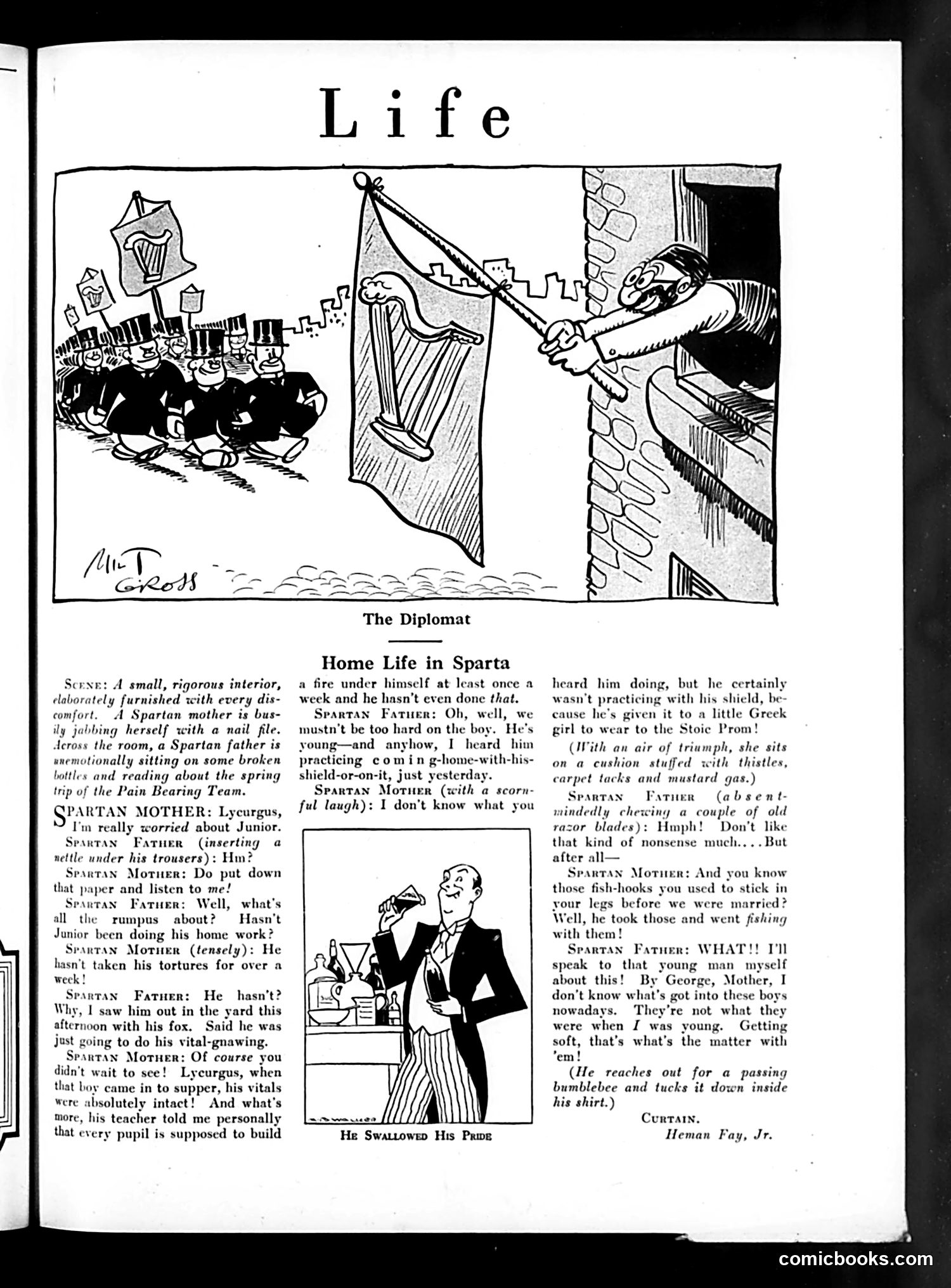
This satirical sketch mocks Spartan militarism by depicting a domestic scene where a Spartan father prioritizes military training over family comfort. The cartoon contrasts the stern, regimented Spartan lifestyle with modern domestic expectations. The humor centers on the father's obsession with his son's martial conditioning—he's annoyed the boy hasn't practiced shield-work enough and dismisses coddling. The mother's frustration with fish-hooks being used as household furniture and her reference to pre-marital courtship customs emphasizes how Spartan militarism has corrupted normal family life. The cartoon likely critiques rigid, militaristic societies that subordinate all personal and domestic values to military preparation—possibly a commentary on contemporary militarism or Prussian-style state control, though the specific historical reference remains unclear.
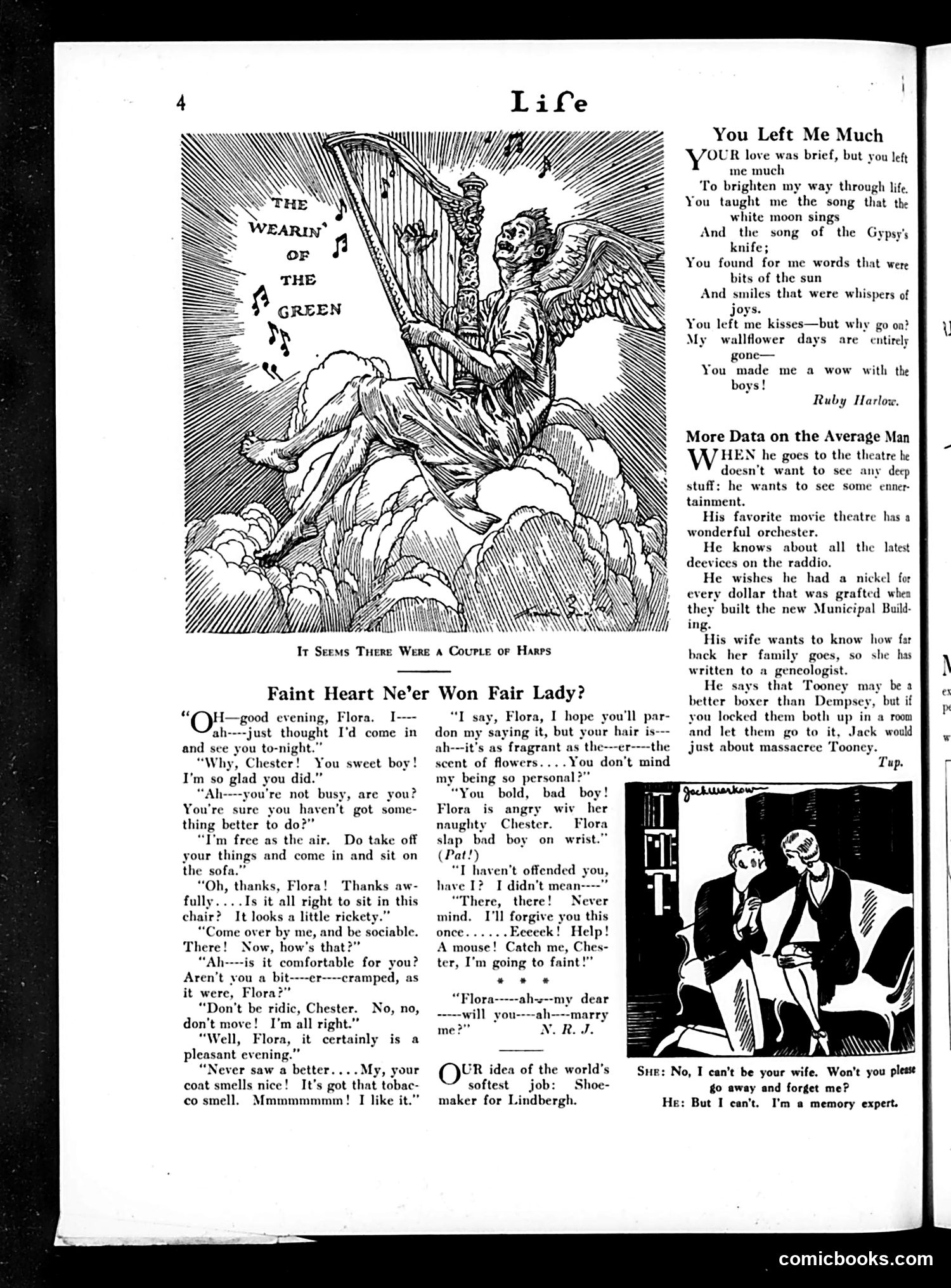
This page contains three distinct pieces of humor content: **"The Wearin' of the Green"** (top): An illustration of a fairy or cherub playing a harp, referencing the Irish song/phrase. The connection between Irish identity and harps is the visual joke. **"Faint Heart Ne'er Won Fair Lady?"** (center): A flirtation dialogue between Chester and Flora. Chester awkwardly courts Flora in a drawing room, complimenting her appearance and asking her to marry him. The satire targets clumsy male courtship tactics and the formal romantic conventions of the era. **"More Data on the Average Man"** (right): Brief observations about typical male preferences—theater, entertainment, radio gadgets, and family genealogy—presenting stereotypical masculine interests humorously. The page reflects early-20th-century domestic humor focused on romance, gender relations, and social behaviors.
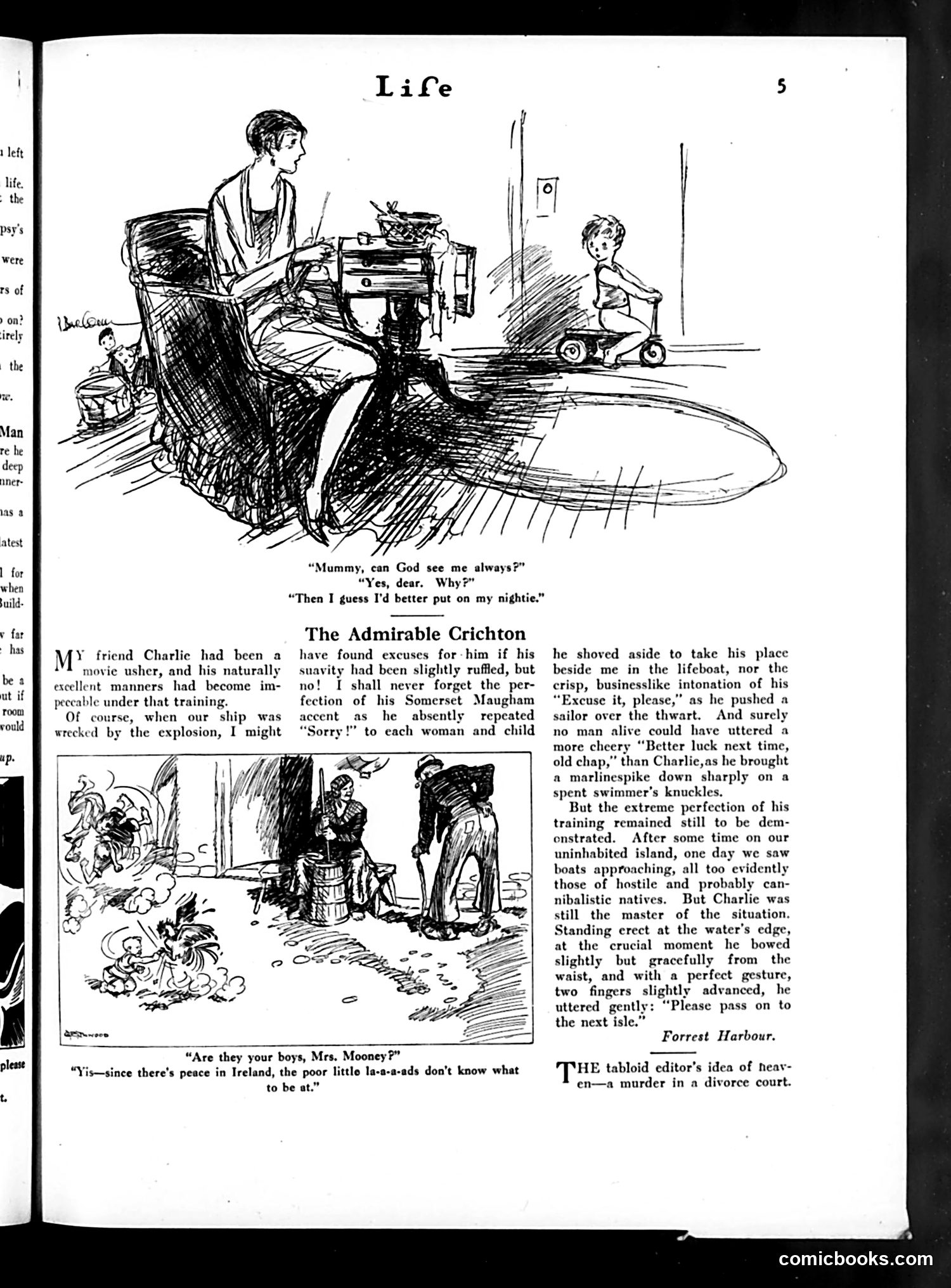
This page contains two satirical pieces: **Top cartoon**: Shows a mother asking God if He can "always" see her, with the child replying she'd "better put on my nightie"—a joke about childhood innocence and modesty before God's omniscience. **"The Admirable Crichton"**: A story about Charlie, a movie usher whose politeness and perfect manners are tested during a shipwreck on an uninhabited island. The narrative satirizes the British ideal of maintaining proper decorum in all circumstances—even when facing "cannibalistic natives." Charlie's unflappable courtesy ("Better luck next time, old chap") in crisis situations parodies the upper-class English obsession with etiquette over practical survival. **Bottom cartoon**: References Irish poverty and social conditions, with dialogue about children's circumstances during peacetime in Ireland. The satire targets class pretensions and rigid social conventions.
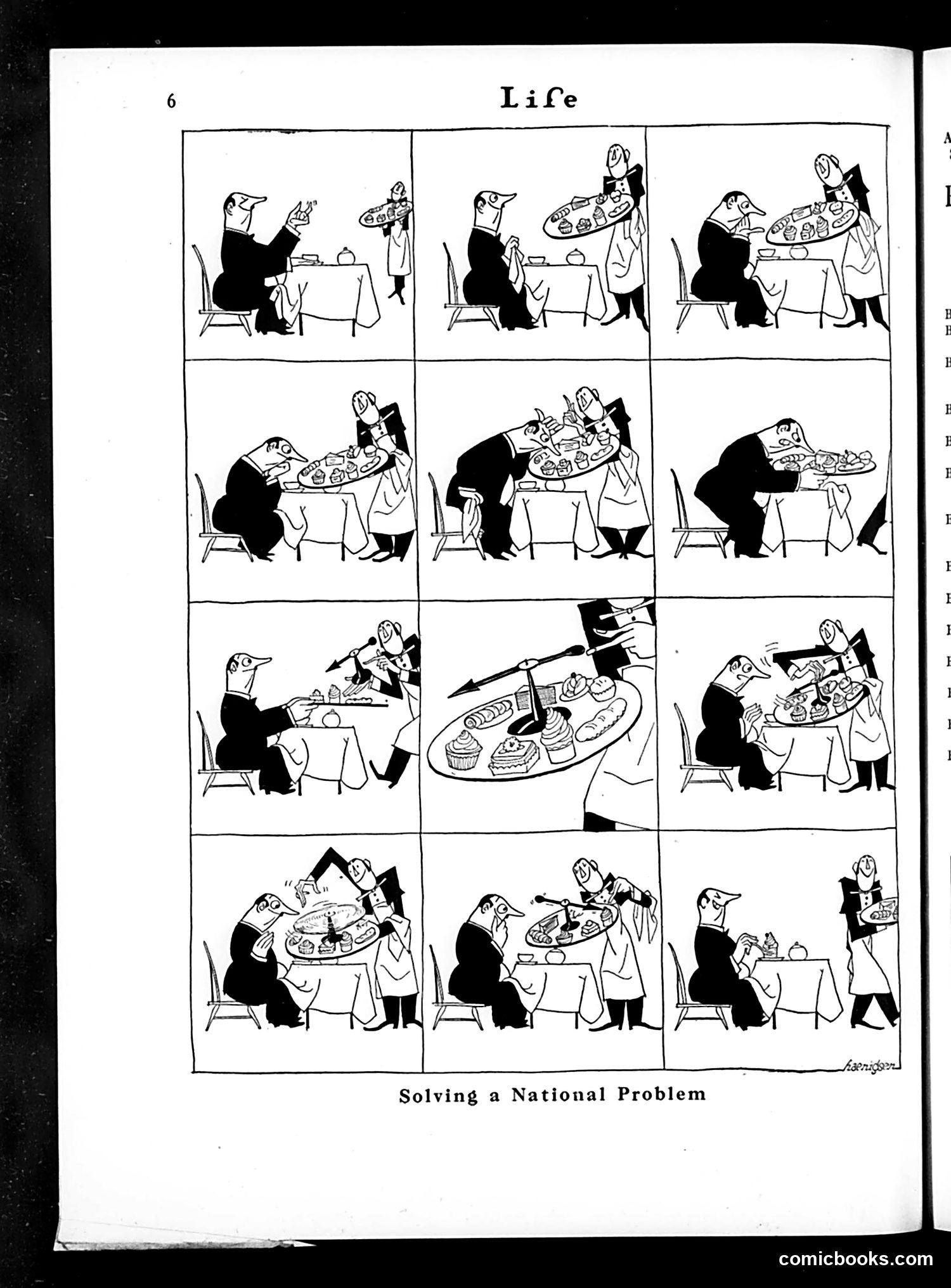
This twelve-panel comic strip satirizes political dysfunction through a dinner scene. A man in formal attire repeatedly attempts to serve food to a woman, but she constantly interrupts with gestures and objections—swatting at the plate, pointing, appearing to argue or complain. The panels escalate in chaos, culminating in what appears to be food flying through the air. The caption "Solving a National Problem" suggests this depicts political or social gridlock—likely referencing early 20th-century debate (the magazine's era). The woman's constant interference preventing any resolution mirrors how partisan obstruction or disagreement prevents action. The deteriorating situation ironically illustrates how attempts to address problems make things worse rather than better.
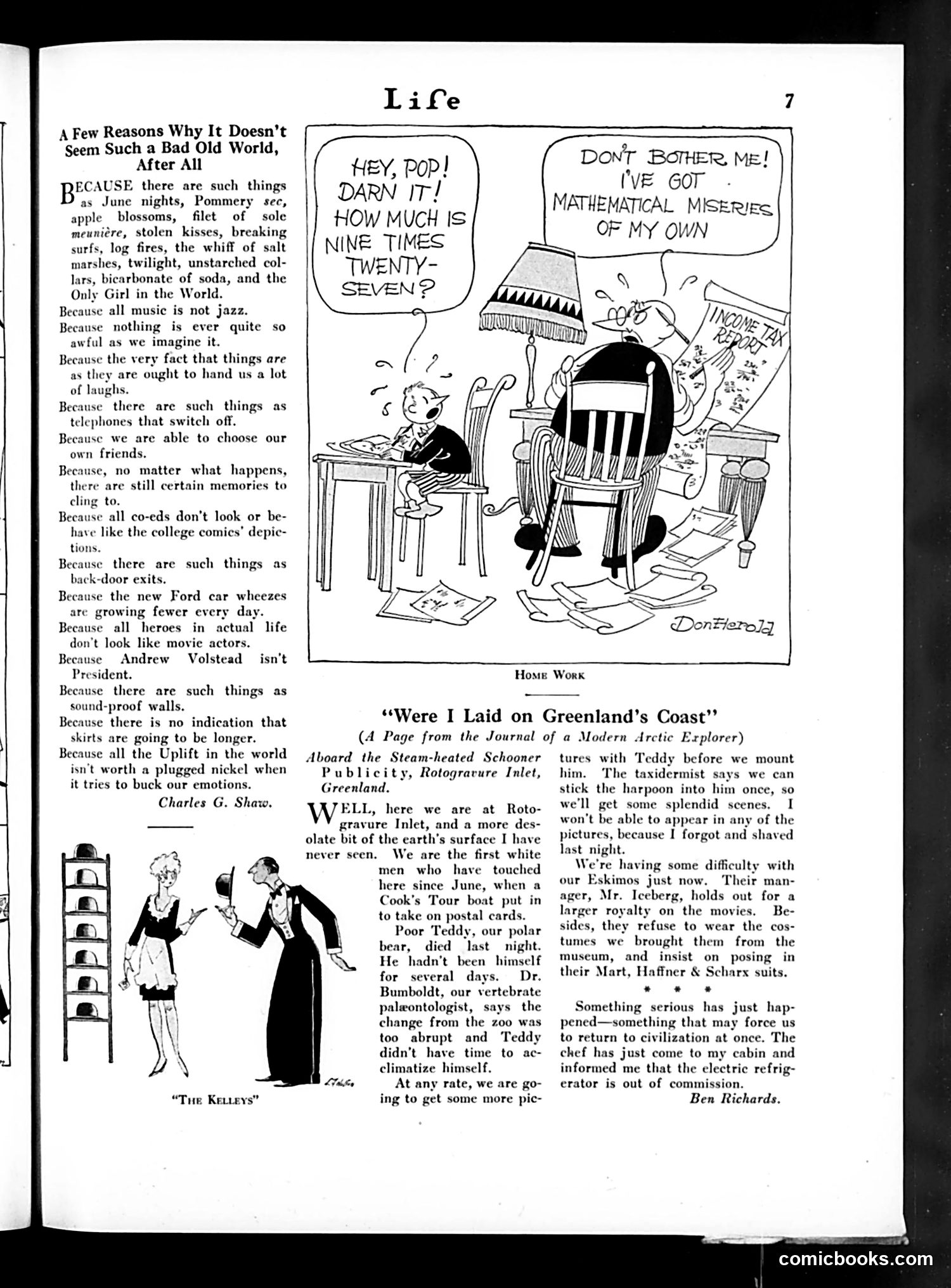
The main cartoon depicts a father and child doing homework together, surrounded by scattered papers. The child asks: "Hey, Pop! Darn it! How much is nine times twenty-seven?" The father responds: "Don't bother, me! I've got mathematical miseries of my own." **The satire:** This jokes about the era's widespread anxiety over modern mathematics education—possibly referencing "new math" pedagogy debates or simply the frustration parents felt helping children with increasingly complex schoolwork. The humor lies in the role reversal: instead of the parent confidently helping, both are overwhelmed by arithmetic, suggesting that even adults struggled with mathematical concepts. The page also contains a short story titled "Were I Laid on Greenland's Coast," an unrelated piece of fiction.
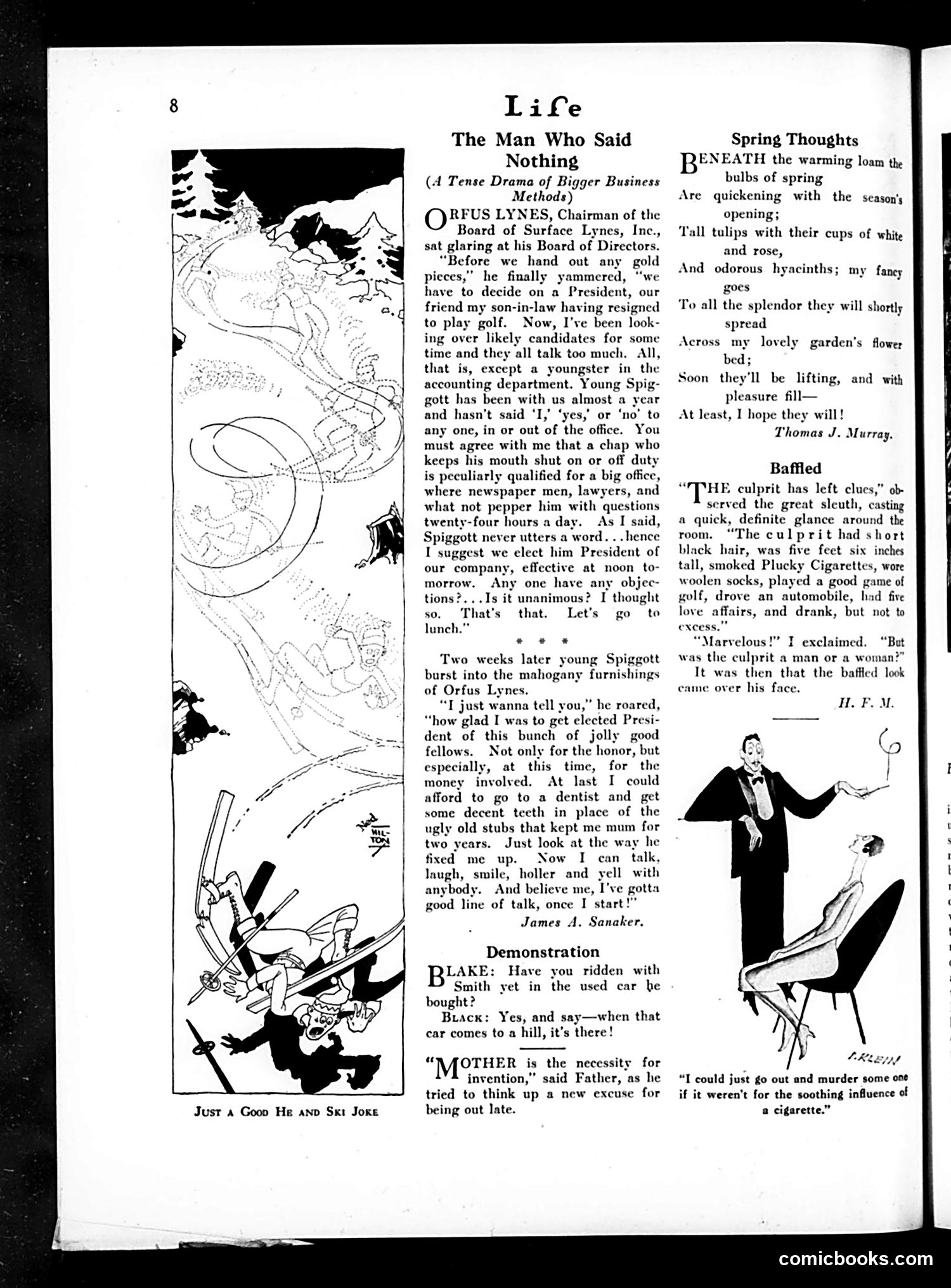
This page contains a satirical short story about corporate management culture. The main narrative mocks a board chairman named Orfus Lynes who proposes elevating a silent junior accountant named Spriggott to President. The joke's premise is that Spriggott's complete silence and lack of opinions make him "peculiarly qualified" for executive leadership—a cutting critique of corporate conformity and yes-men culture. The accompanying cartoons and brief humor pieces ("Spring Thoughts," "Baffled," "Demonstration") maintain the satirical tone, mocking various aspects of early 20th-century American life: romantic sentimentality, workplace confusion, and domestic logic. The page satirizes how corporations valued obedience and silence over actual competence or original thinking.
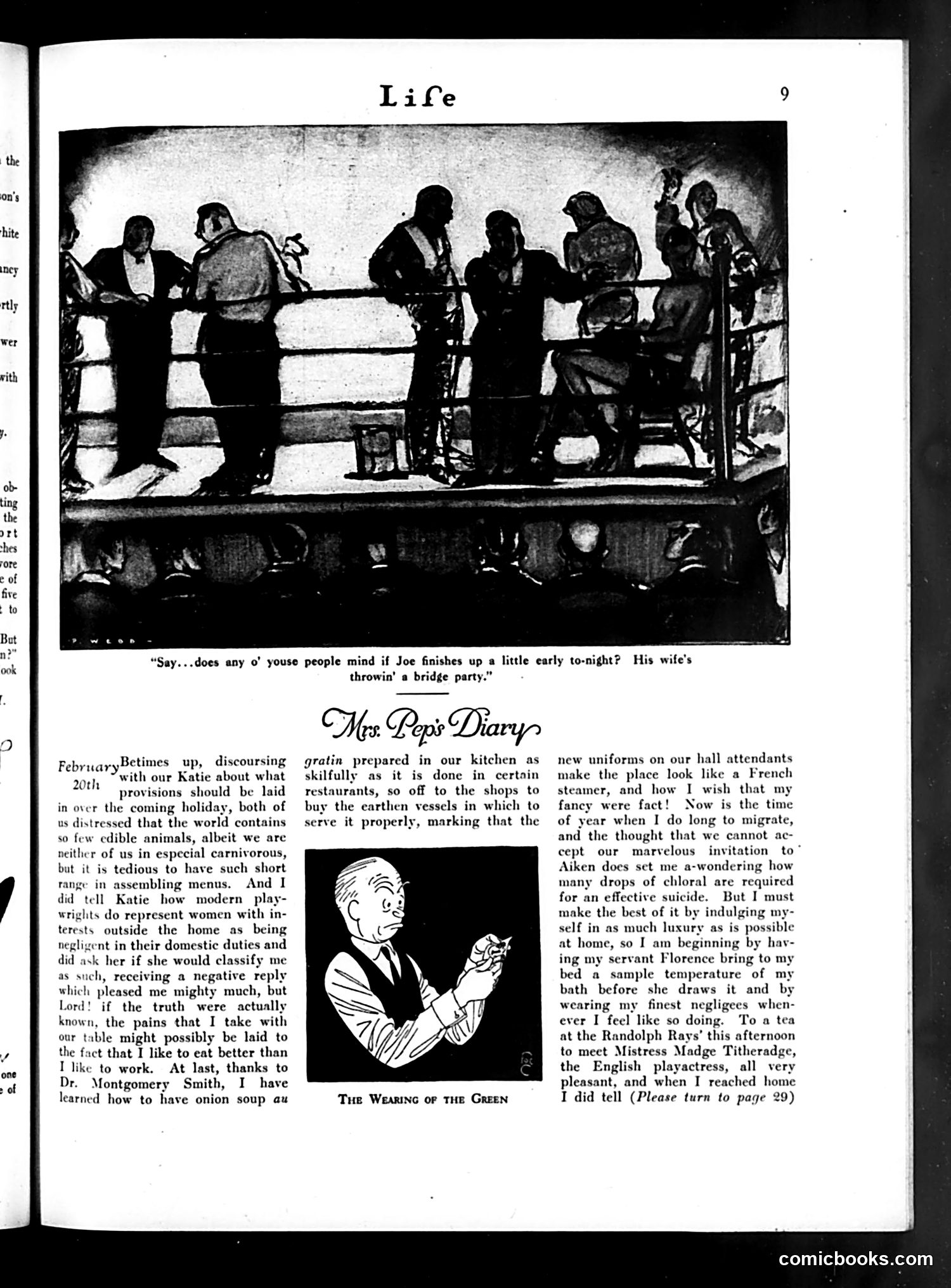
**Top Image:** A photograph captioned with dialogue about "Joe" finishing early from a bridge party, suggesting this is a candid or staged scene documenting social life—likely a humorous moment about domestic social obligations. **"Mrs. Pop's Diary" Column:** A domestic humor piece dated February 20th. The diarist complains about limited edible animals, discusses modern playwrights misrepresenting women who attend matinees, and describes luxurious home habits (elaborate baths, fine negligees). **"The Wearing of the Green" Illustration:** Shows a man in profile, likely referencing the Irish song/tradition of that name, though the specific satirical point is unclear from the visible text. The page exemplifies *Life*'s focus on upper-middle-class domestic satire and social commentary typical of early 20th-century American humor magazines.
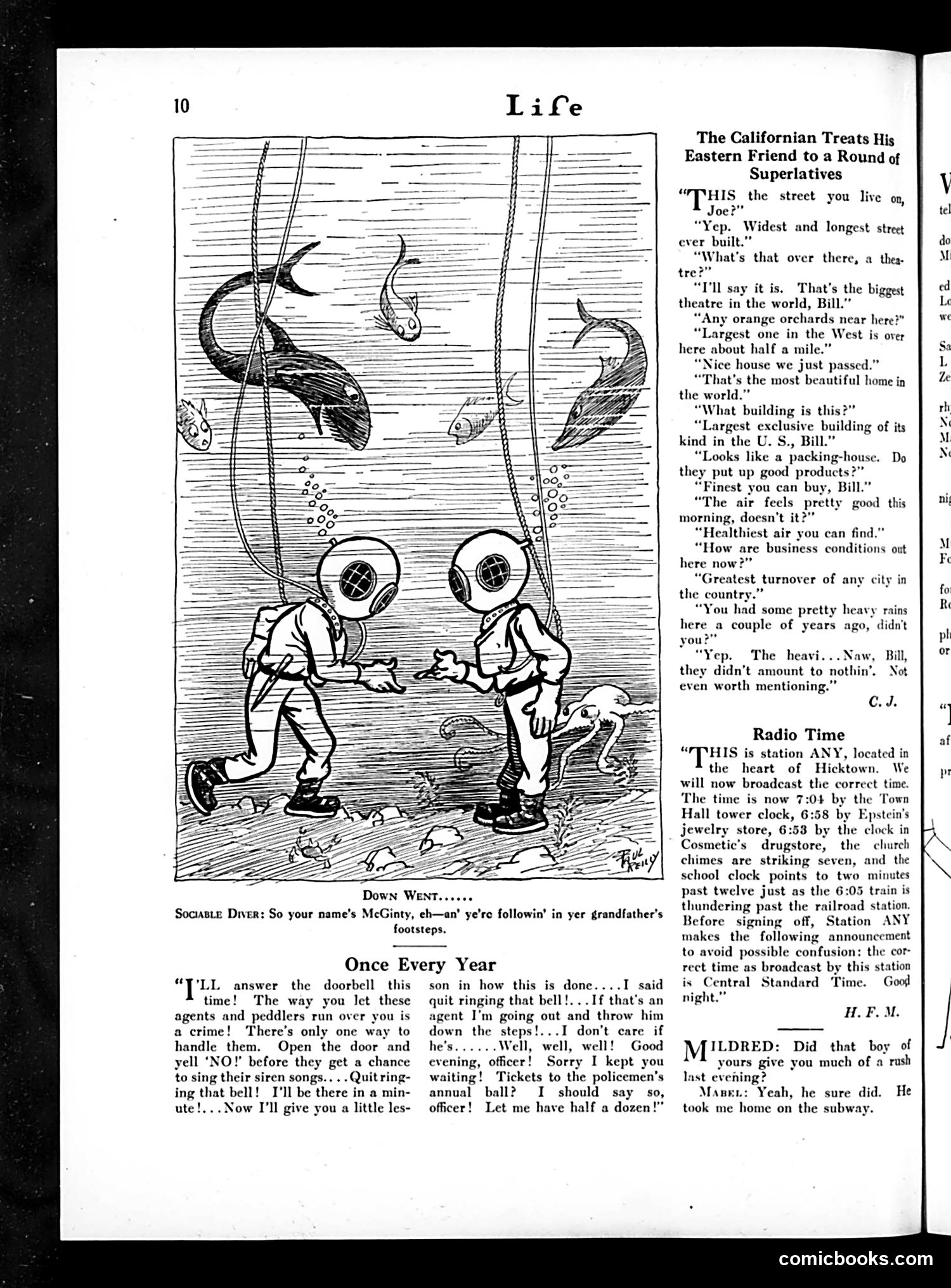
The main cartoon titled "Down Went......" depicts two deep-sea divers underwater, with fish and marine life around them. The caption references "McCurry" following in "grandfather's footsteps," suggesting a humorous comparison between the diver's occupation and family legacy. The page also contains three brief humor sections: "The Californian Treats His Eastern Friend to a Round of Superlatives," a competitive boasting dialogue about California attractions (widest street, biggest theater, largest orange orchard); "Radio Time," a public service announcement about broadcast accuracy; and "Once Every Year," about dealing with door-to-door salesmen and the police ball. These are light, domestic humor pieces typical of Life magazine's satirical style—poking fun at regional stereotypes, modern conveniences, and everyday annoyances rather than serious political commentary.
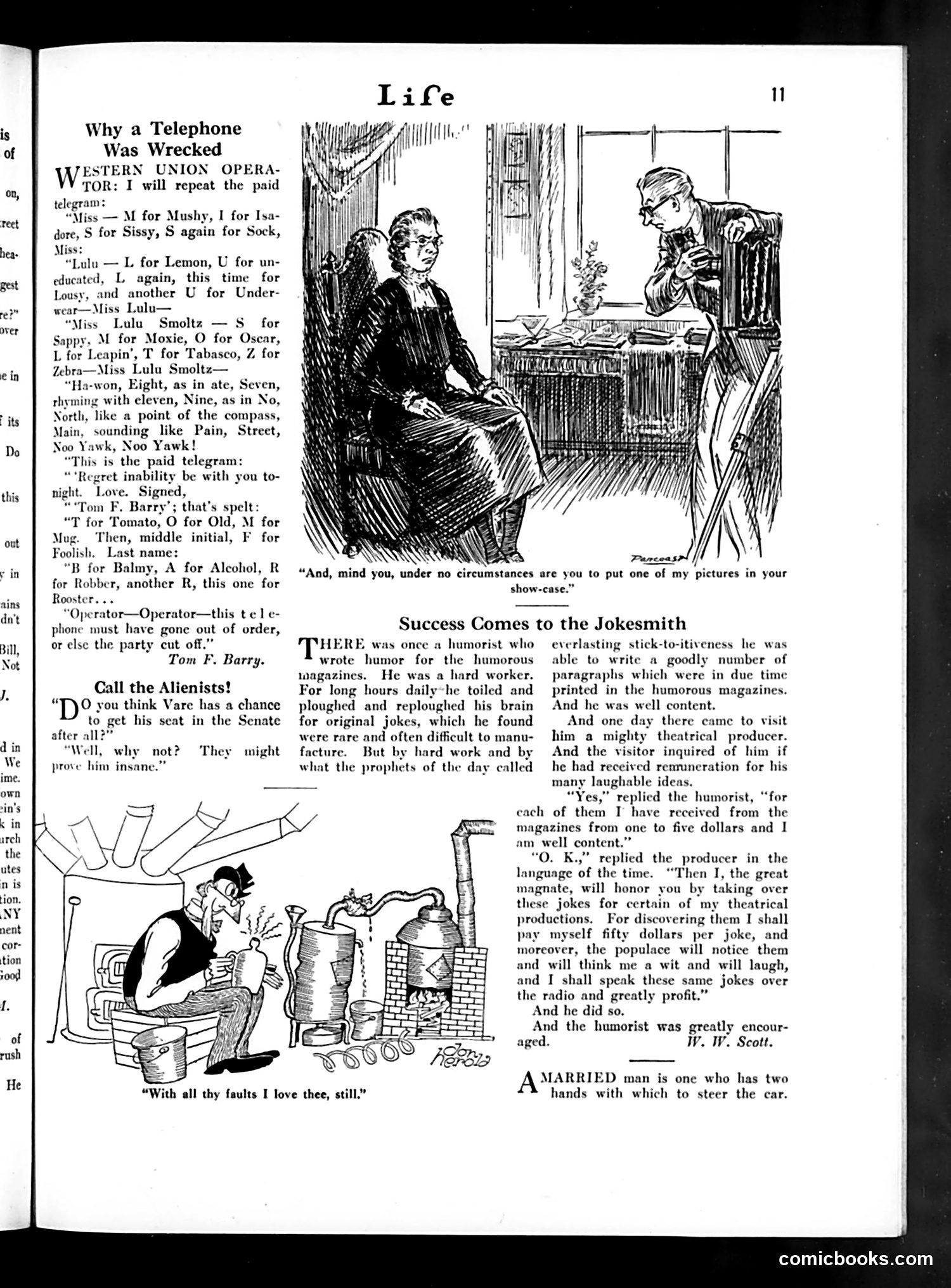
This page from *Life* magazine contains three humor pieces: 1. **"Why a Telephone Was Wrecked"**: A Western Union operator's complaint humorously encoded in Morse code abbreviations (M for Mushy, L for Lemon, etc.). The joke relies on readers understanding telegrapher slang—a profession now obsolete. 2. **"Call the Alienists!"**: A cartoon mocking Senate proceedings, with the caption "With all thy faults I love thee, still." The point appears to be criticism of political ineffectiveness or corruption, though specific context is unclear. 3. **"Success Comes to the Jokesmith"**: A story about a humorist selling jokes to theatrical producers for fifty dollars each. It satirizes commercialization of humor and reflects early 20th-century vaudeville and magazine culture. These pieces assume reader familiarity with now-disappeared professions and entertainment industries.
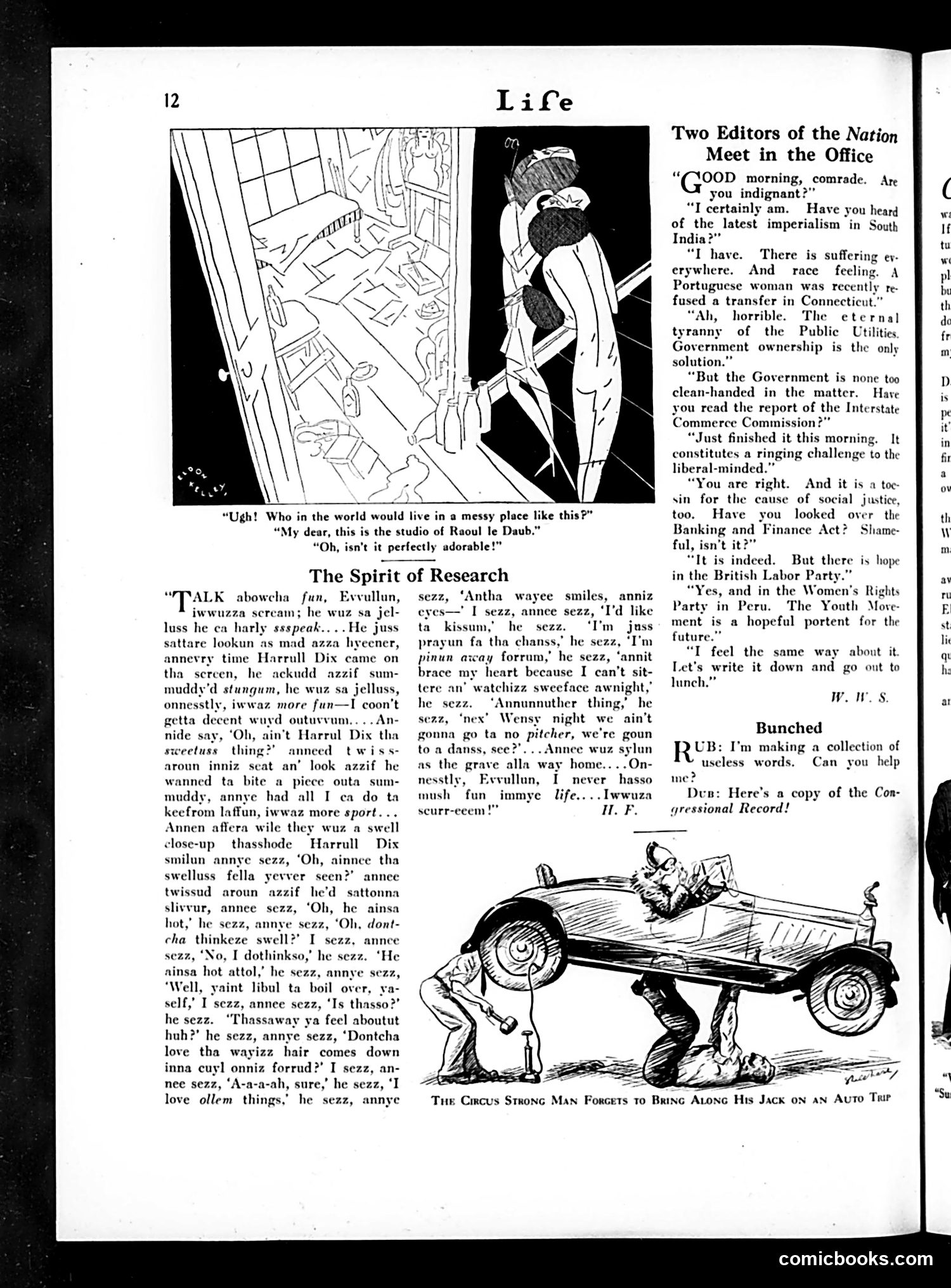
**Top Section - "Two Editors of the Nation Meet in the Office":** Two men discuss political issues including imperialism in South India, Portuguese colonial policy, and British government ownership versus private utilities. The dialogue satirizes earnest progressive debate among intellectual editors, poking fun at how they methodically work through social justice concerns over office conversation. **"The Spirit of Research":** This lengthy phonetic passage appears to be a comedic transcription of dialect speech—likely mocking how intellectuals or academics attempt to document and study vernacular language. The humor derives from the labored, exaggerated phonetic representation. **Bottom - "The Circus Strong Man Forgets to Bring Along His Jack on an Auto Trip":** A visual gag showing a muscular strongman unable to lift a car because he forgot his jack—satirizing reliance on tools over brute strength.
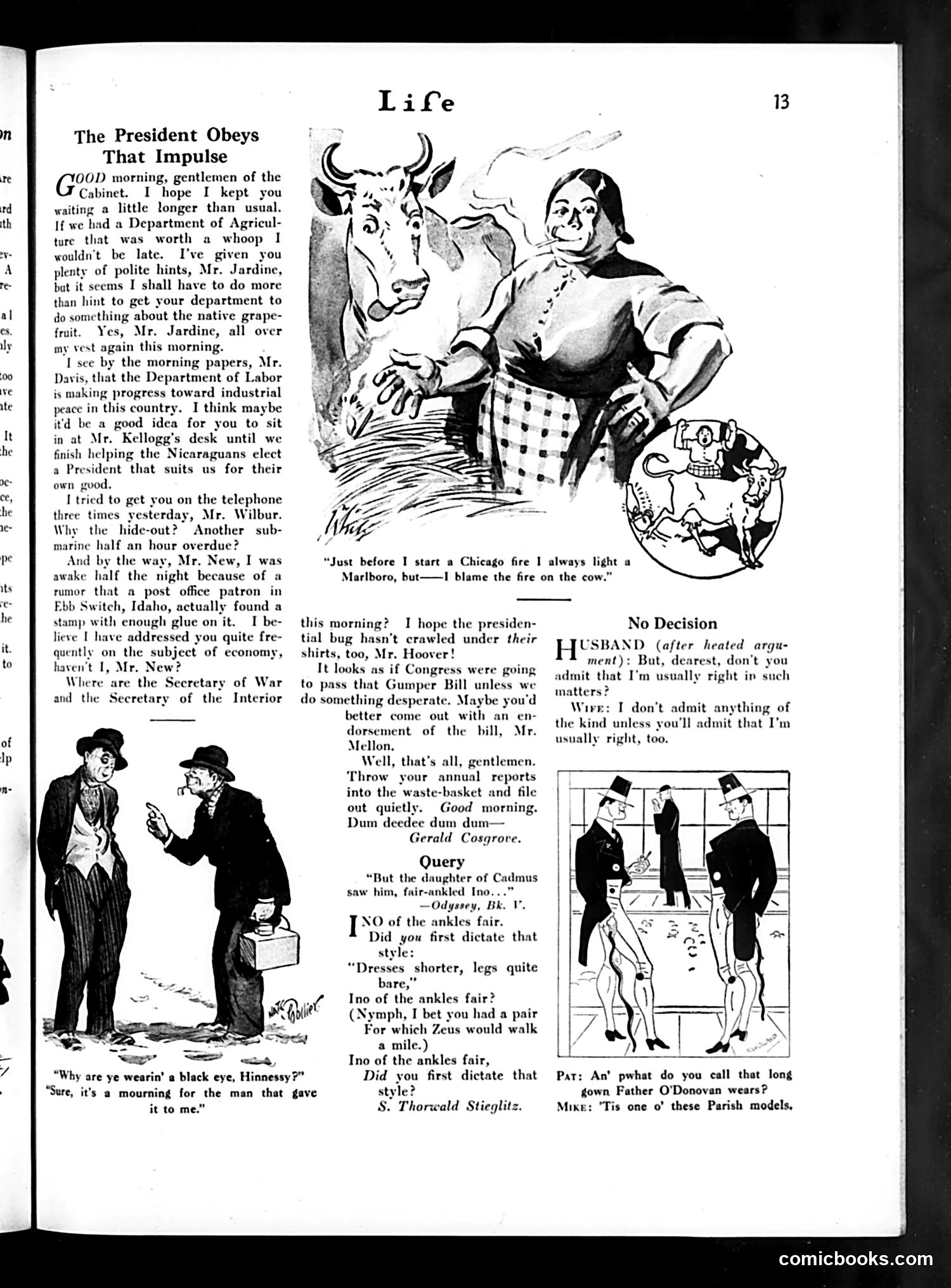
This satirical piece mocks President Hoover's agricultural policy. The cartoon depicts Hoover addressing his Cabinet about a "Department of Agriculture" that allegedly needs to address "native grapefruit" problems. The satire suggests the President is distracted by trivial agricultural concerns while serious issues—labor peace, the Nicaragua situation, and Congressional gridlock over a "Gumper Bill"—go unaddressed. The joke is that Hoover appears obsessed with minor details while major crises demand attention. References to Secretaries of War and Interior suggest cabinet-level dysfunction. The phrase "Throw your annual reports into the waste-basket" indicates bureaucratic inefficiency. This reflects 1920s-30s criticism of Hoover's presidency as ineffectual during economic and political turmoil.
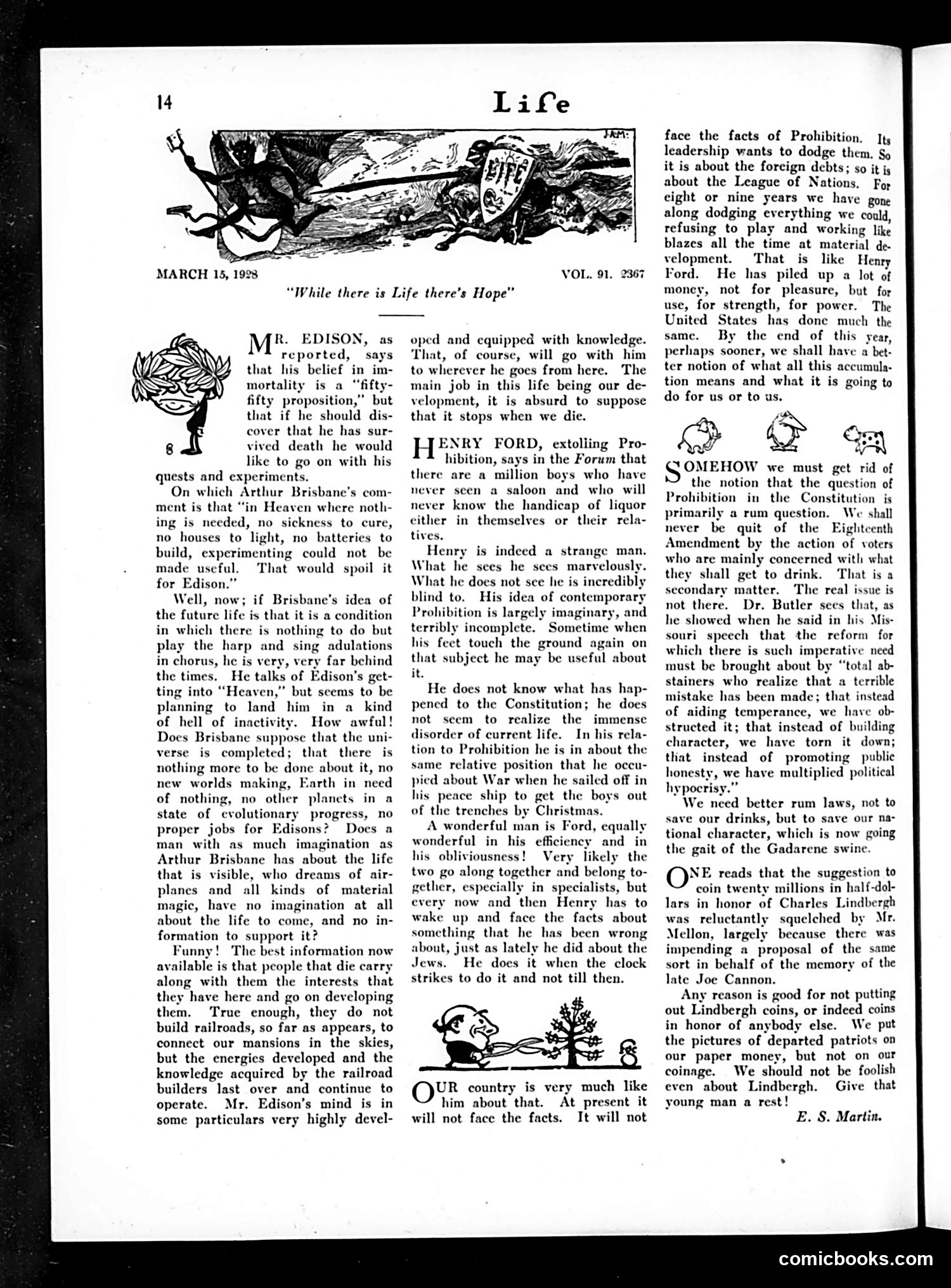
This page contains editorial commentary on Prohibition and American politics. The main cartoon depicts what appears to be a spider or creature labeled "LIFE" attacking or confronting something, likely representing dangers the magazine warns against. The text discusses Edison's views on immortality and life after death, then pivots to criticize Henry Ford's support for Prohibition. The author argues Ford is wrong about Prohibition's effects—that it hasn't stopped drinking but has created disorder and blindness to constitutional issues. The final section satirizes proposals to mint coins honoring Charles Lindbergh, suggesting this is foolish national nostalgia rather than practical policy. The overall tone mocks both Prohibition enforcement and celebrity worship as misguided American preoccupations.
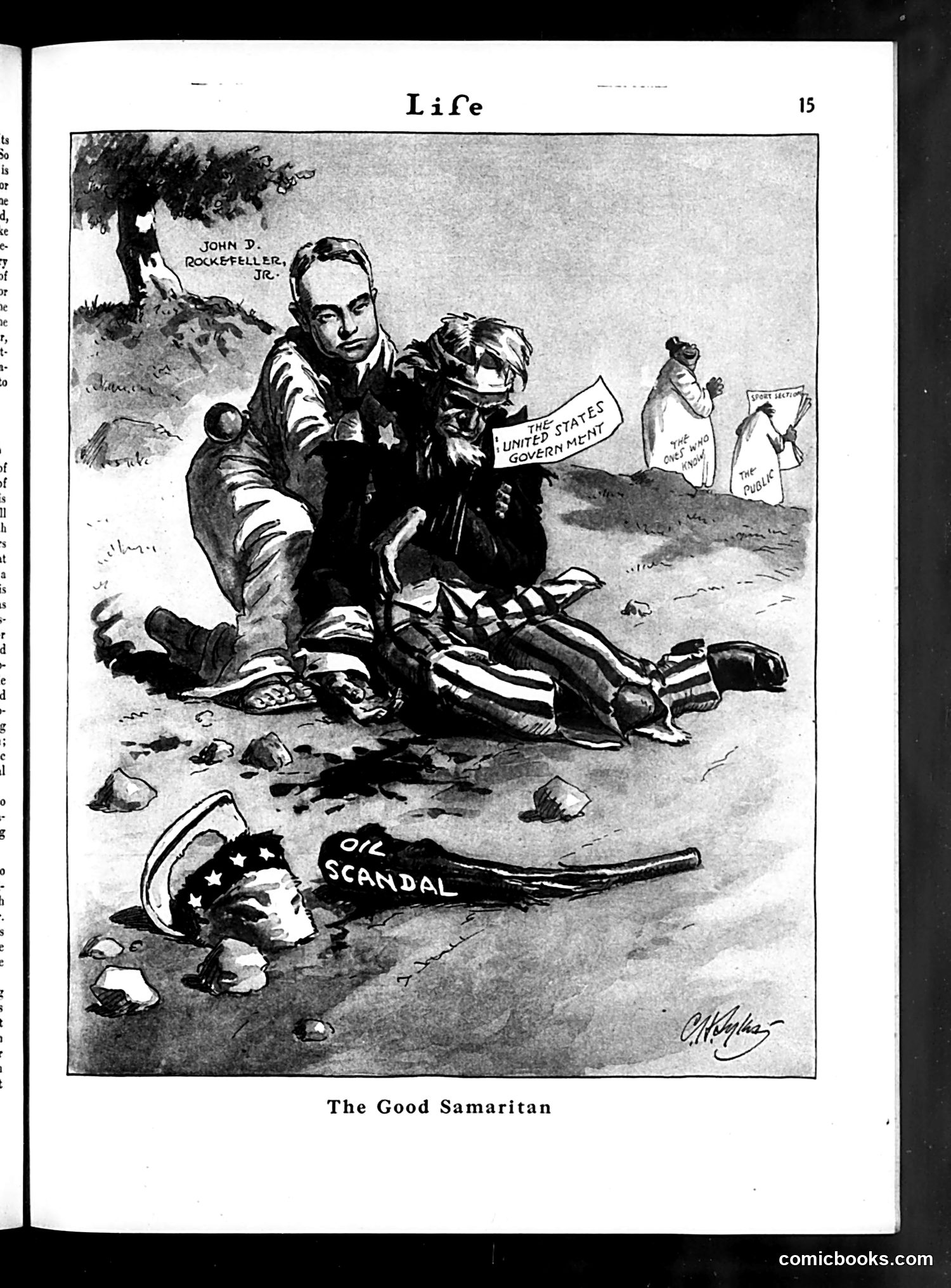
This Life magazine cartoon depicts **John D. Rockefeller Jr.** (labeled at top) as a well-dressed figure helping an injured person labeled "The United States Government." The injured figure lies amid debris including an overturned banner reading "Oil Scandal," referencing what appears to be the **Teapot Dome scandal** (visible as "OIL SCANDAL" on a fallen shield). Signs in the background suggest government corruption or malfeasance. The satire's point is ironic: Rockefeller—a wealthy industrialist from the oil industry—is portrayed as the "Good Samaritan" rescuing government from an oil-related scandal. This likely critiques either Rockefeller's involvement in such scandals or sarcastically suggests the wealthy are positioned as saviors of corrupted government institutions, when they may actually be complicit in the problems.
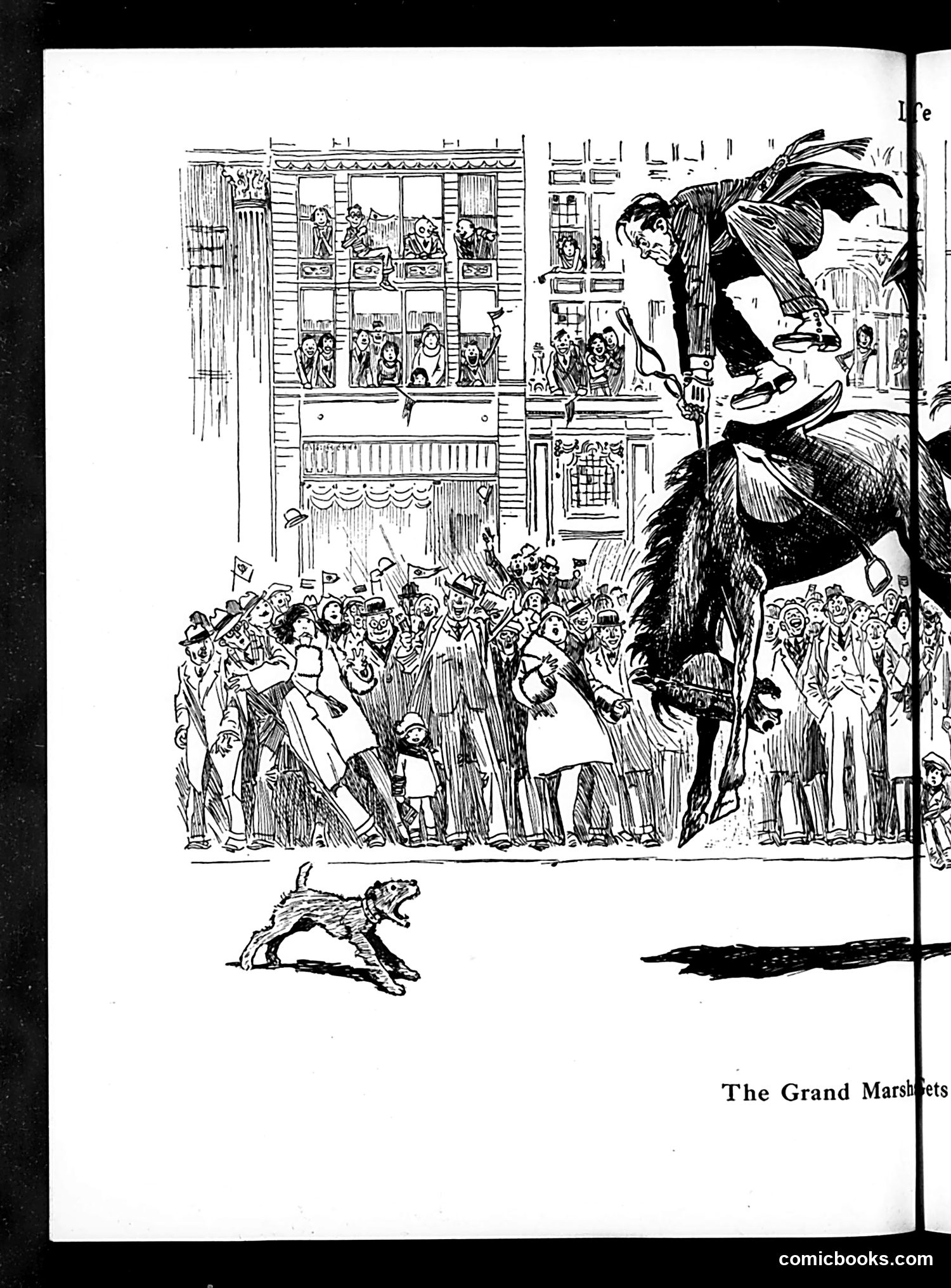
This satirical illustration depicts a grotesque figure dressed in military regalia towering over a crowded urban street scene. The exaggerated caricature—with prominent facial features and an imperious pose—appears to be mocking a political or military leader of the period. The crowd below gazes upward in apparent awe or dismay, while spectators crowd tenement windows above. A small dog in the foreground provides ironic contrast to the grandiose figure. The title "The Grand Marsheets" likely puns on "marshals," suggesting ridicule of authoritarian posturing or military pretension. Without the magazine's date visible, the specific target remains unclear, but the satire critiques the gap between leaders' inflated self-importance and common citizens' reality, a recurring *Life* magazine theme.
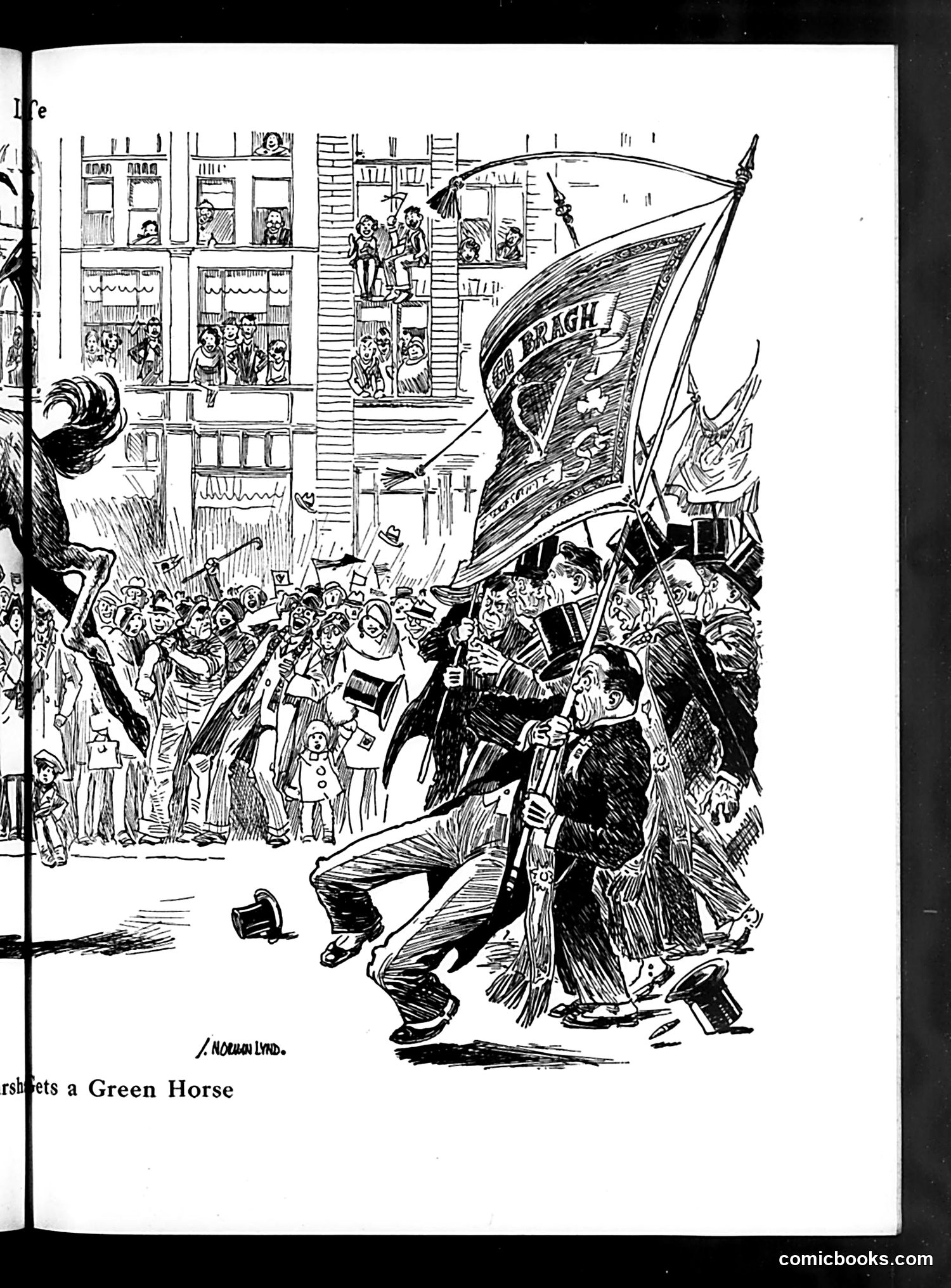
This political cartoon by Norman Lynd depicts a street procession with a large banner labeled "OF BRAZIL" (visible on the flag). The scene shows marching figures in formal dress carrying flags, while crowds of onlookers watch from building windows and street level. The title's reference to a "Green Horse" suggests this cartoons satirizes a diplomatic or political event involving Brazil. The "green horse" likely alludes to naïveté or inexperience—possibly commenting on Brazil's international standing or a specific diplomatic initiative. The elaborate procession and public spectacle suggest the cartoon is mocking either Brazilian pretensions or the American public's reaction to Brazilian affairs, though the exact historical event remains unclear without additional context.
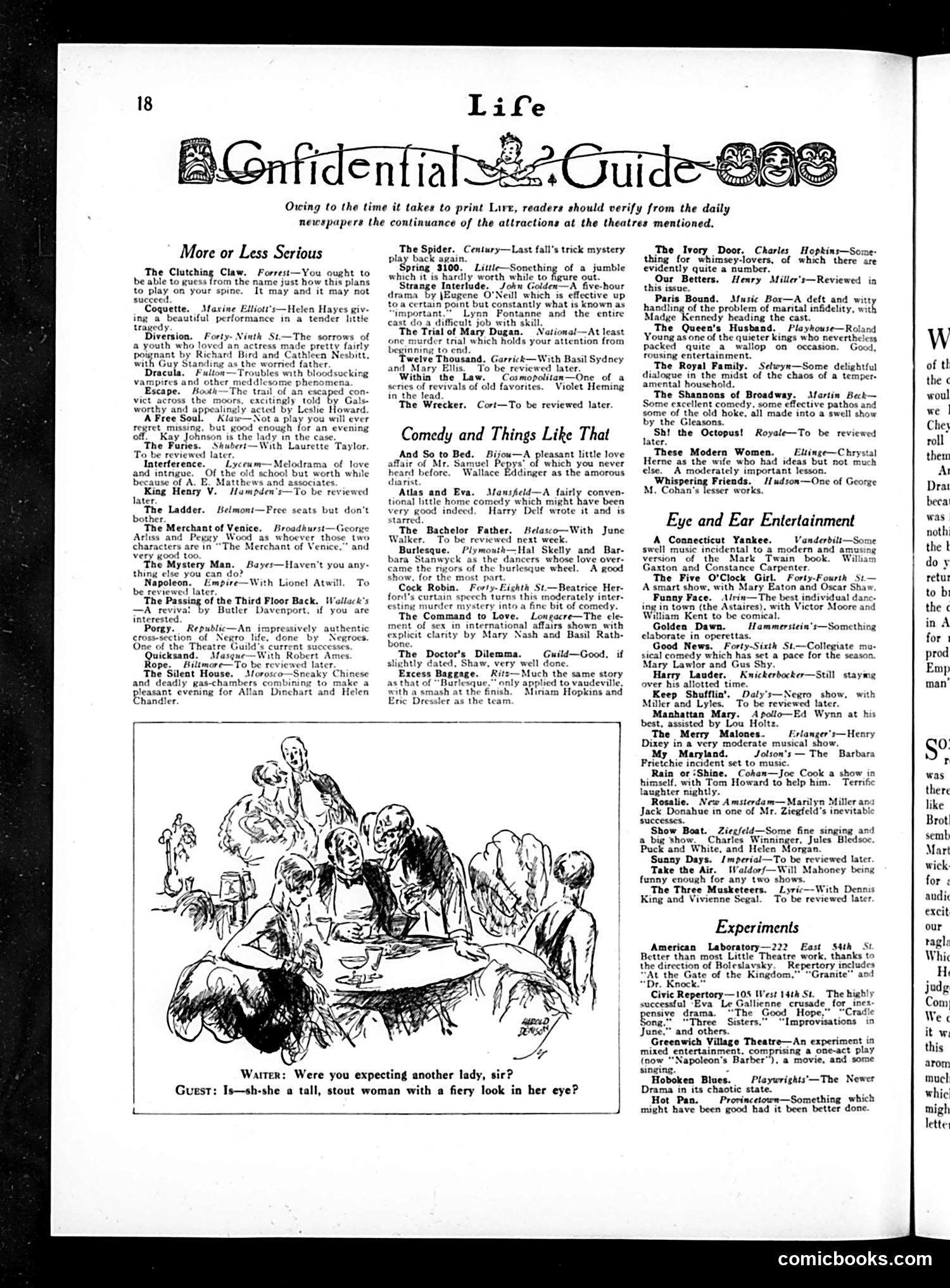
This page is a **theater guide** from Life magazine listing current Broadway productions with brief critical assessments. It's organized into categories: "More or Less Serious," "Comedy and Things Like That," and "Eye and Ear Entertainment." The accompanying **cartoon** depicts a waiter and guest at what appears to be a restaurant or theater lobby. The waiter asks if the guest was "expecting another lady, sir?" The guest replies they expected "a tall, stout woman with a fiery look in her eye"—likely a satirical jab at a specific well-known woman of the era, though the specific identity isn't clear from the image alone. The joke appears to be about mistaken identity or romantic expectations being disappointed, typical of Life's humor. The cartoon complements the theater section by capturing the social comedies being performed on stage—the awkward social situations and romantic mishaps that dominate contemporary plays.
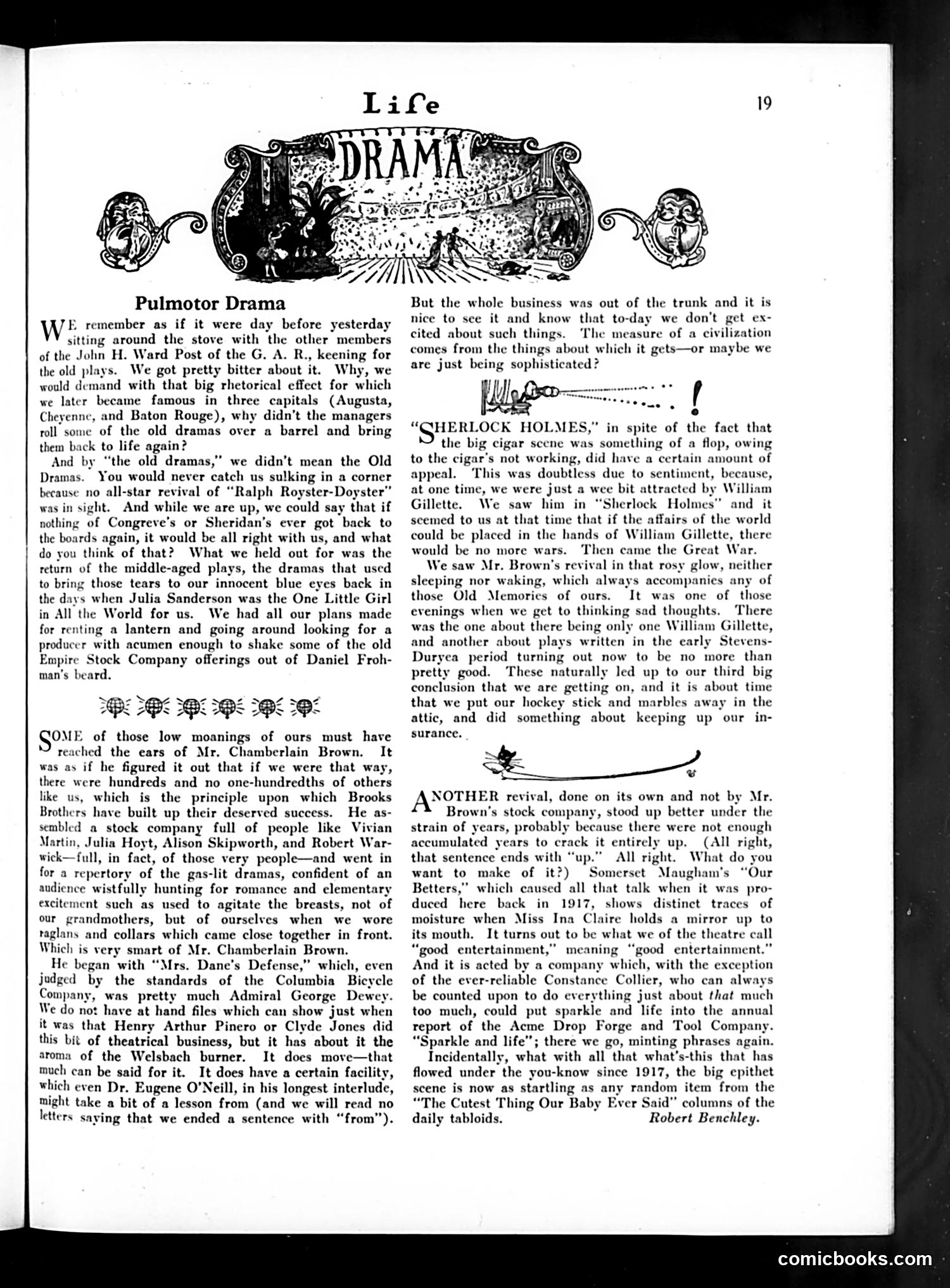
This article reflects early 20th-century nostalgia for melodramatic theater. The writer, representing aging Civil War veterans (G.A.R. members), laments the disappearance of emotionally gripping plays from the "gas-lit" era—middle-aged dramas that featured stars like Julia Sanderson. Producer Chamberlain Brown capitalizes on this sentiment by assembling a stock company (with actors Vivian Martin, Julia Hoyt, Alison Skipworth, Robert Warwick) to revive old plays. The satire mocks both the audience's sentimentality and society's self-congratulation about "progress"—the writer notes that while audiences once got excited about romantic dramas, modern civilization considers such emotional investment unsophisticated. The reviews of revivals like "Mrs. Dane's Defense" and "Sherlock Holmes" (featuring William Gillette) reveal the gap between nostalgic memory and present reality. The article gently satirizes how we romanticize the past while simultaneously pretending we've outgrown its simple pleasures.
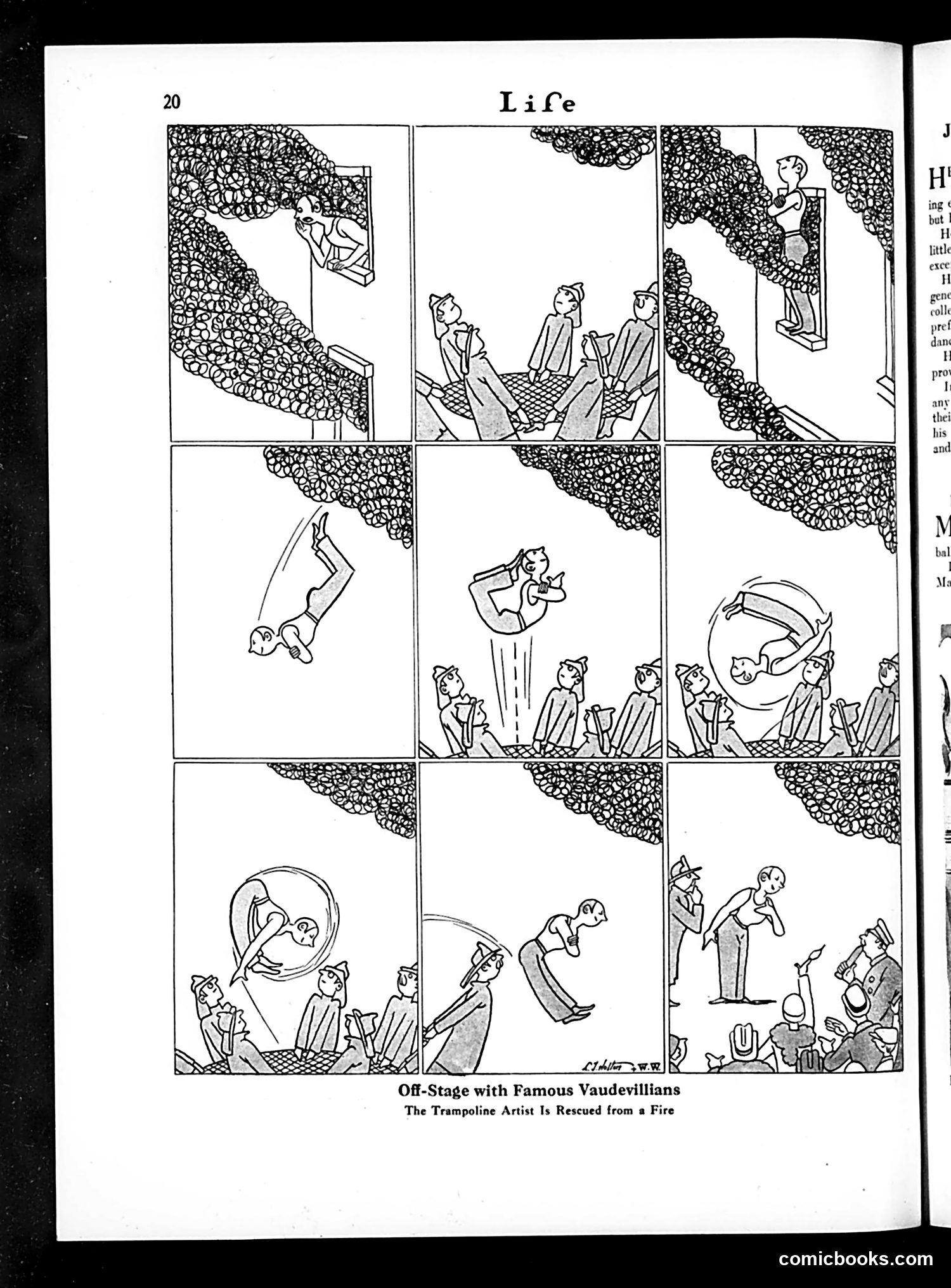
This is a nine-panel comic strip titled "Off-Stage with Famous Vaudevillians," depicting a dramatic rescue scenario. The narrative shows a trampoline artist trapped in a building fire. Vaudeville performers (identifiable by their period clothing) coordinate a rescue using a trampoline to catch the falling artist, who bounces safely into their net-like apparatus. The humor appears to derive from the incongruity of using a performer's own professional equipment—a trampoline—as an emergency rescue tool. The strip plays on the specialized skills and props associated with vaudeville acts, suggesting these theatrical performers could improvise practical solutions using their stage materials. This reflects early 20th-century Life magazine's typical satirical approach: finding absurdist comedy in contemporary entertainment culture and occupational stereotypes.
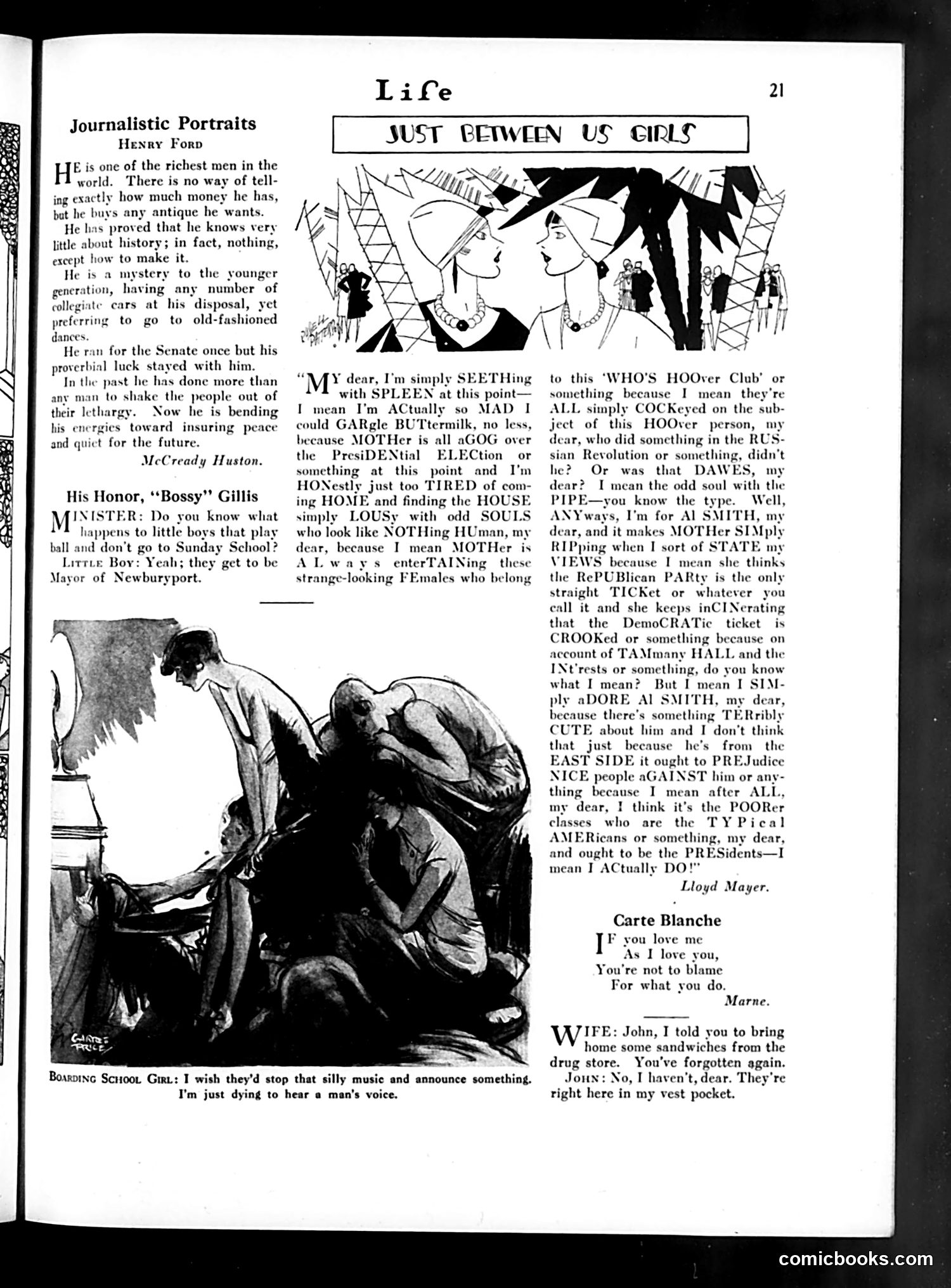
This page contains satirical "Journalistic Portraits" and humor pieces typical of 1920s Life magazine. **Henry Ford portrait**: Mocks Ford's wealth and contradictions—he's a self-made industrialist ignorant of history, yet buys antiques; mysteriously prefers old-fashioned dances despite owning modern cars. The satire highlights his recent failed Senate campaign and his shift toward promoting peace, presenting him as unknowable and inconsistent. **"Bossy" Gillis cartoon**: A brief joke about political corruption in small-town Massachusetts (Newburyport), suggesting boys who skip Sunday School become mayors—implying moral decay in local politics. **"Just Between Us Girls"**: A lengthy satirical monologue capturing flapper speech patterns of the era. The girl breathlessly discusses the 1928 presidential election, mentioning Herbert Hoover and Al Smith (a Democratic Catholic candidate facing anti-Catholic prejudice). The repeated capitalization parodies breathless, scattered female speech. The satire mocks both women's political involvement and class prejudices of the era. The remaining items are brief, unrelated humor pieces about marriage and gender roles.
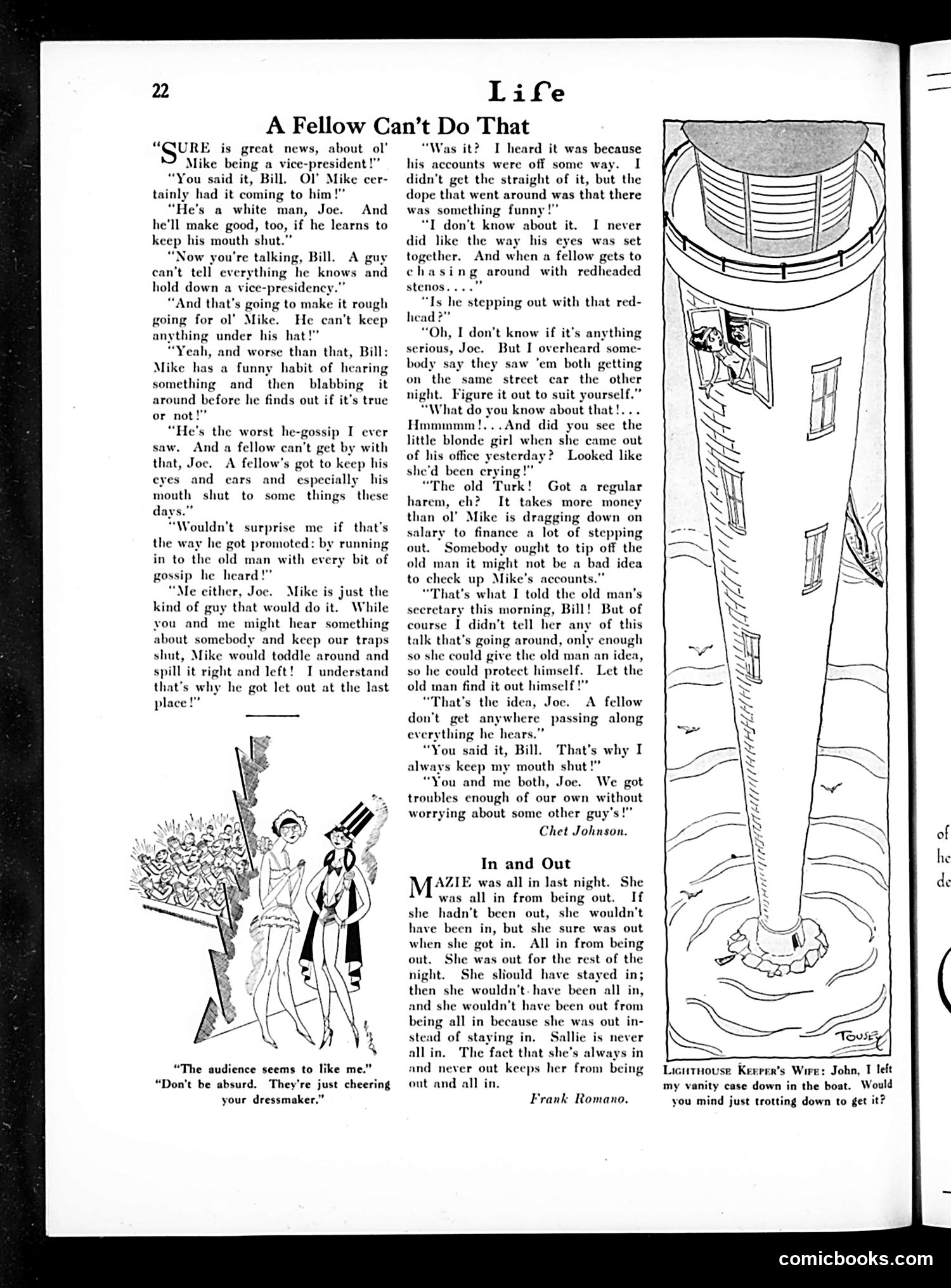
This page satirizes office gossip and workplace hypocrisy. Two men—Bill and Joe—discuss their coworker Mike's recent promotion to vice-president, concluding he'll fail because he can't keep quiet. However, the satire's irony is the entire conversation itself: these two gossips spread unverified rumors about Mike's alleged affairs with "redheaded stenos" and blonde office girls, and even suggest tipping off the boss to investigate his accounts—all while congratulating themselves for discretion and "keeping their mouth shut." The joke exposes how office workers rationalize spreading damaging gossip as protective concern while denying their own participation in rumor-mongering. The bottom sections contain unrelated light humor about circular logic and marital domesticity, typical of *Life* magazine's satirical style.
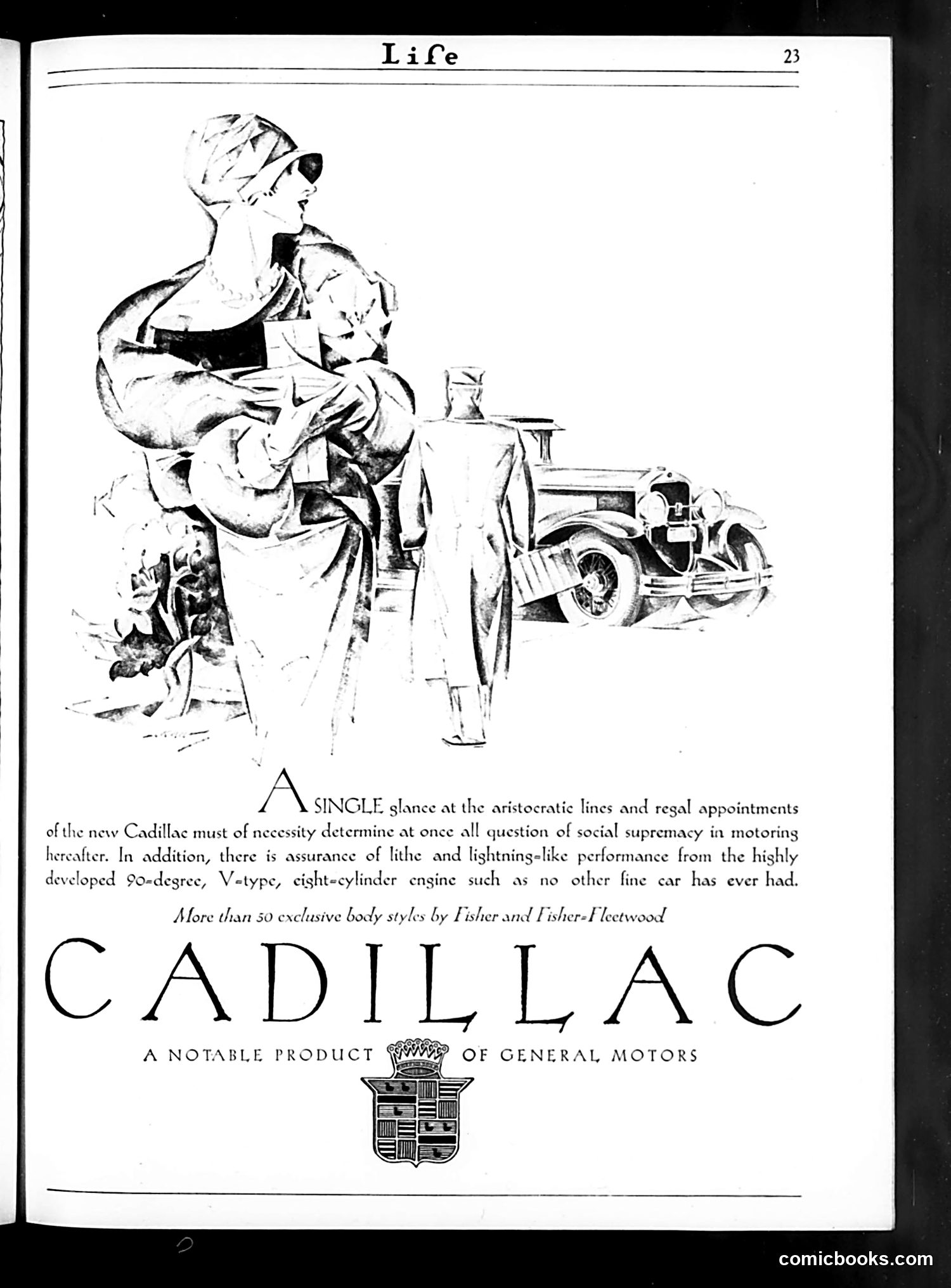
This is **not a political cartoon or satire**—it's a luxury automobile advertisement from Life magazine's early 20th century. The illustration depicts a fashionably dressed woman in 1920s attire (cloche hat, elegant coat) admiring a Cadillac automobile. The accompanying text makes explicit claims about social status: owning a Cadillac supposedly determines "social supremacy in motoring." The satire here is **implicit rather than explicit**—Life's editors likely ran this ad alongside other content that mocked such pretensions. The earnest language about aristocratic "regal appointments" and the direct equation of car ownership with social standing would have invited knowing smiles from readers. The ad's breathless tone about the V-type, eight-cylinder engine reflects 1920s automotive marketing's emphasis on technical supremacy as a proxy for wealth and sophistication. This reflects the Jazz Age consumer culture Life frequently lampooned: the idea that purchasing the right luxury goods guaranteed social legitimacy.
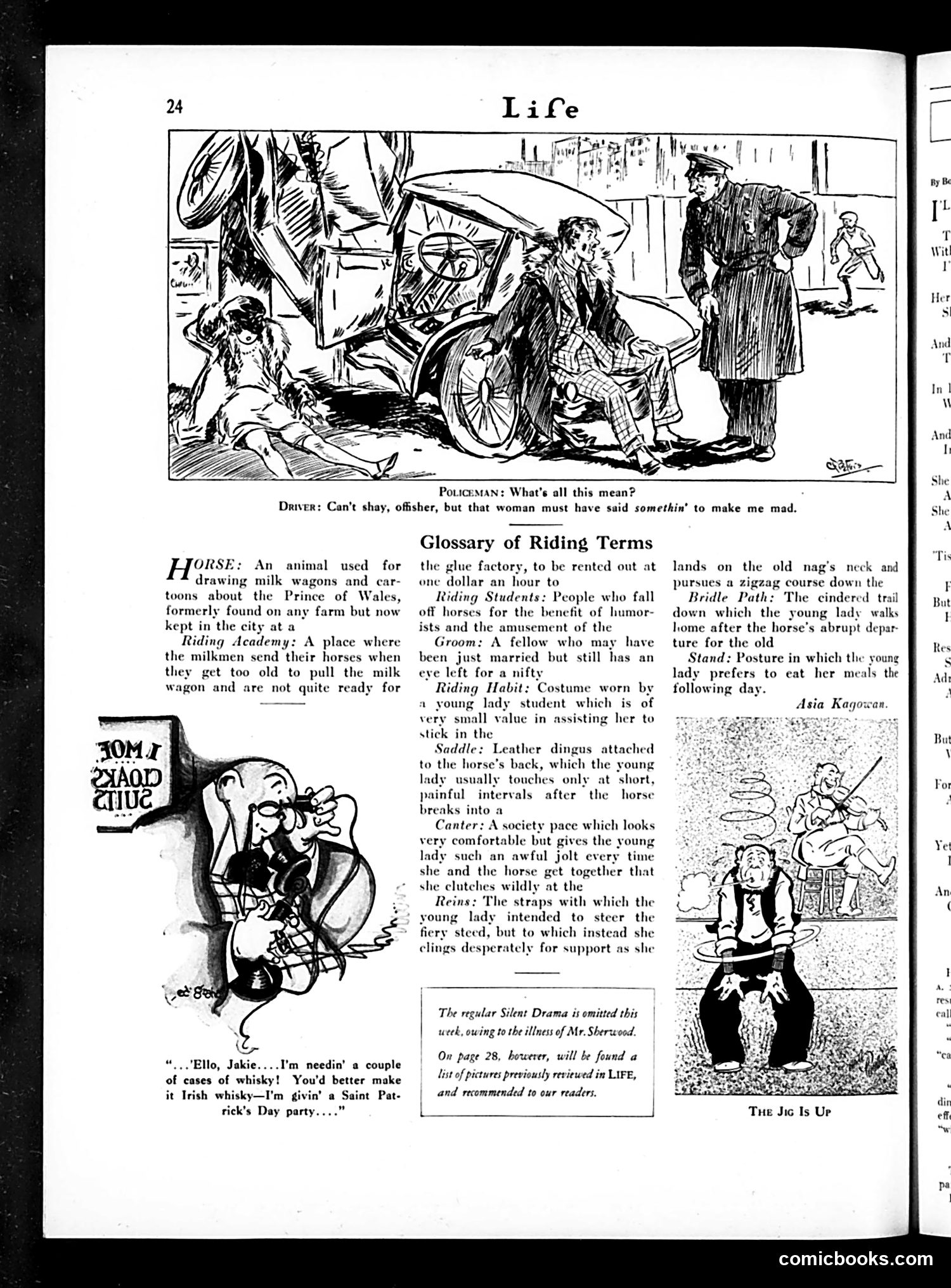
The main cartoon depicts a car accident involving a drunk driver. A policeman asks what happened; the driver—speaking in exaggerated Irish dialect ("Can't shay, offisher")—blames a woman for making him angry, implying she caused the crash through nagging rather than accepting his own intoxication as responsibility. Below is a humorous "Glossary of Riding Terms" mocking wealthy city dwellers who take up horseback riding at fashionable riding academies. The satire targets inexperienced, wealthy young women attempting to ride horses they cannot control, repeatedly falling off. The definitions joke that riding academies exist to warehouse old, worn-out carriage horses; that students are entertainment for humorists; and that women's expensive riding habits are useless since they spend more time on the horse's neck than in the saddle. The smaller "Tom and Jake" whiskey advertisement uses Irish-dialect humor typical of the era's casual ethnic stereotyping.
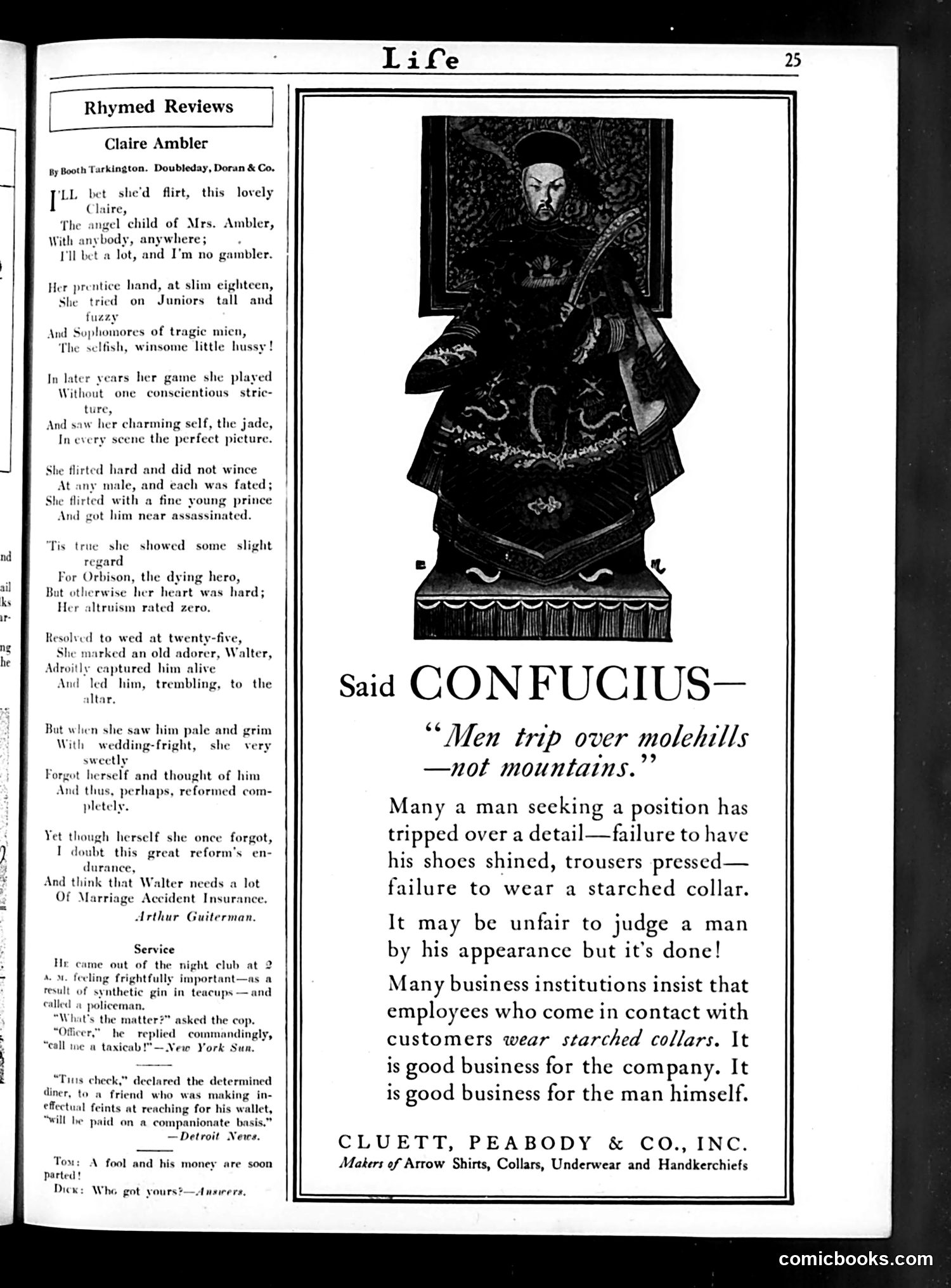
This page contains a book review and advertisements from a vintage Life magazine issue. **Left side:** A humorous rhymed review of Booth Tarkington's novel *Claire Ambler* by Arthur Guiterman. The poem satirizes the titular character as a shameless flirt who manipulates men throughout her youth before marrying an "old adorer" named Walter. The reviewer jokes that Walter needs "Marriage Accident Insurance"—a witty critique of her reformed but likely unreliable nature. **Right side:** A Confucius-themed advertisement for Arrow Shirts and Collars by Cluett, Peabody & Co. The ad uses a faux-philosophical quote ("Men trip over molehills—not mountains") to argue that small grooming details—shined shoes, pressed trousers, starched collars—determine job success. The message: appearance matters in business, and wearing Arrow products serves both employer and employee. This reflects early 20th-century corporate emphasis on employee presentation and respectability.
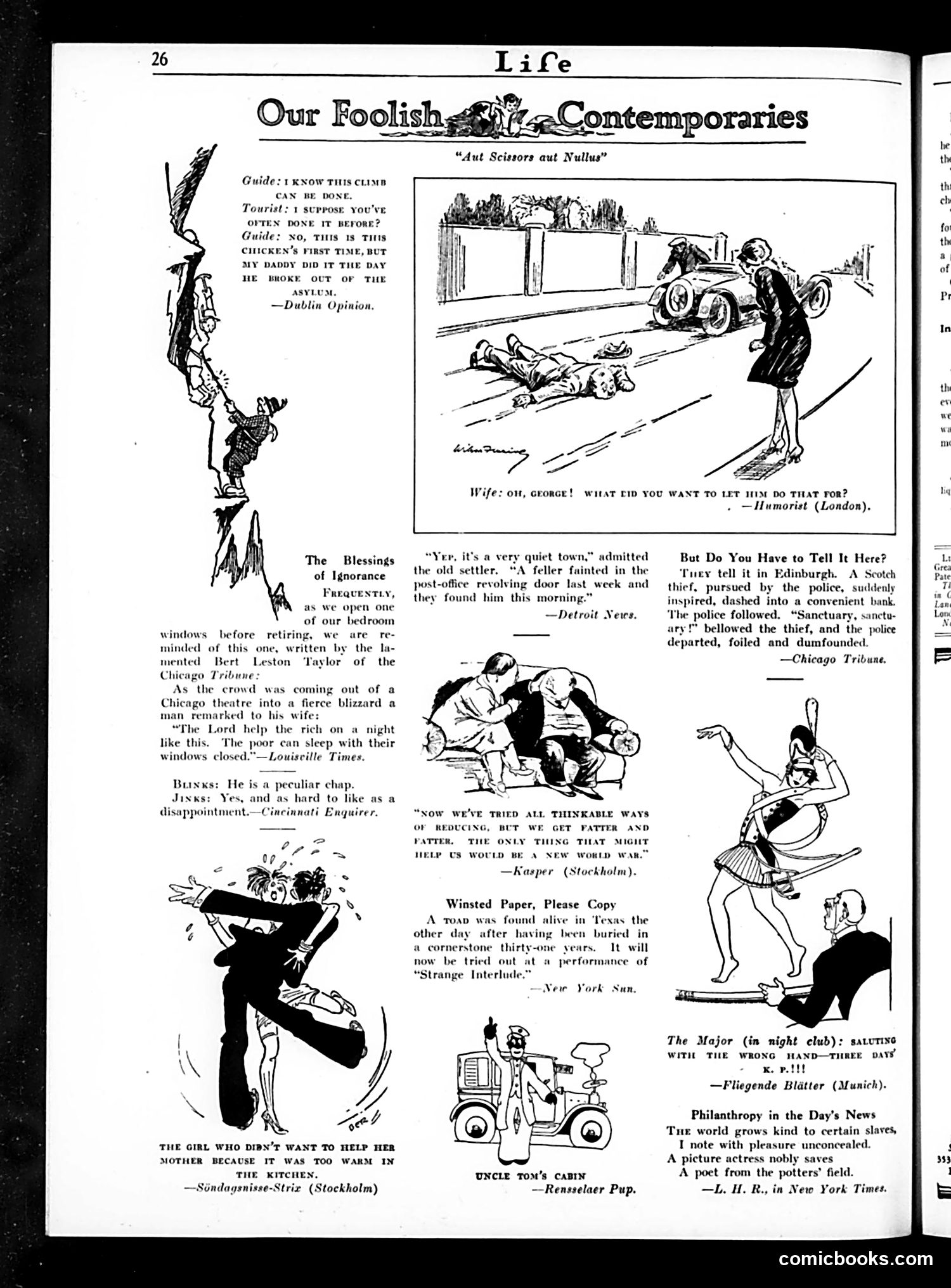
This page collects brief humorous anecdotes and jokes from newspapers worldwide, framed as examples of human foolishness. The cartoons illustrate selected stories: **Top cartoon**: A wife confronts her husband after he's hit someone with a car, asking why he let the victim "do that" — satirizing absurd logic or blame-shifting. **Left cartoons**: Include a couple falling/tumbling (illustrating a domestic mishap story) and a girl refusing kitchen chores because it's too warm — mocking illogical excuses. **Right cartoons**: Show comedic physical situations—a woman in a night club and a man with a cello, illustrating absurdist scenarios. The jokes themselves mock human irrationality: a guide's family history of insanity, a rich man's obliviousness during blizzards, and a Scotch thief exploiting "sanctuary" laws. The page's title suggests these are contemporary follies worth ridiculing through international humor.
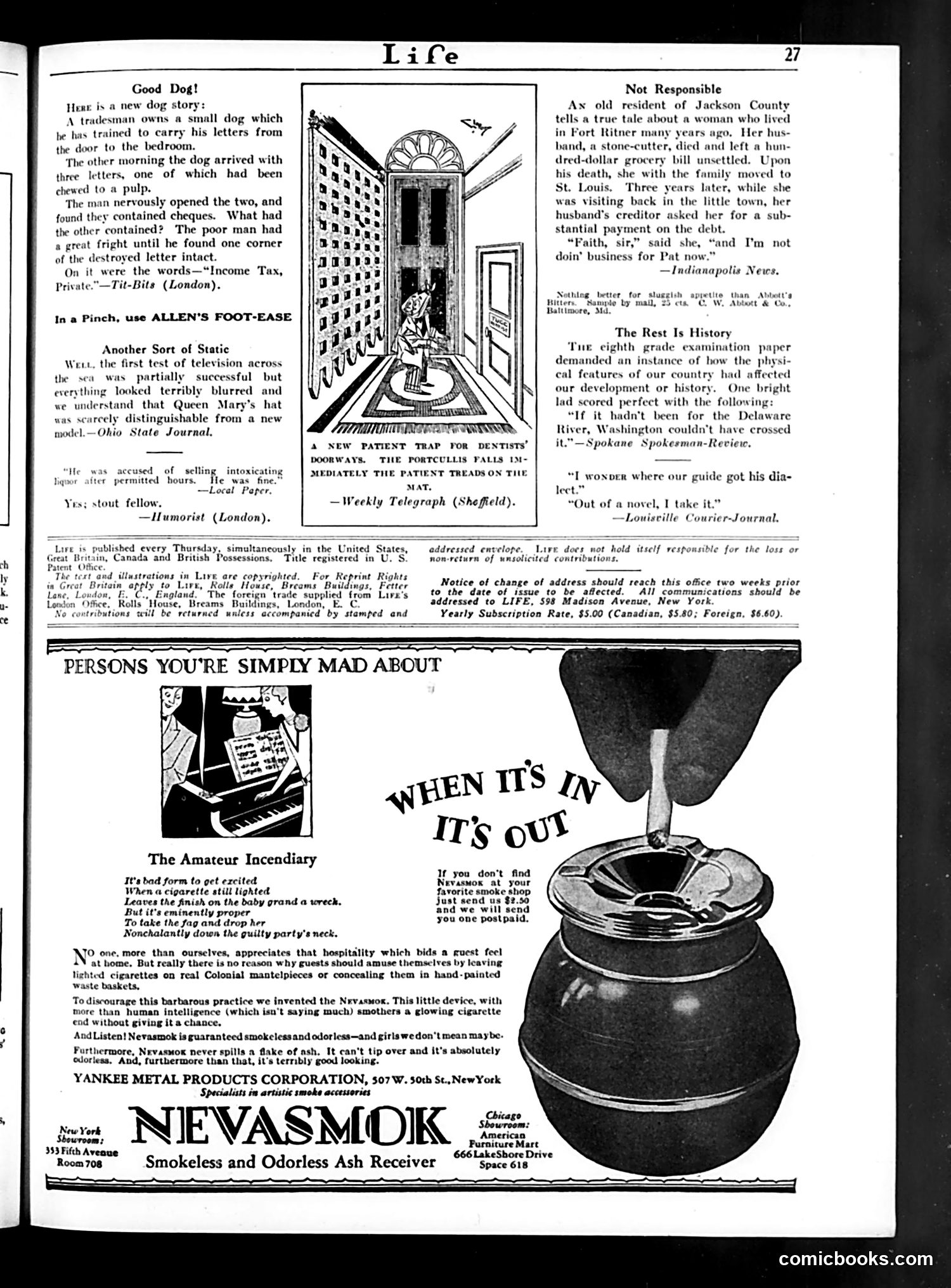
This page mixes humor pieces with advertisements, typical of Life's format. The **cartoons and jokes** satirize everyday annoyances: a dog that destroys an "Income Tax" letter (suggesting taxes are worthless), a woman avoiding debt responsibility, and an eighth-grader's clever history answer about the Delaware River (implying students give absurdly simplistic explanations). The **"Amateur Incendiary" section** humorously criticizes guests who carelessly leave lit cigarettes on furniture, damaging it. It's social satire targeting inconsiderate behavior. The main **advertisement** promotes the "Nevasmox"—a smokeless ash receiver designed to prevent cigarettes from burning furniture and waste baskets. The product aims to stop the exact rude behavior the humor piece mocks. The satire works because the jokes highlight real frustrations (taxes, debt, careless guests), making the advertised solution seem practical rather than frivolous. This was common in Life: humor and advertising reinforced each other.
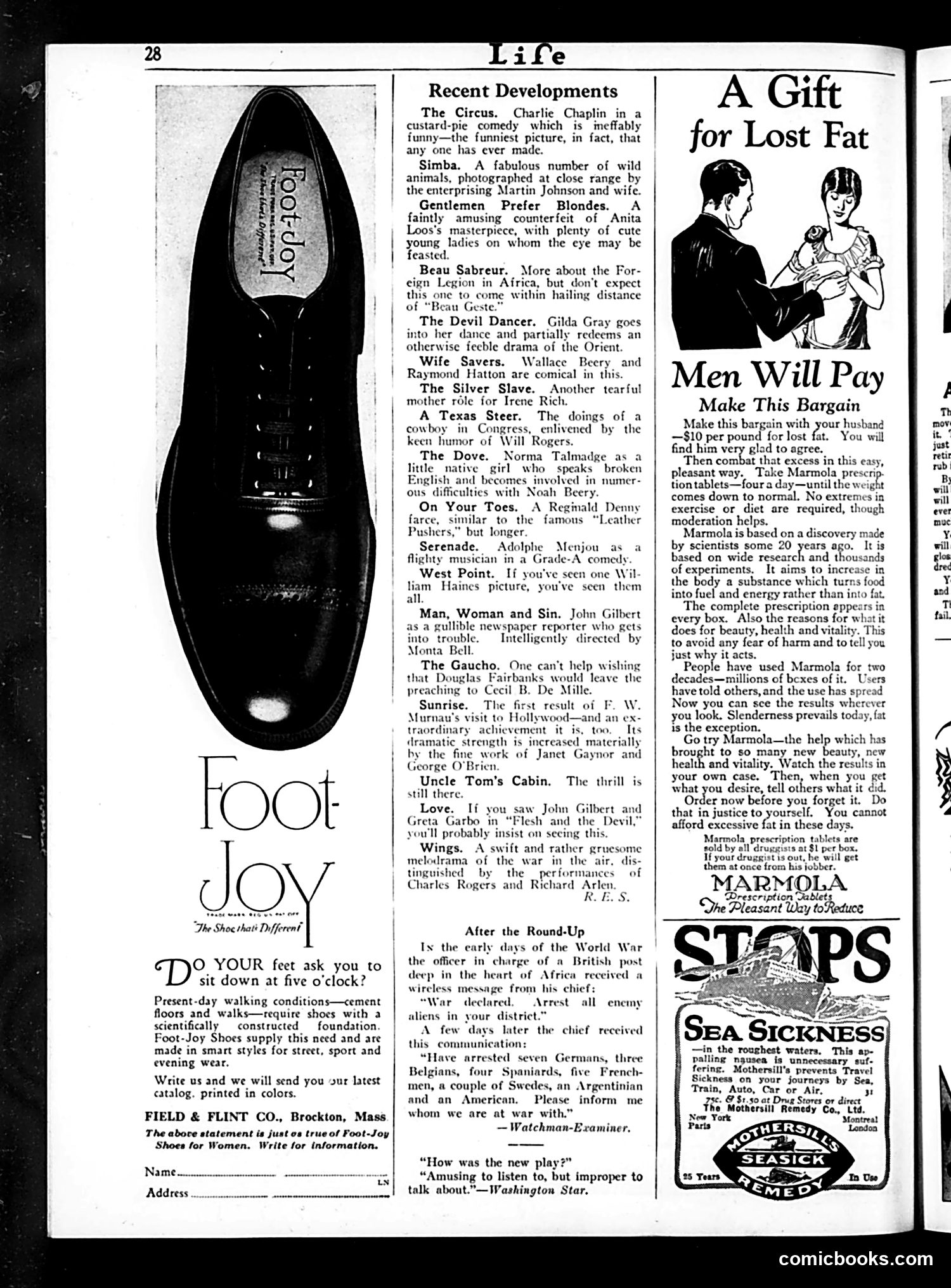
This page primarily contains **movie reviews** and **advertisements**, not political cartoons. The "Recent Developments" section reviews contemporary 1920s films, including Charlie Chaplin's *The Circus*, *Gentlemen Prefer Blondes*, and *Wings*—offering brief, sometimes sarcastic commentary on their quality. The major advertisement is for **Marmola**, a weight-loss tablet marketed to women. The tagline "A Gift for Lost Fat" and "Men Will Pay" reflects 1920s gender dynamics: husbands allegedly offer "$10 per pound for lost fat," framing weight loss as a marital bargain. The ad emphasizes beauty and vitality while claiming the tablets contain a "scientific discovery" that converts food to energy rather than fat—a dubious claim by modern standards. A smaller ad for **Foot-Joy shoes** appears on the left, and maritime remedies advertise at bottom right. The page is essentially a snapshot of 1920s consumer culture and attitudes toward women's appearance.
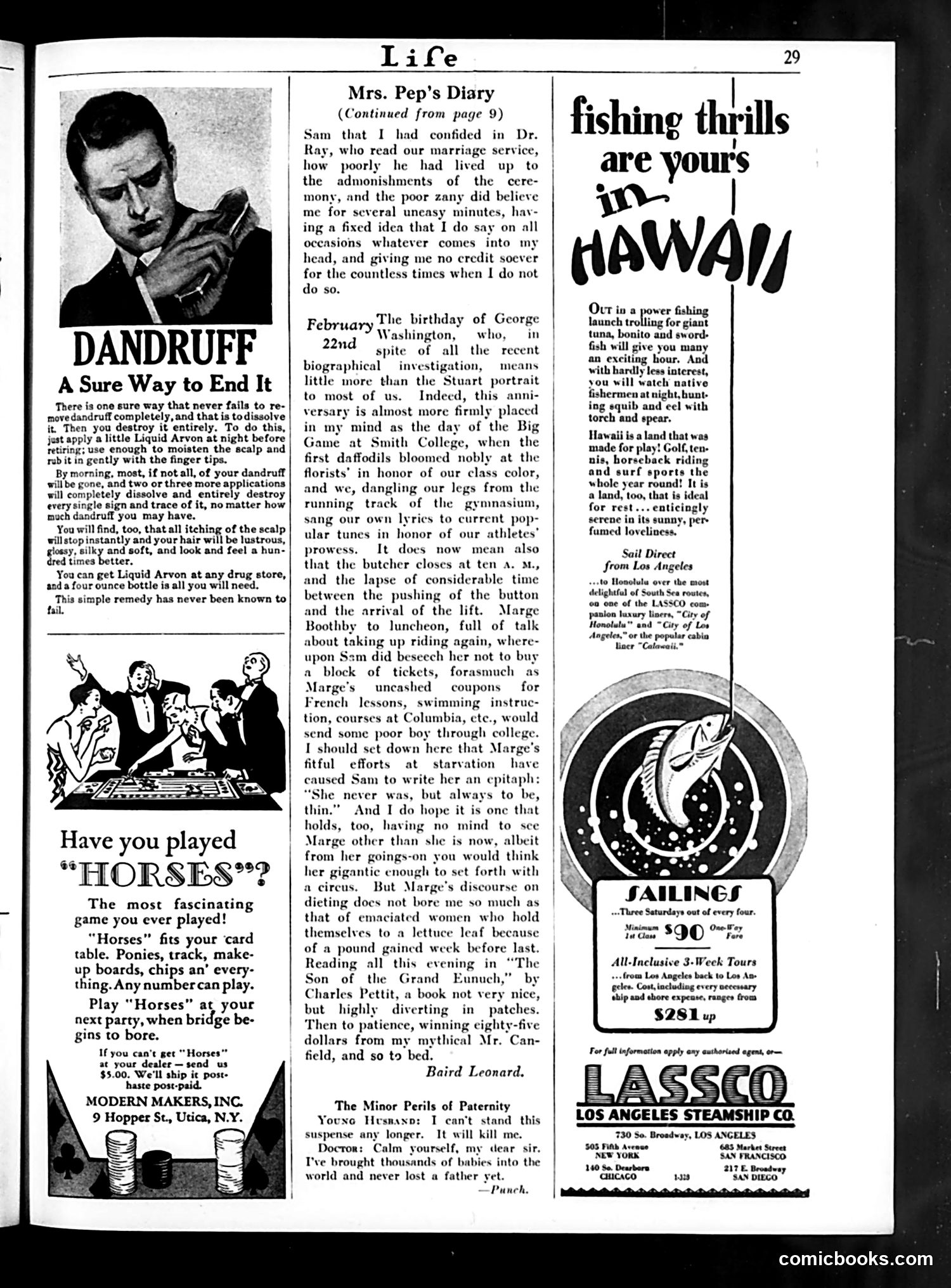
This page contains primarily **advertisements and lifestyle content** rather than political cartoons, though it reflects early 20th-century commercial culture. The **"Dandruff" ad** promotes Liquid Arvon as a cure-all, typical of the era's exaggerated patent-medicine advertising before FDA regulation. **"Mrs. Pep's Diary"** is a society column satirizing upper-class women's concerns—gossiping about friends like "Marge Boothby," discussing her failed dieting attempts, and trivializing women's education (unused coupons for French and swimming lessons). The humor targets wealthy women's frivolous lifestyles. The **"Horses" game ad** markets a card/board game as fashionable entertainment for social gatherings, appealing to the leisure class. The **"Minor Perils of Paternity"** joke mocks men's anxiety about childbirth—the young husband's panic contrasts with the doctor's casual confidence, poking fun at male hysteria. Overall, the page satirizes consumer culture and gender stereotypes of the affluent classes.
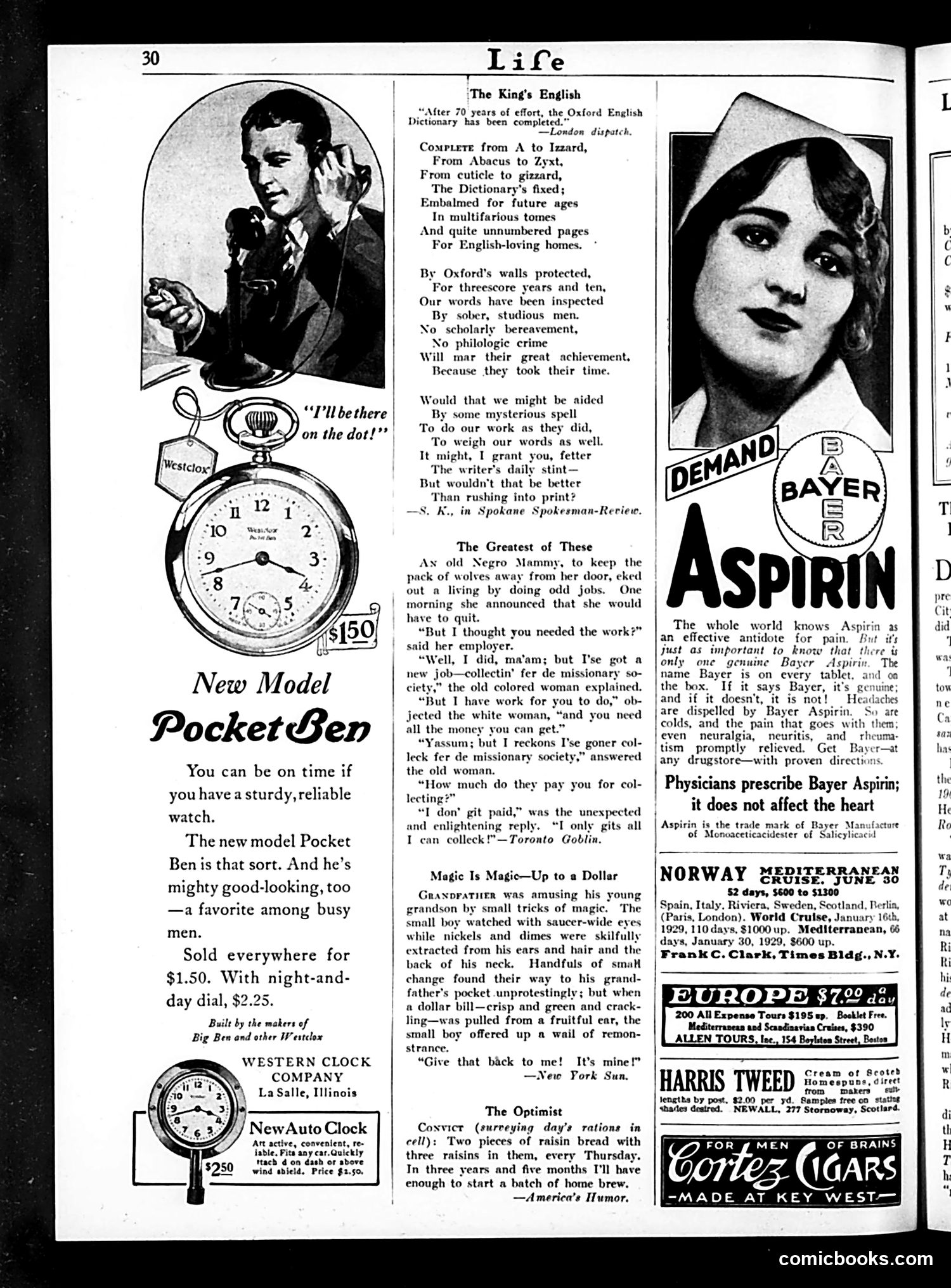
This page mixes advertisements with humorous short pieces typical of Life magazine's satirical format. The main cartoons are brief, comic anecdotes: 1. **"The King's English"** celebrates the Oxford English Dictionary's completion after 70 years, presented as a poetic tribute to scholarly patience and thoroughness—contrasting with modern rushed publishing. 2. **"The Greatest of These"** depicts an elderly Black woman choosing unpaid missionary collection work over paid domestic labor, satirizing either her misplaced priorities or the paltry wages of domestic work (the humor/satire target is ambiguous). 3. **"Magic is Magic"** shows a grandfather's magic tricks delighting a child until a real dollar disappears—the joke being the child only protests when actual money vanishes. 4. **"The Optimist"** presents a convict calculating he'll accumulate enough raisins from prison bread rations to brew illegal alcohol—dark humor about ingenuity under constraint. The page is dominated by period advertisements: Pocket Ben watches, Bayer Aspirin, cruise lines, and Harris Tweed. The overall effect showcases Life's blend of gentle social commentary with commercial content.
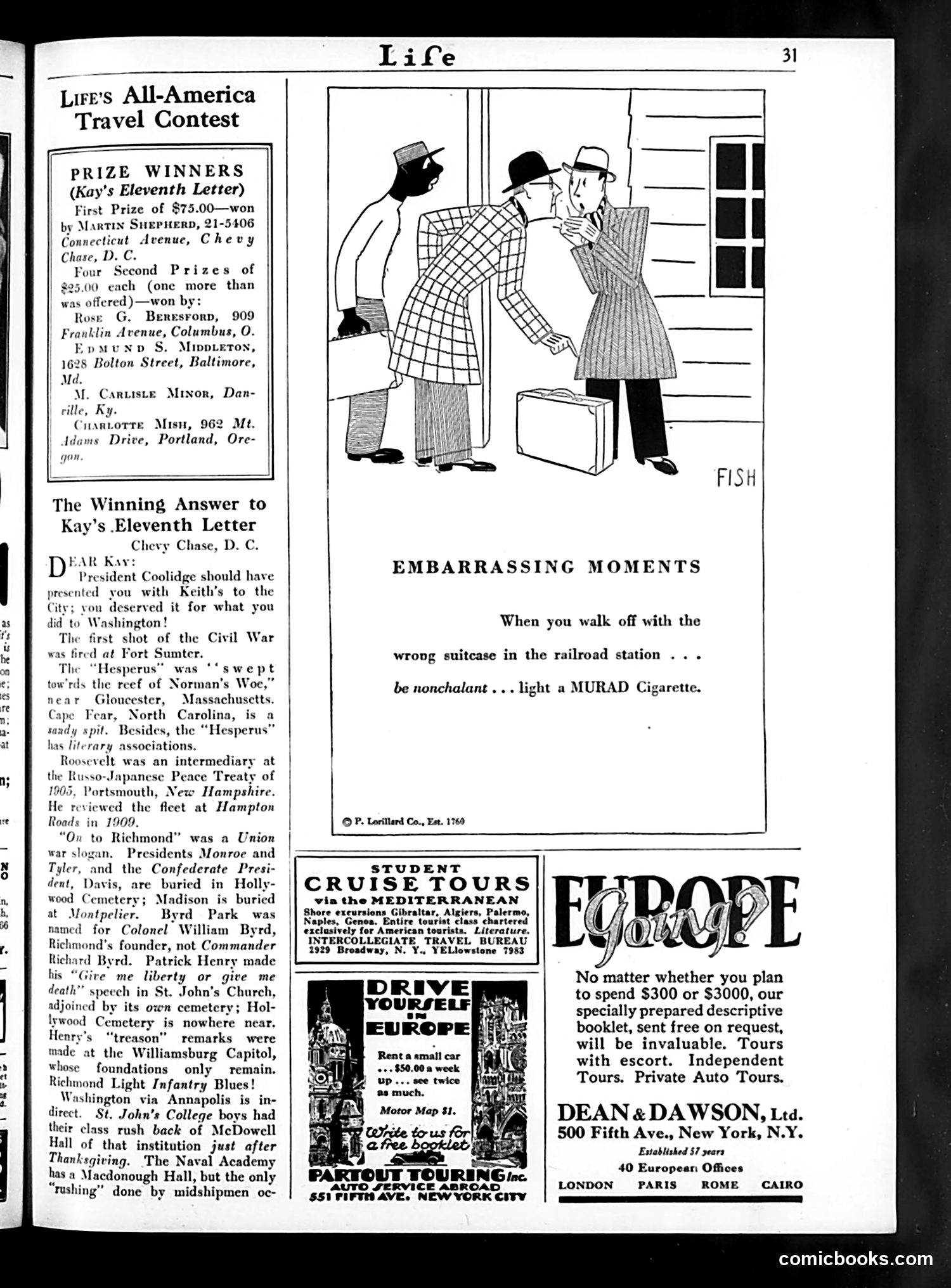
This page is primarily **advertising and contest results**, not political satire. The main content shows Life's "All-America Travel Contest" winners and a cartoon labeled "EMBARRASSING MOMENTS" depicting a humorous social scenario: a man and woman awkwardly discovering they've mixed up their suitcases at a train station. The joke is that the man should "be nonchalant" and light a MURAD cigarette to play it cool during this embarrassing mix-up. The "Winning Answer" section contains a detailed letter correcting geographical and historical errors from a previous contest question about Washington, D.C. and Virginia landmarks—referencing Fort Sumter, the Longfellow poem "The Wreck of the Hesperus," and various presidential associations. The remaining content consists of travel advertisements (Mediterranean cruises, car rentals, European tour companies), reflecting the 1920s-30s leisure travel industry. There is no political commentary or caricature of public figures on this page.
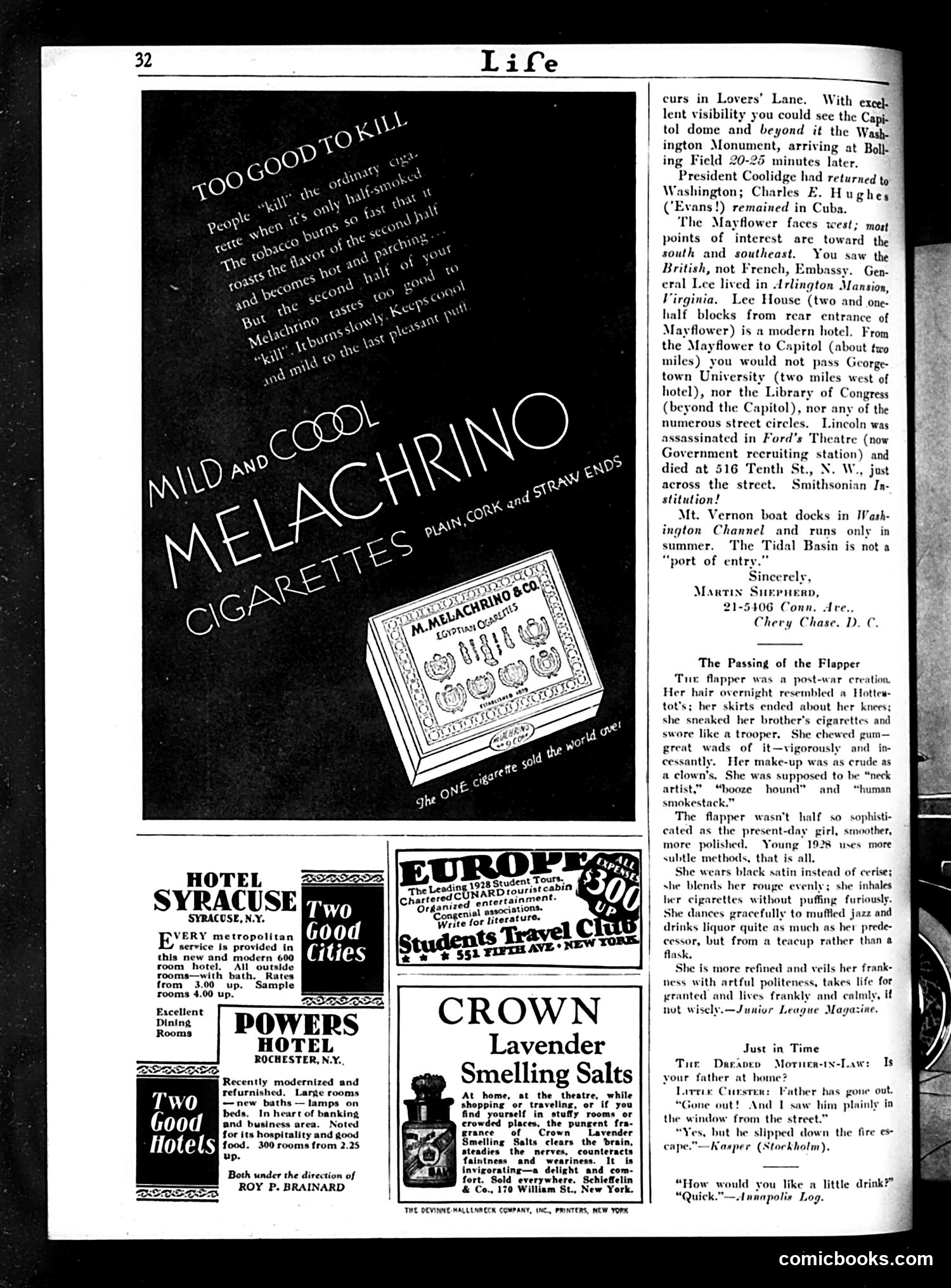
This page primarily features a social commentary article about the decline of 1920s "flapper" culture by 1928. The flapper—a post-WWI phenomenon—was characterized by bobbed hair, short skirts, heavy makeup, public smoking, and deliberately shocking behavior meant to scandalize older generations. The article argues that the modern girl of 1928 hasn't abandoned these behaviors; she's simply refined them. Where the original flapper was crude and obvious—chewing gum loudly, drinking from flasks, puffing cigarettes ostentatiously—the contemporary young woman achieves the same ends with subtlety and polish. She drinks liquor from teacups rather than flasks, inhales cigarettes without theatrical puffing, and applies makeup evenly instead of crudely. The satire's point: moral standards haven't genuinely improved; young women have simply become more sophisticated at concealing their conduct. The article suggests society was fooled by surface-level changes rather than actual behavioral reform. The page also contains period advertisements and hotel listings, typical of Life magazine's revenue model.