
Life, 1928-03-15 · page 7 of 34
Life — March 15, 1928 — page 7: what you’re looking at
What you’re looking at
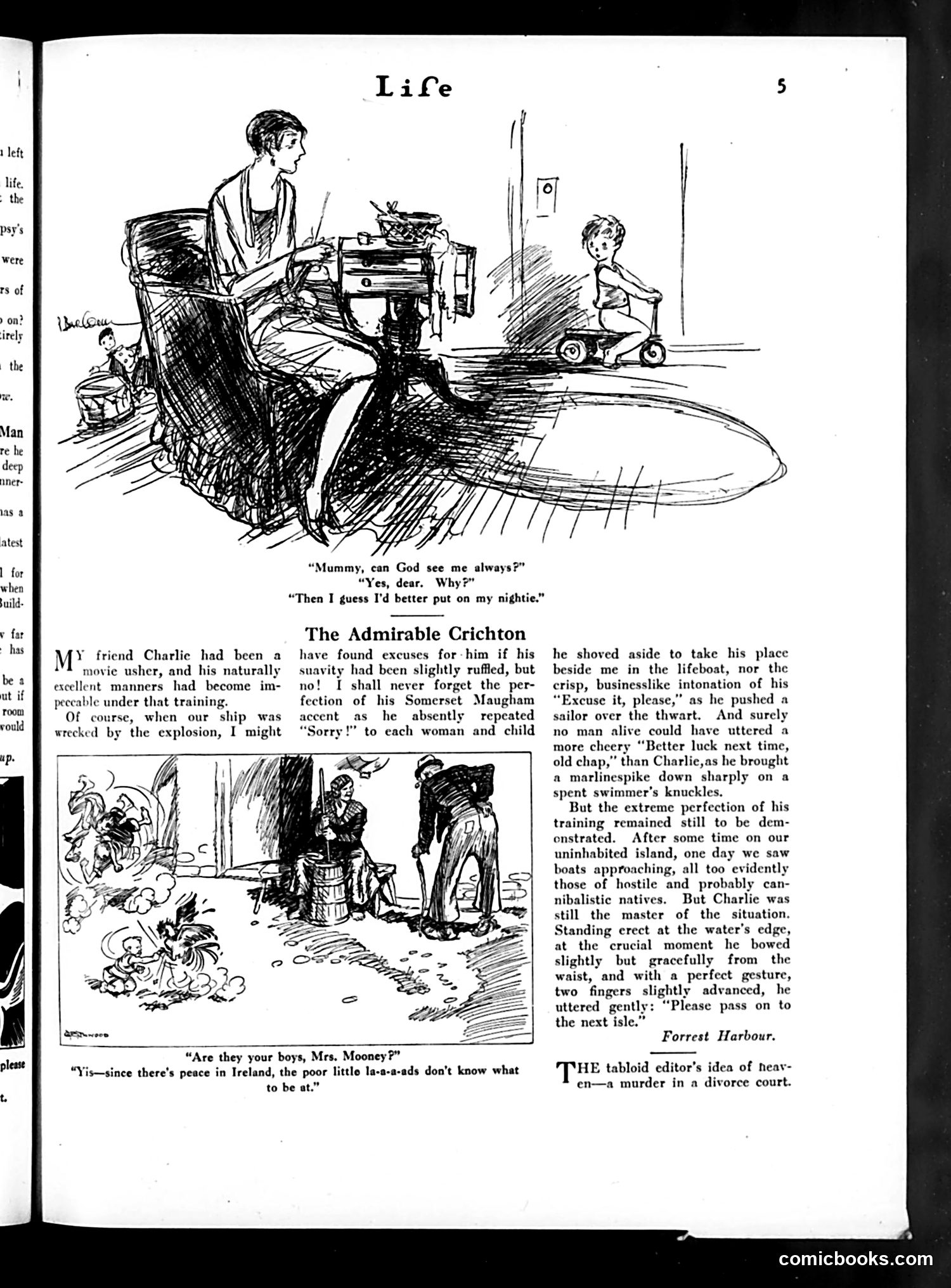
This page contains two satirical pieces: **Top cartoon**: Shows a mother asking God if He can "always" see her, with the child replying she'd "better put on my nightie"—a joke about childhood innocence and modesty before God's omniscience. **"The Admirable Crichton"**: A story about Charlie, a movie usher whose politeness and perfect manners are tested during a shipwreck on an uninhabited island. The narrative satirizes the British ideal of maintaining proper decorum in all circumstances—even when facing "cannibalistic natives." Charlie's unflappable courtesy ("Better luck next time, old chap") in crisis situations parodies the upper-class English obsession with etiquette over practical survival. **Bottom cartoon**: References Irish poverty and social conditions, with dialogue about children's circumstances during peacetime in Ireland. The satire targets class pretensions and rigid social conventions.
📄 Transcribed text from this page (OCR, searchable)
Machine-transcribed from the original scan — historical spelling and the odd misread are preserved.
nner las a atest | for “Mummy, can God see me always?” when “Yes, dear. Why?” build- “Then I guess I'd better put on my nightie.” y fr The Admirable Crichton M* friend Charlie had been a have found excuses for-him if his he shoved aside to take his place movie usher, and his naturally suavity had been slightly ruffled, but beside me in the lifeboat, nor the excellent manners had become im- no! I shall never forget the per- crisp, businesslike intonation of his peccable under that training. fection of his Somerset Maugham “Excuse it, please,” as he pushed a Of course, when our ship was accent as he absently repeated sailor over the thwart. And surely wrecked by the explosion, I might “Sorry!” to each woman and child no man alive could have uttered a more cheery “Better luck next time, iP A Vp p 2: . | old chap,” than Charlie,as he brought é 1h . ete: a marlinespike down sharply on a spent swimmer’s knuckles. But the extreme perfection of his training remained still to be dem- onstrated. After some time on our uninhabited island, one day we saw boats approaching, all too evidently those of hostile and probably can- nibalistic natives. But Charlie was still the master of the situation. Standing erect at the water's edge, at the crucial moment he bowed slightly but gracefully from the waist, and with a perfect gesture, two fingers slightly advanced, he uttered gently: “Please pass on to the next isle.” rould Forrest Harbour. ~ “Are they your boys, Mrs, Mooney?” cients Ca “Yis—since there's peace in Ireland, the poor little la-a-a-ads don’t know what HE tabloid editor’s idea of neav- to be at.” en—a murder in a divorce court. comicbooks.com