
Life, 1928-03-15 · page 21 of 34
Life — March 15, 1928 — page 21: what you’re looking at
What you’re looking at
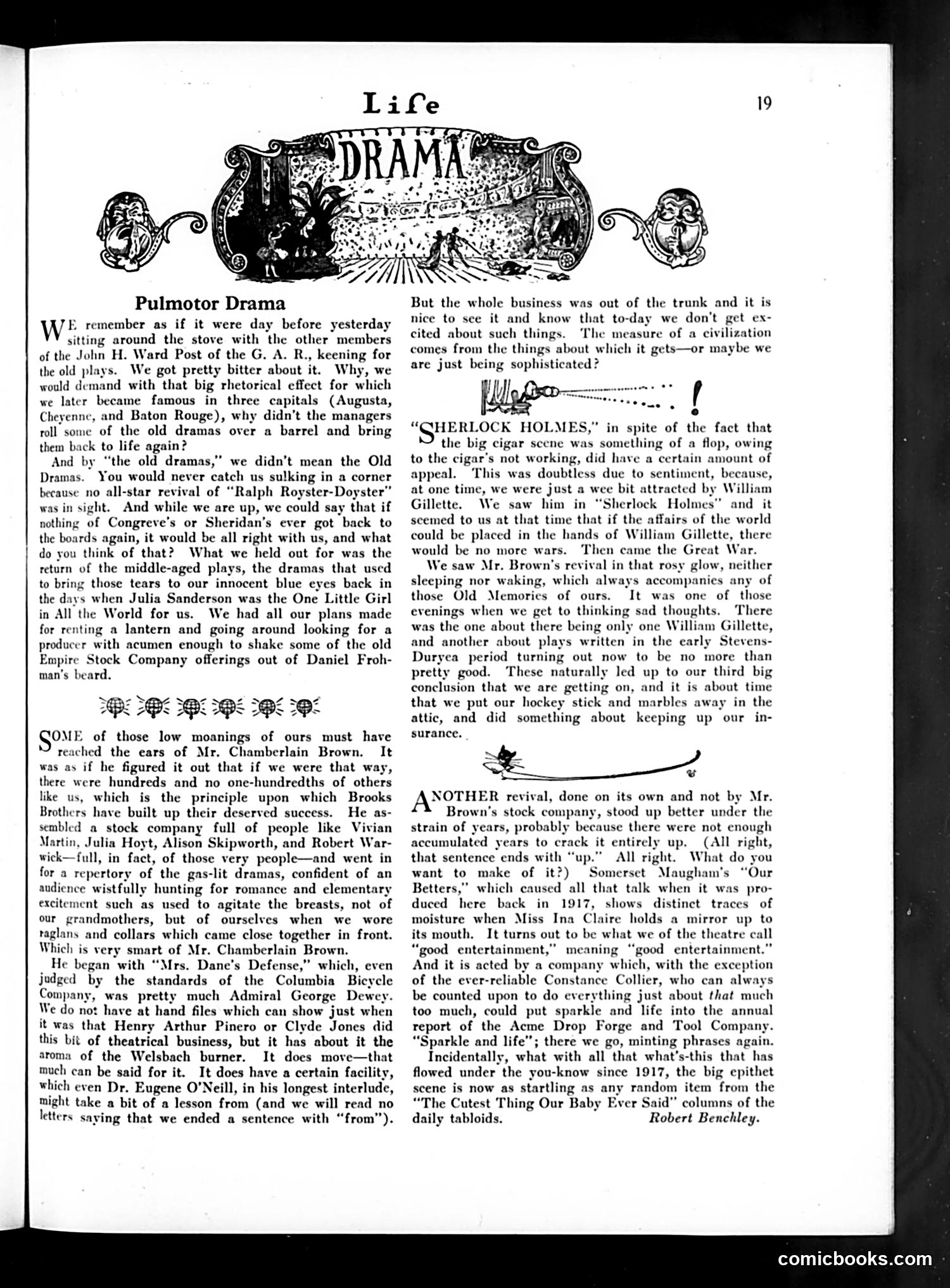
This article reflects early 20th-century nostalgia for melodramatic theater. The writer, representing aging Civil War veterans (G.A.R. members), laments the disappearance of emotionally gripping plays from the "gas-lit" era—middle-aged dramas that featured stars like Julia Sanderson. Producer Chamberlain Brown capitalizes on this sentiment by assembling a stock company (with actors Vivian Martin, Julia Hoyt, Alison Skipworth, Robert Warwick) to revive old plays. The satire mocks both the audience's sentimentality and society's self-congratulation about "progress"—the writer notes that while audiences once got excited about romantic dramas, modern civilization considers such emotional investment unsophisticated. The reviews of revivals like "Mrs. Dane's Defense" and "Sherlock Holmes" (featuring William Gillette) reveal the gap between nostalgic memory and present reality. The article gently satirizes how we romanticize the past while simultaneously pretending we've outgrown its simple pleasures.
📄 Transcribed text from this page (OCR, searchable)
Machine-transcribed from the original scan — historical spelling and the odd misread are preserved.
Pulmotor Drama E remember as if it were day before yesterday sitting around the stove with the other members of the John H. Ward Post of the G. A. R., keening for the old plays. We got pretty bitter about it. Why, we would demand with that big rhetorical effect for which we later became famous in three capitals (Augusta, Cheyenne, and Baton Rouge), why didn’t the managers roll some of the old dramas over a barrel and bring them back to life again? And by “the old dramas,” we didn’t mean the Old Dramas. You would never catch us sulking in a corner because no all-star revival of “Ralph Royster-Doyster” was in sight. And while we are up, we could say that if nothing of Congreve’s or Sheridan's ever got back to the boards again, it would be all right with us, and what do you think of that? What we held out for was the return of the middle-aged plays, the dramas that used to bring those tears to our innocent blue eyes back in the days when Julia Sanderson was the One Little Girl in All the World for us. We had all our plans made for renting a lantern and going around looking for a producer with acumen enough to shake some of the old Empire Stock Company offerings out of Daniel Froh- man’s beard. RE BS BLIGE ICO SOME of those low moanings of ours must have reached the ears of Mr. Chamberlain Brown. It was as if he figured it out that if we were that way, there were hundreds and no one-hundredths of others like us, which is the principle upon which Brooks Brothers have built up their deserved success. He as- sembled a stock company full of people like Vivian Martin, Julia Hoyt, Alison Skipworth, and Robert War- wick—full, in fact, of those very people—and went in for a repertory of the gas-lit dramas, confident of an audience wistfully hunting for romance and elementary excitement such as used to agitate the breasts, not of our grandmothers, but of ourselves when we wore taglans and collars which came close together in front. Which is very smart of Mr. Chamberlain Brown. . He began with “Mrs. Dane’s Defense,” which, even judged by the standards of the Columbia Bicycle Company, was pretty much Admiral George Dewey. We do not have at hand files which can show just when it was that Henry Arthur Pinero or Clyde Jones did this bit of theatrical business, but it has about it the aroma of the Welsbach burner. It does move—that much can be said for it. It does have a certain facility, which even Dr. Eugene O'Neill, in his longest interlude, might take a bit of a lesson from (and we will read no letters saying that we ended a sentence with “from”). But the whole business was out of the trunk and it is nice to see it and know that to-day we don't get ex- cited about such things. The measure of a civilization comes from the things about which it gets—or maybe we are just being sophisticated? k D “QHERLOCK HOLMES,” in spite of the fact that the big cigar scene was something of a flop, owing to the cigar’s not working, did have a certain amount of appeal. This was doubtless due to sentiment, because, at one time, we were just a wee bit attracted by William Gillette. We saw him in “Sherlock Holmes’ and it scemed to us at that time that if the affairs of the world could be placed in the hands of William Gillette, there would be no more wars. Then came the Great War. We saw Mr. Brown's revival in that rosy glow, neither sleeping nor waking, which always accompanies any of those Old Memories of ours. It was one of those evenings when we get to thinking sad thoughts. There was the one about there being only one William Gillette, and another about plays written in the early Stevens- Duryea period turning out now to be no more than pretty good. These naturally led up to our third big conclusion that we are getting on, and it is about time that we put our hockey stick and marbles away in the attic, and did something about keeping up our in- surance, NOTHER revival, done on its own and not by Mr. Brown's stock company, stood up better under the strain of years, probably because there were not enough accumulated years to crack it entirely up. (All right, that sentence ends with “up.” All right. What do you want to make of it?) Somerset Maugham’s “Our Betters,” which caused all that talk when it was pro- duced here back in 1917, shows distinct traces of moisture when Miss Ina Claire holds a mirror up to its mouth, It turns out to be what we of the theatre call “good entertainment,” meaning “good entertainment.” And it is acted by a company which, with the exception of the ever-reliable Constance Collier, who can always be counted upon to do everything just about that much too much, could put sparkle and life into the annual report of the Acme Drop Forge and Tool Company. “Sparkle and life”; there we go, minting phrases again. Incidentally, what with all that what's-this that has flowed under the you-know since 1917, the big epithet scene is now as startling as any random item from the “The Cutest Thing Our Baby Ever Said” columns of the daily tabloids, Robert Benchley. comicbooks.com