
Life, 1928-03-15 · page 16 of 34
Life — March 15, 1928 — page 16: what you’re looking at
What you’re looking at
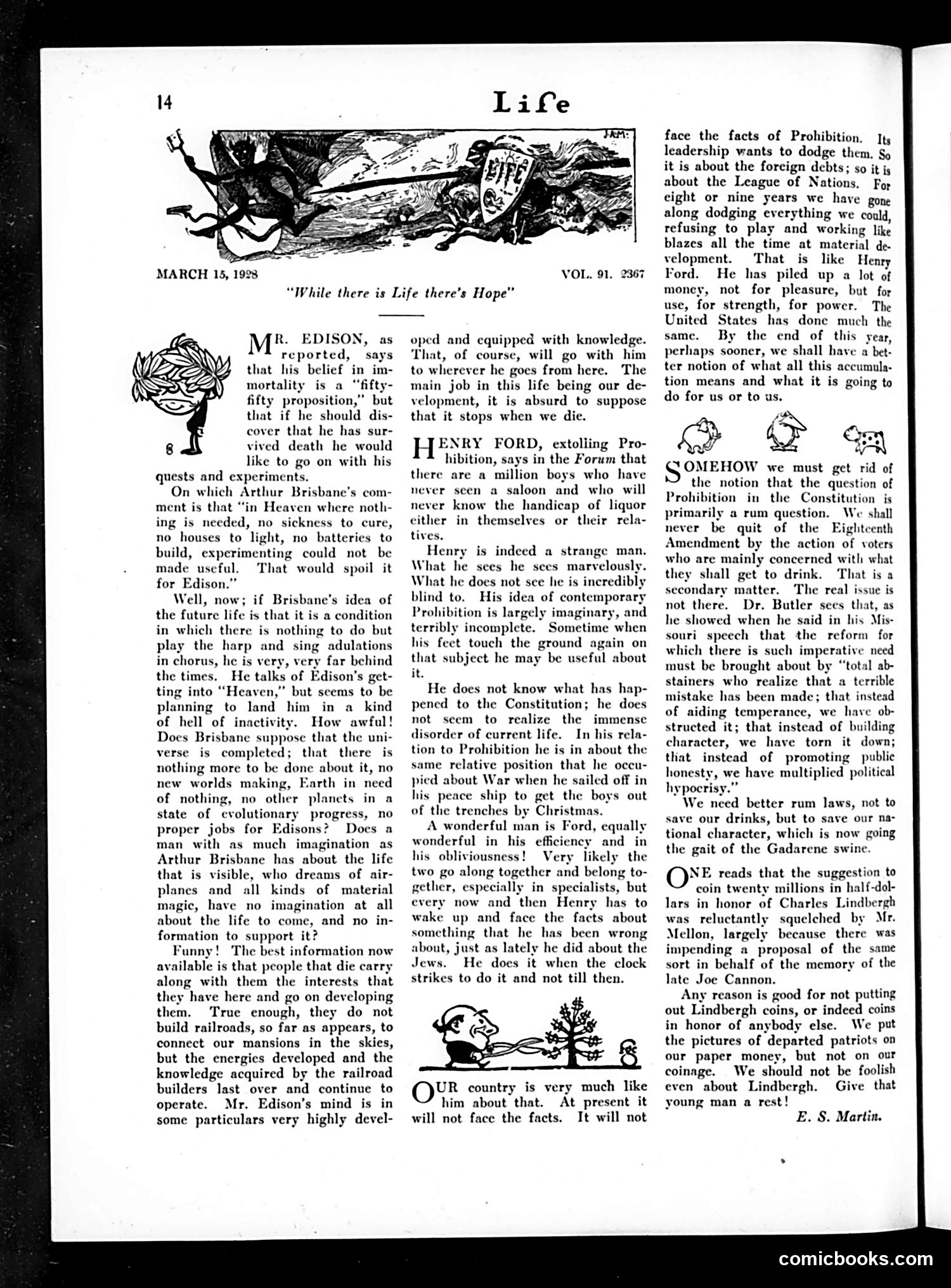
This page contains editorial commentary on Prohibition and American politics. The main cartoon depicts what appears to be a spider or creature labeled "LIFE" attacking or confronting something, likely representing dangers the magazine warns against. The text discusses Edison's views on immortality and life after death, then pivots to criticize Henry Ford's support for Prohibition. The author argues Ford is wrong about Prohibition's effects—that it hasn't stopped drinking but has created disorder and blindness to constitutional issues. The final section satirizes proposals to mint coins honoring Charles Lindbergh, suggesting this is foolish national nostalgia rather than practical policy. The overall tone mocks both Prohibition enforcement and celebrity worship as misguided American preoccupations.
📄 Transcribed text from this page (OCR, searchable)
Machine-transcribed from the original scan — historical spelling and the odd misread are preserved.
MARCH 14, 1993 VOL, 91. 2367 “While there is Life there’s Hope” ] R. EDISON, as reported, says that his belief in im- mortality is a “fifty- fifty proposition,” but that if he should dis- cover that he has sur- vived death he would like to go on with his quests and experiments. On which Arthur Brisbane's com- ment is that “in Heaven where noth- ing is needed, no sickness to cure, no houses to light, no batteries to build, experimenting could not be made useful. That would spoil it for Edison.” Well, now; if Brisbane's idea of the future life is that it is a condition in which there is nothing to do but play the harp and sing adulations in chorus, he is very, ve the times. He talks of ting into “Heaven,” but seems to be planning to land him in a kind of hell of inactivity. How awful! Does Brisbane suppose that the uni- verse is completed; that there is nothing more to be done about it, no new worlds making, Earth in need of nothing, no other planets in a state of cvolutionary progress, no proper jobs for Edisons? Does a man with as much imagination as Arthur Brisbane has about the life that is visible, who dreams of air- planes and all kinds of material magic, have no imagination at all about the life to come, and no in- formation to support it? Funny! The best information now available is that people that die carry along with them the interests that they have here and go on developing them. True enough, they do not build railroads, so far as appears, to connect our mansions in the skies, but the energies developed and the knowledge acquired by the railroad builders last over and continue to operate. Mr. Edison’s mind is in some particulars very highly devel- oped and equipped with knowledge. That, of course, will go with him to wherever he goes from here. The main job in this life being our de- velopment, it is absurd to suppose that it stops when we die. I ENRY FORD, extolling Pro- hibition, says in the Forum that there are a million boys who have never seen a saloon and who will never know the handicap of liquor either in themselves or their rela- tives. Henry is indeed a strange man. What he sees he sees marvelously. What he does not sce he is incredibly blind to. His idea of contemporary Prohibition is largely imaginary, and terribly incomplete. Sometime when his feet touch the ground again on that subject he may be useful about it. He does not know what has hap- pened to the Constitution; he does not seem to realize the immense disorder of current life. In his rela- tion to Prohibition he is in about the same relative position that he occu- pied about War when he sailed off in his peace ship to get the boys out of the trenches by Christmas. A wonderful man is Ford, equally wonderful in his efficiency and in his obliviousness! Very likely the two go along together and belong to- gether, especially in specialists, but ev now and then Henry has to wake up and face the facts about something that he has been wrong about, just as lately he did about the Jews. He does it when the clock strikes to do it and not till then. country is very much like him about that. At present it Tt will not O will not face the facts. face the facts of Prohibition. Its leadership wants to dodge them. So it is about the foreign debts; so it is about the League of Nations, Fo, eight or nine years we have gone along dodging everything we could, refusing to play and working like blazes all the time at material de. velopment. That is like Henry Ford. He has piled up a lot of money, not for pleasure, but for use, for strength, for power. The United States has done much the same. By the end of this year, perhaps sooner, we shall have a bet- ter notion of what all this accumula- tion means and what it is going to do for us or to us. ~OMEHOW we must get rid of the notion that the question of Prohibition in the Constitution is primarily a rum question. We shall never be quit of the Eighteenth Amendment by the action of voters who are mainly concerned with what they shall get to drink. T is a secondary matter. The real issue is not there. Dr. Butler sees that, as he showed when he said in his Mis- souri speech that the reform for which there is such imperative need must be brought about by “total ab- stainers who realize that a terrible mistake has been made; that instead of aiding temperance, we have ob- structed it; that instead of building character, we have torn it down; that instead of promoting public honesty, we have multiplied political hypocrisy.” We need better rum laws, not to save our drinks, but to save our na- tional character, which is now going the gait of the Gadarene swine. NE reads that the suggestion to coin twenty millions in half-dol- lars in honor of Charles Lindbergh was reluctantly squelched by Mr. Mellon, largely because there was impending a proposal of the same sort in behalf of the memory of the late Joe Cannon. Any reason is good for not putting out Lindbergh coins, or indeed coins in honor of anybody else. We put the pictures of departed patriots on our paper money, but not on our coinage. We should not be foolish even about Lindbergh. Give that young man a rest! E. S. Martin. comicbooks.com