
A complete issue · 40 pages · 1927
Life — September 1, 1927
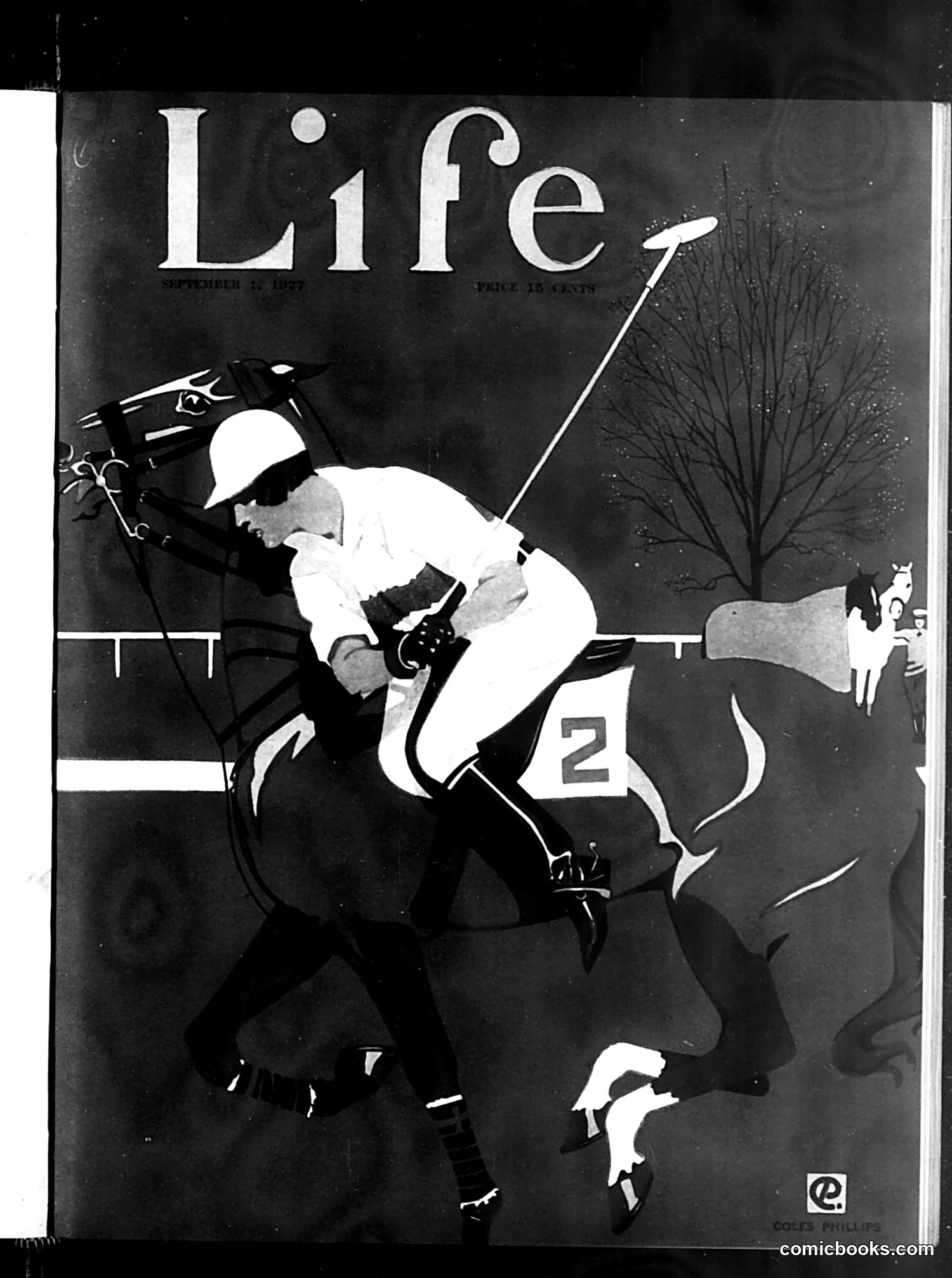
This September 1927 Life cover depicts a polo player on horseback, wearing number 2, executing a polo stroke. The sport of polo was historically associated with wealth and aristocracy in America during the 1920s. Without additional visible text identifying specific individuals, the satire appears to reference polo as a marker of upper-class leisure during the Jazz Age. The stylized, dramatic illustration emphasizes the sport's theatrical elegance while potentially mocking the frivolous pastimes of the wealthy elite. The cover's artistic treatment—the dynamic composition and high contrast—typifies Life's sophisticated visual humor of this era, when the magazine frequently lampooned American high society and their recreational pursuits. The price of 15 cents reflects the period's publishing economics.
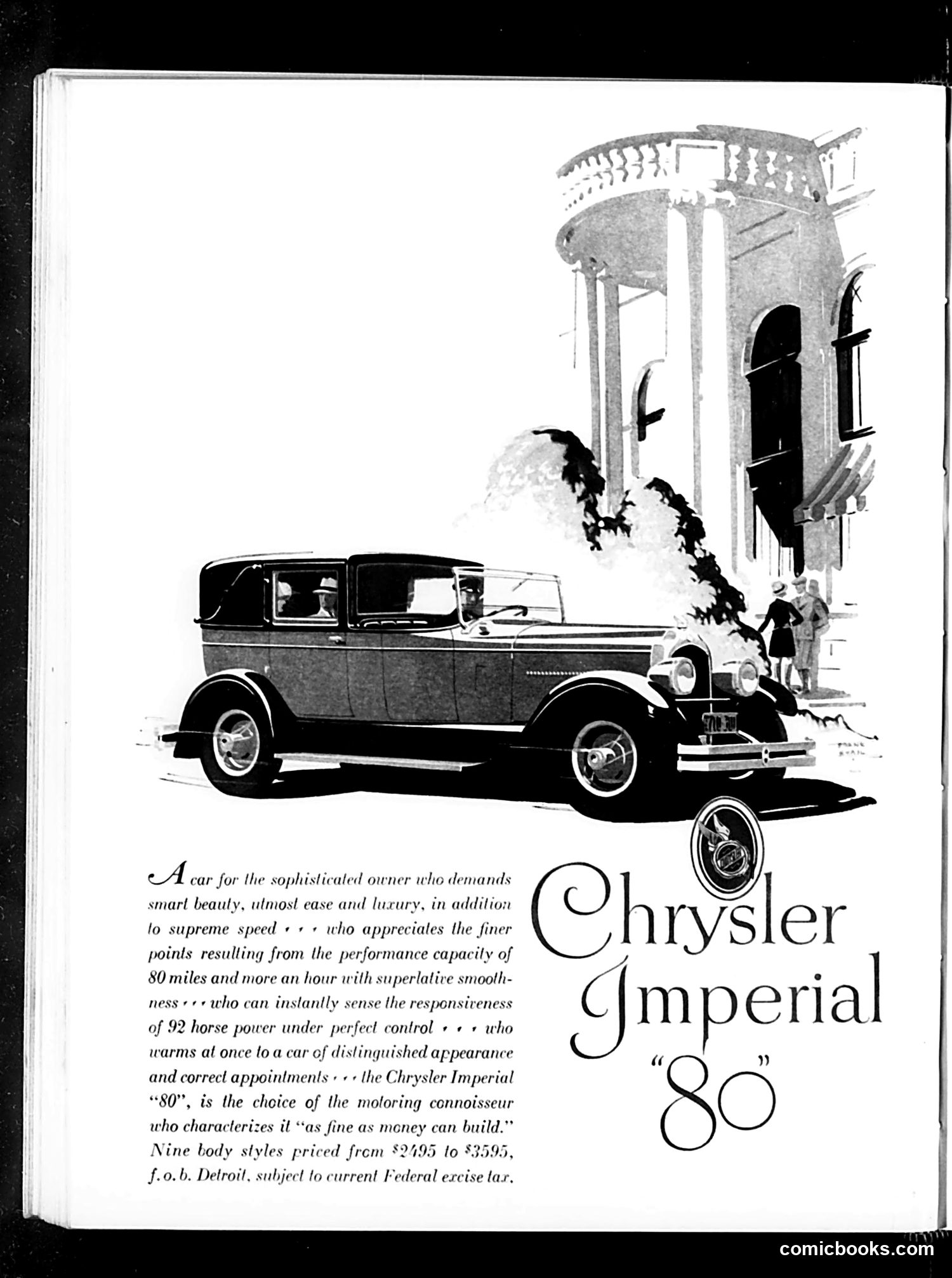
This page is primarily **advertising, not satire or commentary**. It's a full-page Chrysler Imperial "80" automobile advertisement from what appears to be the 1920s-1930s era. The ad features an illustration of the luxury sedan parked beside a tall ornate building (possibly a tower or civic structure). The accompanying text targets wealthy buyers, emphasizing the car's sophistication, speed (80+ mph), power (92 horsepower), and luxury appointments. Key selling points highlighted: smooth performance, distinguished appearance, and price range ($2,195–$3,595). The phrase "as fine as money can build" appeals to affluent consumers seeking status symbols. This represents typical high-end automotive marketing of the period, not political or social satire.
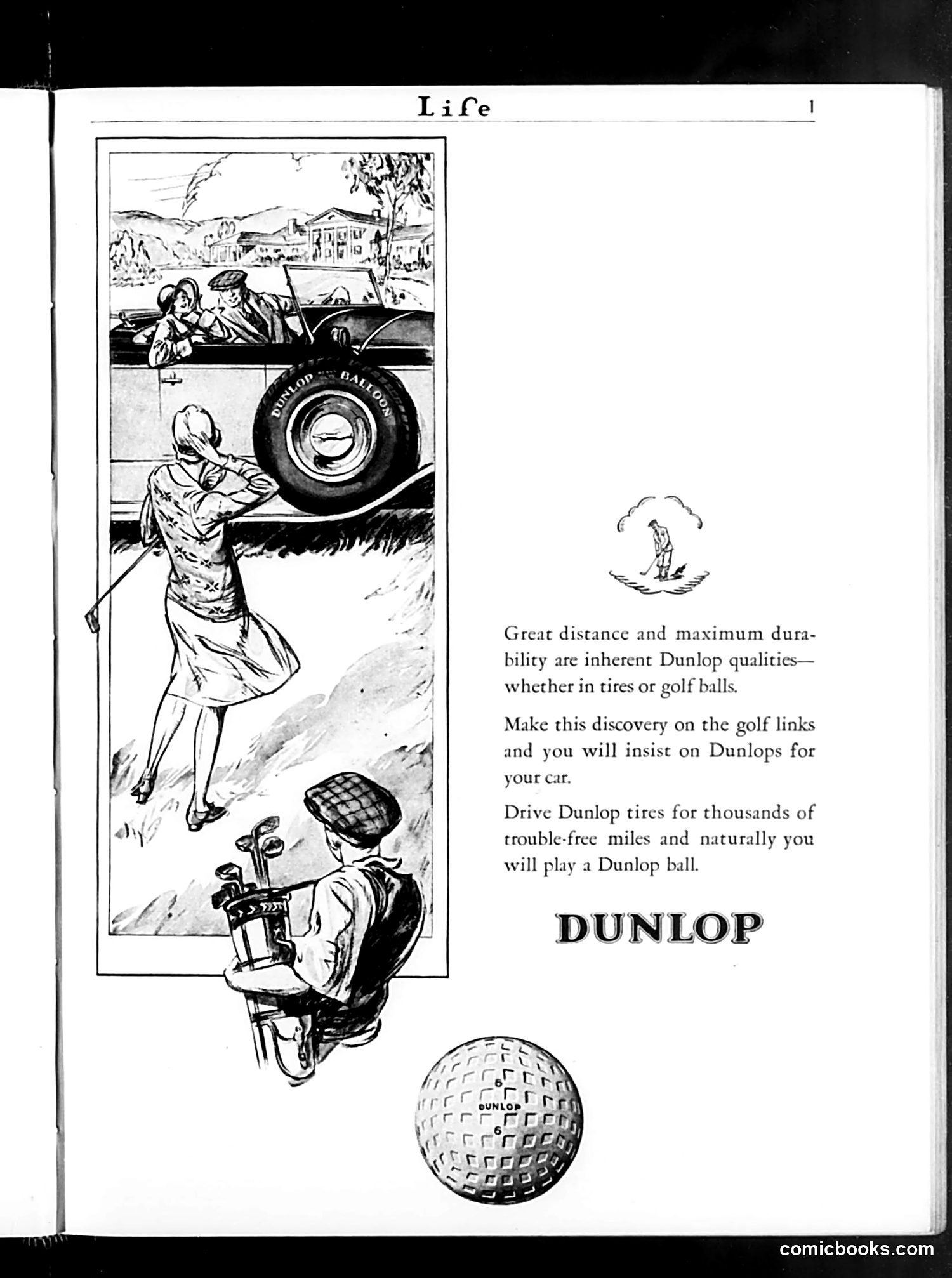
This is a **Dunlop tire advertisement**, not political satire. The page shows three panels depicting leisure activities: driving in an automobile, playing golf, and golfing again. The ad's pitch is straightforward: Dunlop tires offer "great distance and maximum durability" for cars, and the brand also manufactures golf balls with similar qualities. The implicit message is that customers who experience Dunlop's reliability on the road will naturally trust and purchase Dunlop golf equipment. The illustration style is typical of 1920s-era advertising—elegant line drawings showing aspirational middle-class recreation. There's no political commentary or social satire present; this is purely commercial content designed to cross-sell automotive and sporting goods under a unified brand reputation.
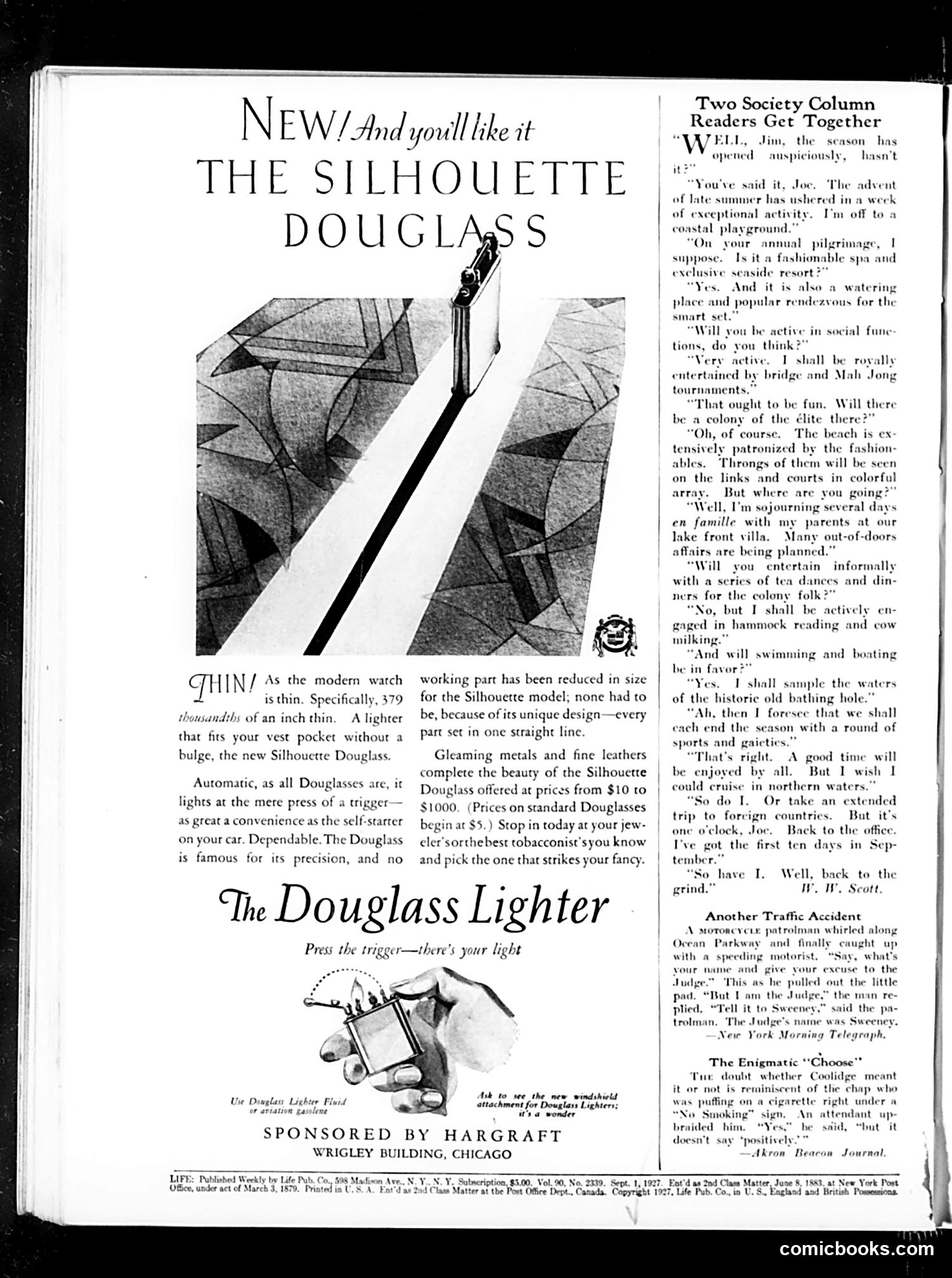
This page is primarily **advertising** for Douglass watches and lighters, sponsored by Hargraft in Chicago's Wrigley Building. The ads emphasize the "Silhouette Douglass" watch—a thin, modern design that fits in a vest pocket without bulging. The pitch emphasizes precision, convenience, and affordability ($10-$100 range). The right column contains a "Two Society Column" dialogue between characters named Jim and Joe discussing summer social activities—spa resorts, bridge tournaments, beach clubs, and travel plans. This appears to be satirical commentary on upper-class leisure and pretension rather than political content. The brief anecdotes at bottom mock minor social absurdities (a motorcycle patrolman's excuse, a "No Smoking" violation) in the style of Life's light humor. **Content: Lifestyle advertising and society satire, not political commentary.**
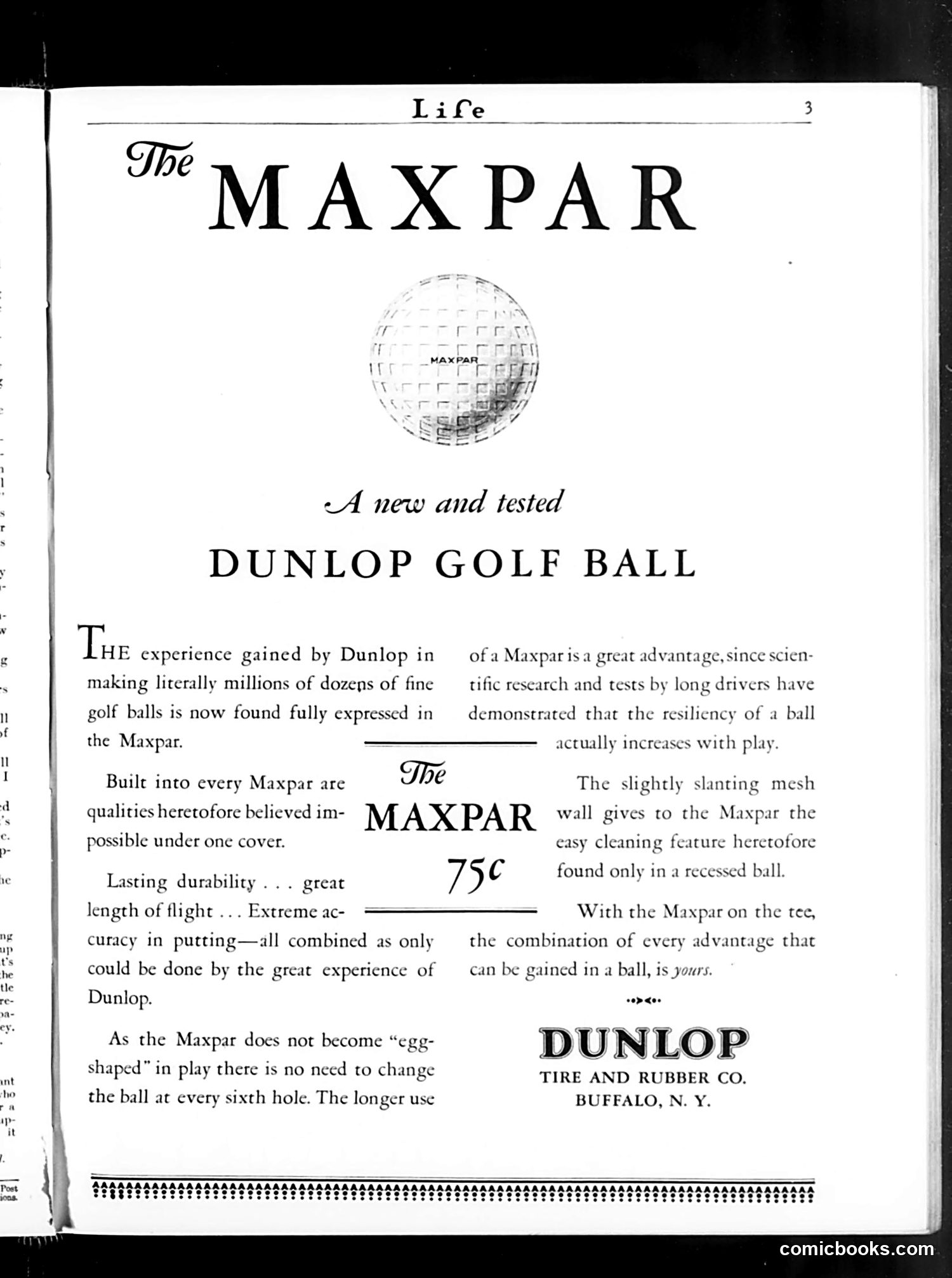
This page is **not a cartoon or satire—it's a straightforward product advertisement** for the Dunlop Maxpar golf ball, published in *Life* magazine. The ad showcases the Maxpar, priced at 75 cents, highlighting features like durability, flight distance, putting accuracy, and resistance to becoming "egg-shaped" during play. It emphasizes Dunlop's manufacturing experience and notes that the ball's mesh surface allows easy cleaning. There is no political or social satire present. This is a standard commercial advertisement leveraging *Life*'s editorial space to promote sporting goods. The only visual element is an illustration of the golf ball itself showing its dimpled surface pattern and "Maxpar" branding.
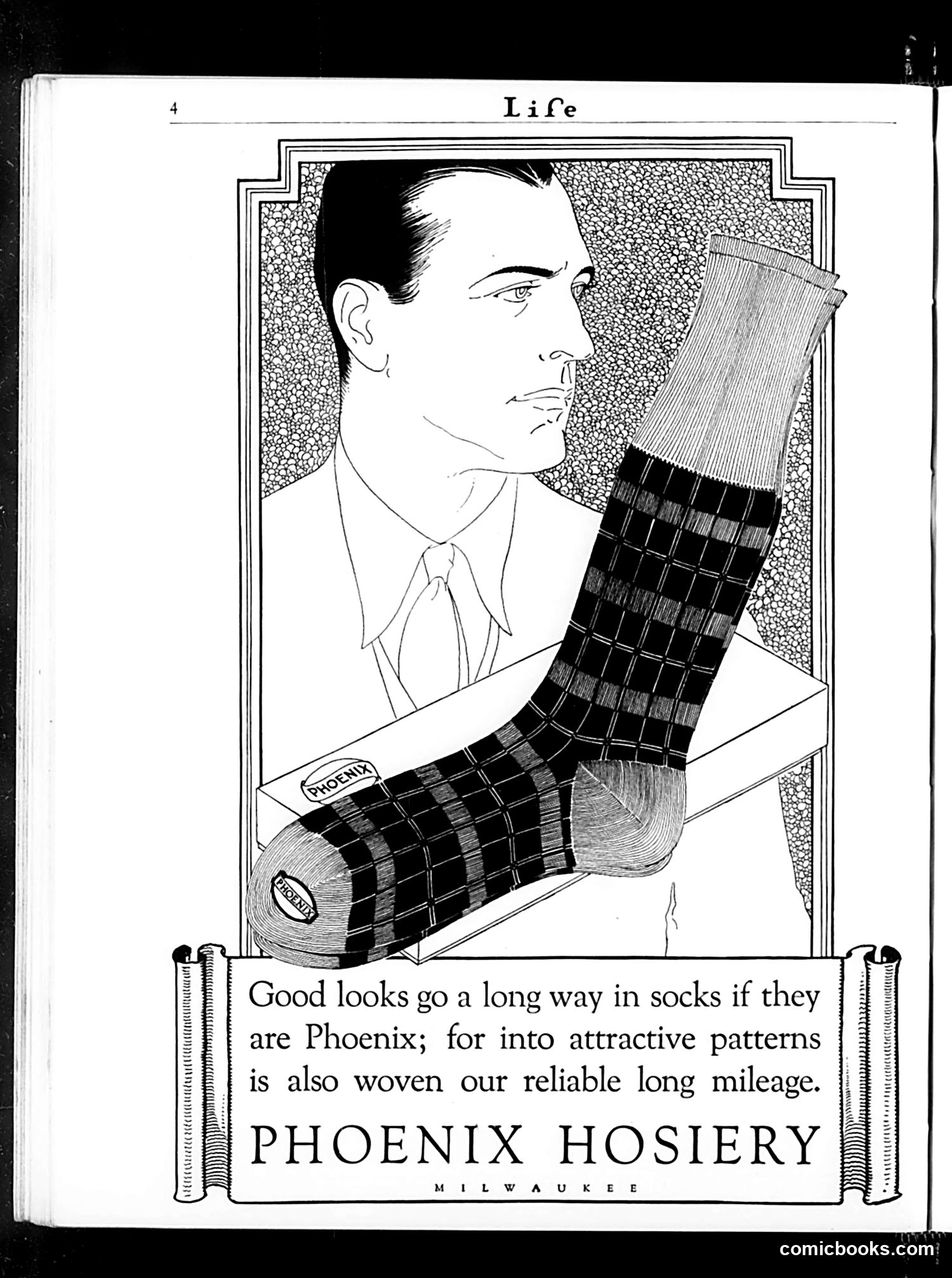
This is a **straightforward advertisement**, not satire or political commentary. The page features a stylized portrait of a well-dressed man in profile, showcasing **Phoenix brand socks** prominently displayed on his foot. The socks feature an attractive plaid pattern in black and lighter tones, with visible "Phoenix" branding on the cuff and heel. The accompanying text is a simple sales pitch: "Good looks go a long way in socks if they are Phoenix; for into attractive patterns is also woven our reliable long mileage." The advertisement appeals to men's vanity by suggesting that quality socks—visible when sitting or crossing legs—reflect well on the wearer while providing durability. This represents typical early-20th-century menswear advertising targeting gentlemen concerned with both appearance and practicality. The stylized illustration was common in *Life* magazine's advertising section.
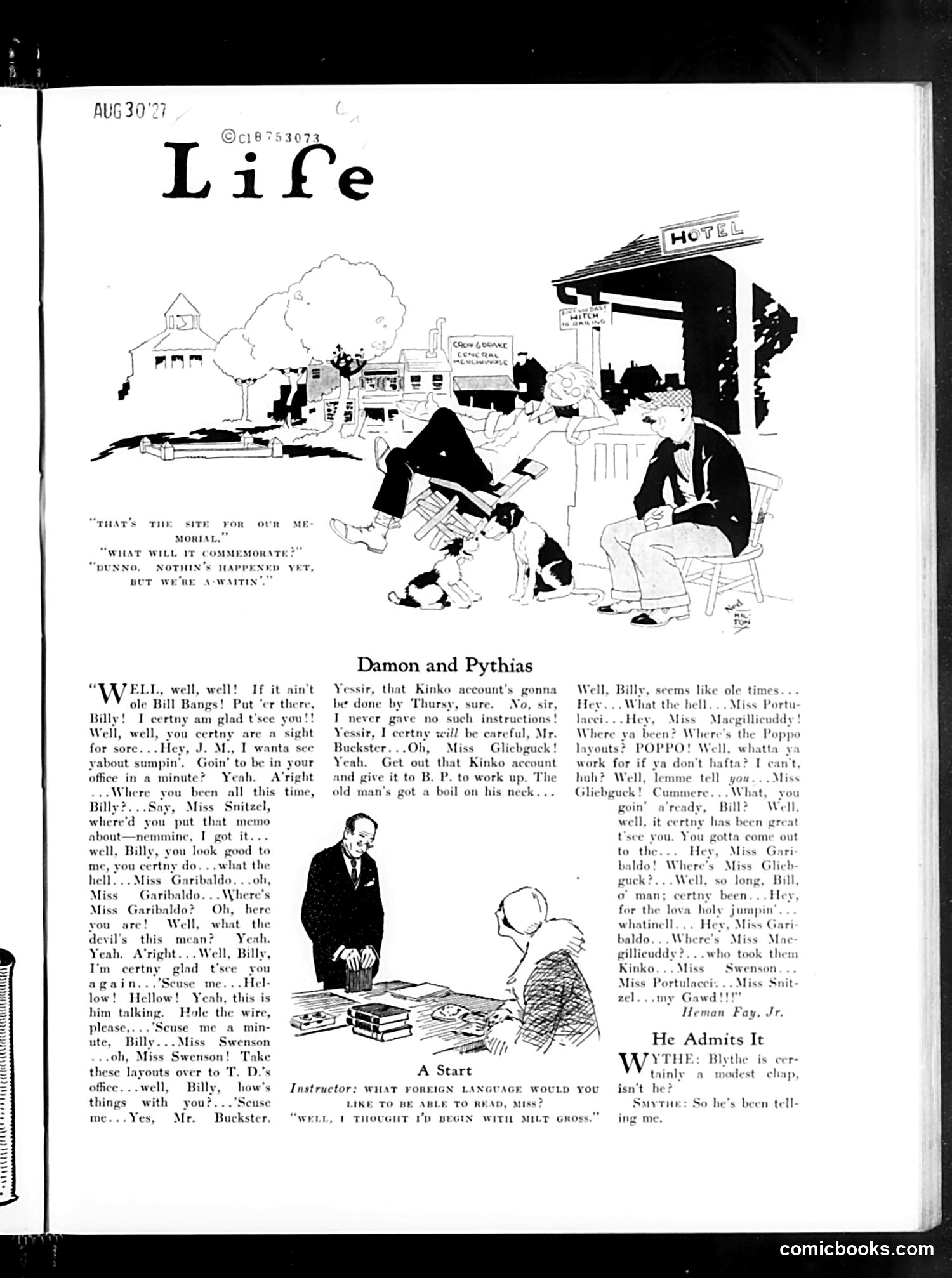
This page contains three separate comedic pieces satirizing early 20th-century American life: **"Damon and Pythias"** depicts office workers gossiping about colleagues' whereabouts and romantic entanglements, mocking workplace rumor-mongering and the melodramatic tone employees use discussing each other's personal lives. **"A Start"** shows an instructor teaching foreign language to a student, likely satirizing overly pedantic teaching methods by having the instructor begin with "Milt Gross"—a deliberate absurdity, as Gross was a cartoonist/humorist of the era, not standard language curriculum. **"He Admits It"** presents a brief dialogue about someone's modesty being questioned, playing on the social pretense of false humility common in the period. The overall page mocks workplace dynamics, pretentious education, and social affectation through gentle humor typical of Life's satirical approach.
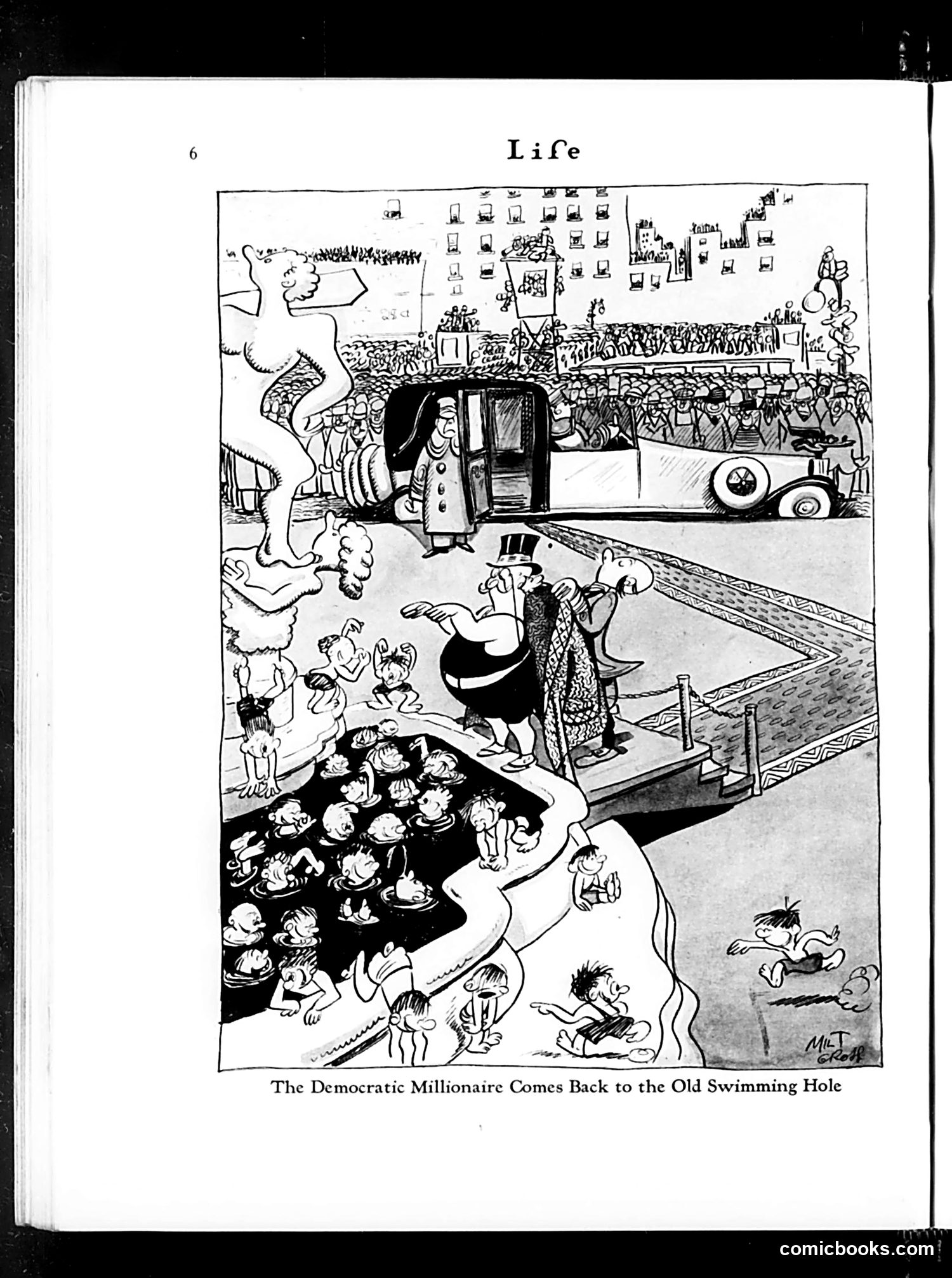
This political cartoon satirizes a wealthy Democratic politician returning to humble origins. The central figure—a portly man in a top hat emerging from an expensive automobile—represents a successful Democratic millionaire visiting a simple public swimming hole where common people (depicted as children and working-class adults) recreate. The satire targets the disconnect between wealthy Democratic leaders and their working-class base. The "old swimming hole" symbolizes populist, everyman values, while the limousine and fancy dress highlight the millionaire's current wealth and status. The cartoon suggests hypocrisy: that such figures exploit working-class nostalgia and Democratic populist rhetoric while living in luxury—a recurring theme in American political satire about class divisions within political parties.
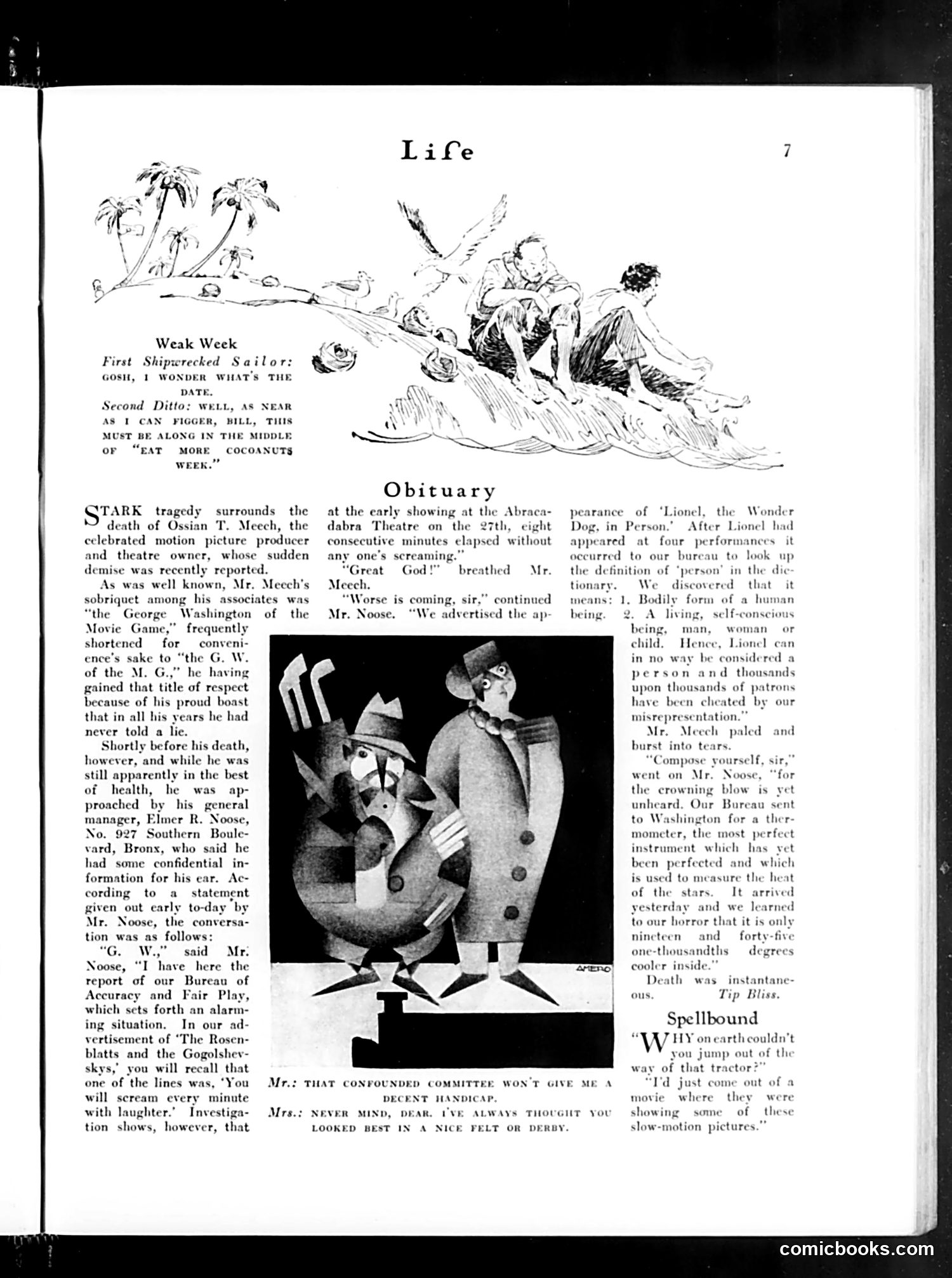
This page contains satirical commentary on the entertainment industry. The central cartoon depicts a confrontation between two figures labeled as "Mr." and "Mrs." discussing a "decent handicap" and appearance in "a nice felt or derby." The illustration style suggests physical comedy or slapstick. The "Obituary" section mocks Ossin T. Meech, a motion picture producer and theater owner, for his sudden death. The satire emphasizes his well-known catchphrase "the George Washington of the Movie Company," ironically suggesting his unreliability. The text suggests he gained this reputation through boastful claims he "never told a lie." The bottom "Spellbound" section presents a brief comedic exchange about movie slow-motion photography, typical of Life's humorous take on contemporary entertainment trends.
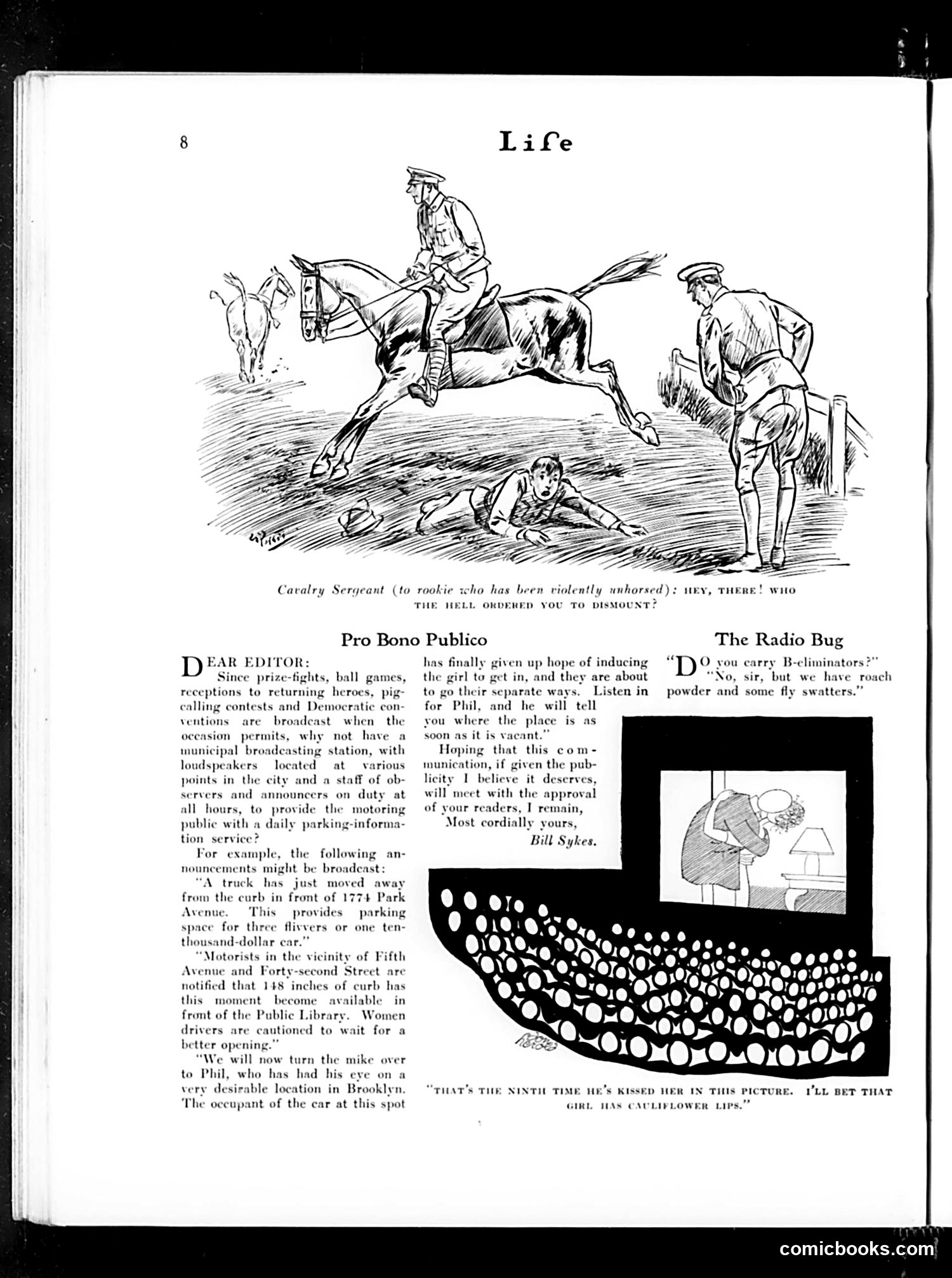
The top cartoon satirizes cavalry training accidents—showing a soldier thrown from a bucking horse while mounted officers observe. The caption quotes a sergeant demanding explanation for the dismount. Below, two items: **"Pro Bono Publico"** letter proposes a municipal broadcasting station with loudspeakers for parking information and event announcements. The writer (Bill Sykes) argues public utility justifies the noise. **"The Radio Bug"** cartoon depicts a woman at a radio set surrounded by dozens of "B-eliminators" (radio static filters). The joke mocks a woman kissing her radio repeatedly—the caption quips she has "lower lips" after nine on-air kisses, suggesting radio romance obsession. Both pieces reflect 1920s-era concerns about new broadcasting technology's social impact—practical infrastructure versus romantic escapism.
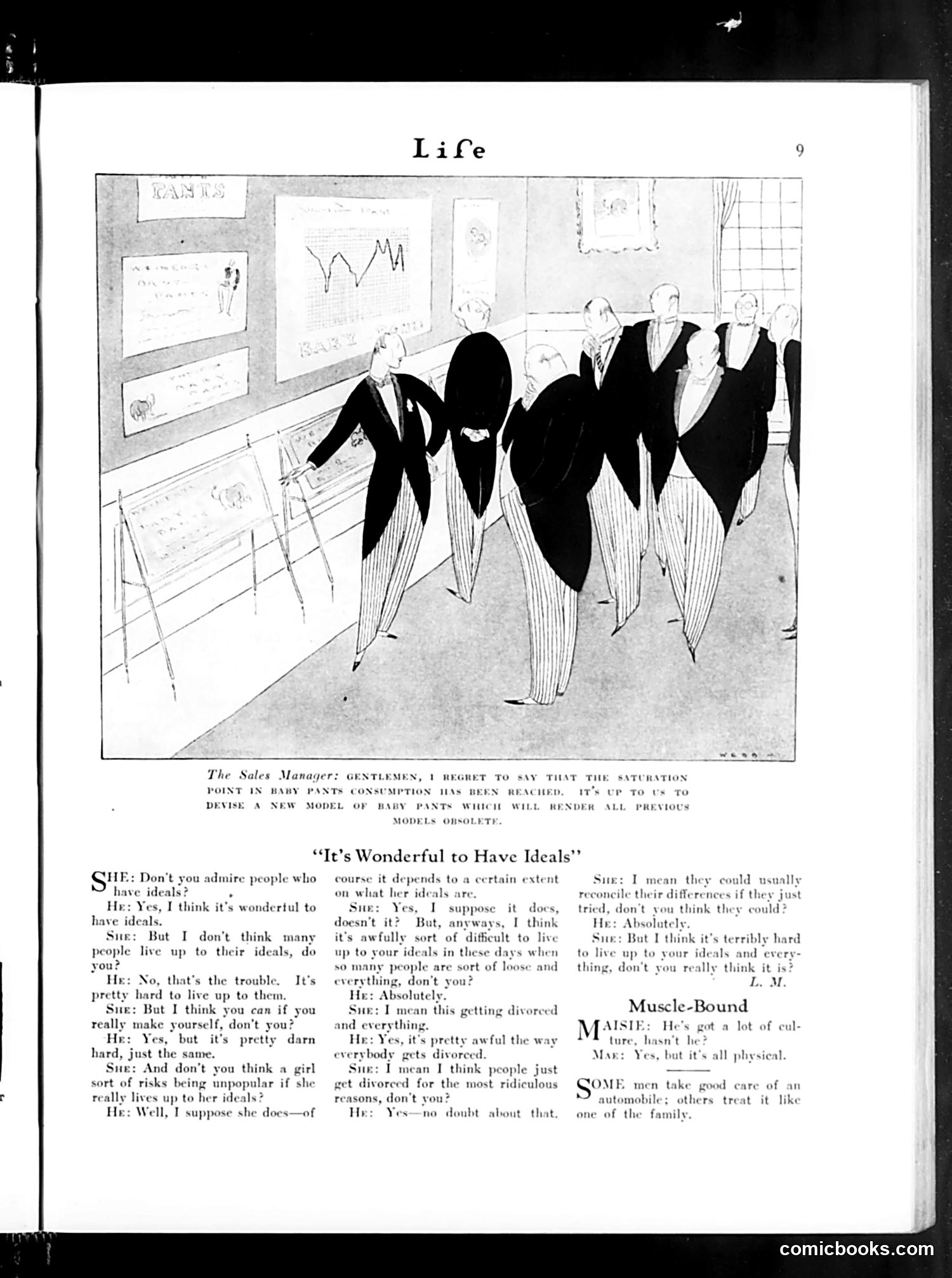
This cartoon satirizes the baby pants industry's market saturation. The sales manager addresses five businessmen (shown in silhouette) about an urgent problem: the market for baby pants has reached "saturation point." He proposes developing a new model to make existing pants "obsolete"—a commentary on planned obsolescence and manipulative marketing practices. The humor targets how manufacturers artificially create demand by making functional products seem outdated, forcing consumers to repurchase unnecessarily. The cartoon critiques the cynicism of early 20th-century business strategy: rather than innovate genuinely, companies simply rebrand existing products to stimulate sales. The accompanying dialogue pieces ("It's Wonderful to Have Ideals" and "Muscle-Bound") appear unrelated vignettes about personal ideals and physical fitness.
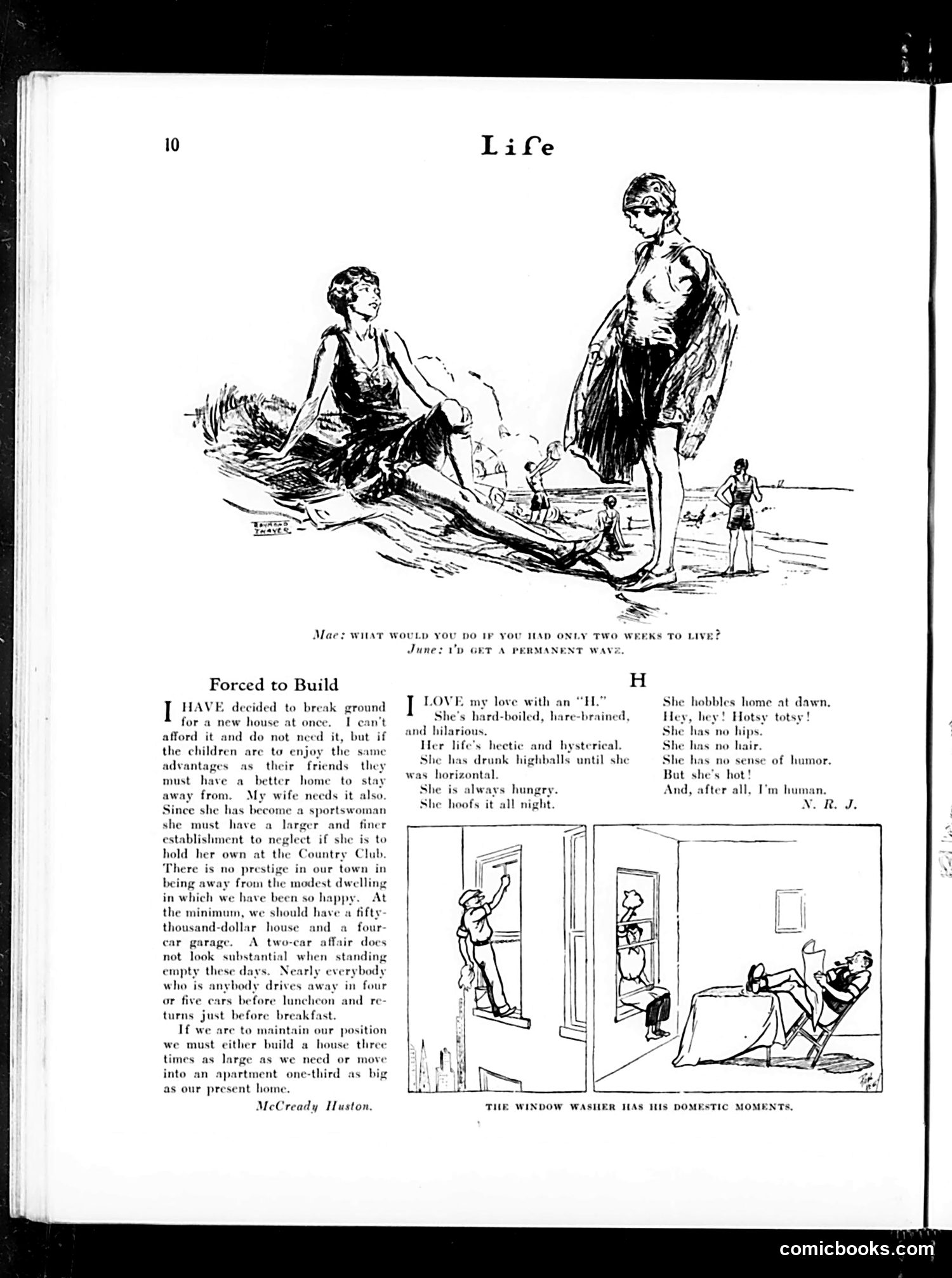
This page contains satirical commentary on gender roles and marriage in early 20th-century America. **"Forced to Build"** (left): McCready Huston critiques the economic pressures on married men. The author argues that wives' participation in sports (implied: golf, country clubs) has forced husbands to build larger homes and maintain expensive lifestyles to keep up with social expectations. **"H" poem and cartoon** (right): N. R. J. humorously catalogs a woman's domestic failures—she's incompetent at housekeeping, lacks humor, and is perpetually hungry—yet concludes "after all, I'm human," suggesting men must accept women's flaws. The cartoon titled "The Window Washer Has His Domestic Moments" shows a man doing housework while his wife relaxes, inverting traditional gender roles for comedic effect.
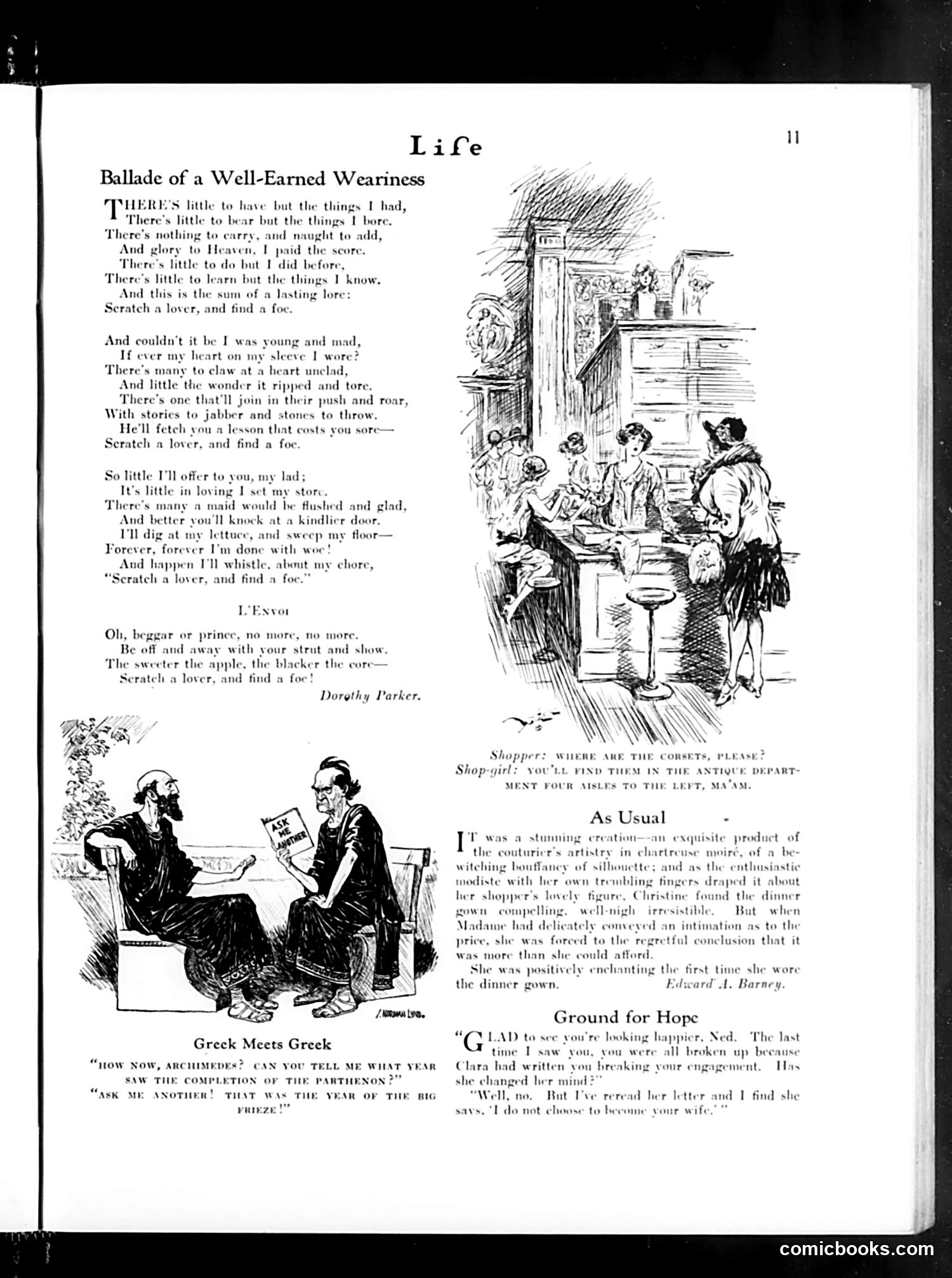
This page contains three separate pieces of satirical content: **"Ballade of a Well-Earned Weariness"** (by Dorothy Parker): A poem mocking romantic idealism, suggesting it's better to be pragmatic about love than pursue futile passion. **"Greek Meets Greek"**: A cartoon showing two men in classical dress debating the Parthenon's completion date and "the year of the big freeze"—likely satirizing pedantic scholarly arguments or perhaps immigrants' affected classical pretensions. **"As Usual"** and **"Ground for Hope"**: Brief humorous prose pieces about shopping for dinner gowns and romantic disappointment, representing typical Life magazine comic vignettes of domestic life and failed romance. The overall theme emphasizes disillusionment with romance and social pretense—characteristic of 1920s satirical humor targeting both sentimental idealism and affected intellectualism.
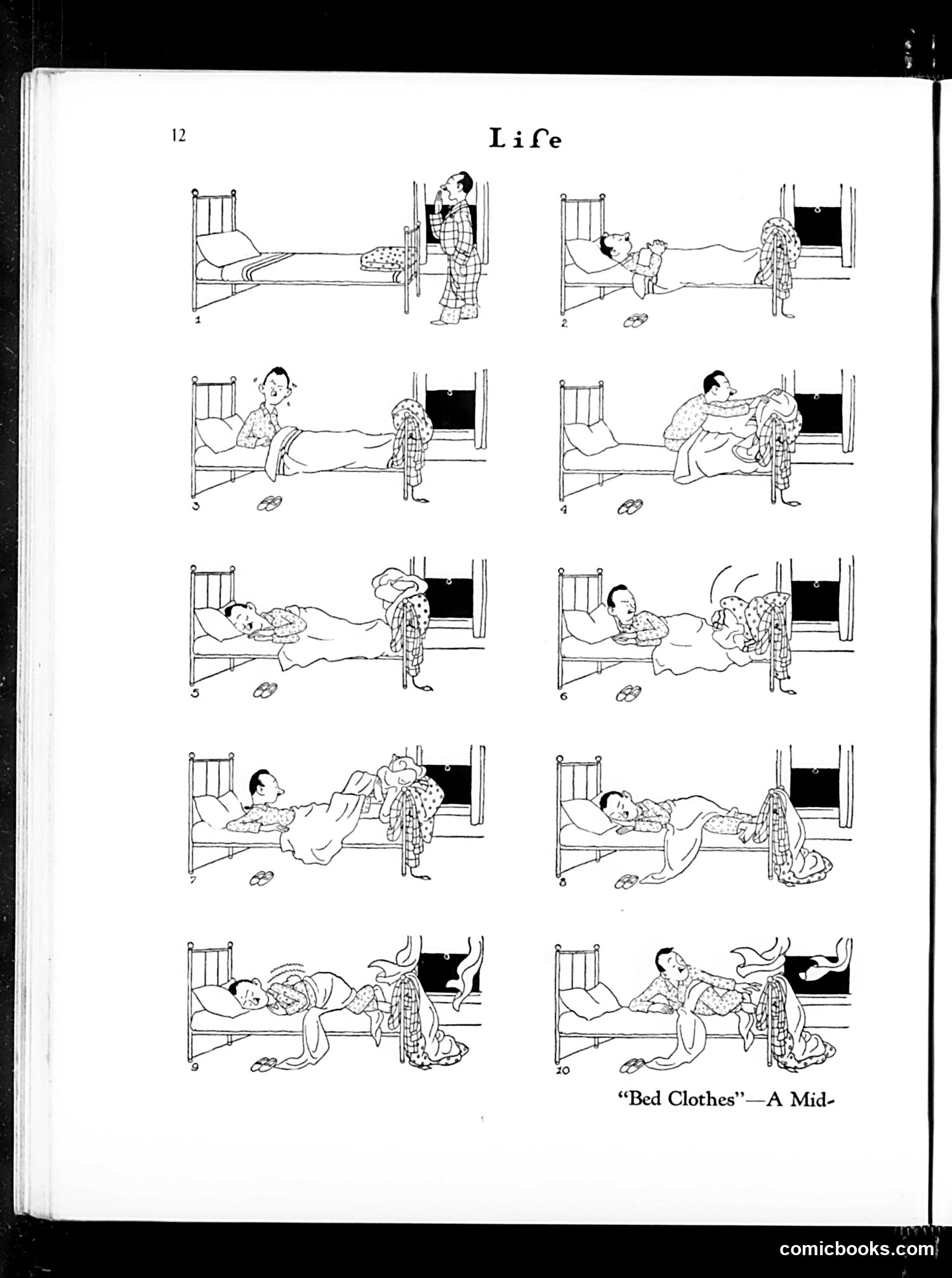
This sequential comic strip illustrates a domestic scenario involving two figures in bed. The progression shows increasingly tangled and chaotic bedding arrangements, culminating in complete dishevelment by the final panels. The humor appears to target marital discord or the physical comedy of sharing a bed—a common satirical subject in early-to-mid 20th century American magazines. The exaggerated poses and escalating mess suggest the joke concerns nighttime struggles: one partner hogging blankets, tossing and turning, or general bedtime incompatibility. The title "Bed Clothes" is a pun, referencing both literal bedding and the state of the couple's relationship. This type of domestic humor was typical for *Life* magazine's satirical cartoons about middle-class American family life, poking gentle fun at everyday marital realities.
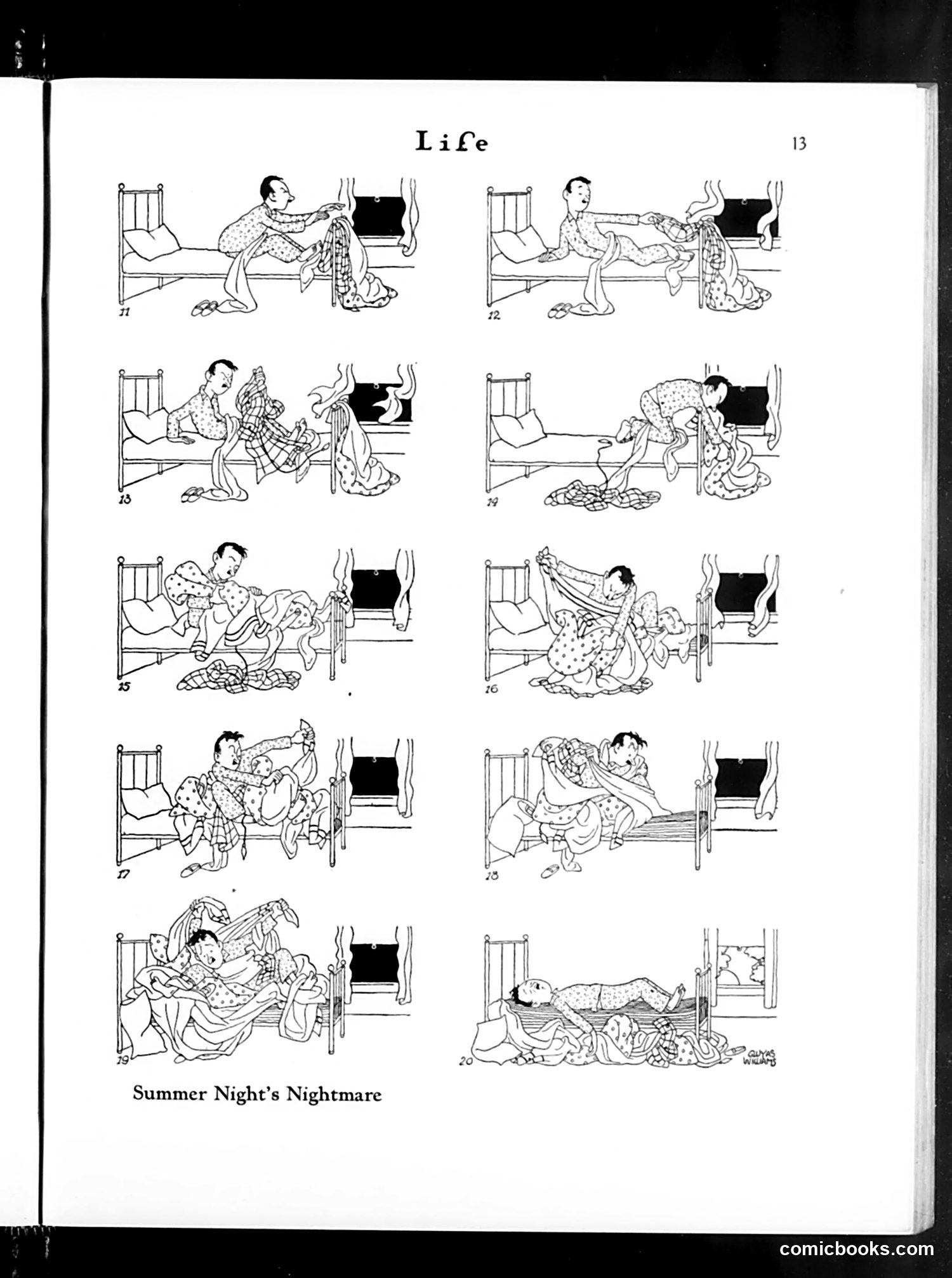
This sequential comic strip depicts a humorous domestic scenario titled "Summer Night's Nightmare." The panels show a man in bed attempting to sleep while experiencing escalating chaos: a woman (likely his wife or partner) manages children, pets, and household items in increasingly chaotic arrangements around the bedroom. The satire targets the discomforts of summer sleeping conditions—the heat (indicated by the stove/fireplace visible throughout) combined with domestic bedlam. The joke appears to be that peaceful summer sleep is impossible when one shares sleeping quarters with multiple family members, animals, and scattered belongings. This reflects early-20th-century domestic humor common in *Life* magazine, mocking the challenges of crowded household sleeping arrangements during hot weather, before widespread air conditioning.
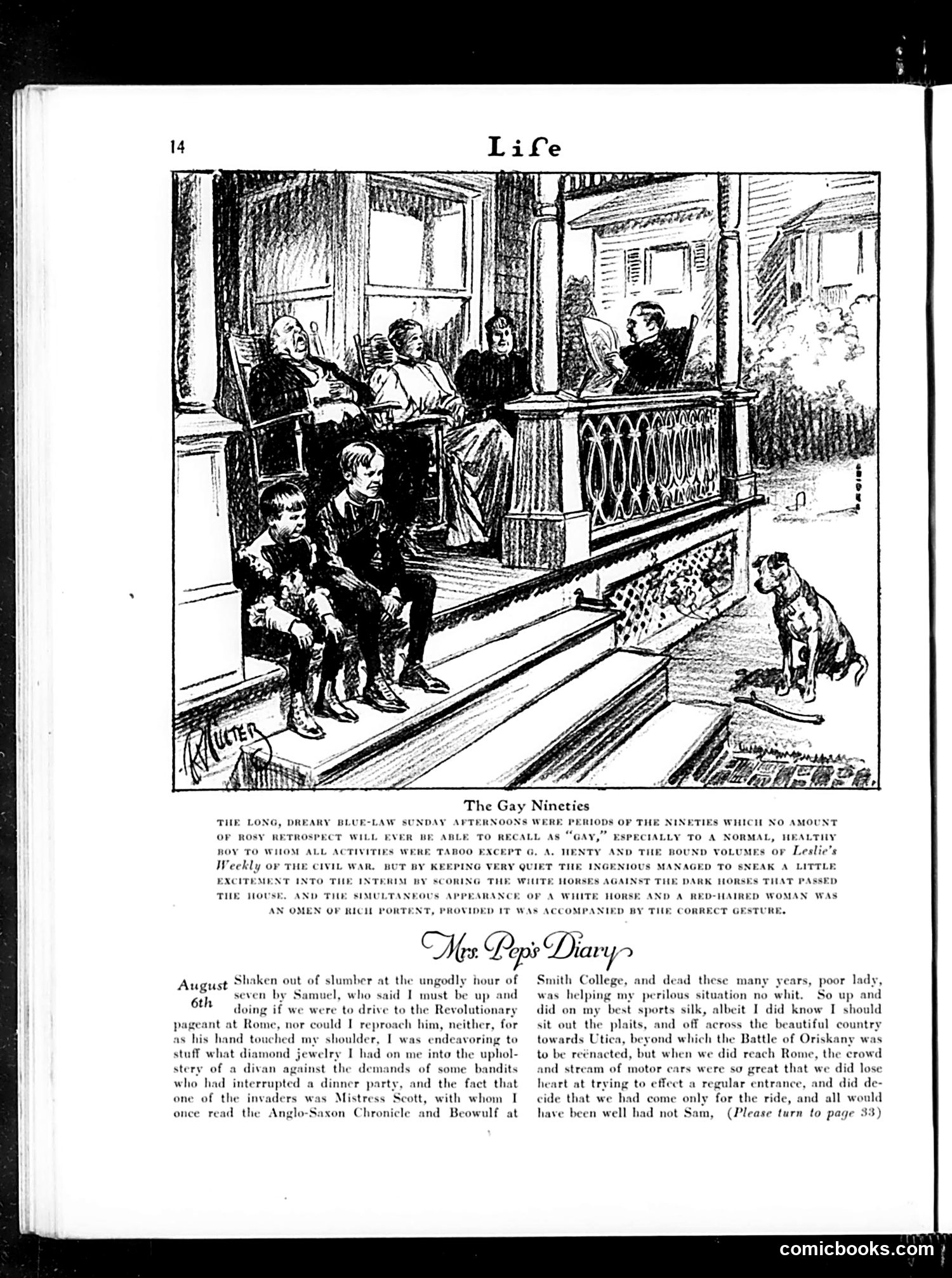
This illustration satirizes the 1890s as a period of strict social constraints, particularly for wealthy families. The cartoon shows adults on a porch entertaining themselves quietly while children and a dog stand outside on the street—visually depicting how rigidly controlled upper-class life was. The caption explains that Sunday afternoons were especially tedious, with activities restricted except for reading G.A. Henty's novels or *Leslie's Weekly* Civil War volumes. The satire mocks how ingeniously people managed "to sneak a little excitement" by observing passing horses, carriages, and "a white horse and a red-haired woman"—suggesting even minor social novelties provided rare entertainment in this buttoned-up era. The piece critiques the repressive gentility of the 1890s American leisure class.
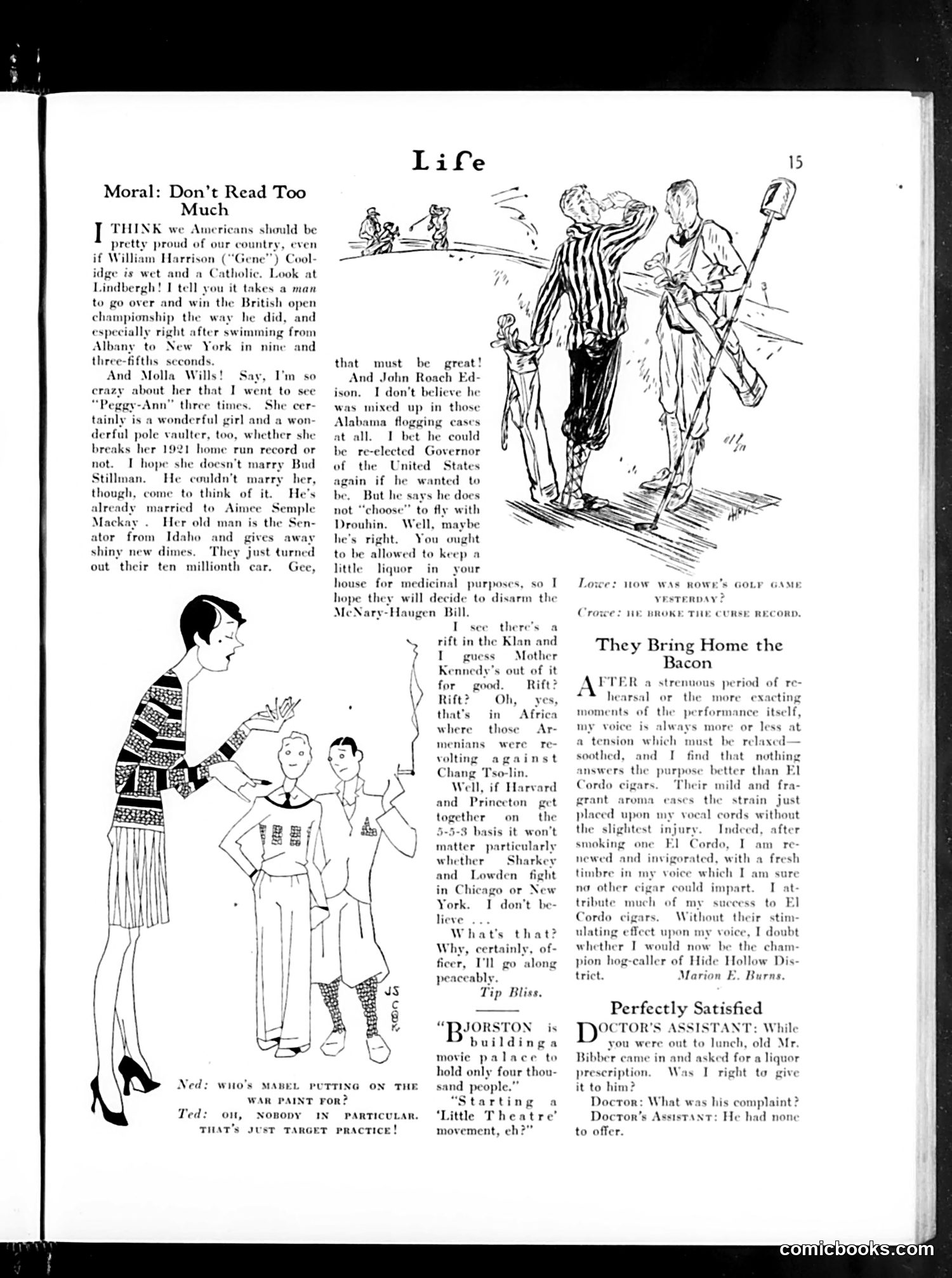
This page contains satirical commentary and light humor typical of Life magazine. The main article "Don't Read Too Much" critiques American pride, mocking figures like golfer Gene Sarazen and actress Molla Wills for their achievements, while questioning political figures like John Roach Edison's involvement in alleged Alabama flogging cases and suggesting Mother Kennedy's family should distance itself from scandal. The cartoon at bottom-left depicts a woman in 1920s fashion asking about "war paint," with a man responding it's "target practice"—likely satirizing women's heavy makeup trends of the era. The right section includes golf and doctor-related jokes. Overall, the page reflects 1920s-30s social commentary on celebrity, American exceptionalism, and contemporary fashion and manners.
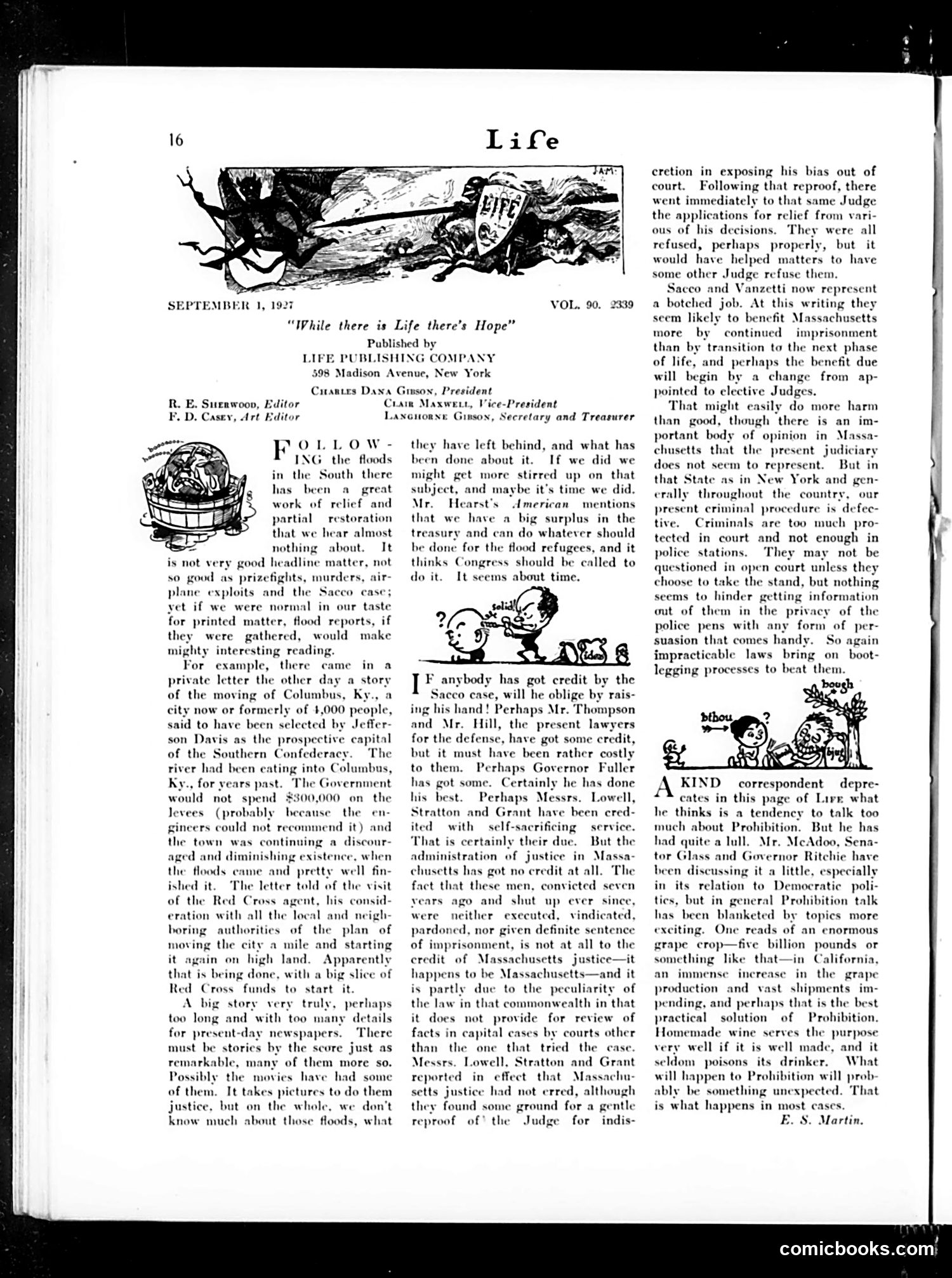
This page contains editorial commentary on contemporary legal and political issues, primarily the **Sacco and Vanzetti case**—referenced explicitly in the text. The article discusses Massachusetts justice, judicial bias, and criminal procedure. The cartoons appear to satirize **Prohibition enforcement** and related legal corruption. One cartoon shows what appears to be police or enforcement officials engaged in questionable activities, mocking how Prohibition laws were being applied and exploited. The main text criticizes Massachusetts judges for apparent bias, discusses concerns about proper legal procedure in capital cases, and suggests that the state's criminal justice system may be flawed. The author (E. S. Martin) concludes that Prohibition's implementation will likely fail without proper enforcement of honest laws.
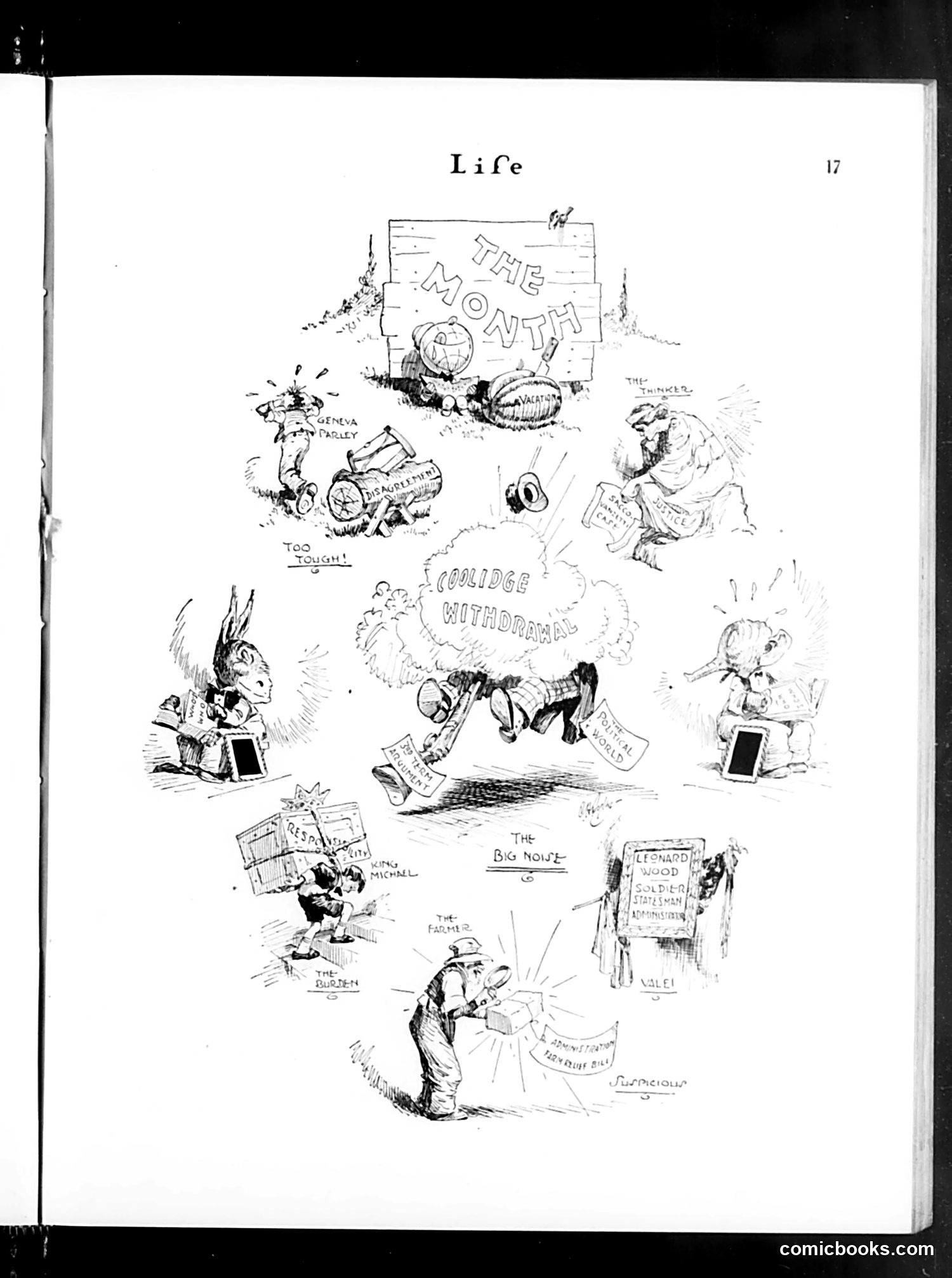
This page displays a satirical cartoon titled "of the month" featuring various political and social figures caricatured around central themes. The readable labels include "Geneva Parley," "Too Tough!," "Coolidge Withdrawal," "The Big Noise," "The Big Michael," "The Farmer," "The Burgess," "The Big House," "It Chard Wood Soldier Statesman Kidnapper Voter," and "Futurician." The cartoon appears to mock multiple contemporary political figures and events—likely from the 1920s based on "Coolidge" (President Calvin Coolidge) and "Geneva" references. Each vignette satirizes different politicians' positions or public personas regarding international negotiations, farming issues, and domestic politics. Without clearer date confirmation, specific identifications of other figures remain uncertain, though the overall intent is political commentary on prominent national debates of the era.
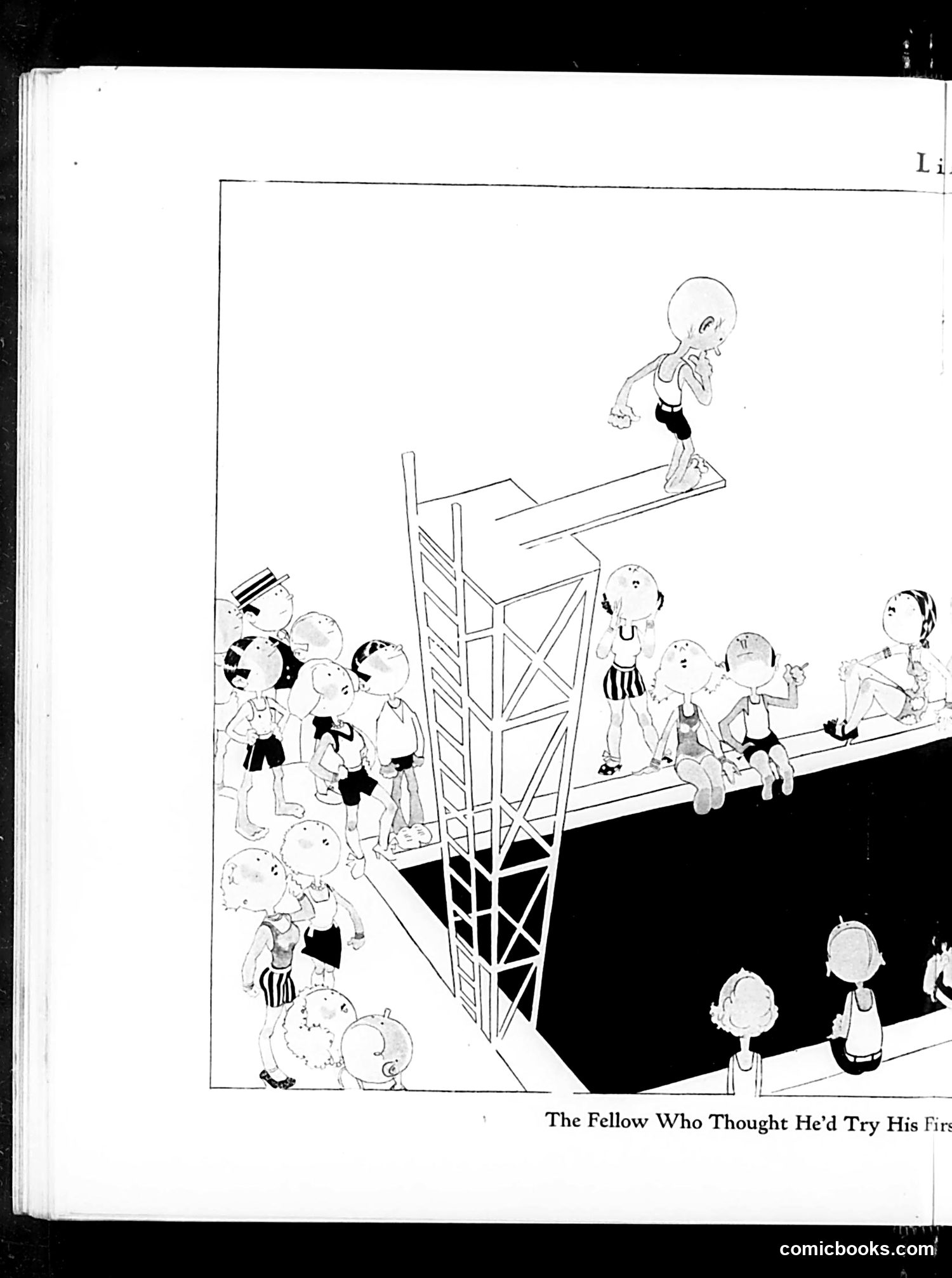
This appears to be a cartoon titled "The Fellow Who Thought He'd Try His Fir[st]" (text cuts off). The image shows a slapstick scene at what looks like a circus or performance venue: a figure stands precariously on a plank/seesaw balanced atop a tall wooden structure, while below, an audience of children watches. The setup suggests the figure is about to attempt some kind of daring stunt or acrobatic feat. The satire appears to target overconfident amateurs attempting dangerous activities beyond their skill level—a common theme in early 20th-century humor. The contrast between the figure's apparent inexperience and the hazardous setup creates comedic tension. Without the complete title, the specific reference remains unclear, but the scene mocks recklessness and naive bravado.
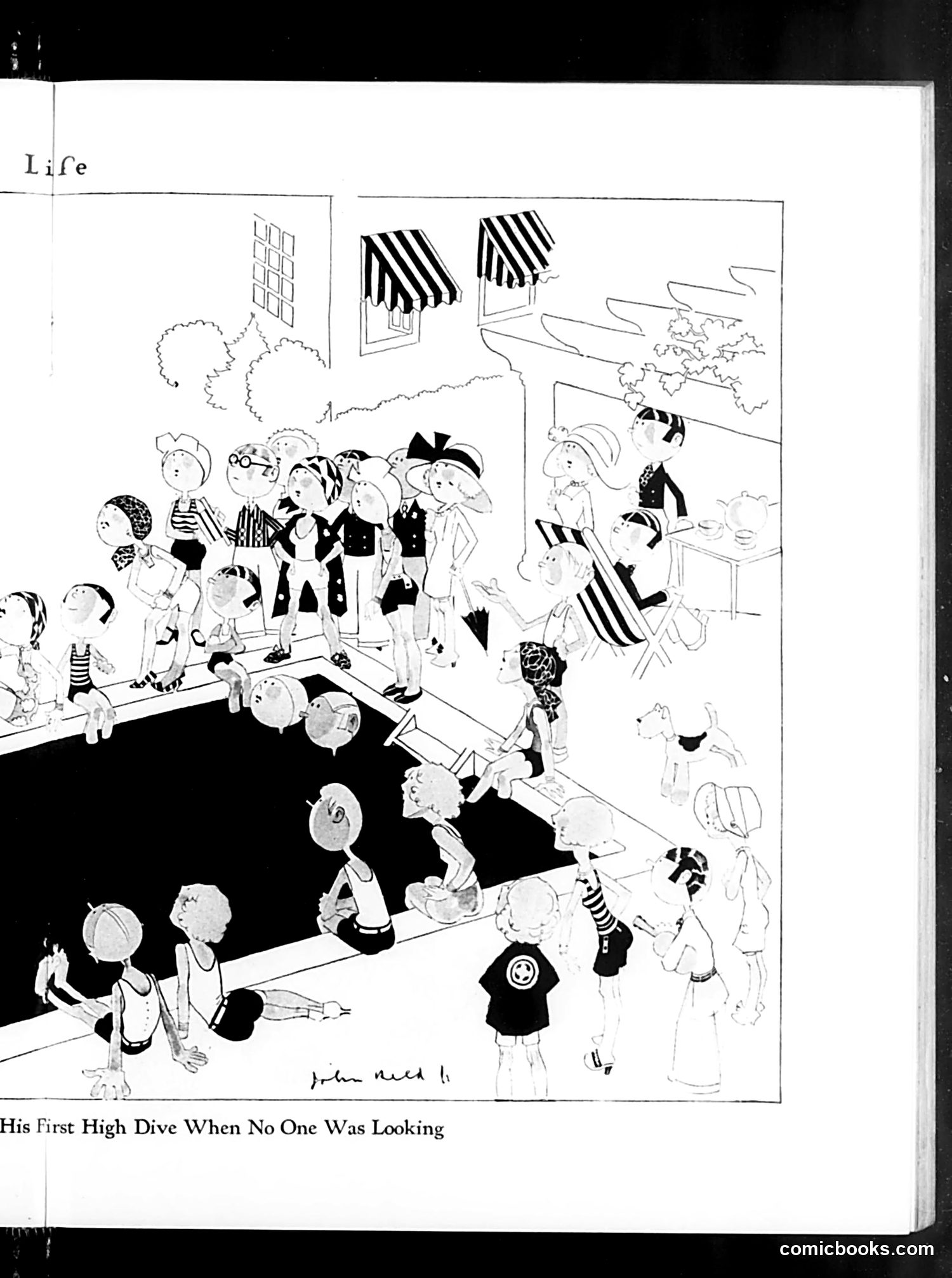
This cartoon satirizes a child attempting a dangerous stunt—a high dive into a pool—specifically when no adults are supervising. The humor relies on the contrast between the child's bold ambition and the precarious, unsupervised situation. The large dark pool and elevated diving platform emphasize the risk. The caption suggests this is about a boy secretly performing a daring act he wouldn't be permitted to do under adult observation. The scene captures a common childhood experience: testing boundaries and attempting risky behavior when authority figures aren't watching. The cartoon likely critiques either reckless childhood behavior or, alternatively, parental inattention. The "Life" magazine context—a satirical publication—suggests social commentary on modern parenting or youth culture of the era depicted.
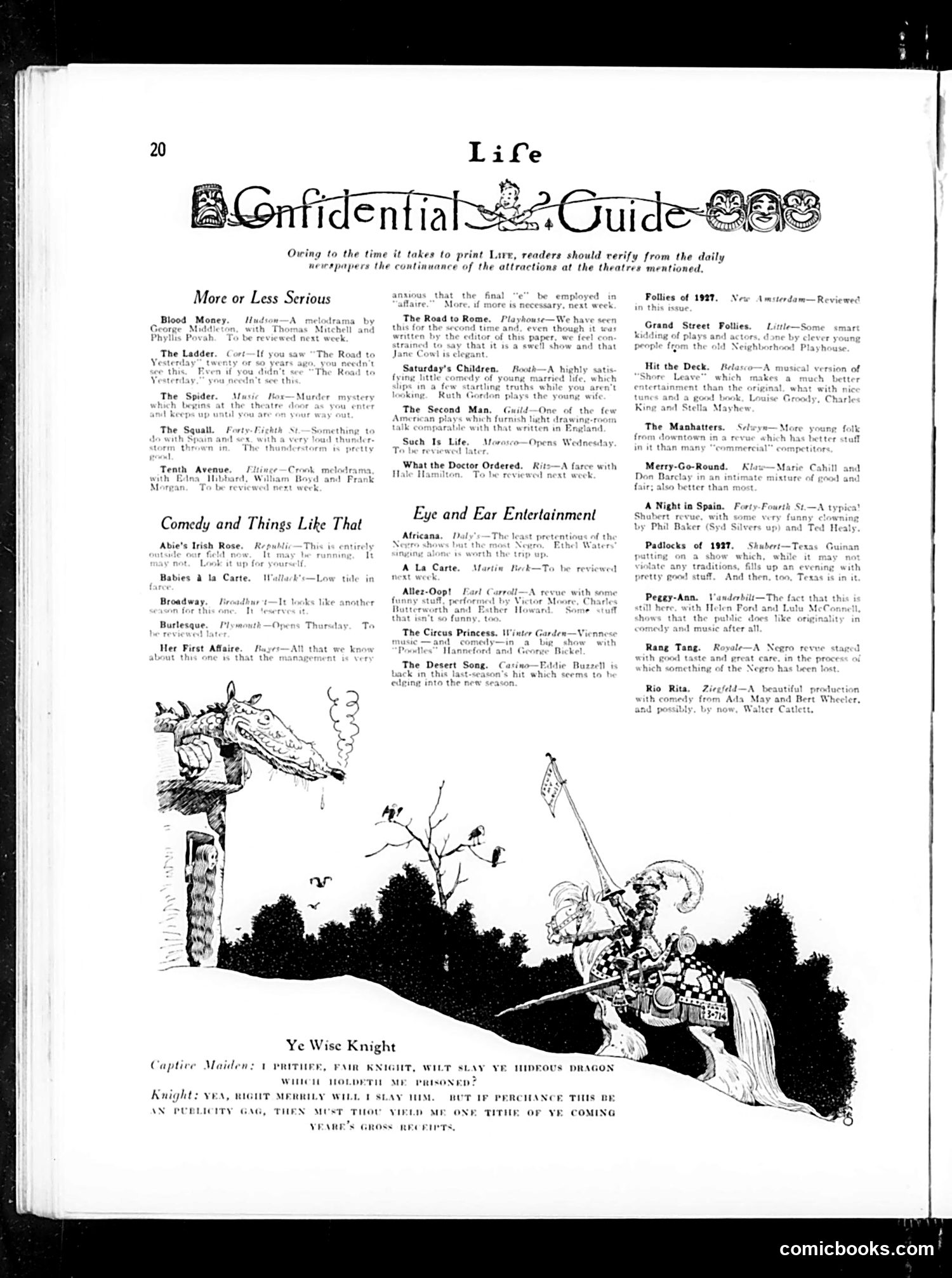
This is a medieval-themed satirical cartoon mocking theatrical publicity stunts of the 1920s. The "Captive Maiden" and "Knight" dialogue presents a mock-serious ransom scenario typical of stage melodrama. The satire's point: The knight threatens to slay a dragon to rescue a maiden—standard dramatic fare. But then he pivots, revealing the true concern: if this rescue is merely a "publicity gag" (a promotional stunt), the maiden must pay him "one tithe of ye coming year's gross receipts"—essentially demanding box office profits. This jokes about how Broadway theaters of the era used elaborate promotional schemes and manufactured scandals to drum up attendance. The cartoon satirizes both the overwrought conventions of stage drama and the cynical commercial calculations behind theatrical promotion, suggesting that producers cared more about profits than authentic storytelling.
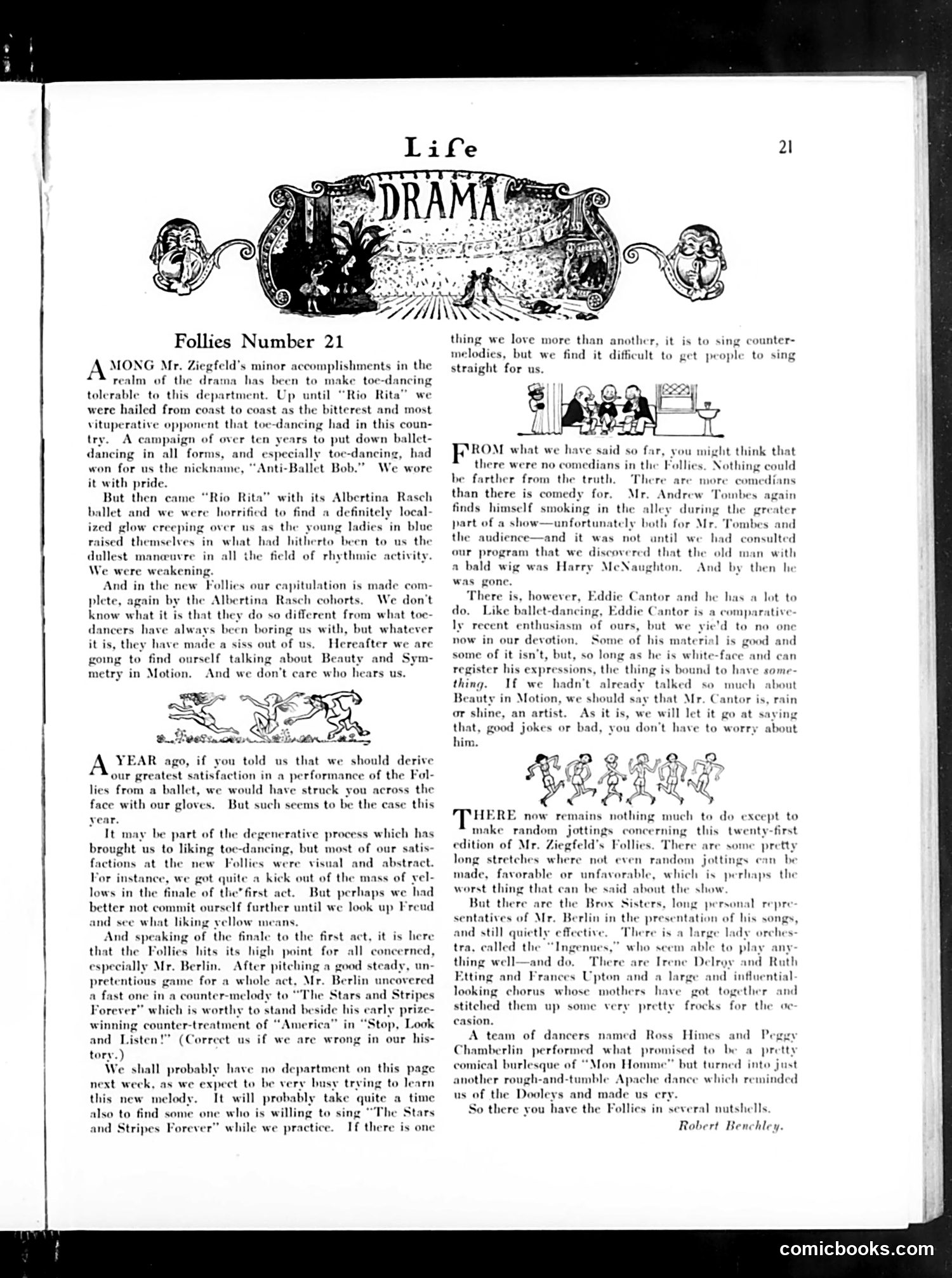
This is a theater review of Florenz Ziegfeld's *Follies* (a famous revue series), specifically praising the choreography of Albertina Rasch's ballet dancers. The author, "Anti-Ballet Bob" (Robert Benchley, Life's drama critic), humorously recounts his conversion from a vocal opponent of toe-dancing to an admirer after seeing Rasch's work in the "Rio Rita" production. The satire's point: Benchley had spent a decade dismissing ballet as boring, but found himself aesthetically moved by the "Beauty and Symmetry in Motion" Rasch created—a humbling reversal he treats with self-deprecating comedy. He also reviews comedians like Eddie Cantor and Andrew Tombes, noting mixed material quality but praising Cantor's expressive talent. The cartoon illustrations appear to show dancers in motion, supporting the text's focus on movement and performance.
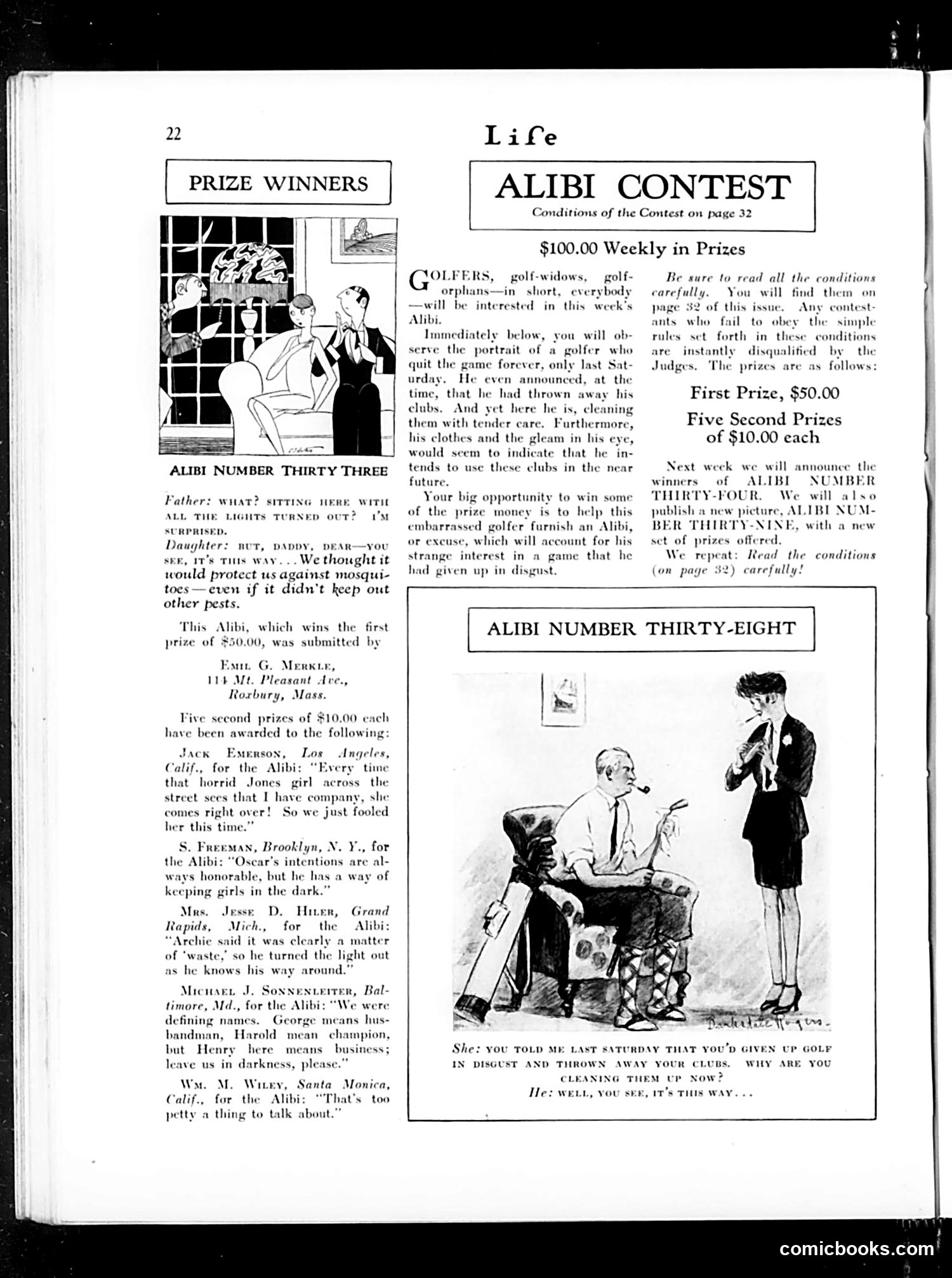
This page showcases Life's ongoing "Alibi Contest"—a humor feature where readers submit witty excuses for awkward situations. The winning alibis are published with cartoon illustrations. **The featured cartoon (Alibi #38)** depicts a husband caught red-handed cleaning golf clubs despite having sworn off the sport last Saturday. His wife confronts him; he begins stammering an explanation ("Well, you see, it's this way..."). The joke satirizes the gap between what people *claim* to do and what they actually do—here, a man's inability to genuinely quit golf despite announcing he'd abandoned it forever. **The contest mechanics**: Readers submit creative excuses for embarrassing situations. Winners receive prize money ($50 first prize; $10 for five runners-up). The page lists previous winners' alibis, mostly about domestic situations—keeping girls "in the dark," fooling neighbors, defining names in darkness. The satire targets human nature: our tendency to make grand declarations we can't keep, and our creativity in constructing believable lies when caught.
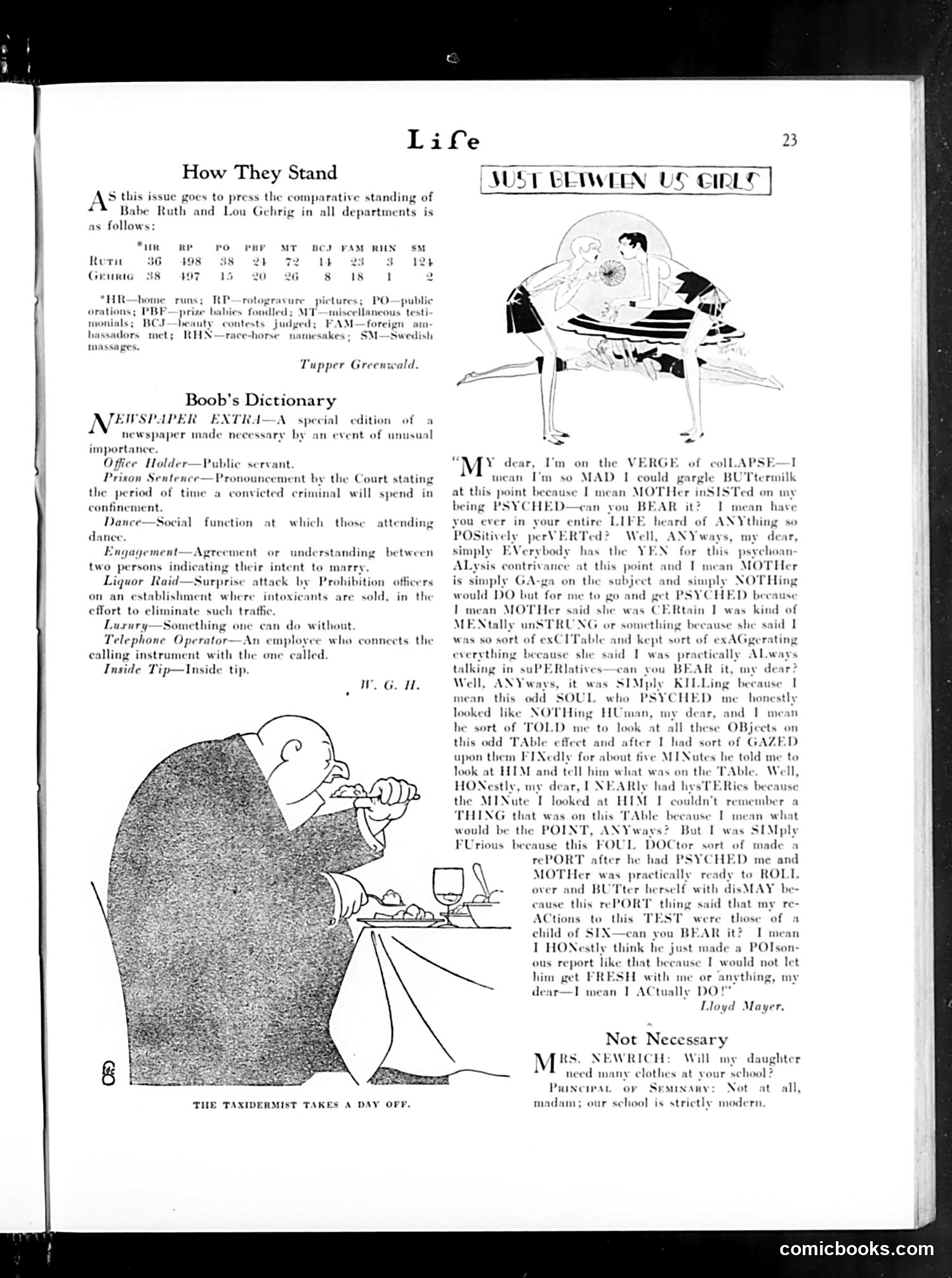
This Life magazine page (page 23) contains two main satirical pieces: **"How They Stand"** compares baseball stars Babe Ruth and Lou Gehrig using humorous metrics beyond statistics—including "rotogravure pictures," "public orations," and "Swedish massages." It mocks celebrity culture's obsession with athletes' off-field endorsements and appearances. **"Just Between Us Girls"** parodies upper-class women's affected speech patterns and psychology fad enthusiasm. The unnamed speaker breathlessly describes visiting a psychoanalyst (likely referencing Freudian psychology's 1920s popularity), using exaggerated capitalization to emphasize dramatic overstatement. She resents being analyzed yet obsesses over the results. **"Boob's Dictionary"** offers sardonic definitions: "Office Holder" equals "Public Servant," while "Prison Sentence" follows logically—satirizing political corruption. "Liquor Raid" references Prohibition enforcement. The cartoon depicts a taxidermist relaxing, likely commenting on the absurdity of modern life requiring escape. Overall, the page satirizes 1920s American excess: celebrity worship, psychological trends, political hypocrisy, and affectation among the wealthy.
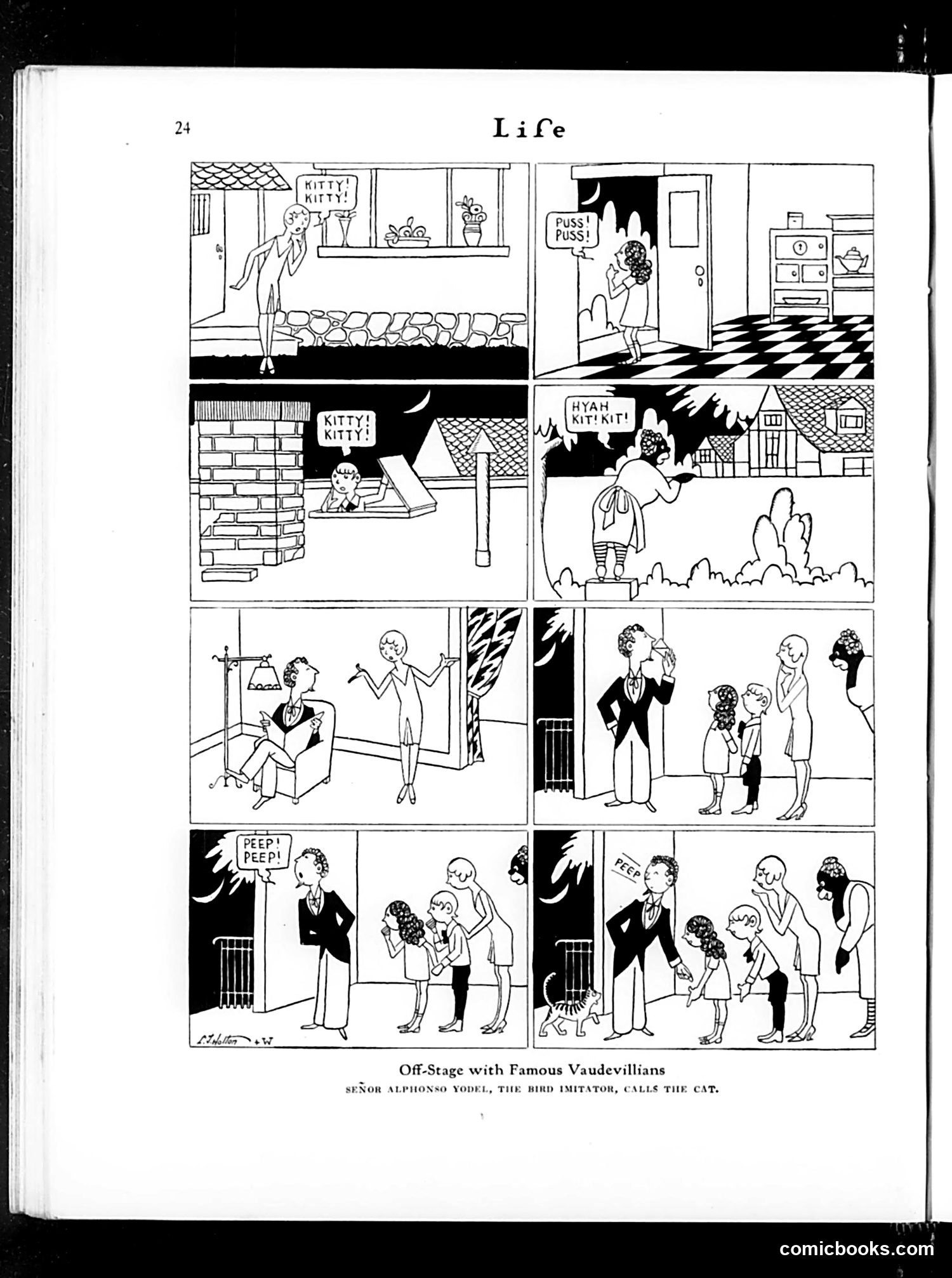
This is a humorous comic strip about vaudeville performers' offstage lives. The title indicates it features "Señor Alphonso Yodel, the Bird Imitator, Calls the Cat." The joke centers on a vaudeville act: Alphonso Yodel is famous for imitating birds (calling "Kitty! Kitty!" and later "Hyah kit'nit!"). The comic shows him attempting to call a cat using his bird-imitation skills, which proves ineffective. The final panels depict the chaos that ensues—the cat appears and creates confusion with the gathered crowd, with someone calling "Peep! Peep!" The satire mocks the disconnect between stage personas and real life: a skilled bird imitator cannot control an actual animal, despite his professional expertise. It's gentle humor about the gap between theatrical talent and practical reality.
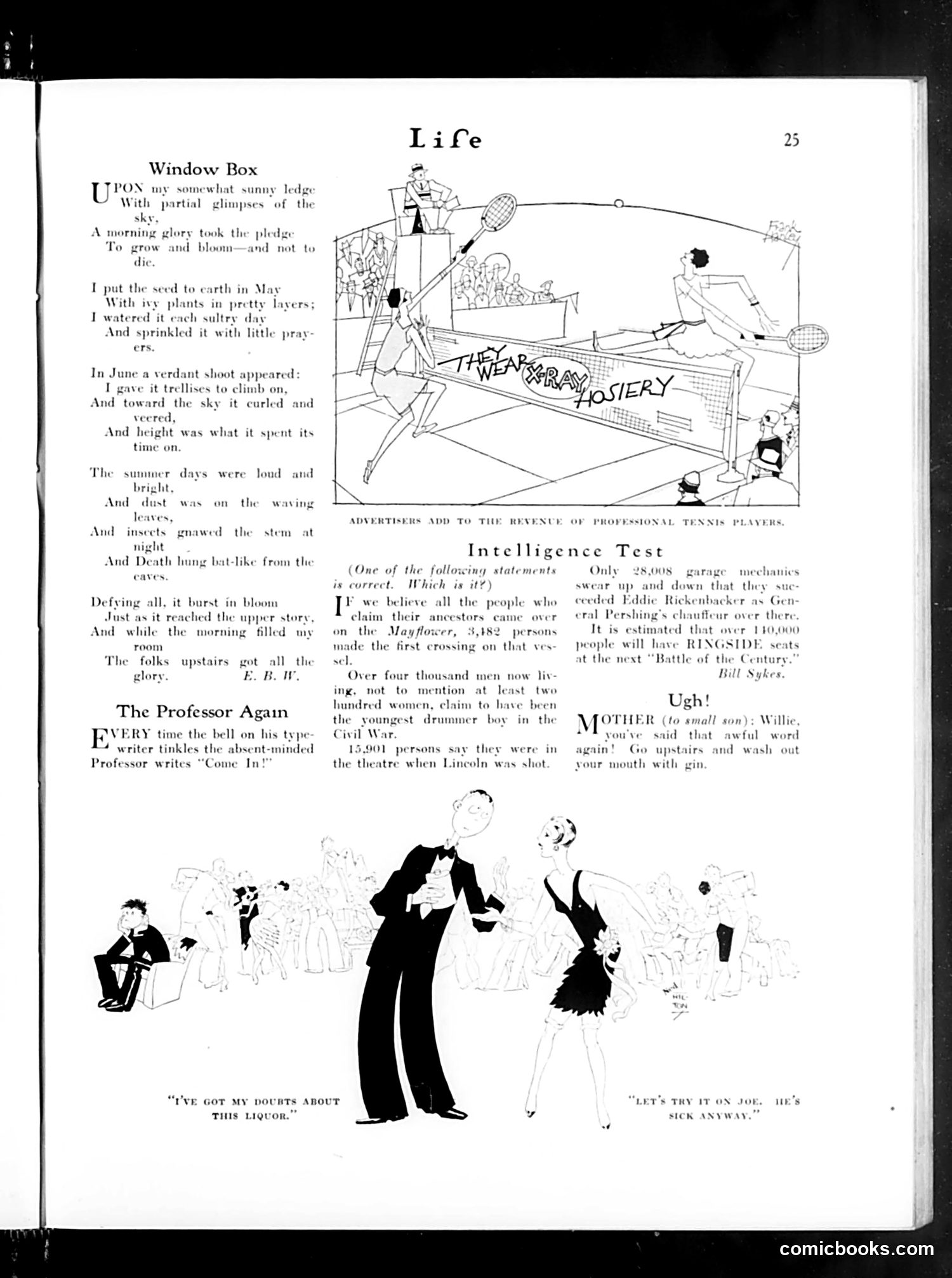
This page contains three separate humorous pieces satirizing American life: **"Window Box"** is a sentimental poem about growing morning glories, mocking overwrought nature writing and domestic sentimentality popular in the era. **"The Professor Again"** jokes about an absent-minded academic who automatically types "Come In!" whenever his typewriter bell rings—satire of professorial distraction and mechanical habit. **"Intelligence Test"** mocks Americans' exaggerated genealogical claims. It presents statistics about people claiming Mayflower ancestry or being present at Lincoln's assassination—far exceeding historical possibility. The joke exposes how Americans invent or embellish family histories. The Eddie Rickenbacker reference (a famous WWI pilot) adds to the absurdity of inflated personal credentials. **"Ugh!"** shows a mother instructing her son to rinse his mouth with gin after swearing—dark humor about Prohibition-era parenting, implying gin is a common household item despite being illegal. All pieces satirize American vanity, pretension, and domestic absurdity.
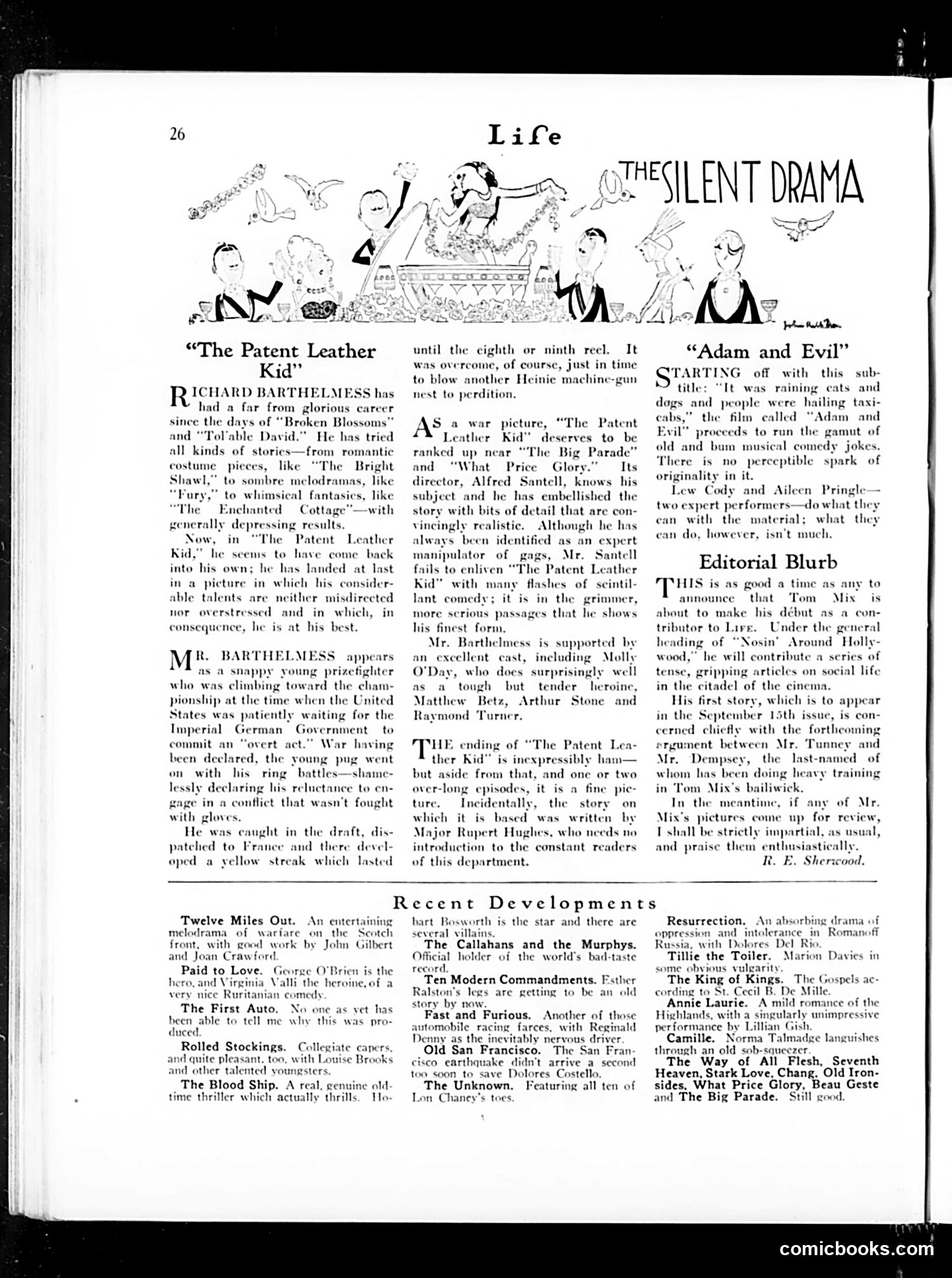
This page reviews two silent films. **"The Patent Leather Kid"** stars Richard Barthelmess as a prizefighter who reluctantly enters WWI, develops "cowardice," but redeems himself by destroying a German machine-gun nest. The reviewer praises Barthelmess's performance, noting he's finally found suitable material after previous failures. The film's ending is criticized as overly sentimental ("inexpressibly ham"). **"Adam and Evil"** receives dismissive treatment—a mediocre musical comedy with clichéd opening ("raining cats and dogs"). Despite capable performers like Lew Cody and Aileen Pringle, the material offers them little to work with. The page also includes an editorial note about cowboy star Tom Mix contributing articles on Hollywood social life and the Dempsey-Tunney boxing match controversy.
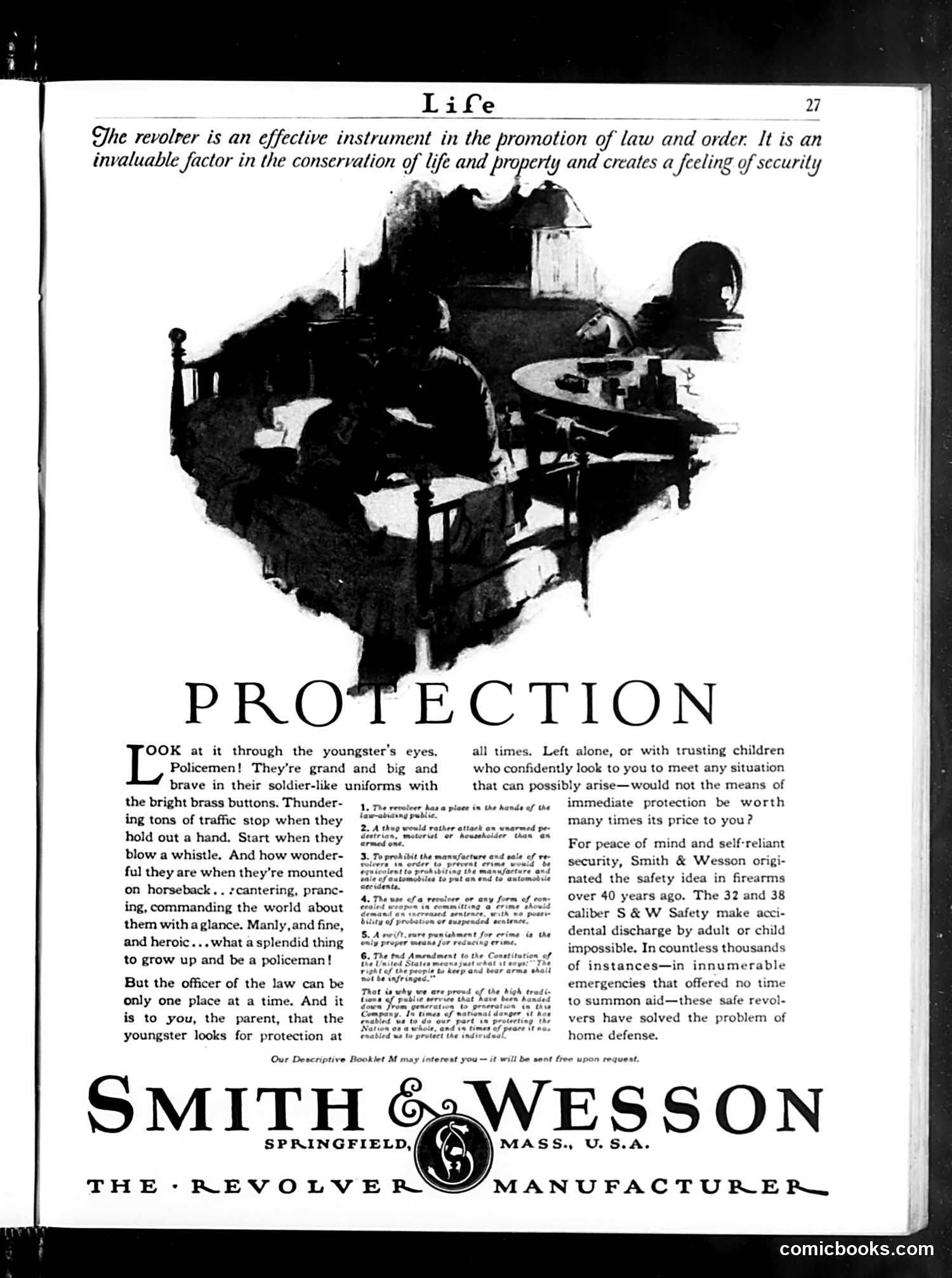
This is a **Smith & Wesson advertisement**, not satire or political commentary. The "Life" magazine page uses emotional appeals to sell revolvers for home defense. The advertisement addresses parents directly, contrasting admiration for police officers ("grand and big and brave") with the reality that police cannot be everywhere. It then pivots to the sales pitch: parents need Smith & Wesson revolvers for home protection. The accompanying illustration shows a child gazing at a mounted policeman, evoking nostalgia and security. The text emphasizes that Smith & Wesson guns have "safety" features (their ".32 and .38 caliber S & W Safety") making accidental discharge "impossible" — a marketing claim that frames gun ownership as responsible. The appeal is explicitly to parental instinct: "Left alone, or with trusting children...would not the means of immediate protection be worth many times its price to you?" **Context for modern readers:** This represents early-20th-century attitudes toward civilian gun ownership as a normal part of home security, marketed through emotional appeals to family protection rather than sport or rights arguments.
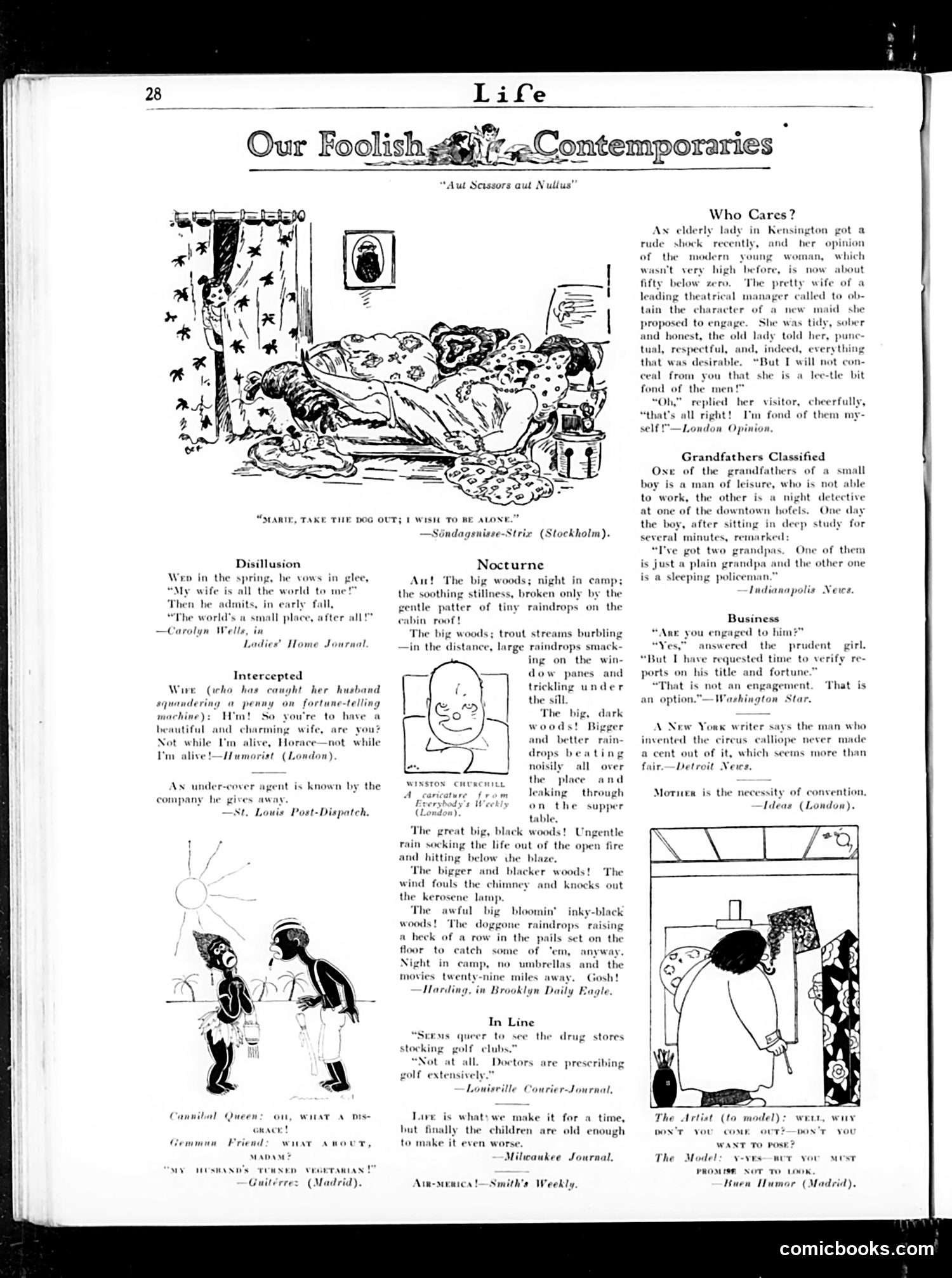
This page collects brief satirical anecdotes mocking modern social behavior and attitudes circa early 20th century. Key recurring themes: **"Who Cares?"** jokes about changing standards: an elderly British woman disapproves of a young woman's modern behavior (being "a lee-tle bit daft"), yet the young woman proudly owns this trait—satirizing generational disconnect and youth rejecting traditional propriety. **"Grandfathers Classified"** ridicules children's blunt honesty, comparing one grandfather to a "sleeping policeman" (slang for traffic bump)—mocking how youth fail to show proper deference to elders. **"Nocturne"** romanticizes camping's discomforts through overwrought language, satirizing sentimental nature-writing. **"Business"** and **"An Option"** mock modern courtship: a girl treats engagement as a provisional business arrangement needing verification—poking fun at practical, transactional attitudes replacing romantic ideals. Overall, the page satirizes modern society's departure from Victorian conventions: youth irreverence, mechanized sentiment, and contractual rather than emotional values. The tone suggests conservative anxiety about social change.
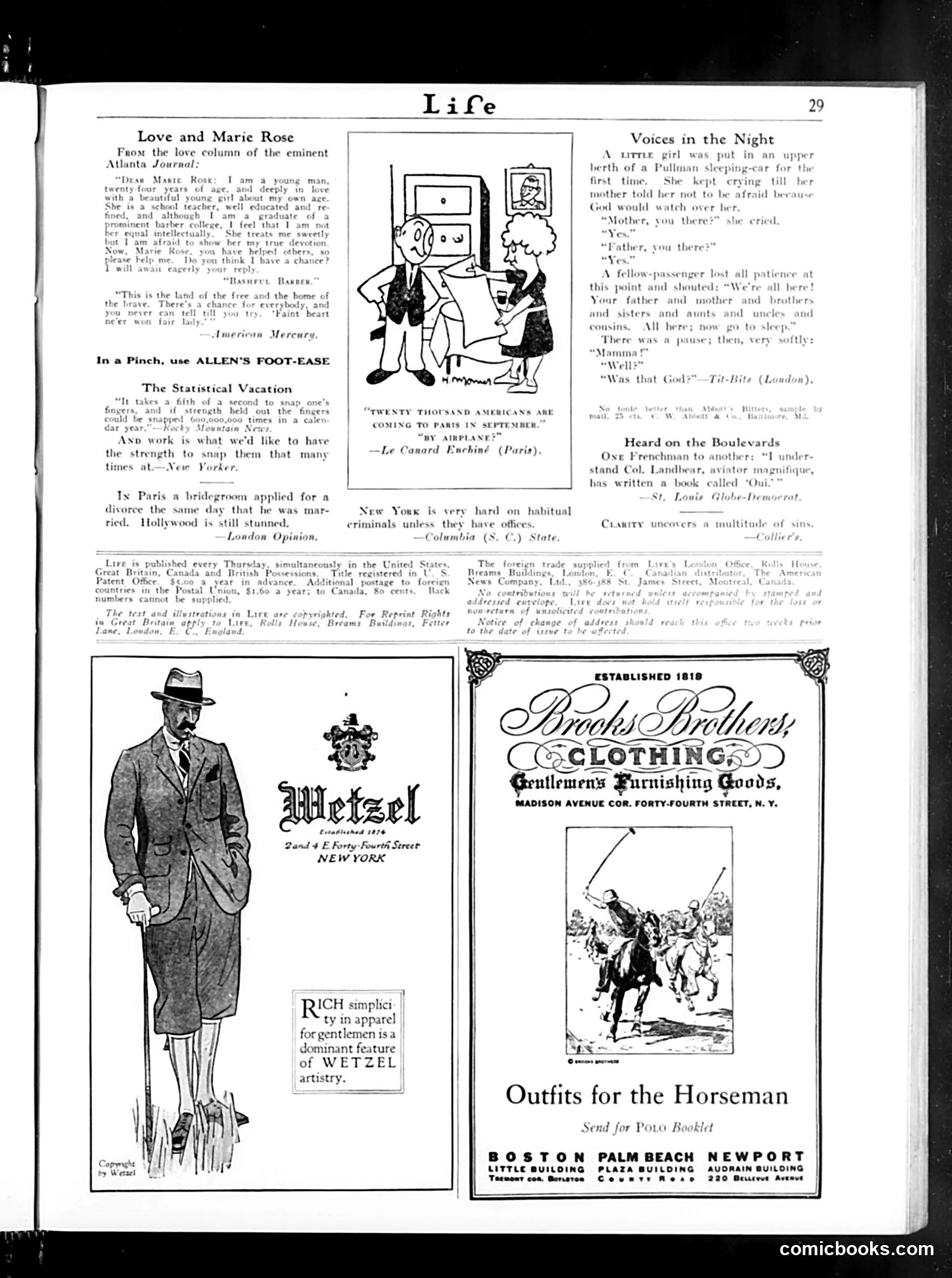
This page mixes editorial content with advertising, typical of Life's format. The main satirical pieces are brief humor snippets: **"Love and Marie Rose"** presents contrasting perspectives on romance—a young man's earnest declaration versus a cynic's dismissal ("Faint heart ne'er won fair lady"), satirizing romantic idealism versus worldly skepticism. **"Voices in the Night"** appears to mock sentimental domestic scenes, with a child's innocent faith in parental protection contrasted against real-world chaos (the passenger who loses patience, shouting "We're all here!"). **"In a Pinch, use Allen's Foot-Ease"** is a mild gag about using foot powder during emergencies rather than actual crises. The other items quote amusing observations from contemporary publications about Parisian bureaucracy and New York's tolerance of criminals with legitimate offices. The page is largely **advertisements**—Wetzel clothing (1876 establishment) and Brooks Brothers—making content secondary to commercial purpose, typical of Life's business model during this period.
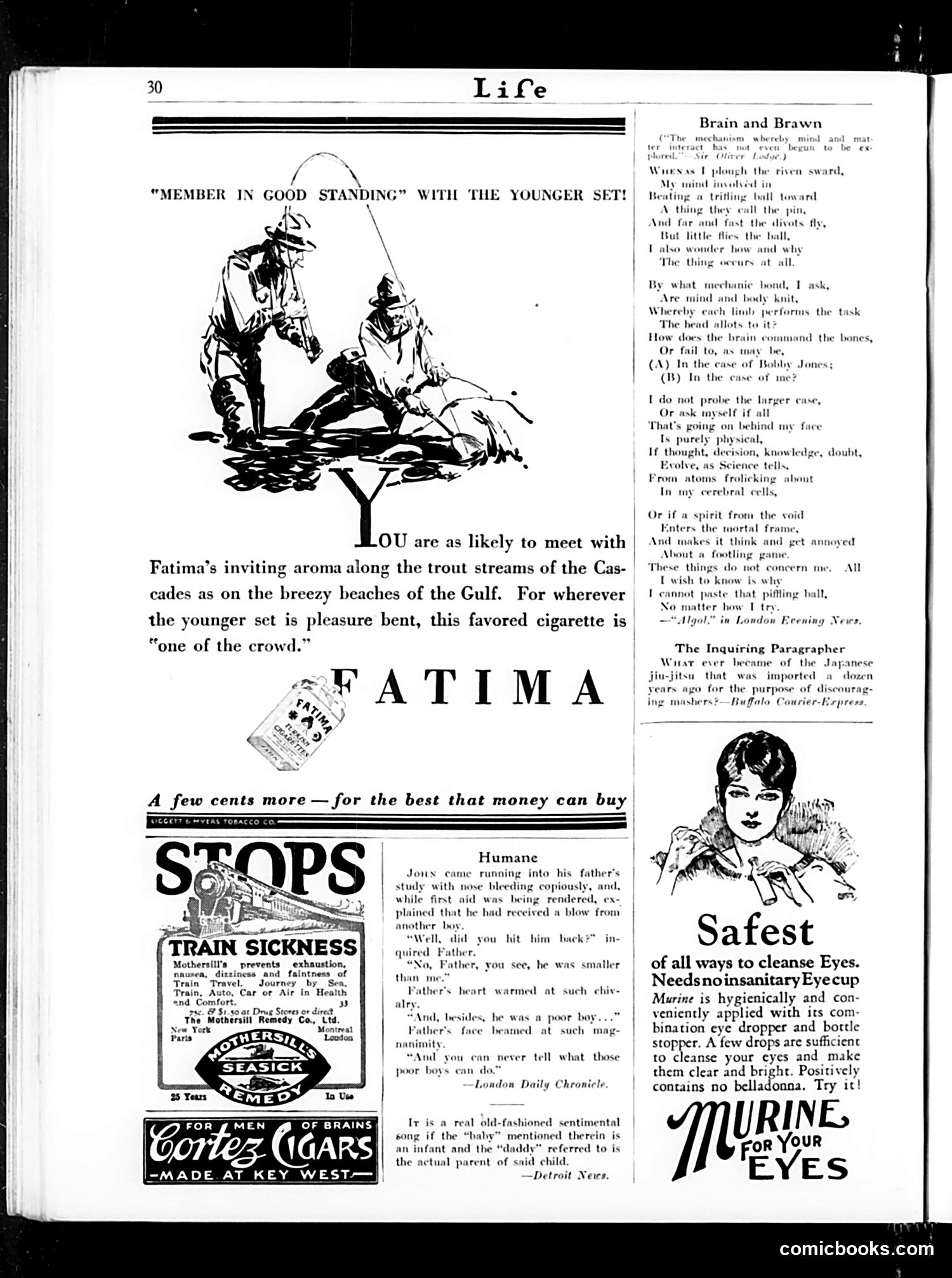
This page consists primarily of **advertisements** interspersed with brief humorous columns typical of Life magazine's satirical format. The main cartoon depicts two figures fishing, captioned "Member in Good Standing with the Younger Set"—advertising Fatima cigarettes as socially ubiquitous among young people. Below are three short satirical pieces: 1. **"Humane"**: A father praises his son for not retaliating when hit by a smaller boy, calling it magnanimity—subtle critique of class-based sentimentality. 2. **"Brain and Brawn"**: A poem about golfing and the mind-body mystery, poking fun at golfers' inability to perform despite conscious effort (likely referencing Bobby Jones, a famous golfer of the era). 3. **"The Inquiring Paragrapher"**: A quip about Japanese jiu-jitsu imported years earlier for "discovering mashers" (street harassers)—implying the fad has disappeared. The page is typical early-20th-century Life content: light social observation mixed with period advertisements for cigarettes, travel remedies, and eye wash.
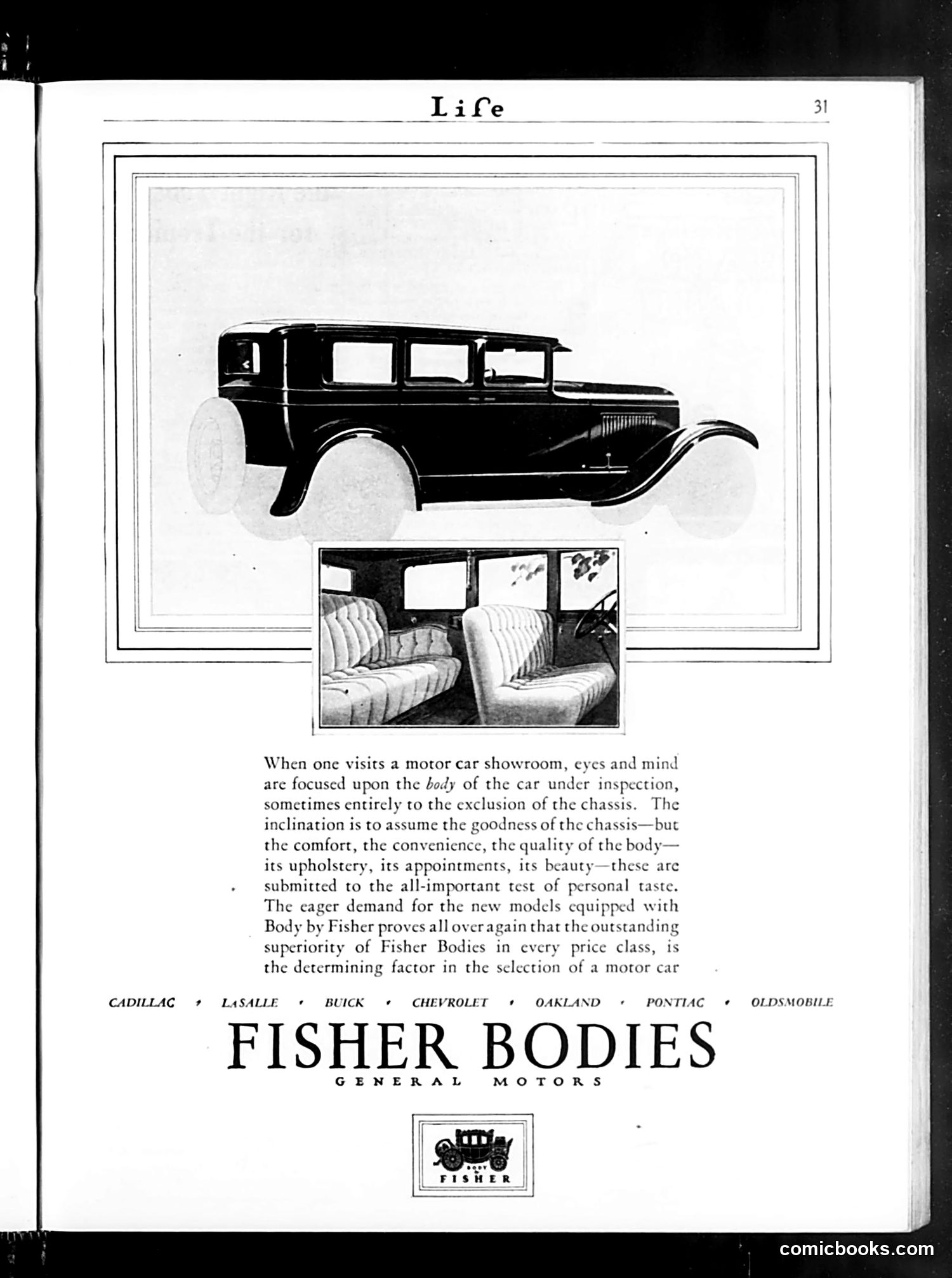
This is **not a cartoon or satire**—it's a straightforward **advertisement** for Fisher Bodies, a General Motors subsidiary. The page features a black sedan illustration with a smaller photograph below showing the car's upholstered interior. The text argues that when buyers visit showrooms, they focus primarily on the car's body rather than its chassis, and that Fisher Bodies' quality and comfort are the decisive factors in purchase decisions. The ad lists seven GM car brands (Cadillac, LaSalle, Buick, Chevrolet, Oakland, Pontiac, Oldsmobile) that used Fisher Bodies, positioning Fisher as a premium component across multiple price points. This appears from an era when car bodies were often manufactured separately from chassis by suppliers like Fisher, before full vertical integration became standard in auto manufacturing.
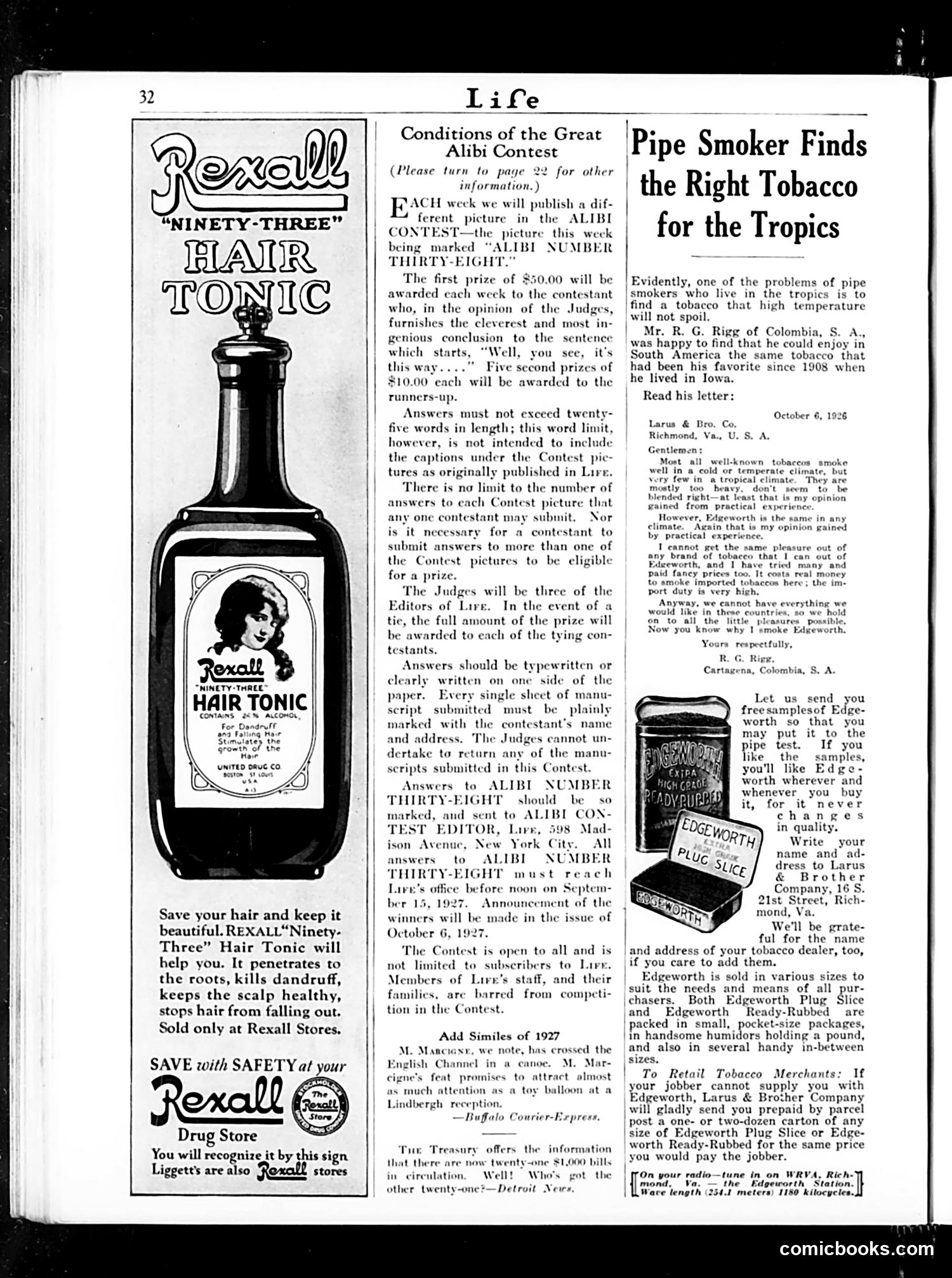
This page is primarily **advertising and contest information**, not political satire. The left side features a **Rexall "Ninety-Three" Hair Tonic advertisement**—a patent medicine promising to cure dandruff and hair loss. The product contains 22% alcohol, notable since this was during Prohibition (1920-1933), when such "medicinal" alcohol sales were legal loopholes. The center details **Life's "Alibi Contest"**—a reader participation game where contestants completed captions for weekly pictures, competing for $50 weekly prizes. This was a common engagement strategy for magazines of the era. The right side advertises **Edgeworth tobacco**, using a testimonial from a Colombia resident praising the product's heat resistance in tropical climates. The accompanying illustration shows the tobacco product and packaging. There is **no political cartoon or satire** on this page—it represents typical 1920s magazine content: commercial advertising mixed with reader contests to build subscriber engagement and loyalty.
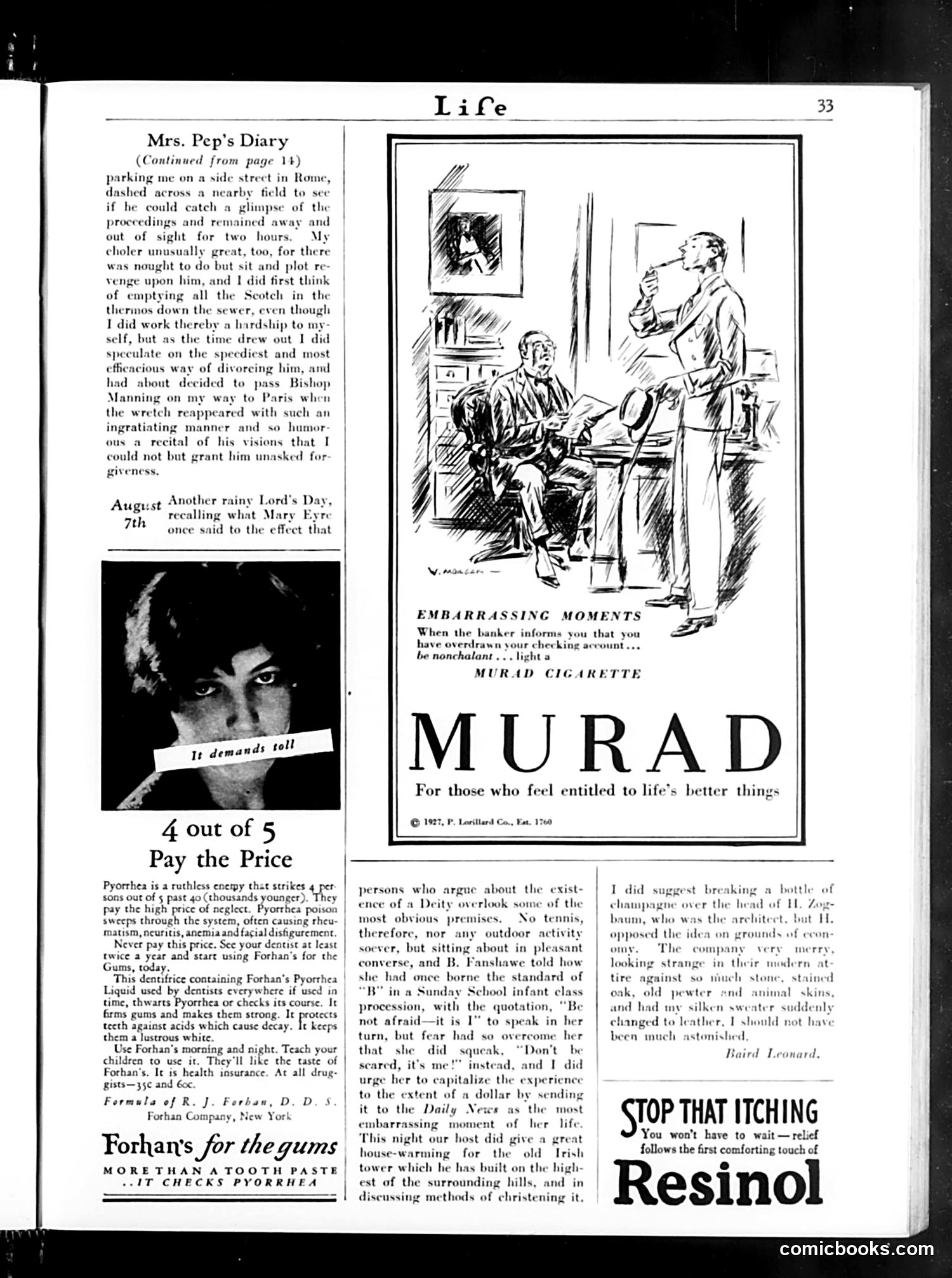
This page contains a humorous diary entry by "Mrs. Pep" describing a marital spat in Rome, where her husband abandons her in a parked car to attend an unspecified event. The satire lies in her escalating fantasies of revenge—from dumping their Scotch to planning divorce—before he returns with such charming storytelling that she forgives him immediately. The piece mocks both marital dynamics and the fickleness of anger. The page is primarily advertising: Forhan's toothpaste (warning of pyorrhea as a threat to health), Murad cigarettes (using an "embarrassing moments" scenario about an overdrawn checking account), and Resinol ointment. These ads are typical 1920s marketing, targeting genteel anxieties about social embarrassment and health. The illustration shows a banker delivering awkward news to a client—the "solution" being a calming cigarette.
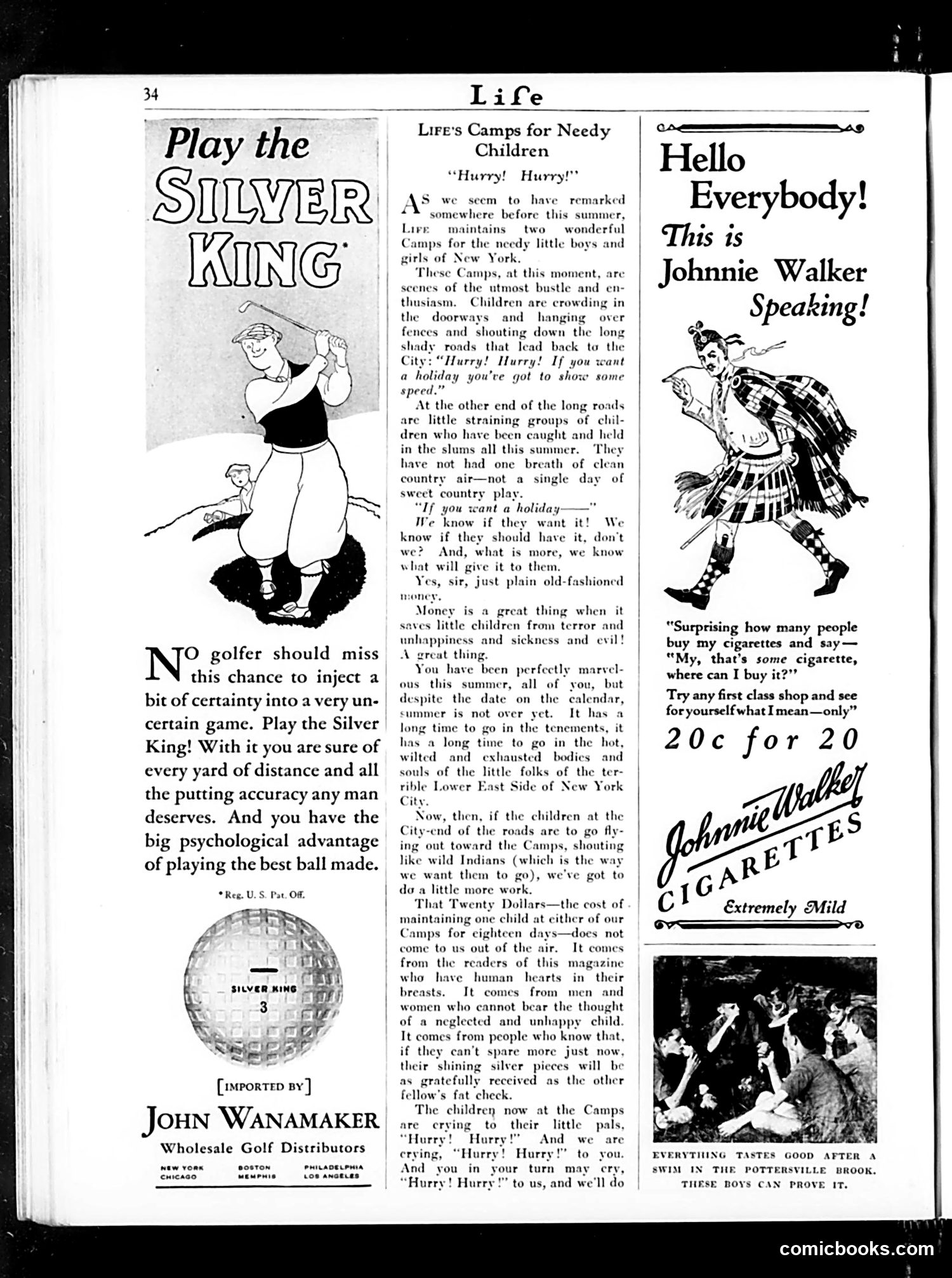
This page combines charitable advocacy with period advertising. The dominant content is **Life's Camps for Needy Children**, a fundraising appeal targeting wealthy magazine readers. The article uses urgent language ("Hurry! Hurry!") to solicit $20 donations to send impoverished children from New York's Lower East Side tenements to summer camps for 18 days—framing this as salvation from "terror and unhappiness and sickness and evil." The accompanying illustrations show children eagerly rushing to the camps, emphasizing their desperation and gratitude. **Advertising includes:** - A "Silver King" golf ball (top left), marketed to affluent golfers - **Johnnie Walker cigarettes** (right), featuring a kilted Scottish figure as the brand mascot, pitched as "extremely mild" at "20c for 20" - A photograph of boys swimming, endorsing the product The juxtaposition reveals the magazine's dual audience: wealthy enough to afford golf equipment and cigarettes, yet supposedly charitable. The appeal's emotional manipulation contrasts sharply with the luxury goods surrounding it.
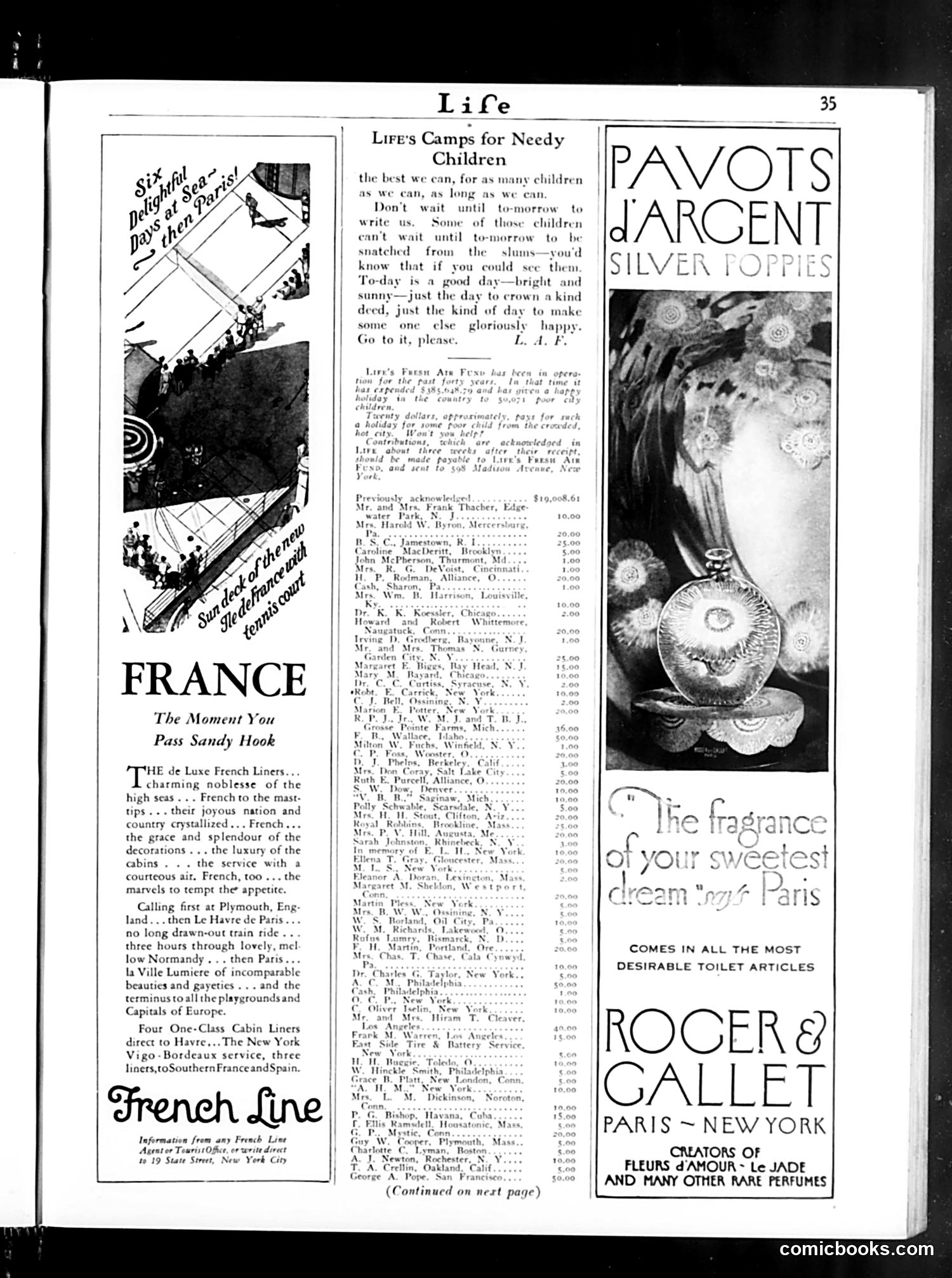
This page is primarily **advertising and charitable content** rather than political satire. The main elements include: 1. **French Line advertisement** (left): Promotes luxury ocean liners to France, emphasizing elegance and direct access to Paris from New York via ports like Le Havre and Plymouth. This targets wealthy American travelers seeking European leisure travel. 2. **Life's Camps for Needy Children** (center): A charitable appeal encouraging immediate donations to send poor children to summer camps, using emotional language about "slums" and opportunity. 3. **Perfume and cosmetics advertisements** (right): High-end French beauty products (Roger & Gallet, Pavots d'Argent) marketed as luxury imports from Paris to American consumers. The page reflects 1920s consumer culture and American aspirations toward European sophistication, while also documenting period charitable efforts for urban poor children. There is no discernible political cartoon or satire present.
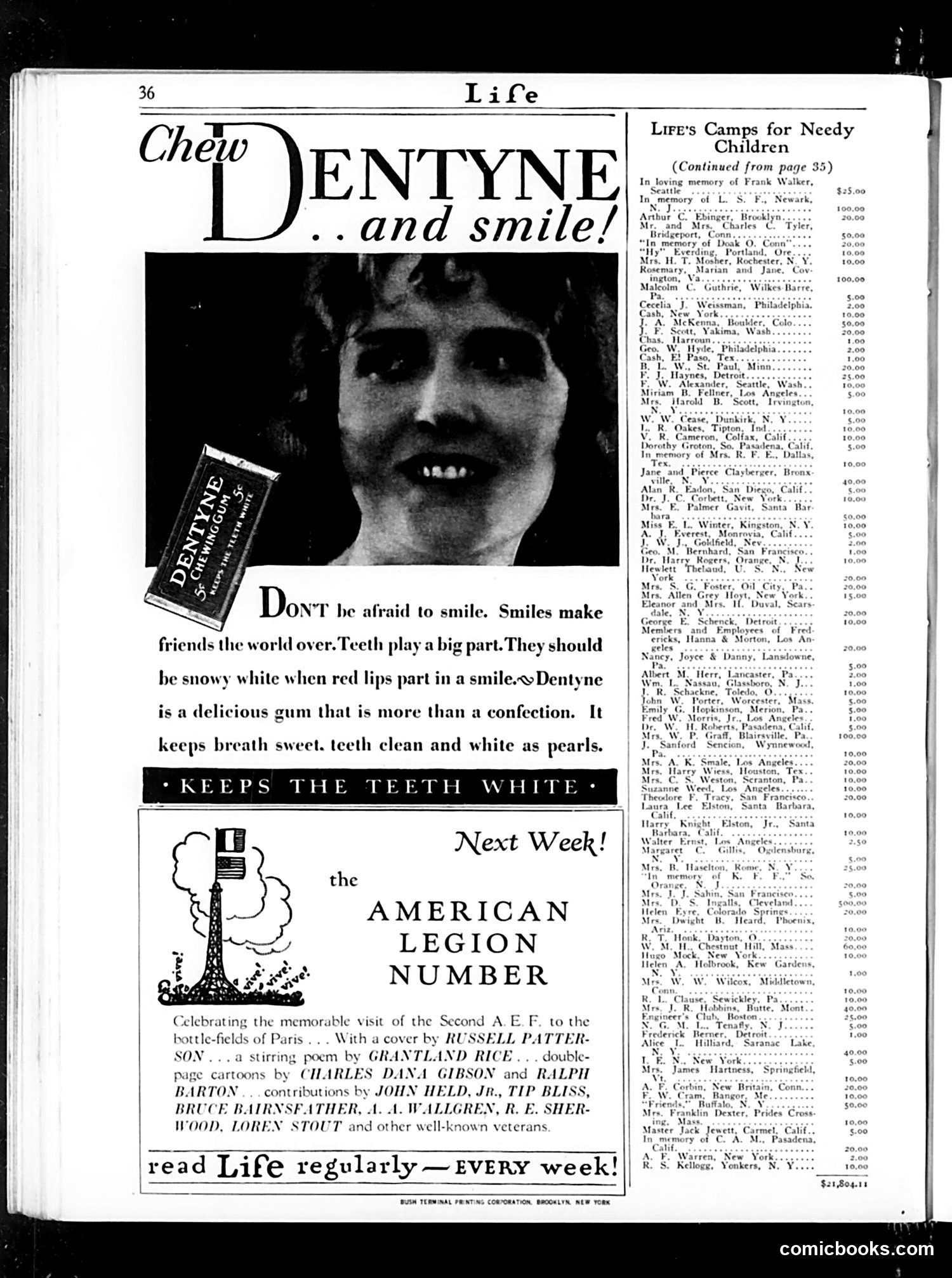
This page is primarily a **toothpaste/gum advertisement** for Dentyne, featuring a close-up photograph of a man's face emphasizing his smile. The ad copy uses straightforward pitch: Dentyne keeps teeth white, breath sweet, and promotes friendly social interaction ("Smiles make friends the world over"). The lower half promotes **next week's American Legion issue** of Life magazine, highlighting contributions from notable writers and cartoonists including Russell Patterson, Grantland Rice, Charles Dana Gibson, and Ralph Barton. It references coverage of "the Second A.E.F. to the bottle-fields of Paris," likely referencing post-WWI American Expeditionary Forces activities. The right column lists **Life's Camps for Needy Children** donations—a charitable fundraising effort. There is **no political satire** on this page; it's primarily commercial advertising and charitable giving announcements typical of early 20th-century Life magazine content.
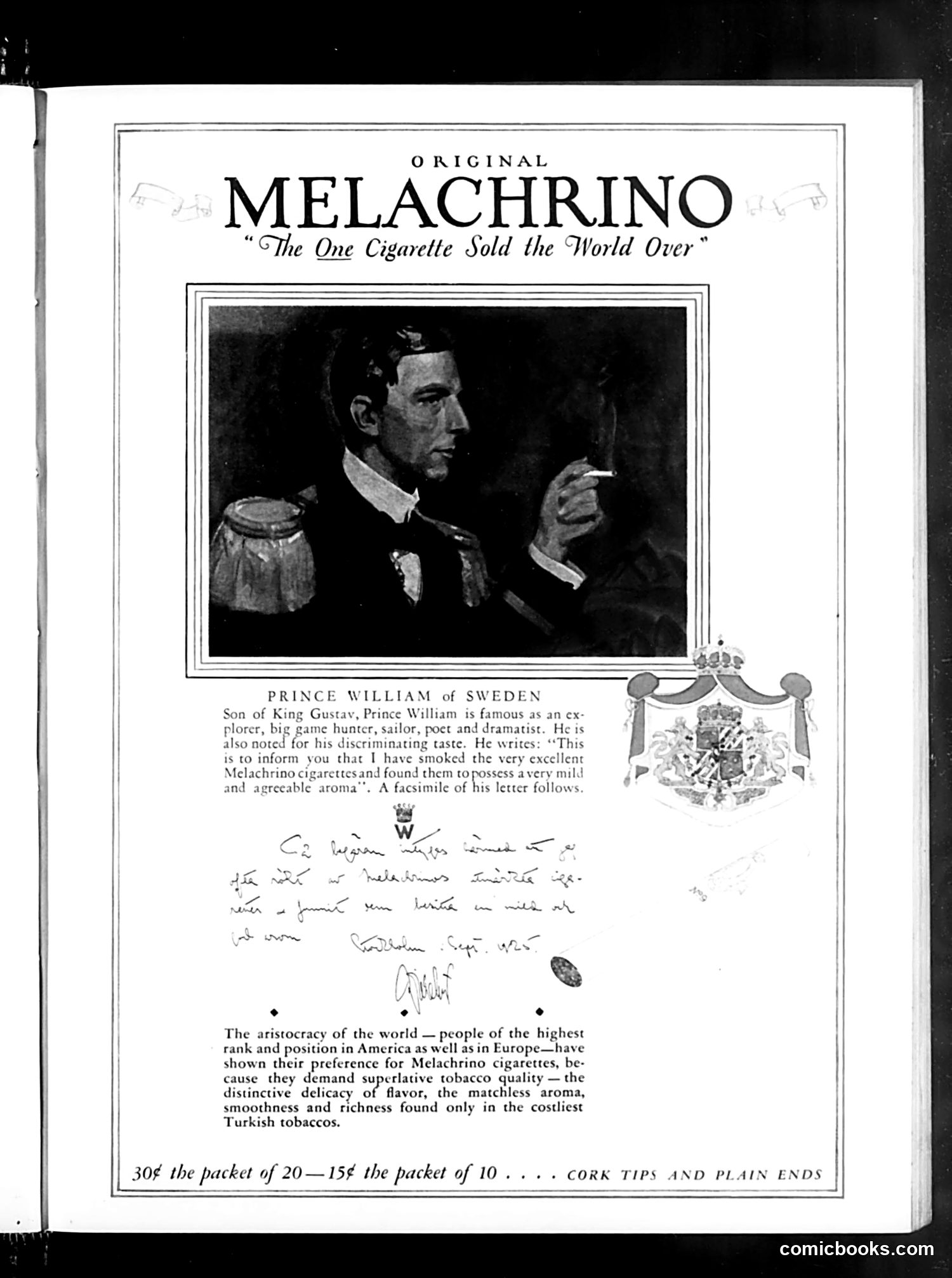
This is a **cigarette advertisement**, not satire. It promotes Melachrino cigarettes by endorsing them through Prince William of Sweden, son of King Gustav. The ad uses his portrait and reproduces what appears to be his handwritten letter praising the cigarettes' "mild and agreeable aroma." The marketing strategy targets affluent consumers by emphasizing that "the aristocracy of the world" prefer Melachrino because of superior Turkish tobacco quality. This was a common advertising tactic of the era—associating products with high-status figures and wealthy elites to suggest luxury and refinement. The pricing ($0.30 for 20 cigarettes, $0.15 for 10) and prominent display of "cork tips and plain ends" indicate product variants marketed to upscale consumers. No satirical commentary is present; this is straightforward luxury-goods advertising exploiting aristocratic endorsement.
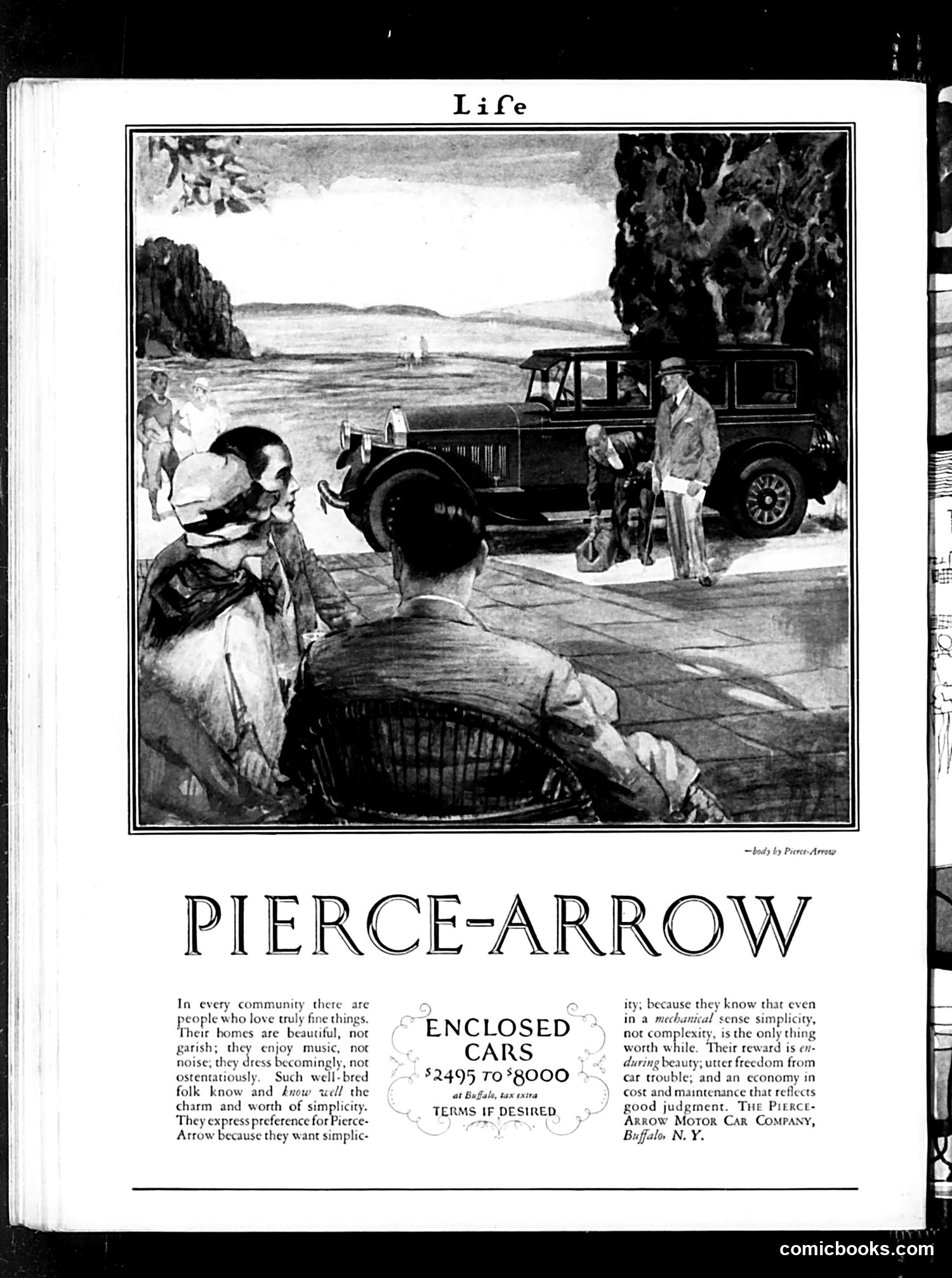
This is primarily an **automobile advertisement**, not satire. The illustration depicts an idealized leisure scene—well-dressed people relaxing by the shore near a Pierce-Arrow enclosed car—to market the vehicle as a luxury good for the refined and tasteful. The advertisement's messaging targets wealthy consumers by conflating car ownership with social class and good taste. It argues that truly cultivated people ("well-bred folk") prefer Pierce-Arrow because it embodies "simplicity" and avoids "ostentation"—a paradoxical pitch, since the car itself ($2,495–$8,000 in the 1920s) was an expensive luxury item. The satire is **unintentional**: the ad reveals how manufacturers marketed exclusivity to the aspirational wealthy by associating their products with refined aesthetics and restraint, when the fundamental message is actually about conspicuous consumption.