
Life, 1927-09-01 · page 18 of 40
Life — September 1, 1927 — page 18: what you’re looking at
What you’re looking at
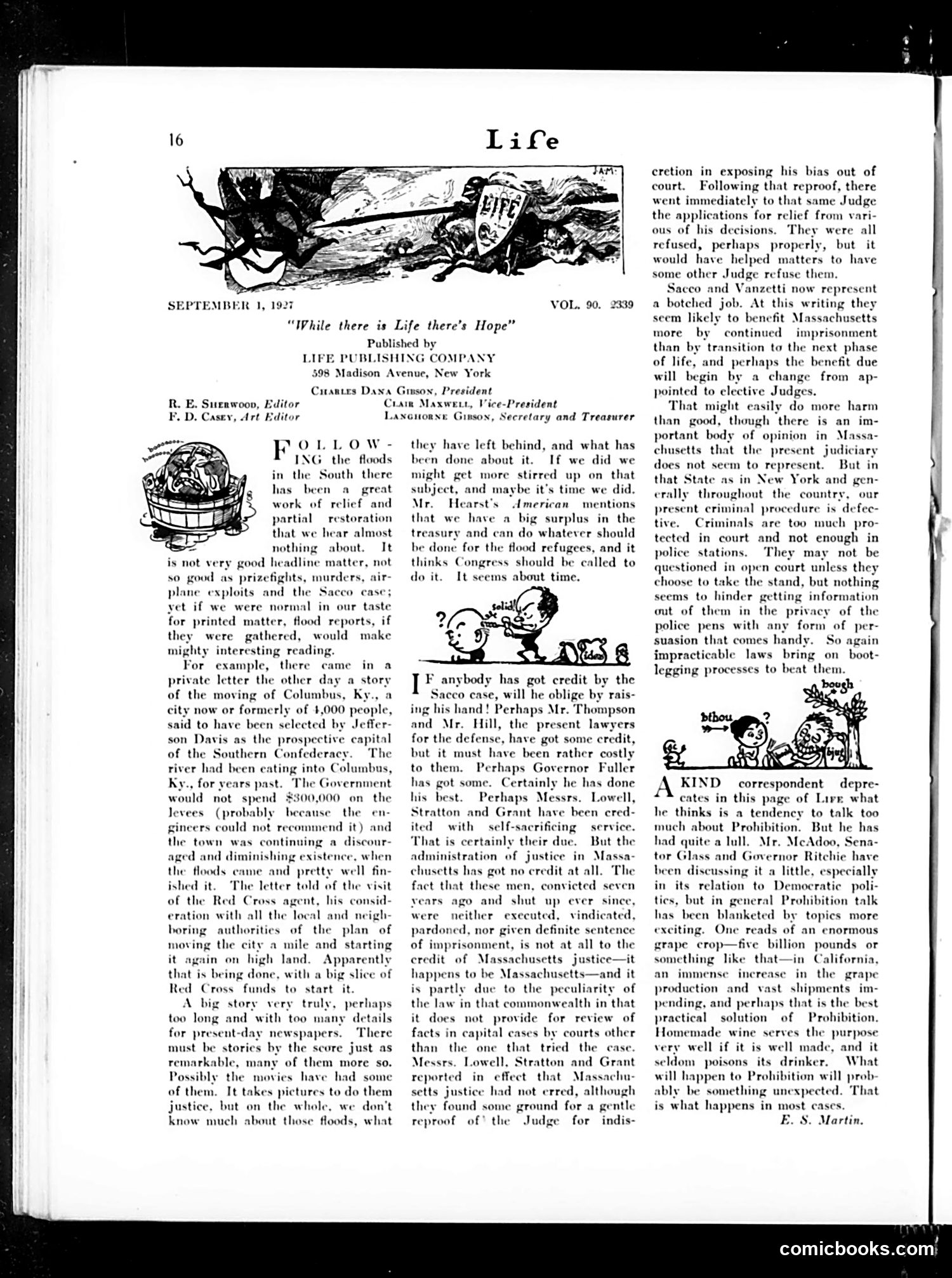
This page contains editorial commentary on contemporary legal and political issues, primarily the **Sacco and Vanzetti case**—referenced explicitly in the text. The article discusses Massachusetts justice, judicial bias, and criminal procedure. The cartoons appear to satirize **Prohibition enforcement** and related legal corruption. One cartoon shows what appears to be police or enforcement officials engaged in questionable activities, mocking how Prohibition laws were being applied and exploited. The main text criticizes Massachusetts judges for apparent bias, discusses concerns about proper legal procedure in capital cases, and suggests that the state's criminal justice system may be flawed. The author (E. S. Martin) concludes that Prohibition's implementation will likely fail without proper enforcement of honest laws.
📄 Transcribed text from this page (OCR, searchable)
Machine-transcribed from the original scan — historical spelling and the odd misread are preserved.
SEPTEMI VOL, 90. 2339 “While there is Life there’s Hope” Published by LIFE PUBLISHING COMPANY 598 Madison Avenue, New York Cuantes Dana Ginson, President R. E. Surawoon, Editor F. D. Casey, Art Editor JOLLOW- ING the floods in the South there has been a great work of relief and partial restoration that we hear almost nothing about. It dline matter, not so good as prizefights, murders, air- is not very good h plane exploits and the Sacco case; yet if we were normal in our taste for printed matter, flood reports, if they were gathered, would make mighty interesting reading. For example, there came in a private letter the other day a story of the moving of Columbus, Ky city now or formerly of 4,000 peop! said to have been selected by Jeffe: son Davis as the prospective capital of the Southern Confederacy. The river had been eating into Columbus, Ky., for years past. The Government would not spend $300,000 on the (probably because the en- gineers could not recommend it) and levees the town was continuing a discour- aged and diminishing existence, when the floods eame and pretty well fin- ished it. The letter told of the visit of the Red Cross agent, his consid- eration with all the local and neigh- boring authorities of the plan of moving the city a mile and starting it again on high land. Apparently that is being done, with a big slice of Red Cross funds to start. it. A big story very truly, perhaps too long and with too many details for presented There must be stories by the score just as remarkable, many of them more so. Possibly the movies have had some of them. It takes pictures to do them justice, but on the whole, we don't know much about those floods, what newspapers. Cram Maxwent, Vice-President Laxouonxr Ginsox, Secretary and Treasurer they have left behind, and what has been done about it. If we did we might get more stirred up on that subject, and maybe it's time we did. Mr. Hearst's American mentions that we have a big surplus in the treasury and can do whatever should be done for the flood refugees, and it thinks Congress should be called to do it. It seems about time. [ F anybody has got credit t Sacco case, will he oblige by rais- ing his hand! Perhaps Mr. Thompson and Mr. Hill, the present lawyers for the defense, have got some credit, but it must have been rather costly to them. Perhaps Governor Fuller has got some. Certainly he has done his best. Perhaps Messrs. Lowell, Stratton and Grant have been ered- ited with self-sacrificing service. That is certainly their due. But the administration of justice in Massa- chusetts has got no credit at all. The fact that these men, convicted seven years ago and shut up ever since, were neither executed, vindicated, pardoned, nor given definite sentence of imprisonment, is not at all to the credit of Massachusetts justice—it happens to be Massachusetts—and it is partly due to the peculiarity of the law in that commonwealth in that it does not provide for review of facts in capital cases by courts other that tried the case. Messrs. Lowell, Stratton and Grant reported in effect that) Massachu- setts justice had not erred, although they found some ground for a gentle reproof of’ the Judge for indis- the one cretion in exposing his bias out of court. Following that reproof, there went immediately to that same Judge the applications for relief from vari- ous of his decisions. They were all refused, perhaps properly, but it would have helped matters to have some other Judge refuse them, Sacco and Vanzetti now represent a botched job. At this writing they seem likely to benefit Massachusetts more by continued imprisonment than by transition to the next phase of life, and perhaps the benefit due will begin by a change from ap- pointed to elective Judges. That might easily do more harm than good, though there is an im- portant body of opinion in Massa- chusetts that the present judiciary does not seem to represent. But in that State as in New York and gen- erally throughout the country, our present criminal procedure is defe tive. Criminals are too much pro- tected in court and not enough in police stations. They may not be questioned in open court unless they choose to take the stand, but nothing seems to hinder getting information aut of them in the privacy of the police pens with any form of per- suasion that comes handy. So again impracticable laws bring on boot- legging processes to beat them. correspondent depre- KIND cates in this page of Lire. what he thinks is a tendency to talk too much about Prohibition. But he has had quite a lull, Mr. McAdoo, Sena- tor Glass and Governor Ritchie have been discussing it a little, especially in its relation to Democratic poli- ties, but in general Prohibition talk has been blanketed by topics more exciting. One reads of an enormous grape crop—five billion pounds or something like th California, an immense increase in the grape production and vast shipments im- pending, and perhaps that is the best practical solution of Prohibition. Homemade wine serves the purpose very well if it is well made, and it seldom poisons its drinker. What will happen to Prohibition will prob: ably be something unexpected. That is what happens in 1 pst cases. y. Martin. comicbooks.com!