
Life, 1927-09-01 · page 23 of 40
Life — September 1, 1927 — page 23: what you’re looking at
What you’re looking at
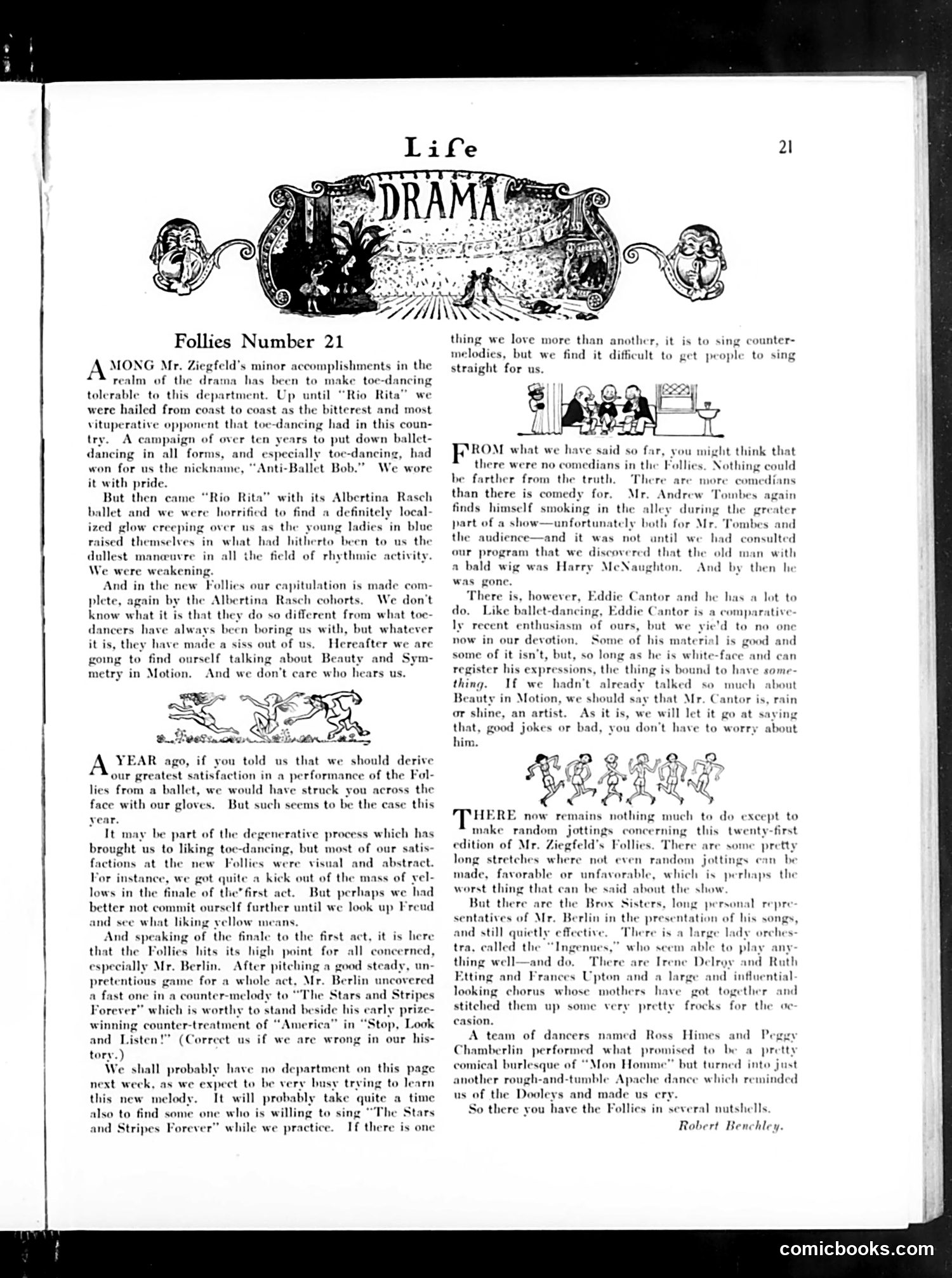
This is a theater review of Florenz Ziegfeld's *Follies* (a famous revue series), specifically praising the choreography of Albertina Rasch's ballet dancers. The author, "Anti-Ballet Bob" (Robert Benchley, Life's drama critic), humorously recounts his conversion from a vocal opponent of toe-dancing to an admirer after seeing Rasch's work in the "Rio Rita" production. The satire's point: Benchley had spent a decade dismissing ballet as boring, but found himself aesthetically moved by the "Beauty and Symmetry in Motion" Rasch created—a humbling reversal he treats with self-deprecating comedy. He also reviews comedians like Eddie Cantor and Andrew Tombes, noting mixed material quality but praising Cantor's expressive talent. The cartoon illustrations appear to show dancers in motion, supporting the text's focus on movement and performance.
📄 Transcribed text from this page (OCR, searchable)
Machine-transcribed from the original scan — historical spelling and the odd misread are preserved.
Follies Number 21 MONG Mr. Ziegfeld’s minor accomplishments in the realm of the drama has been to make toe-dancing tolerable to this department. Up until “Rio Rita” we were hailed from coast to coast as the bitterest and most vituperative opponent that toe-dancing had in this coun- try. A campaign of over ten years to put down ballet- dancing in all forms, and especially toc-dancing, had won for us the nickname, “Anti-Ballet Bob.” We wore it with pride. But then came “Rio Rita” with its Albertina Rasch ballet and we were horrified to find a definitely local- ized glow creeping over us as the young ladies in blue raised themselves in what had hitherto been to us the dullest maneuvre in all the field of rhythmic activity. We were weakening. And in the new Follies our capitulation is made com: plete, again by the Albertina Rasch cohorts. We don't know what it is that they do so different from what toe- dancers have always becn boring us with, but whatever it is, they have made a siss out of us. Hereafter we are going to find ourself talking about Beauty and Sym- metry in Motion. And we don't care who hears us. A YEAR ago, if you told us that we should derive our greatest satisfaction in a performance of the Fol- lies from a ballet, we would have struck you across the face with our gloves. But such seems to be the case this ar. It may be part of the degenerative process which has brought us to liking toe-dancing, but most of our satis- factions at the new Follies were visual and abstract. For instance, we got quite a kick out of the mass of yel- lows in the finale of the’ first act. But perhaps we had better not commit ourself further until we look up Freud and see what liking yellow means. And speaking of the finale to the first act, it is here that the Follies hits its high point for all concerned, especially Mr. Berlin. After pitching a good steady, un- pretent us game for a whole act, Mr. Berlin uncovered ' in a counter-melody to “TT nd Stripes * which is worthy to stand be: rly prize- inning counter-treatment of “America” in “Stop, Look and Listen!” (Correct us if we are wrong in our his- tory.) We shall prob: next week, as we € y have no department on this page pect to be very busy trying to learn this new melody. It will probably take quite a time also to find some one who is willing to sing *' Stars and Stripes Forever” while we practice. If there is one thing we love more than another, it is to sing counter- melodies, but we find it difficult to get people to sing straight for us. QYROM what we have said so far, you might think that there were no comedians in the Follies. Nothing could be farther from the truth. There are more comedians than there is comedy for. Mr. Andrew Tombes again finds himself smoking in the alley during the greater part of a show—unfortunately both for Mr. Tombes and the audience—and it was antil we had consulted our program that we discovered that the old man with a bald wig was Harry McNaughton. And by then he was gone. , There is, however, Eddie Cantor and he has a lot to do. Like ballet-dancing, Eddie Cantor is a comparative ly recent enthusiasm of ours, but we yie'd to no one now in our devotion, Some of his material is good and some of it isn’t, but, so long as he is white-face und can register his expressions, the thing is bound to have some- thing. If we hadn't already talked so much about Beauty in Motion, we should say that Mr. Cantor is, rain or shine, an artist. As it is, we will let it go saying that, good jokes or bad, you don't have to worry about him. i a TH 2RE now remains walking much to do except to ake random jottings concerning this twenty-first edition of Mr. Ziegfeld’s Follies. There are some pretty long stretches where not even nm jottir made, favorable or unfavorable, which is perhaps the worst thing that can be said about the show But there are the Brox Sisters, long personal repre nit wr gs can be sentatives of Mr. Berlin in the presentation of his songs, and still quietly effective tra, called the “Ingenues,” who seem able to play any thing well—and do, re are Trene Delroy and Ruth Etting and Frances Upton and a large and influential looking chorus whose mothers have got together and stitched them up some very pretty frocks for the oc casion. A team of dancers named Ross Himes and Peggy Chamberlin performed what promised to be a pretty comical burlesque of “Mon Homme” ere is a large lady orches: but turned into just another rough-and-tumble Apache dance which reminded us of the Dooleys and made us cry. So there you have the Follies in several nutshells Robert Benchley. comicbooks.com