
A complete issue · 36 pages · 1927
Life — August 11, 1927
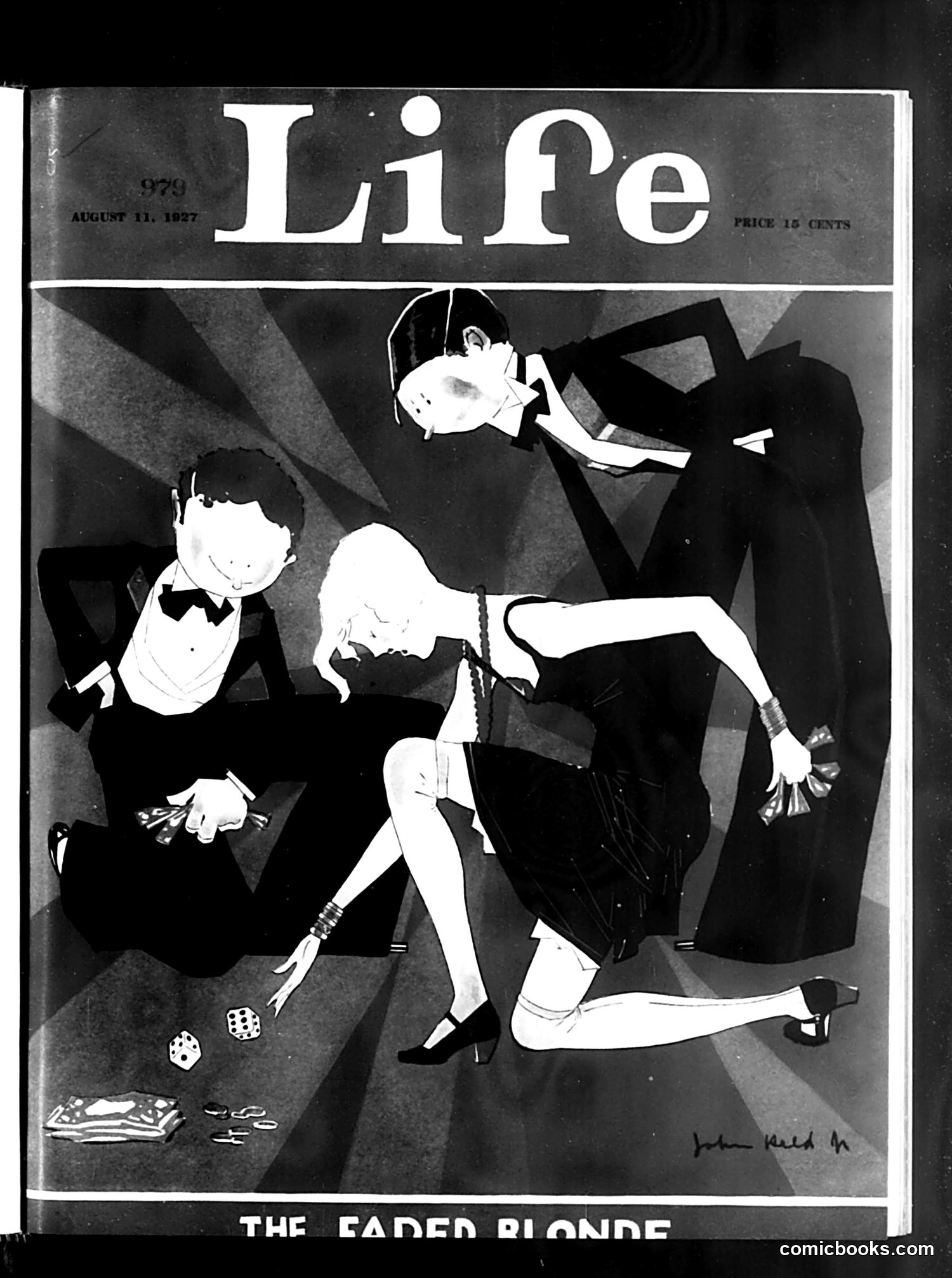
This cover illustration, titled "The Faded Blonde," depicts a 1920s social scene satirizing the Jazz Age. Three stylized figures in formal attire engage in gambling—dice and cards visible on the floor—suggesting wealth, vice, and decadence. The central female figure in a short black dress with prominent legs embodies the "flapper" stereotype: modern, liberated, but also associated with moral decline in conservative eyes. The satire likely targets the perceived frivolity and moral corruption of 1920s high society, particularly wealthy women abandoning traditional roles. The "faded" descriptor suggests commentary on aging within this scene of excess. This reflects broader 1920s anxieties about changing social values, women's independence, and Jazz Age culture that conservative Americans viewed with suspicion.
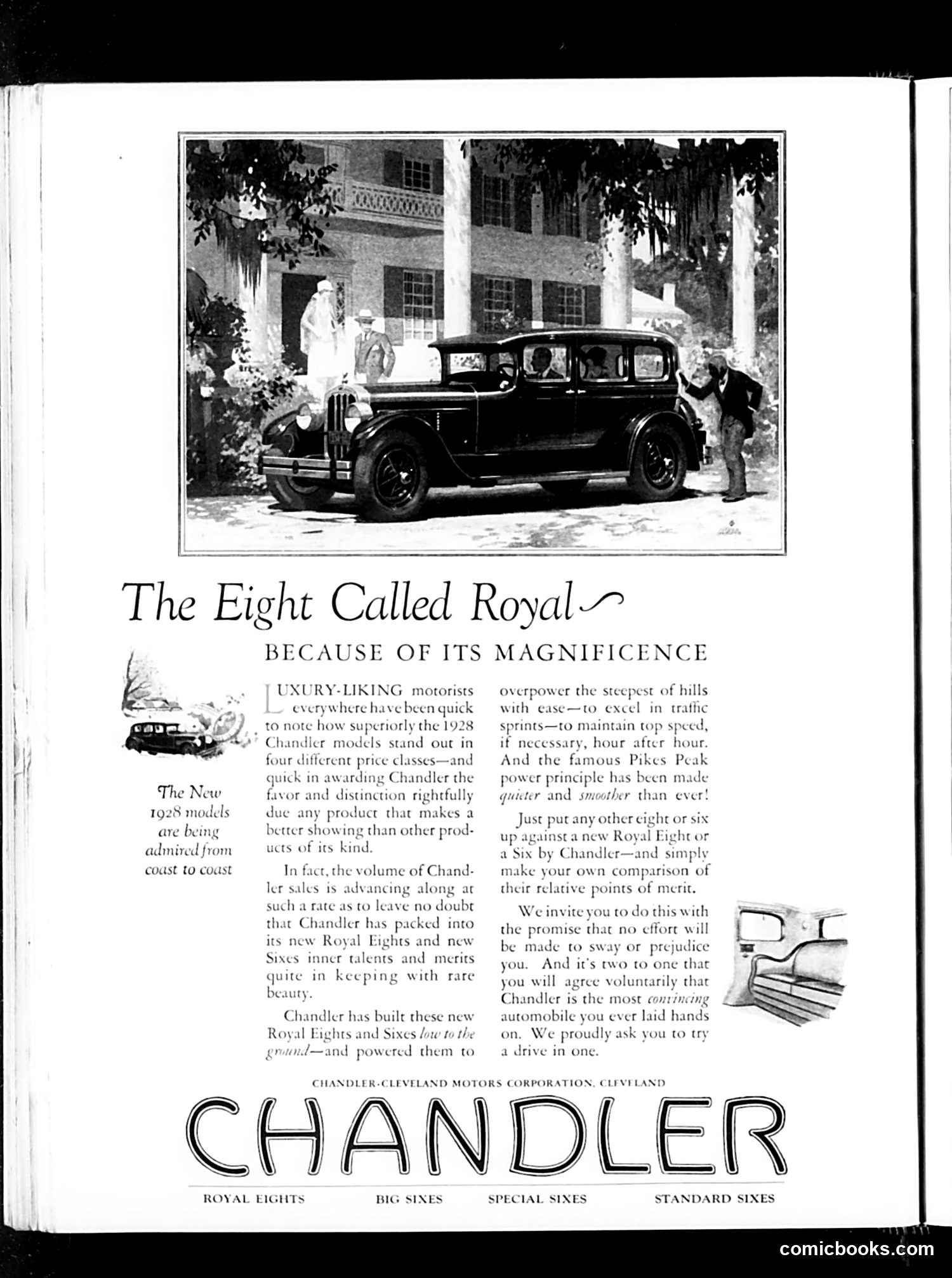
This page is **primarily a Chandler automobile advertisement**, not political satire. It promotes the 1928 Chandler "Royal" and "Eight" models. The image shows a luxury car parked before an elegant mansion with well-dressed figures, establishing the vehicle's upscale market positioning. The advertisement emphasizes the car's superiority across multiple price points and performance metrics (hill-climbing ability, traffic speed maintenance). The text invites direct comparison with competing "eight or six" cylinder vehicles—likely referencing rival manufacturers like Packard. References to the "Pikes Peak power principle" suggest engineering credibility. There is **no political cartoon or satire present**. This is straightforward 1920s automotive marketing aimed at luxury consumers, typical of Life magazine's commercial content during this era.
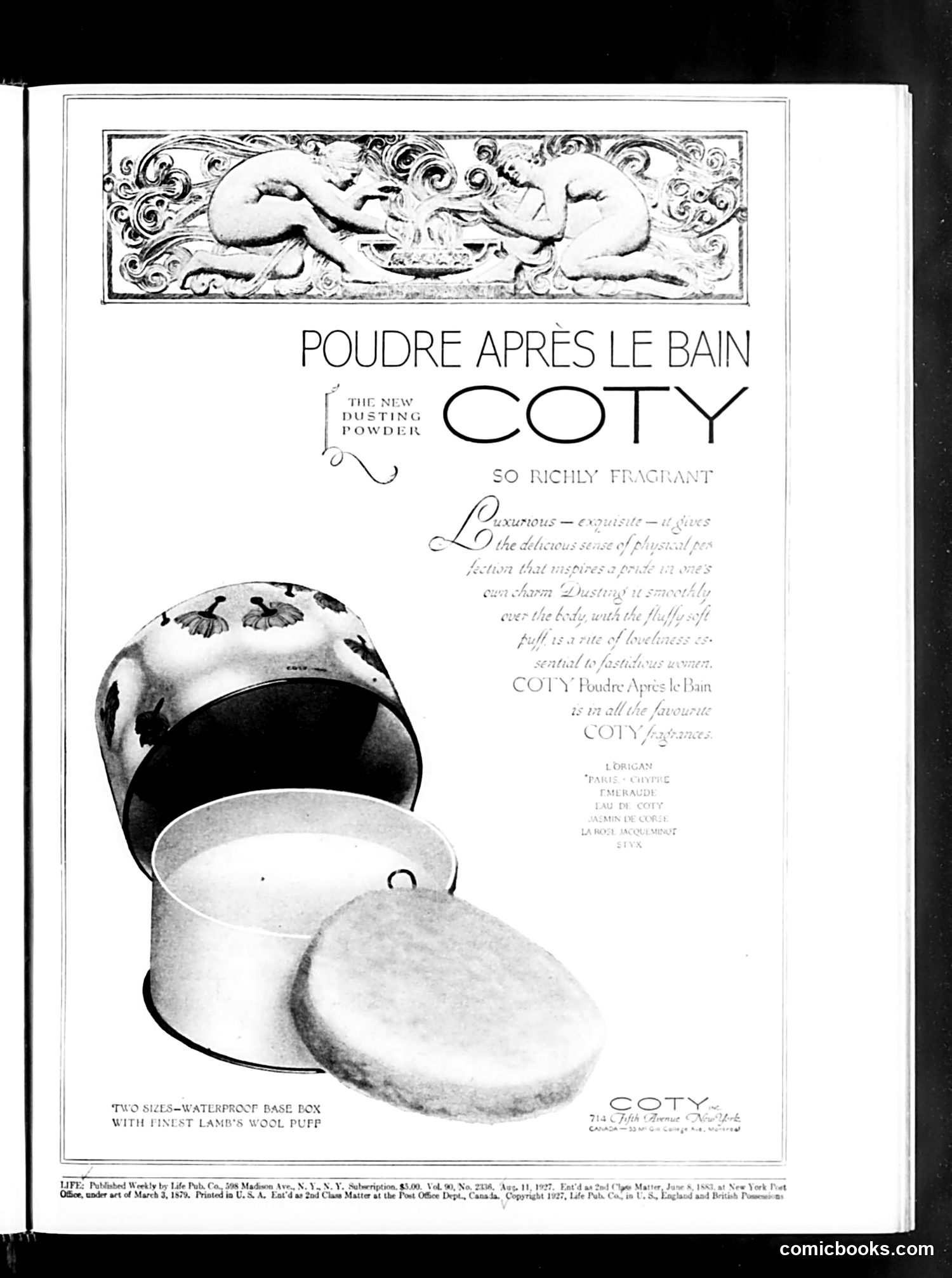
This page is **not a political cartoon** — it's a **cosmetics advertisement** for Coty brand dusting powder. The decorative element at the top shows cherubs in an ornamental classical style, purely decorative. The main content advertises "Poudre Après le Bain" (powder after the bath), presenting the product in an ornate container with a lamb's wool puff. The ad emphasizes luxury and fragrance, listing several Coty perfume names (L'Origan, Paris, Chypre, Émeraude, etc.). The page is from Life magazine's August 11, 1927 issue but contains no satire or political commentary — it's a straightforward period advertisement targeting women consumers with promises of elegance and sensuality.
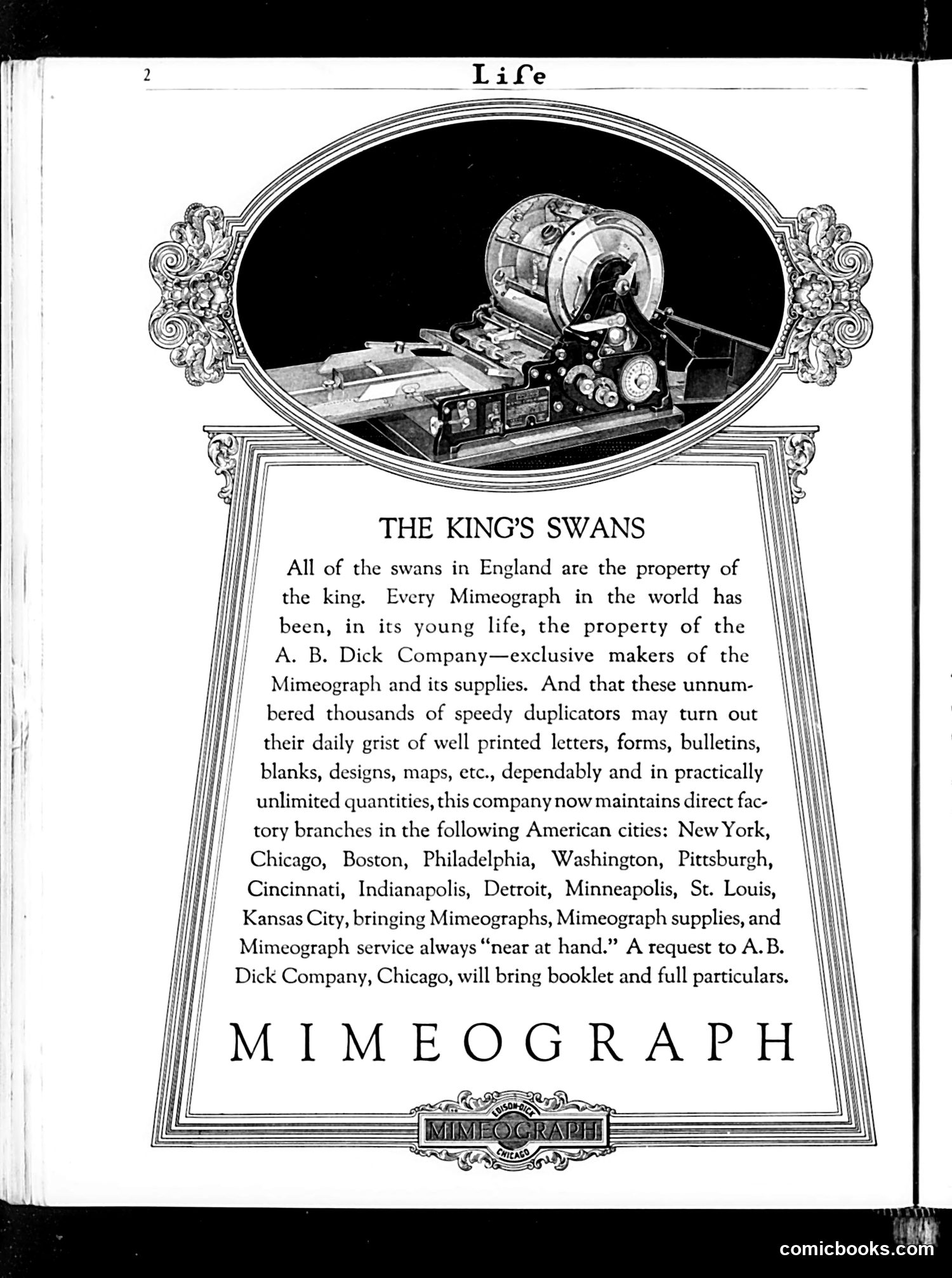
This page is primarily **advertising**, not editorial content or satire. The A.B. Dick Company's advertisement for the Mimeograph machine uses the clever headline "THE KING'S SWANS" as a marketing hook. The joke plays on the British legal principle that all unmarked swans in English waters belong to the crown. Similarly, the ad claims that "every Mimeograph in the world has been, in its young life, the property of the A.B. Dick Company"—meaning they manufactured all machines before distribution. The image shows the Mimeograph device itself. The advertisement emphasizes the machine's ability to produce unlimited quantities of printed materials and lists A.B. Dick's American factory locations to promote accessibility and service. This is straightforward period advertising using a witty analogy rather than political satire.
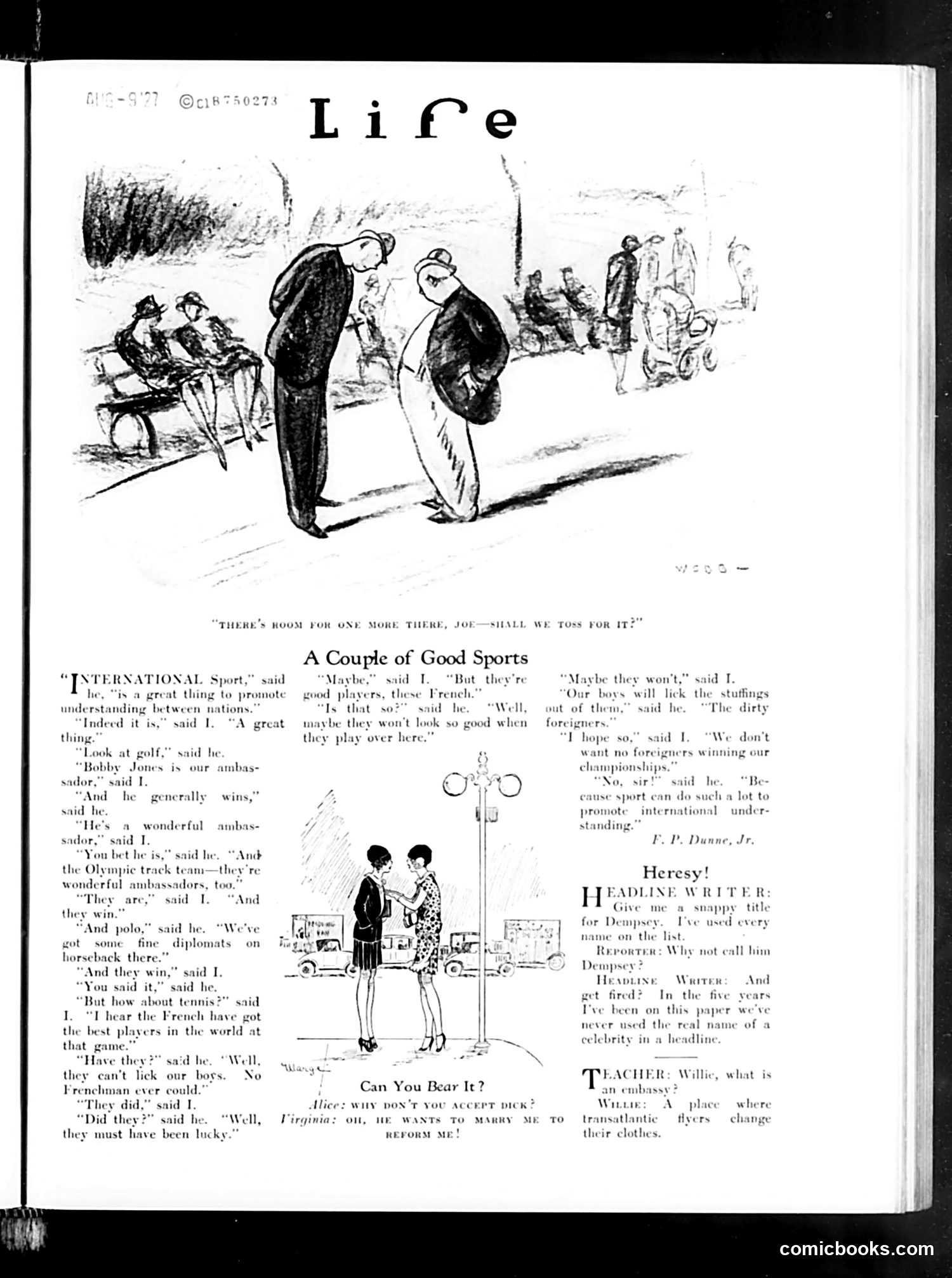
This satirical piece mocks international sports diplomacy. Two men discuss whether to invite French players to compete, debating whether the French are "good sports" and can handle losing to Americans. The dialogue reveals contemporary American attitudes: pride in athletic superiority, skepticism about French sportsmanship, and the notion that sports should promote "international understanding." The humor targets American condescension toward France and the naive assumption that athletic competition builds goodwill between nations. References to "Bobby Jones" (likely the golfer) and mentions of polo, horseback riding, and the Olympic track team suggest this addresses early 20th-century elite amateur sports culture. The lower cartoon "Can You Bear It?" appears to be a separate joke about romantic misunderstandings.
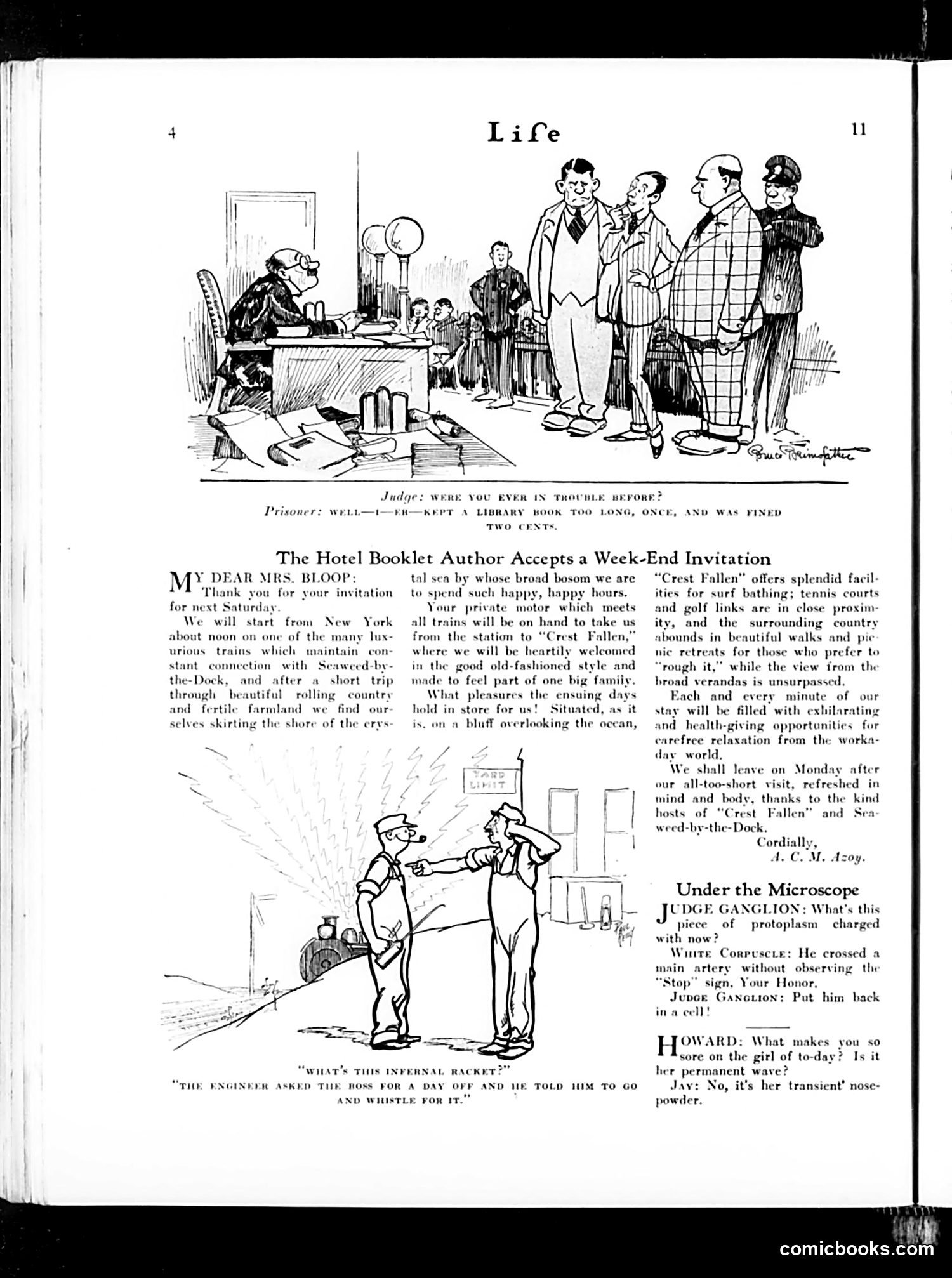
**Top Cartoon (Court Scene):** A judge questions a prisoner about previous troubles. The prisoner's response—that he "kept a library book too long, once, and was fined two cents"—is the joke's punchline. This satirizes either overly harsh judicial systems or absurdly minor offenses being treated seriously in court. The humor lies in the contrast between typical criminal charges and this trivial library fine. **Bottom Cartoon (Two Men):** An engineer asks his boss for a day off, and the boss responds he should "go out and it whistle for it"—meaning the engineer must essentially demand or earn the time off through assertiveness. This satirizes workplace power dynamics and the difficulty workers faced obtaining leisure time. **Other Content:** A humorous invitation acceptance regarding a weekend hotel stay appears to be filler material.
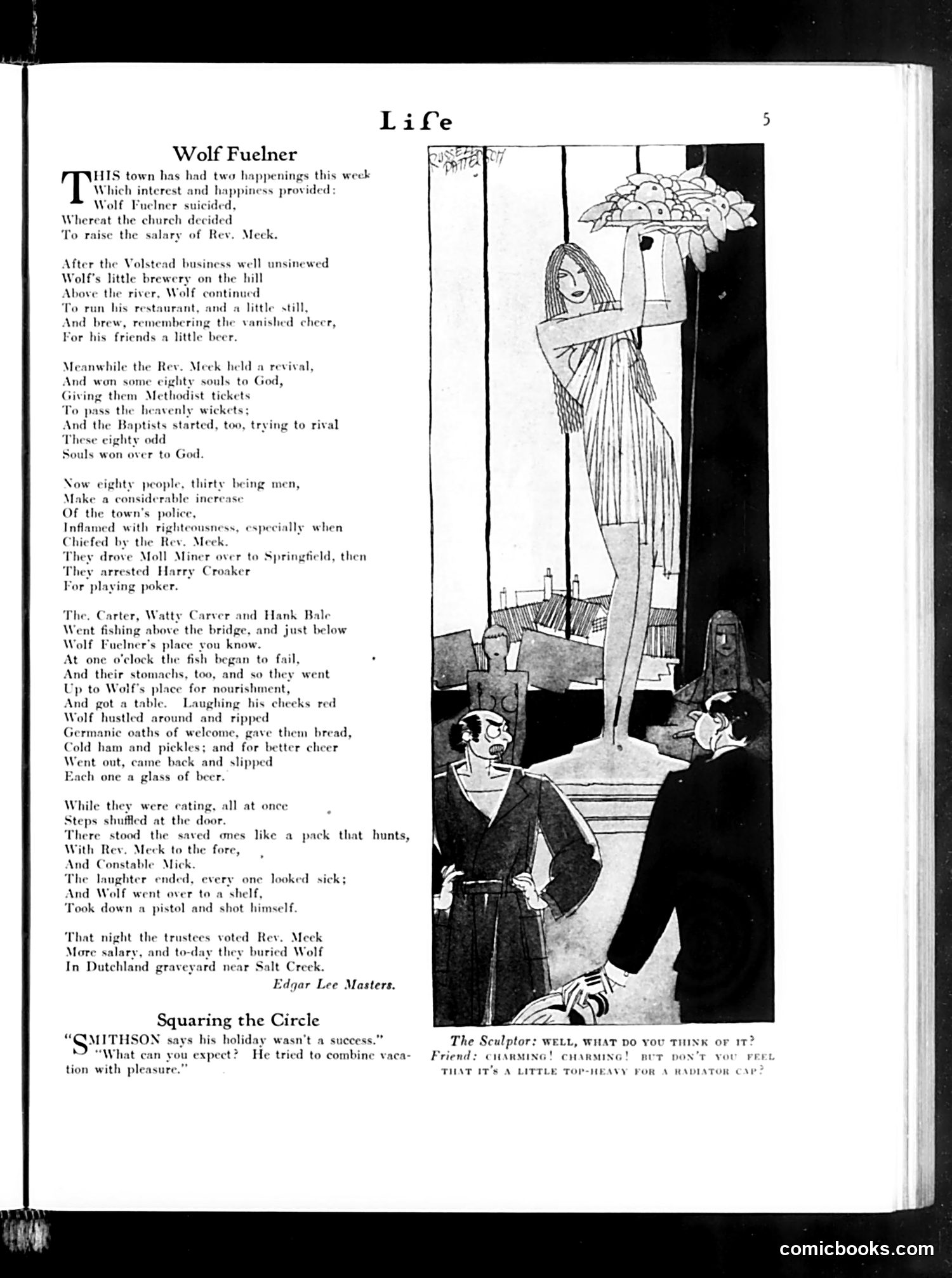
The main poem by Edgar Lee Masters satirizes a small-town scandal involving Wolf Fuelner, who ran a brewery and restaurant. The narrative describes two competing local events: Rev. Meck's religious revival (which converts souls) and increased police activity against gambling and vice—apparently spearheaded by the reverend. The story culminates darkly when armed men arrive at Fuelner's establishment, leading to his suicide. The accompanying illustration shows the chaos of that final scene—the woman with the umbrella and the confrontation below. The bottom "Squaring the Circle" section is a brief satirical exchange mocking someone named Smithson's failed vacation attempt. The page reflects early 20th-century small-town hypocrisy: religious fervor paired with moral policing leading to tragic consequences.
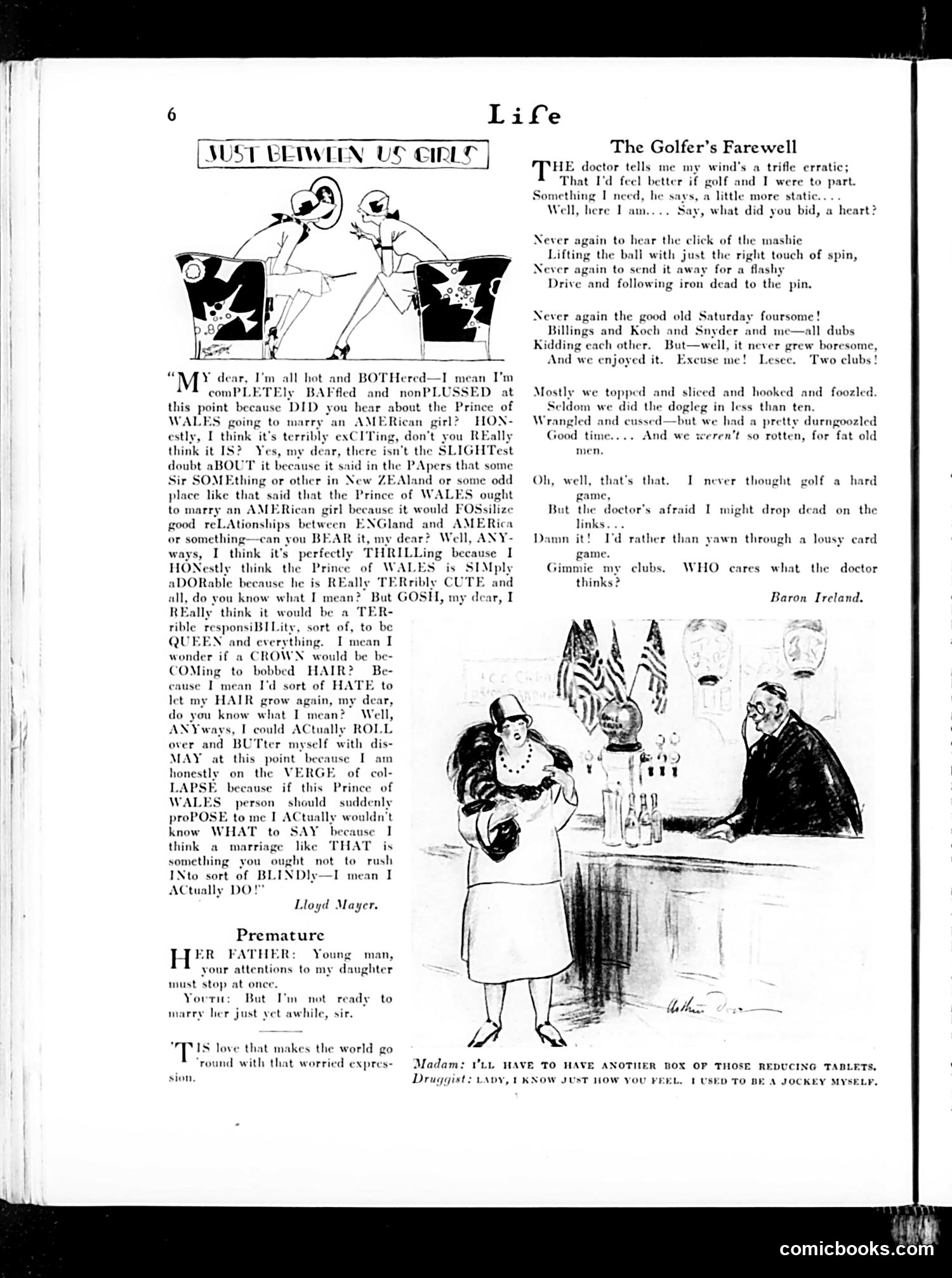
This page contains three humorous pieces satirizing contemporary social issues: 1. **"Just Between Us Girls"** (top): A woman vents frustrations about the Prince of Wales marrying an American girl, using exaggerated capitalization to mock society gossip and anxious propriety. The satire targets upper-class concerns about royal protocol and transatlantic marriages. 2. **"The Golfer's Farewell"** (right): A poem by Baron Ireland mocking golf obsession, where a dying man regrets wasting life on the sport rather than meaningful pursuits. It satirizes the absurdity of prioritizing golf over family and health. 3. **"Premature"** (bottom): A brief dialogue where a father forbids his daughter's engagement, countered by wisdom about love's urgency. This gently satirizes parental overprotectiveness versus youthful romantic impulses. The cartoon illustration shows a doctor advising a patient, likely connected to "The Golfer's Farewell."
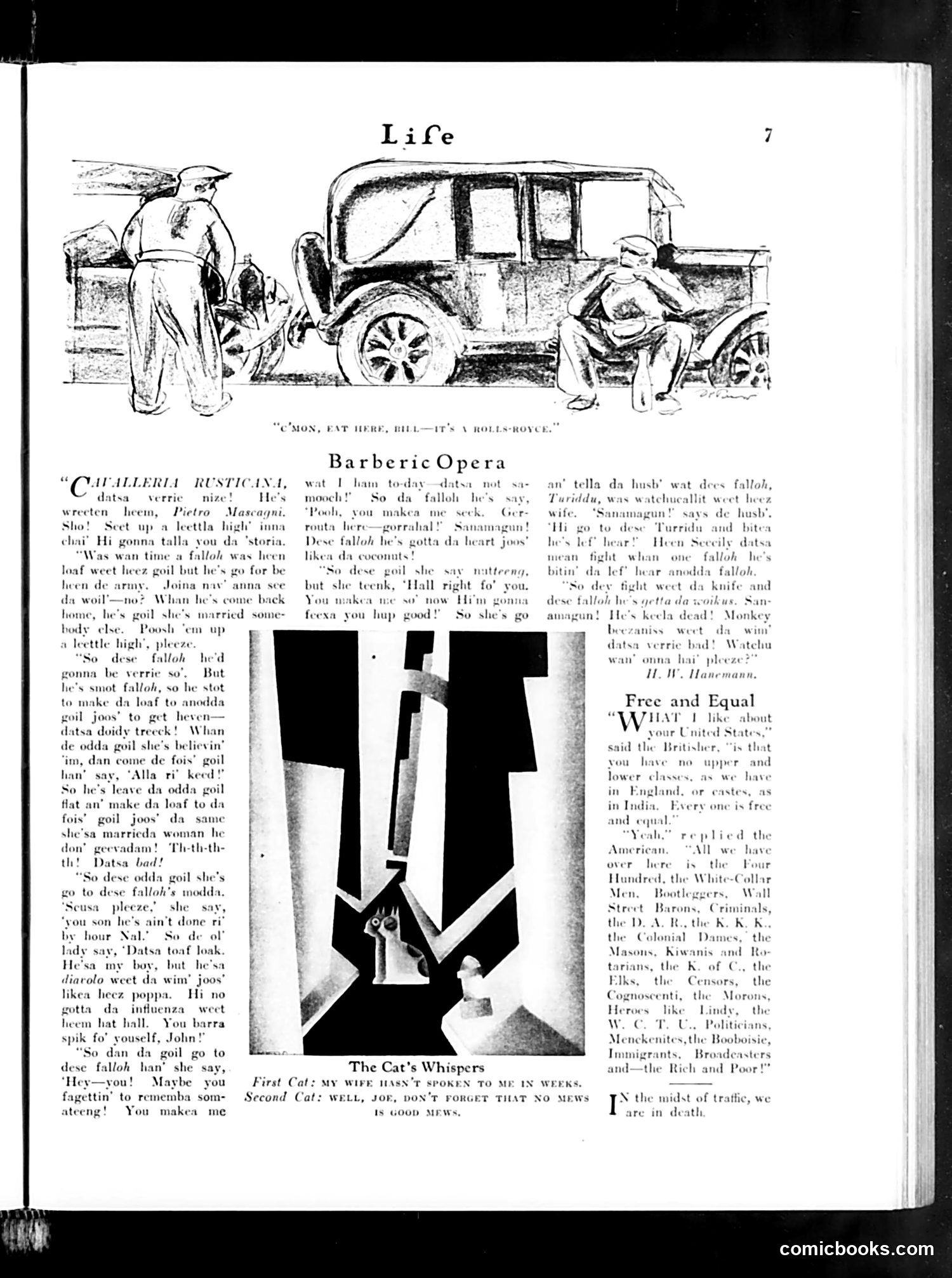
This appears to be a satirical commentary on gossip and rumor-spreading, presented as a dialogue between two cats. The cartoon uses the metaphor of cats whispering to illustrate how misinformation spreads silently and dangerously through society. The two cats' exchange—where the first cat says "My wife hasn't spoken to me in weeks" and the second responds "Well, Joe, don't forget that no news is good news"—ironically suggests that silence or lack of communication might actually be preferable to the alternative of spreading rumors. The joke targets how gossip ("whispers") operates like the cats' secretive communication: quietly, persistently, and often harmfully. It's a commentary on social behavior and the destructive nature of rumor-mongering in everyday life.
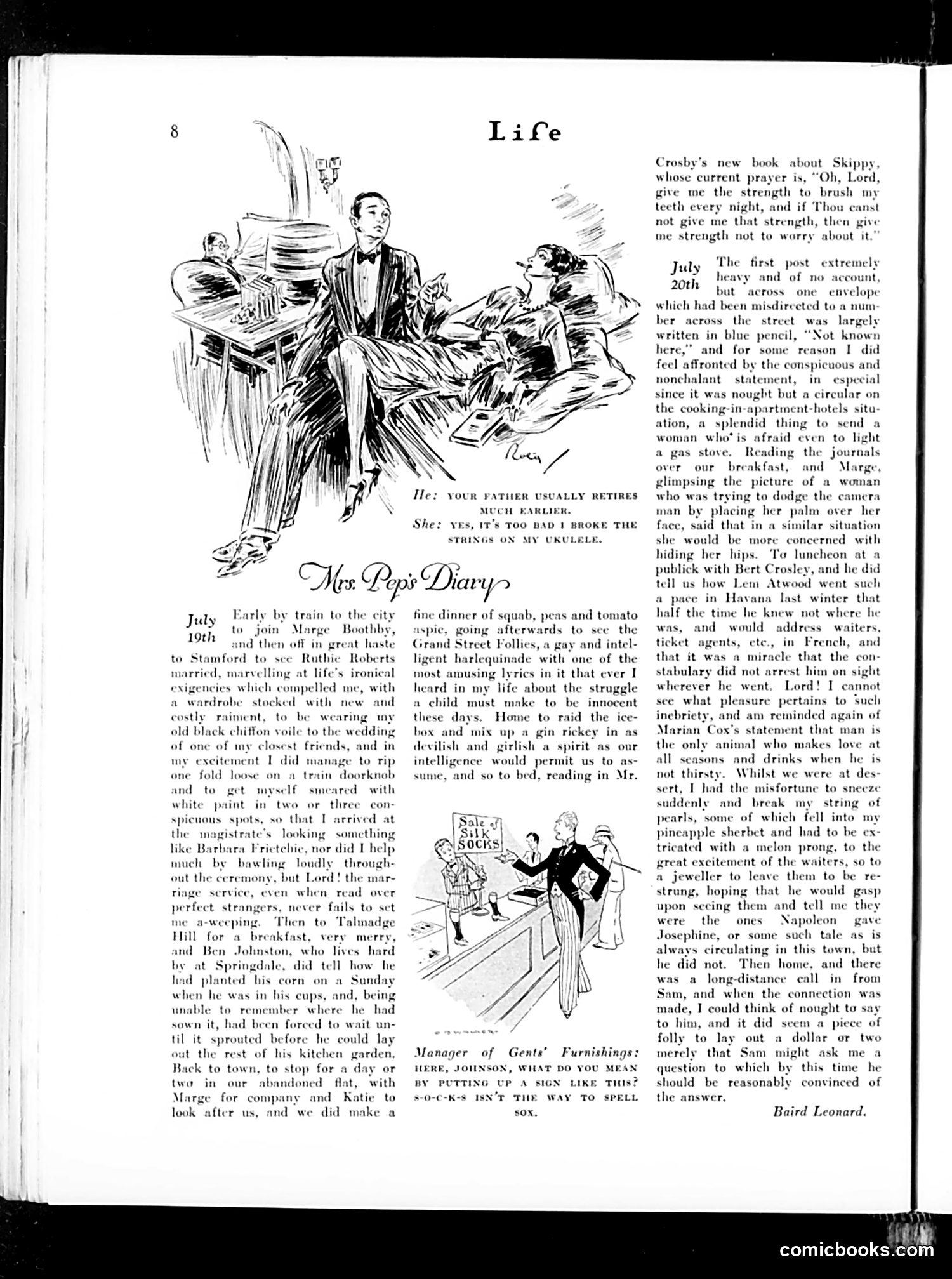
This page contains two satirical pieces: **"Mrs. Popi's Diary"** (left): A humorous account of a woman's wedding day mishaps, including a bridesmaid's wardrobe malfunction and various social embarrassments. The sketch shows her in distress with clothing issues. **"He/She" dialogue** (top center): A brief comic exchange where she complains that her father retires early, and he responds that it's because she broke the strings on his ukulele—poking fun at a daughter's supposed destructiveness. **"Manager of Gents' Furnishings"** (bottom right): A cartoon showing a store manager confused about a sign reading "SOX" instead of "SOCKS," satirizing either poor spelling or ambiguous abbreviations in retail signage. The overall tone is domestic humor typical of early-to-mid 20th century Life magazine satire, targeting everyday social situations and minor domestic frustrations.
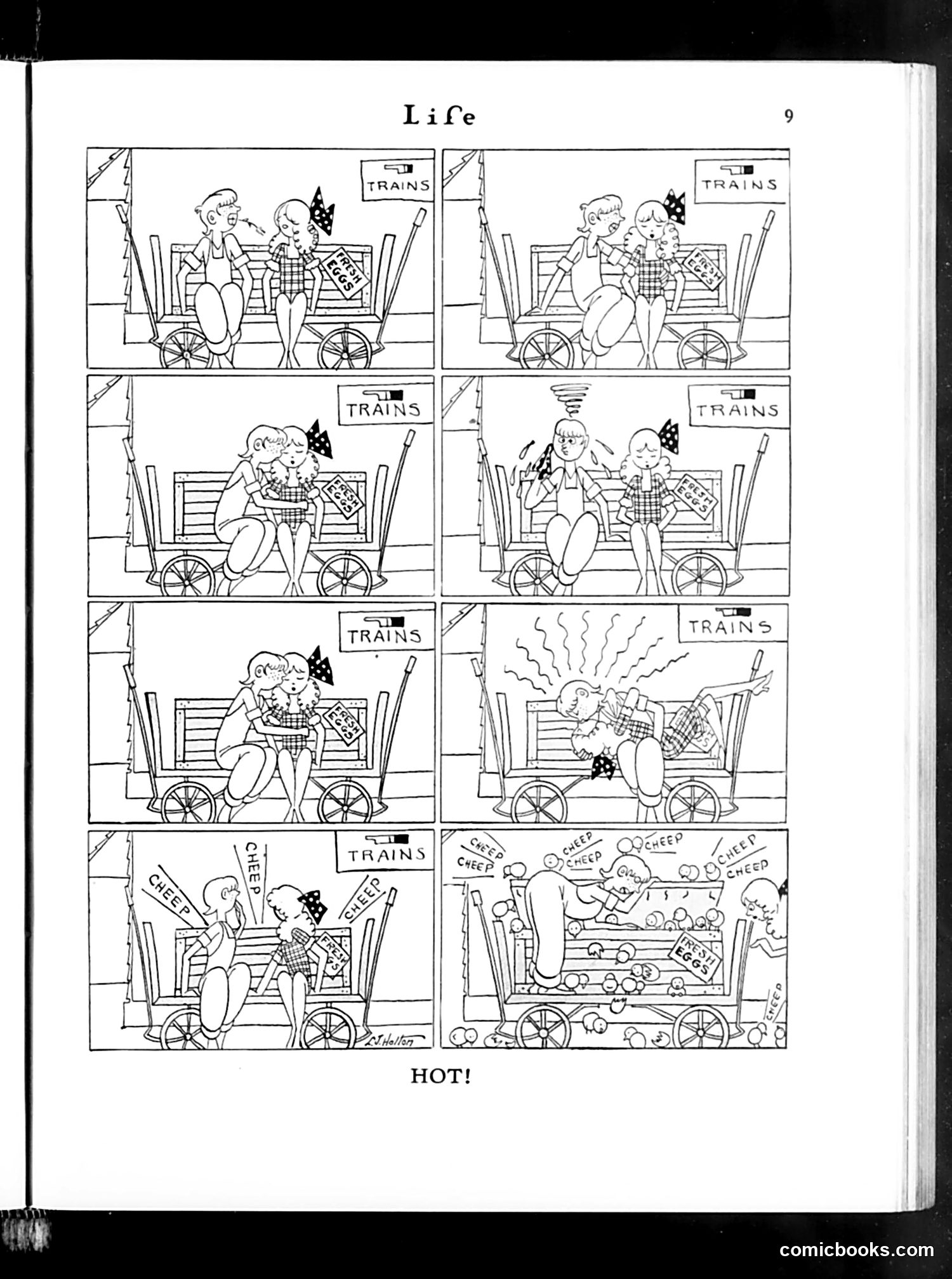
This six-panel comic depicts two women on a bench at what appears to be a train station (visible "TRAINS" sign). The narrative progresses from casual flirtation to escalating physical intimacy and public display. In early panels, one woman flirts with the other. Subsequent panels show increasing physical contact and affection ("CHEER" sounds appear). The final panel depicts them surrounded by onlookers all cheering, suggesting their romantic behavior has become a public spectacle. The satire targets social propriety and public decorum—the joke being that unchecked romantic enthusiasm spirals into shameless public conduct. The title "HOT!" emphasizes the intensifying passion. This reflects early-20th-century *Life* magazine's typical humor about courtship, romance, and the tension between social restraint and desire.
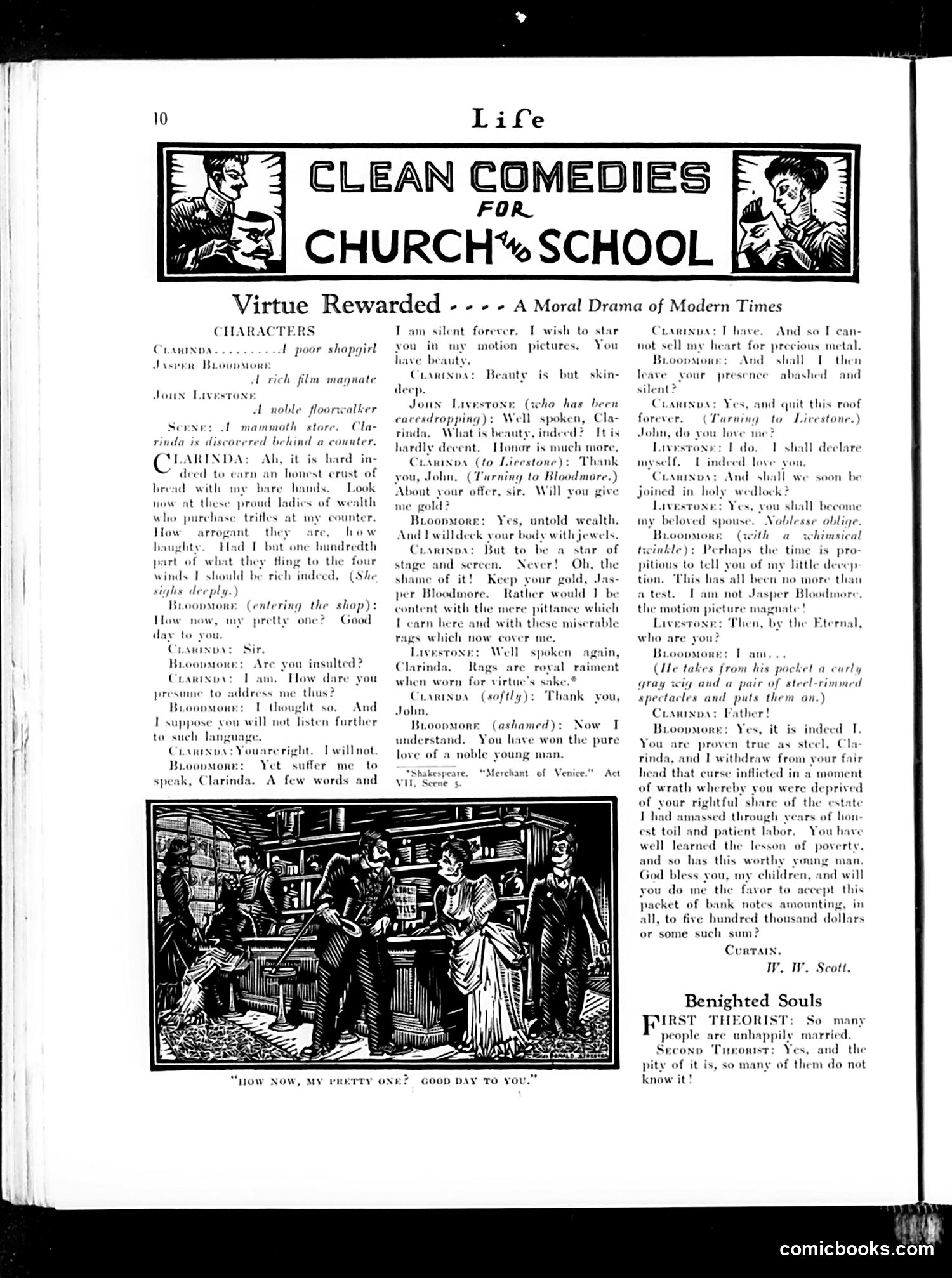
This page contains a theatrical play script titled "Virtue Rewarded — A Moral Drama of Modern Times," presented as a "Clean Comedies for Church and School" offering. The play satirizes class conflict and moral hypocrisy. Characters include Clarinda (a poor shopgirl), Jasper Bloodmore (a rich film magnate), John Limestone (a noble floorcaller), and a Store owner. The plot mocks how wealth and status supposedly determine virtue: Bloodmore offers Clarinda riches and stardom in exchange for becoming his mistress, while the poor but honest Limestone offers genuine love. The satire targets materialistic values in early cinema culture and suggests that "virtue" means resisting sexual coercion despite economic desperation. The script's inclusion in a church-endorsed comedy collection ironically highlights moral anxieties about modern entertainment and temptation.
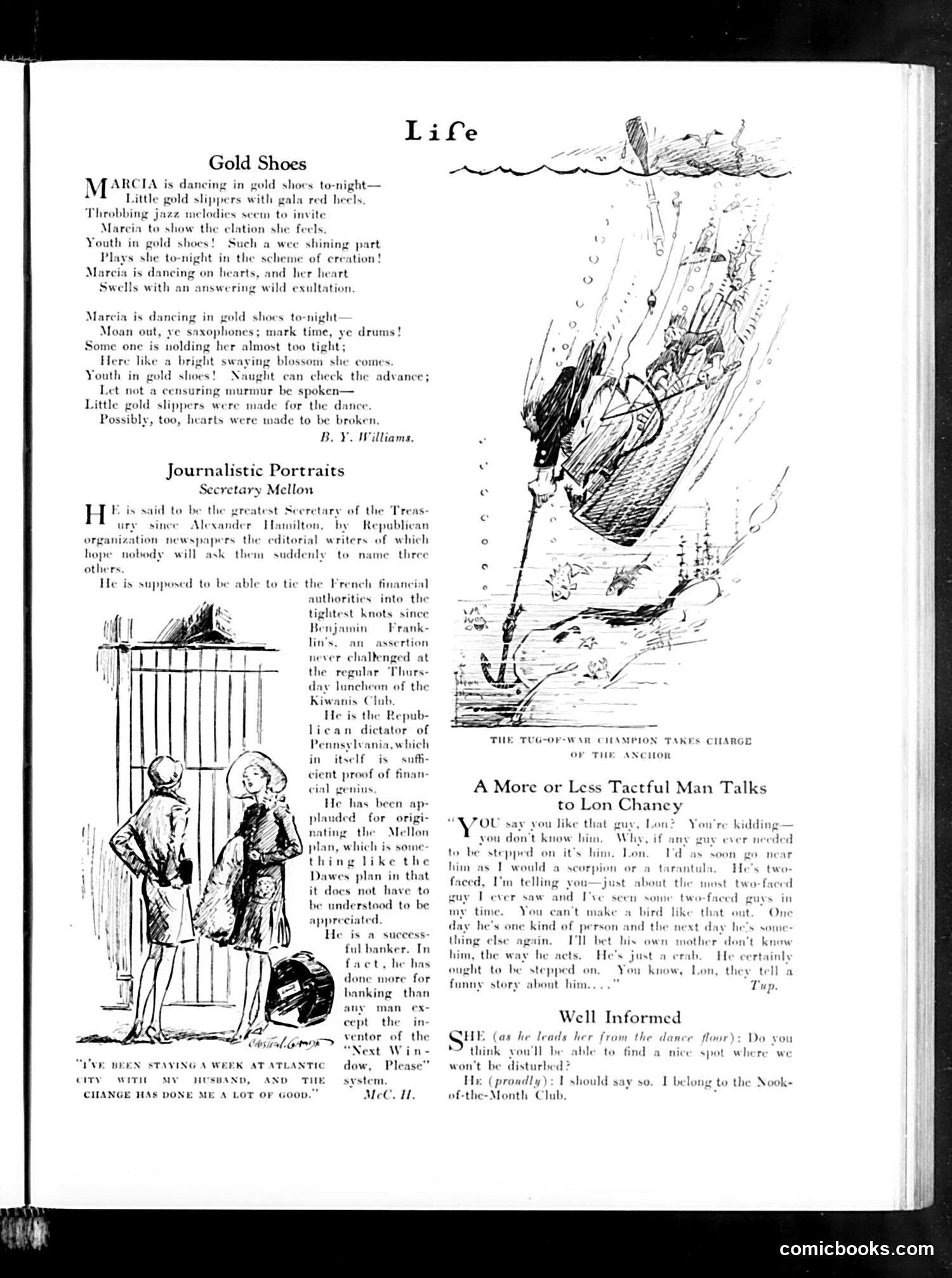
This page contains three separate pieces of social satire: 1. **"Gold Shoes" (poem by B.Y. Williams)**: A romantic poem about a woman named Marcia dancing in gold slippers, celebrating youthful exuberance and physical joy. 2. **"Journalistic Portraits: Secretary Mellon"**: A profile of Andrew Mellon (Treasury Secretary), praising his financial acumen while satirizing Republican newspaper control. The accompanying cartoon shows two women gossiping, with one claiming a week in Atlantic City "changed" her. 3. **"A More or Less Tactful Man Talks to Lord Chaney"** and **"Well Informed"**: Brief humorous dialogues poking fun at social pretension and club membership. The primary satire targets wealth, socialite culture, and political influence. The overall tone is lighthearted social commentary typical of Life magazine's satirical approach to 1920s American society.
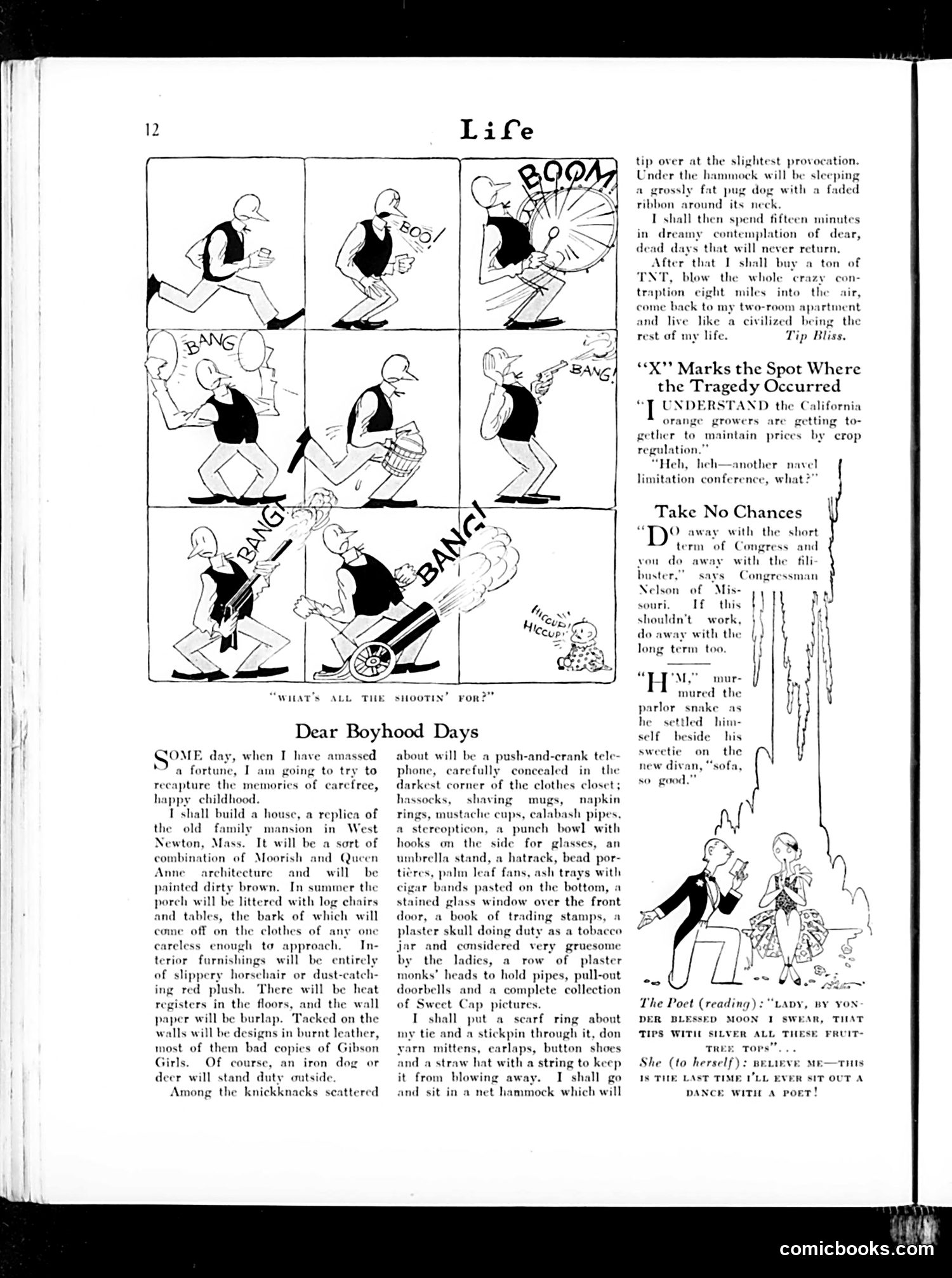
This comic strip satirizes American gun violence and trigger-happiness through slapstick. A man repeatedly shoots at various targets—a can, bottles, and other objects—with escalating chaos and explosions. The title "What's All the Shootin' For?" suggests the satire targets the casual, almost reflexive American enthusiasm for firearms and shooting sports. The accompanying article, "Dear Boyhood Days," nostalgically imagines recreating a childhood home filled with vintage items and masculine pursuits, reflecting early 20th-century middle-class American values. The page also contains other satirical commentary about congressional limitations and California agricultural regulations, typical of *Life* magazine's social and political critique from this era (appears to be 1910s-1920s).
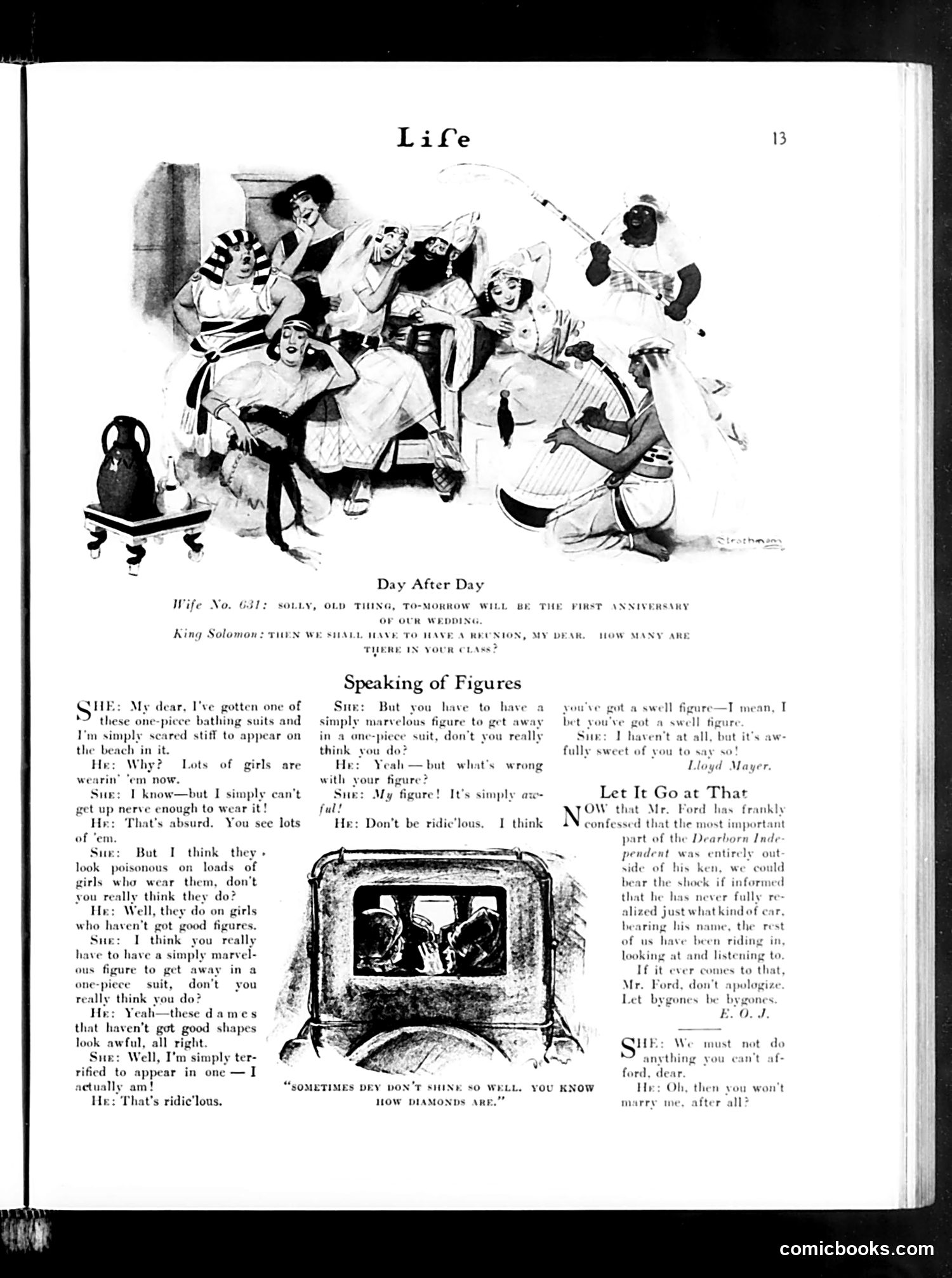
This page contains humor about marriage and gender dynamics typical of early 20th-century Life magazine. The top illustration, "Day After Day," depicts newlyweds discussing wedding plans with exaggerated comic frustration—the husband references "King Solomon" and class reunions, while the wife worries about appearances. Below, "Speaking of Figures" presents a dialogue between a husband and wife debating body image and clothing. The husband criticizes his wife's figure; she defensively argues that good figures look "poisonous on loads of girls" and that she needs a flattering one-piece suit. The joke targets both marital bickering and 1920s anxieties about women's fashion and body standards. The car illustration captioned about diamonds is a visual gag on automotive shine. The final section, "Let It Go at That," references Henry Ford's famous statement, using marital conflict as a setup for satirizing Ford's well-known stubbornness.
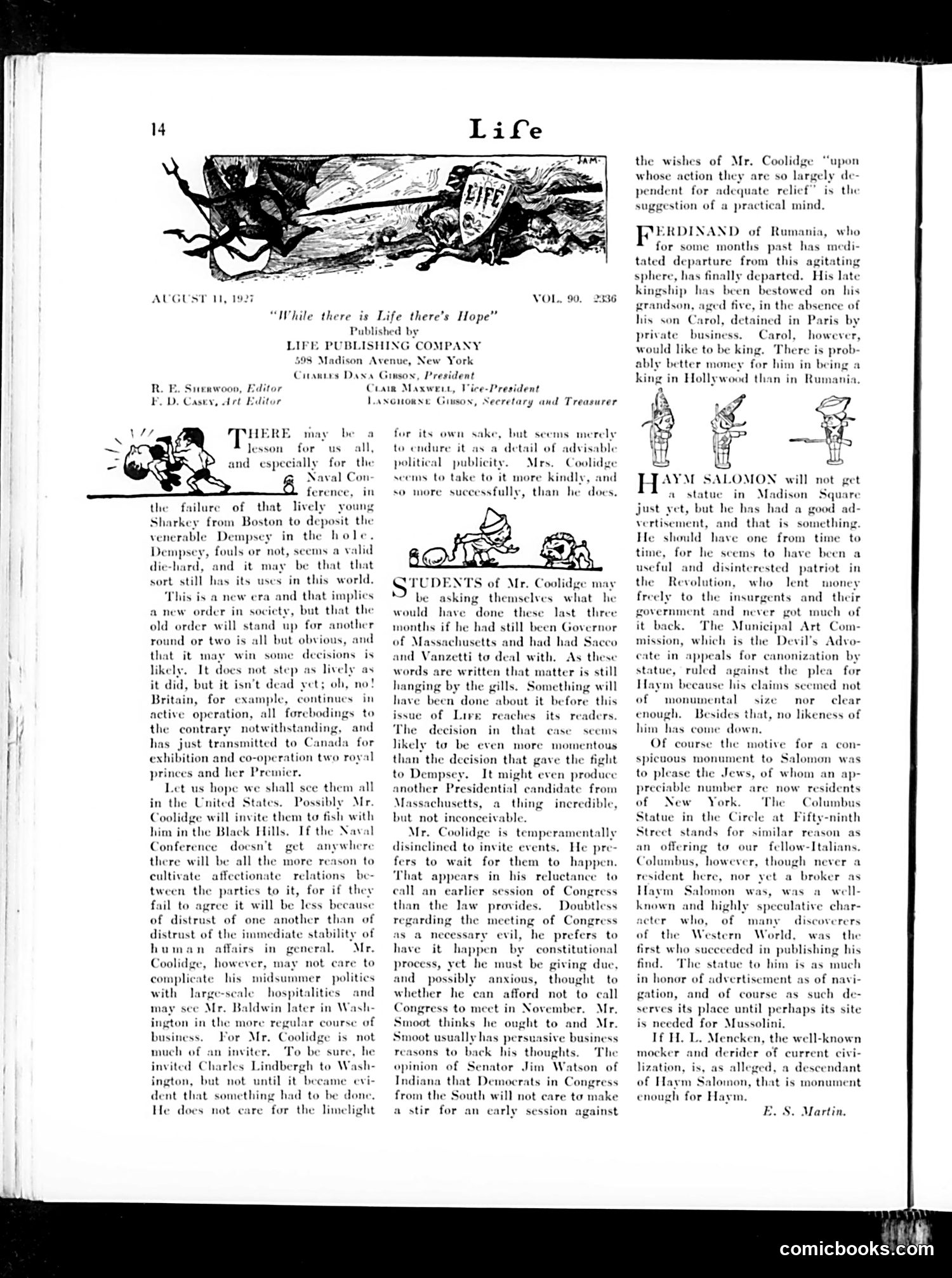
The editorial discusses President **Calvin Coolidge's reluctance to engage in political activity**, particularly regarding Congressional meetings and naval conferences. The cartoon at top likely satirizes Coolidge's passive leadership style—a recurring theme in Life magazine's criticism of his presidency. The text references **Coolidge's ambiguous political positioning**: he's temperamentally disinclined to call Congress into session or actively shape events, preferring constitutional processes. The article suggests this passivity, while legally correct, may be inadequate leadership during politically turbulent times. References to **Haym Salomon** (Revolutionary War financier) and a proposed monument appear to be separate items. The overall thrust critiques Coolidge's hands-off approach to governance as insufficient for contemporary American needs.
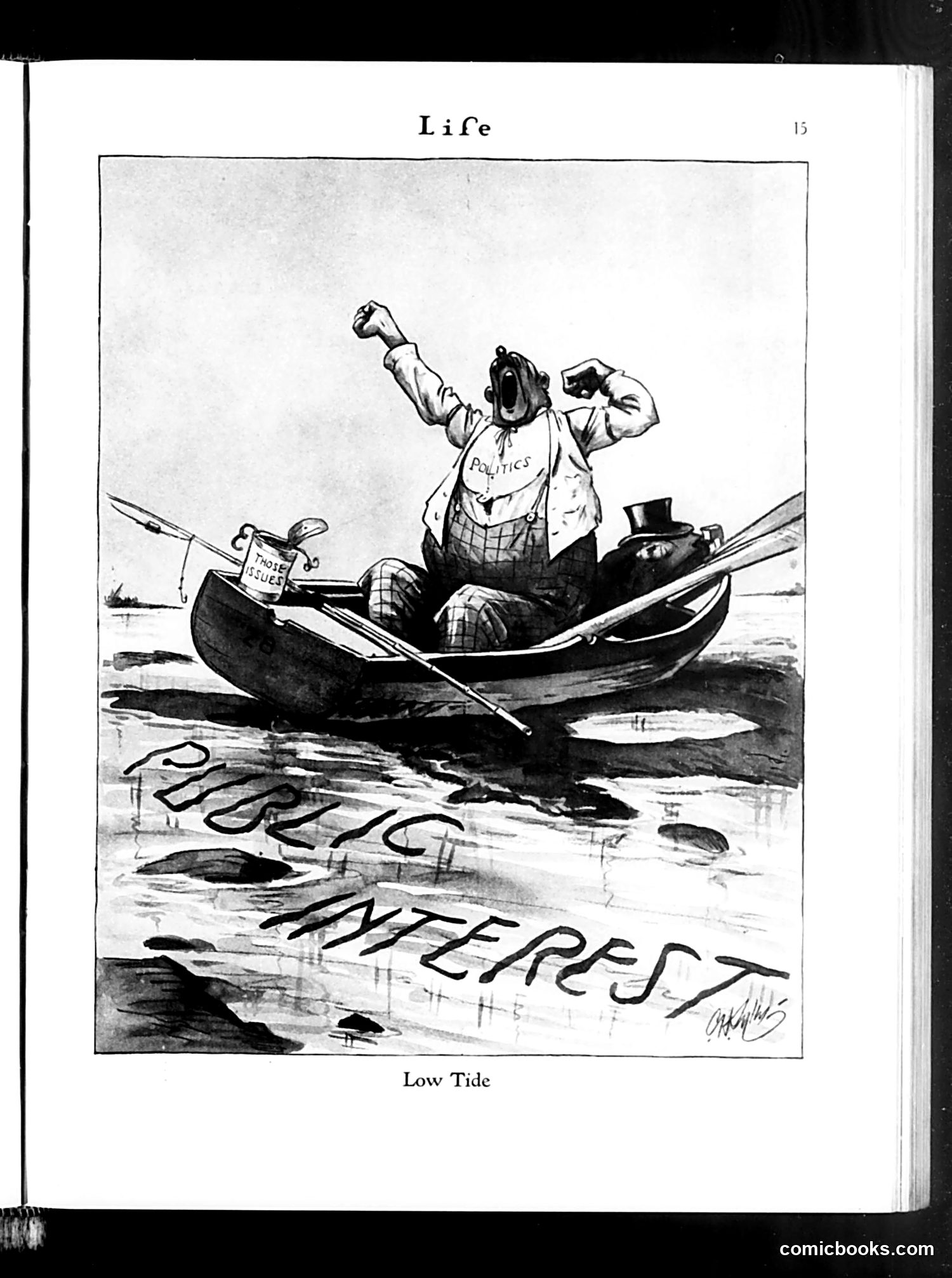
This satirical cartoon from *Life* magazine depicts a figure labeled "POLITICS" sitting in a gondola-style boat during low tide, with arms raised triumphantly. The figure wears a vest marked "POLITICS" and holds what appears to be a flag or document. The surrounding water is labeled "PUBLIC INTEREST," shown as receded and shallow—hence "Low Tide." This visual metaphor suggests that public interest in politics has dramatically diminished or withdrawn, leaving political activity stranded or exposed. The cartoon satirizes the decline of civic engagement or public attention to political matters. The triumphant pose of the politics figure appears ironic, as if celebrating despite the abandonment of public concern—or mocking politics itself as thriving in a landscape emptied of genuine public participation.
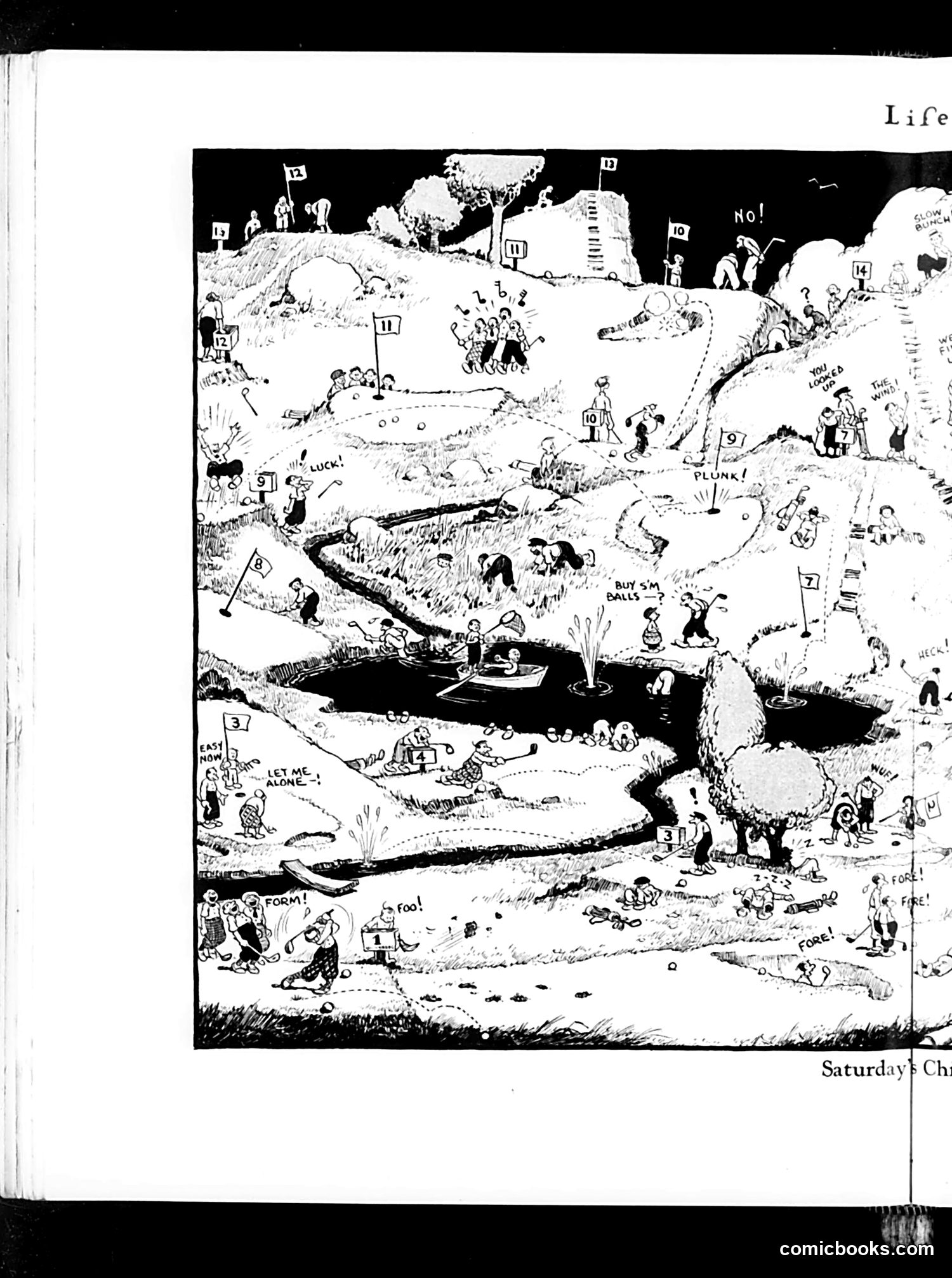
This is a bustling satirical scene depicting a park or recreational area where numerous small figures engage in various activities around a central pond or water feature. The cartoon uses numbered labels (1-14+) to identify different vignettes and activities. The style suggests early-to-mid 20th century American satire, typical of *Life* magazine's social commentary. The dense composition catalogues different types of leisure activities and social behaviors—people fishing, boating, socializing, exercising—presented as a microcosm of American recreational life. Without clearer visibility of specific labels or identifying text for individual figures, I cannot definitively identify particular political targets or specific social critiques. The overall effect appears to satirize the diversity and sometimes chaotic nature of public leisure activities, but the precise satirical point remains unclear from this reproduction.
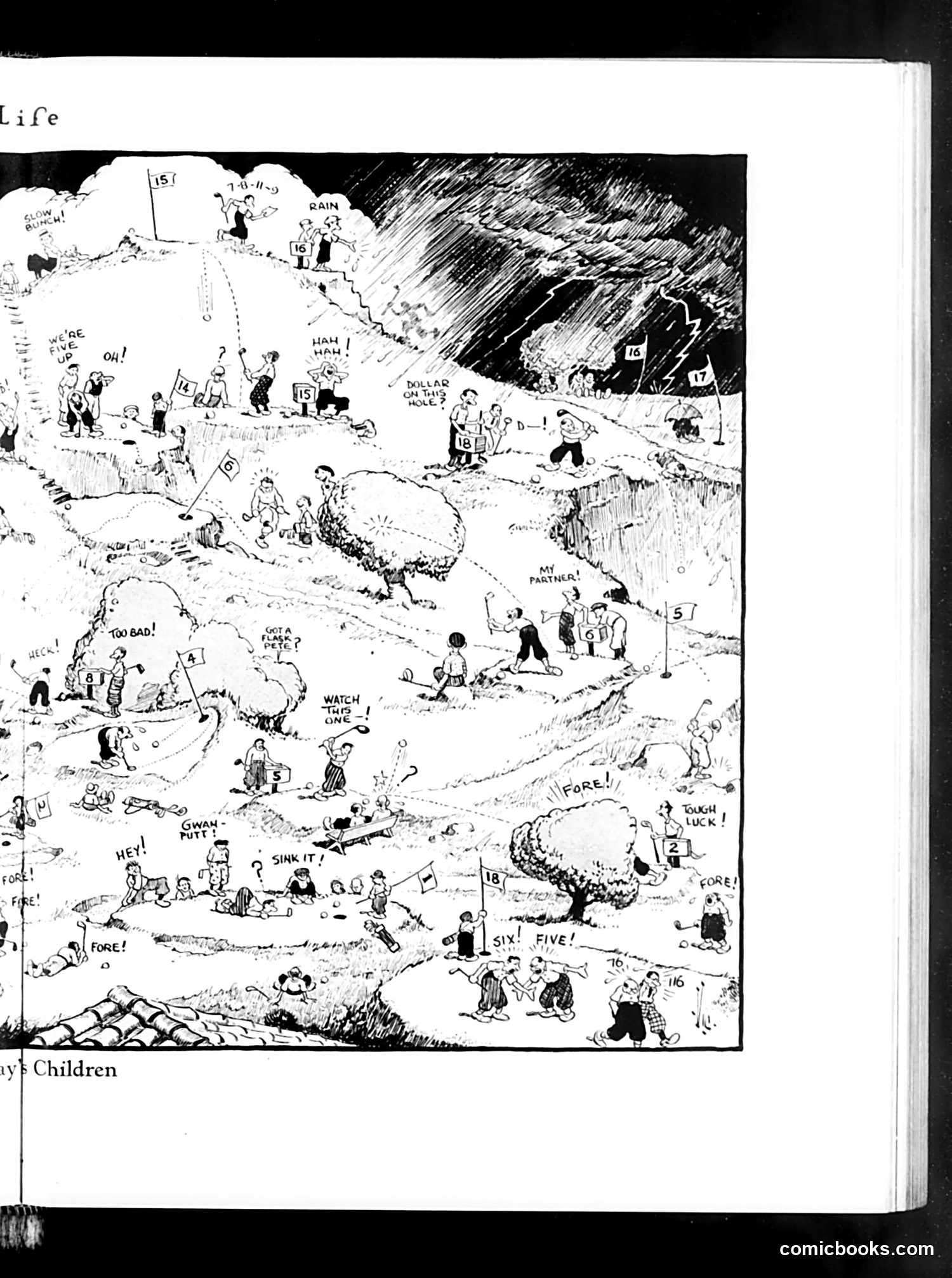
This is a satirical cartoon depicting a golf course populated by numerous children playing golf. The scene shows a chaotic, crowded day on what appears to be a public or municipal golf course, with children of various ages scattered across multiple holes (numbered 15-18 visible). The humor likely targets either: 1. **Overcrowding at public golf facilities** — suggesting too many inexperienced players clog the course 2. **Class commentary** — depicting golf as increasingly accessible to (or invaded by) working-class families rather than remaining exclusive to the wealthy 3. **Parental indulgence** — showing parents bringing numerous children in a comedic display The chaotic composition, numerous speech balloons with exclamations ("Fore!", "Sink it!"), and visible frustration emphasize the satirical point about modern leisure activities becoming undignified or overcrowded.
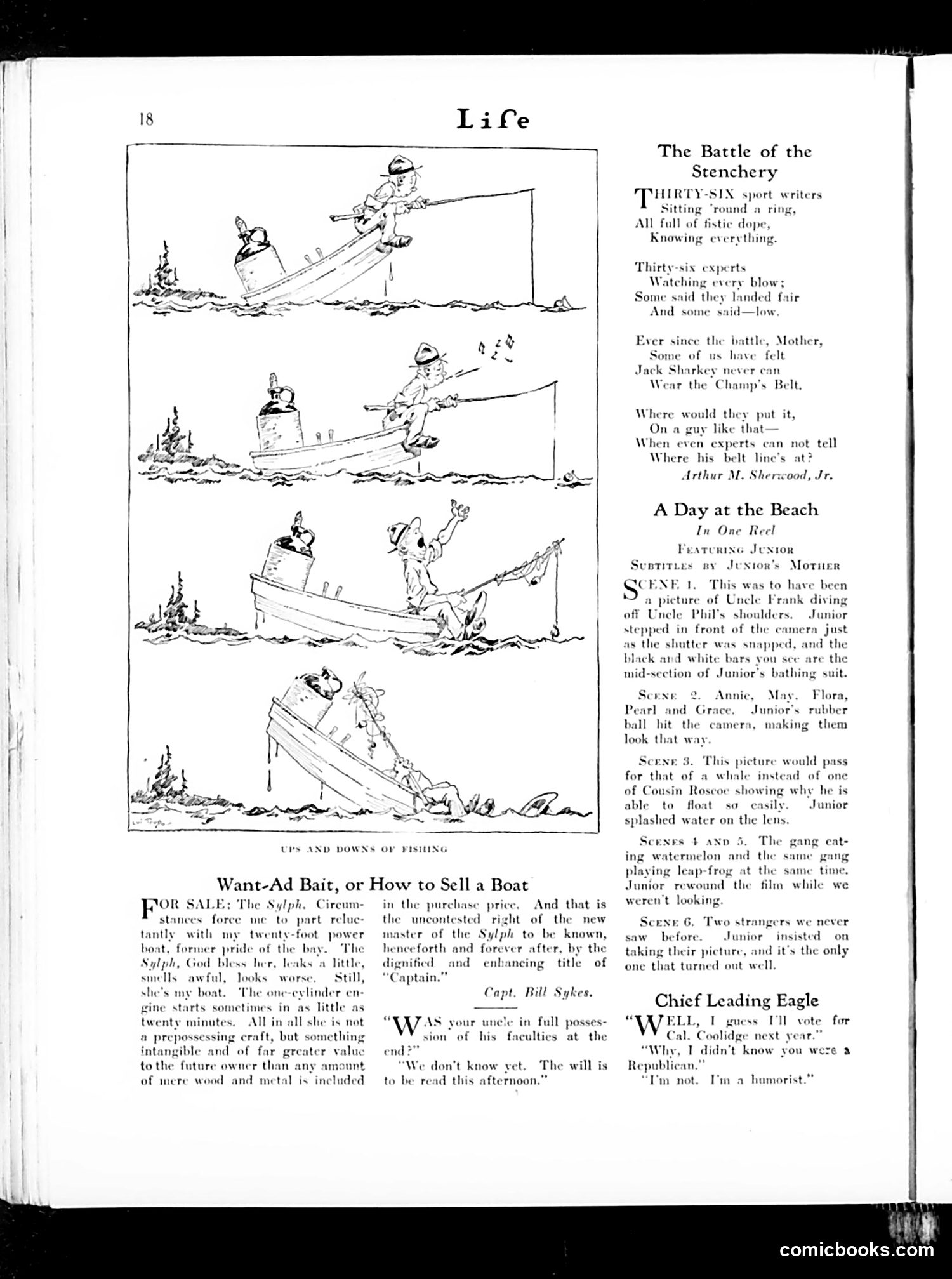
This page contains three distinct pieces of humor: 1. **"Want-Ad Bait"**: A satirical boat-sale advertisement where Captain Bill Sykes admits his boat (the Sylph) leaks, smells terrible, and barely runs—but argues the real value to a buyer is acquiring the prestigious title "Captain." The joke mocks how people buy status symbols despite obvious defects. 2. **"The Battle of the Stenchery"**: A poem by Arthur M. Sherwood, Jr. mocking boxing journalism. It references Jack Sharkey and a championship belt, satirizing how thirty-six sports writers claim expertise watching a fight ("knowing everything") yet can't agree on basic facts—some say punches landed fair, others say low. The humor targets expert overconfidence and the absurdity of sports commentary. 3. **"A Day at the Beach"** and **"Chief Leading Eagle"**: Humorous photo captions about Junior ruining beach photos, and a joke about voting for Calvin Coolidge as a "humorist" rather than political conviction. The page reflects 1920s American humor: class anxiety, sports journalism skepticism, and casual political cynicism.
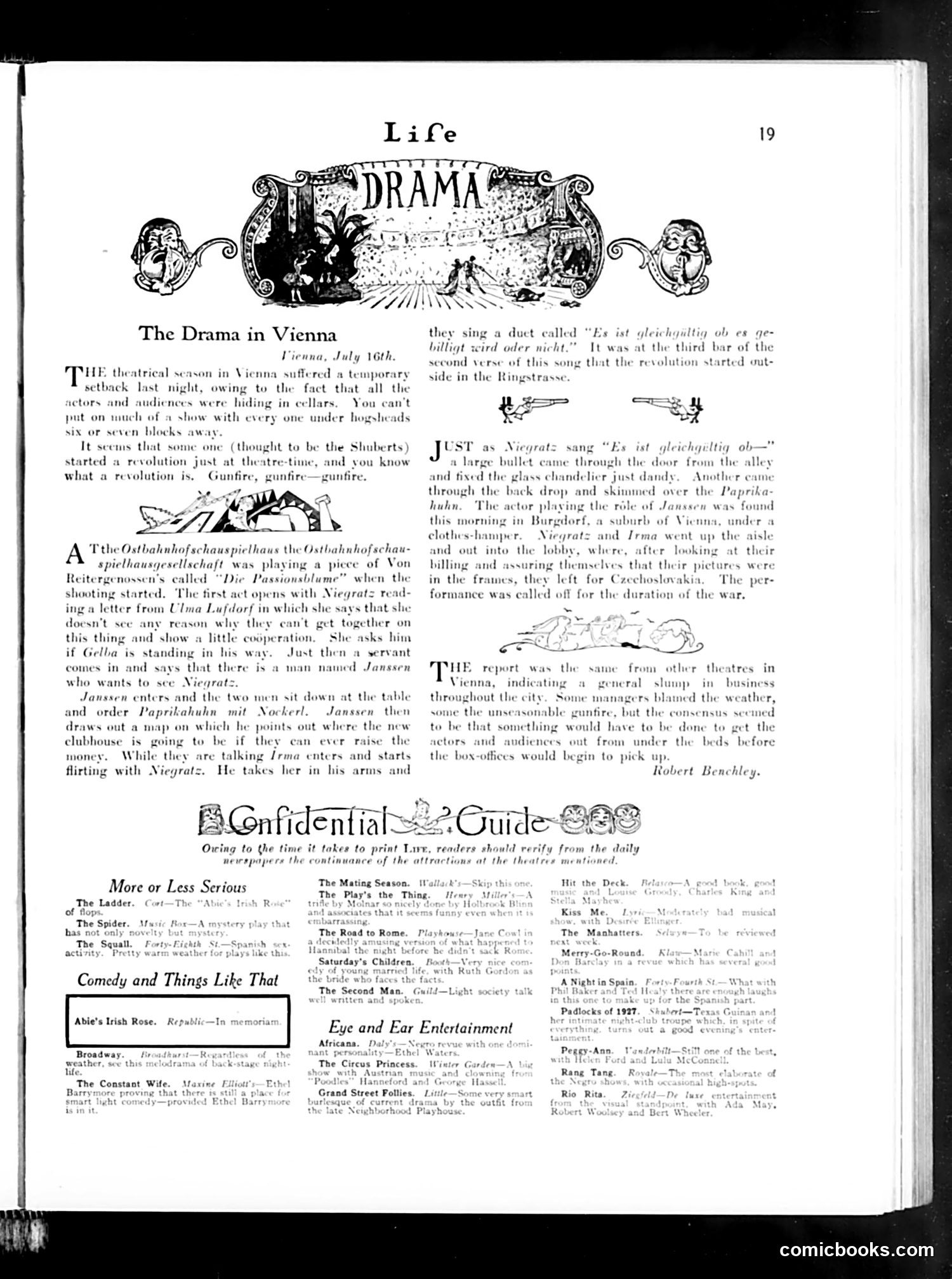
This article satirizes the disruption of Vienna's theatrical season during what appears to be a **1920s Austrian political uprising or revolution**. The humor centers on the absurd collision between dramatic performance and real-world violence. The satire describes how a performance at the Ostbahnhof theater was literally interrupted mid-show—bullets crash through the set during an emotionally climactic duet ("Es ist gleich gültig ob es billigt wird oder nicht"). Actors Niegratz and Irma maintain their theatrical composure, even checking their picture frames for damage before evacuating to Czechoslovakia. **The joke**: Theater people's self-absorption is so complete that they treat a genuine revolution as merely a scheduling inconvenience. Robert Benchley (the author) mocks both the performers' obliviousness and Vienna's general economic collapse—managers blame "unseasonable gunfire" rather than acknowledging actual political instability. This reflects post-WWI Austrian turmoil, when Vienna's cultural institutions faced genuine threats during political upheaval.
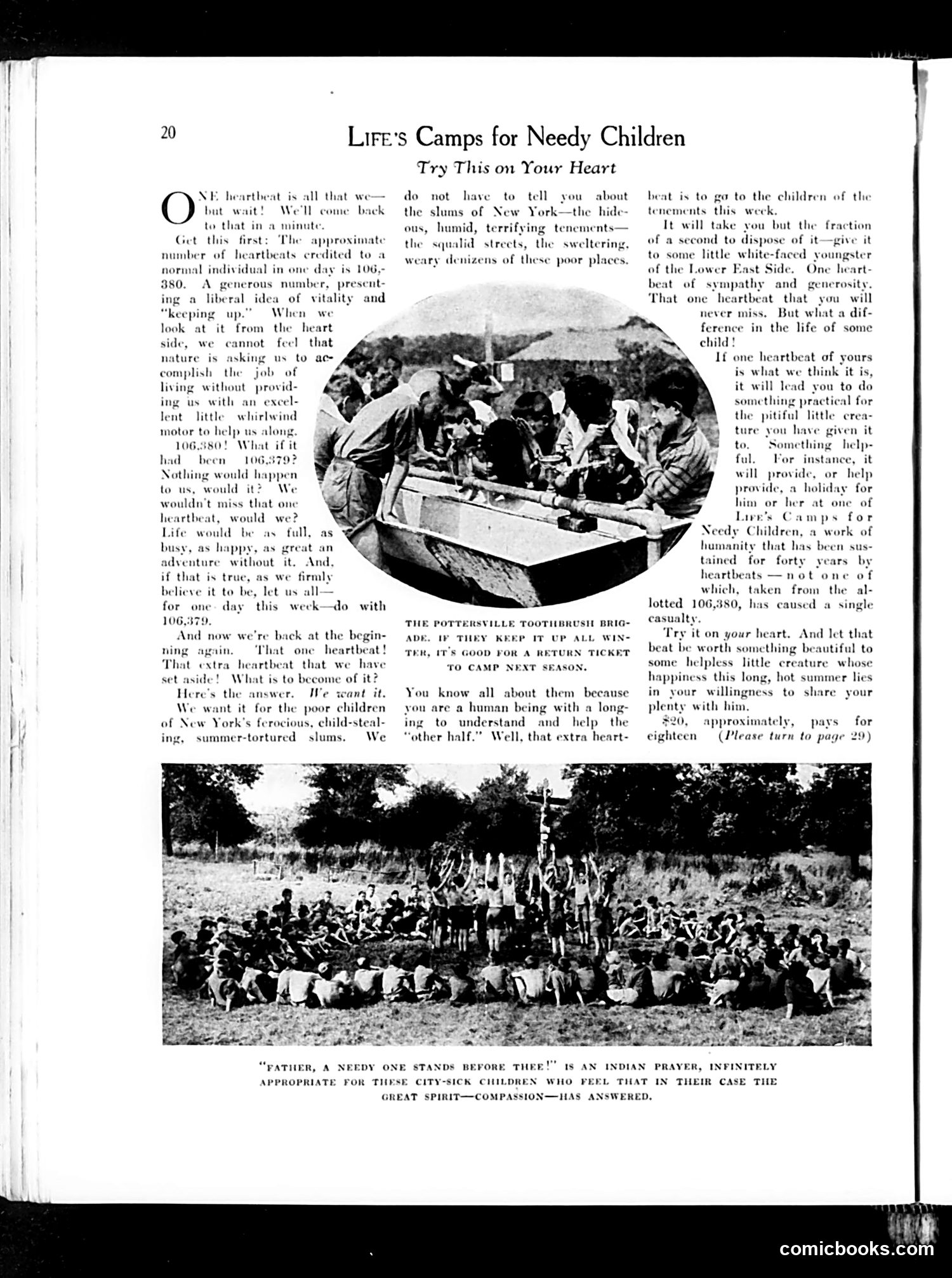
This is not a cartoon but a **charitable fundraising article** from Life magazine. The page uses a poetic, emotional appeal to solicit donations for Life's Camps for Needy Children, an established charity (operating 40 years at publication). **The Pitch:** The author employs a philosophical argument: one human heartbeat among ~106,380 daily heartbeats is imperceptible—you wouldn't miss it. Therefore, readers should metaphorically "donate" one heartbeat's worth of money (approximately $20) to send impoverished New York City children from tenement slums to summer camp. **The Photographs:** Show children at camp activities and prayer—depicting the beneficiaries and the program's wholesome nature. **The Social Context:** Addresses early-20th-century urban poverty, particularly tenement housing and the plight of working-class children without access to nature or recreation. The appeal leverages middle-class guilt and humanitarian sentiment common to Progressive Era philanthropy. **The Satire/Humor:** The "one heartbeat" metaphor is lighthearted wordplay—treating a physiological fact as moral justification for generosity.
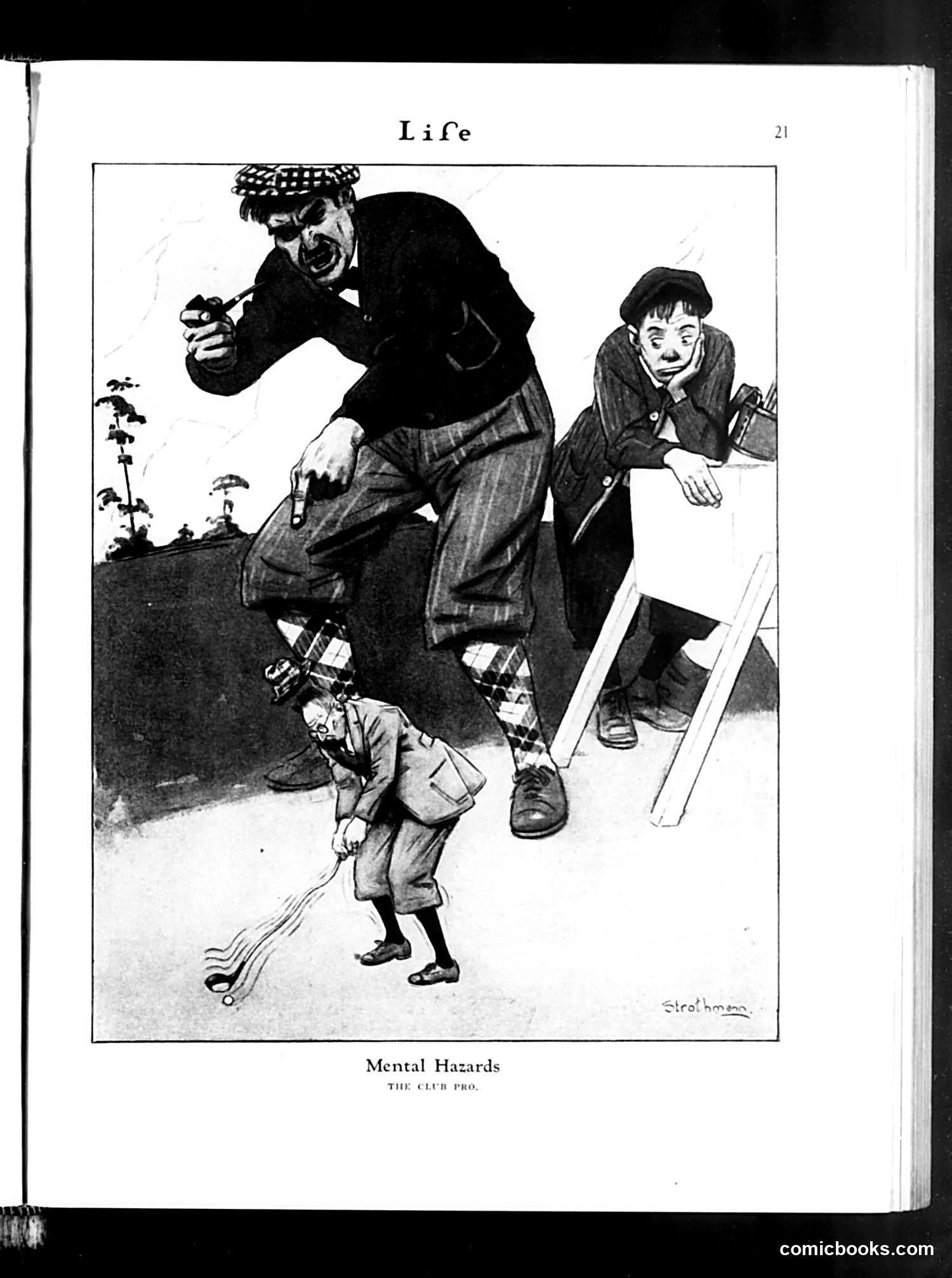
This cartoon satirizes golf instruction, depicting a golf club professional ("the club pro") giving lessons. The humor centers on the psychological pressure the instructor inflicts on his student—a small boy shown sweating nervously while practicing his swing. The "mental hazards" referenced in the title suggest the emotional toll of perfectionist coaching. The exaggerated facial expression of the adult instructor (appearing menacing or intensely critical) contrasts sharply with the boy's anxious demeanor, illustrating how harsh teaching methods can intimidate young learners. This reflects early-20th-century attitudes toward sports instruction, when stern, demanding coaching was considered normal—a practice the satirist clearly critiques as psychologically harmful to children.
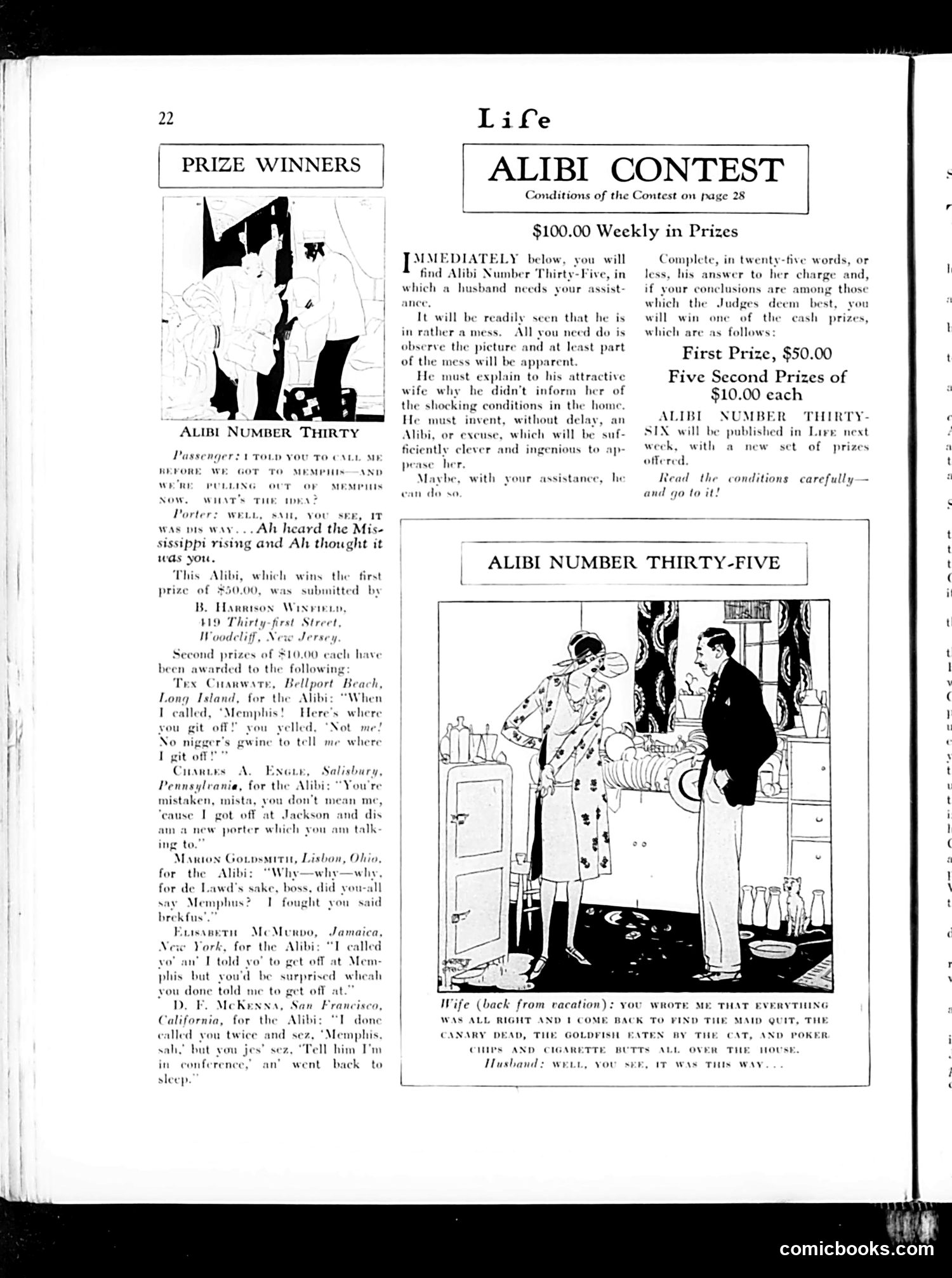
This page features Life's "Alibi Contest," a humor competition where readers submit creative excuses for awkward situations. The winning entries showcase stereotypical dialect humor common to early 20th-century American comedy. **Alibi Number Thirty** (prize winner): A porter uses exaggerated Black dialect to excuse missing a passenger's stop, claiming he confused the passenger's call with the rising Mississippi River. **Alibi Number Thirty-Five** (current contest): Shows a husband who failed to mention household disasters—a dead canary, cat-eaten goldfish, and departed maid—while his wife vacationed. Readers must supply his excuse in 25 words or less to compete for $50 first prize. The humor relies on dialect comedy and marital mishap tropes. The contest offers $100 weekly in prizes, with winners published the following week. This reflects early-1900s popular entertainment standards, including racial stereotyping in comedic presentations that would be considered offensive today.
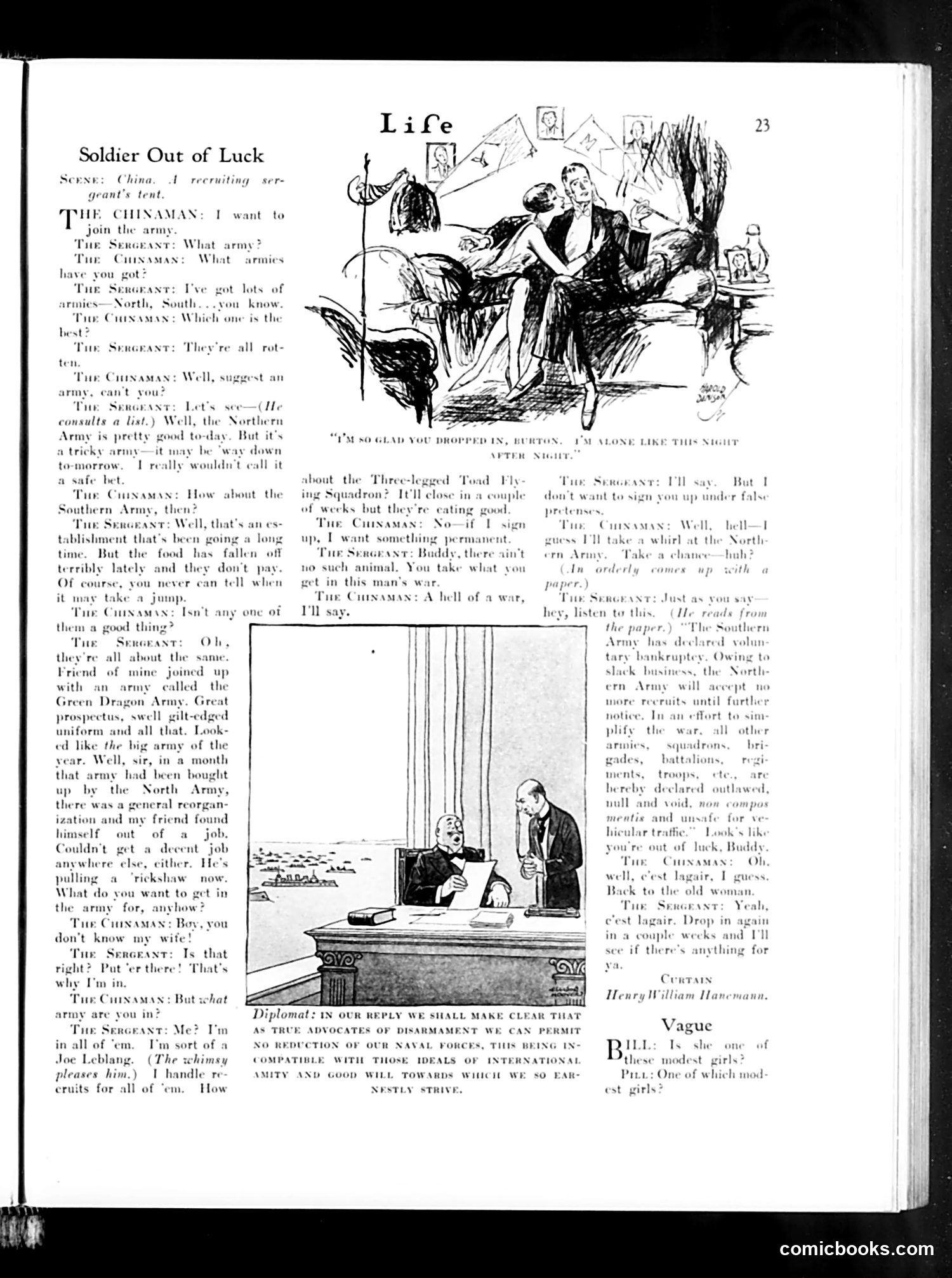
This cartoon satirizes the instability of Chinese military recruitment during the warlord period (likely early 1920s). A Chinese recruiter and sergeant discuss which army to join, but every option collapses: the Northern Army may "go down tomorrow," the Southern Army is "fallen off terribly," and the Green Dragon Army was absorbed by the North, leaving a recruit jobless and reduced to pulling a rickshaw. The joke's point: China's fragmented military landscape made "joining the army" a fool's errand. Armies dissolved, merged, or went bankrupt without warning. The sergeant himself admits working for "all of 'em"—a cynical acknowledgment that these were interchangeable, unstable forces. The accompanying "Diplomat" panel mocks Western governments' hypocritical disarmament rhetoric while the chaos unfolds. The satire targets both China's political fragmentation and Western indifference to it.
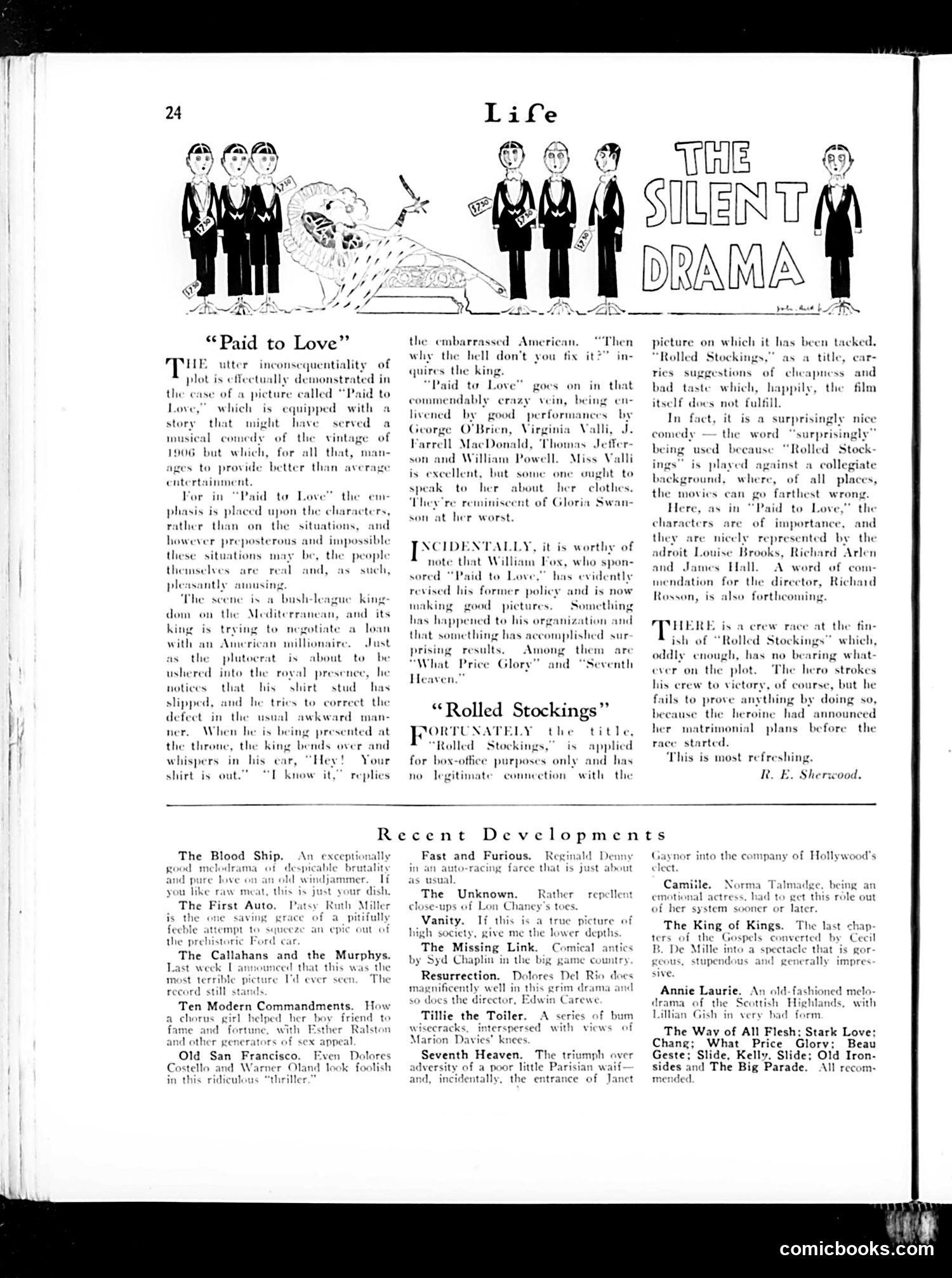
This page contains early 1920s film reviews by R.E. Sherwood. The cartoon header depicts silent film actors in formal dress—a visual joke about the era's transition to talking pictures (though these films are still silent). **"Paid to Love"**: A light comedy set in a fictional Mediterranean kingdom where an American millionaire negotiates a loan. The satire mocks its absurd 1906-style plot, but praises the character work by actors George O'Brien and Virginia Valli. A running joke targets Valli's unfashionable wardrobe, compared unfavorably to actress Gloria Swanson. **"Rolled Stockings"**: A collegiate comedy featuring Louise Brooks and Richard Arlen. The reviewer notes ironically that a climactic crew race has nothing to do with the plot—a refreshing break from typical melodramatic conventions. Both reviews illustrate 1920s film criticism's focus on *character and performance* over narrative logic, reflecting silent cinema's reliance on visual acting rather than dialogue.
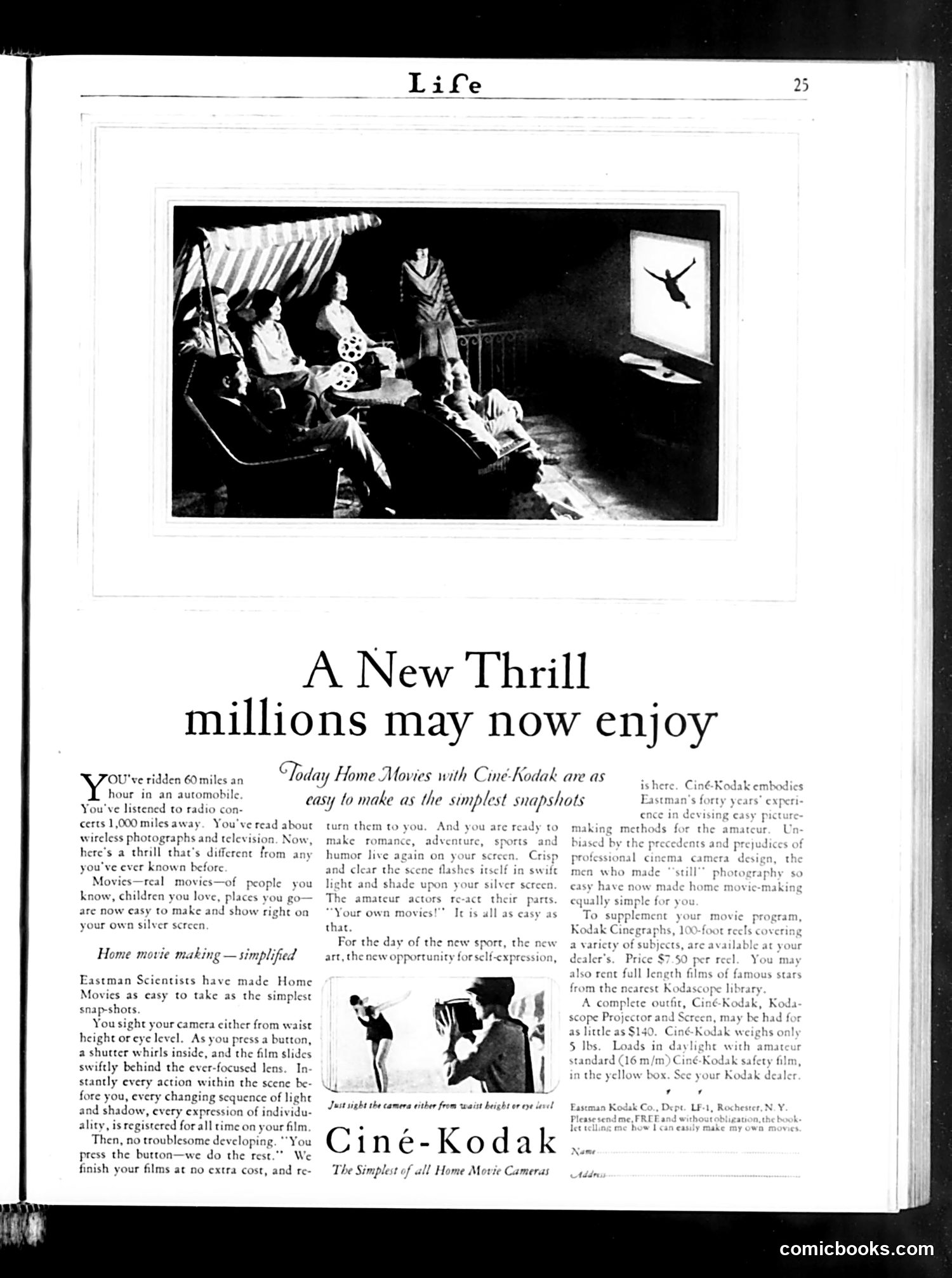
This is **not a political cartoon but a product advertisement** for Cine-Kodak home movie cameras, appearing in Life magazine. The page promotes a new consumer technology: making home movies as easily as taking snapshots. The opening compares this innovation to other modern marvels (automobiles, radio, wireless photography) that have recently thrilled the public. The central pitch is democratization—amateur filmmaking is no longer a technical expert's domain but accessible to ordinary families wanting to document "people you know, children you love, places you go." The small photograph shows a family watching their own filmed content projected on a home screen, illustrating the aspirational lifestyle being sold. The advertisement emphasizes simplicity ("just sight the camera...press the button"), affordability (complete outfit "as little as $143"), and convenience (Kodak handles developing). This represents early home entertainment technology marketing to middle-class consumers, positioning amateur filmmaking as the next consumer hobby after snapshots.
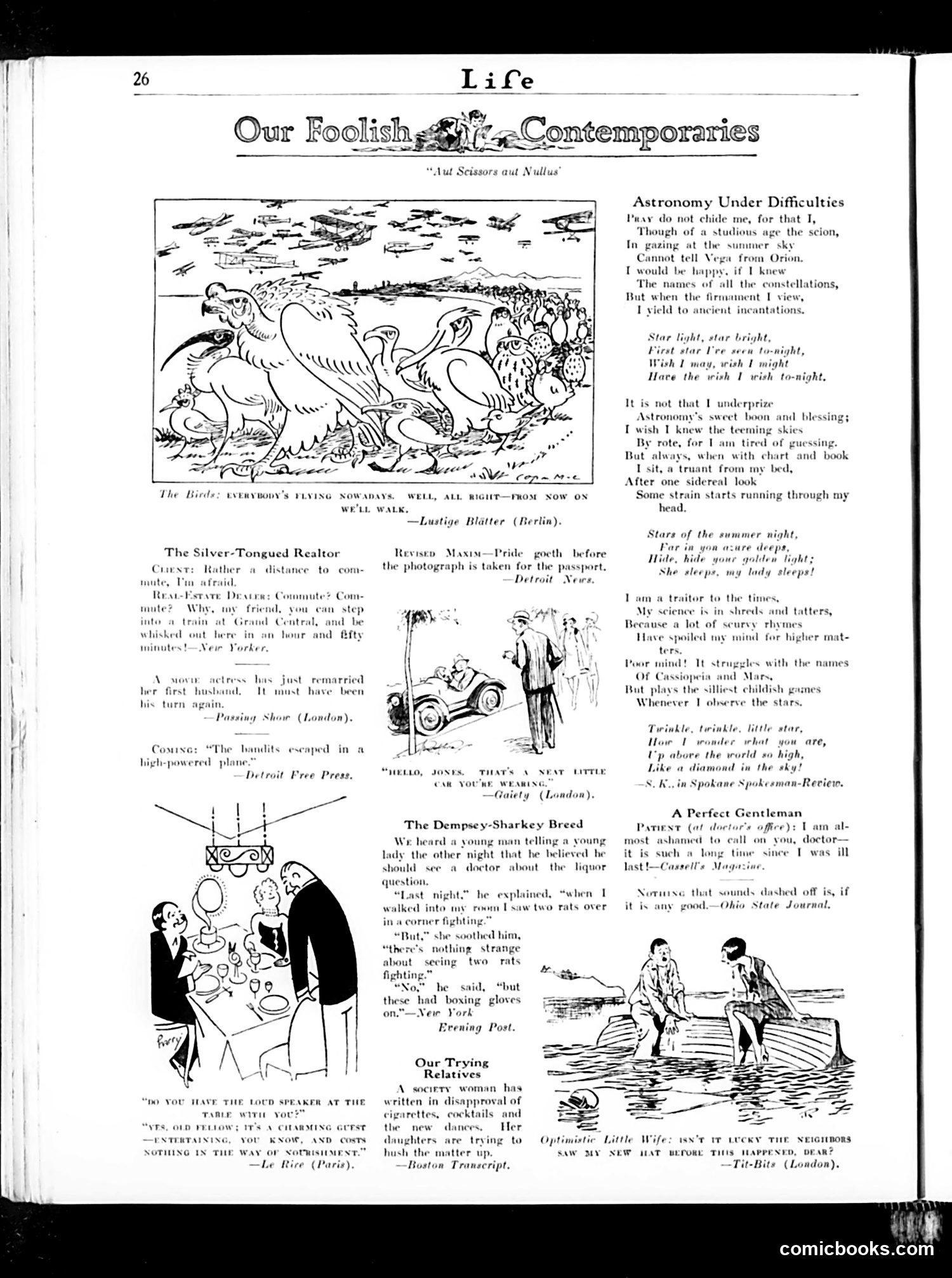
This page collects brief humorous observations on contemporary society circa the 1920s-30s. The cartoons mock: **"The Silver-Tongued Realtor"**: A real estate agent exaggerates commute times, claiming residents can "step into a train at Grand Central" and arrive home in "an hour and fifty minutes"—satirizing salesmen's deceptive marketing. **"The Dempsey-Sharkey Breed"**: A young man reports seeing two rats fighting with **boxing gloves**, suggesting modern youth have become desensitized to absurdity through media coverage of celebrity boxing matches (likely referencing Jack Dempsey, famous boxer). **"Astronomy Under Difficulties"**: A poem mocking educated people who abandon scientific knowledge in favor of childhood nursery rhymes ("Twinkle, Twinkle Little Star") when attempting stargazing—critique of shallow education. **"Our Trying Relatives"**: A mother disapproves of modern dancing and cocktails while daughters try to suppress her complaints. The overall theme: contemporary society is foolish—obsessed with modern conveniences, boxing, and trends while abandoning genuine knowledge and restraint.
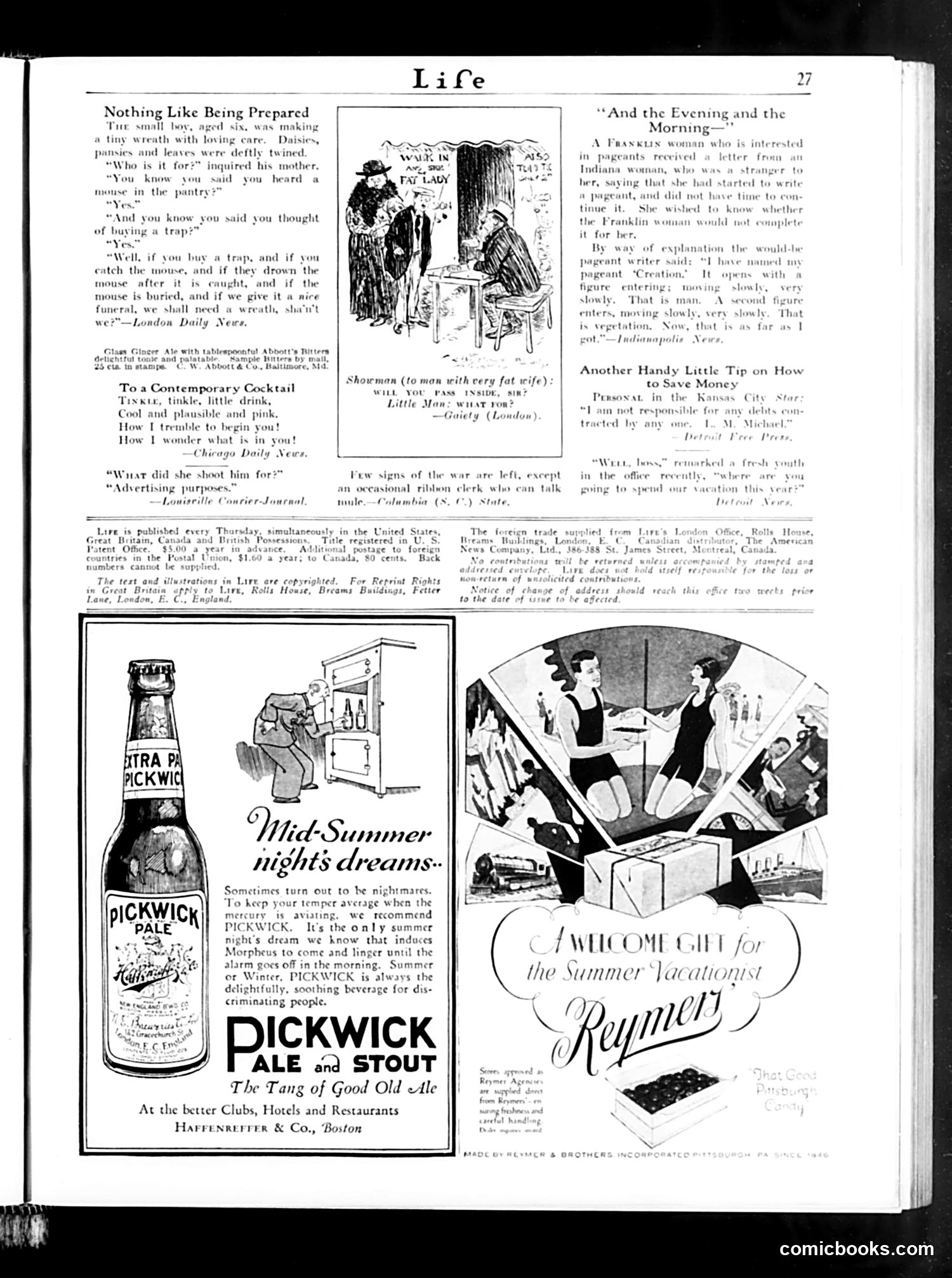
This page contains several short satirical pieces typical of Life's humor format: **"Nothing Like Being Prepared"**: A boy makes a wreath for a dead mouse, extrapolating from his mother's comment about buying a mousetrap. The joke satirizes over-literal thinking and morbid preparation. **"To a Contemporary Cocktail"**: A parody of "Twinkle, Twinkle, Little Star," mocking fashionable 1920s cocktails by expressing anxiety about unknown ingredients in trendy drinks—poking fun at Prohibition-era speakeasies and their dubious concoctions. **Other brief jokes** target advertising excess, modern warfare's absence of visible signs, and temperance concerns. The page is largely **advertising**: prominent ads for **Pickwick Ale and Stout** (Boston) and **Raymor** luggage dominate the lower half. The Pickwick ad uses humor ("Midsummer nights dreams") to market beer as a solution to summer heat and irritability. Overall, the page reflects 1920s-era preoccupations: Prohibition mockery, advertising satire, and modern anxieties about consumer goods.
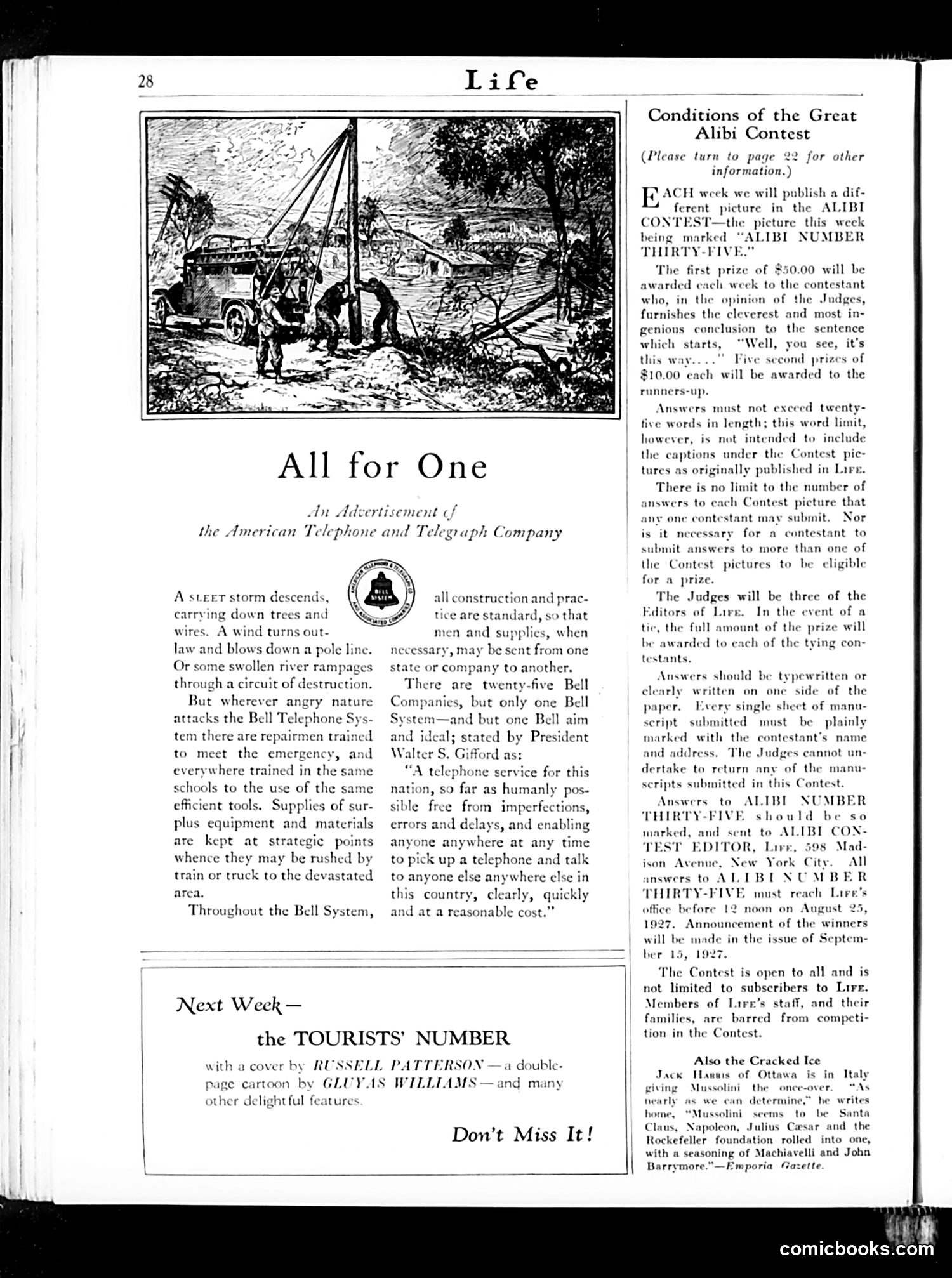
This page is primarily an **advertisement for American Telephone and Telegraph (AT&T)**, not political satire. The illustration depicts telephone workers repairing infrastructure after a natural disaster—a sleet storm that has downed power lines and poles. The ad's message emphasizes AT&T's organizational unity and reliability: though twenty-five separate Bell Companies exist, they operate as "one Bell System" with standardized practices. This allows resources and trained personnel to be rapidly deployed across state lines during emergencies. The ad quotes President Walter S. Gifford's vision of universal telephone service "free from imperfections, errors and delays." The cartoon illustrates the company's practical response capability to natural disasters, positioning AT&T as a dependable infrastructure backbone for American communication. The page also announces upcoming **Life magazine** features, including a "Tourists' Number" and an "Alibi Contest" where readers submit witty caption completions for weekly illustrations, with cash prizes.
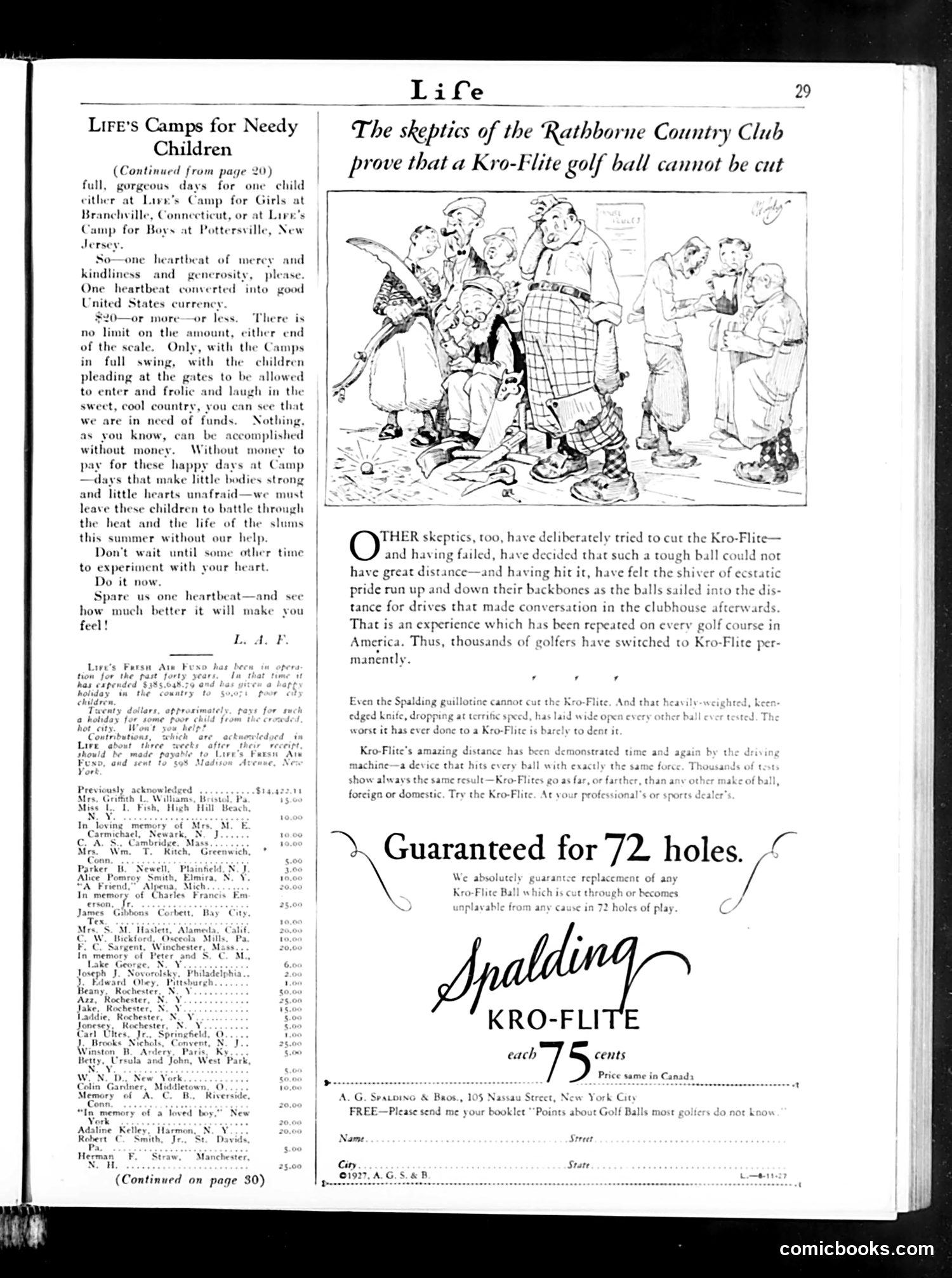
This page combines a charitable appeal with a satirical golf ball advertisement. The left column solicits donations for Life's camps for poor children—a genuine charitable cause requiring funds. The main content is a humorous advertisement for Spalding's Kro-Flite golf balls. The cartoon depicts country club members attempting to cut or damage a Kro-Flite ball to prove it inferior, but failing. The joke mocks golf club skeptics who, unable to cut the durable ball, instead convince themselves of its superiority when it travels far distances—transforming their failed destructive test into proof of quality. The satire suggests these golfers rationalize the ball's toughness as an advantage rather than admitting their criticism was baseless. It's gentle mockery of both golf snobbery and consumer psychology: people talk themselves into liking products that resist their attempts to discredit them. The advertisement emphasizes durability ("guaranteed for 72 holes") at 75 cents.
This page is primarily **advertising and charitable announcements**, not political satire. The main content includes: 1. **Marlboro Cigarettes ad** (left): A vintage cigarette advertisement emphasizing freshness and packaging, created by Philip Morris & Co. 2. **Life's Camps for Needy Children** (center): A continuation of charitable fundraising from the previous page, listing donors and amounts ($1-$100) for children's camps. 3. **Travel advertisements** (right): Multiple cruise and tour company ads promoting European travel, car rentals, and steamship voyages—typical leisure offerings of the 1920s era. There is **no political cartoon or satire** on this page. It represents the magazine's mixed content model: mixing editorial features with paid advertising to fund publication, alongside charitable appeals. The ads reflect post-WWI American prosperity and leisure culture of the late 1920s.
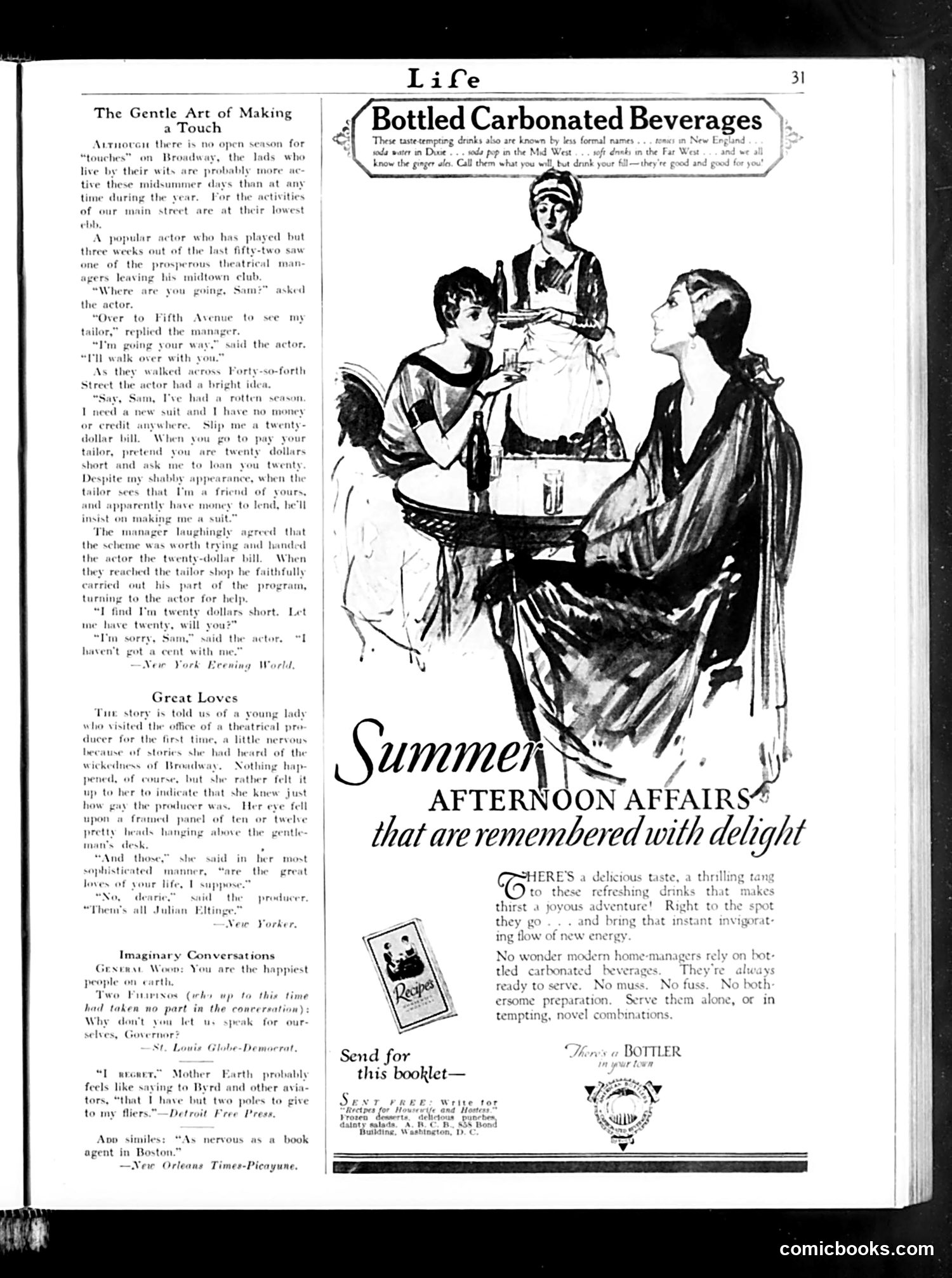
This page contains three humorous short pieces typical of *Life* magazine's satirical humor: **"The Gentle Art of Making a Touch"** satirizes Depression-era financial desperation. An unemployed actor cons a theater manager into lending him money by creating an elaborate scheme: he borrows $20, repays it publicly to impress the tailor, then asks to borrow it back—implying the manager is wealthy enough to lend casually. The joke's on the manager when the actor reveals he has no money at all. It mocks both theatrical pretense and the financial struggles of performers. **"Great Loves"** gently satirizes theatrical producers' vanity. A young actress assumes the framed photos on a producer's desk are his romantic conquests, but they're actually headshots of performers—likely chorus girls or minor actresses. The joke suggests producers' "love affairs" are actually just professional relationships. **The carbonated beverages advertisement** at bottom is straightforward product promotion, not satire. The page reflects 1920s-30s Broadway culture and economic anxiety during lean theatrical seasons.
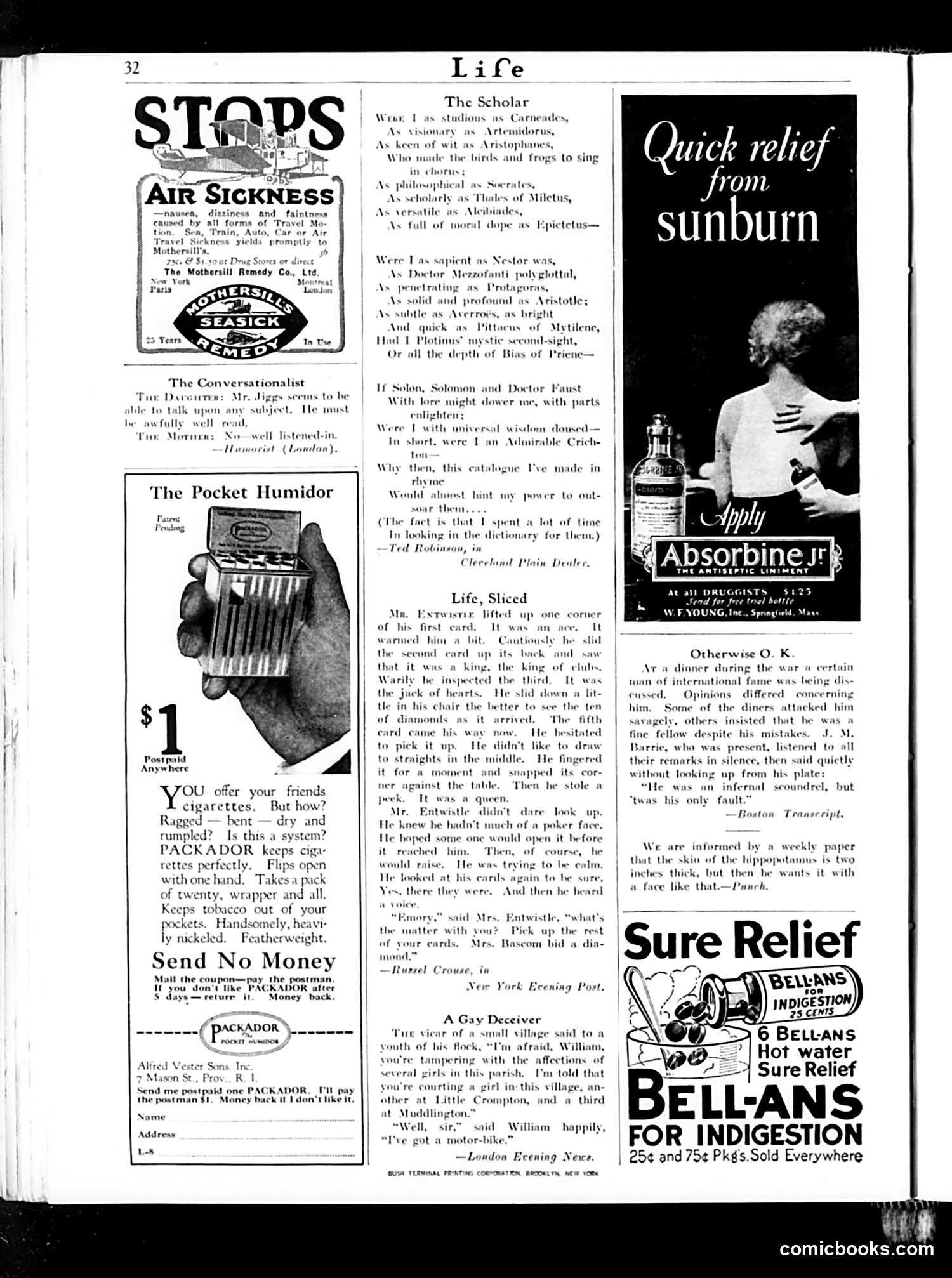
This page combines satirical humor with period advertisements. The main content includes: **"The Scholar"** — A humorous poem mocking pedantry. The speaker catalogs classical philosophers and scholars (Socrates, Aristotle, Plato, etc.), claiming if he possessed their collective wisdom, his rhyming dictionary would be impressive. The joke's reveal: he actually spent considerable time *looking up these names in a dictionary* rather than possessing genuine learning. This satirizes pretentious intellectuals and name-dropping erudition. **"Life, Sliced"** — A domestic humor piece about a man playing poker while his wife interrupts, deflating his concentration. **"A Gay Deceiver"** — Brief anecdote about a young man courting multiple village girls, whose solution is getting a motor-bike (then a novelty/status symbol). The remaining content is **period advertisements** for Packador cigarette cases, Absorbine Jr. liniment, and Bellans indigestion remedy — typical early 20th-century patent medicine and consumer goods marketing.

This is **not a cartoon or satire**—it's a **straight automobile advertisement** for Willys-Knight vehicles, likely from the 1920s. The page shows a photograph of a Great Six Sedan and testimonials from satisfied owners claiming 100,000+ miles of reliable service. The ad emphasizes technical innovations: the Knight Engine (which "improves with use"), seven-bearing crankshaft, four-wheel brakes, and specialized shock absorbers. The small chart on the right graphs engine efficiency gains over time, supporting the claim that performance actually increases with usage—unusual and noteworthy for the era. There is **no political or satirical content** here. This represents genuine automotive advertising from an era when durability and mechanical innovation were major selling points. The copywriting style—featuring owner testimonials and technical specifications—was standard advertising practice of the period.
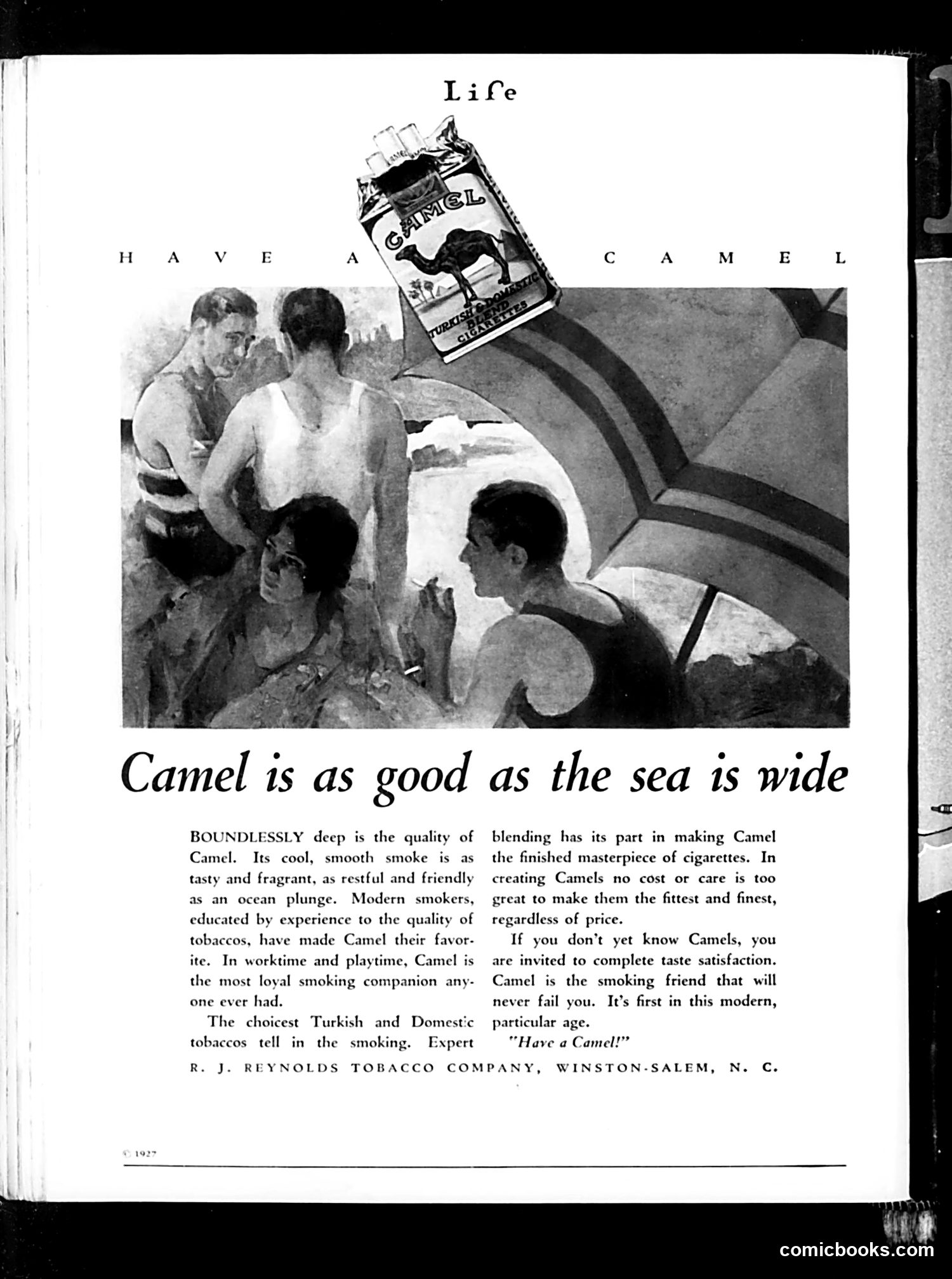
This is a **cigarette advertisement**, not political satire. The page features a Camel cigarettes ad from R.J. Reynolds Tobacco Company (dated 1927 based on the visible "©1927"). The photograph shows beachgoers in vintage swimwear relaxing by the ocean, with a Camel cigarette package prominently displayed above. The imagery connects smoking to leisure, pleasure, and social bonding—common advertising strategies of the era. The tagline "Camel is as good as the sea is wide" uses poetic language to suggest the cigarette's superior quality and universal appeal. The ad text emphasizes Camel's "deep quality," smooth taste, and positioning as a "loyal smoking companion" for both work and play. This represents pre-regulation tobacco advertising, when such campaigns could freely associate cigarettes with health, relaxation, and social desirability—claims now prohibited.