
Life, 1927-08-11 · page 26 of 36
Life — August 11, 1927 — page 26: what you’re looking at
What you’re looking at
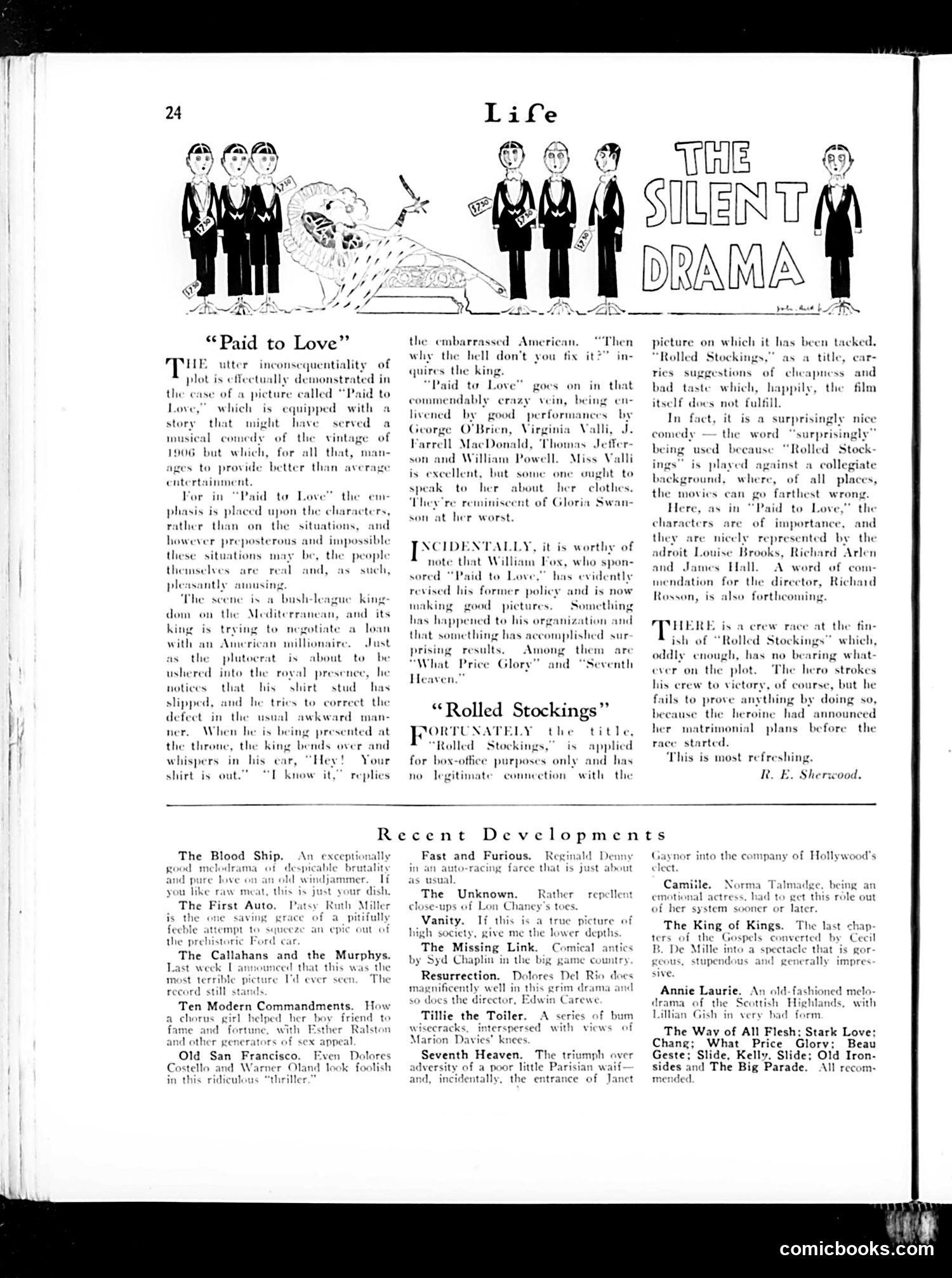
This page contains early 1920s film reviews by R.E. Sherwood. The cartoon header depicts silent film actors in formal dress—a visual joke about the era's transition to talking pictures (though these films are still silent). **"Paid to Love"**: A light comedy set in a fictional Mediterranean kingdom where an American millionaire negotiates a loan. The satire mocks its absurd 1906-style plot, but praises the character work by actors George O'Brien and Virginia Valli. A running joke targets Valli's unfashionable wardrobe, compared unfavorably to actress Gloria Swanson. **"Rolled Stockings"**: A collegiate comedy featuring Louise Brooks and Richard Arlen. The reviewer notes ironically that a climactic crew race has nothing to do with the plot—a refreshing break from typical melodramatic conventions. Both reviews illustrate 1920s film criticism's focus on *character and performance* over narrative logic, reflecting silent cinema's reliance on visual acting rather than dialogue.
📄 Transcribed text from this page (OCR, searchable)
Machine-transcribed from the original scan — historical spelling and the odd misread are preserved.
“Paid to Love” HIE utter inconsequentiality of plot is effectually demonstrated in the case of a picture called “Paid to Love,” which is equipped with a story that might have served a musical comedy of the vintage of 1906 but which, for all that, man- iges to provide better than average entertainment. For in “Paid to Love” the em phasis is placed upon the characters, rather than on the situations, and however preposterous and impossible these situations may be, the peopl themselves are real and, as) such, pleasantly ing. The scene is a bush-league king dom on the Mediterranean, and its king is trying to negotiate a loan with an American millionaire. Just as the plutocrat is about to be ushered into the royal presence, he irt) stud has slipped, and he tries to correct: the defect in the usual awkward man- ner. When he is being presented at notices that his the throne, the king bends over and whispers in his car, “Hey! Your shirt is out.” “TL know it,” replies Then the embarrassed z why the hell don’t you tix it?” in- quires the king “Paid ta Love” g commendably erazy vein, being en- son in that livened by good performances by George O'Brien, Virginia Valli, J. Farrell MacDonald, Thomas Jeffer son and William Powell. Miss Valli is excellent, but one ought to speak to her about her clothes. They're reminiscent of Gloria Swan son at her worst. NCIDENTALLY, it is worthy of note that William Fox, who spon- sored “Paid to Love.” has evidently revised his former policy and is now making good pictures. has happened to his organization and that something has accomplished sur prising results, Among them are “What Price Glory” and “Seventh Heaven,” “Rolled Stockings” FORTUNATELY the title, “Rolled Stockings,” is applied for box-office purposes only and has no legitimate conneetion with the QO SENT 6 = picture on which it has been tacked, “Rolled Stockings,” as a title, ear- ries suggestions of cheapness and bad taste which, happily, the film itself does not fulfill. In fact, it is a surprisingly nice comedy — the word “surprisingly” being used because “Rolled Stock- ings” is played against a collegiate background, where, of all places, the me farthest wrong. Here, as in “Paid to Love,” the characters are of importance, and they are nicely represented by the adroit Louise Brooks, Richard Arlen and James Hall. A word of com- mendation for the director, Richard Rosson, is also forthcoming. ies can THERE is a crew race at the fin- ish of “Rolled Stockings” which, oddly enough, has no bearing what- ever on the plot. The hero strokes his crew to victory, of course, but he fails to prove anything by doing so, because the heroine had announced her matrimonial plans before the race started. This is most refreshing. R. E. Sherwood. Recent The Blood Ship. An exception old windjammer. li your dish. h Miller of a_ pitifully The First Auto. th is the one feeble an epic out of the pre ric Ford car The Callahans and the Murphys. «l that this was the I'd ever seen. The Last week [ annow most terrible pict record still sta’ Ten Modern Commandments. How 1 helped her boy friend to fame and forty r Ralston and other ger al Old San Francisco. Even Dolores Costello and Warner OL. look foolish in this ridiculous “thril Fast and Furious. Rc Denny in an rac farce that is just about as usual. The Unknown. Rather repellent close-ups of Lon Chaney's toes. Vanity. high societ The Mi by Syd Chaplin in the big x Resurrection. Dolores Del Rio does ificently well in this grim drama and win Carewe a true picture of Tillie the Toiler. A series of ‘ks, interspersed with views of Marion Davies’ knees. Seventh Heaven. The triumph over ity of a poor little Parisi incidentally, the e Developments into the company of Hollywood's ing an emotional actress. role out of her system sooner or later. The King of Kings. The last chap ters of the Gospels converted by Cecil B. De Mille into a spectacle that is gor geous, and generally impres sive. Annie Laurie. drama of the Scott Lillian Gish in very The Way of All Flesh; Stark Love; Chang; What Price Glory; Beau Geste; Slide, Kelly. Slide; Old Iron- sides and The Big Parade. All recom: mended. oned melo: nds, with if comicbooks.co ‘ '