
Life, 1927-08-11 · page 33 of 36
Life — August 11, 1927 — page 33: what you’re looking at
What you’re looking at
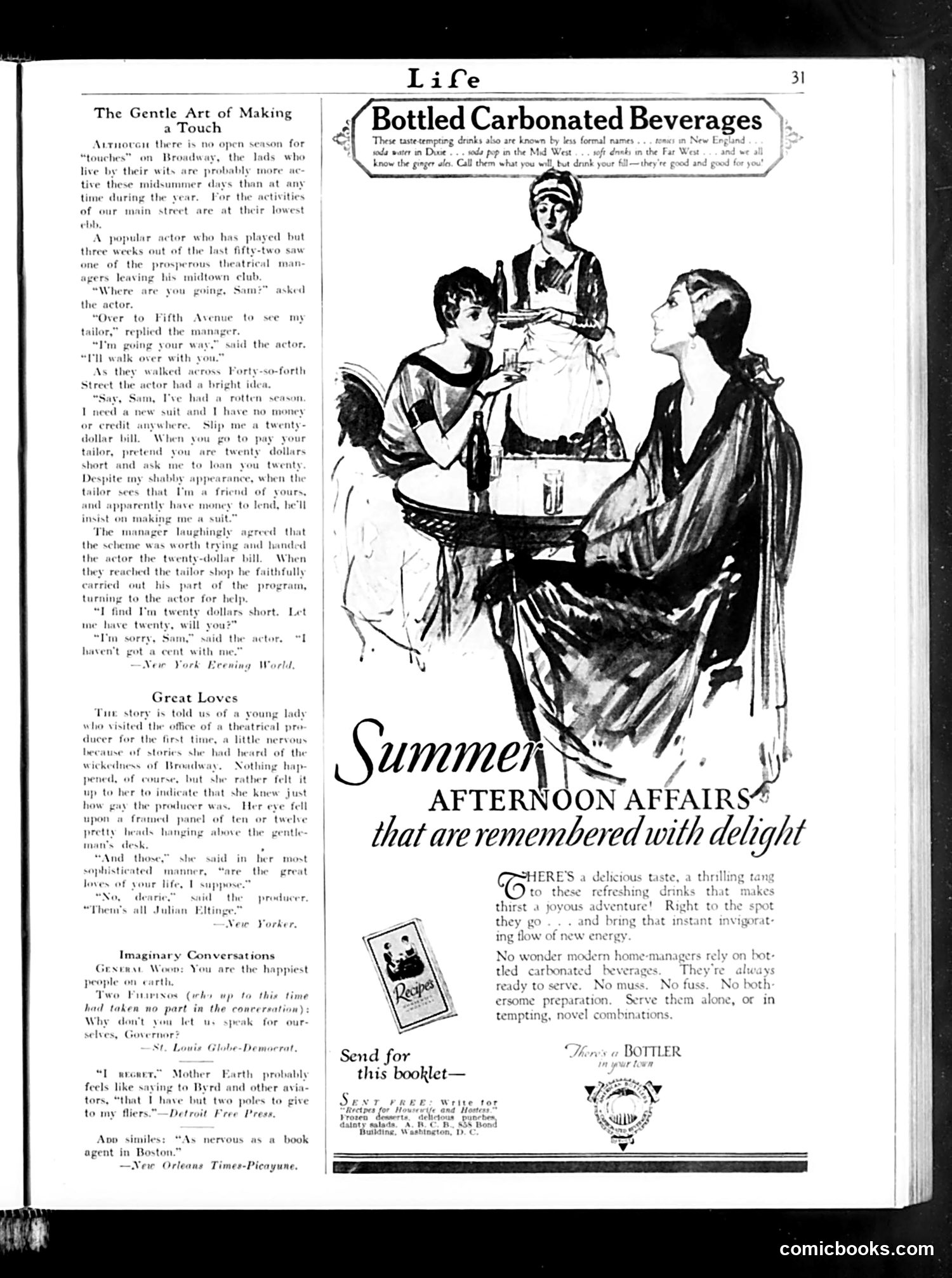
This page contains three humorous short pieces typical of *Life* magazine's satirical humor: **"The Gentle Art of Making a Touch"** satirizes Depression-era financial desperation. An unemployed actor cons a theater manager into lending him money by creating an elaborate scheme: he borrows $20, repays it publicly to impress the tailor, then asks to borrow it back—implying the manager is wealthy enough to lend casually. The joke's on the manager when the actor reveals he has no money at all. It mocks both theatrical pretense and the financial struggles of performers. **"Great Loves"** gently satirizes theatrical producers' vanity. A young actress assumes the framed photos on a producer's desk are his romantic conquests, but they're actually headshots of performers—likely chorus girls or minor actresses. The joke suggests producers' "love affairs" are actually just professional relationships. **The carbonated beverages advertisement** at bottom is straightforward product promotion, not satire. The page reflects 1920s-30s Broadway culture and economic anxiety during lean theatrical seasons.
📄 Transcribed text from this page (OCR, searchable)
Machine-transcribed from the original scan — historical spelling and the odd misread are preserved.
The Gentle Art of Making a Touch Atrnoven there is no open season for uiches” on Broadway, the ads who live by their wits are probably more ac tive these midsummer days than at any time during the year. For the activities of our main stree at their lowest ebb, A popular actor who has played but three weeks out of the last fifty- one the prosperous theatrical, man: agers leaving his midtown club. “Where are you going, Sam?" asked the actor. “Over to Fifth Avenue to see my tailor,” rey the manager. “I'm going your way,” said the actor, “EM walk over with y« As they walked across Forty-so-forth Street the actor had a bright idea Ive had a rotten se and T have no m or credit. any Slip me a twenty- dollar bill you go to pay your tailor, pretend you are twenty dollars port and ask me loan you twenty Despite my shabby appearance, when the tailor sees that I'ma friend of y wand apparently have money to lend, he'll insist on making me a s The manager laughingly eed that the scheme was worth tryir 1 handed the actor the twenty-dollar bill, When they reached the t shop he faithfully carried out his part of the program, turning to the actor for help “I find I'm twenty dollars short. Let me have twenty, will you?" A” sid the actor, “1 haven't got a cent with me New York Evening World. Great Loves Tit story is told us of a young lady who visited ‘the office of a theatrical pre: ducer for the first time, a little nervous because of stories she had heard of the ness of Broadway. Ne hap. pened, of course, but she rather felt it up to her to indicate that she knew just how gay the producer was. Her eye fell upon a framed panel of ten or twelve pretty heads hang hove the man’s desk . “And those,” shes her most sophisticated im < the great es of your lif . learie” suid the — producer all Julian Eltinge.” Imaginary Conversations Gexense W You are the happiest people on curt Two Fiurxos (hs up to this time had taken no part in the conversation): Why don't you let us speak for our- selves, Governor? “L rvorer.” Mother Earth probably feels like saying to Byrd and other avia- tors, “that T have but two poles to give to my fliers."—Detroit Free Press. App similes: “As nervous as a book agent in Boston. —New Orleans Times-Picayune. Bottled Carbonated Beverages These taste-tempti ks also are known $s formal names * New Er soda pop in the Md W f n the Far West them what you will, but dink your fill —~they'r J AFTERNOON AFFAIRS that ave remembered with dels agit Crs he RES a delicia Dus e refre thirst a} they go ing flow of No wonder m tled carbona ready to serve. No mu: ersome preparatior this booklet— Sex r rree: write tor ws! Hoveer ie: ton eeu comicbooks.com