
A complete issue · 40 pages · 1927
Life — August 4, 1927
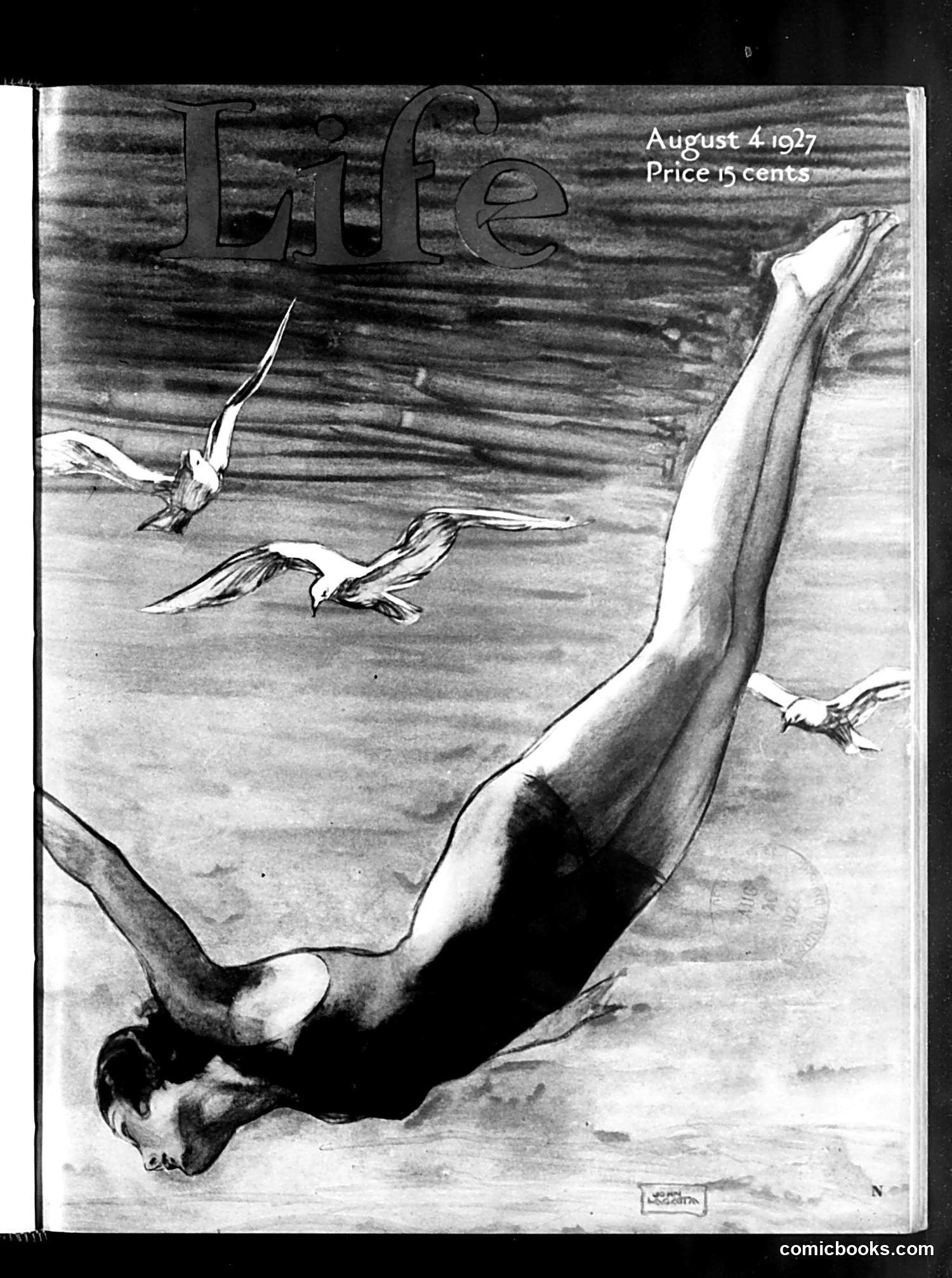
This cover depicts a woman in a bathing suit diving or falling toward water, with several birds scattered around her. The illustration appears to be a bathing/swimming scene, likely satirizing 1920s leisure culture and women's fashion during the "Roaring Twenties." The specific political or social commentary is unclear from the image alone without additional OCR text content. The cover could be commenting on: - Popular swimming culture and beach fashions of the era - Women's increasing participation in recreational activities - The magazine's typical humorous take on contemporary social trends Without more context from the magazine's interior content or caption, the precise satirical target remains uncertain, though the playful rendering suggests lighthearted social observation rather than sharp political critique.
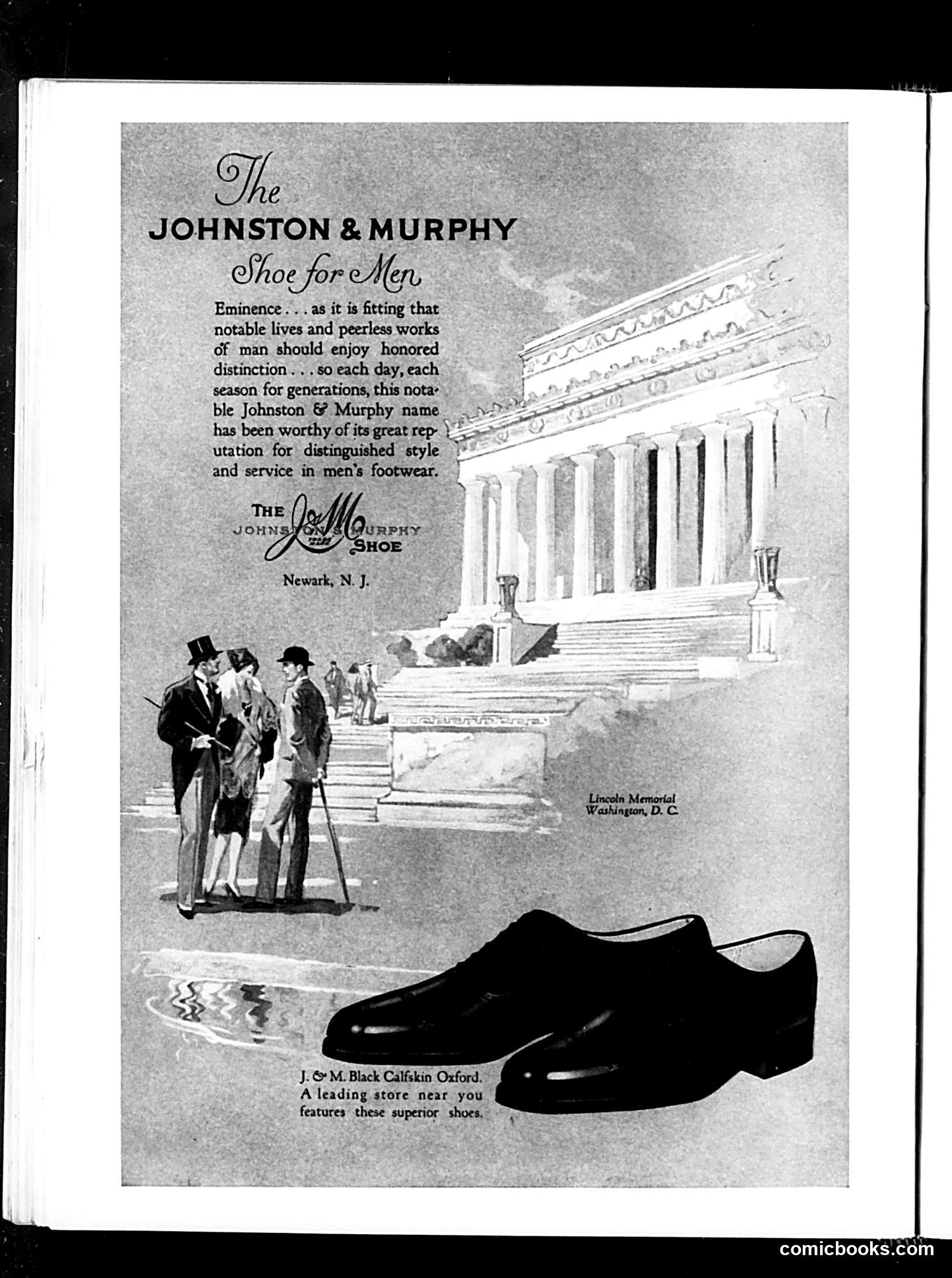
This is a **straightforward advertisement**, not political satire. Johnston & Murphy, a Newark, New Jersey shoe company, promotes their men's footwear by associating it with distinction and eminence. The ad uses the **Lincoln Memorial in Washington, D.C.** as a visual backdrop—a symbol of American prestige and timeless importance. Three well-dressed men in formal attire (top hats, suits) stand before the monument, suggesting that wearing Johnston & Murphy shoes is appropriate for men of importance and standing. The text emphasizes the brand's "great reputation for distinguished style and service in men's footwear" across generations. The lower section shows the actual shoe product: a black Calfskin Oxford. The messaging equates proper footwear with respectability and social standing.
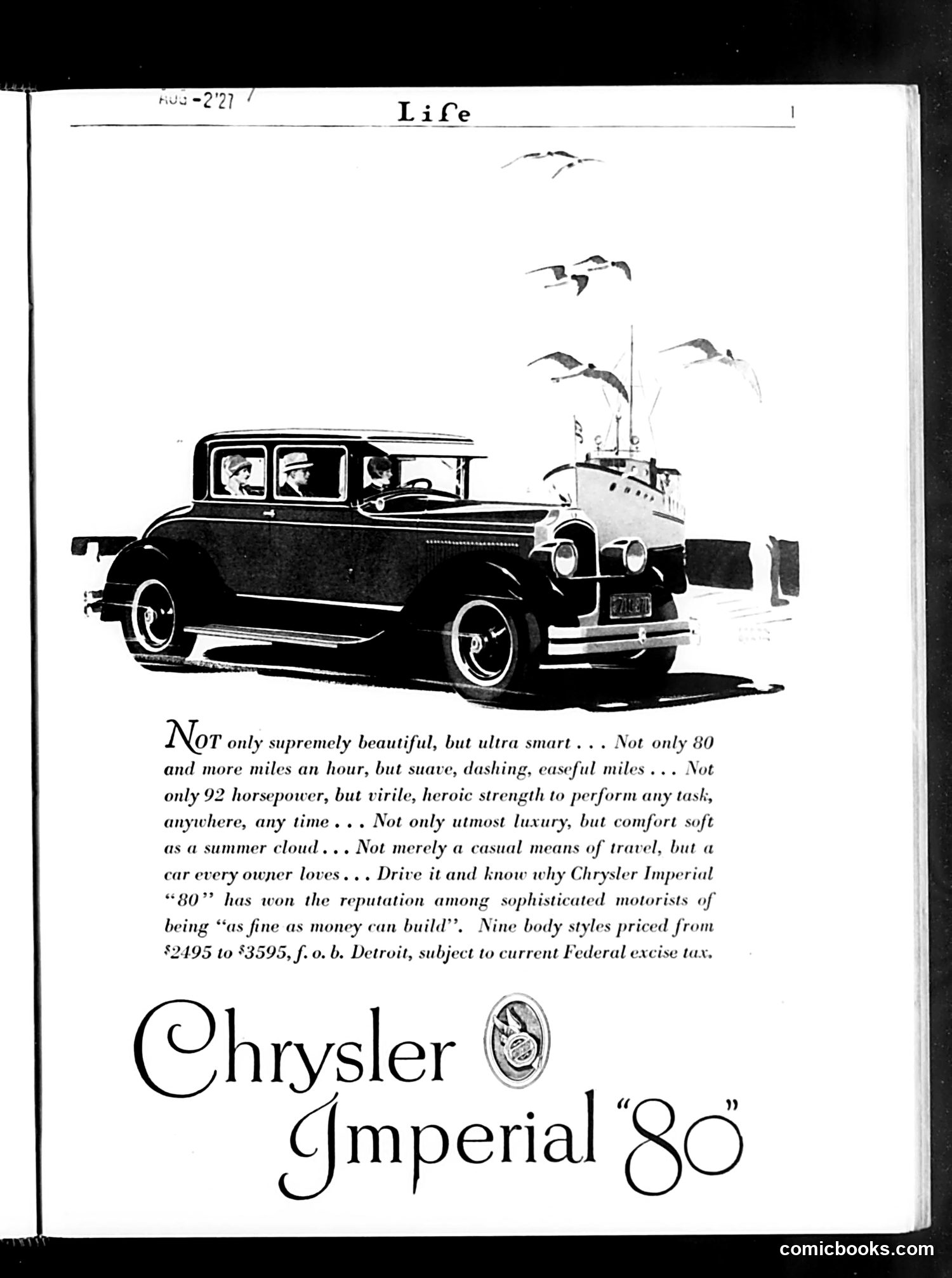
This page is **primarily an automobile advertisement**, not political satire or comics. It advertises the Chrysler Imperial "80" model to readers of *Life* magazine. The advertisement uses persuasive language emphasizing luxury features: beauty, speed (80+ mph), horsepower (92), comfort, and prestige. The illustration shows an elegant sedan at a dock with a ship in the background, suggesting cosmopolitan sophistication and travel. The phrase "as fine as money can build" appeals to wealthy readers. Pricing ranges from $2,195 to $3,595 (substantial sums in this era), with a note about Federal excise taxes. There is **no political commentary or satire present**—this is straightforward commercial marketing targeting affluent motorists of the period.
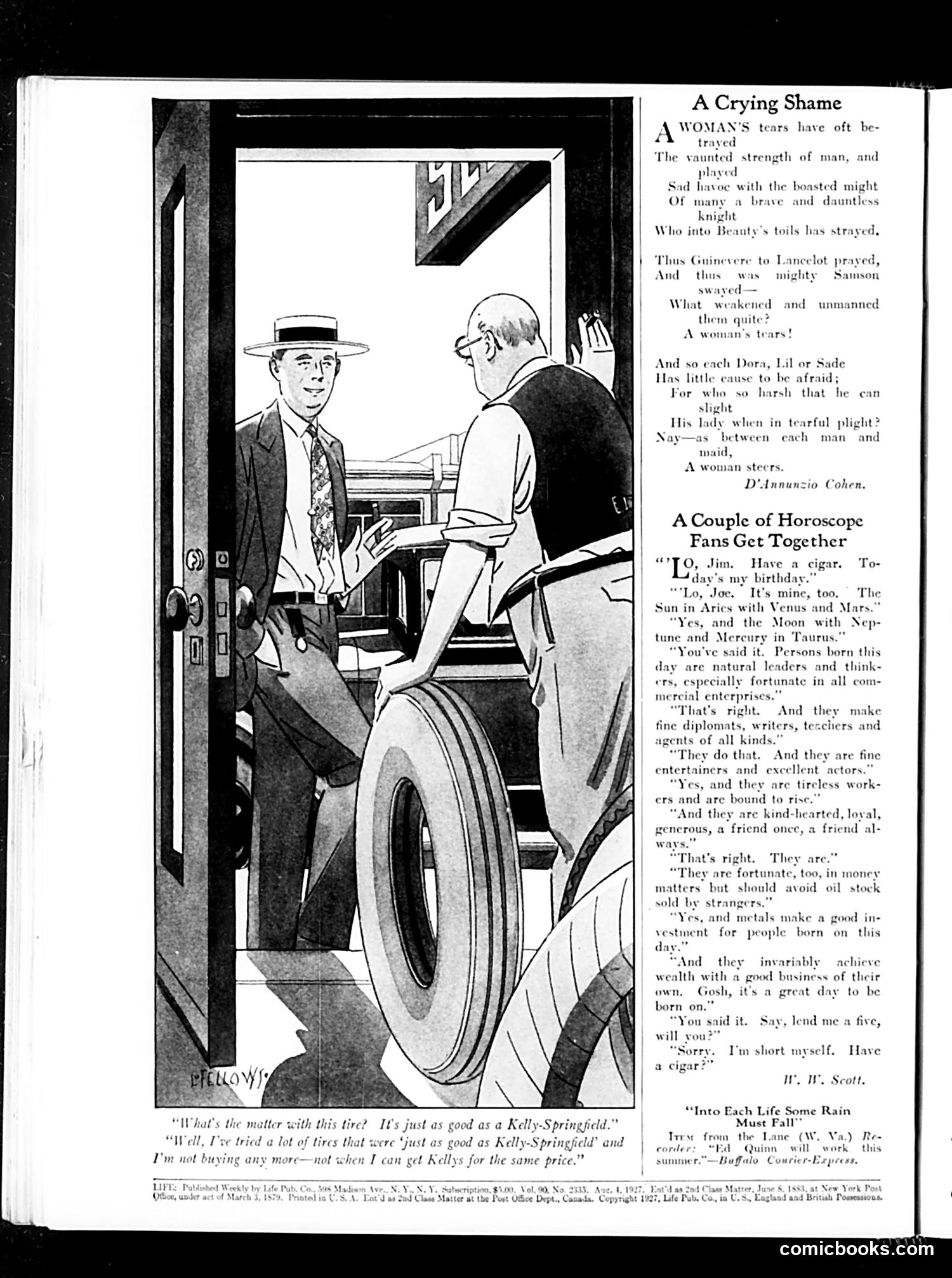
The main cartoon depicts two men discussing a car tire. One man (appearing to be a salesman or mechanic in a hat) is pitching the tire to another man. The caption quotes them debating tire quality and price, specifically mentioning "Kelly-Springfield" brand tires. The humor centers on a commercial sales pitch: the customer resists buying the expensive new Kelly-Springfield tire, claiming his current tire "is just as good." The salesman counters that he can no longer afford cheaper alternatives. This satirizes both aggressive advertising tactics and consumer resistance during what appears to be the 1920s automotive era. The adjacent text pieces—"A Crying Shame" (poetry about women's tears) and "A Couple of Horoscope Fans Get Together" (dialogue about astrology)—are separate satirical content mocking sentimentality and superstition respectively, typical of Life magazine's varied social commentary format.
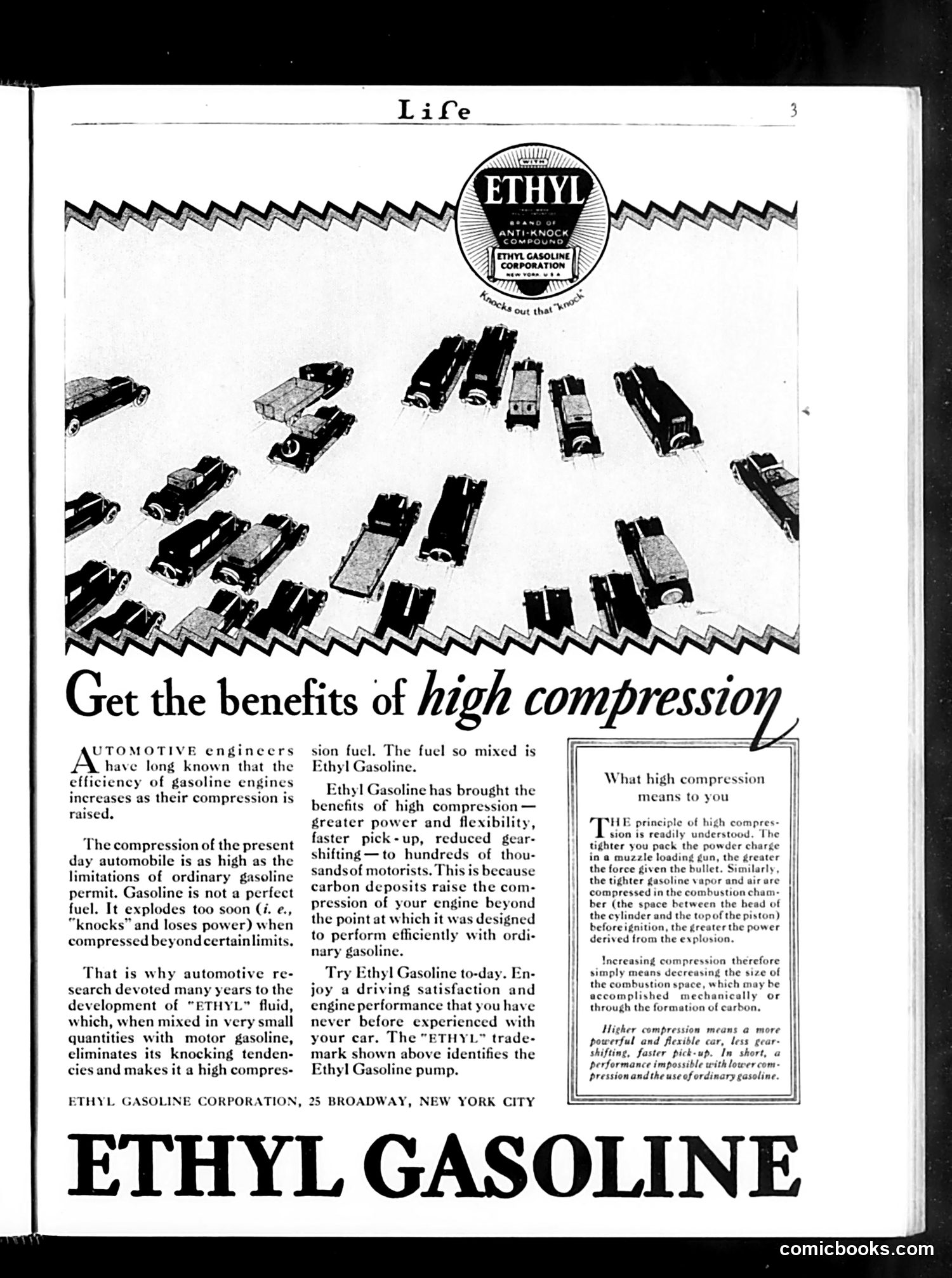
This is **not satire or a political cartoon**—it's a straightforward product advertisement for Ethyl Gasoline, published by the Ethyl Gasoline Corporation of New York. The page promotes the benefits of high-compression engine fuel through technical explanation and visual appeal. The illustration shows various automobiles arranged in a decorative pattern, emphasizing product availability. The advertisement explains that Ethyl Gasoline's anti-knock properties allow engines to operate at higher compression ratios, delivering greater power and performance than ordinary gasoline. This appears to be from the early automobile era when fuel technology was still developing and competitive differentiation through chemical additives was a novel marketing strategy.
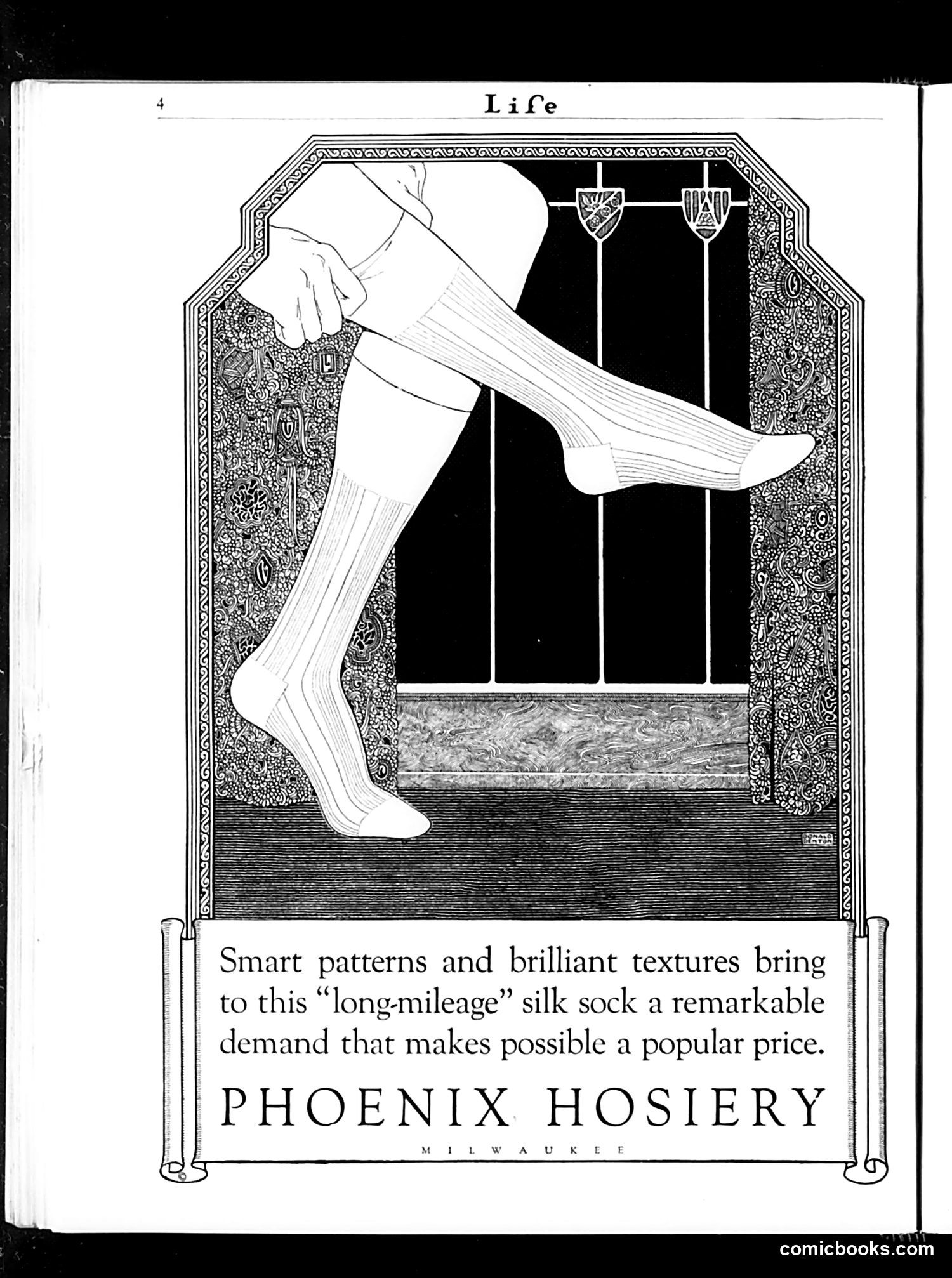
This is a **commercial advertisement, not a political cartoon**. It promotes Phoenix Hosiery from Milwaukee, featuring an illustration of a woman's leg wearing decorative silk socks. The ad emphasizes that smart patterns and brilliant textures justify the product's popularity and competitive pricing for a "long-mileage" silk sock. There is no satire, political content, or hidden meaning here—it's a straightforward early 20th-century fashion advertisement using an aesthetic illustration style typical of *Life* magazine's advertising section. The page number (4) and masthead confirm this is editorial content from the magazine, but the actual material is purely commercial messaging aimed at consumers interested in hosiery.
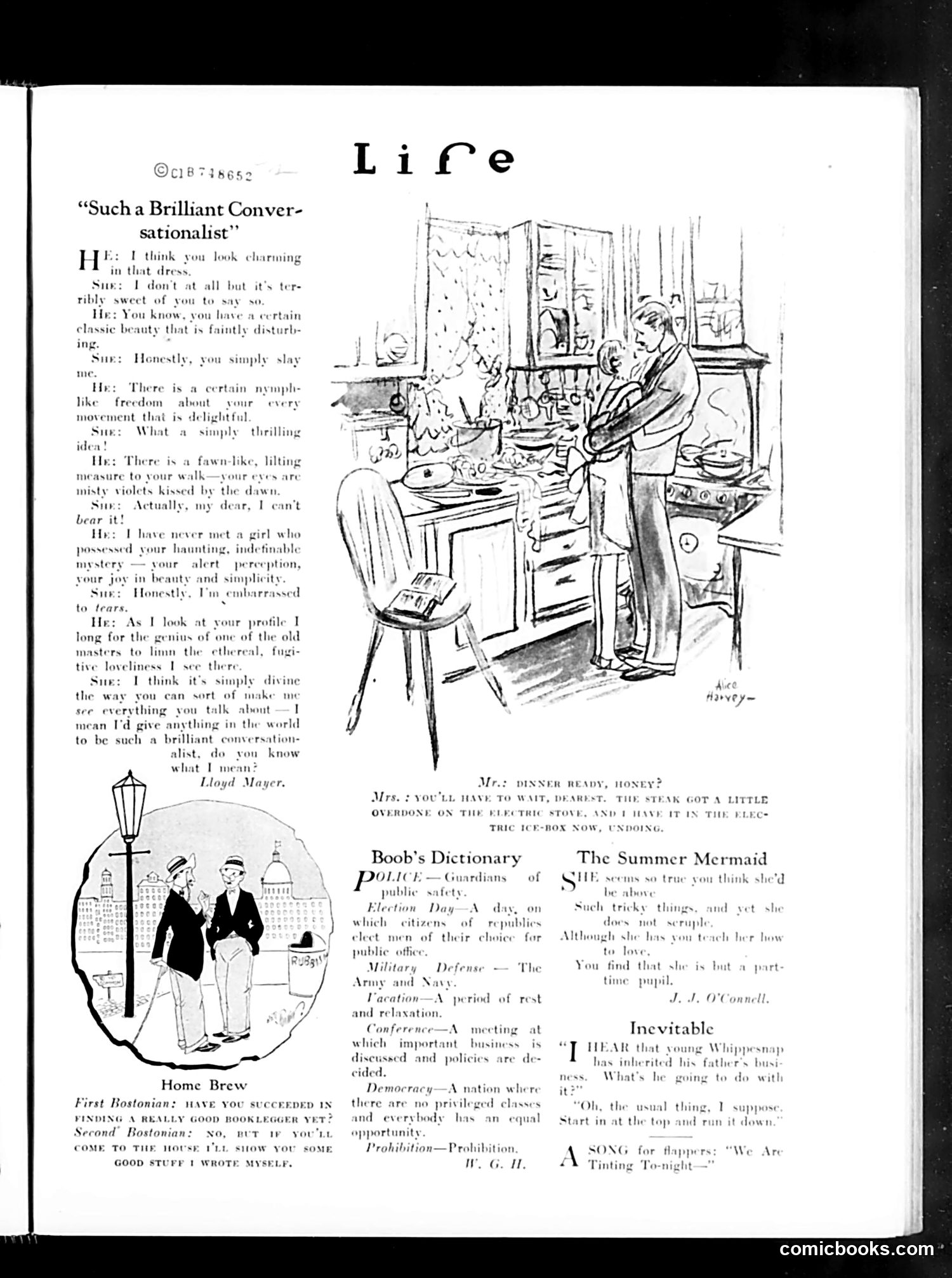
This page contains satirical humor rather than political cartooning. The main content is a dialogue titled "Such a Brilliant Conversationalist," credited to Lloyd Mayer, depicting a flirtation between a man and woman in a kitchen setting. The humor relies on the woman's flattery and the man's oblivious responses—she compliments his "charming" dress and "distinguished" quality, while he boasts about his freedom and compares himself to Renaissance masters. The satire targets shallow social conversation and masculine vanity. The page also includes minor sections: "Boob's Dictionary" (defining political/civic terms satirically), "The Summer Mermaid" (a poem), "Home Brew" (a city scene), and "Inevitable" (brief anecdote). These are light, domestic humor typical of Life's general-interest satirical content from this era.
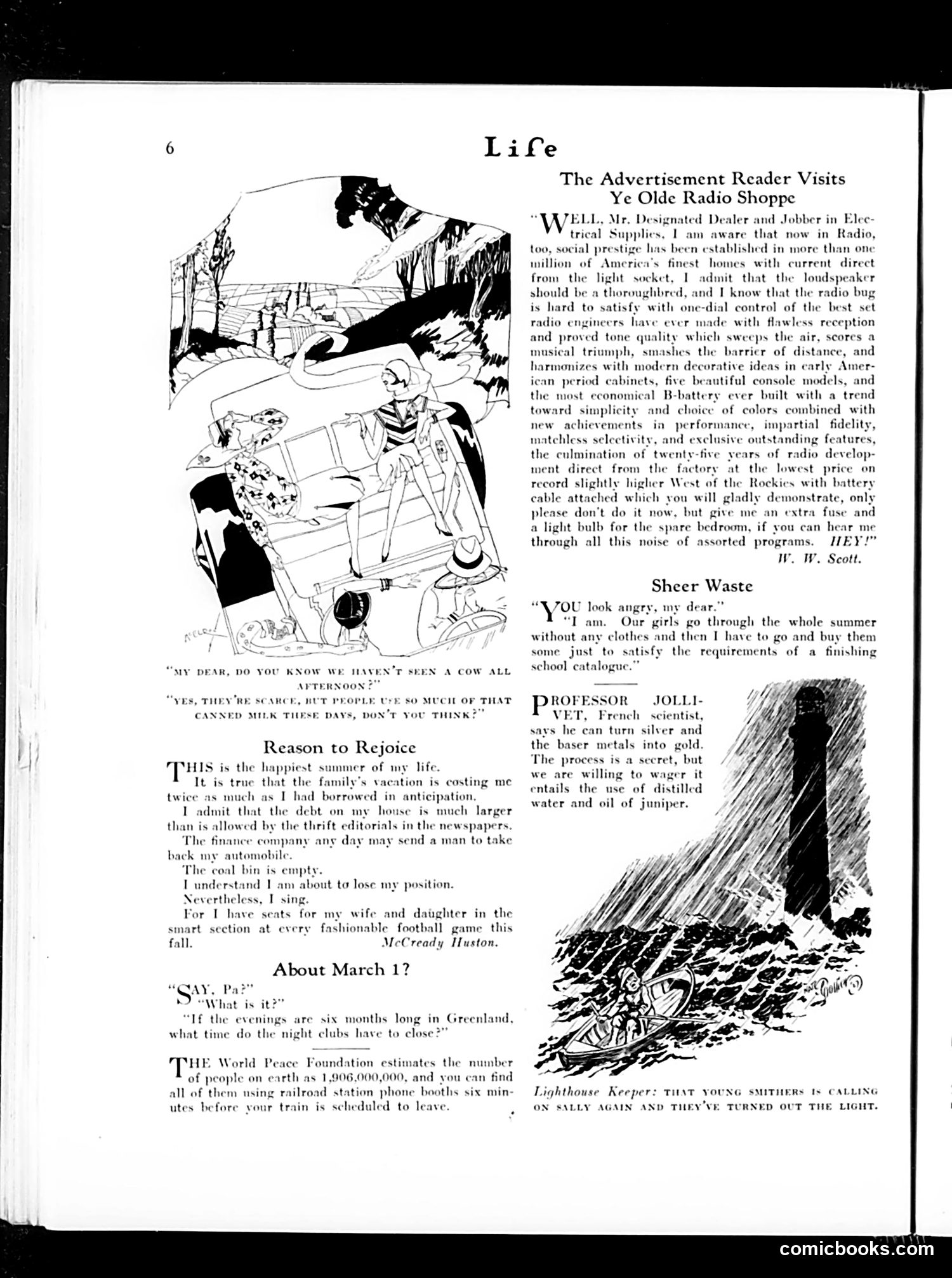
This page contains several satirical pieces typical of Life's humor format: **"The Advertisement Reader Visits Ye Olde Radio Shoppe"**: A critique of radio advertising claims. The illustration shows an exaggerated radio salesman pitching to a skeptical customer, satirizing manufacturers' inflated promises about radio performance and features. **"Reason to Rejoice"**: A brief humorous monologue from someone facing financial hardship (vacation debt, potential job loss, empty coal bin) yet maintaining optimism about attending football games—satirizing misplaced priorities and American optimism amid economic difficulty. **"Sheer Waste"** and other shorter pieces offer social commentary on frivolous summer spending and wasteful consumer habits. The **lighthouse illustration** appears unrelated to accompanying text about night clubs in Greenland, suggesting disconnected layout typical of magazine design.
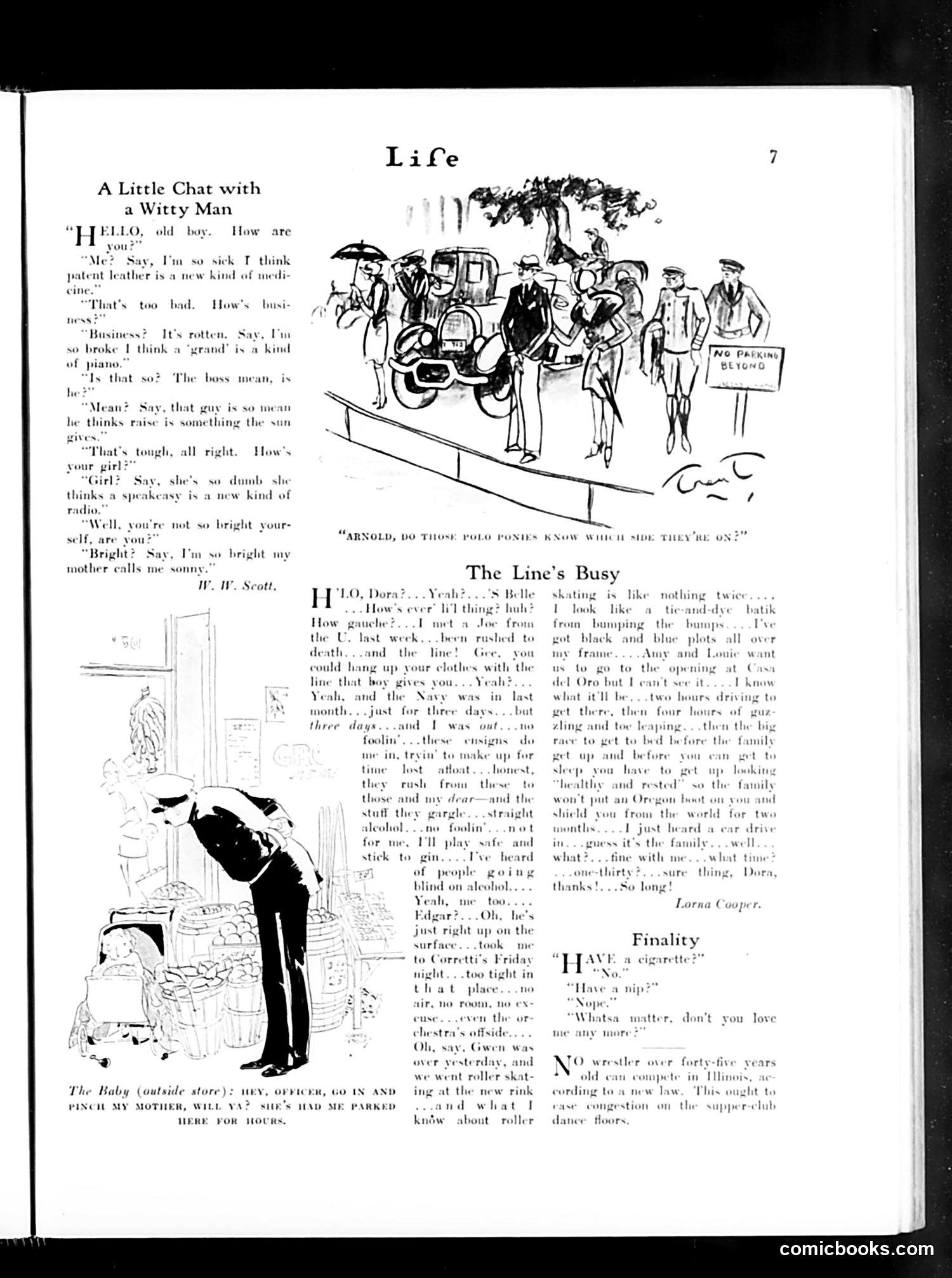
**Top Cartoon ("Arnold, Do Those Polo Ponies Know Which Side They're On?"):** This depicts a group of well-dressed men near an automobile and tree, with a "No Parking Beyond" sign visible. The joke appears to target wealthy polo players, suggesting they're so detached from ordinary rules that even their horses might be confused about which side of a parking restriction they belong on. It's satirizing upper-class entitlement and obliviousness to normal civic regulations. **"A Little Chat with a Witty Man":** A dialogue between two men discussing business failure, a girl, and various social observations. The humor relies on the protagonist's self-deprecating admissions of incompetence and poor judgment. **"The Line's Busy" and "Finality":** Appear to be short humorous pieces about modern inconveniences—phone difficulties and romantic rejection, respectively.
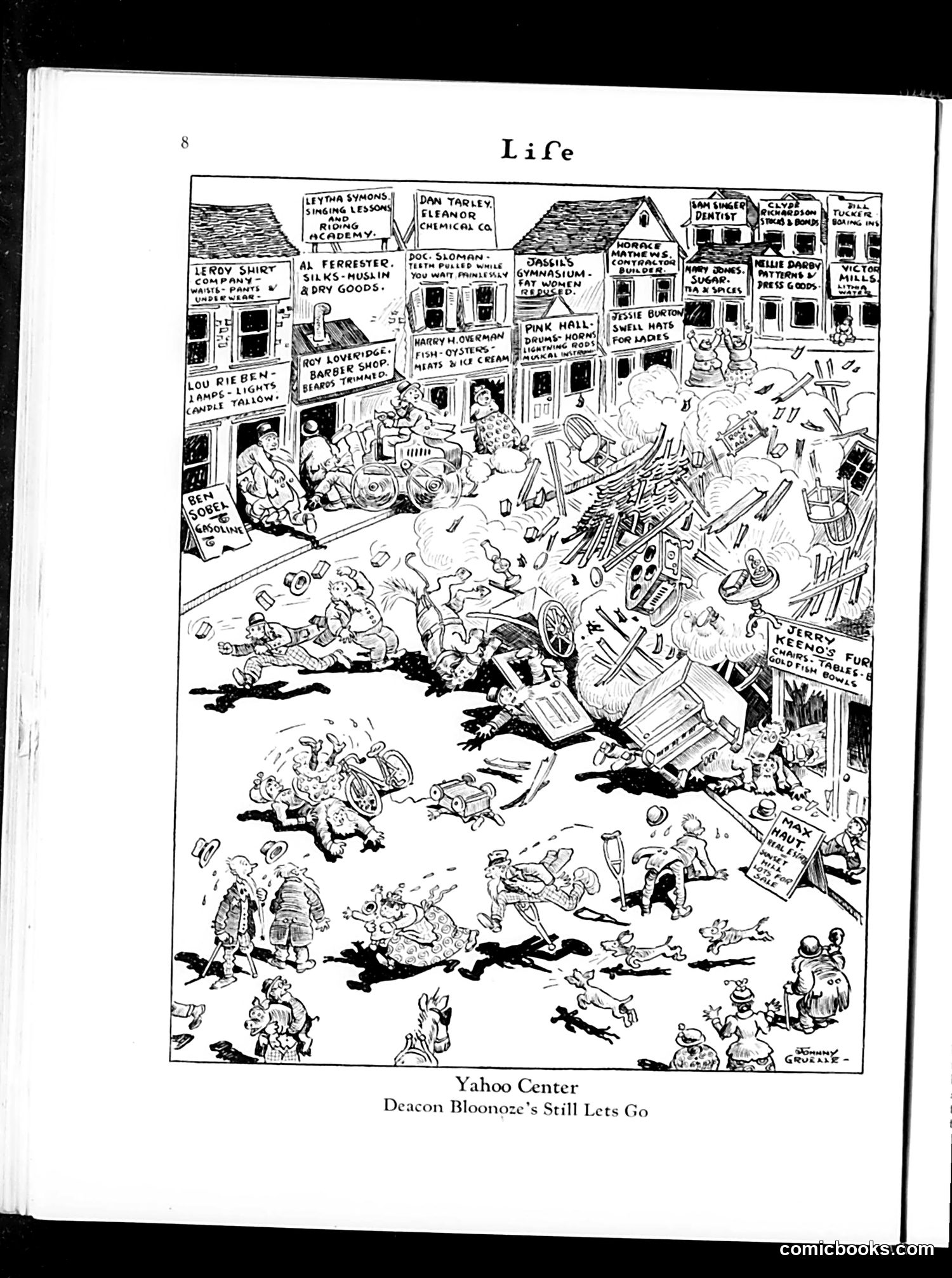
This is a satirical cartoon titled "Yahoo Center: Deacon Bloonoze's Still Lets Go," depicting a chaotic street scene in what appears to be a small town or neighborhood commercial district. The cartoon shows numerous storefronts (including a barber shop, chemical company, and various shops) with people engaged in wild, energetic activity—running, fighting, and generally behaving in undisciplined ways. The satire appears to mock small-town disorder or the breakdown of civic decorum, possibly suggesting excessive behavior at a local establishment called "Deacon Bloonoze's." The crowded, frenzied composition emphasizes chaos and lack of restraint. Without additional context about "Deacon Bloonoze" or the specific date, the precise political or social target remains unclear, though it likely satirizes either Prohibition-era speakeasy culture or general small-town social disorder.
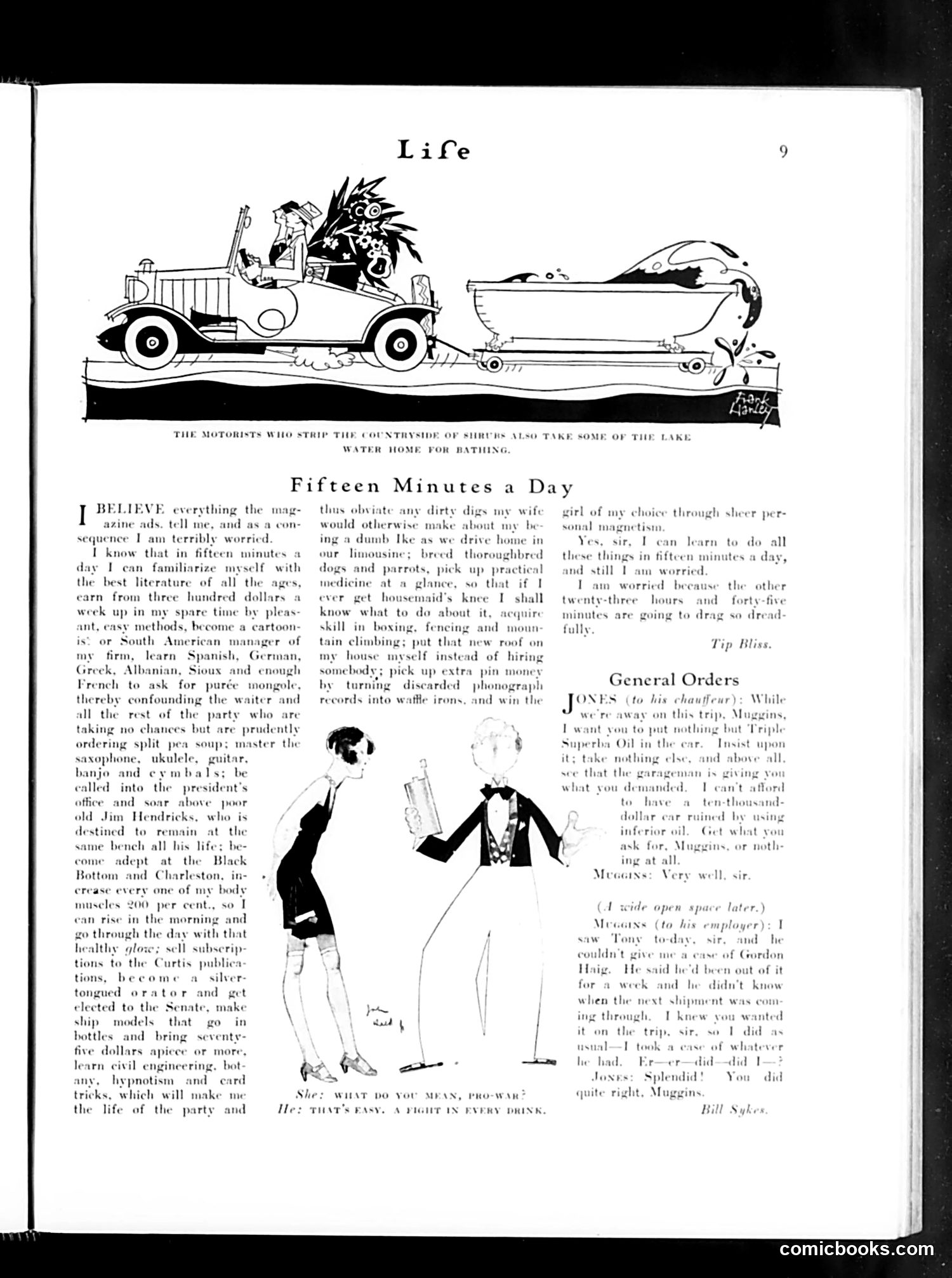
This page from *Life* magazine contains a satirical article titled "Fifteen Minutes a Day" alongside period illustrations. The main cartoon shows a car towing a bathtub—depicting motorists who take lakeside bathing trips, humorously suggesting they transport entire bathing facilities while driving through the countryside. The article text expresses anxiety about modern life's pace, claiming the author can master "all the ages" in fifteen minutes daily through reading. The narrative mocks self-improvement culture and dilettantism, referencing figures like "old Jim Hendricks" and satirizing the pretension of becoming a "silver-tongued orator" or "elected to the Senate" through such minimal effort. The accompanying figure illustrations show a woman and man in period dress, with dialogue suggesting romantic tension or social awkwardness—typical of *Life*'s humor about modern courtship and leisure.
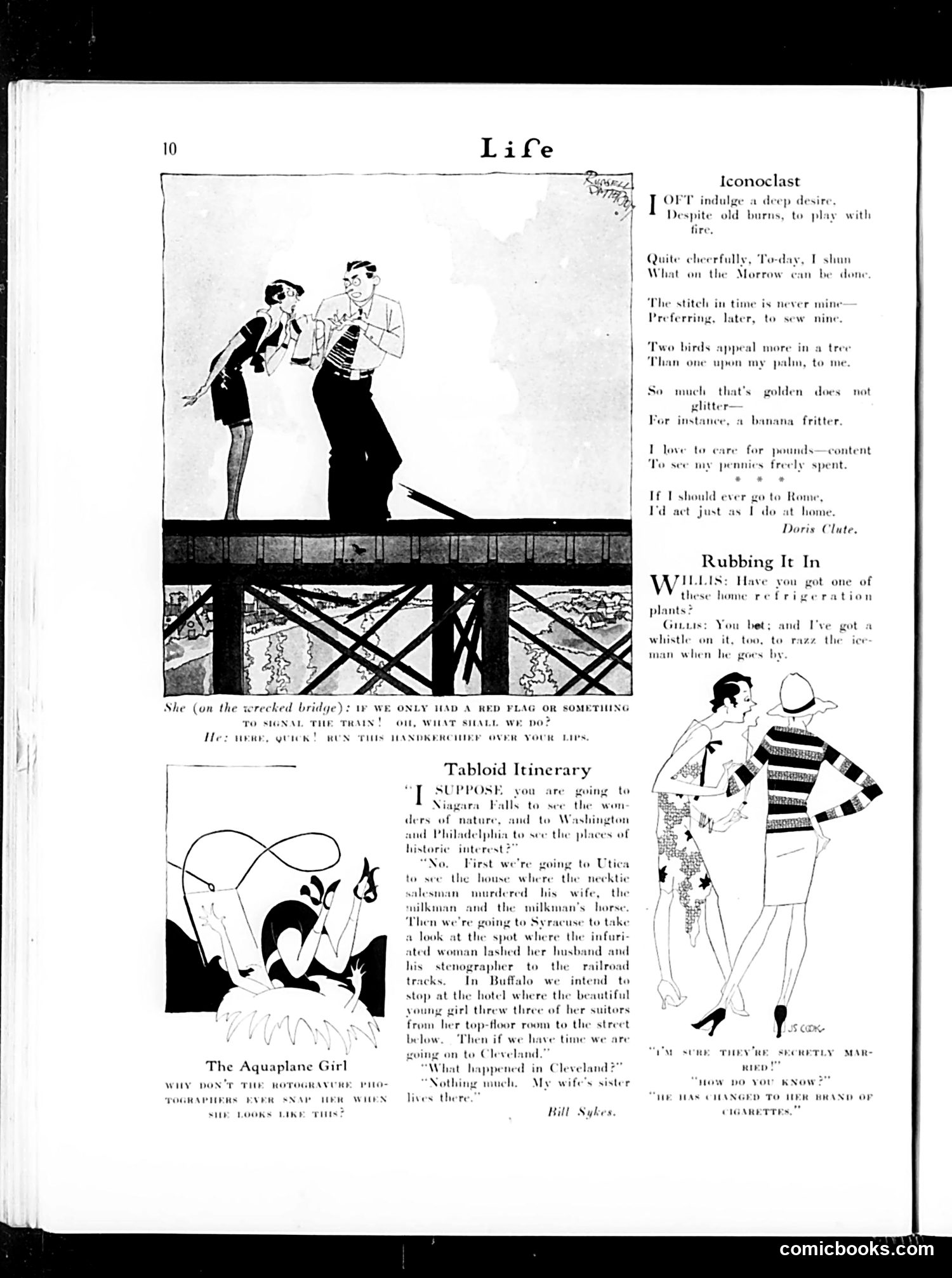
This page contains three separate humor pieces typical of early 20th-century Life magazine: 1. **"Iconoclast"** - A poem by Doris Clute celebrating unconventional behavior and rejecting materialism ("So much that's golden does not glitter—For instance, a banana fritter"). 2. **"Rubbing It In"** - A dialogue joke about home refrigeration technology, with one character bragging about owning a "whistle" to warn the iceman of his arrival—a status symbol among those who could afford ice delivery. 3. **"The Aquaplane Girl"** - A caption joke about photography, questioning why photographers can't photograph an attractive woman on an aquaplane without her appearing blurry. 4. **"Tabloid Itinerary"** - A conversational piece about planning a tourist trip hitting various American landmarks and sites associated with notorious crimes or scandals. All reflect period-appropriate domestic humor and consumer culture anxieties.
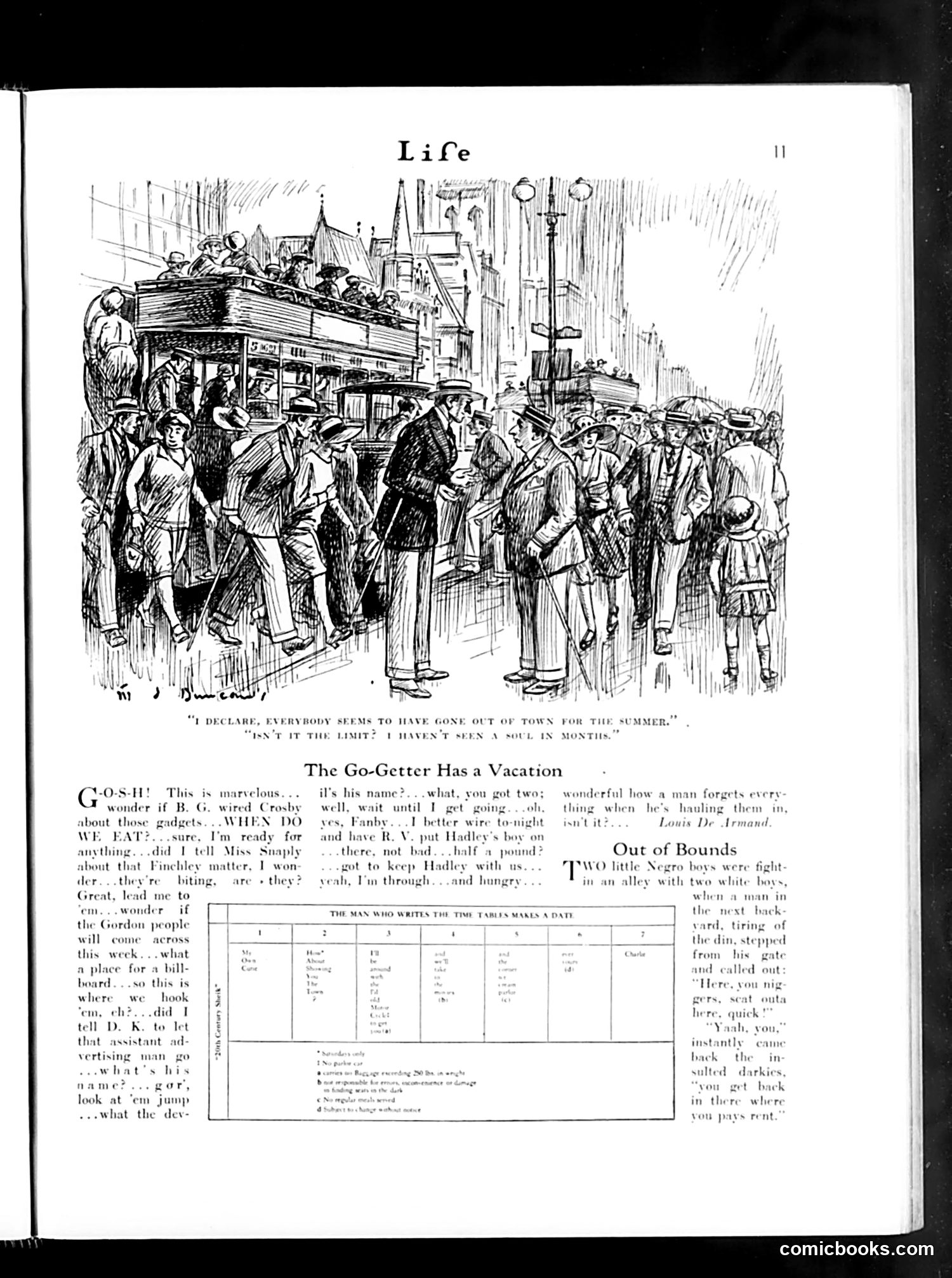
This page contains two satirical pieces about urban summer life circa early 1900s. **"The Go-Getter Has a Vacation"** mocks a business-obsessed character who, despite leaving the city for summer, cannot stop thinking about work—mentioning his office, staff, and business matters even while supposedly relaxing. The satire targets the emerging "go-getter" businessman culture and workaholic mentality of the era. **"Out of Bounds"** depicts two Black children being chased from a white neighborhood yard by an angry resident. The short story critiques racial segregation and exclusionary practices in American neighborhoods, illustrating the discriminatory "color line" that confined Black Americans to specific areas. Both pieces use humor and narrative to satirize contemporary social problems—compulsive work culture and racial discrimination—that Life's readers would have recognized from daily life.
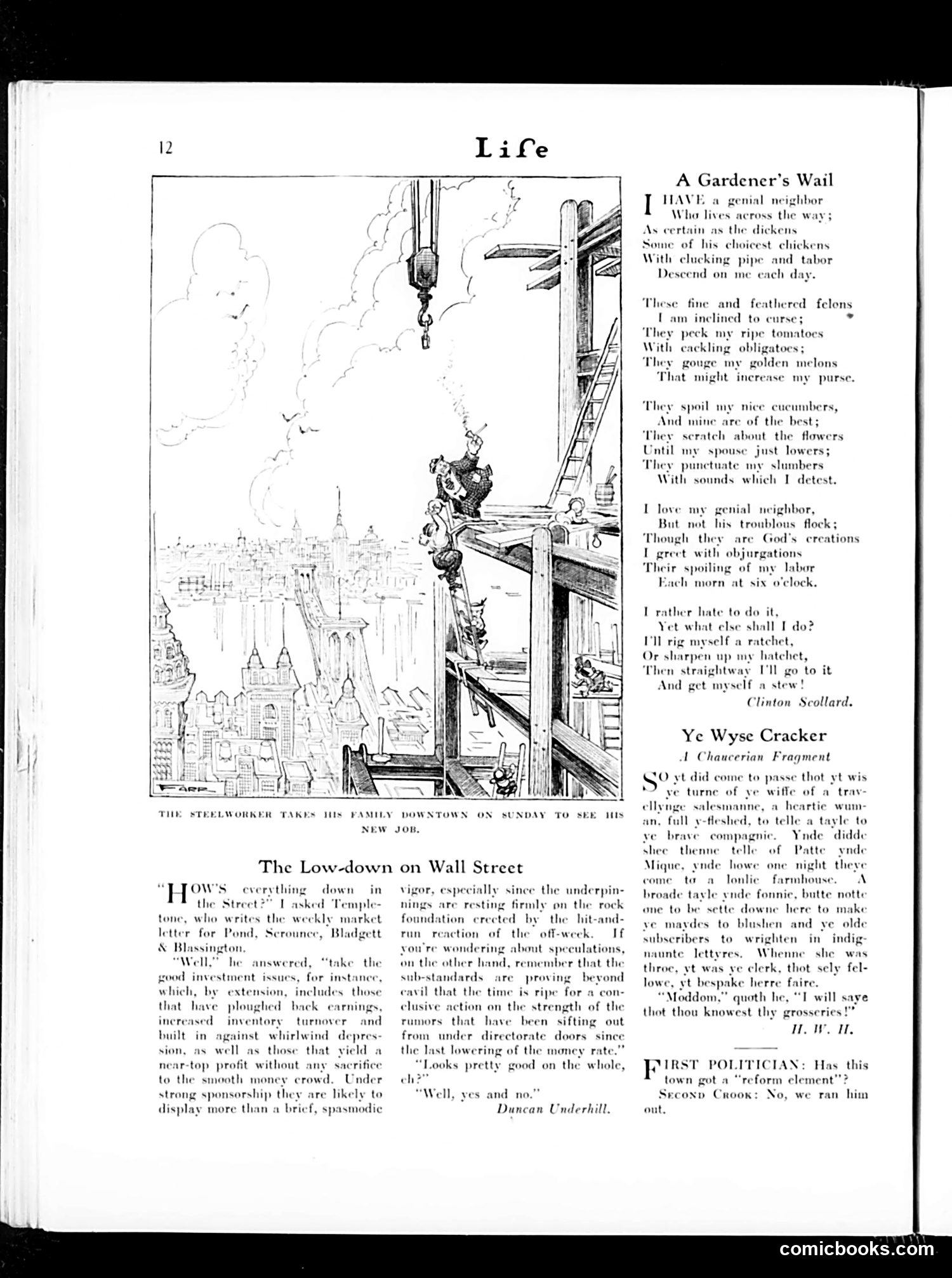
This page contains three separate pieces of satirical content: 1. **"The Low-down on Wall Street"** — A cartoon depicting workers suspended on the exterior of a tall building overlooking a cityscape, illustrating the precarious nature of Wall Street employment and financial instability. The accompanying dialogue discusses how building foundations (likely metaphorical for financial institutions) are unstable, with mentions of "off-the-week" speculation and money rates. 2. **"A Gardener's Wail"** by Clinton Scollard — A poem satirizing a neighbor's chickens and livestock that destroy the speaker's garden and produce, expressing frustration with rural nuisances while acknowledging they're "God's creations." 3. **"Ye Wyse Cracker"** — A Chaucerian-style fragment parodying medieval literature, appearing to mock either archaic language or period storytelling conventions. The page exemplifies Life's mix of financial satire, domestic humor, and literary parody.
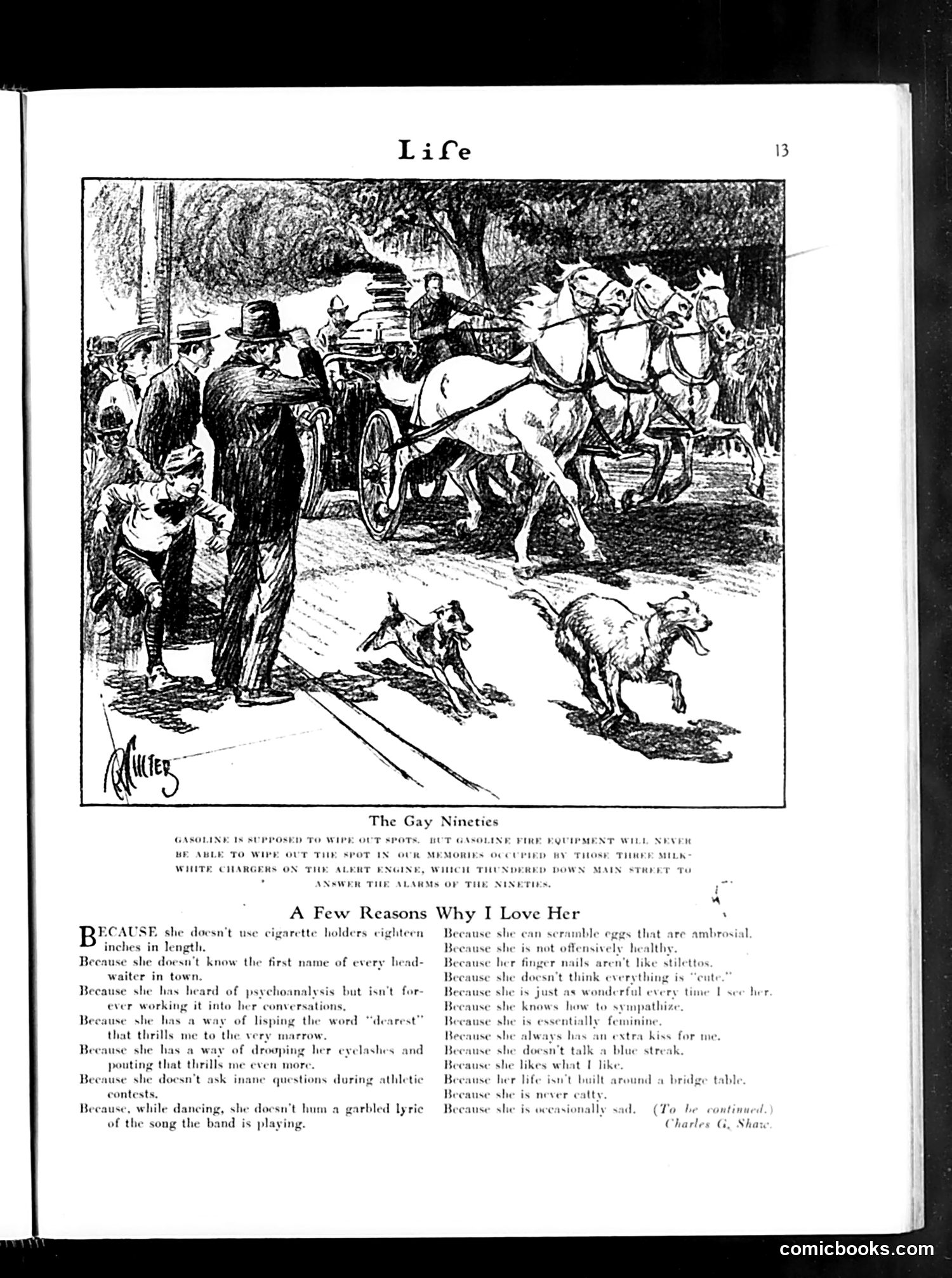
This satirical cartoon mocks the romanticized nostalgia for the 1890s. The caption states that "gasoline fire equipment will never wipe out spots...occupied by those three milk-white chargers on the alert engine, which thundered down Main Street to answer the alarms of the nineties." The image depicts a modern (1920s-era) motorized fire engine alongside horses and a carriage from the 1890s, with well-dressed onlookers. The satire targets sentimental idealization of the "Gay Nineties"—suggesting that while people romanticize that era, they ignore its actual inefficiencies. The joke is that nostalgia overlooks how primitive and problematic old methods were compared to modern technology, even if they seemed more picturesque.
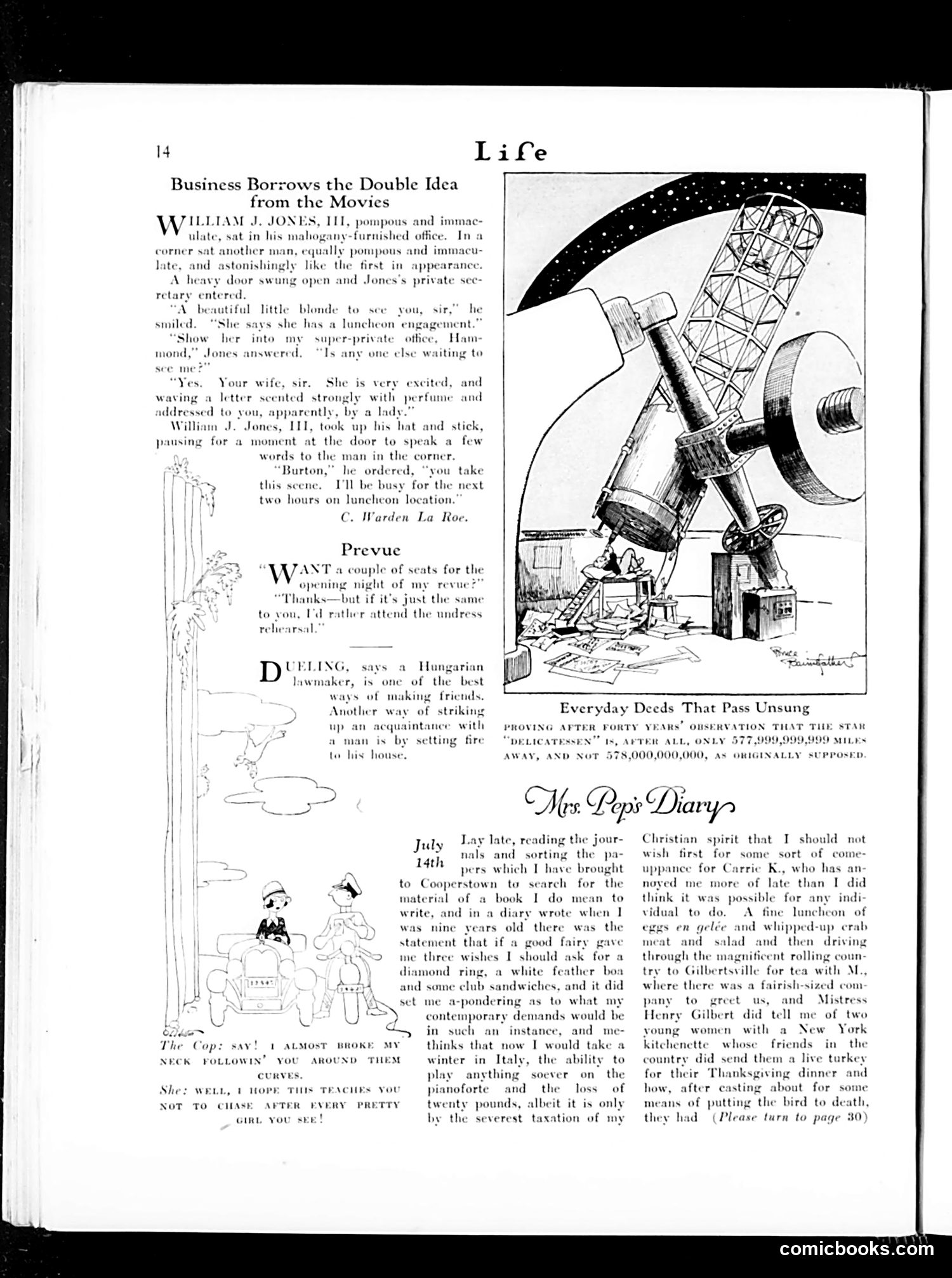
This page contains three distinct pieces of satirical content: **"Business Borrows the Double Idea from the Movies"** mocks a pompous businessman named William J. Jones III who imitates movie theatricality in his office behavior, complete with dramatic entrances and affected mannerisms. **"Prevue"** is a brief joke about someone declining theater seats, preferring the undress rehearsal—likely satirizing voyeuristic interests. **"Mrs. Pep's Diary"** (main feature) presents a woman's reflection on outdated childhood wishes versus modern adult concerns. The accompanying cartoon shows parents and children, with dialogue about chasing "pretty girls," satirizing generational differences in values and desires. The overall theme critiques how movies influence everyday business culture and how societal priorities shift across generations.
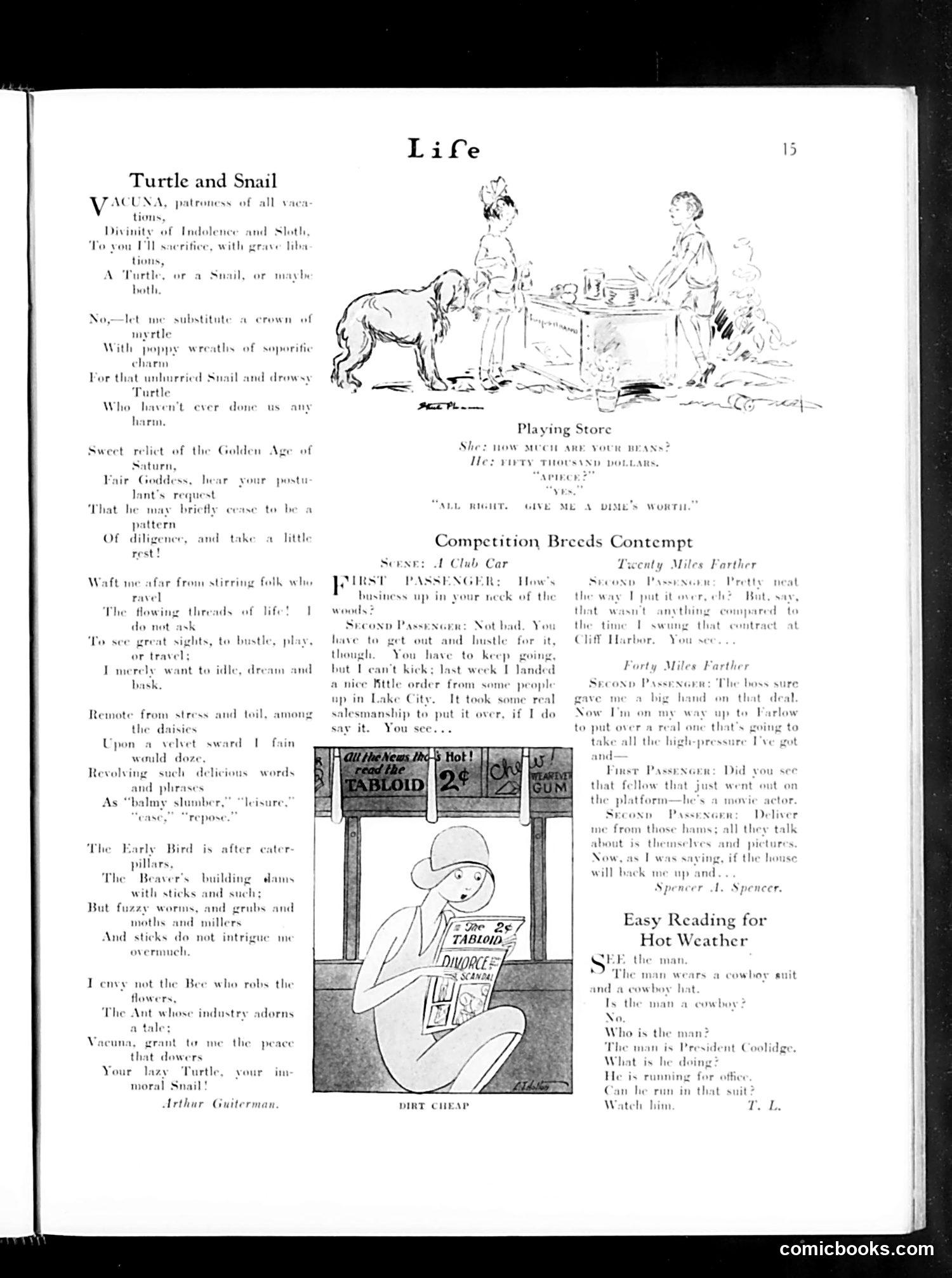
This page from *Life* magazine (page 15) contains three distinct pieces: 1. **"Turtle and Snail"** — A poem by Arthur Guiterman addressing Vacuna (Roman goddess of leisure) and Sloth, advocating rest and idleness over industriousness. The accompanying sketch shows children and a dog at play. 2. **"Playing Store"** and **"Competition Breeds Contempt"** — Humorous dialogues. "Playing Store" shows children role-playing commerce; "Competition Breeds Contempt" depicts train passengers discussing business dealings, satirizing commercial culture. 3. **"Dirt Cheap"** — A cartoon of a figure reading tabloid newspapers (visible mastheads include what appears to be sensationalist publications), mocking cheap journalism and popular taste for lowbrow media. The page overall satirizes American consumer culture, commercial competitiveness, and mass-market entertainment, contrasting these with idealized leisure and innocence.
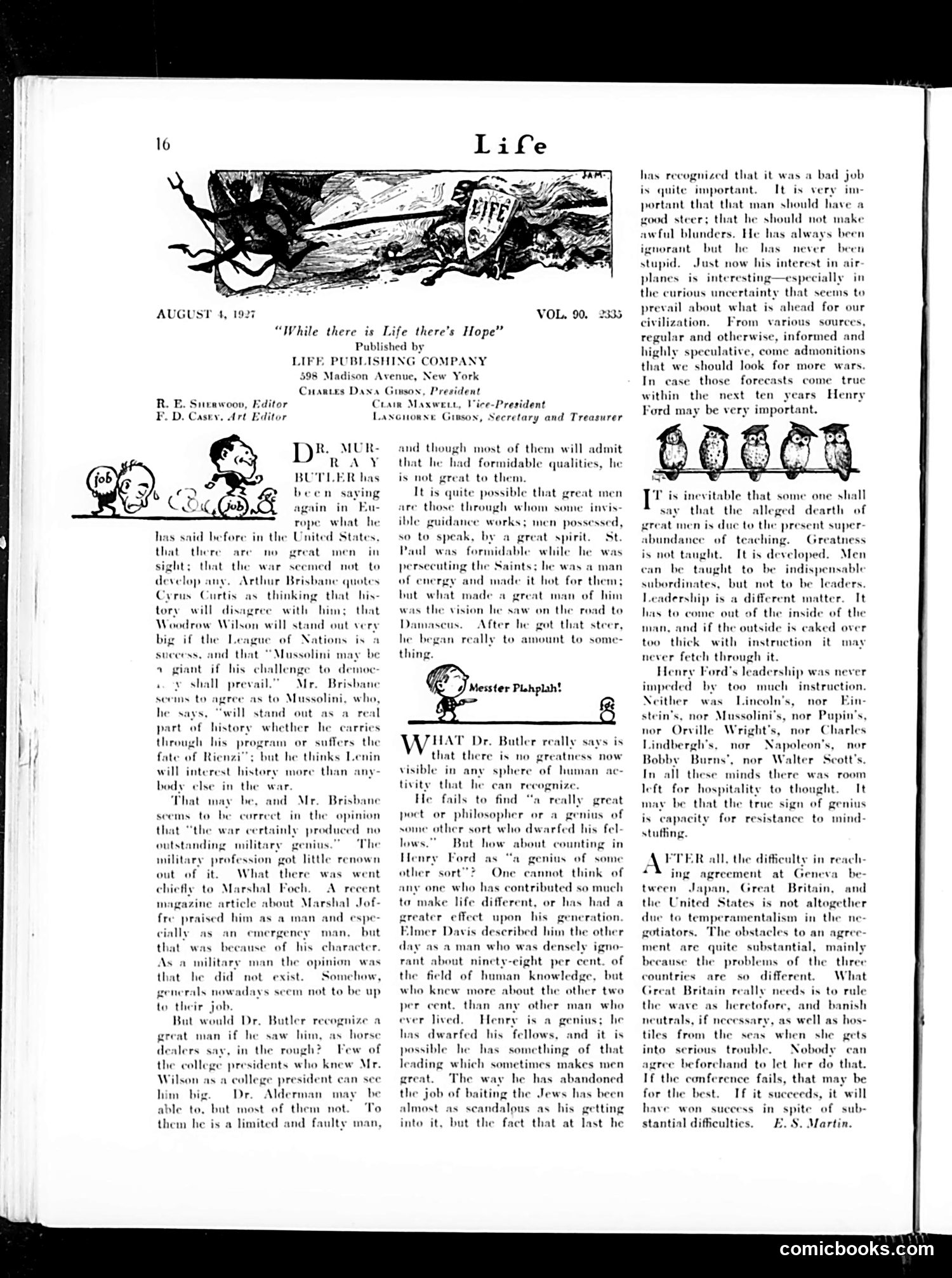
This page contains editorial commentary on leadership and greatness, with a small cartoon labeled "Master Pickpocket!" showing a child figure. The main text discusses Dr. Murray Butler's argument that greatness cannot be recognized in contemporary figures. The author counters by listing historical leaders—Lincoln, Napoleon, Henry Ford—who demonstrated genius through action rather than instruction. The piece critiques an over-reliance on education and teaching as markers of leadership, suggesting instead that true greatness emerges from capacity for resistance to mindlessness and decisive action. The final section mentions obstacles to international agreement at Geneva between Japan, Britain, and the United States regarding war treaties and disarmament—likely referencing post-WWI naval negotiation debates of the 1920s.
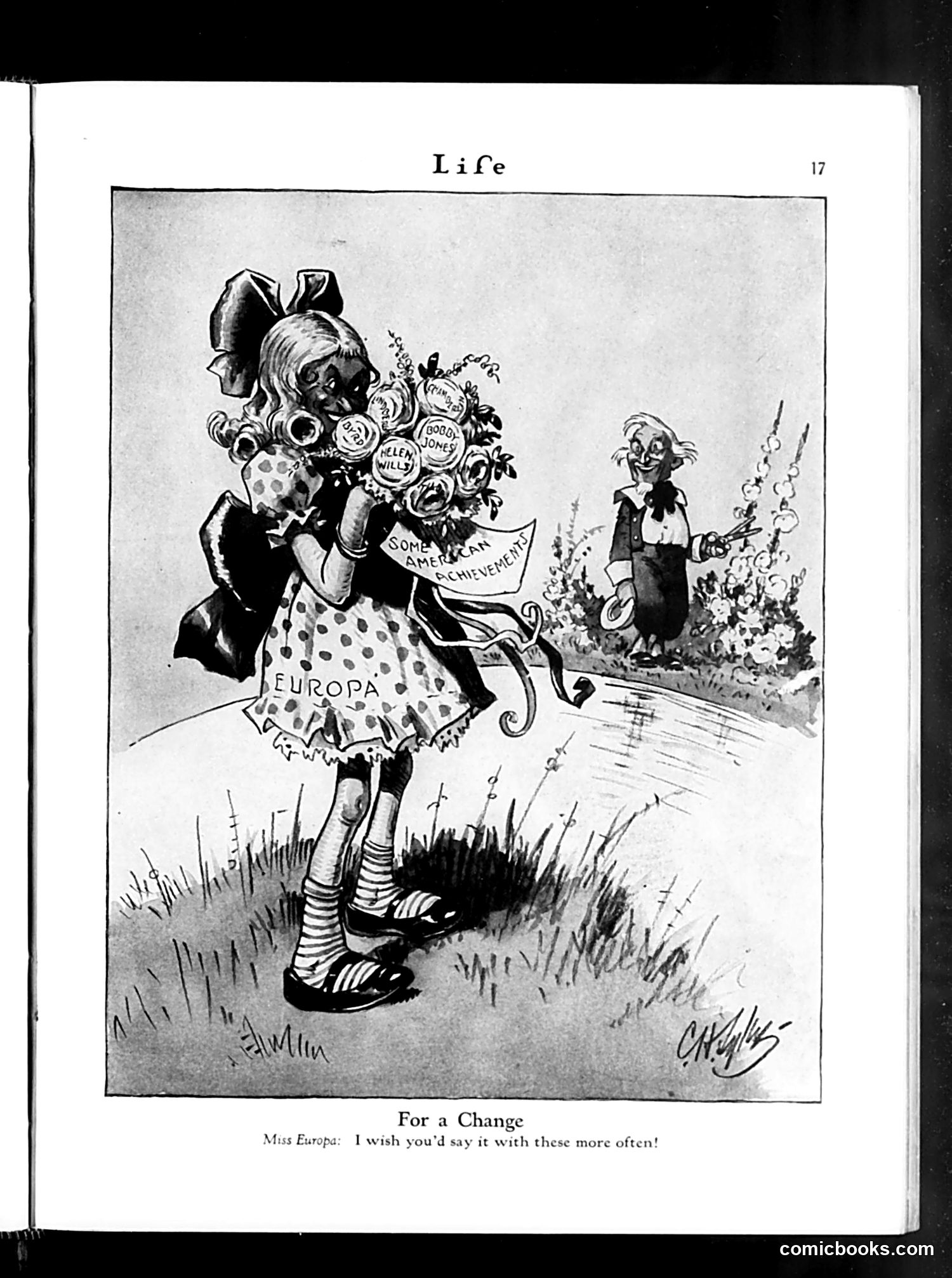
This satirical cartoon from *Life* magazine depicts "Miss Europa" (personified Europe) as a woman in a polka-dotted dress holding a large bouquet of flowers labeled with names including "Helen," "Dolly," and others marked "SOME AMERICAN ACHIEVEMENT." She wears a bow and striped stockings. A caricatured figure (likely representing an American or specific American politician) stands to the right. The caption reads: "Miss Europa: I wish you'd say it with these more often!" The satire appears to critique American foreign policy or diplomacy—suggesting that Americans rely too heavily on monetary gifts or economic gestures ("say it with flowers") rather than substantive political engagement or genuine relationship-building with Europe. The cartoon reflects early 20th-century tensions between American isolationism and European expectations for American involvement.
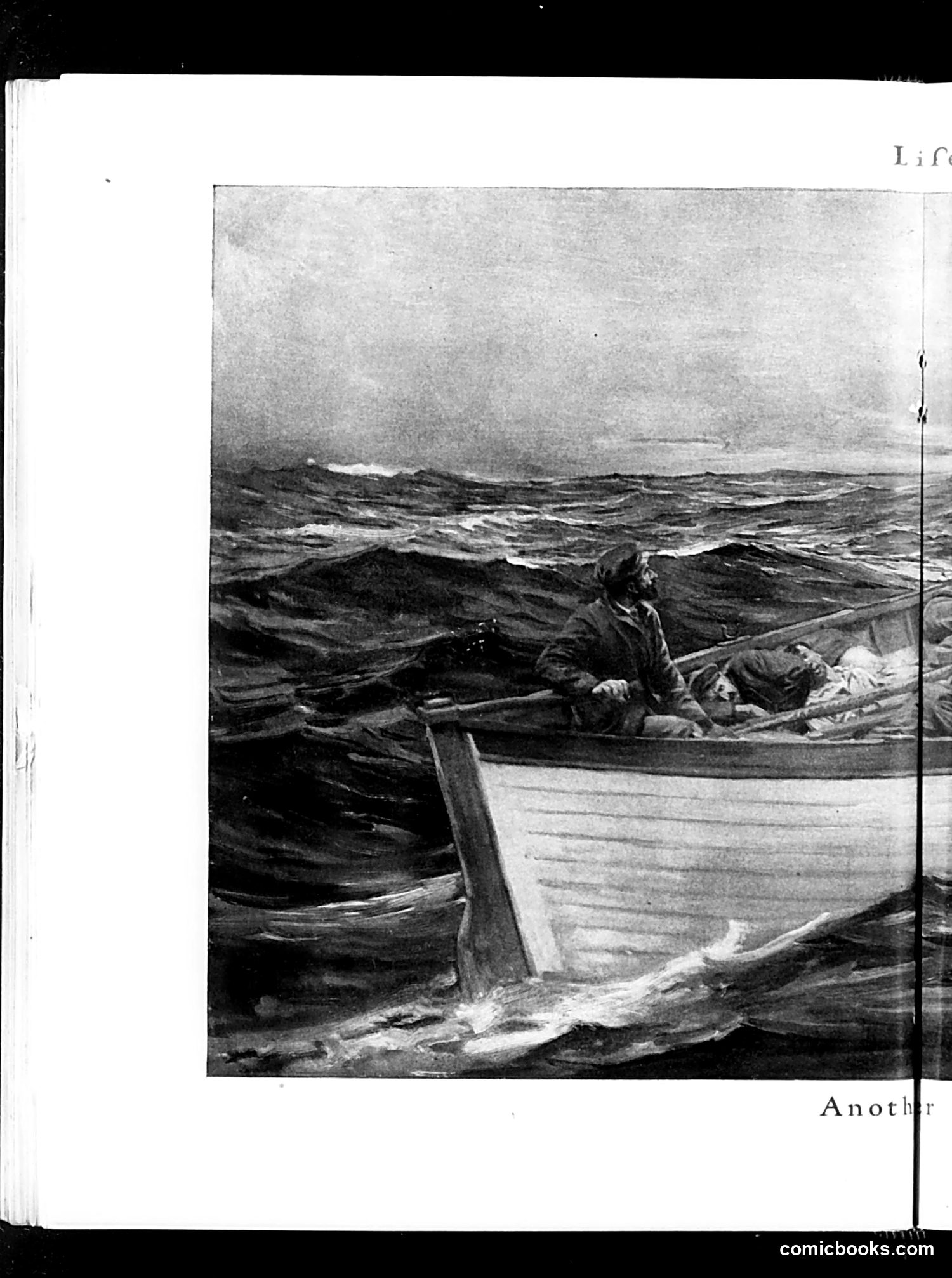
This page shows a dramatic maritime scene: two figures in a small rowboat amid rough seas. One person appears to be rowing or struggling with an oar while another lies in the boat. The visible text reads "Anoth[er]" at the bottom right. Without additional context from the magazine issue's date or surrounding articles, the specific political or social reference is unclear. However, the image likely illustrates a contemporary event or social commentary—possibly relating to maritime disaster, survival, immigration, or nautical peril that Life's readership would have recognized. The dramatic composition and inclusion in a satirical magazine suggests it comments on a newsworthy situation rather than serving as pure reportage. The incomplete text prevents definitive interpretation of the satire's target.
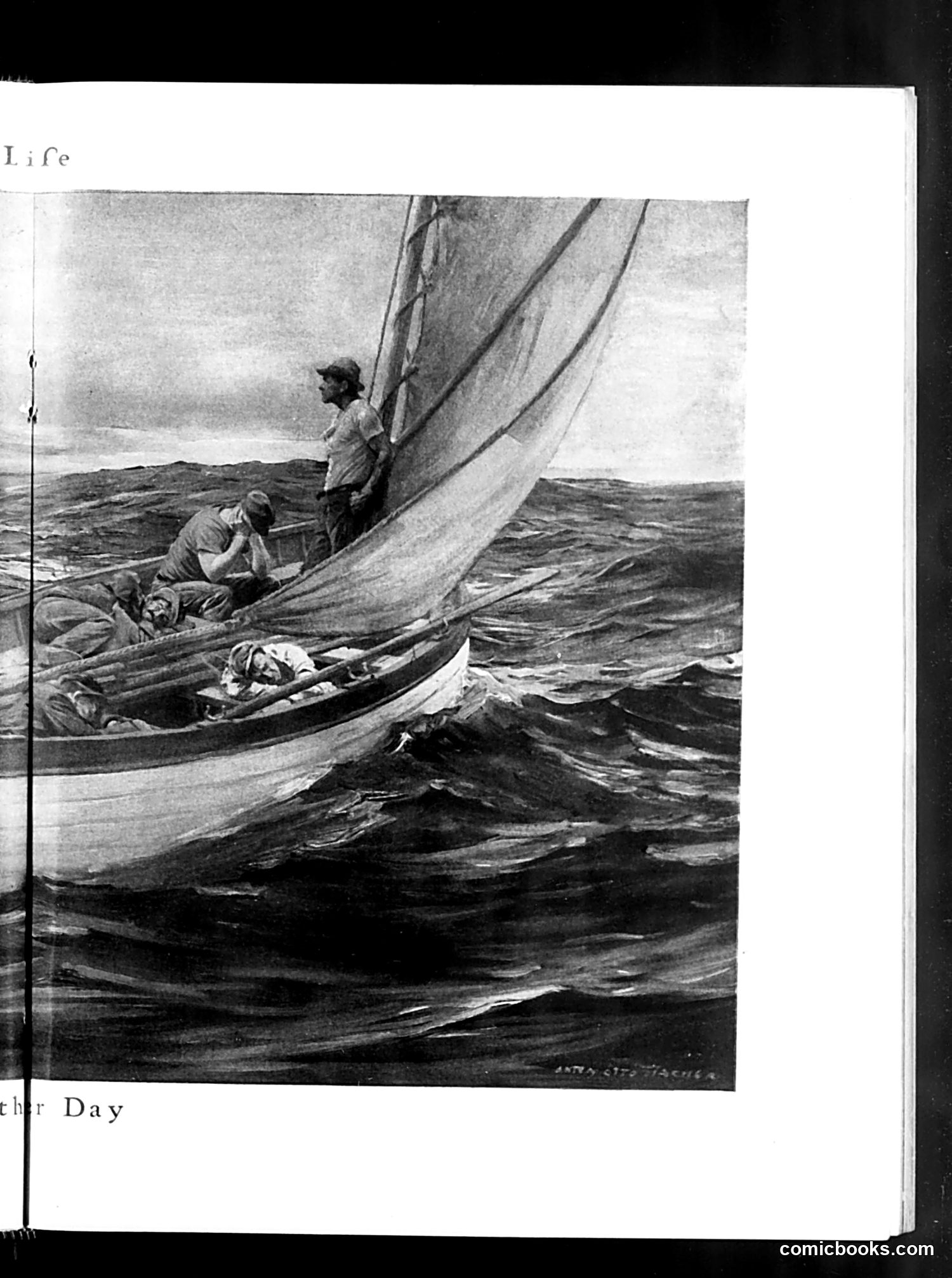
The OCR text is corrupted and illegible, so I must rely solely on the image. This black-and-white photograph shows three men in a small sailboat on rough seas. Two men sit/recline in the boat while one stands. The composition and dramatic water suggest this depicts a rescue or perilous situation at sea. Without legible text identifying the figures or context, I cannot definitively explain what political or social satire this represents. The page header reads "Life" and there appears to be partial text reading "ther Day" at bottom left, but this is insufficient to identify the cartoon's subject, the figures depicted, or its satirical point. **I cannot responsibly identify who these men are meant to represent or what event or commentary this illustrates.**
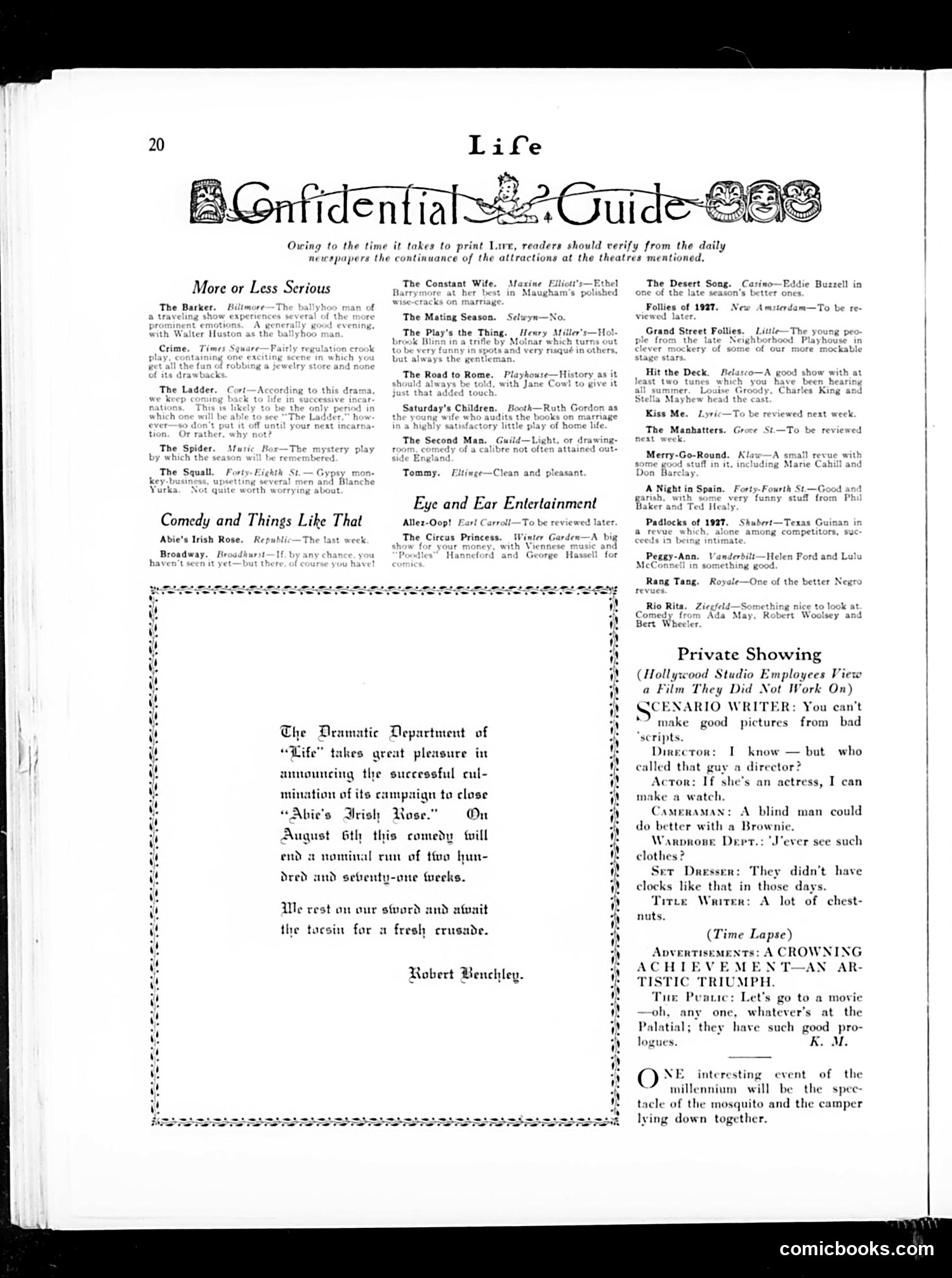
This page from Life magazine (circa 1927, based on theater references) contains theatrical reviews and satirical commentary on Hollywood filmmaking. The main satire is the "Private Showing" section—a humorous dialogue among Hollywood studio workers critiquing a film they didn't work on. Each department blames others: the scenario writer faults the script, the director questions who hired the "director," the actor brags he could "make a watch" (succeed despite bad material), the cameraman claims a blind person could do better, the wardrobe department notices anachronistic costumes, and the title writer dismisses the dialogue as "chestnuts" (old jokes). The joke satirizes Hollywood's internal dysfunction and mutual finger-pointing—everyone blames everyone else rather than taking responsibility. Separately, the page announces Life's successful campaign to close "Abie's Irish Rose," a popular Broadway comedy that apparently ran for 271 weeks. Robert Benchley's closing quip about mosquitoes and campers lying together is abstract social commentary on unlikely peaceful coexistence.
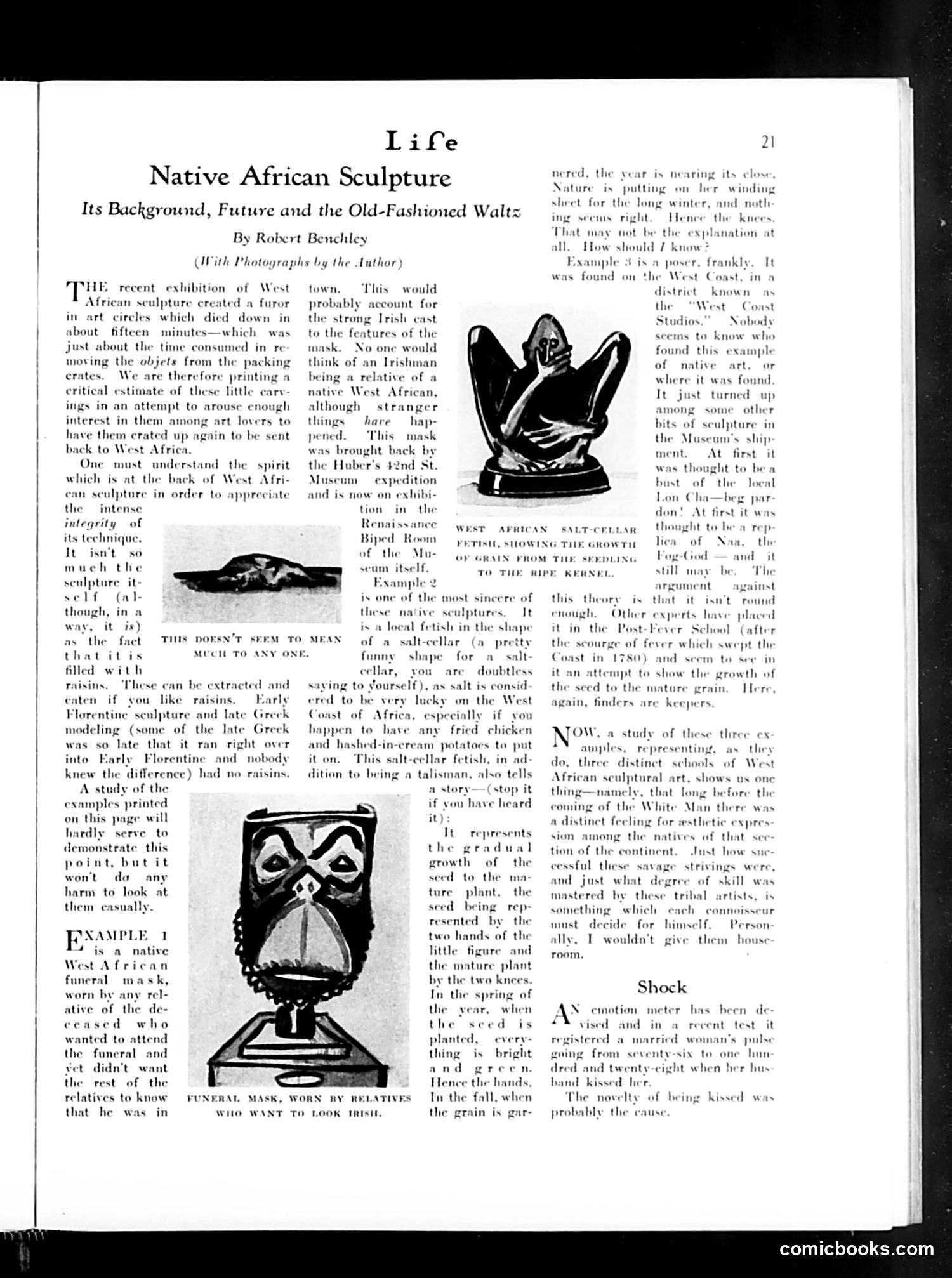
This page presents Robert Benchley's humorous essay on West African sculpture, accompanied by photographs of actual artifacts. Benchley employs satirical commentary on both the artworks and contemporary art criticism's pretentious approach to "primitive" art. The three examples shown are genuine African objects: a funeral mask (Example 1), a salt-cellar fetish (Example 2), and a seed-to-plant fertility symbol (Example 3). Benchley's joke lies in deflating art-world solemnity—he notes the funeral mask's "strong Irish cast" and jests that the salt-cellar doesn't "seem to mean much to any one," while the fertility figure's symbolic meaning seems arbitrary ("How should I know?"). The satire targets two things: Western art experts' tendency to over-interpret non-Western objects through invented significance, and the casual dismissiveness toward African art despite its exhibition value. Benchley's casual tone mocks the reverent language typically surrounding such collections.
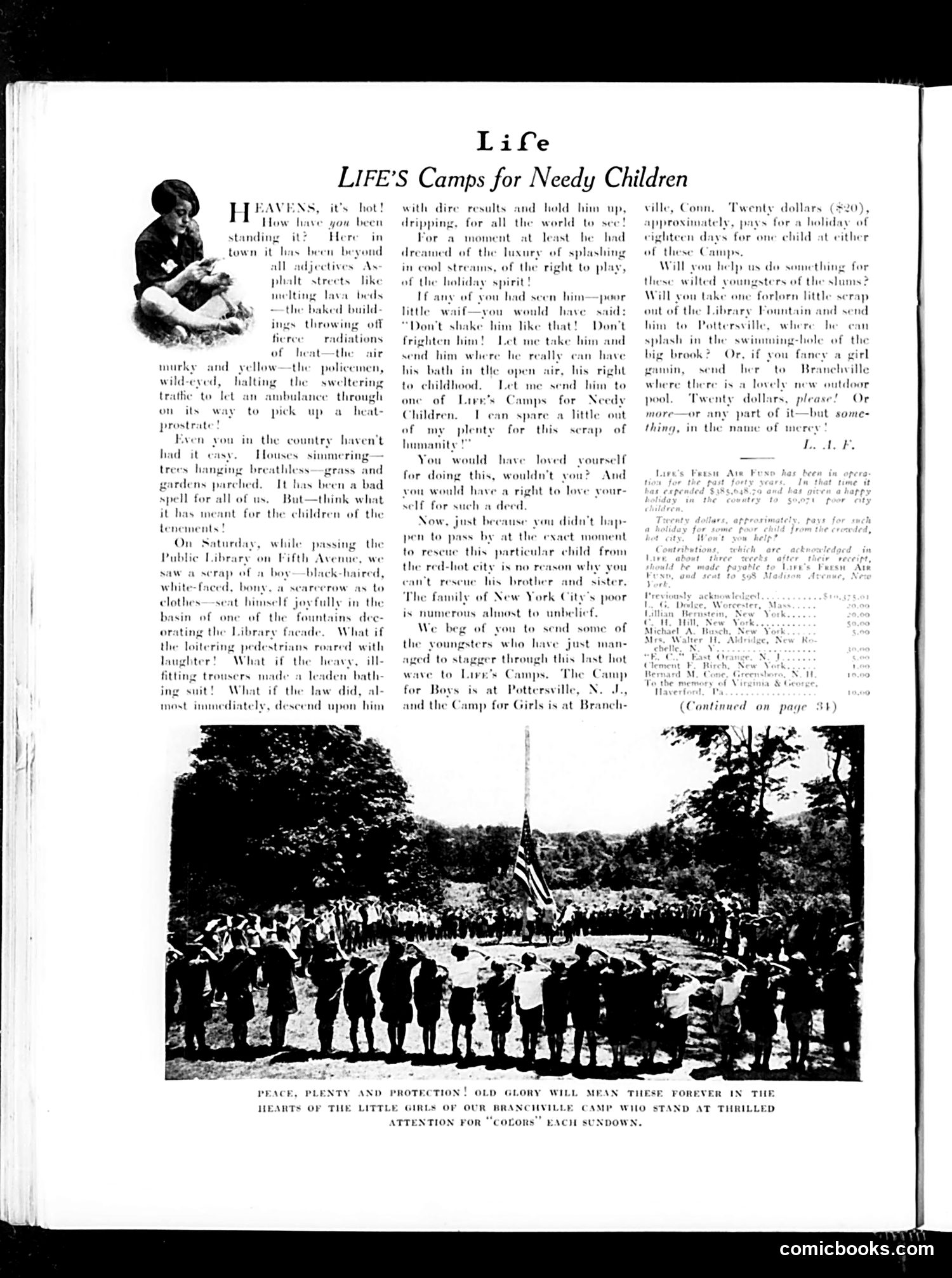
This is a charitable appeal, not satire. The article advocates for Life's summer camps serving poor children from New York City tenements during a brutal heat wave. The narrative describes witnessing a malnourished boy cooling himself in a public library fountain—an image of desperation. The author asks readers: if you'd want to rescue *this* child, why not support the camps that help many like him? The photograph shows children at the Branchville girls' camp during a flag ceremony, illustrating the "peace, plenty and protection" the camps provide. The appeal requests $20 donations (approximately $650 today) to fund an 18-day camp stay. Two camps are mentioned: one for boys in Pottersville, New Jersey, and one for girls in Branchville, Connecticut. This reflects Progressive Era concern for urban poverty and child welfare—positioning summer camps as moral remedy for tenement life.
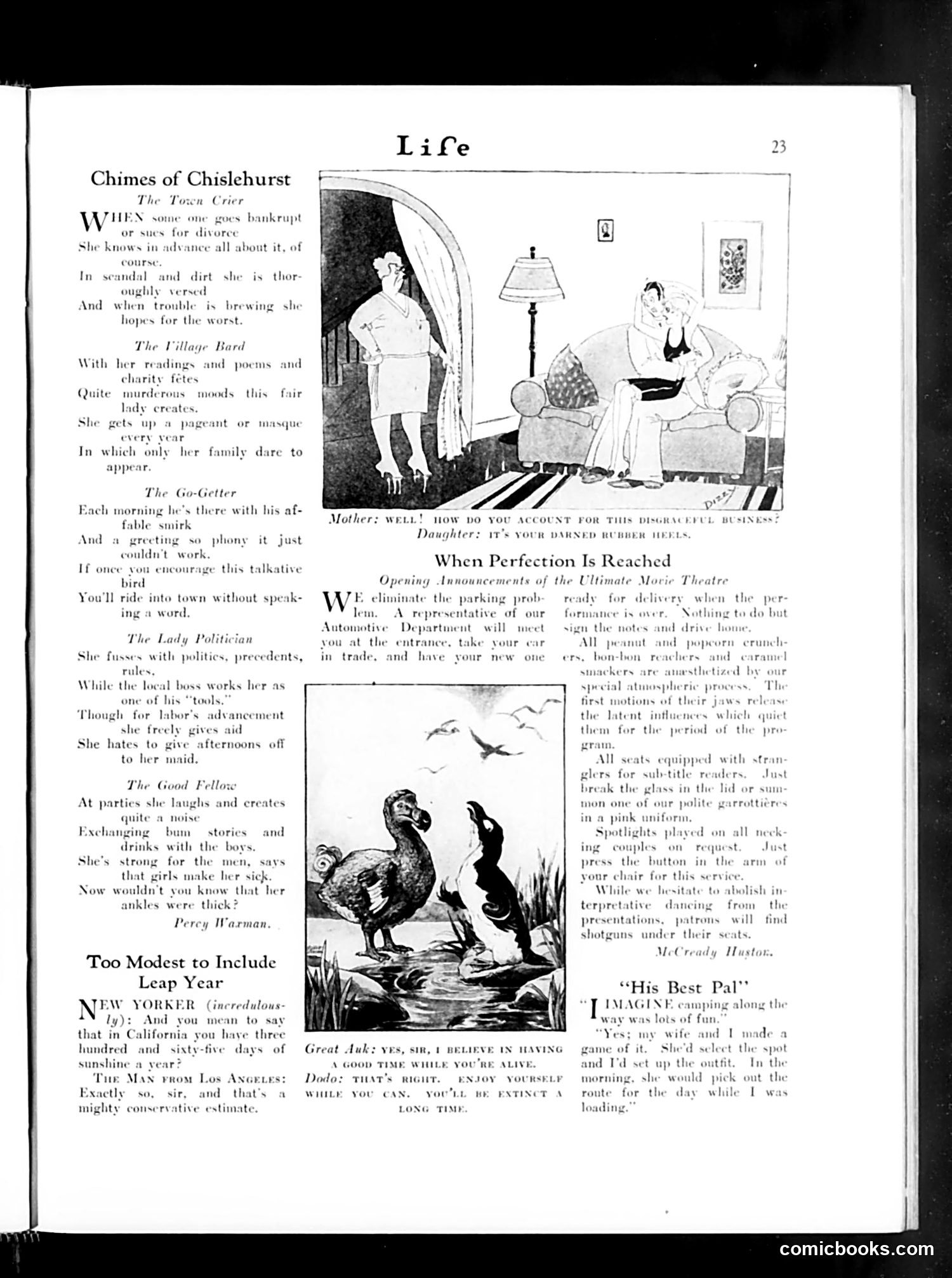
This page from *Life* magazine contains several short satirical pieces about social types and contemporary issues: **"Chimes of Chislehurst"** presents character sketches mocking small-town gossips and busybodies—the town crier who spreads rumors, the village bard who hosts charity pageants, the chatty "Go-Getter," and the hypocritical "Lady Politician" who advocates for workers' rights but won't give her maid time off. **The cartoon** (top right) shows a daughter being scolded for her "rubber heels"—apparently noisy footwear that scandalizes her mother, suggesting anxieties about women's fashion and behavior. **"When Perfection Is Reached"** satirizes a new movie theater's amenities—automated parking, special snacking processes, and electronic chair controls—mocking the era's obsession with technological "progress" and comfort. **The bottom joke** about camping references gender dynamics: the husband lets his wife choose camping spots, implying she leads their leisure activities. The overall tone is gently mocking of bourgeois pretension and social convention.
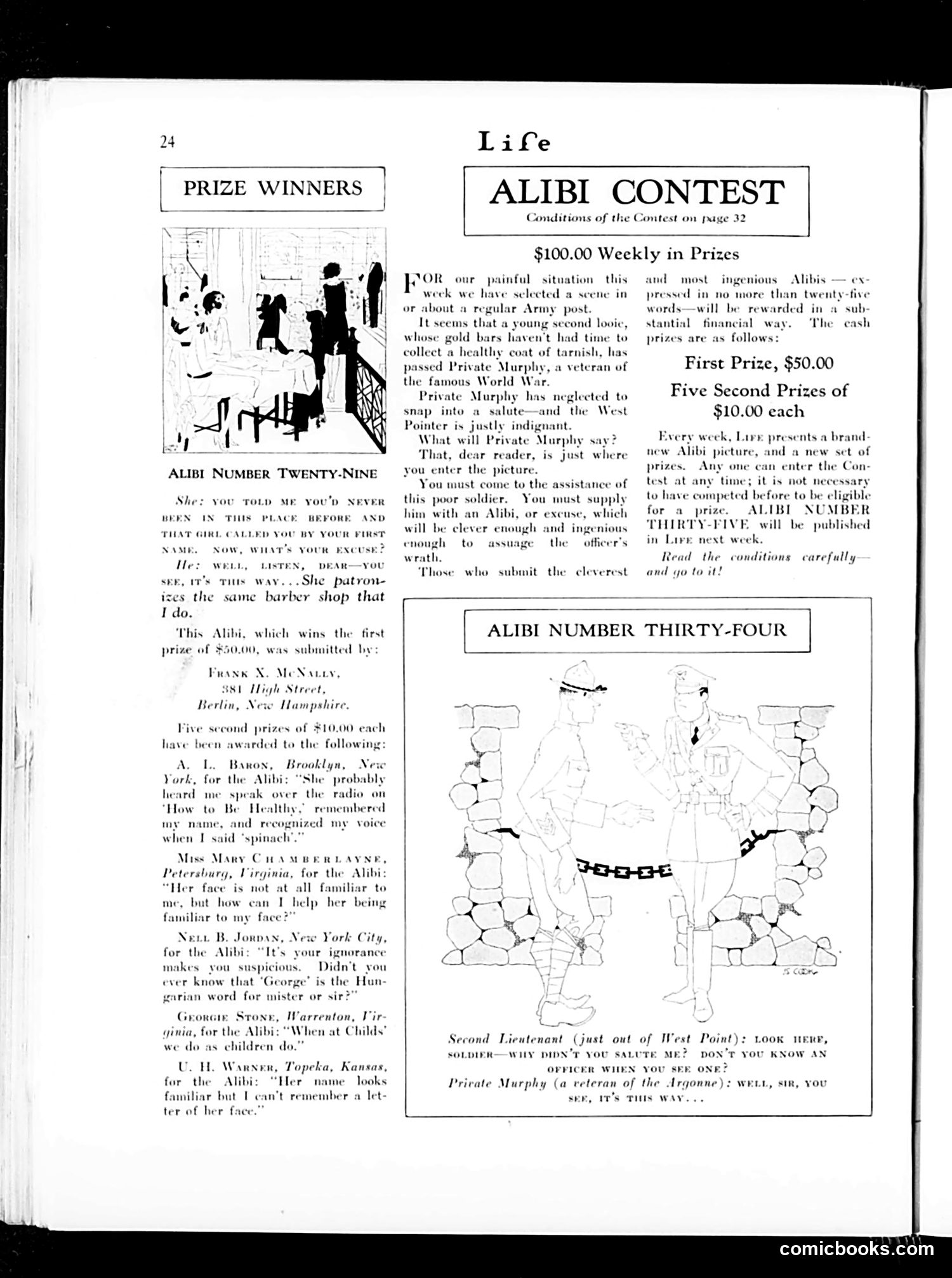
This page presents *Life* magazine's "Alibi Contest," a humor feature where readers submit clever excuses for awkward social situations. The main cartoon (Alibi #34) depicts a young, newly-commissioned Second Lieutenant from West Point confronting Private Murphy, a hardened veteran of World War I's Battle of the Argonne, for failing to salute. The joke's context: the inexperienced officer demands a salute; the experienced soldier must provide an excuse. The satire mocks military hierarchy and generational tension—the green officer insists on protocol while the battle-scarred enlisted man operates by different rules. The officer's indignation contrasts with Murphy's casual familiarity with actual warfare. Below are winning alibis from readers, mostly playing on shared references (barber shops, radio personalities, mistaken identity). The contest invited readers to submit their own excuses in under 25 words, offering $50 for the best entry. This was a popular audience-participation feature demonstrating *Life*'s satirical engagement with everyday social pretense and class dynamics.
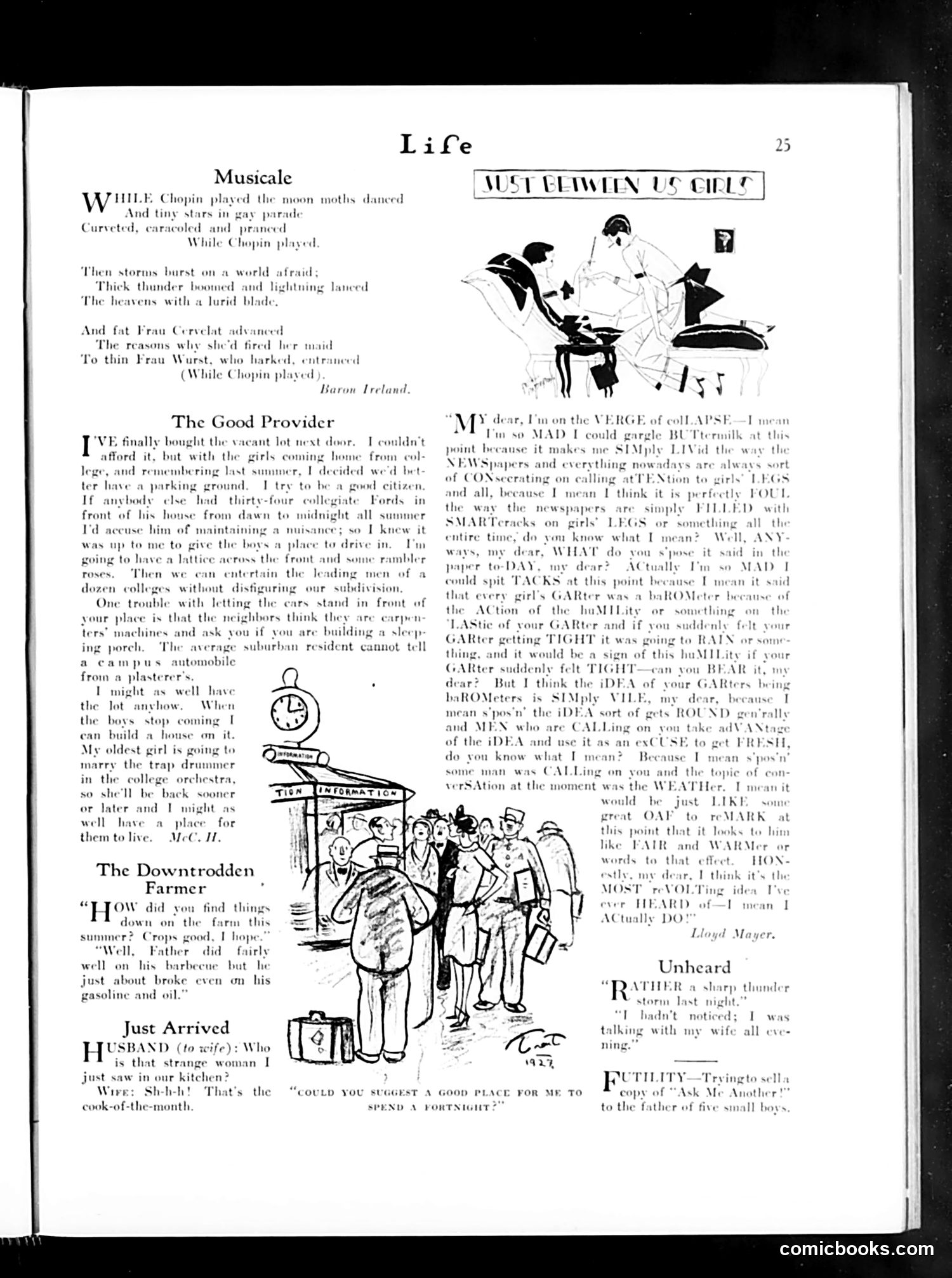
This page contains several satirical pieces typical of Life's humor: **"Must Between Us Girls"** features a woman's breathless monologue obsessing over newspaper coverage of girls' garters as barometers of weather and morality. The satire mocks both overwrought female conversation and contemporary anxiety about women's fashion revealing too much—garters visibly rising/falling with humidity became a pseudo-scientific joke about female modesty and atmospheric conditions. The exaggerated capitalization and breathless tone parody both gossip columns and social hysteria. **"The Good Provider"** satirizes a man who builds a parking lot on his property to appear civic-minded, but actually just wants to supervise young people and prevent cars from blocking his view—revealing his true controlling, curmudgeonly nature beneath the charitable facade. **"Just Arrived"** presents a brief husband-wife joke about a mysterious "cook-of-the-month," implying domestic staff turnover or infidelity. The cartoons and poems throughout maintain Life's signature blend of social observation and gentle mockery of American middle-class anxieties and pretensions.
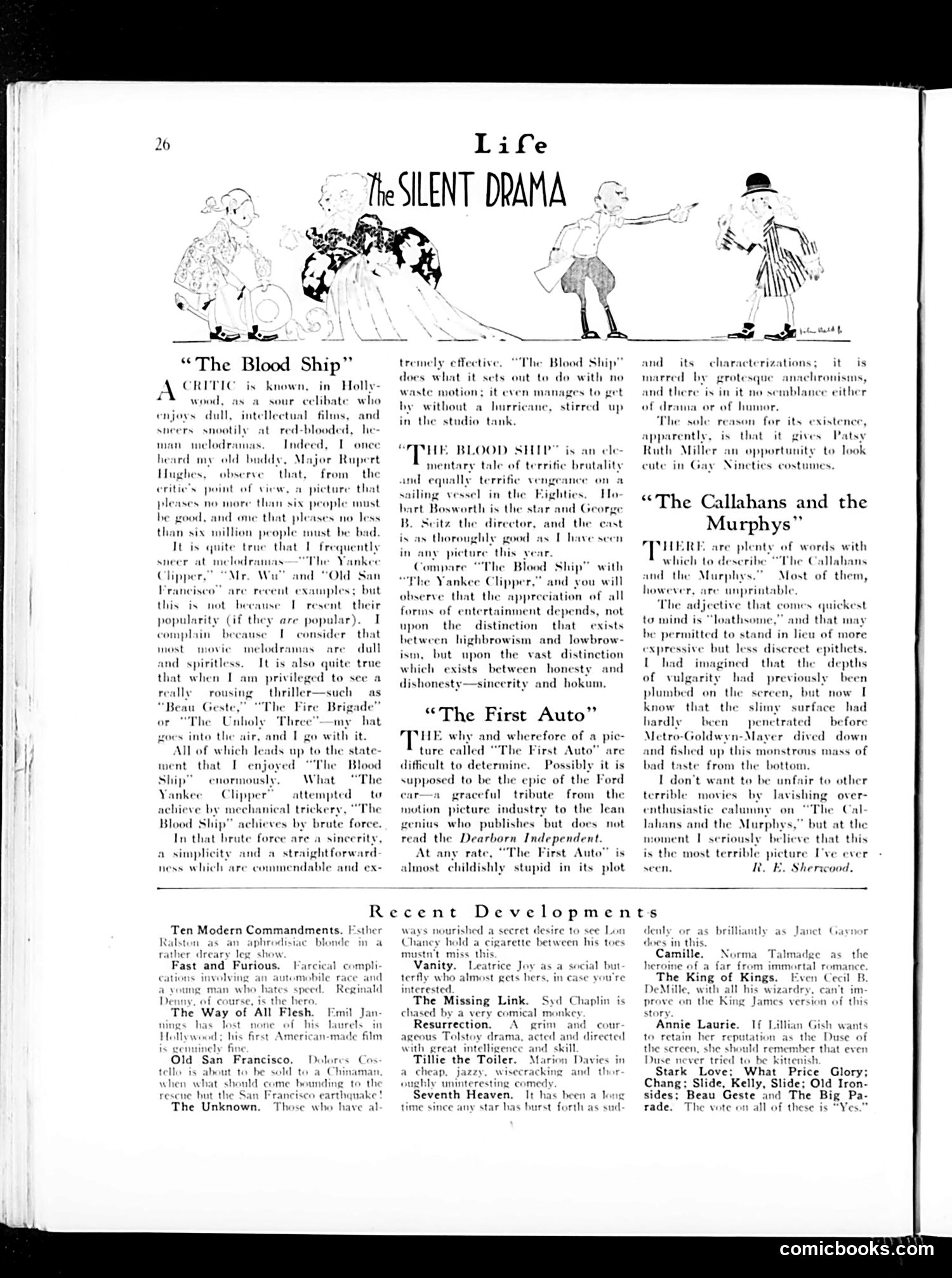
This page contains film criticism from Life magazine's movie section. The cartoon header depicts four figures in exaggerated poses, illustrating different cinematic styles or audience reactions to silent films. The main reviews critique several 1920s silent pictures, evaluating their artistic merit. The critic argues that entertainment quality depends not on whether films are "highbrow" or "lowbrow," but on **sincerity versus hokum**—authenticity versus artifice. Notable reviews include: - **"The Blood Ship"**: Praised for brute-force effectiveness and straightforward storytelling - **"The First Auto"**: Mocked as "almost childishly stupid," apparently a Ford Motor Company tribute - Various other contemporary releases assessed for honesty in filmmaking The critic references Major Rupert Hughes' observation that if six million people enjoy a film, critics dismiss it—satirizing the gap between popular and critical taste. The page illustrates how 1920s film criticism evaluated silent cinema on narrative integrity and emotional authenticity rather than technical spectacle.
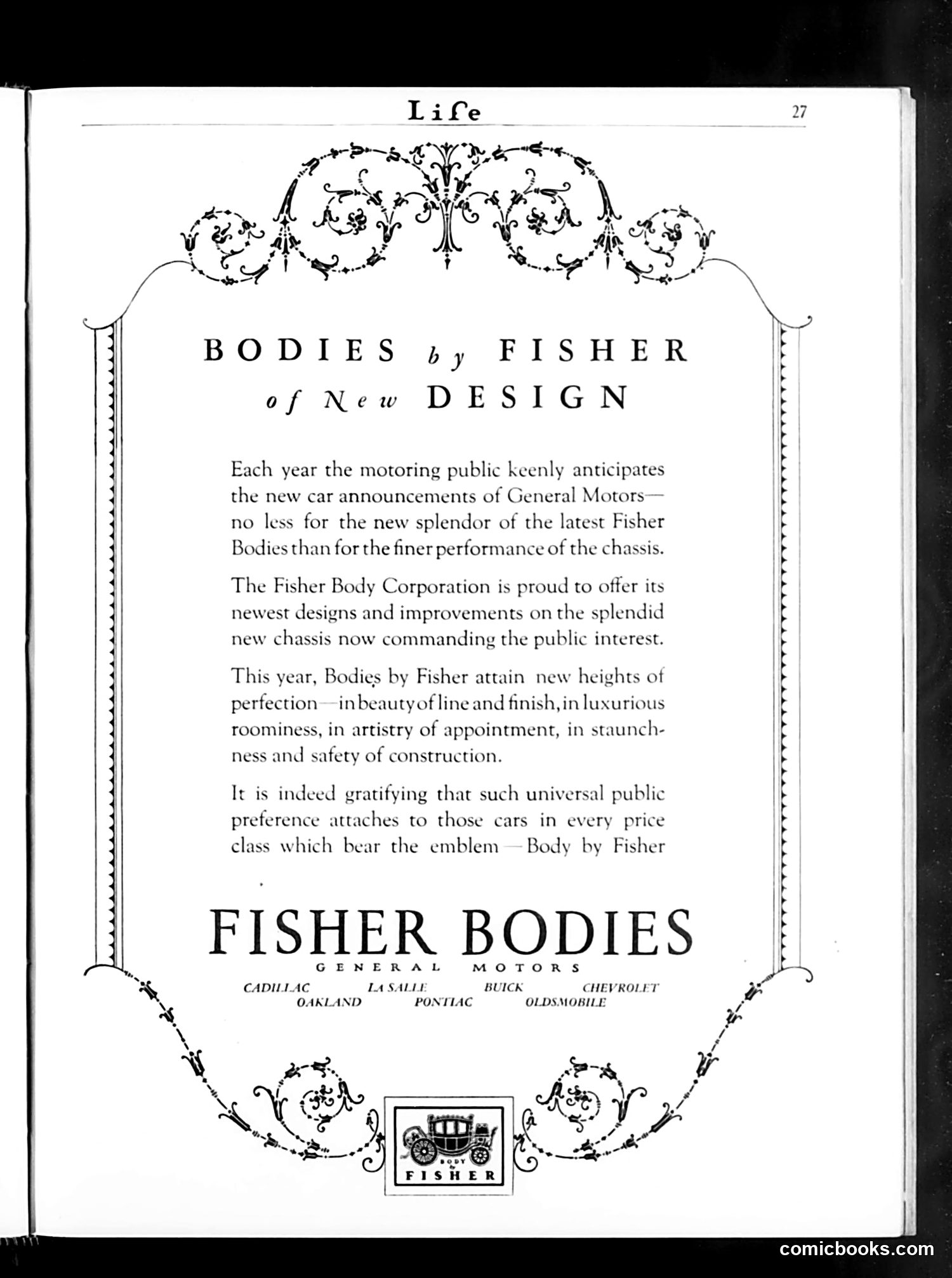
This is not a cartoon or satire—it's a straightforward advertisement for Fisher Body Corporation, a General Motors subsidiary. The page promotes Fisher Bodies' new car designs across multiple GM brands (Cadillac, Buick, Chevrolet, Pontiac, Oldsmobile, Oakland, and LaSalle). The ad emphasizes luxury features: beauty of line, roominess, artistic appointments, and safety construction. It claims universal public preference for Fisher-bodied cars across all price classes. The ornamental Art Deco border and Fisher logo at bottom are purely decorative branding elements typical of early-twentieth-century advertising design. This appears in *Life* magazine's advertising section, not its editorial/satirical pages. There is no political or social satire present.
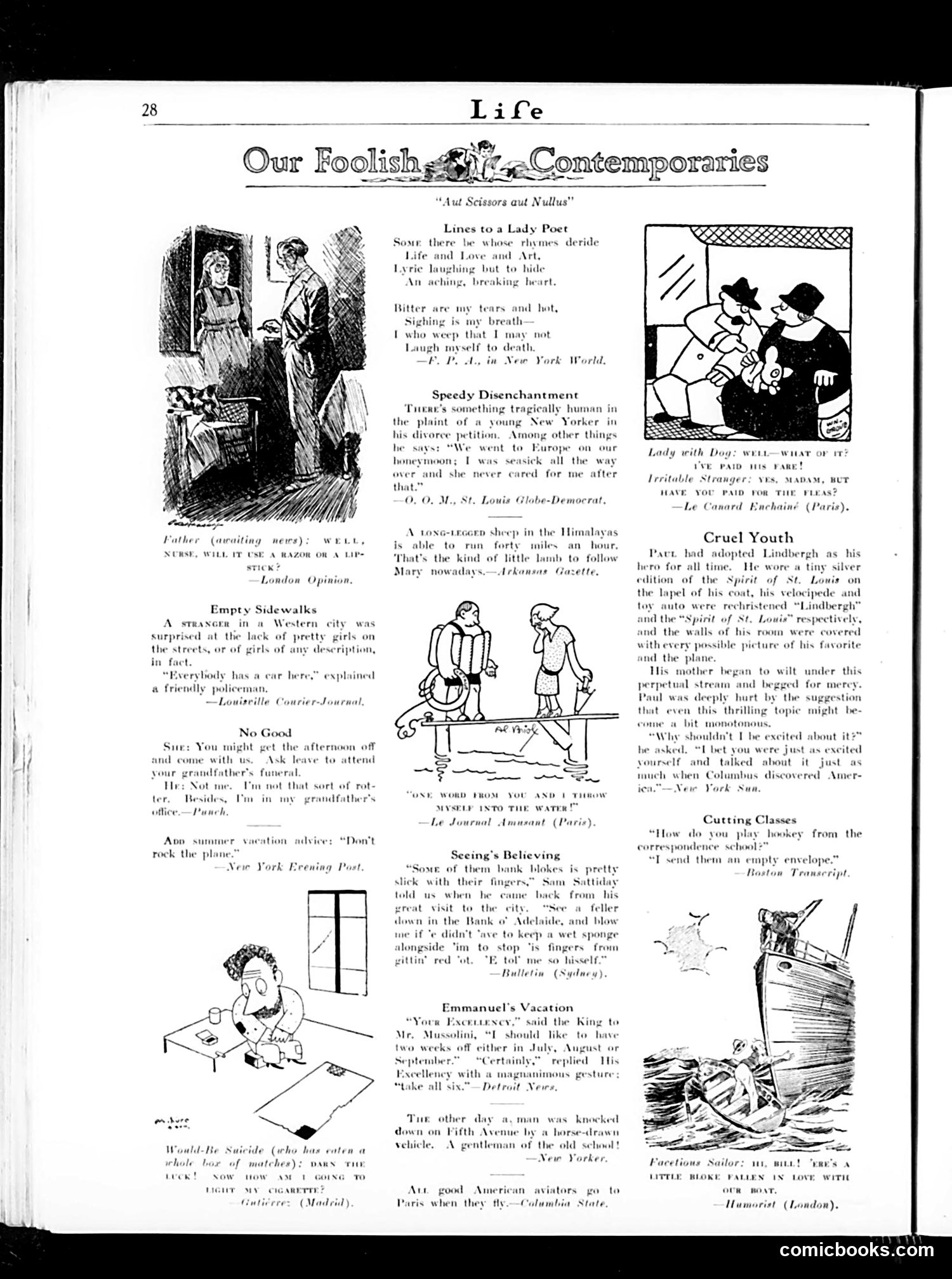
This page presents a collection of short satirical pieces and cartoons mocking contemporary social follies. The section title suggests these are critiques of modern behavior and attitudes. Key targets include: **Romantic excess**: "Lines to a Lady Poet" mocks overwrought, melodramatic verse about love and heartbreak—a dig at self-indulgent poetic sentimentality. **Divorce and casual attitudes**: "Speedy Disenchantment" ridicules a New York divorce petition where a husband complains his wife grew indifferent after their honeymoon—satirizing both romantic naïveté and marital disposability. **Celebrity worship**: "Cruel Youth" criticizes a child who has adopted Lindbergh (the famous aviator) as his hero, surrounding himself with aviation imagery. This mocks blind hero-worship and commercialized celebrity culture. **Class and labor**: "Seeing's Believing" presents a working-class narrator describing office workers obsessively protecting wet sponges—likely satirizing petty office politics or labor disputes. The cartoons use exaggeration and ironic dialogue to expose vanity, superficiality, and absurd modern preoccupations. Attribution lines reference international publications (Paris, London, Madrid), suggesting shared transatlantic satire.
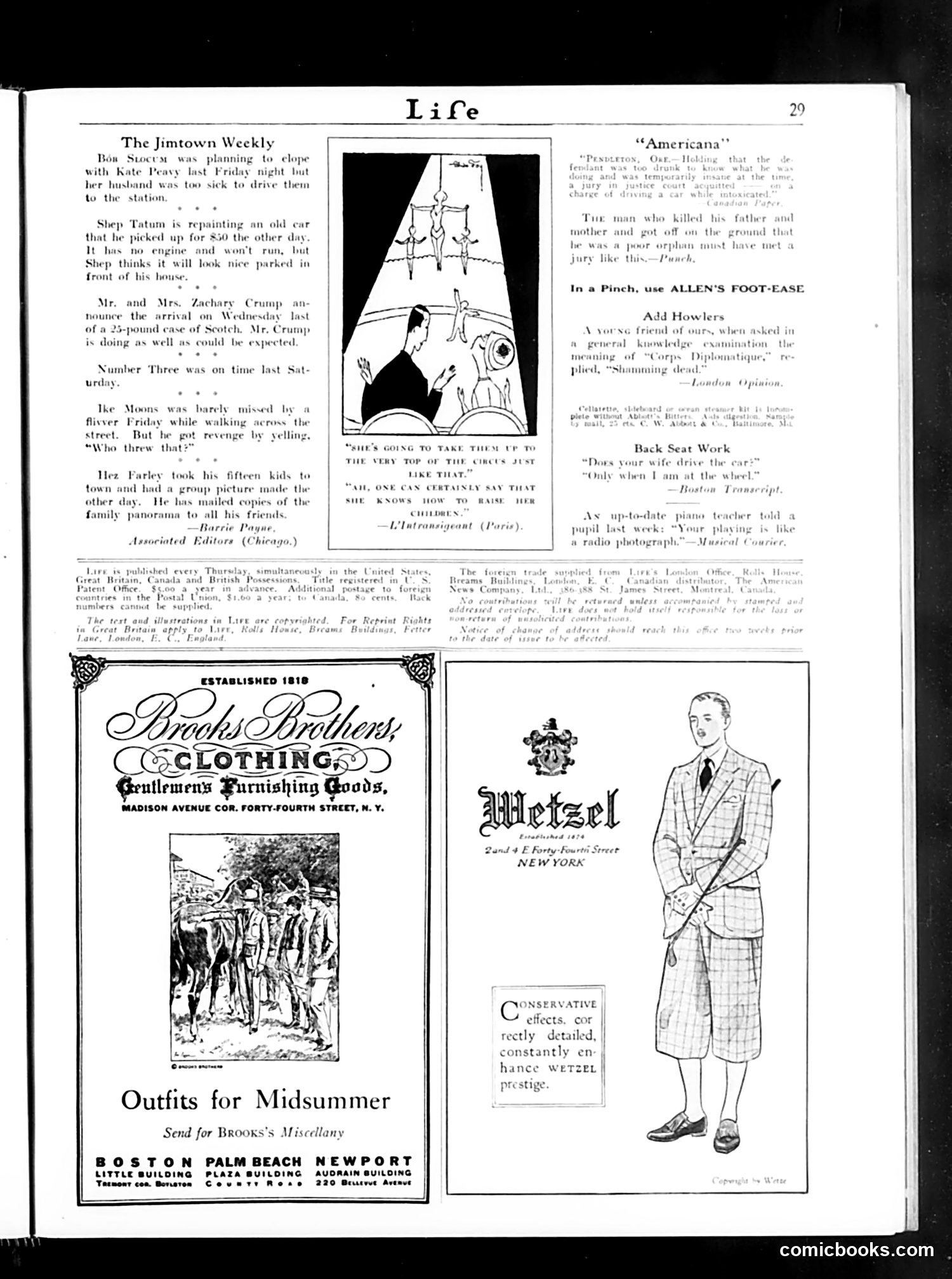
This page from *Life* magazine is primarily **advertising and humor filler** rather than political satire. The main content includes: **"The Jimtown Weekly"** — a recurring satirical column mocking small-town life through absurd local news items: a man too sick to drive his wife to an elopement, a car with no engine being repainted, a child throwing objects from a circus tent. The humor relies on rural simpleton stereotypes popular in early 20th-century American comedy. **"Add Howlers"** — brief jokes about malapropisms and misunderstandings, a common magazine feature of the era. The page is otherwise dominated by **advertisements**: Brooks Brothers clothing (with a period sketch of summer fashions) and Wetzel menswear. The cartoons serve primarily as padding between ads rather than delivering social commentary. The satire targets rural/small-town American culture through gentle mockery of provincial life and speech patterns — typical of *Life's* urban-focused audience.
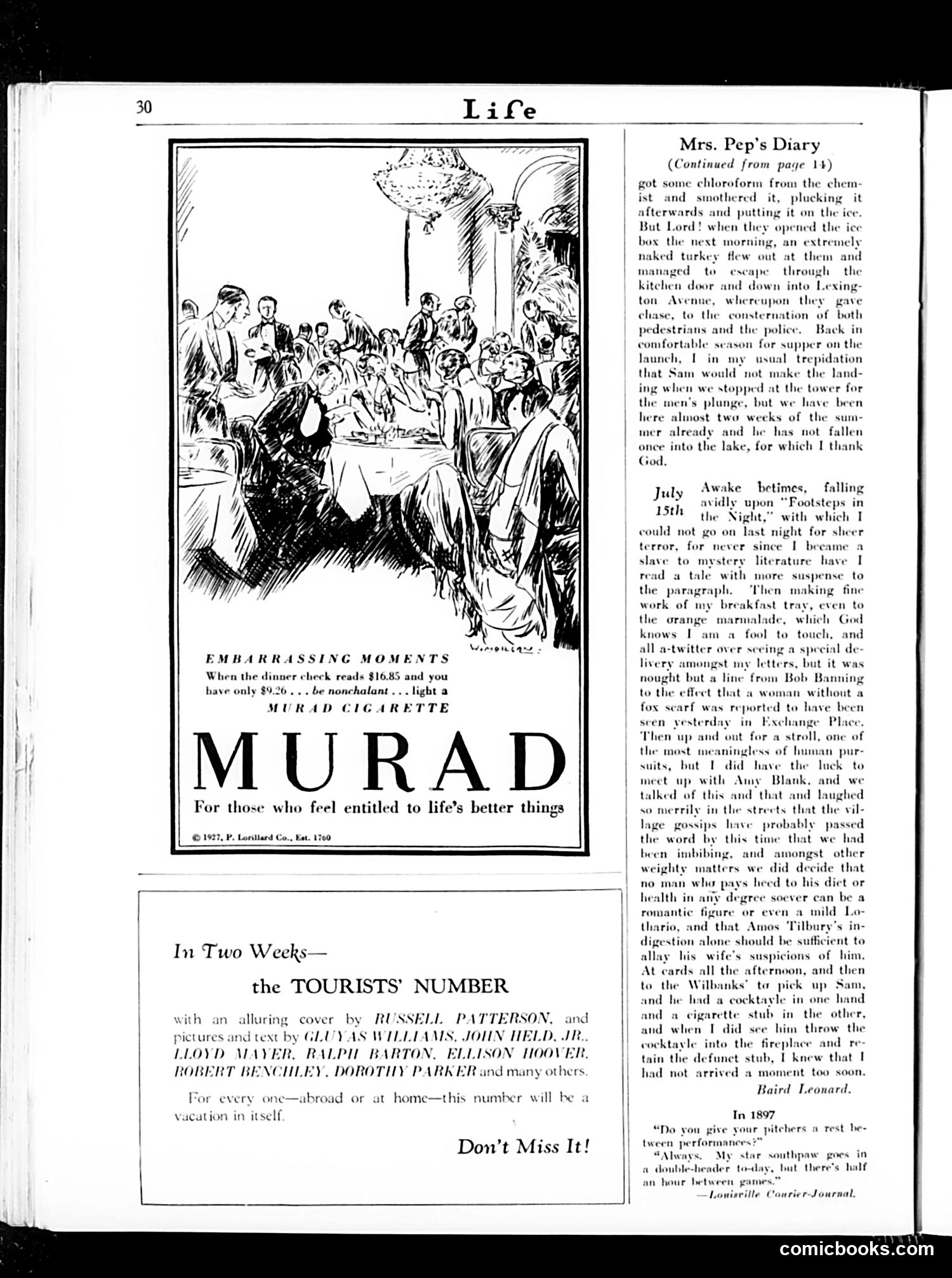
This page features a satirical advertisement for Murad cigarettes positioned as a relatable cartoon about social embarrassment. The illustrated scene shows a fancy dinner party where a diner faces the awkward situation of receiving a bill ($16.85) while only having $9.26—a substantial shortfall. The joke's satirical point: the solution to this mortifying moment is to appear unconcerned by casually lighting a Murad cigarette, thereby maintaining composure and social dignity through sophisticated nonchalance. The humor relies on the advertising logic of the 1920s era, where smoking cigarettes signified worldliness, confidence, and upper-class refinement. By smoking, an embarrassed person could deflect from financial inadequacy through performed composure. The ad mocks this aspiration while simultaneously selling it—typical of *Life* magazine's advertising strategy, which often satirized consumer culture while profiting from it.
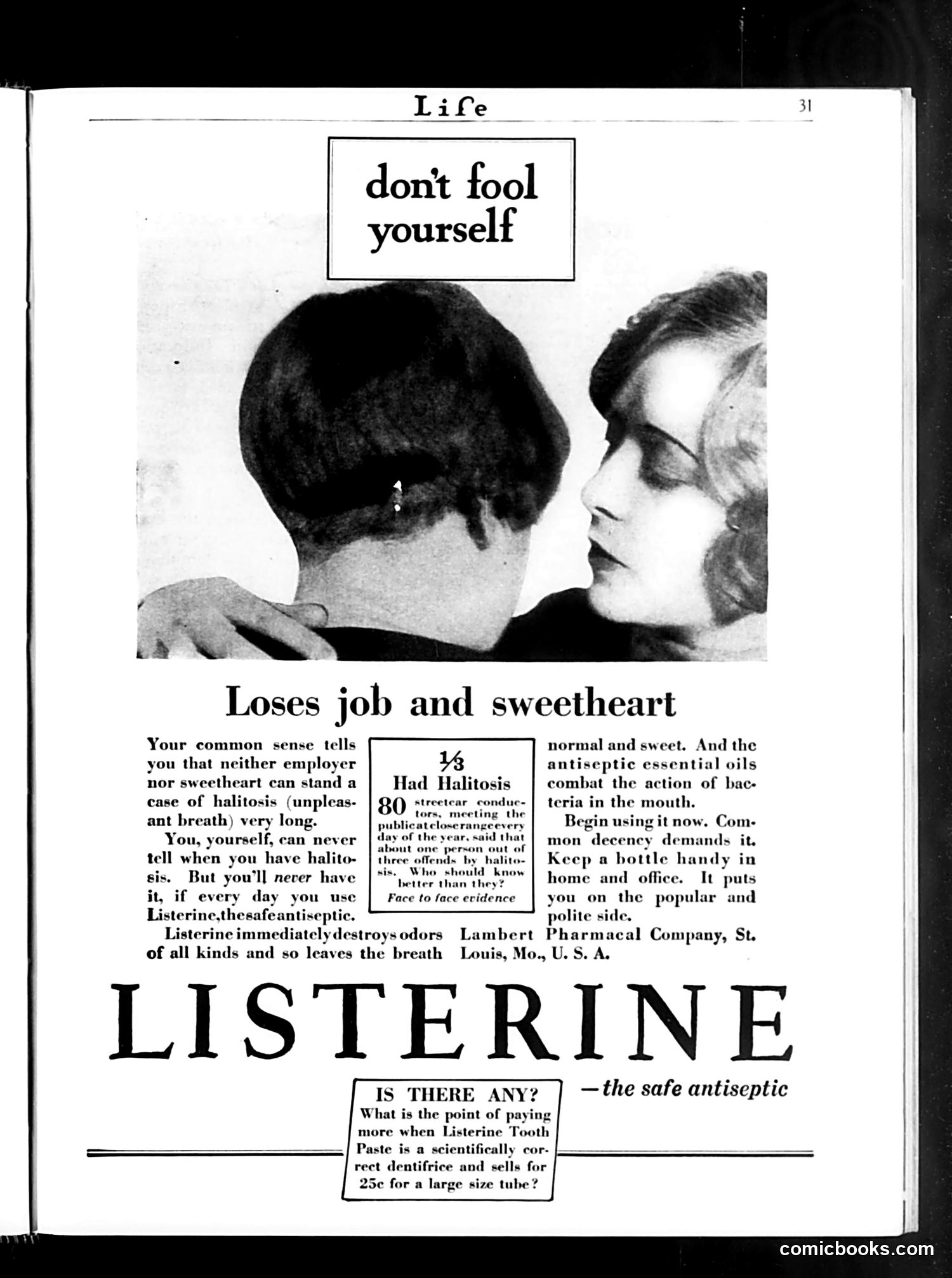
This is a **Listerine mouthwash advertisement**, not political satire. The page uses fear-based marketing typical of early-to-mid 20th century advertising. The headline "don't fool yourself" and the photograph of an intimate couple warns readers that "halitosis" (bad breath) will cause them to lose their job and romantic relationships. The ad plays on social anxieties about personal hygiene and acceptability. The "Face to face evidence" callout emphasizes that bad breath is noticeable to others but invisible to the sufferer—a vulnerability the product claims to solve. The accompanying statistics ("1/3 Had Halitosis") lend false authority, while the copy uses shame-based messaging: "common decency demands it." The toothpaste section at bottom promotes a cheaper alternative product line, expanding market reach. This represents early mass-market advertising's manipulation through social embarrassment and relationship anxiety.
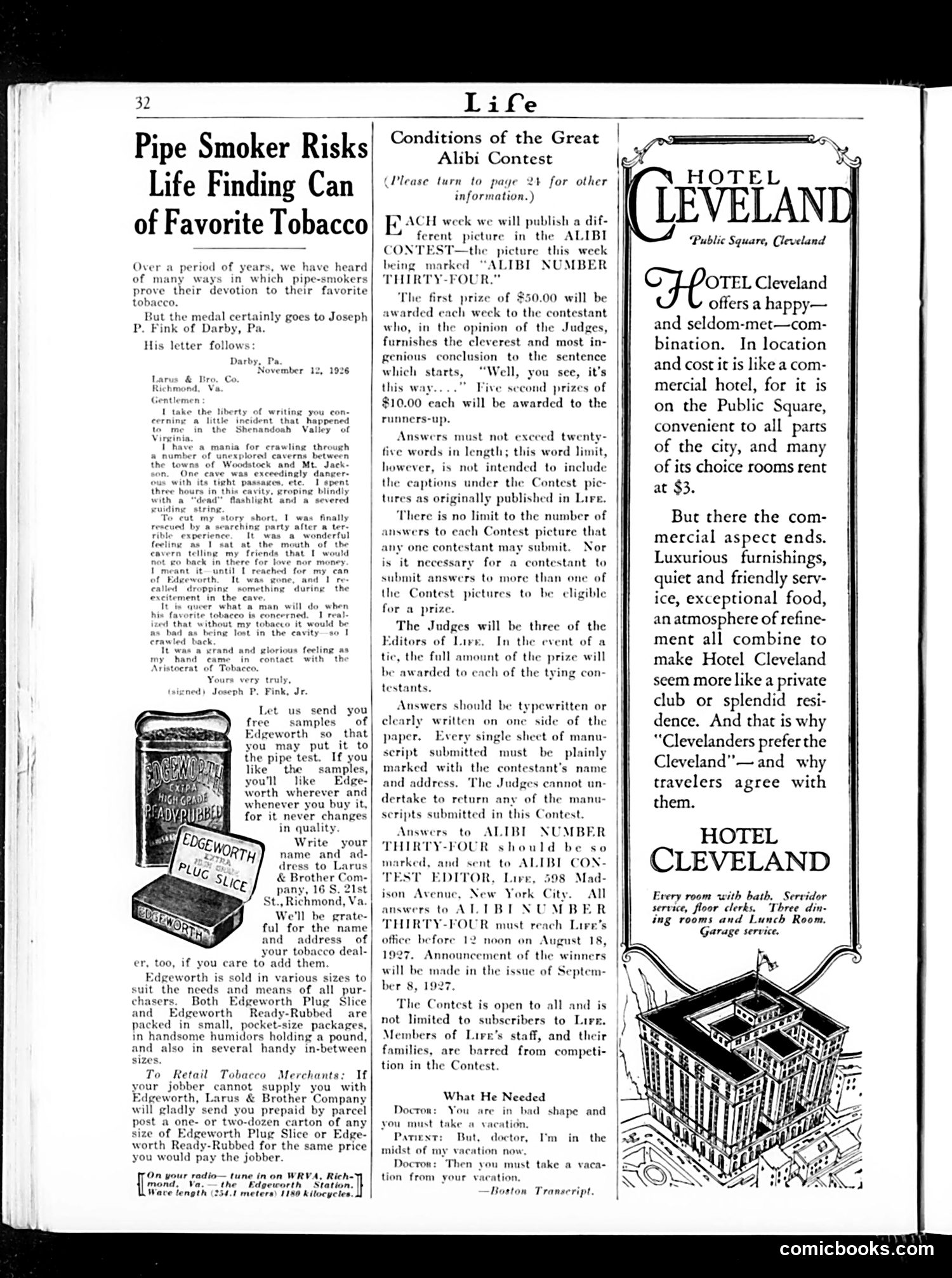
This page contains a humorous testimonial letter and tobacco advertisement rather than a political cartoon. A reader named Joseph P. Fink from Pennsylvania writes to Larus & Brother Company describing how he nearly died crawling through Shenandoah Valley caverns to retrieve his lost can of Edgeworth pipe tobacco—emphasizing that his devotion to the brand was worth risking his life. The piece satirizes pipe-smokers' obsessive brand loyalty and the extreme lengths men claim to go for their preferred tobacco. By printing this as if it were a genuine testimonial, *Life* gently mocks both masculine posturing and the exaggerated advertising claims common in 1926. The accompanying Edgeworth advertisement plays along with the joke, offering free samples to test the supposedly irreplaceable product.
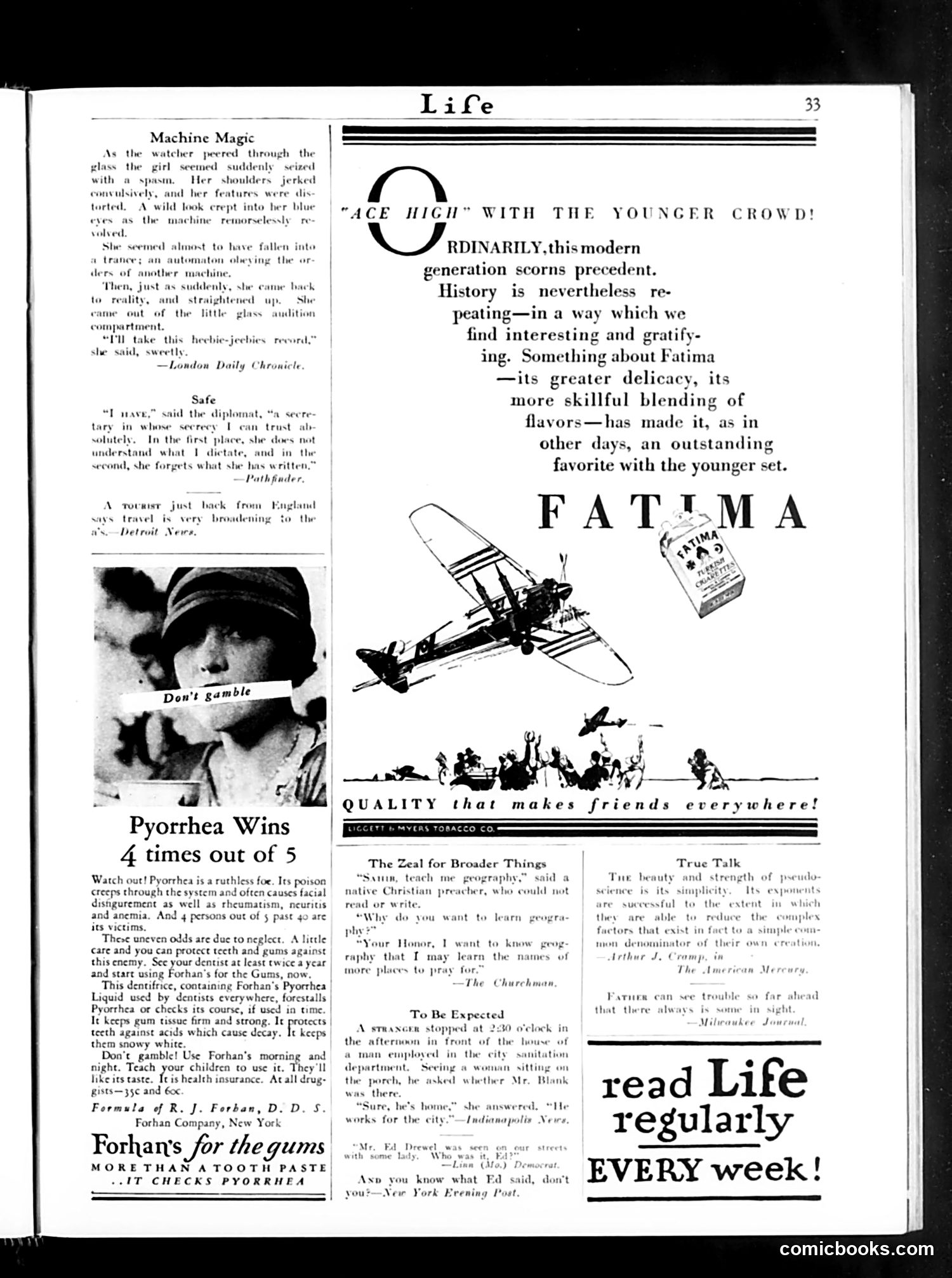
This page is primarily **advertising and filler content** rather than political satire. The main elements are: **Fatima Cigarettes Ad**: The large central advertisement promotes Fatima cigarettes to "the younger crowd," claiming the brand has historical appeal due to its "greater delicacy" and "skillful blending of flavors." The airplane imagery suggests modernity and excitement. **Forhan's Toothpaste Ad**: Features a woman labeled "Don't gamble" promoting Forhan's as protection against pyorrhea (gum disease), claiming 4 of 5 people over 40 suffer from it without proper care. **Short Anecdotes**: The page includes brief humorous pieces—one about a Christian preacher wanting to learn geography to identify more places to pray for, another about a city worker's mundane encounter. **Closing Message**: "Read Life regularly EVERY week!" encourages subscriptions. The page reflects 1920s-30s advertising culture and light humor rather than political commentary or satire.
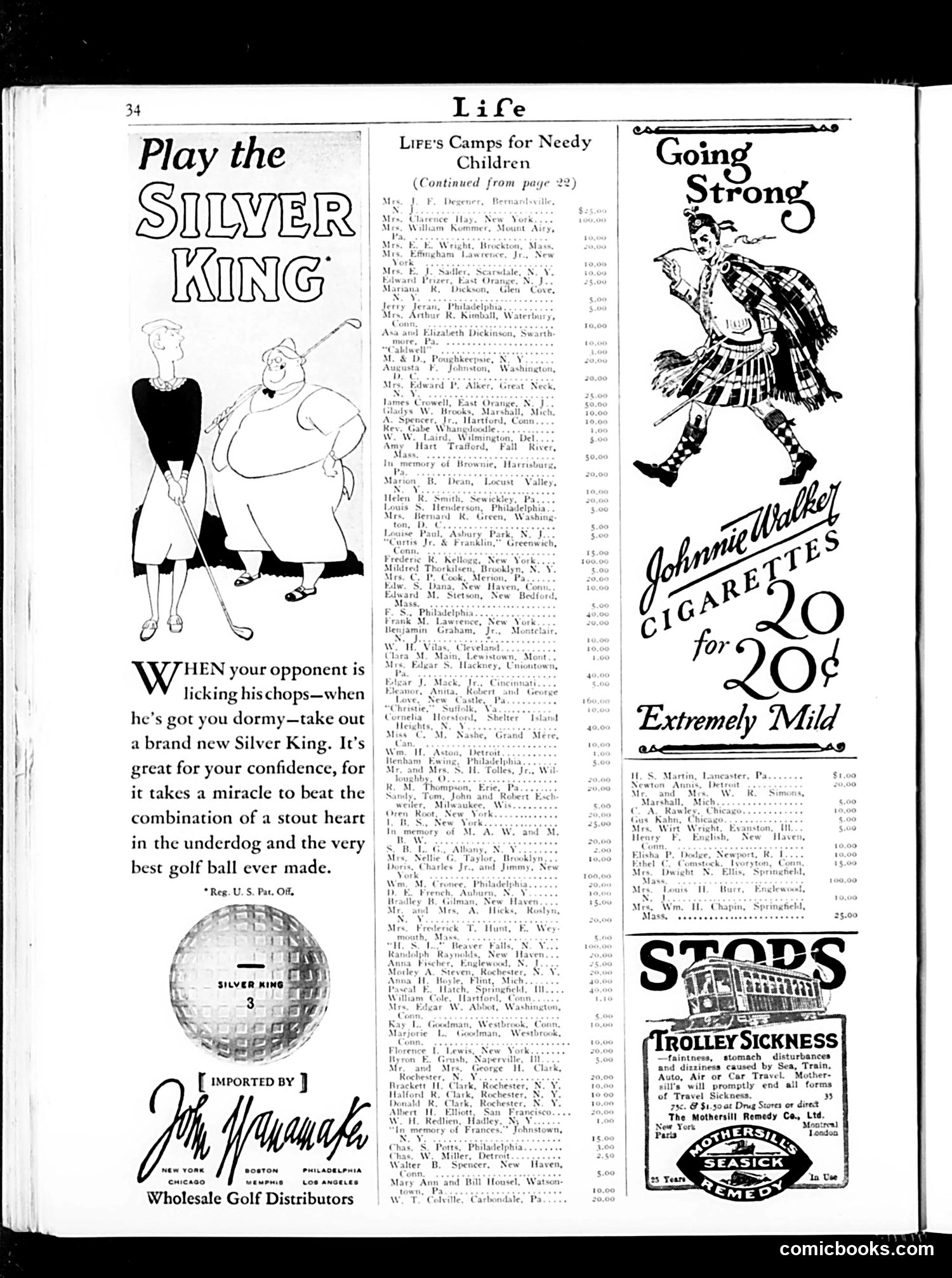
This page is primarily **advertising**, not political satire. The dominant content consists of three commercial advertisements: 1. **"Play the Silver King"** (left): A golf ball advertisement featuring cartoon figures. The ad uses sports psychology messaging—claiming the Silver King ball gives confidence to the "underdog" golfer. The visual humor is mild, showing stylized golfers, with text emphasizing the product's quality. 2. **"Going Strong"** (top right): A Johnnie Walker cigarette advertisement featuring an exaggerated cartoon figure in Scottish dress (kilts, sporran), likely playing on the brand's Scottish heritage. 3. **"Stops Trolley Sickness"** (bottom right): A patent medicine ad for seasickness remedy, with typical early-20th-century medical advertising hyperbole about curing travel-related ailments. The center column lists donors to "Life's Camps for Needy Children," a charitable endeavor. This reflects 1920s-era Life magazine: lighthearted, advertisement-heavy, with simple cartoon illustrations supporting product marketing rather than social commentary.
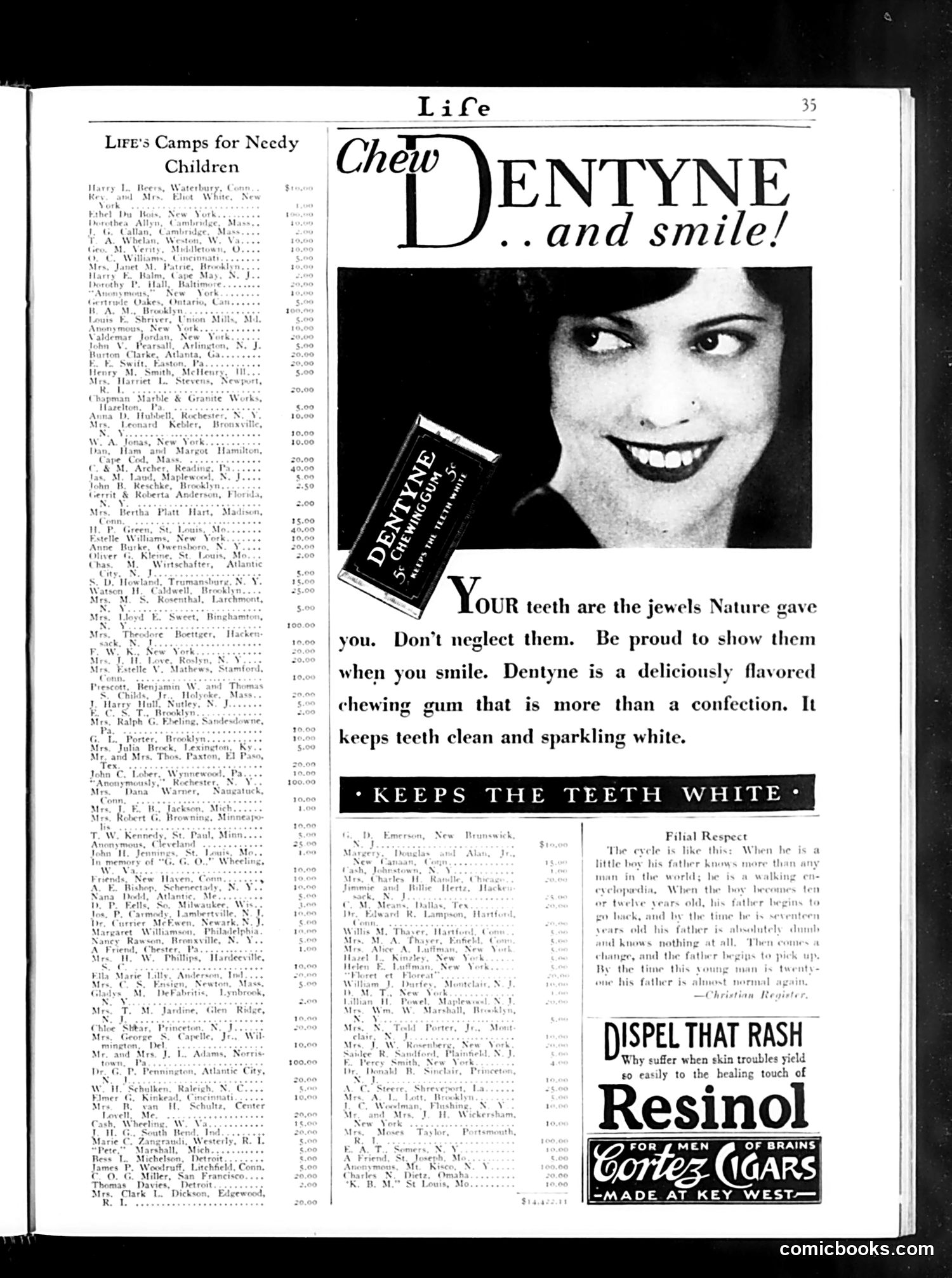
This page is **primarily advertising**, not satire or political commentary. The main content consists of three advertisements: 1. **Dentyne Chewing Gum** (top): Features a smiling woman's face promoting gum as a teeth-cleaning product. The ad uses the slogan "Chew Dentyne...and smile!" and emphasizes that teeth are "jewels Nature gave you." 2. **Resinol** (bottom right): Advertises a skin treatment for rashes, using the phrase "Dispel That Rash." 3. **Corral Cigars** (bottom): A small ad for cigars "made at Key West." The left column contains **"Life's Camps for Needy Children,"** a charitable listing with donors' names and contribution amounts. The small text block titled "Filial Respect" appears to be a humorous anecdote about a father-son relationship cycle, though it's partially cut off. There is **no political cartoon or satire** on this page—it's a typical early 20th-century magazine layout mixing charitable notices with consumer product advertisements.
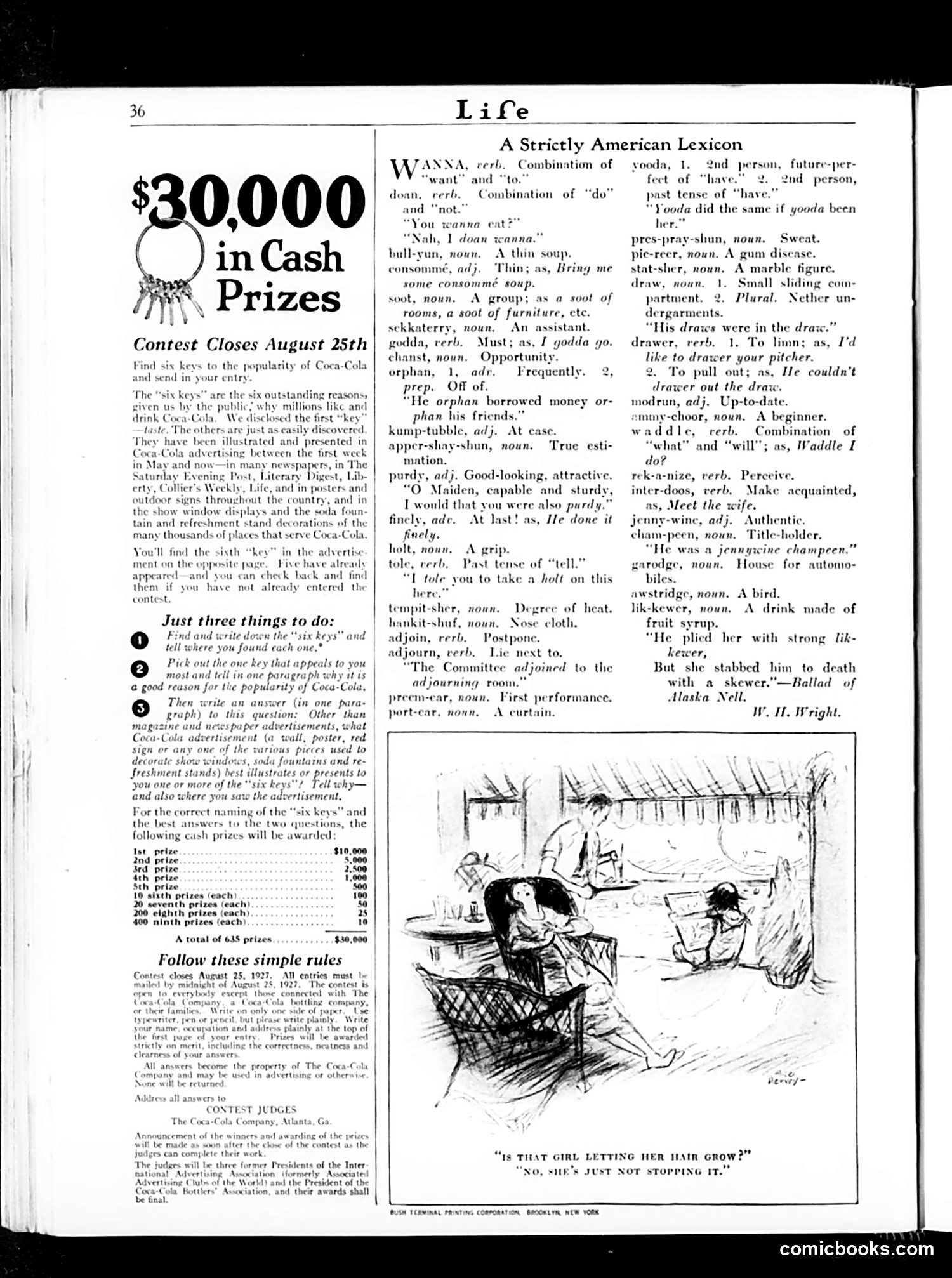
This page is primarily a **Coca-Cola advertising contest** (offering $30,000 in prizes), not political satire. The main content asks readers to identify six reasons for Coca-Cola's popularity from prior advertisements. The only cartoon-like content is a small illustration at bottom-right showing a domestic scene with the caption "IS THAT GIRL LETTING HER HAIR GROW?" / "NO, SHE'S JUST NOT STOPPING IT." This appears to be a simple visual gag about a woman's untidy appearance—likely mocking contemporary beauty standards or grooming habits. The majority of the page is occupied by "A Strictly American Lexicon," which satirizes working-class American dialect and pronunciation (e.g., "wanna," "godda," "doan"). These phonetic spellings mock colloquial speech patterns, reflecting a common 1920s literary device that portrayed lower-class speech as both humorous and inferior to standard English. The cartoons/satire here are **not political**—they're social comedy targeting appearance standards and class-based speech patterns.
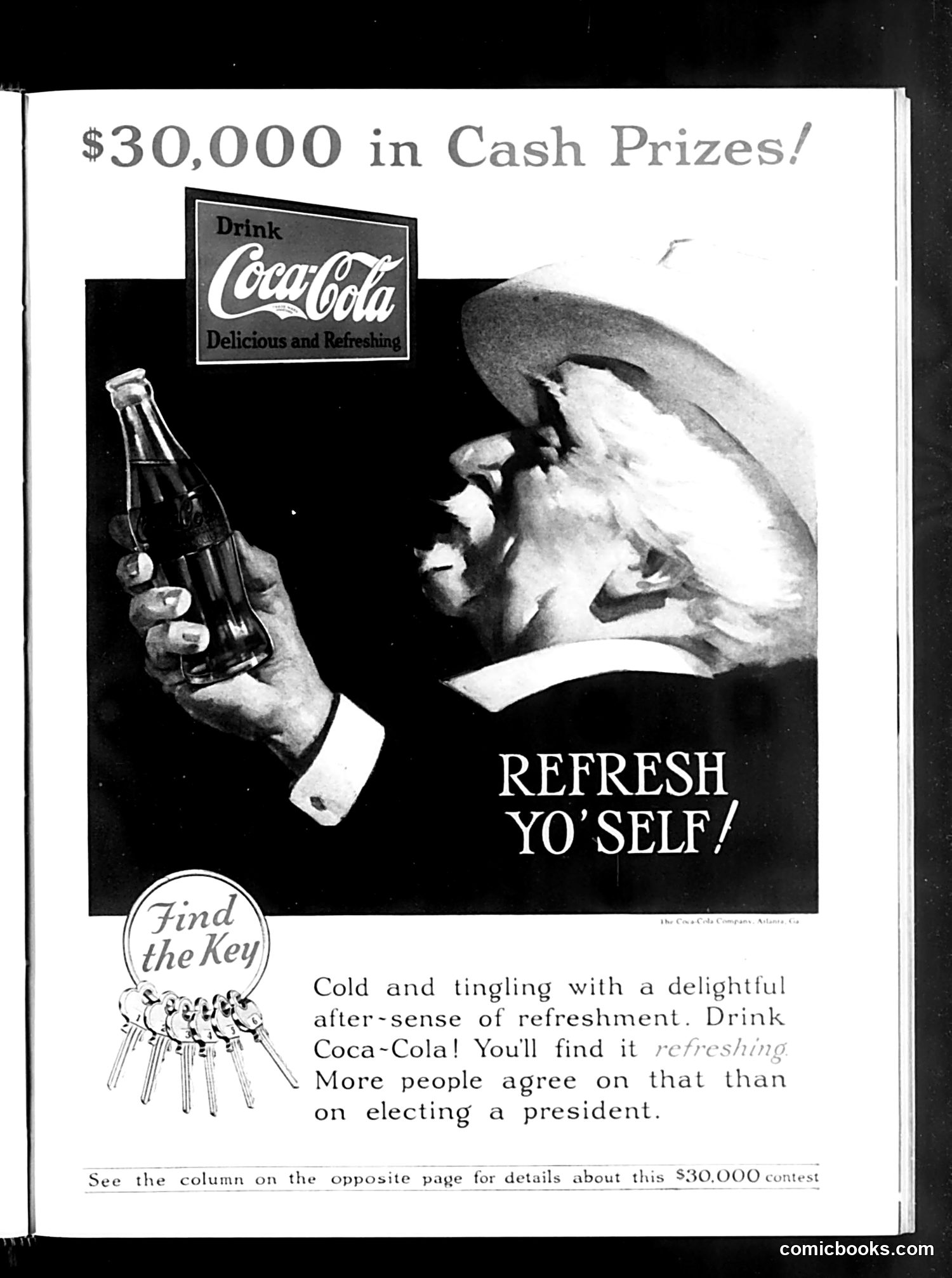
This is a Coca-Cola advertisement, not political satire. The page promotes a $30,000 cash prize contest while advertising the soft drink. The image shows a man in a cowboy hat holding a Coca-Cola bottle with the slogan "REFRESH YO'SELF!" The copy emphasizes the drink's refreshing quality and includes a humorous line: "More people agree on that than on electing a president." This jest likely references contemporary political division—possibly from an election year when public disagreement about presidential candidates was notable. The joke suggests Coca-Cola's universal appeal transcends the partisan conflicts that divide Americans on political matters. The "Find the Key" contest element appears to be a promotional game offering the advertised cash prizes.
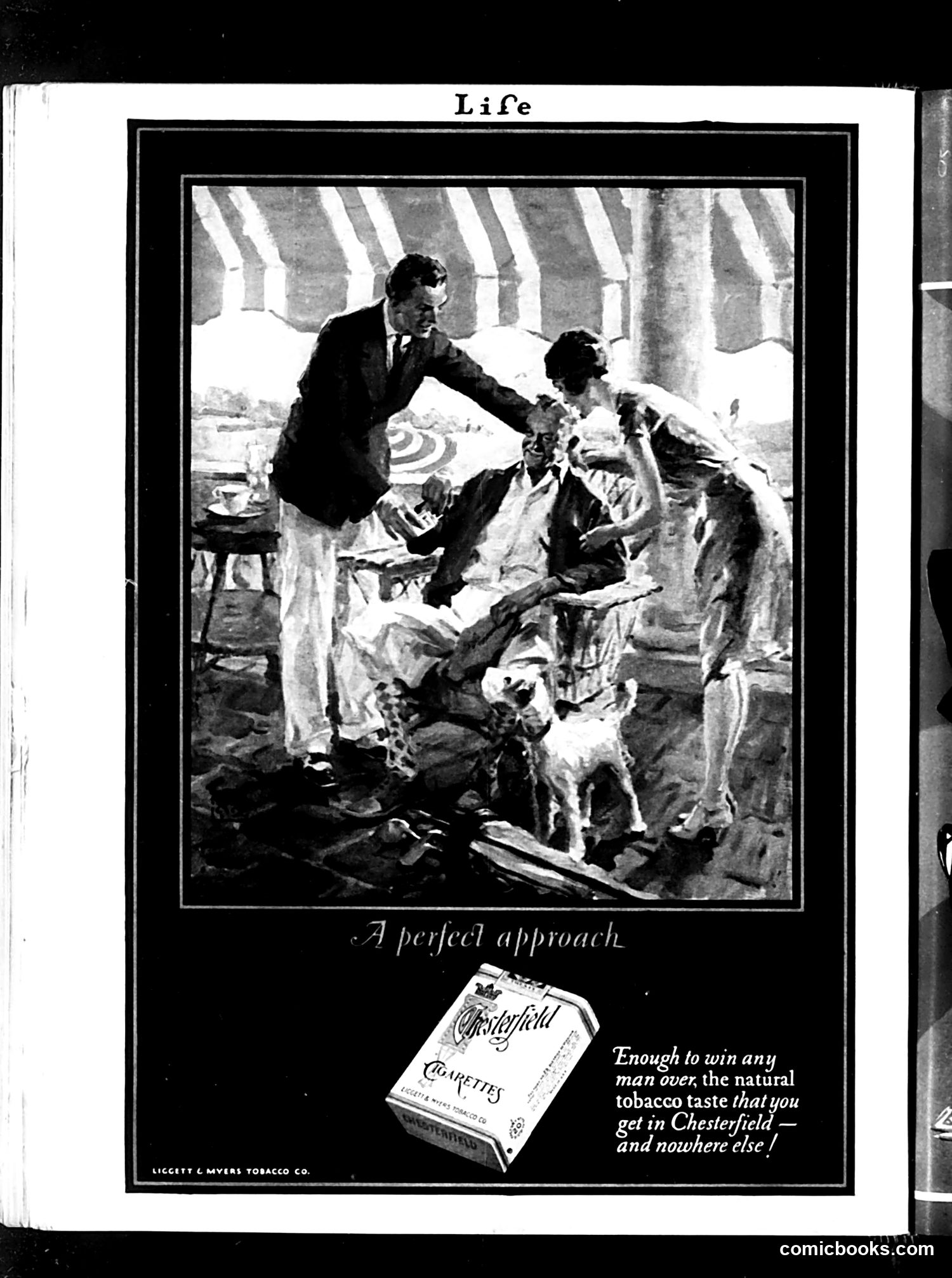
This is a **cigarette advertisement**, not satire or political commentary. It appears in *Life* magazine and promotes Chesterfield cigarettes. The image shows a social scene under a striped beach tent or awning. A well-dressed man in a suit offers cigarettes to seated women in light summer clothing, with a dog present. The caption "A perfect approach" suggests the cigarette as a social tool for male-female interaction. The ad's message claims Chesterfield's "natural tobacco taste" is uniquely superior and persuasive—"enough to win any man over." This is a straightforward mid-century marketing appeal linking cigarettes to social attractiveness and romantic success, typical of the era before tobacco health warnings became mandatory.