
Life, 1927-08-04 · page 28 of 40
Life — August 4, 1927 — page 28: what you’re looking at
What you’re looking at
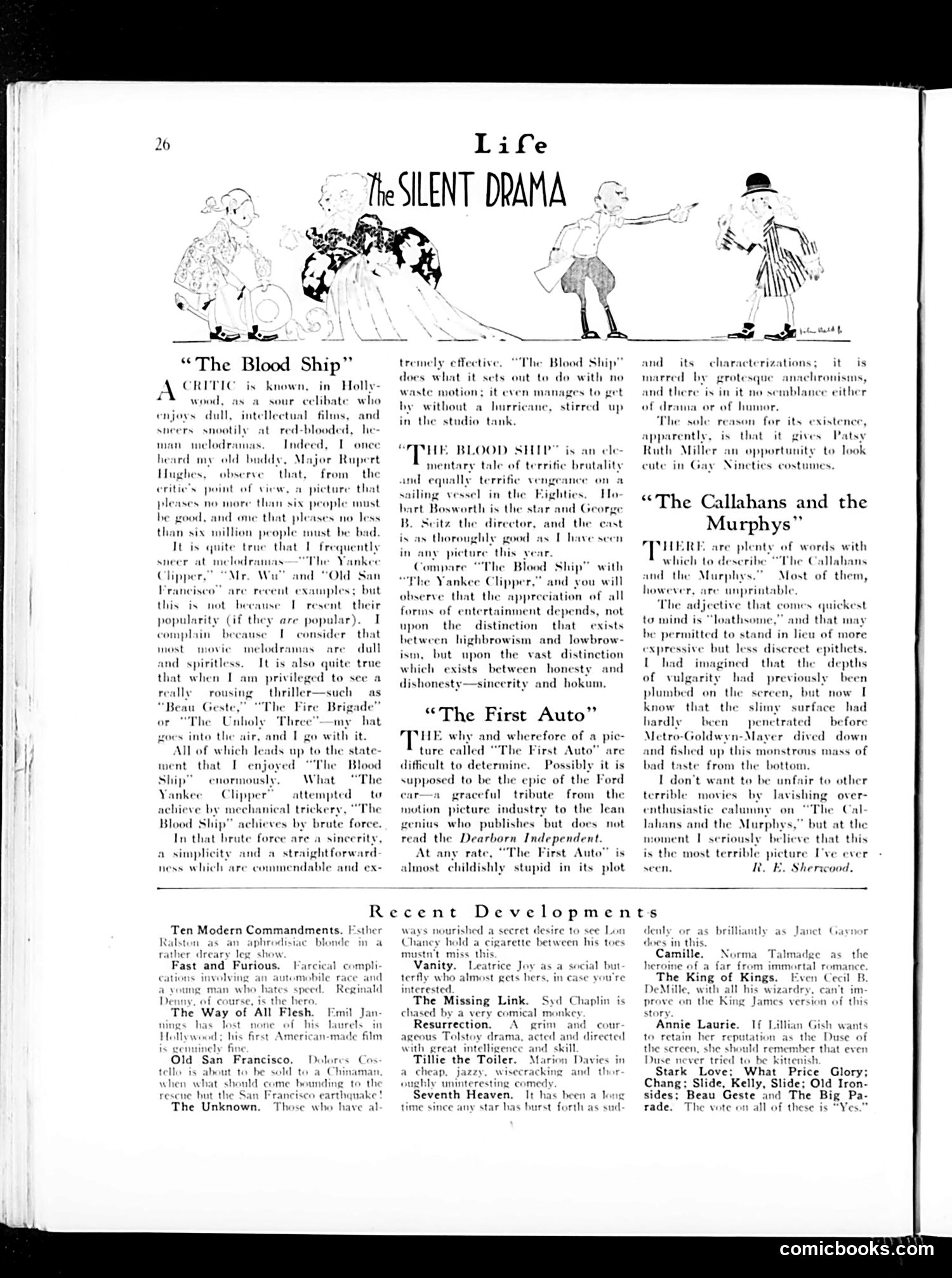
This page contains film criticism from Life magazine's movie section. The cartoon header depicts four figures in exaggerated poses, illustrating different cinematic styles or audience reactions to silent films. The main reviews critique several 1920s silent pictures, evaluating their artistic merit. The critic argues that entertainment quality depends not on whether films are "highbrow" or "lowbrow," but on **sincerity versus hokum**—authenticity versus artifice. Notable reviews include: - **"The Blood Ship"**: Praised for brute-force effectiveness and straightforward storytelling - **"The First Auto"**: Mocked as "almost childishly stupid," apparently a Ford Motor Company tribute - Various other contemporary releases assessed for honesty in filmmaking The critic references Major Rupert Hughes' observation that if six million people enjoy a film, critics dismiss it—satirizing the gap between popular and critical taste. The page illustrates how 1920s film criticism evaluated silent cinema on narrative integrity and emotional authenticity rather than technical spectacle.
📄 Transcribed text from this page (OCR, searchable)
Machine-transcribed from the original scan — historical spelling and the odd misread are preserved.
ar Al “The Blood Ship” CRITIC wood, as a dull, sheers snootily at is known, in’ Holly- sour celibate who intellectual and red-blooded, he- " miclodramas. Indeed, 1 heard my old buddy, Major Rupert that, from the 1 picture that ore than six people must i enjoys films, once Hughes, observe eritie’s point of view, pleases be good, and one that pleases no less than six million people must be bad. that 1 frequently at melodranias The Yankee “Mr. Wu" and “Old San ire recent examples; but It is quite true sneer Clipper. Francisco this is not because LT resent their popularity (if they are popular). I that melodramas are dull It is also quite true complain’ because 1 consider most movie and. spiritless. that when I am privileged to see a really rousing thriller—such as “Beau Geste,” “The Fire Brigade” or “The Unholy ‘Three—my hat es into the air, and T go with it. All of which leads up to the state that J Blood Ship” cnormously. What “The Yankee Clipper” attempted — to achieve by mechanical trickery, “The Blood Ship” achieves by brute force. tment In that brute force are a sincerity, a simplicity and a straightforward ness which are commendable and ex- Ten Modern Commandments. | Ralston as ay rather dreary leg Farcical compli bile race and nny, of course, is the hero. The Way of All Flesh. Emil Jan lost none of his laurels in his first American-made film Hollywood Old San Francisco, Dolores Cos tello is about to be sold to a Chinaman when what should come bounding to resene but the San Francis The Unknown. Those who have al Life tremely effective. “The Blood Ship” does what it sets out to do with no waste motion; it even manages to get by without a hurricane, stirred up in the studio tank. “HE BLOOD SHIP” is an ele mentary tale of terrific brutality and equally terrifie vengeance on a Kighties. Ho hart Bosworth is the star and George B. Seitz the director, and the cast sailing vessel in’ the is as thoroughly good as TP have seen in any picture this vear. Compare “The Blood Ship” with he Yankee Clipper,” and you will observe that the appreciation of all forms of entertainment depends, not upon the distinction that exists between highbrowism and lowbrow- ism, but upon the vast distinction which exists between honesty and dishonesty—sincerity and hokum. “The First Auto” THE why and wherefore of a pic- ture called “The First Auto” are difficult to determine. Possibly it is supposed to be the epic of the Ford graceful tribute from the ion picture industry to the Jean genius who publishes but does not read the Dearborn Independent. At any rate, “The First Auto” is almost childishly stupid in its plot car—a cent ways nourished a secret desire to see I igarette between his t Vanity. Leatrice Joy as a social but terfly who almost gets hers, in case you're interested The Missing Link. Syd Chaplin is chased by a very comical monkey Resurrection. A grim and ageous Tolstoy drama, acted and directed with great intelligence and skill Tillie the Toiler. Maric a cheap, jazzy, wisecracki aghly uninteresting comedy Seventh Heaven. It time since any star has burst forth as sv cour Davies in and thor ind its characterizations; it is marred by unachronisms, ind there of drama or of humor, The sole reason for its existence, ipparently, is that it gives Patsy Rath Miller an opportunity to look Nineties costumes. grotesque is in it no semblance either cute in Gay “The Callahans and the Murphys” TTP HERE: are plenty of words with which to describe “The Callahans ind the Most of them, however, are unprintable The adjective that e to mind is “loathsome,” and that may he permitted to stand in licu of more expressive but less discreet epithets. LT ohad imagined that the of vulgarity had previously plumbed on the know that the surface had hardly been penctrated before Metro-Goldwyn-Mayer dived down ind fished up this monstrous mass of bad taste from the t I don’t want to be terrible over- enthusiastic calumny on Cal Jahans and the Murphys,” but at the moment 1 seriously believe that this is the most terrible picture I've ever seen. R. Sherwood. Murphys.” ies quickest depths been sereen, but now I slim. tom. unfair to other movies by lavishing Developments does in this Camille. Norma Talmadge as the heroine of a far from immortal romance The King of Kings. Even Cecil B DeMille, with all his wizardry, ¢ im prove on the King James version of this story Annie Laurie. to retain her the screen, she Duse never tried to be ki : Stark Love; What Price Glory; Chang; Slide, Kelly, Slide; Old Iron- sides; Beau Geste ind The Big Pa- rade. The vote on all of these is “Yes.” hh wants comicbooks.com