
Life, 1927-08-04 · page 18 of 40
Life — August 4, 1927 — page 18: what you’re looking at
What you’re looking at
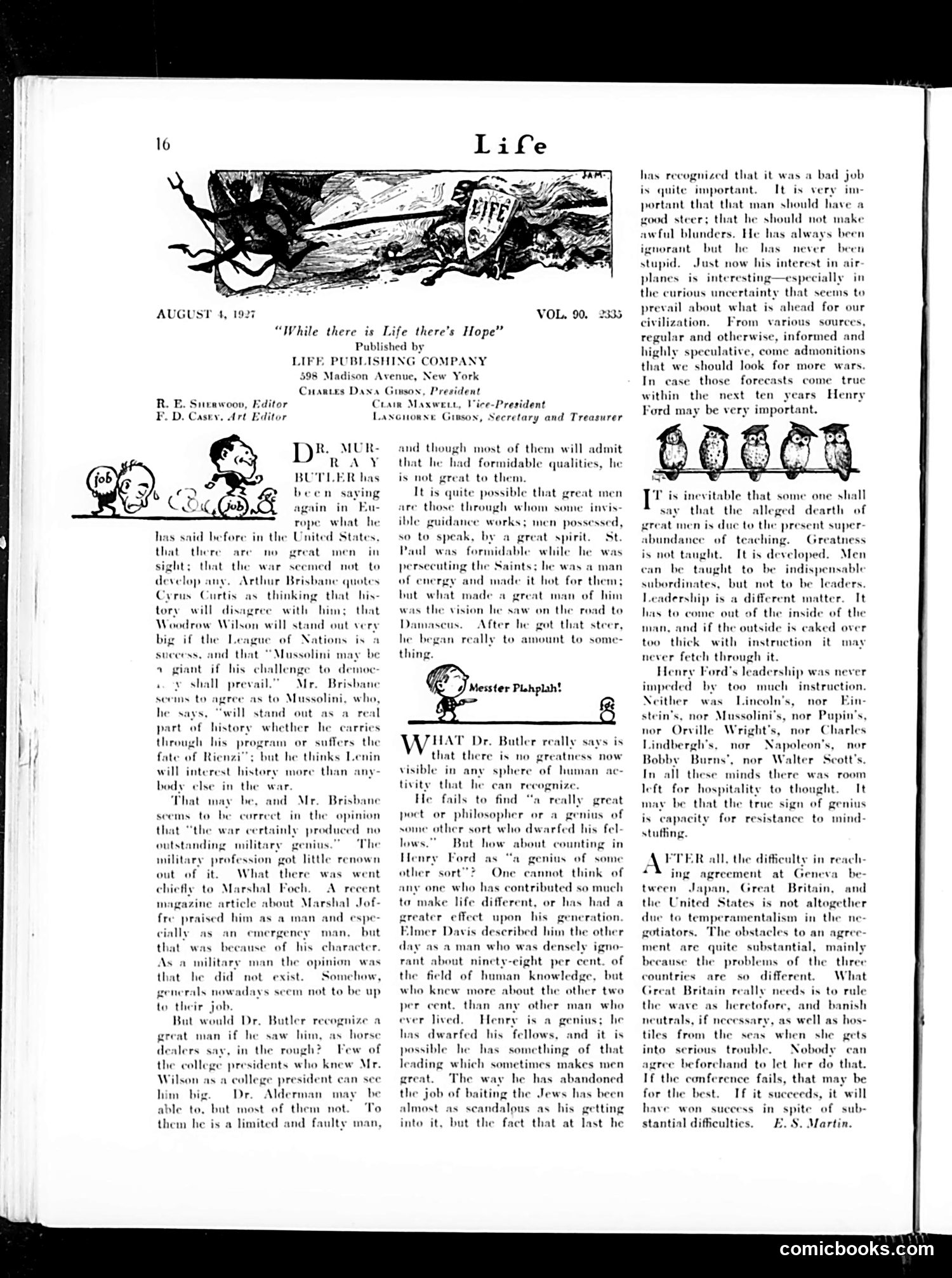
This page contains editorial commentary on leadership and greatness, with a small cartoon labeled "Master Pickpocket!" showing a child figure. The main text discusses Dr. Murray Butler's argument that greatness cannot be recognized in contemporary figures. The author counters by listing historical leaders—Lincoln, Napoleon, Henry Ford—who demonstrated genius through action rather than instruction. The piece critiques an over-reliance on education and teaching as markers of leadership, suggesting instead that true greatness emerges from capacity for resistance to mindlessness and decisive action. The final section mentions obstacles to international agreement at Geneva between Japan, Britain, and the United States regarding war treaties and disarmament—likely referencing post-WWI naval negotiation debates of the 1920s.
📄 Transcribed text from this page (OCR, searchable)
Machine-transcribed from the original scan — historical spelling and the odd misread are preserved.
AUGUST 4, 1927 “While there is Life there’s Hope” Published by LIFE, PUBLISHING COMPANY 598 Madison Avenue, New York Curaates Dana Guison, President R. E. Sirawoov, Editor F.D. Casey, Art Editor D?: MUR- RAY BUTLER has been saying again in’ Eu- rope what he has said before in the United States. that ureat sight; that the war seemed not. to develop any. Arthur Brisbane quotes Cyrus Curtis as thinking that his- tory will with him; that Woodrow Wilson will stand out very big if the League snecess, and that “Mussolini may be his challen prevai there are ne men in disagree of Nations is a to democ Mr. Brisbane is to Mussolini, who, will stand out as a real whether he carries through his program or suffers the fate of Rienzi”; but he thinks Lenin will interest history more than any- a giant if shall wy he says, part of history body else in the war. ‘That be, and Mr seems to be in the that “the war certainly produ outstanding military genius.” The military profession got little renown out of it. What there was went chiefly to Marshal Foch. A_ recent irticle about Marshal J fre praised him as a man and espe man, but Brisbane opinion ed no. may correct ma, ine cially as an that As a military man the opinion was that he did not Somehow, generals nowadays seem not to be up to their job. But would great man if he saw him emergeney was because of his character exist. Dr. Butler recognize a as horse dealers say, in the rough? Few of the college presidents who knew Mr. Wilson as a college president can sec him big Dr. Alderman able to. but most of them not. To them he is a limited and faulty man, may ds Crate Maxwent, Vice-President Laxcuoaxt Ginsox, Secretary and Treasurer and though most of them will admit that he had formidable qualities, he is not great to them. It is quite possible that great men are those through whom some invis- ible guidance works; men possessed, » to speak, by a great spirit. St. Paul formidable while he was persecuting the Saints; he was a man of energy and made it hot for them; but what made a great man of him the read to t that steer, mount to some- was was the vision he saw ¢ After he he began really to S Mester Plahplah! 2 Damascus. WHAT Dr. Butler really says is that there is 1 visible in any sphe greatness now of human ac- tivity that he can recognize. He fails to find “a really great poct or philosopher or a genius of other sort who dwarfed his fel But how Ford as “ lows.” Henry other sort’? about counting in a genius of some One cannot think of iny one who has contributed so much ta make life different, or has had a greater effect upon his generation. Elmer Davis described him the other day as a man who was densely igno: rant about nincty-eight per cent. of the field of human knowledge, but who knew more about the other two per cent. than any other man who ever lived. Henry is a. ge has dwarfed his fellows, and it is has something of that ius; he possible he leading which sometimes makes men great. The way he has abandoned the job of baiting the Jews has been ilmost as scandalous as his getting into it, but the fact that at last he has recognized that it was a bad job ix quite important. Tt is very im- portant that that man should Nave a yood steer; that he should not make awful blunders. He has always been ignorant but he never Lb stupid. Just now his interest in air ly in the curious uncertainty that seems to prevail about what is ahead for our civilization. From various sources, regular and otherwise, informed and highly speculative, come admonitions that we should look for more wars In case those forecasts come true within the next ten years Henry Ford may be very important. planes is interesting—especi, is inevitable that some one shall ay that the alleged dearth of men iy due to the present super- abundance of teaching. Greatness is not taught. [tis developed. Men can be taught to be indispensable subordinates, but not to be leaders. Leadership is a different matter. It has to come out of the inside of the man nd if the outside is caked over too thick with instruction it may never fetch through it. Henry Ford's rship was never impeded by too instruction. Neither Lincoln's, nor Ein- stein's, nor Mussolini's, nor Pupin’s, nor Orville Wright's, nor Charles Lindbergh's. Napoleon's, nor Bobby Burns’, nor Walter Scott's. In all these minds there was room left for hospitality to thought. It may be that the true sign of genius is capacity to mind- stuffing. much was nor for resistance A ETER all, the difficulty in reach 2% ing agreement at Geneva be- tween Jap. Great Britain, and the United States is not altogether due to tempe gotiators. The obstacles to an agree ment are quite substantial, mainly because the problems of the thr countries are so different. What Great Britain really needs is to rule the wave as heretofore, and banish neutrals, ifn nentalism in the ne- ssary, as well as hos- tiles from the when she gets into serious trouble. Nobody ean agree beforchand to let her do that. If the conference fails, that may be for the If it succeeds, it will have won success in spite of sub- stantial difficulties. EF. S. Martin. best comicbooks.com