
Life, 1927-08-04 · page 23 of 40
Life — August 4, 1927 — page 23: what you’re looking at
What you’re looking at
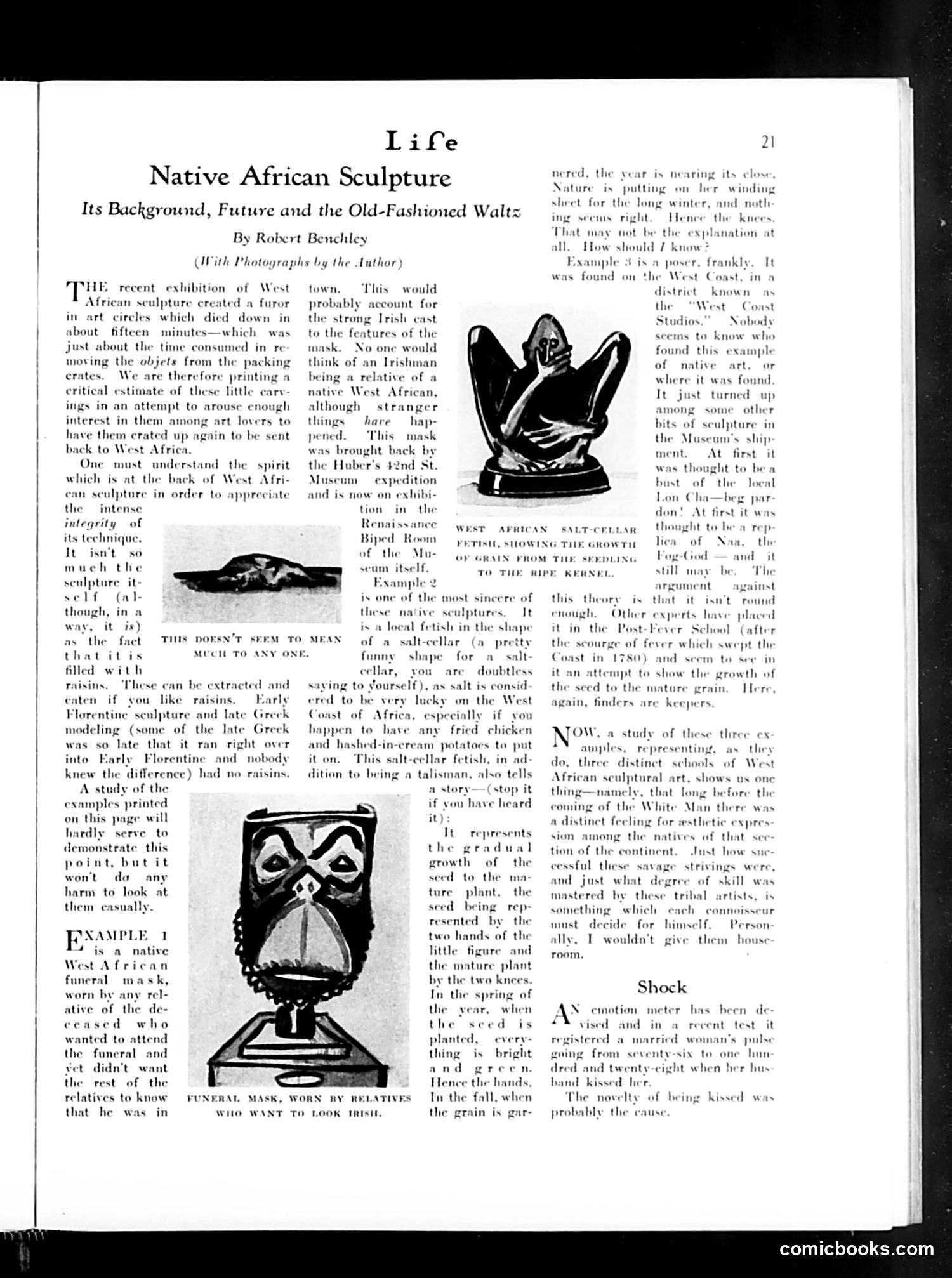
This page presents Robert Benchley's humorous essay on West African sculpture, accompanied by photographs of actual artifacts. Benchley employs satirical commentary on both the artworks and contemporary art criticism's pretentious approach to "primitive" art. The three examples shown are genuine African objects: a funeral mask (Example 1), a salt-cellar fetish (Example 2), and a seed-to-plant fertility symbol (Example 3). Benchley's joke lies in deflating art-world solemnity—he notes the funeral mask's "strong Irish cast" and jests that the salt-cellar doesn't "seem to mean much to any one," while the fertility figure's symbolic meaning seems arbitrary ("How should I know?"). The satire targets two things: Western art experts' tendency to over-interpret non-Western objects through invented significance, and the casual dismissiveness toward African art despite its exhibition value. Benchley's casual tone mocks the reverent language typically surrounding such collections.
📄 Transcribed text from this page (OCR, searchable)
Machine-transcribed from the original scan — historical spelling and the odd misread are preserved.
Life Native African Sculpture Its Background, Future and the Old-Fashioned Waltz By Robert Benchley (With Photographs by the Author) THE recent exhibition of West African sculpture created a furor in art bout circles which died down in fifteen just about the time consumed in re moving the objets from the pac crates. We are therefore printing a critical estimate of these little ings in an attempt to arouse enough interest in them among art lovers to minutes—which was cary have them crated up again to be sent back to West Africa. One must understand the spirit which is at the back of West Afri- can sculpture in order to the ippreciate intense integrity of Renaissance west aprican its technique. Biped Room yyristt, sows It isn't so of the Mu- oy aay pros much the scum itself To THE RIP sculpture it aa Example 2 self (al- - is one of the most sincere of though, in a these native sculptures. It way, it is) is a local fetish in the shape as the fact THIS DORSN’T SEEM TO MEAN of a salt-cellar (a pretty that itis MUCH TO ANY ONE. funny shape for a salt filled with cellar, you are doubtless raisins. ‘These can be extracted and — saying to yourself), as salt is consid eaten if you like raisins. Early ered to be very lucky on the West Florentine sculpture and late Greck Coast of Africa, especially if you modeling (some of the late Greek happen to have any fried chicken was so late that it ran right over and hashed-in-eream potatoes to put into Early Florentine and nobody — it on. This salt-cellar fetish, in ad- knew the difference) had no raisins. A study of the examples printed on this page will hardly s to demonstrate this point, but it won't. do any harm to look at them casually. ve F(XAMPLE 1 4 is a native West Afric funeral mask, worn by any rel- ative of the de- ased who wanted to attend the funeral and ¥et didn't: want the rest of the relatives to know that he FUNERAL MASK, was in WORN BY RELATIVES WHO WANT TO LOOK TRISIE, This probably account for the strong Irish cast to the mask. No one would think of an Irishman being a relative of a West Africa town, would features of the native n, although = strange things hare hap- pened. This mask was brought back by the Huber’s 42nd St. Museum — expedition and is now on exhibi- tion in the dition to being a talisman, also tells a story—(stop it if vou have heard it) It represents the gradual growth of the seed to the ma ture plant. the seed being rep- resented by the two hands of the little figure and the mature plant by the two knees. In the of the when the planted, thing is bright und green Hence the hands. In the fall, when the grain is gar- spring year, seed is every- nered, the Nature is year iy nearing its close putting on her sheet for the | winding x winter, and noth Hence the knees be the explanation at How should 7 know? frankly. It West Coast, in a district the Studios seems right That may not ll was found on the known as West ¢ Ni seems to know who found this example of where it was found It just among native art, or turned up some other bits of sculpture in the Museum's ship ment At first it was thought to bea bust of the local Lon Cha—beg par don! At first it was sant-ceunar thought to be a rep «tur crowrn lier of Naa, the rie seeping — Pox-God and it e RMERE still may be. ‘Thi ingument this theory ix that it’ isn't round enough. Other experts have placed it in the Post-Fever Sel (after the scourge of fever which swept the Coast in 1780) and seem ein it an attempt to show the growth of the seed to the mature grain. Here again, finders N do, ure keepers IW, a study of these three ex al representing, as they distinet s of West African sculptural art, shows us one thing—namely, that long before the of the White Man there a distinet feclir riesthetic expres nnong the natives of that sec tion of the continent cessful these and just what mastered by these three sch was sion Just how suc savage strivings were, © of skill tribal artists, is each was something which connoisseur himself. Person them must decide for uly, I wouldn't room. house Shock emotion meter has been de vised recent test it tered a marricd woman's pulse AS re hun going from seventy-six one dred and twenty-eight when her hus hand kissed her. The novelty of being kissed was probably the cause comicbooks.com