
A complete issue · 38 pages · 1927
Life — June 23, 1927
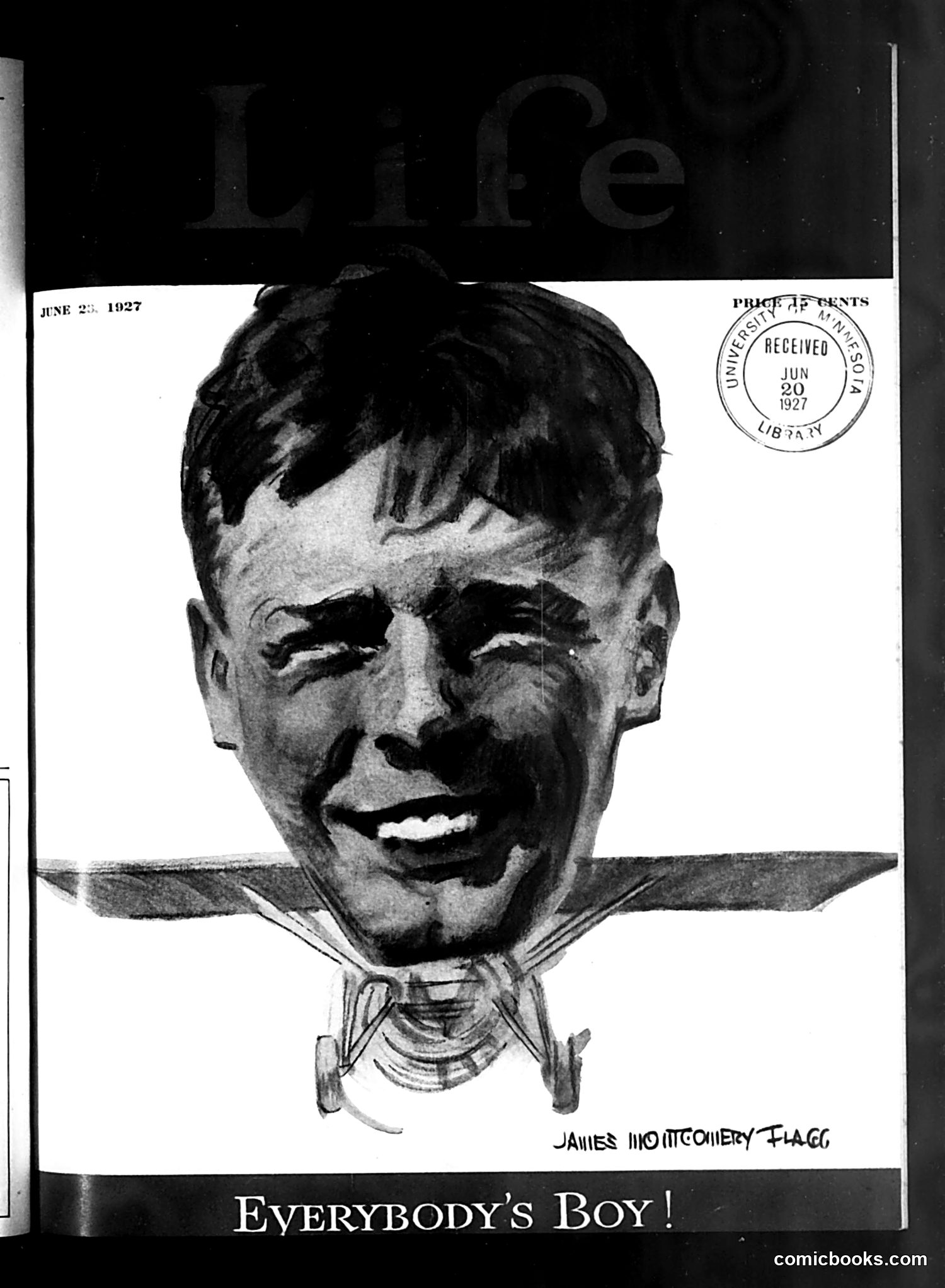
This is a caricature from *Life* magazine dated June 23, 1927, labeled "Everybody's Boy!" The drawing depicts James Montgomery Flagg, a famous American illustrator and cartoonist, rendered as an exaggerated caricatured head with prominent features and an airplane propeller extending from his neck. The propeller reference likely connects to the aviation craze of the 1920s, particularly the celebrity status surrounding aviators like Charles Lindbergh, whose transatlantic flight occurred just weeks before this issue (May 1927). By adding aviation imagery to Flagg's caricature, the cartoonist satirizes either Flagg's popular appeal or the era's obsession with aviation as the ultimate symbol of American modernity and heroism.
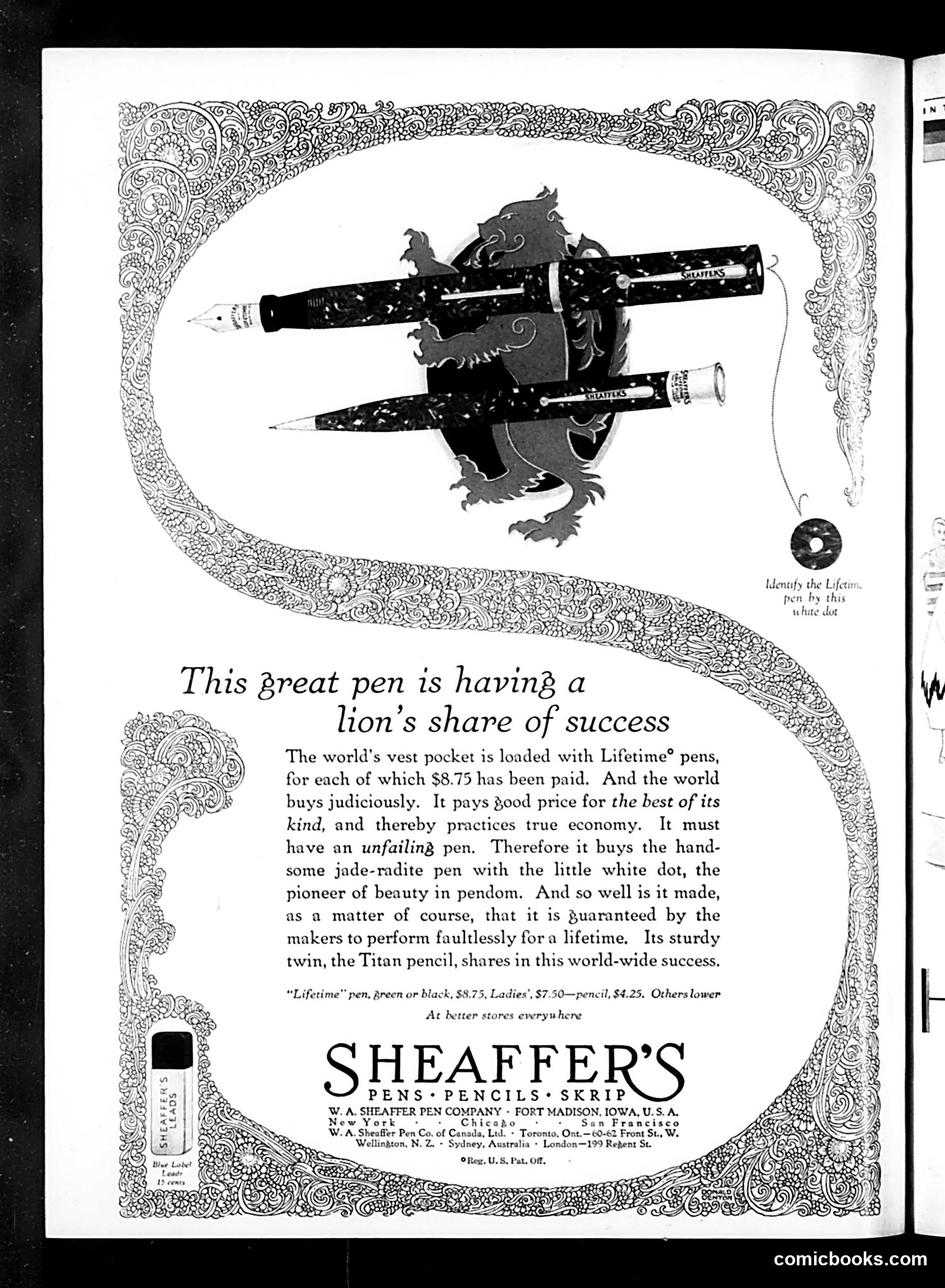
This is a **Sheaffer's pen advertisement**, not political satire. The central image shows a dragon or mythical beast wielding writing instruments—a "Lifetime" pen and "Titan" pencil—as weapons or tools of success. The ad's humor plays on the metaphor of business competition as warfare: the creature uses pens and pencils as its "lion's share of success" in the marketplace. The ornate decorative border frames this fantastical image in a style typical of early-to-mid 20th century advertising design. The text emphasizes product quality and value ($8.75 for the Lifetime pen), claiming lifetime durability and reliability. The joke relies on anthropomorphizing writing instruments and associating them with dominance and conquest—suggesting Sheaffer products are essential weapons for professional success.
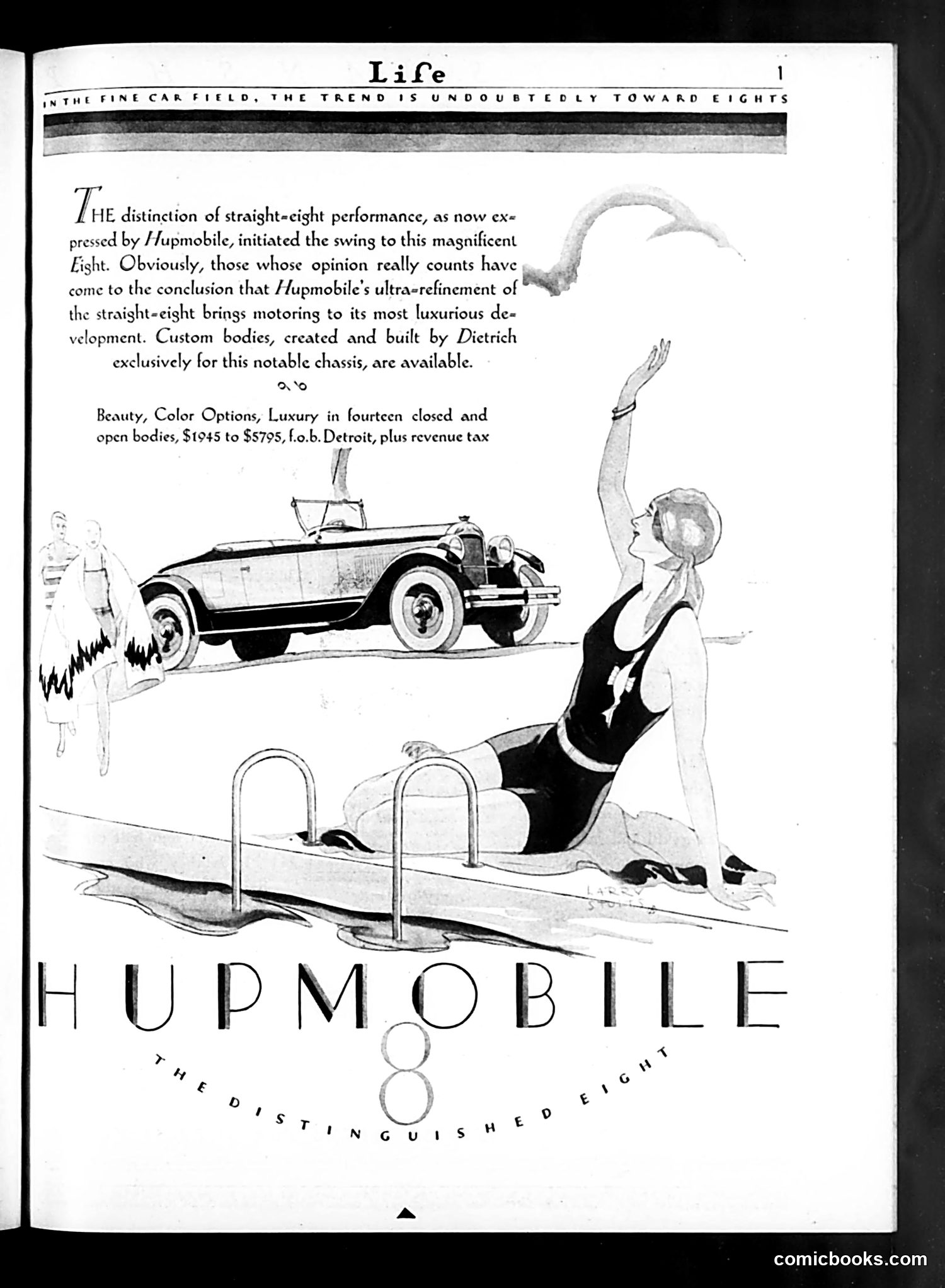
This is primarily a **luxury car advertisement**, not political satire. The page promotes the Hupmobile straight-eight engine, positioning it as bringing "motoring to its most luxurious development." The illustration depicts a fashionable woman in a bathing suit lounging poolside while admiring the elegant Hupmobile automobile. The visual strategy is standard for 1920s advertising: associating the product with leisure, sophistication, and attractive lifestyle imagery. The only potential social commentary is implicit—the ad reflects Jazz Age consumer culture and gender roles, presenting the car as aspirational luxury for affluent buyers. There's no identifiable political figure or satire. The "eight" refers to the engine's cylinder count, a significant technical specification marketed as superior to competitors.
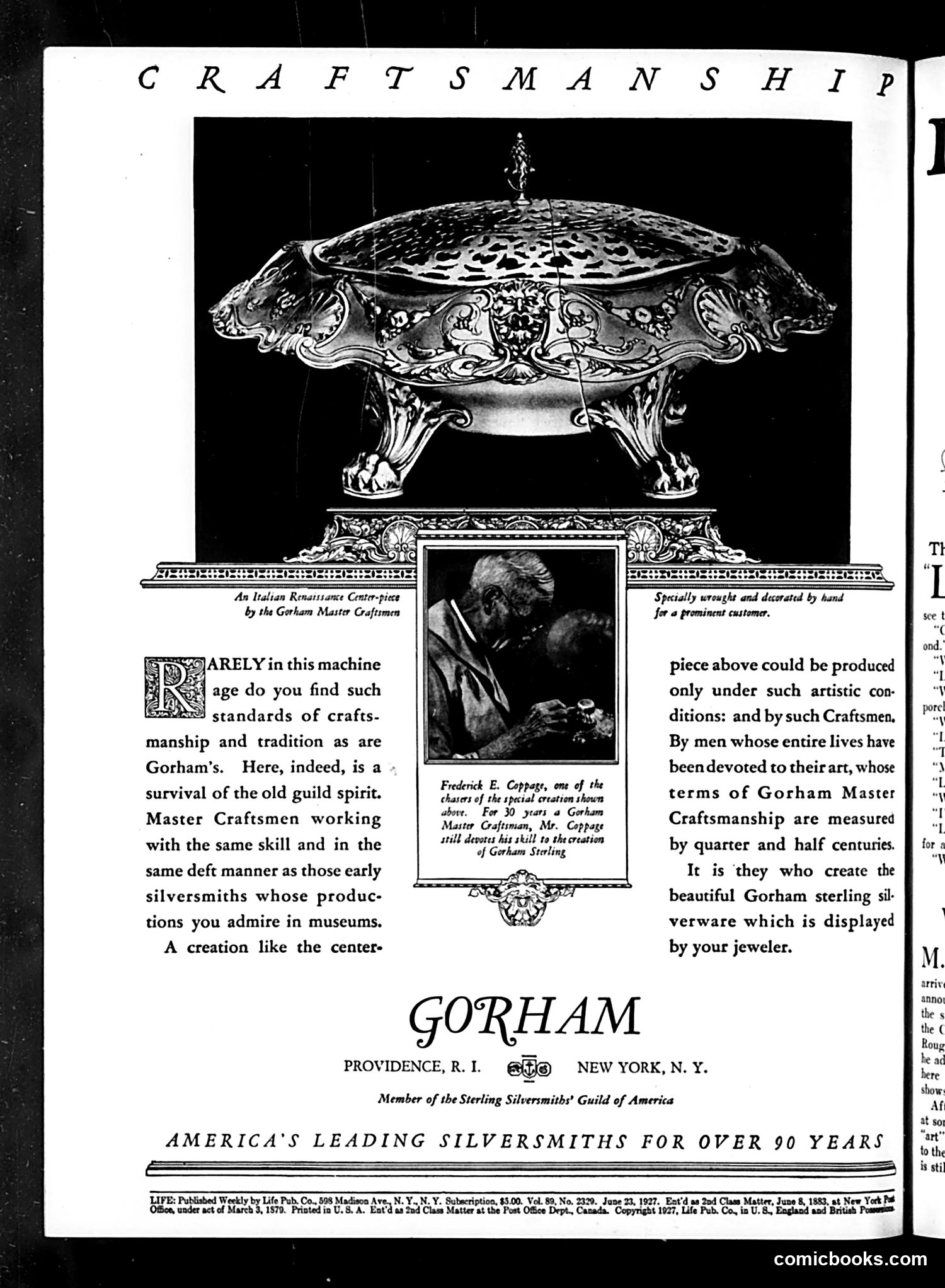
This page is **not a political cartoon or satire**—it's a **full-page advertisement for Gorham silverware**, America's leading silversmiths. The ad celebrates traditional craftsmanship through an ornate silver centerpiece shown at top. A photograph features Frederick E. Cappele, a Gorham Master Craftsman with 25+ years experience, demonstrating hand-wrought silverware production. The text emphasizes that Gorham maintains "old guild spirit" standards, with craftsmen trained over "quarter and half centuries." The ad positions Gorham silver as museum-quality work produced by dedicated artisans, contrasting handmade excellence against mass manufacturing. Located in Providence, Rhode Island and New York, Gorham marketed itself as "America's Leading Silversmiths for Over 90 Years," appealing to wealthy customers valuing tradition and artisanal quality.
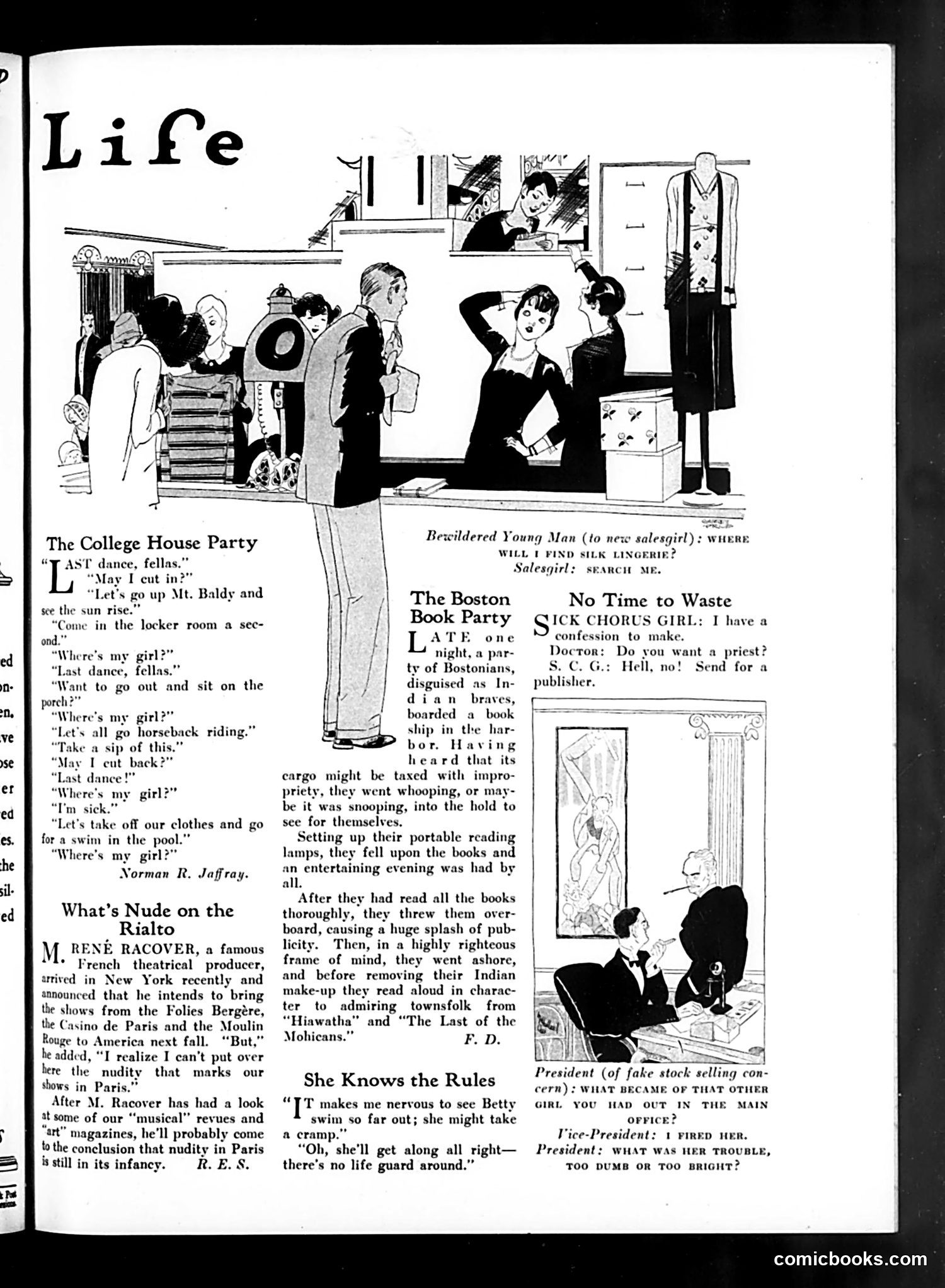
This page contains several humorous vignettes satirizing 1920s social life: **"The College House Party"** mocks young men's predictable behavior at parties—repeatedly asking "Where's my girl?" and suggesting increasingly absurd activities (horseback riding, pool swimming). **"The Boston Book Party"** jokes about wealthy Bostonians who disguise themselves as Native Americans, board a ship, and throw books overboard—a satirical reference to the Boston Tea Party, suggesting pretentious intellectuals mimicking historical rebellion for entertainment. **"No Time to Waste"** depicts workplace comedy about a "sick chorus girl" consulting a doctor, with office gossip following. **"She Knows the Rules"** gently mocks a woman's swimming etiquette concerns. The cartoon style and social scenarios reflect 1920s leisure culture, class consciousness, and gender dynamics of the Jazz Age.
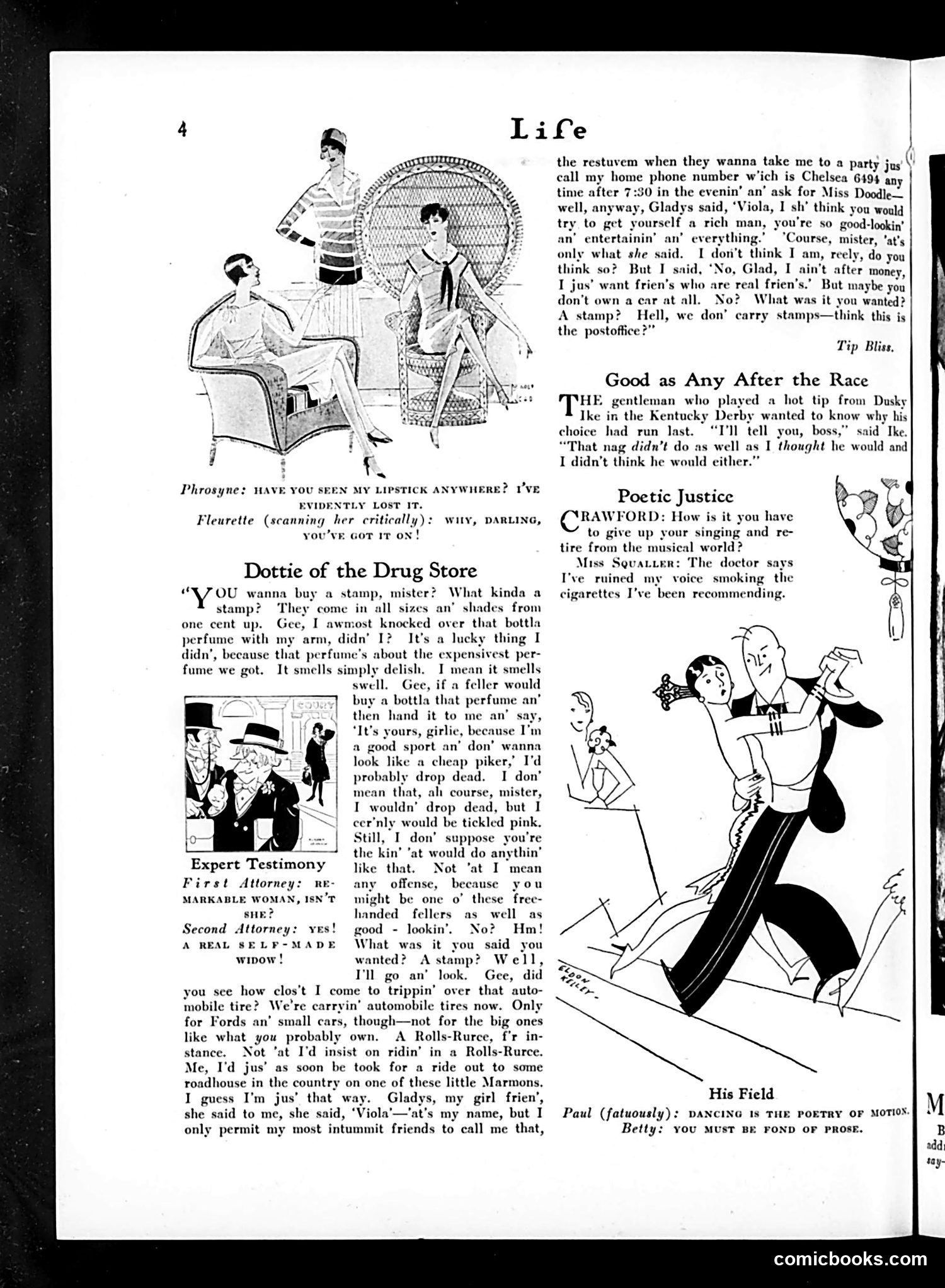
This page contains several satirical vignettes typical of Life's humor format: **"Dottie of the Drug Store"** features a garrulous drugstore clerk who dominates conversation while a customer tries to buy a stamp. The humor derives from the clerk's rambling tangents about perfume, automobiles, and her friend "Viola"—satirizing working-class female chattiness and the customer service experience. **"Good as Any After the Race"** mocks a man who received a poor horse-racing tip, illustrating gullible pursuit of gambling advice. **"Poetic Justice"** presents brief comic dialogues—one involving a singing instructor, another depicting a couple dancing, with wordplay and ironic reversals. The cartoons satirize everyday American social situations: commercial transactions, gambling culture, romance, and pretension. The humor relies on character types and relatable social awkwardness rather than topical references.
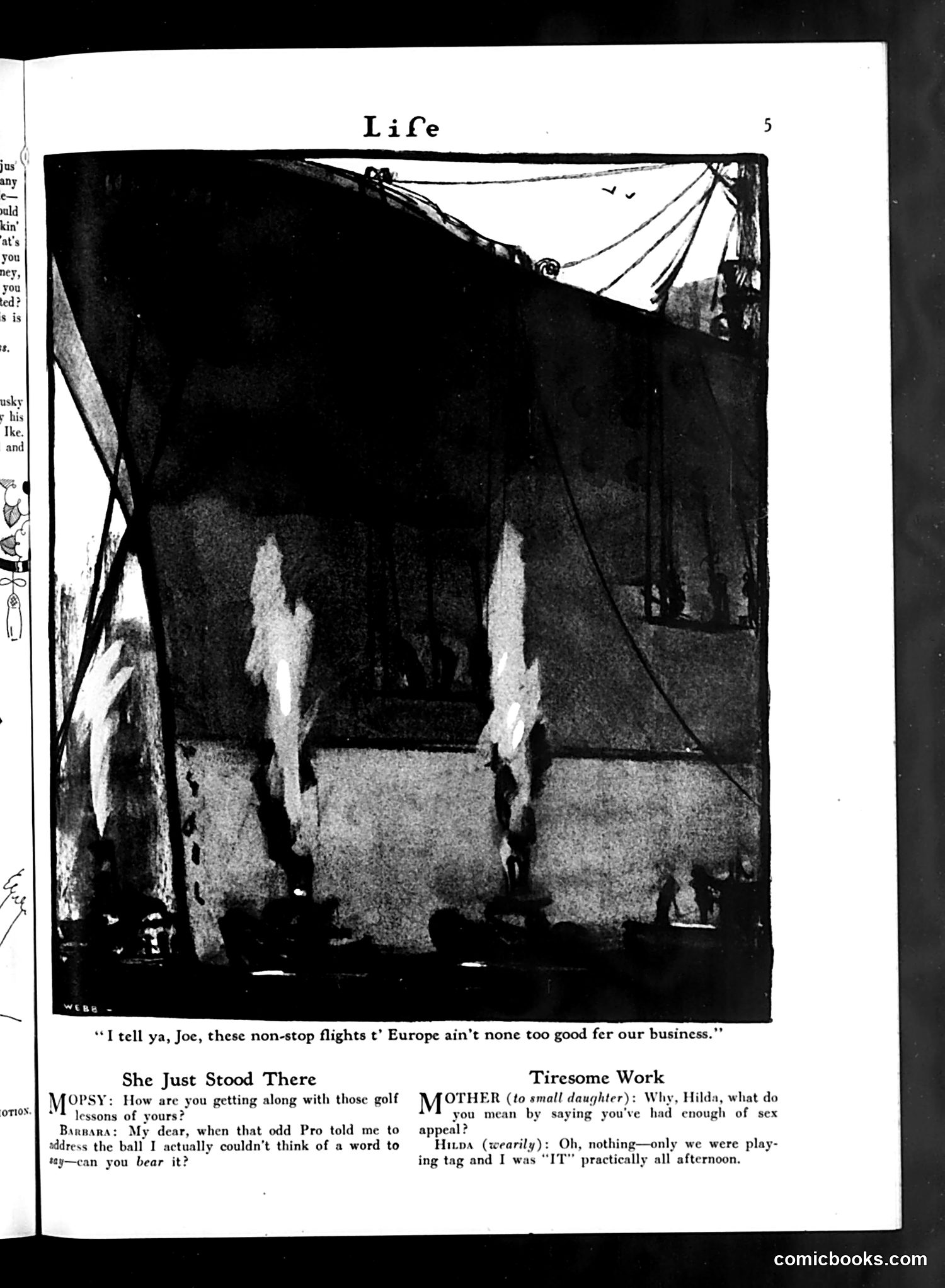
This page contains a photograph of dairy cattle (appears to be a prize cow with white markings) with the caption commenting on transatlantic air travel impacting the cattle business. Below are two separate humor pieces: **"She Just Stood There"** features a dialogue between Mopsy and Barbara about golf lessons—a Pro instructor apparently left Barbara speechless with his advice. **"Tiresome Work"** shows a Mother-Daughter exchange: the daughter Hilda complains she's had "enough of sex appeal" after playing tag all afternoon. The humor derives from the double meaning of "IT"—referencing the contemporary slang term for sexual attractiveness (likely from the 1927 Clara Bow film). The page reflects early 20th-century domestic humor focused on gender roles, leisure activities, and social conventions of the period.
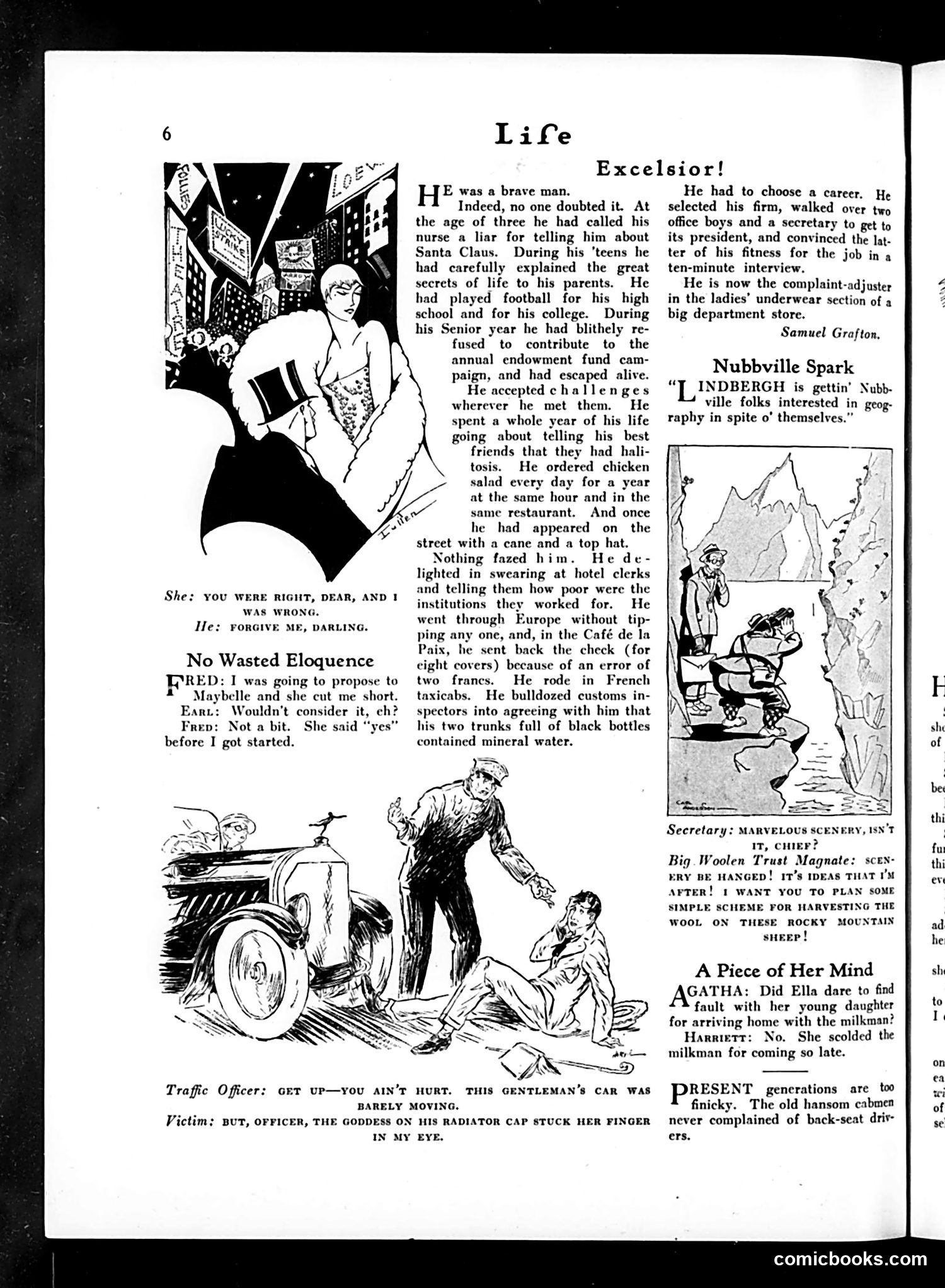
This page contains several brief humorous vignettes typical of Life's satirical humor: **"No Wasted Eloquence"** depicts a marriage proposal rejected almost immediately—the joke being that the woman says "yes" before the man even finishes asking. **The traffic accident cartoon** shows a collision where both the officer and victim blame the other party, with the officer claiming the gentleman's car was "barely moving" while the victim notes the radiator cap stuck in his eye—absurdist humor about accident blame-shifting. The remaining sections—"Excelsior!," "Nubville Spark," "Big Woolen Trust Magnate," and "A Piece of Her Mind"—are brief anecdotes poking fun at everyday social situations: career ambition, small-town gossip, business schemes, and marital domestic disputes. The humor relies on exaggeration and observational comedy about middle-class American life.
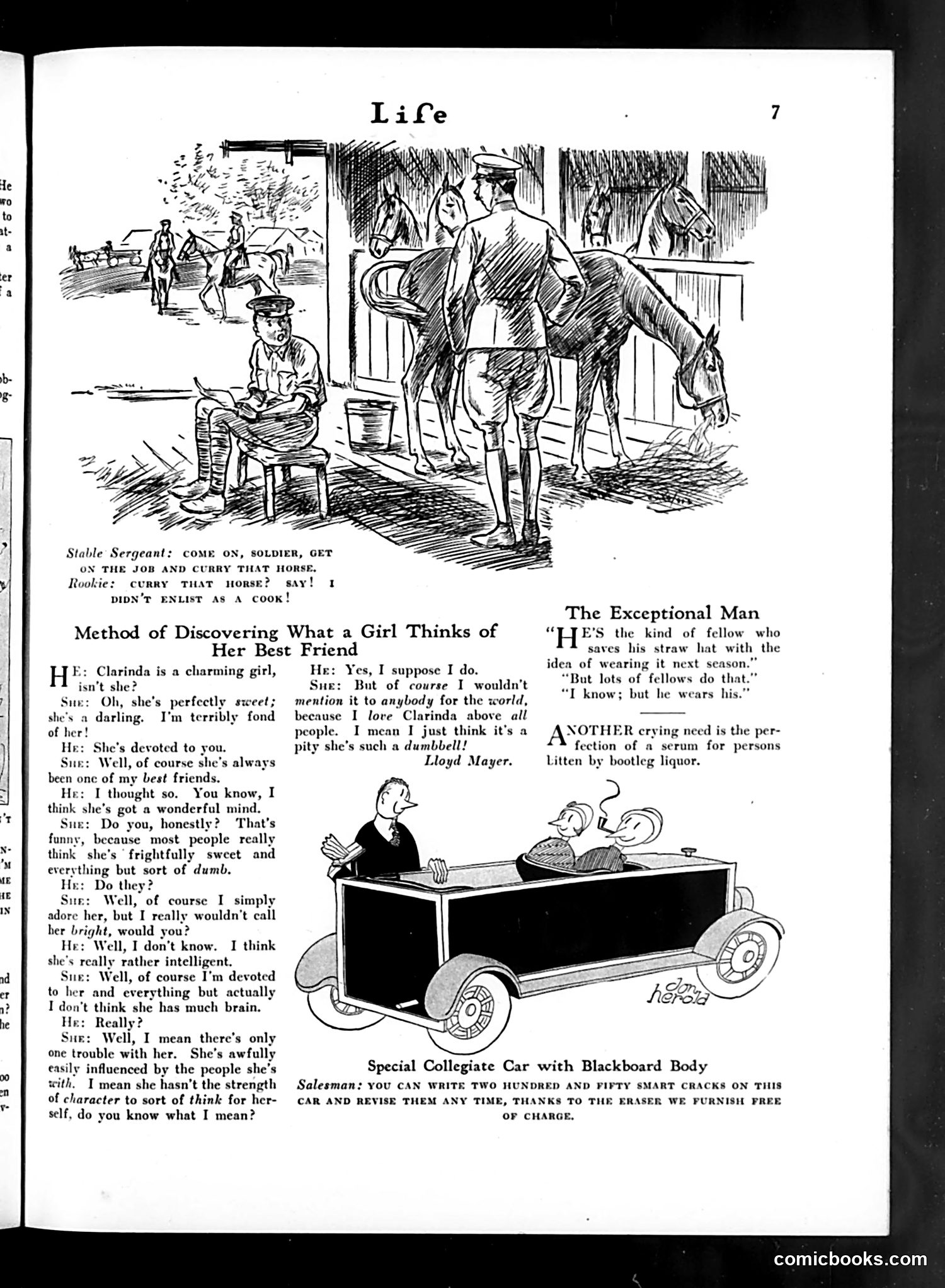
This page contains three distinct pieces of satirical content: 1. **Top cartoon**: A stable scene mocking military incompetence—a sergeant orders a rookie to curry a horse despite the soldier's protest that he "didn't enlist as a cook," satirizing the absurdity of military hierarchy and menial assignments. 2. **Middle dialogue**: "Method of Discovering What a Girl Thinks of Her Best Friend" presents a conversation where a man extracts backhanded compliments about a woman (calling her "sweet" but "dumb," "devoted" but "easily influenced"). The satire targets how people reveal true opinions through careful questioning. 3. **Bottom advertisement**: A novelty "Collegiate Car with Blackboard Body" for students—a humorous product pitch allowing buyers to write and erase messages on their vehicle, targeting the college market of the era. The page reflects typical early-20th-century Life magazine humor: social observation and light mockery of gender relations, military culture, and consumer culture.
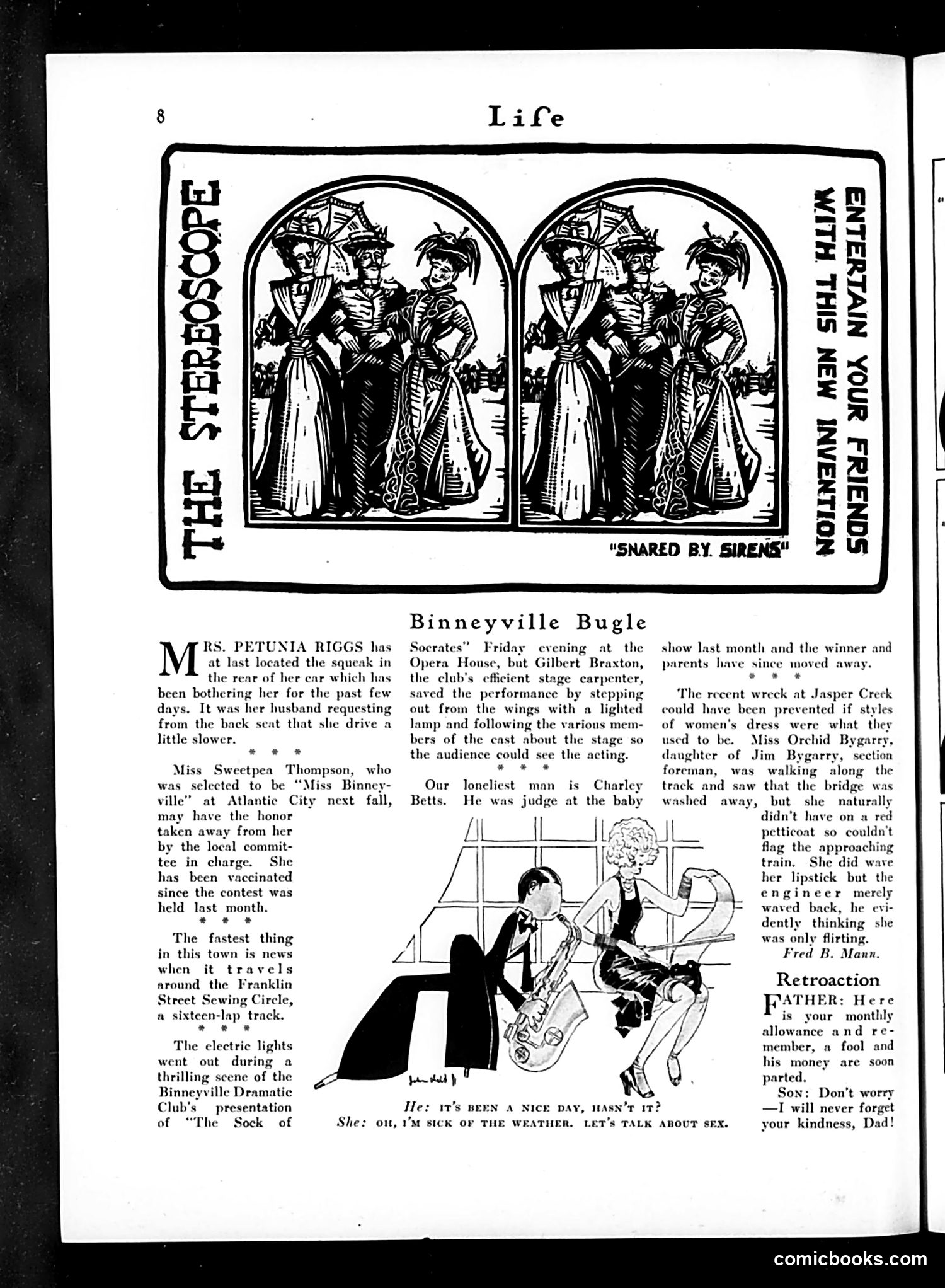
This page from *Life* magazine contains local humor about Binneyville. The main content includes: **"Snared by Sirens"** - A stereoscopic image (viewed with a special viewer) showing three fashionably dressed women with umbrellas, likely depicting an outdated Victorian or Edwardian entertainment concept. **"Binneyville Bugle"** - Local gossip items about town events, including a dramatic club performance and mentions of residents like Miss Sweetpea Thompson and Charley Betts. **The central cartoon** shows a couple in a train car. The woman says she's "sick of the weather" and wants to "talk about sex"—a mild innuendo joke for the era about marital conversation. **"Retraction"** - A brief humorous exchange between father and son about allowance and money. The page represents typical early-20th-century American magazine humor: local social gossip, mildly risqué domestic jokes, and small-town entertainment references.
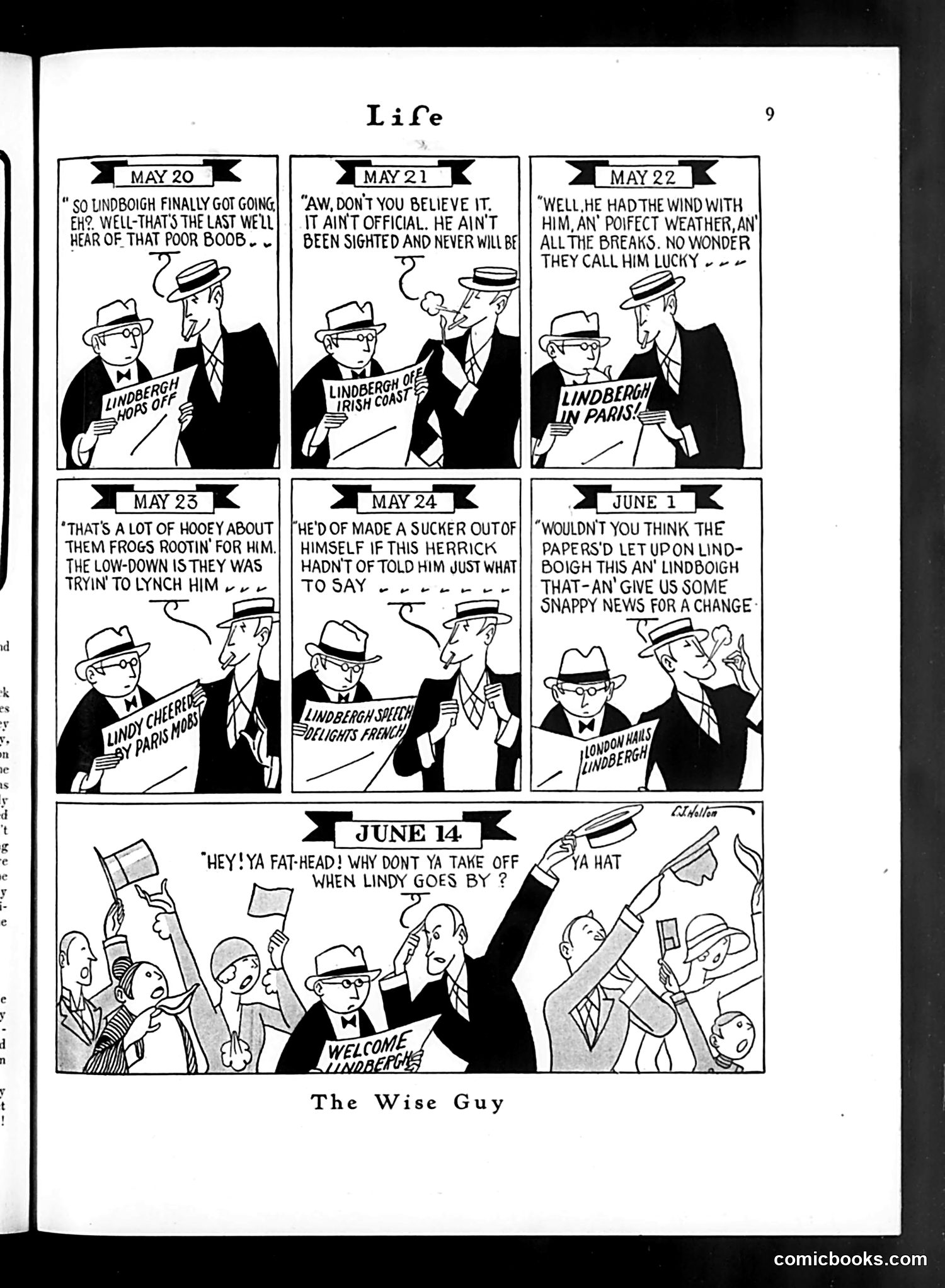
This comic mocks public obsession with Charles Lindbergh following his May 1927 transatlantic flight. The "wise guy" character makes knowing comments about Lindbergh's journey while reading sensationalized newspaper headlines tracking his progress ("Lindbergh Off Irish Coast," "Lindbergh In Paris," etc.). The satire targets: - **Media sensationalism**: Newspapers' breathless coverage of every detail - **Public gullibility**: People accepting unverified reports as fact - **Celebrity worship**: The public treating Lindbergh as a lucky hero despite lacking confirmed sightings The June 14 panel shows crowds greeting Lindbergh with patriotic fervor, contrasting with earlier panels where the "wise guy" skeptically questions the reliability of reports. The joke suggests ordinary people naively consume whatever newspapers print about celebrities.
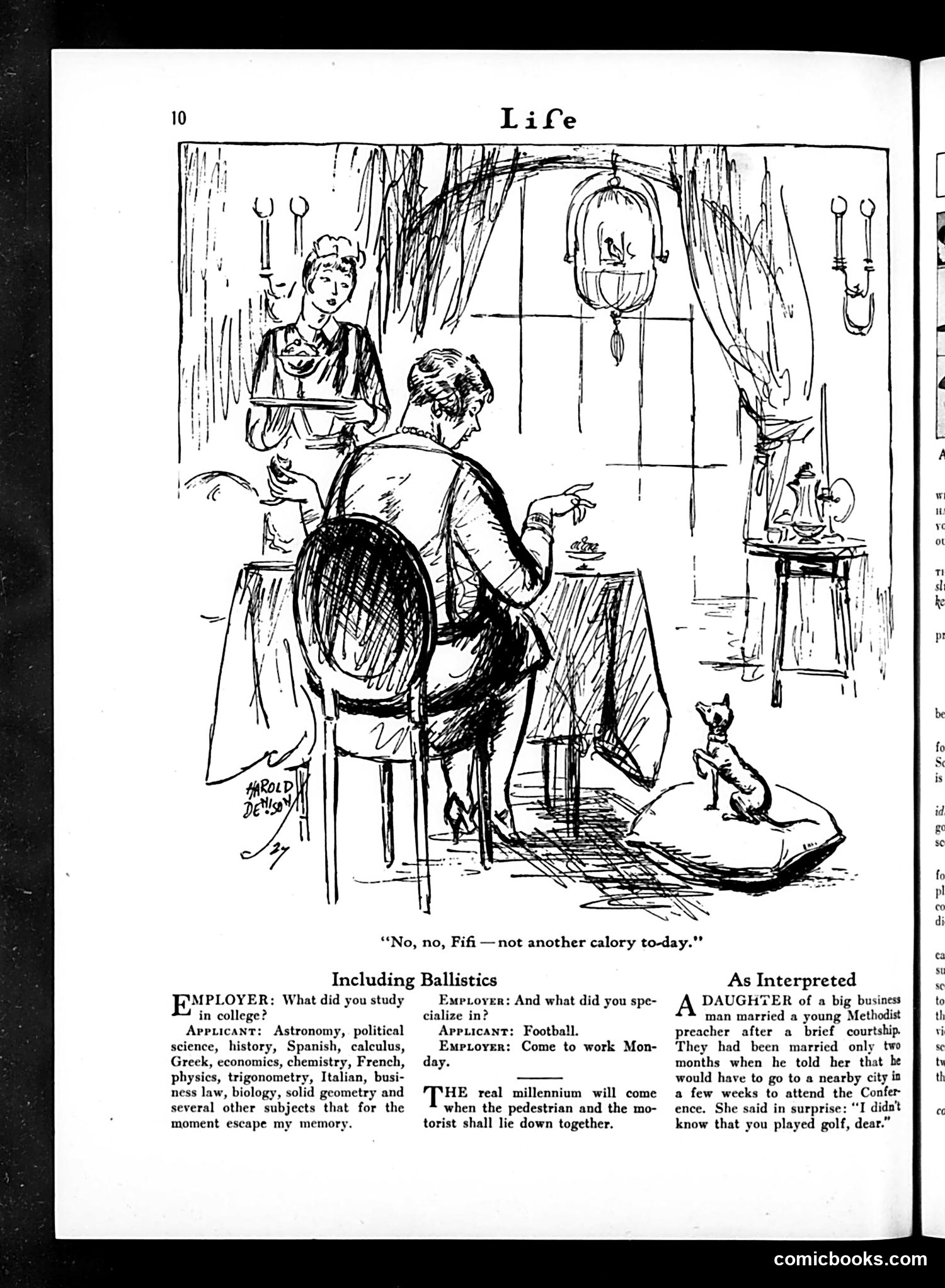
This page contains two satirical pieces mocking educational and marital expectations of the era. The main cartoon shows a man at dinner rejecting "another calory [sic]" while his wife serves him. The accompanying text "Including Ballistics" lists absurdly comprehensive college subjects he supposedly studied (astronomy, chemistry, French, etc.), while sarcastically noting he can only discuss football—suggesting educated men often retain nothing practical from their studies. The second piece, "As Interpreted," mocks a newlywed husband who abandons his Methodist bride after only two months to attend a conference, claiming she shouldn't mind because she "played golf, dear." The satire critiques both male self-centeredness in marriage and women's limited autonomy—she's presented as property whose interests can be dismissed. Both pieces reflect early 20th-century gender dynamics and class anxieties about education and domesticity.
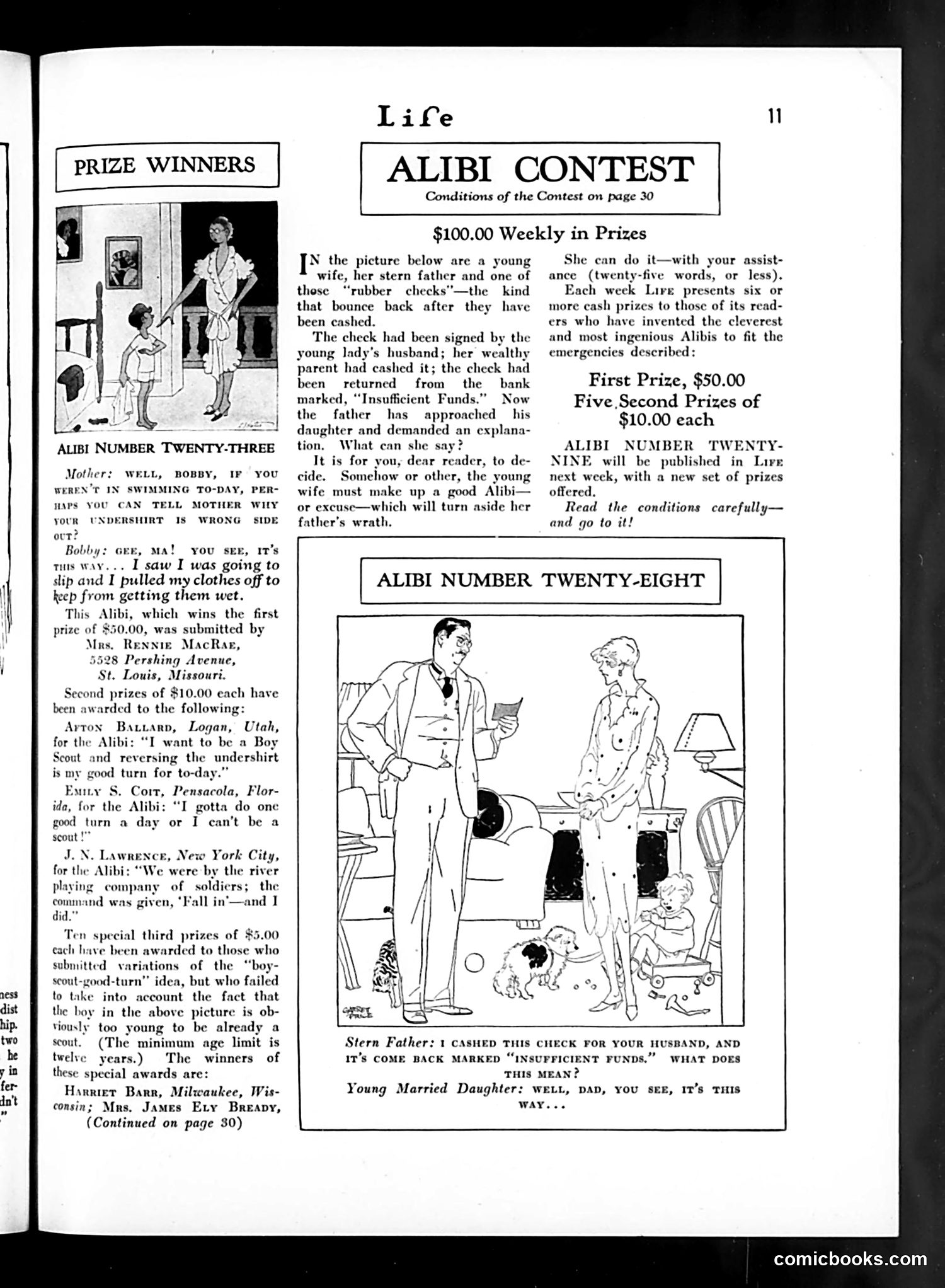
This page features a weekly contest where readers submit creative alibis to explain embarrassing or problematic situations. The featured "Alibi Number Twenty-Eight" shows a domestic scene: a stern father confronts his daughter about a bounced check marked "Insufficient Funds." The young married daughter must explain why her husband's check failed. The contest's humor relies on readers inventing excuses—alibis—to explain away the daughter's financial mishap. The illustration depicts the awkward family confrontation, with the father demanding answers while the daughter sits defensively with a child present. This reflects early 20th-century middle-class anxieties about financial stability, marital responsibility, and generational conflict. The contest awarded $100 weekly in cash prizes for the cleverest explanations.
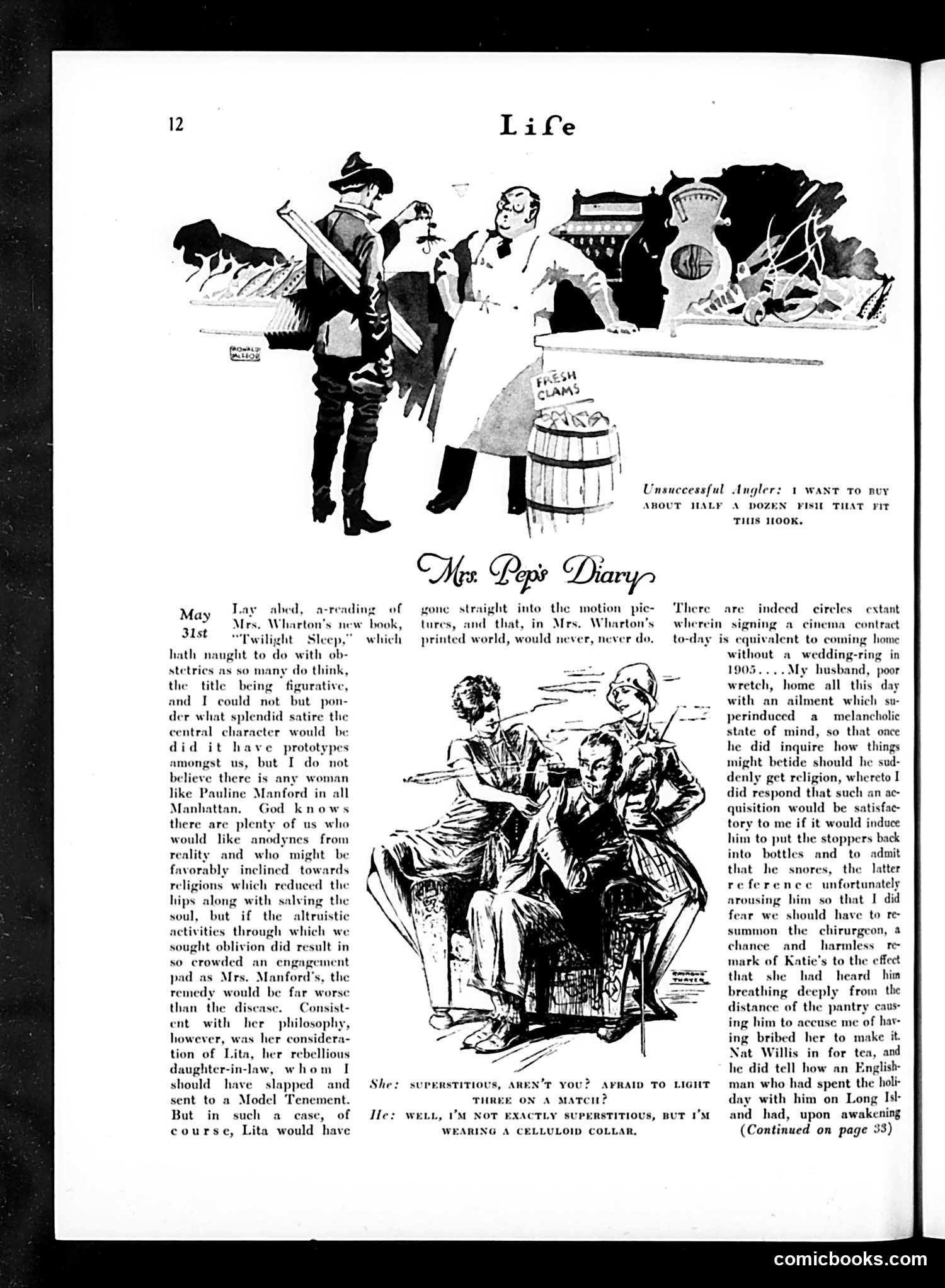
This page features a satirical diary entry and illustration mocking domestic life and superstition. The top cartoon shows an "Unsuccessful Angler" attempting to purchase fish for a hook, a absurdist visual joke about poor fishing luck. The main "Mrs. Pep's Diary" section critiques theatrical pretension—specifically Mrs. Wharton's "Twilight Sleep" (a real anesthetic procedure). The diary sarcastically describes a woman seeking a Pauline Manford-like character while discussing religious anxieties and hypochondria. The lower illustration depicts a woman telling her companion she's "superstitious" and afraid to light three candles on a match, while her companion dismissively wears a celluloid collar—a humorous visual contrast suggesting modern skepticism versus old superstitions. The satire targets middle-class anxieties about health, religion, and outdated beliefs.
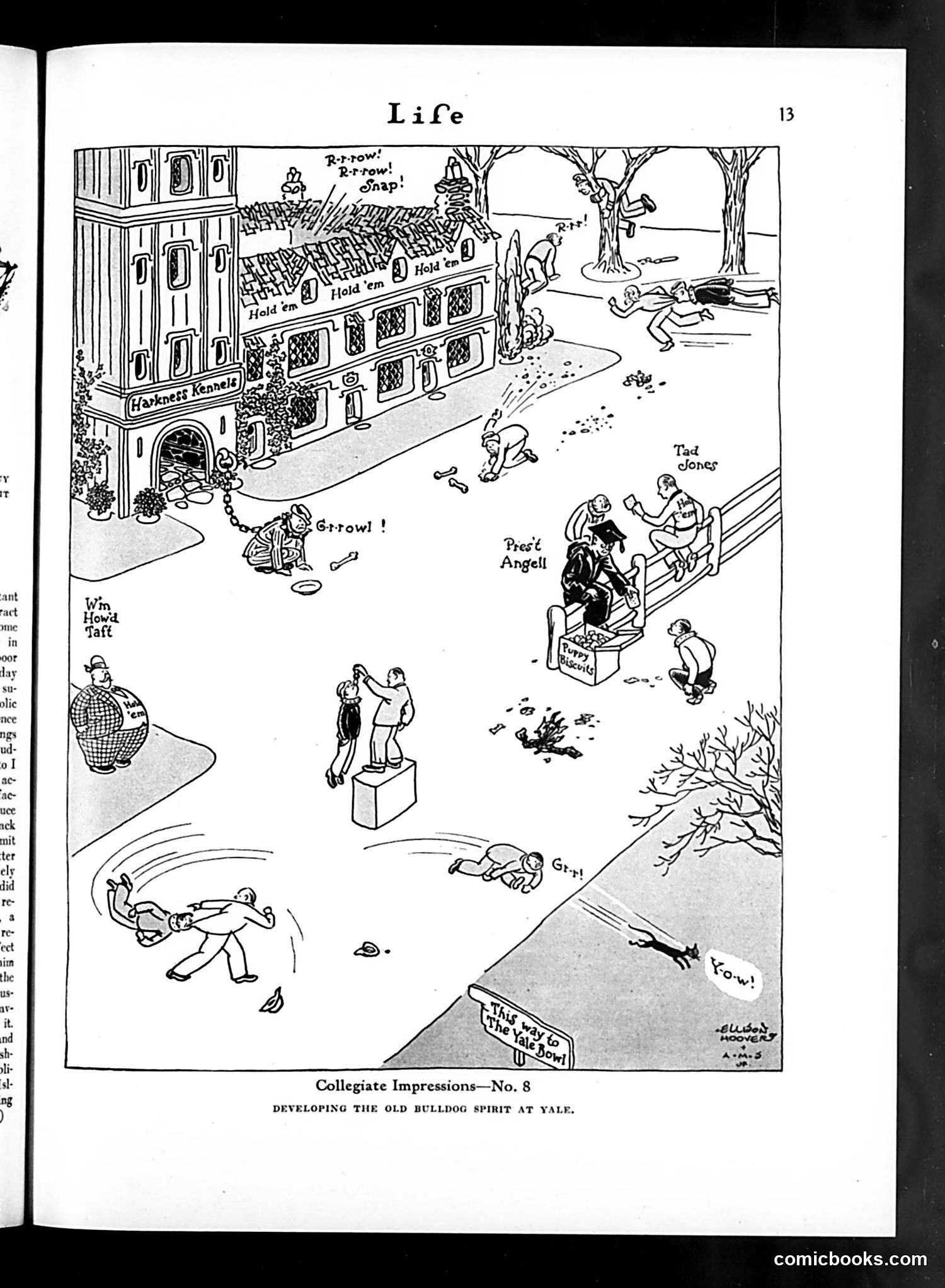
This satirical cartoon depicts Yale University students engaging in various rowdy, destructive behaviors—labeled variously as "Growl!," "Grit," "Harkness Kennels," and "Tact Clones." The scene shows students fighting, vandalizing property, breaking windows on buildings, and generally acting unruly. The satire mocks the institutional valorization of the "bulldog spirit"—Yale's mascot and the aggressive competitive ethos supposedly cultivated there. By literally depicting students as animals in kennels being trained toward brutishness, the cartoon critiques how elite universities supposedly develop not refined gentlemen but rather crude, violent hooligans under the guise of school spirit and tradition.
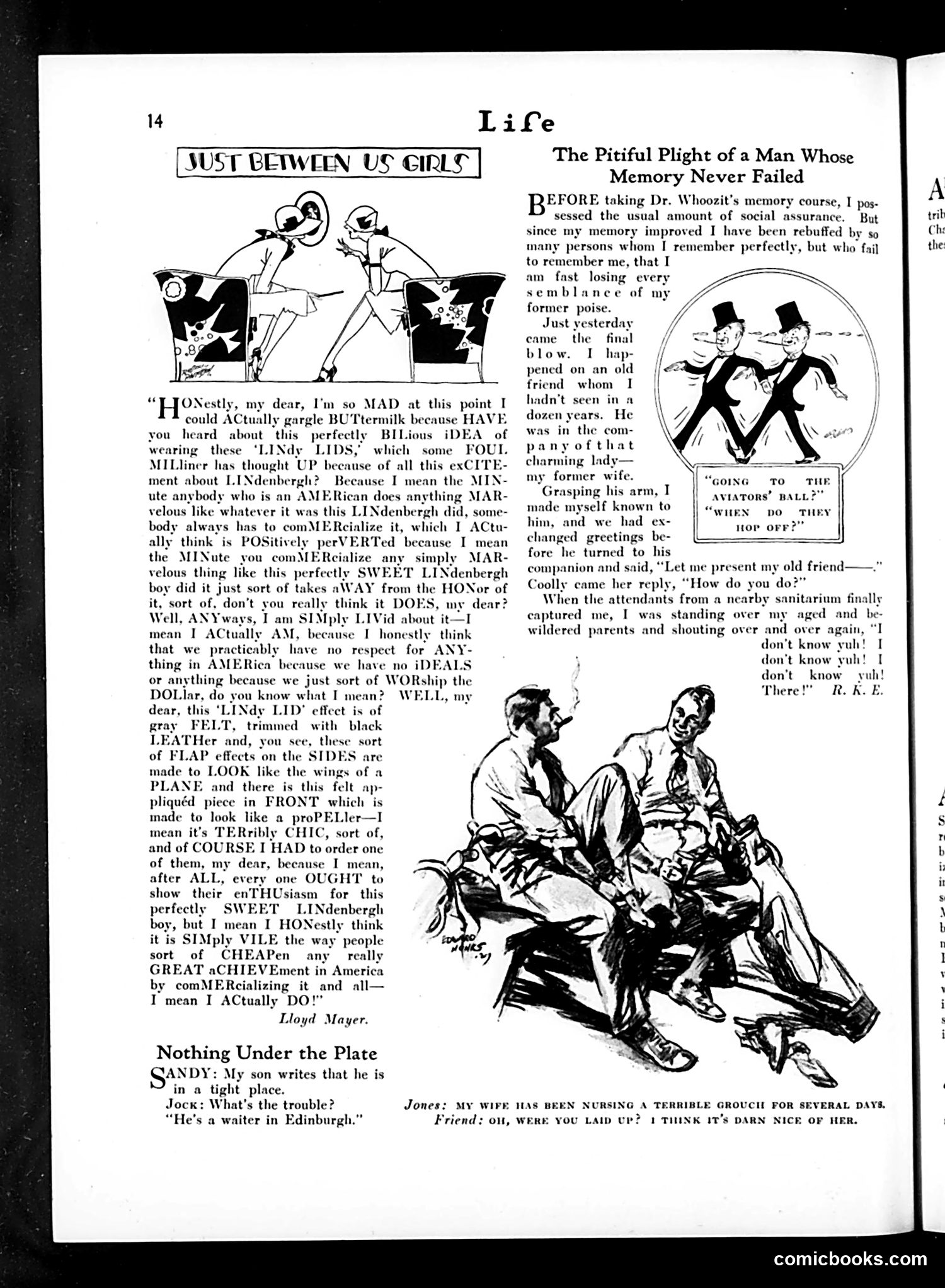
This page contains three humor pieces typical of 1920s Life magazine: **"Just Between Us Girls"** (top): A satirical monologue by Lloyd Mayer mocking the "LIDo LID" fashion—likely a cloche hat or close-fitting women's hat style. The speaker sarcastically praises how this trend supposedly demonstrates women's "great achievement in America" by making them indistinguishable and trivializing their accomplishments. **"Nothing Under the Plate"** (bottom left): A brief joke about a man's son being "in a tight place" because he's "a waiter in Edinburgh"—a pun on financial or social constraint. **Untitled cartoon** (bottom right): Shows two men, one explaining his wife's illness to a friend, who quips it's "darn nice of her" to be bedridden—dark humor about inconvenience masquerading as sympathy. The page reflects 1920s social commentary on fashion, class, and domestic life.
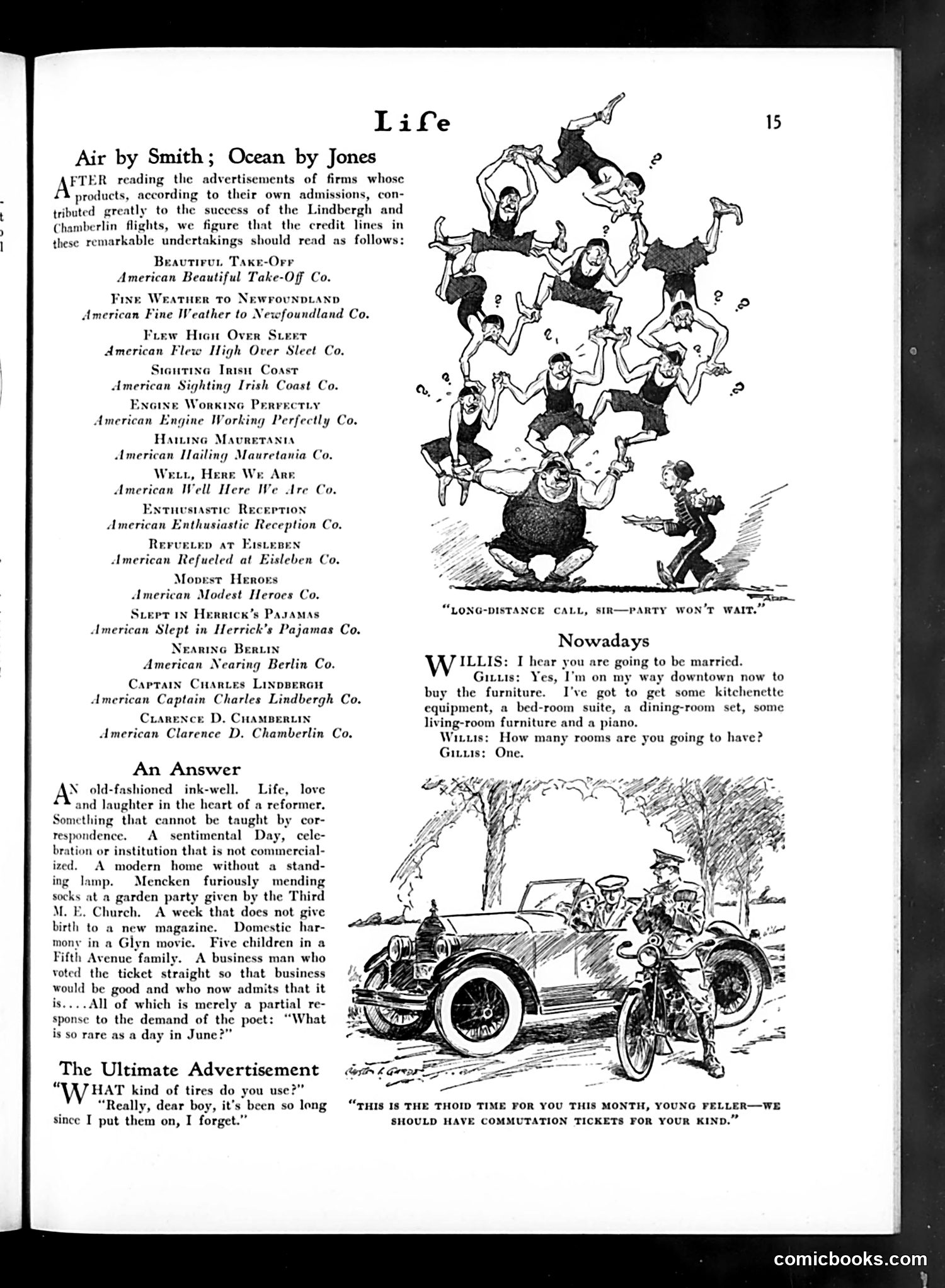
This page contains several satirical pieces targeting American commercial culture and consumer behavior. The top illustration mocks Lindbergh and Chamberlain aviation achievements by listing exaggerated company credit lines ("American Beautiful Take-Off Co.," "American Engine Working Perfectly Co."), satirizing how businesses exploit famous accomplishments for advertising. The "Nowadays" dialogue jokes about modern consumerism—a fiancé buying furniture on credit, planning a one-room apartment with expensive equipment (bed-room suite, dining-room set, piano), capturing early 20th-century anxiety about installment buying and marital expectations. The bottom cartoon shows a motorist and officer discussing commutation tickets, likely satirizing emerging automobile culture and urban congestion. The page overall critiques commercial exploitation of achievements and modern consumer debt culture.
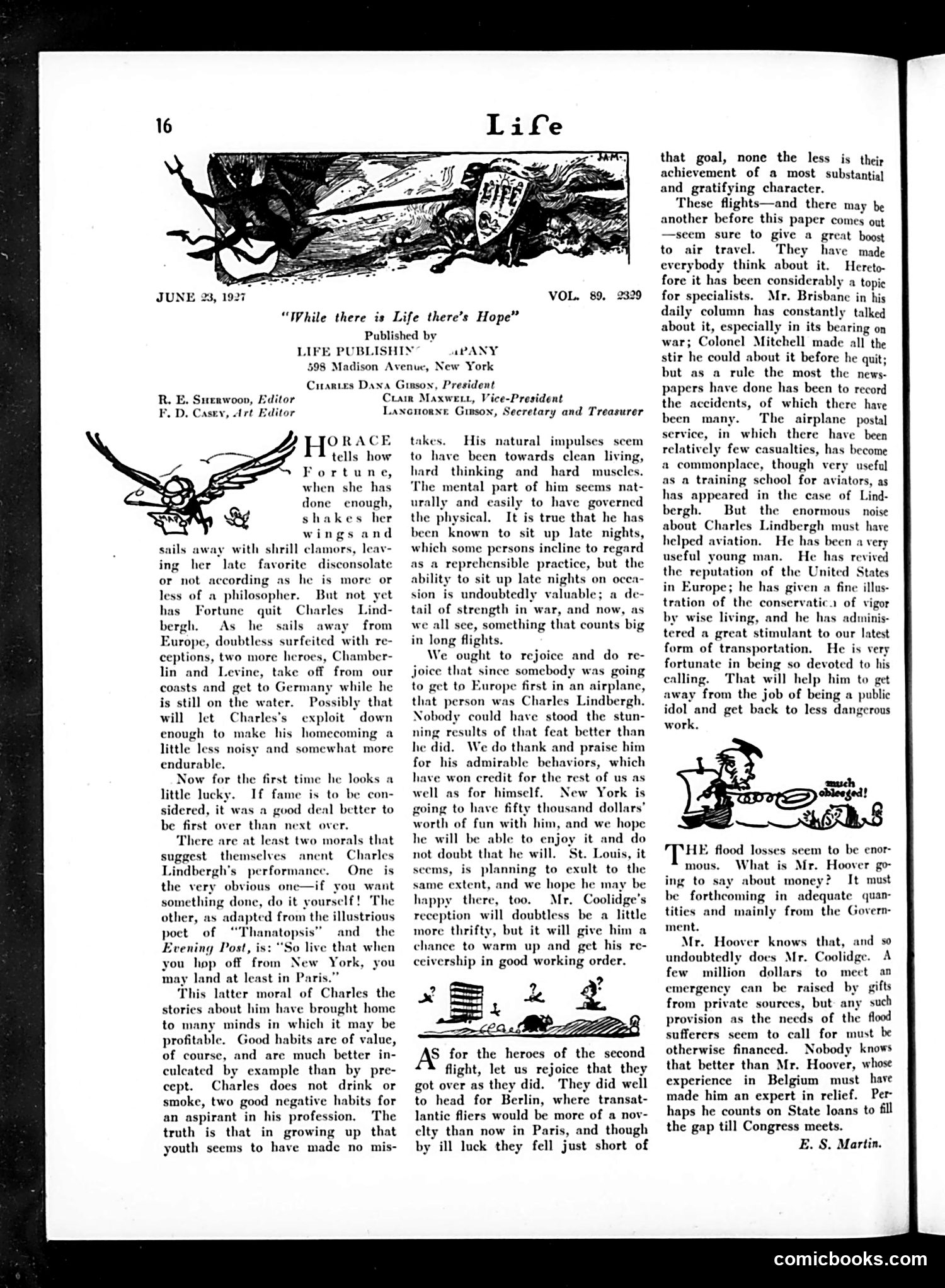
This page celebrates Charles Lindbergh's transatlantic flight. The editorial praises Lindbergh's character, noting he doesn't drink or smoke—"good negative habits for an aspirant in his profession." The text argues aviation deserves serious attention beyond novelty coverage, positioning Lindbergh as having elevated the field's reputation internationally. It discusses flood relief efforts, praising President Hoover's disaster response while noting Congressional funding remains inadequate. The small cartoon illustrations (showing figures with aircraft/parachutes) appear to be decorative period graphics rather than substantive satire. The page is primarily earnest editorializing about Lindbergh's achievement and contemporary policy matters, not satirical commentary.
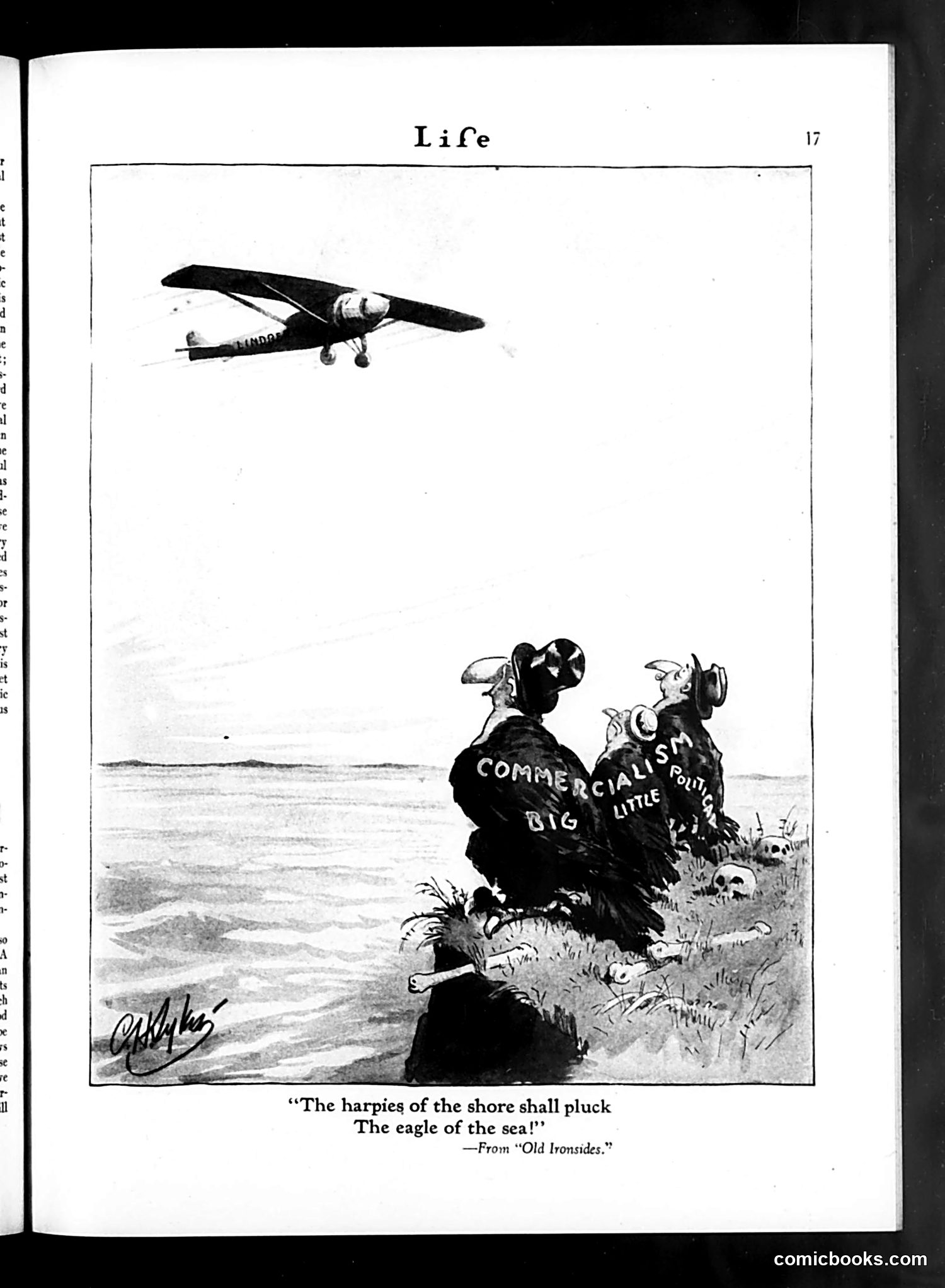
This is a political cartoon satirizing early aviation and commercial interests. Two figures labeled "Commercial" (large) and "Alison" (small) stand on a shore, looking up at an airplane labeled "Lindbergh" flying overhead. The caption quotes from Homer's *Odyssey*: "The harpies of the shore shall pluck / The eagle of the sea." The satire appears to target commercialization of aviation achievement. The "eagle of the sea" refers to the airplane (likely Lindbergh's famous transatlantic flight), while the "harpies of the shore" represent commercial interests trying to exploit or diminish the aviation accomplishment. The contrasting sizes of the two figures suggest satire about how different parties—possibly commercial entities versus smaller players—scramble to profit from aviation breakthroughs.
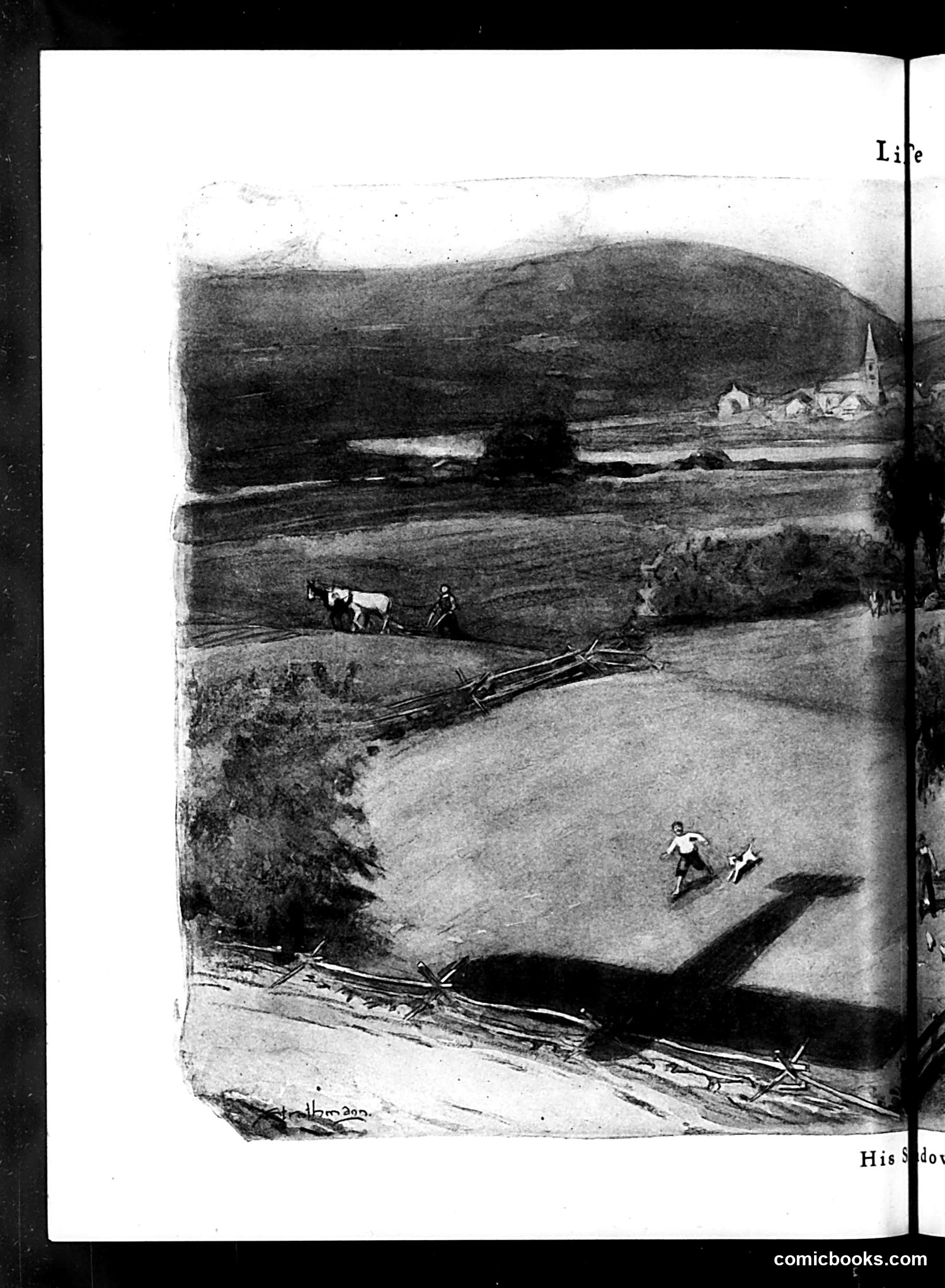
This appears to be a page from the satirical magazine *Life*, though the OCR text provides minimal context. The image shows a rural landscape with a small village (featuring a church steeple) nestled in rolling hills. In the foreground, two figures appear to be engaged in some form of labor or activity near felled logs. The page headers read "Life" (top right) and "His S'dor" (bottom right), though the latter text is unclear—possibly a caption fragment or header that's been cut off. Without more legible OCR text or additional context, I cannot definitively identify the specific satire or political commentary intended. The pastoral rural setting and labor scene suggest possible commentary on rural American life or agricultural work, but the precise meaning remains unclear from this image alone.
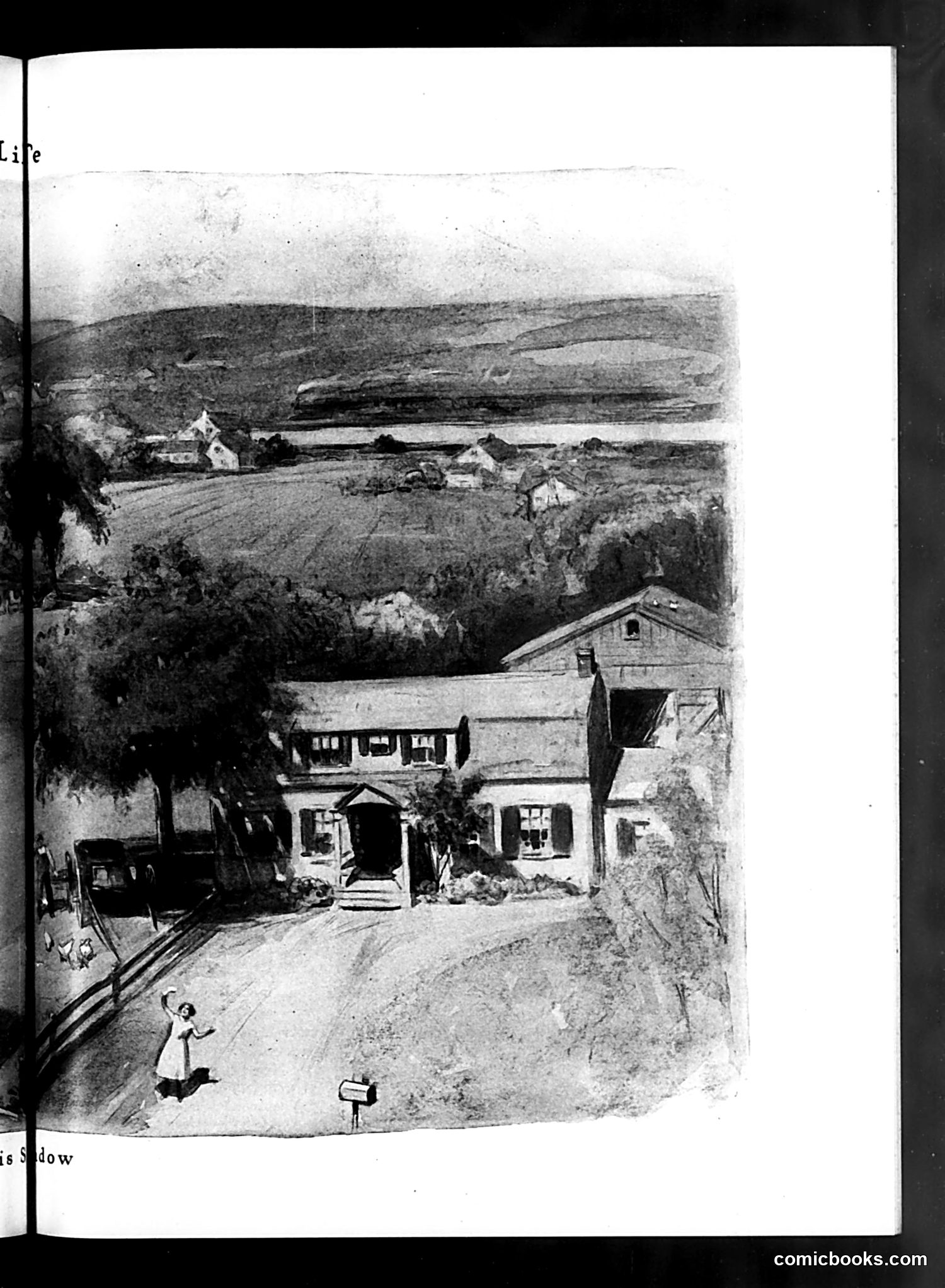
This appears to be a illustration or sketch rather than a political cartoon. The image shows a rural farmhouse scene with rolling hills in the background, several buildings including what looks like a main residence and barn, trees, and a figure in the foreground. The setting appears pastoral and idyllic. The OCR text is heavily degraded and doesn't provide coherent readable content to help interpret any satirical message. Without legible text or clear captions identifying specific political figures or social commentary, I cannot determine what particular satire or social criticism this page from *Life* magazine was attempting to convey. The image alone suggests rural or agricultural subject matter, but the intended joke or point remains unclear from the available information.
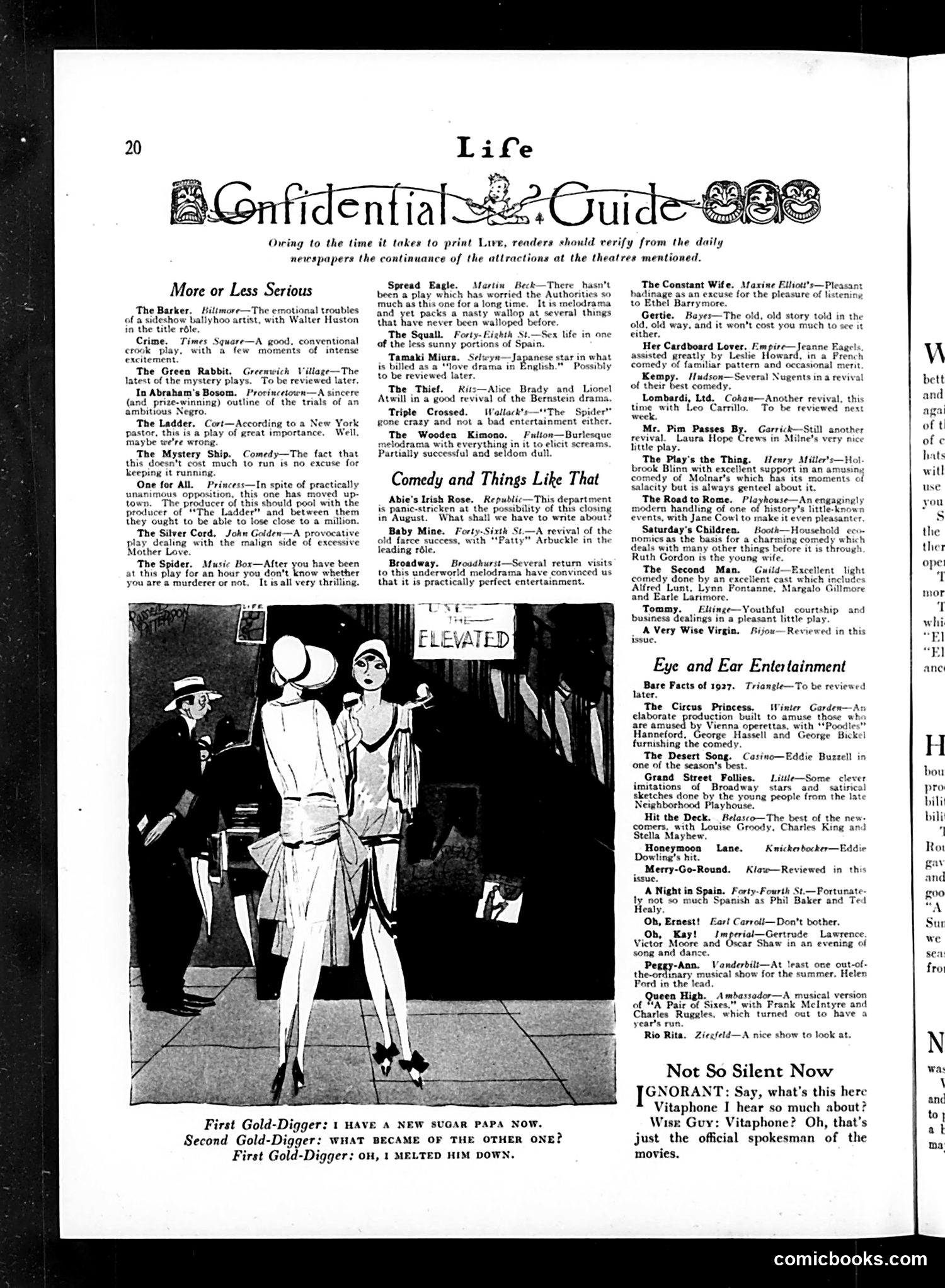
This page is a theater guide reviewing Broadway and touring productions from the 1920s. The large cartoon depicts the famous "Gold-Digger" archetype—women who pursued wealthy men for financial support, a prevalent social anxiety of the era. The joke's dark humor reflects post-WWI cynicism: when asked what happened to her previous wealthy patron, the gold-digger quips she "melted him down"—suggesting she literally consumed/destroyed him for profit. This plays on period fears about predatory women and the nouveau riche's vulnerability. The theatrical reviews themselves touch contemporary concerns: "Spread Eagle" apparently critiques American foreign policy; "In Abraham's Bosom" addresses racial struggle; "The Silver Cord" examines "excessive Mother Love." The snide commentary ("what shall we have to write about?" regarding *Abie's Irish Rose*) reveals Life's satirical stance toward both theater and society. The fashion illustration emphasizes 1920s aesthetics: the "Elevated" setting, flapper silhouette, and urbane sophistication typical of Jazz Age satire.
This is a theater review column discussing Broadway's 1922-23 season. The author catalogs depressing statistics: 264 openings since August, 163 without music, with "Merry-Go-Round" and "A Very Wise Virgin" being forgettable recent productions requiring dismissal before tackling the full season summary. The satire targets theatrical mediocrity. The author mocks the absurdity of collecting review data ("data-bound"), notes shows closing after mere performances, and laments that even promising collaborations—specifically citing talented writers Morrie Ryskind and Howard Dietz—produce only average work due to commercial compromises. The running joke about yellow forsythia flowers as ubiquitous stage decoration satirizes designers' clichéd choices. The "Spirit of What the Public Wants" personification blames mass-market taste for preventing bold theatrical innovation, suggesting Broadway prioritizes commercial safety over artistic ambition.
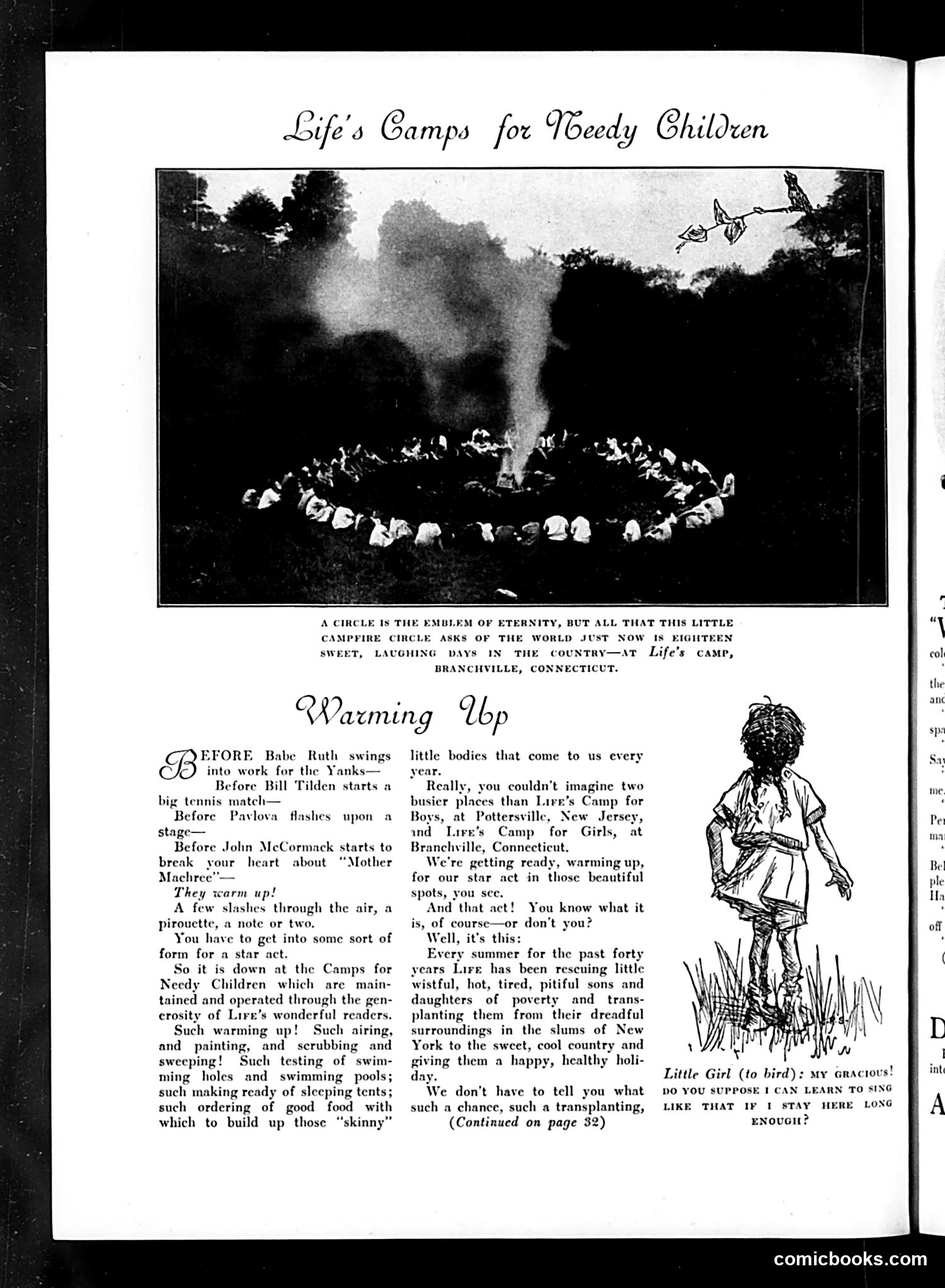
This page promotes Life magazine's charitable summer camps for poor urban children from New York slums. The article uses sports celebrities as a metaphor: just as Babe Ruth, Bill Tilden, and opera singer Pavlova "warm up" before performing, Life's camps prepare disadvantaged children for life through rest, nutrition, and recreation in the Connecticut countryside. The accompanying photograph shows children gathered around a campfire—the visual proof of this charitable work. The small cartoon at bottom depicts a poor girl asking a bird if she can learn to sing by staying at camp, expressing the transformative hope the camps offered. This reflects early 20th-century Progressive Era attitudes: wealthy magazines mobilizing readers' generosity to rescue impoverished children through "transplanting" them from urban poverty to rural health and moral improvement—a then-popular social reform strategy.
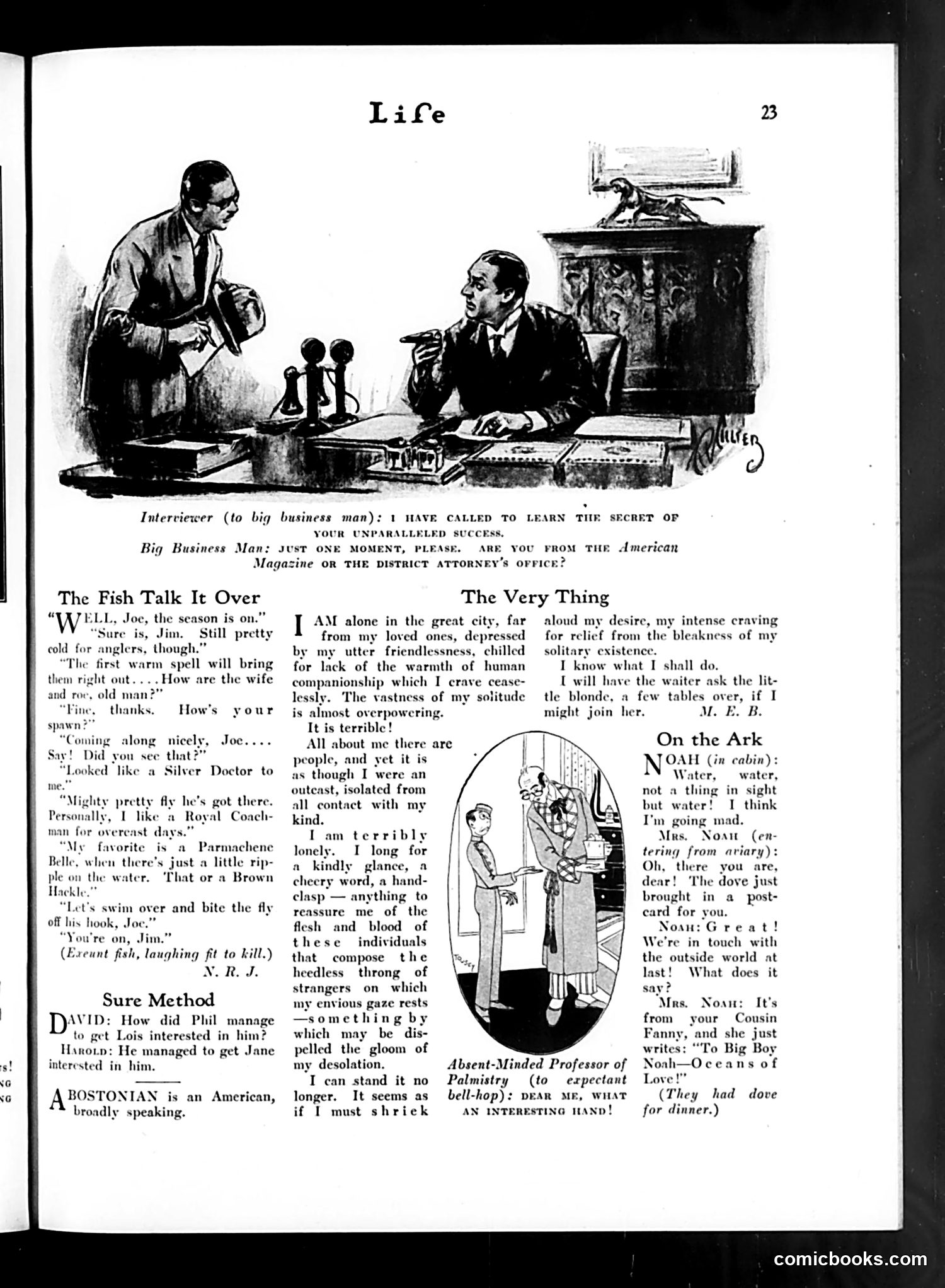
**Top Cartoon - "Interviewer"**: A business magnate, when asked about his success, nervously inquires whether his interviewer represents *American Magazine* or the **District Attorney's office**. This satirizes the era's corporate scandals and legal investigations into "Big Business" practices—suggesting successful businessmen often faced scrutiny for questionable or illegal methods. The joke: he's unsure whether to brag or invoke legal protection. **"The Fish Talk It Over"**: Fishermen discuss angling while fish below mock them and steal bait. Light nature humor with no apparent political content. **"The Very Thing"**: A lonely urban man, drowning in solitude despite masses around him, decides to ask a blonde waitress to join him. Satirizes modern city alienation and social anxiety. **"On the Ark" & other pieces**: Light domestic/relationship humor typical of the magazine's general comedic content. The page's dominant theme is **early 20th-century anxieties**: corporate malfeasance, urban isolation, and social awkwardness.
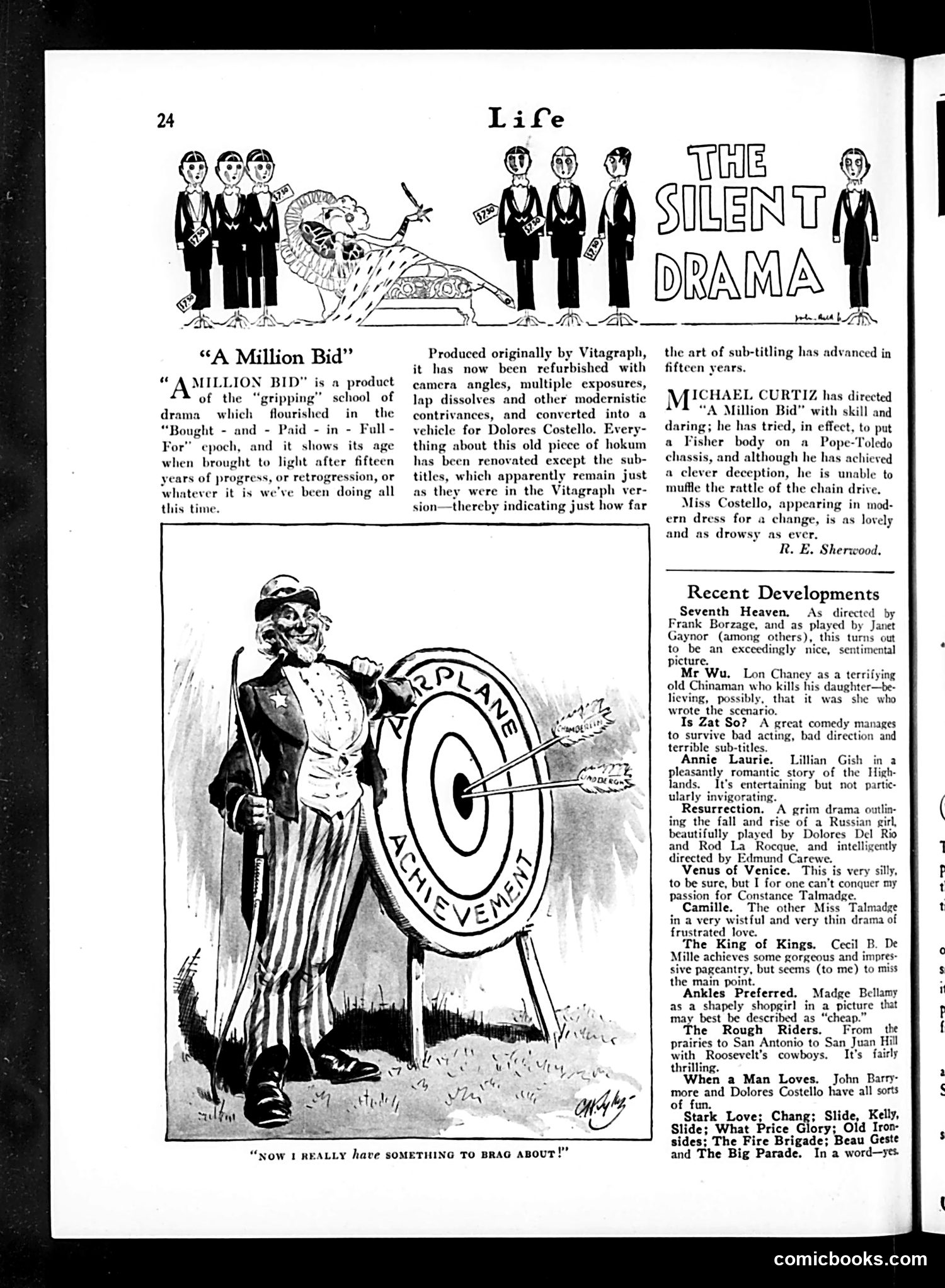
This page reviews silent films from the mid-1920s. The main cartoon depicts a figure spinning a large wheel labeled "Aeroplane Achievement," captioned "Now I really have something to brag about"—satirizing how filmmakers recycled old material with superficial modern technical updates. The text reviews "A Million Bid," a 1915 Vitagraph film rereleased by director Michael Curtiz with actress Dolores Costello. The critic R.E. Sherwood mocks the production: while cinematography improved (multiple exposures, lap dissolves), the original wooden **intertitles** (silent film text cards) remained unchanged—exposing how little substantive progress had occurred in fifteen years. The joke is that modernizing only camera techniques while keeping ancient dialogue cards demonstrates the film industry's laziness. The "Recent Developments" section briefly reviews other contemporary silent films, including works by famous directors like Cecil B. DeMille and Frank Borzage.
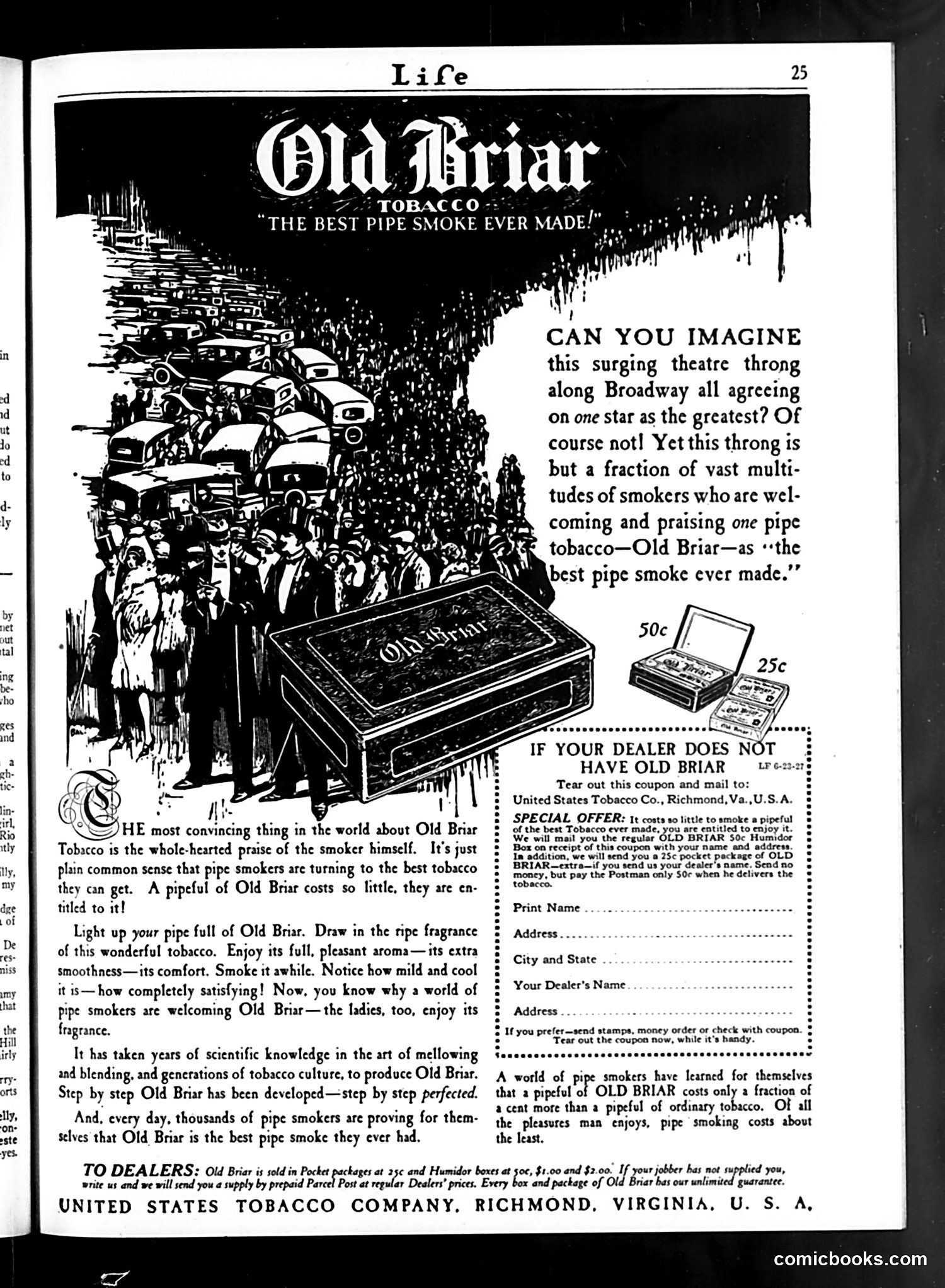
This is a full-page advertisement, not political satire. It promotes Old Briar pipe tobacco using a populist appeal. The illustration shows a massive Broadway theatre crowd, implying that while theatre audiences disagree on performers, pipe smokers unanimously praise Old Briar as "the best pipe smoke ever made." The ad's strategy emphasizes democratic consensus among working men—pipe smoking is affordable ("costs so little"), enjoyed by "the ladies, too," and requires no snobbish expertise. The copy stresses scientific development and reliability while downplaying cost. The coupon offers a deal: send the coupon for a sample box, with dealers' names encouraged for advertising purposes. This was standard early-20th-century direct-response marketing, positioning affordable luxury tobacco as attainable to ordinary Americans.
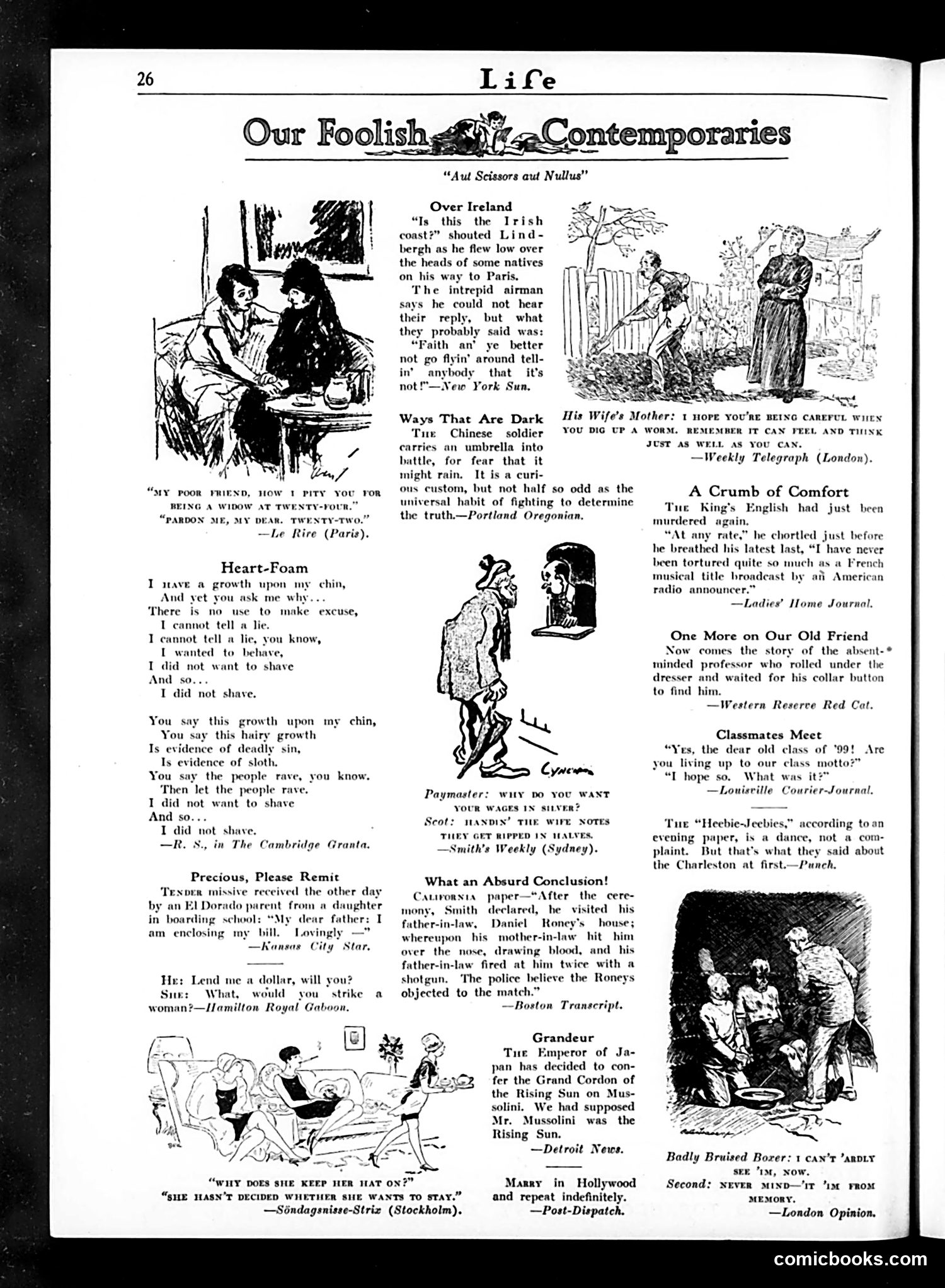
This page collects brief satirical pieces and jokes from international publications, mocking social absurdities of the era (likely 1920s-30s). **Key items:** - **Lindbergh reference**: Jokes about Charles Lindbergh's famous transatlantic flight, with Irish natives supposedly unimpressed by his boasting about their coast. - **Chinese soldier umbrella**: Mocks the illogical superstition of carrying an umbrella into battle to prevent rain—absurd wartime logic. - **Scottish soldier wages joke**: Playing on Scottish stereotype of thriftiness (wanting silver rather than paper notes that tear). - **Mussolini/Emperor of Japan**: Satirizes the Italian dictator being honored while already considering himself grandiose ("the Rising Sun"). - **Various domestic humor**: Absent-minded professors, widow miscalculations, boarding school daughters requesting money—typical period comedy tropes mocking human folly. The page's title, "Aut Scissors aut Nullus" (scissors or nothing), suggests sharp criticism cutting through contemporary foolishness.
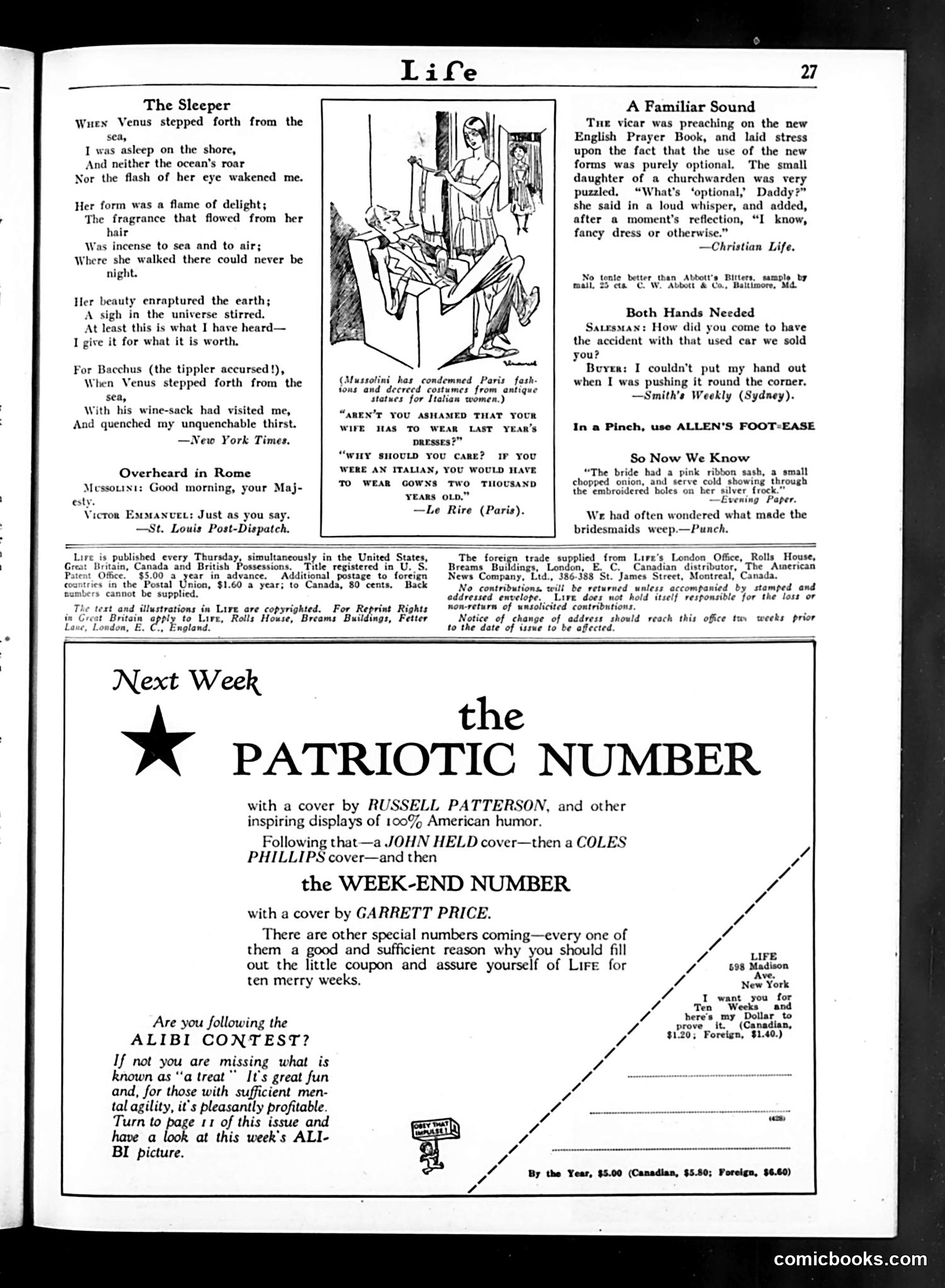
This page contains several short humorous pieces satirizing contemporary social issues: **The central cartoon** mocks Mussolini's 1930s fashion decrees mandating Italian women wear historical costume. A husband and wife exchange reveals the absurdity: she complains his wife must wear "last year's dress," he retorts that if she were Italian, she'd wear 2,000-year-old gowns—a jab at Mussolini's obsession with ancient Roman glory as fascist propaganda. **Other brief jokes** include: - A vicar's daughter mishearing "optional" as "fancy dress"—gentle Anglican humor - A car salesman's complaint about a buyer unable to signal while pushing a vehicle—mocking used-car sales culture - A bewildered observation about bridesmaids' tears, blamed on an oddly-described wedding dress recipe The page functions primarily as **filler and advertisements** between heavier content, using international reprints (from Paris's *Le Rire*, Australian *Smith's Weekly*, British *Punch*) to demonstrate Life's cosmopolitan scope during the interwar period.
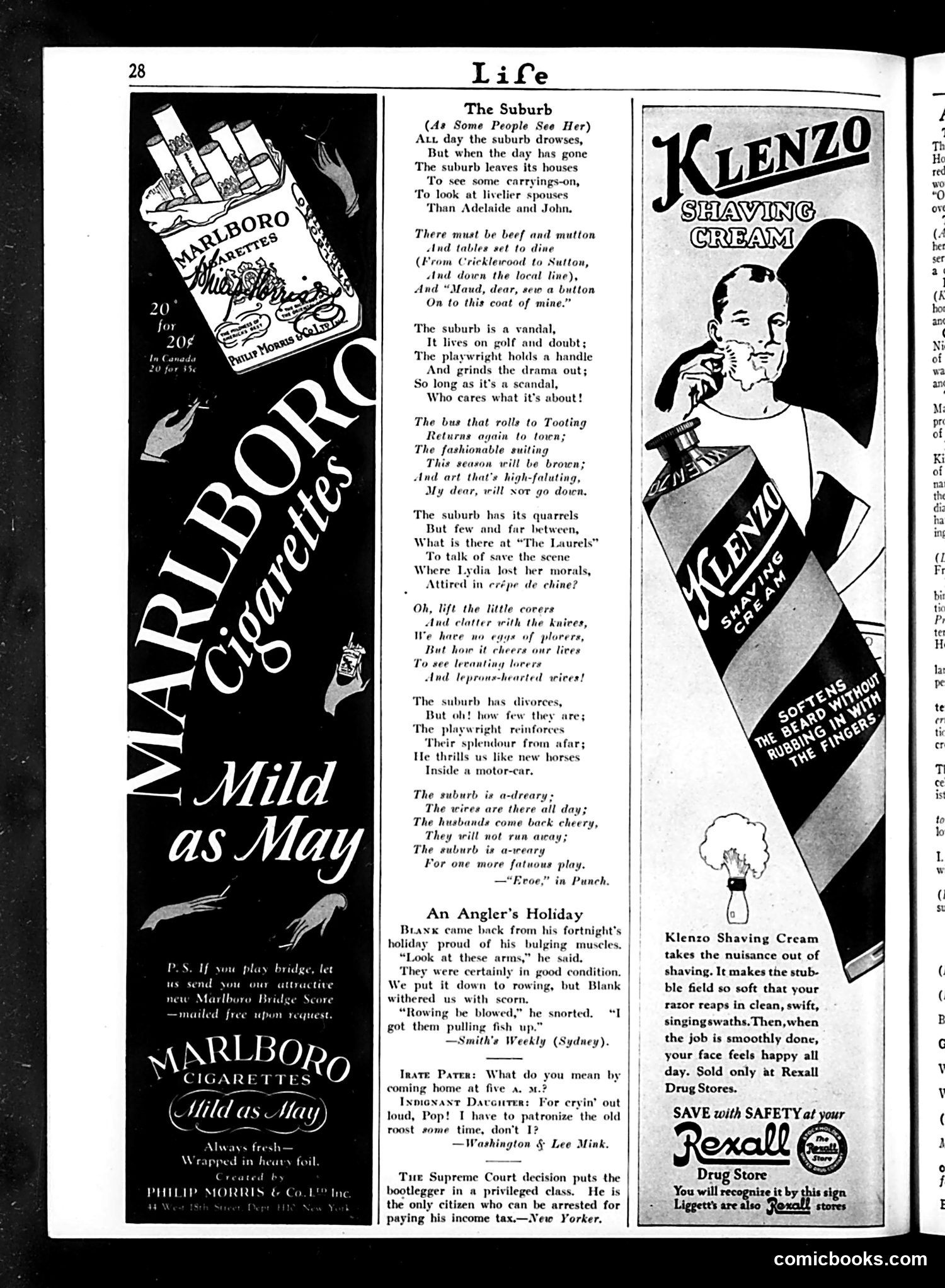
This is a poem satirizing suburban life, likely from the 1920s based on references to fashions and social customs. The piece mocks suburban residents as hypocritical and bored—outwardly respectable (with mentions of "Adelaide and John," domestic routines like sewing buttons) but secretly fascinated by scandal and infidelity. Key targets include: - **The suburbs' pretended morality** versus their obsession with gossip about neighbors' affairs ("Where Lydia lost her morals") - **Social conformity**: everyone plays golf, follows fashion trends (brown suiting), and consumes theater for vicarious thrills - **Underlying dissatisfaction**: described as "weary" and desperate for entertainment The italicized phrases reference actual publications—quotes are attributed to *Punch* magazine and other contemporary sources, lending satirical authority. The surrounding advertisements (Marlboro cigarettes, Klenzo shaving cream) are period commercial content, not part of the satire.
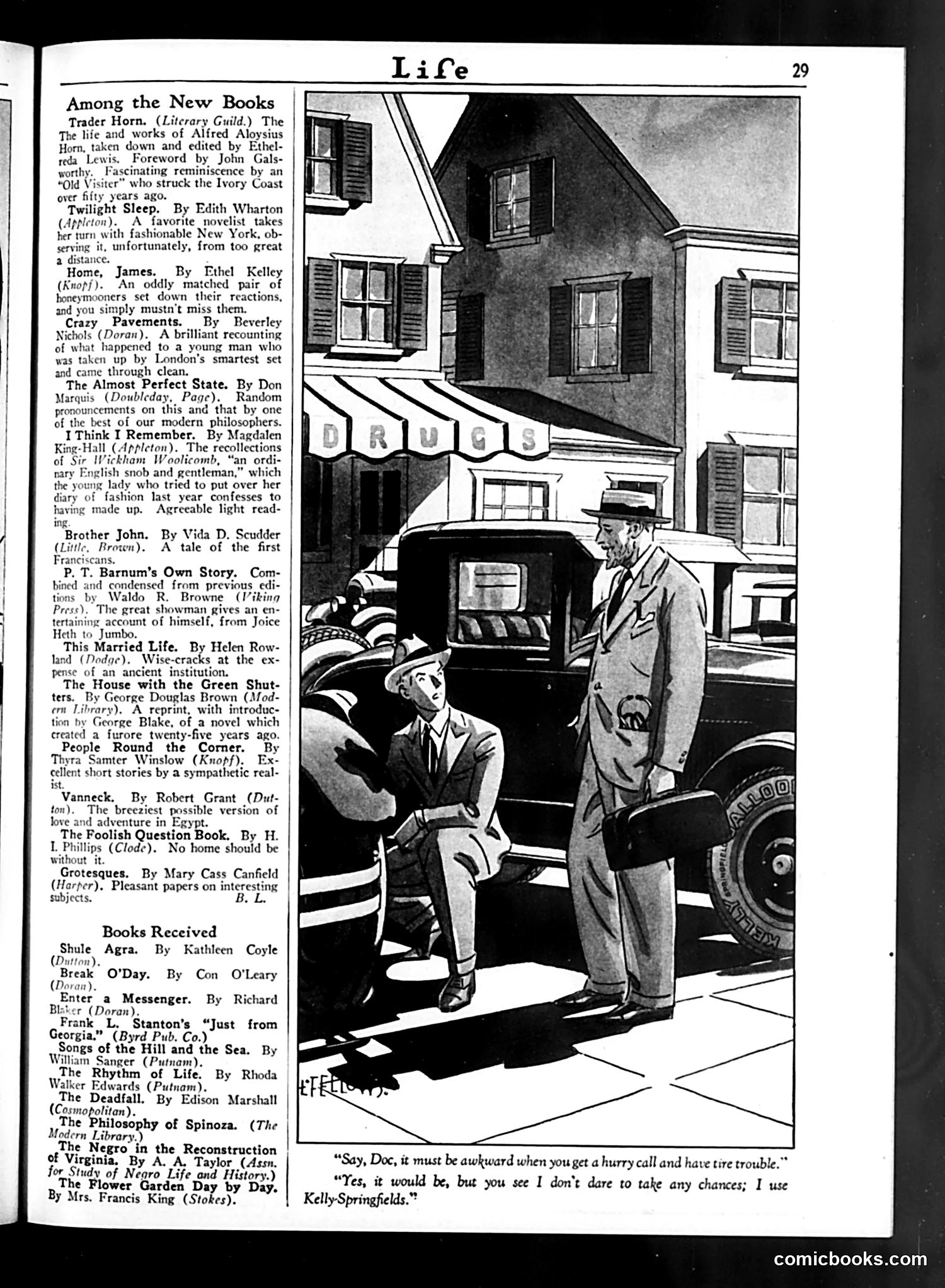
This page is primarily a **book review section** with an embedded **automobile advertisement**, not a political cartoon. The illustrated cartoon at bottom depicts two men examining a car, discussing tire reliability. The standing figure (appearing to be a doctor, given the "Doc" address) explains he uses Kelly-Springfield tires because he cannot afford breakdowns during emergency calls. This is a **commercial advertisement disguised as editorial content**—a common 1920s marketing tactic. The "joke" relies on the anxiety of early automobile ownership: unreliable tires posed genuine hazards. By positioning tire failure as potentially life-threatening (a doctor missing emergency calls), the ad creates urgency around product choice. The page's primary content is straightforward book reviews of contemporary 1920s literature, including works by Edith Wharton and Don Marquis. No political satire is evident; this represents typical Life magazine mixed editorial and advertising content from the period.
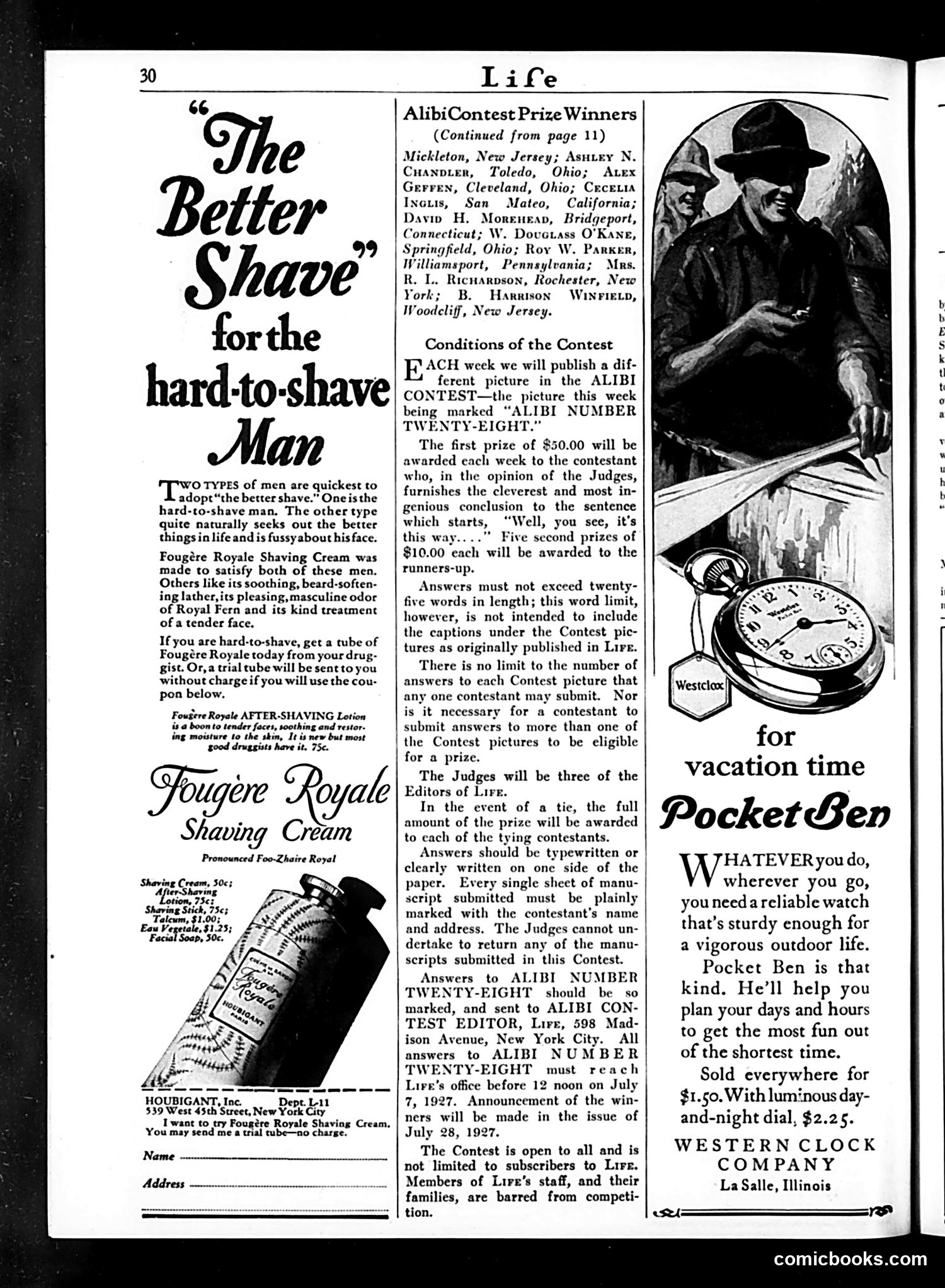
This page is primarily **advertising and contest information**, not political satire. The left side features a **Fougère Royale shaving cream advertisement** targeting men with difficult beards, emphasizing the product's soothing lather and masculine appeal—typical early 20th-century marketing positioning grooming products as essential to male respectability. The center section announces **Life's "Alibi Contest"**: readers submit humorous excuses (max 25 words) completing "Well, you see, it's this way...." to captioned cartoon images. Winners receive $50 (first prize) or $10 (runners-up). This was a popular interactive feature allowing readers creative participation. The right side advertises **Pocket Ben watches**—affordable, durable timepieces ($1.50–$2.25) marketed for outdoor recreation and vacation planning, framed as essential tools for maximizing leisure time. The page reflects 1920s consumer culture: accessible luxury goods, interactive reader engagement, and marketing emphasizing masculinity and modern efficiency.
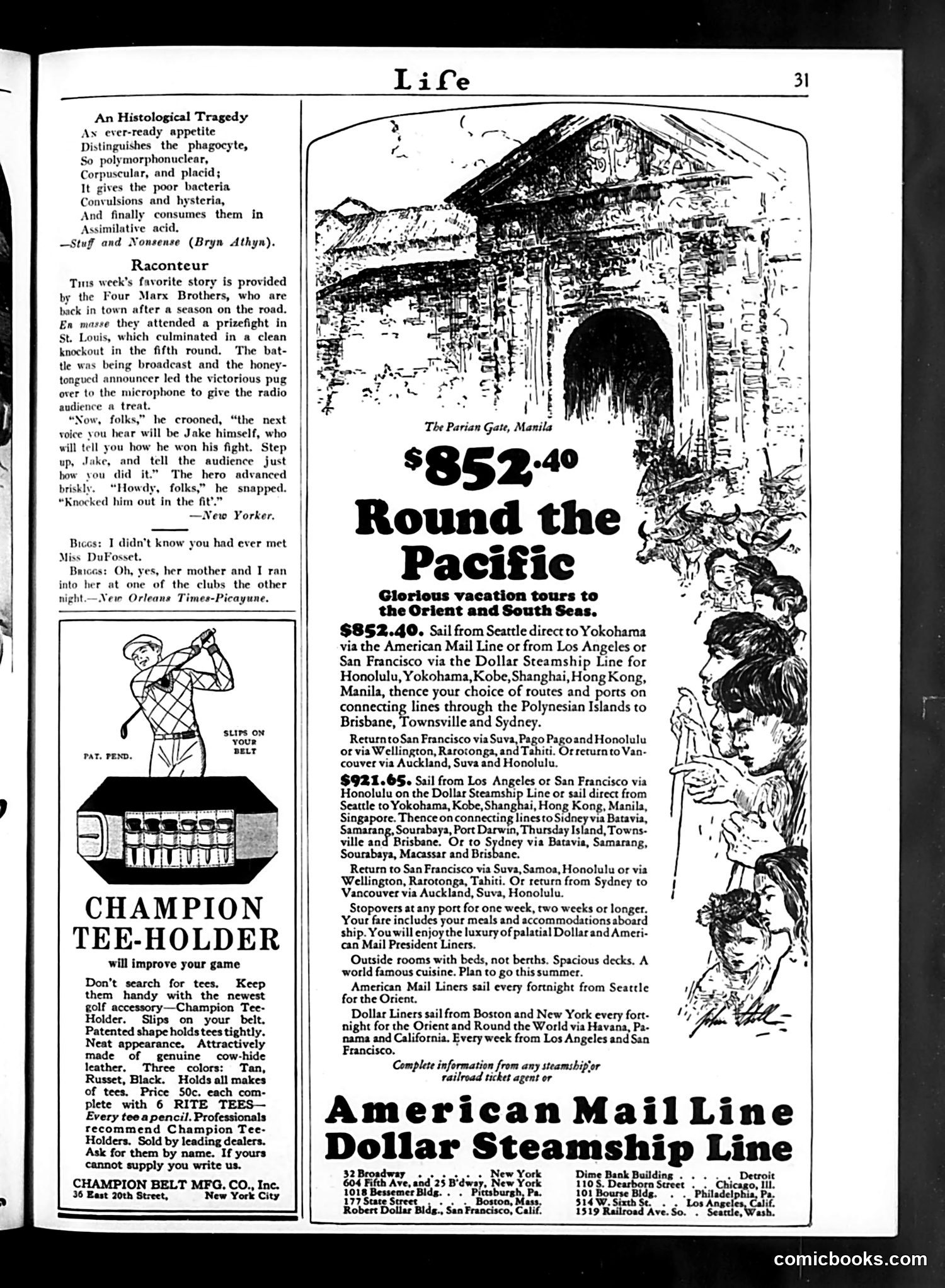
This page combines light humor and advertising. The left column features three short comic pieces: a scientific poem about phagocytes (white blood cells) consuming bacteria; a Marx Brothers anecdote about a boxer's awkward radio interview; and a brief joke about meeting someone's mother at a club. Below is an advertisement for a "Champion Tee-Holder"—a belt accessory for golfers to carry tees, pitched as improving one's game. The dominant right side is a travel advertisement for Pacific steamship cruises ($852.40–$921.68) via American Mail Line and Dollar Steamship Line, offering routes to Japan, China, and Australia with stops in Hawaii and Polynesia. It emphasizes luxury accommodations and leisure travel. The small illustration appears to be the "Parian Gate, Manila," a tourist landmark. The humor and advertising reflect 1920s American leisure culture—golf as a gentlemen's pastime and exotic Pacific tourism for the affluent.
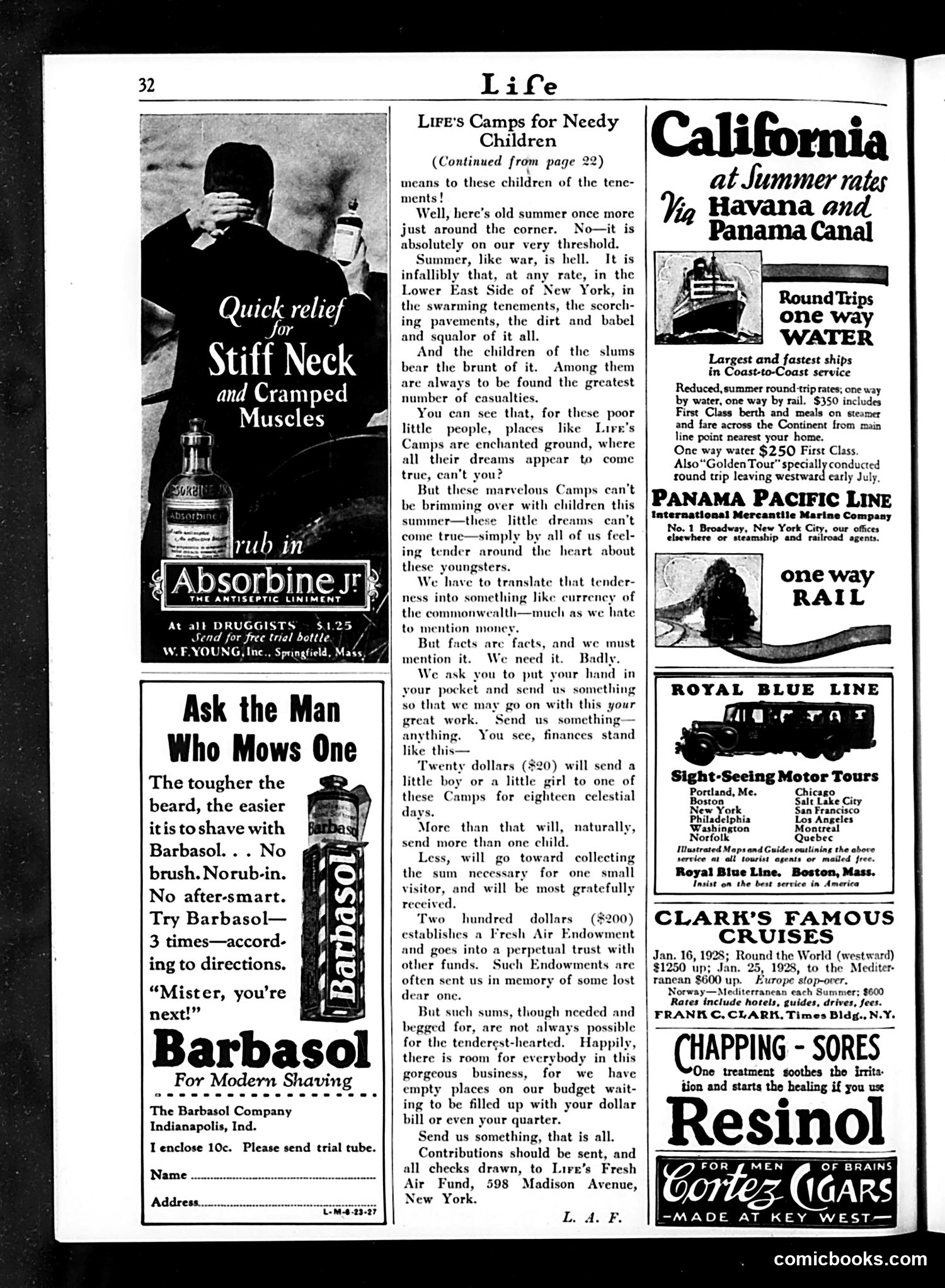
This page mixes commercial advertisements with a fundraising appeal for Life magazine's Fresh Air Camps for poor children in New York's Lower East Side tenements. The main text (continued from page 22) argues that summer in crowded slums is dangerous for children—comparing it to war in its severity. The author appeals for donations ($20 sends one child for eighteen days; $200 establishes an endowment) to fund camps where these children can escape urban conditions. The advertisements surrounding this appeal include shaving cream (Barbasol), liniment (Absorbine Jr.), and various travel services—steamship lines and motor tours to California, the Panama Canal, and cruises. The juxtaposition is striking: luxury travel ads frame a plea for poor urban children's welfare, reflecting the magazine's dual audience of affluent readers.
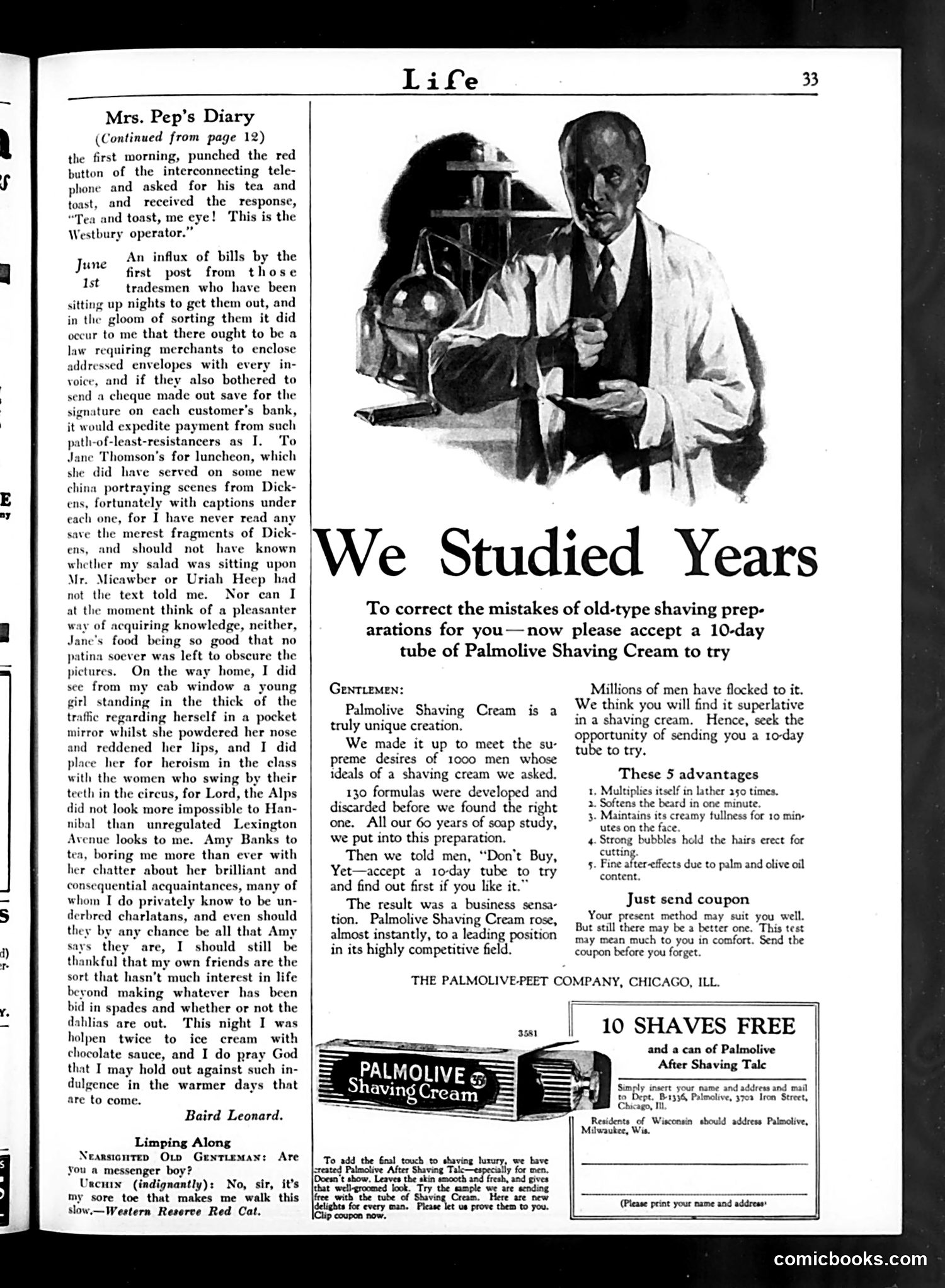
This page contains two distinct elements: **"Mrs. Pep's Diary"** is a humorous column documenting the social observations and domestic complaints of an upper-class woman. The entry mocks petty annoyances: inefficient bill-paying merchants, a dinner companion (Jane Thomson) who serves china illustrated with Dickens scenes—helpful because the narrator admits she's never read Dickens. The diary also includes a vignette about a young woman applying makeup while standing in dangerous traffic on Lexington Avenue, presented as an act of brave foolishness comparable to Hannibal crossing the Alps. **The bulk of the page is a Palmolive Shaving Cream advertisement**—a full-page sponsored pitch claiming the product results from studying "60 years of soap study" and testing 130 formulas. The ad offers a free 10-day trial tube, listing five supposed advantages (lather multiplication, beard softening, etc.). This juxtaposition is typical of *Life* magazine's format: satirical editorial content alongside commercial advertisements. The diary's dry wit about mundane upper-class life contrasts sharply with the earnest marketing language below.
This page is **not a cartoon or satire**—it's a full-page advertisement for a legitimate travel service. The "Ask Mr. Foster" agency was a real, nation-wide travel information bureau operating in the early 20th century. The ad emphasizes that the service operates **without profit motive**: it accepts no commissions, charges no fees, and operates no tours. Instead, 150 trained employees provide free travel planning assistance at office locations in major American cities and resort areas. The service had support from government agencies, hotels, railroads, and department stores where branch offices were located. The copy stresses reliability and expertise, positioning it as a civic-minded enterprise. For modern readers: this represents an era when such **philanthropic business services** were marketed as virtuous alternatives to profit-driven commerce—a concept largely absent from contemporary corporate culture.
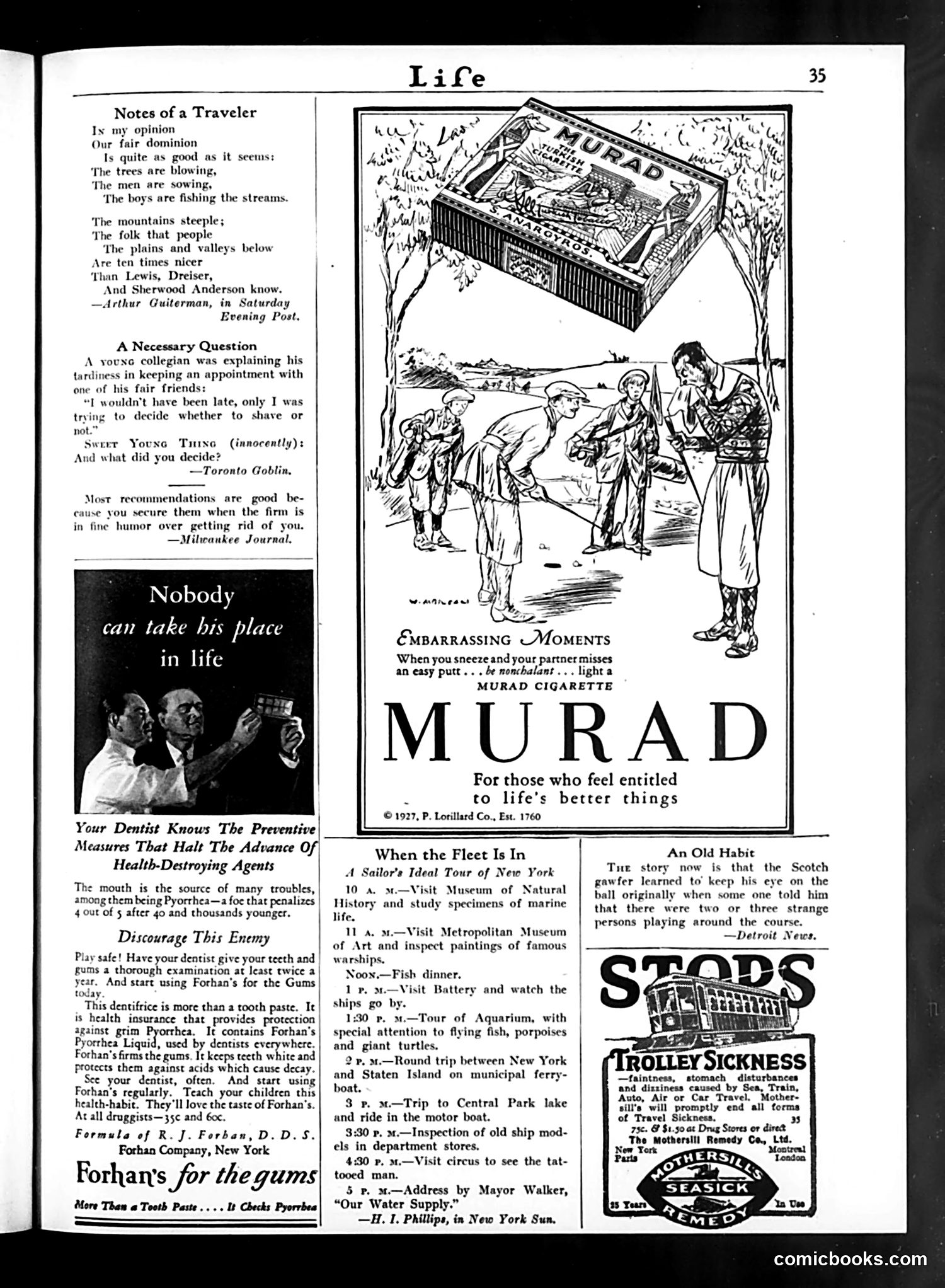
This page is primarily **advertising with light satirical content**—typical of Life's format during this era. The main illustration depicts a humorous scenario titled "Embarrassing Moments": a golfer has sneezed mid-swing, causing his partner to miss an easy putt. The satire is gentle—poking fun at social awkwardness on the golf course. The caption suggests lighting a Murad cigarette to recover one's composure, positioning smoking as a solution to embarrassment. The page contains multiple advertisements (Forhan's toothpaste, Murad cigarettes, Stodds for trolley sickness, Mothersill's for travel sickness) interspersed with brief humorous items: a poem about rural America, a joke about a college boy deciding whether to shave, and a satirical "tour itinerary" for sailors visiting New York that obsessively emphasizes water and ships. The humor is mild and consumer-focused—typical 1920s magazine fare designed to entertain while selling products to middle-class readers.
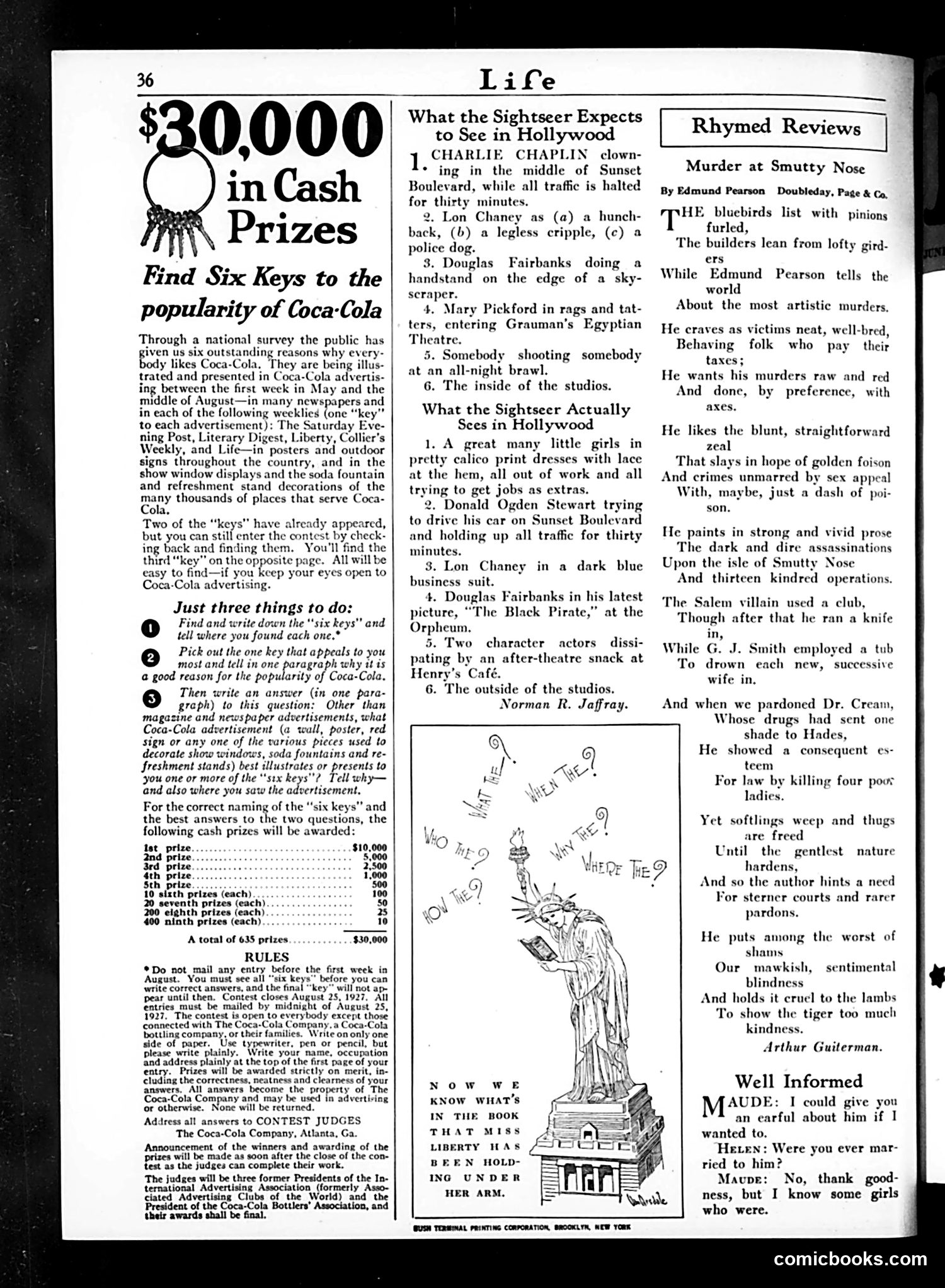
This Life magazine page contains **two distinct content sections**: **Left side:** A Coca-Cola advertising contest offering $30,000 in cash prizes. Readers must identify "six keys" to Coca-Cola's popularity hidden in advertisements appearing throughout summer 1927, then explain which key appeals to them most. This is straightforward commercial promotion disguised as a game. **Right side:** Satirical Hollywood commentary titled "What the Sightseer Expects to See in Hollywood." It humorously lists six exaggerated stereotypes tourists imagine they'll encounter: Charlie Chaplin disrupting traffic, Lon Chaney in grotesque makeup, Douglas Fairbanks performing death-defying stunts, Mary Pickford in tattered costumes, random shoot-outs, and studio interiors. The satire mocks both Hollywood's larger-than-life public image and tourists' naive expectations of constant celebrity chaos. The joke relies on recognizing 1920s film stars' signature roles and the gap between Hollywood's manufactured mystique and reality.