
Life, 1927-06-23 · page 18 of 38
Life — June 23, 1927 — page 18: what you’re looking at
What you’re looking at
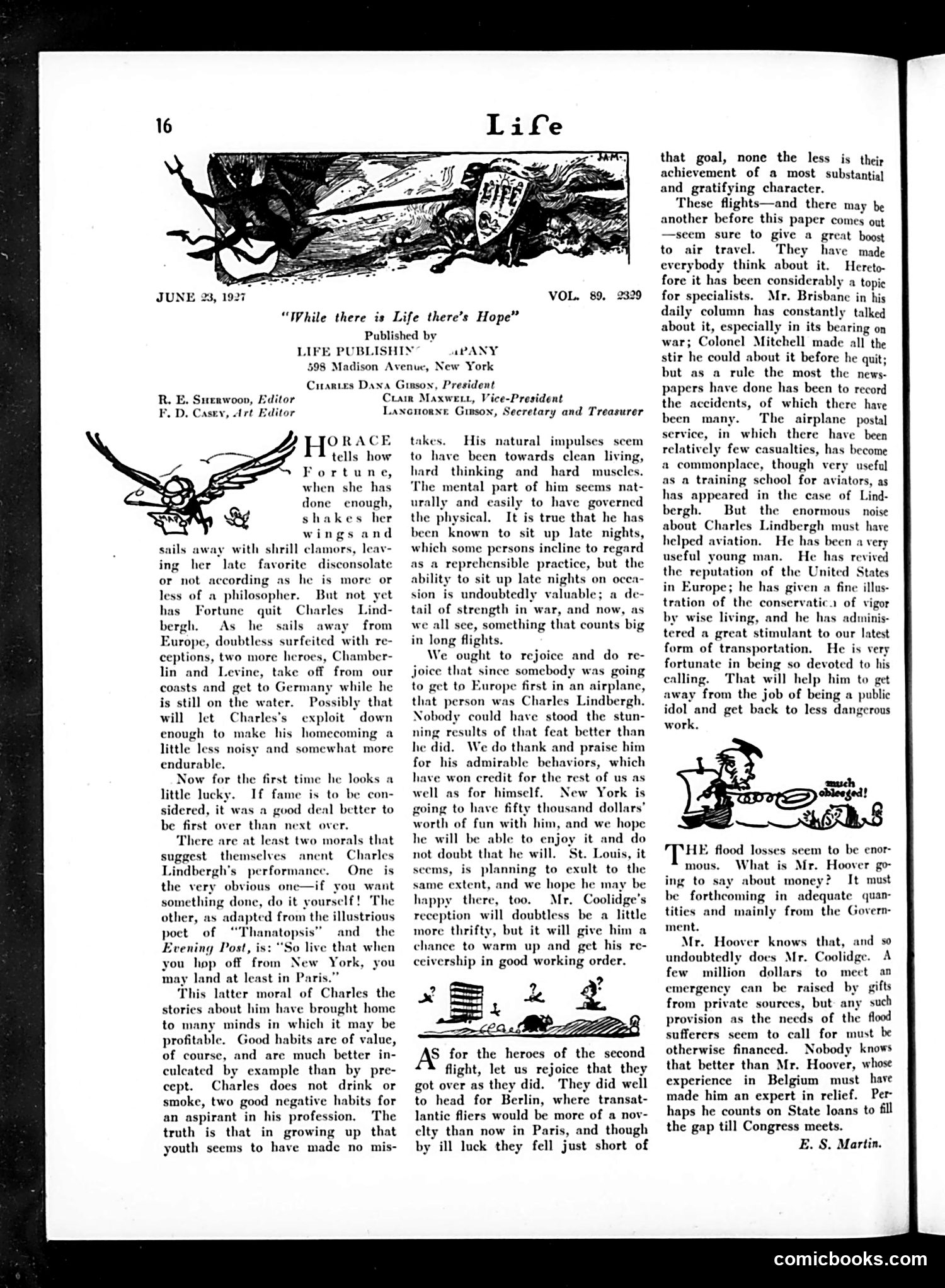
This page celebrates Charles Lindbergh's transatlantic flight. The editorial praises Lindbergh's character, noting he doesn't drink or smoke—"good negative habits for an aspirant in his profession." The text argues aviation deserves serious attention beyond novelty coverage, positioning Lindbergh as having elevated the field's reputation internationally. It discusses flood relief efforts, praising President Hoover's disaster response while noting Congressional funding remains inadequate. The small cartoon illustrations (showing figures with aircraft/parachutes) appear to be decorative period graphics rather than substantive satire. The page is primarily earnest editorializing about Lindbergh's achievement and contemporary policy matters, not satirical commentary.
📄 Transcribed text from this page (OCR, searchable)
Machine-transcribed from the original scan — historical spelling and the odd misread are preserved.
JUNE 23, 19. VOL. 89. 2329 “While there is Life there’s Hope” Published by LIFE PUBLISHIY 598 Madison Avenu R. E. Suenwoon, Editor F. D. Casey, rt Editor ORACE tells how Fortune, when she has done enough, Sy shakes her wings and ils away with shrill clamors, leav- ing her late favorite disconsolate or not according as he is more or less of a philosopher. But not yet has Fortune quit Charles Lind- bergh. As he sails aw from Europe, doubtless surfeited with re- ceptions, two more heroes, Chamber- lin and Levine, take off from our coasts and get to Germany while he is still on the water. Possibly that will let) Charles's exploit down enough to make his homecoming a little less noisy and somewhat more endurable, Now for the first time he looks a little lucky. If fame is to be con- sidered, it was a good deal better to be first over than next over. There are at least two morals that suggest themselves ent Charles Lindbergh's perforr » One is the very obvious one—if you want something done, do it yourself! The other, as adapted from the illustrious poct of “Thanatopsis” and the Evening Post, is: “So live that when you hop off from New York, you may land at least in Paris.” This latter moral of Charles the stories about him have brought home to many minds in which it may be profitable. Good habits are of value, of course, and are much better in- culeated by example than by pre- cept. Charles does not drink or smoke, two good negative habits for an aspirant in his profession. The truth is that in growing up that youth seems to have made no mis- —S we Cuartes Dana Ginsox, President Cram Maxweit, V Lancnorne Grnson, Secretary and Treasurer takes. His natural impulses seem to have been towards clean living, hard thinking and hard muscles. The mental part of him seems nat- urally and easily to have governed the physical. It is true that he has been known to sit up late nights, which some persons incline to regard as a reprehensible practice, but the ability to sit up late nights on occa- sion is undoubted luable; a de- tail of strength in , and now, as we all see, something that counts big in long flights. We ought to rejoice and do re- joice that since somebody was going to get to Europe first in an airplane, that person was Charles Lindbergh. Nobody could have stood the stun- ning results of that feat better than he did. We do thank and praise him for his admirable behaviors, which have won credit for the rest of us as well as for himself. New York is going to have fifty thousand dollars’ worth of fun with him, and we hope he will be able to enjoy it and do not doubt that he will. St. Louis, it seems, is planning to exult to the same extent, and we hope he may be happy there, too. Mr. Coolidge’s reception will doubtless be a little more thrifty, but it will give him a chance to warm up and get his re- ceivership in good working order. 2 x (4 S for the heroes of the second flight, let us rejoice that they got over as they did. They did well to head for Berlin, where transat- lantic fliers would be more of a nov- elty than now in Paris, and though by ill luck they fell just short of that goal, none the less is their achievement of a most substantial and gratifying character. These flights—and there may be another before this paper comes out —seem sure to give a great boost to air travel. They have made everybody think about it. Hereto- fore it has been considerably a topic for specialists. Mr. Brisbane in his daily column has constantly talked about it, especially in its bearing on war; Colonel Mitchell made all the stir he could about it before he quit; but as a rule the most the news- papers have done has been to record the accidents, of which there have been many. The airplane postal service, in which there have been relatively few casualties, has become a commonplace, though very useful as a training school for aviators, as has appeared in the case of Lind- bergh. But the enormous noise about Charles Lindbergh must have helped aviation. He has been a very useful young man. He has revived the reputation of the United States in Europe; he has given a fine illus- tration of the conservatic.a of vigor by wise living, and he has adminis- tered a great stimulant to our latest form of transportation. He is very fortunate in being so devoted to his calling. That 1 help him to get away from the job of being a public idol and get back to less dangerous work, — HE flood losses seem to be enor- mous. What is Mr. Hoover go- ing to say about money? It must be forthcoming in adequate quan- tities and mainly from the Govern- ment. Mr. Hoover knows that, and so undoubtedly does Mr. Coolidge. A few million dollars to meet an emergency can be raised by gifts from private sources, but any such provision as the necds of the flood sufferers seem to call for must be otherwise financed. Nobody knows that better than Mr. Hoover, whose experience in Belgium must have made him an expert in relief. Per haps he counts on State loans to fill the gap till Congress meets. E. S. Martin. comicbooks.com