
Life, 1927-06-23 · page 23 of 38
Life — June 23, 1927 — page 23: what you’re looking at
What you’re looking at
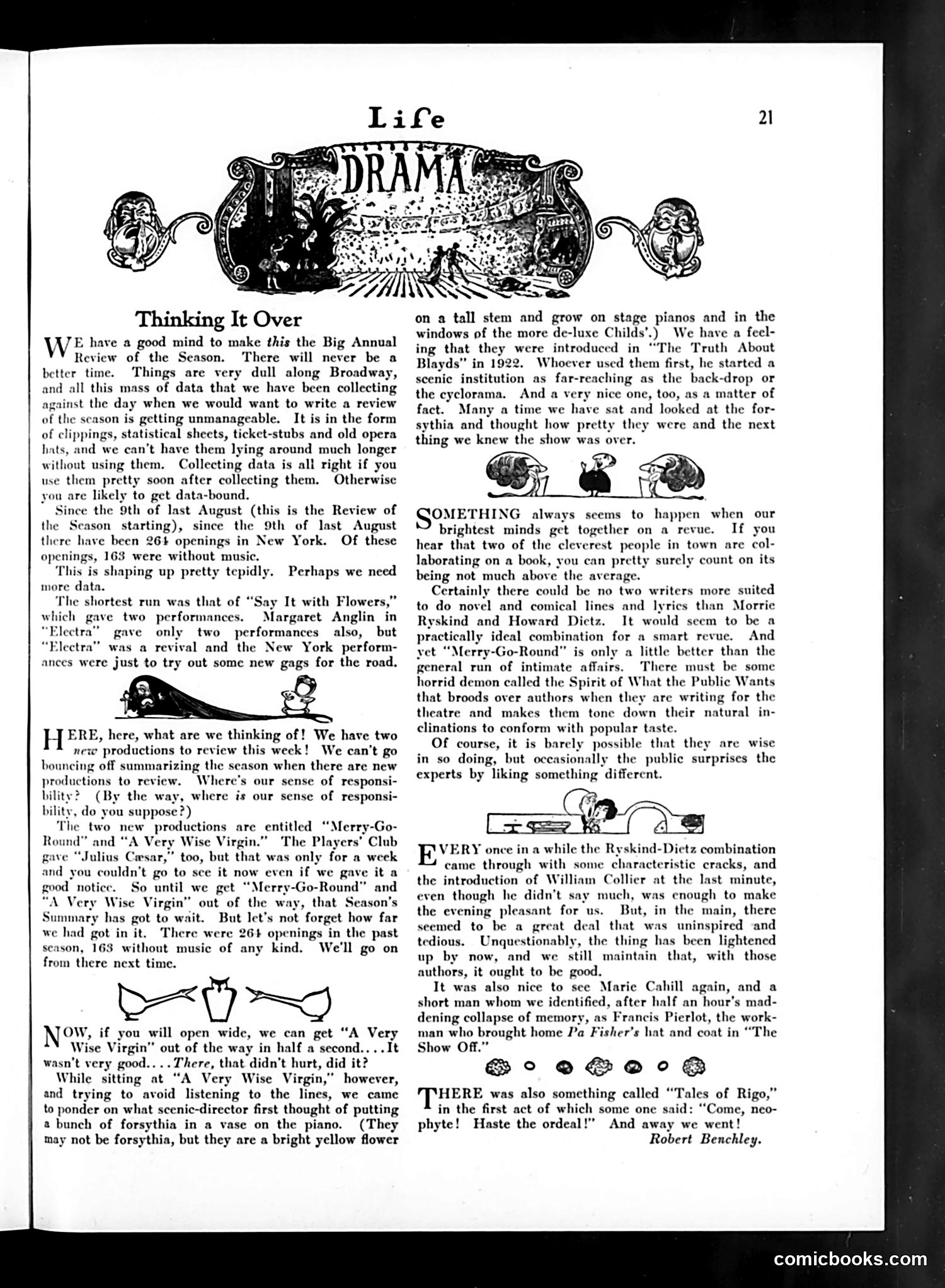
This is a theater review column discussing Broadway's 1922-23 season. The author catalogs depressing statistics: 264 openings since August, 163 without music, with "Merry-Go-Round" and "A Very Wise Virgin" being forgettable recent productions requiring dismissal before tackling the full season summary. The satire targets theatrical mediocrity. The author mocks the absurdity of collecting review data ("data-bound"), notes shows closing after mere performances, and laments that even promising collaborations—specifically citing talented writers Morrie Ryskind and Howard Dietz—produce only average work due to commercial compromises. The running joke about yellow forsythia flowers as ubiquitous stage decoration satirizes designers' clichéd choices. The "Spirit of What the Public Wants" personification blames mass-market taste for preventing bold theatrical innovation, suggesting Broadway prioritizes commercial safety over artistic ambition.
📄 Transcribed text from this page (OCR, searchable)
Machine-transcribed from the original scan — historical spelling and the odd misread are preserved.
WE have a good mind to make this the Big Annual Review of the Season. There will never be a better time. Things are very dull along Broadway, and all this mass of data that we have been collecting against the day when we would want to write a review of the season is getting unmanageable. It is in the form of clippings, statistical sheets, ticket-stubs and old opera hats, and we can’t have them lying around much longer without using them, Collecting data is all right if you use them pretty soon after collecting them. Otherwise you are likely to get data-bound. the 9th of last August (this is the Review of son starting), since the 9th of last August there have been 264 openings in New York. Of these openings, 163 were without music. This is shaping up pretty tepidly. more data. The shortest run was that of “Say which gave two performances. Margaret Anglin in . ra’ gave only two performances also, but ra” was a revival and the New York perform- ances were just to try out some new gags for the road. Perhaps we need y It with Flowers,” } ERE, here, what are we thinking of! We have two new productions to review this weck! We can't go bouncing off summarizing the season when there are new productions to review. Where’s our sense of responsi- bility? (By the way, where is our sense of responsi- bility, do you suppose?) The two new productions are entitled “Merry-Go- Round” and “A Very Wise Virgin.” The Players’ Club gave “Julius Cesar,” too, but that was only for a week and you couldn't go to sce it now even if we gave it a good noticc. So until we get “Merry-Go-Round” and “A Very Wise Virgin” out of the way, that Season’s Summary has got to wait. But let’s not forget how far we had got in it. There were 264 openings in the past season, 163 without music of any kind. We'll go on from there next time. bea OW, if you will open wide, we can get “A Very Wise Virgin” out of the way in half a second... .It wasn’t very good.... There, that didn’t hurt, did it? While sitting at “A Very Wise Virgin,” however, and trying to avoid listening to the lines, we came to ponder on what scenic-director first thought of putting a bunch of forsythia in a vase on the piano. (They may not be forsythia, but they are a bright yellow flower on a tall stem and grow on stage pianos and in the windows pf the more de-luxe Childs’.) We have a feel- ing that they were introduced in “The Truth About Blayds” in 1922. Whoever used them first, he started a scenic institution as far-reaching as the back-drop or the cyclorama. And a very nice one, too, as a matter of fact. Many a time we have sat and looked at the for- sythia and thought how pretty they were and the next thing we knew the show was over. OMETHING always seems to happen when our brightest minds get together on a revue. If you hear that two of the cleverest people in town are col- laborating on a book, you can pretty surely count on its being not much above the average. Certainly there could be no two writers more suited to do novel and comical lines and lyrics than Morrie Ryskind and Howard Dictz. It would seem to be a practically ideal combination for a smart revue. And yet “Merry-Go-Round” is only a little better than the general run of intimate affairs. There must be some horrid demon called the Spirit of What the Public Wants that broods over authors when they are writing for the theatre and makes them tone down their natural in- clinations to conform with popular taste. Of course, it is barely possible that they are wise in so doing, but occasionally the public surprises the experts by liking something different. aor ERY once in a while the Ryskind-Dietz combination came through with some characteristic cracks, and the introduction of William Collier at the last minute, even though he didn’t say much, was enough to make the evening pleasant for us. But, in the main, there seemed to be a great deal that was uninspired and tedious. Unquestionably, the thing has been lightened up by now, and we still maintain that, with those authors, it ought to be good, It was also nice to see Marie Cahill again, and a short man whom we identified, after half an hour’s mad- dening collapse of memory, as Francis Pierlot, the work- man who brought home Pa Fisher’s hat and coat in “The Show Off.” Bo e@ooeg HERE was also something called “Tales of Rigo,” in the first act of which some one said: “Come, neo- And away we went! phyte! Haste the ordeal!” y Robert Benchley. comicbooks.com