
A complete issue · 39 pages · 1927
Life — April 21, 1927
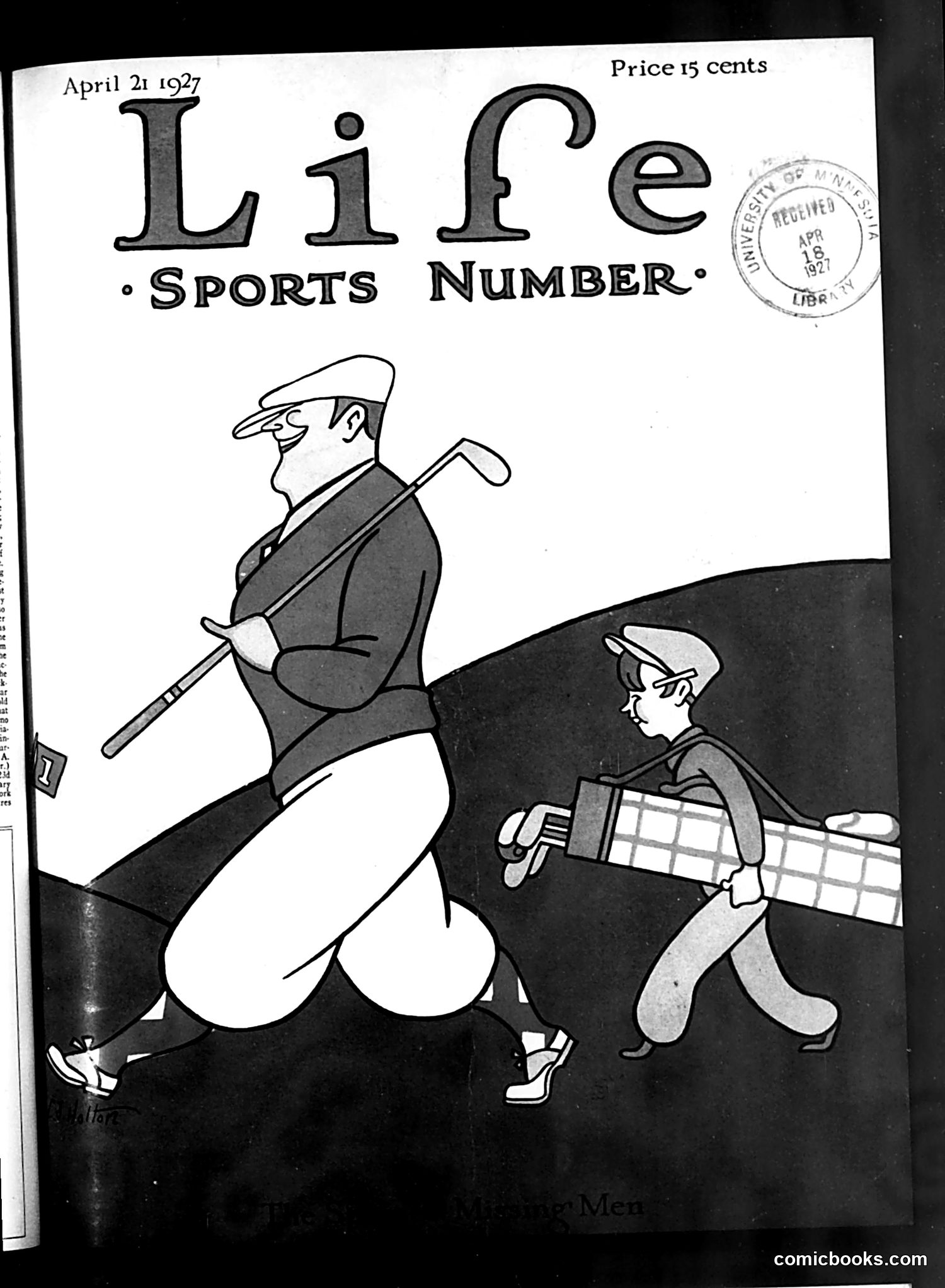
This is the cover of *Life*'s "Sports Number" from April 1927. The cartoon depicts two figures playing golf: a large man in formal attire (suit and cap) swinging energetically, and a smaller boy carrying the golf bag. The satire likely mocks the era's golf craze among wealthy, prominent men—a fashionable leisure activity associated with business elites and politicians. The exaggerated proportions and the boy's laboring to keep up suggest commentary on the disparity between the indulgent leisure pursuits of the wealthy and ordinary workers. The specific figures remain unclear from the image alone, but the visual joke emphasizes golf's cultural prominence in 1920s American society.
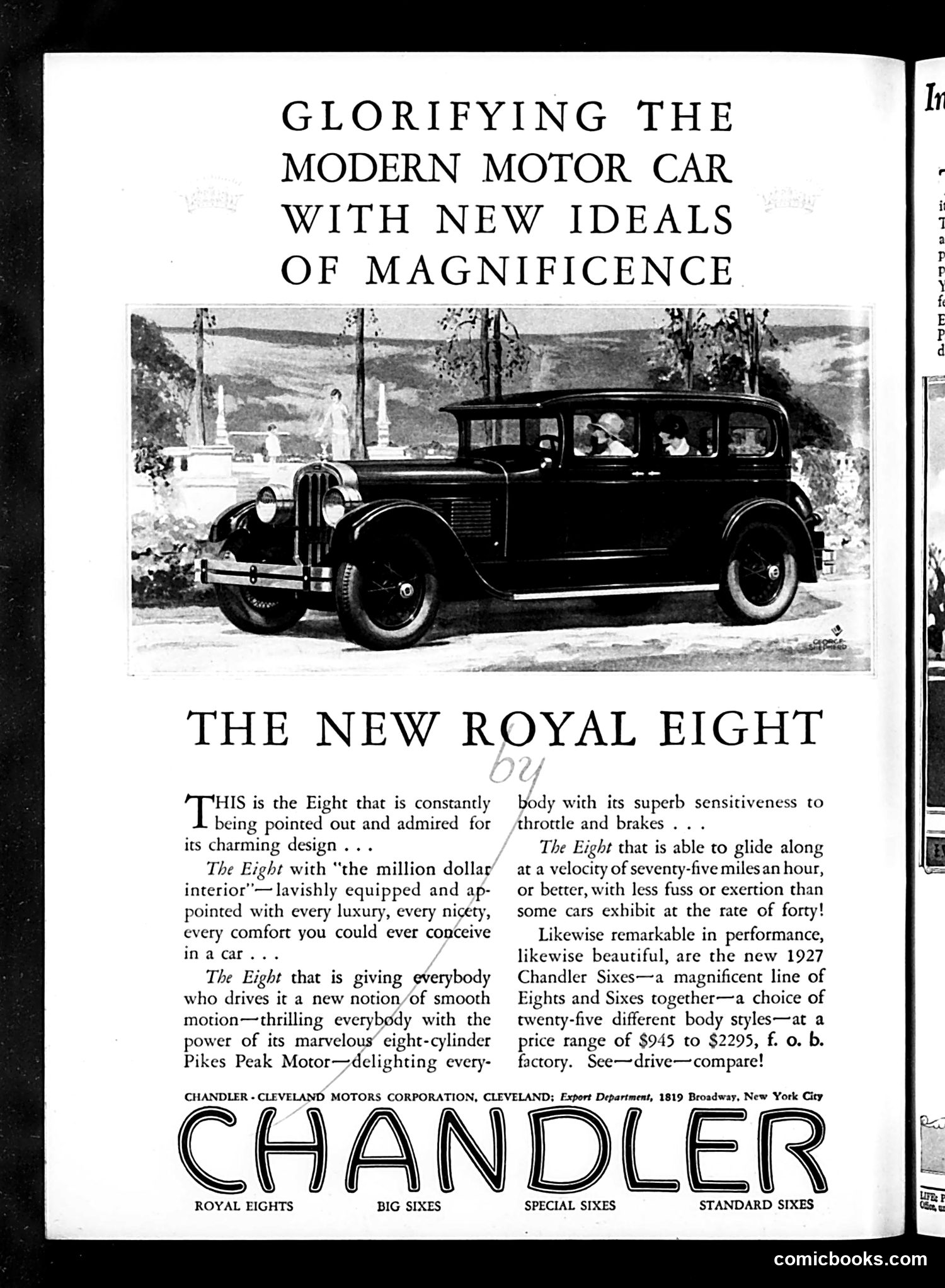
This is **not a political cartoon or satire** — it's a straightforward **automobile advertisement** for the Chandler Royal Eight motorcar, placed in Life magazine (circa 1927, based on the styling and price points mentioned). The page advertises luxury features of the new Royal Eight: its eight-cylinder Pikes Peak Motor, smooth performance at 75 mph, and "million dollar interior" with lavish appointments. It also mentions competing 1927 Chandler Sixes, priced $945–$2295. The image shows a well-dressed couple in the elegant sedan parked before an estate, emphasizing the car's association with wealth and social status. This represents typical 1920s automotive advertising that linked car ownership to prosperity and sophistication during the Jazz Age economic boom.
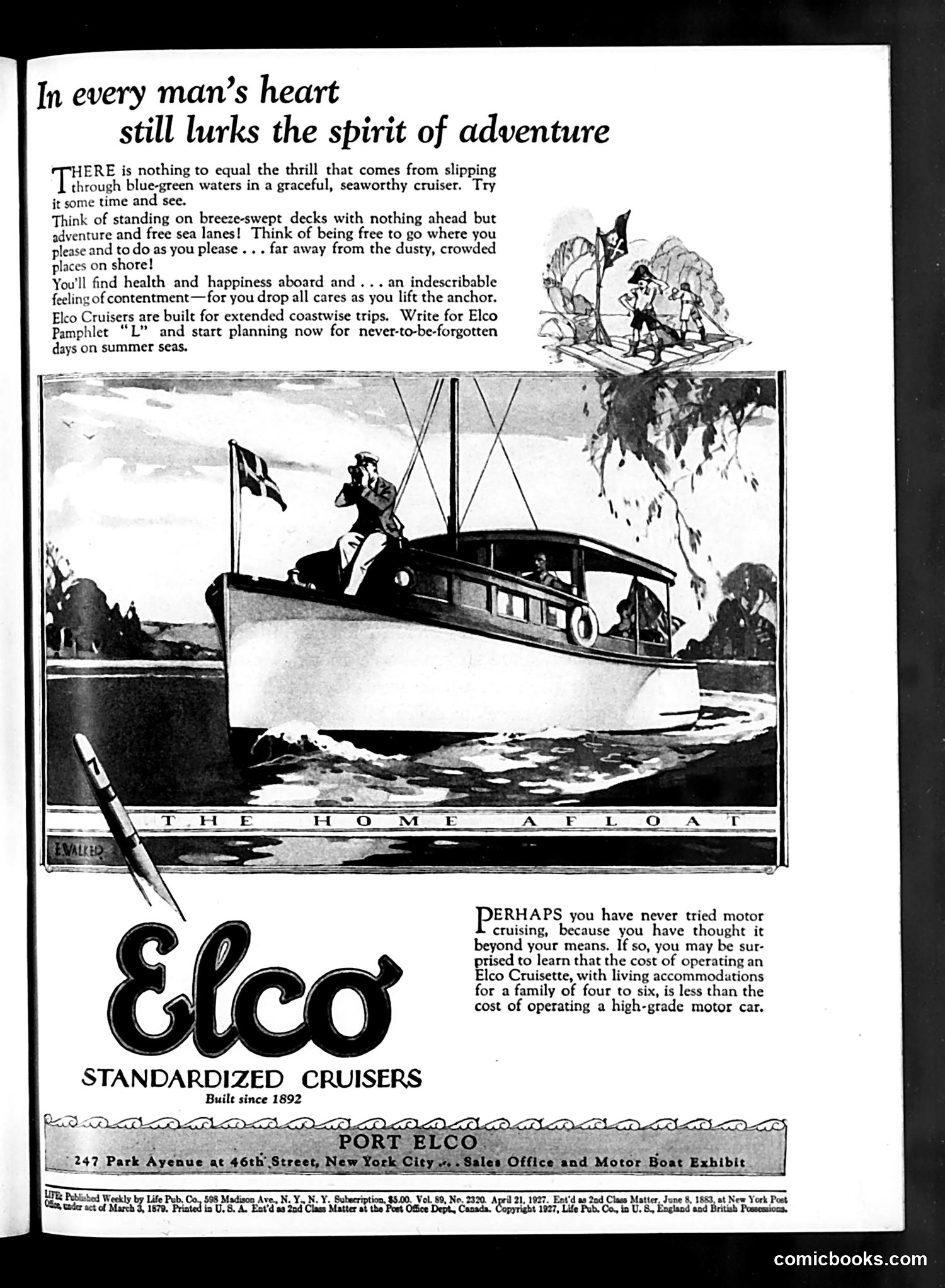
This is **not a political cartoon**, but rather a **full-page advertisement** for Elco Standardized Cruisers, motorboats built since 1892. The ad uses romantic, aspirational messaging appealing to middle-class readers' desire for leisure and escape. The headline "In every man's heart still lurks the spirit of adventure" romanticizes boat ownership as accessible freedom. The illustration shows a well-dressed couple aboard a motor cruiser, suggesting leisure travel. The key sales pitch appears at bottom: motor cruising costs less than operating a high-grade automobile—an important economic argument during the 1920s. The address (Port Elco, New York) and reference to a "Motor Boat Exhibit" indicate this ran during boat-show season. This reflects 1920s consumer culture and the democratization of recreational boating among affluent Americans.
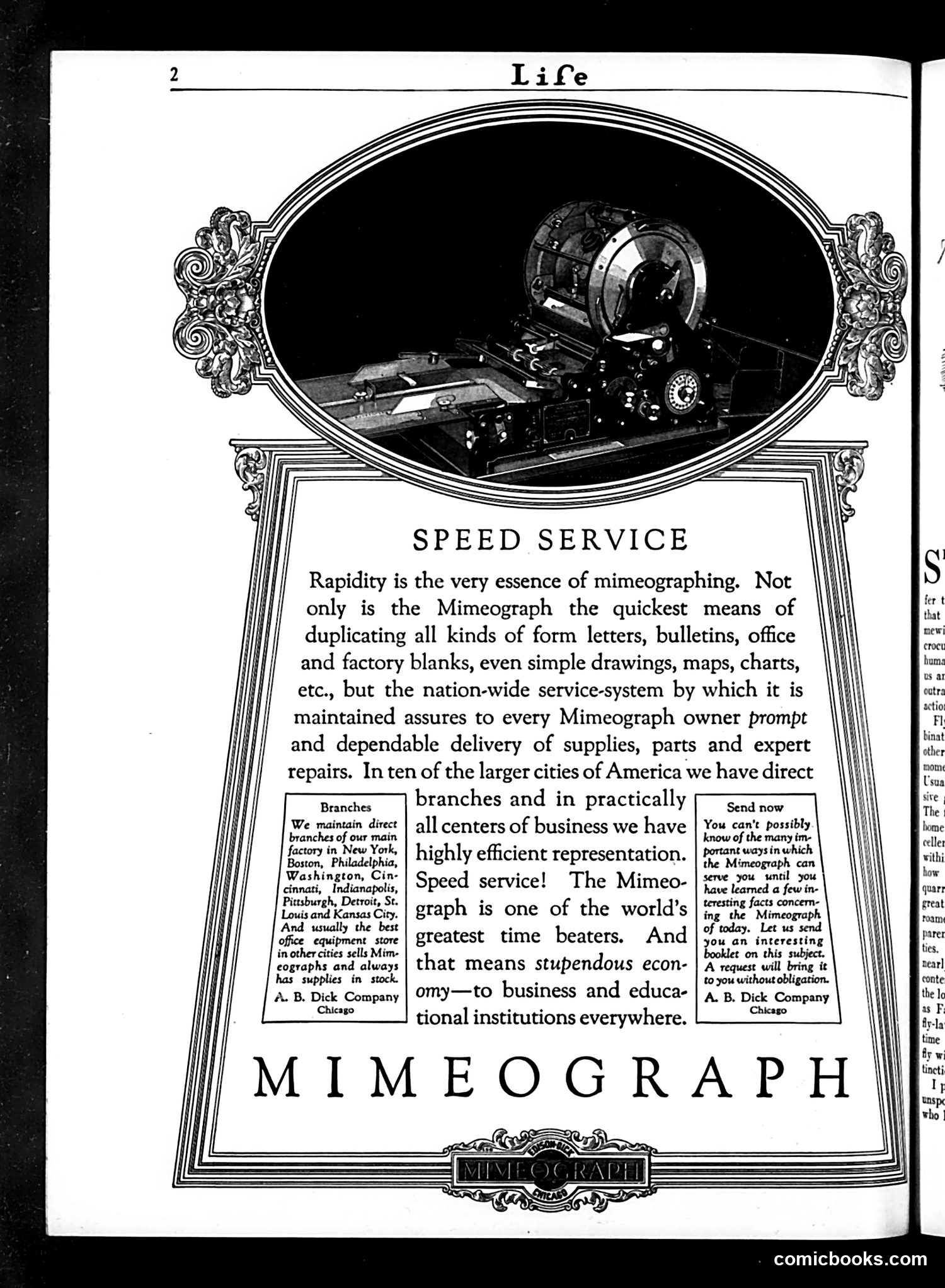
This page is **primarily an advertisement**, not a satirical cartoon. It promotes the Mimeograph machine, a copying device that was commercially significant in the early-to-mid 20th century. The ad emphasizes the machine's speed and service network. The ornate oval frame shows a Mimeograph device itself. Text highlights the company's nationwide branches in major American cities (New York, Boston, Philadelphia, Washington, etc.) and promises "prompt and dependable delivery" of supplies and repairs. The pitch targets businesses and institutions by stressing efficiency and time-saving—"one of the world's greatest time beaters"—which would have been genuinely novel when photocopiers didn't exist. This is commercial messaging, not political satire or editorial cartooning.
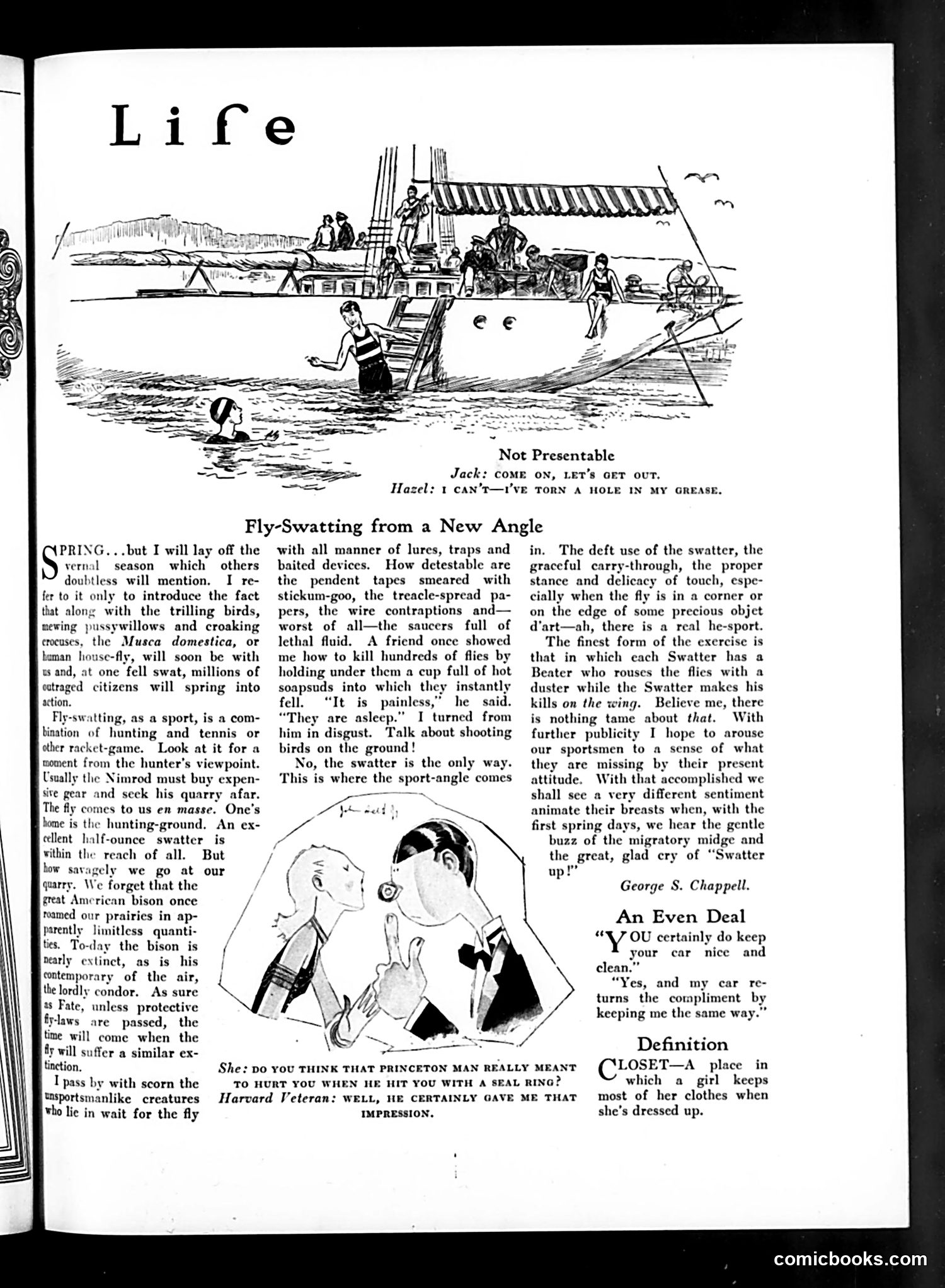
This page contains three distinct pieces of early 20th-century humor: **"Not Presentable"**: A cartoon depicting people at a boat, with Jack refusing to leave because he's "torn a hole in my grease"—a joke about the social embarrassment of damaging one's clothing while engaged in casual activity. **"Fly-Swatting from a New Angle"**: An essay by George S. Chappelle advocating fly-swatting as a sport, comparing it to hunting. The piece satirizes the decline of frontier activities by suggesting this domestic pest-control activity offers similar satisfaction. **"An Even Deal" & "Definition"**: Brief jokes about car maintenance and a definition of "closet" as storage for a woman's excessive clothing—typical period humor about gender roles. The page reflects early 1900s American leisure culture and social attitudes rather than specific political content.
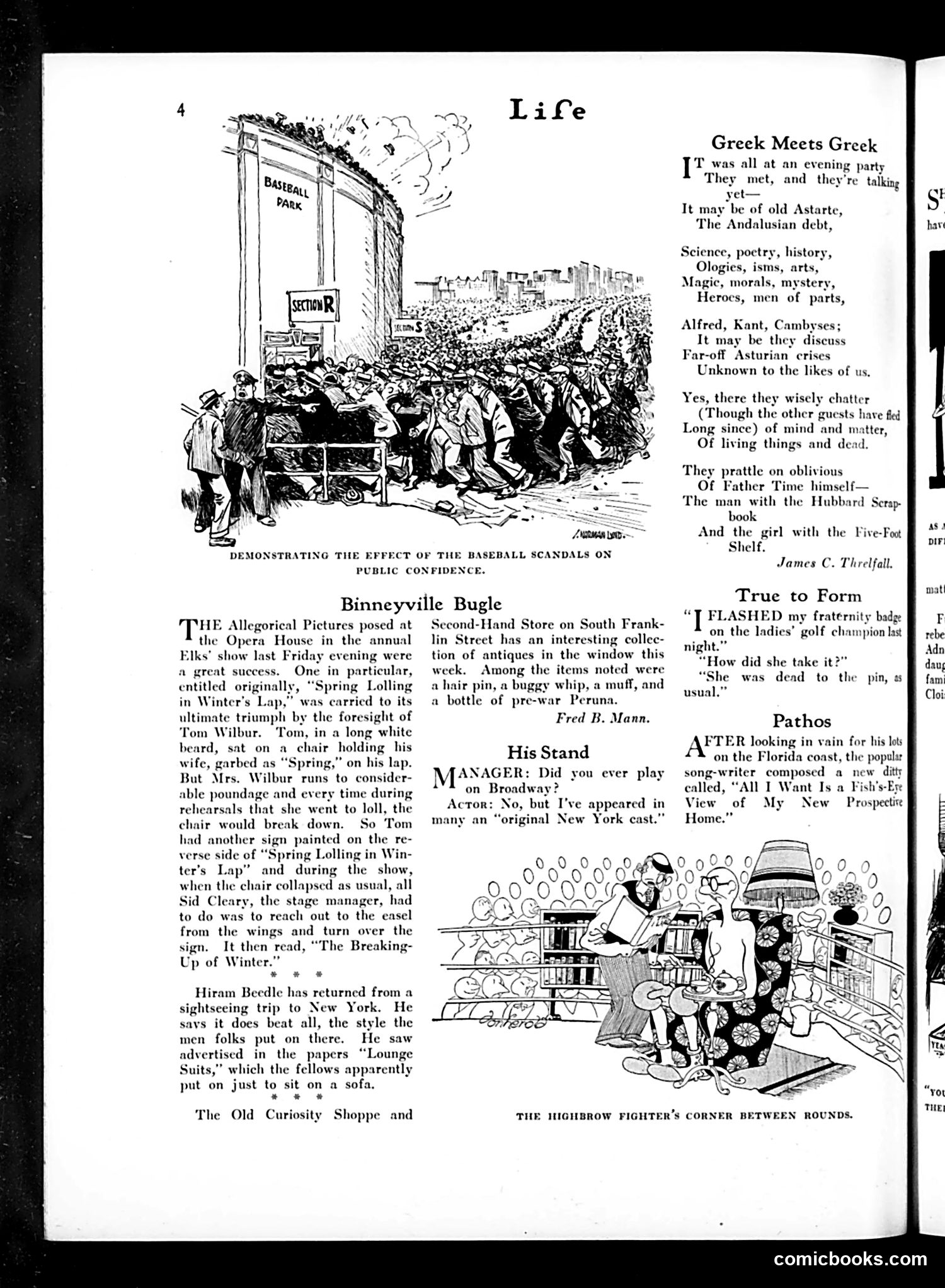
The top cartoon satirizes baseball scandals' damage to public confidence. It shows a massive crowd gathered outside a baseball park marked "Section R," with the caption "DEMONSTRATING THE EFFECT OF THE BASEBALL SCANDALS ON PUBLIC CONFIDENCE." The enormous turnout actually contradicts the intended message—suggesting the scandals drew rather than repelled spectators, perhaps mocking predictions that scandals would destroy the sport's popularity. The lower cartoon, captioned "THE HIGHBROW FIGHTER'S CORNER BETWEEN ROUNDS," depicts a boxing match scene with spectators. The satire appears to contrast intellectual pretension with the brutality of prizefighting, though the specific reference remains unclear without additional context. Both cartoons use visual irony to mock contemporary social anxieties about sports and public morality.
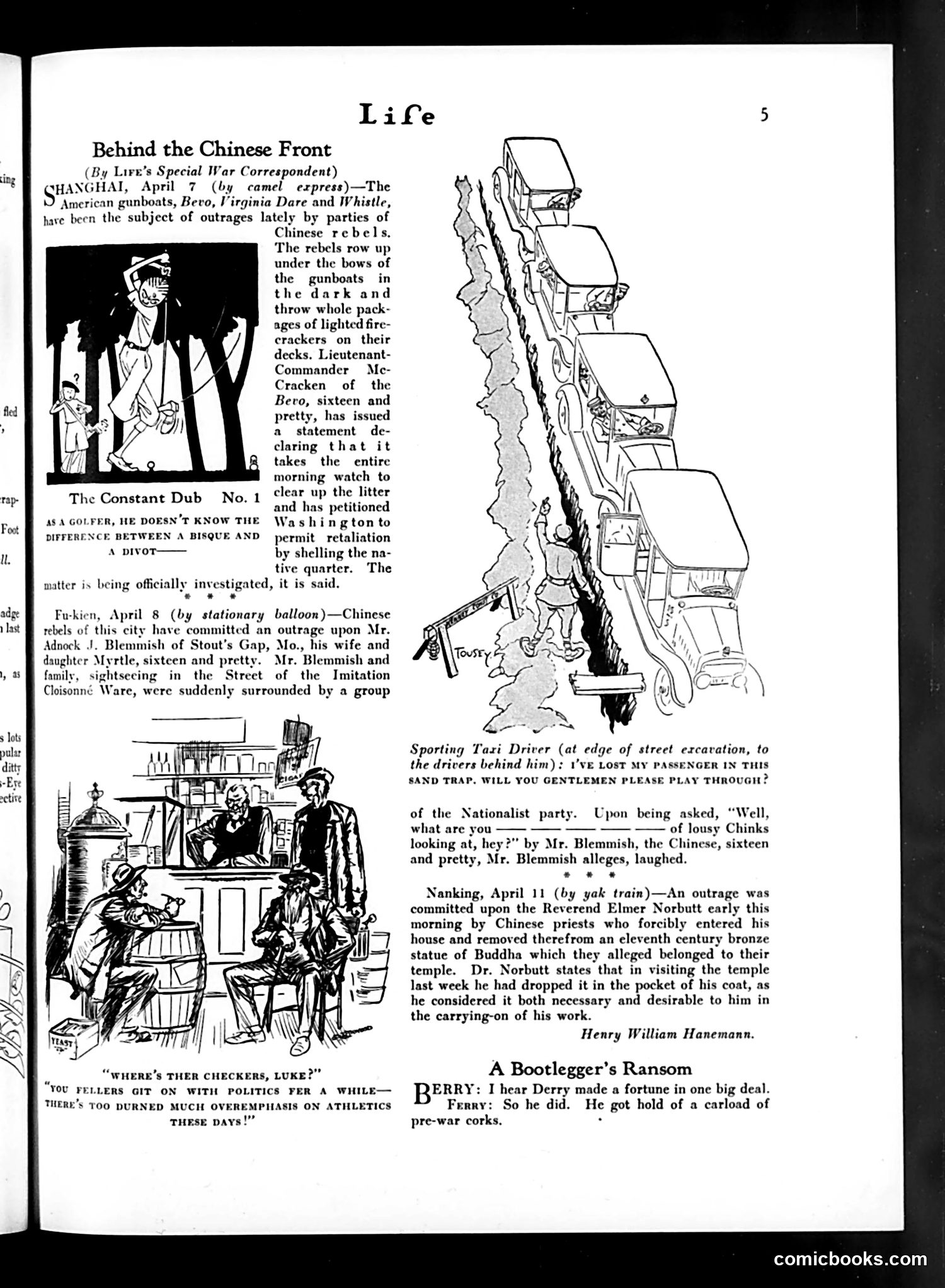
This page contains three separate satirical pieces about the Chinese Front during what appears to be early WWI (dated April 1919): 1. **"The Constant Dub"** (top left cartoon): A golfer doesn't know the difference between a bisque and a divot—satirizing upper-class ignorance. 2. **"Behind the Chinese Front"** (main article with illustration): Reports American gunboats attacked by Chinese rebels; includes anecdotes about Western civilians caught in disturbances, including Mr. Blemmish's family encountering Chinese nationalists. 3. **"Sporting Taxi Driver"** (right illustration): A taxi driver trapped in a street excavation appeals to passengers for help—likely satirizing urban chaos or indifference. 4. **"A Bootlegger's Ransom"** (bottom): Brief dialogue about bootlegging profits, likely referencing Prohibition-era black market activity. The page satirizes both foreign conflicts and domestic American social issues.
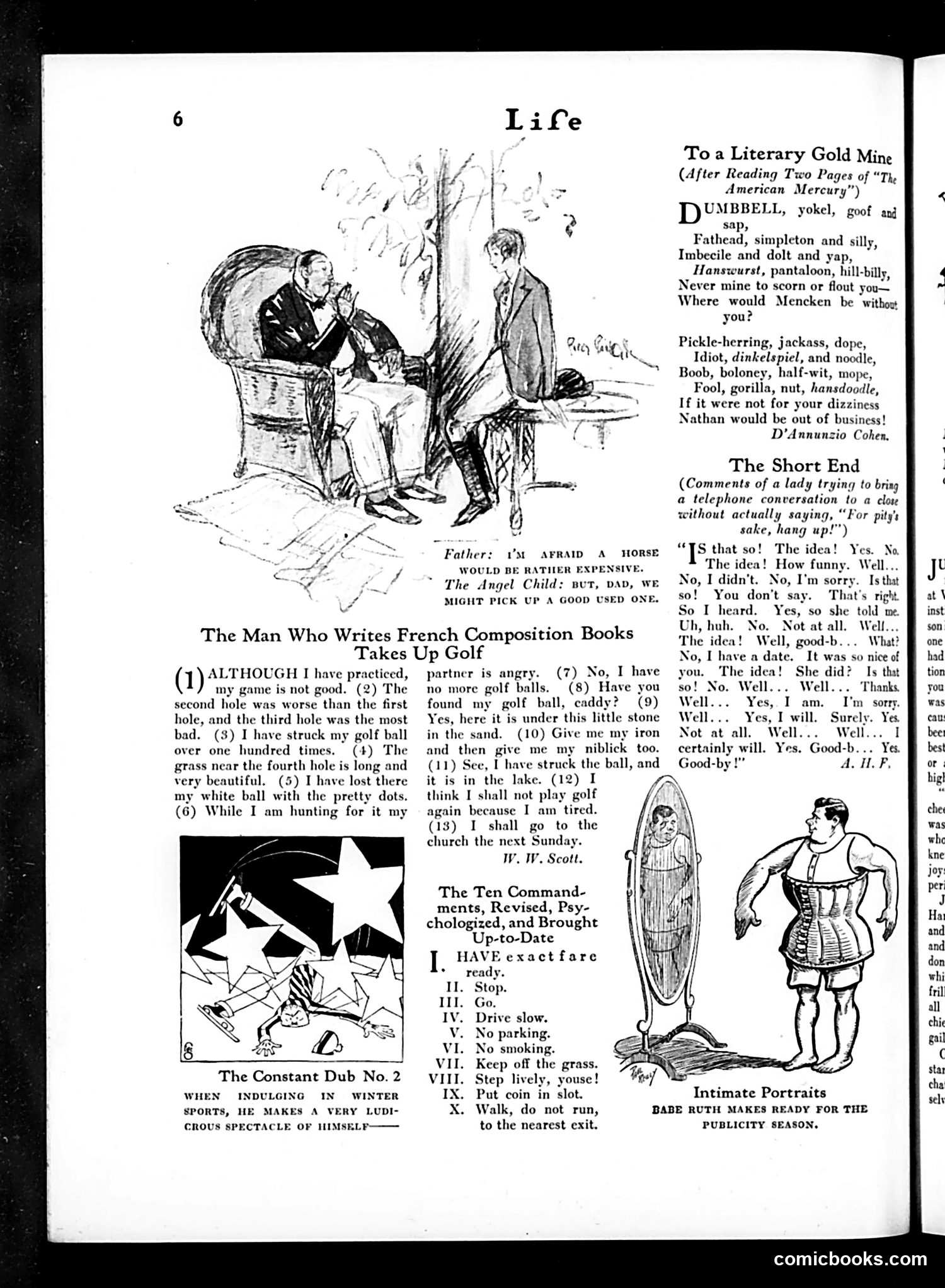
This page from *Life* magazine contains three satirical pieces: 1. **"To a Literary Gold Mine"**: A poem mocking *The American Mercury* magazine by attacking it with period insults ("dumbbell," "jackass," "boob"). The satire targets the publication's intellectual pretensions. 2. **"The Man Who Writes French Composition Books Takes Up Golf"**: A humorous numbered monologue where a pedantic French teacher applies his overly-analytical teaching style to golfing, creating absurd situations (striking balls 100 times, losing his ball). The joke is professional overcomplication of a simple recreational activity. 3. **"The Short End"**: A comedic telephone conversation where a woman tries ending a relationship without directly saying so, using indirect hints while the man remains oblivious. 4. **"Intimate Portraits"**: Cartoon sketches of exaggerated figures for publicity purposes. The overall theme emphasizes human awkwardness and social miscommunication through humor.
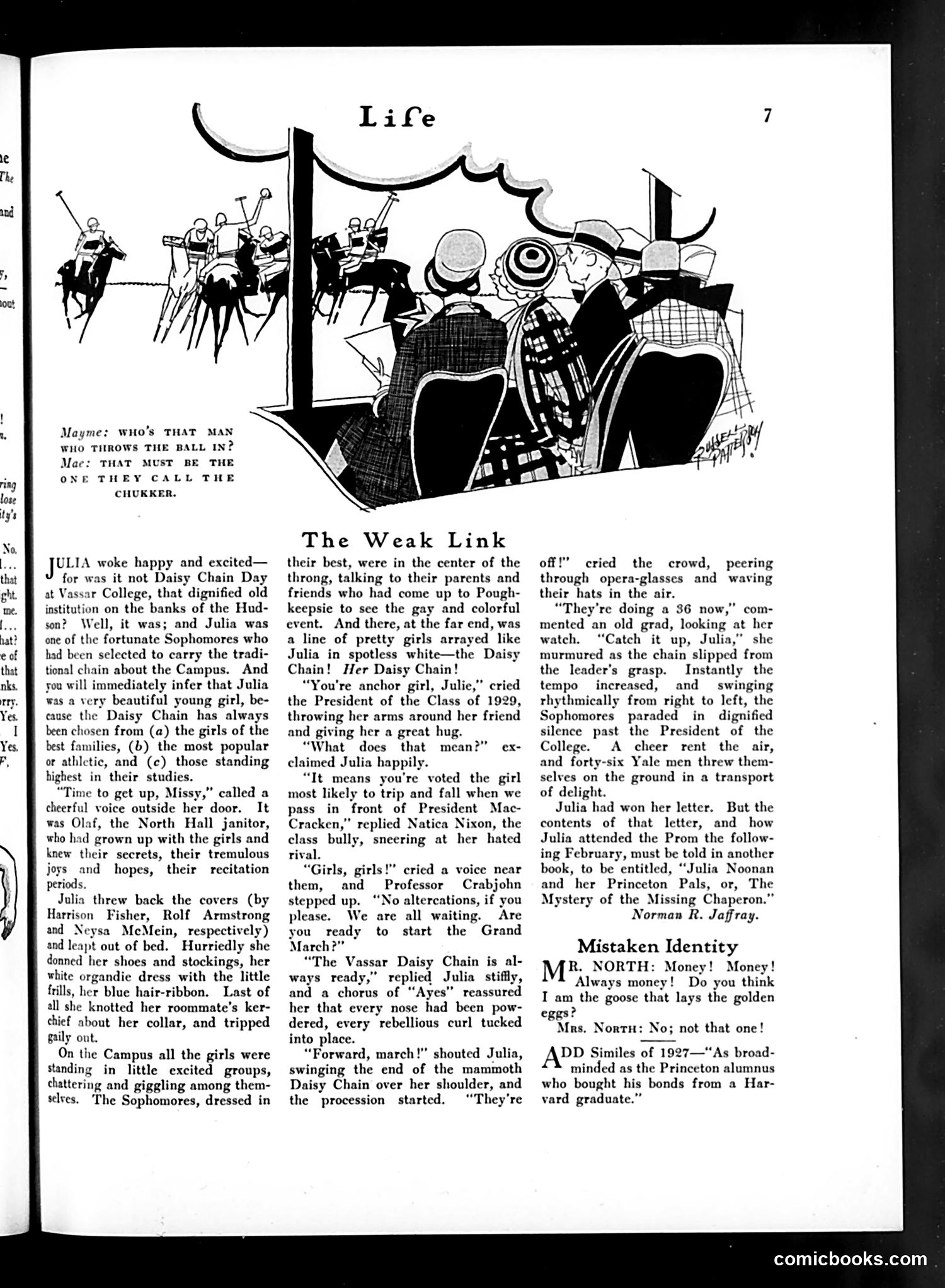
This page contains a short story titled "The Weak Link" about Julia, a Vassar College sophomore selected to carry the traditional Daisy Chain during a campus event. The illustration at top shows spectators at what appears to be a polo match or sporting event, with someone asking who threw the ball—the "chucker." The story itself describes Julia's excitement about participating in this college tradition, where selected girls form a chain carrying daisies during a procession. The narrative focuses on social hierarchy and peer dynamics among female students, with references to class elections and inter-girl rivalry. Below is a brief humor section titled "Mistaken Identity" featuring wordplay about money and eggs. The content reflects early 1920s college social life and female student traditions.
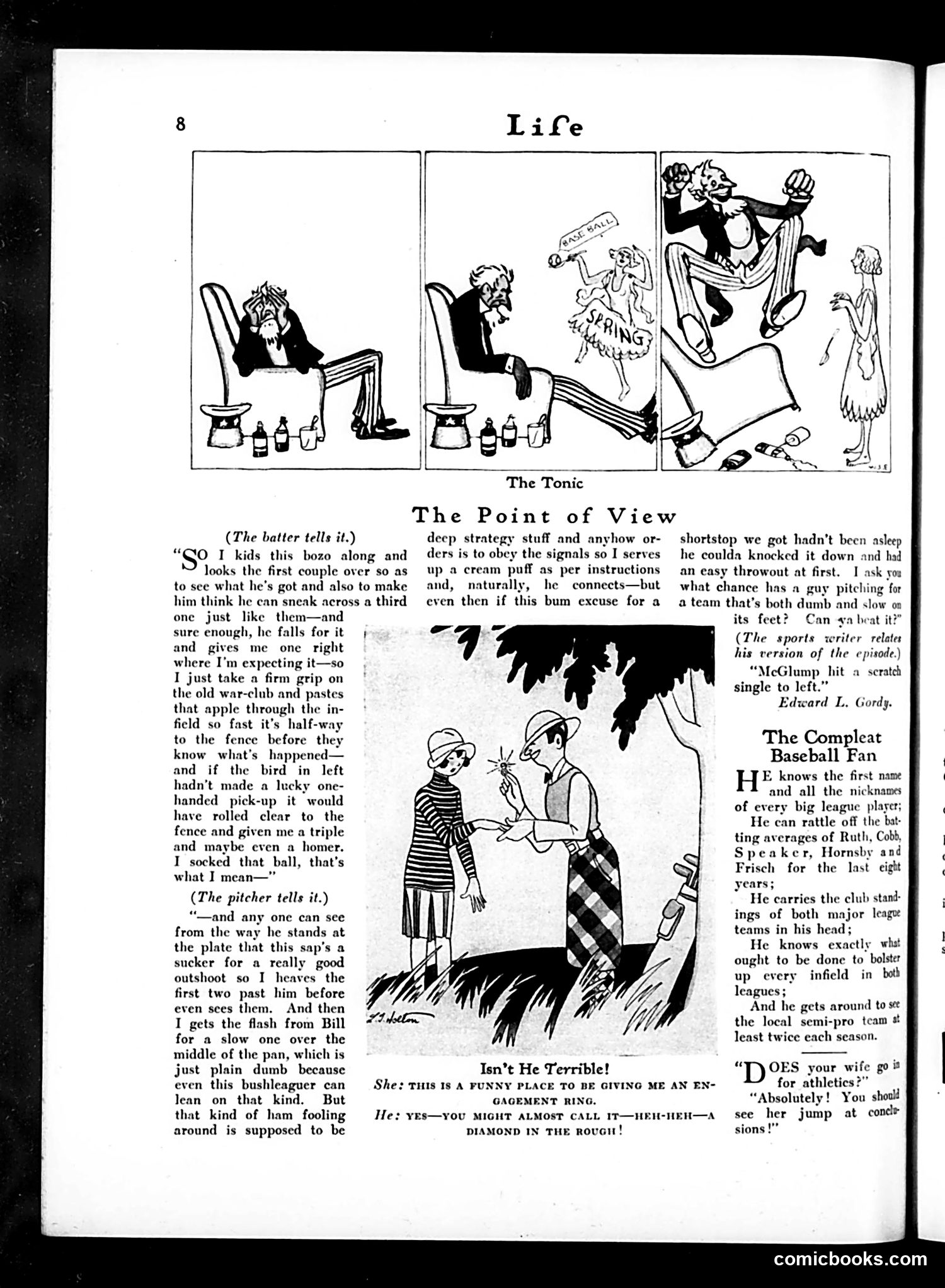
This page contains two main pieces of baseball humor: **"The Tonic"** (top comic strip) shows a man taking a patent medicine tonic, then hallucinating wildly—suggesting the product contains alcohol or powerful drugs that cause delusions. **"The Point of View"** (main article) presents contrasting perspectives on baseball strategy from a batter and pitcher, humorously disagreeing about proper technique and baseball theory. **"Isn't He Terrible!"** (bottom cartoon) depicts a marriage proposal at a baseball diamond, with the caption playing on the absurdity of choosing a sports venue for an engagement ring presentation. The overall page satirizes both patent medicine culture (common in early 20th-century America) and baseball's obsessive fan base, mocking how seriously people took the sport.
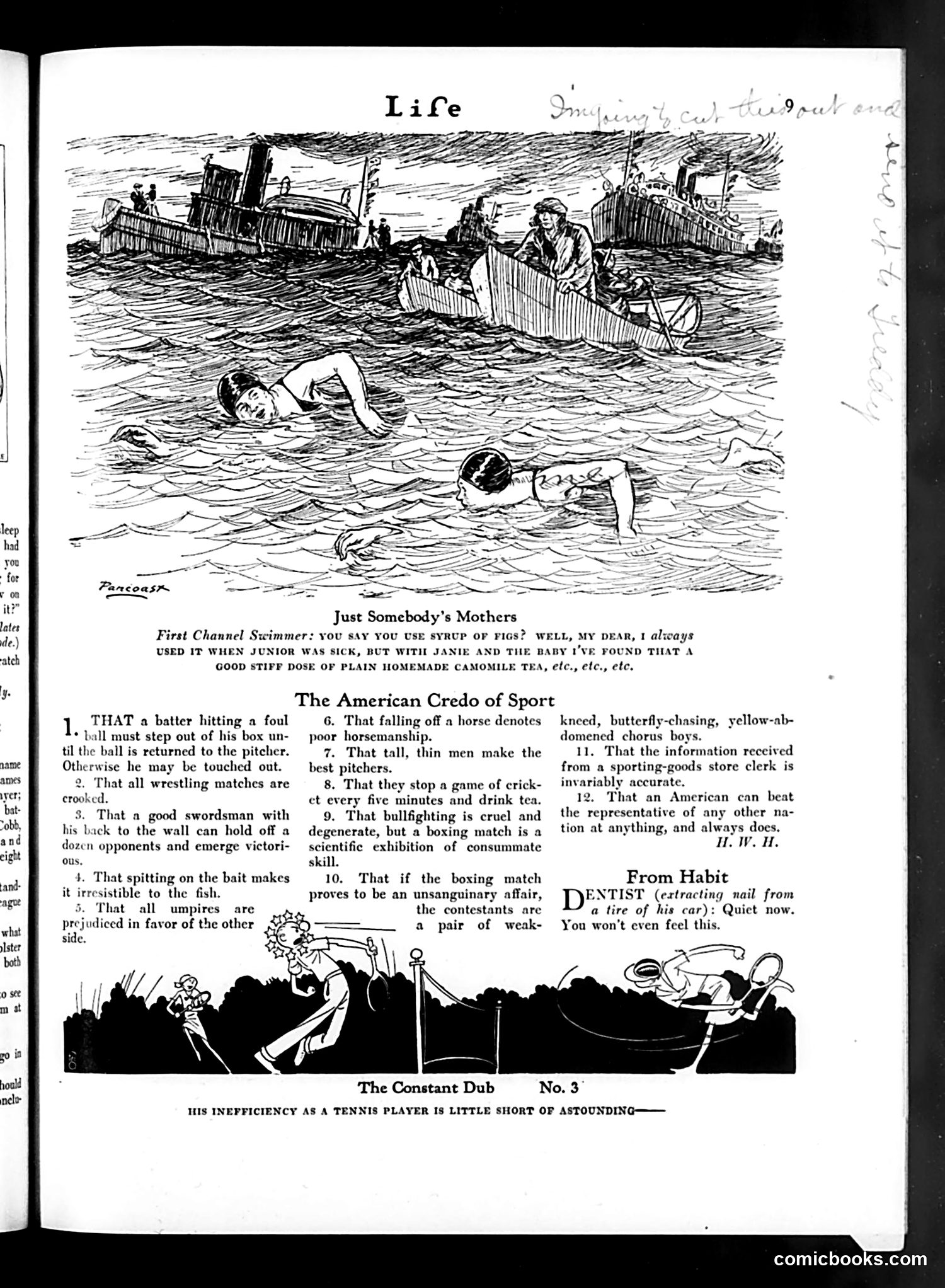
This page contains three separate satirical pieces about leisure and sport: **"Just Somebody's Mothers"** depicts two women swimming while boats full of spectators watch. The caption mocks mothers who use syrup or camomile tea as home remedies for sick children, implying they're more interested in swimming than child care. **"The American Credo of Sport"** is a numbered list satirizing American sporting attitudes—mocking assumptions about sportsmanship, rule interpretation, and national superiority in athletics. It critiques both actual sports practices and smug American exceptionalism regarding sport. **"The Constant Dub No. 3"** shows a dentist extracting a nail from a tennis player's ear, captioned about his poor tennis performance. This recurring comic series mocks an incompetent amateur athlete. The overall theme ridicules American leisure culture and sporting pretensions.
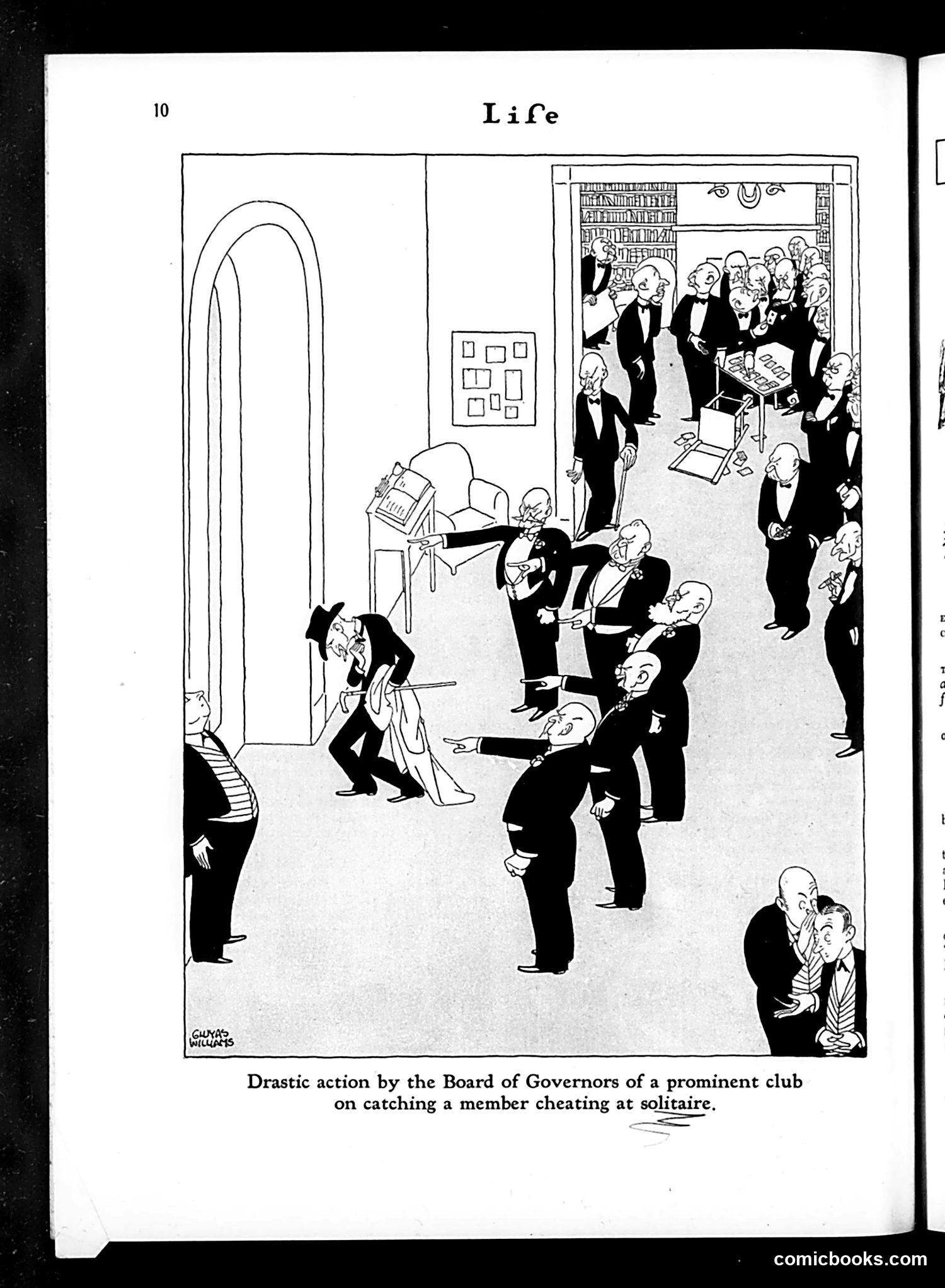
This is a satirical cartoon from *Life* magazine depicting "Drastic action by the Board of Governors of a prominent club on catching a member cheating at solitaire." The humor relies on the absurd disproportion of the response: a lone man seated at a table playing solitaire is being forcibly ejected by numerous stern-faced governors in formal attire. The exaggerated physical intervention—multiple men restraining and removing the offender—mocks both the rigidity of exclusive club governance and the pretentiousness of enforcing strict ethical codes over a solitary card game. The cartoon satirizes how upper-class institutions prioritize decorum and rule-enforcement, treating minor infractions with excessive formality and severity. The cartoonist (signed "Gluyas Williams") uses visual comedy to critique institutional pomposity and the disproportionate punishment culture of gentlemen's clubs.
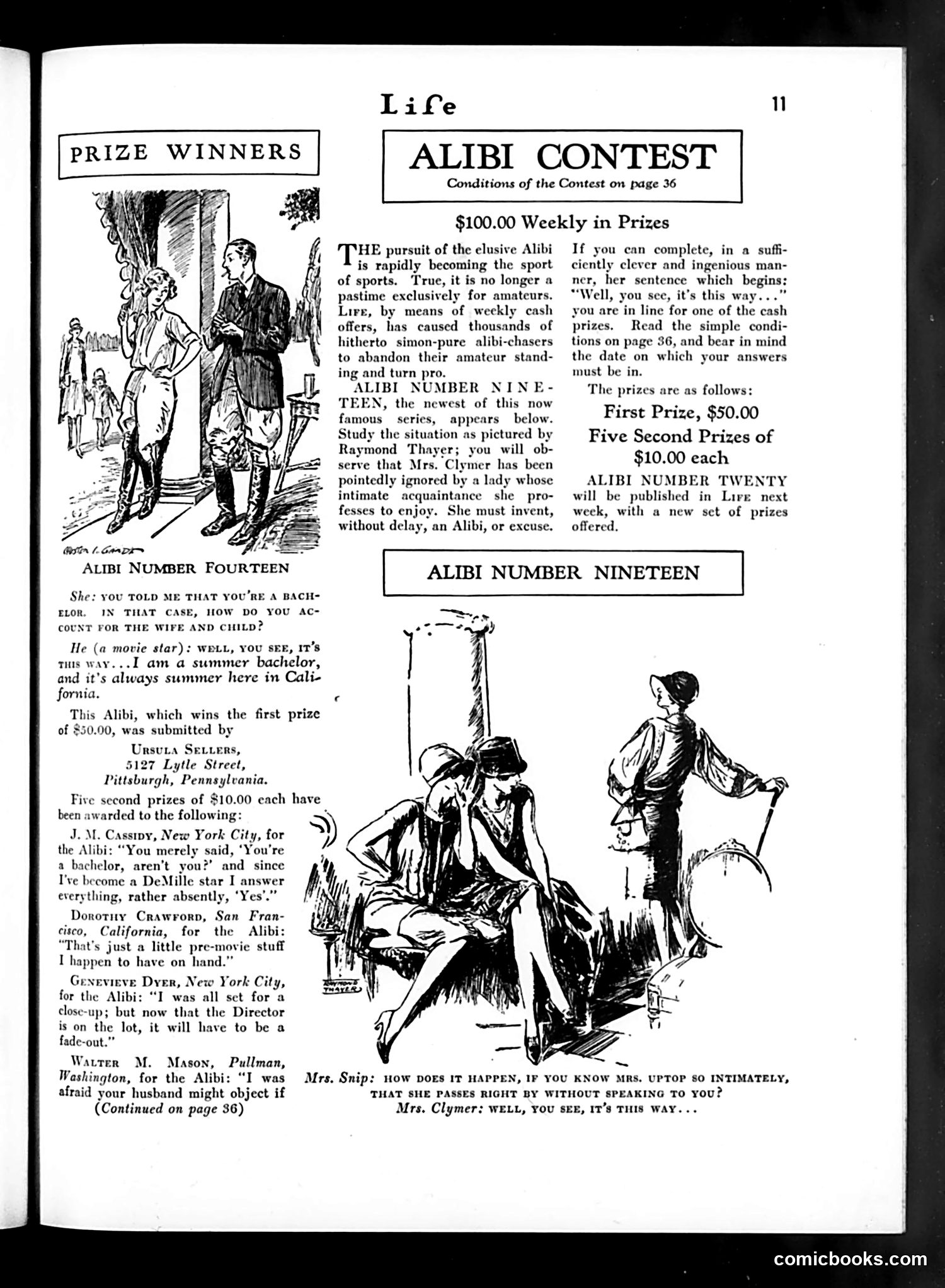
This page presents an "Alibi Contest"—a humor feature where readers submit creative excuses to awkward social situations. The contest offers $100 weekly in prizes ($50 first prize, five $10 second prizes). **Alibi #14** shows a bachelor explaining to a woman how he accounts for a wife and child despite being unmarried—his excuse is that he's always a "summer bachelor" in California. **Alibi #19** depicts a social awkwardness scenario: a woman (Mrs. Ship) questions how someone could pass by an intimate acquaintance (Mrs. Clymer) without speaking. The humor centers on fabricating plausible excuses for social rudeness or contradictions. This reflects early-20th-century American humor: readers competed by inventing witty explanations for embarrassing situations—a participatory entertainment format common in magazines before television.
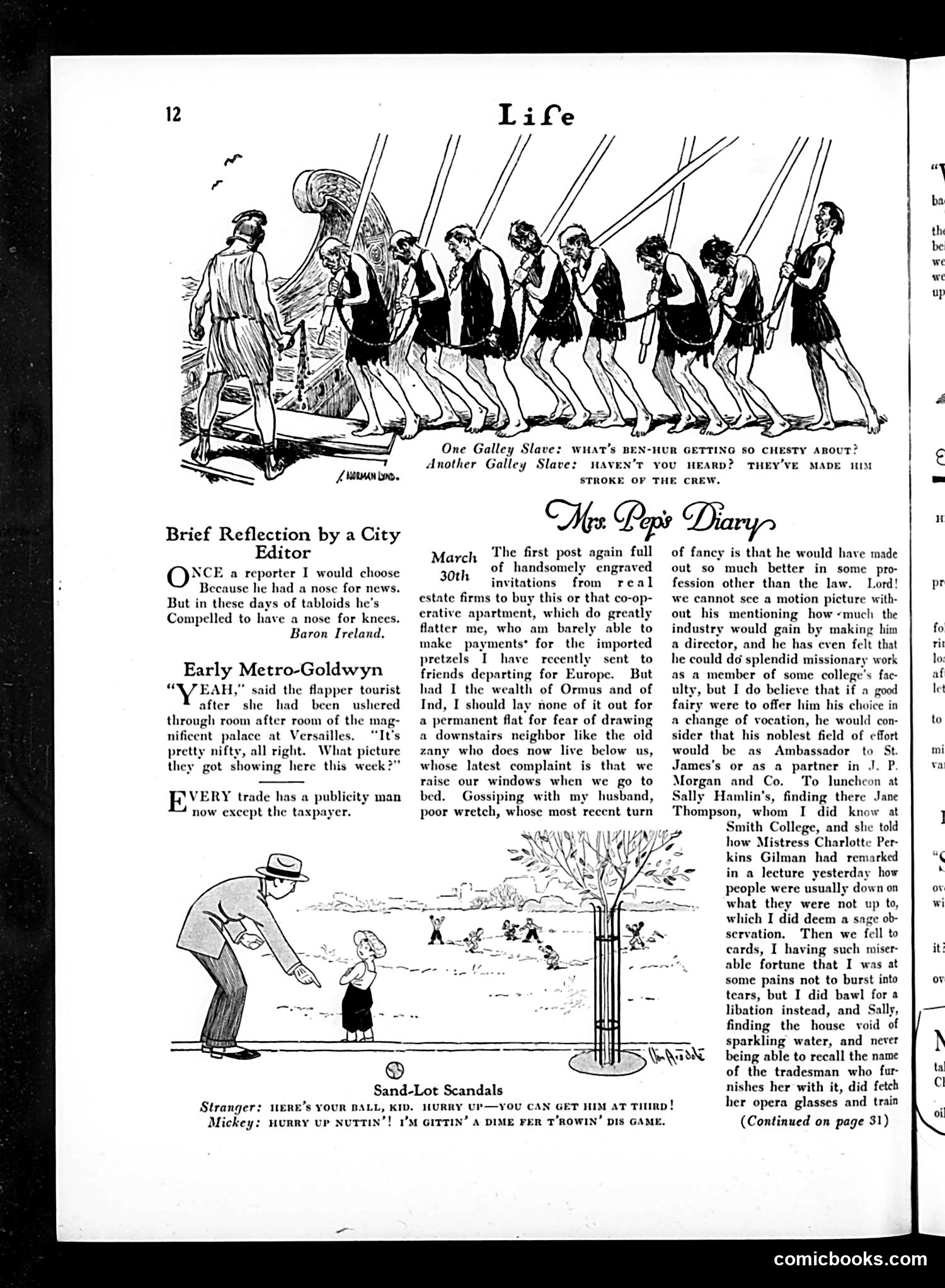
This 1920s *Life* magazine page contains satirical commentary and cartoons about contemporary urban life. **Top cartoon**: Depicts galley slaves being whipped, with the caption contrasting their labor to modern office workers complaining about crew work—satirizing white-collar complaints about workplace conditions. **"Brief Reflection by a City Editor"**: A short poem mocking reporters' need for news sources, attributed to Baron Ireland. **"Early Metro-Goldwyn"**: Jokes about a wealthy woman's pretensions after visiting Versailles. **Bottom cartoon**: Shows a street vendor and child in a "Sand-Lot Scandals" sketch about street games and gambling, typical period humor about urban youth culture. The overall tone satirizes contemporary American urban society—workplace grievances, social climbing, and working-class street life—common *Life* magazine subjects of the era.
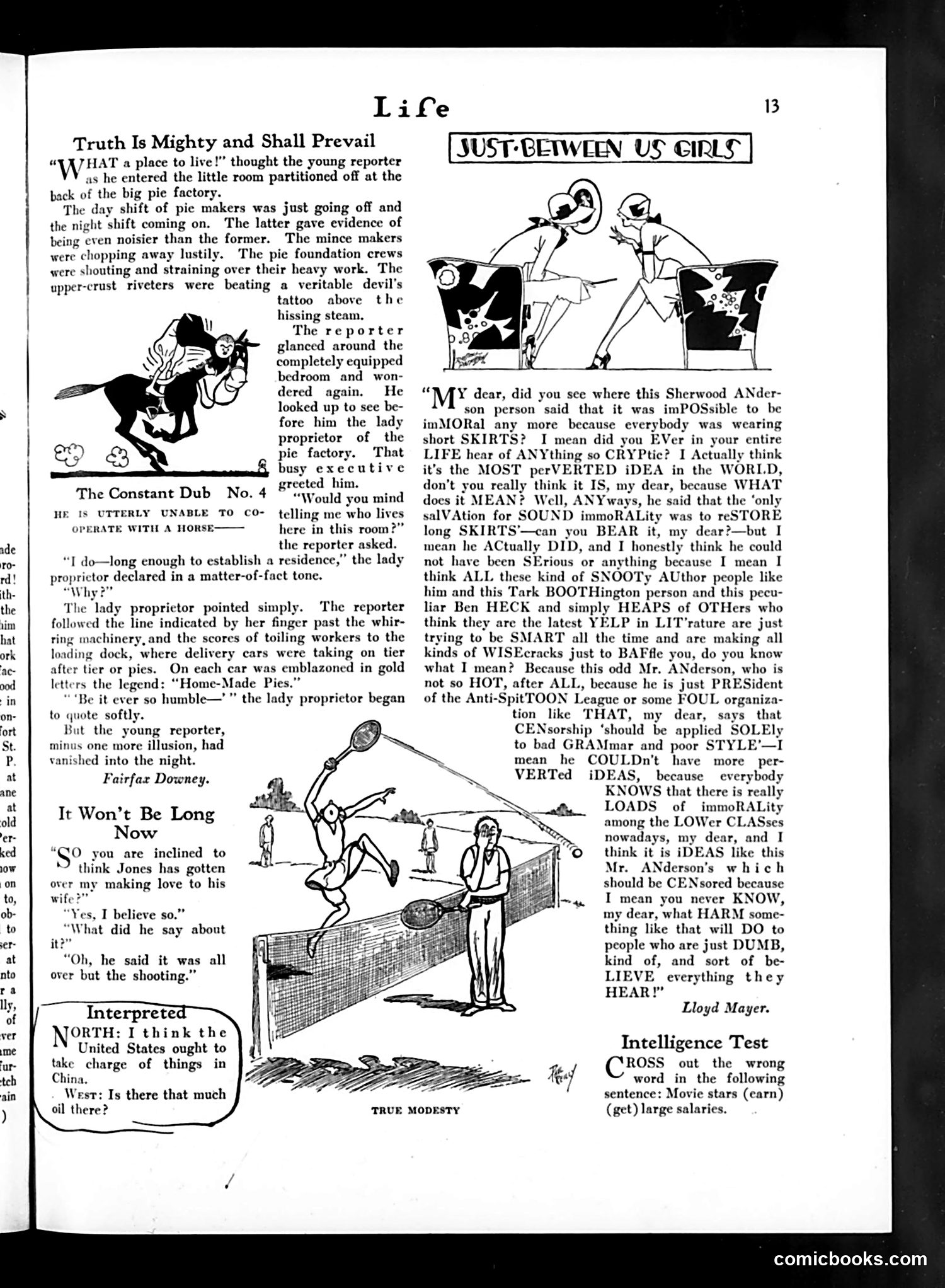
This page contains several humor pieces satirizing early 20th-century social conventions and workplace conditions: **"The Constant Dub No. 4"** mocks an incompetent man unable to operate a horse—the "dub" appears to be a recurring character representing social ineptitude. **"Just Between Us Girls"** is a gossip column where women discuss scandals involving short skirts, censorship debates, and social propriety. It satirizes both women's fashion choices and puritan disapproval, referencing "Sherwood Anderson" and concerns about "immoral" literature and film. **"It Won't Be Long Now"** presents a domestic conversation where a husband believes his wife is concerned about infidelity, but she's actually worried about his hunting accident—a wordplay joke on miscommunication. The cartoons collectively mock social pretension, censorship anxieties, and gender miscommunication characteristic of the era.
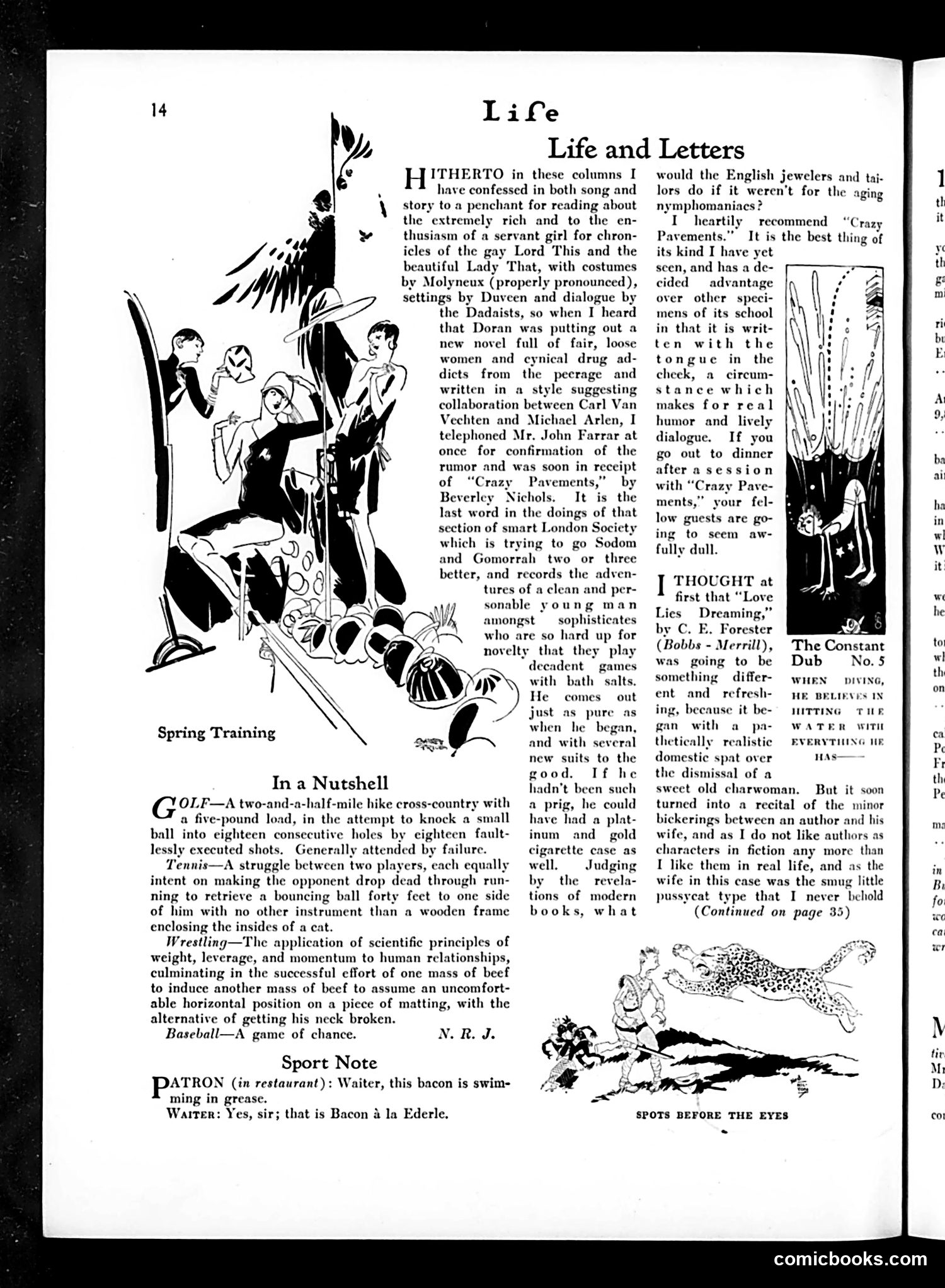
This page features literary commentary and sports humor from what appears to be the 1920s-30s era of *Life* magazine. The main content discusses newly published novels, including "Crazy Pavements" by Beverley Nichols—described as featuring "fair, loose women and cynical drug addicts" in a style suggesting collaboration between Carl Van Vechten and Michael Arlen. The author humorously recommends "Crazy Pavements" for its satirical portrayal of decadent London society obsessed with novelty. The lower section includes brief sports definitions (golf, tennis, wrestling, baseball) presented as humorous "translations" of their actual nature—mocking their complexity or absurdity. A "Sport Note" joke plays on a waiter's misunderstanding of "Bacon à l'Ederle" (likely referencing swimmer Gertrude Ederle), confusing it with actual bacon.
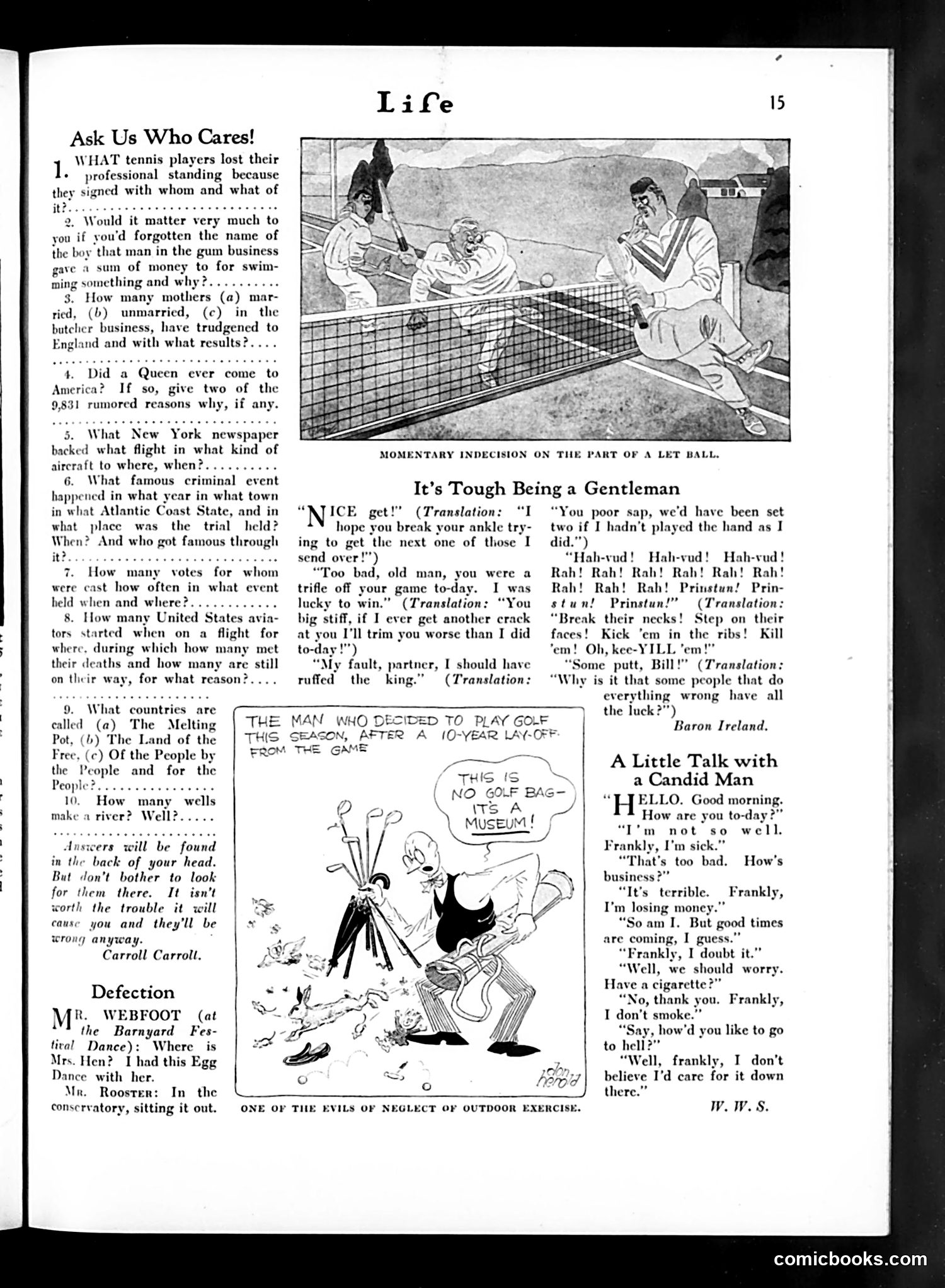
**Main Cartoon: "One of the Evils of Neglect of Outdoor Exercise"** This cartoon satirizes a man who abandoned golf for a decade, now attempting to resume the sport. The joke: his golf bag has become a museum piece—so neglected it's grown moss and attracted wildlife. The satire targets sedentary lifestyles and the physical deterioration from inactivity, a concern during this era. **"It's Tough Being a Gentleman"** A humorous dialogue between tennis players, with one complaining about losing after deliberately playing poorly to let his opponent win. The satire mocks the Victorian ideal of gentlemanly conduct—where losing gracefully was expected—as impractical and frustrating. Both pieces reflect early-20th-century anxieties about masculinity, leisure, and modern etiquette.
This page contains editorial text rather than a prominent political cartoon. The main illustrated elements are decorative mastheads featuring cherubic figures. The content discusses contemporary issues: China's political instability and foreign intervention; Henry Ford's potential testimony in the Sapiro libel suit (Ford faced legal action over antisemitic publications); and Chicago's mayoral election, where incumbent William Dever lost to William Thompson, partly due to Dever's strict Prohibition enforcement. The satirical tone criticizes American foreign policy inconsistencies in China and suggests that Prohibition, while having strong public support, created political problems for officials enforcing it. The references assume readers followed ongoing scandals and legislative debates of 1927.
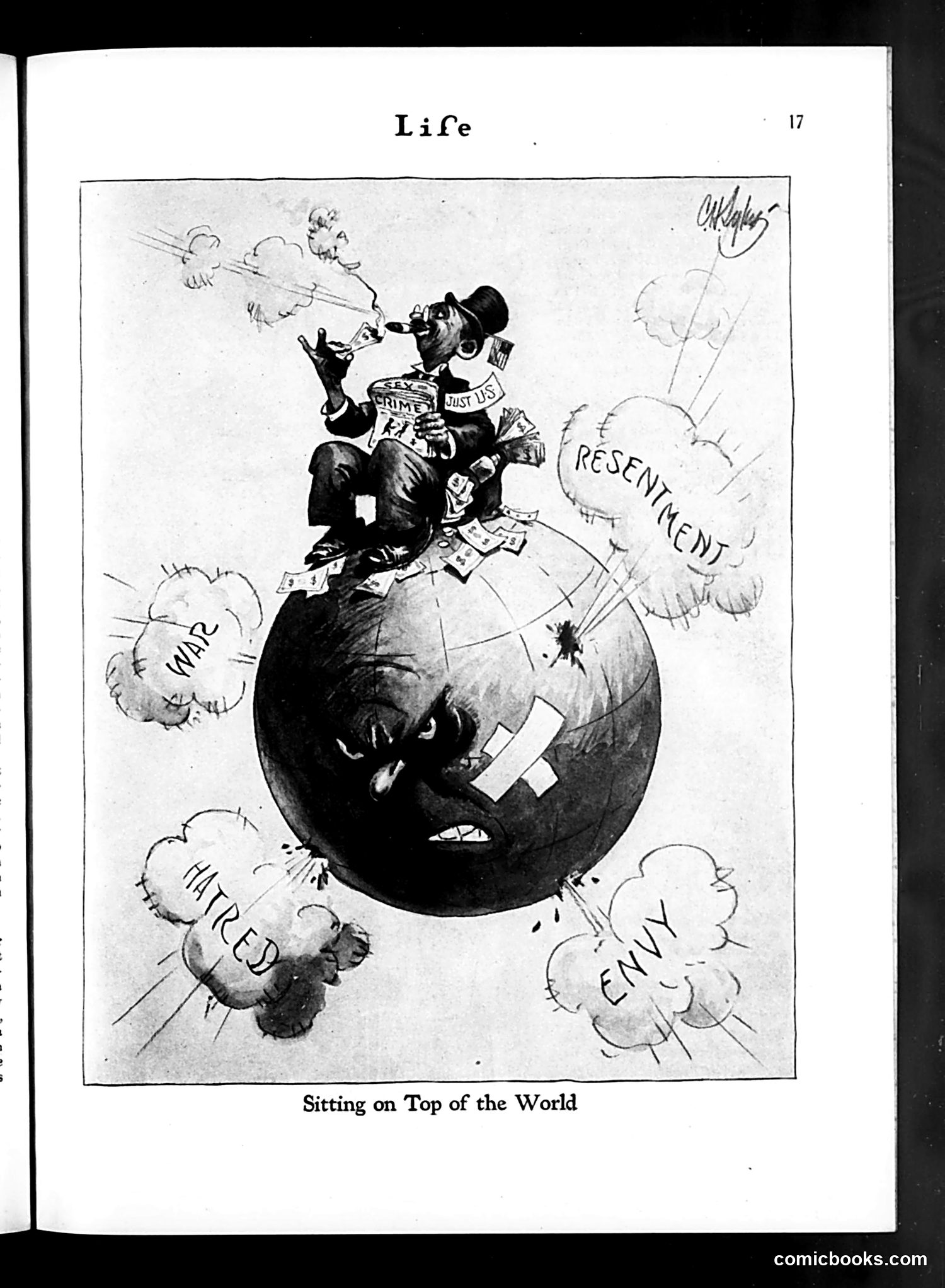
This political cartoon depicts a wealthy industrialist or financier (identifiable by top hat, monocle, and money-laden clothing) perched atop a globe. He juggles money while surrounded by exploding clouds labeled "War," "Hatred," "Resentment," and "Envy." The satire critiques how the wealthy profited from global conflict and social discord—likely referencing World War I and its aftermath. The figure's smug satisfaction while the world literally burns around him suggests that capitalists grew rich from warfare and human suffering while ordinary people faced devastation. The title "Sitting on Top of the World" is ironic: though he appears triumphant, he's actually balanced precariously on an unstable, damaged sphere. This warns that such inequality and exploitation cannot sustain itself indefinitely.
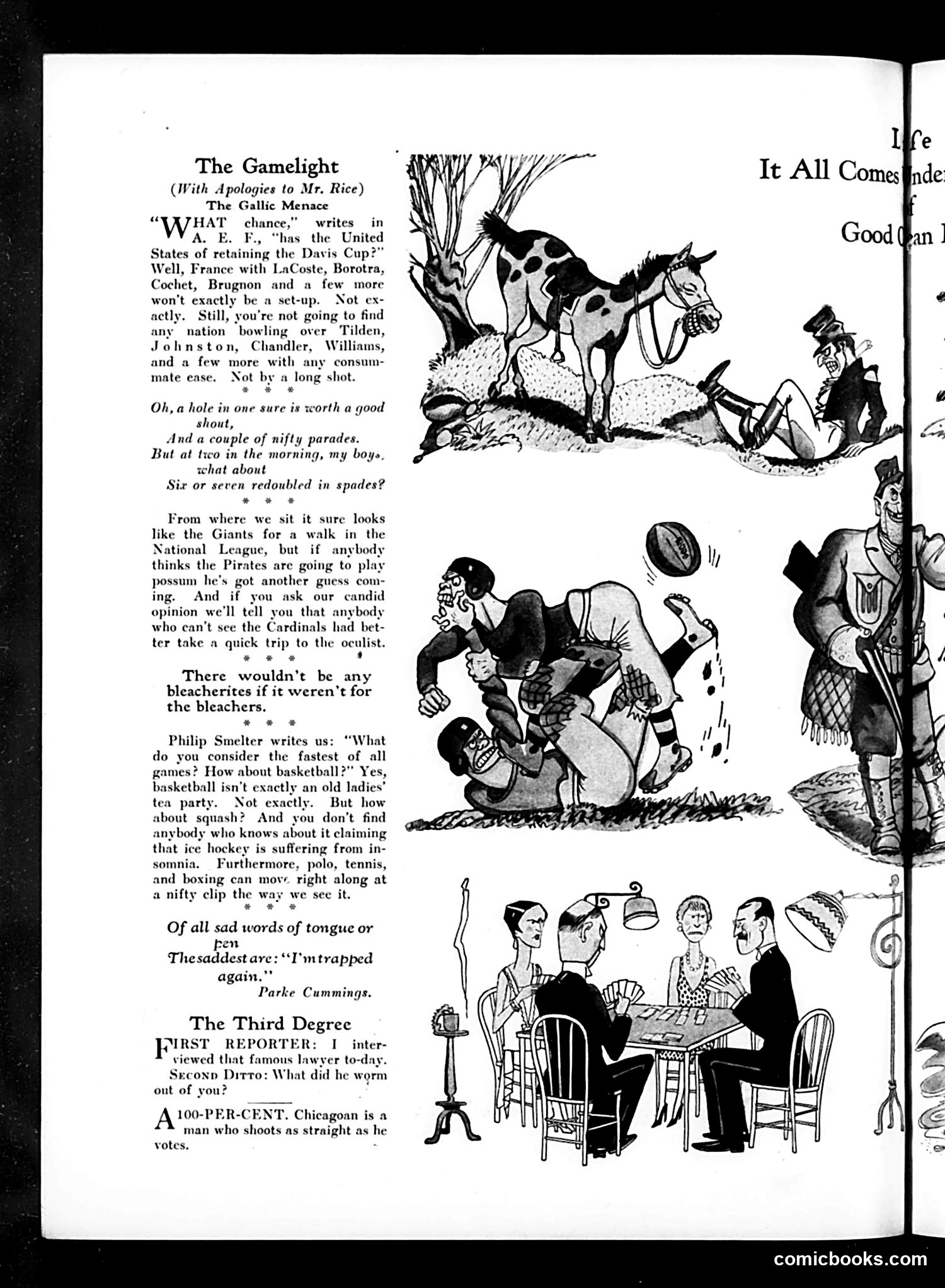
This page from *Life* magazine contains sports and humor commentary circa the 1920s-30s. **"The Gallic Menace"** satirizes American anxiety about French tennis dominance, specifically the Davis Cup competition. It references real players: LaCoste, Borotra, Cochet, and Brugnon (France's famous tennis team) versus American champions Tilden, Johnston, Chandler, and Williams. The joke mixes sports anxiety with bridge card-game references—suggesting Americans worry more about losing at cards than tennis. **The middle illustration** appears to show a baseball or sports collision scene with comedic exaggeration. **"The Third Degree"** is a lawyer joke: a reporter interviews a famous lawyer, asking what he "wormed out of you"—implying lawyers extract money from clients rather than information. **The final joke** mocks Chicago politics, suggesting a "100-per-cent Chicagoan" shoots straight with guns but not with votes—a cynical jab at political corruption. The overall tone reflects 1920s-30s American sports obsession and cynicism about politics and law.
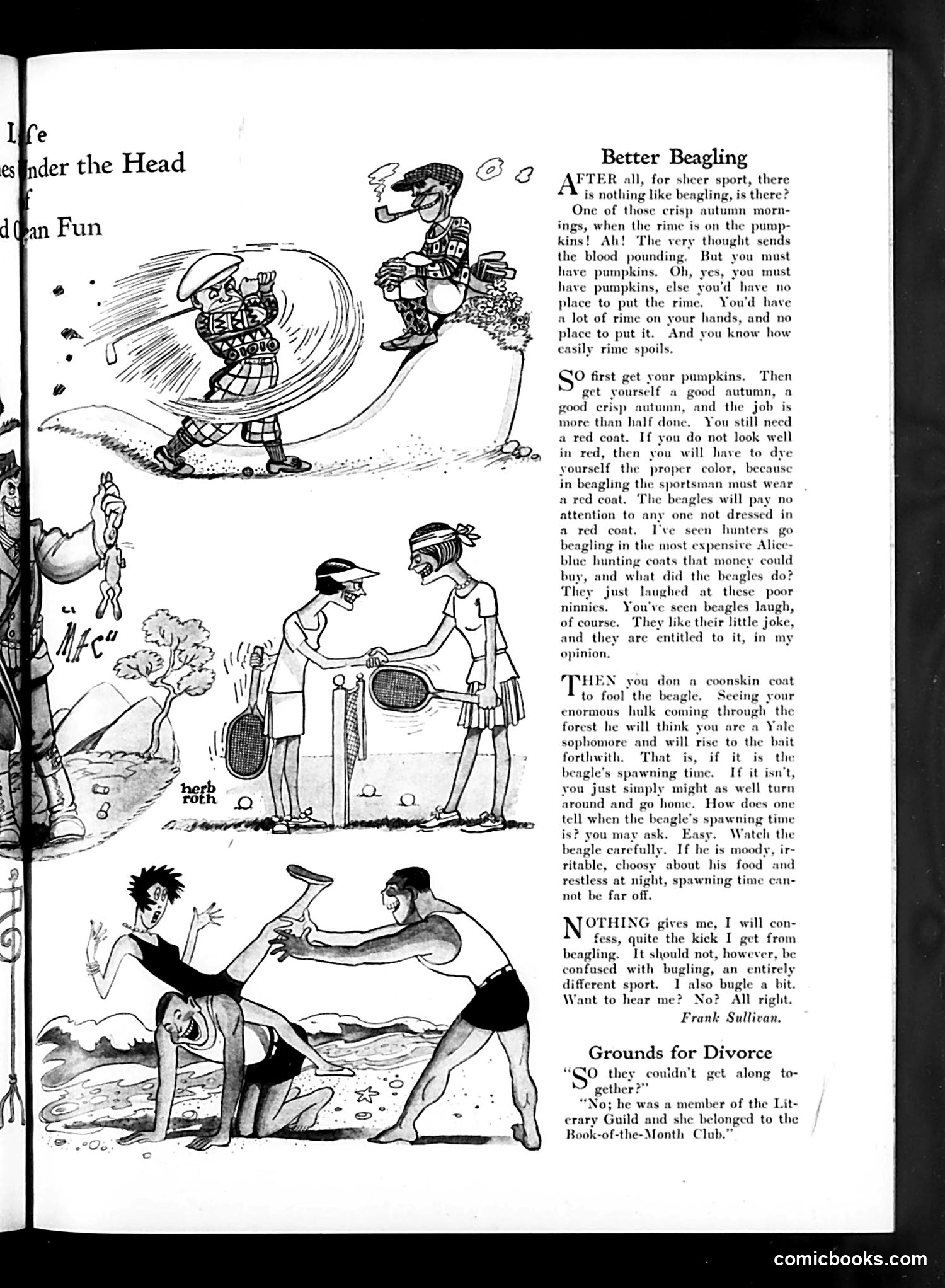
This is absurdist humor mocking both the sport of beagling (hunting with beagle dogs) and pretentious sporting culture. Sullivan's satire works through deliberate nonsense: he treats absurd requirements (pumpkins, rime, specific coat colors) as serious prerequisites, then adds increasingly ridiculous pseudo-logic about beagles' preferences and "spawning time." The joke targets upper-class hunters who take themselves too seriously while obsessing over proper attire and sporting codes. The brief "Grounds for Divorce" joke at bottom satirizes intellectual snobbery—two people cannot coexist because they belong to rival book clubs (the Literary Guild and Book-of-the-Month Club were actual competing subscription services). The implication: cultured people can be just as absurdly incompatible over trivial status markers as sport enthusiasts. Both pieces mock pretension masquerading as sophistication.
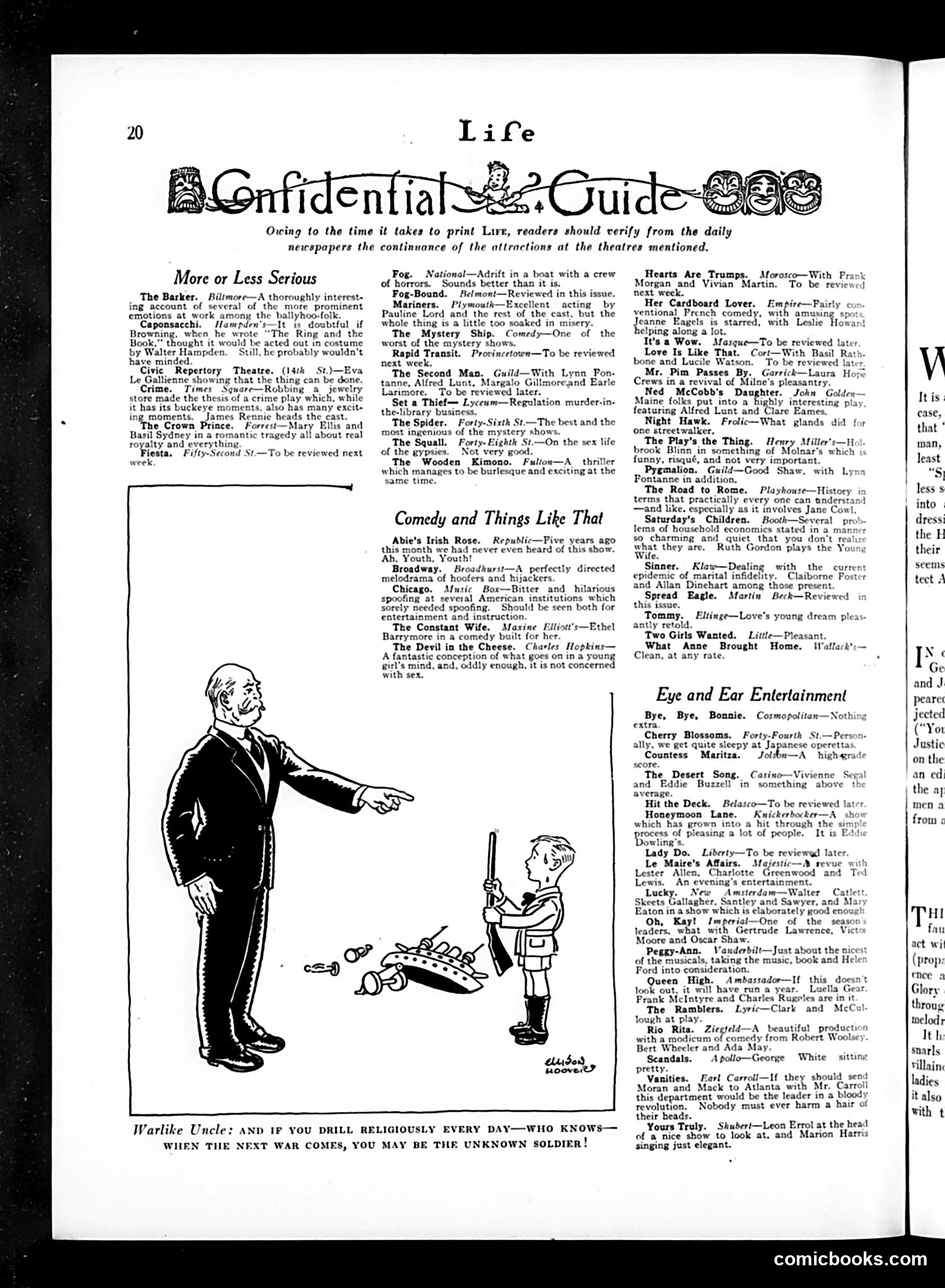
This is a theater review page from Life magazine featuring entertainment listings and criticism. The main illustration depicts an adult man in formal attire standing next to a small child playing with toy soldiers and military equipment on the ground. The caption below reads: "Warlike Uncle: AND IF YOU DRILL RELIGIOUSLY EVERY DAY—WHO KNOWS WHEN THE NEXT WAR COMES, YOU MAY BE THE UNKNOWN SOLDIER!" **The satire**: This is dark political commentary on American militarism and preparedness anxiety in the 1920s. The "Warlike Uncle" indoctrinates a child into military discipline under the guise of patriotic preparation, suggesting that American culture was grooming the next generation for inevitable warfare. The phrase "Unknown Soldier" references the recently honored WWI casualties, making the joke grimly prophetic—by encouraging childhood military play, the uncle acknowledges the child might become another anonymous casualty. The joke critiques both militaristic ideology and the normalization of war preparation in everyday American life.
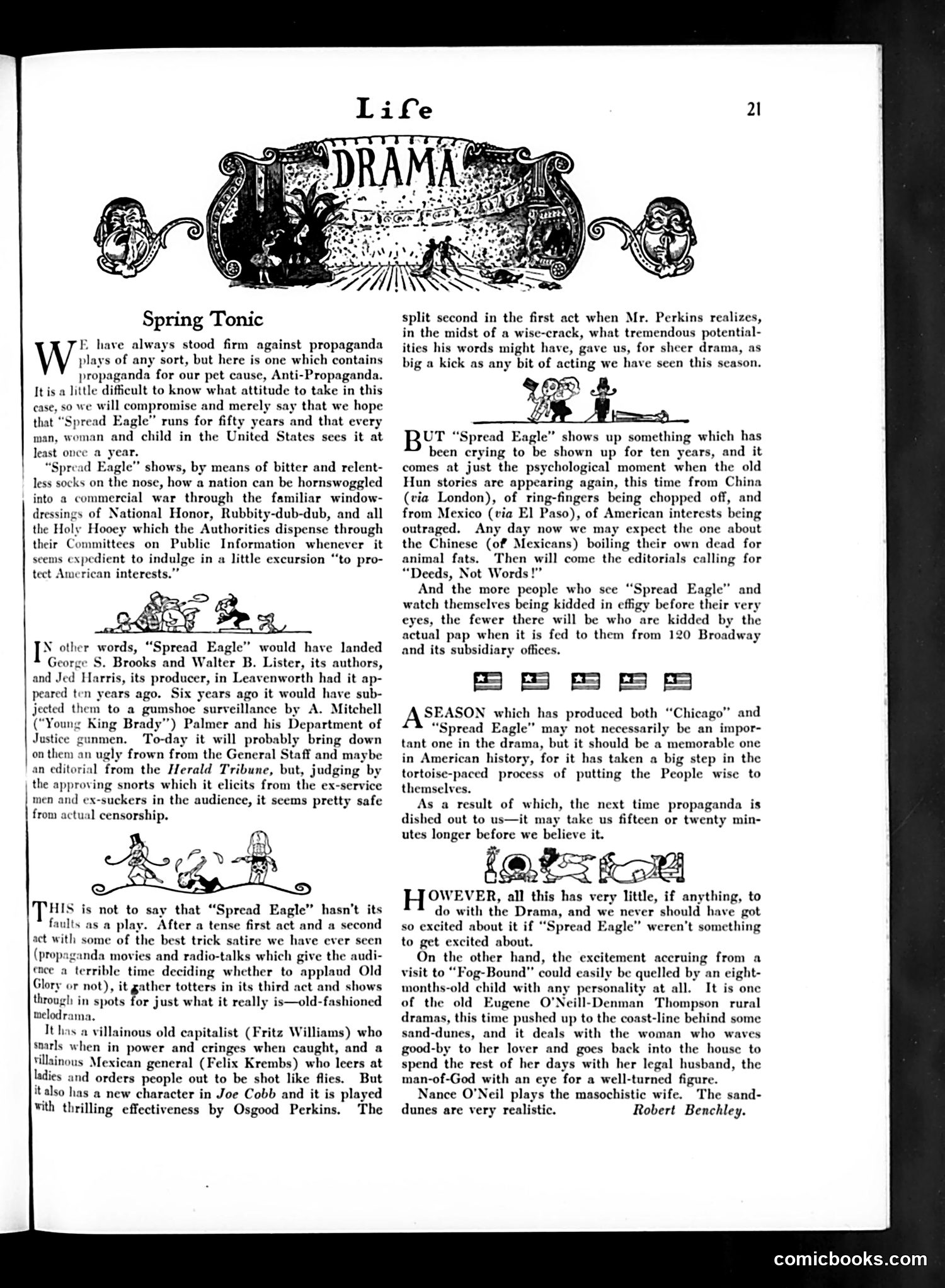
This is a theater review praising the play "Spread Eagle" as anti-propaganda satire. The play exposes how nations manipulate citizens into wars through appeals to "National Honor" and patriotic rhetoric—what the reviewer dismisses as "Holy Hooey." The review notes the play would have faced serious censorship a decade earlier under Attorney General A. Mitchell Palmer's anti-radical surveillance, but now (circa mid-1920s) merely draws disapproval from military brass and the *Herald Tribune*. The satire mocks how propaganda movies and radio convince audiences to support wars, using stock villains: a capitalist and a Mexican general—tropes designed to stir American aggression. The reviewer celebrates the play's timeliness, as warmonger narratives resurface about China and Mexico. The central point: if citizens see themselves mocked in this satire, fewer will believe actual propaganda distributed by government officials at "120 Broadway" (likely referring to military/government offices).
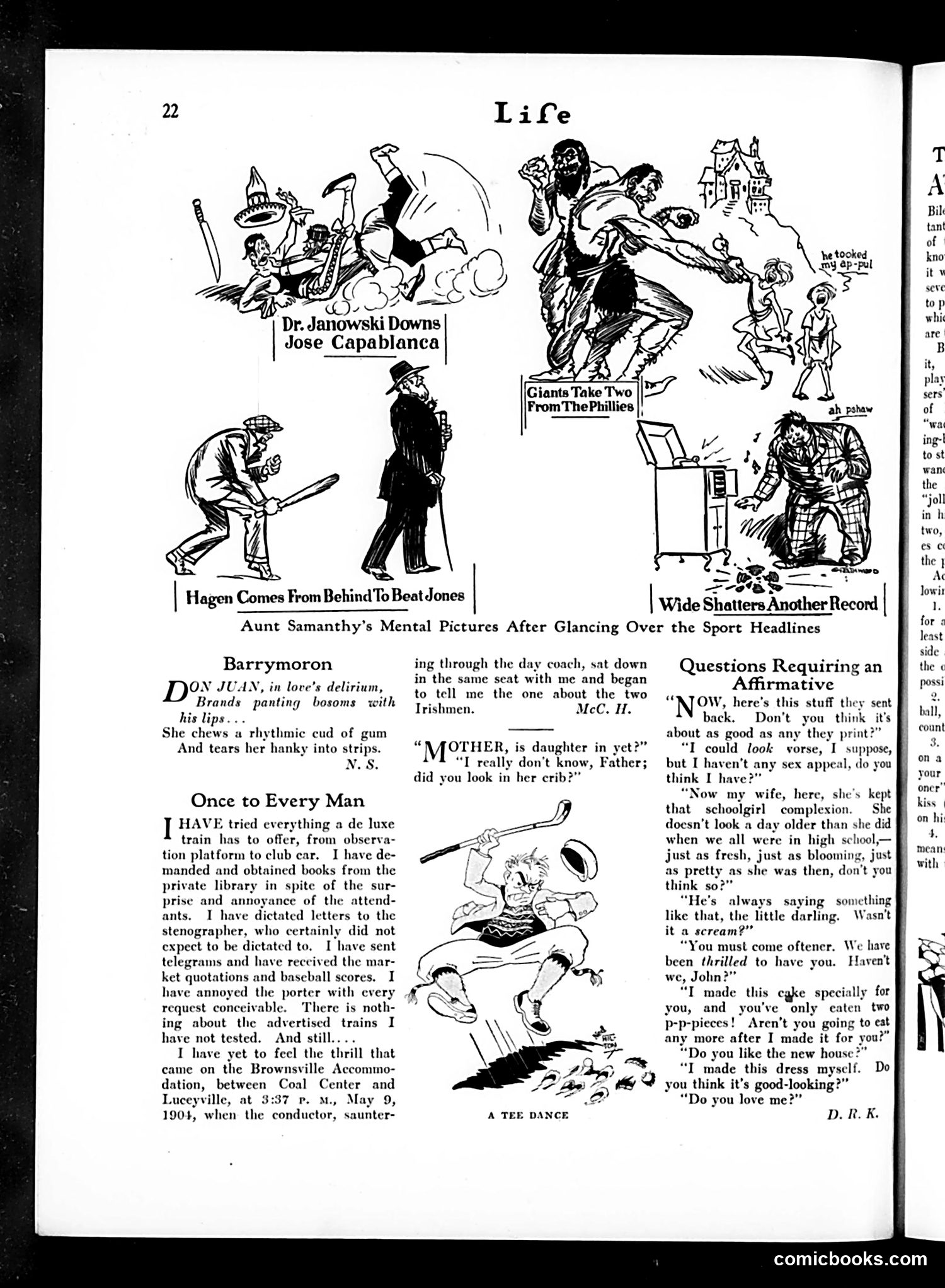
This page satirizes early 1900s sports and social culture through cartoons and humorous pieces. The top cartoons depict absurd, exaggerated reactions to sports news—Dr. Janowski downing Jose Capablanca (likely chess), giants beating the Phillies, Hagen beating Jones (golf), and Wide breaking records. The joke is that "Aunt Samanthy" imagines these events with melodramatic violence and chaos. Below, pieces mock contemporary life: "Barrymoron" parodies romantic theater (likely actor John Barrymore), "Once to Every Man" celebrates a mundane train conductor's joke as thrilling, and "Questions Requiring an Affirmative" satirizes modern wives' constant fishing for compliments—asking about appearance, the new house, homemade dress and cake, seeking constant reassurance ("Do you love me?"). The satire targets both celebrity culture and middle-class domestic anxiety, particularly women's perceived neediness for validation.
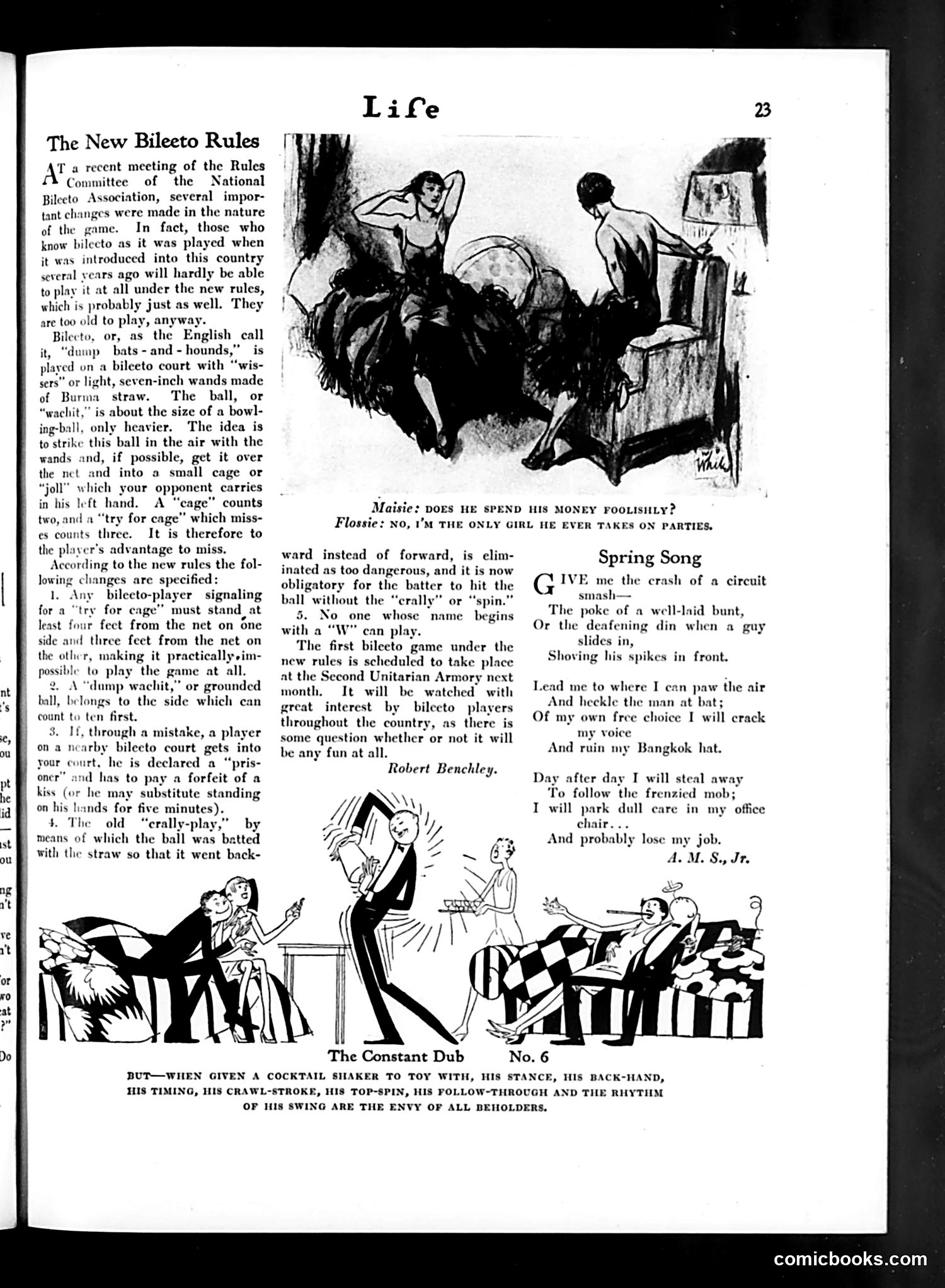
This *Life* magazine page contains satirical humor typical of early 20th-century American comedy. **"The New Bilecto Rules"** by Robert Benchley is absurdist satire mocking overly complicated sports rules. "Bilecto" appears to be a fictional or obscure sport (likely invented for humor), and Benchley ridicules how rule changes make games unplayable—a jab at how bureaucratic committees complicate leisure activities. The joke is that rule #1 makes the game "practically impossible to play at all." **The cartoon** above shows a domestic scene where a woman (Maisie) assures another (Flossie) that her boyfriend spends money wisely—because she's "the only girl he ever takes on parties." The humor relies on the implication that taking only one girl out is economical, though it's unclear if this is genuine praise or sarcastic. **"The Constant Dub"** cartoon illustrates a man who's clumsy at sports generally but becomes graceful when given a cocktail shaker to manipulate—satirizing how some people are naturally skilled at bartending despite lacking athletic ability. All reflect *Life's* focus on genteel, urbane humor for educated readers.
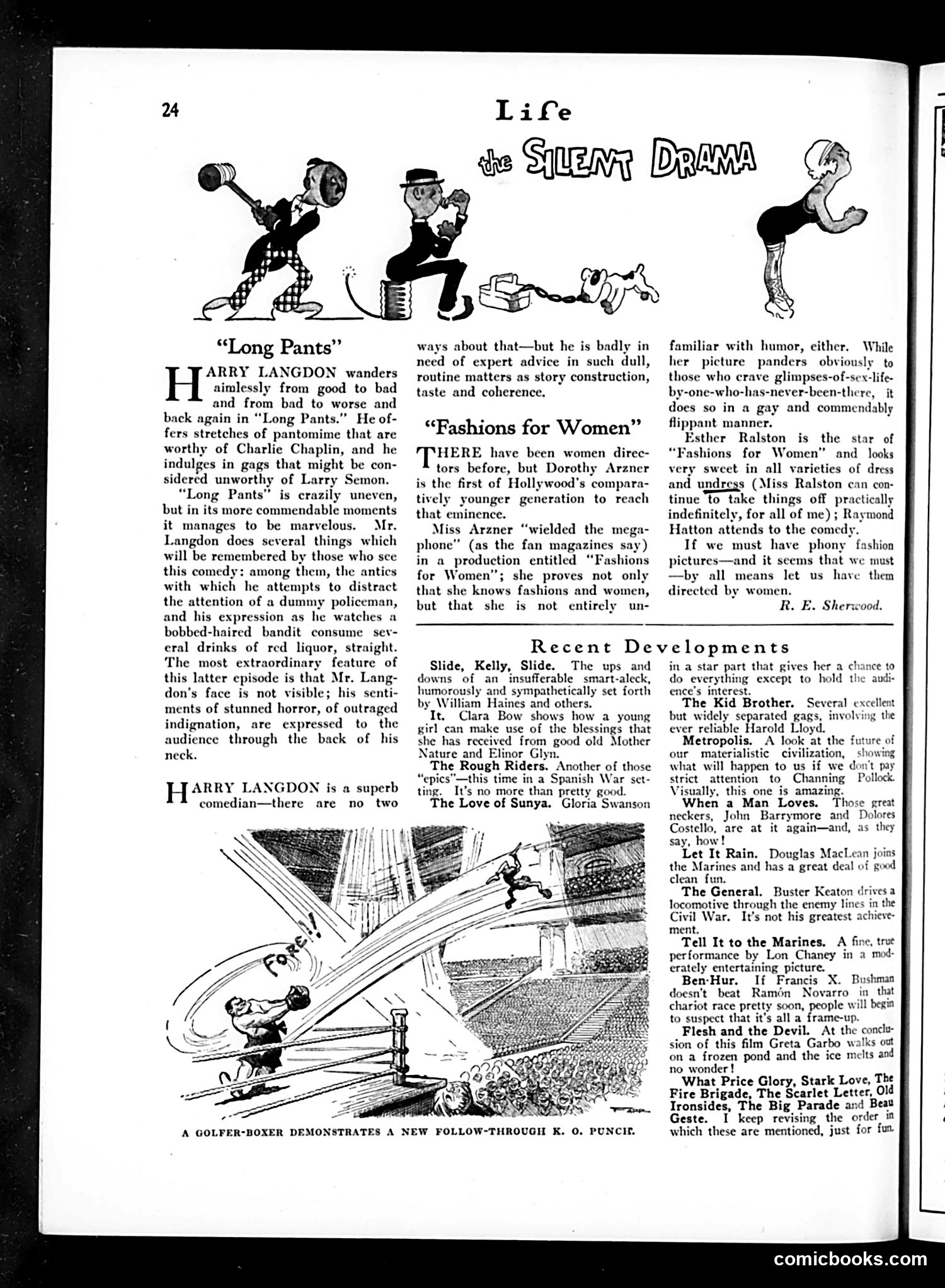
This page reviews silent films from Hollywood's mid-1920s golden age. **"Long Pants"** features Harry Langdon, a physical comedian compared favorably to Charlie Chaplin but criticized for uneven storytelling. The reviewer praises his pantomime skill, notably his ability to convey emotion through body language—famously, his "expression" shown only through the back of his neck as he watches in shock. **"Fashions for Women"** marks Dorothy Arzner as the first female director of Hollywood's younger generation. The review acknowledges the film panders to voyeuristic audiences interested in undressing scenes, but credits Arzner's "gay and commendably flippant" direction. Star Esther Ralston and co-star Raymond Hatton provide romantic comedy. **"Recent Developments"** briefly reviews other current releases, including films with Gloria Swanson, Harold Lloyd, and Buster Keaton—all major silent-era stars. The tone is casual, mixing praise and mild mockery of plot conventions. The cartoon below shows a golfer-boxer hybrid, illustrating physical comedy typical of silent films.
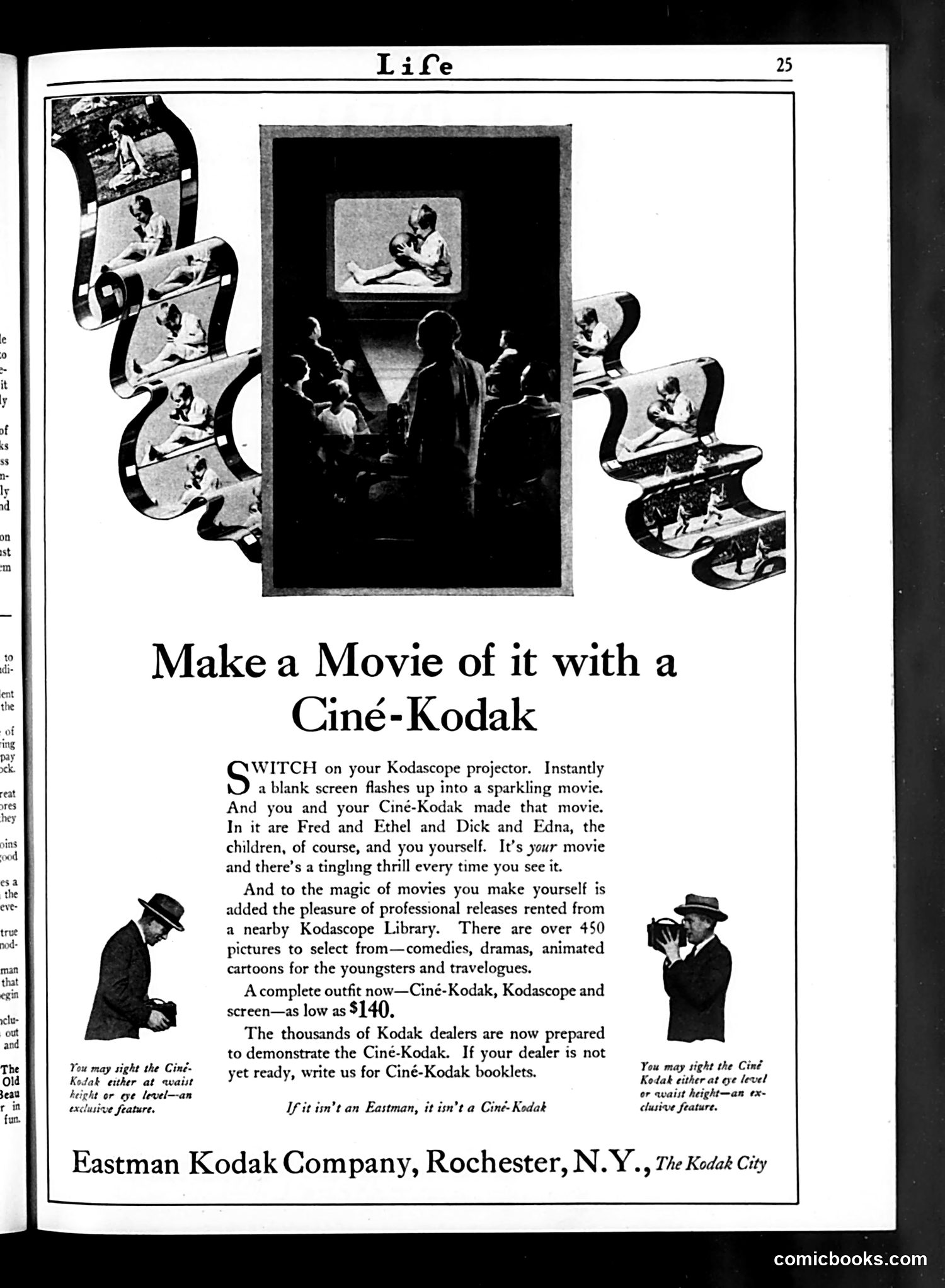
This is a **Kodak advertisement**, not political satire. It promotes the Ciné-Kodak, an early home movie camera system for consumers (circa 1920s-30s based on styling and price point of $140). The page shows a family scenario: people watching projected home movies of themselves and loved ones (Fred, Ethel, Dick, Edna) on a screen. The appeal is democratic—ordinary families could now create and project their own films, not just watch professional studio releases. The two illustrations of men with cameras demonstrate the camera's adjustable viewfinder (usable "at waist height or eye level"), marketed as an exclusive feature. **The "point"** is aspirational marketing: home movie-making transforms everyday family moments into entertainment. The ad emphasizes both amateur content ("your movie") and access to professional films via rental libraries, positioning Kodak as bringing Hollywood magic into the home. This reflects early consumer enthusiasm for amateur cinematography as a novelty and domestic entertainment medium.
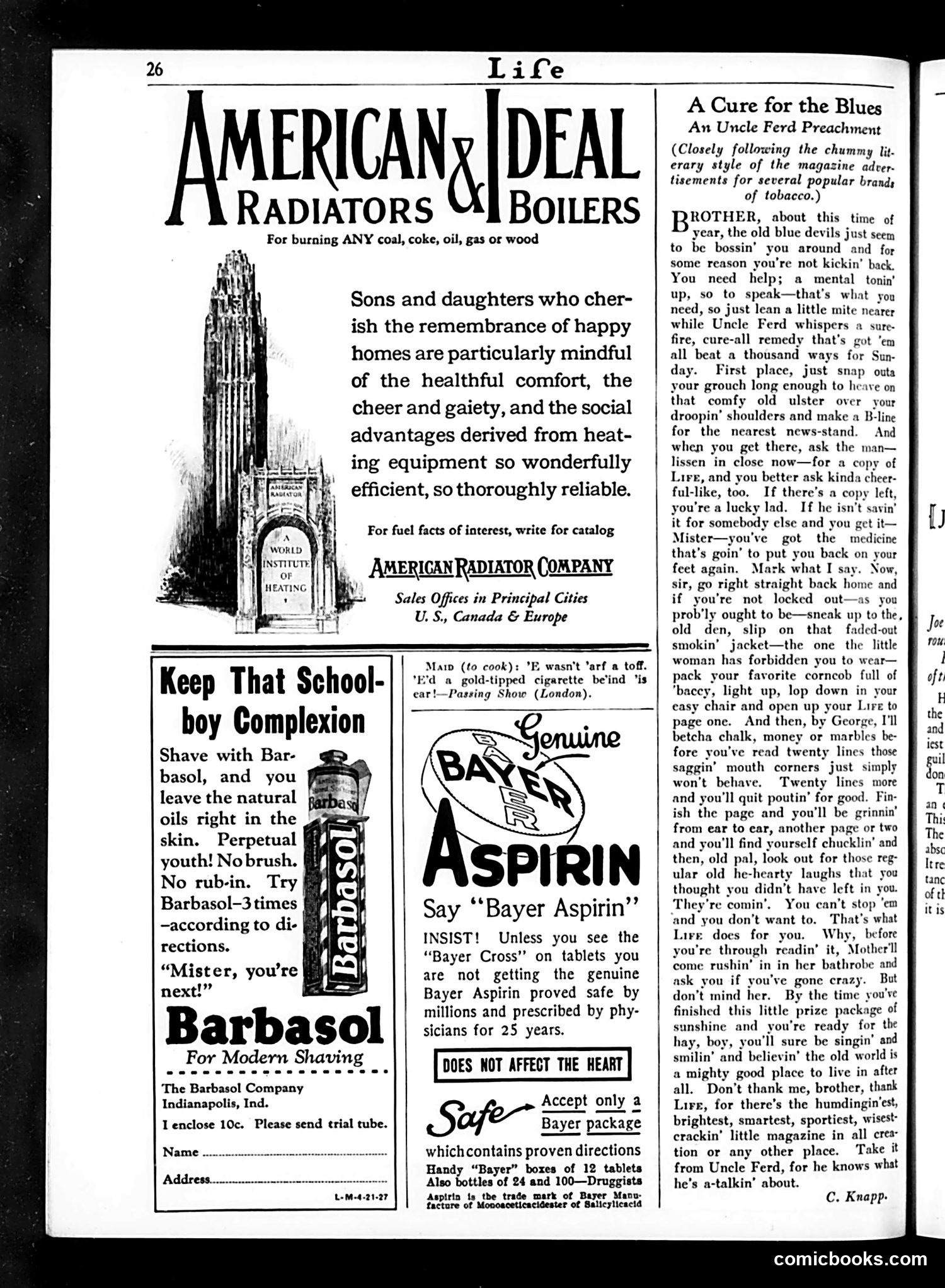
This page is primarily **advertisements** interspersed with satirical content typical of Life magazine's format. The main satirical piece is "A Cure for the Blues: An Uncle Ferd Preachment," which parodies tobacco advertising's folksy, pseudo-medicinal tone. "Uncle Ferd" humorously recommends *Life* magazine itself as a cure for depression—mimicking how contemporary ads claimed their products (cigarettes, patent medicines) could cure ailments. The joke is self-promotional satire: Life suggests reading Life will cure your blues through humor and escapism. The other advertisements (Barbasol shaving cream, Bayer Aspirin, American Radiator boilers) are presented straightforwardly without satire. The small London humor item about a "gold-tipped cigarette" is a mild social joke about class affectation. The entire page reflects early 20th-century advertising conventions: exaggerated health claims, intimate "talking to you" tone, and visual appeals to aspiration and comfort. Modern readers would recognize the absurdity of treating magazine-reading as medical treatment—exactly Life's satirical point.
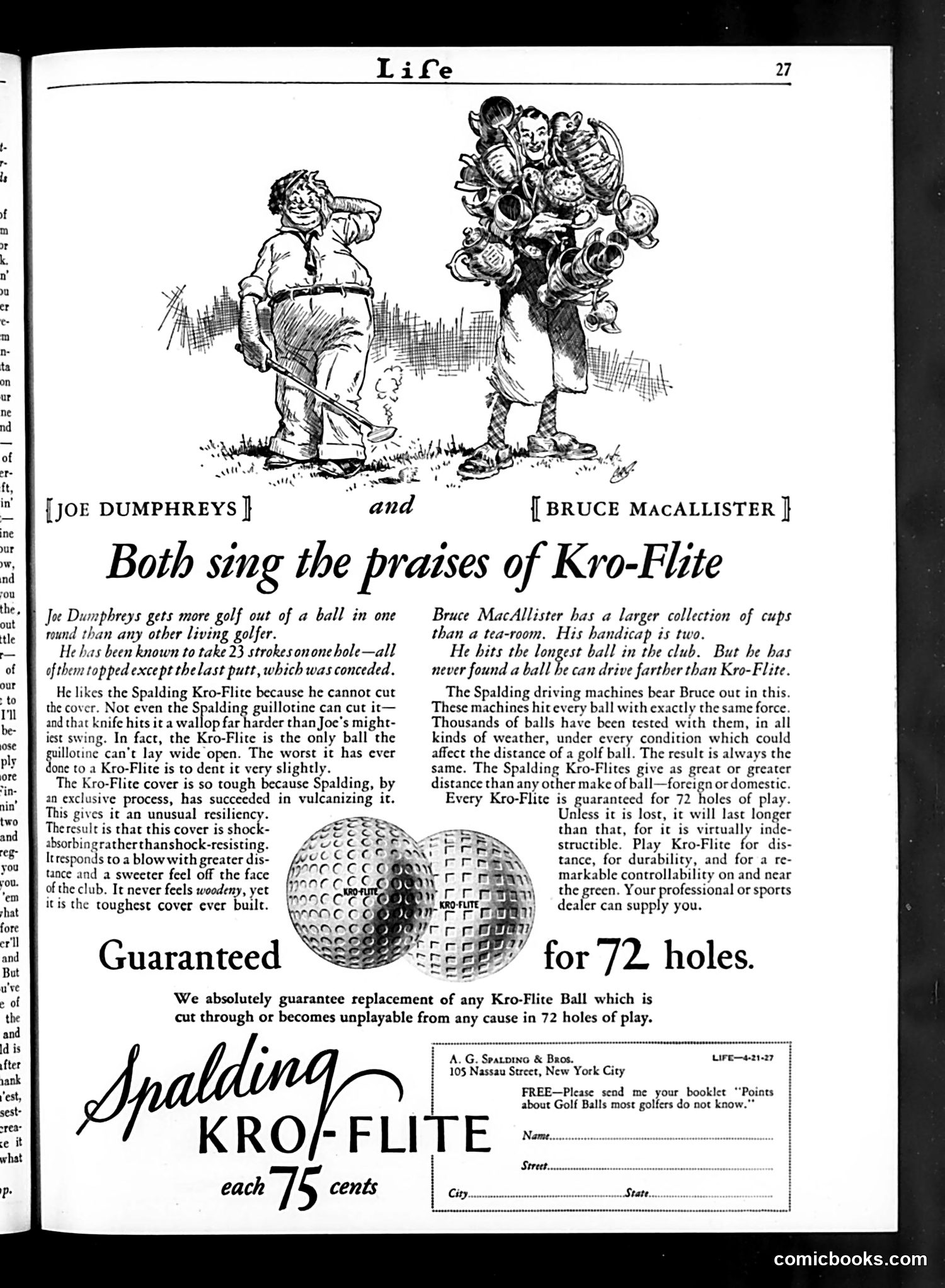
This is primarily a **golf ball advertisement** for Spalding's Kro-Flite brand, using humor and celebrity endorsement rather than straightforward sales pitch. **The "Satire":** The page features two fictional golfers—Joe Dumphreys (a terrible player who takes 23 strokes on one hole) and Bruce MacAllister (an excellent player)—humorously praising the same product. The joke is that Kro-Flite balls are so durable they withstand even the worst golfer's abuse and perform equally well for skilled players. **Key Selling Points:** - Vulcanized cover resistant to damage - Consistent distance performance (tested by machines) - 72-hole guarantee - Price: 75 cents each **Historical Context:** This appears to be 1920s-era advertising that uses gentle, self-deprecating humor about golf rather than direct claims. The cartoon style and celebrity endorsement format were standard advertising techniques of the period. The emphasis on durability reflects manufacturing innovation as a competitive advantage. The advertisement effectively argues the ball's value applies to golfers of all skill levels.
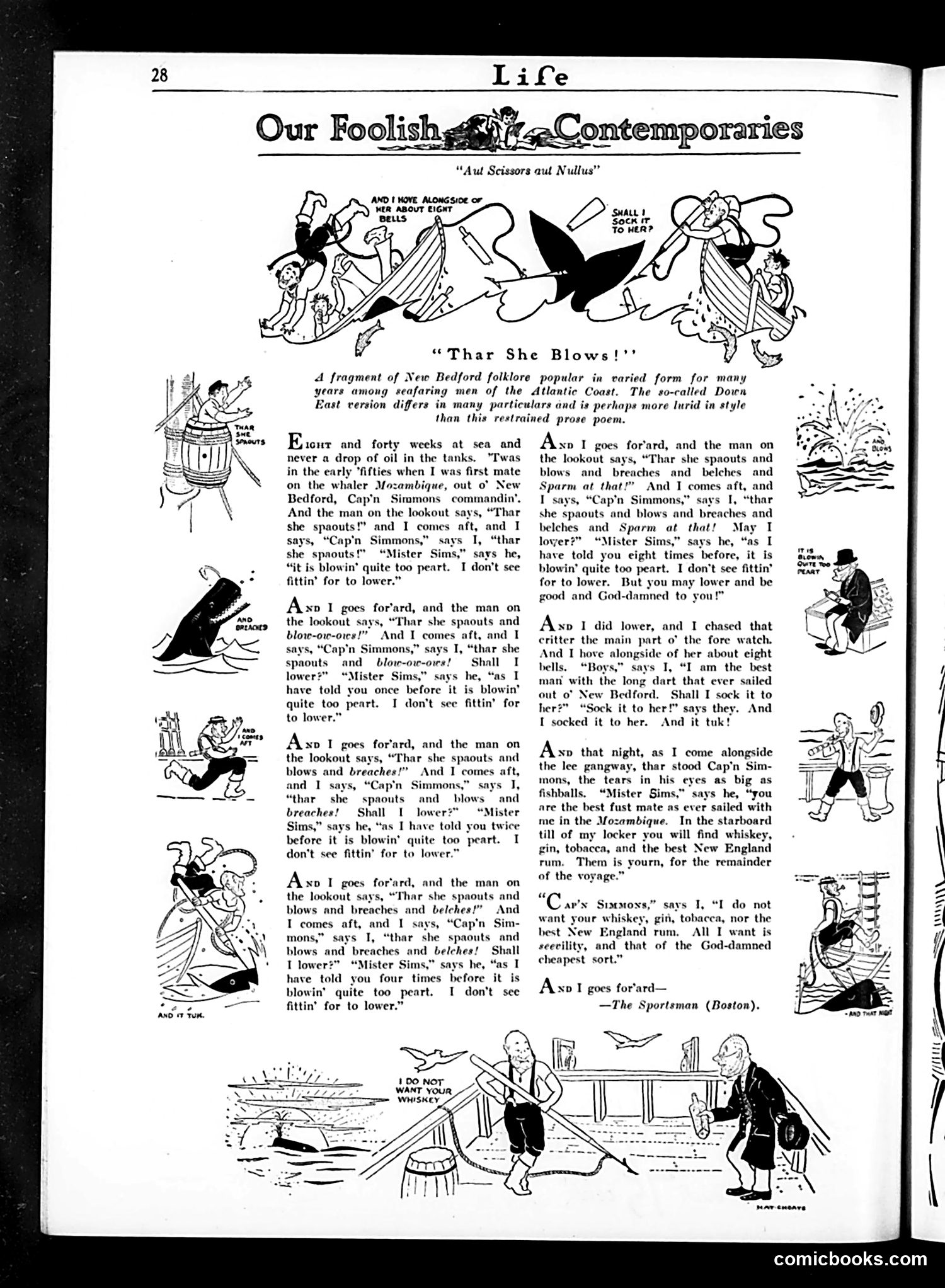
This page presents a humorous tall tale from New Bedford folklore about a whaling voyage. The narrative satirizes workplace hierarchy and stubbornness through repetitive dialogue between a first mate (Mister Sims) and Captain Simmons. The joke: Despite increasingly dramatic reports of whale activity ("spouts," "breaches," "belches," and finally "sperm"), Captain Simmons repeatedly refuses to lower the boats, claiming conditions are "too pearl" (too rough). Only after the eighth report does he relent—then Sims successfully harnesses the whale. The satire targets rigid authority figures who ignore mounting evidence and subordinates' expertise. The punchline's final exchange—where Sims rejects offered luxuries for mere "civility"—mocks how workers value respect over material compensation. The accompanying cartoons illustrate the whaling action with period-appropriate maritime humor. This reflects Life magazine's early focus on American folk humor and class-based social commentary.
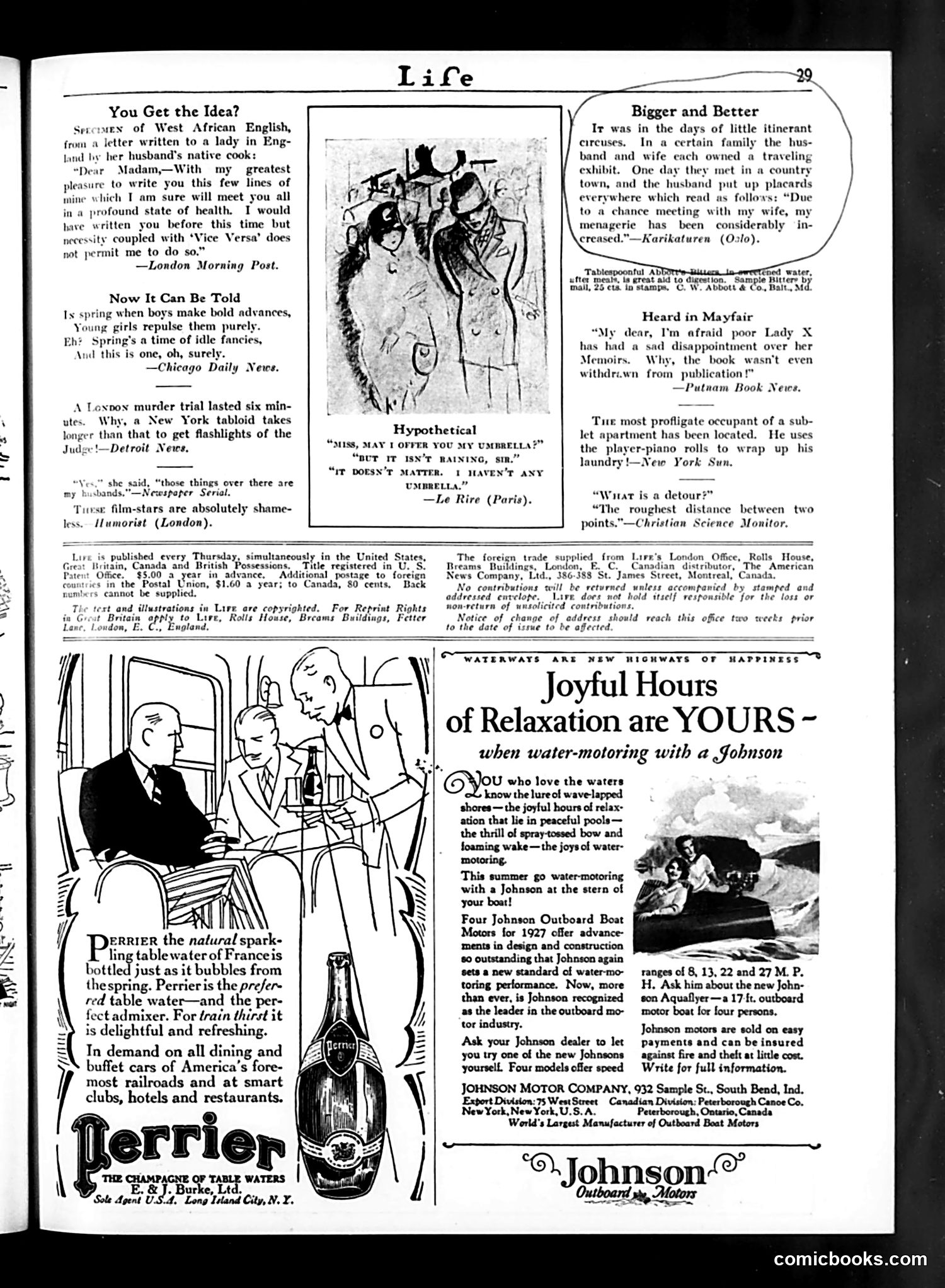
This page from *Life* magazine contains mostly **humorous short jokes and advertisements** rather than political cartoons. The joke sections mock various topics: a West African cook's formal English letter, spring romance clichés, a fast London murder trial, and matrimonial mishaps. One cartoon shows a man offering an umbrella to a woman—the joke being he admits he has no umbrella himself, playing on absurdist French humor. The larger illustrated cartoon depicts a well-dressed man and woman on what appears to be a train, accompanying an advertisement for **Perrier sparkling water**—presented as a sophisticated French beverage for refined dining. The page is dominated by **two full advertisements**: one for Perrier water emphasizing its prestige in American railcars and restaurants, and another for **Johnson outboard boat motors**, promoting summer leisure and relaxation. The content reflects 1920s consumer culture targeting middle and upper-class readers with appeals to sophistication, leisure, and modern conveniences—typical of *Life*'s advertising-heavy format during this era.
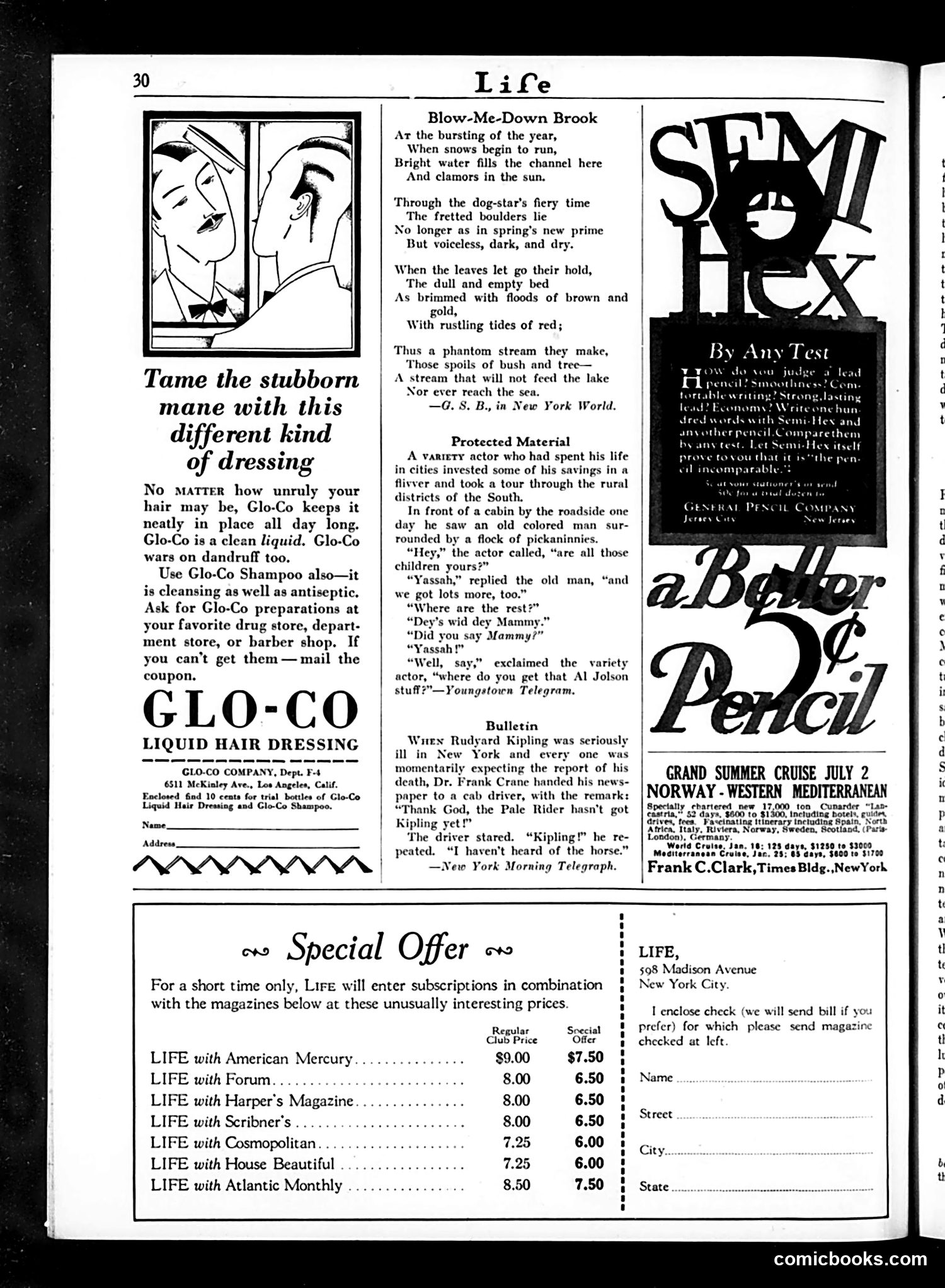
This page is primarily **advertising and subscription offers**, with minimal satirical content. The notable cartoon element is small—a simple line drawing at top left showing two faces in profile labeled "Tame the stubborn mane with this different kind of dressing," advertising Glo-Co hair product. The joke appears to be visual wordplay: the "stubborn mane" refers both to unruly hair and literally a horse's mane, though the cartoon depicts human faces. The page also includes three brief humorous anecdotes ("Protected Material" section): 1. A cab driver mishearing "Kipling" (the author Rudyard, then seriously ill) as a horse's name 2. A variety actor asking a rural Black man about his many children in exaggerated dialect These jokes reflect period attitudes and language standards now considered offensive. The bulk of the page comprises **subscription offers combining Life with other magazines** at discounted rates, plus cruise and pencil advertisements.
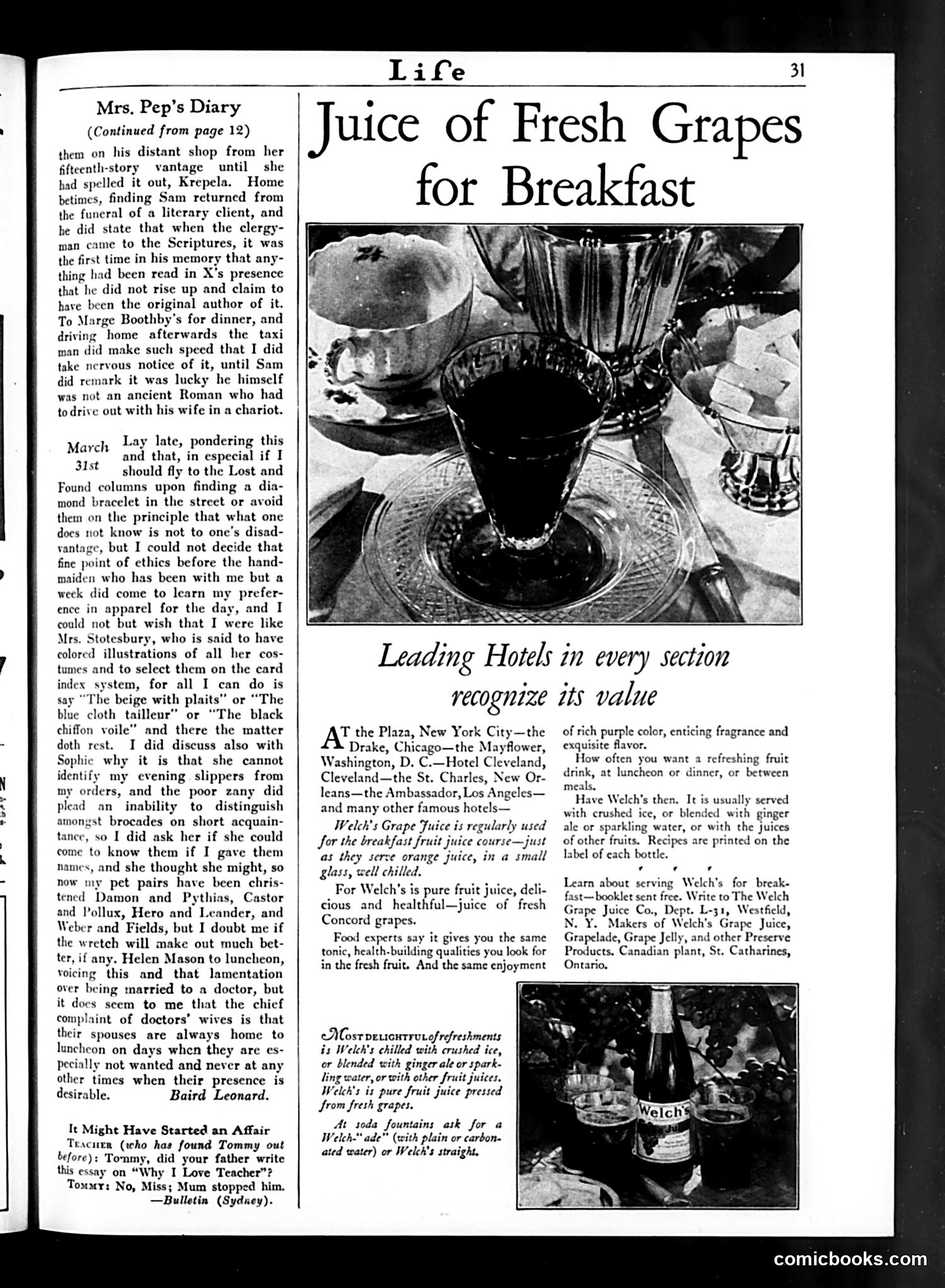
This page contains **no political cartoon or satire**. It's primarily a **Welch's Grape Juice advertisement** disguised as editorial content in Life magazine, a common early 20th-century advertising practice. The top section reprints "Mrs. Pep's Diary"—a gossipy society column about upper-class life (references to Mrs. Stotesbury, fancy hotels, servants). The small humor piece at bottom mocks a child almost writing a flirtatious school essay to his teacher. The main content is a **juice advertisement** posing as lifestyle advice. It features two photographs of grape juice and claims that leading luxury hotels (Plaza, Drake, Mayflower, etc.) serve Welch's at breakfast. The text emphasizes health benefits and refreshment value—typical early advertising language before modern regulations required clear distinction between ads and editorial. The humor in the diary section is gentle society satire about servants' confusion and wealthy women's preoccupations—unremarkable by modern standards.
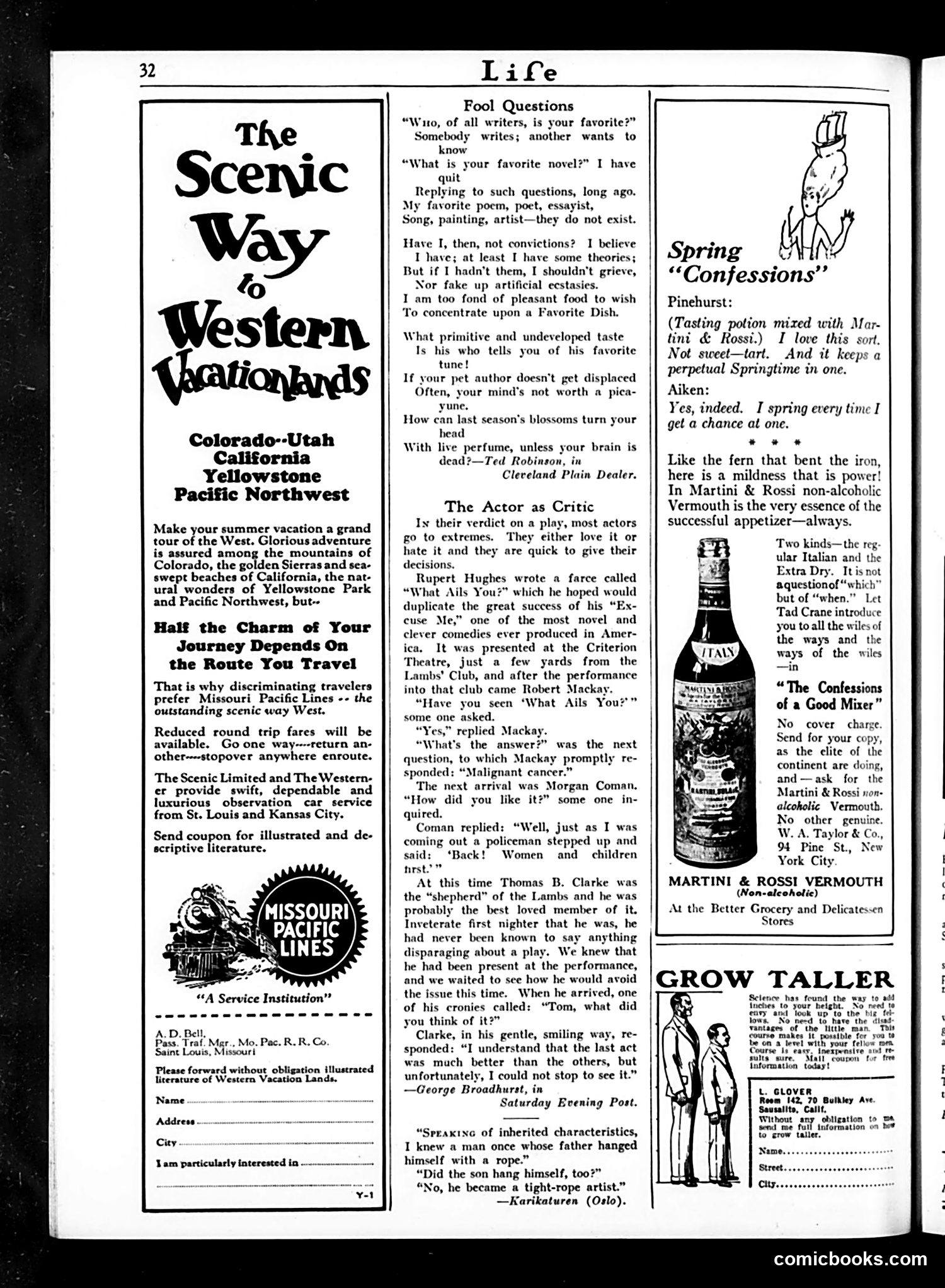
This page is primarily **advertising and light humor content**, not political satire. **Left side:** Missouri Pacific Lines railroad advertisement promoting Western vacation destinations (Colorado, Yellowstone, California). Standard travel marketing. **Center:** Two humor pieces: 1. **"Fool Questions"** — A poem by Ted Robinson mocking people who claim to have single "favorite" authors, poems, or foods. The satire targets pretentiousness and artificial taste-making. 2. **"The Actor as Critic"** — An anecdote by George Broadhurst about theater actors at NYC's Lambs Club giving extreme verdicts on a play called "What Ails You?" The humor relies on actors' exaggerated responses (one says "malignant cancer," another invokes a police warning to children). It satirizes theater people's tendency toward dramatic overstatement. **Right side:** Advertisements for Martini & Rossi vermouth and a "Grow Taller" product. The page contains no political cartoons or significant historical references requiring context.
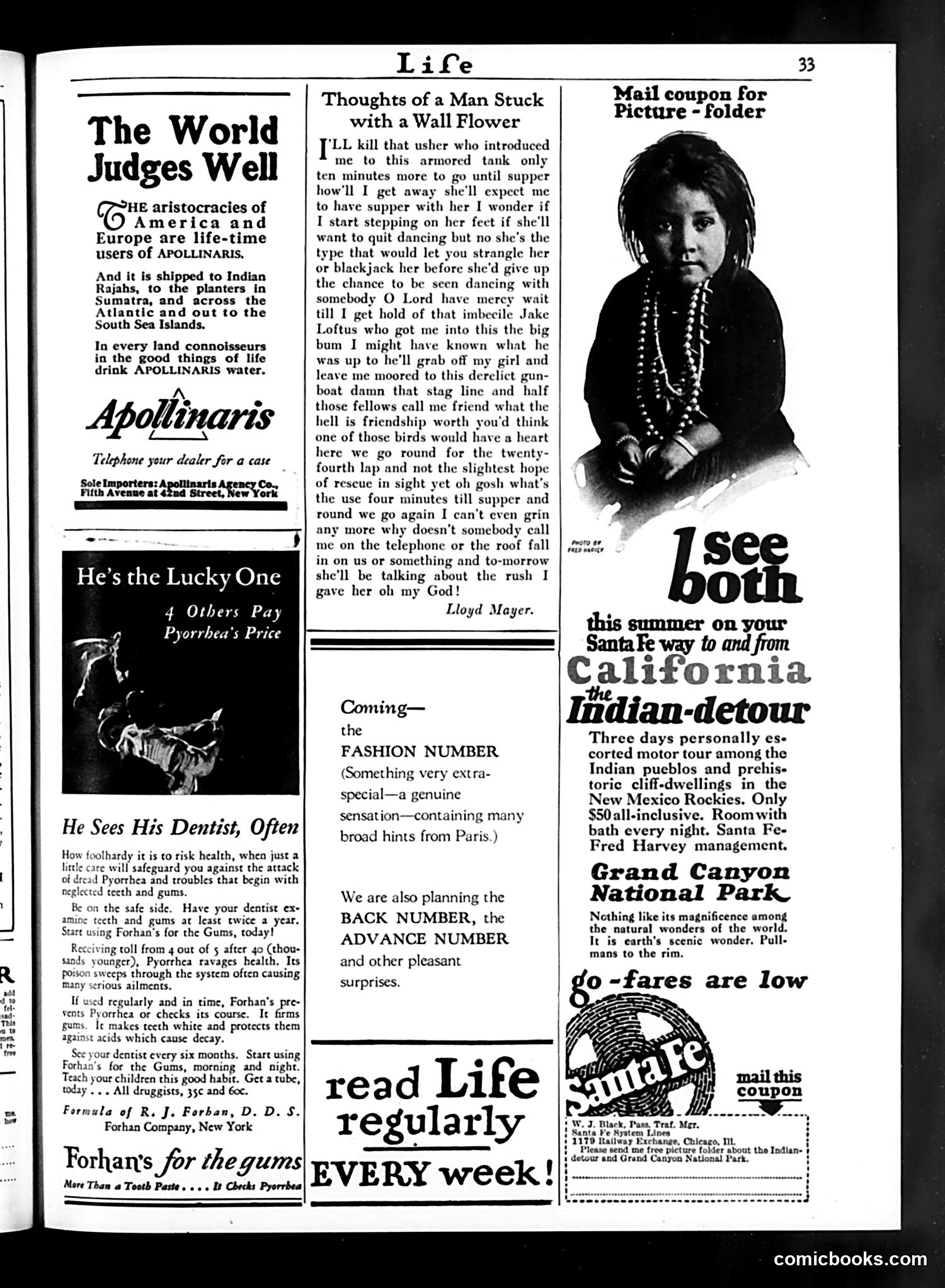
This page is primarily **advertisements and filler content**, typical of 1920s Life magazine format. The main satirical content is Lloyd Mayer's "Thoughts of a Man Stuck with a Wall Flower"—a stream-of-consciousness monologue from a reluctant dancer forced to partner with an unattractive woman. The humor derives from the era's dating etiquette: social obligation required politeness even when mismatched. His internal complaints about being "stuck," his resentment toward the friend who introduced them, and his desperate hope for rescue reflect period anxieties about enforced social courtship. The reference to a "stag line" (men waiting to cut in and dance) underscores that he's trapped—no one will rescue him by asking to dance with her. The surrounding ads (Apollinaris water, Forhan's toothpaste, Santa Fe tourism) occupy most space, indicating Life's revenue model depended heavily on advertising. The page demonstrates both the magazine's satirical voice and its commercial nature.
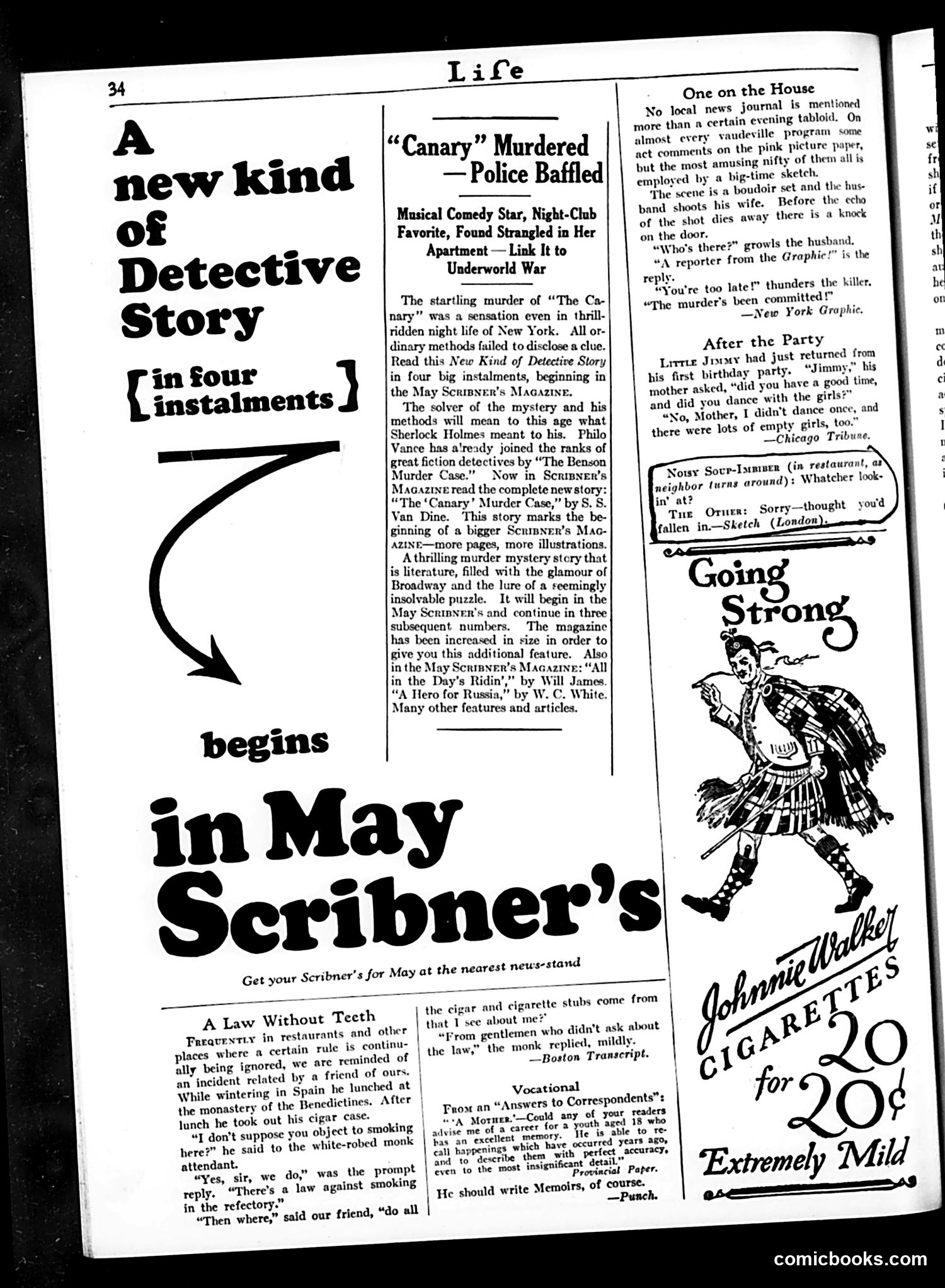
This page promotes a serialized detective story titled "The Canary Murder Case" debuting in Scribner's Magazine in May. The story features a "musical comedy star" found strangled in her apartment, with the murder linked to underworld crime—reflecting 1920s concerns about organized crime and vice in New York nightlife. The page positions this new detective fiction as modern literature's equivalent to Sherlock Holmes, noting that detective Philo Vance has already gained recognition through "The Benson Murder Case." The remaining content consists of humorous anecdotes and advertisements typical of Life's satirical approach: jokes about tabloid reporters, children's innocence, restaurant rudeness, and—most pointedly—a sketch mocking unenforced smoking laws in Spanish monasteries, suggesting legal regulations were routinely ignored. The Johnnie Walker cigarettes advertisement at right targets the era's smoking culture without health disclaimers.
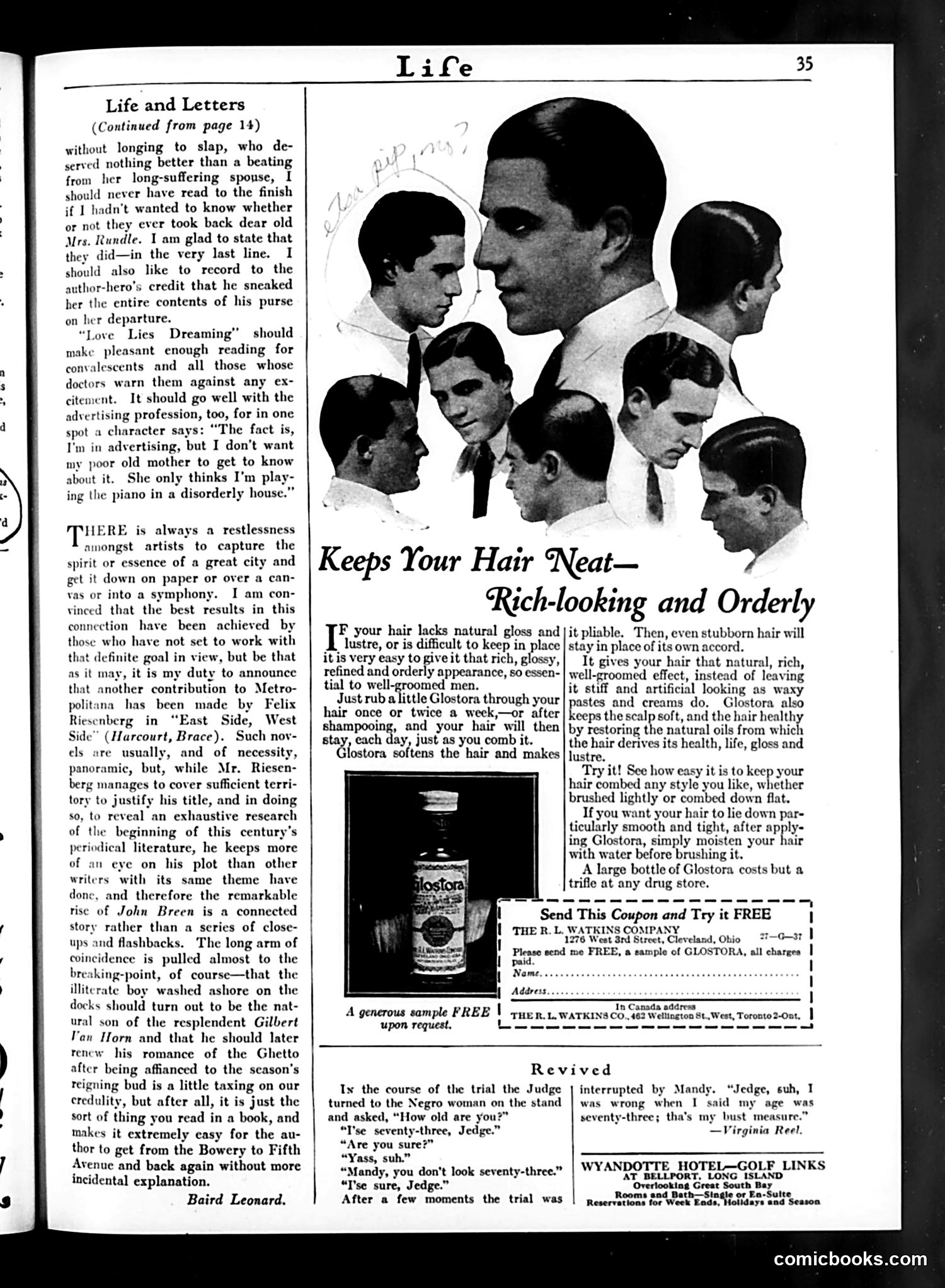
This page is primarily **literary review and advertising**, not political satire. The upper half contains book reviews by "Baird Leonard." The visible review discusses novels set in New York City, particularly praising Felix Riesenberg's "East Side, West Side" for balancing panoramic scope with coherent plotting. The lower half is a **Glostora hair product advertisement**—a men's hair grooming product. The six male headshots demonstrate the product's effects. The ad emphasizes that Glostora creates a "natural, rich, well-groomed effect" without the artificial shine of competing products (likely pomades or creams). It promises to soften hair, restore natural oils, and maintain styling. The humorous sidebar quote about an advertising man hiding his profession from his mother who thinks he "plays piano in a disorderly house" is editorial commentary—satirizing advertising as morally questionable work, a common 1920s-30s critique. There is **no political cartoon** on this page. It's a standard magazine layout mixing book criticism with commercial advertising.
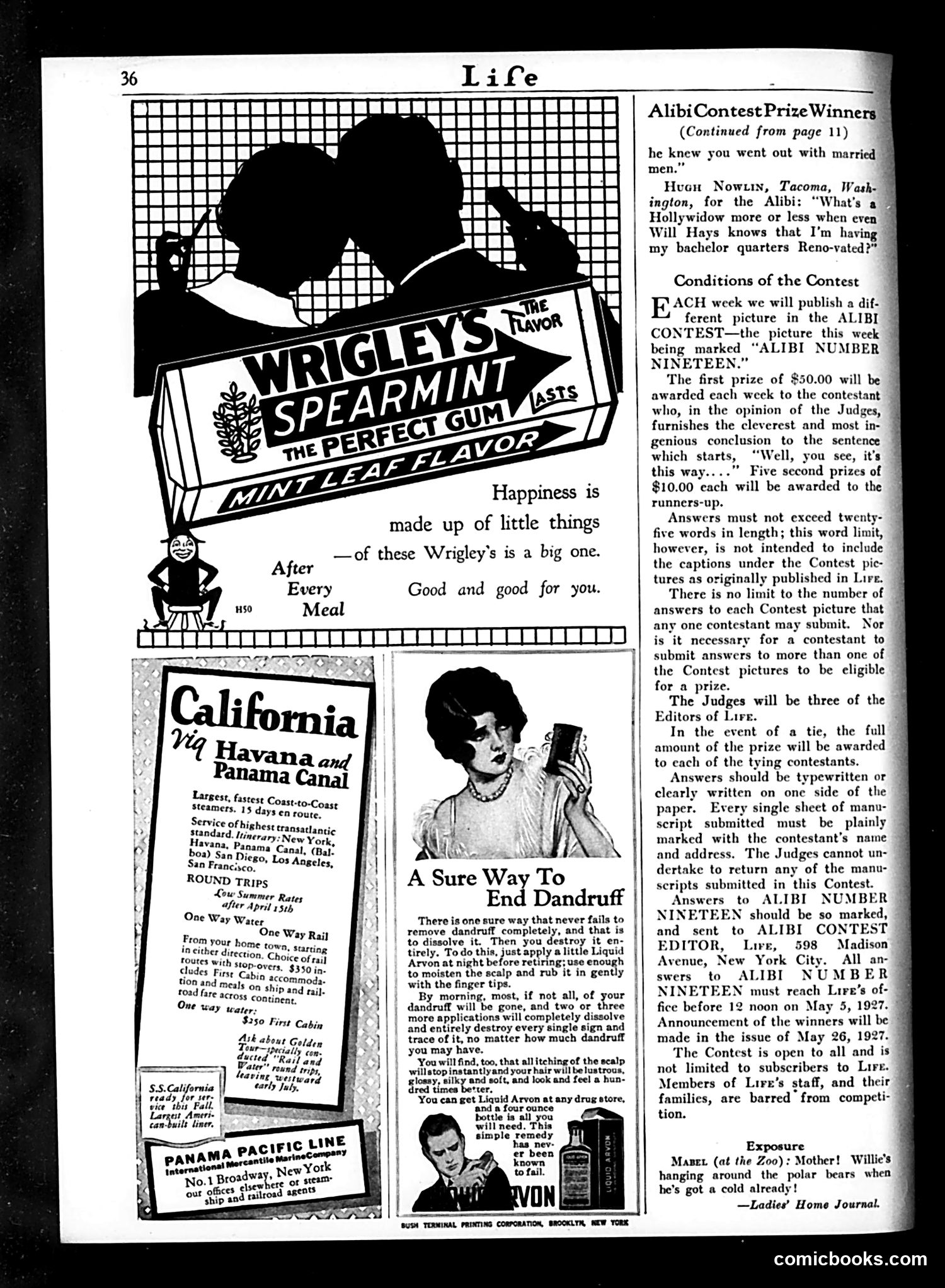
This 1927 *Life* magazine page contains ads and a humor contest section called "Alibi Contest." **Main Content:** The "Alibi" section publishes jokes submitted by readers. Two winning entries are featured, involving Hollywood and romantic scandals—standard humor of the era. One references Will Hays (head of Hollywood's self-censorship office) and "Reno-vated" (a pun on Nevada divorces, then common among celebrities). **Advertisements:** The page includes typical 1920s ads: Wrigley's chewing gum emphasizing "little things" make happiness, a "Sure Way to End Dandruff" product (Liquid Arvon), California steamship tours via Panama Pacific Line, and Hudson River steamboat service. **The Contest:** Readers submit clever one-liners to complete sentence fragments. Winners receive $50, runners-up $10 each. Answers must be submitted before May 5, 1927. The page reflects period concerns (dandruff remedies, ocean travel excitement) and contemporary jokes about Hollywood scandals and divorce.

I can see this is a very dark, low-contrast black and white image that appears to be from an old publication. While I can make out what seem to be circular stamp-like marks or seals on the right side of the page, and there's a white margin on the left suggesting this is a scanned document page, the image is too dark and unclear for me to reliably identify specific cartoon content, figures, or text beyond the "comicbooks.com" watermark at the bottom. To provide accurate historical analysis as requested, I would need a clearer, higher-contrast version of this page. I cannot confidently identify the cartoons, caricatures, or satirical references without being able to see them distinctly.