
Life, 1927-04-21 · page 9 of 39
Life — April 21, 1927 — page 9: what you’re looking at
What you’re looking at
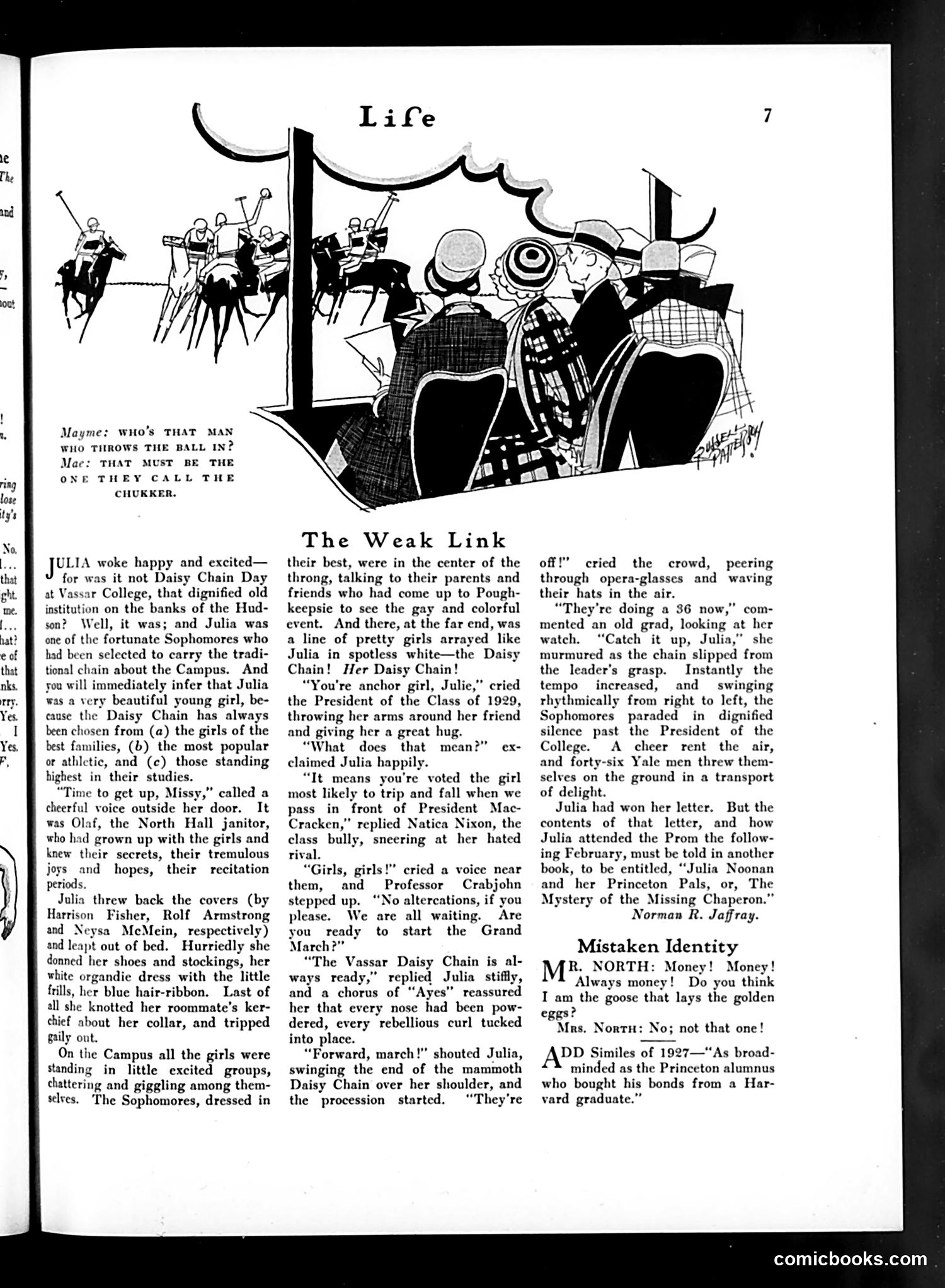
This page contains a short story titled "The Weak Link" about Julia, a Vassar College sophomore selected to carry the traditional Daisy Chain during a campus event. The illustration at top shows spectators at what appears to be a polo match or sporting event, with someone asking who threw the ball—the "chucker." The story itself describes Julia's excitement about participating in this college tradition, where selected girls form a chain carrying daisies during a procession. The narrative focuses on social hierarchy and peer dynamics among female students, with references to class elections and inter-girl rivalry. Below is a brief humor section titled "Mistaken Identity" featuring wordplay about money and eggs. The content reflects early 1920s college social life and female student traditions.
📄 Transcribed text from this page (OCR, searchable)
Machine-transcribed from the original scan — historical spelling and the odd misread are preserved.
Mayme: WHo’s THAT MAN WHO THROWS THE BALL IN? Mae: THAT MUST BE THE ONE THEY CALL THE CHUKKER. ULIA woke happy and excited— for was it not Daisy Chain Day at Vassar College, that dignified old institution on the banks of the Hud- son? Well, it was; and Julia was one of the fortunate Sophomores who had been selected to carry the tradi- tional chain about the Campus. And you will immediately infer that Julia was a very beautiful young girl, be- cause the Daisy Chain has always been chosen from (a) the girls of the best families, (b) the most popular or athletic, and (c) those standing highest in their studies. “Time to get up, Missy,” called a cheerful voice outside her door. It was Olaf, the North Hall janitor, who had grown up with the girls and knew their secrets, their tremulous joys and hopes, their recitation periods. Julia threw back the covers (by Harrison Fisher, Rolf Armstrong and Neysa MeMein, respectively) and leapt out of bed. Hurriedly she donned her shoes and stockings, her white organdie dress with the little frills, her blue hair-ribbon. Last of all she knotted her roommate's ker- chief about her collar, and tripped gaily out. On the Campus all the girls were standing in little excited groups, chattering and giggling among them- selves. The Sophomores, dressed in The Weak Link their best, were in the center of the throng, talking to their parents and friends who had come up to Pough- keepsie to see the gay and colorful event. And there, at the far end, was a line of pretty girls arrayed like Julia in spotless white—the Daisy Chain! Her Daisy Chain! “You're anchor girl, Julie,” cried the President of the Class of 1929, throwing her arms around her friend and giving her a great hug. “What does that mean?” ex- claimed Julia happily. “It means you're voted the girl most likely to trip and fall when we pass in front of President Mac- Cracken,” replied Natica Nixon, the class bully, sneering at her hated rival. “Girls, girls!” cried a voice near them, and Professor Crabjohn stepped up. “No altercations, if you please. We are all waiting. Are you ready to start the Grand March?” “The Vassar Daisy Chain is al- ways ready,” replied Julia stiffly, and a chorus of “Ayes” reassured her that every nose had been pow- dered, every rebellious curl tucked into place. “Forward, march!” shouted Julia, swinging the end of the mammoth Daisy Chain over her shoulder, and the procession started. “They're off!” cried the crowd, peering through opera-glasses and waving their hats in the air. “They're doing a 36 now,” com- mented an old grad, looking at her watch. “Catch it up, Julia,” she murmured as the chain slipped from the leader's grasp. Instantly the tempo increased, and swinging rhythmically from right to left, the Sophomores paraded in dignified silence past the President of the College. A cheer rent the air, and forty-six Yale men threw them- selves on the ground in a transport of delight. Julia had won her letter. But the contents of that letter, and how Julia attended the Prom the follow- ing February, must be told in another book, to be entitled, “Julia Noonan and her Princeton Pals, or, The Mystery of the Missing Chaperon.” Norman R. Jaffray. Mistaken Identity R. NORTH: Money! Always money! I am the goose that lays the golden eggs? Mrs. Nortu: No; not that one! Money! Do you think DD Similes of 1927—"As broad- minded as the Princeton alumnus who bought his bonds from a Har- vard graduate.” comicbooks.com