
Life, 1927-04-21 · page 26 of 39
Life — April 21, 1927 — page 26: what you’re looking at
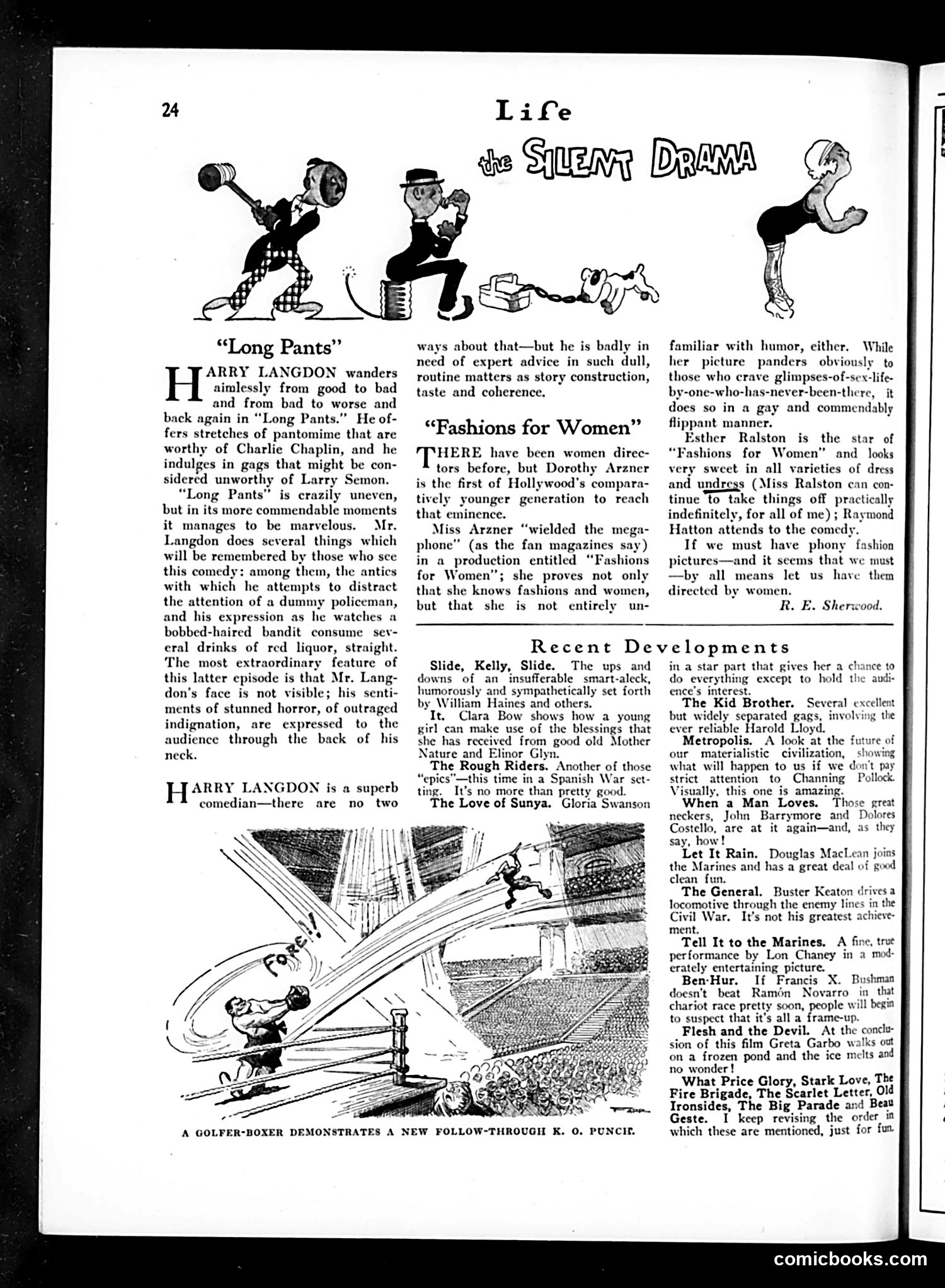
What you’re looking at
This page reviews silent films from Hollywood's mid-1920s golden age. **"Long Pants"** features Harry Langdon, a physical comedian compared favorably to Charlie Chaplin but criticized for uneven storytelling. The reviewer praises his pantomime skill, notably his ability to convey emotion through body language—famously, his "expression" shown only through the back of his neck as he watches in shock. **"Fashions for Women"** marks Dorothy Arzner as the first female director of Hollywood's younger generation. The review acknowledges the film panders to voyeuristic audiences interested in undressing scenes, but credits Arzner's "gay and commendably flippant" direction. Star Esther Ralston and co-star Raymond Hatton provide romantic comedy. **"Recent Developments"** briefly reviews other current releases, including films with Gloria Swanson, Harold Lloyd, and Buster Keaton—all major silent-era stars. The tone is casual, mixing praise and mild mockery of plot conventions. The cartoon below shows a golfer-boxer hybrid, illustrating physical comedy typical of silent films.
📄 Transcribed text from this page (OCR, searchable)
Machine-transcribed from the original scan — historical spelling and the odd misread are preserved.
“Long Pants” ARRY LANGDON wanders aimlessly from good to bad and from bad to worse and back again in “Long Pants.” He of- fers stretches of pantomime that are worthy of Charlie Chaplin, and he indulges in gags that might be con- sidered unworthy of Larry Semon. “Long Pants” is crazily uneven, but in its more commendable moments it manages to be marvelous. Mr. Langdon does several things which will be remembered by those who see this comedy: among them, the antics with which he attempts to distract the attention of a dummy policeman, and his expression as he watches a bobbed-haired bandit consume eral drinks of red liquor, straight. The most extraordinary feature of this latter episode is that Mr. Lang- don’s face is not visible; his senti- ments of stunned horror, of outraged indignation, are expressed to the audience through the back of his neck. Harkey LANGDON is a superb comedian—there are no two ways about that—but he is badly in need of expert advice in such dull, routine matters as story construction, taste and coherence. “Fashions for Women” HERE have been women direc- tors before, but Dorothy Arzner is the first of Hollywood's compara- ly younger generation to reach minence. Miss Arzner “wielded the mega- phone” (as the fan magazines say in a production entitled ‘Fashions for Women”; she proves not only that she knows fashions and women, but that she is not entirely un- Ny familiar with humor, either. While her picture panders obviously to those who crave glimpses-of-sex-life- by-one-who-has-never-been-there, it does so in a gay and commendably flippant manner. Esther Ralston is the star of “ashions for Women” and _ looks very sweet in all varieties of dress and undregs (Miss Ralston can con- tinue to take things off practically indefinitely, for all of me) ; Raymond Hatton attends to the come: If we must have phony fashion pictures—and it seems that we must yy all means let us have them directed by women. R. E. Sherwood. Recent Developments Slide, Kelly, Slide. The ups and downs of an insufferable smart-aleck, humorously and sympathetically set forth by William Haines and others. It. Clara Bow shows how a young girl can make use of the blessings that she has received from good old Mother Nature and Elinor Glyn. The Rough Riders. Another of those “epics"—this time in a Spanish War set- ting. It’s no more than pretty good. The Love of Sunya. Gloria Swanson - A GOLFER-BOXER DEMONSTRATES A NEW FOLLOW-THROUGH K. 0. PUNCIT. ce to audi- in a star part that gives her a do everything except to hold ence’s interest. The Kid Brother. Several excellent but widely separated gags, involving the ever reliable Harold Lloyd. Metropolis. A look at the our materialistic civilization, what will happen to us if we strict attention to Channing Visually, this one is amazing. When a Man Loves. Those great neckers, John Barrymore and Dolores Costello, are at it again—and, as they say, how! Let It Rain. Douglas Macl. the Marines and has a great deal ¢ clean fun. The General. Buster Keaton drives a locomotive through the enemy lines in the Civil War. It’s not his greatest achieve- ment. Tell It to the Marines. A fine, true performance by Lon Chaney in a mod- erately entertaining picture. Ben-Hur. If Francis X. Bushman doesn’t beat Ramén Novarro in that chariot race pretty soon, people will begin to suspect that it’s all a frame-up. Flesh and the Devil. At the conclu- sion of this film Greta Garbo walks out on a frozen pond and the ice melts and no wonder! What Price Glory, Stark Love, The Fire Brigade, The Scarlet Letter, Old Ironsides, The Big Parade and Beat Geste. I keep revising the order in which these are mentioned, just for fun. n joins good comicbooks.com