
Life, 1927-04-21 · page 23 of 39
Life — April 21, 1927 — page 23: what you’re looking at
What you’re looking at
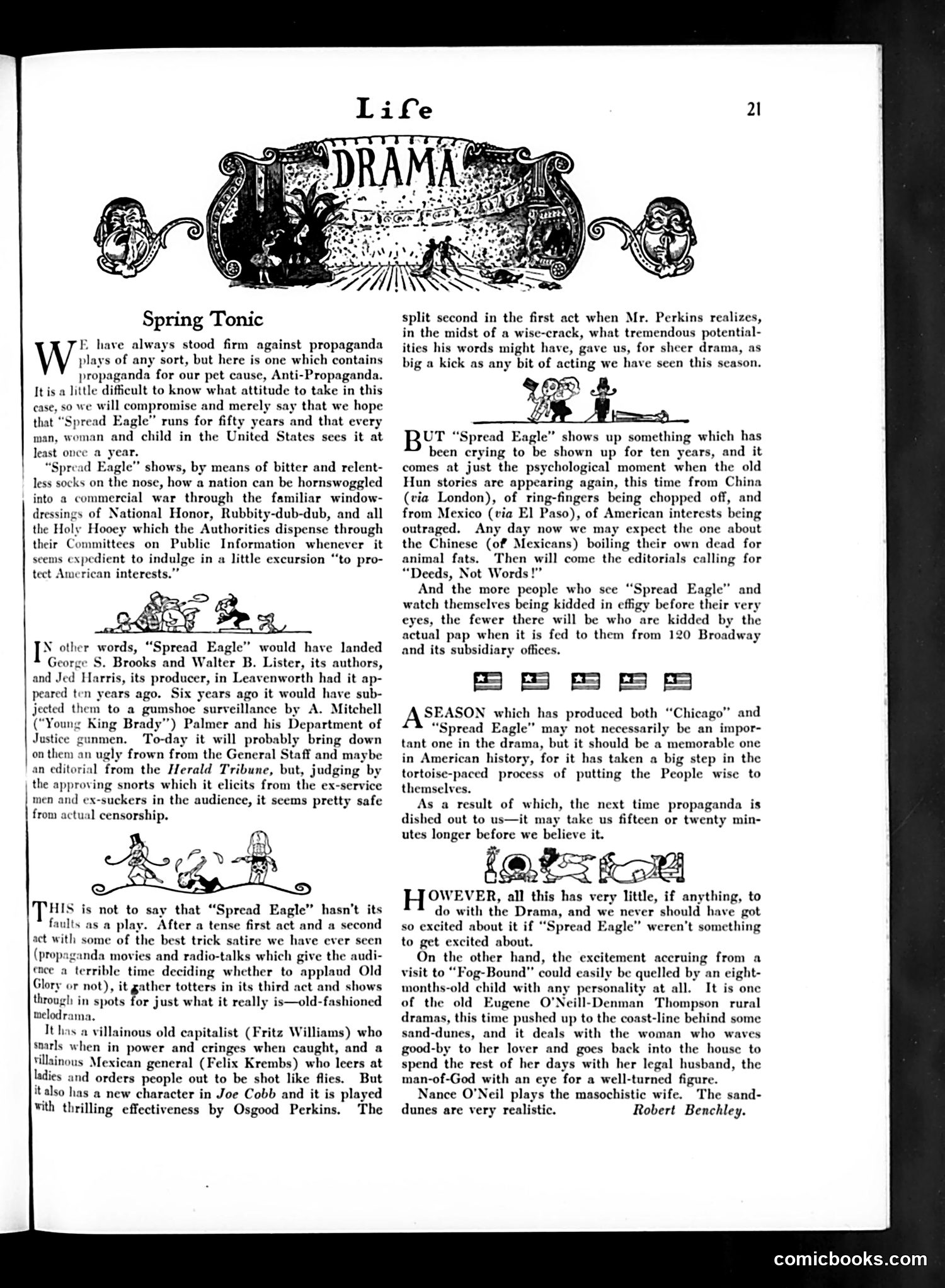
This is a theater review praising the play "Spread Eagle" as anti-propaganda satire. The play exposes how nations manipulate citizens into wars through appeals to "National Honor" and patriotic rhetoric—what the reviewer dismisses as "Holy Hooey." The review notes the play would have faced serious censorship a decade earlier under Attorney General A. Mitchell Palmer's anti-radical surveillance, but now (circa mid-1920s) merely draws disapproval from military brass and the *Herald Tribune*. The satire mocks how propaganda movies and radio convince audiences to support wars, using stock villains: a capitalist and a Mexican general—tropes designed to stir American aggression. The reviewer celebrates the play's timeliness, as warmonger narratives resurface about China and Mexico. The central point: if citizens see themselves mocked in this satire, fewer will believe actual propaganda distributed by government officials at "120 Broadway" (likely referring to military/government offices).
📄 Transcribed text from this page (OCR, searchable)
Machine-transcribed from the original scan — historical spelling and the odd misread are preserved.
Spring Tonic F. have always stood firm against propaganda Wits: of any sort, but here is one which contains propaganda for our pet cause, Anti-Propaganda. It is a little difficult to know what attitude to take in this case, so we will compromise and merely say that we hope that read Eagle” runs for fifty years and that every man, woman and child in the United States sees it at least once a year. “Spread Eagle” shows, by means of bitter and relent- less socks on the nose, how a nation can be hornswoggled into a commercial war through the familiar window- dressings of National Honor, Rubbity-dub-dub, and all the Holy Hooey which the Authorities dispense through their Committees on Public Information whenever it seems expedient to indulge in a little excursion “to pro- tect American interests.” LEG Bo L other words, “Spread Eagle” would have landed € S. Brooks and Walter B. Lister, its authors, and Jed Harris, its producer, in Leavenworth had it ap- peared ten years ago. Six years ago it would have sub- jected them to a gumshoe surveillance by A. Mitchell x King Brady”) Palmer and his Department of gunmen. To-day it will probably bring down on them an ugly frown from the General Staff and maybe an editorial from the Herald Tribune, but, judging by | the approving snorts which it elicits from the ex-service men and ex-suckers in the audience, it seems pretty safe from actual censorship. HIS is not to say that “Spread Eagle” hasn't its faulty as a play. After a tense first act and a second act with some of the best trick satire we have ever seen (propaganda movies and radio which give the audi- ence a terrible time deciding whether to applaud Old Glory or not), it gather totters in its third act and shows through in spots fr just what it really is—old-fashioned welodrama. It has a villainous old capitalist (Fritz Williams) who snarls when in power and cringes when caught, and a villainous Mexican general (Felix Krembs) who leers at ladies and orders people out to be shot like flies. But it also has a new character in Joe Cobb and it is played with thrilling effectiveness by Osgood Perkins. The split second in the first act when Mr. Perkins realizes, in the midst of a wise-crack, what tremendous potential- ities his words might have ¢ us, for sheer drama, as big a kick as any bit of acting we have seen this season. UT “Spread Eagle” shows up something which has been crying to be shown up for ten years, and it comes at just the psychological moment when the old Hun stories are appearing again, this time from China (via London), of ring-fingers being chopped off, and from Mexico (via El Paso), of American interests being outraged. Any day now we may expect the one about the Chinese (of Mexicans) boiling their own dead for animal fats. Then will come the editorials calling for “Deeds, Not Words!” And the more people who sce “Spread Eagle” and watch themselves being kidded in effigy before their very eyes, the fewer there will be who are kidded by the actual pap when it is fed to them from 120 Broadway and its subsidiary offices. SE = & = SEASON which has produced both “Chicago” and “Spread Eagle” may not necessarily be an impor- tant one in the drama, but it should be a memorable one in American history, for it has taken a big step in the tortoise-paced process of putting the People wise to themselves. As a result of which, the next time propaganda is dished out to us—it may take us fifteen or twenty min- utes longer before we believe it. HON ete 2) OWEVER, all this has very little, if anything, to do with the Drama, and we never should have got so excited about it if “Spread Eagle” weren't something to get excited about. On the other hand, the excitement accruing from a visit to “Fog-Bound” could easily be quelled by an eight- months-old child with any personality at all. It is one of the old Eugene O'Neill-Denman Thompson rural dramas, this time pushed up to the coast-line behind some sand-dunes, and it deals with the woman who waves good-by to her lover and goes back into the house to spend the rest of her days with her legal husband, the man-of-God with an eye for a well-turned figure. Nance O'Neil plays the masochistic wife. The sand- dunes are very realistic. Robert Benchley. comicbooks.com