
A complete issue · 35 pages · 1927
Life — March 31, 1927
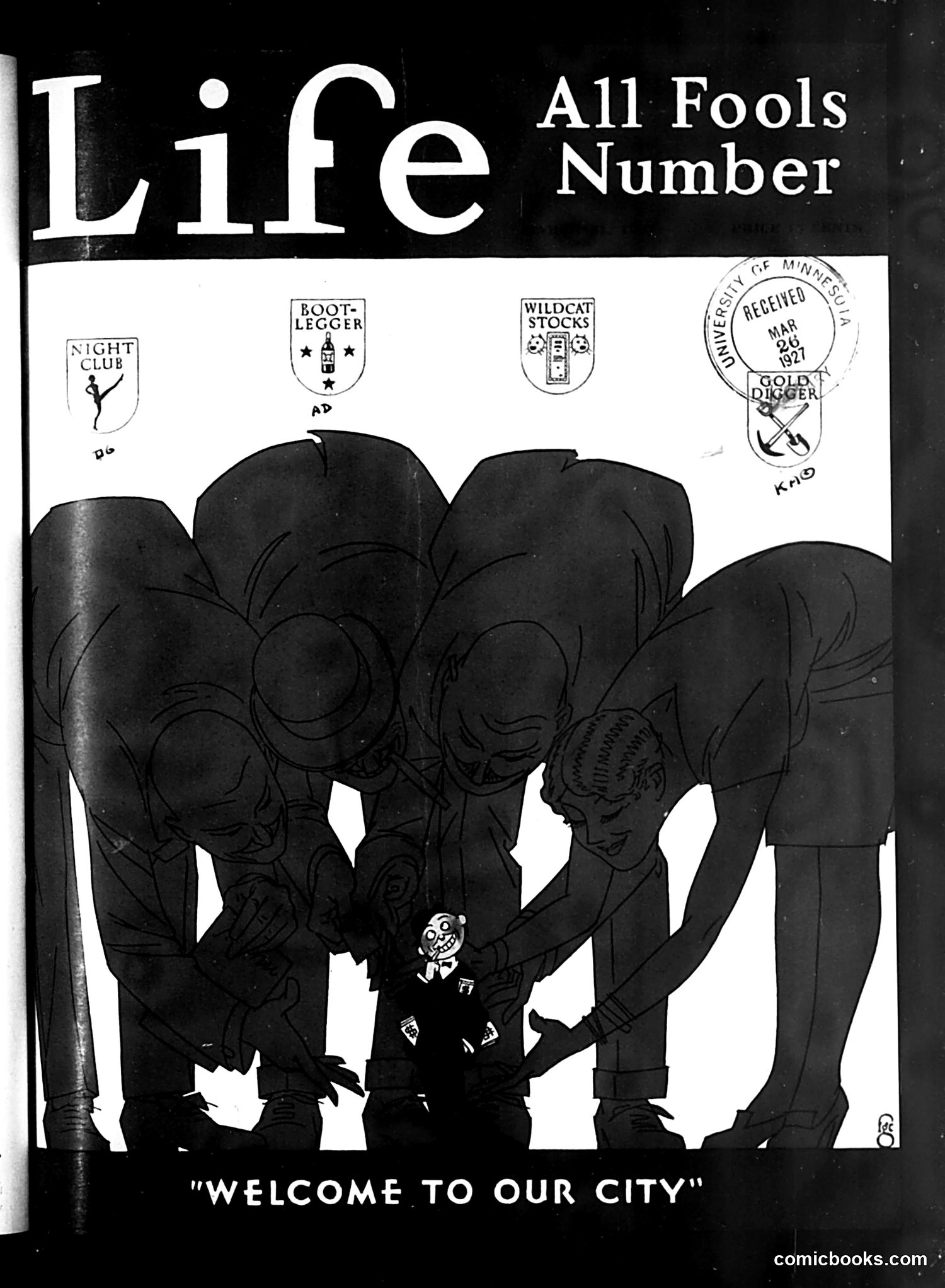
This is Life magazine's "All Fools" (April Fools') issue, as indicated by the header. The central cartoon depicts a small figure in formal dress being surrounded by four large men in business suits bending down toward him, captioned "Welcome to Our City." The satire appears to target urban corruption or organized crime in a major American city. The four large figures likely represent corrupt city officials, businessmen, or criminal figures who are welcoming the newcomer—suggesting he's being drawn into a corrupt system. The various logos at top (Night Club, Boot-leggers, Wildcat Stocks, Gold Digger) reinforce themes of Prohibition-era vice, illegal gambling, and urban moral decay. This would resonate with 1920s-30s readers concerned about city corruption.
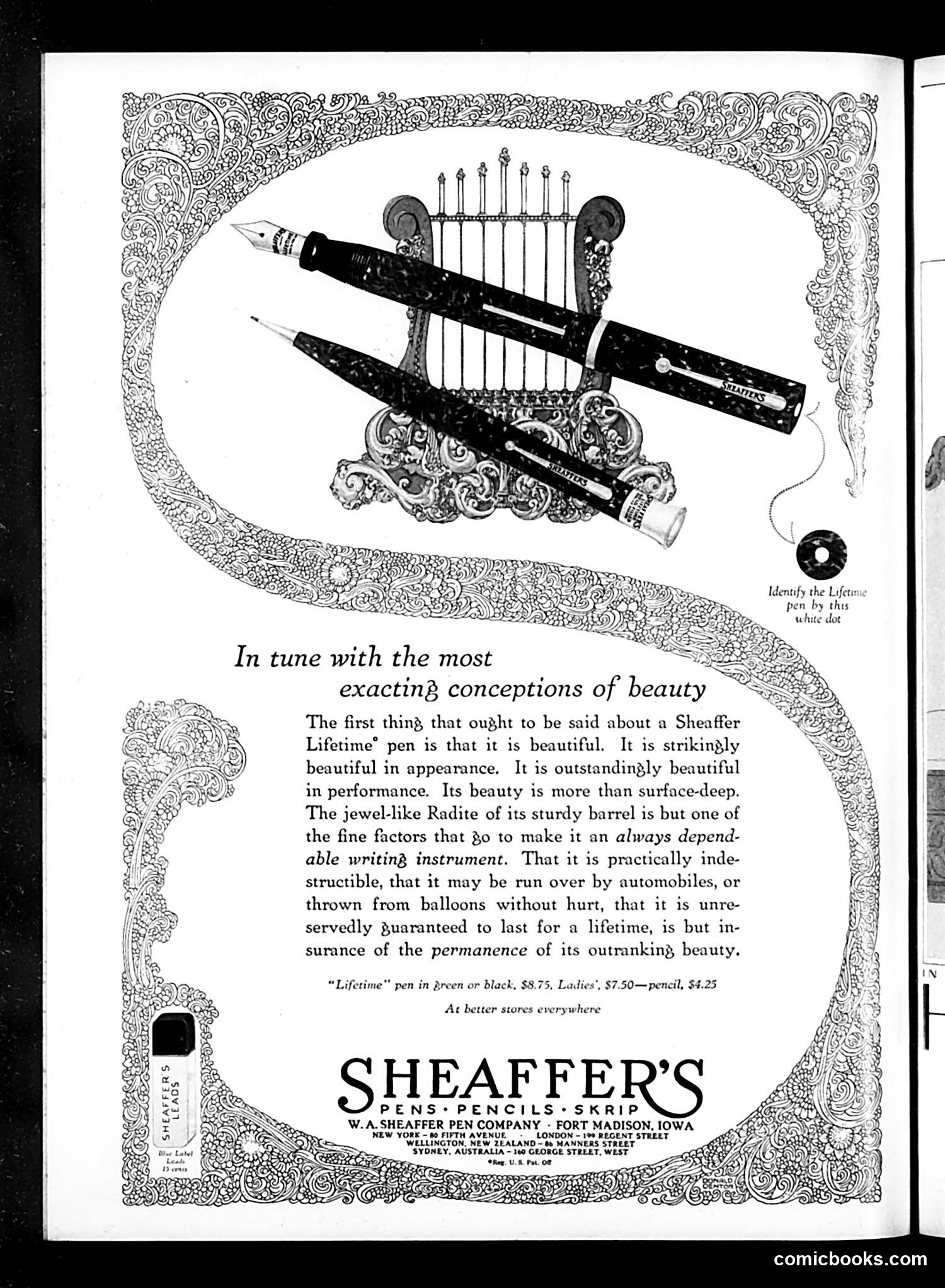
This is **not a political cartoon or satire**—it's a straightforward **advertisement for Sheaffer's pens and pencils**, likely from the 1920s-1930s based on the Art Deco styling and typography. The page uses ornamental Art Deco borders and displays Sheaffer writing instruments arranged artistically atop a decorative base. The ad emphasizes the pen's durability and beauty, claiming it can survive being run over by automobiles or dropped from balloons while maintaining a lifetime guarantee. The text stresses both aesthetic appeal ("strikingly beautiful in appearance") and practical reliability ("always dependable writing instrument"). Pricing and retailer information appear at bottom. This represents typical luxury goods marketing of the era, targeting affluent consumers who valued both craftsmanship and permanence.
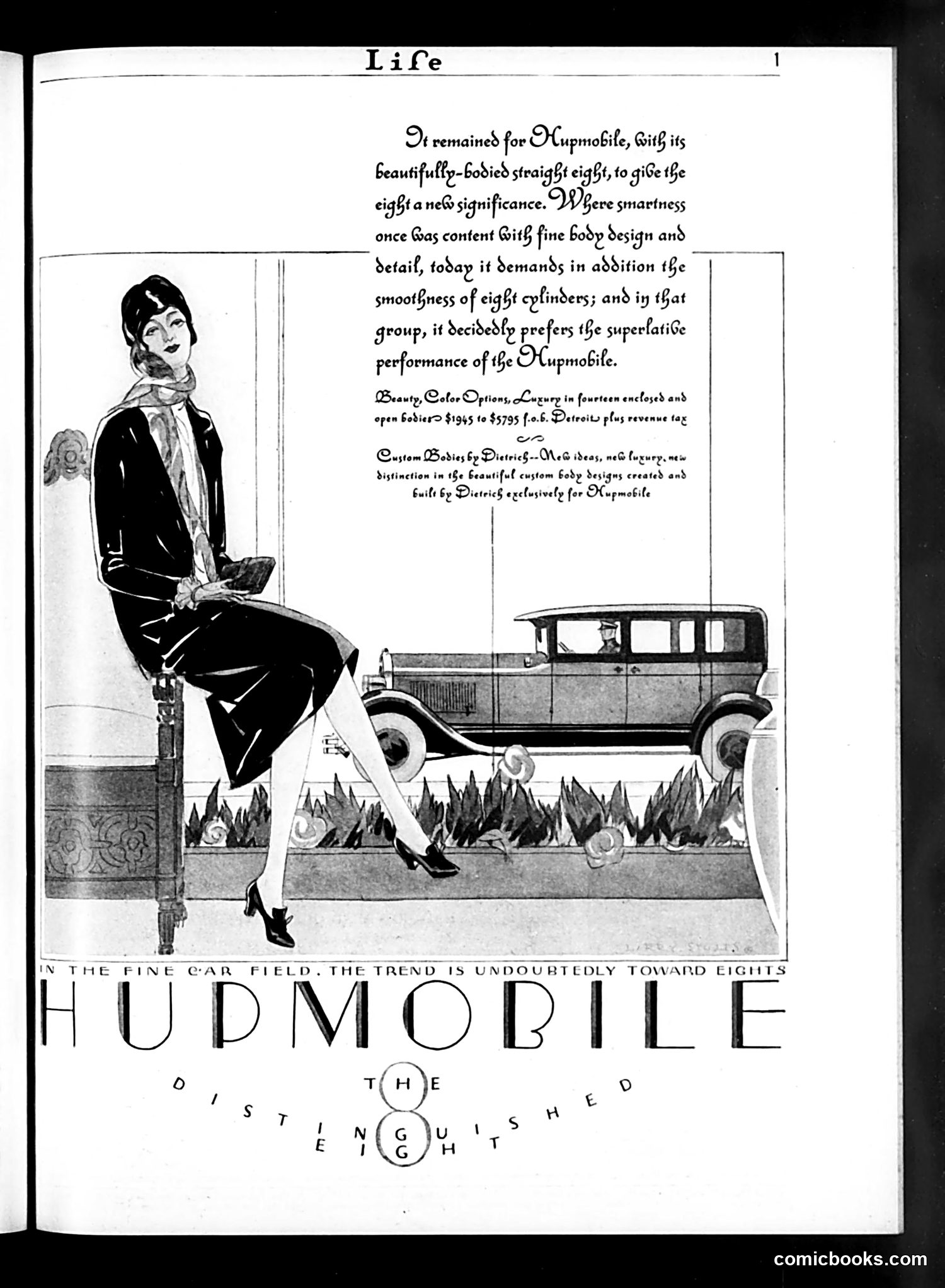
This is an advertisement for the Hudmobile automobile, not political satire. The page features a stylishly dressed woman in 1920s fashion sitting beside a Hudmobile sedan. The ad emphasizes the car's "straight eight" engine and "eight cylinders," presenting these technical features as sophisticated innovations. The accompanying text highlights the Hudmobile's design elegance and performance capabilities, marketing it as a luxury vehicle. References to "Custom Bodies by Dietrich" suggest bespoke, high-end craftsmanship. The headline claims that "in the fine car field, the trend is undoubtedly toward eights," positioning the Hudmobile as aligned with contemporary automotive advancement. This represents typical 1920s advertising strategy: linking consumer products to modernity and social aspiration.
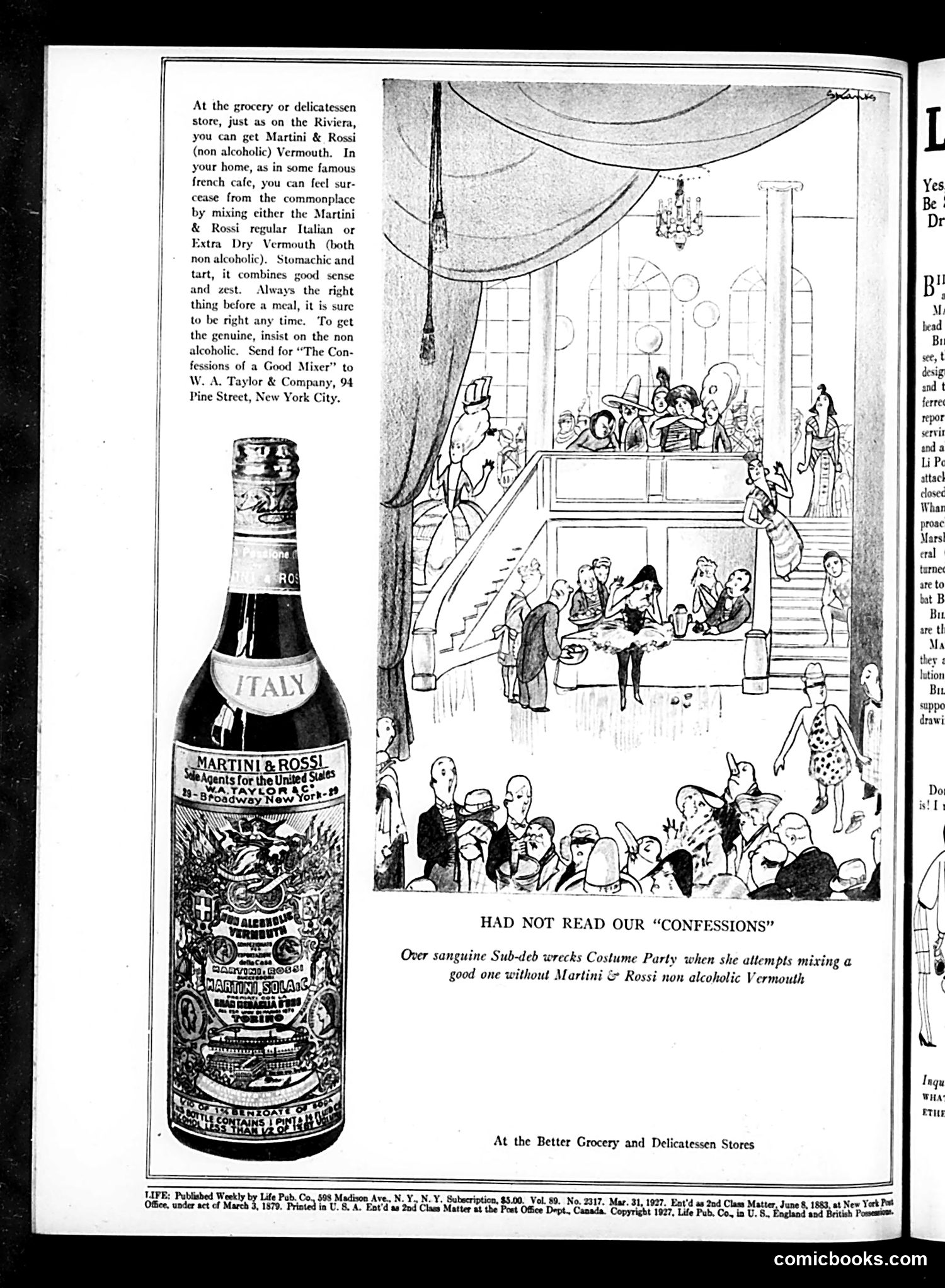
This page is primarily a **Martini & Rossi vermouth advertisement** disguised as editorial content. The left side displays the product bottle; the right shows a satirical illustration titled "Had Not Read Our 'Confessions.'" The cartoon depicts a chaotic **costume party** scene where someone attempted to mix a cocktail using inferior vermouth instead of Martini & Rossi brand, resulting in disaster. The illustration shows elegant party-goers in formal dress amid confusion and apparent mishap on a grand staircase. The joke plays on the advertisement's preceding text, which claims Martini & Rossi vermouth ensures "a meal, it is sure to be right any time." The satire suggests using inferior products leads to social embarrassment—a common advertising trope of the era that equated consumer choices with personal success and respectability.
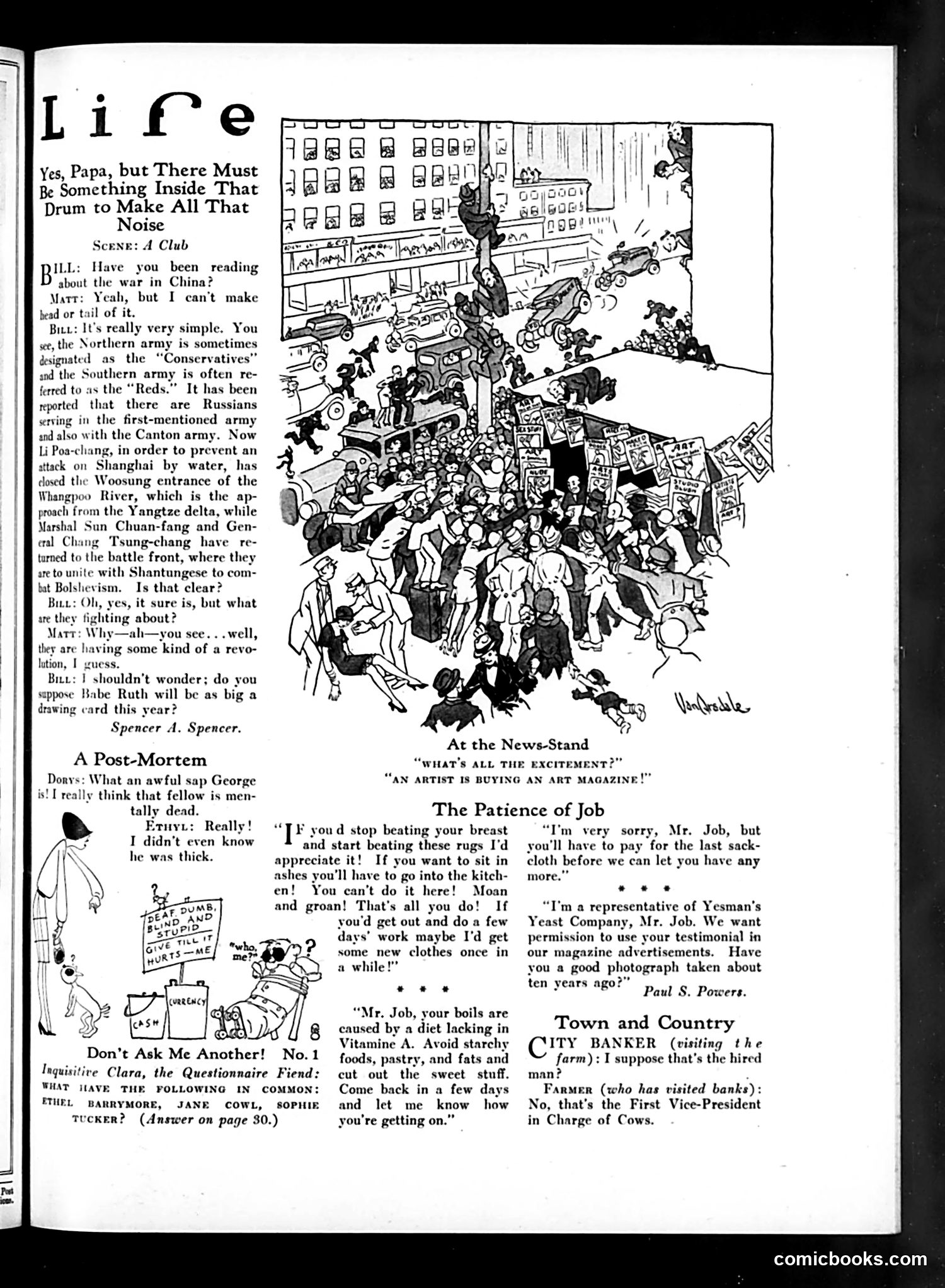
This cartoon satirizes the chaotic American consumer experience, likely from the 1920s-30s based on the style. The crowded street scene depicts people frantically purchasing newspapers and magazines at a news vendor's stand, with the caption "WHAT'S ALL THE EXCITEMENT?" / "AN ARTIST IS BUYING AN ART MAGAZINE!" The humor lies in mocking the absurdity of treating an artist buying an art magazine as shocking news worthy of public excitement—suggesting either that artists rarely buy such publications, or that the general public finds intellectual/cultural pursuits so unusual they treat them as novelties. The satirical point critiques both mass media sensationalism and American philistinism toward the arts.
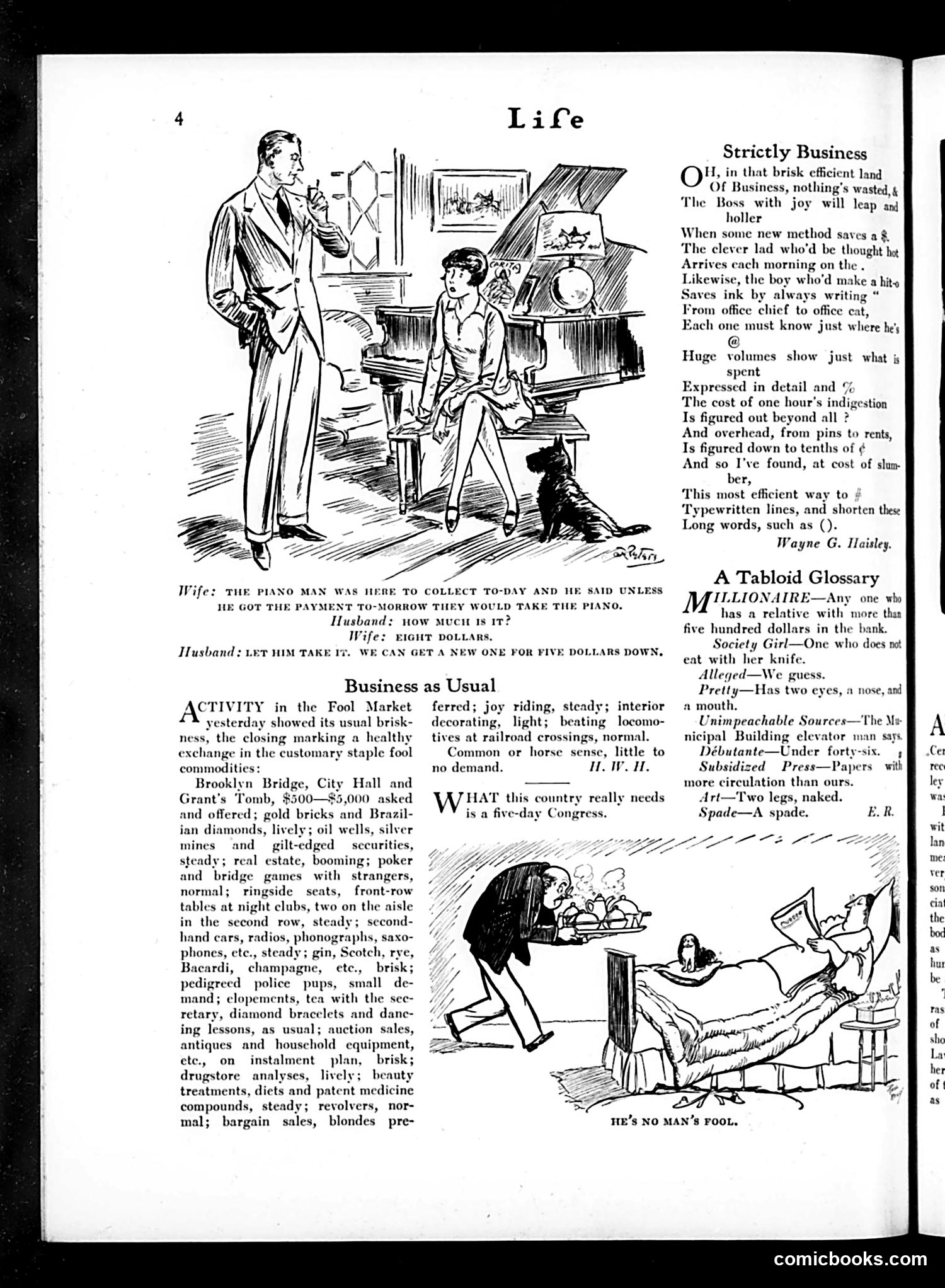
**Top Cartoon ("Strictly Business"):** A well-dressed man stands over a seated woman at an office desk, discussing piano payment. The joke hinges on marital efficiency: the wife mentions a piano man came to collect payment; the husband dismisses getting a new piano for only five dollars down. This satirizes early 20th-century consumer credit culture and the casual attitude toward debt installment plans, while also poking fun at domestic economics where husbands treat major purchases as trivial expenses. **Bottom Cartoon ("He's No Man's Fool"):** A bent figure serves food to a reclining person. The caption suggests this depicts someone who refuses to be fooled or manipulated—likely satirizing gullibility or social dynamics, though the exact reference remains unclear without additional context.
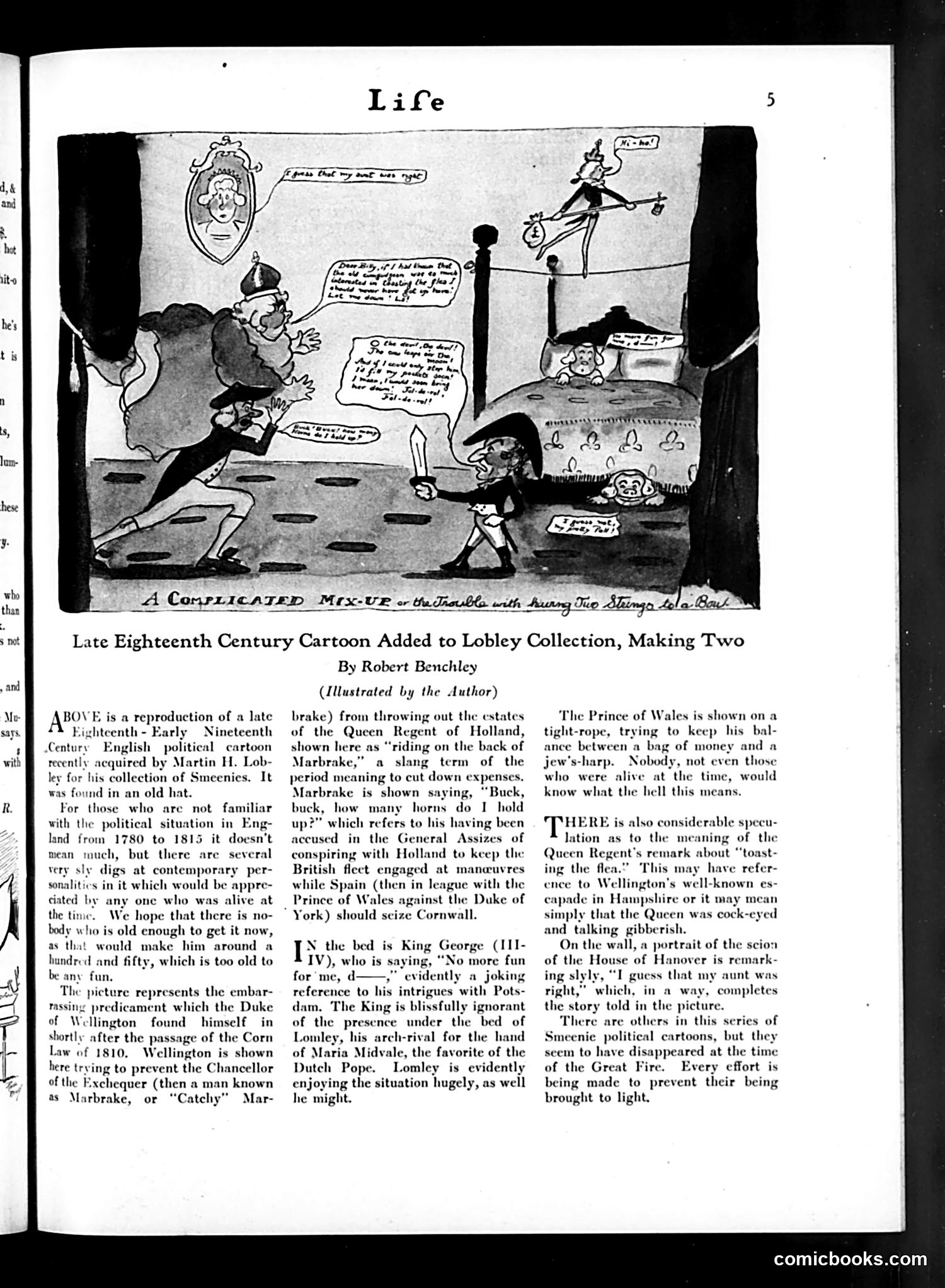
This late 18th/early 19th-century cartoon satirizes British political figures during the Napoleonic era (1780-1815). The text identifies **King George III** in bed, **the Duke of Wellington** (attempting to prevent Chancellor Castlereagh from acting), and **the Prince of Wales** balancing precariously on a tightrope between a money bag and a Jewish moneylender's blade. The satire targets the Prince's notorious debts and financial scandals, his political rivalries, and the broader chaos of wartime governance. References to "Marbrake" (slang for cutting expenses) and intrigues with Potsdam suggest critiques of military spending and diplomatic maneuvers. The cartoon's title promises "a complicated mix-up" involving these power struggles—typical of *Life* magazine's biting political humor mocking the era's leadership.
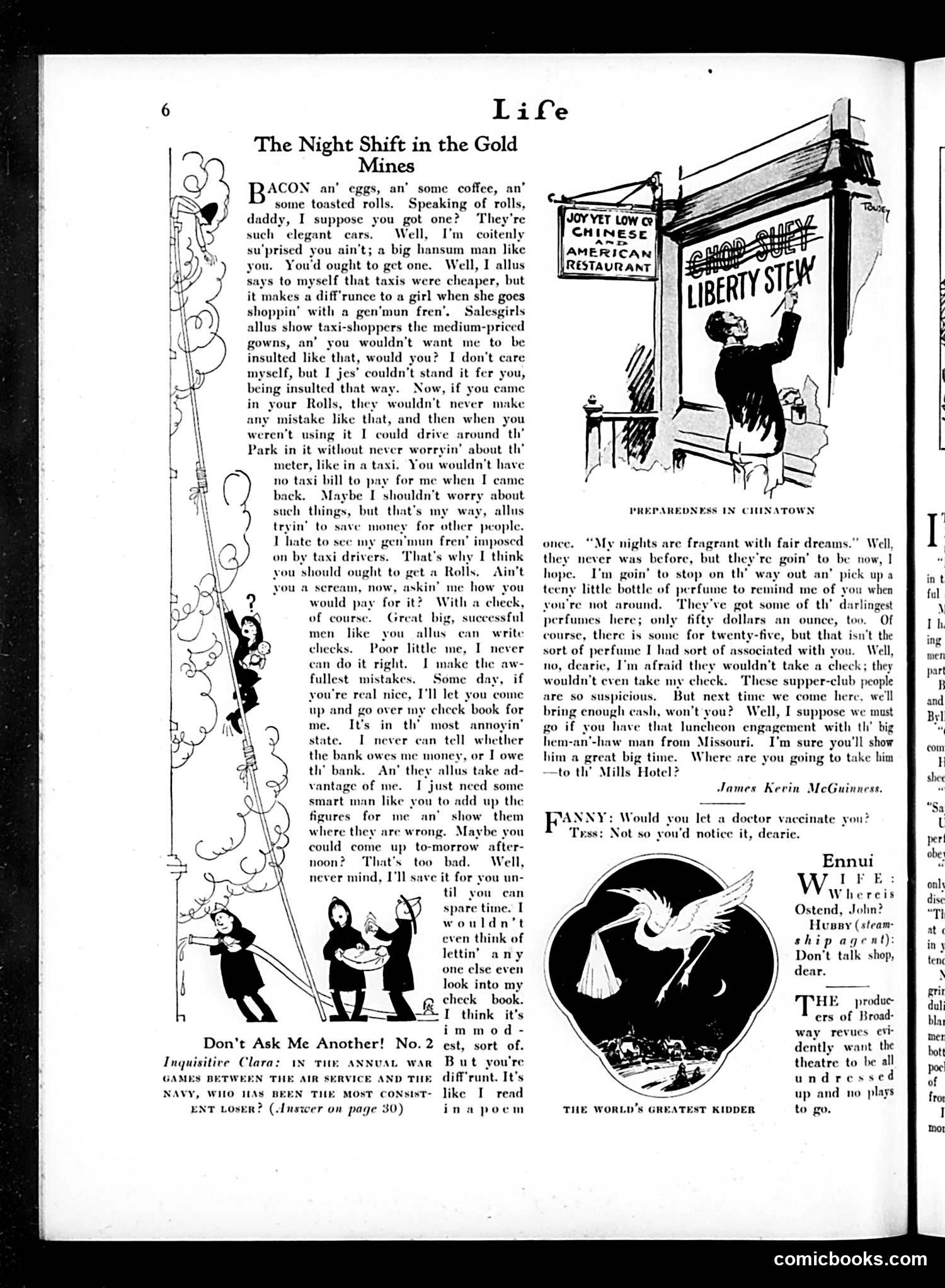
This page contains a satirical article titled "The Night Shift in the Gold Mines" by James Kevin McGuinness, featuring commentary on taxi drivers and their complaints about fares, salon girls, and financial pressures. The left illustration shows figures climbing what appears to be a rope or chain, likely representing working-class people struggling economically. The main illustration depicts a Chinese-American restaurant storefront with a sign reading "Liberty Stew," captioned "Preparedness in Chinatown." This appears to satirize how immigrant businesses adopt American patriotic language, possibly referencing early-1900s American anxiety about Chinese immigration and assimilation. Additional short humor pieces appear, including an exchange about doctors vaccinating people. The page reflects early 20th-century American class commentary and ethnic stereotyping typical of *Life* magazine's satirical approach.
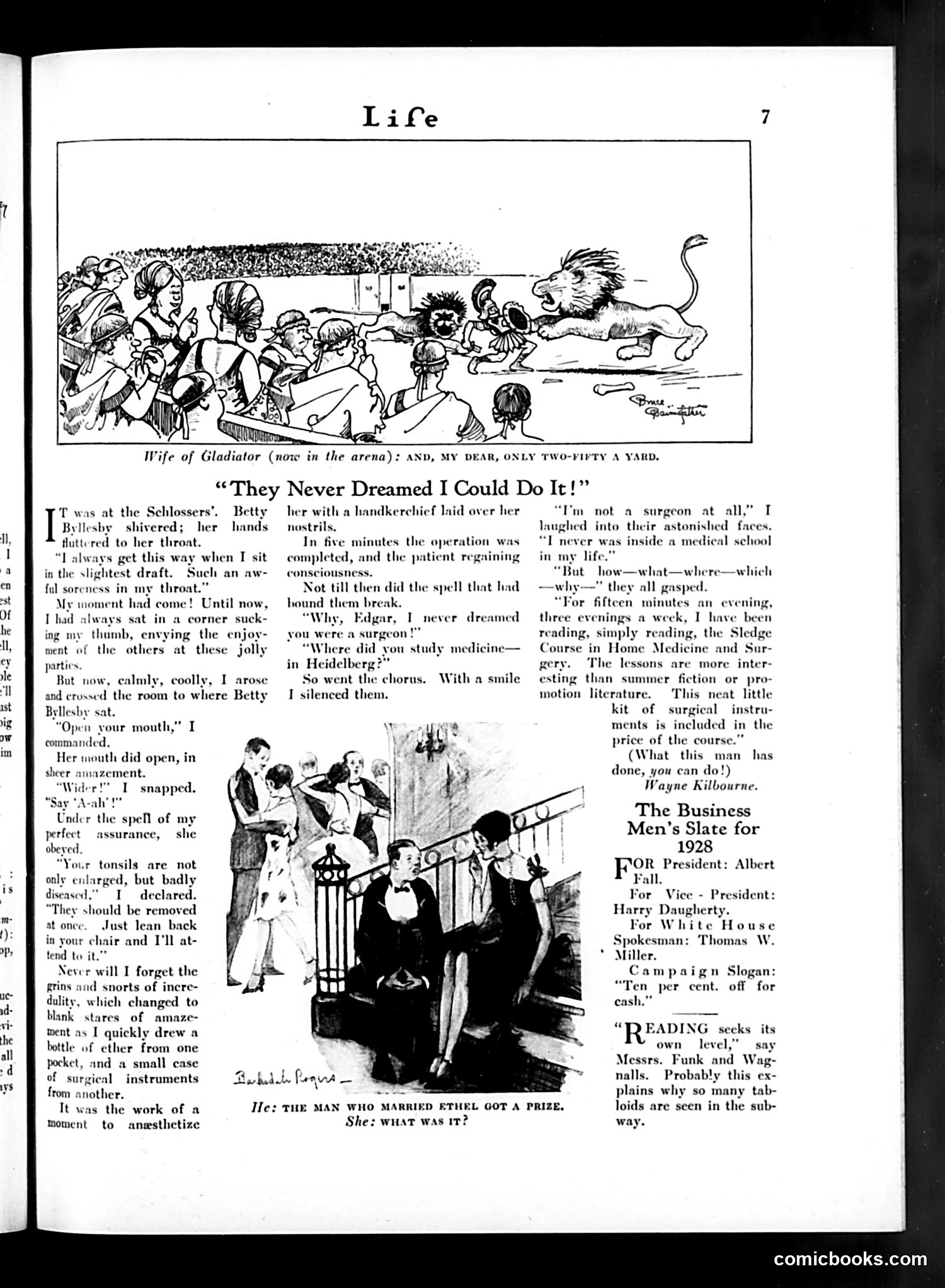
This story satirizes gender stereotypes in medicine. A woman (Betty) performs an emergency surgical procedure on a man at a social gathering, shocking the assembled guests. Their gasped reactions—"I never was inside a medical school in my life!"—highlight the era's assumption that women couldn't be surgeons. The narrative's humor lies in subverting expectations: despite lacking formal training, she successfully completes the operation, proving competence transcends gender. The man's amazement that an unqualified woman succeeded where trained doctors might have failed becomes the ironic punchline. Published in 1928, this reflects early feminist commentary on professional barriers women faced, even when demonstrating clear ability. The satire critiques society's prejudices rather than the woman's capabilities.
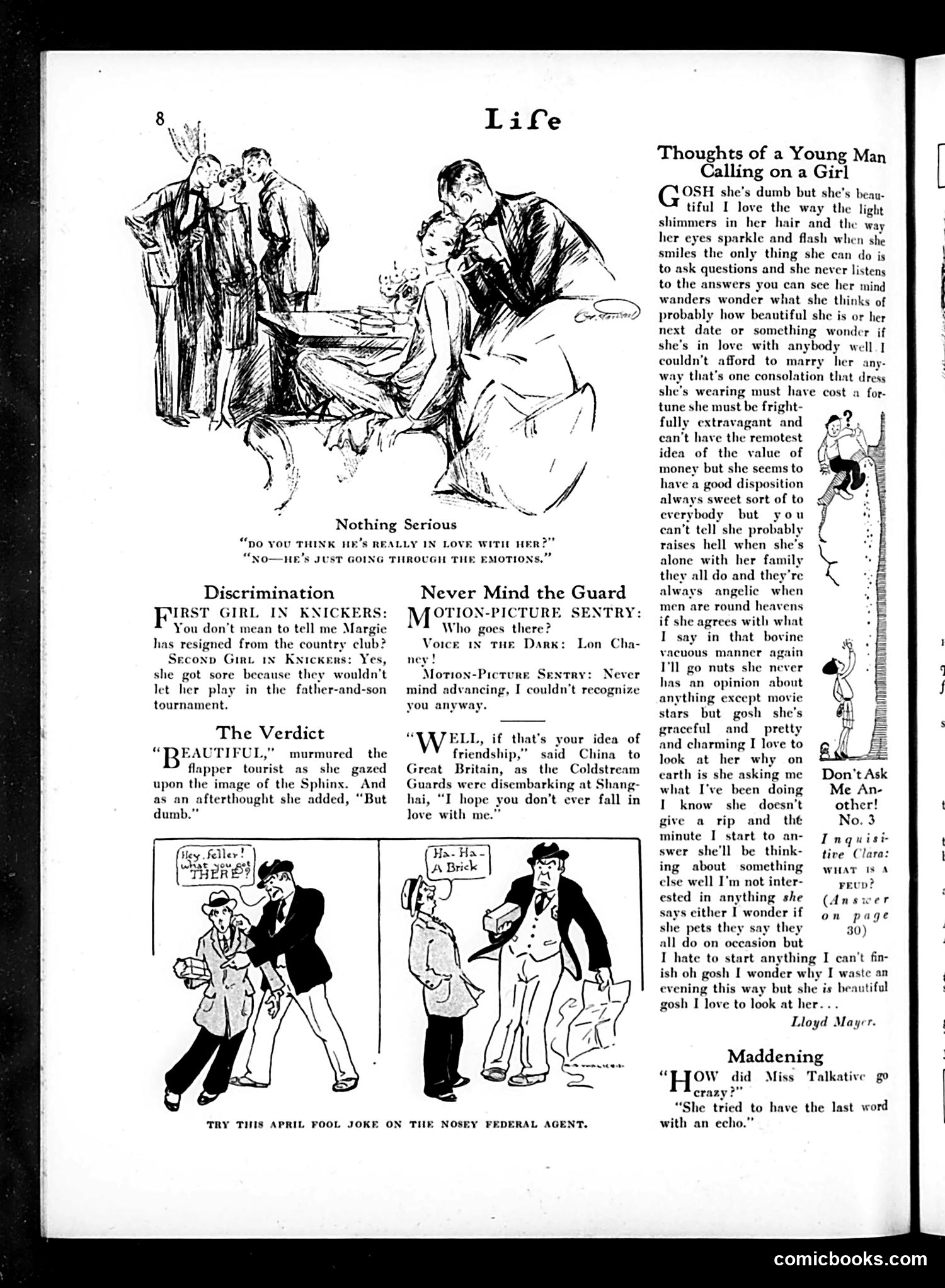
This page contains humorous social commentary typical of early 20th-century Life magazine. The main content includes: **"Thoughts of a Young Man Calling on a Girl"** — A satirical monologue mocking shallow male romantic attitudes, describing the narrator's obsession with the girl's appearance while simultaneously dismissing her intelligence and opinions. **"Nothing Serious"** — A sketch questioning whether a man is genuinely in love, with the caption revealing he's "just going through the emotions." **"Discrimination," "Never Mind the Guard," and "The Verdict"** — Brief satirical pieces about social situations and tourist behavior. **April Fool's Joke** — Bottom cartoons depicting pranks on a "Nosey Federal Agent," likely referencing Prohibition-era enforcement. The overall theme mocks courtship conventions, masculine posturing, and social pretense of the era.
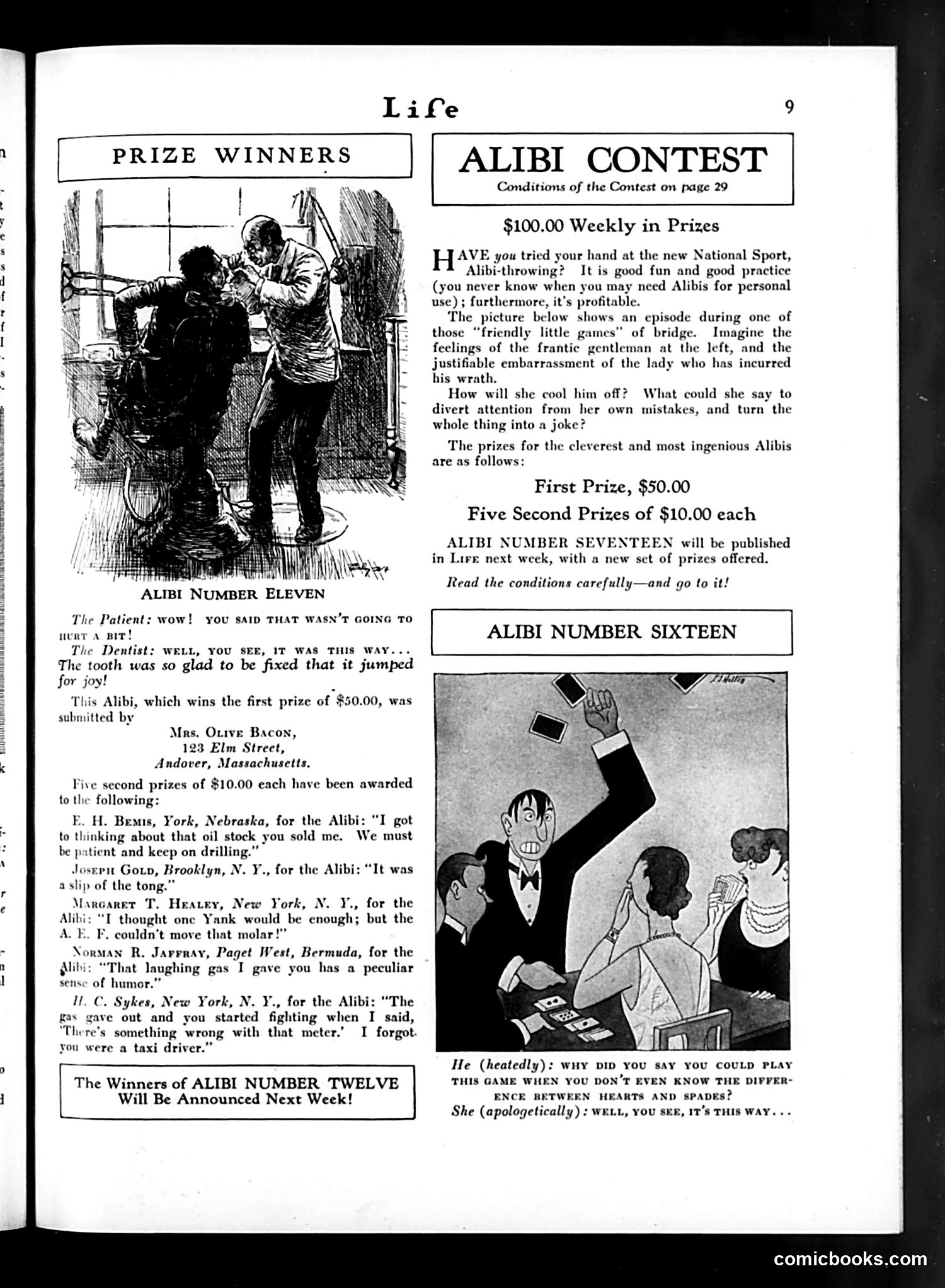
This page presents **Alibi Number Eleven** and **Alibi Number Sixteen**, part of Life magazine's humor contest asking readers to submit clever excuses. **Alibi Eleven** depicts a dentist visit gone wrong: a patient's tooth was so loose it "jumped for joy" during extraction—an absurd explanation the patient offers to explain their distress to an annoyed lady (likely a companion). The humor relies on the ridiculous excuse and the woman's justifiable anger at the patient's embarrassment. **Alibi Sixteen** shows a man caught playing cards, claiming he didn't know the difference between hearts and spades—a transparent lie mocking those who feign ignorance to escape blame. The contest awards $50 for the best alibi and $10 each for five runners-up, encouraging readers to submit humorous excuses for everyday mishaps and social failures.
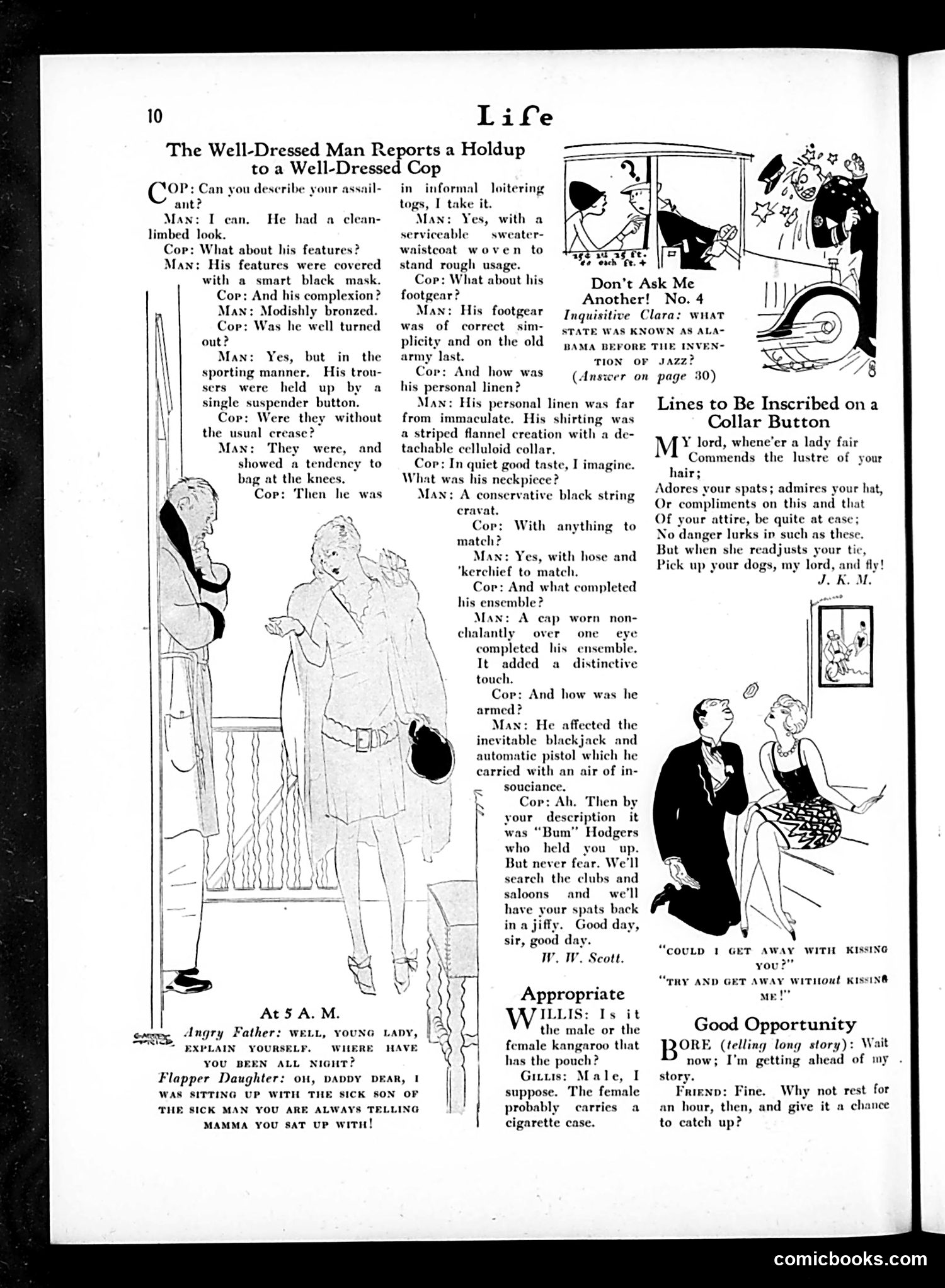
This page contains humorous sketches and jokes satirizing early 20th-century social conventions. **Top section** ("The Well-Dressed Man Reports a Holdup"): A conversation between a mugging victim and a police officer. The joke satirizes vanity—the victim describes his assailant's clothing in meticulous detail (sweater, footgear, neckpiece, cap) while providing almost no useful identifying information about his actual appearance or features. This mocks men obsessed with fashion over substance. **Other sketches** include domestic humor and social commentary on courtship and gender relations, typical of Life's satirical style. The cartoons rely on visual exaggeration and witty dialogue to mock contemporary attitudes about dress, social propriety, and masculine vanity—themes central to Life's audience of educated, upper-class readers.
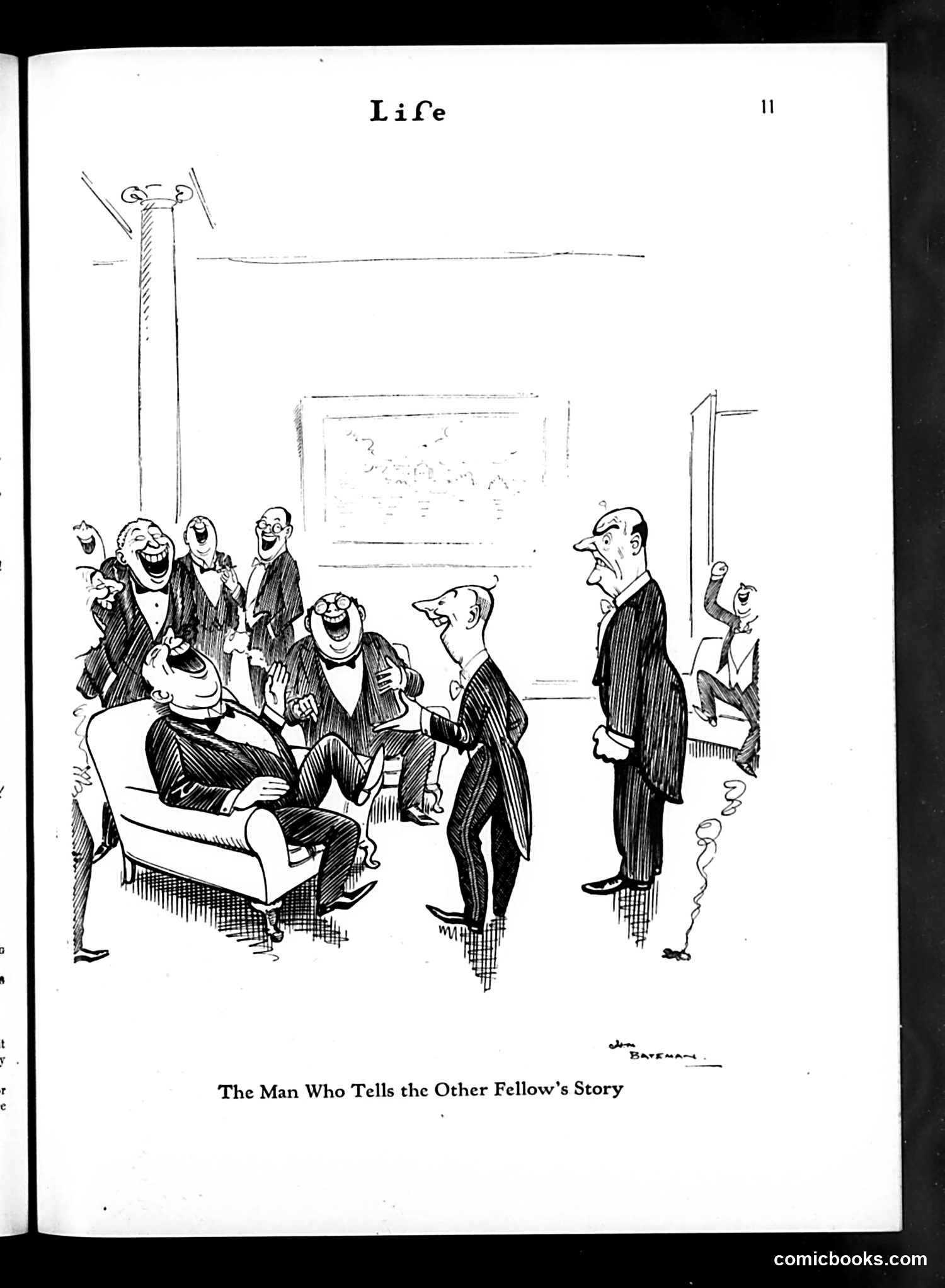
This cartoon depicts a social scenario common to early 20th-century urban life: a man seated on a sofa, energetically recounting an anecdote to an assembled group of well-dressed gentlemen. The seated figure appears to be the protagonist—"the man who tells the other fellow's story"—gesturing expressively while his audience laughs heartily around him. The satire targets a recognizable social type: the raconteur who monopolizes conversation, typically retelling others' experiences rather than his own. The standing figure on the right, apart from the group, appears disengaged or excluded—possibly the original story's owner, now sidelined by the teller's performance. The cartoon mocks this common social behavior of taking credit for entertaining others with borrowed anecdotes.
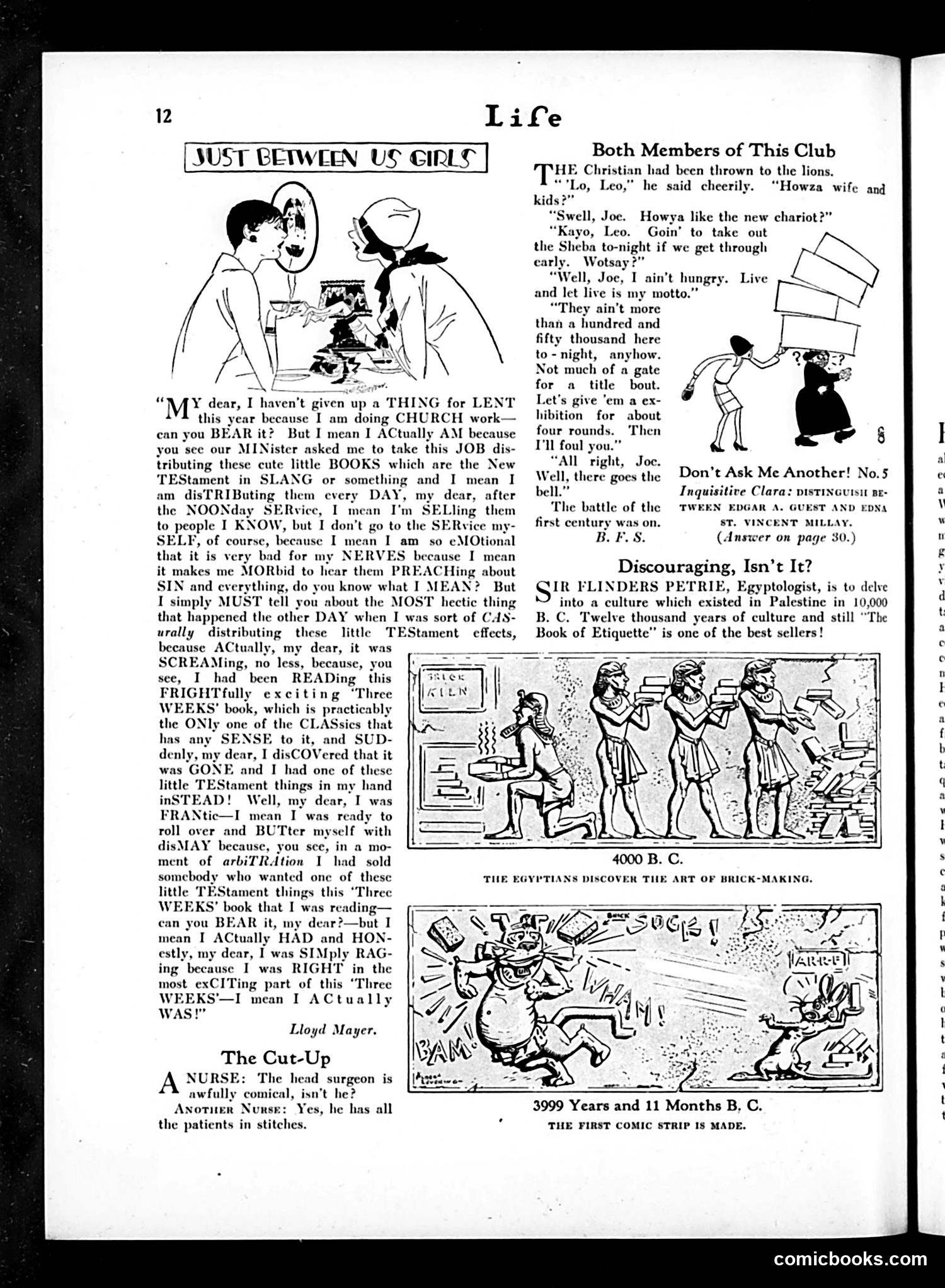
This page contains humor about women's social roles and religious obligations. The main piece, "Just Between Us Girls," satirizes a woman's elaborate excuses for not giving up anything for Lent—she claims religious duty requires her to attend church work, distribute books, and attend services, using capitalized wordplay (like "SELfing" instead of "SELfing") to mock how she twists language to justify self-indulgence. The joke targets hypocrisy: she claims religious devotion while clearly prioritizing personal comfort and social activities over actual sacrifice. The cartoons below illustrate ancient history—Egyptians making bricks (4000 B.C.) and early comic strips (3999 B.C.)—presenting lighthearted historical humor unrelated to the main satire.
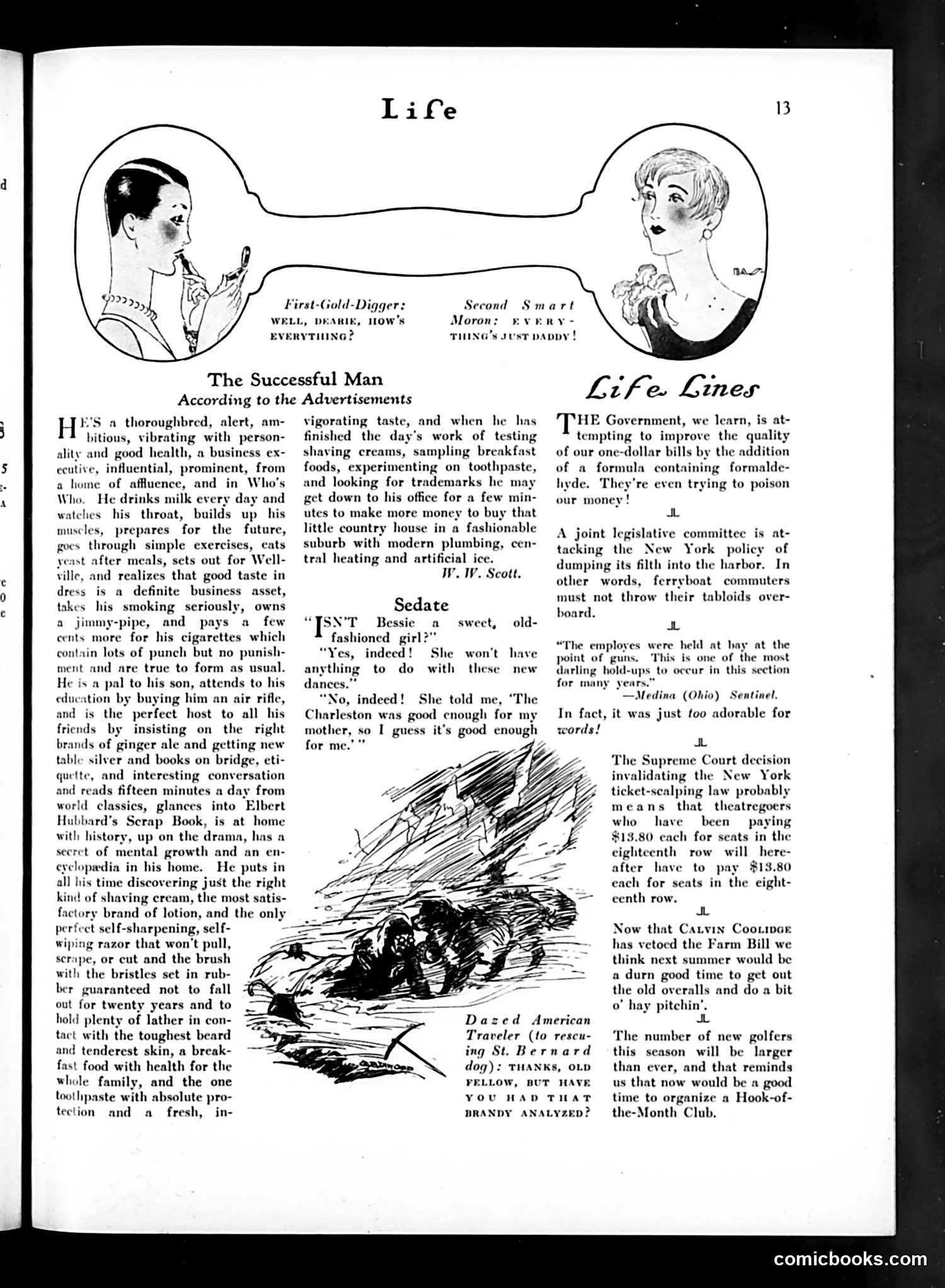
This page contains satirical commentary on 1920s American consumer culture and politics. The top section mocks "The Successful Man" through advertisements—a caricature of the aspirational businessman who obsesses over grooming products, shaving creams, and toothpastes while pursuing wealth and status symbols (home furnishings, air rifles for his son, bridge books). "Life Lines," the right column, offers political jabs: criticism of government attempts to improve dollar bills, commentary on New York harbor dumping, and a Supreme Court decision on theater ticket-scalping. There's also a joke about Calvin Coolidge vetoing a Farm Bill and reference to growing interest in golf. The central illustration depicts a dazed American traveler rescued from St. Bernard dog—a darkly humorous scene. Overall, the page satirizes consumerism, government inefficiency, and contemporary social trends.
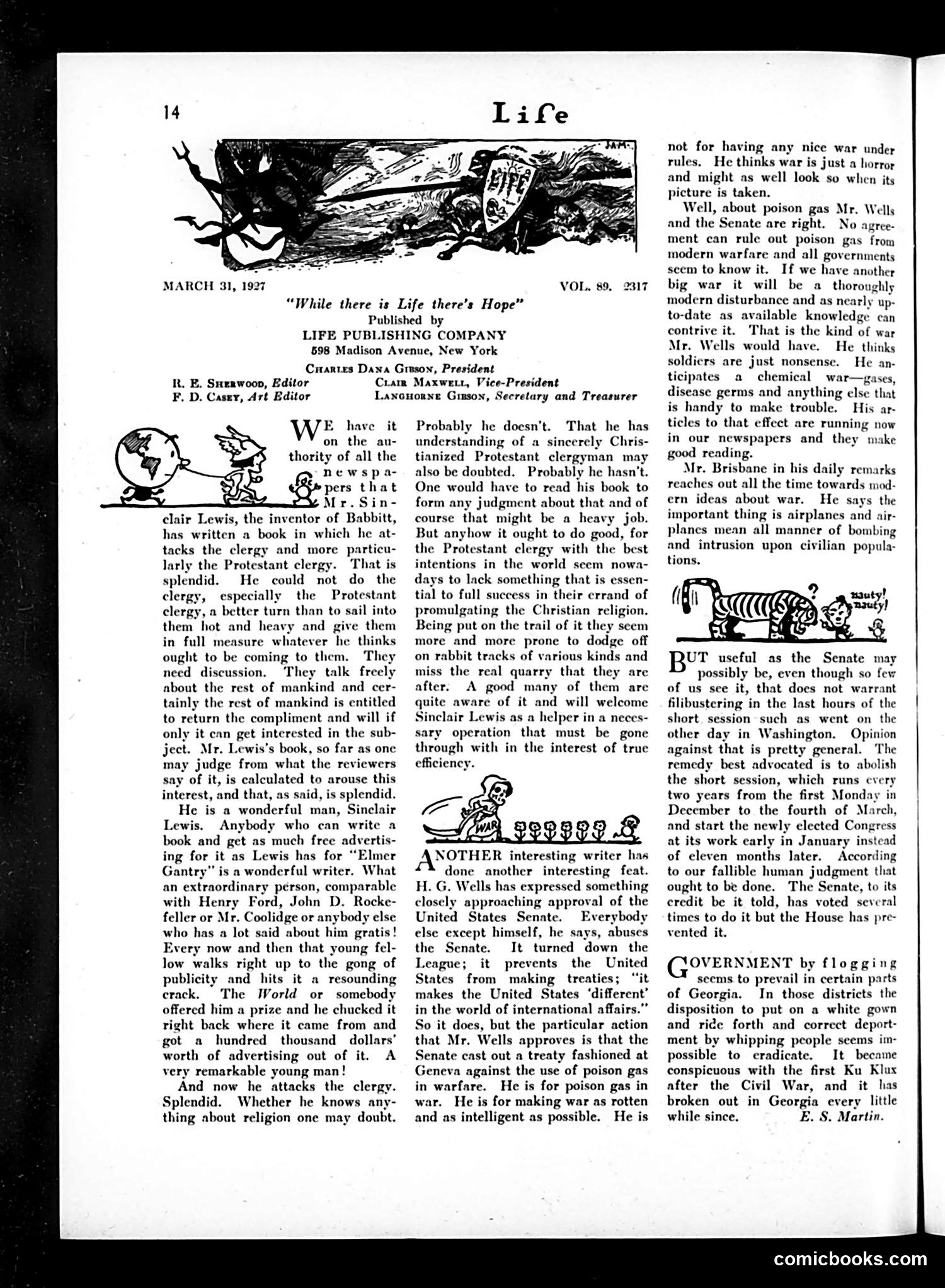
This page discusses **Sinclair Lewis's book attacking Protestant clergy**. The editorial praises Lewis as a "wonderful man" for his critique, while acknowledging the clergy may not appreciate being portrayed as self-interested and ineffectual at promoting genuine Christian values. The text also mentions **H.G. Wells's approval of poison gas in warfare**—apparently Wells supports making war "modern" and "intelligent" through chemical weapons, though the editor finds this troubling. A third item addresses **government flogging in Georgia**, describing it as a brutal punishment method that persists despite being outdated. The cartoons (small, sketchy illustrations) appear to accompany these critiques but are too unclear in this reproduction to interpret with confidence.
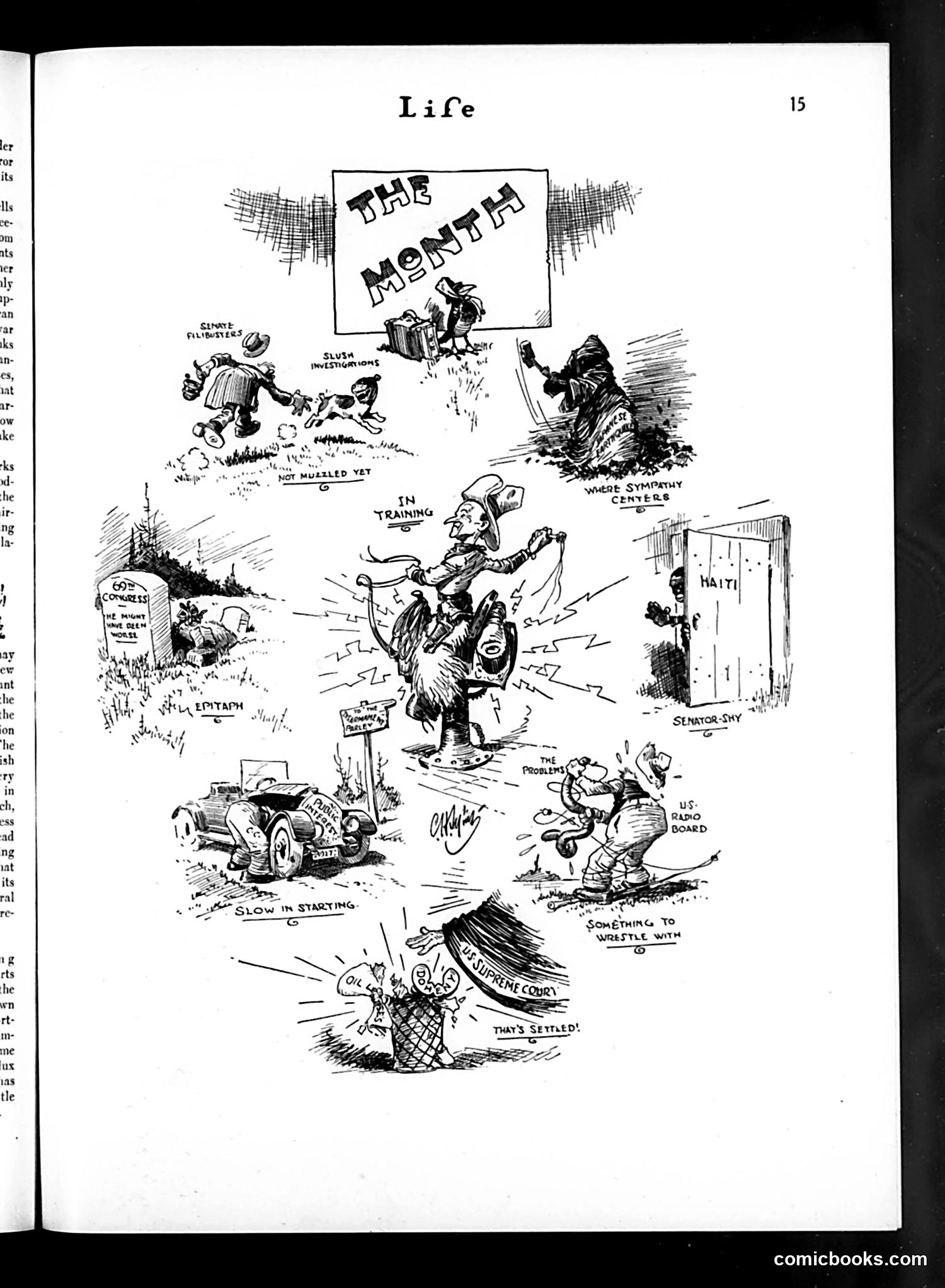
This is a composite political cartoon depicting various contemporary issues. The central figure appears to be a politician being manipulated or trained like a performer. Around this central scene are labeled vignettes including: - "Crime Investigations" and "Slum Investigation" (upper left) - "Where Sympathy Goes" (upper right) - "In Training" (center) - "Slow in Starting" (lower left, showing a car) - "The Problem" and "U.S. Radio Board" (lower right) - "Something to Wrestle With" - "That's Settled!" (bottom, showing what appears to be a court scene) The cartoon satirizes political ineffectiveness and competing priorities, suggesting politicians are reactive, poorly coordinated, and slow to address societal problems. The exact historical moment is unclear without a visible date.
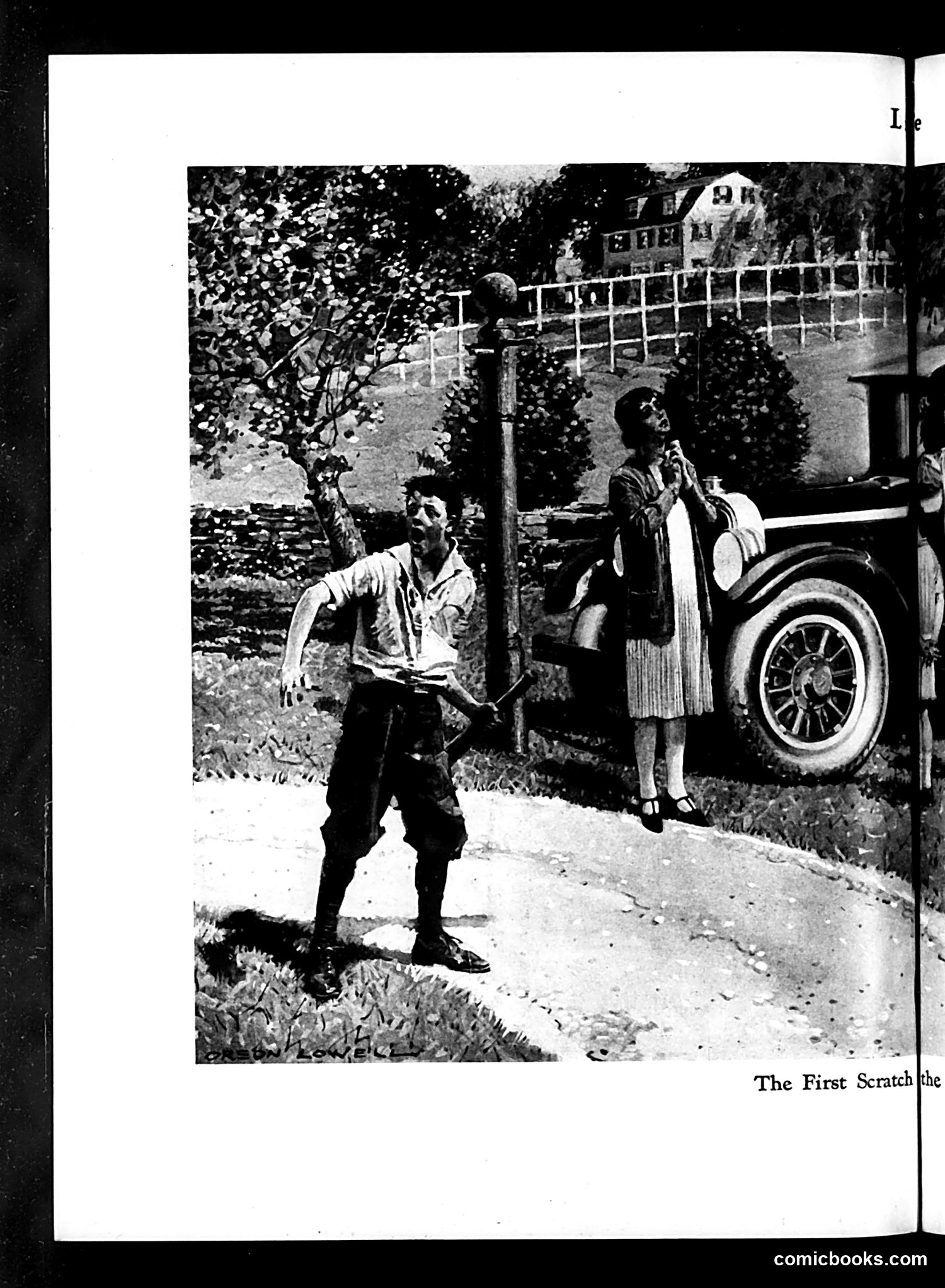
This appears to be a humorous domestic scene from an early 20th-century Life magazine. The photograph shows a man and woman posed near a parked automobile, with the caption "The First Scratch." The joke likely plays on the common frustration of new car owners—the anxiety over the first inevitable damage or imperfection to a pristine vehicle. The man's exaggerated posture suggests distress or concern, while the woman's stance near the car implies she may be involved in the mishap. This reflects the period when automobiles were still luxury items and sources of considerable pride and concern for their owners. The satire gently mocks the obsessive care owners took with their new vehicles and the domestic tensions such incidents might cause.
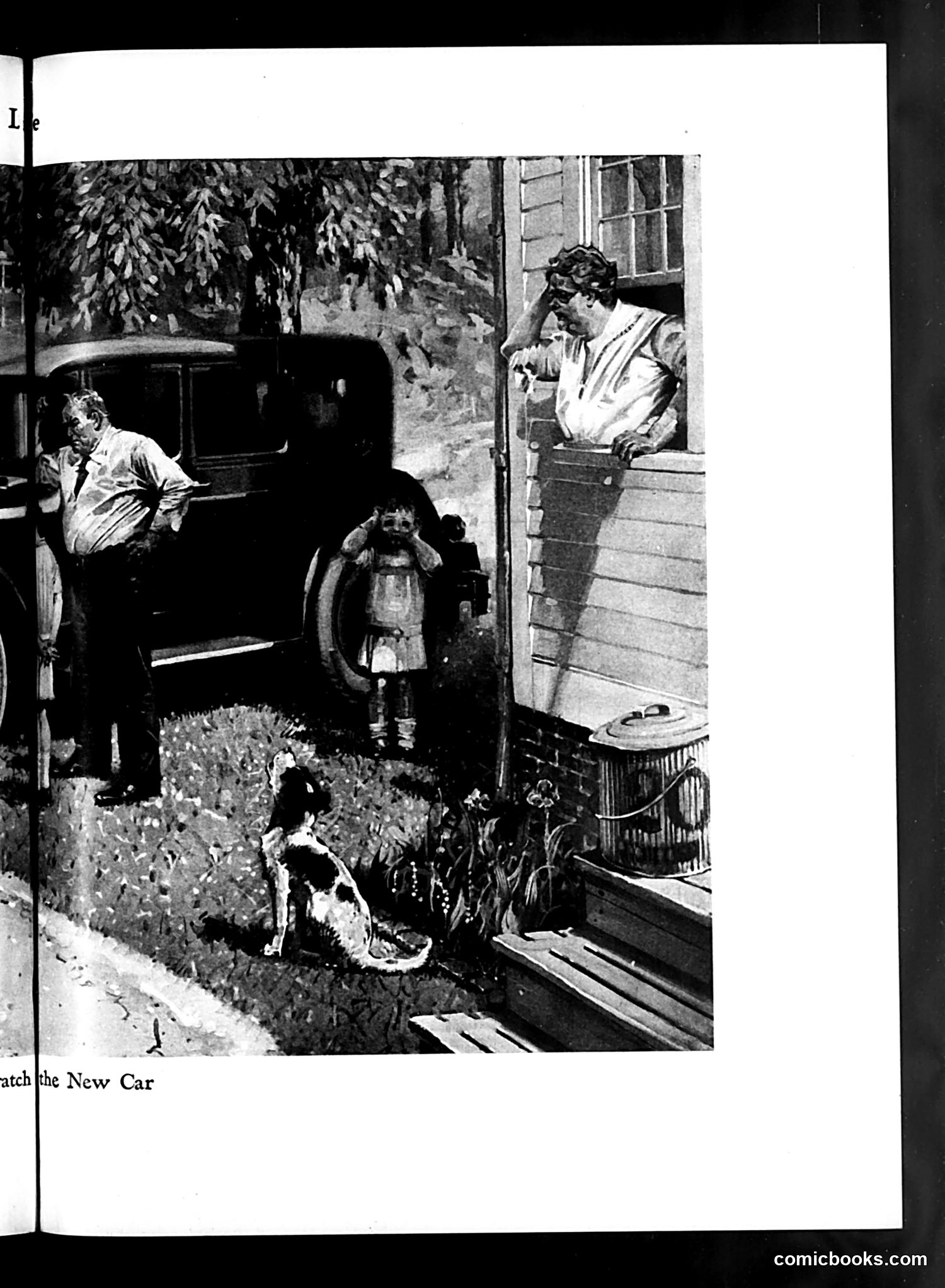
This appears to be a satirical domestic scene from early 20th-century Life magazine. The image shows a man inside a vintage automobile while a woman leans out a window of a house, and a dog stands in the yard observing the vehicle. The caption "Watch the New Car" suggests satire about the novelty and fascination automobiles generated during their early adoption period. The humor likely centers on how the new technology commanded attention from everyone—the woman watching from the house, the dog's interest—reflecting society's obsession with this modern innovation. The scene captures a moment when automobiles were still remarkable enough to stop people in their tracks, poking fun at the excitement surrounding early motorcar culture and its disruptive impact on ordinary domestic life.
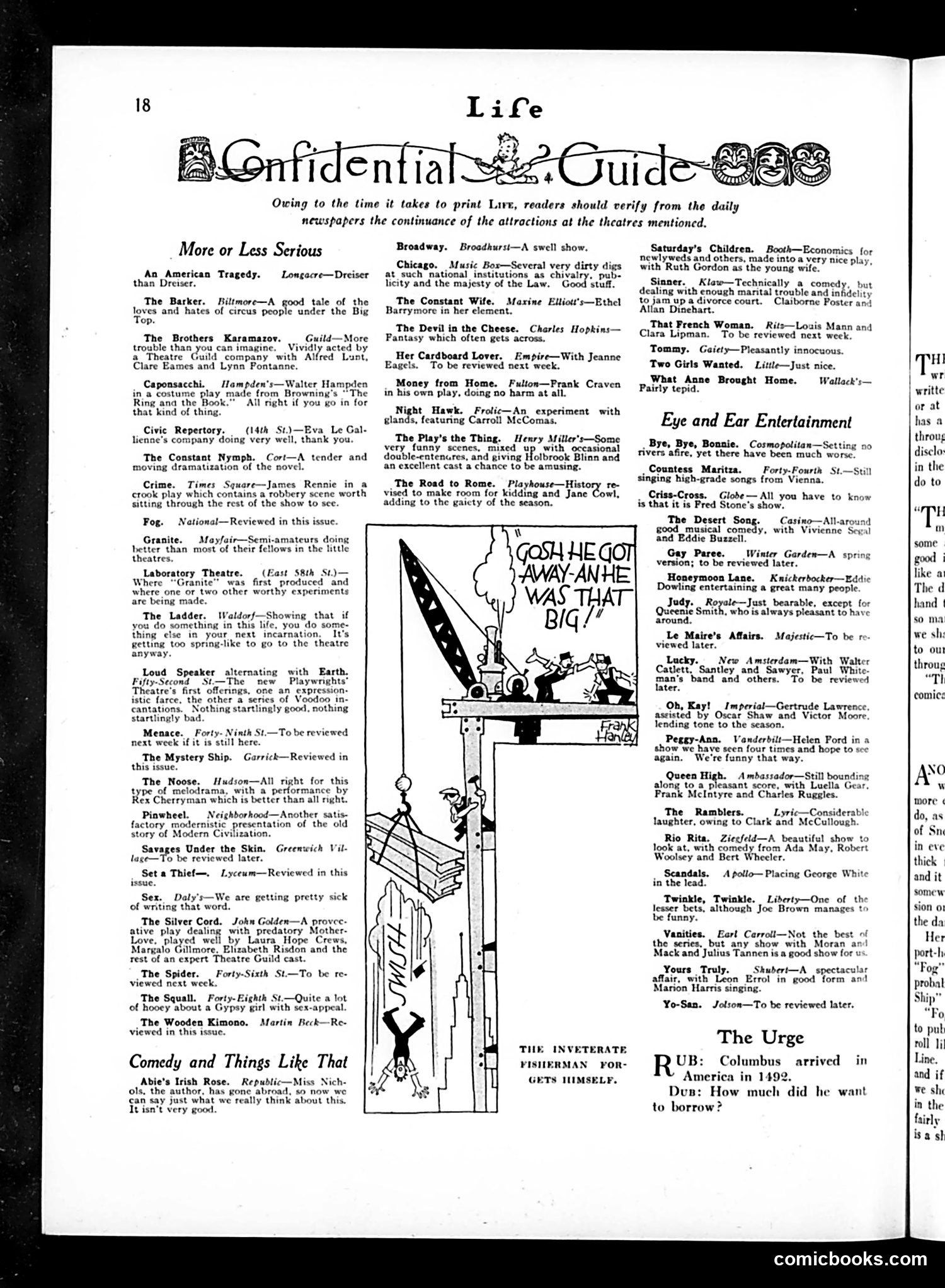
This is a theater review section from Life magazine listing Broadway and off-Broadway shows circa mid-1920s. The cartoons and layout are characteristic of Life's satirical style during this era. The large central cartoon depicts a figure at a theater box office window, with the caption "GOSH HE GOT AWAY AN' HE WAS THAT BIG"—likely mocking either ticket scalpers' exaggerated claims about sold-out shows or patrons' inflated memories of performances they attended. The reviews themselves are tongue-in-cheek critiques of contemporary theater. Notable is the comment on *Abie's Irish Rose* (a then-famous play): the reviewer states since the author "has gone abroad, so now we can say just what we really think about this. It isn't very good"—a characteristic Life jab at a popular work they considered mediocre. Reviews range from brief dismissals ("It isn't very good") to backhanded compliments ("All right if you go in for that kind of thing"). The content reflects 1920s theater culture and Life's sophisticated, sardonic editorial voice.
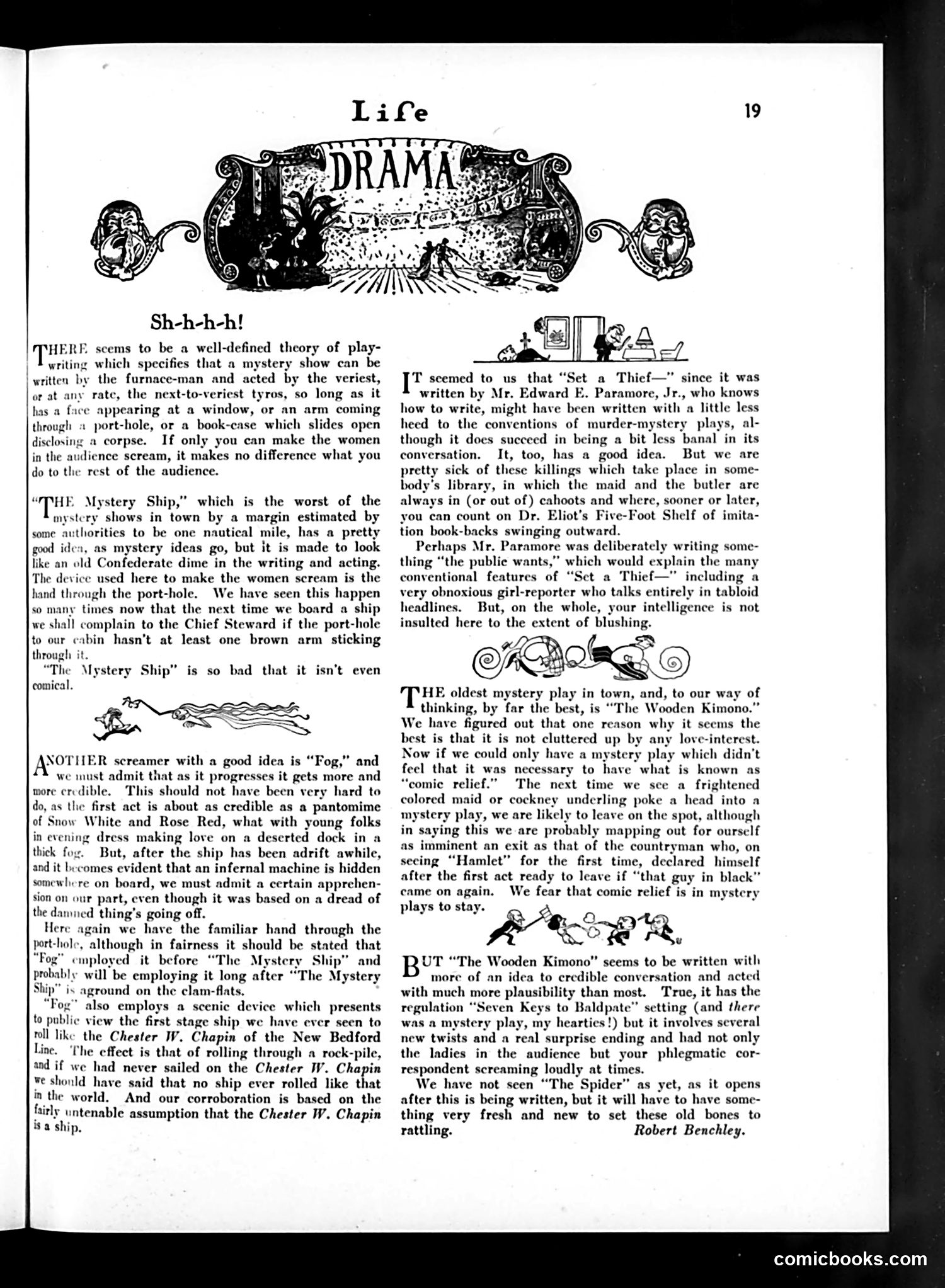
This is theater criticism satirizing the conventions of mystery plays currently running on Broadway. The author mocks how these productions rely on cheap tricks—mysterious hands through portholes, sliding bookcases revealing corpses, women screaming—rather than genuine drama or intelligent writing. Specific targets include: - **"The Mystery Ship"**: Called the worst mystery show in town; criticized for using a hand-through-the-porthole gimmick so repeatedly it's become absurd. - **"Fog"**: Also uses the porthole trick; praised slightly for improving as it progresses, though it features improbable scenery (rolling like the real ship *Chester W. Chapin*). - **"Set a Thief"**: By Edward E. Paramore Jr., criticized for relying on library murders, maids/butlers as suspects, and revolving bookcases—though the author admits it's written by someone competent. - **"The Wooden Kimono"**: Endorsed as the best mystery play because it lacks the obligatory love subplot. The satire targets theater audiences' willingness to accept lazy writing if actresses scream convincingly.
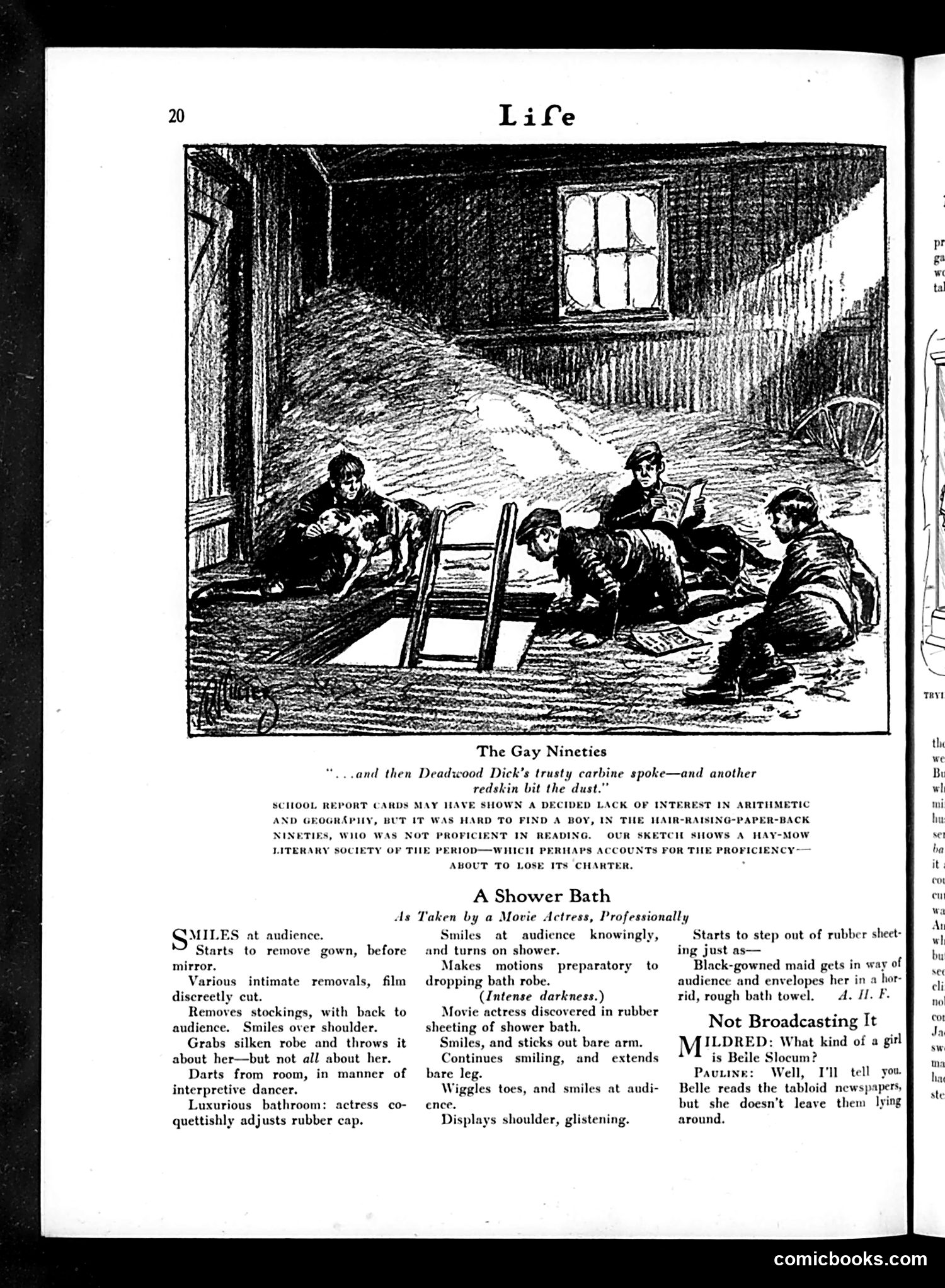
This page contains two satirical pieces from Life magazine's "Gay Nineties" section, mocking late 19th-century culture. **Top cartoon:** Criticizes boys' obsession with dime-novel westerns featuring "Deadwood Dick"—pulp fiction about outlaws and violence. The satire notes these boys failed arithmetic and geography in school but were experts at reading sensational "hair-raising" stories. The sketch shows children engrossed in this literature, suggesting it corrupted their education. **"A Shower Bath" section:** Parodies how movie actresses performed shower scenes for cinema audiences—teasing nudity through strategic camera cuts, shadows, and partial reveals (bare arm, leg, shoulder) while maintaining plausible deniability. The joke concludes when a maid wraps her in a towel, foiling the display. This mocks both actresses' calculated seductiveness and audiences' appetite for borderline-indecent entertainment. Both pieces satirize lowbrow American entertainment consuming the public's attention.
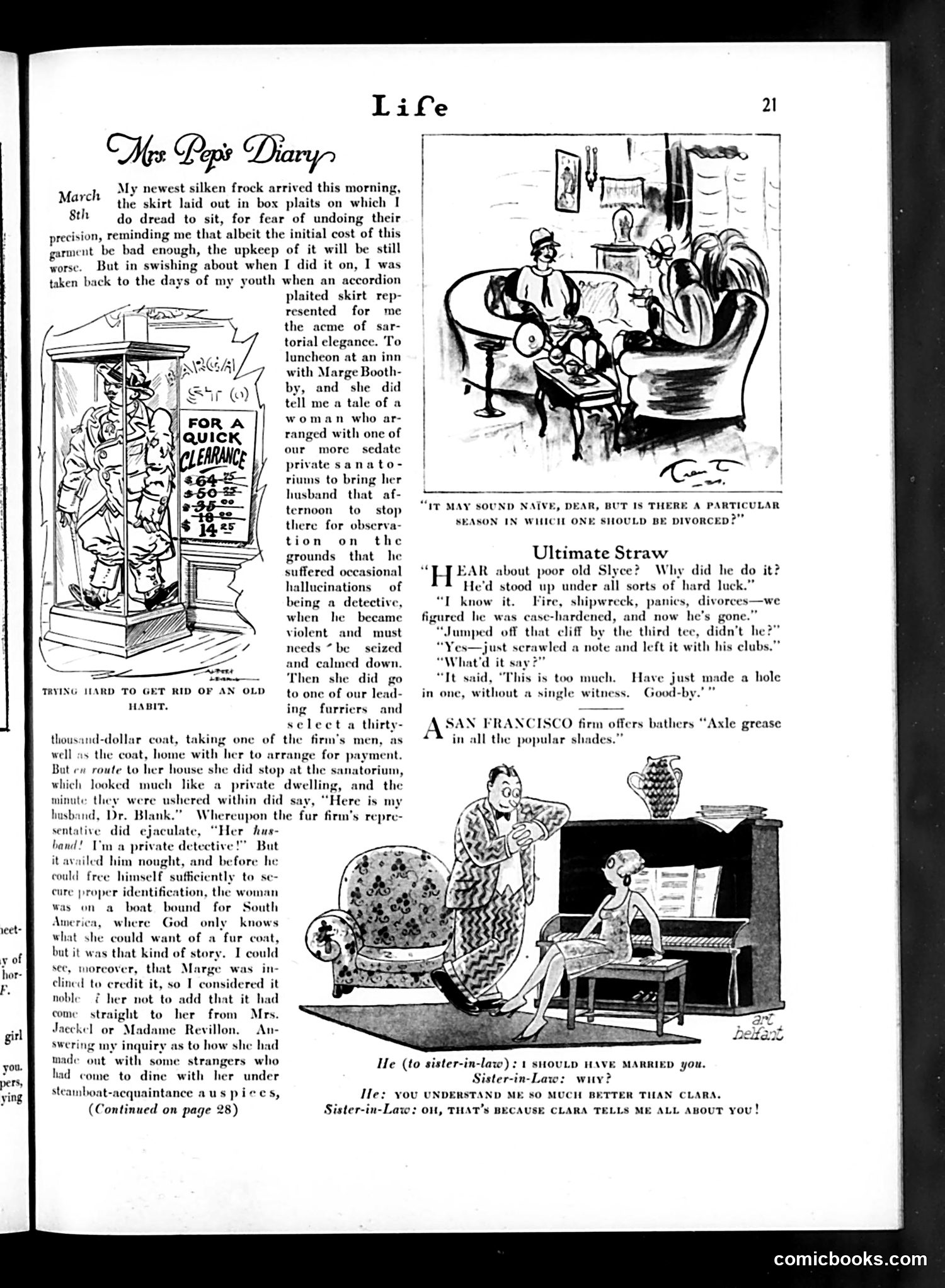
This page contains **Mrs. Pep's Diary** (a humor column) and several cartoon jokes reflecting upper-class anxieties of the era. **The main diary entry** satirizes wealthy women's materialism and moral flexibility. A woman arranges her husband's commitment to a sanatorium (claiming he suffers detective delusions), then uses his absence to purchase a $30,000 fur coat by deceiving the furrier into thinking the husband approved it. **The cartoons below mock marital discord:** 1. **"Ultimate Straw"** jokes about a man (Slyce) driven to suicide by his wife's infidelity—even hardship couldn't break him, but *divorce* did. 2. **The piano scene** depicts a husband telling his sister-in-law he should have married *her* instead, because she understands him better. Her response reveals the joke's sting: she only knows him so well because his wife (Clara) tells her everything about him. These satirize the period's anxieties about divorce, infidelity, and women's financial independence and cunning within marriage.
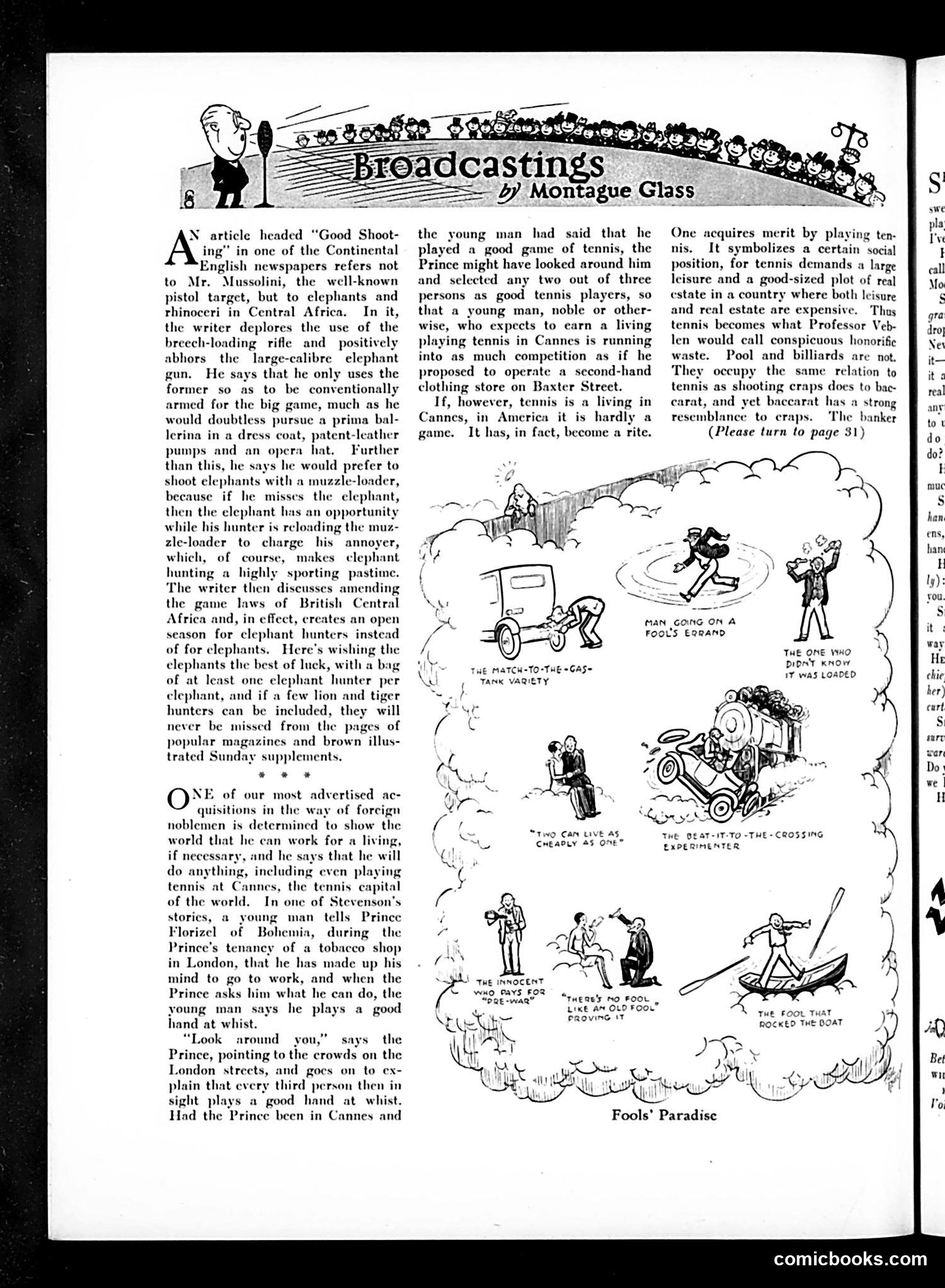
This page combines two pieces by Montague Glass. The first article satirizes a British newspaper's absurd proposal to restrict elephant hunting in Central Africa by banning modern rifles—the writer prefers muzzle-loaders to give elephants a "sporting" chance to charge and kill hunters. Glass mocks this backwards logic. The second piece ridicules American social pretension around tennis. In Cannes, France, tennis is merely a game; in America, it's become a status symbol—"conspicuous honorific waste" requiring expensive leisure time and property. Playing tennis signals wealth and social position, unlike pool or billiards, which carry no prestige. The cartoon "Fools' Paradise" (bottom) illustrates various foolish scenarios: the match-box car variety, the cross-country experimenter, and the fool who didn't know a gun was loaded. These visually reinforce the theme that foolish behavior masquerades as sophistication.
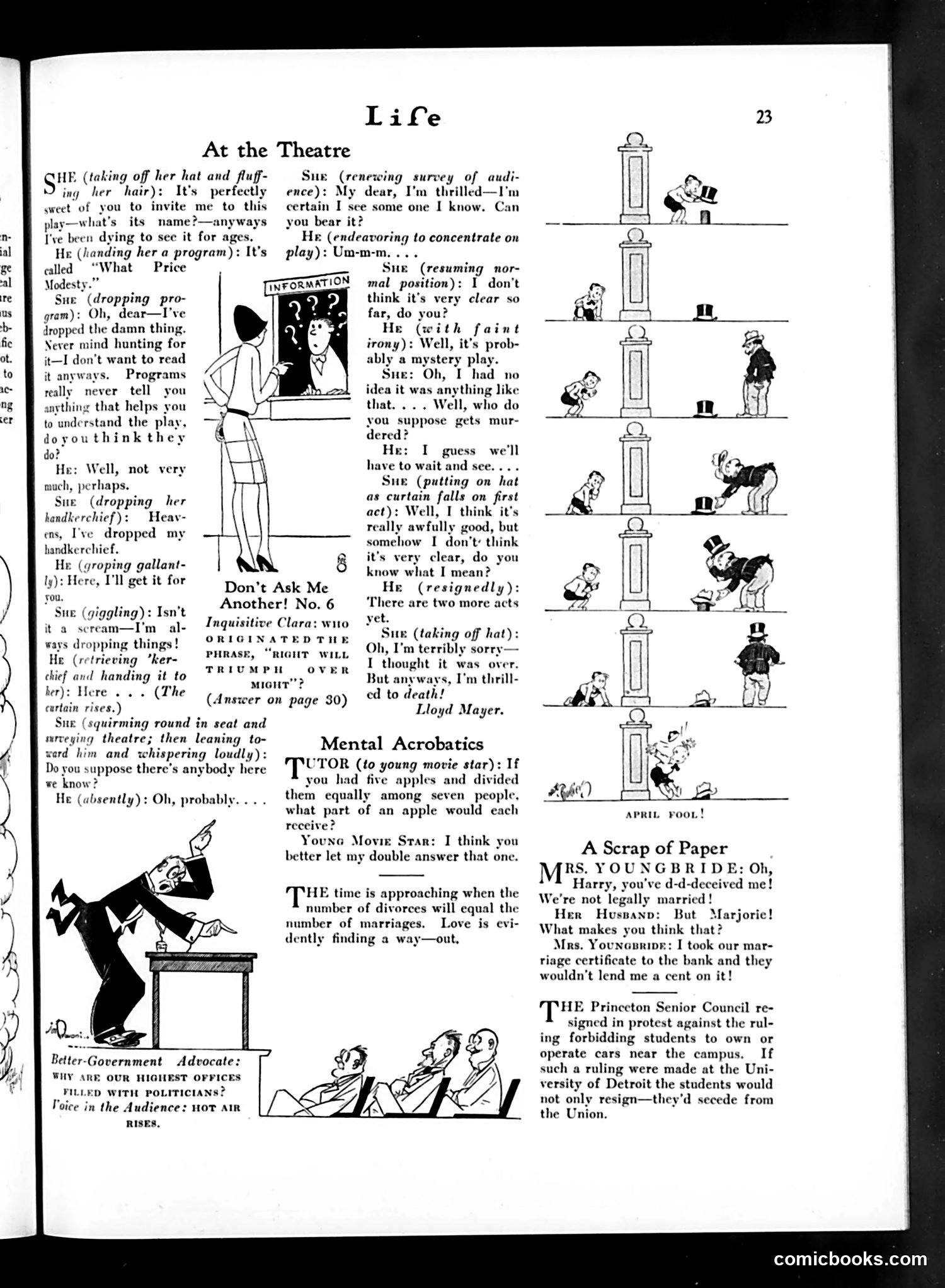
This page from *Life* magazine contains three separate satirical pieces: **"At the Theatre"** mocks shallow theatergoers—specifically a woman (Sue) more interested in socializing and being seen than actually watching the play. She constantly drops things to appear helpless, asks irrelevant questions, and admits she doesn't understand the plot while sitting through it. The humor targets people who attend cultural events for appearance rather than genuine engagement. **"Mental Acrobatics"** jokes about a young movie star's inability to solve a basic math problem, stereotyping Hollywood actors as intellectually dependent on stand-ins even for thinking. **"A Scrap of Paper"** and the "Better-Government" cartoon are brief political/social satire. The marriage certificate joke plays on 1920s-30s concerns about legal formality; the final item mocks Princeton students' entitled resistance to car restrictions by suggesting Detroit students would be even more rebellious—a regional class jab. The overall page satirizes vanity, intellectual pretension, and generational excess.
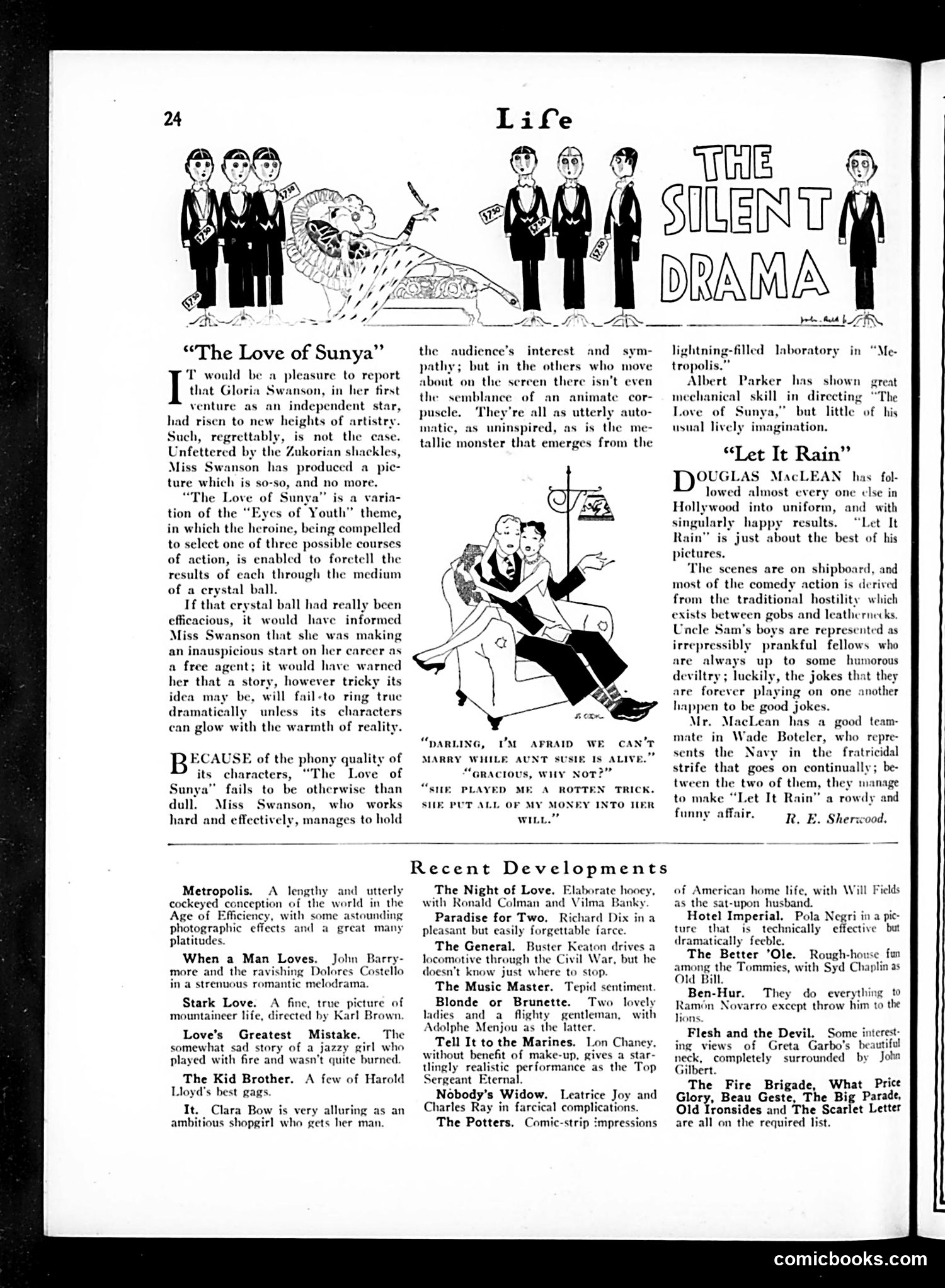
This page contains film reviews from Life magazine's satirical entertainment section. The main critique targets **Gloria Swanson's "The Love of Sunya,"** her first independent film after leaving producer Adolph Zukor's studio. The reviewer argues the film fails artistically despite its clever premise (a crystal-ball plot device allowing multiple story outcomes). The problem: phony characterization—the supporting cast lacks warmth and humanity, appearing "automatic" and uninspired. By contrast, **Douglas MacLean's "Let It Rain"** receives praise for its shipboard comedy featuring rivalry between Navy sailors and Marines (leathernecks). The humor derives from traditional service-branch hostility, presented through good-natured pranks. The **cartoon dialogue** depicts a marriage negotiation derailed when a woman reveals she "put all of my money into her will"—a dig at fortune-hunters and marriage deceptions, common satirical targets in 1920s comedy. The page also briefly reviews other current releases in Life's dismissive house style.
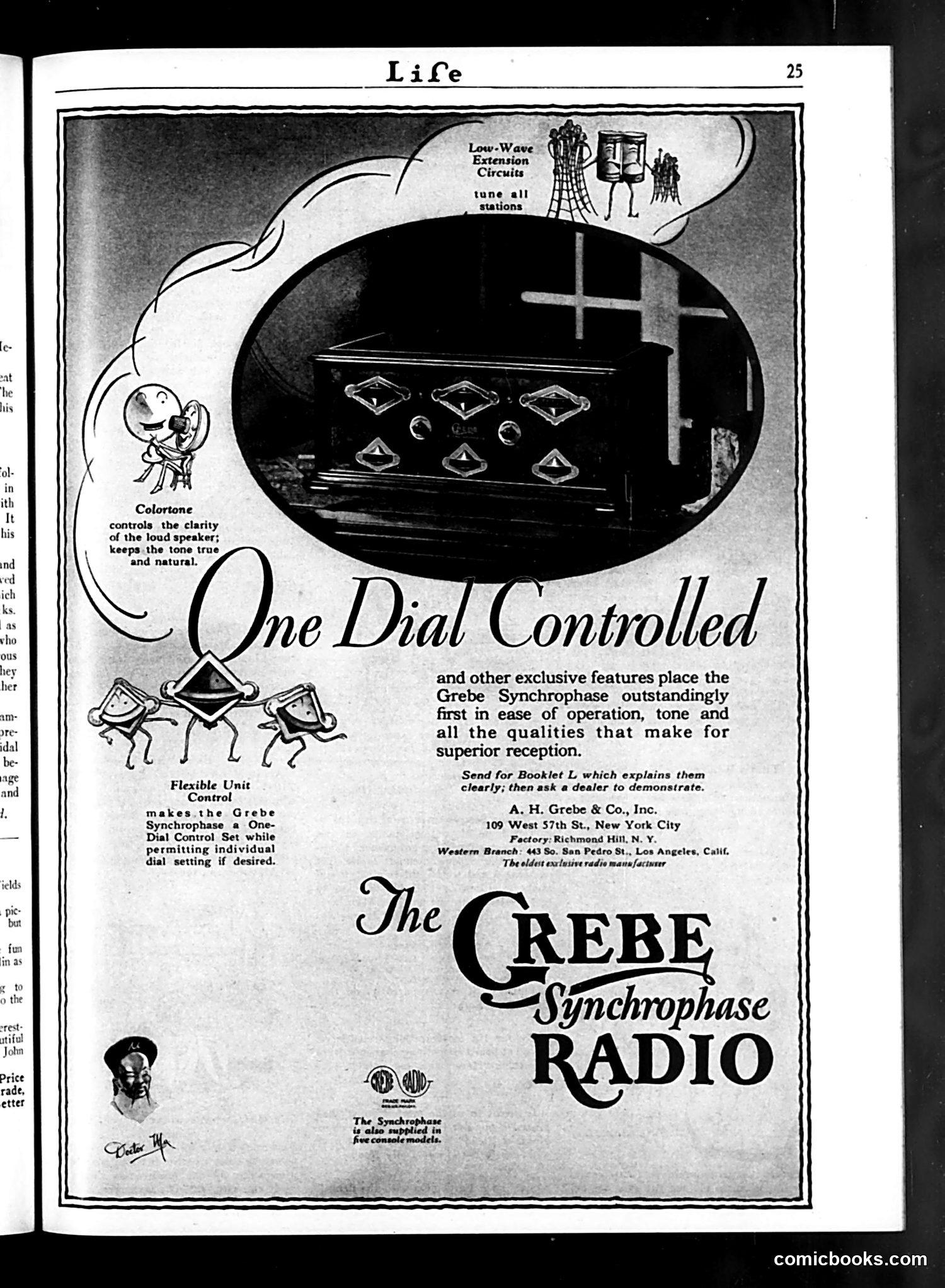
This is primarily a **product advertisement** for the Grebe Synchrophase Radio, not political satire. The page features whimsical cartoon characters (anthropomorphic radio dials/controls) that personify the radio's features. The "Colortone" character explains how the device controls speaker clarity, while the "Flexible Unit Control" mascots demonstrate the radio's one-dial operation capability. The humor is gentle and promotional rather than satirical—using cute, dancing figures to make radio technology accessible and appealing to 1920s consumers. The advertisement emphasizes user-friendly features: a single dial control, superior tone quality, and "ease of operation." This reflects the era when radio was still novel consumer technology requiring explanation to potential buyers. The playful mascots served to demystify complex mechanical features and build brand personality.
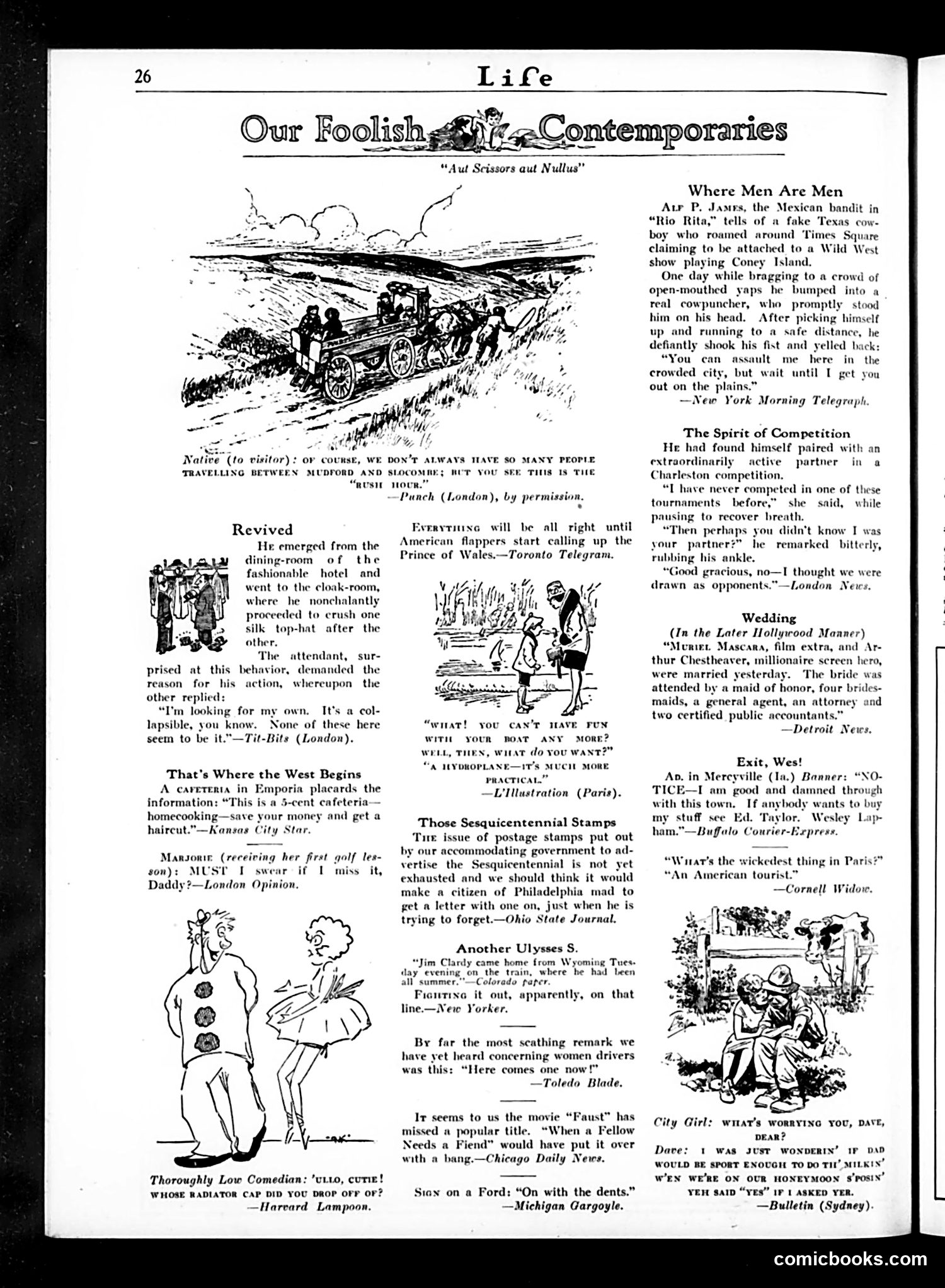
This page collects brief satirical jokes from various newspapers and magazines, mocking contemporary social behaviors and absurdities of the 1920s era. Key targets include: **Social pretension**: A hotel guest crushing silk top-hats searching for his collapsible one; a wealthy Hollywood bride surrounded by accountants and lawyers rather than genuine attendants. **Modern technology confusion**: A Parisian man requesting a hydroplane for his boat because it's "more practical"—satirizing how new inventions were adopted without understanding. **Women and modernity**: Jokes about female golfers swearing, women drivers (presented as incompetent), and American female tourists abroad as "the wickedest thing in Paris." **Post-war American identity**: Fake Texas cowboys in New York; confused small-town residents; references to the 1926 Sesquicentennial. The humor relies on incongruity and social observation typical of 1920s satirical magazines, with most jokes targeting newly affluent or pretentious Americans and modern social changes.
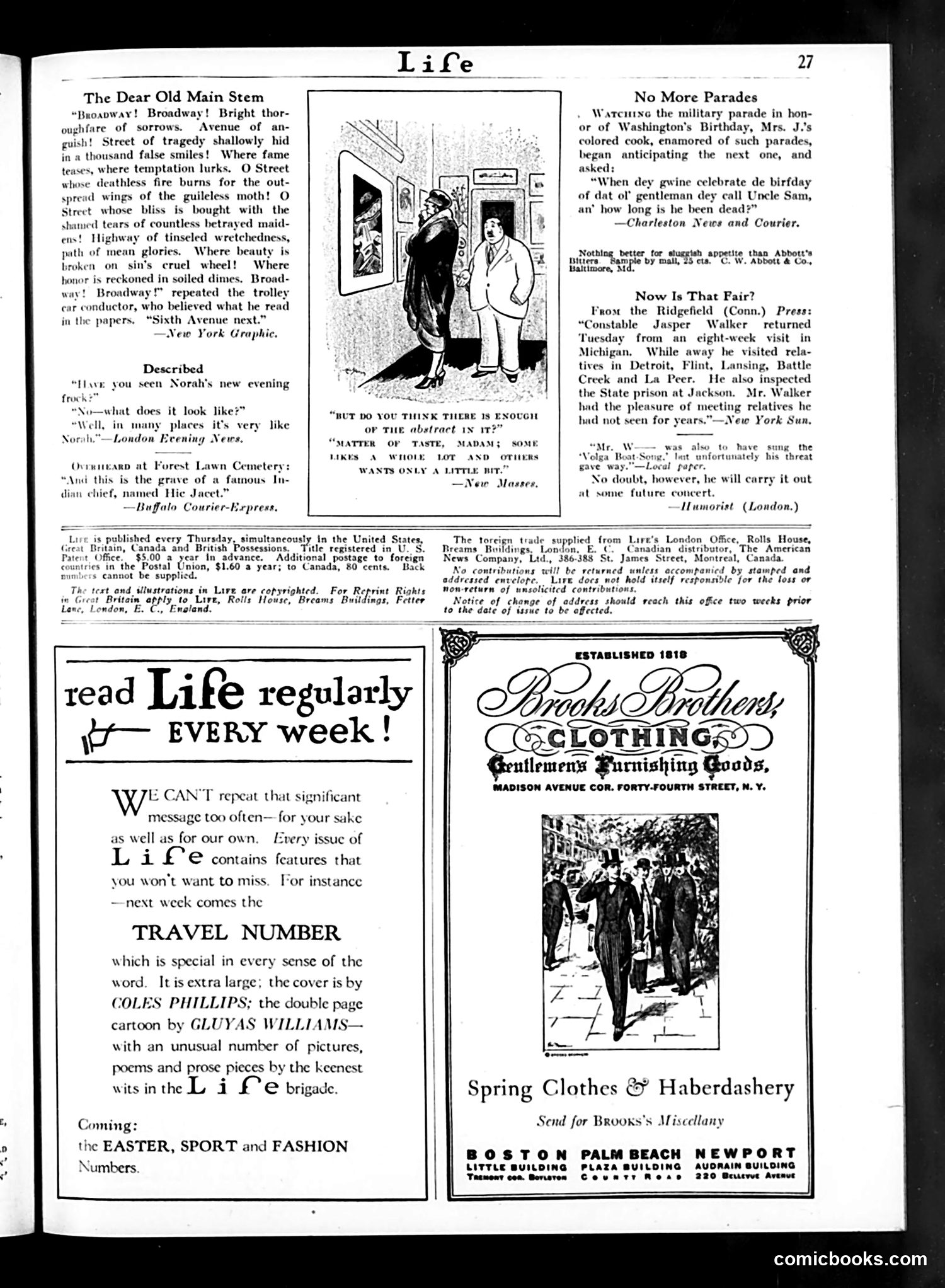
This page contains **four separate humor pieces** typical of Life's satirical format: 1. **"The Dear Old Main Stem"**: A mock-romantic lament about Broadway, parodying flowery theatrical language while depicting it as a place of moral decay and exploitation. The accompanying cartoon shows a street scene; the joke satirizes the gap between Broadway's glamorous reputation and its actual seediness. 2. **"Described"**: A brief visual gag about a woman's revealing evening dress, using euphemistic language ("in many places it's very Norah"). 3. **"No More Parades"**: A dialect-humor piece where a Black cook misunderstands the phrase "Uncle Sam's birthday," confusing the patriotic symbol with an actual deceased person—playing on perceived naiveté. 4. **"Now Is That Fair?"**: Reprints a newspaper excerpt with an unintentional double entendre about a constable who "had the pleasure of meeting relatives" (omitting that he visited a prison). The page primarily consists of these brief comedic vignettes rather than sustained political commentary, with advertisements filling the lower half.
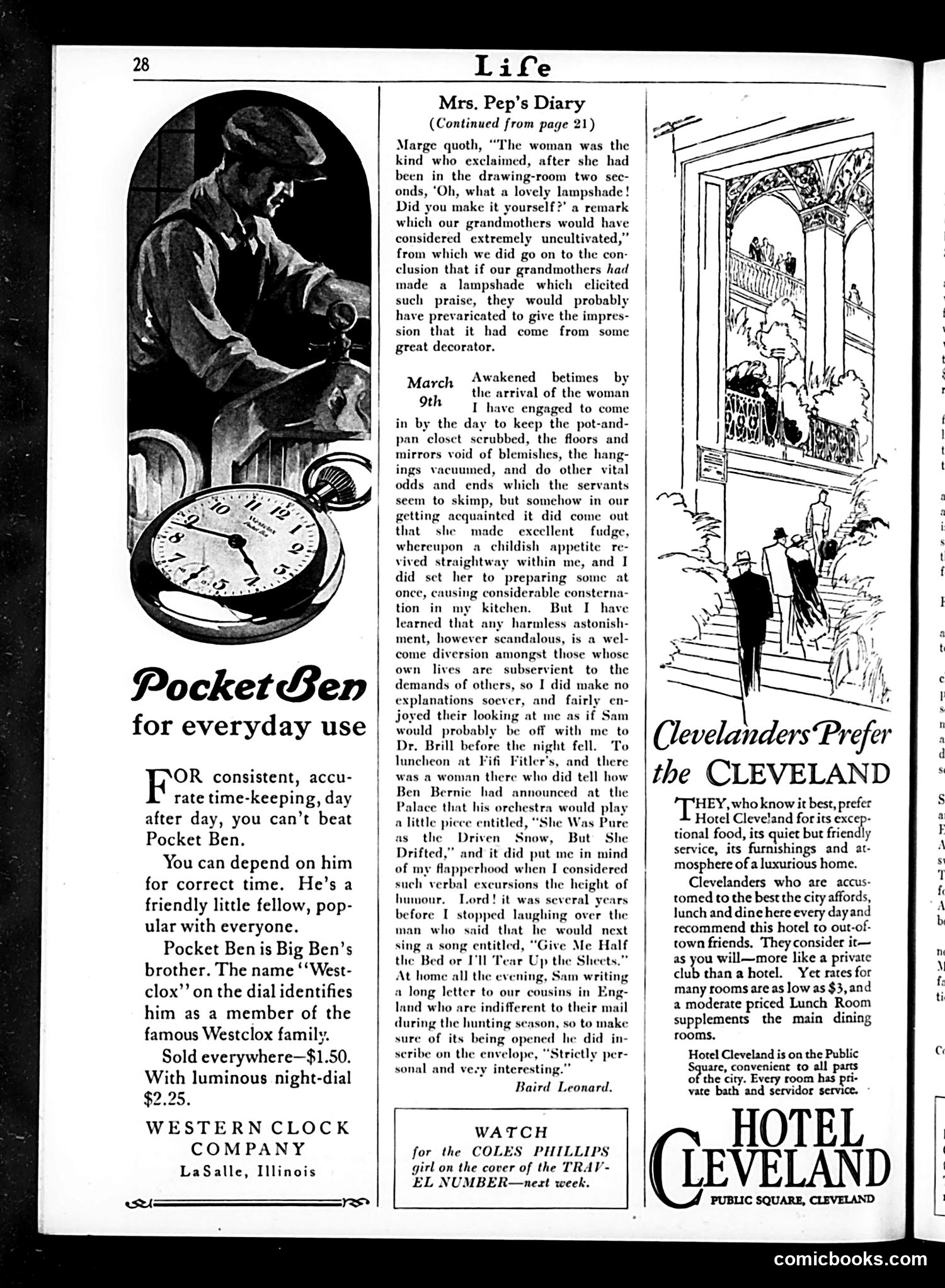
This page contains primarily **advertising** rather than political satire. The left side advertises **Pocket Ben**, a pocket watch made by Western Clock Company, using personification—Ben is "Big Ben's brother," presented as a "friendly little fellow" you can trust for accurate timekeeping. This was typical early-20th-century consumer marketing. The center features **Mrs. Pep's Diary**, a humor column satirizing upper-middle-class domestic life. The March 9th entry mocks genteel pretension: a visitor compliments a lampshade, prompting reflection on how grandmothers would have *lied* about its origins to seem cultured. The column also gently jokes about servants and "flapperhood" (youth indiscretions), reflecting period attitudes toward class and changing social mores. The right side advertises the **Hotel Cleveland**, appealing to wealthy locals by positioning it as more "club than hotel." The page reflects **1920s consumer culture and social humor** rather than political commentary.
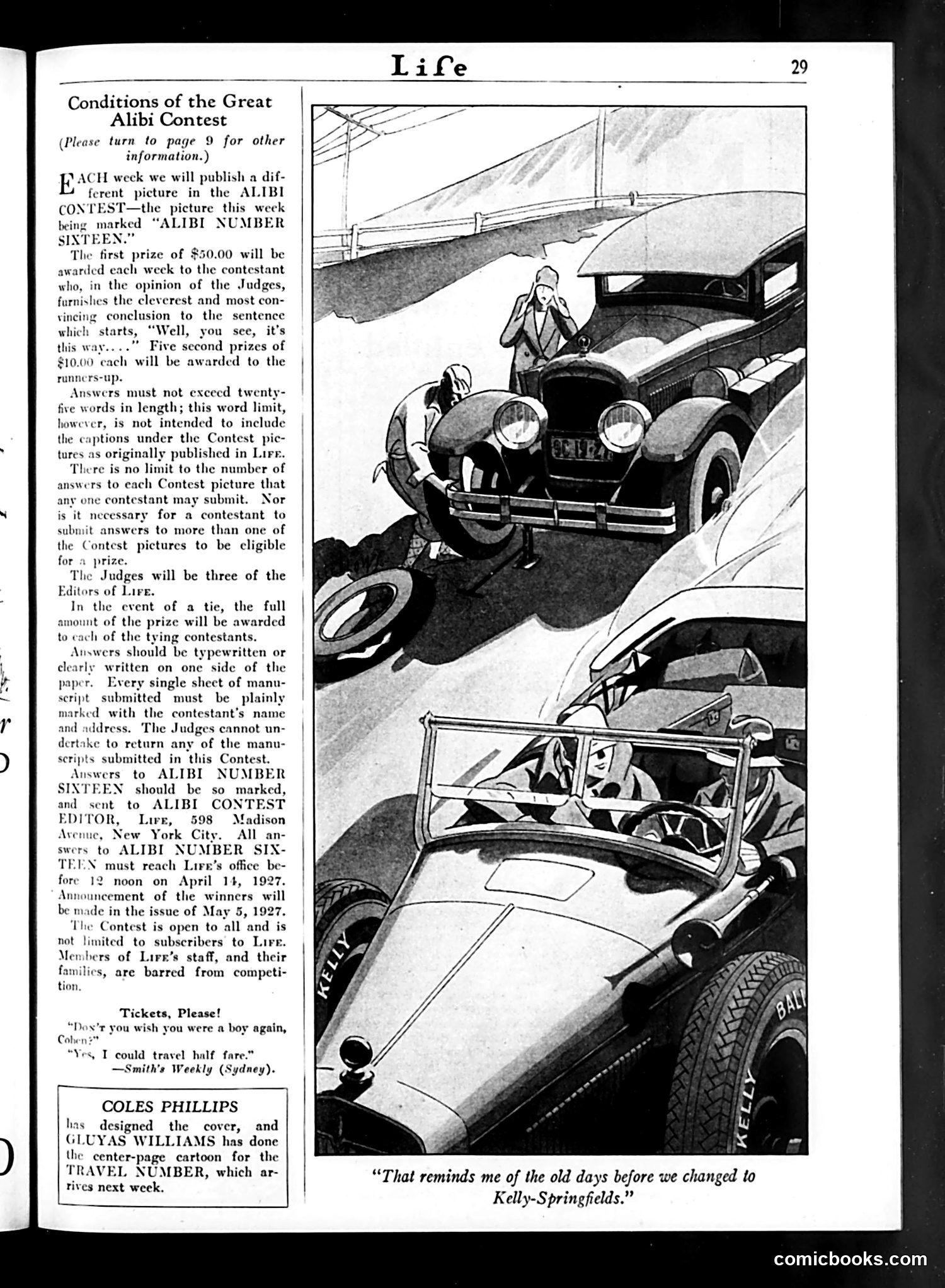
This page announces *Life* magazine's "Alibi Contest," a humor competition asking readers to complete the sentence "Well, you see, it's this way...." with clever explanations for awkward situations. The accompanying illustration shows a car accident scenario: two vehicles have collided, with occupants emerging looking sheepish. The caption reads, "That reminds me of the old days before we changed to Kelly-Springfields"—a joke implying the speaker is fabricating an excuse (an "alibi") by blaming the accident on inferior tires rather than admitting fault. The contest itself is satire on human nature: readers compete to invent the most convincing lies or excuses. The Kelly-Springfields reference is product placement/advertising humor, common in *Life*. The small joke below about wishing to be a boy to travel at half-fare relates to children's ticket discounts—a nostalgic dig at aging. The contest ran through April 1927, with $50 first prize and five $10 runner-up prizes.
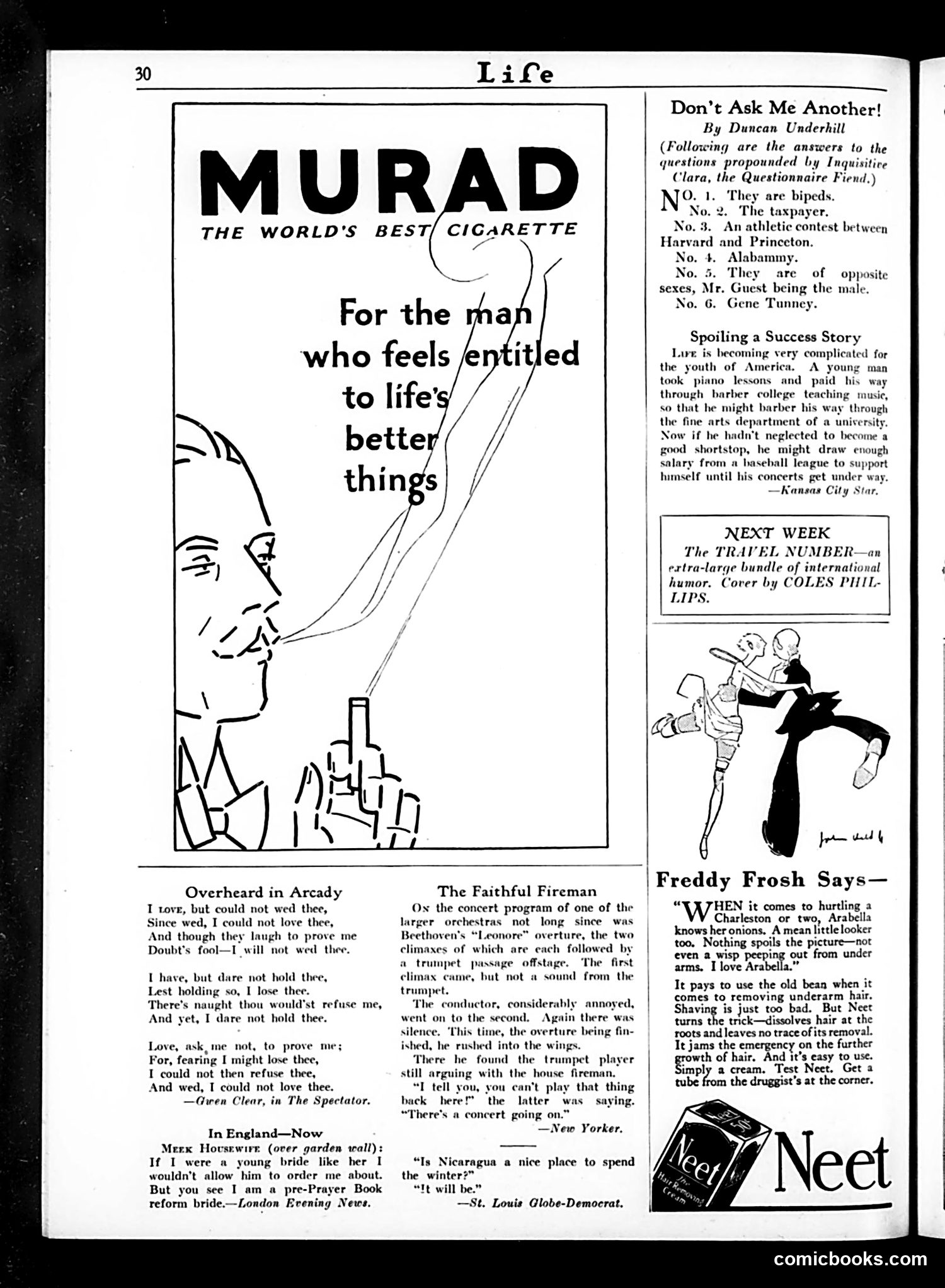
This page comprises **advertisements and humor pieces** typical of 1920s Life magazine. The dominant feature is a **Murad cigarette advertisement** targeting affluent men, using aspirational language ("life's better things"). This reflects the era's aggressive cigarette marketing before health warnings. The humor sections include: - **"Overheard in Arcady"**: A romantic poem about love's paradoxes (appears to reference classical pastoral literature) - **"The Faithful Fireman"**: A New Yorker anecdote where a theater fireman prevents an off-stage trumpet player from performing during Beethoven's "Leonore" overture—satire of rigid bureaucratic rules interrupting art - **"In England—Now"**: A joke about modern women rejecting traditional marital obedience (likely referencing post-WWI social changes and women's suffrage) - **"Don't Ask Me Another"**: A Q&A column with absurdist answers (Gene Tunney, a 1920s boxer, appears as answer to question 6) - **"Freddy Frosh Says"**: An advertisement for Neet hair removal, using slang ("knows her onions," "Charleston") to target young women concerned about underarm hair visibility during the flapper era
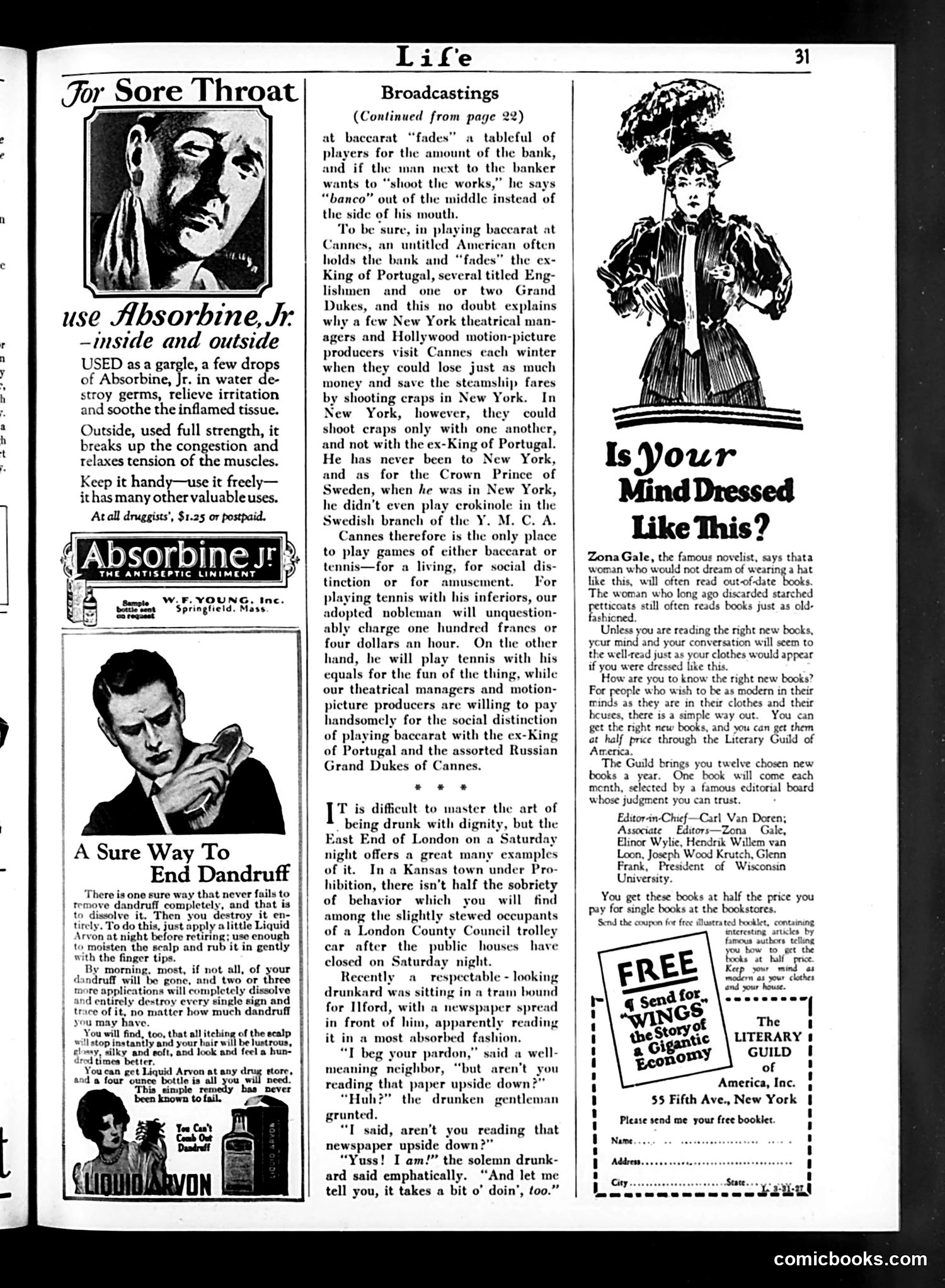
This page contains primarily **advertisements and a humor column** rather than political satire. The ads promote **Absorbine Jr.** (a medicinal liniment) and **Liquid Arvon** (a dandruff treatment)—typical early 20th-century patent medicines with broad, dubious claims. The main editorial content is a "Broadcastings" humor piece about gambling and drinking in Europe. It mocks wealthy Americans visiting **Cannes**, France, who gamble at baccarat with European nobility (ex-Kings, Grand Dukes) to gain social status—when they could gamble cheaply in New York but prefer the prestige of European company. The second anecdote satirizes London's working-class drunk on a Saturday night, reading a newspaper **upside down** on a tram. The joke relies on the drunk's matter-of-fact insistence he's doing it intentionally ("it takes a bit o' doin'")—gentle satire about dignity-in-inebriation rather than social critique. The page also advertises the **Literary Guild** book club service.
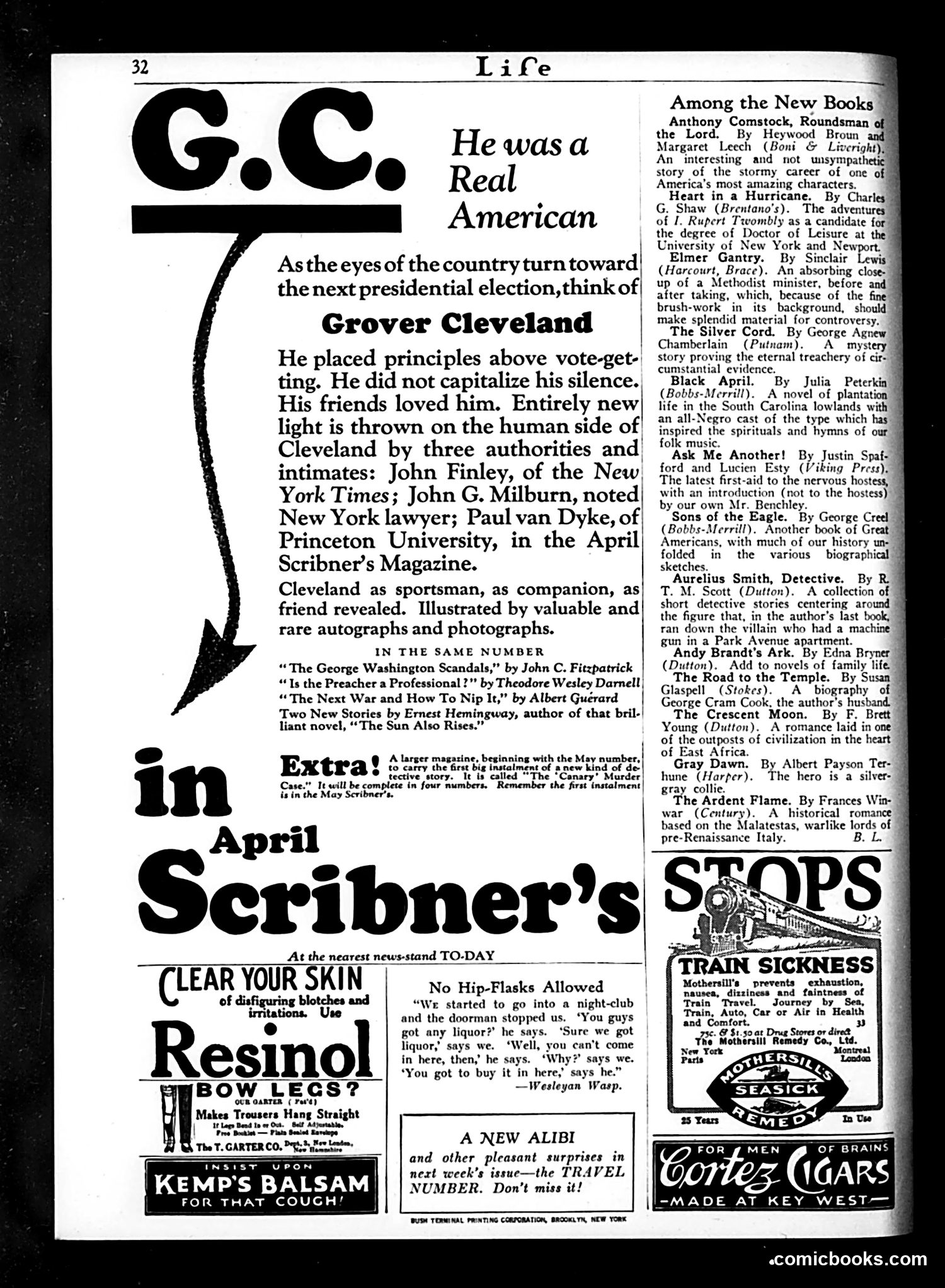
This page features a prominent article celebrating **Grover Cleveland**, the 22nd and 24th U.S. President, as the presidential election season approaches. The large illustration and accompanying text present Cleveland as a principled statesman who "placed principles above vote-getting" and "did not capitalize his silence." The article announces that three prominent authorities—John Finley (New York Times), John G. Milburn (lawyer), and Paul van Dyke (Princeton University)—have contributed pieces to the April *Scribner's Magazine* offering "entirely new light" on Cleveland's character as a sportsman, companion, and friend, supported by rare photographs and autographs. The satire is subtle: by framing Cleveland in such reverential, nostalgic terms during a new election cycle, *Life* appears to be gently mocking contemporary politics by suggesting that such principled leadership is now notably absent. The contrast between Cleveland's celebrated integrity and the self-serving politicians of the 1920s forms the implicit joke—the magazine asks readers to "think of Grover Cleveland" when considering the upcoming election. The remainder of the page consists of book reviews and advertisements.

I can see this is a very dark, low-contrast black and white image that appears to be from a historical publication. However, the image quality is too poor for me to reliably make out specific cartoon details, facial features, captions, or other identifying elements that would allow me to accurately explain the satire or references. While text reading "comicbooks.com" is visible at the bottom, the actual cartoon content—including any figures, caricatures, or political references—is not sufficiently clear in this scan for me to responsibly identify specific individuals or explain the intended satirical meaning. To properly analyze this page, a higher-contrast or higher-resolution image would be needed.