
Life, 1927-03-31 · page 7 of 35
Life — March 31, 1927 — page 7: what you’re looking at
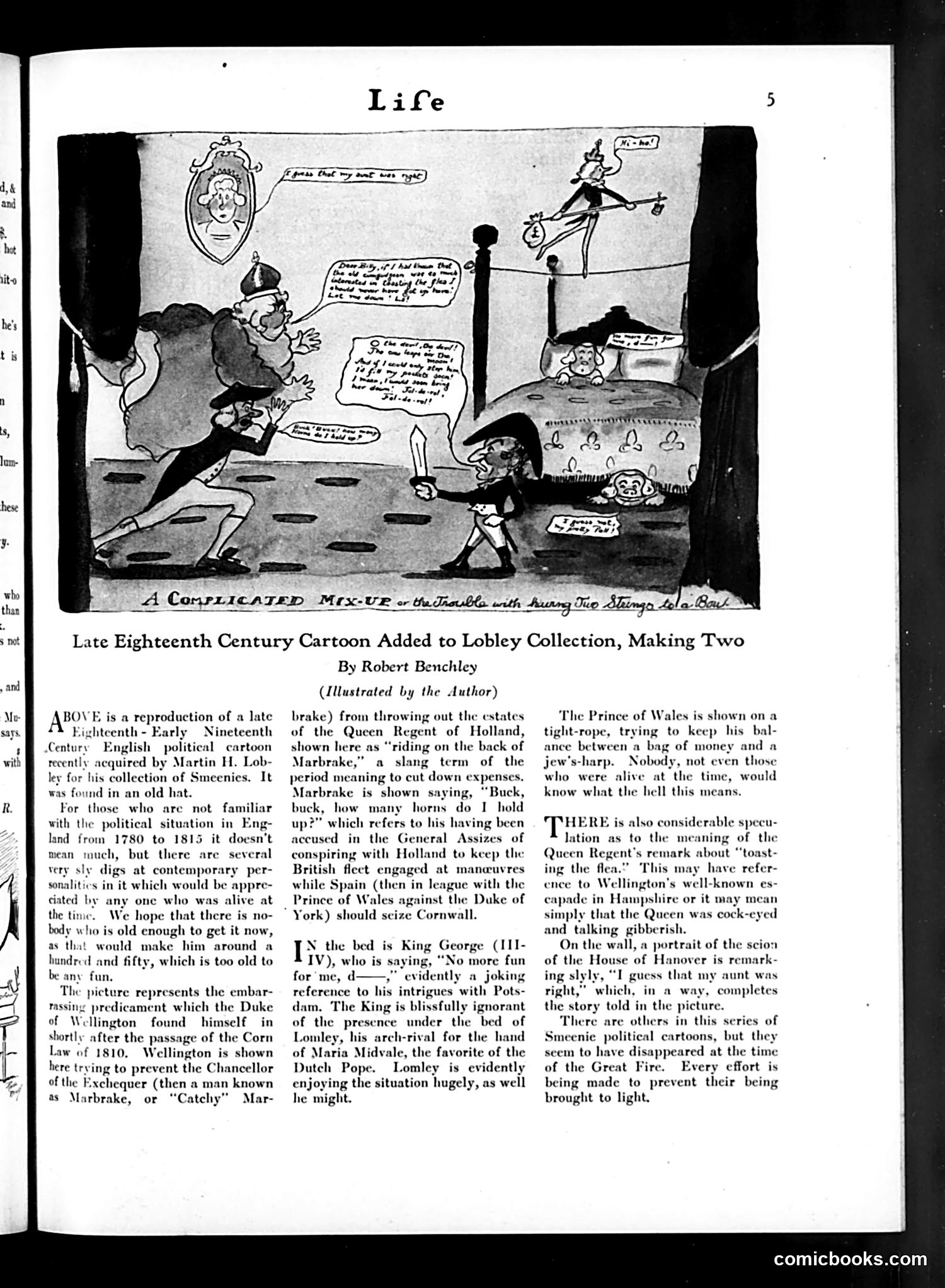
What you’re looking at
This late 18th/early 19th-century cartoon satirizes British political figures during the Napoleonic era (1780-1815). The text identifies **King George III** in bed, **the Duke of Wellington** (attempting to prevent Chancellor Castlereagh from acting), and **the Prince of Wales** balancing precariously on a tightrope between a money bag and a Jewish moneylender's blade. The satire targets the Prince's notorious debts and financial scandals, his political rivalries, and the broader chaos of wartime governance. References to "Marbrake" (slang for cutting expenses) and intrigues with Potsdam suggest critiques of military spending and diplomatic maneuvers. The cartoon's title promises "a complicated mix-up" involving these power struggles—typical of *Life* magazine's biting political humor mocking the era's leadership.
📄 Transcribed text from this page (OCR, searchable)
Machine-transcribed from the original scan — historical spelling and the odd misread are preserved.
Dror Bibs if had Oann toat the oly cans wae ta mh aes 5 ade 0 ° aie ‘ A Compre n TED MiIx-UR o te Tiable with husng Ti Bhima, Lola: Bows. Late Eighteenth Century Cartoon Added to Lobley Collection, Making Two ApoY s a reproduction of a late E enth- Early Nineteenth Century English political cartoon recently acquired by Martin H. Lob- key for his collection of Smeenics. It was found in an old hat. For those who are not fami with the political situation in En; land from 1780 to 1815 it doesn’t mean much, but there are several very sly digs at contemporary per- sonalities in it which would be appre- ciated by any one who was alive at the tine. We hope that there is no- body who is old enough to get it now, as that would make him around a hundred and fifty, which is too old to be any fun, The picture represents the embar- rassing predicament which the Duke of Wellington found himself in shortly after the passage of the Corn Law of 1810, Wellington is shown here trying to prevent the Chancellor of the Exchequer (then a man known as Marbrake, or “Catchy” Mar- By Robert Benchley (Illustrated by the Author) brake) from throwing out the estates of the Queen Regent of Holland, shown here as “riding on the back of Marbrake,” a slang term of the period meaning to cut down expenses, Marbrake is shown saying, “Buck, buck, how many horns do I hold up?” which refers to his having been accused in the General Assizes of conspiring with Holland to keep the British flect engaged at manauvres while Spain (the league with the Prince of Wale st the Duke of York) should seize Cornwall. [4 the bed is King George (III- IV), who is ing, “No more fun forme, d evidently a joking reference to his intrigues with Pots- dam. The King is blissfully ignorant of the presence under the bed of Lomley, his arch-rival for the hand of Maria Midvale, the favorite of the Dutch Pope. Lomley is evidently enjoying the situation hugely, as well he might. The Prince of Wales is shown on a tight-rope, trying to keep his bal- ance betwe bag of money and a jew's-harp. Nobody, not even those who were alive at the time, would know what the hell this means. HERE is also considerable specu- lation as to the meaning of the Queen Regent’s remark about “toast- ing the f This may have refer- : ‘Hington’s well-known es- ypshire or it may mean y ren Was COCcK~ and talking gibberish, On the wall, a portrait of the scion of the House of Hanover is rem ess that my a : a the story told in the pictu There are others in this series of Smeenie political cartoons, but they seem to have d ed at the time of the Great Fire very effort is being made to prevent their being brought to light, comicbooks.com