
Life, 1927-03-31 · page 20 of 35
Life — March 31, 1927 — page 20: what you’re looking at
What you’re looking at
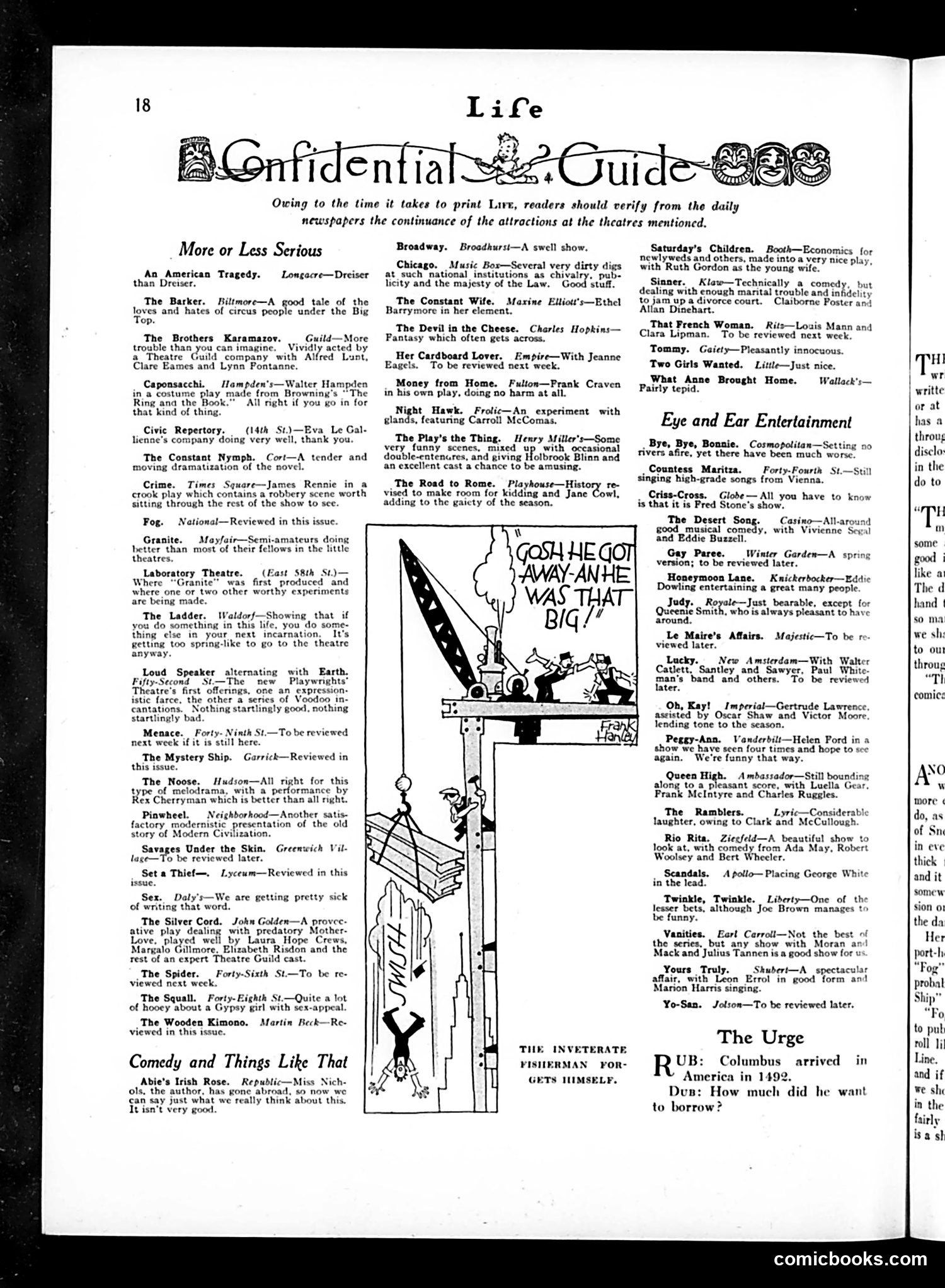
This is a theater review section from Life magazine listing Broadway and off-Broadway shows circa mid-1920s. The cartoons and layout are characteristic of Life's satirical style during this era. The large central cartoon depicts a figure at a theater box office window, with the caption "GOSH HE GOT AWAY AN' HE WAS THAT BIG"—likely mocking either ticket scalpers' exaggerated claims about sold-out shows or patrons' inflated memories of performances they attended. The reviews themselves are tongue-in-cheek critiques of contemporary theater. Notable is the comment on *Abie's Irish Rose* (a then-famous play): the reviewer states since the author "has gone abroad, so now we can say just what we really think about this. It isn't very good"—a characteristic Life jab at a popular work they considered mediocre. Reviews range from brief dismissals ("It isn't very good") to backhanded compliments ("All right if you go in for that kind of thing"). The content reflects 1920s theater culture and Life's sophisticated, sardonic editorial voice.
📄 Transcribed text from this page (OCR, searchable)
Machine-transcribed from the original scan — historical spelling and the odd misread are preserved.
Owing to the time it takes to print Live, readers should verify from the daily newspapers the continuance of the attractions at the theatres mentioned. More or Less Serious An American Tragedy. than Dreiser. The Barker. Biltmore—A good tale of the loves and hates of circus people under the Big ‘op. Longacre— Dreiser The Brothers Karamazov. Guild—More trouble than you can imagine. Vividly acted by a Theatre Guild company with Alfred Lunt, Clare Eames and Lynn Pontanne, Caponsacchi. Hampden's—Walter Hampden in a costume play made from Browning's “The Ring ana the Book.” All right if you go in for that kind of thing. —Eva_ Le Gal- Civic Repertory, (14th I, thank you. lien: company doing very The Constant Nymph. Cort—A tender and moving dramatization of the novel. Crime. Times Square—James Rennie in a crook play which contains a robbery scene worth sitting through the rest of the show to sce. Fog. National—Reviewed in this issue. Granite. Mayfair—Semi-amateurs doing better than most of their fellows in the little theatres, Laboratory Theatre. (East S8th St.)— Where “Granite” was first produced and where one or two other worthy experiments are being made. The Ladder. 1Waldorf—Showing that if you do something in this life, you do some- thing else in your next incarnation, It's getting too spring-like to go to the theatre anyway. Loud Speaker alternating with Earth, Fifty-Second. St—The new Playwrights’ Theatre's first offerings, one an expression istic farce, the other a series of Voodoo in- cantations. Nothing startlingly good, nothing startlingly bad Menace. Forty- Ninth St—To be reviewed next week if it is still here. The Mystery Ship. Garrick—Reviewed in this issue. The Noose. Hudson—All right for this type of melodrama, with a performance by Rex Cherryman which is better than all right. Pinwheel. — Neighborhood—Another satis- factory modernistic presentation of the old story of Modern Civilization. Savages Under the Skin. Greenwich Vil- lage—To be reviewed later. Seta Thief—. Lyceum—Reviewed in this issue. Sex. Daly's—We are getting pretty sick of writing that word. The Silver Cord. John Golden—A provee- ative play dealing with predatory Mother- Love, played well _by Laura Hope Crews, Margalo Gilmore. Elizabeth Risdon and the rest of an expert Theatre Guild cast. The Spider. — Forty-Sixth St—To be re- viewed next week. The Squall. Forty-Eighth St.—Quite a lot of hooey about a Gypsy girl with sex-appeal. The Wooden Kimono. Martin Beck—Re- viewed in this issue. Comedy and Things Like That Abie's Irish Rose. Republic—Miss Nich- ols, the author, has gone abroad, so now we can say just what we really think about this. It isn’t very good. Broadway. Broadhursi—A swell show. Chicago. Music Box—Several very dirty digs at such national institutions as chivalry, pub- licity and the majesty of the Law. Good stuf. The Constant Wife. Maxine Eltiott's—Ethel Barrymore in her element. The Devil in the Cheese. Charles Hopkins— Pantasy which often gets across. Her Cardboard Lover. Empire—With Jeanne Eagels. To be reviewed next week. Money from Home. Fulton—Prank Craven in his own play, doing no harm at all. Night Hawk. Frolic—An experiment with glands, featuring Carroll McComas. The Play's the Thing. Henry Miller’s—Some very funny scenes, mixed up with occasional double-entenares, and giving Holbrook Blinn and an excellent cast a chance to be amusing. _The Road to Rome. Playhouse—History re- vised to make room for kidding and Jane Cowl, adding to the gaicty of the season. THE FISHERMAN GETS ILIMSELF. INVETERATE ror- Saturday’s Children. Booth—Economics for newlyweds and others, made into a very nice play with Ruth Gordon as the young wife. . Sinner. Klaw—Technically a comedy dealing with enough marital trouble and inh to jam up a divorce court. Claiborne Poster and Allan Dinebart. “ That French Woman. Rit>—Louis M. t Clara Lipman. To be reviewed next week. and Tommy. Gaiety—Pleasantly innocuous. Two Girls Wanted. Littl—Just nice. What Anne Brought Home. — Wallack's— Pairly tepid. Eye and Ear Entertainment _ Bye, Bye, Bonnie. Cosmopolitan—Set rivers afire, yet there have been much worse _ Countess Maritza. —Forty-Fourth St.—Still singing high-grade songs from Vienna. __ Criss-Cross. Globe— All you have to know is that it is Pred Stone’s show. The Desert Song. Casino—All-aro: good musical comedy, with Vivienne Seal and Eddie Buzzell. Gay Paree. Winter Garden—A spring version; to be reviewed later. Honeymoon Lane. Knickerbocker—Eddic Dowling entertaining a great many people. Judy. Royale—Just bearable, except for Queenfe Smith, who is always pleasant to have around. Le Maire’s Affairs. viewed later. Lucky. New Amsterdam—With Walter Catlett, ‘Santley and Sawyer, Paul White- man’s band and others. To be reviewed later. Oh, Kay! _Imperial—Gertrude Lawrence. aseisted by Oscar Shaw and Victor Moore. lending tone to the season. Peggy-Ana. Vanderbilt—Helen Ford in a show we have seen four times and hope to see again. We're funny that way. Queen High. A mbassador—Still bounding along to a pleasant score, with Luella Gear, Prank McIntyre and Charles Ruggles. The Ramblers. Lyric—Considerable laughter, owing to Clark and McCullough. Rio Rita. Ziecfeld—A beautiful show to look at, with comedy from Ada May, Robert Woolsey and Bert Wheeler. Scandals. A pollo— Placing George White in the lead. Twinkle, Twinkle. Liderty—One of the lesser bets, although Joe Brown manages to be funny. Vanities. Earl Carroll—Not the best of the series, but any show with Moran an! Mack and Julius Tannen is a good show for ws. Yours Truly. — Shuber!—A spectacular affair, with Leon Errol in good form anil Marion Harris singing. Yo-San. Jolson—To be reviewed later. The Urge arrived in Majestic—To be re- UB: Columbus America in 1492. Dus: How much did he want to borrow? TH wr writte or at has a throug disel in the do to “TH m some good | like a The d hand | so ma we shi to ou throug “Th comics A 0 w more | do, as of Sn in eve thick and it somew sion o1 the da Her port-h comicbooks.com