
Life, 1927-03-31 · page 26 of 35
Life — March 31, 1927 — page 26: what you’re looking at
What you’re looking at
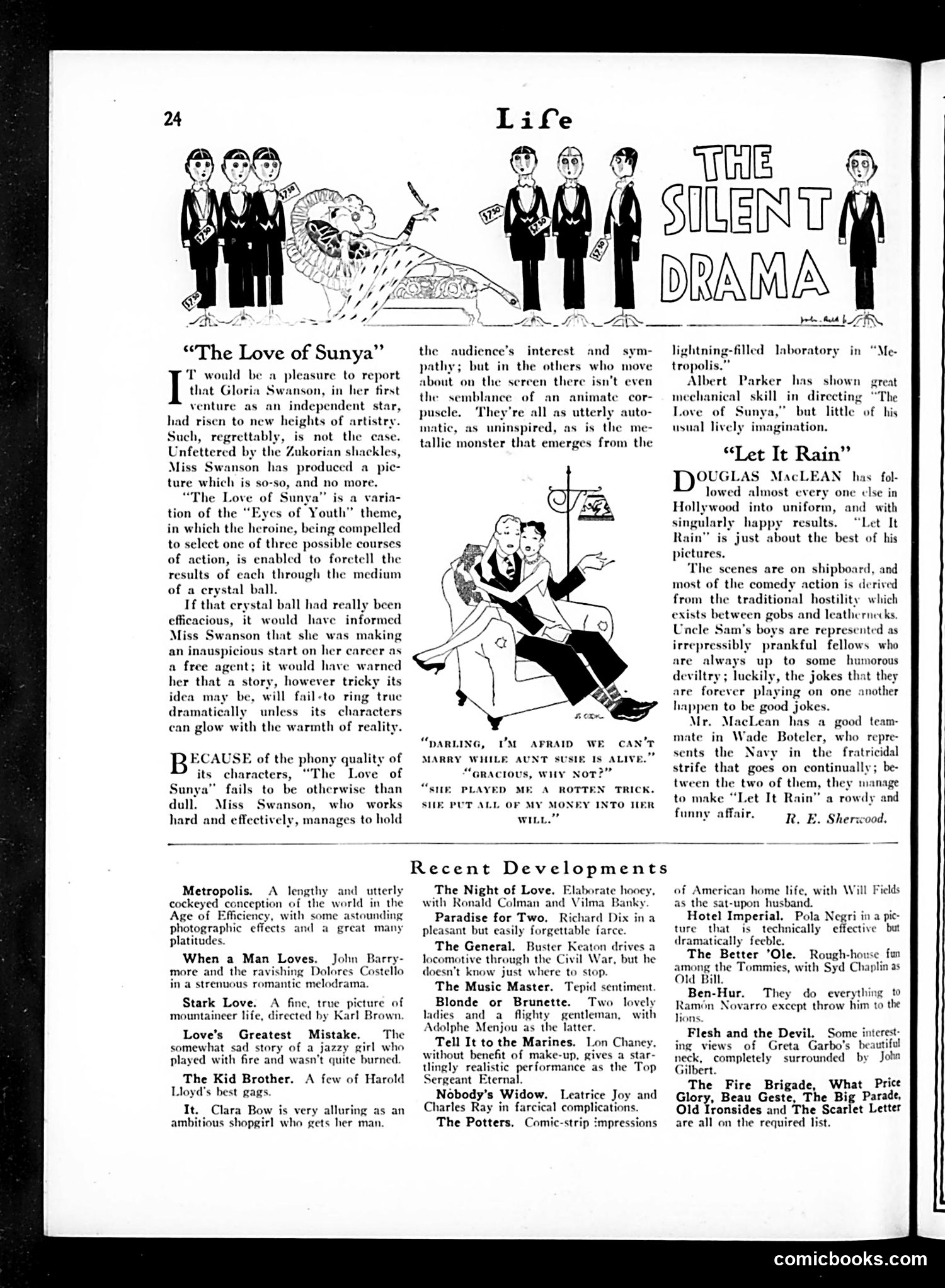
This page contains film reviews from Life magazine's satirical entertainment section. The main critique targets **Gloria Swanson's "The Love of Sunya,"** her first independent film after leaving producer Adolph Zukor's studio. The reviewer argues the film fails artistically despite its clever premise (a crystal-ball plot device allowing multiple story outcomes). The problem: phony characterization—the supporting cast lacks warmth and humanity, appearing "automatic" and uninspired. By contrast, **Douglas MacLean's "Let It Rain"** receives praise for its shipboard comedy featuring rivalry between Navy sailors and Marines (leathernecks). The humor derives from traditional service-branch hostility, presented through good-natured pranks. The **cartoon dialogue** depicts a marriage negotiation derailed when a woman reveals she "put all of my money into her will"—a dig at fortune-hunters and marriage deceptions, common satirical targets in 1920s comedy. The page also briefly reviews other current releases in Life's dismissive house style.
📄 Transcribed text from this page (OCR, searchable)
Machine-transcribed from the original scan — historical spelling and the odd misread are preserved.
“The Love of Sunya”’ ' would be a pleasure to report that Gloria Swanson, in her first venture as an independent star, had risen to new heights of artistry. Such, regrettably, is not the case. Unfettered by the Zukorian shackles, Miss Swanson has produced a_pic- ture which is so-so, and no more. “The Love of Sunya” is a varia- tion of the “Eyes of Youth” theme, in which the heroine, being compelled to select one of three possible courses of action, is enabled to foretell the results of each through the medium of a crystal ball. If that crystal ball had really been efficacious, it would have informed Miss Swanson that she was making an inauspicious start on her career as a free agent; it would have warned her that a story, however tricky its idea may be, will fail-to ring true dramatically unless its characters can glow with the warmth of reality. ECAUSE of the phony quality of its characters, “The Love of Sunya” fails to be otherwise than dull. Miss Swanson, who works hard and effectively, manages to hold the audience’s interest and sym- pathy; but in the others who move about on the sereen there isn’t even the semblance of an animate cor- puscle, They're all as utterly auto- matic, as uninspired, as is the me- tallic monster that emerges from the SOK CAN'T “DARLING, UM MARRY WHILE “Gracious, WHY NoT? “SIE PLAYED ME A ROT TRICK. SHE PUT ALL OF MY MONEY INTO TIER WILL.” AFRAID WE AUNT SUSIE IS ALIV: filled laboratory in Albert) Parker nical skill of Sur has shown in direc AN has fol- almost every one clse in Hollywood » uniform, and with singularly happy results. “Let It Rain” is just about the best of his pictures, The scenes are on shipboard, and most of the comedy action is derived from the traditional hostility which exists between gobs and leathernecks. Uncle Sam's boys are represented as irrepressibly prankful fellows who always up to some humorous deviltry ; luckily, the jokes that they are forever playing on one another happen to be good jokes. Mr. MacLean has a good team- mate in Wade Boteler, who repre- sents the Navy in the fratricidal strife that goes on continually; be- tween the two of them, they manage to maki et It Rain” a rowdy and funny affair. R. E. Sherwood. Metropolis. A lengthy and_ utterly cockeyed conception of the world in the Age of Efficiency, with some astounding photographic effects and a great many platitudes. When a Man Loves. John Barry- more and the ravishing Dolores Costello in a strenuous romantic melodrama. Stark Love. A fine, true picture of mountaineer life, directed by Karl Brown. Love’s Greatest Mistake. The somewhat sad story of a jazzy girl who played with fire and wasn’t quite burned. The Kid Brother. A few of Harold Lloyd's best gags. It. Clara Bow is very alluring as an ambitious shopgirl who gets her man. Recent Developments ‘The Night of Love. Elaborate hooey, with Ronald Colman and Vilma Banky Paradise for Two. Richard Dix ina pleasant but easily forgettable farce. The General. Buster Keaton drives a locomotive through the Civil War, but he doesn’t know just where to stop, The Music Master. Tepid sentiment Blonde or Brunette. Two lovely ladies and a flighty gentleman, with Adolphe Menjou as the latter. Tell It to the Marines. Lon Chaney, without benefit of make-up, gives a star- tlingly realistic performance as the Top Sergeant Eternal. Nobody’s Widow. Leatrice Joy and Charles Ray in farcical complications. The Potters. Comic-strip impressions American home life, with Will Fields as the sat-upon husband. Hotel Imperial. Pola Negri in a pic- ture that is technically effective but dramatically feeble. The Better ‘Ole. Rough-house fun among the Tommies, with Syd Chaplin as Old Bill. Ben-Hur. They do everything to Ramon Novarro except throw him to the lions, Flesh and the Devil. Some interest- ing views of Greta Garbo’s beautiful neck, completely surrounded by Joha Gilbert. The Fire Brigade, What Price Glory, Beau Geste, The Big Parade, Old Ironsides and The Scarlet Letter are all on the required list. comicbooks.com