
Life, 1927-03-31 · page 16 of 35
Life — March 31, 1927 — page 16: what you’re looking at
What you’re looking at
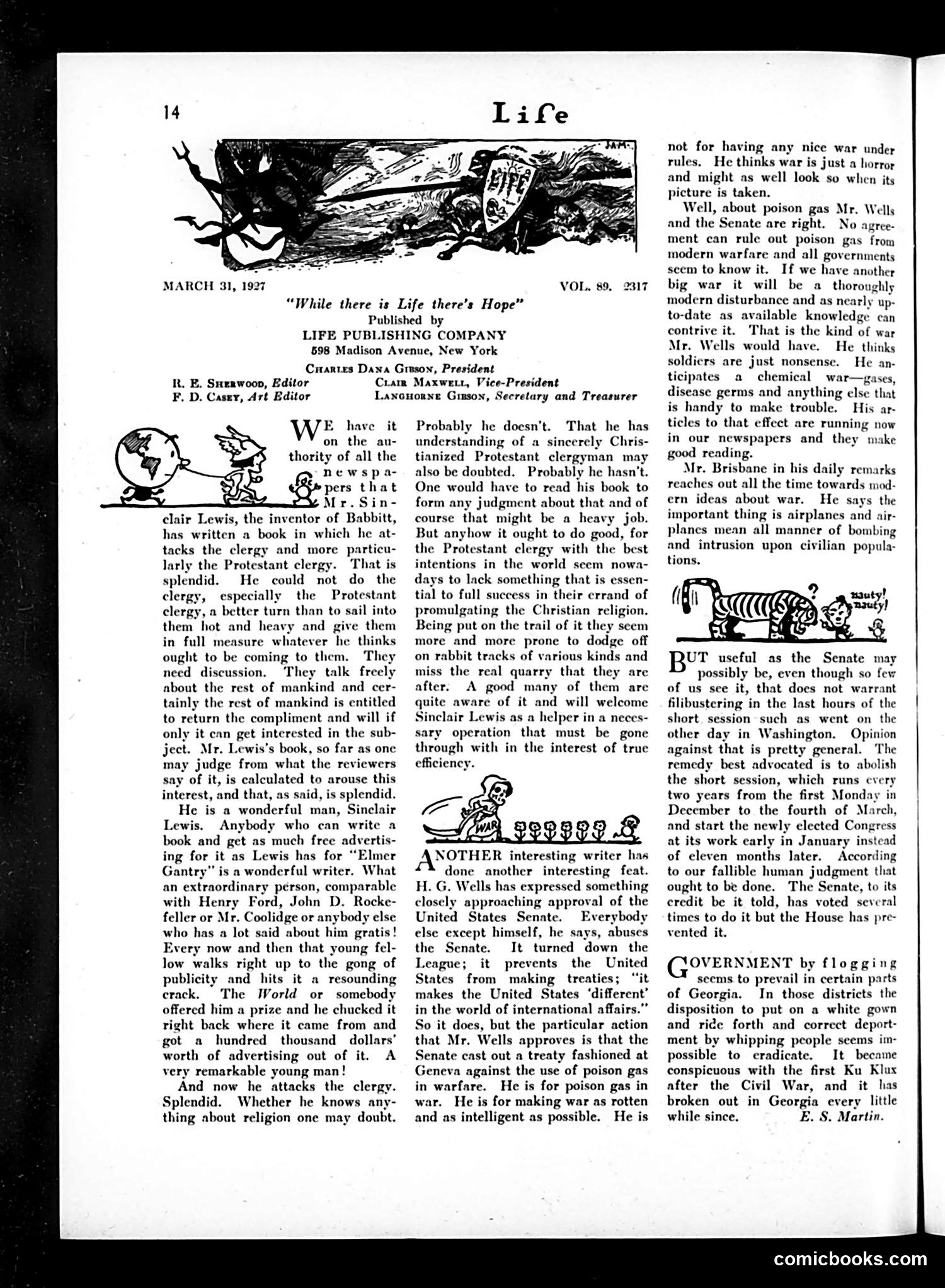
This page discusses **Sinclair Lewis's book attacking Protestant clergy**. The editorial praises Lewis as a "wonderful man" for his critique, while acknowledging the clergy may not appreciate being portrayed as self-interested and ineffectual at promoting genuine Christian values. The text also mentions **H.G. Wells's approval of poison gas in warfare**—apparently Wells supports making war "modern" and "intelligent" through chemical weapons, though the editor finds this troubling. A third item addresses **government flogging in Georgia**, describing it as a brutal punishment method that persists despite being outdated. The cartoons (small, sketchy illustrations) appear to accompany these critiques but are too unclear in this reproduction to interpret with confidence.
📄 Transcribed text from this page (OCR, searchable)
Machine-transcribed from the original scan — historical spelling and the odd misread are preserved.
MARCH 31, 1927 VOL. 89, 2317 “While there is Life there’s Hope” Published by LIFE PUBLISHING COMPANY 598 Madison Avenue, New York Crartzs Dana Gruson, President R, E. Suerwoon, Editor F. D. Casey, Art Editor E have it on the au- thority of all the newspa- pers that Mr.Sin- clair Lewis, the inventor of Babbitt, has written a book in which he at- tacks the clergy and more particu- larly the Protestant clergy. That is splendid. He could not do the clergy, especially the Protestant clergy, a better turn than to sail into them hot and heavy and give them in full measure whatever he thinks ought to be coming to them. They need discussion. They talk freely about the rest of mankind and cer- tainly the rest of mankind is entitled to return the compliment and will if only it can get interested in the sub- ject. Mr. Lewis's book, so far as one may judge from what the reviewers say of it, is calculated to arouse this interest, and that, as said, is splendid. He is a wonderful man, Sinclair Lewis. Anybody who can write a book and get as much free advertis- ing for it as Lewis has for “Elmer Gantry” is a wonderful writer. What an extraordinary person, comparable with Henry Ford, John D. Rocke- feller or Mr. Coolidge or anybody else who has a lot said about him gra’ Every now and then that young fel- low walks right up to the gong of publicity and hits it a resounding crack. The World or somebody offered him a prize and he chucked it right back where it came from and got a hundred thousand dollars’ worth of advertising out of it. A very remarkable young man! And now he attacks the clergy. Splendid. Whether he knows any- thing about religion one may doubt. Cram Maxwett, Vice-President Lanouorne Ginson, Secretary and Treasurer Probably he doesn’t. That he has understanding of a sincerely Chris- tianized Protestant clergyman m also be doubted. Probably he hasn't. One would have to read his book to form any judgment about that and of course that might be a heavy job. But anyhow it ought to do good, for the Protestant clergy with the best intentions in the world seem nowa- days to lack something that is essen- tial to full success in their errand of promulgating the Christian religion. Being put on the trail of it they seem more and more prone to dodge off on rabbit tracks of various kinds and miss the real quarry that they are after. A good many of them are quite aware of it and will welcome Sinclair Lewis as a helper in a neces- sary operation that must be gone through with in the interest of true efficiency. NOTHER interesting writer has done another interesting feat. H. G. Wells has expressed something closely approaching approval of the United States Senate. Everybody else except himself, he says, abuses the Senate. It turned down the League; it prevents the United States from making treaties; “it makes the United States ‘different’ in the world of international affai So it does, but the particular action that Mr. Wells approves is that the Senate cast out a treaty fashioned at Geneva against the use of poison gas in warfare. He is for poison gas in war. He is for making war as rotten and as intelligent as possible. He is not for having any nice war under rules. He thinks war is just a horror and might as well look so when its picture is taken. Well, about poison gas Mr. Wells and the Senate are right. No agree- ment can rule out poison gas from modern warfare and all governments seem to know it. If we have another big war it will be a thoroughly modern disturbance and as nearly up- to-date as available knowledge can contrive it. That is the kind of war Mr. Wells would have. He thinks soldiers are just nonsense. He an- ticipates a chemical war—gases, disease germs and anything else that is handy to make trouble. His ar- ticles to that effect are running now in our newspapers and they make good reading. Mr. Brisbane in his daily remarks reaches out all the time towards mod- ern ideas about war. He says the important thing is airplanes and air- plancs mean all manner of bombing and intrusion upon civilian popula- tions, UT useful as the Senate may possibly be, even though so few of us see it, that does not warrant filibustering in the last hours of the short. session such as went on the other day in Washington. Opinion against that is pretty general. The remedy best advocated is to abolish the short session, which runs cvery two years from the first Monday in December to the fourth of March, and start the newly elected Congress at its work early in January instead of eleven months later. According to our fallible human judgment that ought to be done. The Senate, to its credit be it told, has voted several times to do it but the House has pre- vented it. OVERNMENT by flogging seems to prevail in certain parts of Georgia. In those districts the disposition to put on a white gown and ride forth and correct deport- ment by whipping pcople seems im- possible to cradicate. It became conspicuous with the first Ku Klux after the Civil War, and it has broken out in Georgia every little while since. E. S. Martin. comicbooks.com