
Life, 1927-03-31 · page 21 of 35
Life — March 31, 1927 — page 21: what you’re looking at
What you’re looking at
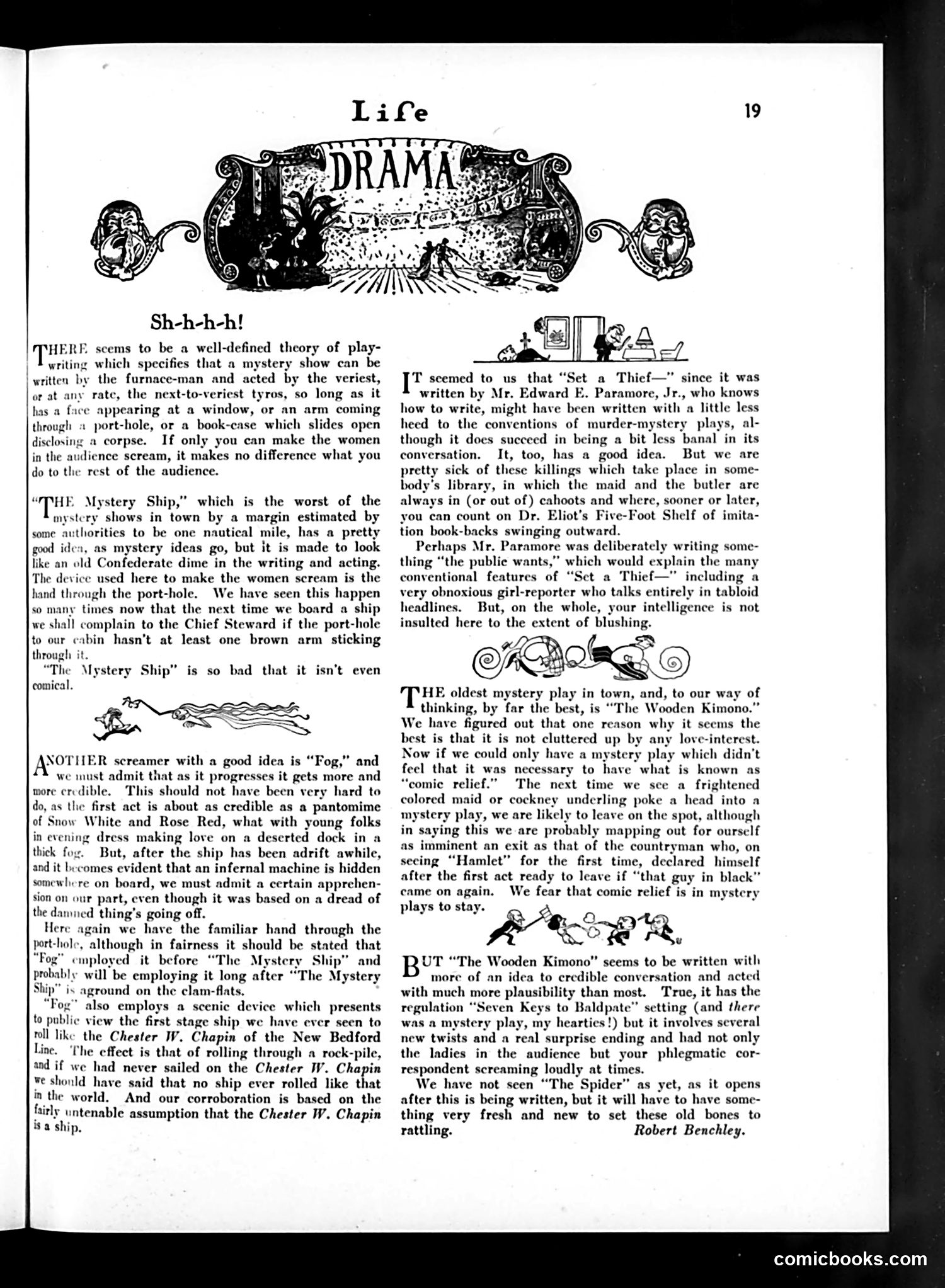
This is theater criticism satirizing the conventions of mystery plays currently running on Broadway. The author mocks how these productions rely on cheap tricks—mysterious hands through portholes, sliding bookcases revealing corpses, women screaming—rather than genuine drama or intelligent writing. Specific targets include: - **"The Mystery Ship"**: Called the worst mystery show in town; criticized for using a hand-through-the-porthole gimmick so repeatedly it's become absurd. - **"Fog"**: Also uses the porthole trick; praised slightly for improving as it progresses, though it features improbable scenery (rolling like the real ship *Chester W. Chapin*). - **"Set a Thief"**: By Edward E. Paramore Jr., criticized for relying on library murders, maids/butlers as suspects, and revolving bookcases—though the author admits it's written by someone competent. - **"The Wooden Kimono"**: Endorsed as the best mystery play because it lacks the obligatory love subplot. The satire targets theater audiences' willingness to accept lazy writing if actresses scream convincingly.
📄 Transcribed text from this page (OCR, searchable)
Machine-transcribed from the original scan — historical spelling and the odd misread are preserved.
Sh-h-h-h! HERE. scems to be a well-defined theory of play- writing which specifies that a mystery show can be | written by the furnace-man and acted by the veriest, or at any rate, the next-to-veriest tyros, so long as it has a face appearing at a window, or an arm coming through » port-hole, or a book-case which slides open disclosing a corpse. If only you can make the women in the audience scream, it makes no difference what you do to the rest of the audience. “HE Mystery Ship,” which is the worst of the mystery shows in town by a margin estimated by some authorities to be one nautical mile, has a pretty good idea, as mystery ideas go, but it is made to look like an old Confederate dime in the writing and acting. The device used here to make the women scream is the hand through the port-hole. We have seen this happen so many times now that the next time we board a ship we shall complain to the Chief Steward if the port-hole to our cabin hasn’t at least one brown arm sticking through it. “The Mystery Ship” is so bad that it isn’t even comical. AXOTHER screamer with a good idea is “Fog,” and we must admit that as it progresses it gets more and more credible. This should not have been very hard to do, as the first act is about as credible as a pantomime of Snow White and Rose Red, what with young folks in evening dress making love on a deserted dock in a thick fi But, after the ship has been adrift awhile, and it becomes evident that an infernal machine is hidden somewhere on board, we must admit a certain apprehen- sion on our part, even though it was based on a dread of the damned thing’s going off. Here again we have the familiar hand through the port-hole, although in fairness it should be stated that “Fog” cmployed it before “The Mystery Ship” and probably will be employing it long after “The Mystery Ship” is aground on the clam-flats. . Iso employs a scenic device which presents to public view the first stage ship we have ever seen to ll like the Chester W. Chapin of the New Bedford line. ‘The effect is that of rolling through a rock-pile, and if we had never sailed on the Chester W. Chapin ve should have said that no ship ever rolled like that in the world. And our corroboration is based on the ery yntenabla assumption that the Chester W. Chapin Sa ship. T scemed to us that “Set a Thief—” since it was written by Mr. Edward E. Paramore, Jr., who knows how to write, might have been written with a little less heed to the conventions of murder-mystery plays, al- though it does succeed in being a bit less banal in its conversation. It, too, has a good idea. But we are pretty sick of these killings which take place in some- body's library, in which the maid and the butler are always in (or out of) cahoots and where, sooner or later, you can count on Dr. Eliot’s Five-Foot Shelf of imita- tion book-backs swinging outward. Perhaps Mr. Paramore was deliberately writing some- thing “the public wants,” which would explain the many conventional features of “Set a Thief—" including a very obnoxious girl-reporter who talks entirely in tabloid headlines. But, on the whole, your intelligence is not insulted here to the extent of blushing. HE oldest mystery play in town, and, to our way of thinking, by far the best, is “The Wooden Kimono.” We have figured out that one reason why it seems the best is that it is not cluttered up by any love-interest. Now if we could only have a mystery play which didn’t feel that it was necessary to what is known as “comic relief.” The next time we sce a frightened colored maid or cockney underling poke a head into a mystery play, we are likely to leave on the spot, although in saying this we are probably mapping out for ourself as imminent an exit as that of the countryman who, on secing “Hamlet” for the first time, declared himself after the first act ready to leave if “that guy in black” came on again. We fear that comic relief is in mystery plays to stay. a > ya oD oe ‘ uv UT “The Wooden Kimono” seems to be written with more of an idea to credible conversation and acted with much more plausibility than most. True, it has the regulation “Seven Keys to Baldpate” setting (and there was a mystery play, my hearties!) but it involves several new twists and a real surprise ending and had not only the ladies in the audience but your phlegmatic cor- respondent screaming loudly at times. We have not seen “The Spider’ as yet, as it opens after this is being written, but it will have to have some- thing very fresh and new to set these old bones to rattling. Robert Benchley. comicbooks.com