
A complete issue · 38 pages · 1927
Life — March 10, 1927
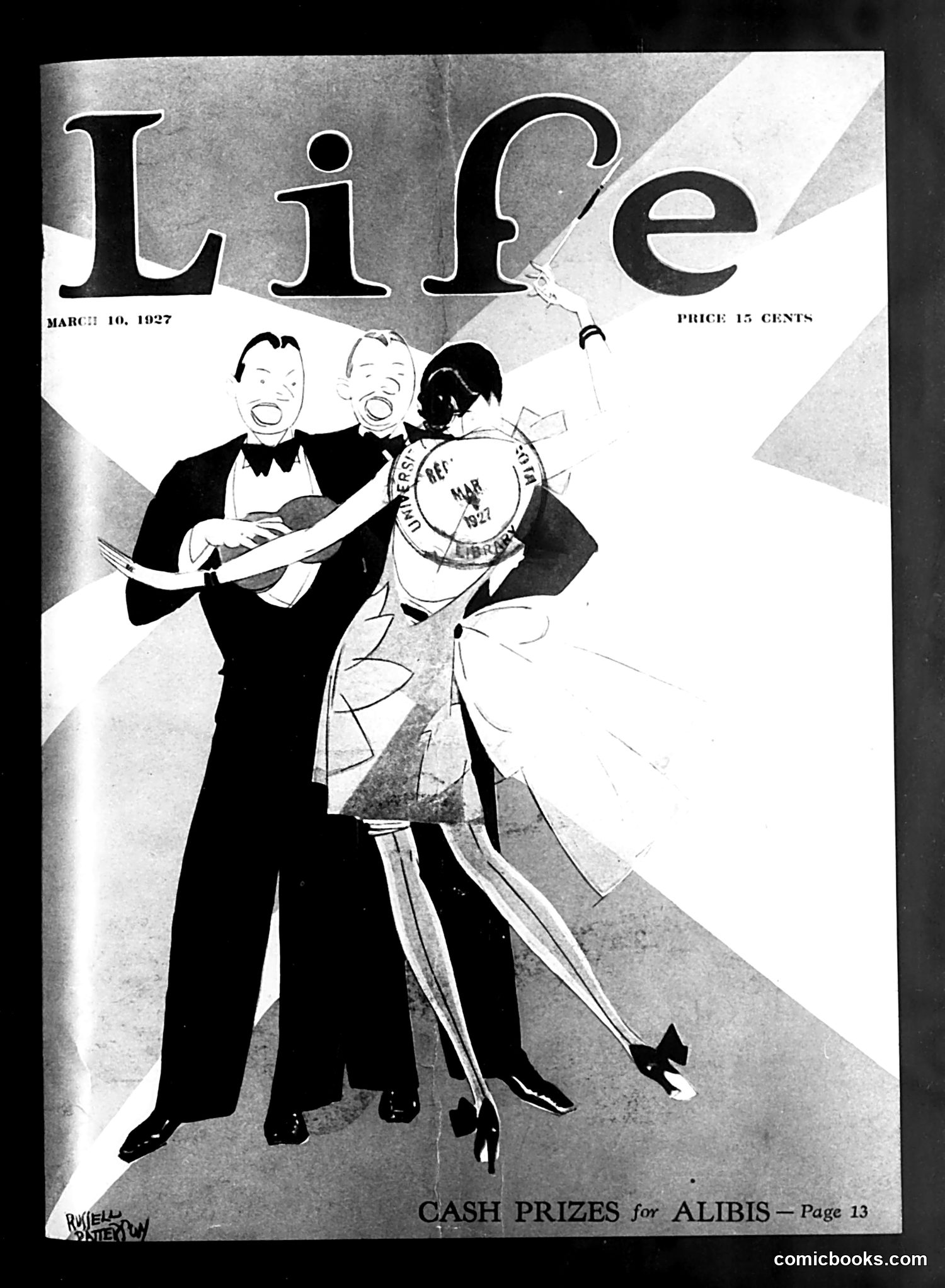
This cover satirizes the **alibi**—a humorous theme referenced in the bottom text ("Cash Prizes for Alibis"). The illustration shows two men in formal attire gleefully holding up a woman who appears to be caught mid-action, with a large circular seal or stamp marked on her (dated 1927). The satire likely concerns making excuses or false explanations, a popular comedic subject of the 1920s. The woman's animated pose and the men's delighted expressions suggest she's been "caught" or exposed in some way. The composition pokes fun at how people invent justifications for their behavior. The 15-cent price and formal illustration style are typical of Life's period satirical covers targeting contemporary social attitudes.
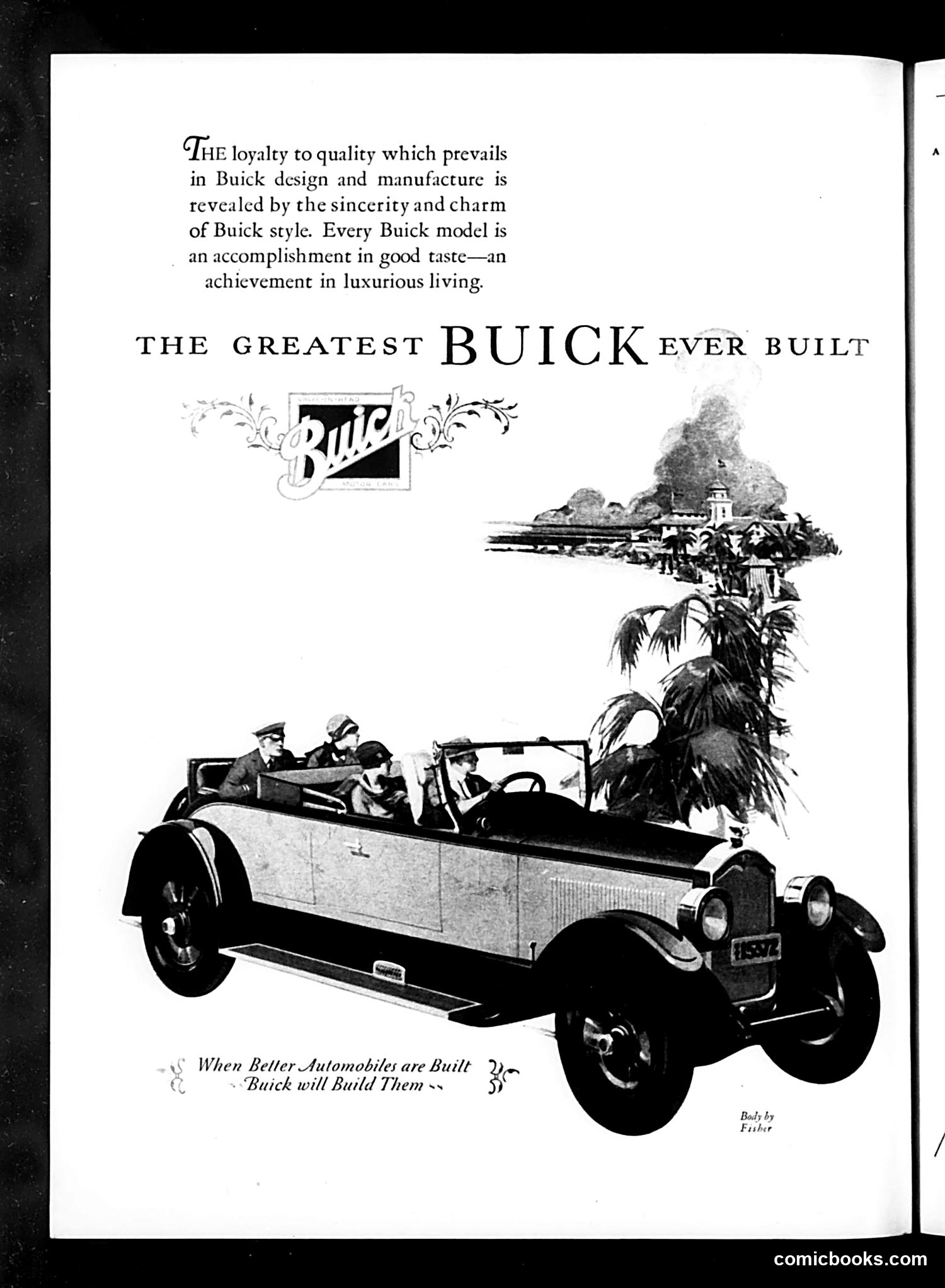
This page is a **Buick automobile advertisement**, not a political cartoon. It dates from the early automotive era (likely 1920s based on the car's design and styling). The ad promotes Buick as "The Greatest Buick Ever Built," emphasizing quality, luxury, and good taste. The image shows a convertible touring car with well-dressed passengers in an idyllic tropical setting, suggesting aspirational leisure and wealth. The tagline "When Better Automobiles are Built, Buick will Build Them" is the company's famous slogan, positioning Buick as the premium standard-bearer in automotive manufacturing. There is no satire or political commentary here—this is straightforward luxury brand marketing aimed at affluent consumers, using imagery of comfort and social status to sell the product.
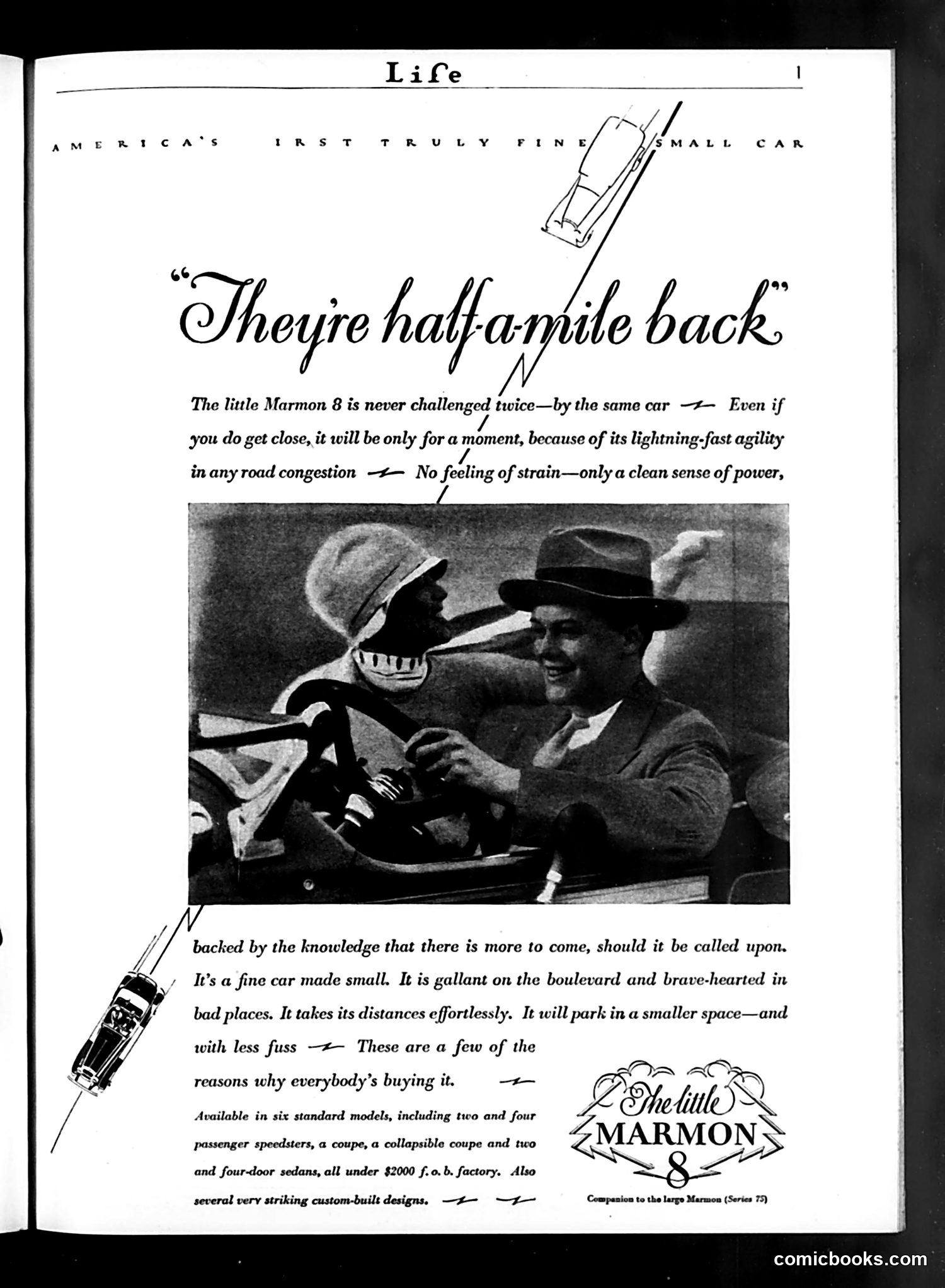
This is primarily a **Marmon 8 automobile advertisement**, not political satire. The page promotes the "little Marmon 8" as "America's first truly fine small car." The image shows two men in a car—likely representing typical drivers rather than specific historical figures. The ad copy emphasizes the car's speed ("lightning-fast agility"), maneuverability in traffic, and parking convenience for urban use. The headline "They're half a mile back" is a boast about the car's performance advantage over competitors. The advertisement highlights practical benefits: effortless driving, smooth power, and compact size—appealing to the emerging middle-class car market of the 1920s-30s. This reflects the era's automobile advertising strategy: positioning smaller, affordable vehicles as luxury alternatives to larger models.
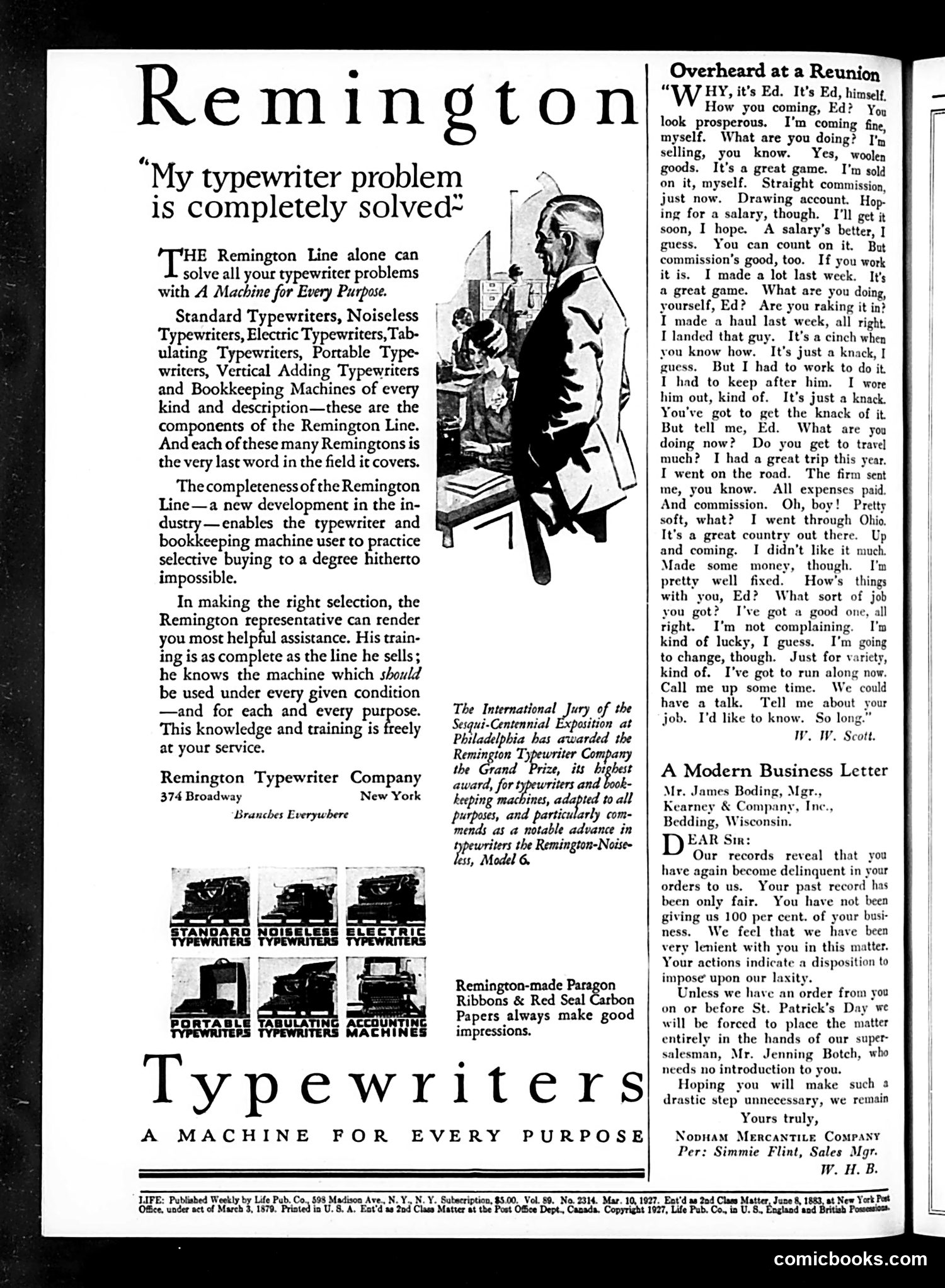
This page is primarily **advertising**, not political satire. The main content consists of three advertisements for typewriters and business services: 1. **Remington Typewriter** (left): Promotes their complete product line as solving all typewriter needs, emphasizing their variety of machines "for every purpose." 2. **"Overhead at a Reunion"** (top right): A humorous dialogue between two businessmen at a reunion, discussing their respective careers in sales and commission work. This serves as lifestyle/aspirational advertising rather than political commentary. 3. **"A Modern Business Letter"** (bottom right): A collection letter from Norham Mercantile Company to a delinquent customer, presented as a sample of professional business correspondence—essentially advertising good business practices. The page contains no political cartoons or social satire requiring historical context beyond early 20th-century business culture.
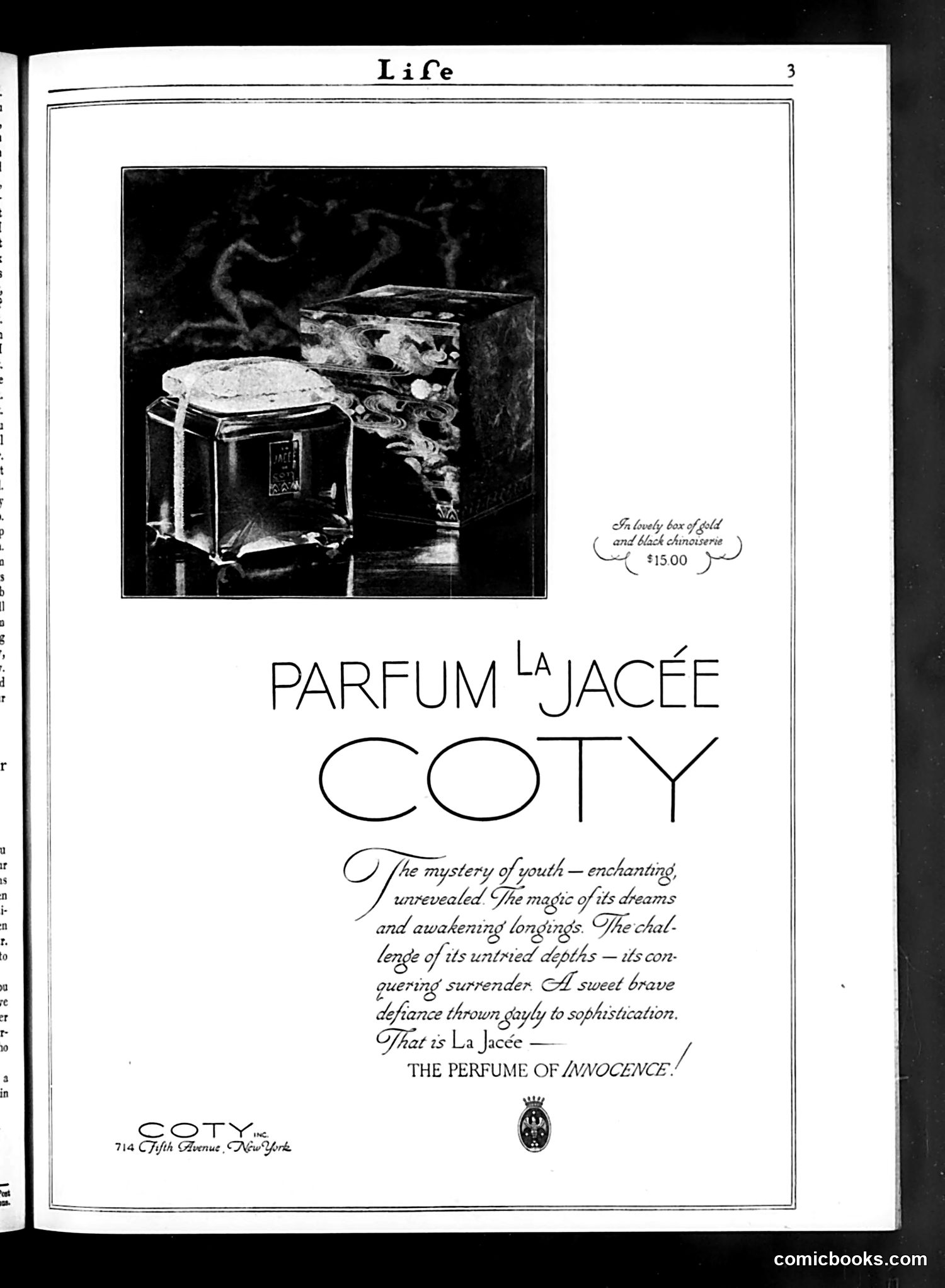
This page is **not a cartoon or satirical content** — it's a **perfume advertisement** for "Parfum La Jacée" by Coty, Inc., a New York-based fragrance company. The ad features a photograph of an ornate box of perfume and attempts to market the scent through romantic, poetic language. It describes the fragrance as "the perfume of innocence," appealing to notions of youth, mystery, and sophistication. The tagline emphasizes youth's "enchanting" and "unreveal[ed]" nature, positioning the perfume as capturing ethereal feminine qualities. The price of $15.00 for a small box of gold and black chinoiserie indicates this was a luxury product. This is straightforward commercial advertising rather than satirical content.
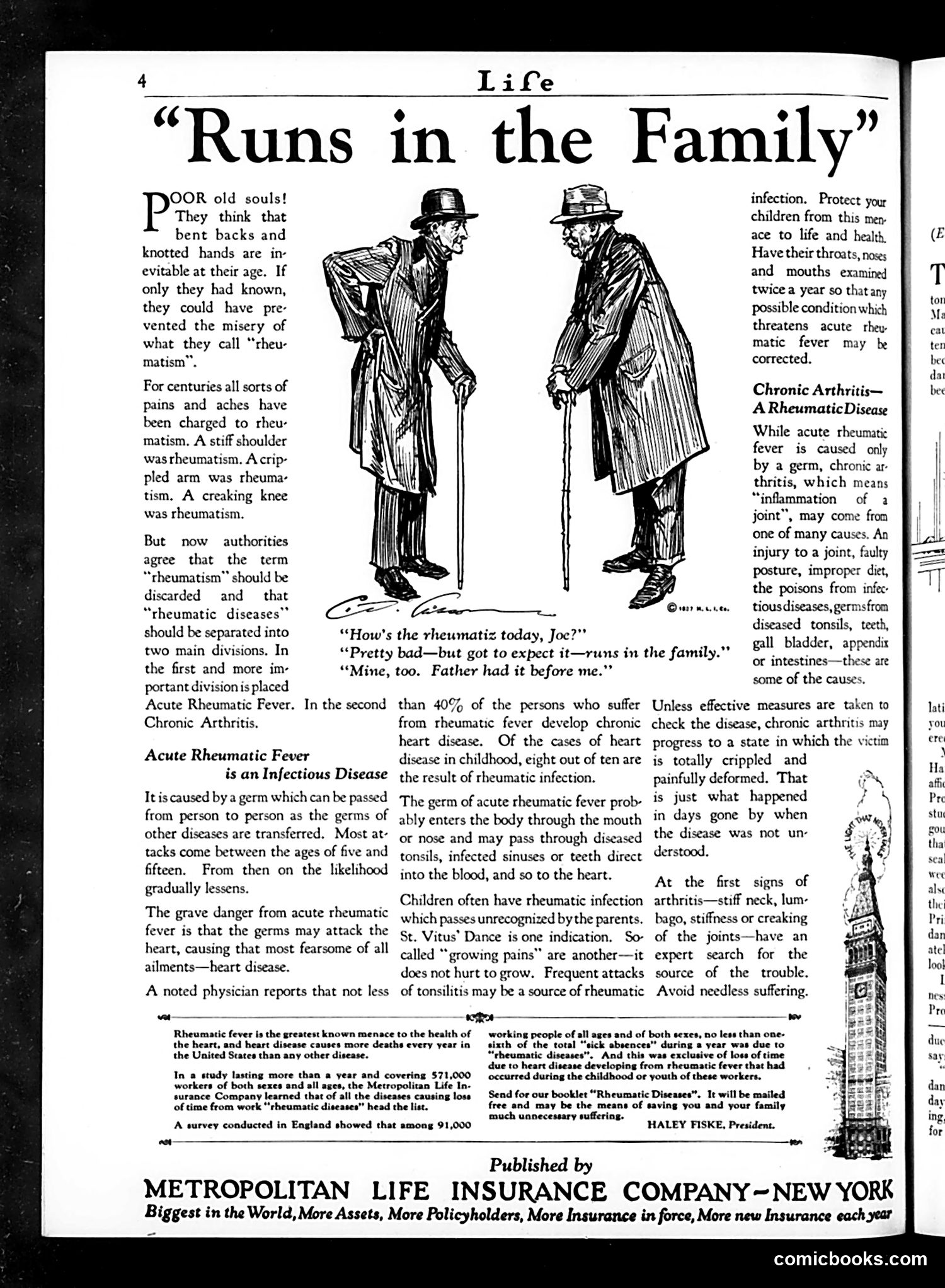
This page combines educational content with advertising for Metropolitan Life Insurance. The central cartoon depicts two elderly men in conversation, with the caption "'How's the rheumatiz today, Joe?' 'Pretty bad—but got to expect it—runs in the family.' 'Mine, too. Father had it before me.'" The satire mocks the widespread folk belief that rheumatism is hereditary and inevitable. The article clarifies that rheumatism actually comprises two distinct diseases: acute rheumatic fever (an infectious germ disease) and chronic arthritis. The joke exposes how common people mistakenly accept family illnesses as fate, when medical understanding shows many causes are preventable or treatable. The insurance company uses this to promote preventive health measures and their services as protection against such afflictions.
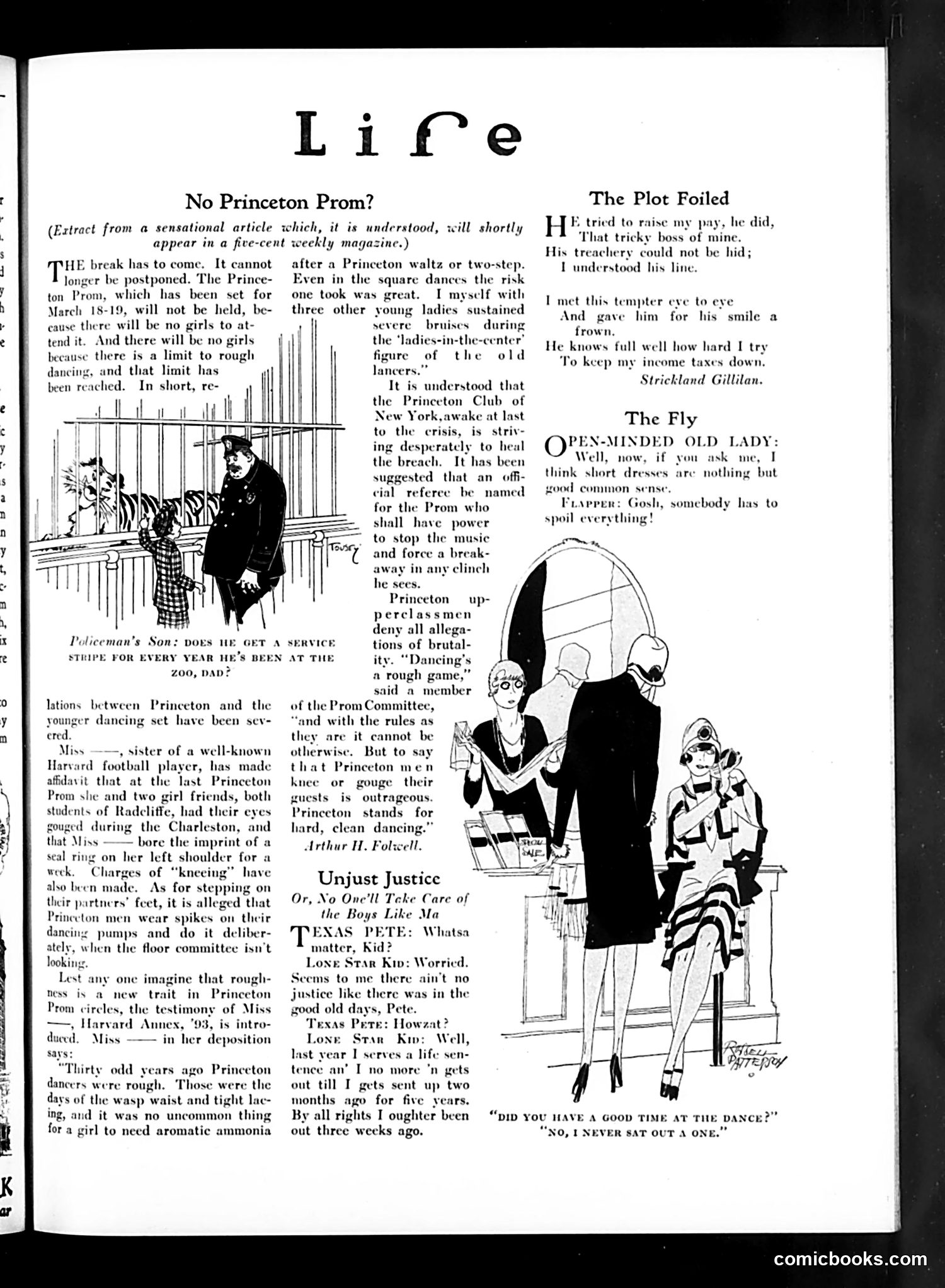
This Life magazine page satirizes 1920s social customs, specifically the Princeton Prom controversy. The left article criticizes Princeton University's attempt to cancel their prom due to concerns about dancers' physical contact and "roughness." The satire mocks Princeton men for being overly concerned with propriety while simultaneously suggesting the real issue is controlling young women's behavior. The right cartoon "The Fly" depicts a woman with an umbrella protecting children from a man—likely satirizing anxieties about male predation or improper advances at dances. The dialogue about "good time" and never sitting out suggests commentary on courtship rituals and changing social freedoms. The overall theme critiques upper-class institutions' attempts to regulate youth behavior and dancing during the sexually liberated Jazz Age, portraying such efforts as hypocritical or futile.
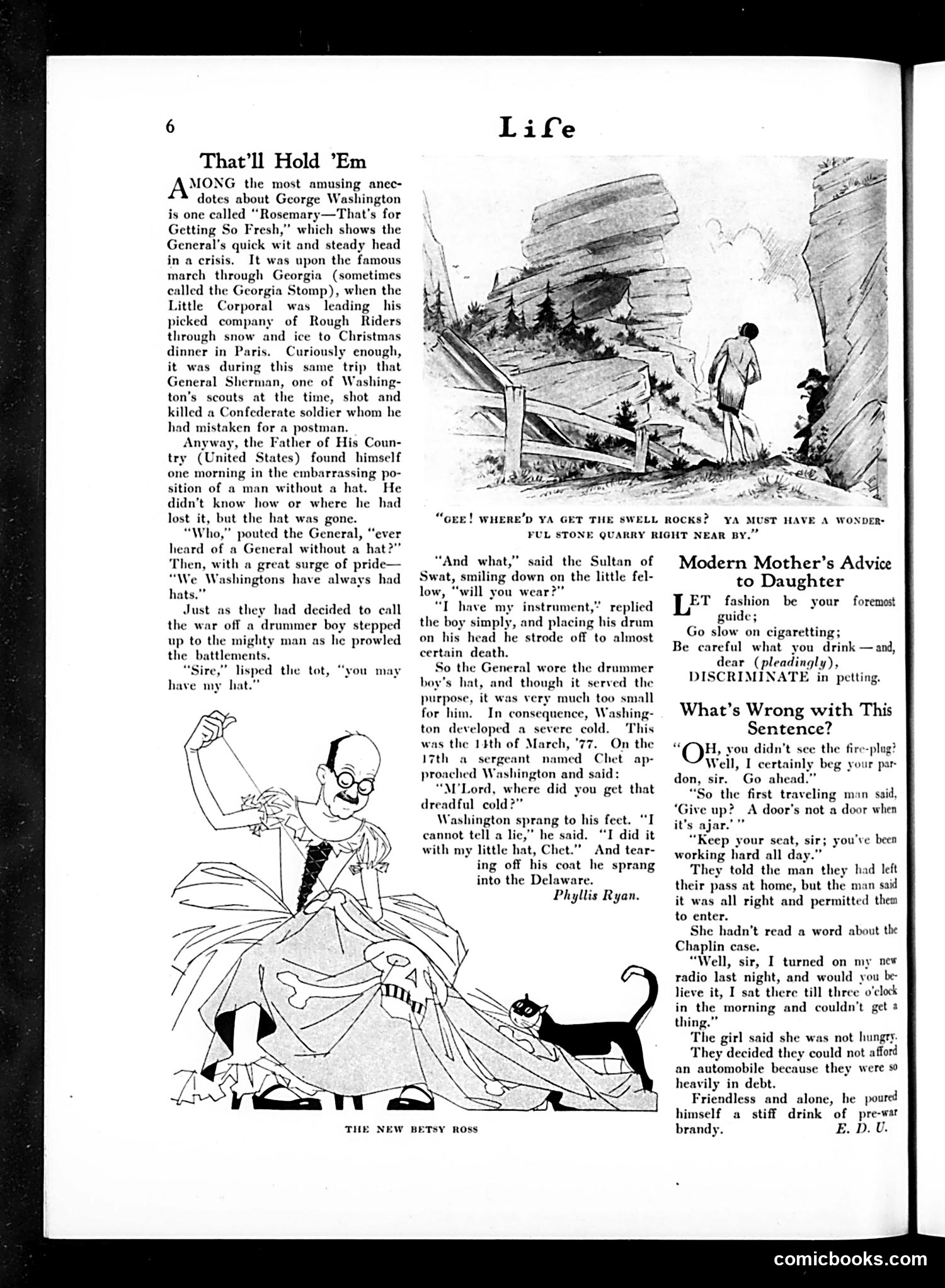
This page contains three distinct pieces: 1. **"That'll Hold 'Em"** - A humorous anecdote about George Washington during the Revolutionary War (Georgia campaign), where Washington lost his hat and a drummer boy's small hat was substituted, causing Washington to develop a cold. 2. **"The New Betsy Ross"** - A cartoon illustration (bottom left) showing a woman sewing, likely satirizing contemporary fashion or domestic life, though the specific reference is unclear from the visible text. 3. **"Modern Mother's Advice to Daughter"** and **"What's Wrong with This Sentence?"** - These appear to be humor columns offering satirical guidance on fashion, behavior, and grammar/language usage for young women. The page exemplifies *Life* magazine's blend of historical anecdotes, social satire, and advice humor targeting early 20th-century readers.
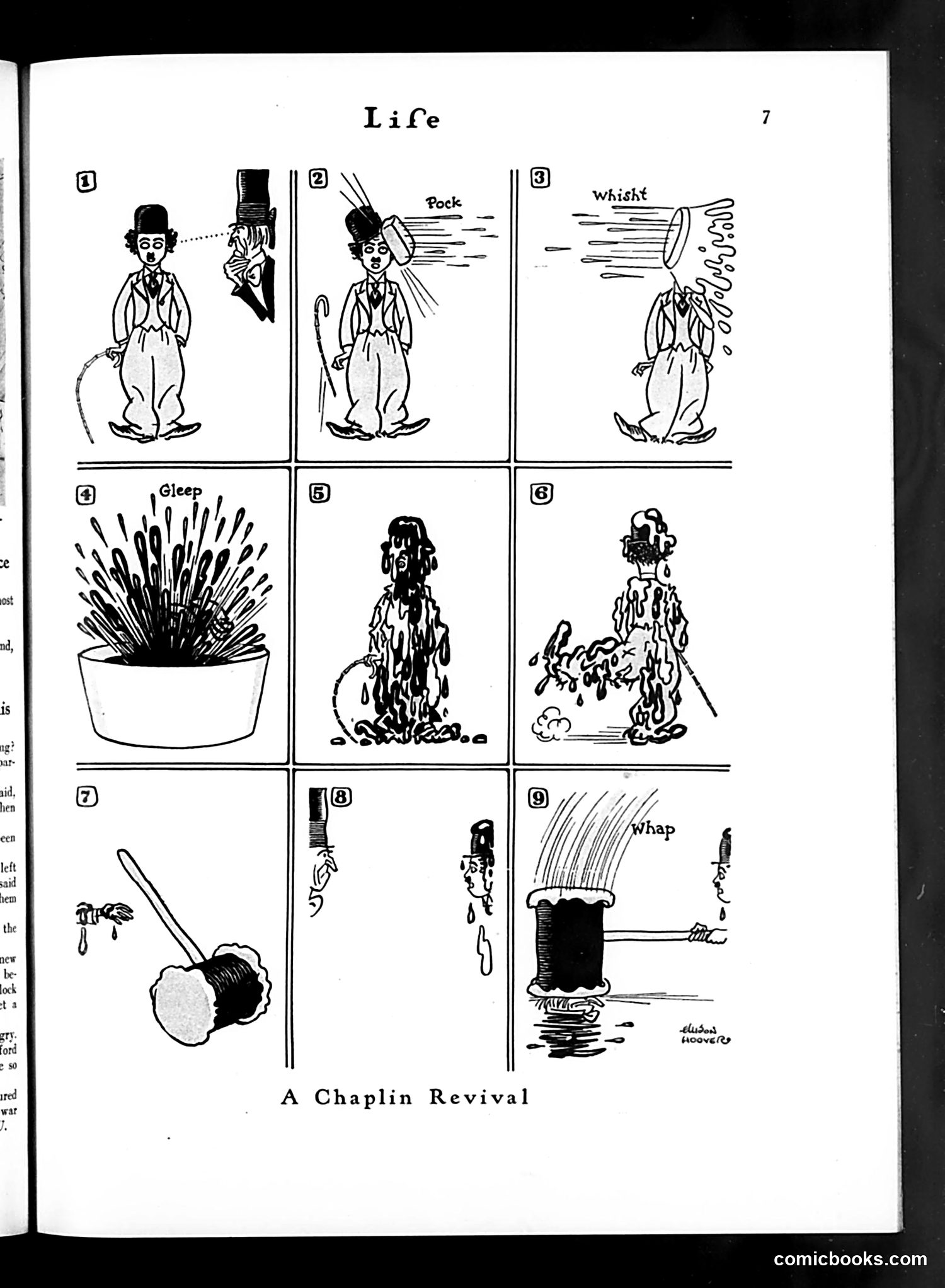
This comic strip parodies Charlie Chaplin's iconic "Tramp" character through exaggerated physical comedy. The nine panels show the character experiencing escalating misfortunes: being hit by objects ("Rock," "Whack"), falling asleep in a pot, catching fire, being struck by an anvil, getting tangled with a fly, being chased by a boot, and finally being hit by a whip and water spray. The title "A Chaplin Revival" suggests this is satirizing either Chaplin's return to filmmaking or a re-release of his silent films. The humor derives from the slapstick violence typical of Chaplin's physical comedy style, with each panel depicting increasingly absurd suffering—a direct commentary on the exaggerated, cartoonish nature of Chaplin's famous comedic technique.
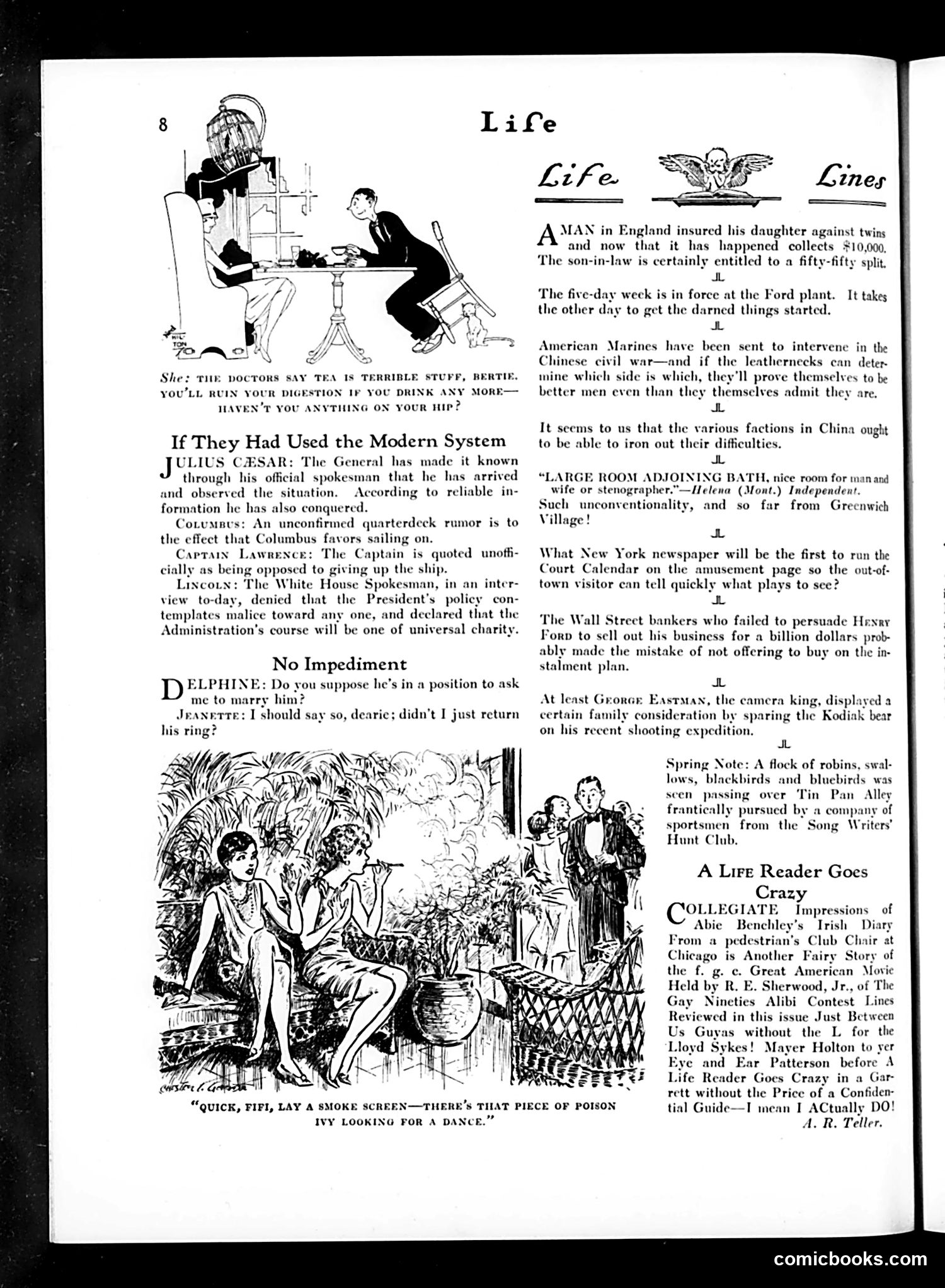
The main cartoon depicts two women in a garden setting with the caption: "Quick, Fifi, lay a smoke screen—there's that piece of poison ivy looking for a dance." This is a social satire about romantic pursuits. "Poison ivy" was slang for an undesirable or dangerous woman—likely someone considered morally loose or a "gold digger." The women are humorously portrayed as needing to hide from this threatening figure. The joke plays on contemporary anxiety about certain women and dating culture of the era. The surrounding "Life Lines" section contains brief satirical notes on current events, including references to insurance, the Ford plant's five-day work week, Chinese civil war, and Wall Street banking failures. These are typical of *Life* magazine's humorous commentary on contemporary social and political topics.
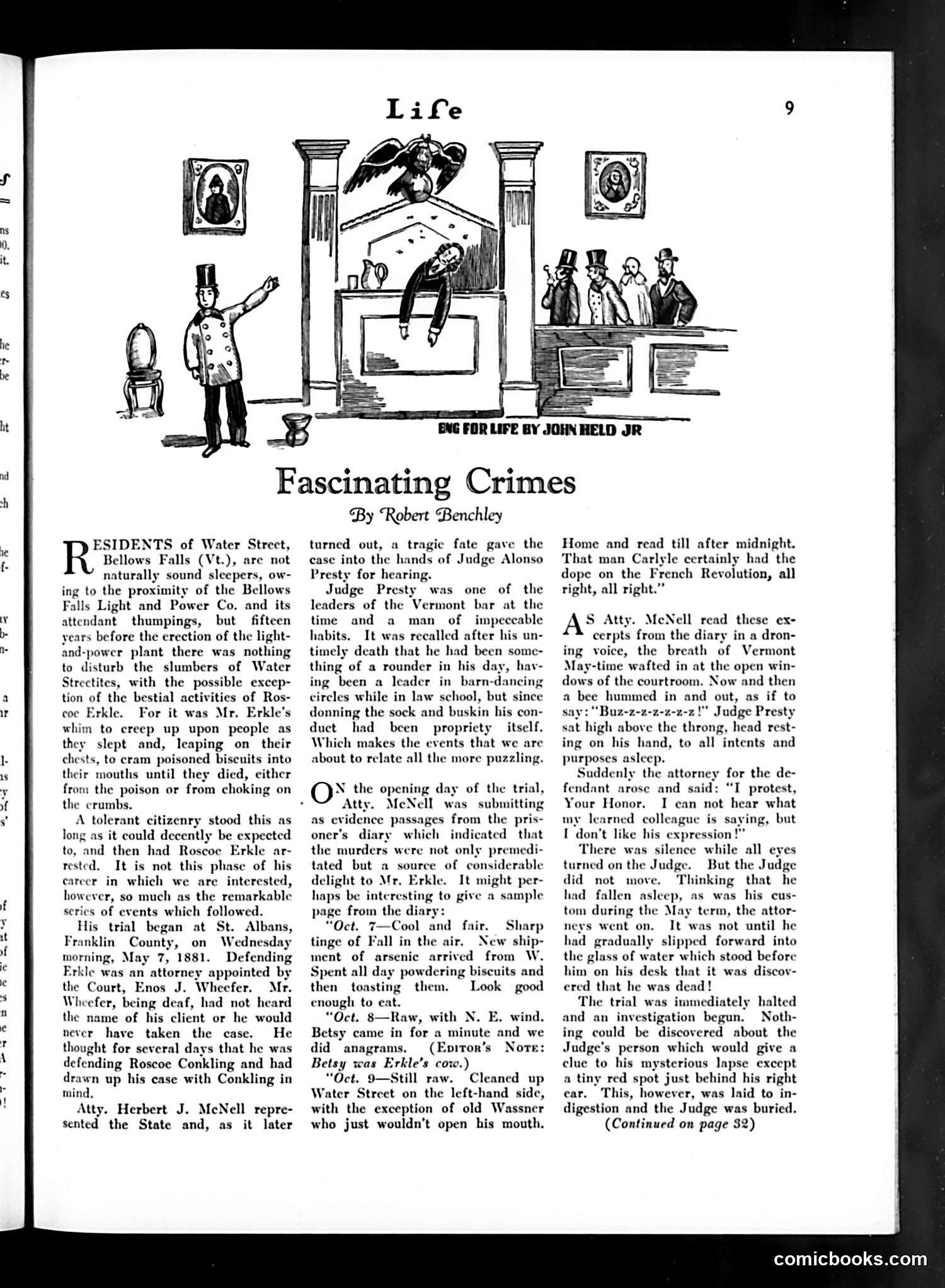
This page features a satirical article about a Vermont murder trial, accompanied by an illustration titled "ENG FOR LIFE BY JOHN HELD JR" depicting a courtroom scene. The cartoon shows a judge presiding over proceedings with various courtroom figures. The article discusses the trial of Roscoe Erkle, accused of murder, which began May 7, 1881, in Franklin County. The satire appears to mock the sensational nature of the trial and the public's fascination with crime details. The illustration's style—with exaggerated figures and the judge prominently displayed—suggests mockery of legal proceedings and courtroom dramatics. The article references diary entries from the alleged victim as evidence, adding to the case's "interesting" nature to contemporary readers seeking scandal and intrigue.
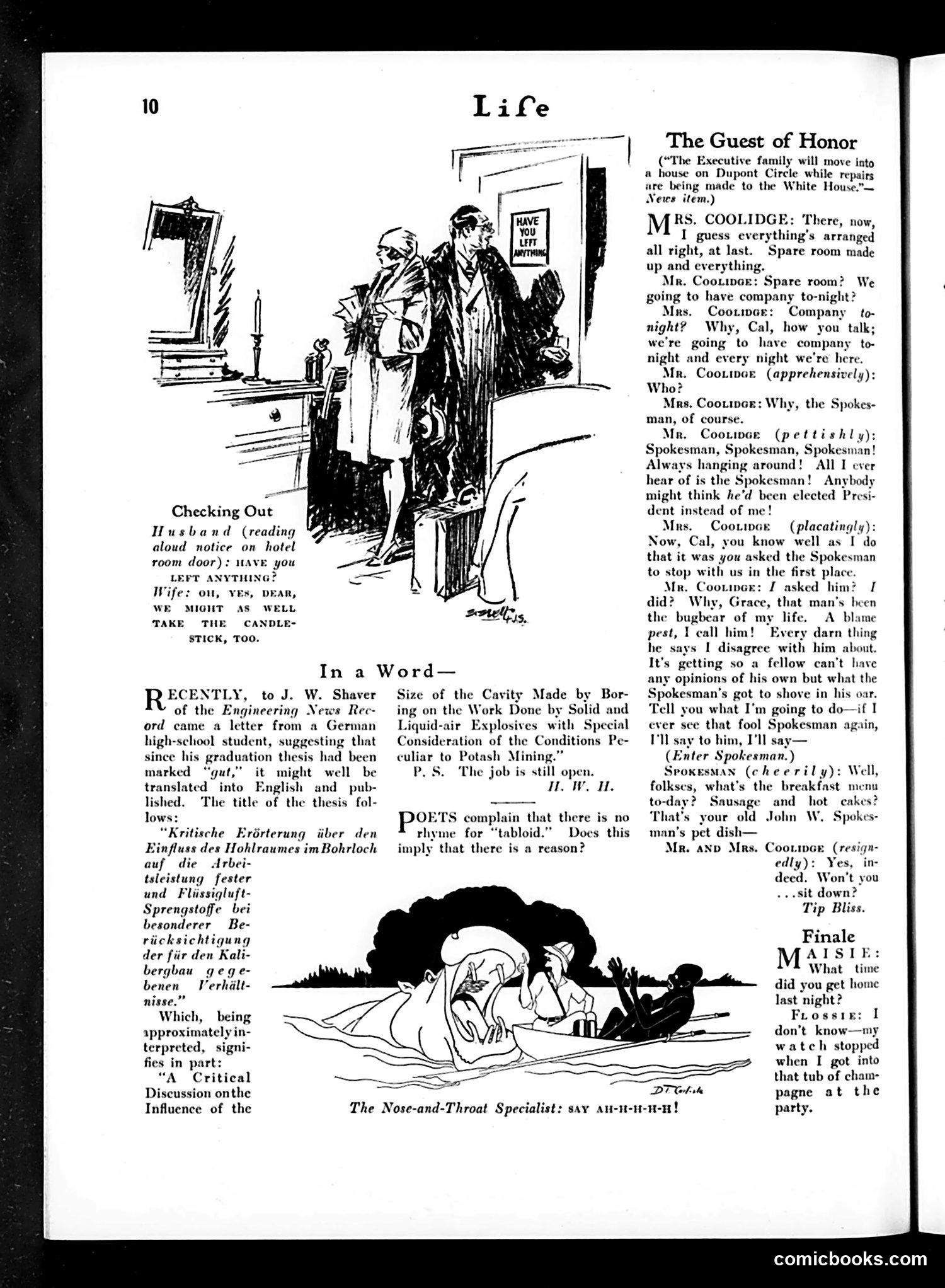
This page contains three humorous sketches satirizing domestic life and social conventions. **"Checking Out"** mocks hotel departures, showing a husband reading a notice while his wife protests about forgotten items like the candlestick. **"The Guest of Honor"** depicts Mrs. Coolidge complaining about having a spokesman (likely referring to Calvin Coolidge's administration). She sarcastically suggests the Spokesman should have been elected President instead, expressing frustration that he dominates conversation and prevents her from sharing opinions. The humor targets political wives' lack of agency and male dominance in public discourse. **"The Nose-and-Throat Specialist"** shows someone in a bathtub, with a caption suggesting they've been there since champagne arrived at a party—a joke about alcohol consumption during Prohibition. All three sketches use everyday situations to mock social behaviors and contemporary politics.
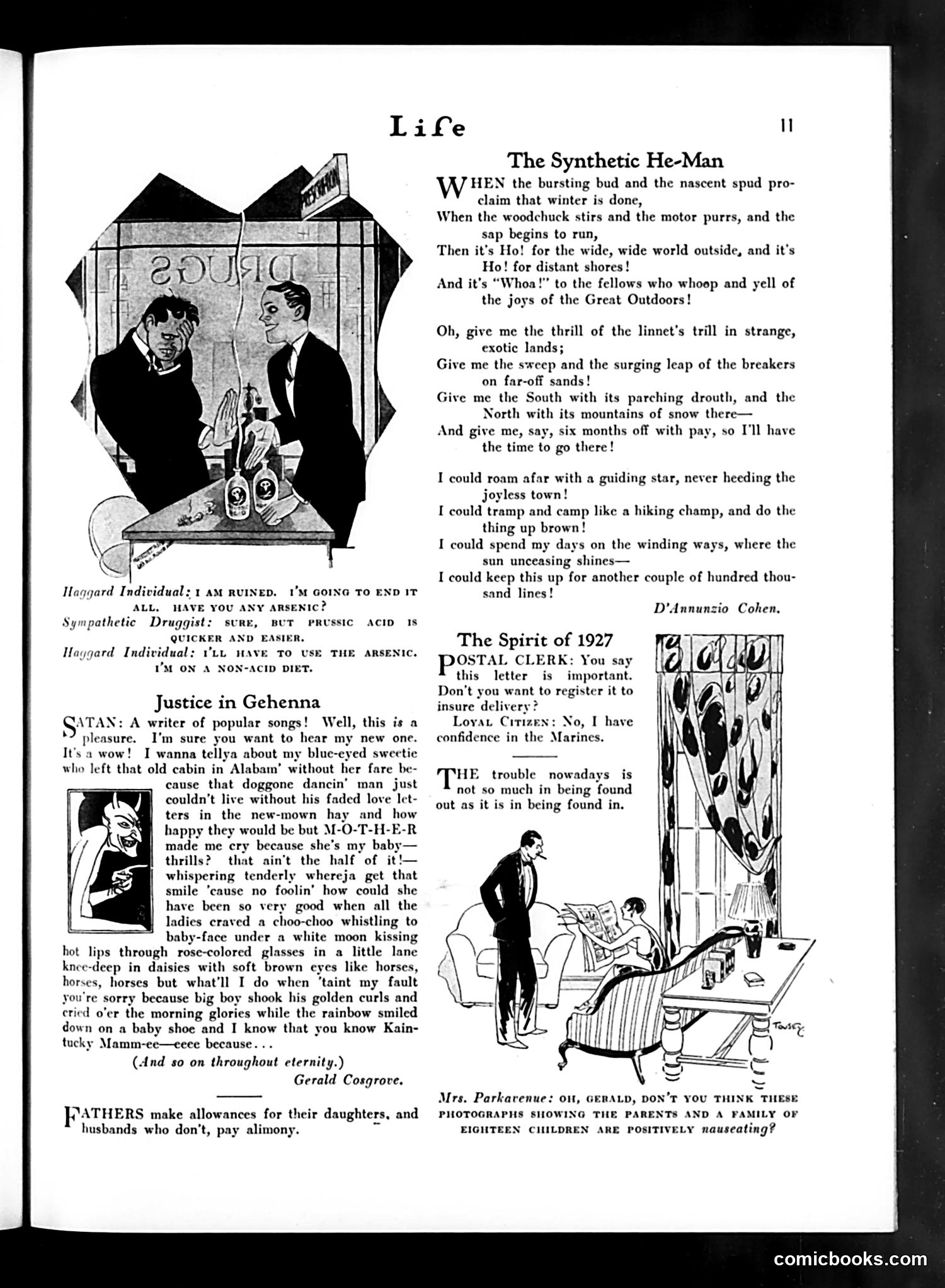
This page contains several satirical pieces targeting 1920s social attitudes: **"The Synthetic He-Man"** (poem by D'Annunzio Cohen) mocks men who romanticize outdoor adventure and travel while lacking the means or commitment to actually pursue it—a critique of aspirational fantasy masquerading as masculinity. **"Justice in Gehenna"** (by Gerald Cosgrove) satirizes sentimental popular songs, particularly those glorifying motherhood and domestic sentimentality. The caricatured figure suggests mockery of overly emotional artistic expression. **"The Spirit of 1927"** cartoon depicts a postal clerk and citizen discussing mail registration—likely satirizing bureaucratic paranoia or trust issues in an increasingly mechanized society. **"Mrs. Parkerenue"** cartoon mocks vanity and conspicuous consumption, specifically photographs showcasing large families as status symbols among the wealthy. The overall theme critiques 1920s consumer culture and artificial social values.
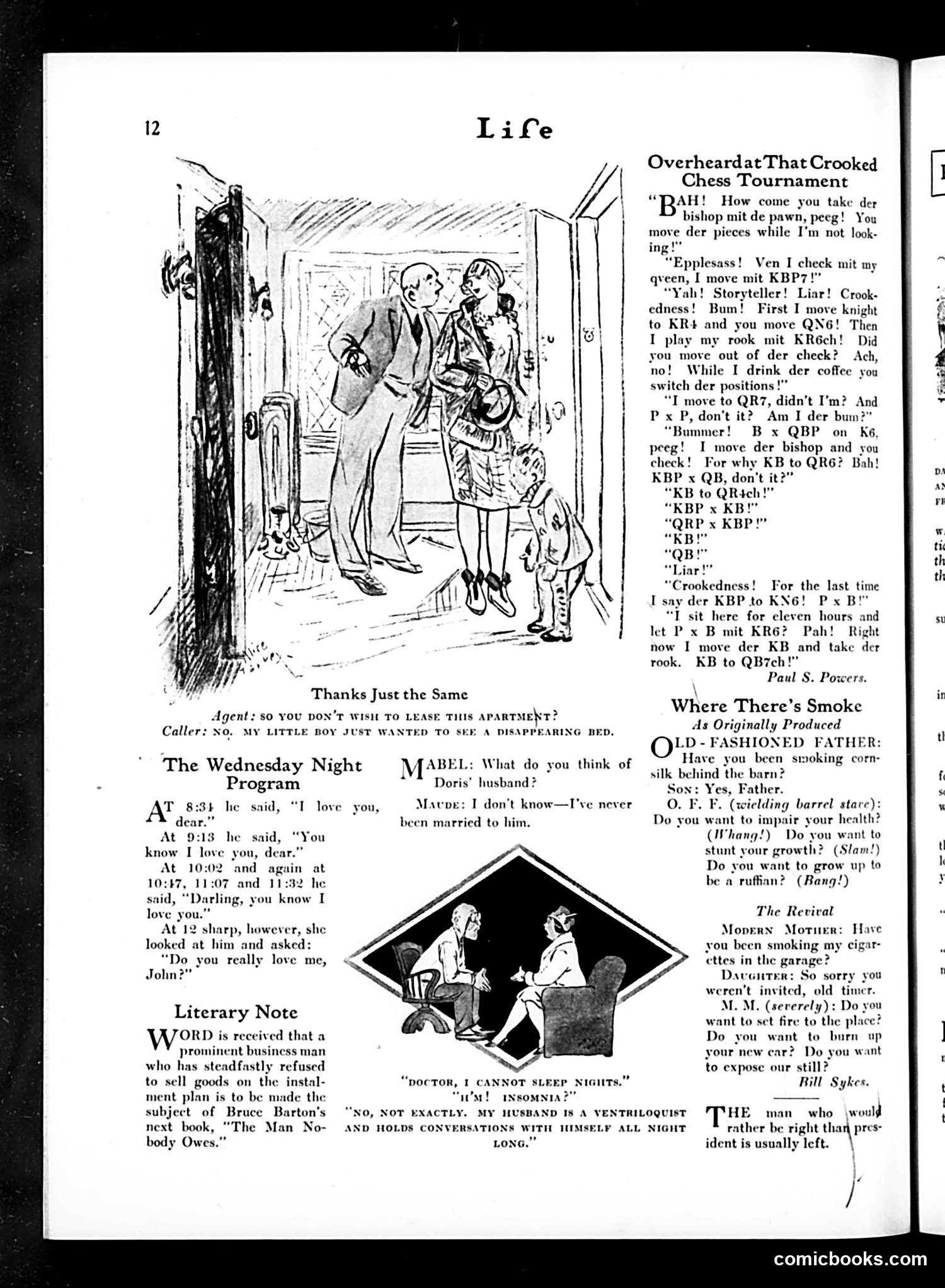
This cartoon satirizes apartment-hunting in the early 20th century. An agent shows an apartment to a prospective tenant while a woman (likely the agent's wife or colleague) stands nearby. The caller's caption reveals the joke: "So, my little boy just wanted to see a disappearing bed." The satire targets a common sales pitch of the era—apartments marketed with space-saving "disappearing beds" (Murphy beds, which fold into walls). The humor lies in the gap between the agent's professional marketing and the practical absurdity: the prospective tenant's child simply wanted to *watch* the novelty work, not actually lease the apartment for housing purposes. This reflects anxieties about cramped urban living and deceptive real estate marketing tactics of the period.
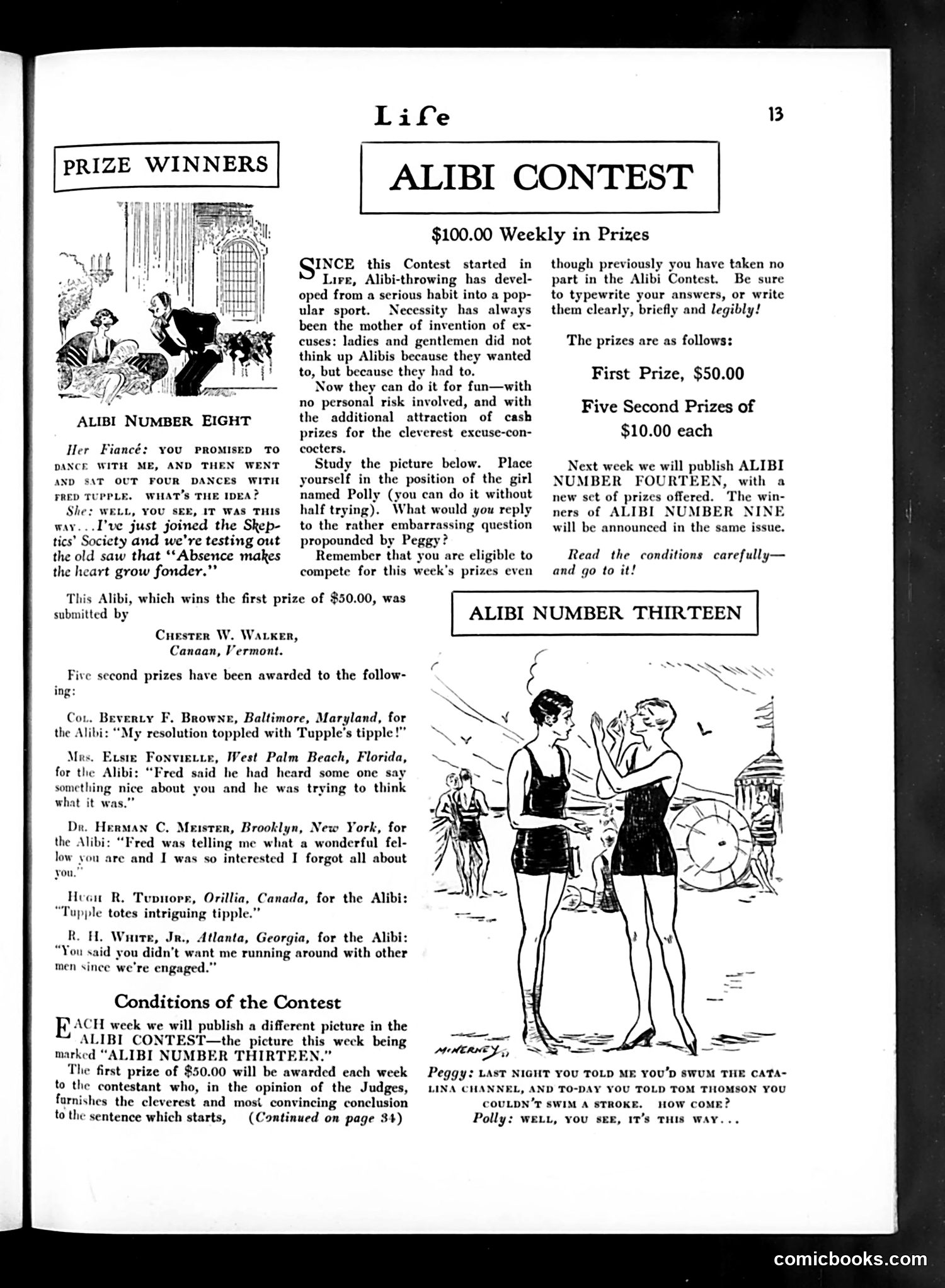
This page announces Life magazine's "Alibi Contest," a humor competition offering $100 weekly in prizes ($50 first prize, five $10 second prizes). The contest asks readers to imagine themselves as a woman named "Dolly" in a compromising situation: caught by her fiancé while dancing with another man. Contestants must supply an alibi—a plausible excuse for the infidelity. The cartoon (Alibi Number Thirteen) shows two young women at what appears to be a beach or resort, with one explaining her behavior to the other. The dialogue bubble hints at the comic premise: Peggy accuses Dolly of breaking her engagement promise, and Dolly attempts a creative excuse. This reflects 1920s-30s humor conventions: marital fidelity concerns, witty evasions, and the popularity of parlor games and word puzzles among educated audiences. The contest invited readers' comedic creativity around everyday social transgressions.
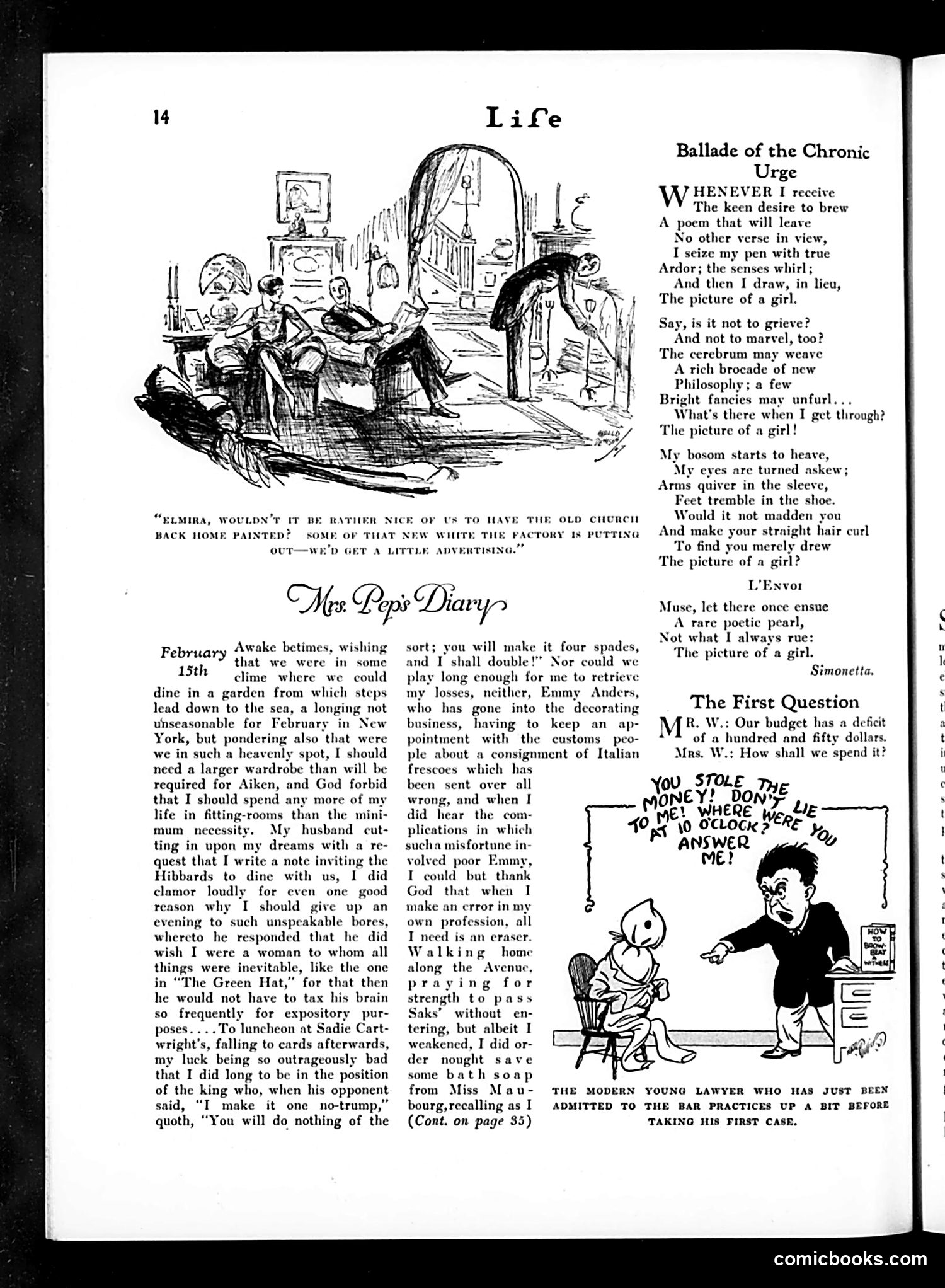
This cartoon satirizes a young lawyer's naïveté or incompetence. A baby sits in a chair while an aggressive man (the senior lawyer or opposing counsel) demands: "You stole the bonds! Where were you at midnight to answer me!" The joke centers on the lawyer's absurd error: he's brought an infant to a serious criminal case, apparently unable to distinguish between his actual client and a baby. This mocks inexperienced lawyers who are unprepared or comically incompetent at their profession. The caption confirms he's "just been admitted to the bar" and is taking his "first case"—highlighting the humorous contrast between legal credentials and practical ability. It's a straightforward joke about professional incompetence rather than political satire.
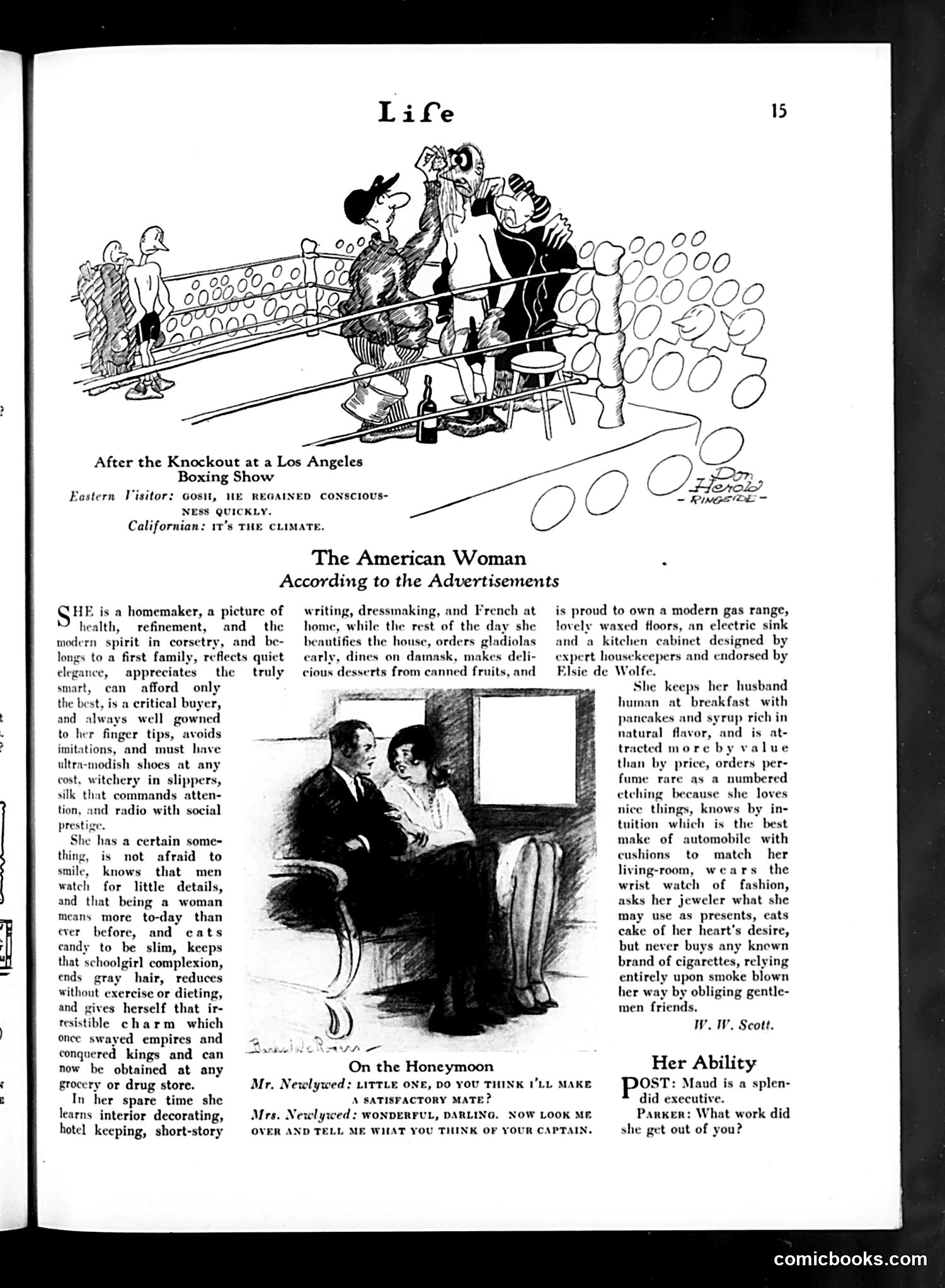
**Top Cartoon**: Depicts an Eastern visitor being revived after a knockout at a Los Angeles boxing show. The joke contrasts regional stereotypes: the Easterner is shocked and needs revival ("gosh, he regained consciousness quickly"), while a Californian dismisses it casually as "it's the climate"—suggesting California's supposedly invigorating weather makes such spectacles routine or unremarkable. **Main Content**: "The American Woman According to the Advertisements" satirizes idealized advertising portrayals. It describes an impossibly perfect woman who is simultaneously a homemaker, fashion-conscious, health-conscious, and effortlessly elegant—always available to charm her husband. The accompanying illustration shows a couple on a honeymoon, with dialogue about satisfying one's spouse, reinforcing satirical commentary on gender expectations and consumer culture's unrealistic depictions of women's roles.
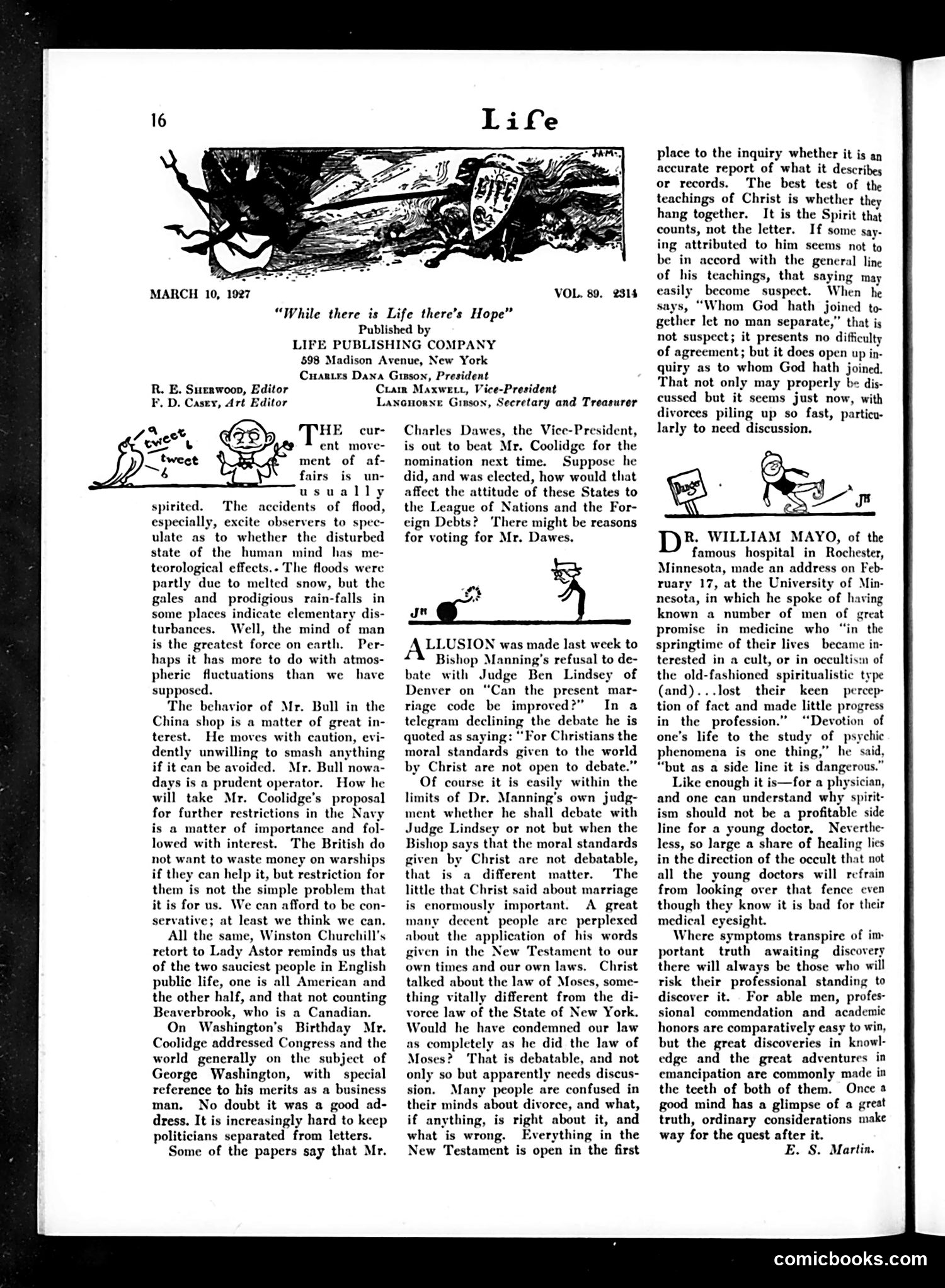
This page contains editorial commentary rather than traditional cartoons. The main satirical content discusses: **Charles Dawes** (Vice-President) as a candidate to challenge Calvin Coolidge for the Republican nomination, with skepticism about whether electing Dawes would meaningfully change U.S. foreign policy positions. **Winston Churchill** receives praise as a shrewd businessman and good dresser, with the editor noting it's "increasingly hard to keep politicians separated from letters"—satirizing the blurred lines between politics and public relations. **Bishop Manning's debate** with Judge Ben Lindsey about marriage codes is discussed, questioning whether Christian moral standards should be publicly debatable. The small cartoon figures appear decorative rather than illustrative of specific political figures or events.
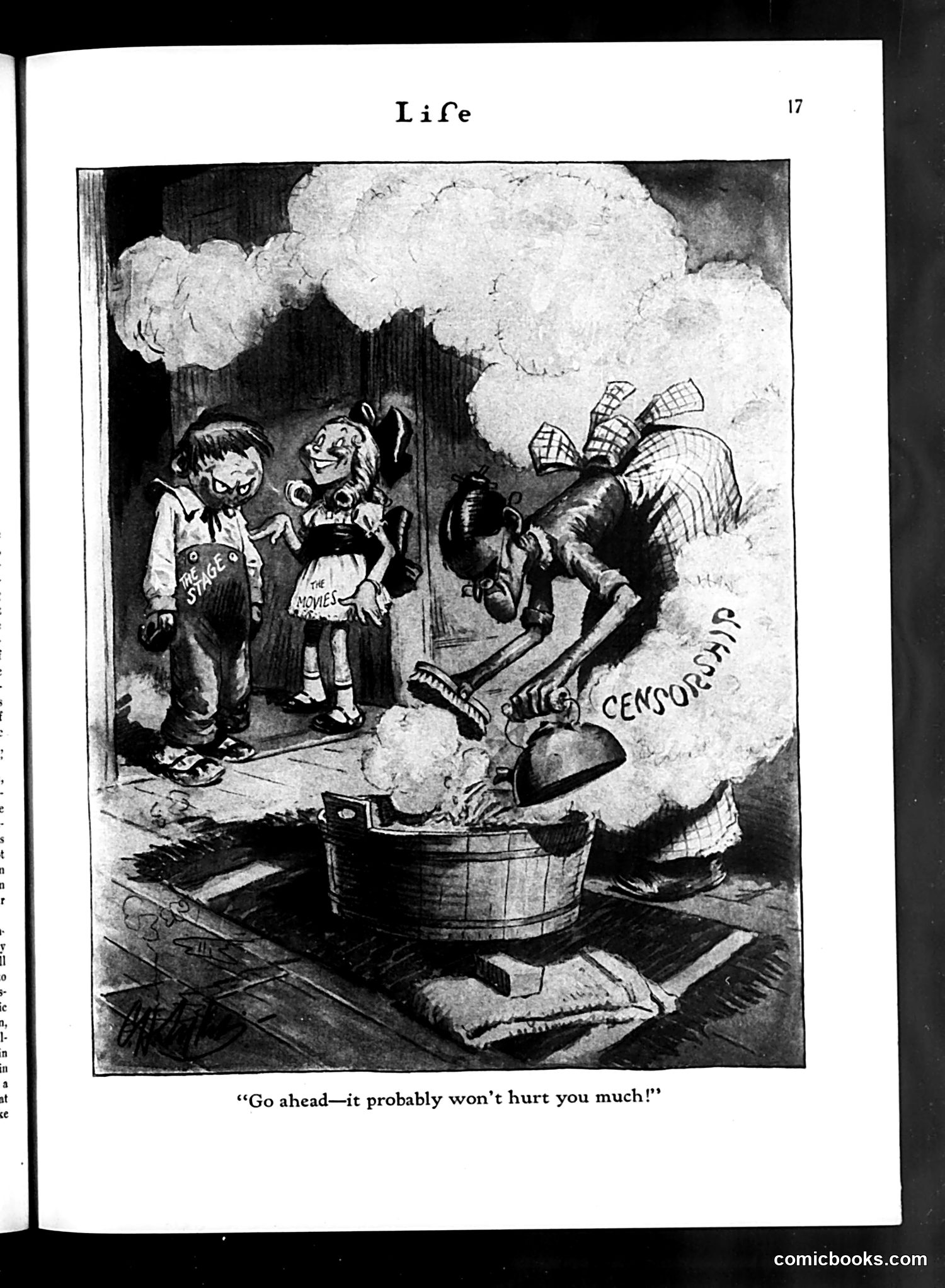
This cartoon from *Life* magazine satirizes film industry censorship. Two children labeled "STAGE" and "MOVIES" are shown being urged by an adult figure (likely representing a censor or moral authority) to reach into a barrel labeled "CENSORSHIP." The figure reassures them, "Go ahead—it probably won't hurt you much!" The satire is darkly ironic: the cartoon suggests that censorship, presented as harmless protection, actually poses danger to creative industries. The children represent vulnerable creative arts being pressured to accept restrictive censorship standards. The vague reassurance ("probably won't hurt you much") emphasizes how the consequences of censorship are downplayed by those enforcing it, while the cartoon itself argues censorship is fundamentally damaging to artistic freedom.
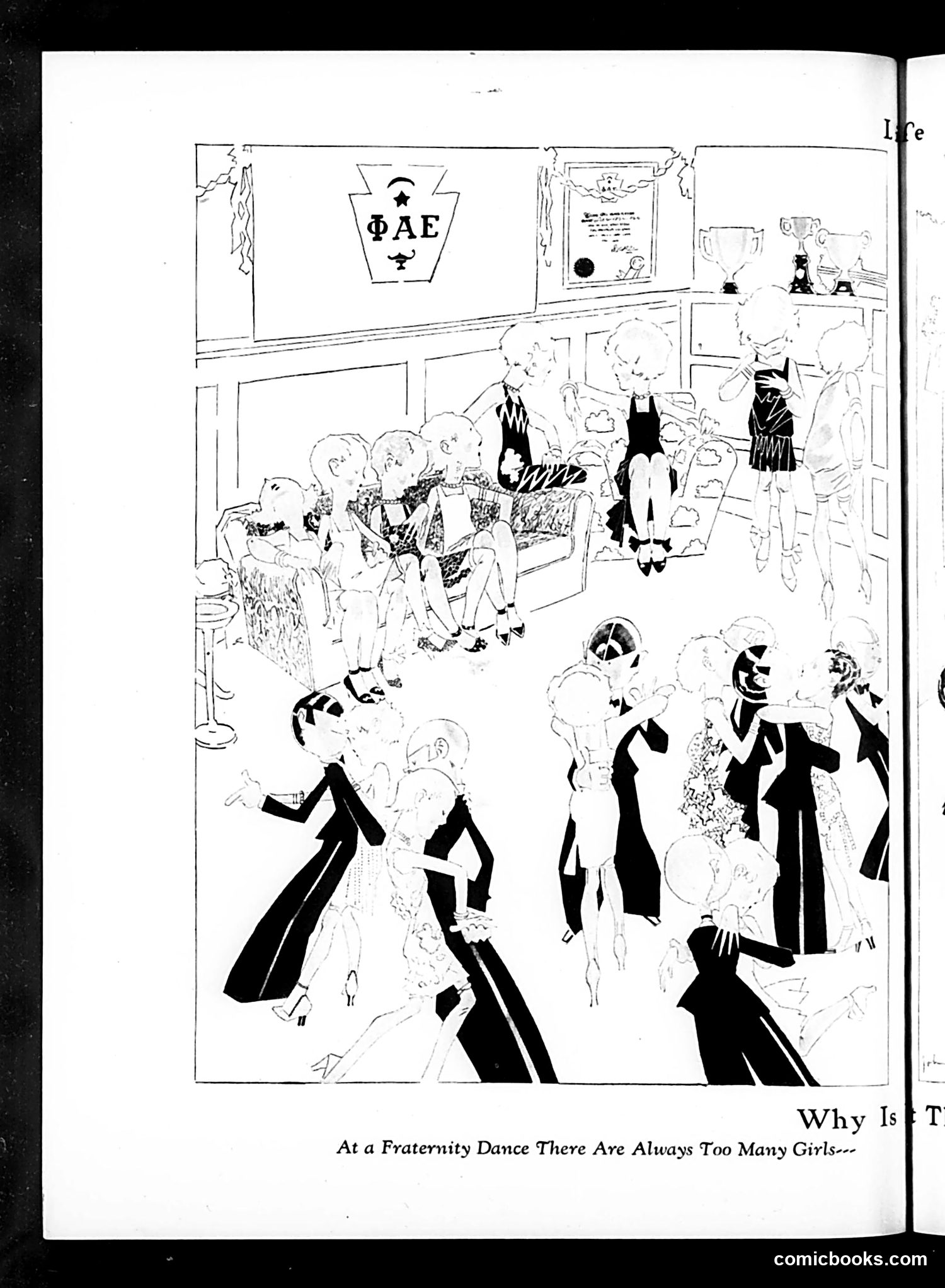
This is a humorous single-panel cartoon depicting a fraternity dance. The "ΦΔΕ" (Phi Delta Epsilon or similar fraternity letters) emblem hangs prominently on the back wall, establishing the setting. The joke illustrates the caption's complaint: there are visibly more female attendees than male. Women in 1920s-style flapper dresses crowd the dance floor and sides of the room, while relatively few men in dark suits are present. The few males appear overwhelmed or disengaged by the surplus of female dance partners. This satirizes a genuine social concern of the era—gender imbalance at collegiate social events—presented as lighthearted commentary on fraternity life and dating dynamics of the period. The exaggerated disproportion makes the point humorously.
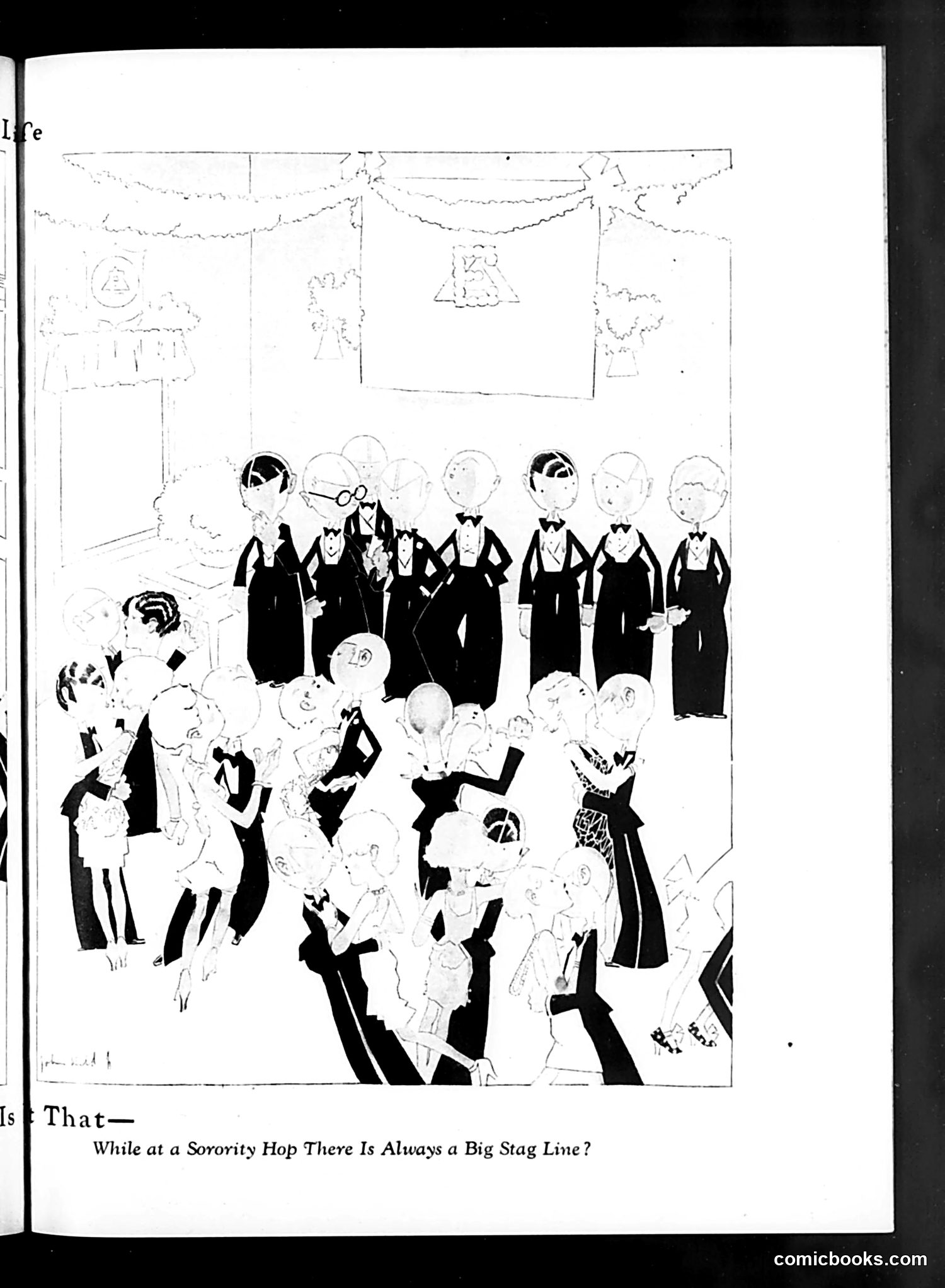
This cartoon satirizes social dynamics at 1920s-30s college sorority dances. The image shows a formal hop (dance) where men in tuxedos stand in a prominent "stag line"—groups of unattached men waiting to cut in and dance with women. The joke's caption questions whether there's "always" a large stag line at such events, likely criticizing either: - The prevalence of dateless men at these affairs, or - The social awkwardness this creates The cartoon depicts well-dressed attendees in a decorated venue with the stag line prominently positioned, emphasizing how these waiting men dominated the social space of college dances. This reflects period anxieties about dating customs and gender dynamics among the educated class.
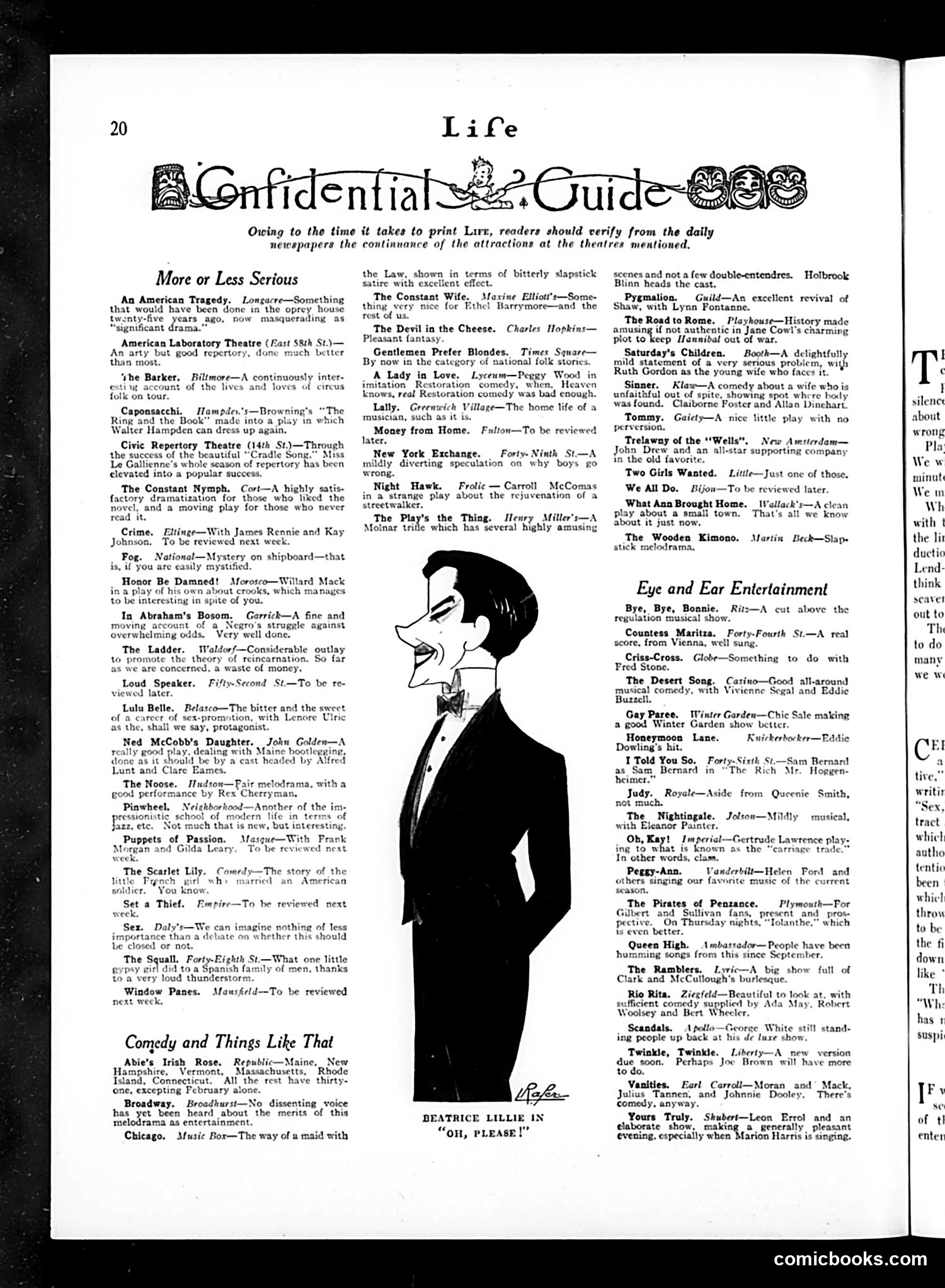
This is a **theater review page** from Life magazine, not primarily a political cartoon. The page lists Broadway and off-Broadway productions with brief critical commentary. The only illustration is a **caricature of Beatrice Lillie** (labeled "BEATRICE LILLIE IN 'OH, PLEASE!'"), a celebrated British-American comedienne and actress. The exaggerated features—elongated face, prominent nose, stylized hair—are typical of 1920s theatrical caricature style used to humorously represent entertainment personalities. The reviews themselves are witty commentary on contemporary theater, employing satirical tone common to Life's editorial voice. For example, critics dismiss some plays as pretentious ("arty but good repertory") while praising others. The page reflects 1920s theatrical culture and Life's role as an entertainment and culture arbiter for educated American readers. This is **not political satire** but rather **entertainment criticism with satirical wit**—standard content for Life magazine's cultural coverage of that era.
This editorial piece satirizes theatrical censorship practices of the era. The author critiques the hypocrisy of moral guardians who target plays with suggestive titles ("Sex," "The Captive," "The Virgin Man") while ignoring equally or more salacious productions with innocent-sounding names. The satire's main points: 1. **Arbitrary censorship**: Authorities appear to simply scan playbill titles for suspicious words rather than evaluating actual content—suggesting incompetent gatekeeping. 2. **Provincial hypocrisy**: The author mocks visitors from outside New York (New Englanders and "virile Westerners") who claim moral outrage yet specifically request "not too clean" shows—exposing their actual lustful interest. 3. **Linguistic narrowing**: The piece observes that "moral" and "immoral" have been reduced to exclusively sexual meanings, reflecting society's obsession. The tone is mockingly self-aware; the author acknowledges Life's own ambivalent stance on censorship while attacking the censors' inconsistent, title-based methodology as naive and ineffective.
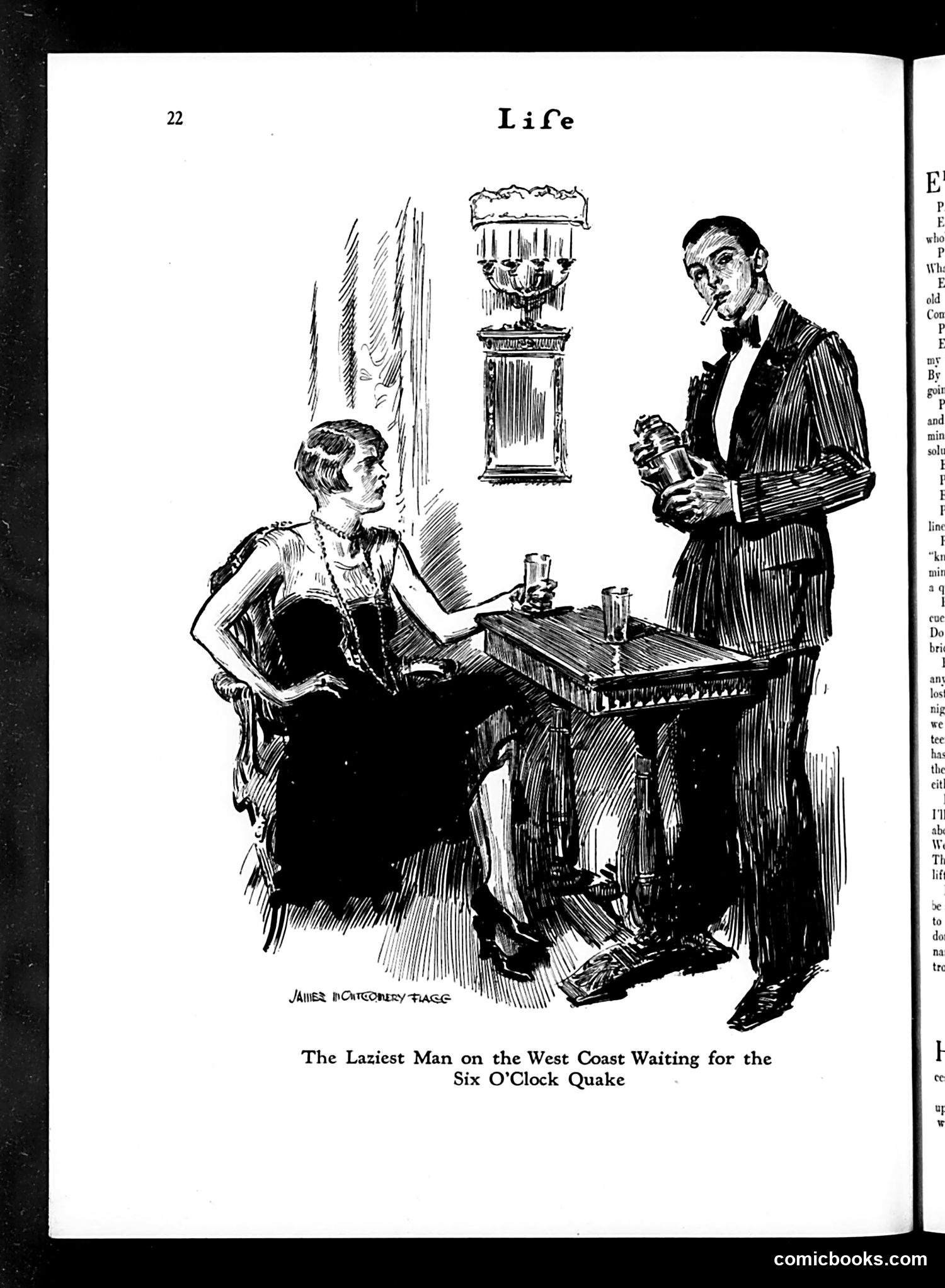
This satirical cartoon depicts a man and woman at a small table with drinks, captioned "The Laziest Man on the West Coast Waiting for the Six O'Clock Quake." The joke concerns **earthquake preparedness on the West Coast** (California), where seismic activity was a known hazard. The "laziest man" is apparently too indolent to prepare for or brace himself during an earthquake—instead, he's casually waiting for a predicted tremor at 6 o'clock, presumably expecting the quake itself to do the work for him (possibly shake things up, or perhaps he's waiting for it to disrupt his scheduled activities). The satire mocks both West Coast residents' casual attitude toward natural disasters and human laziness generally. The woman's expression suggests she finds his attitude absurd or troubling. The cartoon's date and exact context remain unclear without publication information.
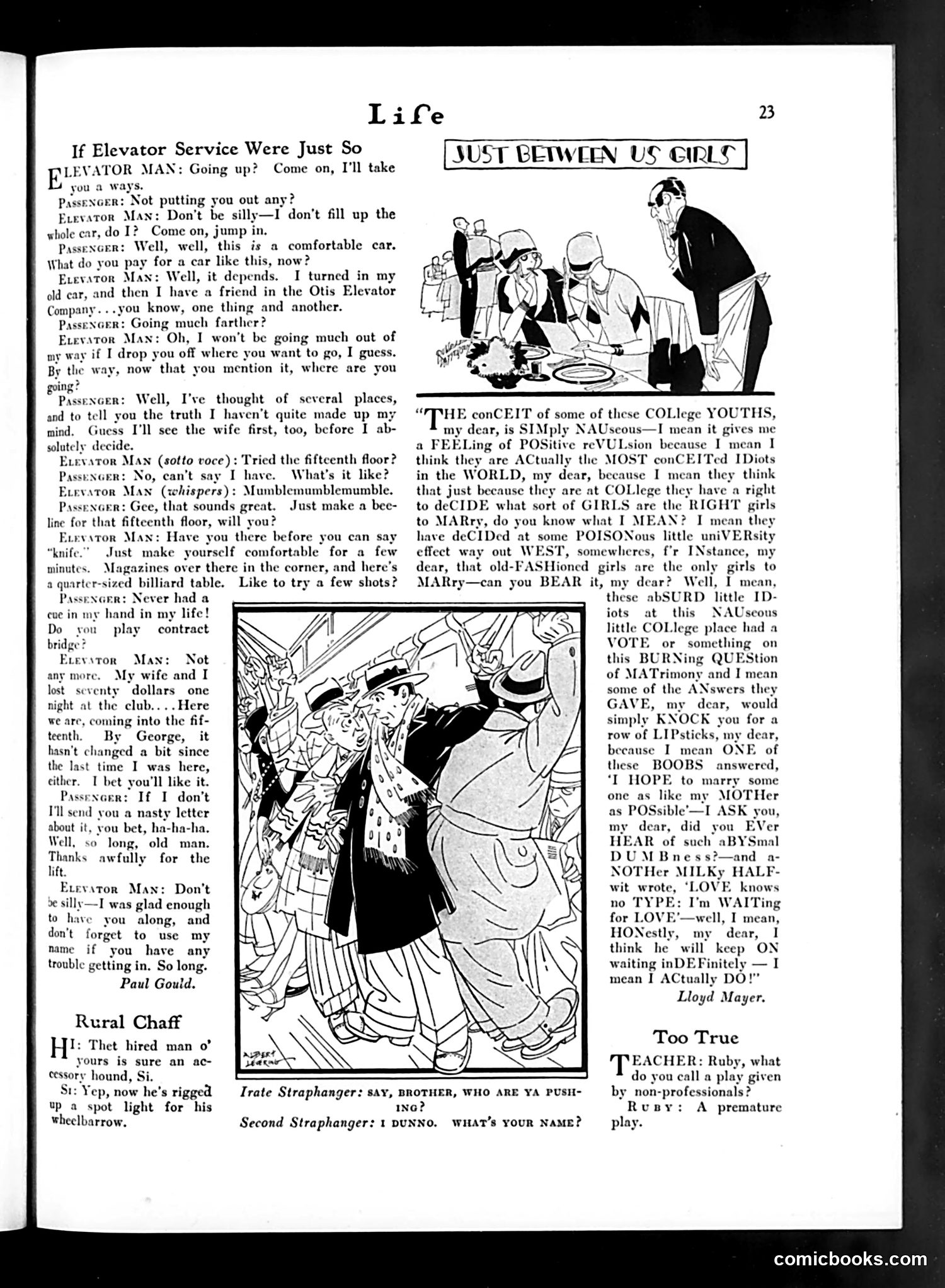
This 1920s *Life* magazine page contains three satirical pieces: **"If Elevator Service Were Just So"** (top): Mocks the casual, overly-familiar chitchat of elevator operators who treated their job as social conversation rather than professional service. The humor lies in the operator treating a passenger ride like a personal outing—offering comfort, suggesting destinations, playing billiards—absurdly blurring professional boundaries. **"Just Between Us Girls"** (right): A woman complains about college-educated young men who presume to decide what "type" of girls to marry. She mocks their arrogance and specific criteria (wanting a wife "like my mother"), satirizing both male entitlement and the pretensions of college-educated youth during the era. **"Rural Chaff"** and **"Too True"** (bottom): Brief, simple jokes—one about a farm hired man's improvised wheelbarrow light; one about amateurs in theater. The formatting emphasizes key words through capitalization, a stylistic choice of the era meant to add comedic punch through visual emphasis rather than content.
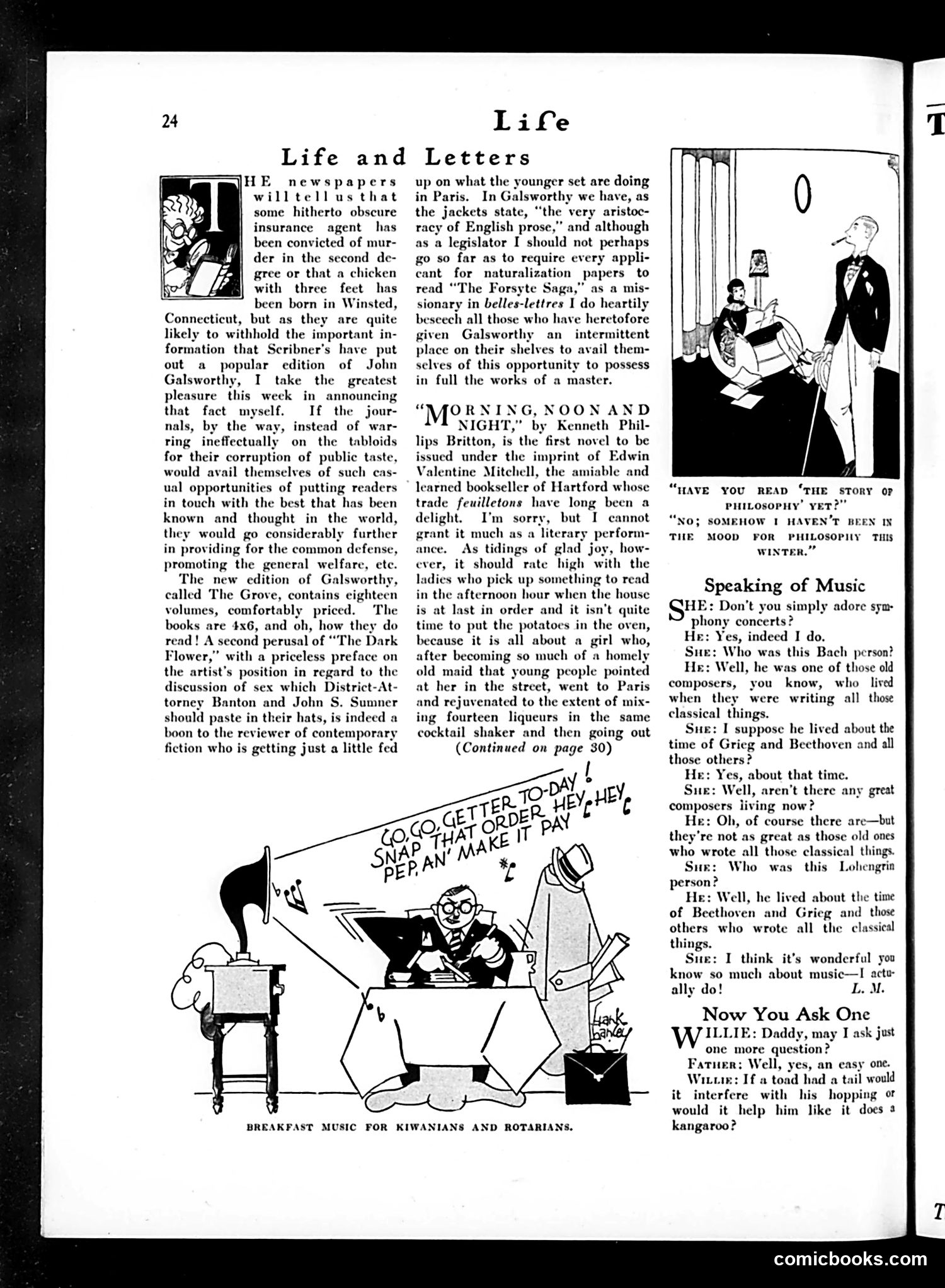
This page from *Life* magazine contains literary commentary and three humorous cartoons satirizing early 20th-century American culture. **Main Content:** The editor enthusiastically promotes John Galsworthy's new edition of *The Grove*, contrasting serious literature with sensationalist newspaper coverage. He criticizes journalism for ignoring cultural value while focusing on scandals and oddities. **Cartoons:** 1. **"Breakfast Music"** mocks service clubs (Kiwanians and Rotarians) by showing a man forcing loud phonograph music on breakfast diners—suggesting these organizations impose entertainment on unwilling audiences. 2. **"Speaking of Music"** satirizes social pretense: a woman asks about classical composers, but her questions reveal complete ignorance (confusing Lohengrin, a Wagner opera, with a person; grouping unrelated composers). The man patronizes her while she flatters his knowledge. 3. **"Now You Ask One"** presents a father-child dialogue where a child asks if a toad's tail would help it hop like a kangaroo—gentle humor about childish logic. The overall theme criticizes superficial cultural engagement and false sophistication among Americans.
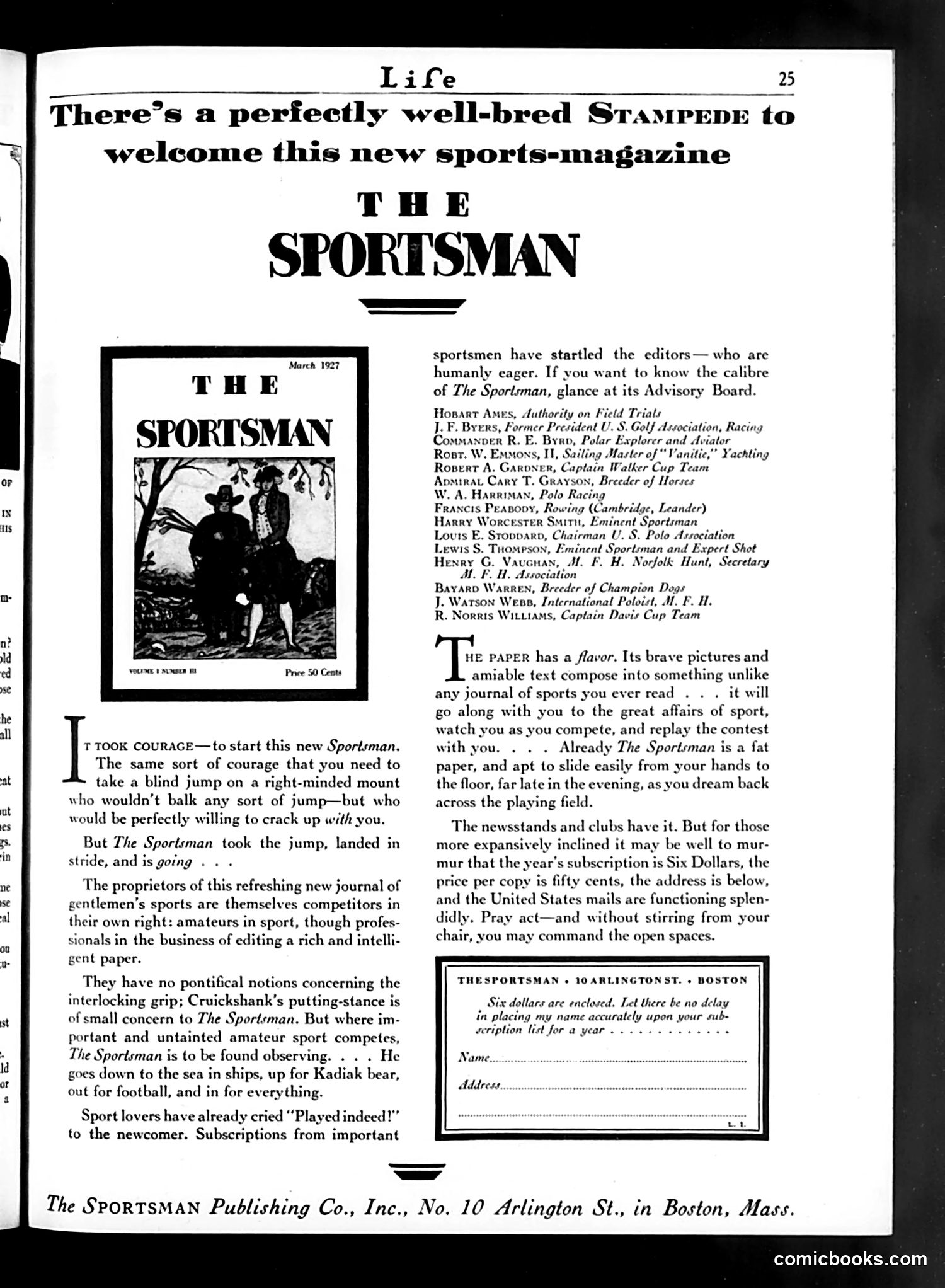
This page advertises a new sports magazine called *The Sportsman*, launching in 1927. The humor lies in the opening reference to a "perfectly well-bred STAMPEDE" welcoming the magazine—a playful pun suggesting upper-class, refined chaos endorsing this venture. The advertisement emphasizes that the publication's founders are themselves serious amateur sportsmen (not mere desk editors), listing an prestigious Advisory Board of wealthy and accomplished individuals: polo players, golf association leaders, yacht captains, and Olympic athletes. This establishes the magazine's elite credentials. The satirical tone suggests that starting a sports magazine requires the same reckless courage as riding an untamed horse that "would be perfectly willing to crack up with you"—mocking the daring yet potentially foolish ambition of launching a new publication in a crowded market. The pitch frames *The Sportsman* as covering all gentleman's sports, from field trials to polar exploration, positioned for affluent subscribers at six dollars yearly.
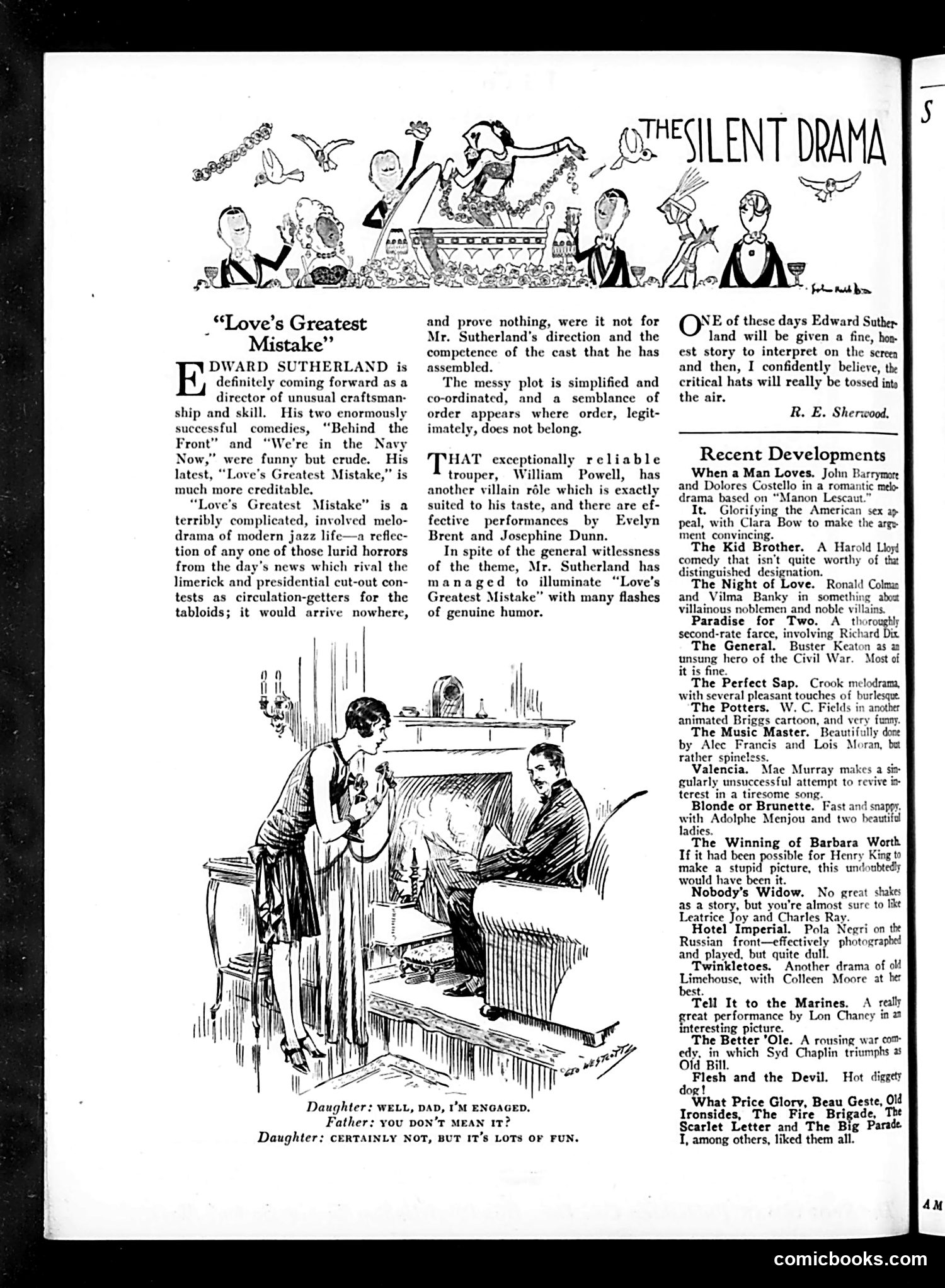
This page reviews Edward Sutherland's silent film "Love's Greatest Mistake," praising his directorial skill in salvaging a messy, melodramatic plot about modern "jazz life" (1920s contemporary culture). The reviewer notes Sutherland transforms tabloid-style sensationalism into coherent entertainment through competent direction and cast performances by William Powell, Evelyn Brent, and Josephine Dunn. The cartoon below illustrates the film's themes: a daughter announces her engagement, but clarifies it's "lots of fun" rather than serious—reflecting the era's changing attitudes toward romance and courtship among young women. The page also lists recent film releases, typical of *Life* magazine's entertainment coverage during Hollywood's silent era.
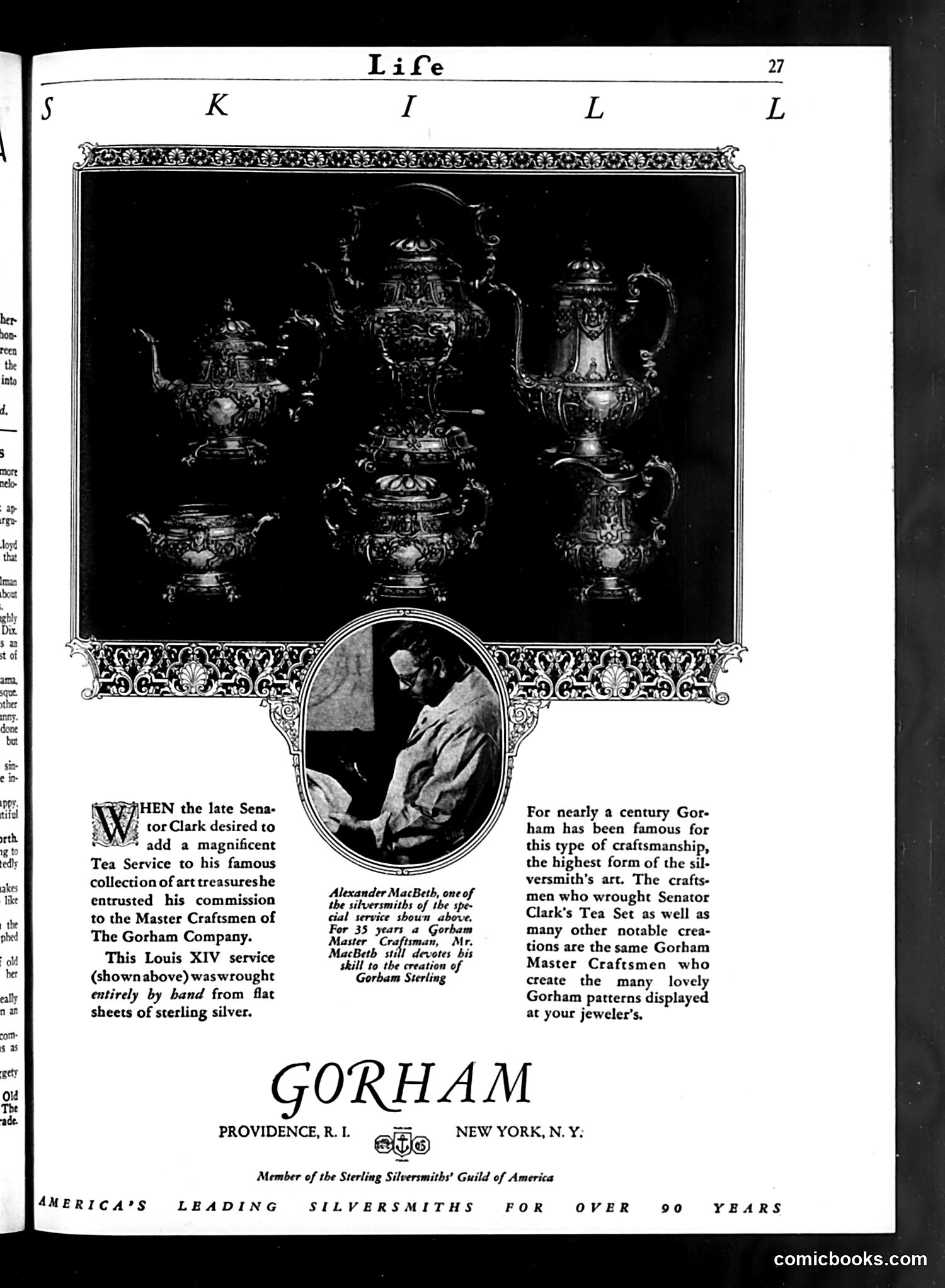
This is **not a political cartoon or satire**—it's a **full-page advertisement** for Gorham sterling silver. The page showcases an ornate Louis XIV tea service (six vessels displayed at top) commissioned by the late Senator Clark. The image of Alexander MacBeth, identified as a Gorham Master Craftsman of 35 years, illustrates the human craftsmanship behind the product. The ad's message emphasizes **tradition and quality**: Gorham has maintained excellence in silversmithing for nearly a century, hand-crafting pieces from flat sheets of sterling silver. By featuring both the finished luxury product and the skilled craftsman who created it, the advertisement appeals to wealthy readers' desire for heirloom-quality goods made through traditional artisanal methods. This represents typical *Life* magazine content from the early 20th century—luxury advertising targeting affluent readers alongside satirical editorial content.
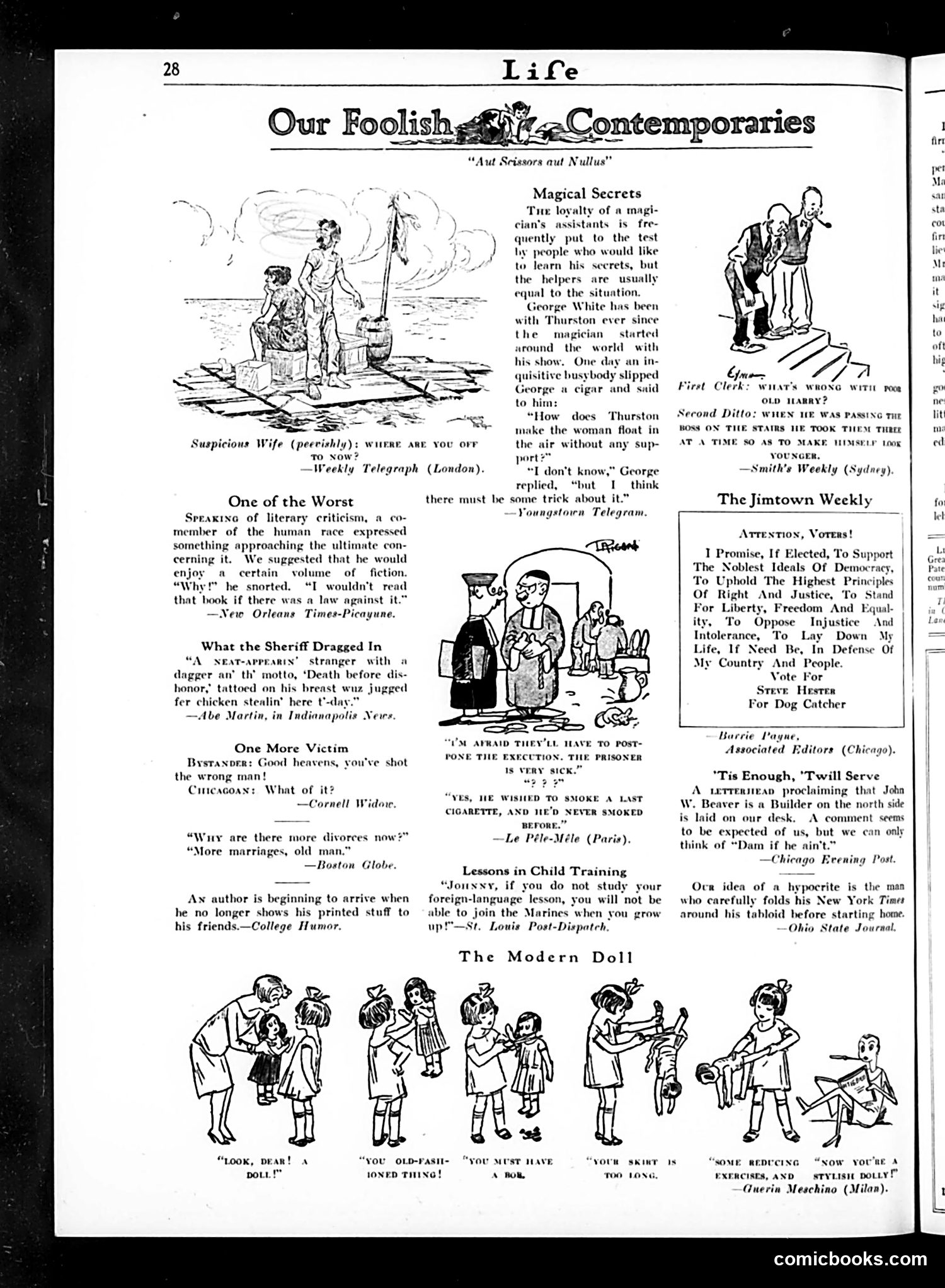
This page from *Life* magazine contains several short humorous pieces satirizing early 20th-century society: **"Magical Secrets"** mocks the public's nosiness about magicians' tricks. George White, assistant to magician Thurston, deflects a bribe-attempt by feigning ignorance. **"One of the Worst"** and related sections ridicule literary snobs and social pretension—someone refusing to read a book "if there was a law against it," a tattooed criminal arrested for petty theft, and divorce statistics blamed on remarriage. **"The Modern Doll"** cartoon series satirizes mothers forcing rigid social expectations on daughters—proper clothing, speech, and behavior—through puppet-like instruction. **"The Jimtown Weekly"** parodies empty political rhetoric: a candidate for Dog Catcher (a minor, absurd position) pledges grandiose ideals about democracy and personal sacrifice. The page's overall theme critiques hypocrisy, social climbing, conformity, and how Americans—from critics to politicians—often express grand principles while behaving foolishly.
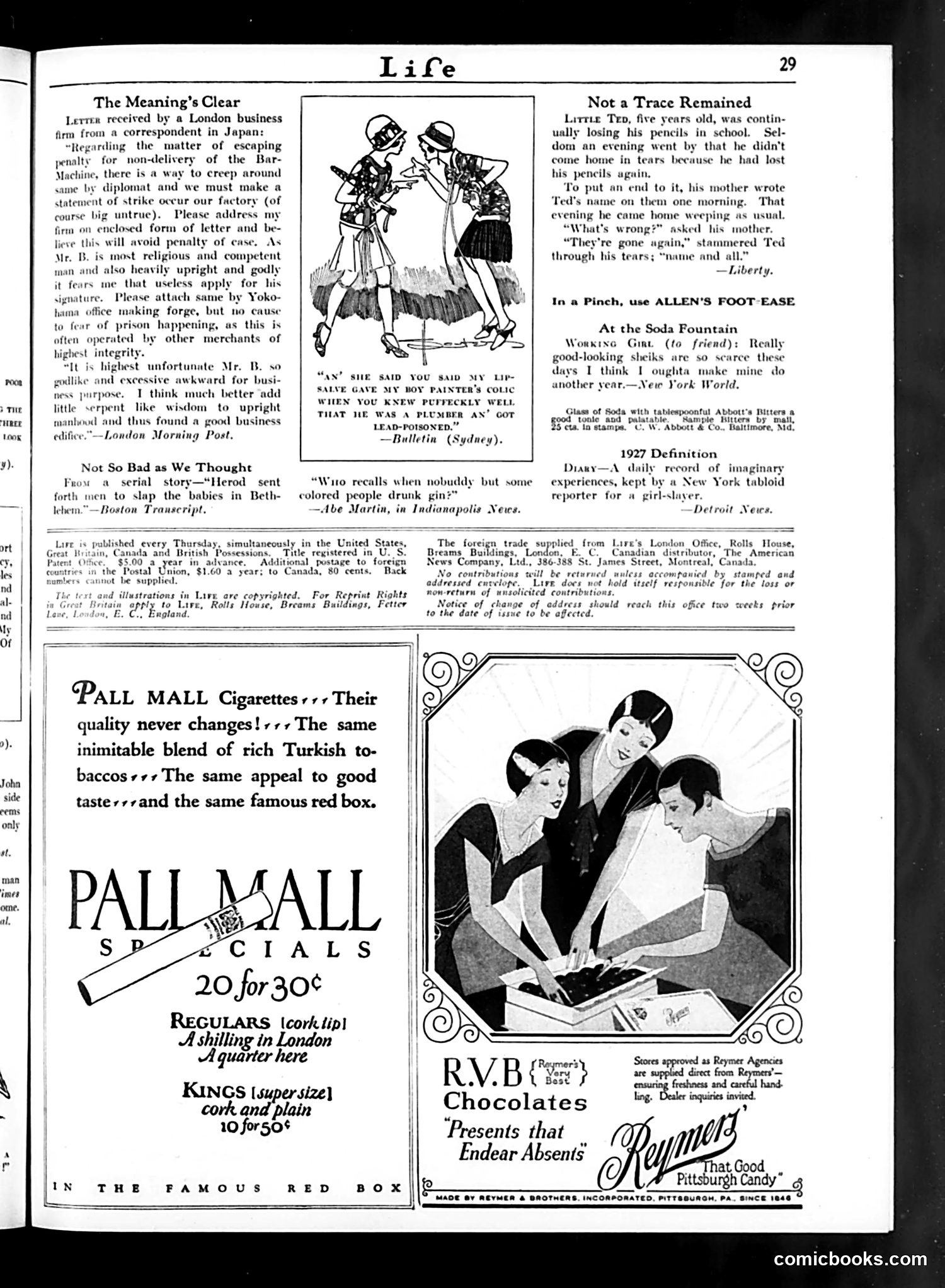
This page combines short humorous anecdotes with period advertisements. The main cartoons/jokes are: **"The Meaning's Clear"**: A London business letter from a Japanese correspondent attempting to excuse non-delivery of a "Bar-Machine" by fabricating a factory strike. The satire mocks broken English and transparent dishonesty disguised with flowery language about morality and godliness. **Other brief jokes** include a quip about Herod's soldiers, a Sydney bulletin about a plumber falsely claiming painter's colic (lead poisoning), and observations about gin-drinking and pencil-losing children. These are gentle, domestic humor pieces typical of the era. The advertisements for Pall Mall cigarettes, R.V.B. Chocolates, and foot powder reflect 1920s consumer culture. The page emphasizes wordplay and mild social observation rather than sharp political satire—common for Life's general-audience humor of this period.
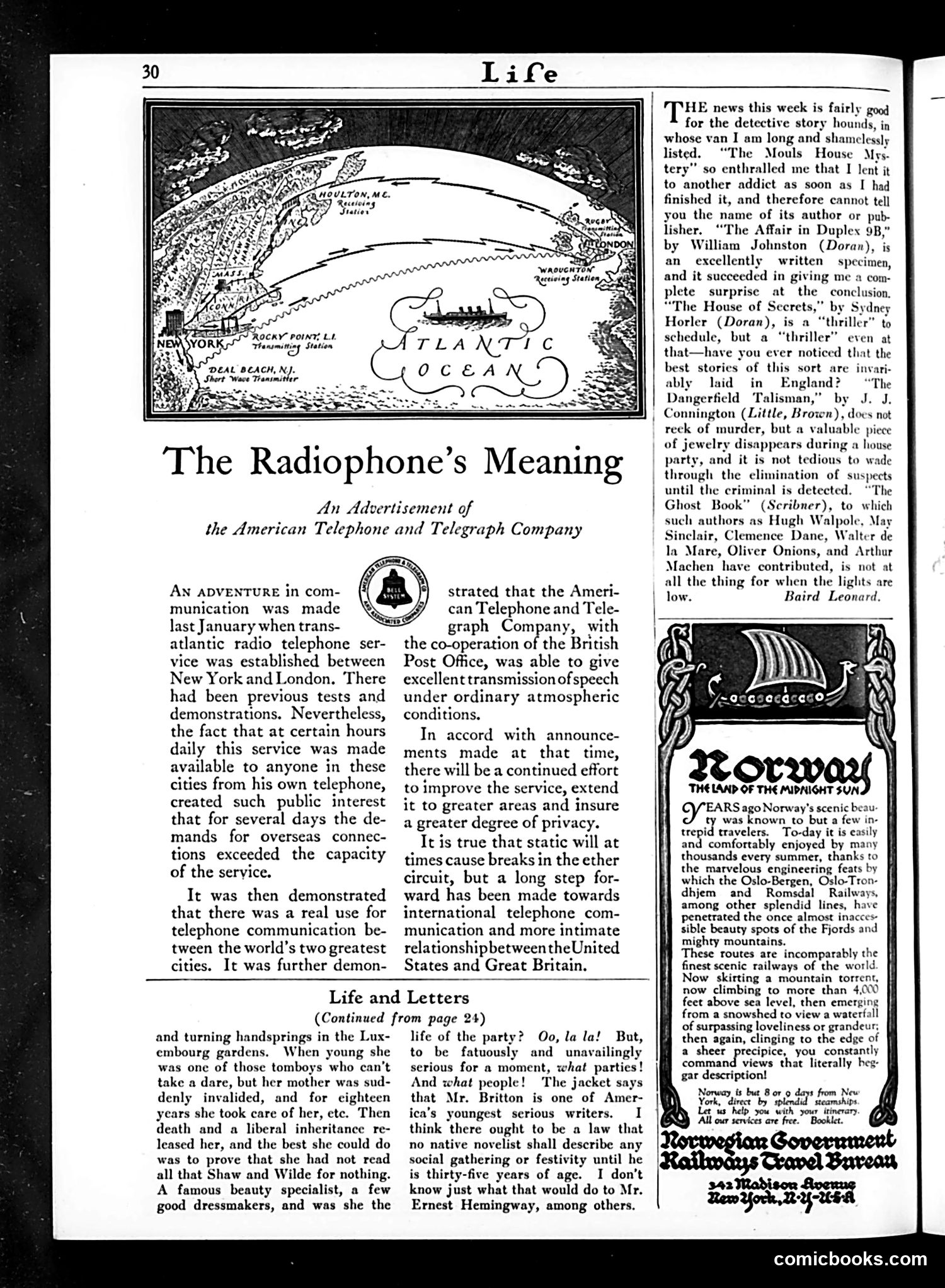
This page contains **primarily advertising and book reviews**, not political satire. The main content is an **AT&T advertisement** celebrating the recent establishment of transatlantic radiotelephone service between New York and London (initiated January 1927). The ad emphasizes AT&T's technological achievement in enabling clear voice transmission across the Atlantic, though it acknowledges ongoing issues with static and privacy concerns. The accompanying map shows the transatlantic route. The "Life and Letters" column reviews detective fiction and novels, praising authors like William Johnston and J.J. Connington. It includes criticism of young writers like Hemingway for attempting to depict sophisticated social scenes before reaching age thirty-five. A secondary advertisement promotes Norway as a tourist destination, suggesting it's now accessible to ordinary travelers via rail routes. **No political cartoons or satire appears on this page.** The content reflects 1920s-era corporate celebration of modern telecommunications technology and period literary criticism.
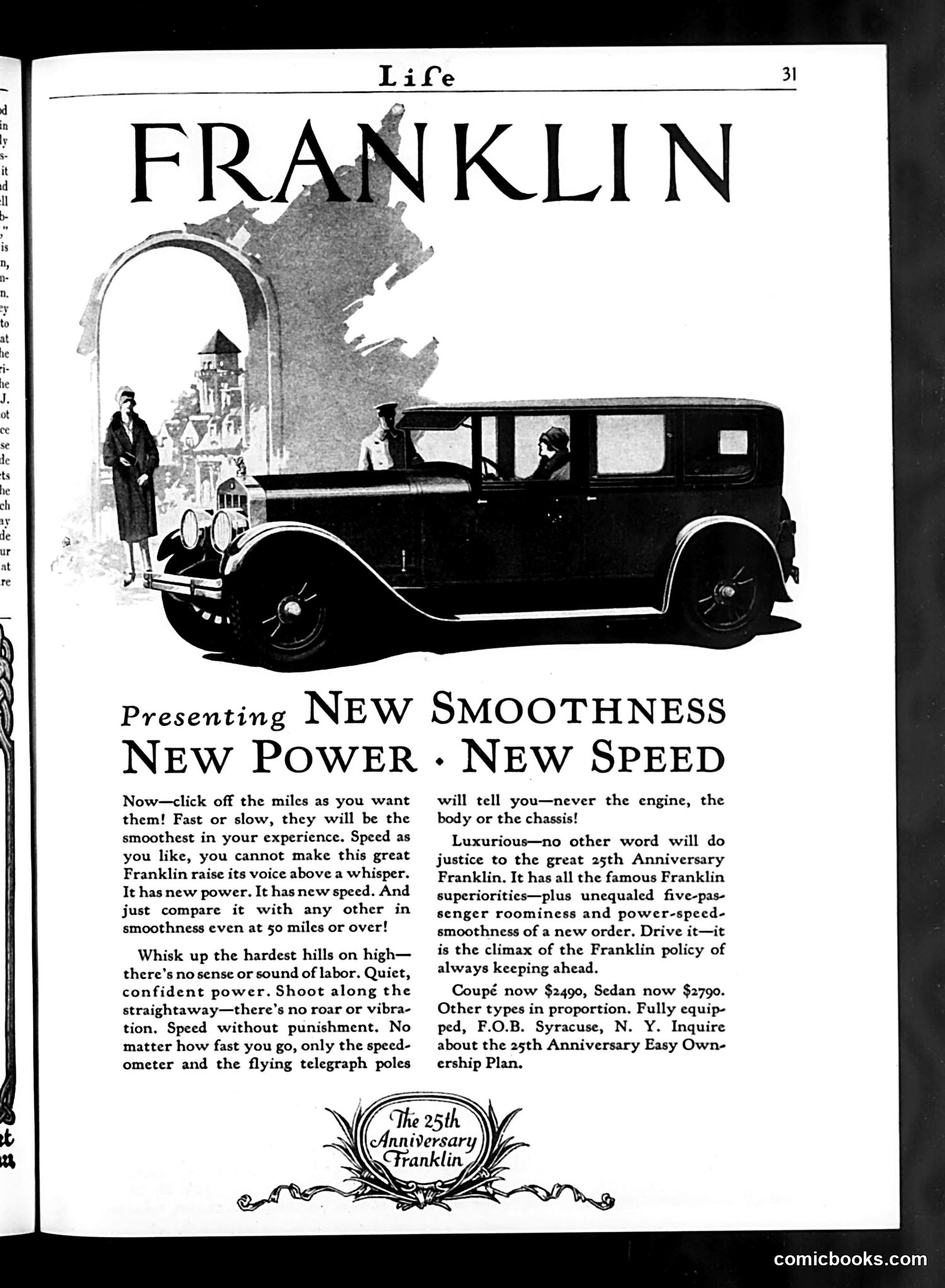
This is a **full-page automobile advertisement**, not political satire. It promotes the Franklin motor car's 25th Anniversary model, emphasizing three selling points: smoothness, power, and speed. The illustration shows a luxury sedan with well-dressed passengers and pedestrians in an elegant European setting (note the cathedral arch), suggesting prestige and cosmopolitan sophistication. The text uses hyperbolic marketing language typical of 1920s-30s advertising—claiming the car runs so quietly at high speeds that "never the engine, the body or the chassis!" will betray your acceleration. Pricing is listed ($2,490-$2,790), and the ad promotes an "Easy Ownership Plan." **Key context for modern readers:** This represents pre-Depression automotive luxury marketing, when cars were expensive status symbols. The emphasis on silence and smoothness reflects early internal-combustion engine technology that was still notably loud and rough by today's standards.
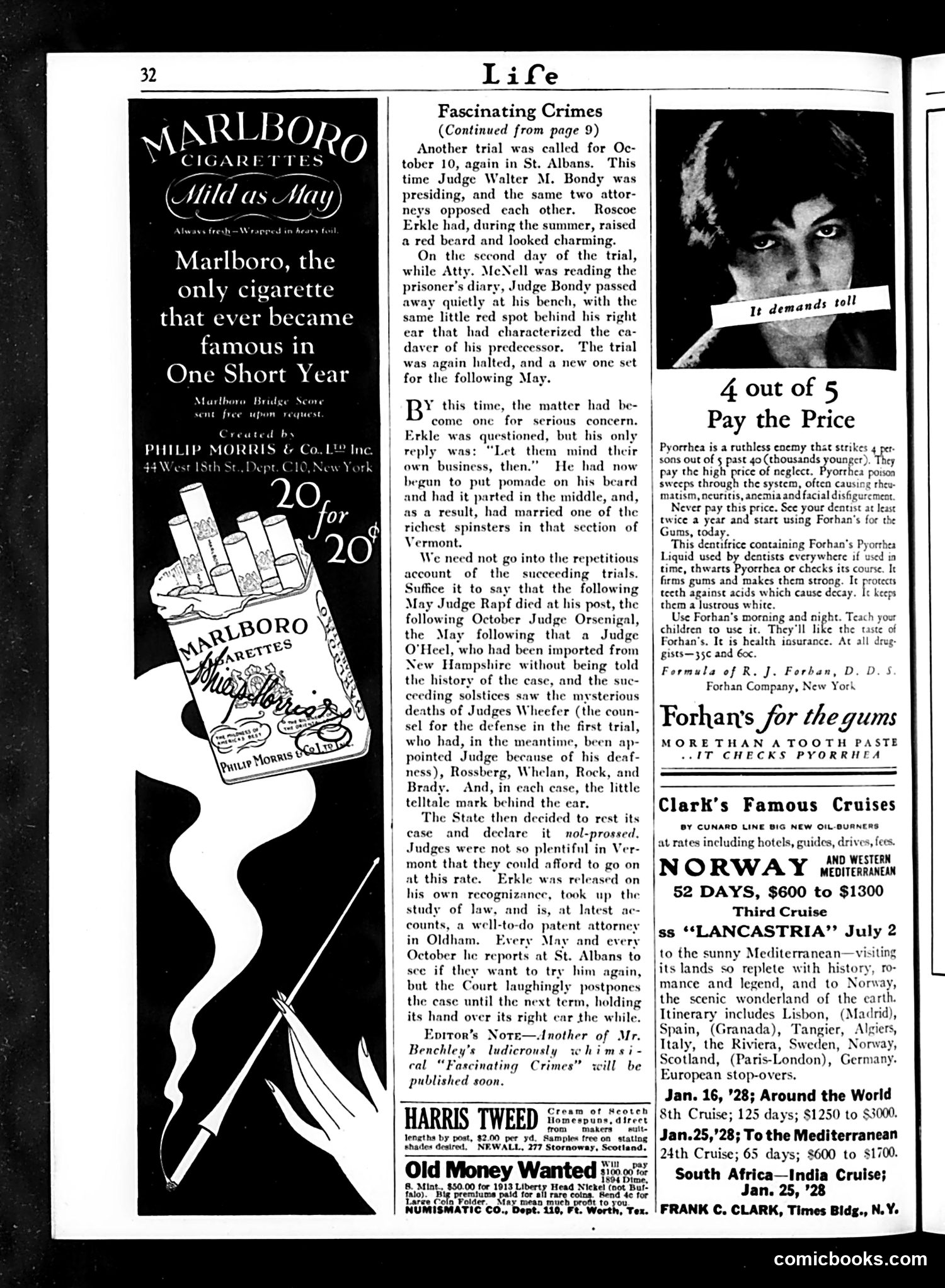
This page presents Robert Benchley's serialized humorous story about a Vermont trial gone absurdly wrong. The premise: a man named Roscoe Erkle is repeatedly tried for an unspecified crime, but each presiding judge mysteriously dies during proceedings—each bearing a suspicious red mark behind the right ear. The satire mocks legal inefficiency and bureaucratic absurdity: Vermont, unable to afford continued judicial losses, eventually abandons prosecution, allowing Erkle to walk free despite multiple suspicious deaths seemingly linked to him. The judges' deaths appear possibly connected to Erkle (who grows increasingly dapper between trials), yet nothing is proven. The joke for contemporary readers was Benchley's wry commentary on slow, repetitive legal proceedings and judicial system vulnerabilities—suggesting Vermont's justice system prioritizes fiscal concerns over actual justice. The story trades in grotesque coincidence for comedic effect.
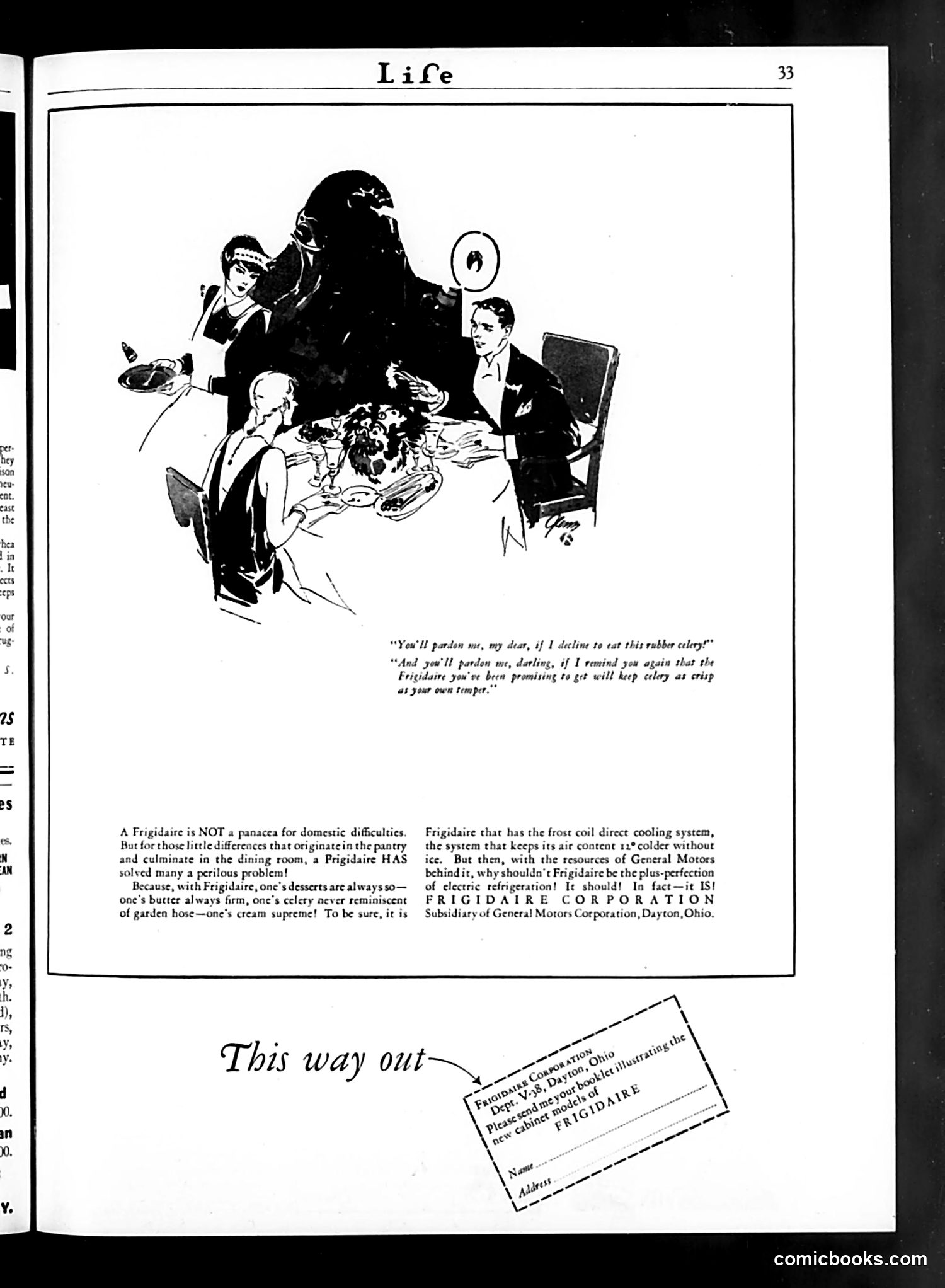
This is a **Frigidaire refrigerator advertisement** disguised as satirical humor. The cartoon depicts a domestic argument: a husband refuses to eat wilted celery, and his wife sarcastically reminds him he promised to buy a Frigidaire refrigerator that would keep produce fresh. The "joke" plays on marital tension—suggesting that poor food storage causes kitchen disputes. The ad then pivots to claim that Frigidaire solves "perilous problems" by keeping celery crisp, butter firm, and cream fresh, implying it prevents domestic conflict. This reflects early 20th-century advertising strategy: using humor and relatable domestic scenarios to sell appliances by positioning them as solutions to everyday friction. The endorsement of General Motors' engineering adds authority. For modern readers, the humor feels dated and the gender dynamics (wife's role managing food quality) reflect era-specific assumptions about domestic roles.
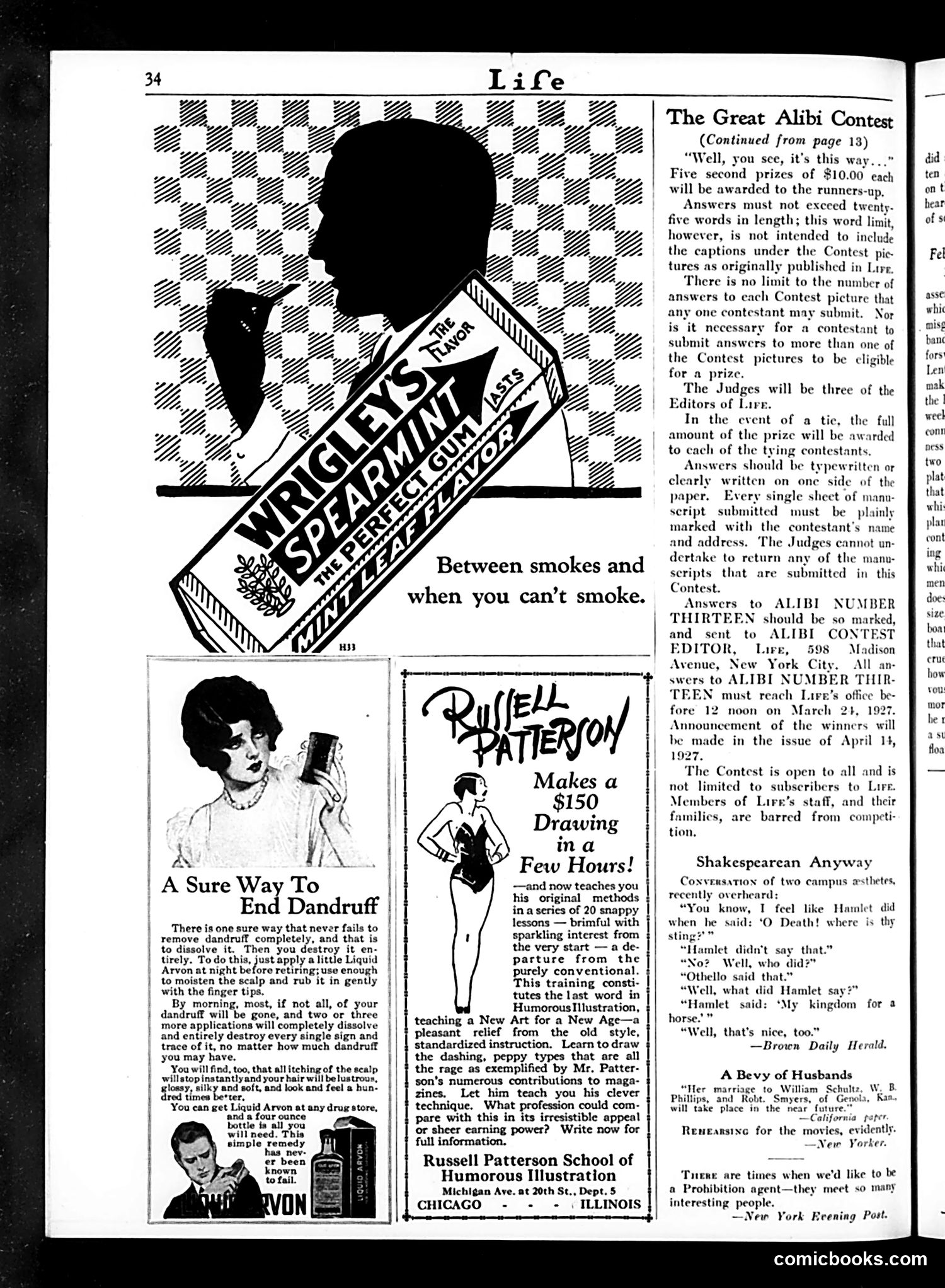
This page contains period advertisements and editorial content typical of 1920s Life magazine. The dominant image is an advertisement for Spergley's spearmint gum, showing a silhouetted profile smoking and holding the product, with text promising it works "between smokes and when you can't smoke." This references Prohibition-era restrictions on smoking in certain venues. Below are advertisements for Liquid Arvon (a dandruff cure) and the Russell Patterson School of Humorous Illustration, promoting both personal grooming solutions and commercial art training as profitable pursuits. The text includes "The Great Alibi Contest," where readers submit captions for pictures, and lighter humor pieces including "Shakespearean Anyway" (a joke about college athletes misquoting Hamlet) and "A Bevy of Husbands" (a brief newspaper clipping likely poking fun at unusual marriages). Overall, the page reflects 1920s consumer culture focused on self-improvement, commercial entertainment, and gentle social satire rather than political commentary.
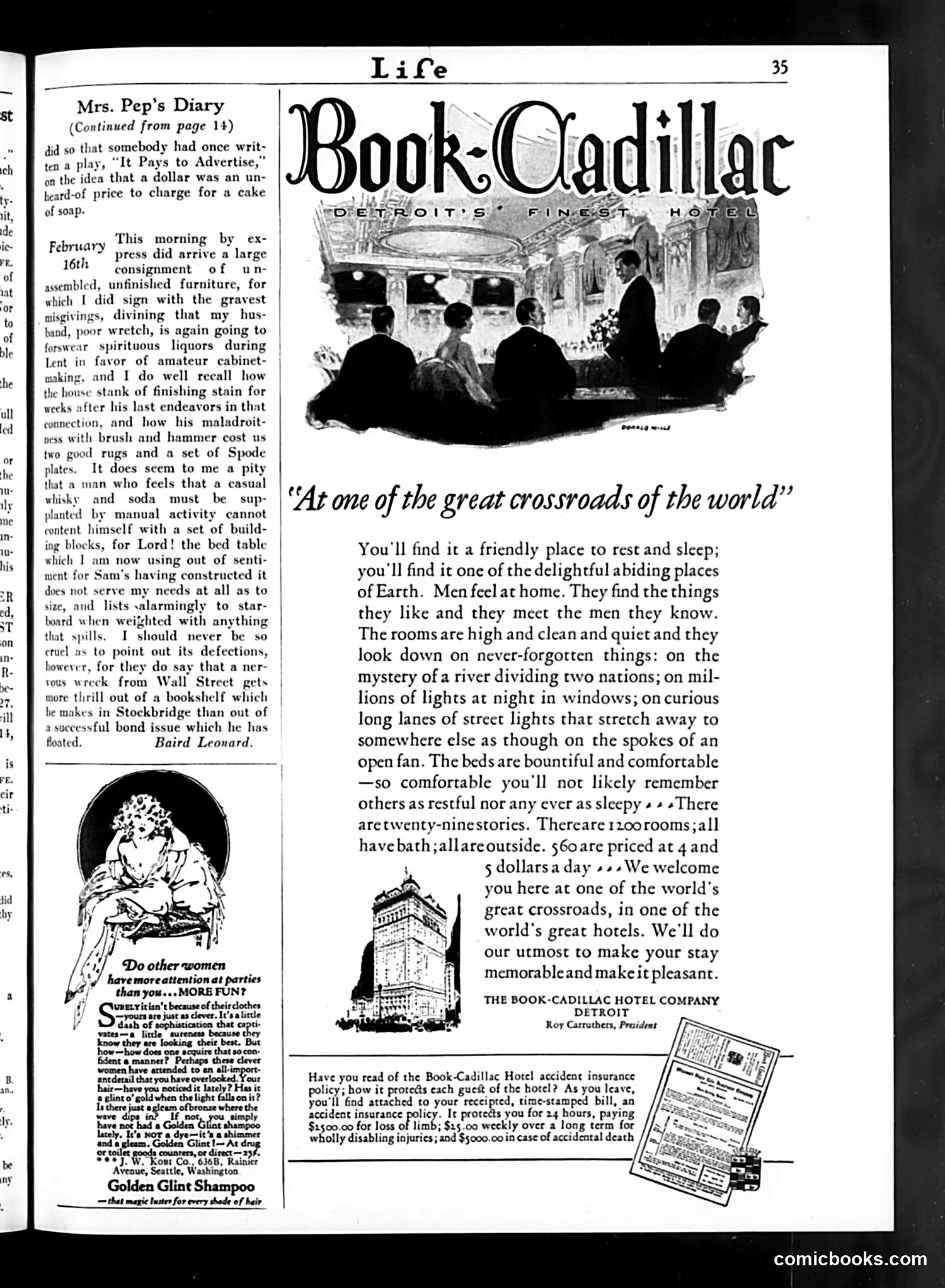
This page combines a satirical domestic diary entry with hotel and product advertising. **Mrs. Pep's Diary** humorously chronicles a wife's exasperation with her husband's Lenten tradition of abandoning alcohol for amateur furniture-making. The joke rests on a familiar 1920s scenario: stressed businessmen seeking "therapy" through DIY hobbies. Mrs. Pep notes his projects are disastrous—his handmade bedside table lists dangerously and damaged rugs—yet she tolerates them because such "nervous wrecks from Wall Street" supposedly find more satisfaction in a homemade bookshelf than professional success. The satire mocks both masculine anxiety about modern work and the period's emerging faith in amateur craftsmanship as psychological remedy. The remainder is advertising for the Book-Cadillac Hotel (Detroit), Golden Glint Shampoo, and hotel accident insurance—typical Life magazine content mixing social commentary with revenue-generating advertisements. The diary's gentle domesticity establishes the magazine's audience: educated, middle-to-upper-class readers amused by marital observation and consumer culture.
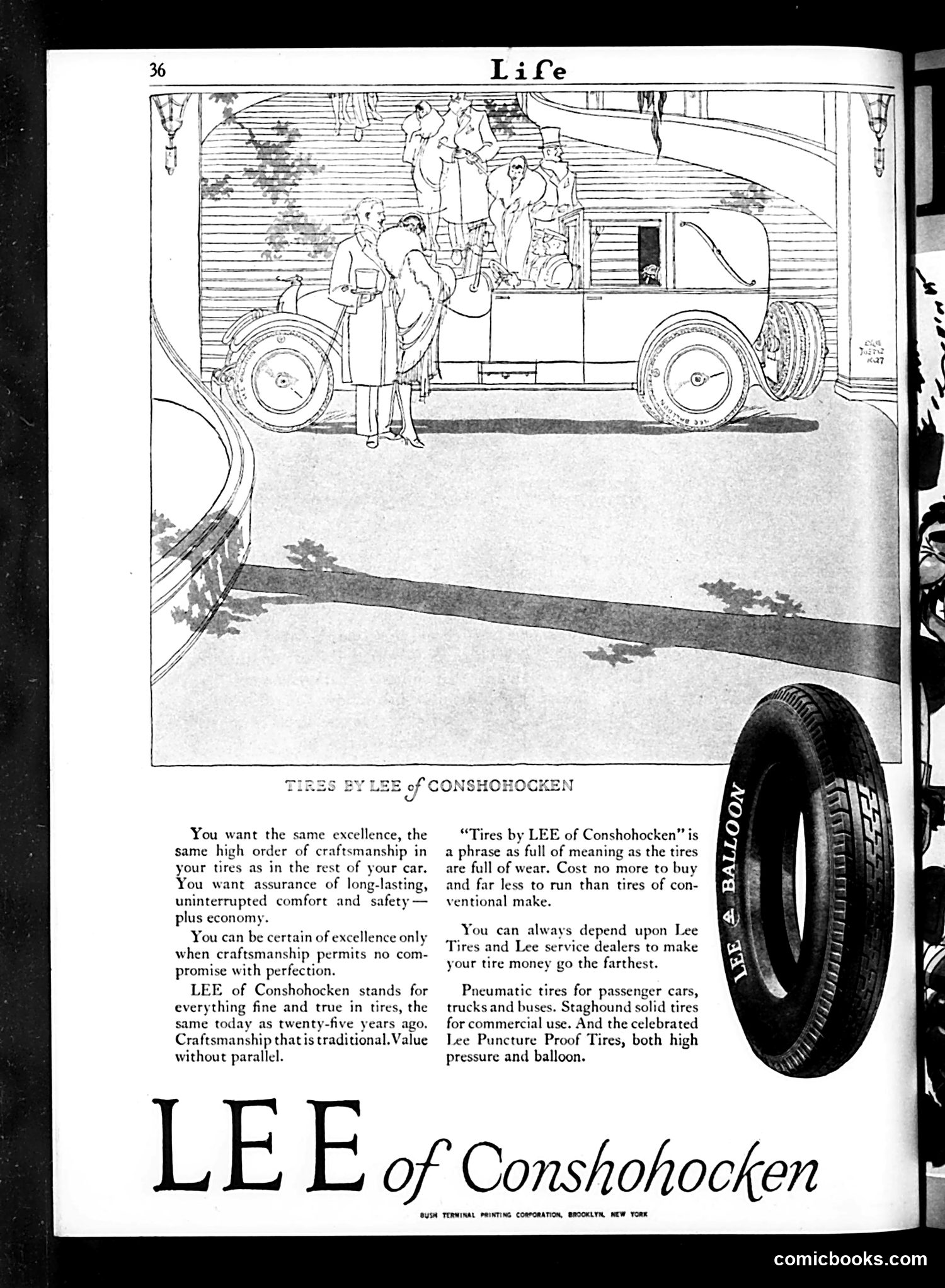
This is not a cartoon or satire—it's a straightforward advertisement for Lee Tires of Conshohocken (Pennsylvania). The illustration shows a 1920s-era bus or touring vehicle with passengers boarding, designed to showcase the tire product in an aspirational social setting. The ad emphasizes traditional craftsmanship and quality, claiming Lee Tires have maintained excellence for twenty-five years. It promotes several tire varieties: pneumatic tires for passenger vehicles, solid "Staghound" tires for commercial use, and "Puncture Proof Tires" in both high-pressure and balloon styles. The message targets middle-class consumers seeking reliability and economy—promising that Lee Tires cost no more upfront but run cheaper than conventional alternatives. The tone appeals to values of durability and dependable American manufacturing.