
Life, 1927-03-10 · page 18 of 38
Life — March 10, 1927 — page 18: what you’re looking at
What you’re looking at
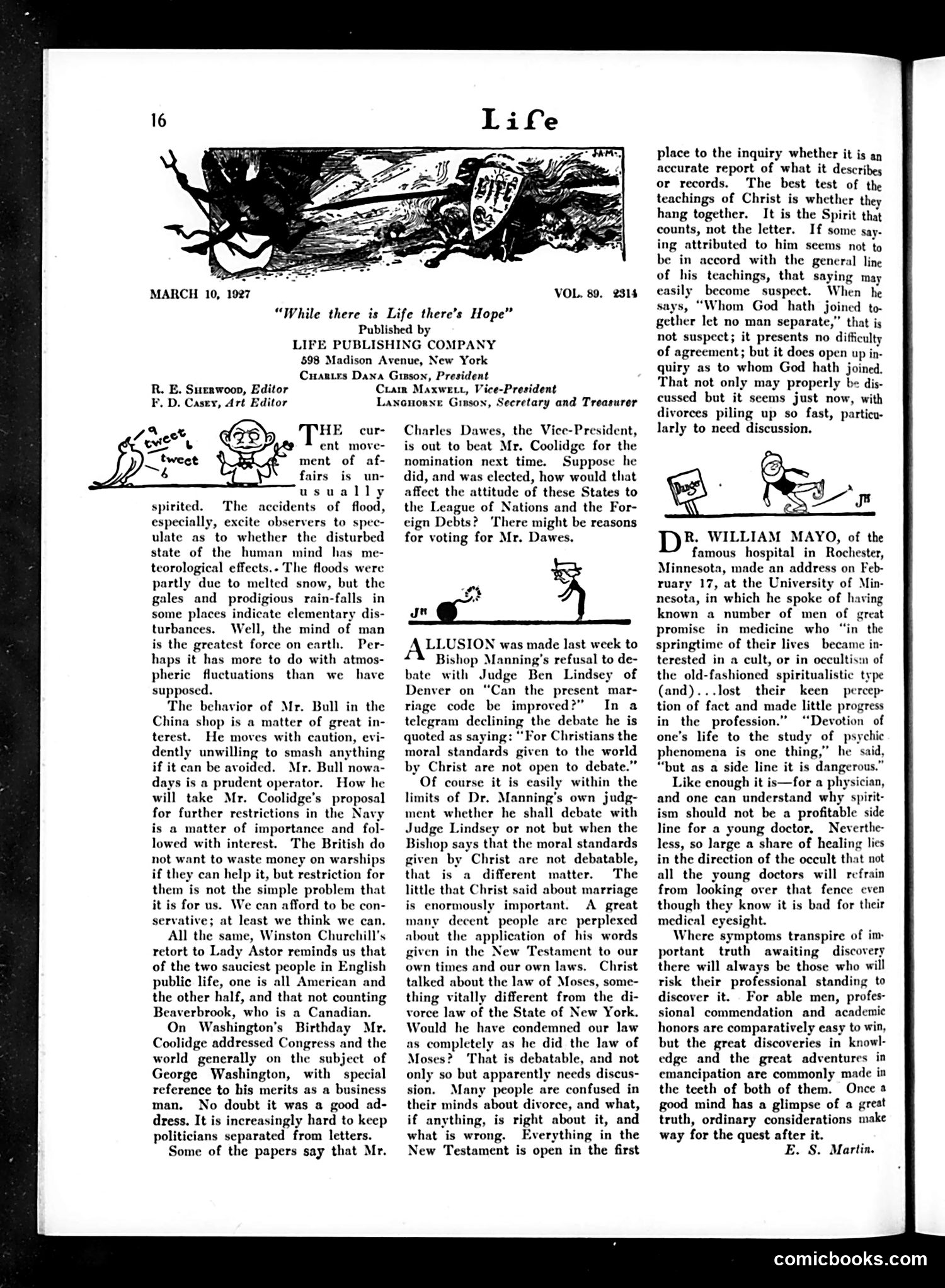
This page contains editorial commentary rather than traditional cartoons. The main satirical content discusses: **Charles Dawes** (Vice-President) as a candidate to challenge Calvin Coolidge for the Republican nomination, with skepticism about whether electing Dawes would meaningfully change U.S. foreign policy positions. **Winston Churchill** receives praise as a shrewd businessman and good dresser, with the editor noting it's "increasingly hard to keep politicians separated from letters"—satirizing the blurred lines between politics and public relations. **Bishop Manning's debate** with Judge Ben Lindsey about marriage codes is discussed, questioning whether Christian moral standards should be publicly debatable. The small cartoon figures appear decorative rather than illustrative of specific political figures or events.
📄 Transcribed text from this page (OCR, searchable)
Machine-transcribed from the original scan — historical spelling and the odd misread are preserved.
MARCH 10, 1927 VOL. 89. 2314 “While there is Life there’s Hope” Published by LIFE PUBLISHING COMPANY 598 Madison Avenue, New York Cuantrs Dana Gipson, President R. E. Surrwoon, Editor F. D. Casey, Art Editor HE cur- ent move- ment of af- fairs is un- usually spirited. The accidents of flood, especially, excite observers to spec- ulate as to whether the disturbed state of the human mind has me- teorological effects.- The floods were partly due to melted snow, but the gales and prodigious rain-falls in some places indicate elementary dis- turbances. Well, the mind of man is the greatest force on earth. Per- haps it has more to do with atmos- pheric fluctuations than we have supposed, The behavior of Mr. Bull in the China shop is a matter of great in- terest. He moves with caution, evi- dently unwilling to smash anything if it can be avoided. Mr. Bull nowa- days is a prudent operator. How he will take Mr. Coolidge’s proposal for further restrictions in the Navy is a matter of importance and fol- lowed with interest. The British do not want to waste money on warships if they can help it, but restriction for them is not the simple problem that it is for us. We can afford to be con- servative; at least we think we can, All the same, Winston Churchill's retort to Lady Astor reminds us that of the two sauciest people in English public life, one is all American and the other half, and that not counting Beaverbrook, who is a Canadian. On Washington's Birthday Mr. Coolidge addressed Congress and the world generally on the subject of George Washington, with special reference to his merits as a business man. No doubt it was a good ad- dress, It is increasingly hard to keep politicians separated from letters. Some of the papers say that Mr. Cram Maxwett, Vice-President Lanonorne Ginson, Secretary and Treasurer Charles Dawes, the Vice-President, is out to beat Mr. Coolidge for the nomination next time. Suppose he did, and was elected, how would that affect the attitude of these States to the League of Nations and the For- eign Debts? There might be reasons for voting for Mr. Dawes. LLUSION was made last week to Bishop Manning's refusal to de- bate with Judge Ben Lindsey of Denver on “Can the present mar- riage code be improved?” In a telegram declining the debate he is quoted as sayin, or Christians the moral standards given to the world by Christ are not open to debate.” Of course it is easily within the limits of Dr. Manning’s own judg- ment whether he shall debate with Judge Lindsey or not but when the Bishop says that the moral standards given by Christ are not debatable, that is a different matter. The little that Christ said about marriage is enormously important. A great many decent people are perplexed about the application of his words given in the New Testament to our own times and our own laws. Christ talked about the law of Moses, some- thing vitally different from the di- vorce law of the State of New York. Would he have condemned our law as completely as he did the law of Moses? That is debatable, and not only so but apparently needs discus- sion. Many people are confused in their minds about divorce, and what, if anything, is right about it, and what is wrong. Everything in the New Testament is open in the first place to the inquiry whether it is an accurate report of what it describes or records. The best test of the teachings of Christ is whether they hang together. It is the Spirit that counts, not the letter. If some say- ing attributed to him seems not to be in accord with the general line of his teachings, that saying may easily become suspect. When he says, “Whom God hath joined to- gether let no man separate,” that is not suspect; it presents no difficulty of agreement; but it does open up in- quiry as to whom God hath joined. That not only may properly be dis- cussed but it seems just now, with divorces piling up so fast, particu- larly to need discussion. R. WILLIAM MAYO, of the famous hospital in Rochester, Minnesota, made an address on Feb- ruary 17, at the University of Min- nesota, in which he spoke of having known a number of men of great promise in medicine who “in the springtime of their lives became in- terested in a cult, or in occultismn of the old-fashioned spiritualistic type (and)...lost their keen percep- tion of fact and made little progress in the profession.” ‘Devotion of one’s life to the study of psychic phenomena is one thing,” he “but as a side line it is dangerous.” Like enough it is—for a physician, and one can understand why spirit- ism should not be a profitable side line for a young doctor. Neverthe- less, so large a share of heal in the direction of the occult that not all the young doctors will refrain from looking over that fence even though they know it is bad for their medical eyesight. Where symptoms transpire of im portant truth awaiting discovery there will always be those who will risk their professional standing to discover it. For able men, profes- sional commendation and academic honors are comparatively easy to win, but the great discoveries in knowl- edge and the great adventures in emancipation are commonly made in the teeth of both of them. Once a good mind has a glimpse of a great truth, ordinary considerations make way for the quest after it. E. S. Martin. comicbooks.com