
Life, 1927-03-10 · page 23 of 38
Life — March 10, 1927 — page 23: what you’re looking at
What you’re looking at
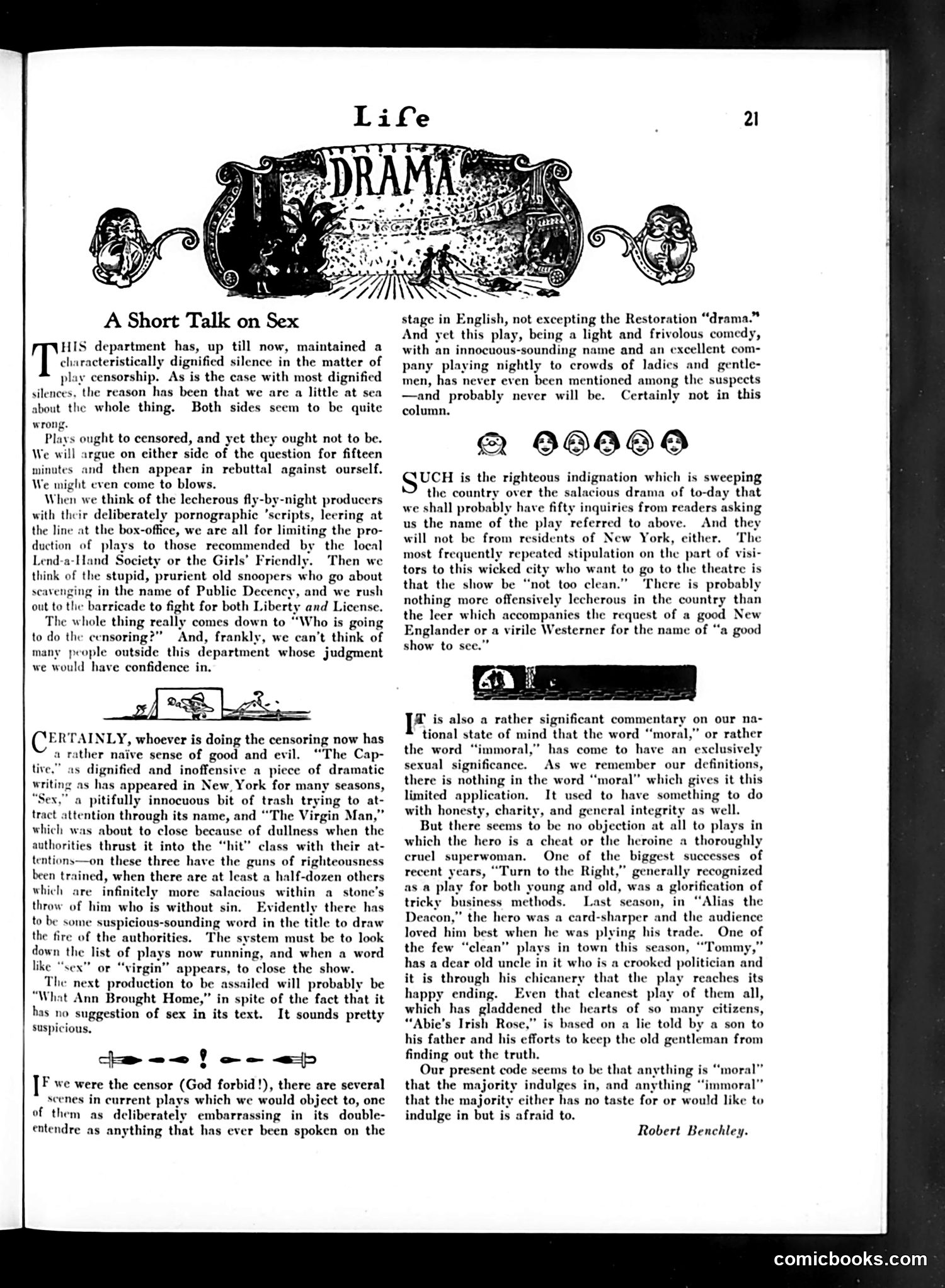
This editorial piece satirizes theatrical censorship practices of the era. The author critiques the hypocrisy of moral guardians who target plays with suggestive titles ("Sex," "The Captive," "The Virgin Man") while ignoring equally or more salacious productions with innocent-sounding names. The satire's main points: 1. **Arbitrary censorship**: Authorities appear to simply scan playbill titles for suspicious words rather than evaluating actual content—suggesting incompetent gatekeeping. 2. **Provincial hypocrisy**: The author mocks visitors from outside New York (New Englanders and "virile Westerners") who claim moral outrage yet specifically request "not too clean" shows—exposing their actual lustful interest. 3. **Linguistic narrowing**: The piece observes that "moral" and "immoral" have been reduced to exclusively sexual meanings, reflecting society's obsession. The tone is mockingly self-aware; the author acknowledges Life's own ambivalent stance on censorship while attacking the censors' inconsistent, title-based methodology as naive and ineffective.
📄 Transcribed text from this page (OCR, searchable)
Machine-transcribed from the original scan — historical spelling and the odd misread are preserved.
A Short Talk on Sex HIS department has, up till now, maintained a IT isrscternticatly dignified silence in the matter of play censorship. As is the case with most dignified silences, the reason has been that we are a little at sea about the whole thing. Both sides seem to be quite wrong. Plays ought to censored, and yet they ought not to be. We will argue on either side of the question for fifteen minutes and then appear in rebuttal against ourself. We might even come to blows. When we think of the lecherous fly-by-night producers with their deliberately pornographic ‘scripts, leering at the line at the box-office, we are all for limiting the pro- duction of plays to those recommended by the local Lend-a-Hand Society or the Girls’ Friendly. Then we think of the stupid, prurient old snoopers who go about scavenging in the name of Public Decency, and we rush out to the barricade to fight for both Liberty and License. The whole thing really comes down to “Who is going to do the censoring?” And, frankly, we can’t think of many people outside this department whose judgment we would have confidence in. RTAINLY, whoever is doing the censoring now has 1 rather naive sense of good and evil. “The Cap- tive.” as dignified and inoffensive a piece of dramatic writing as has appeared in New, York for many seasons, “Sex,” a pitifully innocuous bit of trash trying to at- tract attention through its name, and “The Virgin Man,” which was about to close because of dullness when the authorities thrust it into the “hit” class with their at- tentions—on these three have the guns of righteousness been trained, when there are at least a half-dozen others which are infinitely more salacious within a stone's throw of him who is without sin. Evidently there has to be some suspicious-sounding word in the title to draw the fire of the authorities. The system must be to look down the list of plays now running, and when a word like “sex” or “virgin” appears, to close the show. The next production to be assailed will probably be “What Ann Brought Home,” in spite of the fact that it has no suggestion of sex in its text. It sounds pretty Suspicious, fm m2 oe <b F we were the censor (God forbid!), there are several scenes in current plays which we would object to, one of them as deliberately embarrassing in its double- entendre as anything that has ever been spoken on the stage in English, not excepting the Restoration “drama.” And yet this play, being a light and frivolous comedy, with an innocuous-sounding name and an excellent com- pany playing nightly to crowds of ladies and gentle- men, has never even been mentioned among the suspects —and probably never will be. Certainly not in this & 20868 Such is the righteous indignation which is sweeping the country over the salacious drama of to-day that we shall probably have fifty inquiries from readers asking us the name of the play referred to above. And they will not be from residents of New York, either. The most frequently repeated stipulation on the part of vis tors to this wicked city who want to go to the theatre that the show be “not too clean.” There is probably nothing more offensively lecherous in the country than the leer which accompanies the request of a good New Englander or a virile Westerner for the name of “a good show to see.” fat is also a rather significant commentary on our na- tional state of mind that the word “moral,” or rather the word “immoral,” has come to have an exclusively sexual significance. As we remember our definitions, there is nothing in the word “moral” which gives it this limited application. It used to have something to do with honesty, charity, and general integrity as well But there seems to be no objection at all to plays in which the hero is a cheat or the heroine a thoroughly cruel superwoman. One of the biggest successes of recent years, “Turn to the Right,” generally recognized as a play for both young and old, was a glorification of tricky business methods. Last season, in “Alias the Deacon,” the hero was a card-sharper and the audience loved him best when he was plying his trade. One of the few “clean” plays in town this season, has a dear old uncle in it who is a crooked politic it is through his chicanery that the play reaches its happy ending. Even that cleanest play of them all, which has gladdened the hearts of so many citizens, “Abie’s Irish Rose,” is based on a lie told by a son to his father and his efforts to keep the old gentleman from finding out the truth. Our present code seems to be that anything is that the majority indulges in, and anything “immoral” that the majority either has no taste for or would like to indulge in but is afraid to. ‘moral” Robert Benchley. comicbooks.com