
Life, 1927-03-10 · page 26 of 38
Life — March 10, 1927 — page 26: what you’re looking at
What you’re looking at
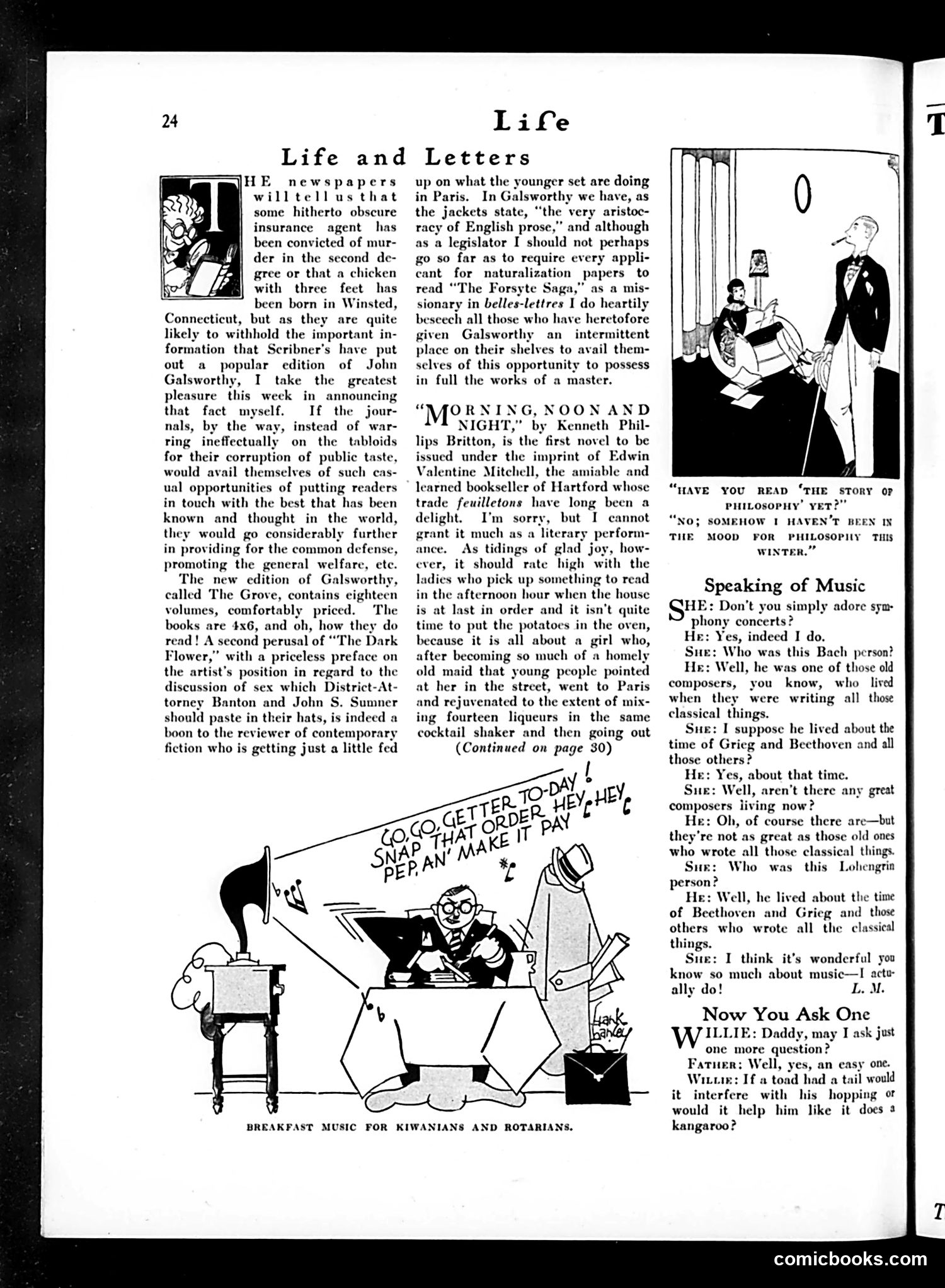
This page from *Life* magazine contains literary commentary and three humorous cartoons satirizing early 20th-century American culture. **Main Content:** The editor enthusiastically promotes John Galsworthy's new edition of *The Grove*, contrasting serious literature with sensationalist newspaper coverage. He criticizes journalism for ignoring cultural value while focusing on scandals and oddities. **Cartoons:** 1. **"Breakfast Music"** mocks service clubs (Kiwanians and Rotarians) by showing a man forcing loud phonograph music on breakfast diners—suggesting these organizations impose entertainment on unwilling audiences. 2. **"Speaking of Music"** satirizes social pretense: a woman asks about classical composers, but her questions reveal complete ignorance (confusing Lohengrin, a Wagner opera, with a person; grouping unrelated composers). The man patronizes her while she flatters his knowledge. 3. **"Now You Ask One"** presents a father-child dialogue where a child asks if a toad's tail would help it hop like a kangaroo—gentle humor about childish logic. The overall theme criticizes superficial cultural engagement and false sophistication among Americans.
📄 Transcribed text from this page (OCR, searchable)
Machine-transcribed from the original scan — historical spelling and the odd misread are preserved.
Life Life and Letters HE newspapers willtell us that some hitherto obscure insurance agent has been convicted of mur- der in the second de- gree or that a chicken with three feet has been born in Winsted, Connecticut, but as they are quite likely to withhold the important in- formation that Scribner's have put out a popular edition of John Galsworthy, I take the greatest pleasure this week in announcing that fact myself. If the jour- nals, by the way, instead of war- ring ineffectually on the tabloic for their corruption of public taste, would avail themselves of such cas- ual opportunities of putting readers in touch with the best that has been known and thought in the world, they would go considerably further in providing for the common defense, promoting the general welfare, ete. The new edition of Galsworthy, called The Grove, contains eighteen volumes, comfortably priced. The books are 4x6, and oh, how they do read! A second perusal of “The Dark Flower,” with a priceless preface on the artist's position in regard to the discussion of sex which District-At- torney Banton and John S. Sumner should paste in their hats, is indeed a boon to the reviewer of contemporary fiction who is getting just a little fed up on what the younger set are doing in Paris. In Galsworthy we have, as the jackets state, “the very aristoc- racy of English prose,” and although as a legislator I should not perhaps go so far as to require every appli- cant for naturalization papers to read “The Forsyte Saga,” as a mis- sionary in belles-lettres I do heartily beseech all those who have heretofore given Galsworthy an_ intermittent place on their shelves to avail them- selves of this opportunity to possess in full the works of a master, “MORNING, NOON AND NIGHT,” by Kenneth Phil- lips Britton, is the first novel to be issued under the imprint of Edwin Valentine Mitchell, the amiable and learned bookseller of Hartford whose trade feuilletons have long been a delight. I'm sorry, but I cannot grant it much as a literary perform- ance. As tidings of glad joy, how- ever, it should rate high with the ladies who pick up something to read in the afternoon hour when the house is at last in order and it isn’t quite time to put the potatoes in the oven, because it is all about a girl who, after becoming so much of a homely old maid that young people pointed at her in the street, went to Paris and rejuvenated to the extent of mix- ing fourteen liqueurs in the same cocktail shaker and then going out (Continued on page 30) BREAKFAST MUSIC FOR KIWANIANS AND ROTARIANS. “HAVE YOU READ ‘THE sToRY oP PHILOsopHY’ YET?” } SOMEHOW I HAVEN’T BEEN IN MOOD FOR PHILOSOPILY THIS WINTER.” Speaking of Music HE: Don’t you simply adore sym phony concerts? He: Yes, indeed I do. Sue: Who was this Bach person? He: Well, he was one of those old composers, you know, who lived when they were writing all those classical things. Sue: I suppose he lived about the time of Grieg and Beethoven and all those others? I Yes, about that time. Su ren’t there any great composers living now? He: Oh, of course there are—but they're not as great as those old ones who wrote all those classical things. Who was this Lohengrin He: Well, he lived about the time of Beethoven and Grieg and those others who wrote all the classical : I think it’s wonderful you know so much about music—I actu- ally do! L. M. Now You Ask One WILLIE: Daddy, may I ask just one more question? Fatuer: Well, yes, an easy one. Witum: If a toad had a tail would it interfere with his hopping oF would it help him like it does + kangaroo? comicbooks.com om |