
Life, 1927-03-10 · page 32 of 38
Life — March 10, 1927 — page 32: what you’re looking at
What you’re looking at
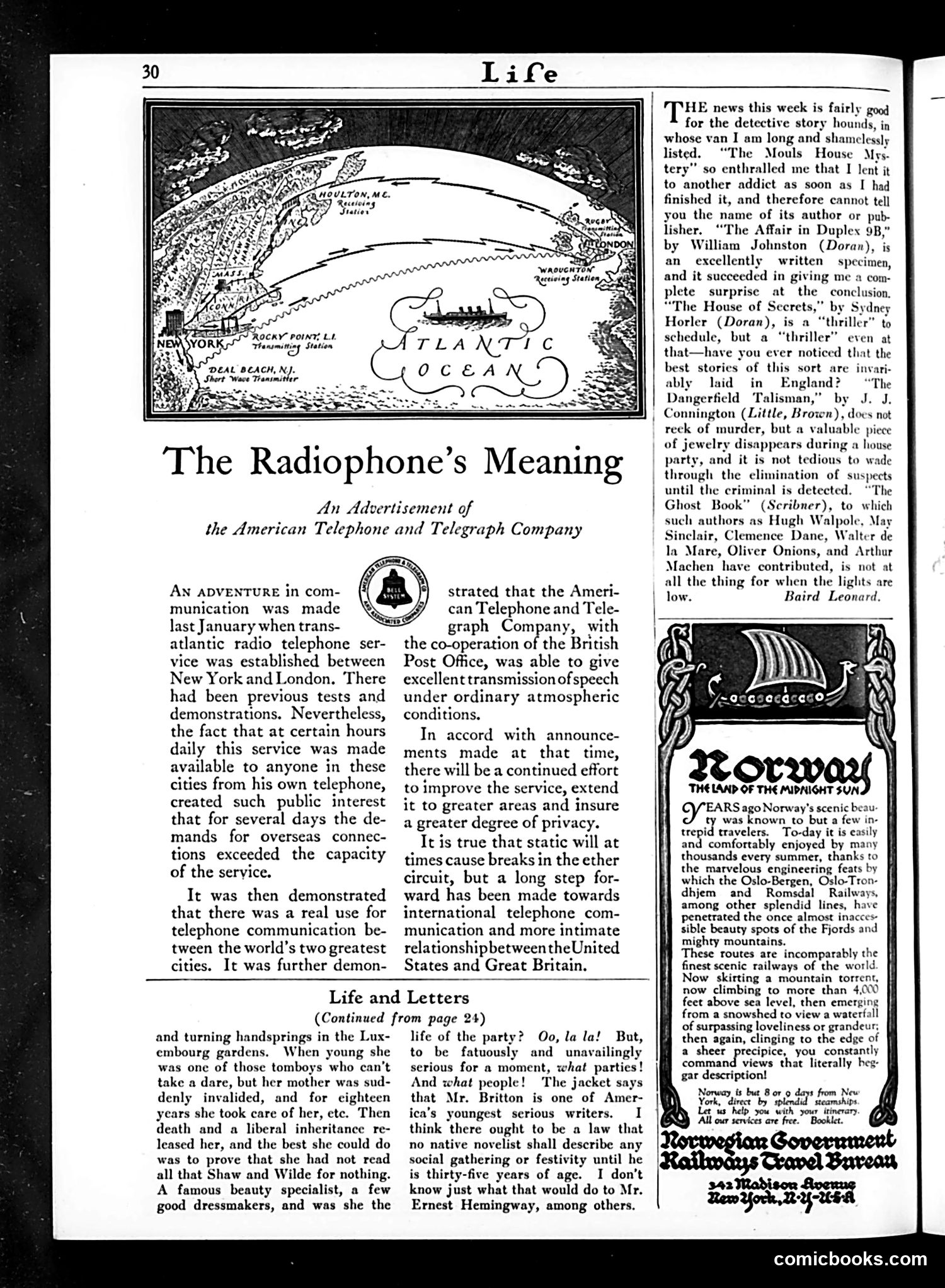
This page contains **primarily advertising and book reviews**, not political satire. The main content is an **AT&T advertisement** celebrating the recent establishment of transatlantic radiotelephone service between New York and London (initiated January 1927). The ad emphasizes AT&T's technological achievement in enabling clear voice transmission across the Atlantic, though it acknowledges ongoing issues with static and privacy concerns. The accompanying map shows the transatlantic route. The "Life and Letters" column reviews detective fiction and novels, praising authors like William Johnston and J.J. Connington. It includes criticism of young writers like Hemingway for attempting to depict sophisticated social scenes before reaching age thirty-five. A secondary advertisement promotes Norway as a tourist destination, suggesting it's now accessible to ordinary travelers via rail routes. **No political cartoons or satire appears on this page.** The content reflects 1920s-era corporate celebration of modern telecommunications technology and period literary criticism.
📄 Transcribed text from this page (OCR, searchable)
Machine-transcribed from the original scan — historical spelling and the odd misread are preserved.
HOULTON,ME. oo] Receleing LANTIC The Radiophone’s Meaning An Advertisement of the American Telephone and Telegraph Company AN ADVENTURE in com- munication was made last January when trans- atlantic radio telephone ser- vice was established between New York and London. There had been previous tests and demonstrations. Nevertheless, the fact that at certain hours daily this service was made available to anyone in these cities from his own telephone, created such public interest that for several days the de- mands for overseas connec- tions exceeded the capacity of the service. It was then demonstrated that there was a real use for telephone communication be- tween the world’s two greatest cities. It was further demon- strated that the Ameri- can Telephone and Tele- graph Company, with the co-operation A British Post Office, was able to give excellent transmission of speech under ordinary atmospheric conditions. In accord with announce- ments made at that time, there will be a continued effort to improve the service, extend it to greater areas and insure a greater degree of privacy. It is true that static will at times cause breaks in the ether circuit, but a long step for- ward has been made towards international telephone com- munication and more intimate relationshipbetweentheUnited States and Great Britain. Life and Letters (Continued from page 24) and turning handsprings in the Lux- embourg gardens. When young she was one of those tomboys who can’t take a dare, but her mother was sud- denly invalided, and for cighteen years she took care of her, ete. Then death and a liberal inheritance re- leased her, and the best she could do was to prove that she had not read all that Shaw and Wilde for nothing. A famous beauty specialist, a few good dressmakers, and was she the life of the party? Oo, la la! But, to be fatuously and unavailingly serious for a moment, what parties! And what people! The jacket says that Mr. Britton is one of Amer- ica’s youngest serious writers. I think there ought to be a law that no native novelist shall describe any social gathering or festivity until he is thirty-five years of age. I don’t know just what that would do to Mr. Ernest Hemingway, among others. TRE news this week is fairly good for the detective story hounds, in whose van I am long and shamelessly listed. “The Mouls House Mys- tery” so enthralled me that I lent it to another addict as soon as I had finished it, and therefore cannot tell you the name of its author or pub- lisher. “The Affair in Duplex 9B,” by William Johnston (Doran), is an_ excellently written specimen, and it succeeded in giving me a com- plete surprise at the conclusion, “The House of Secrets,” by Sydney Horler (Doran), is a “thriller” to schedule, but a “thriller” even at that—have you ever noticed that th best stories of this sort are invari- ably laid in’ England? = “The Dangerfield Talisman,” by J. J. ,; Connington (Little, Brown), does not reck of murder, but a valuable piece of jewelry disappears during a house party, and it is not tedious to wade | through the elimination of suspects until the criminal is detected. “The | Ghost Book” (Scribner), to which such authors as Hugh Walpole, May Sinclair, Clemence Dane, Walter de la Mare, Oliver Onions, and Arthur Machen have contributed, is not at all the thing for when the lights are Baird Leonard. Of EARS ago Norway's scenic beau- ty was known to but a few in- trepid travelers. To-day it is easily and comfortably enjoyed by many thousands every summer, thanks to the marvelous engineering feats by which the Oslo-Bergen, Oslo-Tron- dhjem and Romsdal Railways, among other splendid lines, have penetrated the once almost inacces- sible beauty spots of the Fjords and mighty mountains. These routes are incomparably the finest scenic railways of the world. Now skirting a mountain torrent, now climbing to more than 4,000 feet above sea level, then emerging from a snowshed to view a waterfall jf of surpassing loveliness or grandeur; then again, clinging to the edge of a sheer precipice, you constantly fommand vices that literally beg- gar description! Norway is but 8 # from New for, erect by “ole Pasa us with your itiner Al ou services are free.” Booklet.” 342 Madison comicbooks.com