
A complete issue · 39 pages · 1927
Life — February 24, 1927
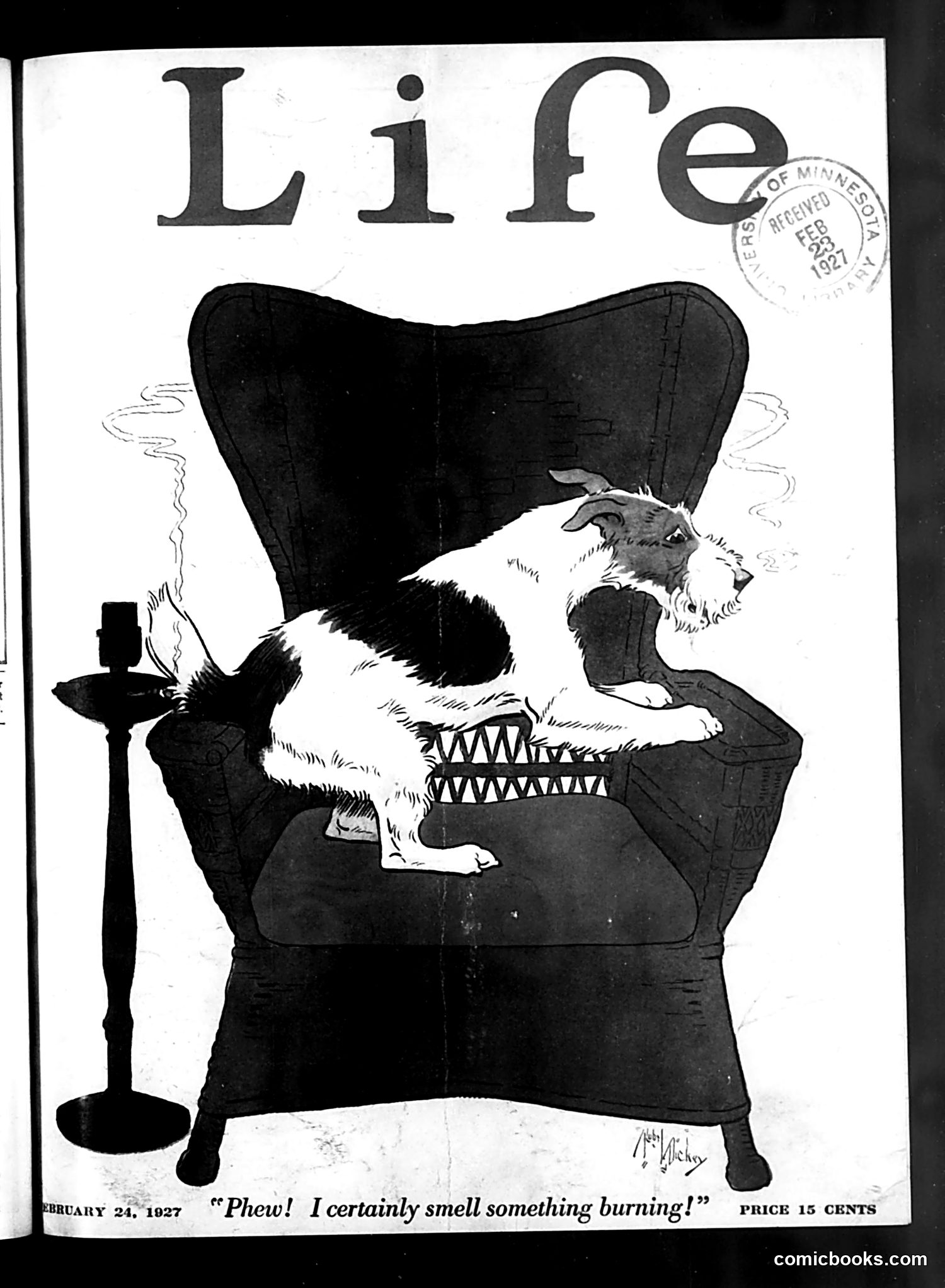
This cartoon depicts a menacing dog or wolf-like creature sitting in an armchair, with prominent sharp teeth exposed. The animal appears aggressive and dangerous. A lamp stands nearby, and smoke rises from the chair, prompting the caption: "Phew! I certainly smell something burning!" The cartoon likely satirizes a political or social threat of the 1920s—possibly labor unrest, communism, or organized crime, which were prominent anxieties during this era. The "burning" smell suggests danger or crisis. The creature's fierce expression and sharp teeth emphasize the perceived threat. Without additional context about specific 1927 events, the exact target remains unclear, though the imagery suggests warning about a dangerous force lurking within American society.
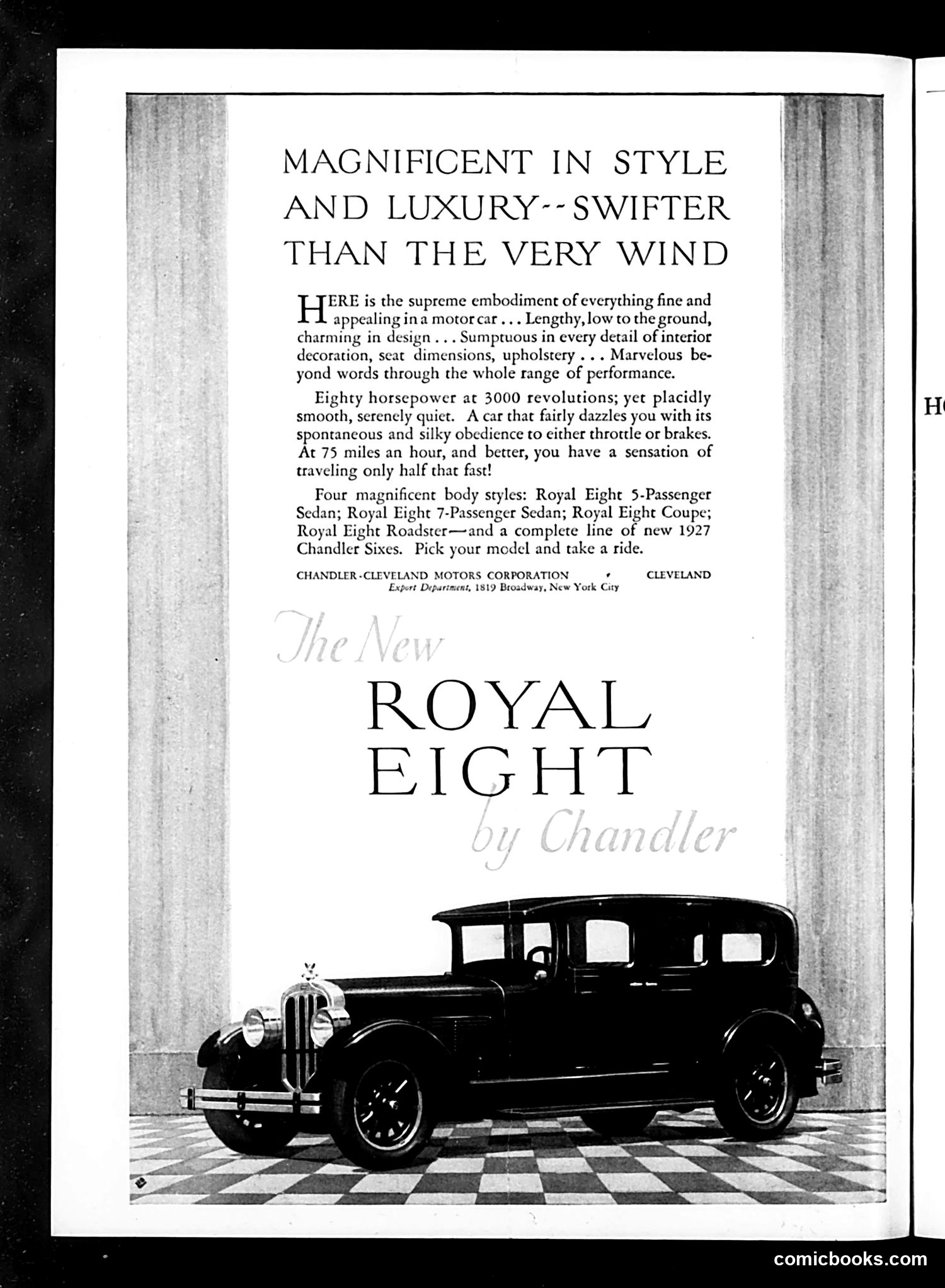
This page is **not a cartoon or satirical content** — it's a straightforward automobile advertisement for the Chandler Royal Eight, a luxury car manufactured by Chandler-Cleveland Motors Corporation of Cleveland, Ohio. The ad highlights the 1927 Royal Eight model with marketing language emphasizing performance ("80 horsepower at 3000 revolutions"), luxury design ("sumptuous in every detail"), and smooth driving experience. It mentions four body styles available and encourages potential buyers to test drive the vehicle. The formal typography, elegant serif fonts, and black-and-white photograph of the automobile reflect 1920s advertising conventions for high-end consumer goods. This represents typical Life magazine content from the era—paid commercial advertising, not satire.
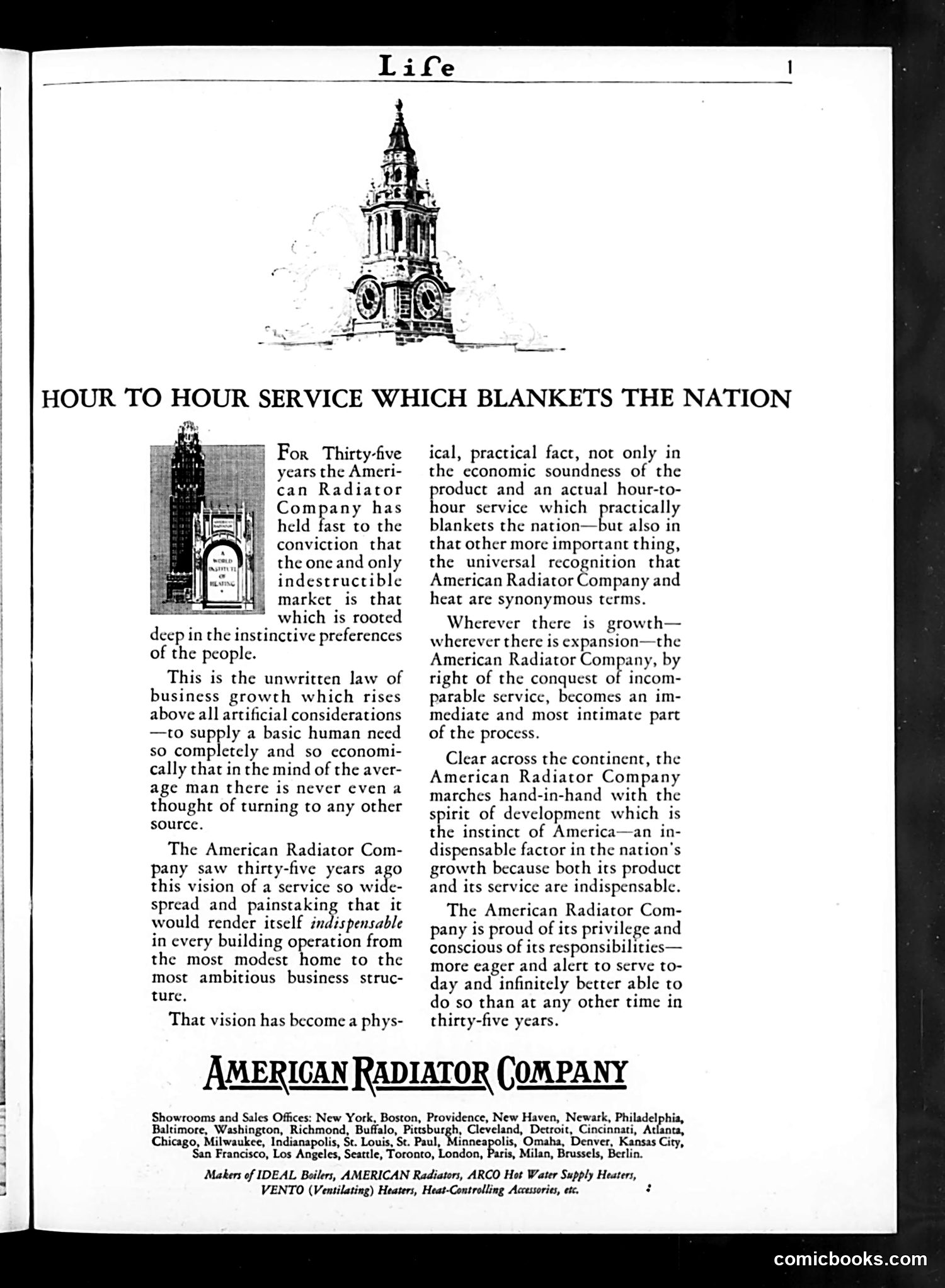
This is primarily **advertising content**, not satire or political cartoon. The page features an American Radiator Company advertisement from *Life* magazine (a legitimate publication, not the modern humor magazine). The advertisement uses a clock tower illustration as its central image, with the headline "HOUR TO HOUR SERVICE WHICH BLANKETS THE NATION." The copy celebrates the company's 35-year history providing heating products and services nationwide. The "satire" element—if any—appears subtle: the ad positions heating/radiators as so essential to American life that the company has become practically indispensable, comparing business growth to meeting basic human needs. However, this reads as straightforward corporate self-promotion rather than intentional satire. The page serves mainly as a corporate testimonial advertisement.
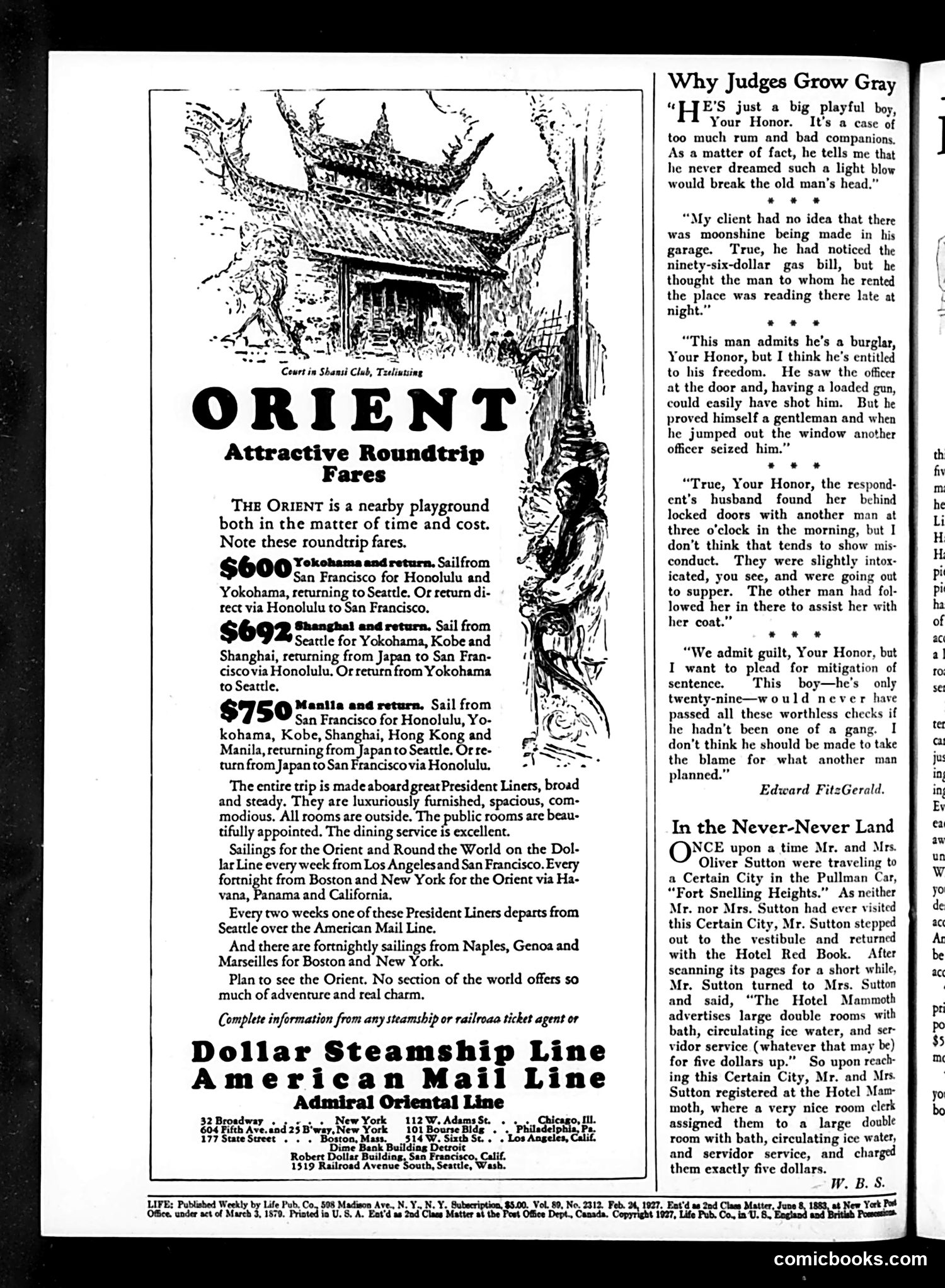
This page features two distinct sections: **a travel advertisement** (left) and **a humorous short story** (right). The story "Why Judges Grow Gray" presents a judge hearing a case involving a burglar caught at a house. The defendant's attorney argues the young man (age 29) deserves leniency because he was coerced into crime by older gang members. The judge appears sympathetic to this mitigation argument, suggesting judicial frustration with systemic criminality and peer pressure in crime. The accompanying illustration of an ornate Asian temple reinforces themes of complexity and hidden depths—matching the story's exploration of criminal motivations beneath surface actions. The satire is straightforward: judges age prematurely dealing with criminals claiming exploitation rather than personal culpability.
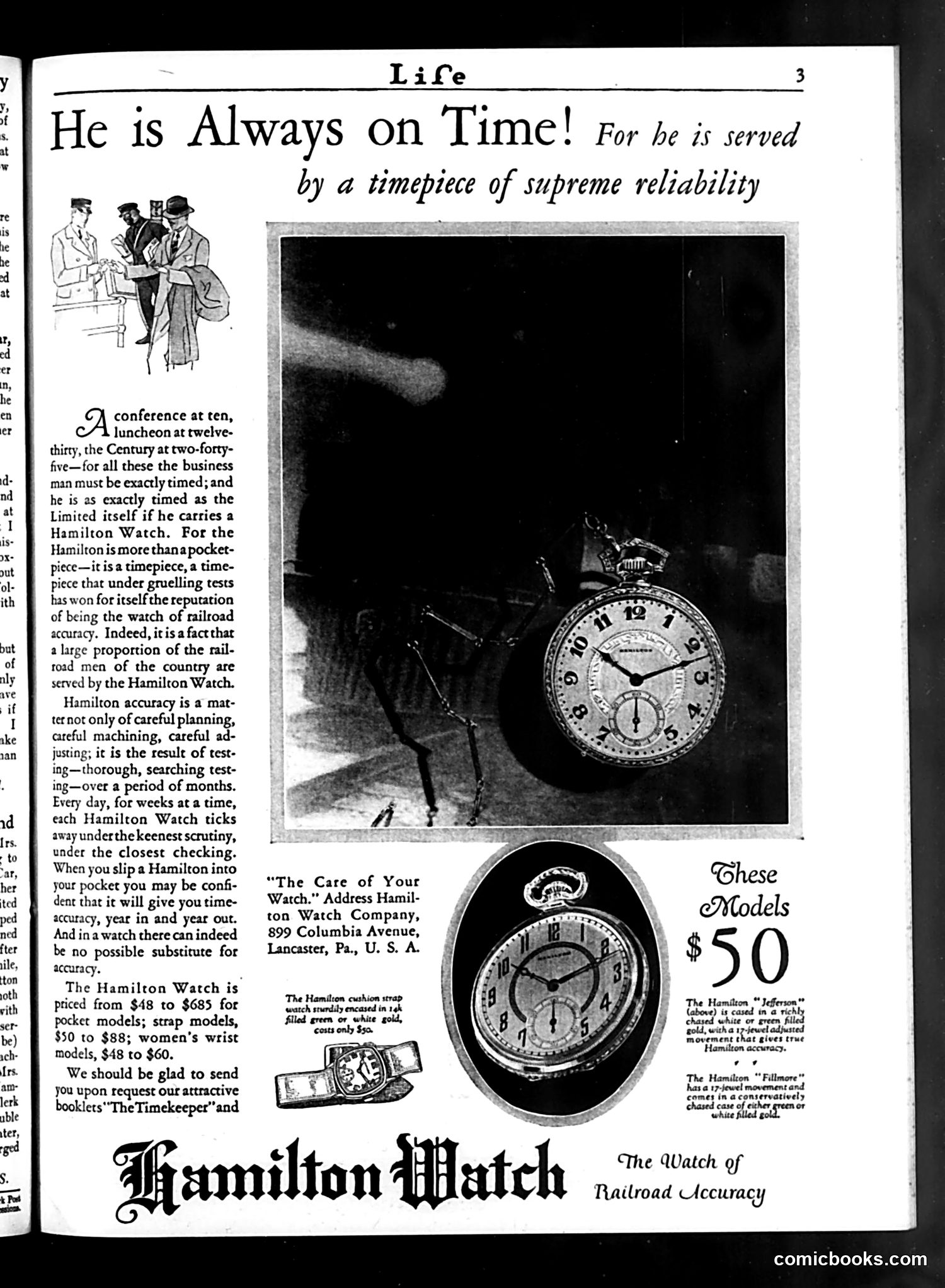
This is primarily a **Hamilton Watch advertisement**, not a political cartoon. The page shows luxury pocket watches priced at $50, marketed to businessmen who need precise timekeeping for professional schedules (conferences, lunches, train travel). The small illustration on the left depicts three businessmen in an office setting—a visual shorthand for the "business man" target audience. The text emphasizes that Hamilton watches are trusted for "railroad accuracy," suggesting the company's reputation for reliability among railroad workers and executives. The large photograph displays the watches themselves, with decorative styling. This is straightforward commercial advertising exploiting early 20th-century anxieties about punctuality and professional reliability, not satirical commentary.
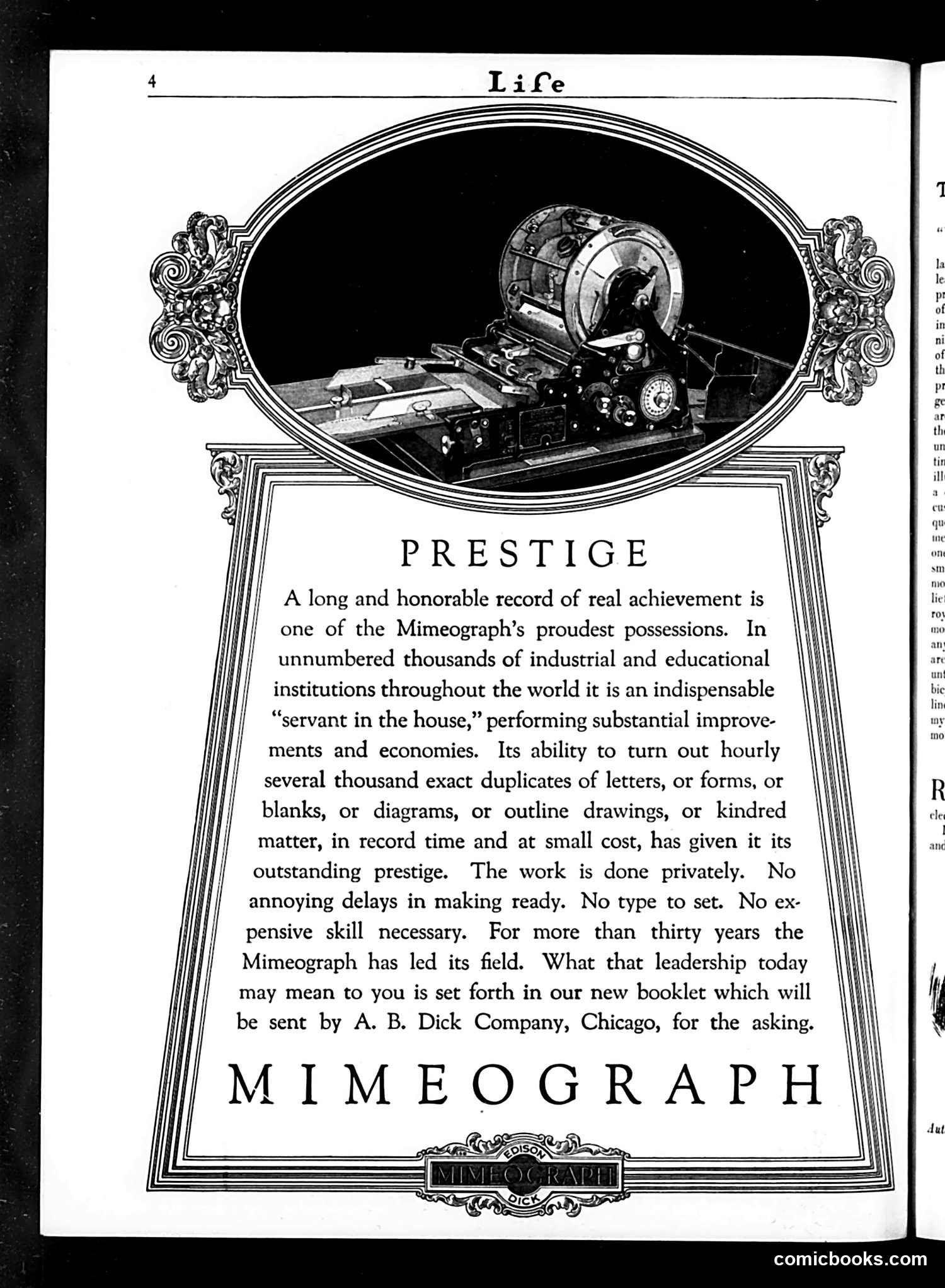
This page is primarily **advertising, not satire or political commentary**. It's a Mimeograph company advertisement from Life magazine promoting the Mimeograph duplicating machine. The ad highlights the machine's practical business value: it could produce thousands of exact copies of letters, forms, and documents quickly and inexpensively. The ornate border and oval frame containing the machine image are typical of early 20th-century advertising design. The text emphasizes the Mimeograph's "prestige" and market leadership over thirty years, positioning it as indispensable to industrial and educational institutions. The ad promises interested readers can obtain more information from A.B. Dick Company in Chicago. There is no political cartoon or satire present on this page.
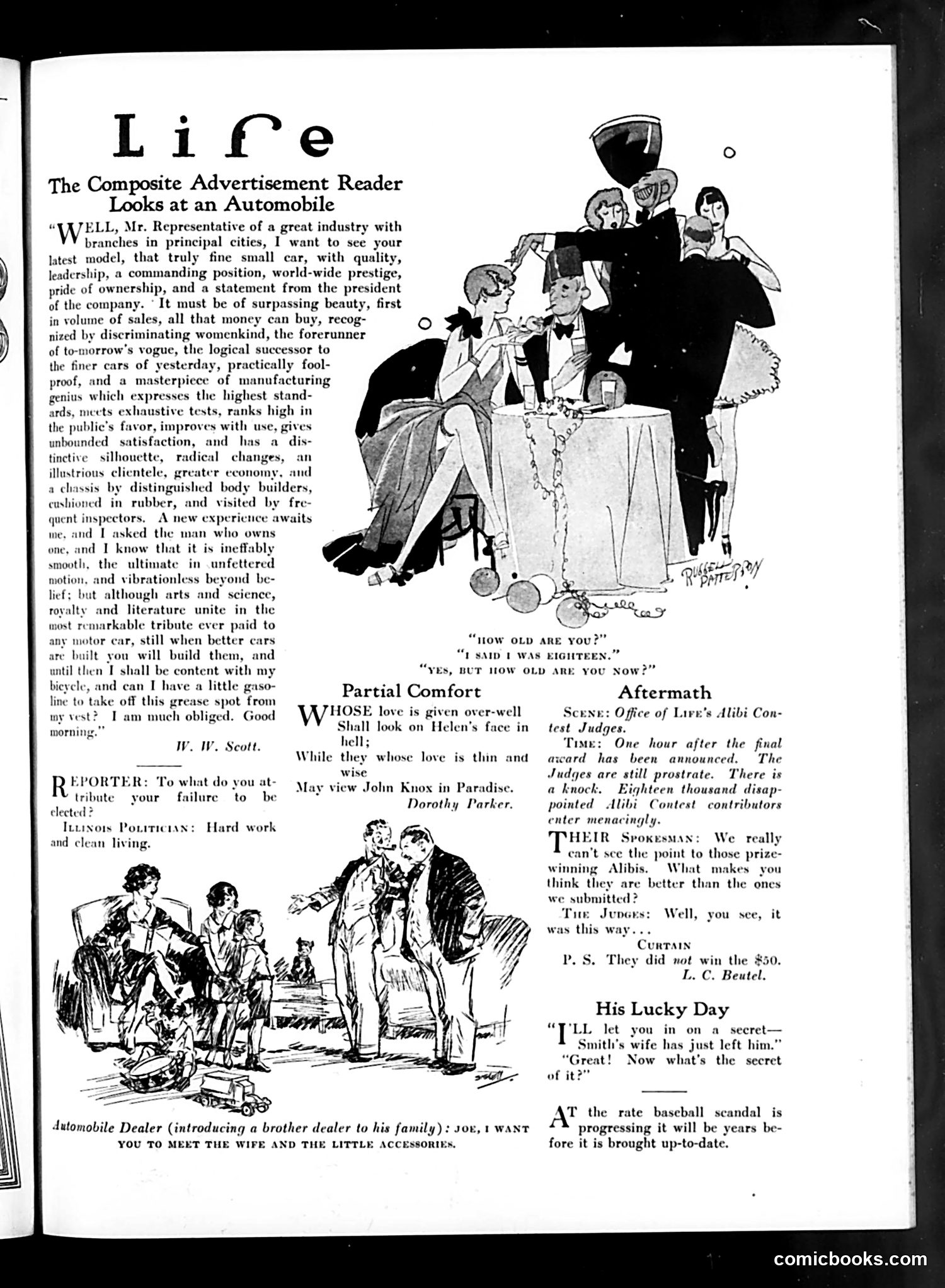
This *Life* magazine page contains satirical humor pieces about early automobiles and social pretension. **Top cartoon**: A composite advertisement reader interrogates an automobile salesman's grandiose claims about quality, prestige, and manufacturing superiority. The satire mocks how car advertisements use extravagant language to sell relatively simple products, and how consumers are gulled by marketing rhetoric. **Bottom cartoon**: An automobile dealer introduces his brother (also a dealer) to his family, captioned "I want you to meet the wife and the little accessories." The joke satirizes how businessmen reduce their families to mere possessions or business assets—treating wives and children as commodities like car parts. Both pieces ridicule commercial excess and materialism of the early automotive era.
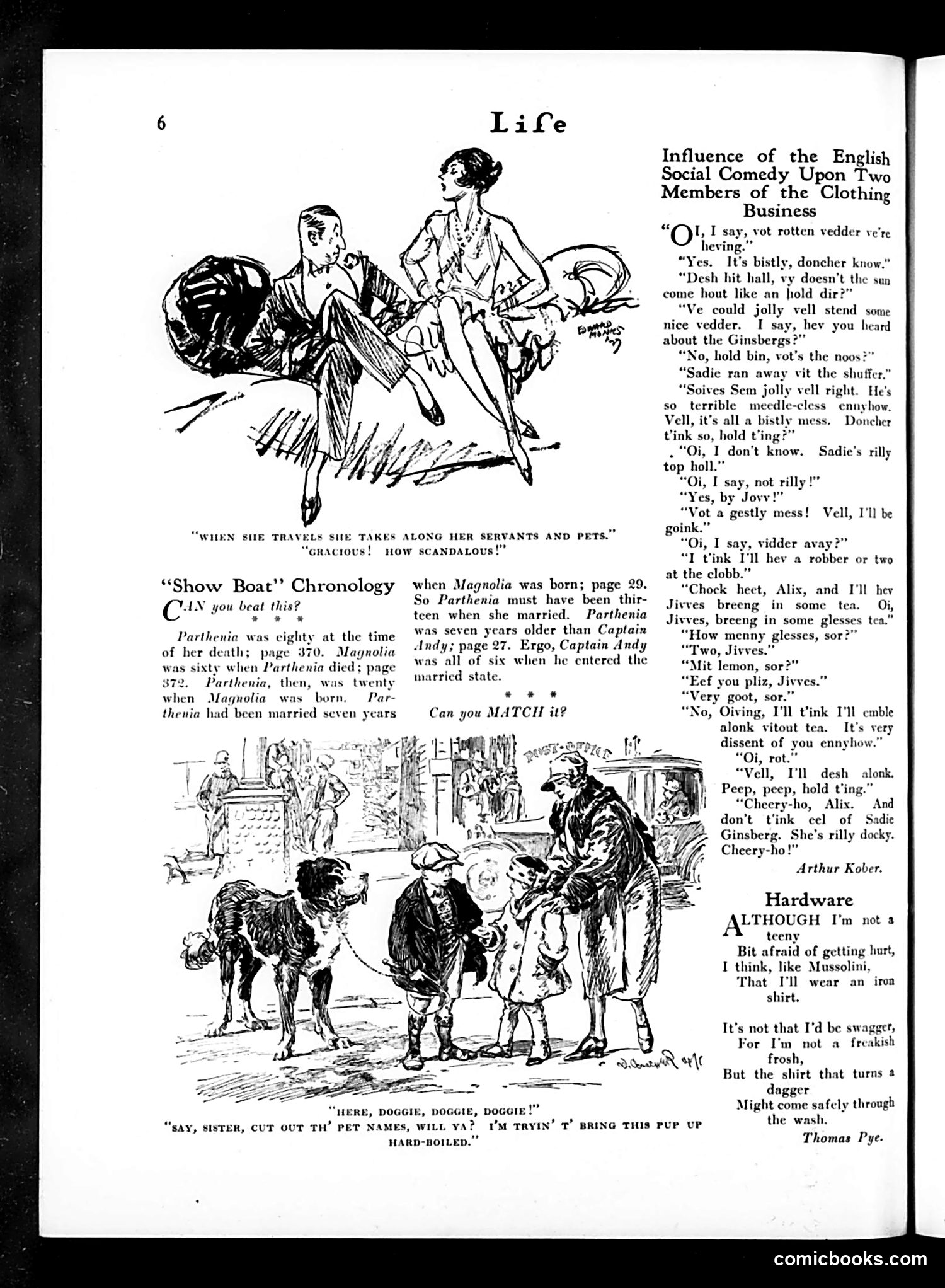
This page contains two satirical pieces about early 20th-century social life: **Top section**: "Influence of the English Social Comedy Upon Two Members of the Clothing Business" mocks men in the fashion industry adopting affected British speech patterns and mannerisms. The dialogue shows them using exaggerated British slang ("rotten vedder," "bistly") while discussing scandals among society figures like "the Ginsburgs" and "Sadie." The satire targets the pretentious Anglophilia of nouveau riche businessmen trying to appear sophisticated. **Bottom section**: Two illustrated scenes titled "Can you MATCH it?" and featuring "Hardware" by Thomas Pág. These appear to be street-scene vignettes satirizing everyday urban working-class life and behavior, likely commenting on rough masculinity or social awkwardness. The overall page mocks class aspirations and cultural affectation in contemporary American society.
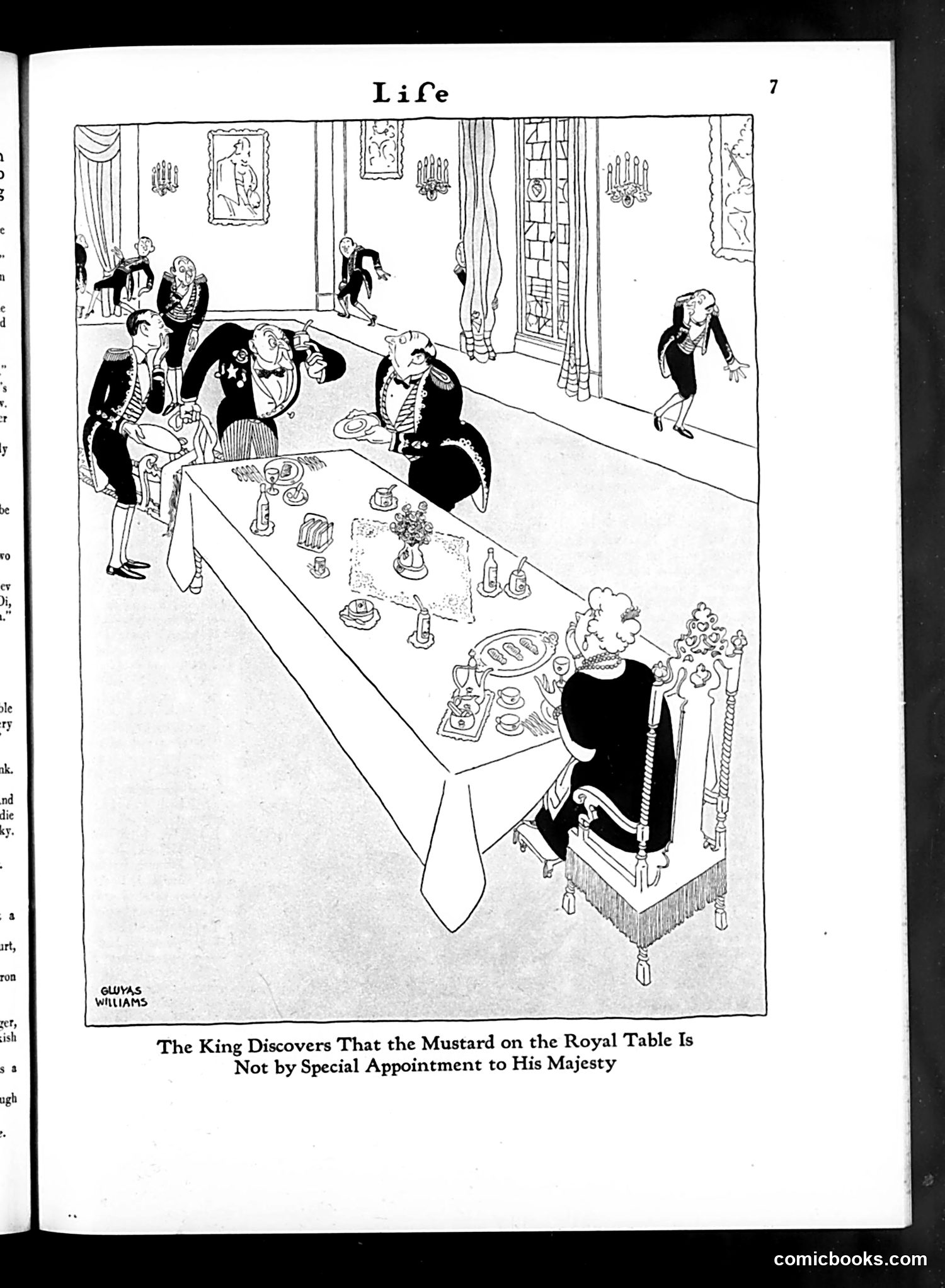
This single-panel cartoon by Gluyas Williams depicts a formal royal banquet scene. The caption reads: "The King Discovers That the Mustard on the Royal Table Is Not by Special Appointment to His Majesty." The humor relies on the British tradition of granting "Royal Warrants"—official appointments designating merchants as authorized suppliers to the monarchy. The joke satirizes both royal pretension and commercial marketing: even the mustard at the king's own table lacks this prestigious endorsement. The cartoon mocks how thoroughly British commerce had adopted royal warrant branding, suggesting that even essential condiments claimed official royal status. The king's discovery of this gap in his table service highlights the absurdity of over-relying on such appointments as markers of quality or exclusivity.
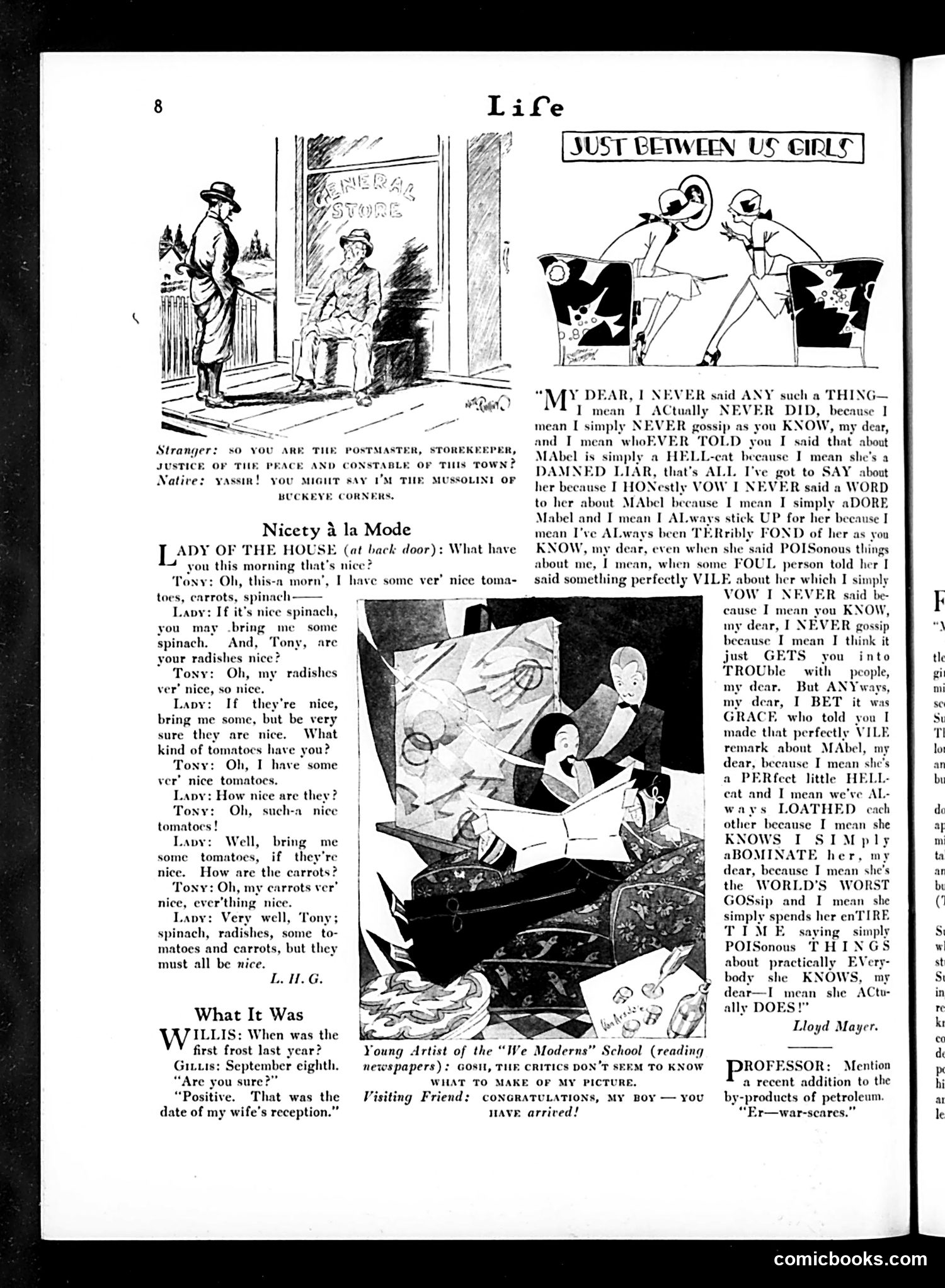
This page contains three unrelated satirical pieces: **"Stranger" cartoon**: A postmaster and constable discuss a suspicious visitor, playing on small-town paranoia about outsiders. **"Nicety à la Mode"**: A comedic dialogue where a lady requests increasingly specific vegetables from her grocer ("Tony"), each qualified as "nice." The joke mocks genteel affectation and excessive politeness in social interactions. **"Just Between Us Girls"**: A long, breathless monologue by one woman to another, satirizing gossip culture. She denies spreading rumors about "MAbel" while doing exactly that—a classic ironic critique of female social hypocrisy and cattiness. **"What It Was"**: A brief joke about a man misremembering his wife's reception date. The page lampoons class pretension, small-town suspicion, and especially women's social behavior through exaggeration and irony.
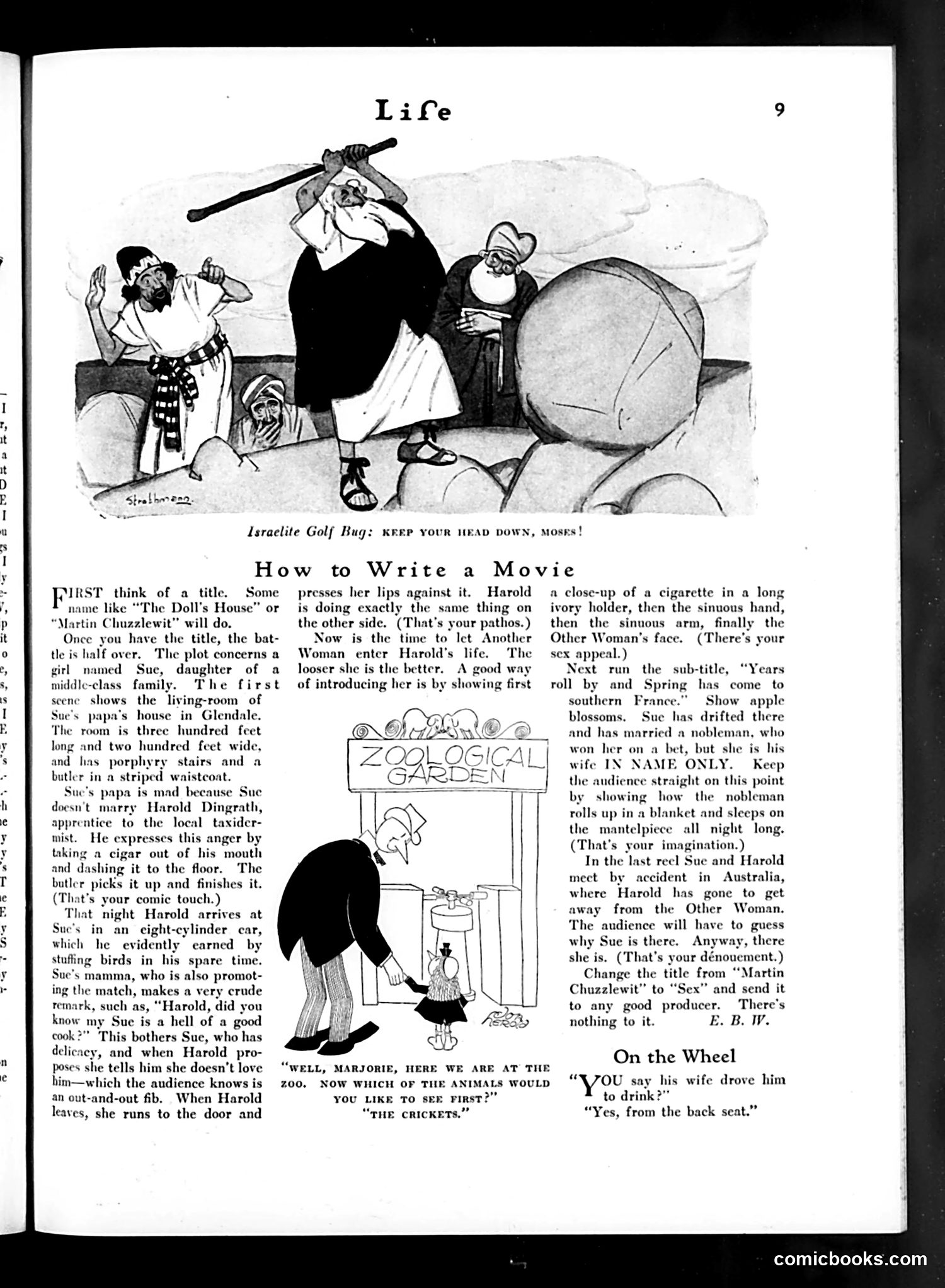
**Top Cartoon - "Israelite Golf Bug":** This depicts Jewish figures at leisure, with a man wielding a golf club over his head in an exaggerated manner. The caption "KEEP YOUR HEAD DOWN, MOSES!" suggests both golf instruction humor and a biblical reference. This appears to be ethnic/religious satire typical of early 20th-century *Life* magazine, which frequently published stereotyped caricatures of immigrant and minority groups as subjects of ridicule. **"How to Write a Movie" & "On the Wheel":** These are instructional humor pieces satirizing Hollywood screenwriting clichés and marital dynamics. They mock formulaic plotting, romantic tropes, and the clash between refined European settings and domestic American relationships—reflecting contemporary anxieties about cinema's growing influence and changing social relations.
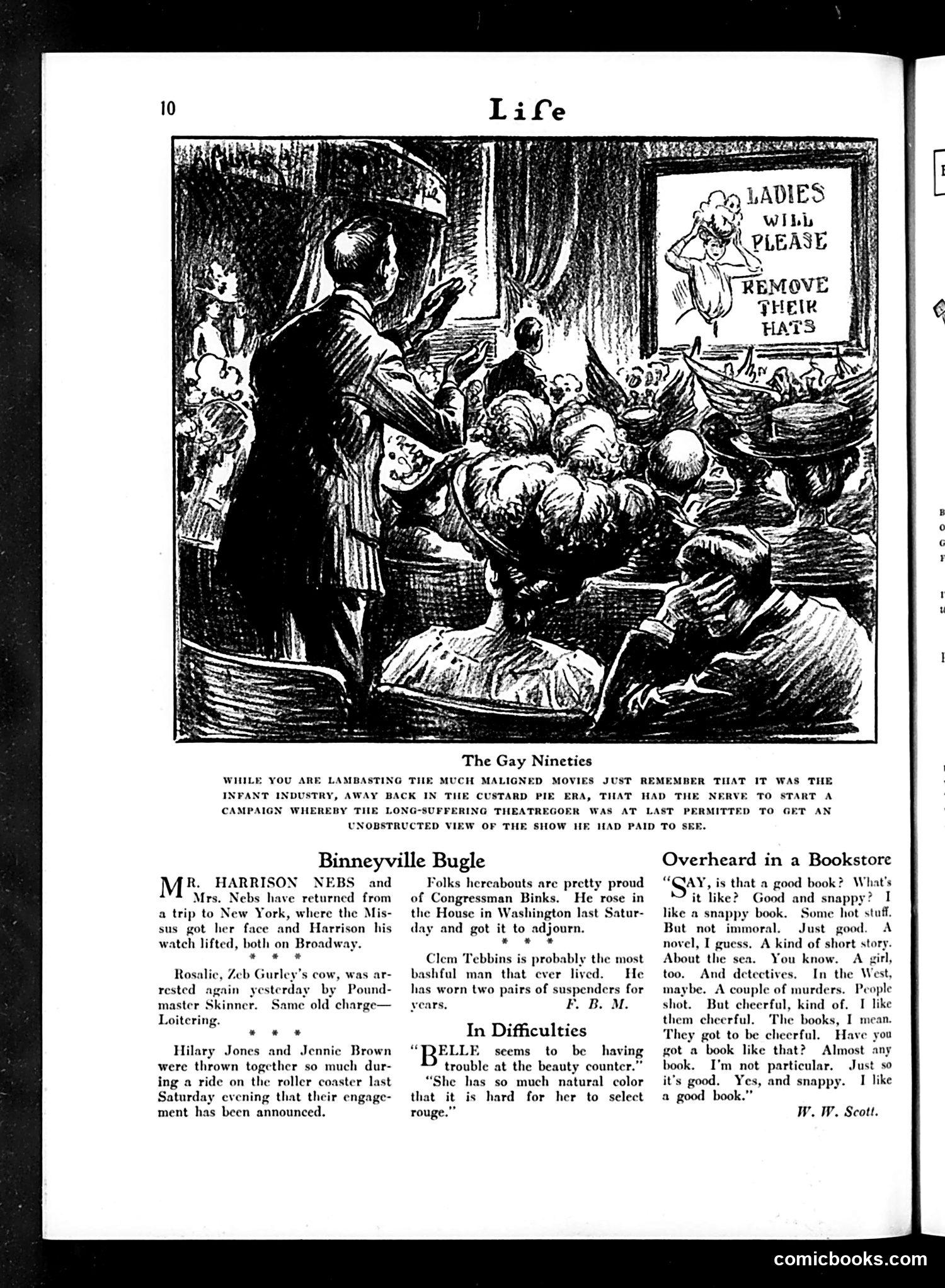
This cartoon satirizes early cinema's infancy. The caption explains that theatergoers of the 1890s rarely got unobstructed views—hence the sign demanding ladies remove their hats. The humor targets two things: (1) women's excessively large, elaborate hats fashionable in that era, which blocked other patrons' sightlines, and (2) the novelty and desperation of early movie theaters, which had to publicly plead for basic courtesy. The scene shows a crowded theater with the sign prominently displayed above the audience. This reflects a genuine social irritation of the period—women's fashion directly interfered with public entertainment. The cartoon mocks both the absurd hat fashions and the theater's need to explicitly enforce this request.
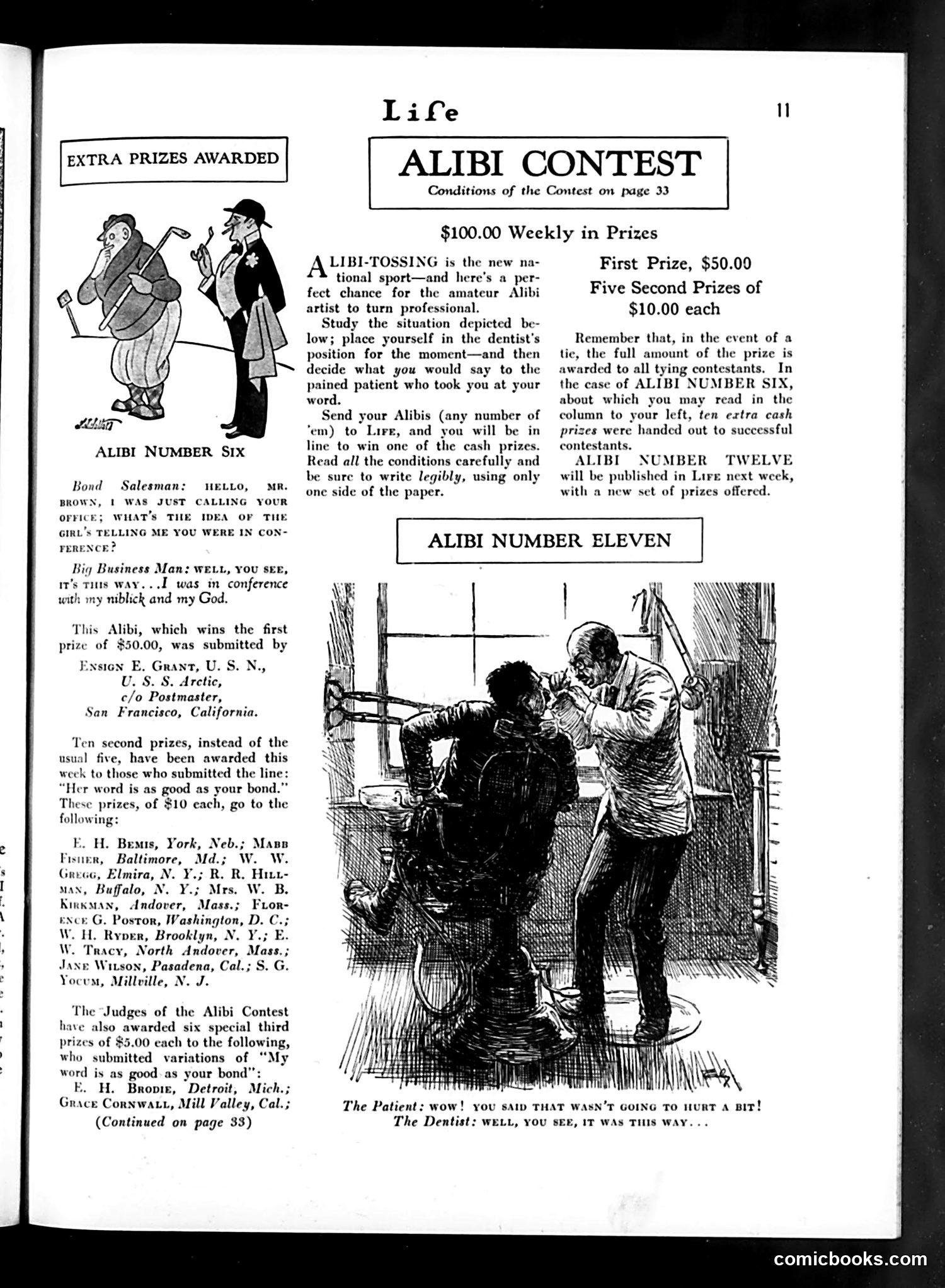
This page promotes Life's "Alibi-Tossing" contest, where readers submit excuses they'd give to a dentist caught examining them unexpectedly. The cartoon at top shows a "Bond Salesman" and "Big Business Man" exchanging alibis about a girl and a conference. **Alibi Number Eleven** (the main illustration) depicts a dental examination scene. The patient claims he "wasn't going to hurt a bit," while the dentist responds "it was this way"—implying the patient lied. The satire targets universal dental anxiety and the transparent excuses people make to avoid admitting fear of the dentist. The contest offered $100 weekly in prizes ($50 first prize) for the best submitted alibis, reflecting 1920s-30s public fascination with humor about everyday embarrassments.
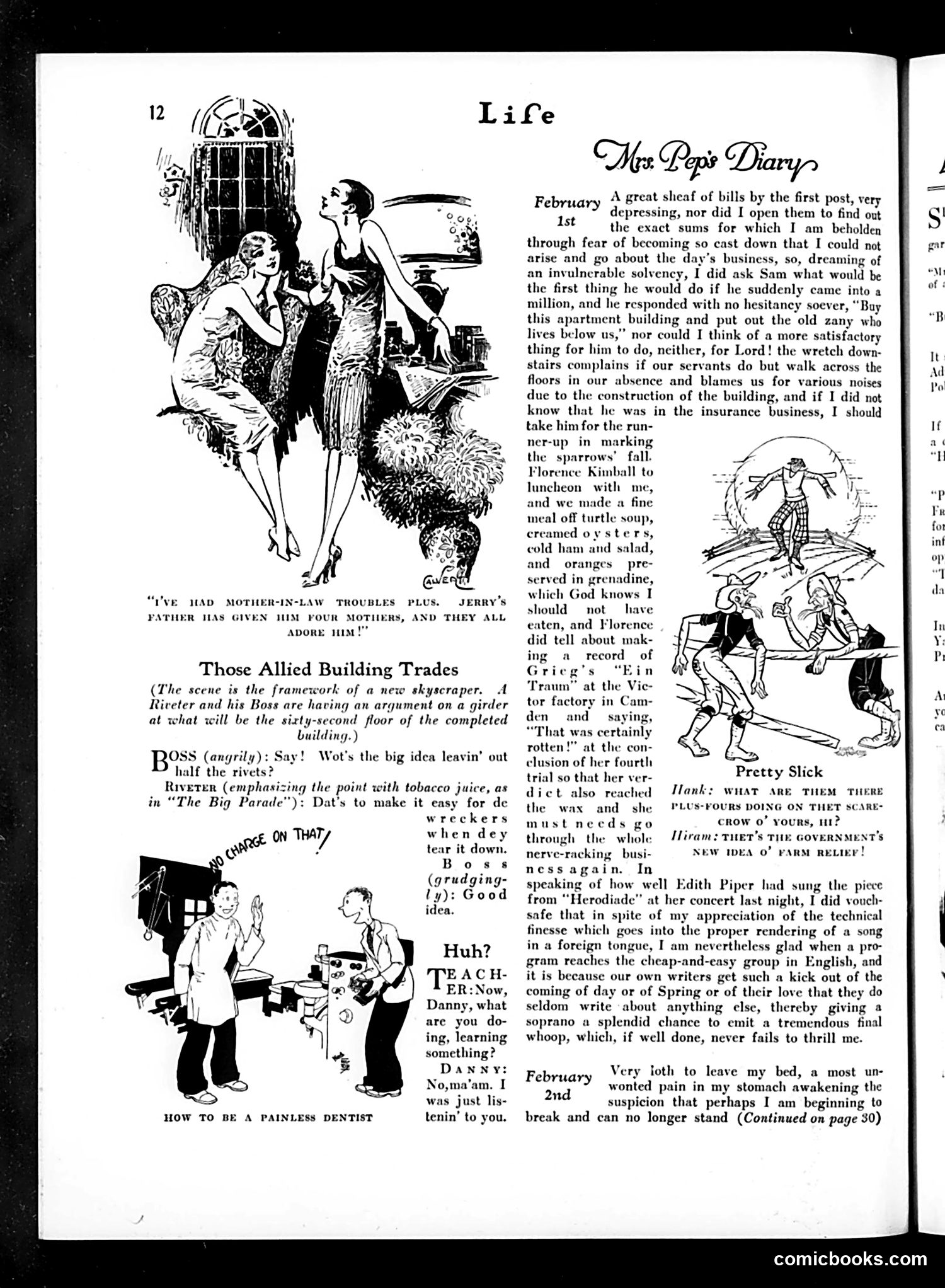
This cartoon satirizes labor disputes within construction unions during building expansion. "Boss" and "Riveter" argue over who controls decisions on a girder at a building's sixty-second floor. The humor lies in their petty jurisdictional squabbling while literally working at dangerous heights—the precariousness of their position matches the absurdity of their argument. The caption "No charge on that?" suggests competitive tensions between trades (riveters, carpenters, etc.) over who gets paid for which work. This reflects early 20th-century union conflicts where overlapping job responsibilities created territorial disputes. The satire mocks how workers' serious workplace safety concerns get overshadowed by bureaucratic turf wars.
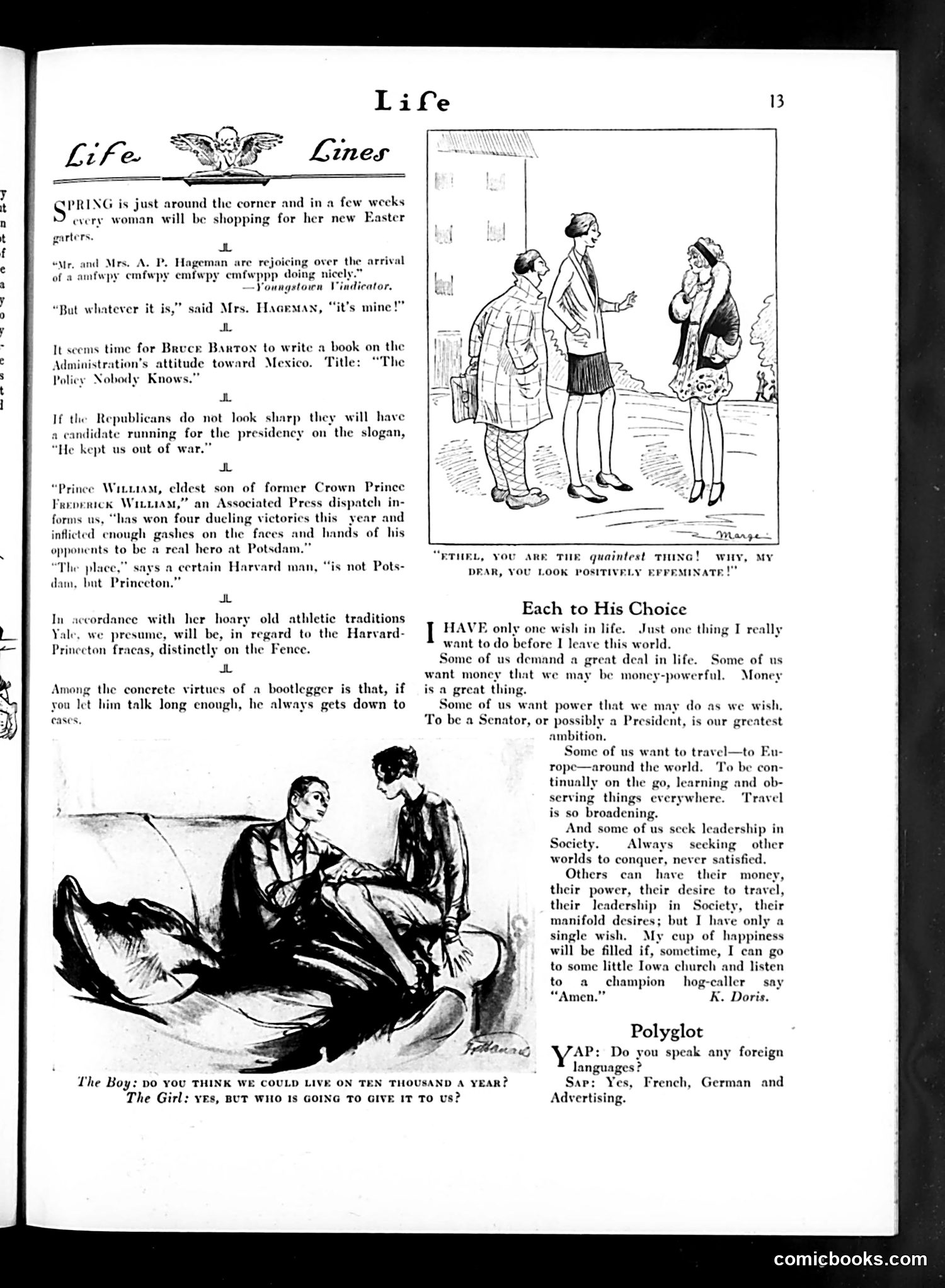
**Top Cartoon ("Ethel, you are the daintiest thing, my dear..."):** Shows three figures on a street. A man compliments a woman's appearance while another woman looks on dismissively. The caption suggests the compliment is performative or insincere—the joke appears to be about superficial flattery or courtship rituals of the era. **Bottom Cartoon ("The Boy" and "The Girl"):** A young couple discusses finances. He asks if they could live on $10,000/year; she replies: "Yes, but who is going to give it to us?" This satirizes youth expectations versus economic reality—a common Jazz Age theme about young people's financial naiveté or dependence on parental support. Both pieces reflect period anxieties about courtship, money, and gender roles.
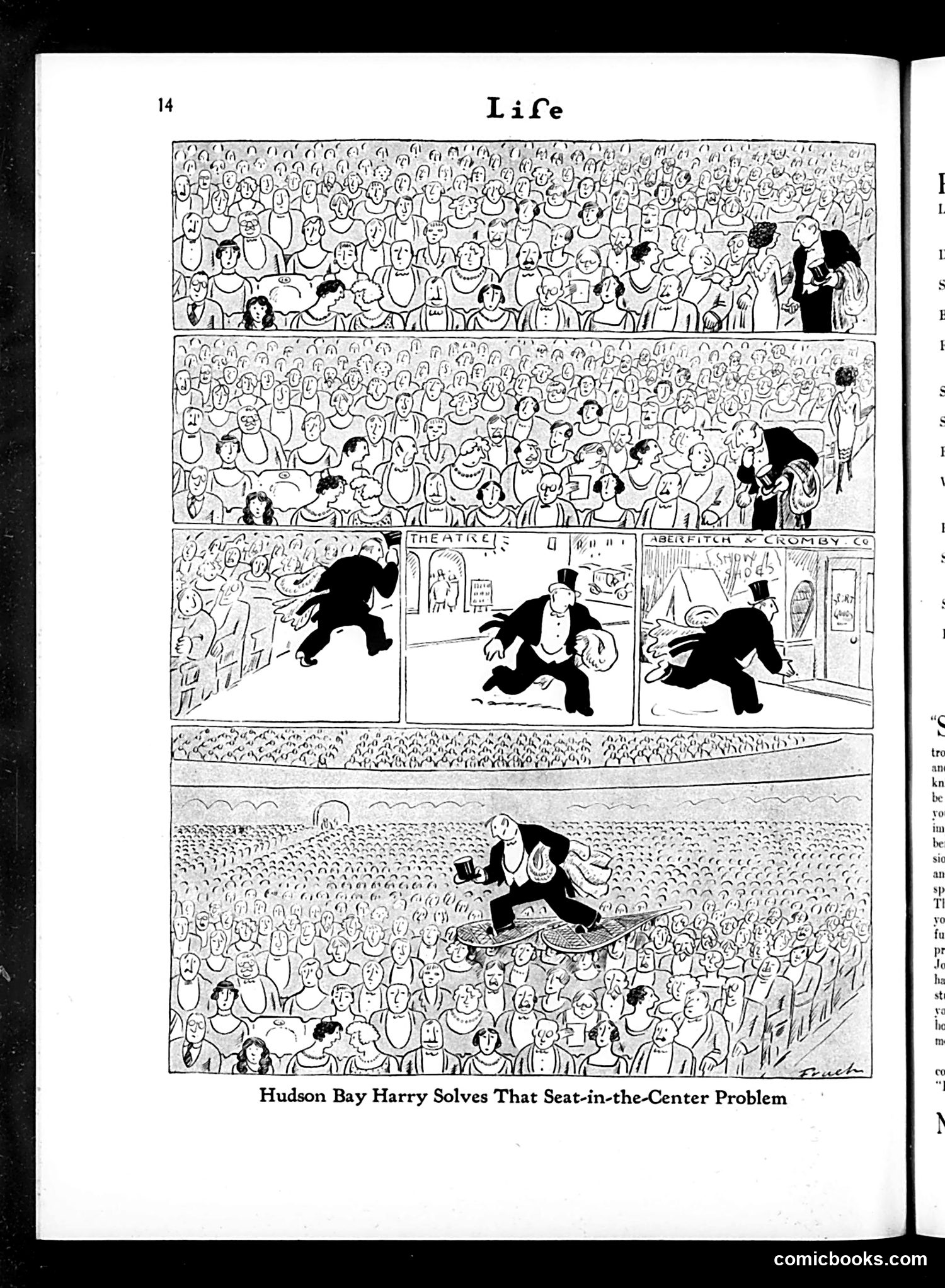
This comic strip satirizes a social problem of the era: crowded public venues (theaters, stadiums) where people competed for desirable center seating. The protagonist, "Hudson Bay Harry," is depicted as a man in formal attire who discovers an unconventional solution. The narrative progression shows Harry: escaping from a crowded crowd, rushing through city streets past a theater and what appears to be a men's store, then surfing or skating across a massive crowd of spectators on his way to a center seat. The joke relies on absurdist humor—rather than securing a seat through normal means, Harry literally travels *across* the crowd itself to reach the coveted center position. It's satirizing both the desperation people felt about seating arrangements and the ridiculous lengths one might go to for a better view.
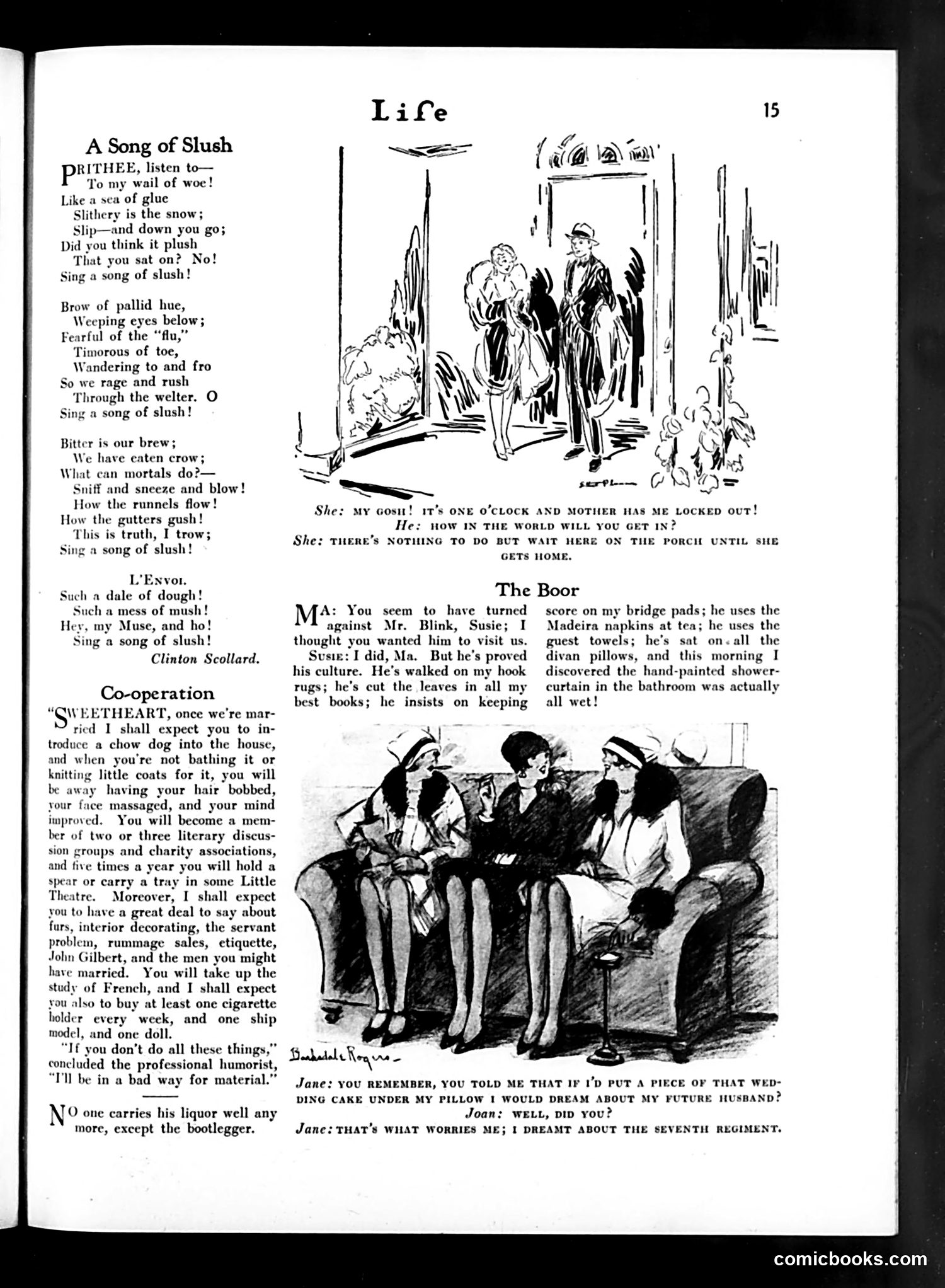
This page contains three distinct pieces of satirical content: 1. **"A Song of Slush"** — A poem mocking complaint and misery, using "slush" as metaphor for life's difficulties. 2. **"The Boor"** — A sketch about a rude houseguest (Mr. Blink) who violates social etiquette: scuffing bridge pads, misusing linens, damaging books, and wet shower curtains. The satire targets poor manners among the wealthy or socially ambitious. 3. **"Co-operation"** — A humorous marriage contract where a husband demands his wife join clubs, attend theater, study French, and buy consumer goods. The wife's worries about dreaming of "the seventh regiment" suggest anxiety about infidelity, satirizing both marital control and women's limited autonomy. The cartoons mock early 20th-century social pretensions, domestic friction, and gender dynamics.
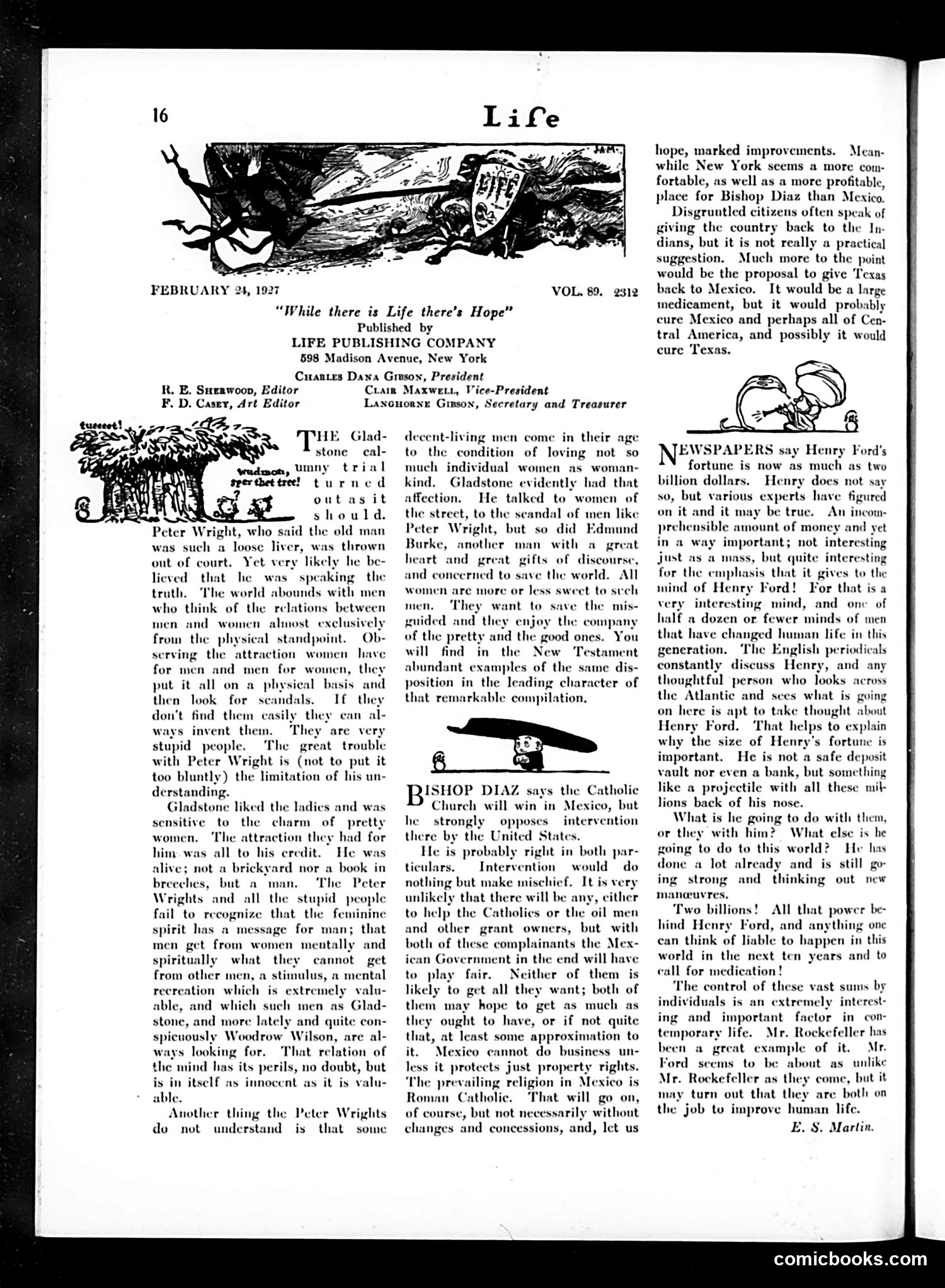
This page contains editorial commentary rather than political cartoons. The main illustrations are decorative vignettes (small scenes with trees and a scale/balance). The text discusses **Henry Ford's enormous fortune** and speculates about its control and social impact. The author notes Ford's wealth is "interesting" precisely because it's almost incomprehensibly large—potentially more influential than banks or governments. The piece also discusses **Bishop Diaz and Mexico**, addressing whether the U.S. should intervene in Mexican affairs. The author skeptically examines proposals to "give Texas back to Mexico" and opposes foreign intervention, arguing Mexico should resolve its own religious and political conflicts. The tone is satirical toward wealth concentration and interventionist foreign policy, common Progressive Era concerns in 1927.
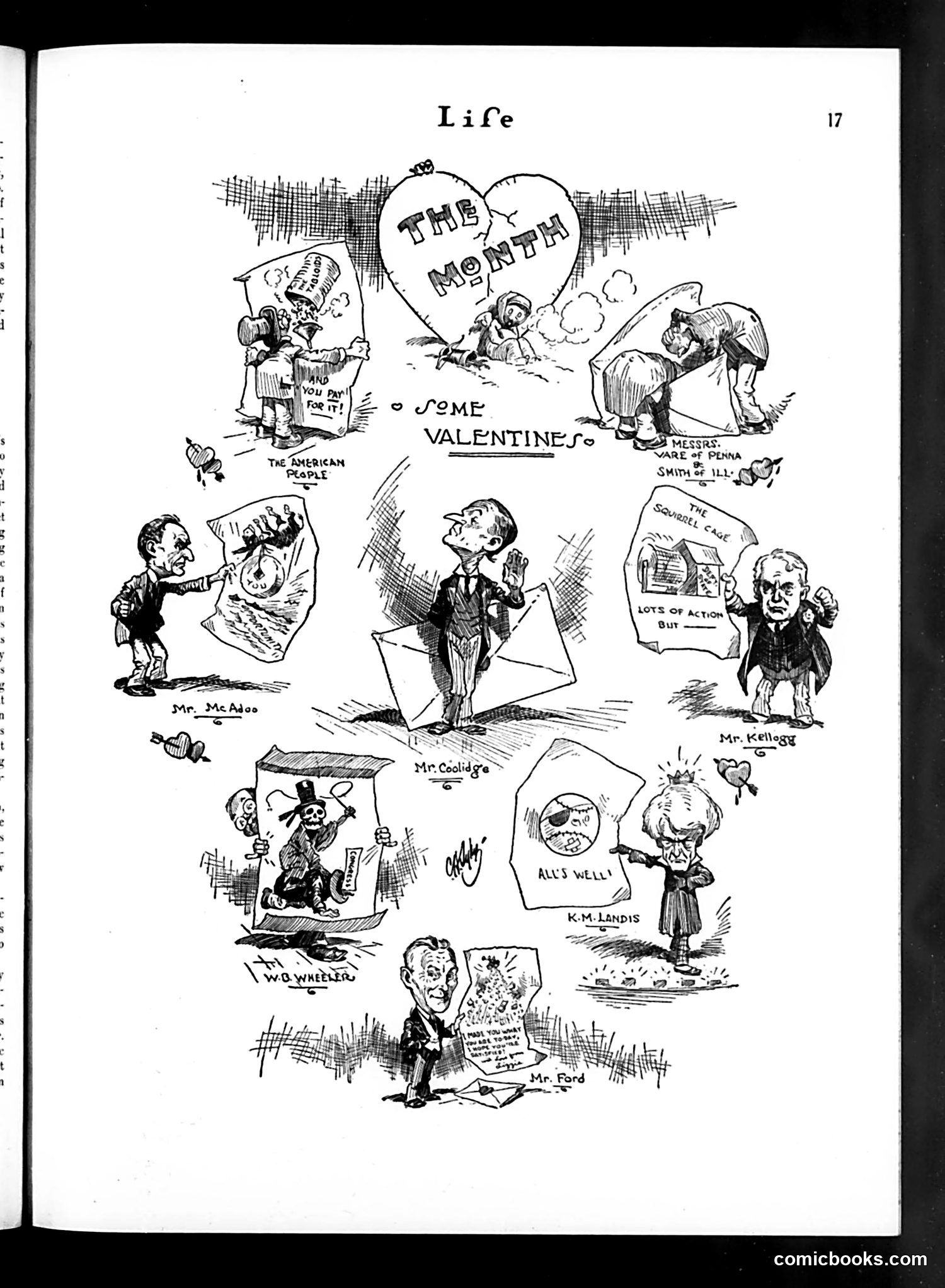
This satirical cartoon presents Valentine's Day messages from prominent public figures of the era. Each figure holds a valentine expressing their characteristic concerns or public persona: - **The American People** send a valentine about "Find You by It" - **Mr. McAdoo** displays a financial/economic valentine - **Mr. Coolidge** receives an envelope (suggesting political correspondence) - **Mr. Kellogg** holds a document labeled "Somebody's Else Lots of Action But—" - **K.M. Landis** displays "All's Well!" - **W.O. Wheelers** presents what appears to be a satirical valentine - **Mr. Ford** receives a valentine at the bottom The cartoon satirizes contemporary political and business leaders by imagining their Valentine's Day sentiments, likely mocking their public statements, policies, or recent controversies. The specific references suggest this dates to the 1920s era.
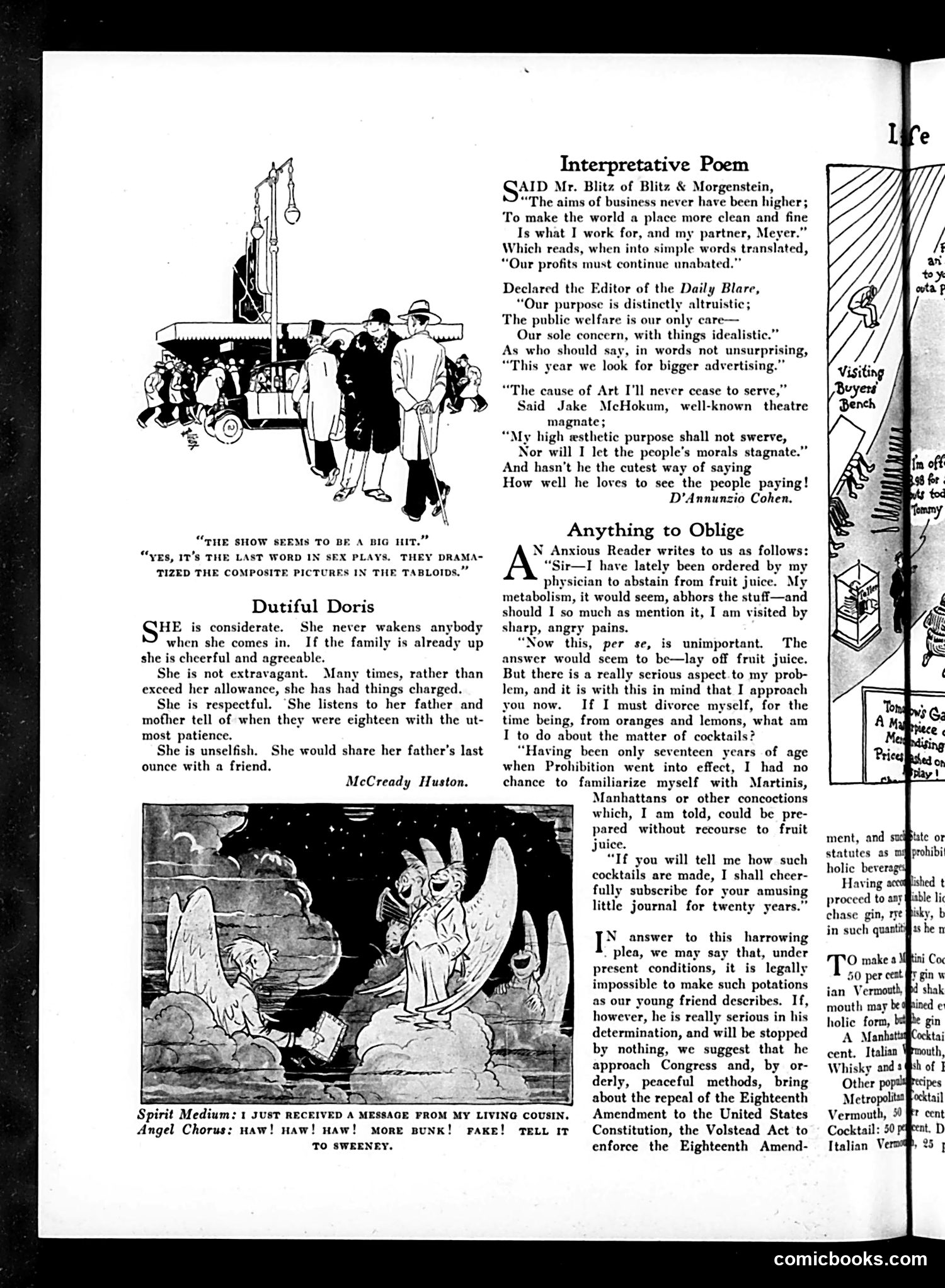
This 1920s *Life* magazine page satirizes hypocrisy among business and cultural elites during Prohibition. **Top cartoon:** Mocks sex-focused theatre as merely dramatizing tabloid gossip—trivial entertainment dressed up as serious art. **"Interpretative Poem":** Four stanzas mockingly expose false advertising claims. Business executives (Blitz, Meyer), newspaper editors, and theatre magnates publicly claim noble motives (clean world, public welfare, artistic integrity) while the poem's final lines reveal their true goal: profit and attendance. The satirist "D'Annunzio Cohen" exposes the gap between stated ideals and actual greed. **"Anything to Oblige":** A reader asks how to make cocktails without fruit juice during Prohibition. The editor's tongue-in-cheek response—suggesting he petition Congress to repeal Prohibition itself—mocks the law's obvious impracticality and widespread violation. The humor lies in openly suggesting law-breaking while appearing helpful. **Overall theme:** Corporate and cultural leaders hypocritically claim public-spirited motives while pursuing profit; Prohibition is unenforceable nonsense.
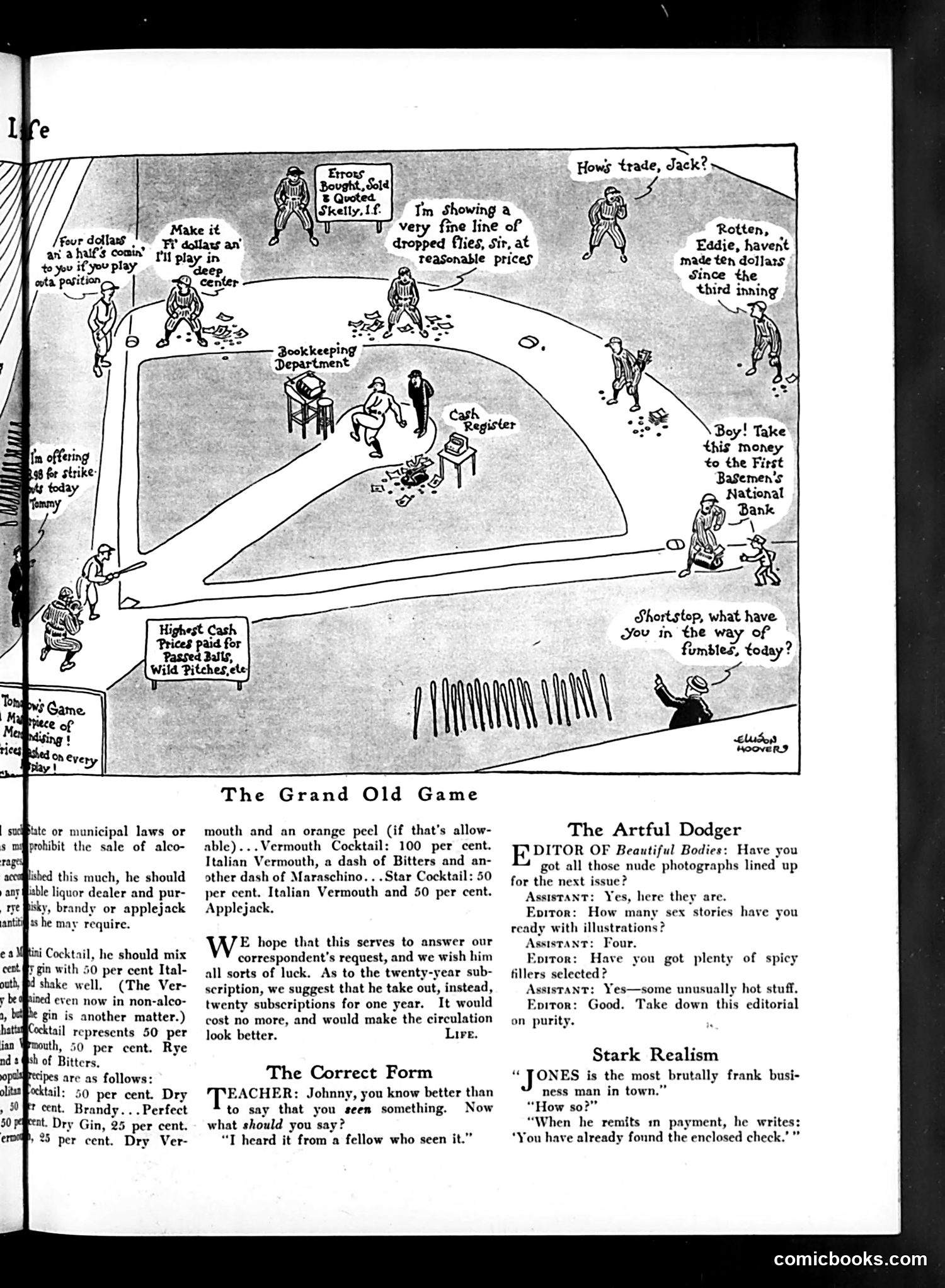
This cartoon satirizes baseball's widespread gambling culture in the early 20th century. The scene depicts a bookmaking operation disguised as a legitimate business, with various characters making bets on baseball games. The dialogue reveals the scheme: characters discuss "dropped flies" (intentional fielding errors) at "reasonable prices," suggesting players were paid to lose or make mistakes. References to the "Basemen's National Bank" mock how betting proceeds flow through financial institutions. The satire targets both corrupt players willing to fix games and the broader gambling infrastructure that profited from baseball. This reflects genuine concerns about game-fixing scandals that plagued early professional baseball, threatening the sport's integrity. The cartoon exposes how organized betting infiltrated the sport at all levels—from street-level bettors to banking systems—making a mockery of baseball as "the grand old game."
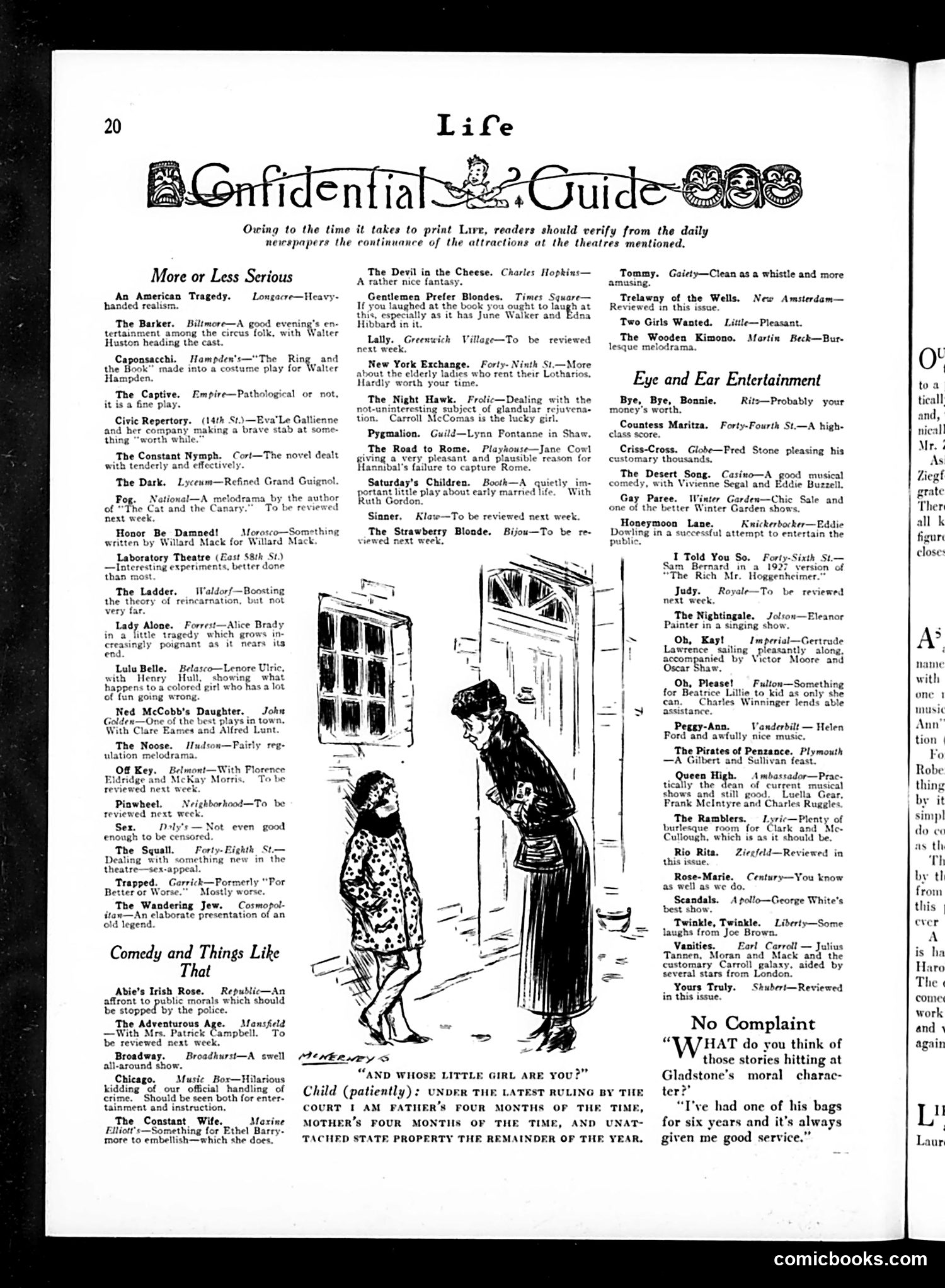
This is a theater review section from Life magazine (likely 1920s, based on theatrical references). The main cartoon depicts a social comedy scenario: an elegantly dressed woman confronts a man entering through a window, asking "AND WHOSE LITTLE GIRL ARE YOU?" The accompanying text explains the joke—under a legal ruling, the child (patiently held) is technically the father's property for four months yearly, with the mother retaining custody the remainder of the year. The satire targets custody law absurdities of the era, treating children almost as chattels to be divided between parents. The cartoon illustrates how ridiculous such arrangements became in practice. The page itself is dominated by brief theatrical reviews—"More or Less Serious" drama, comedies, and musical entertainment playing in New York. Reviews like dismissing "Sex" as "not even good enough to be censored" show Life's satirical editorial voice toward contemporary theater's moral controversies.
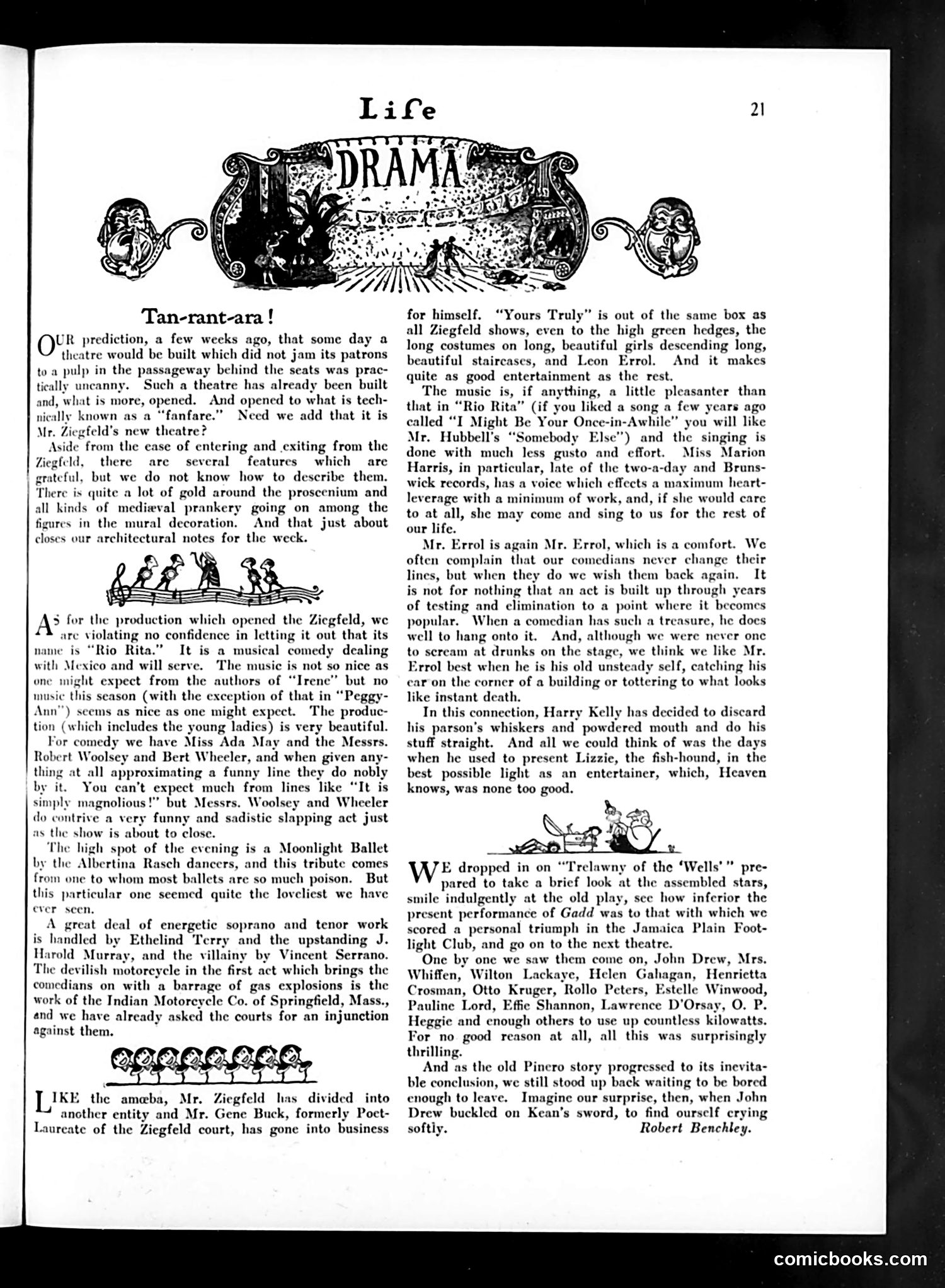
This page reviews two Broadway productions at Mr. Ziegfeld's newly opened theater. The critic praises the theater's architecture—notably its improved crowd flow—as a novelty worthy of "fanfare." **"Rio Rita"** is a musical comedy set in Mexico featuring comedians Robert Woolsey and Bert Wheeler (praised for a "slapping act"), the Albertina Rasch dancers' "Moonlight Ballet," and soprano Ethelind Terry. The critic finds the music pleasant but unremarkable. **"Yours Truly"** stars Leon Errol, a Ziegfeld regular known for playing drunk characters. The production features Marion Harris (a recording artist) and follows Ziegfeld's trademark formula: "high green hedges, long costumes on long, beautiful girls descending long, beautiful staircases." The satire mocks Ziegfeld's formulaic approach—his shows are interchangeable products from "the same box." The critic's tone is affectionately condescending toward Broadway's predictable entertainments and aging comedians who repeat successful routines rather than innovate.
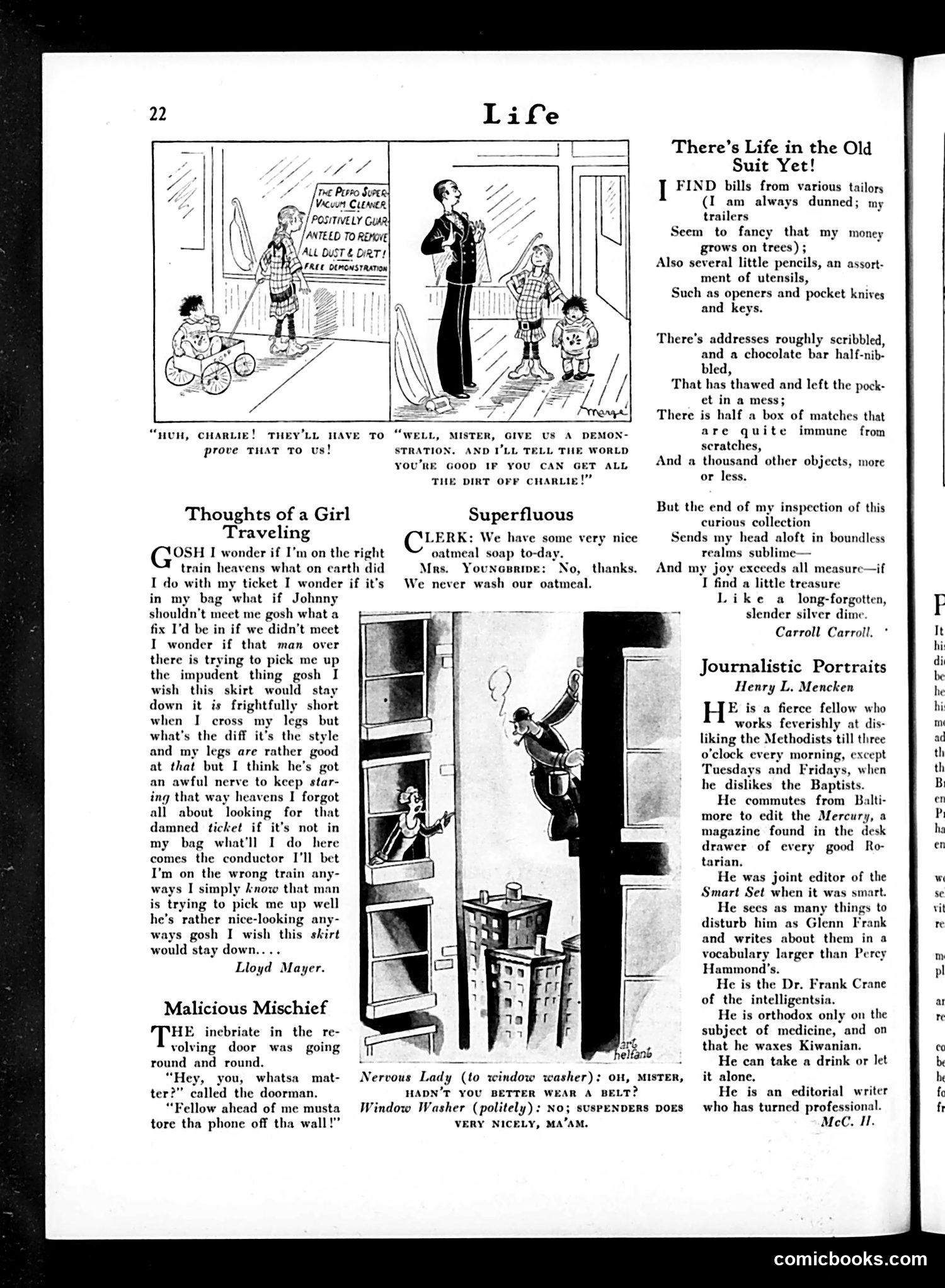
This page contains several satirical pieces mocking early 20th-century American life: **"Superfluous"** jokes about a clerk's failed attempt to sell oatmeal soap to a woman who reveals her family never washes their oatmeal—absurdist humor about sales pitches. **"Thoughts of a Girl Traveling"** satirizes women's scattered minds, depicting a girl obsessing over fashion, male attention, and lost tickets rather than practical concerns—reflecting period stereotypes about female irrationality. **"Malicious Mischief"** involves a drunk man trapped in a revolving door, with a doorman's darkly humorous response about damaged property. **"Henry L. Mencken"** is a celebrity roast of the famous Baltimore critic, mocking his intellectual pretensions, his religious cynicism, and his work with *The Smart Set* magazine—positioning him as representative of self-important intellectuals. The window washer cartoon jokes about class and propriety: a working-class man's casual response ("suspenders") to a nervous lady's concern about safety standards.
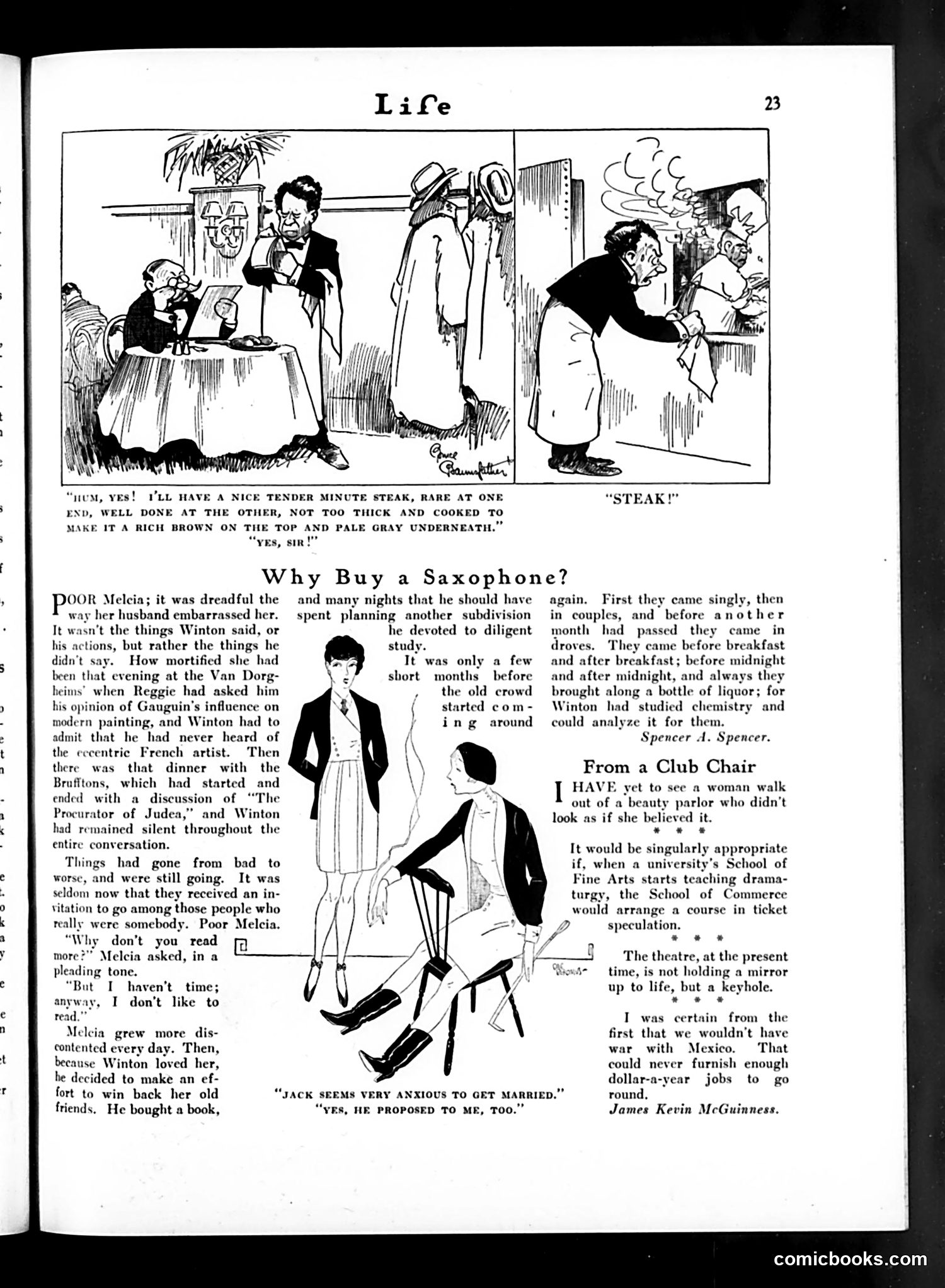
**Top Cartoon**: A restaurant scene satirizing pretentious diners. A customer delivers an absurdly complicated steak order with contradictory specifications (rare AND well-done, thick yet thin), while the exasperated waiter simply shouts "STEAK!" This mocks affectation and overcomplicated demands among the wealthy. **"Why Buy a Saxophone?"**: A story about social climbing. Melcia is embarrassed by her husband Winton's cultural ignorance (unfamiliar with Gauguin, unable to discuss "The Procurator of Judea"). To win back their social circle, he buys a book and studies chemistry, which ironically attracts people seeking free alcohol analysis rather than genuine intellectual companionship. The satirical point: genuine knowledge isn't what impresses society—perceived usefulness or entertainment value is. **"From a Club Chair"**: Brief observations mocking women's vanity about beauty treatments, university ticket scalping, theatre as voyeurism rather than art, and military-industrial corruption (jokes about wartime profiteering through "dollar-a-year" government jobs).
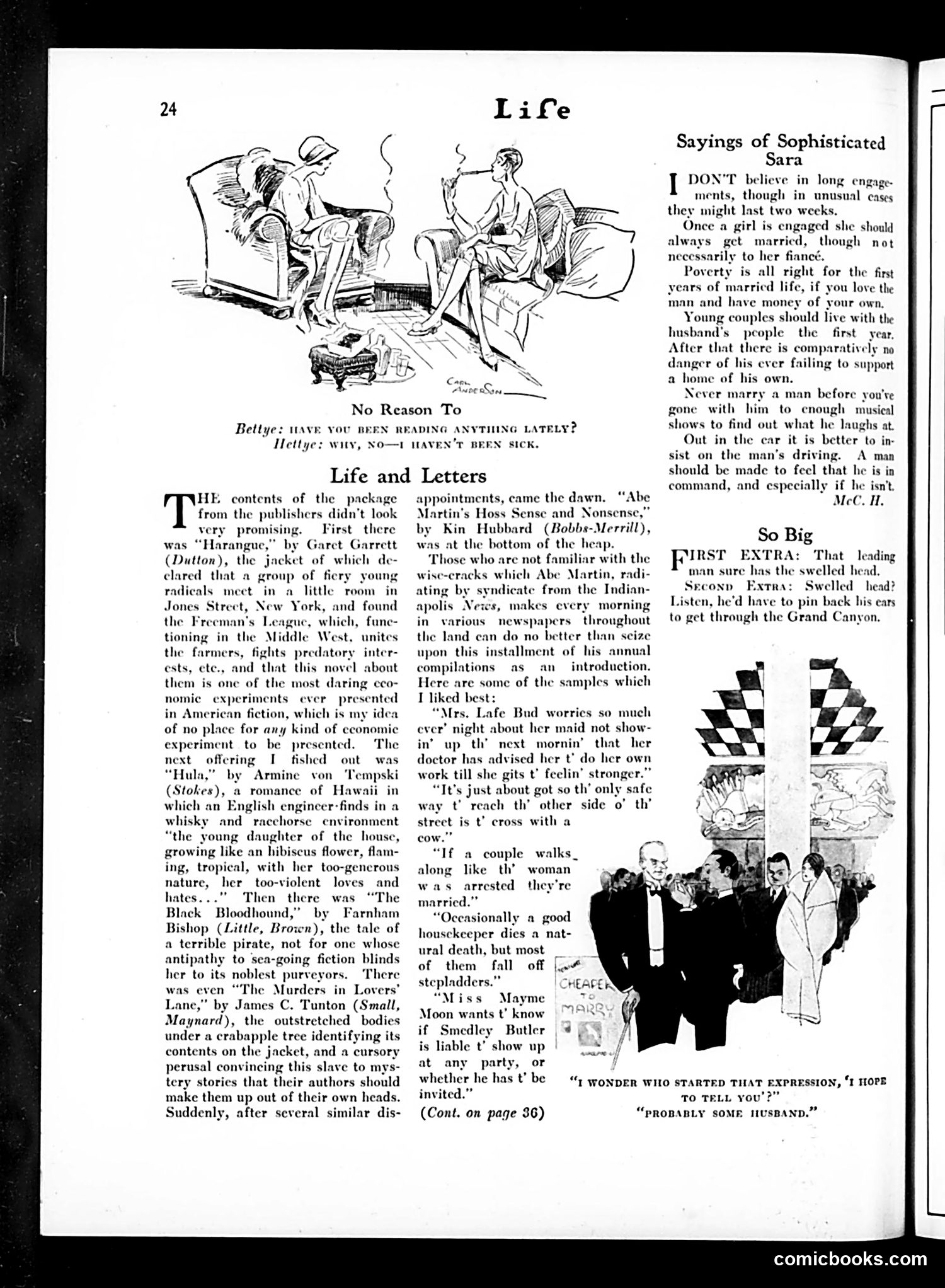
This page contains three satirical humor sections typical of 1920s Life magazine: **"No Reason To"** (top cartoon): A brief joke about a couple's leisure reading habits, with minimal satirical content. **"Life and Letters"** (main text): A book reviewer dismissively critiques new literary releases—describing plots about radical activists, Hawaiian romance, pirates, and murder mysteries as tedious or sensationalist. The reviewer's relief arrives with "Abe Martin's Hoss Sense and Nonsense," a collection of folksy aphorisms by Kin Hubbard, a popular syndicated humorist. The excerpted Martin quotes mock small-town concerns (unreliable maids, street-crossing dangers, marital discord) with rural dialect humor. **"Sayings of Sophisticated Sara"** and **"So Big"** (right column): Cynical observations about modern marriage and relationships, presented as witty commentary on contemporary social attitudes. The final joke about "I hope to tell you" being originated by husbands is a dig at marital complaint. Overall, the page reflects 1920s satirical humor: dismissal of "serious" literature in favor of accessible folksy wit, and sophisticated mockery of modern courtship and marriage conventions.
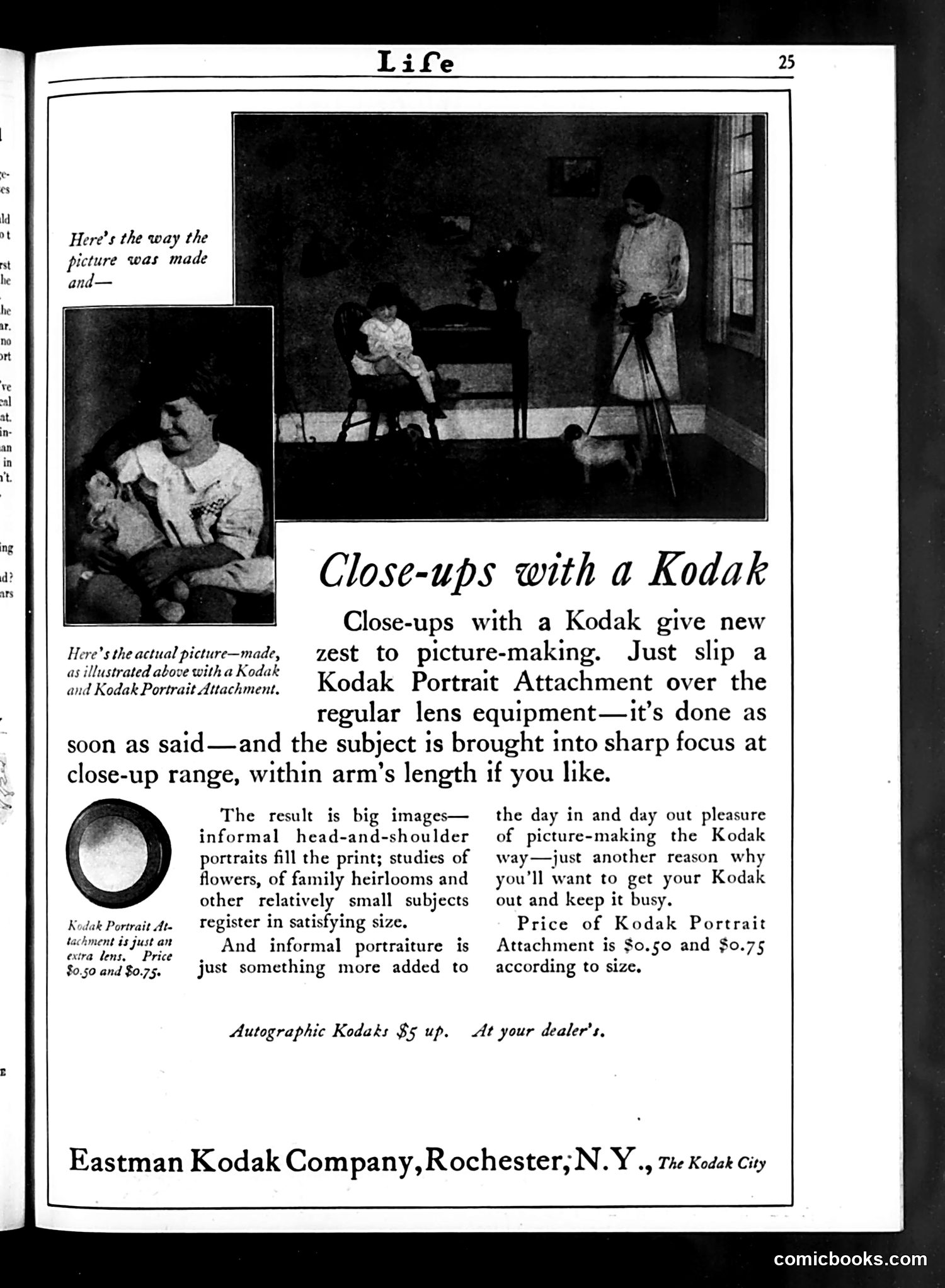
This page is entirely a **product advertisement** for the Kodak Portrait Attachment—there is no political cartoon or satire. It appears in *Life* magazine's advertising section. The ad demonstrates how the attachment works: a photographer can add a special lens to their camera to take close-up portraits. The images show the setup (left: actual photograph made with the device; center/right: behind-the-scenes demonstration of how the picture was taken). The advertisement targets amateur photographers, emphasizing that the inexpensive attachment ($0.50–$0.75) enables sharp, enlarged portraits of people, flowers, and small objects—marketed as adding "zest" to everyday picture-making. The appeal is democratic accessibility: ordinary people with Kodak cameras could now create professional-looking close-ups without expensive equipment.
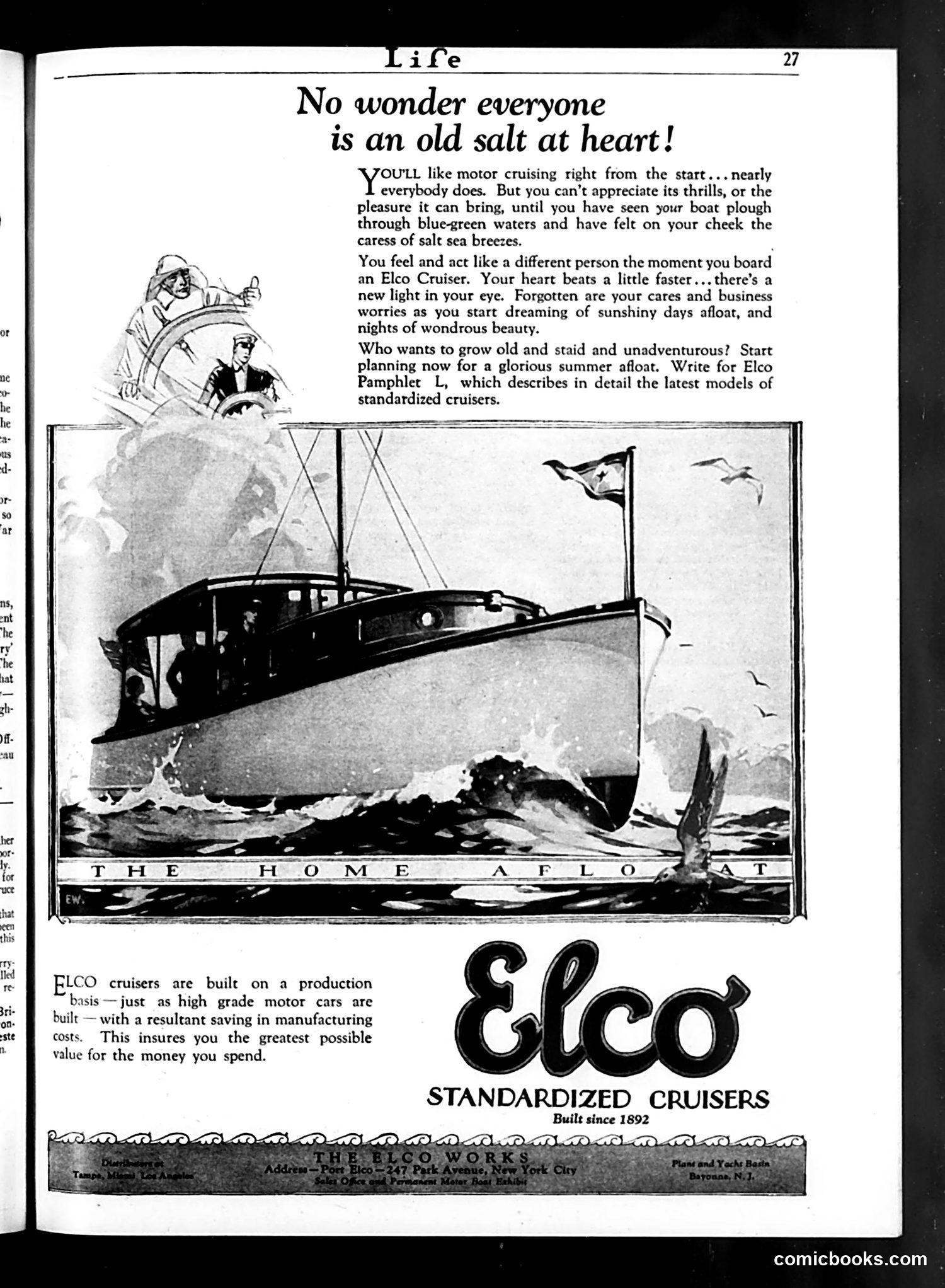
This is **not a cartoon or satire—it's a vintage advertisement** for Elco motorboats, disguised as editorial content in *Life* magazine. The page uses aspirational messaging common to 1920s-30s advertising: owning a luxury cruiser supposedly transforms you from an ordinary person into an adventurous "old salt" (experienced sailor). The headline ironically suggests everyone secretly wants this maritime lifestyle. The large illustration depicts an elegant motorboat at sea with flags flying—emphasizing leisure, romance, and escape from mundane life. Copy promises that boarding an Elco cruiser makes your "heart beat faster" and lets you forget "cares and business worries." The pitch emphasizes practical value: Elco uses assembly-line manufacturing (like automobiles) to offer affordability without sacrificing quality. This was a significant selling point during an era when motorboats were luxury items. The company address (The Elco Works, New York City) appears at the bottom, confirming this is paid advertising presented as lifestyle editorial—a common *Life* magazine practice.
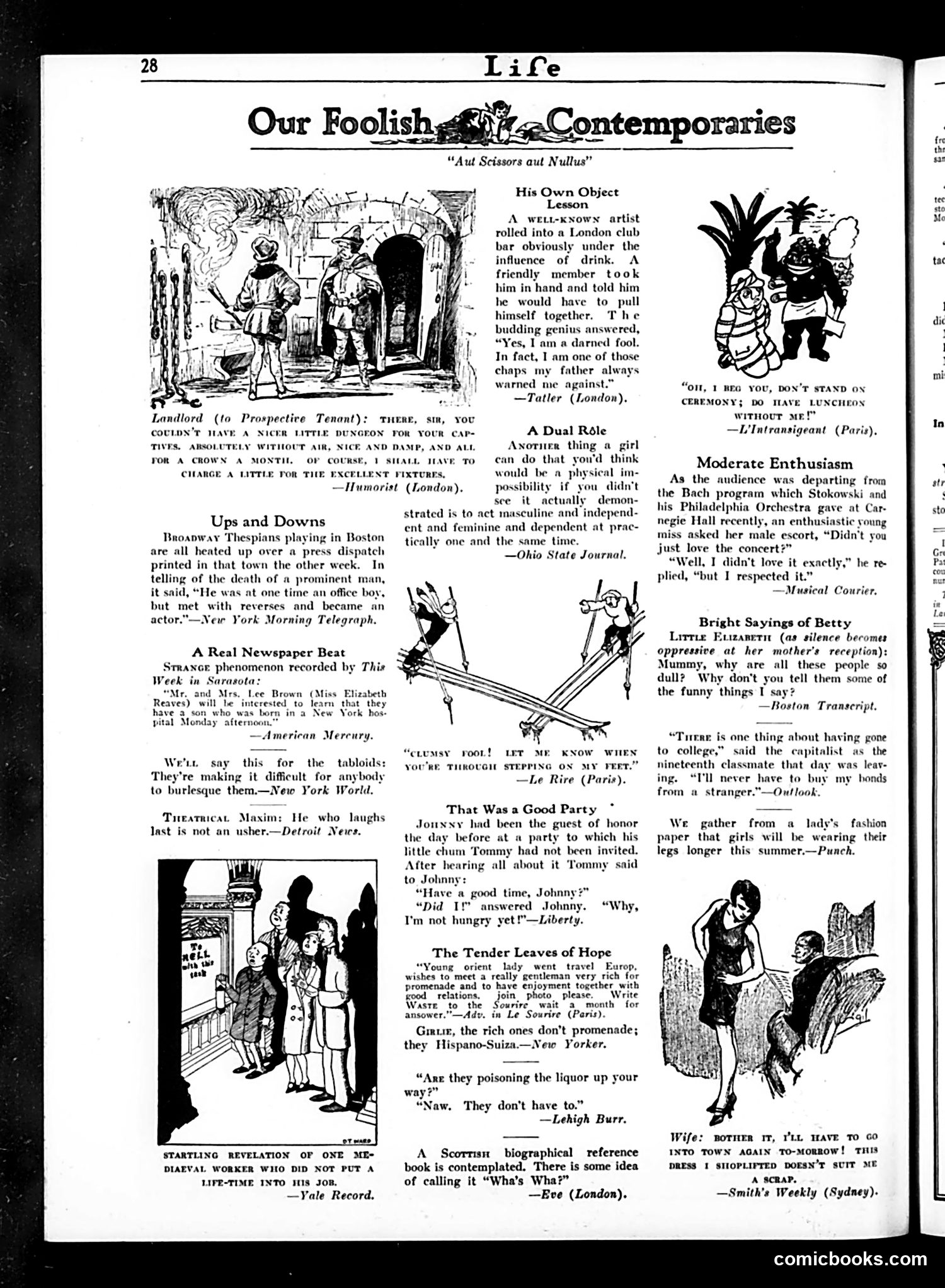
This page collects brief satirical pieces from various publications. Key cartoons and jokes: **"Landlord to Prospective Tenant"**: Mocks slumlords advertising terrible living conditions—damp, airless dungeons—as desirable features, charging premium rent. Social critique of exploitative housing. **"Ups and Downs"**: Theater folks were offended by a newspaper calling an actor's career a "reversal"—implying acting is a step down from honest work. Self-aware theatrical humor about actors' social status. **"Real Newspaper Beat"**: Mocks absurd birth announcements, satirizing tabloid sensationalism. **Various quips** target: drunk artists, gender role contradictions, the wealthy's indifference to promenading (they use Hispano-Suiza cars instead), and social pretense. The recurring theme: satirizing human foolishness across class lines—whether landlords, actors, the wealthy, or society women. The cartoons use exaggeration and irony typical of 1920s-era satirical magazines.
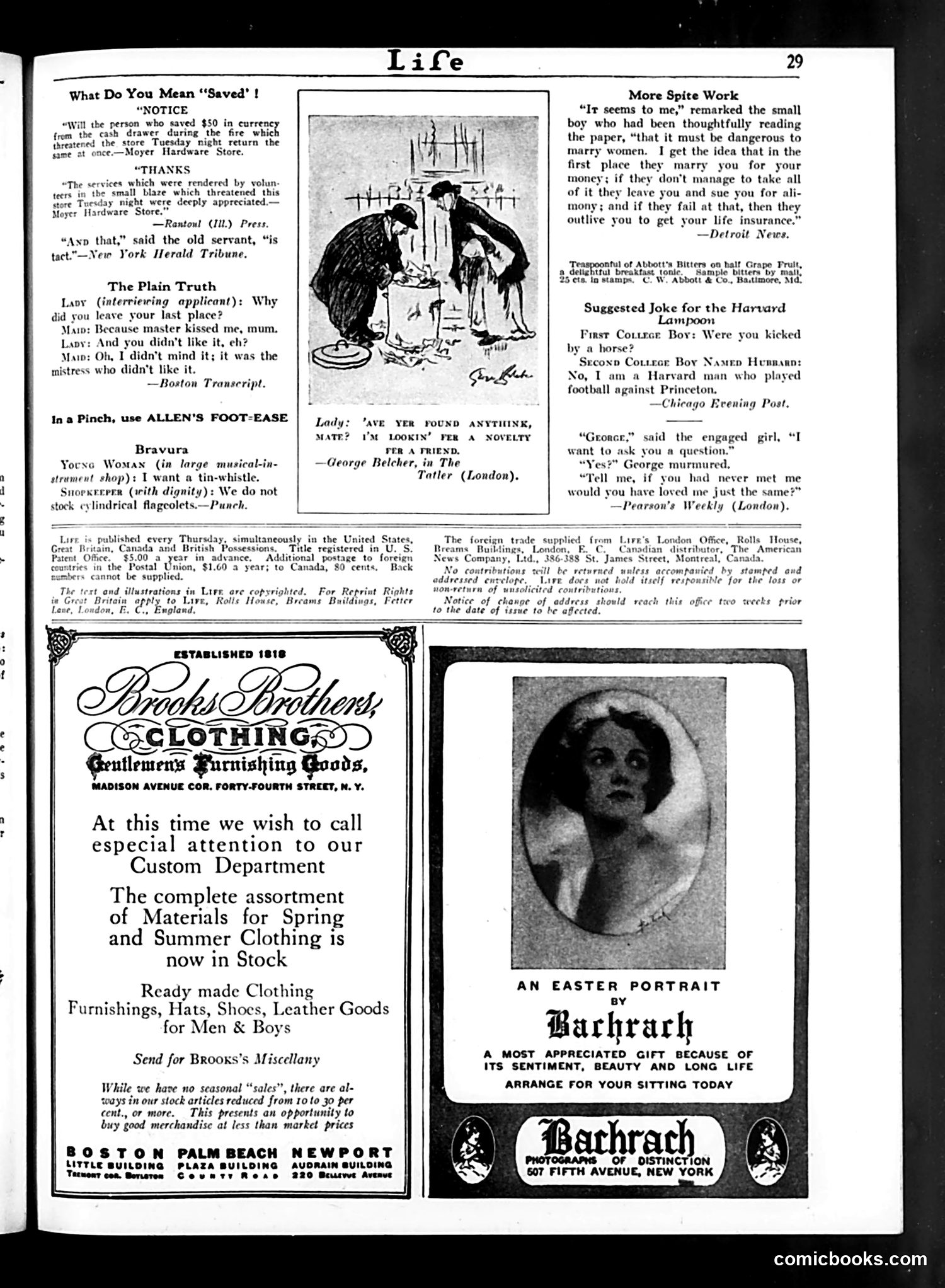
This page comprises mostly **humor shorts and advertisements** rather than political cartoons. The content reflects early 20th-century domestic comedy: **Notable items:** The main cartoon depicts a domestic scene—likely illustrating one of the brief jokes about servants or marital relations that dominate the page. Several jokes target **women and marriage**: one suggests wives marry for money, leave, sue for alimony, then outlive husbands to collect life insurance—a cynical view of matrimonial finances typical of the era. Other humor touches on class dynamics (a maid leaving employment after the master kissed her, causing the *mistress* displeasure) and servant incompetence. **The advertisements** (Brooks Brothers, Bachrach photography) suggest this appeals to **affluent male readers** concerned with fashion and social standing. The overall tone is **misogynistic by modern standards**, treating women as mercenary or problematic. This reflects common satirical attitudes of the 1910s-1920s among Life magazine's upper-class audience.
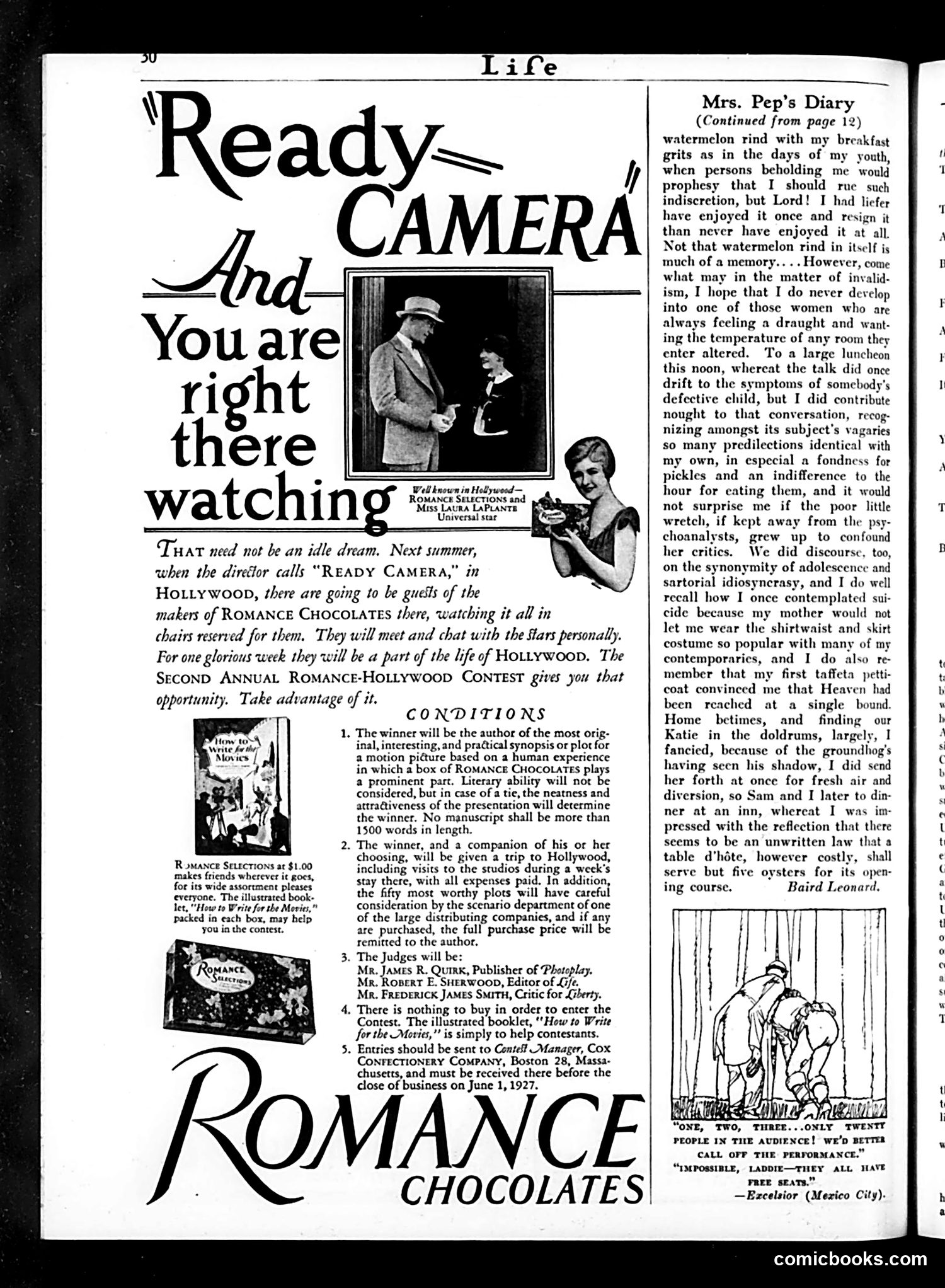
This page combines a **Romance Chocolates advertising contest** with a serialized **society gossip column** ("Mrs. Pep's Diary"). The advertisement features actress **Laura LaPlante** (a Universal Pictures star) and promotes the "Second Annual Romance-Hollywood Contest." The pitch is straightforward: readers submit short stories (under 1,500 words) featuring Romance Chocolates; winners get a trip to Hollywood to observe film production alongside industry judges (editors of major magazines like *Photoplay* and *Life*). The accompanying diary excerpt is satirical social commentary. "Mrs. Pep" documents trivial upper-class concerns—watermelon at breakfast, a luncheon conversation about a "defective child," restaurant oyster portions—presented in elaborate, pretentious language. The satire mocks women of leisure who obsess over minor discomforts and psychological trends (psychoanalysis, "adolescence and sartorial idiosyncrasy"). Together, the page represents **1920s consumer culture**: packaging glamorous Hollywood access to entice chocolate purchases while simultaneously mocking the vacuous society women who constituted the target audience.
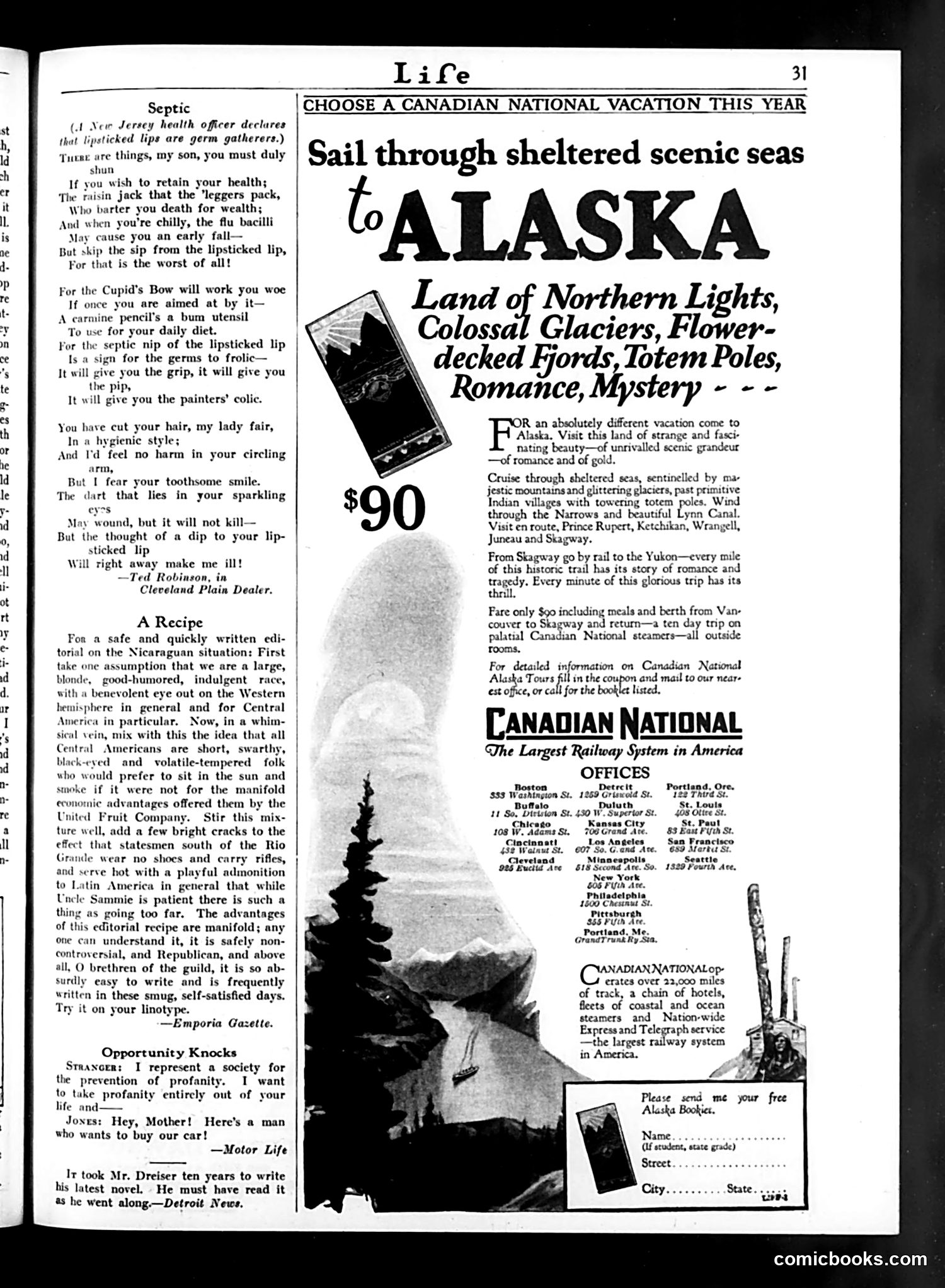
This page is primarily **advertising**, not political satire. The dominant feature is a Canadian National Railways advertisement promoting Alaska vacations for $90. The left column contains three brief satirical pieces typical of *Life* magazine's humor section: 1. **"Septic"**: A humorous health advisory (attributed to a New Jersey health officer) warning against kissing women wearing lipstick, treating it as a germ vector. This reflects 1920s anxieties about cosmetics and hygiene. 2. **"A Recipe"**: Satire mocking formulaic newspaper editorials about Central America/Nicaragua, stereotyping Latin Americans as lazy, volatile, and economically dependent on American companies like United Fruit. This reflects contemporary American imperialist attitudes. 3. **"Opportunity Knocks"**: A one-liner joke about a profanity-prevention society representative—the punchline being that the man wants to "buy" the car (implying the family uses profanity constantly). None of these pieces reference specific political figures or events. They're general social commentary typical of *Life*'s satirical content from this era.
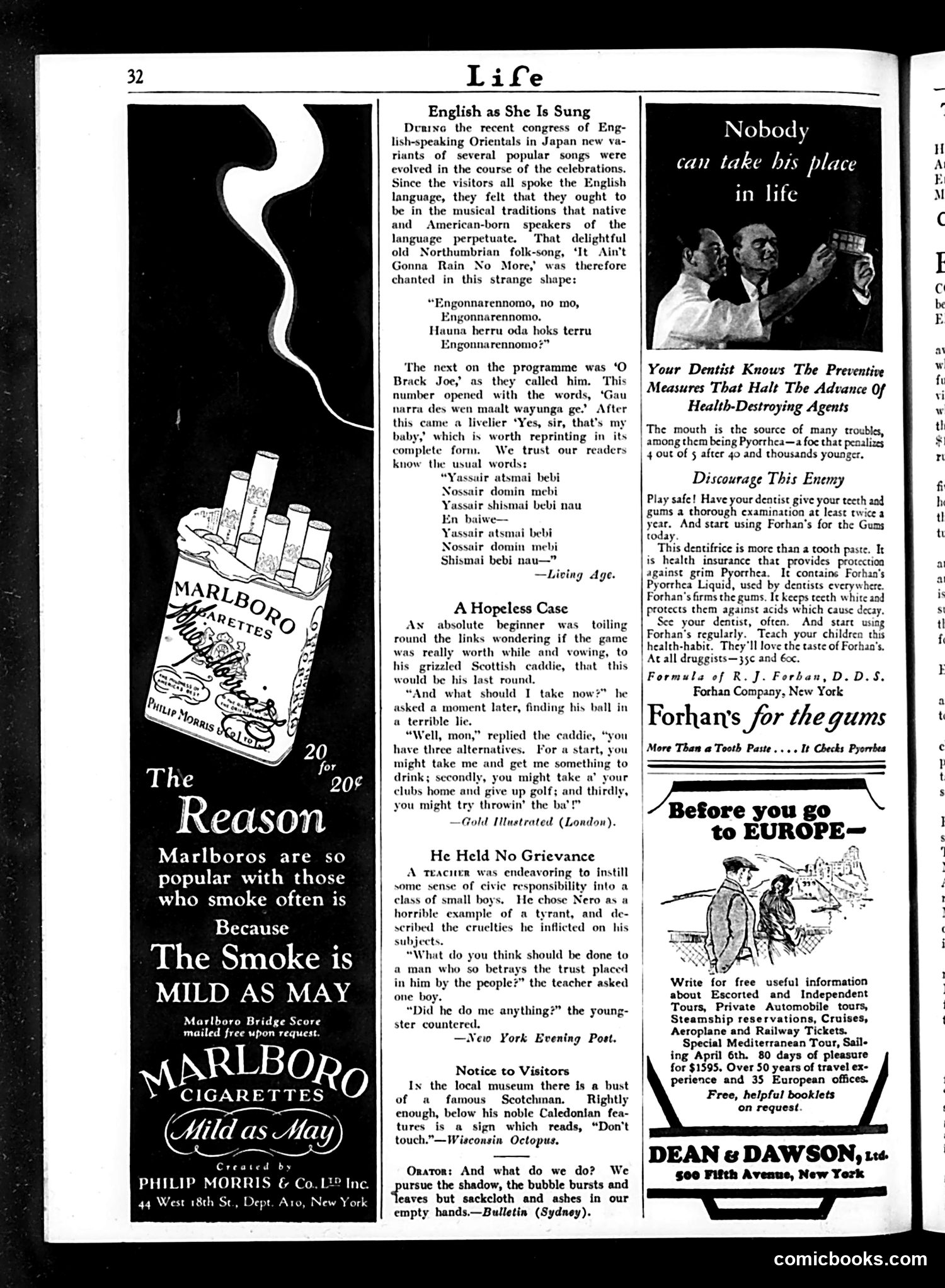
This page primarily contains **humorous anecdotes and advertisements** rather than political cartoons. The main satirical content includes: **"English as She Is Sung"**: Mocks Oriental visitors to Japan attempting to sing English folk songs phonetically, creating absurd pronunciations like "Engonnarennomo" for "It Ain't Gonna Rain No More." The satire targets both the linguistic challenges of learning English and the incongruity of non-native speakers adopting Anglo-American musical traditions. **"A Hopeless Case"**: A golf anecdote where a Scottish caddie offers three sardonic "solutions" to a beginner's poor play—getting drunk, quitting golf, or throwing the ball—poking fun at golf's frustrations. **"He Held No Grievance"**: A schoolboy contradicts a teacher's moral lesson about Nero's tyranny by asking if Nero wronged *him personally*—satirizing youthful amorality and self-interest over abstract ethics. The remainder is **product advertising** (Marlboro cigarettes, Forhan's toothpaste, Dean & Dawson travel agency), typical of Life's commercial content during this era.
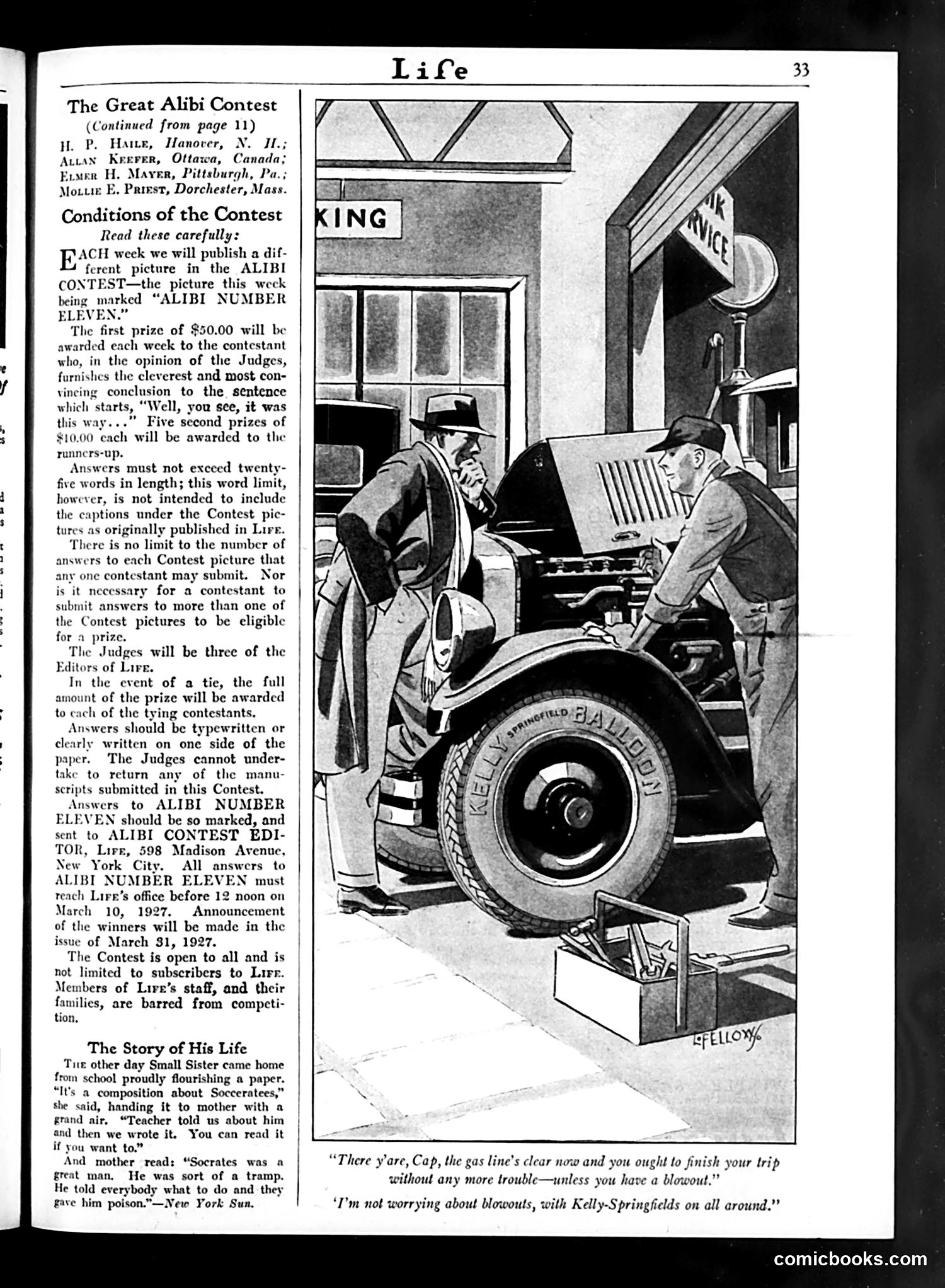
This page features **Life's "Alibi Contest,"** a participatory humor feature where readers submit clever explanations for captioned illustrations. The main cartoon (Alibi Number Eleven) depicts two mechanics at a gas station examining a car's engine. One says the gas line is clear and the car should finish its trip "unless you have a blowout." The driver responds he's not worried because he has Kelly-Springfield tires. The joke's point: The driver confidently dismisses the mechanic's warning about mechanical failure by asserting his tire brand's reliability—a **non-sequitur** that misses the actual concern. Readers were invited to supply humorous explanations starting with "Well, you see, it was this way..." for why this absurd confidence made sense. The contest offered $50 weekly prizes for the cleverest alibis (maximum 25 words). This was typical of Life's interactive entertainment during the 1920s, encouraging reader participation and boosting circulation.
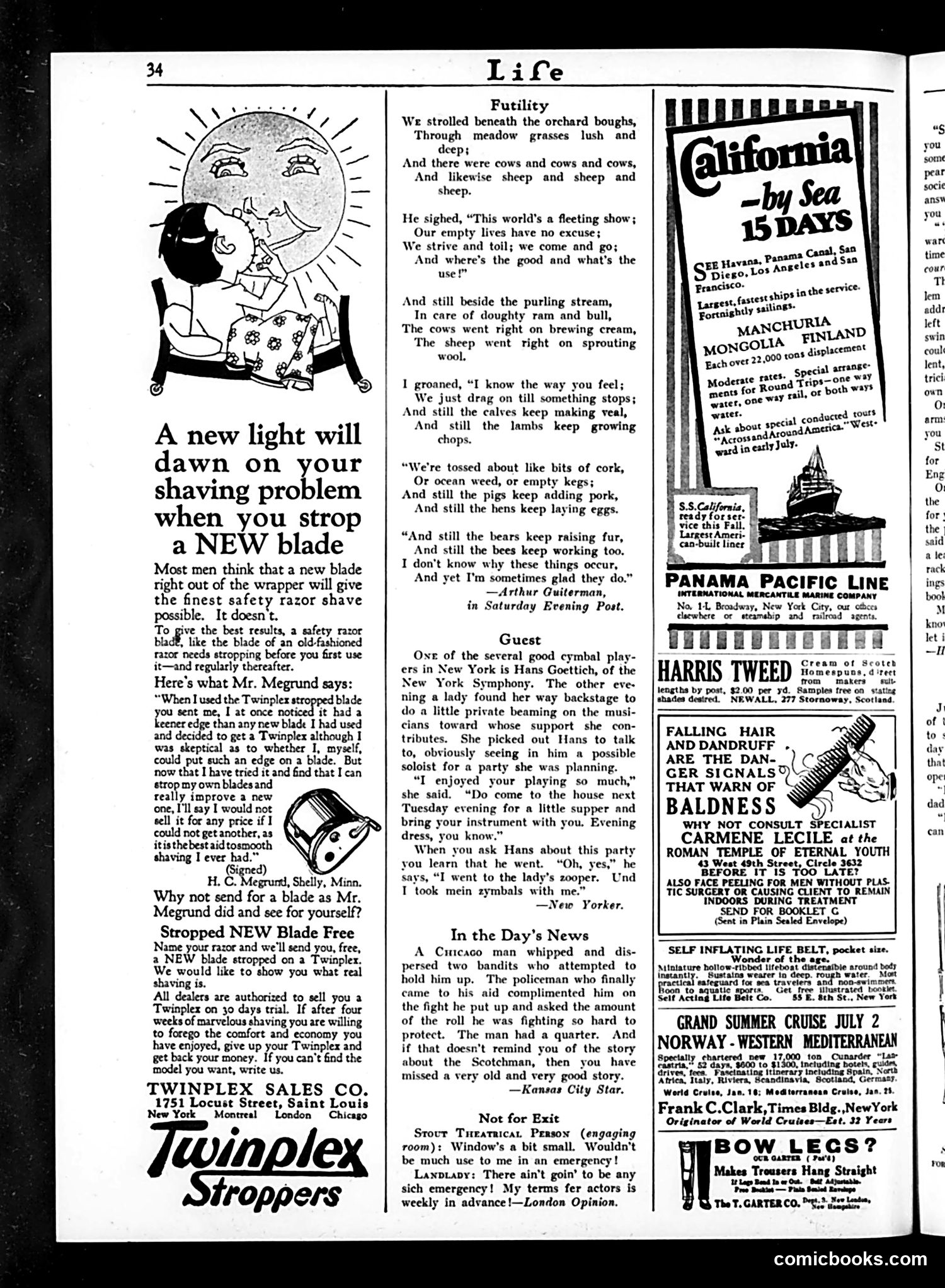
This page contains **two distinct pieces**: **Left side: Twinplex Stropper Advertisement** A shaving blade company uses customer testimonial to argue that new safety razor blades need "stropping" (sharpening on a leather strop) before first use—contrary to what most men assumed. The ad presents this as a revelation that will improve shaving results. Today, this would seem antiquated; modern disposable razors require no stropping. **Right side: "Futility" Poem by Arthur Guiterman** A philosophical poem where two men observe farm animals contentedly productive (making cream, wool, etc.) while lamenting human existence as meaningless drudgery. The satire mocks existential despair by contrasting it with animals' simple, purposeful lives—suggesting human anxiety over "the good and what's the use" is absurd when nature simply continues functioning indifferently. Both reflect early 20th-century concerns: practical grooming solutions and philosophical pessimism about modern life's meaninglessness.
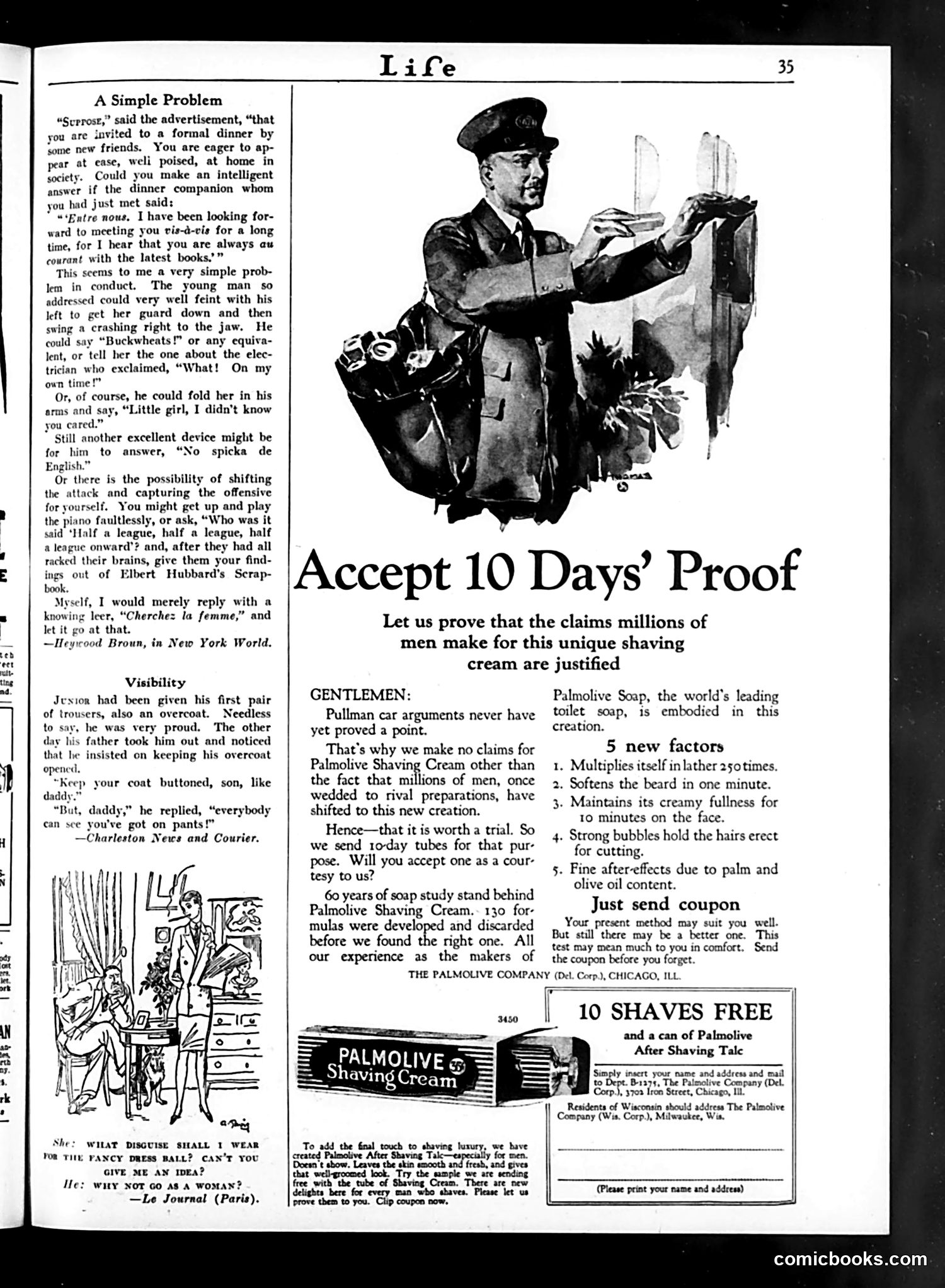
This page contains three unrelated humor pieces and a Palmolive shaving cream advertisement. **"A Simple Problem"** satirizes social anxiety among the aspirationally genteel. A dinner guest is flustered when a new acquaintance addresses him in French ("entre nous," "vis-à-vis," "au courant"), suggesting pretentious sophistication. The column humorously catalogs absurd responses—from punching her to feigning ignorance of English to deploying fake erudition. The satire targets both the pretentiousness of forced French phrases in polite society and the insecurity of those trying to fit into "proper" circles. **"Visibility"** jokes about a child's pride in wearing long pants for the first time, keeping his coat unbuttoned to display them constantly. It mocks youthful vanity and the social significance once placed on this coming-of-age milestone. **The cartoon caption** presents a gag about costume party suggestions, where a man cheekily recommends a woman disguise herself as a woman—implying women are inherently deceptive or mysterious. The **Palmolive advertisement** makes product claims typical of early 20th-century marketing, emphasizing scientific superiority and offering a trial coupon.
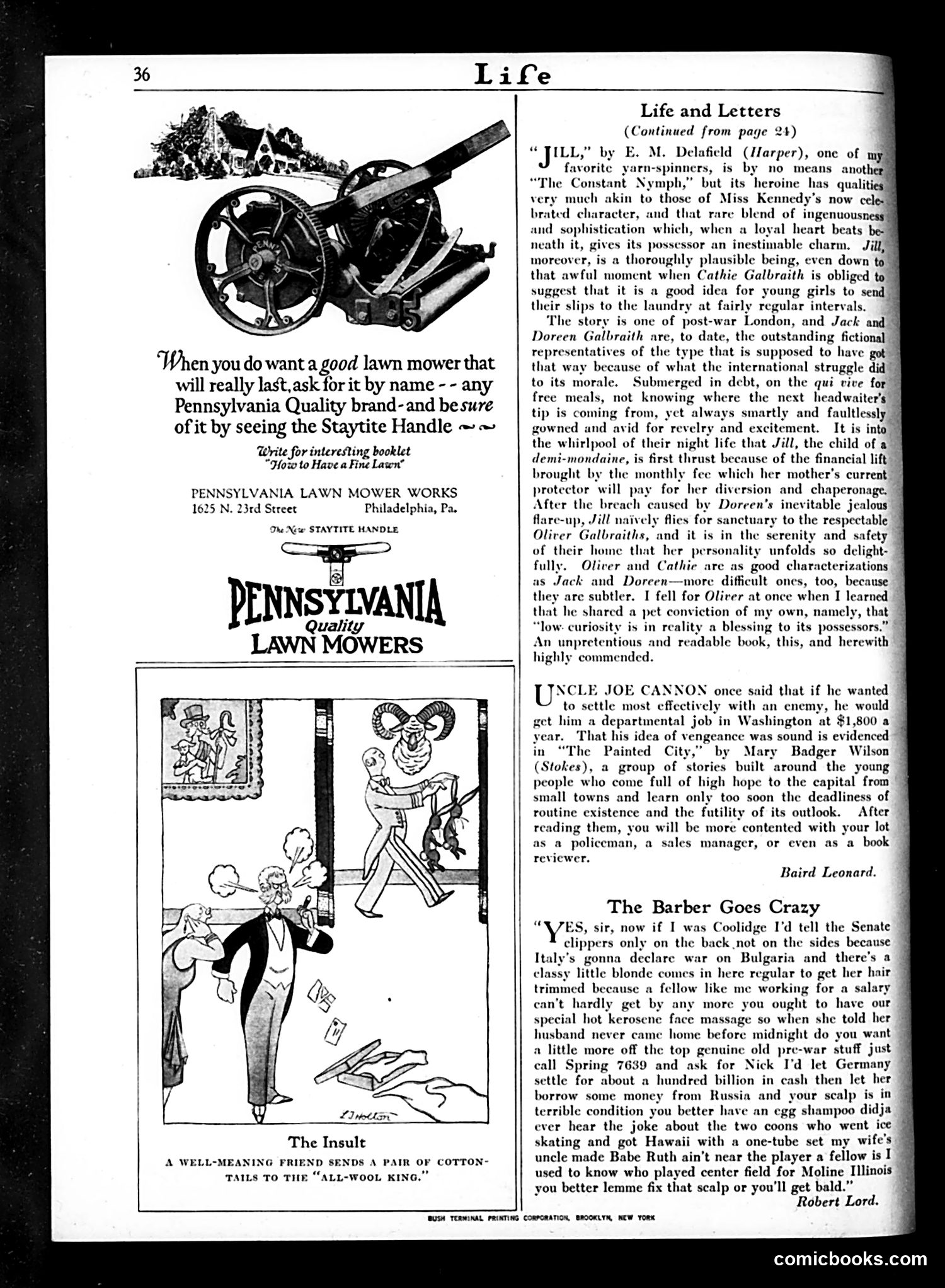
This page mixes book reviews with advertisements and humor pieces. **The Main Cartoon** ("The Insult"): A well-dressed man reacts with exaggerated fury to receiving cotton-tail items when he apparently prides himself on being an "all-wool king"—a humorous jab at pretension and vanity about material quality and social status. **"The Barber Goes Crazy"**: A satirical monologue by a barber whose stream-of-consciousness rambling conflates personal gossip, current events (Italy and Bulgaria, Germany's war reparations), and customer chatter. The joke skewers barber-shop culture—the stereotypical chatty barber who blends trivial matters with serious politics incoherently, reflecting post-WWI anxieties and the public's confused grasp of international affairs. **Book Reviews**: Brief recommendations for novels about post-war London society and young people navigating Washington bureaucracy—reflecting contemporary literary interests in depicting how WWI changed social life. The page captures 1920s American magazine culture: mixing advertising, social satire, and literary criticism for educated readers.

I can see this is a black and white image that appears to be a page scan, but the image is extremely dark and low contrast, making it nearly impossible to discern specific cartoon details, figures, or text beyond what's barely visible on the left margin and the "comicbooks.com" watermark at bottom. While the OCR text indicates this should be from Life magazine, I cannot reliably identify specific caricatures, political figures, historical references, or the intended satire from this particular scan. The image quality is too degraded to meet the accuracy standard required. To provide a proper analysis, a clearer or higher-contrast version of this page would be needed.