
Life, 1927-02-24 · page 23 of 39
Life — February 24, 1927 — page 23: what you’re looking at
What you’re looking at
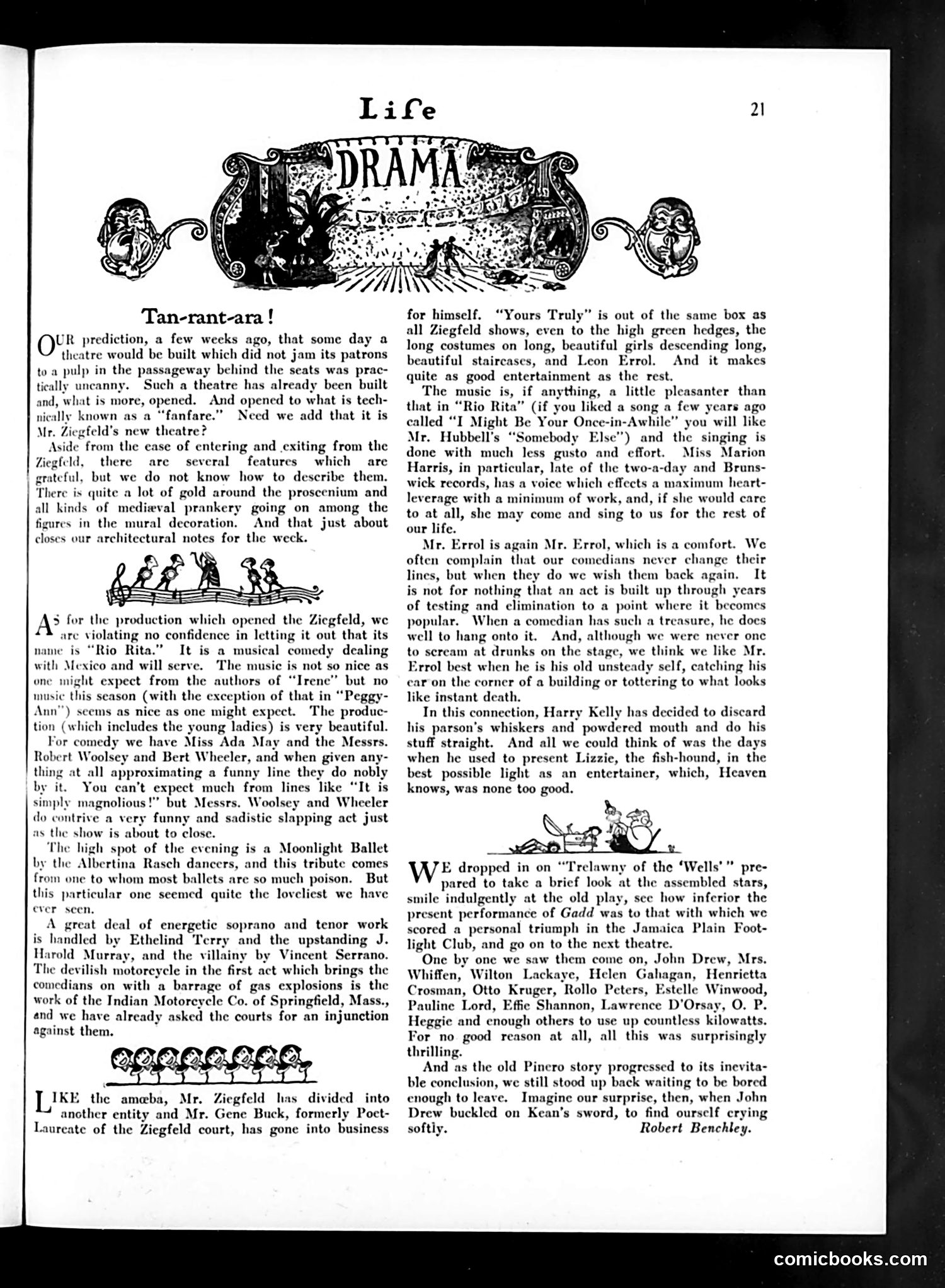
This page reviews two Broadway productions at Mr. Ziegfeld's newly opened theater. The critic praises the theater's architecture—notably its improved crowd flow—as a novelty worthy of "fanfare." **"Rio Rita"** is a musical comedy set in Mexico featuring comedians Robert Woolsey and Bert Wheeler (praised for a "slapping act"), the Albertina Rasch dancers' "Moonlight Ballet," and soprano Ethelind Terry. The critic finds the music pleasant but unremarkable. **"Yours Truly"** stars Leon Errol, a Ziegfeld regular known for playing drunk characters. The production features Marion Harris (a recording artist) and follows Ziegfeld's trademark formula: "high green hedges, long costumes on long, beautiful girls descending long, beautiful staircases." The satire mocks Ziegfeld's formulaic approach—his shows are interchangeable products from "the same box." The critic's tone is affectionately condescending toward Broadway's predictable entertainments and aging comedians who repeat successful routines rather than innovate.
📄 Transcribed text from this page (OCR, searchable)
Machine-transcribed from the original scan — historical spelling and the odd misread are preserved.
Tan-rant-ara ! Ov R prediction, a few weeks ago, that some day a theatre would be built which did not jam its patrons toa pulp in the passageway behind the seats was prac- tically uncanny. Such a theatre has already been built and, what is more, opened. And opened to what is tech- nically known a “fanfare.” Need we add that it is Mr. Ziegfeld's new theatre? Aside from the ease of entering and exiting from the Ziegfeld, there are several features which are grateful, but we do not know how to describe them. | There is quite a lot of gold around the proscenium and all kinds of medieval prankery going on among the figures in the mural decoration. And that just about closes our architectural notes for the weck. A? for the production which opened the Ziegfeld, we are violating no confidence in letting it out that its name is “Rio Rita.” It is a musical comedy dealing with Mexico and will serve. The music is not so nice as one might expect from the authors of “Irene” but no music this season (with the exception of that in “Peggy- Ann") seems as nice as one might expect. The produc- tion (which includes the young ladies) is very beautiful. For comedy we have Miss Ada May and the Messrs. Robert Woolsey and Bert Wheeler, and when given any- all approximating a funny line they do nobly You can’t expect much from lines like “It is simply magnolious!” but Messrs. Woolsey and Wheeler do contrive a very funny and sadistic slapping act just as the show is about to close. The high spot of the evening is a Moonlight Ballet by the Albertina Rasch dancers, and this tribute comes m one to whom most ballets are so much poison. But this particular one seemed quite the loveliest we have ever seen. A great deal of energetic soprano and tenor work is handled by Ethelind Terry and the upstanding J. Harold Murray, and the villainy by Vincent Serrano. The devilish motorcycle in the first act which brings the comedians on with a barrage of gas explosions is the work of the Indian Motorcycle Co. of Springfield, Mass., and we have already asked the courts for an injunction against them. IKE the ameba, Mr. another entity and Mr. Gene Buck, formerly Poct- Laureate of the Ziegfeld court, has gone into business Ziegfeld las divided into for himself. “Yours Truly” is out of the same box as all Ziegfeld shows, even to the high green hedges, the long costumes on long, beautiful girls descending long, beautiful staircases, and Leon Errol. And it makes quite as good entertainment as the rest. The music is, if anything, a little pleasanter than that in “Rio Rita” (if you liked a song a few years ago called “I Might Be Your Once-in-Awhile” you will like Mr. Hubbell’s “Somebody Else”) and the singing is done with much less gusto and effort. Miss Marion Harris, in particular, late of the two-a-day and Bruns- wick records, has a voice which effects a maximum heart- leverage with a minimum of work, and, if she would care to at all, she may come and sing to us for the rest of our life. Mr. Errol is again Mr. Errol, which is a comfort. We often complain that our comedians never change their lines, but when they do we wish them back again. It is not for nothing that an act is built up through years of testing and elimination to a point where it becomes popular. When a comedian has such a treasure, he does well to hang onto it. And, although we were never one to scream at drunks on the stage, we think we like Mr. Errol best when he is his old unsteady self, catching his ear on the corner of a building or tottering to what looks like instant death, In this connection, Harry Kelly has decided to discard his parson’s whiskers and powdered mouth and do his stuff straight. And all we could think of was the days when he used to present Lizzie, the fish-hound, in the best possible light as an entertainer, which, Heaven knows, was none too good. NS a 0 NCD WE dropped in on “Trelawny of the ‘Wells’ pre- pared to take a brief look at the assembled stars, smile indulgently at the old play, see how inferior the present performance of Gadd was to that with which we scored a personal triumph in the Jamaica Plain Foot- light Club, and go on to the next theatre. One by one we saw them come on, John Drew, Mrs. iffen, Wilton Lackaye, Helen Gahagan, Henrietta Crosman, Otto Kruger, Rollo Peters, Estelle Winwood, Pauline Lord, Effie Shannon, Lawrence D'Orsay, O. P. Heggie and enough others to use up countles: kilowatts. For no good reason at all, all this was surprisingly thrilling. And as the old Pinero story progressed to its inevita- ble conclusion, we still stood up back waiting to be bored enough to leave. Imagine our surprise, then, when John Drew buckled on Kean’s sword, to find ourself crying softly. Robert Benchley. Wi comicbooks.com