
Life, 1927-02-24 · page 26 of 39
Life — February 24, 1927 — page 26: what you’re looking at
What you’re looking at
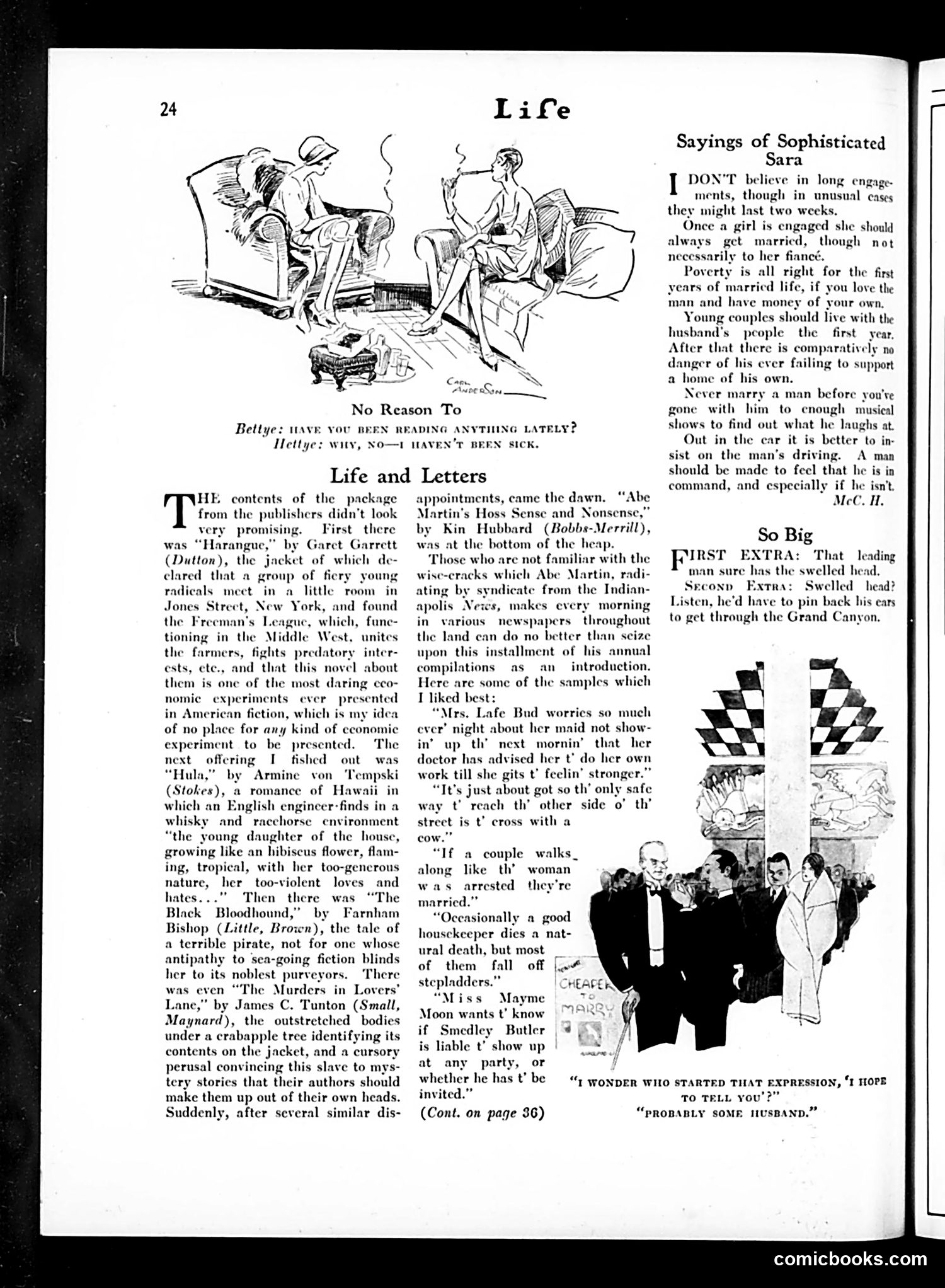
This page contains three satirical humor sections typical of 1920s Life magazine: **"No Reason To"** (top cartoon): A brief joke about a couple's leisure reading habits, with minimal satirical content. **"Life and Letters"** (main text): A book reviewer dismissively critiques new literary releases—describing plots about radical activists, Hawaiian romance, pirates, and murder mysteries as tedious or sensationalist. The reviewer's relief arrives with "Abe Martin's Hoss Sense and Nonsense," a collection of folksy aphorisms by Kin Hubbard, a popular syndicated humorist. The excerpted Martin quotes mock small-town concerns (unreliable maids, street-crossing dangers, marital discord) with rural dialect humor. **"Sayings of Sophisticated Sara"** and **"So Big"** (right column): Cynical observations about modern marriage and relationships, presented as witty commentary on contemporary social attitudes. The final joke about "I hope to tell you" being originated by husbands is a dig at marital complaint. Overall, the page reflects 1920s satirical humor: dismissal of "serious" literature in favor of accessible folksy wit, and sophisticated mockery of modern courtship and marriage conventions.
📄 Transcribed text from this page (OCR, searchable)
Machine-transcribed from the original scan — historical spelling and the odd misread are preserved.
Hettye: Wuy, NO—1 HAVEN'T BE Life and Letters HE contents of the package | from the publishers didn’t look v promising. First’ there was “Harangu by Garet € 4 (Dutton), the jacket of which de- clared that a group of fiery young radicals meet in a little room in Jones Street, New York, and found the Freeman's League, which, fune- tioning in the Middle West, unites the farmers, fights predatory inter- ests, cte., and that this novel about them is one of the most daring cco- nomic experiments ever presented in American fiction, which is my idea of no place for any kind of economic experiment to be presented. The next offering I fished out was “Hula,” by Armine von ‘Tempski (Stokes), a romance of Hawaii in which an English engincer-finds in a whisky and racchorse environment “the young daughter of the house, growing like an hibiscus flower, flam- ing, tropical, with her too-generous nature, her too-violent lov and hates..." Then there was “The Bl Bloodhound,” by Farnham Bishop (Little, Brown), the tale of a terrible pirate, not for one whose antipathy to sea-going fiction blinds her to its noblest purveyors. There was even “The Murders in Lovers’ Lane,” by James C. Tunton (Small, Maynard), the outstretched bodies under a crabapple tree identifying its contents on the jacket, and a cursory perusal convincing this slave to mys- tery stories that their authors should make them up out of their own heads. Suddenly, after several similar dis- appointments, came the dawn. “Abe Martin's Hoss Sense and Nonsense,” Kin Hubbard (Bobbs-Merrill), as at the bottom of the heap. Those who are not familiar with the wise-cracks which Abe Martin, radi- ating by syndicate from the Indian- apolis News, makes every morning in various newspapers throughout the land can do no better than seize upon this installment of his annual compilations as an introduction, Here are some of the samples which I liked best: “Mrs. Lafe Bud worrics so much ever’ night about her maid not show- in’ up th’ next mornin’ that her doctor has advised her t’ do her own work till she gits t’ feelin’ stronger.” “It’s just about got so th’ only safe way t’ reach th’ other side o’ th’ street is t’ cross with a cow.” “If a couple walks_ along like th’ woman was arrested they're married.” “Occasionally a good housckeeper dies a nat- ural death, but most of them fall off stepladders.” “Miss Mayme Moon wants t’ know if Smedley Butler is liable t’ show up at any party, or whether he has t’ be invited.” (Cont. on page 36) Sayings of Sophisticated Sara DON’T believe in long engage. ments, though in unusual cases they might last two weeks. Once a girl is engaged she should always get married, though not necessarily to her fiancé. Poverty is all right for the first years of married life, if you love the man and have money of your own. Young couples should live with the husband's people the first year, After that there is comparatively no danger of his ever failing to support a home of his own. Never marry a man before you've gone with him to enough musical shows to find out what he laughs at. Out in the car it is better to in- sist on the man’s driving. A man should be made to feel that he is in command, and especially if he isn’t. McC. So Big TRA: That leading the swelled head. Extra: Swelled head? Furst E. man sure Srconp Listen, he'd have to pin back his ears to get through the Grand Canyon. “| WONDER WILO STARTED THAT EXPRESSION, ‘I HOPE TO TELL you'?” “PROBABLY SOME IIUSBAND.” comicbooks.com