
A complete issue · 35 pages · 1927
Life — February 3, 1927
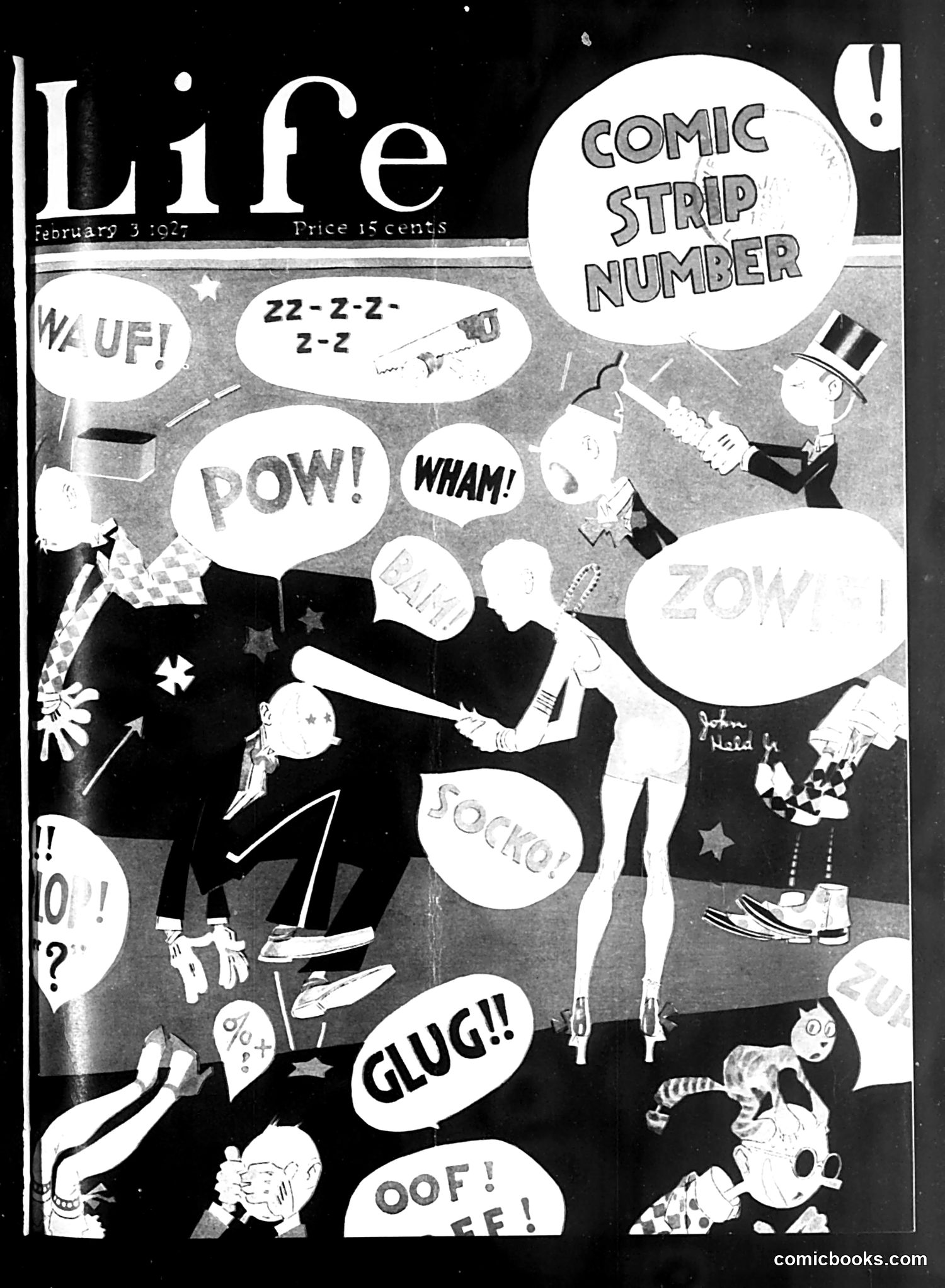
This is a **comic strip showcase issue** of *Life* magazine, prominently labeled "Comic Strip Number" on the cover. The page features a chaotic, energetic illustration packed with dynamic action and sound effects typical of early comic strip style—"POW!", "WHAM!", "ZOW!", "GLUG!!", "SOCKO!", and "OOF!" The cartoon depicts exaggerated physical comedy: characters in formal wear engaged in slapstick violence (hitting, kicking, flying), with stars and impact lines emphasizing the action. The style satirizes the increasingly popular comic strip medium itself—celebrating its over-the-top violence, broad humor, and absurdist sensibilities that were becoming mainstream entertainment in the 1920s. The cover price of **15 cents** reflects early 20th-century publishing costs.
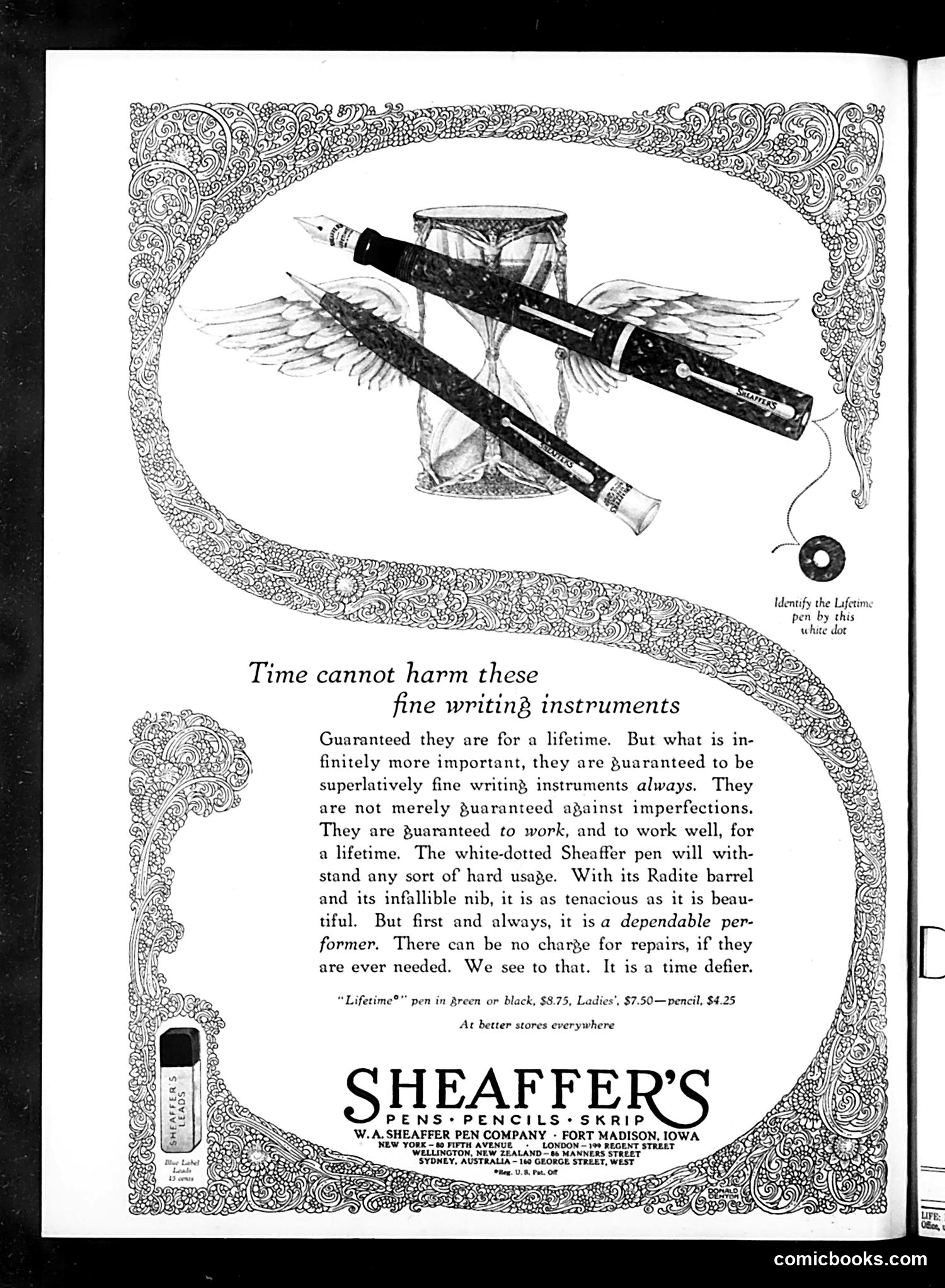
This page is primarily an advertisement for Sheaffer's pens and pencils, not a political cartoon or satire. The ad features ornate decorative borders typical of early 20th-century magazine design and displays writing instruments alongside an hourglass—a visual metaphor for time and permanence. The headline "Time cannot harm these fine writing instruments" emphasizes durability as the product's key selling point. The ad promises lifetime guarantees, reliable performance, and "dependable performer" status. It highlights the "Lifetime" pen model available in green or black for $8.75, with pencils at $4.25. The text assures customers of quality construction and free repairs, positioning Sheaffer's as a premium, trustworthy brand. This is straightforward product marketing rather than political or social satire.
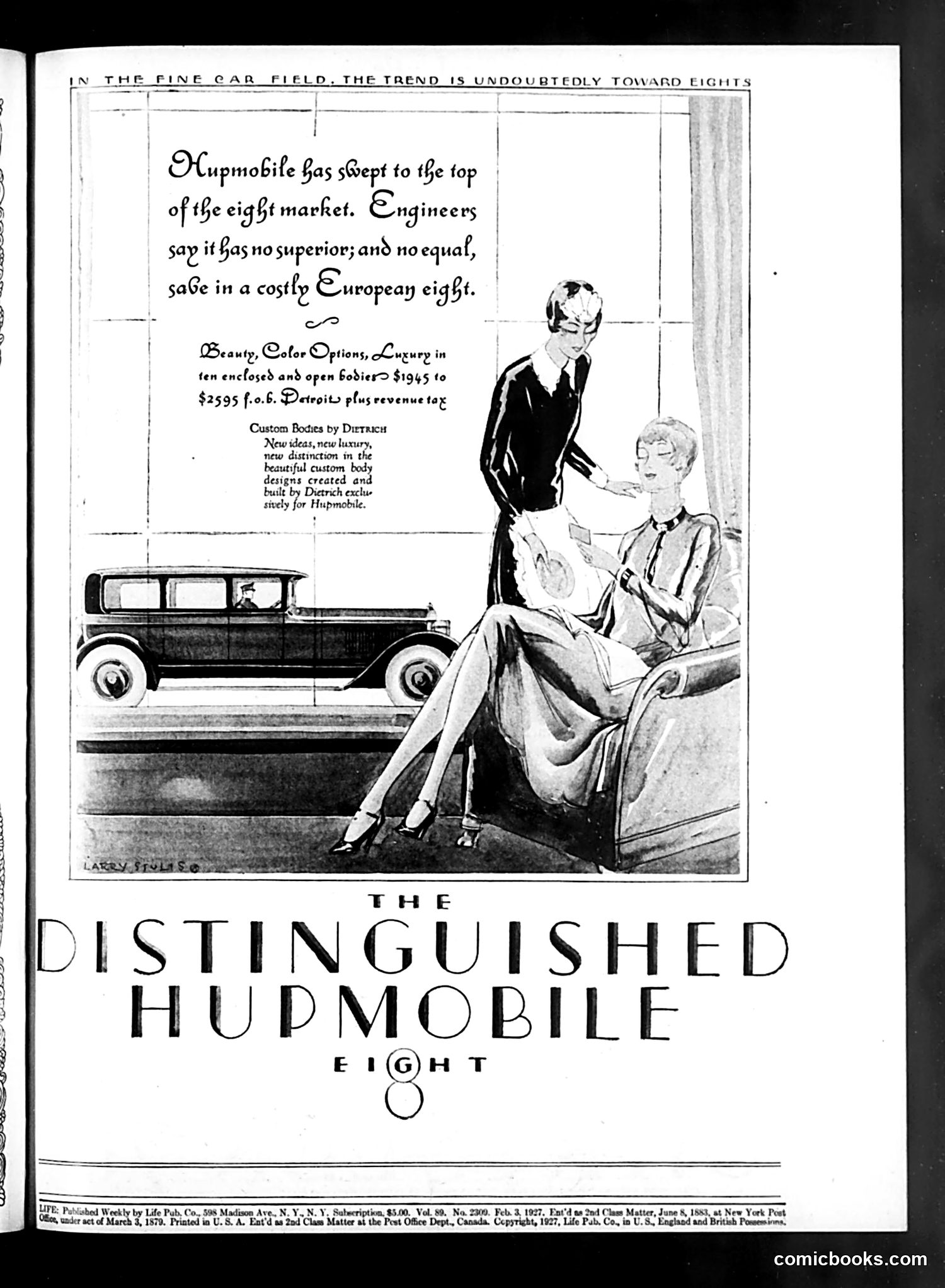
This page is primarily a **Hupmobile automobile advertisement**, not political satire. The ad promotes the "Distinguished Hupmobile Eight," a luxury car manufactured by the Hupmobile company. The illustration depicts two elegantly dressed women admiring the vehicle, reflecting 1920s advertising conventions that associated automobiles with sophistication and leisure. The ad emphasizes luxury features and custom Dietrich bodies, pricing the vehicle at $1,945 to $2,595 (substantial sums in that era). The headline claims Hupmobile "swept to the top of the eight market," asserting superiority over competitors. This is straightforward commercial promotion rather than political commentary—typical of Life magazine's advertising content during this period.
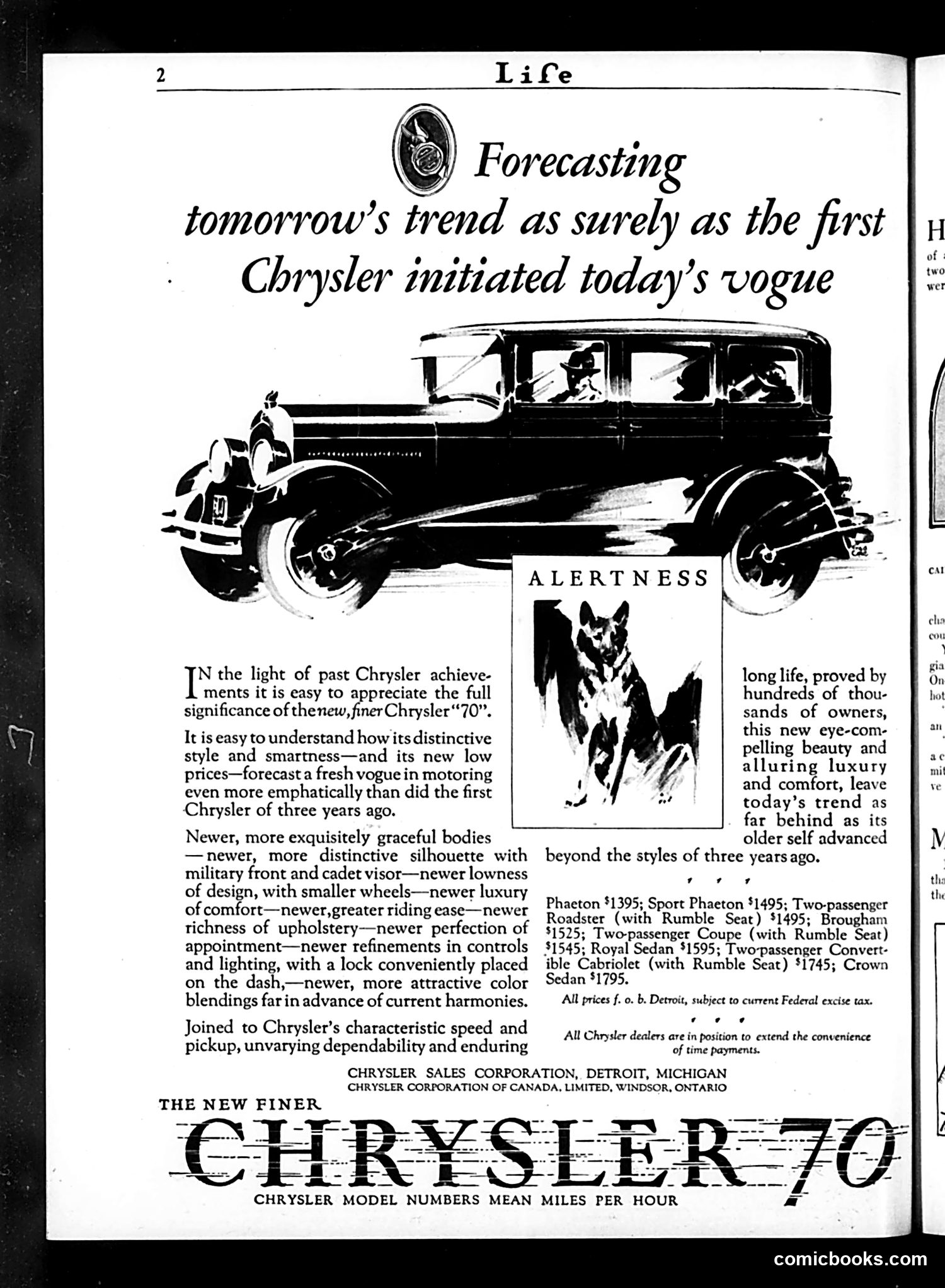
This is primarily a **Chrysler automobile advertisement**, not political satire. The page advertises the "Chrysler '70" model, positioning it as the trendsetter that will define future automotive fashion. The ad features: - An illustration of the new Chrysler sedan - A small image labeled "Alertness" (appears to be a German Shepherd dog), likely meant to convey the car's vigilance/reliability - Marketing copy emphasizing the vehicle's distinctive style, lower price, and luxury features compared to previous Chrysler models The headline claims Chrysler "initiated today's vogue"—framing the company as an industry innovator. The tagline "Chrysler Model Numbers Mean Miles Per Hour" suggests performance capabilities. This is a straightforward commercial advertisement typical of 1920s-era Life magazine, which carried substantial advertising revenue.
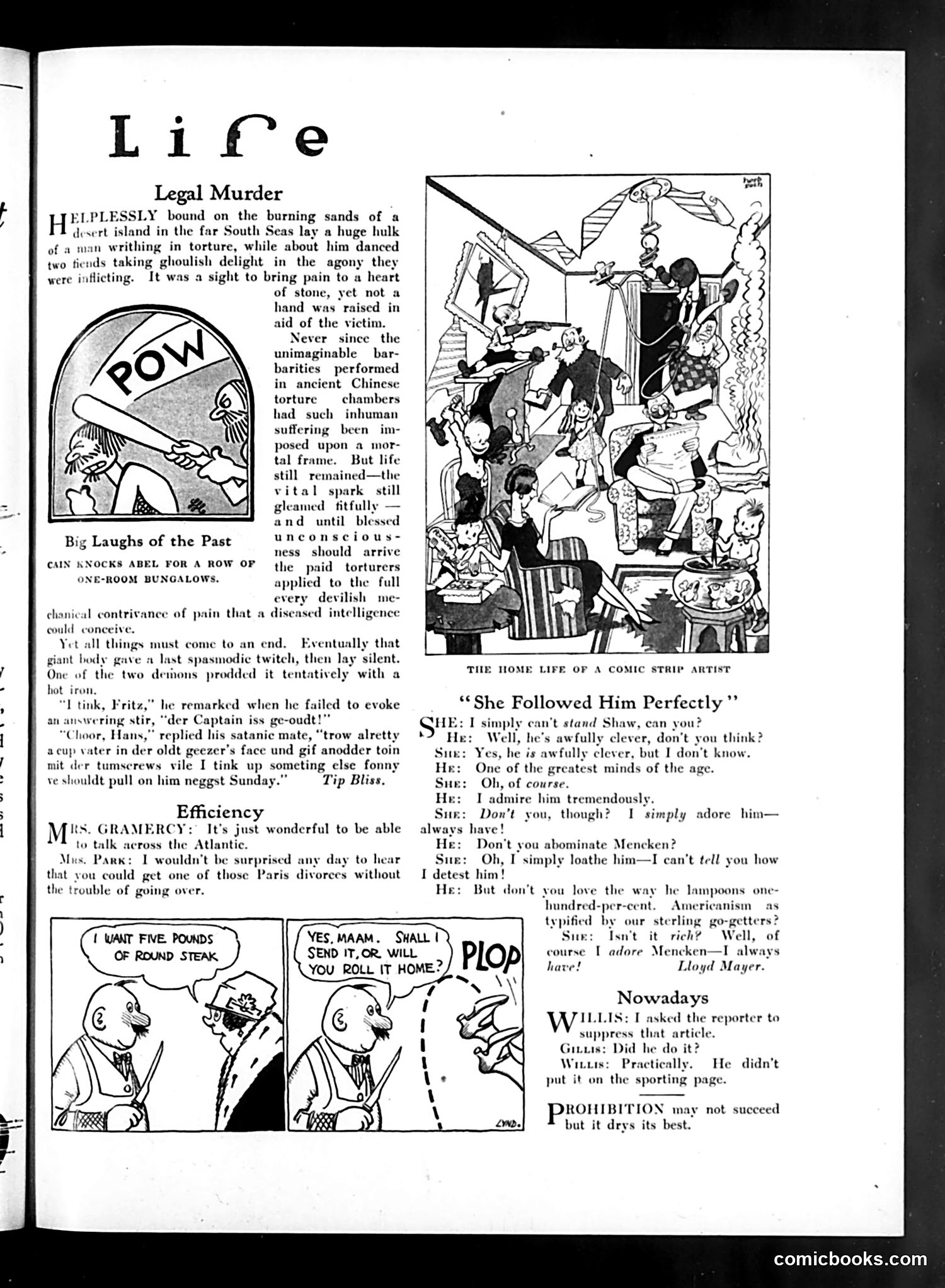
This page contains several humorous sections typical of Life's satirical format: **"Legal Murder"** criticizes extreme torture methods, referencing historical Chinese torture chambers while condemning their inhumanity—a commentary on judicial cruelty. **"Big Laughs of the Past"** presents a joke about pain inflicted on the disabled, reflecting era-typical dark humor now considered offensive. **"Efficiency"** jokes about transatlantic divorces among wealthy women, satirizing the leisured class's marital instability. **The comic strip** labeled "Efficiency" depicts a domestic scene with a servant, showing class dynamics and servant-employer relations of the period. **"She Followed Him Perfectly"** is a dialogue-heavy satirical piece about admiration and marriage, likely mocking romantic conventions. **"Nowadays"** contains brief satirical quips about media suppression and Prohibition—referencing 1920s alcohol ban enforcement. The overall tone reflects 1920s-era American satirical humor and social commentary.
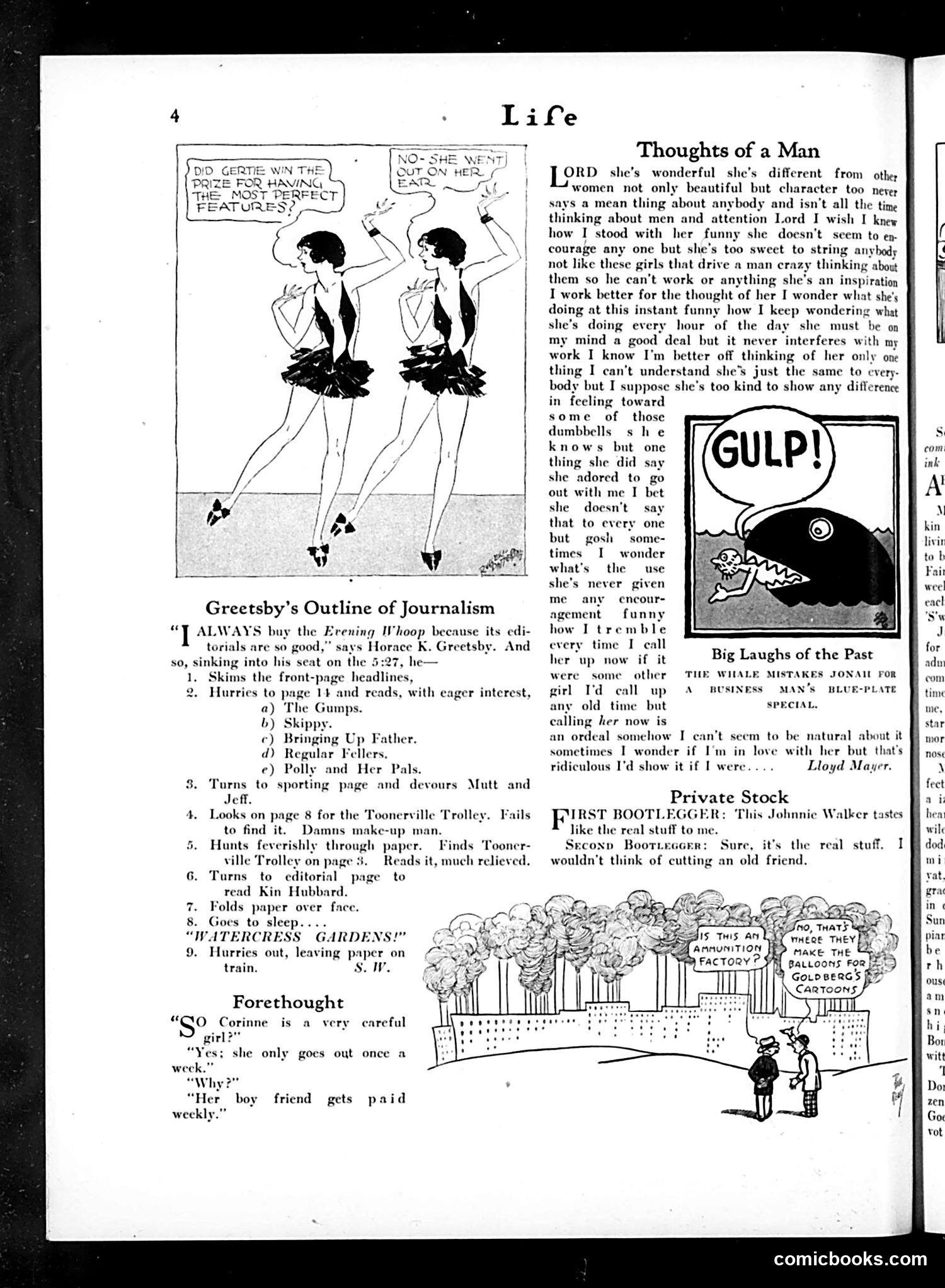
This page contains several humorous pieces typical of 1920s Life magazine: **Top cartoon:** Two identical women in flapper dresses discuss one winning "the most perfect features" in what appears to be a beauty contest. The joke mocks the era's obsession with standardized feminine beauty and competition. **"Greetsby's Outline of Journalism":** A satirical how-to guide for newspaper reading, mocking how readers actually consume the Evening Whoop—skimming headlines, focusing on gossip and sports while ignoring substantive content. **"Private Stock" and "Forethought":** Brief humorous dialogues about bootleg liquor (Prohibition-era contraband) and careful dating practices. **"Big Laughs of the Past":** A whale cartoon with minimal context visible. The content reflects 1920s preoccupations: beauty standards, newspaper culture, Prohibition, and courtship conventions.
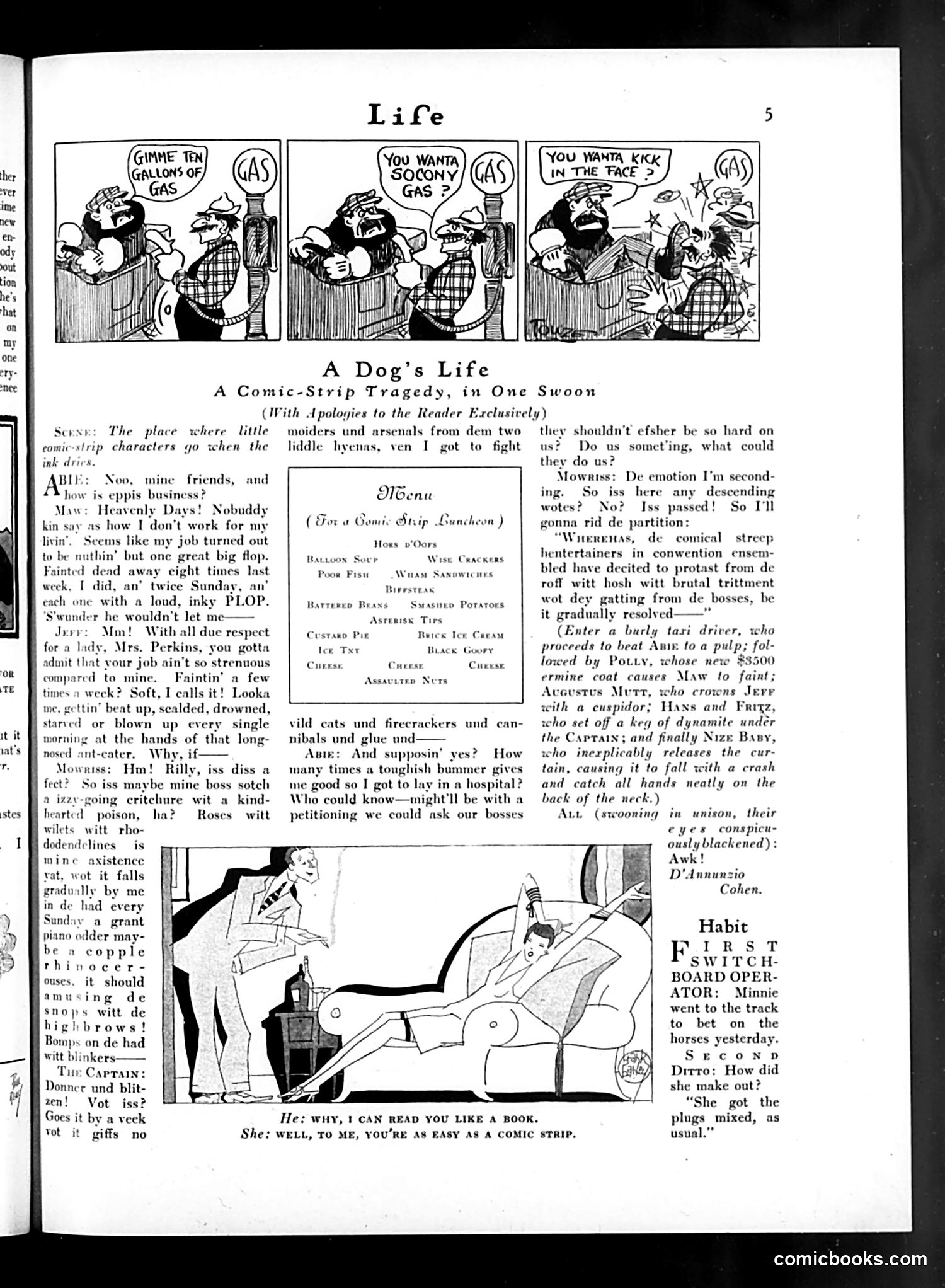
This page satirizes working-class hardship through a dog's complaint about his employer. The dog character laments long hours ("eight times last week"), dangerous conditions (being "fainted dead away"), and mistreatment by "that long-nosed ant-eater" (his boss). The accompanying illustrations mock both the dog's predicament and romantic complications with a female dog. A lower panel depicts a "Switchboard Operator" anecdote about mixed electrical wires causing mishaps. The satire targets labor exploitation and poor working conditions of the era, using animal characters as stand-ins for human workers. The comedic tone softens serious complaints about industrial employment, wages, and workplace safety—issues relevant to early 20th-century labor movements. The piece uses humor to critique economic inequality and worker vulnerability.
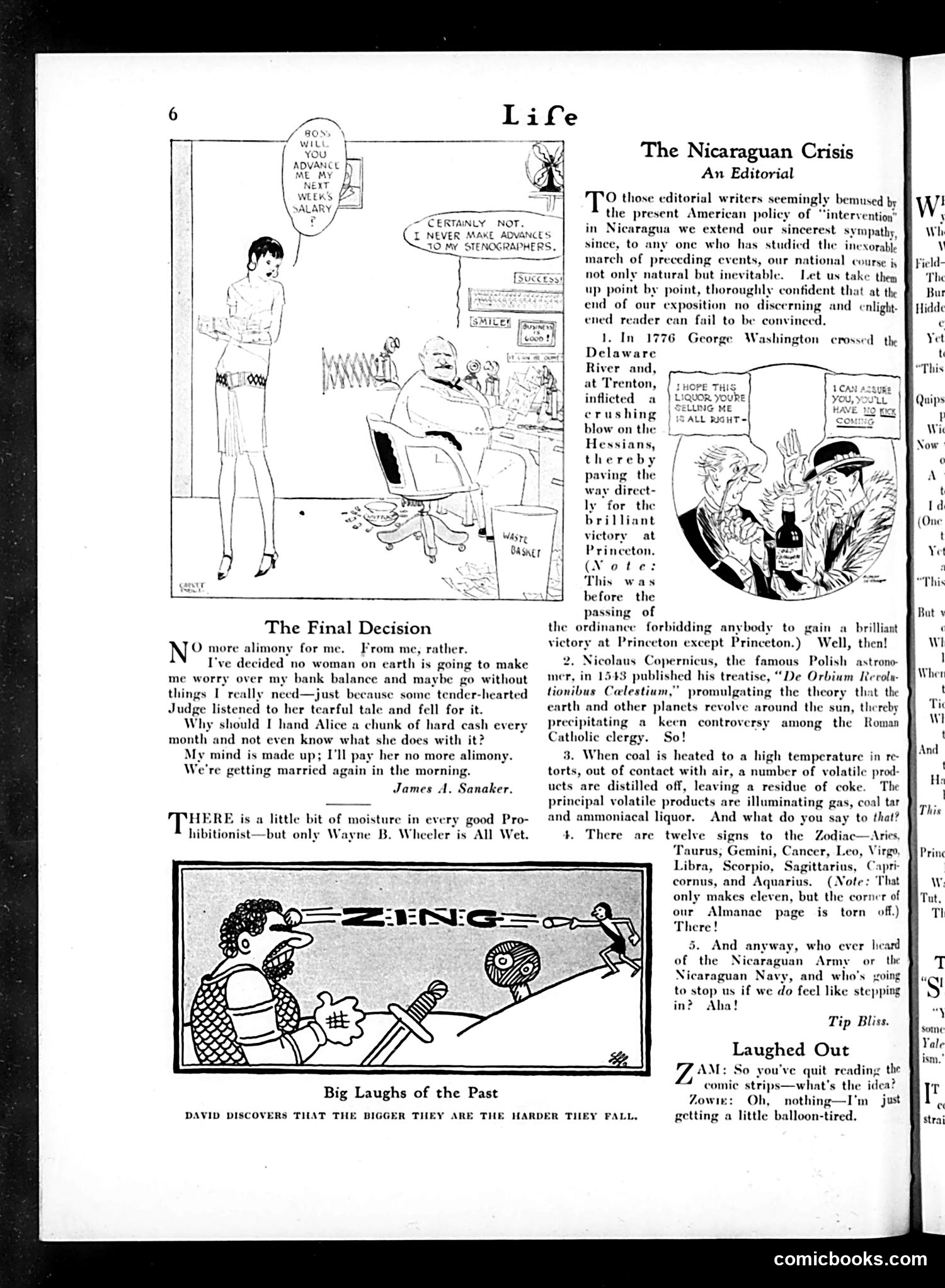
This cartoon satirizes a woman rejecting alimony upon remarriage. The humor targets wealthy women's financial independence, a progressive but controversial topic in this era. The woman declares she'll no longer burden her ex with support payments, viewing it as incompatible with her new marriage. The accompanying editorial piece discusses the Nicaraguan Crisis, offering sympathy to Americans confused by U.S. foreign policy interventions. It presents historical precedents (Washington's Delaware crossing, Copernicus, coal chemistry) as intellectual context for understanding complex geopolitical situations—suggesting editorial readers deserve clearer explanations of America's involvement. The page juxtaposes domestic comedy with serious foreign policy critique, typical of *Life* magazine's mixed satirical approach.
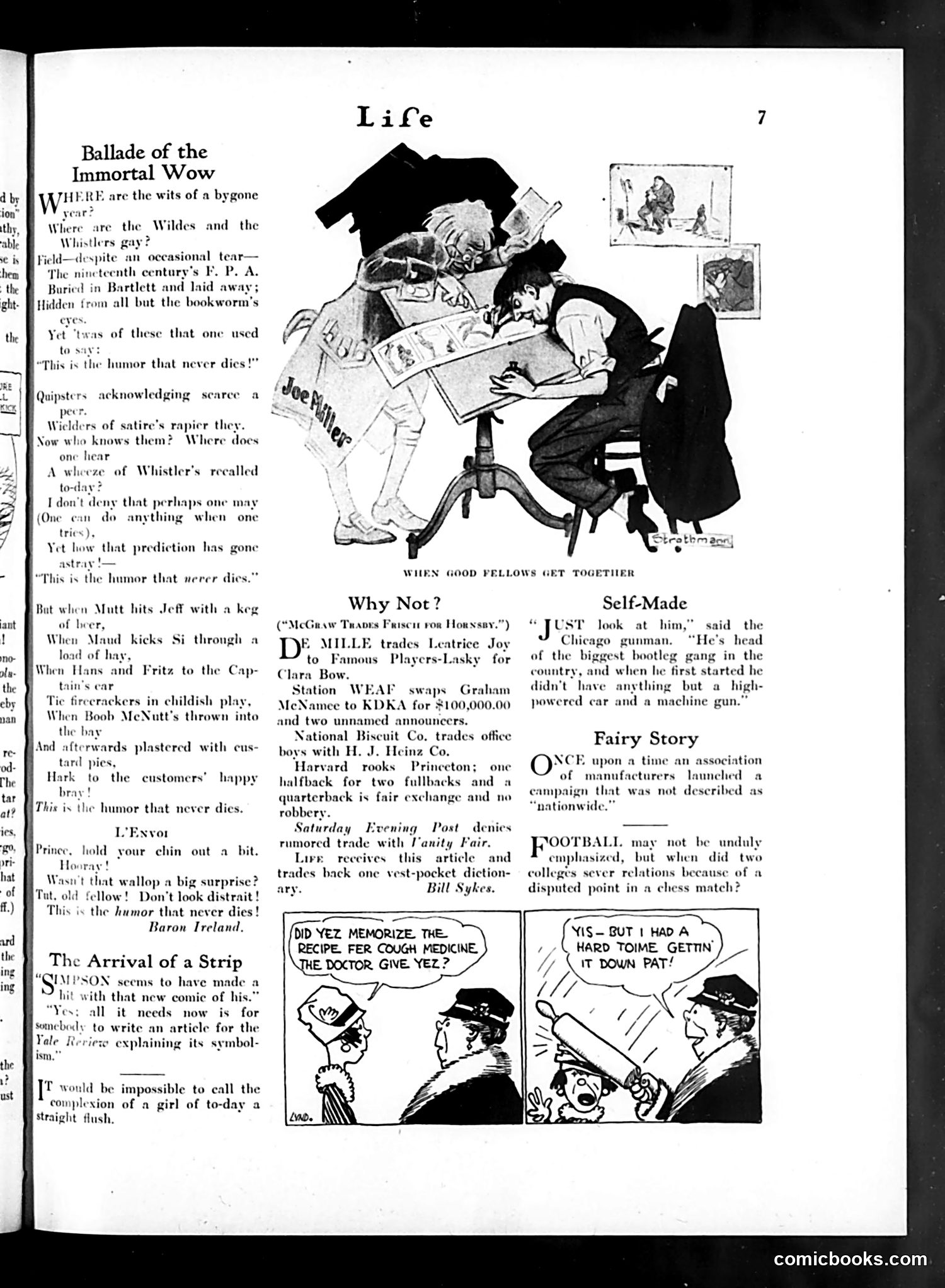
This page contains several satirical pieces typical of Life's humor: **"Ballad of the Immortal Wow"** mocks outdated literary and social references—the "wits of a bygone year" and forgotten cultural figures. It's satire about how quickly humor becomes irrelevant. **"Why Not?" and "Self-Made"** appear to be brief trade-gossip items poking fun at entertainment industry deals and self-aggrandizing bootleggers (likely referencing Prohibition-era figures). **The comic strip at bottom** shows a cough-medicine joke: a doctor recommends patent medicine, and a patient sarcastically notes he got it down his pants—a visual pun on medicinal efficacy. The overall page emphasizes Life's strength: mocking cultural pretension, faded fame, and dubious commercial claims with irreverent humor designed for contemporary readers.
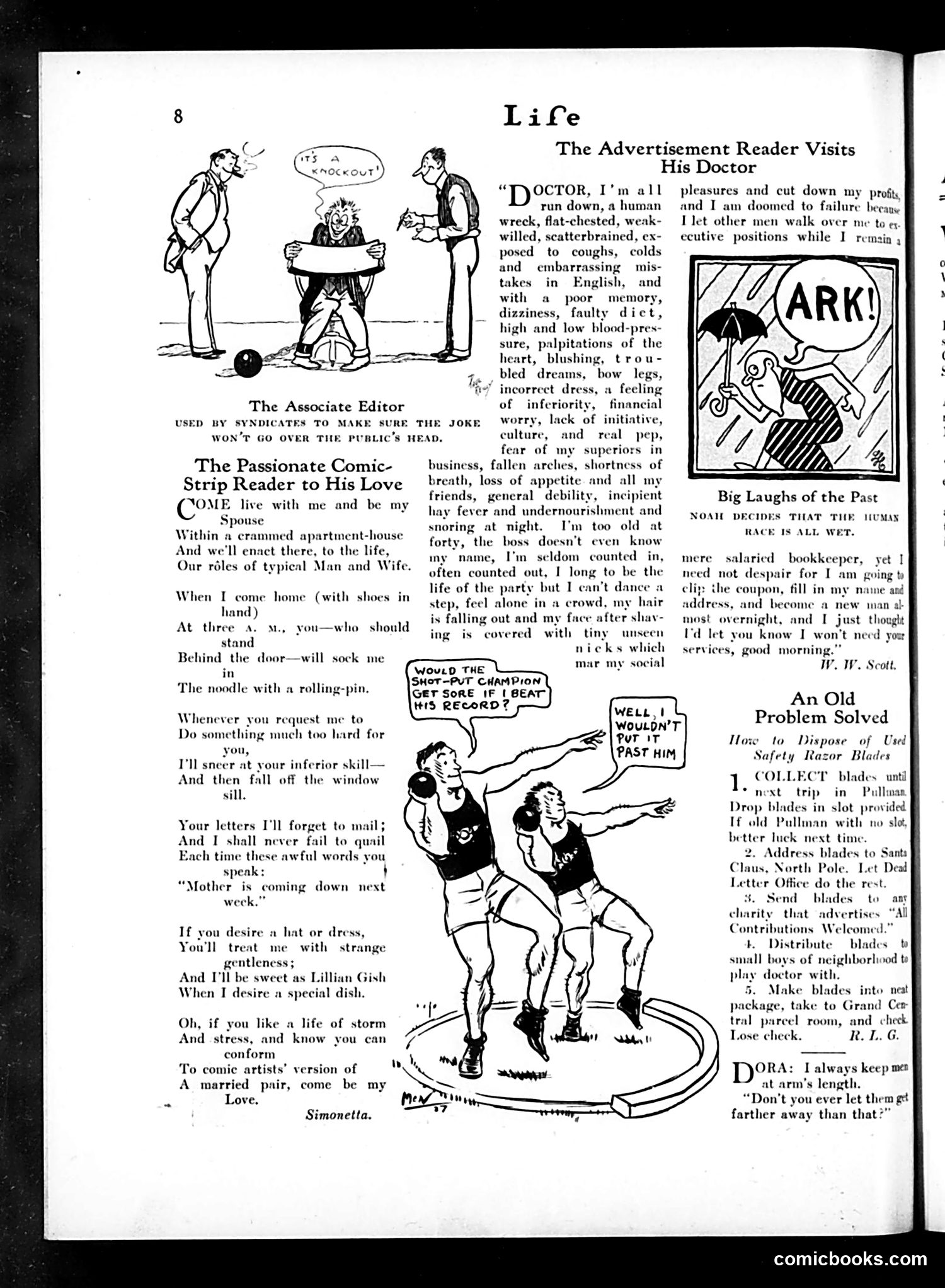
This *Life* magazine page contains three separate humorous pieces: 1. **"The Associate Editor"** (top): A cartoon showing men using the editor as a human punching bag—a joke about syndicated cartoonists using him to "make sure the joke lands" with readers. 2. **"The Passionate Comic-Strip Reader to His Love"** (left): A satirical poem where a man proposes marriage while listing all the ways he'll neglect and mistreat his wife—inverting romantic conventions. It's absurdist humor mocking men's selfish behavior. 3. **Two boxers arguing** (center): One brags about a knockout record; the other claims he surpassed it. A straightforward boxing joke. 4. **"An Old Problem Solved"** (right): Practical advice for disposing of used razor blades, suggesting mailing them to the North Pole or addressing them to charities. This reflects early 20th-century waste concerns and dry, practical humor.
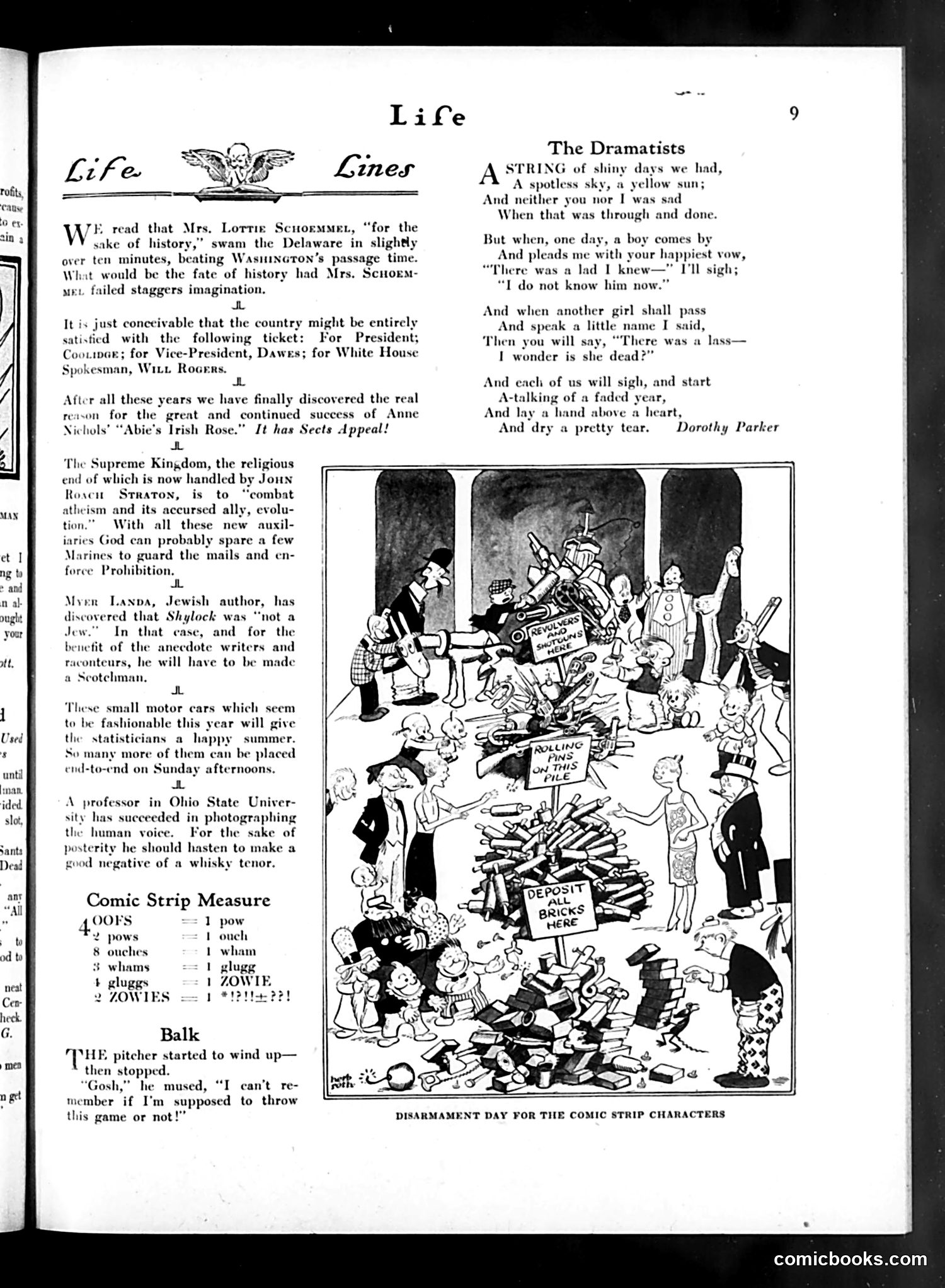
This cartoon satirizes the post-WWI disarmament movement by depicting comic strip characters destroying weapons and military equipment. The caption explicitly labels this "Disarmament Day for the Comic Strip Characters." The humor operates on multiple levels: it mocks serious international peace negotiations by applying them to fictional, comedic characters. The chaotic scene shows these lighthearted figures dramatically "disarming"—smashing guns, cannons, and weapons—suggesting the naive optimism or performative nature of real disarmament efforts of that era. The satire implies that if even silly cartoon characters could abandon militarism, perhaps real nations should too—yet the chaos of the scene undercuts this, suggesting disarmament is messy, impractical, or ultimately absurd.
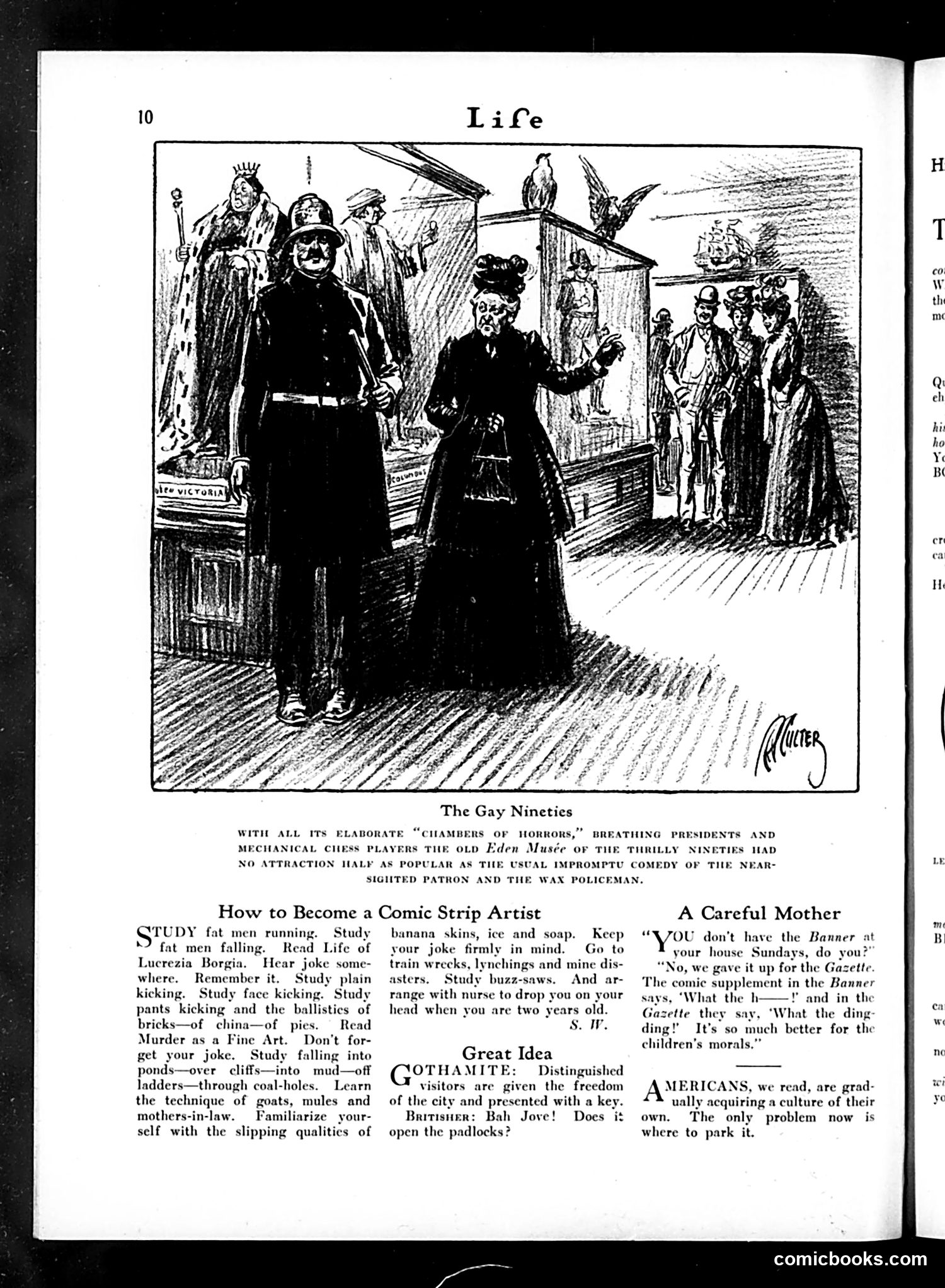
This satirical cartoon mocks the romanticized nostalgia for the 1890s. The caption declares that despite "elaborate chambers of horrors, breathing presidents and mechanical chess players," the 1890s had "no attraction half as popular as impromptu comedy of the near-sighted patron and the wax policeman." The scene depicts a museum or exhibition space where visitors observe displays. The humor targets two things: (1) the era's fascination with crude mechanical attractions and oddities presented as entertainment, and (2) the gullibility of visitors who treat fabricated or exaggerated exhibits seriously. The "near-sighted patron" and "wax policeman" reference suggests visitors couldn't distinguish real from artificial—a jab at 1890s popular culture's low intellectual standards and the public's easy deception by commercial entertainment.
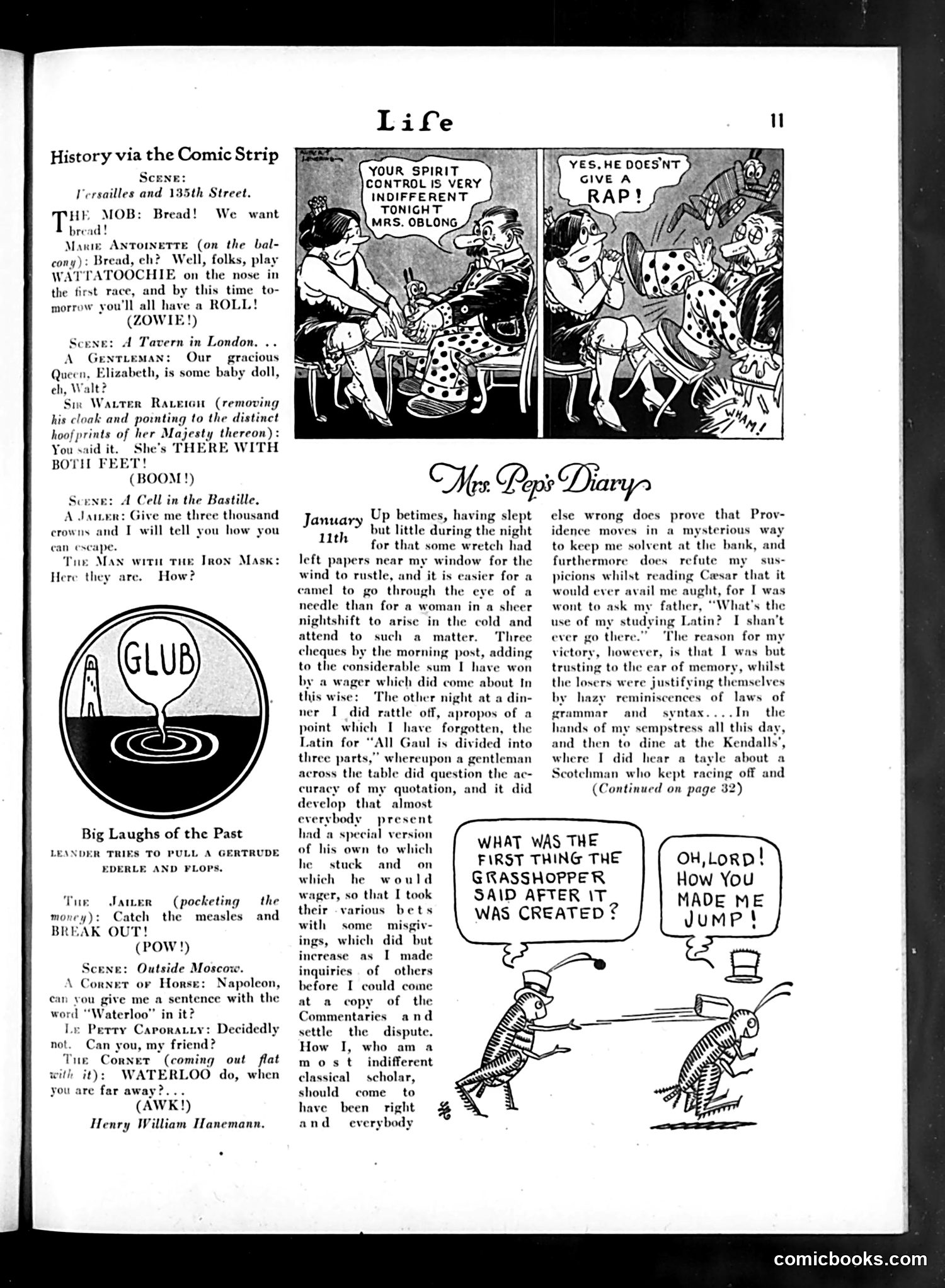
This page contains three distinct pieces of period humor: 1. **"History via the Comic Strip"** mocks historical scenes rendered as comic panels, featuring puns (Marie Antoinette at the guillotine, Sir Walter Raleigh's "footprints"). 2. **"Mrs. Peps Diary"** (January 11th) is a personal diary entry satirizing upper-class social pretensions—the diarist obsesses over trivial matters (Latin quotations, wagers at dinners) while claiming scholarly indifference. 3. **"Big Laughs of the Past"** collects antique jokes, including a Cornet of Horse pun on "Waterloo" and a jest about a grasshopper's existential remark ("Oh, Lord! How you made me jump!"). The humor relies on period wordplay and assumes readers' familiarity with classical references and Victorian mannerisms now largely obscure to modern audiences.
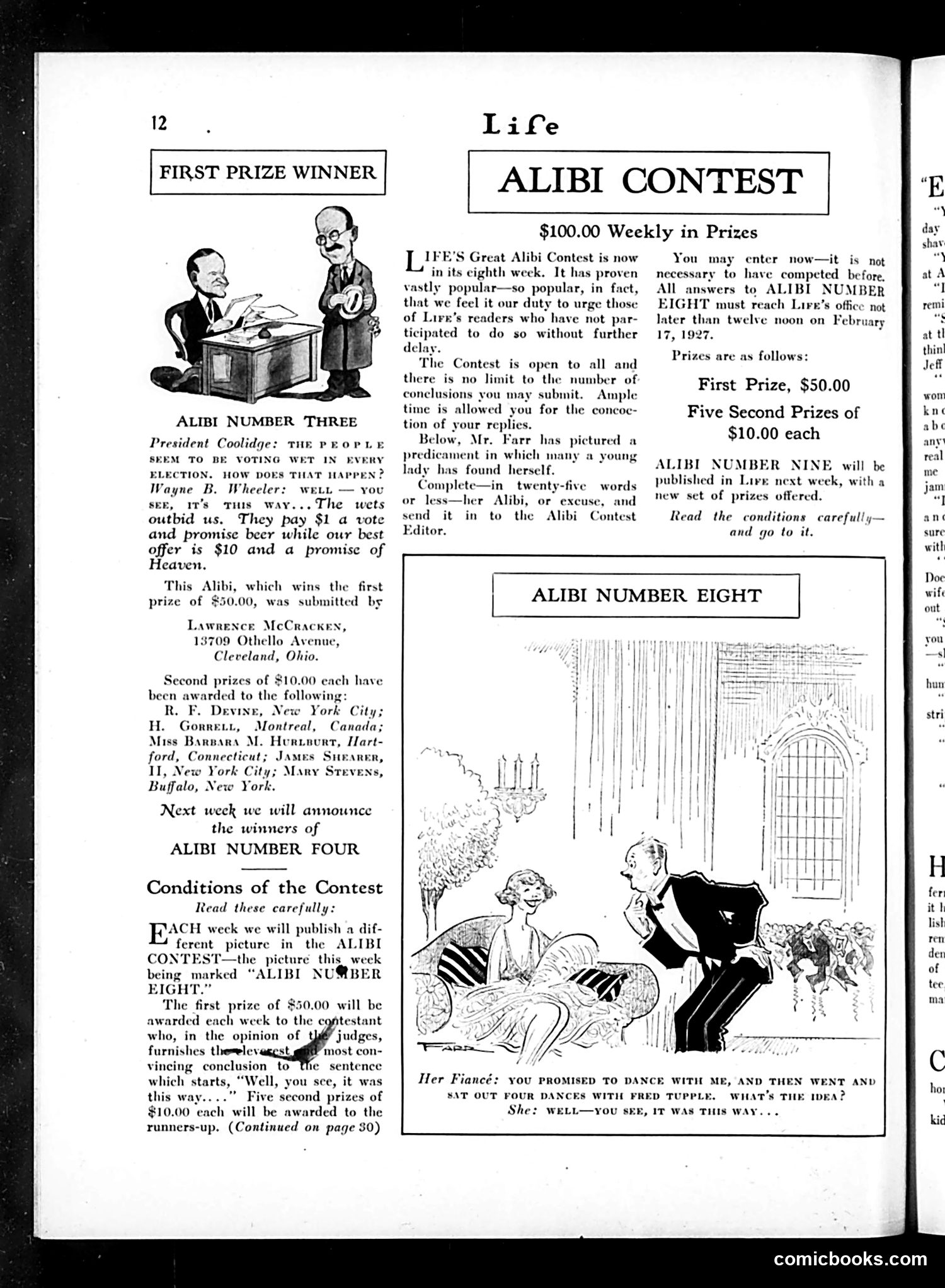
This page announces Life's "Alibi Contest," a humor competition inviting readers to submit excuses or explanations for awkward situations. The first prize winner (Lawrence McCracken, Cleveland) submitted an alibi about a politician caught accepting bribes—a dig at political corruption common in 1920s America. **Alibi Number Eight** (the featured cartoon) depicts a couple at a formal dance. The man's fiancée confronts him about dancing with another woman, whom he'd promised to avoid. His alibi: "You see, it was this way..."—implying he'll offer some flimsy excuse. The humor relies on relatable social embarrassment and the absurdity of trying to talk one's way out of obvious wrongdoing. The contest format encourages readers to create their own humorous alibis for everyday predicaments.
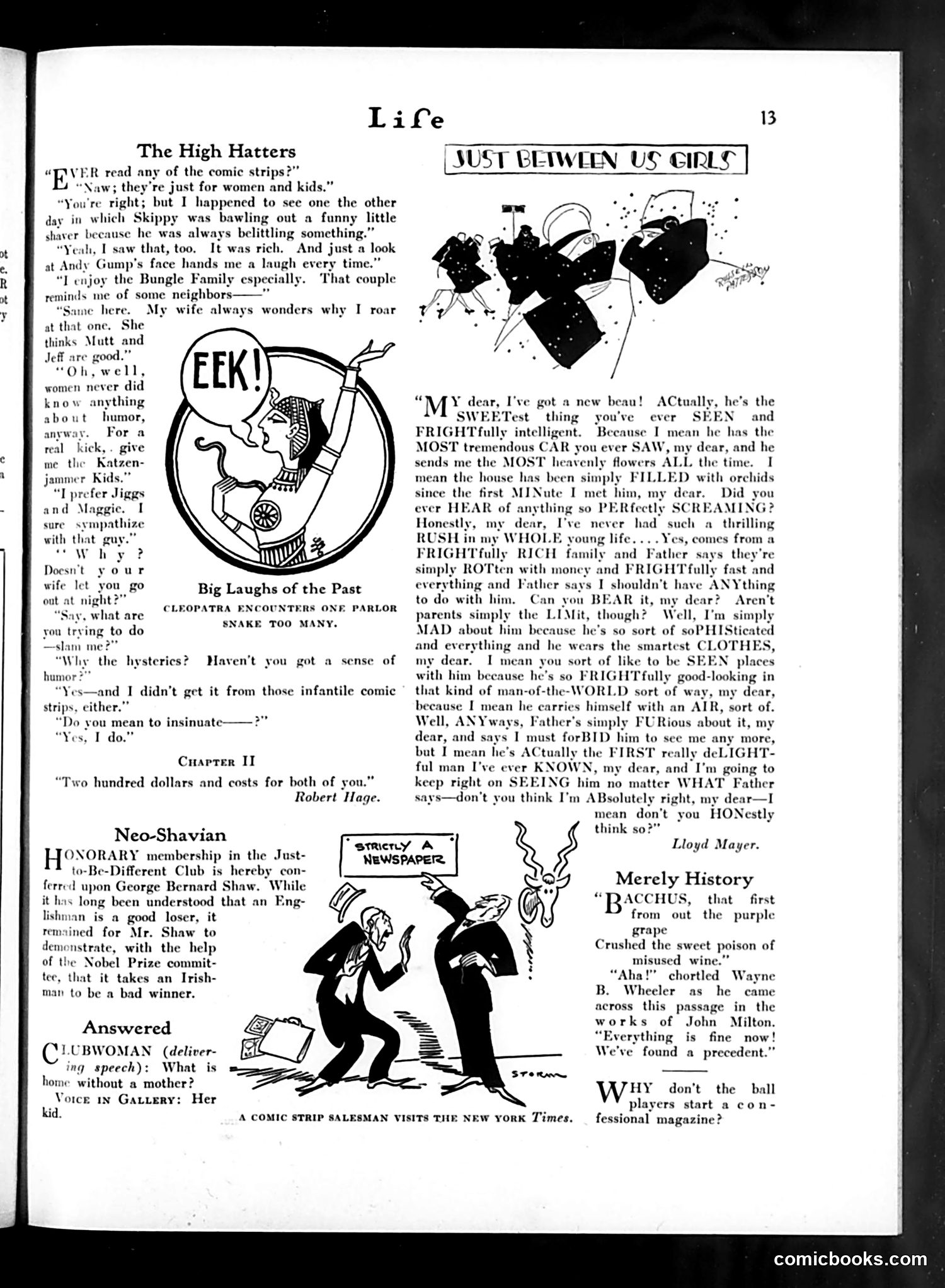
This page contains several humor pieces typical of 1920s Life magazine: **"The High Hatters"** discusses comic strips, with one character praising "Andy Gump's face" for its comedic value—a reference to the popular *Andy Gump* comic strip of that era. **"Big Laughs of the Past"** presents a joke about Cleopatra encountering a snake in a parlor, playing on the "asp/asp" sound-alike pun. **"Neo-Shavian"** features a cartoon showing two figures arguing while holding a newspaper, captioned as "A Comic Strip Salesman Visits the New York Times"—satirizing the tension between commercial comic strips and serious newspapers. The remaining sections include brief humor items and literary references (Bacchus, John Milton), typical of Life's miscellaneous joke format.
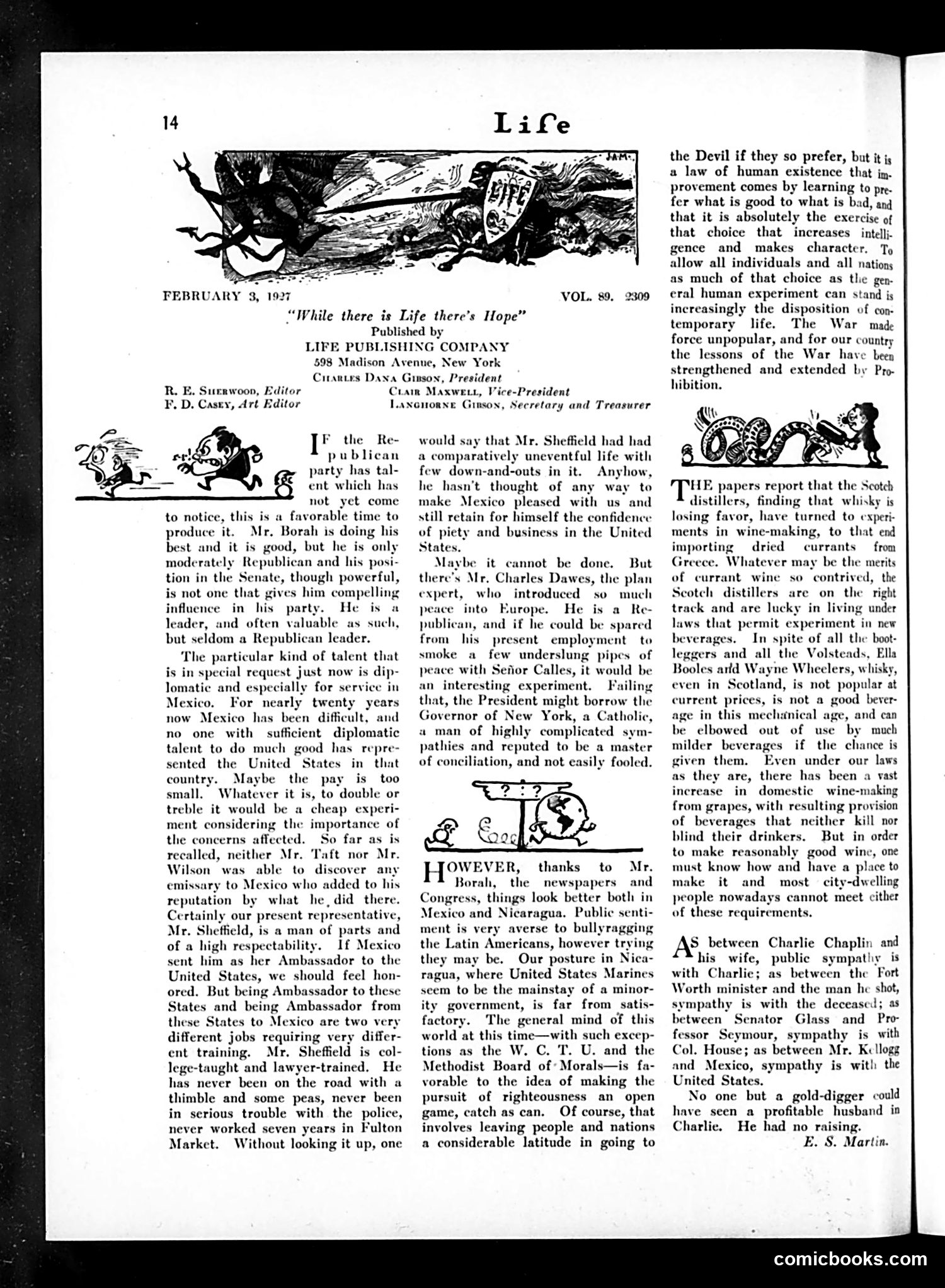
This page contains editorial commentary on diplomatic and political matters rather than standalone cartoons. The small decorative illustrations (dancing figures, cherubs) are ornamental rather than satirical. The text discusses Mr. Sheffield as a potential U.S. Ambassador to Mexico, praising his diplomatic skills while noting Mexico's complicated political situation. It also comments on Prohibition-era whisky experimentation in Scotland and domestic wine-making, suggesting Americans are frustrated by alcohol restrictions. A final section addresses Charlie Chaplin's marital troubles, noting public sympathy is divided among various political figures depending on their personal allegiances—a commentary on how Americans' political loyalties influenced their response to celebrity scandals. The page reflects 1920s concerns: diplomatic relations with Mexico, Prohibition enforcement, and celebrity culture's intersection with politics.
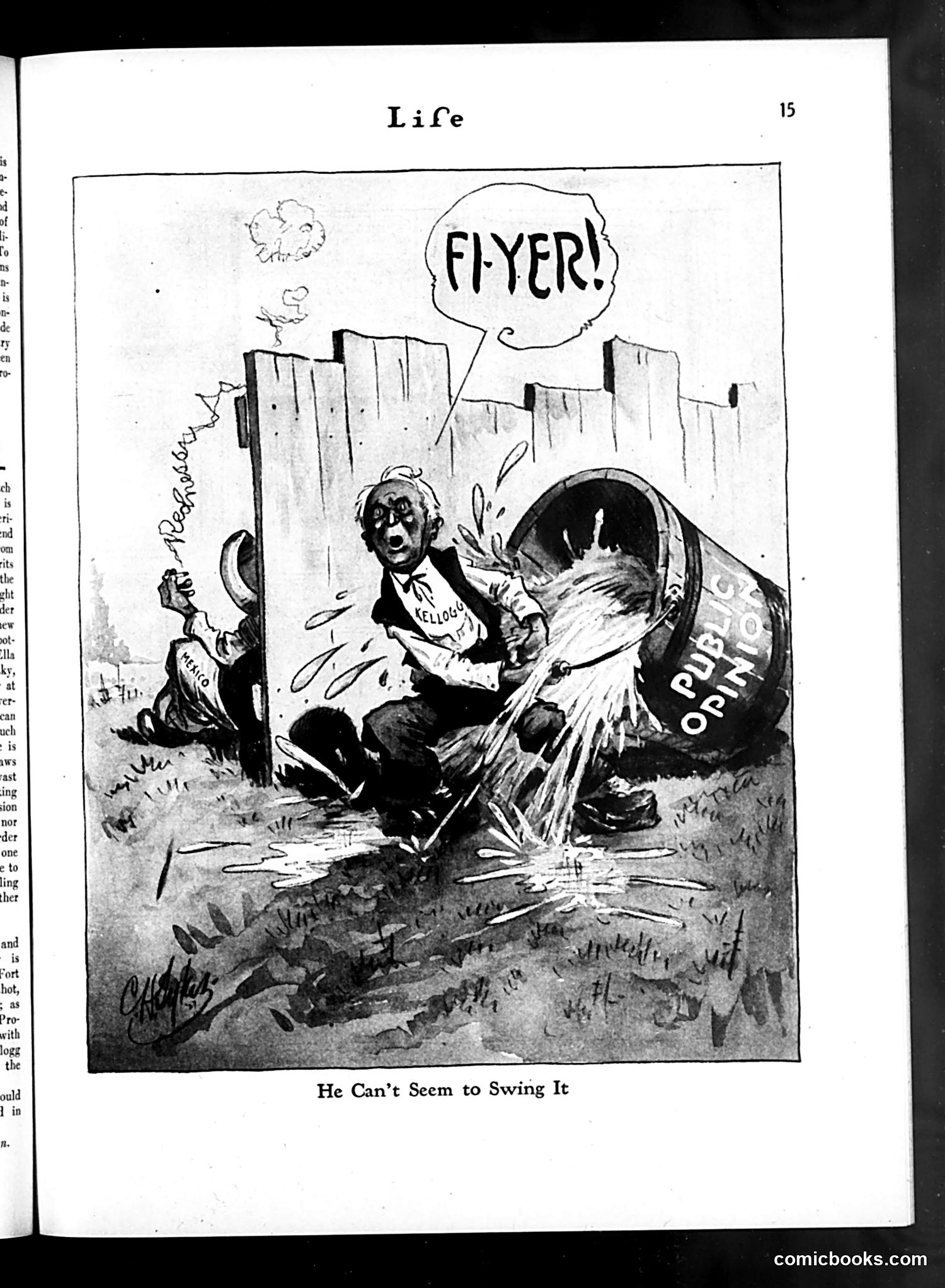
This political cartoon satirizes someone's failure to manage a difficult situation, using baseball as its metaphor. A man labeled "Fellow" stands amid chaos—a trash can labeled "OPIUM" has spilled, and he's shouting "FLYER!" while trying unsuccessfully to swing at what appears to be flying debris or consequences. The "opium" reference suggests this concerns drug policy or enforcement failures, likely American efforts to control the opium trade (a significant issue in early 20th-century U.S. politics). The "flyer" exclamation and his inability to "swing it" implies the depicted official or policy-maker is failing to address or control the problem effectively. The cartoon criticizes incompetence in handling this public crisis.
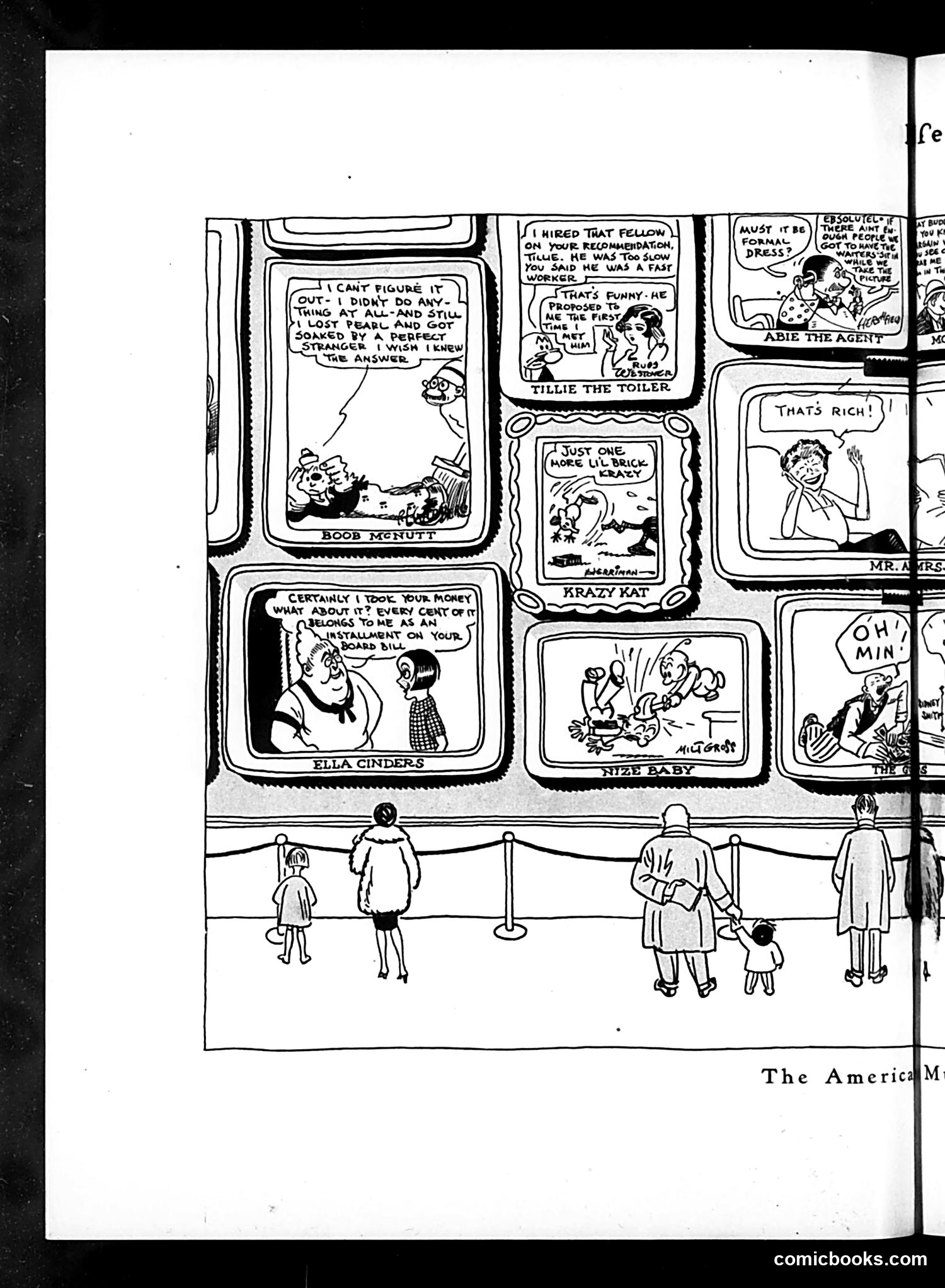
This page shows a series of comic strips displayed as if on a movie theater marquee, with viewers standing below. The strips include "Boob McNutt," "Tillie the Toiler," "Krazy Kat," "Ella Cinders," and "Nizie Baby"—all popular newspaper comic strips from the early 20th century. The satire mocks how cinema was competing with traditional newspaper comics for audience attention. By depicting these beloved strips as if they were movie advertisements, Life magazine comments on the cultural shift toward film entertainment. The bottom panel shows families gazing up at the marquee, suggesting how movies were replacing comics as the primary mass entertainment medium, even as the comic characters themselves remain culturally present through this crossover presentation.
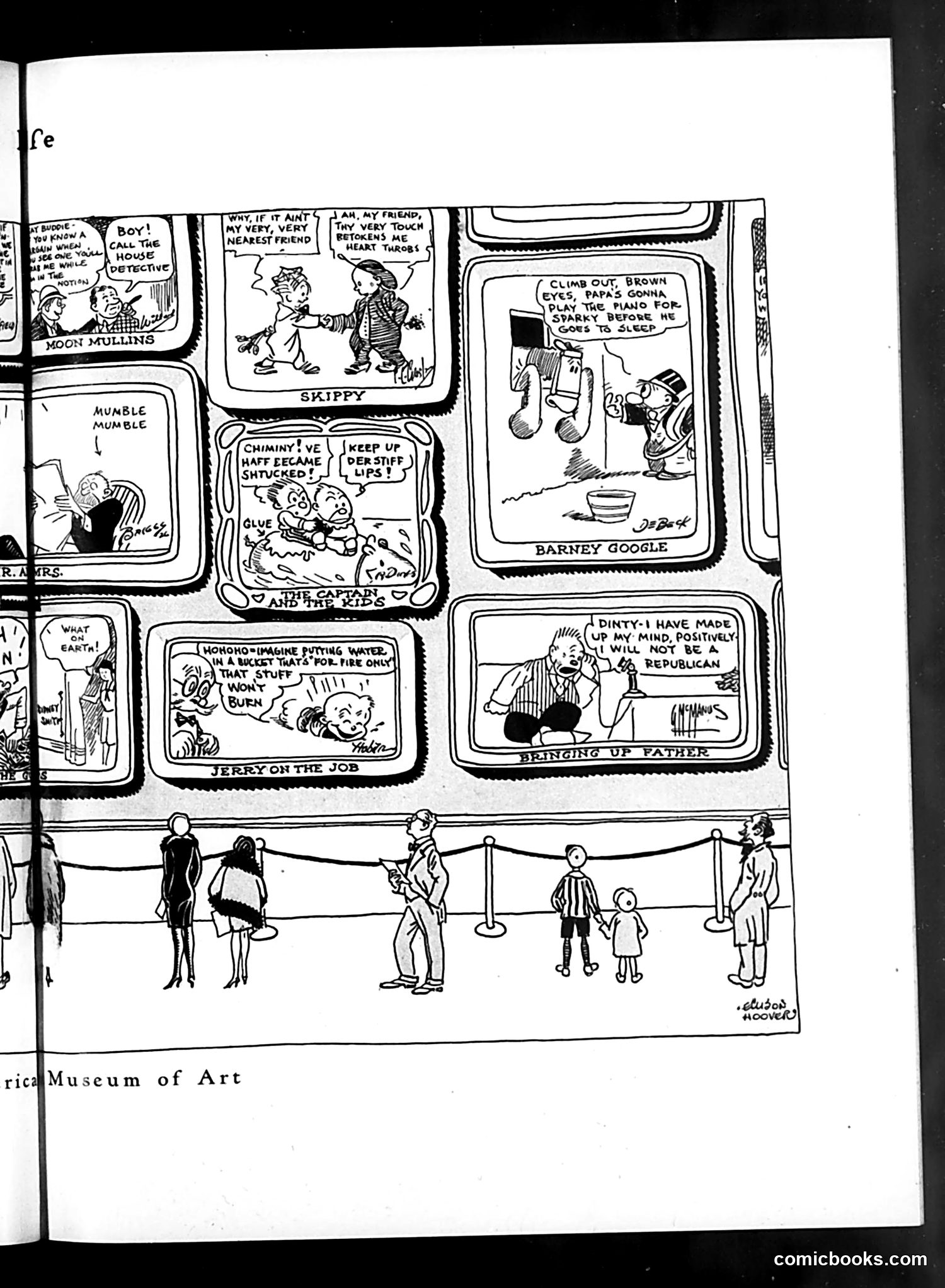
This page contains six comic strips depicting various humorous domestic and professional scenarios: **"Moon Mullins"** shows a character calling a house detective. **"Skippy"** depicts children playing, with one claiming to have very tough biceps. **"Barney Google"** features a character instructing someone to climb out and "give Papa a spanky" before sleeping. **"The Captain and the Kids"** shows glue-related mishaps. **"Jerry on the Job"** depicts workplace humor involving burning. **"Bringing Up Father"** shows a character declaring they won't be a Republican. At the bottom, visitors observe these comic strips displayed in what appears to be a museum setting—likely satirizing the elevation of popular comic strips to "high art" status. This reflects early 20th-century cultural debates about comics' legitimacy as serious artistic works.
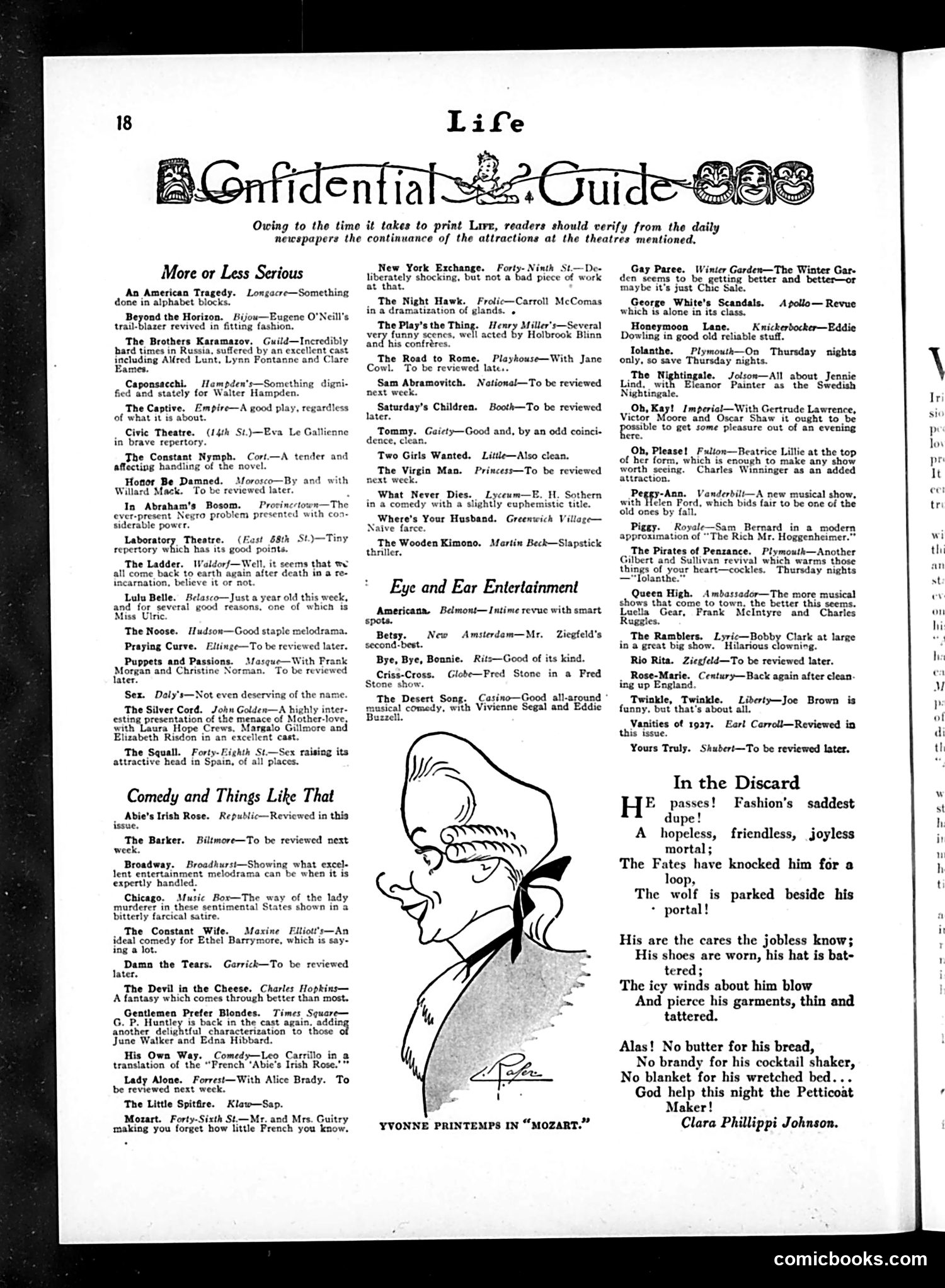
This is a **theater review guide** from Life magazine's "Confidential Guide" section, listing Broadway shows currently running. The page catalogs dozens of productions, organizing them by tone: "More or Less Serious," "Comedy and Things Like That," and "Eye and Ear Entertainment." The **cartoon** depicts a shabby, impoverished man—captioned "YVONNE PRINTEMPS IN 'MOZART'"—illustrated as a destitute vagrant. This is **satirical commentary**: the caption sardonically contrasts the elegant French actress Yvonne Printemps (who starred in the actual Mozart comedy at the Forty-Sixth Street Theatre) with the wretched figure shown. The accompanying poem "In the Discard" laments his poverty and suffering, heightening the joke through stark incongruity. The satire likely mocks either the play's quality or serves as social commentary on wealth disparity—a common Life magazine approach during the 1920s prosperity era.
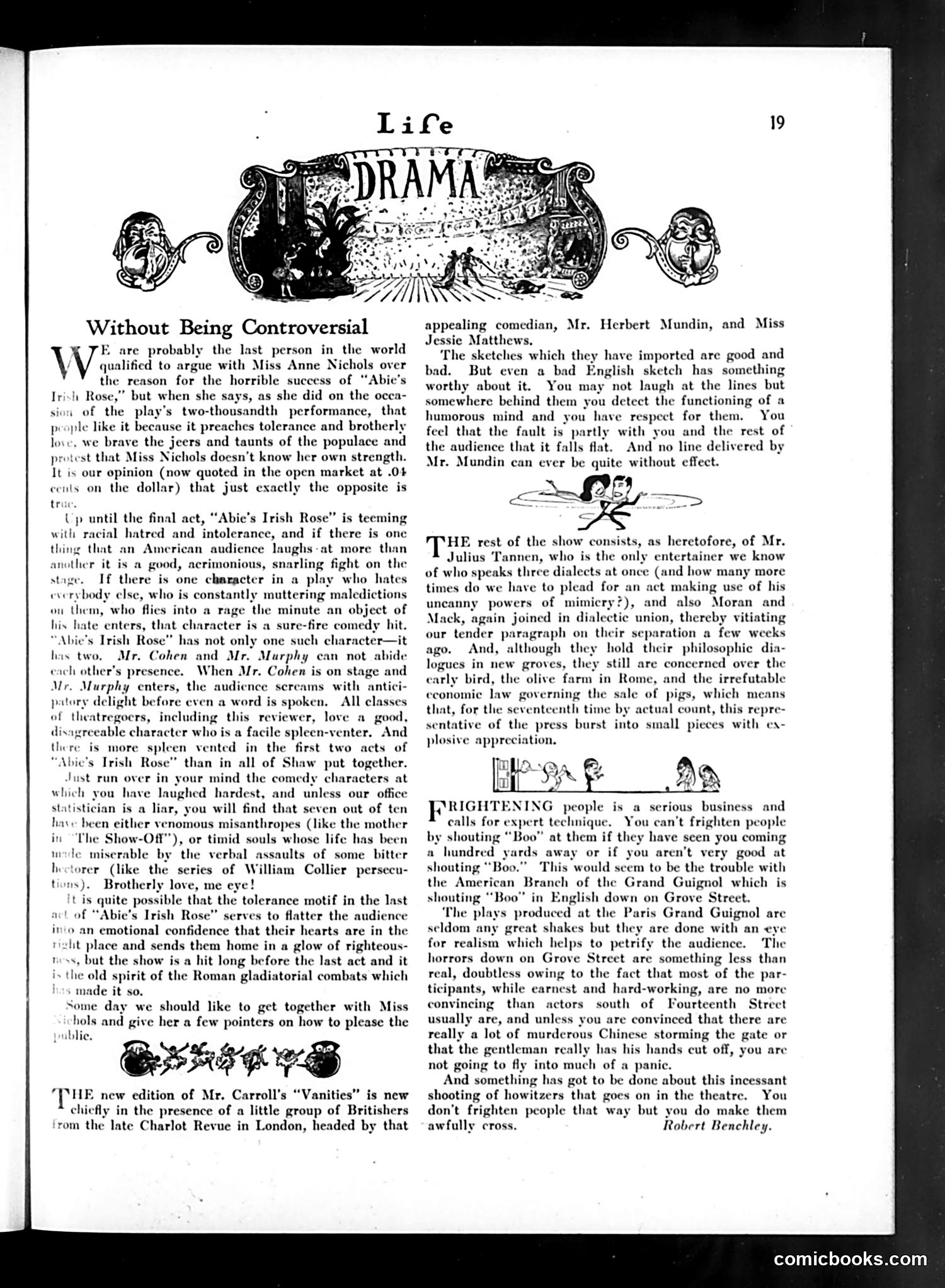
This page critiques the Broadway hit "Abie's Irish Rose," a play about Irish-Jewish relations that had reached its two-thousandth performance. The author argues that the play's actual appeal contradicts creator Anne Nichols's claim that it succeeds through preaching tolerance and brotherhood. Instead, the critic contends the play works because audiences enjoy the **racial antagonism** between characters Mr. Cohen and Mr. Murphy—both ethnic stereotypes who constantly insult each other. The author suggests people laugh hardest at acrimonious, spiteful characters, and that the play's final act's "tolerance message" merely flatters audiences morally while the real entertainment comes from ethnic conflict. The page also reviews Carroll's "Vanities," praising British performers Herbert Mundin and Jessie Matthews, and comedian Julius Tannen's dialect work. The satire reveals early 1920s attitudes: ethnic stereotyping was mainstream entertainment, and social criticism operated by mocking both the plays and audiences who enjoyed them.
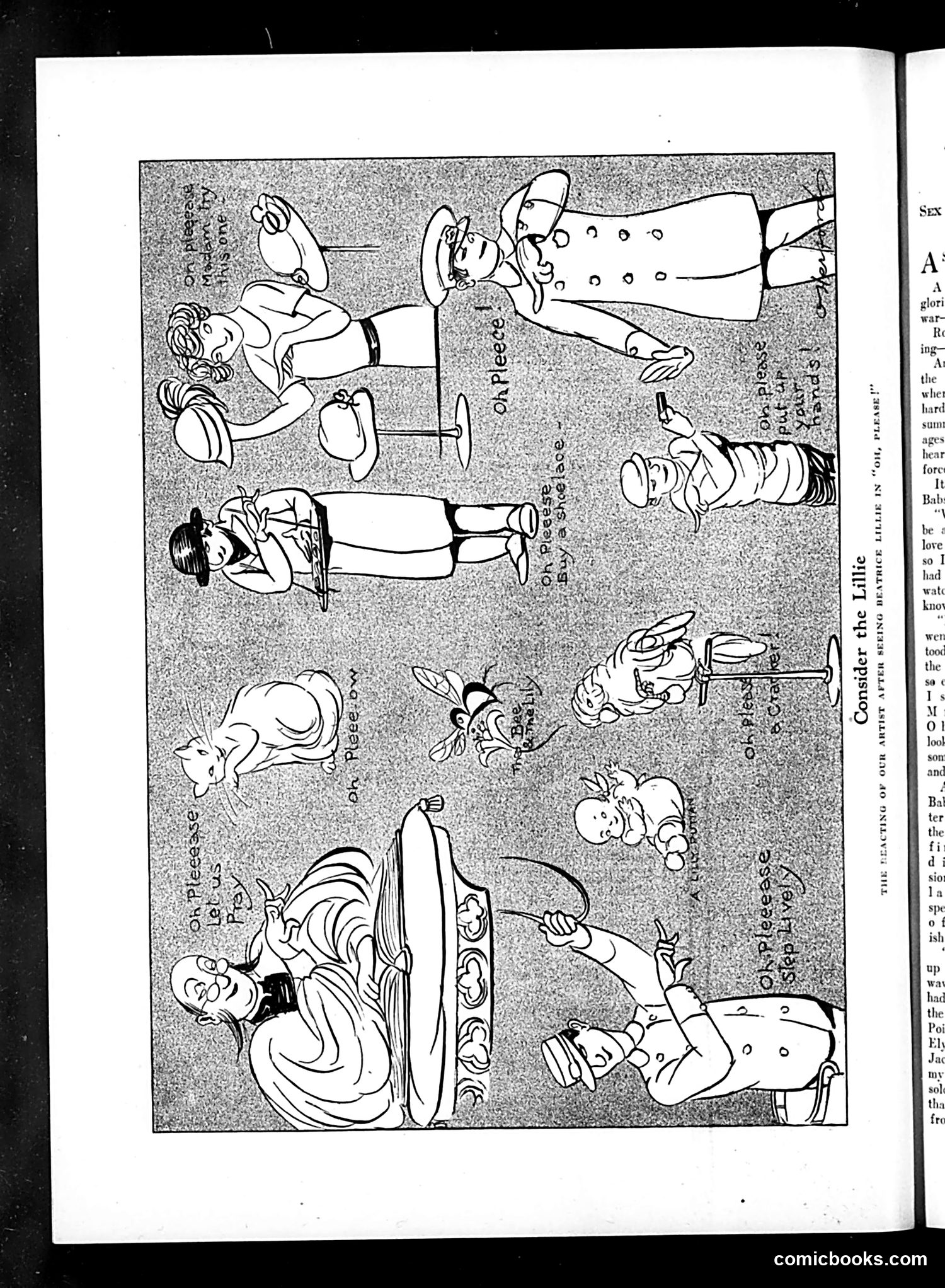
This page contains a single-panel cartoon titled "Consider the Lilies" showing multiple figures in various poses of leisure and relaxation. The cartoon appears to be social satire about idleness or carefree living, contrasting different characters who are lounging, reclining, or engaged in frivolous activities. The title "Consider the Lilies" references the Biblical passage about lilies not toiling, suggesting the cartoon comments on people living without labor or responsibility. The figures' varied costumes and body types suggest different social classes or stereotypes, possibly satirizing how different groups approach leisure. Without clearer OCR text or visible artist attribution, the specific satirical target remains unclear, though the overall message appears critical of idleness or irresponsibility during a particular historical moment.
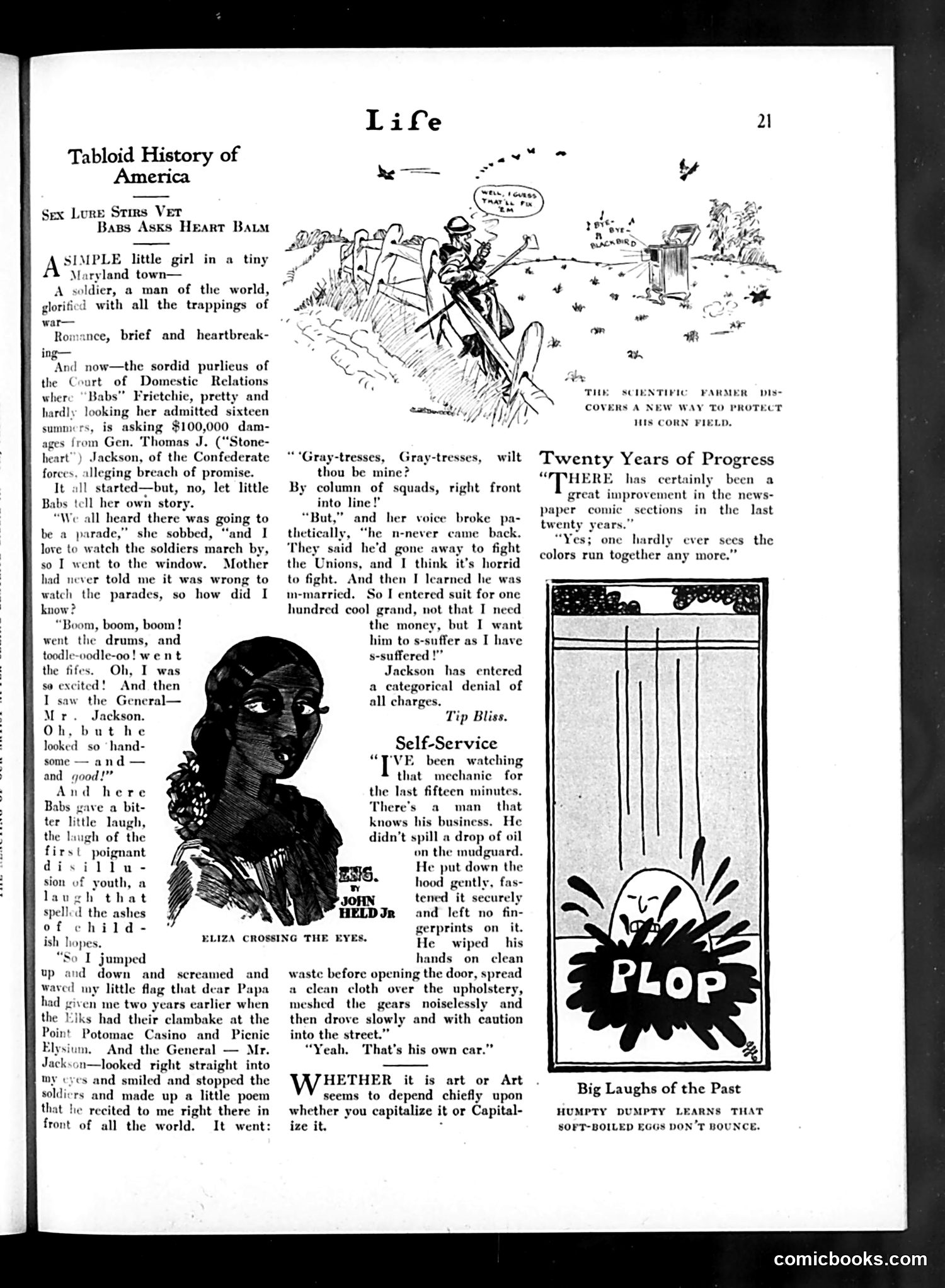
This page from *Life* magazine satirizes American sensationalism through mock-serious storytelling. The main feature, "Tabloid History of America," parodies cheap tabloid journalism by presenting a melodramatic breach-of-promise lawsuit. **The Central Story:** "Babs" Frietchie, a 16-year-old girl, claims General Thomas J. Jackson (the Confederate general "Stonewall" Jackson) seduced her with romantic verses during a Civil War parade, then abandoned her. She's suing for $100,000 damages. The satire mocks both the girl's naïveté and the sensational way tabloids exploit such stories—the overwrought emotional language, the portrait illustration labeled "Eliza Crossing the Eyes," and Jackson's categorical denial all parody tabloid conventions. **Secondary items** include brief humor about a careful mechanic and a joke about newspaper comic printing improvements. The satire targets how American media sensationalizes romantic scandal and exploits human drama for entertainment.
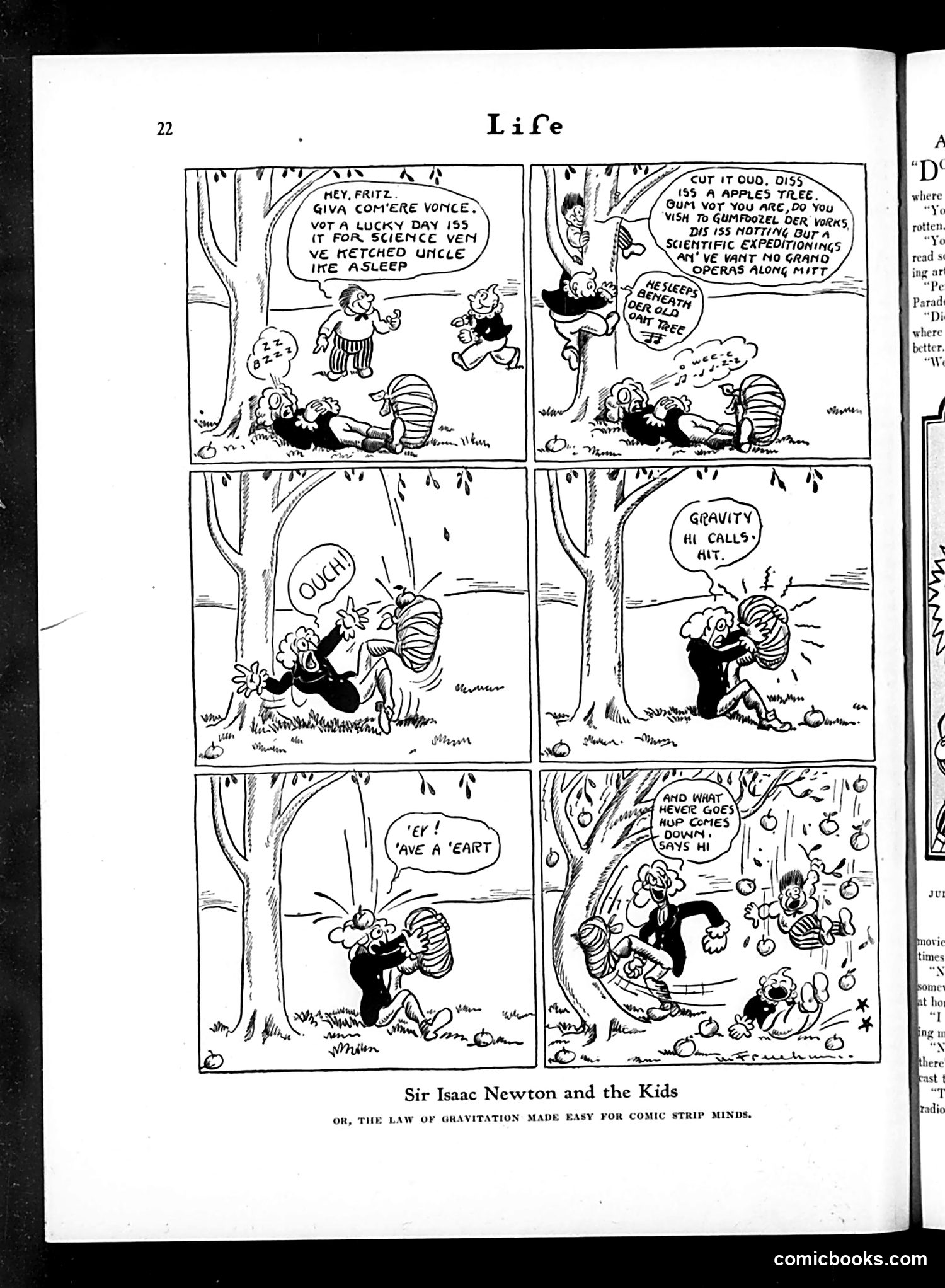
This comic strip satirizes how scientific concepts are oversimplified or distorted when explained to children or the uninformed. The title references Newton's law of gravitation, but the dialogue uses exaggerated foreign accents (appearing to be German or Eastern European stereotypes) and malapropisms ("gumfoozel," "notting but"). The joke develops across six panels: children discover an adult napping under an apple tree, attempt a "scientific expedition," gravity causes the apple to fall on his head (the famous Newton anecdote), and chaos ensues with multiple apples raining down. The satire mocks how popular culture mangles genuine scientific principle into absurdist slapstick, reducing Newton's revolutionary insight into mere physical comedy. The accents and clumsy phrasing reinforce the mockery of poor education and understanding—the "comic strip minds" of the subtitle.
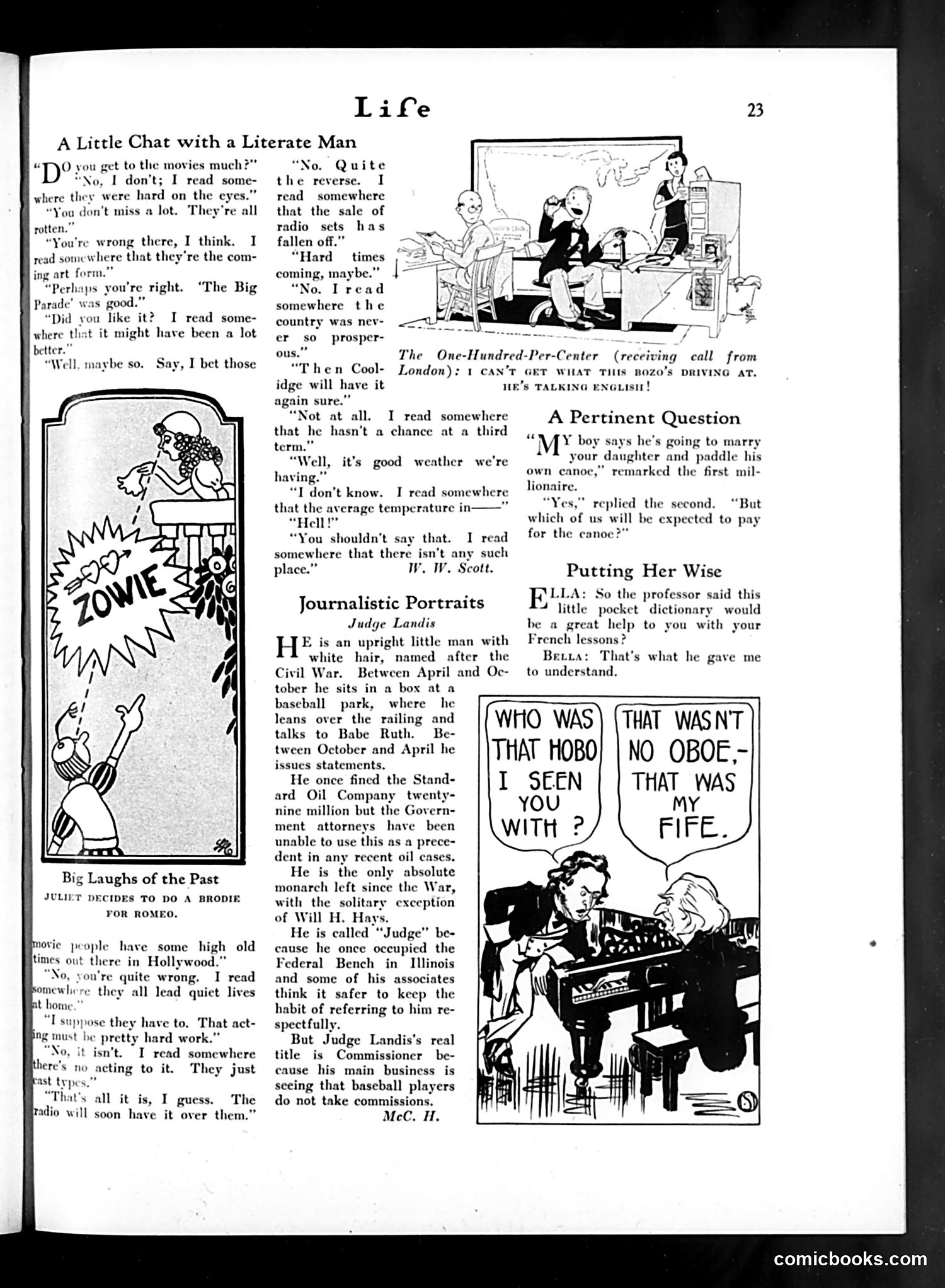
This page contains three distinct satirical pieces: **"A Little Chat with a Literate Man"** mocks someone who constantly cites things "read somewhere" rather than forming independent opinions. The joke: this pedantic person dismisses movies, Hollywood actors, and radio while defending everything through vague secondhand sources—satirizing intellectual pretension and blind deference to print authority. **"Judge Landis" portrait** offers political satire about baseball commissioner Kenesaw Mountain Landis (named after the Civil War). The humor lies in his absolute power over baseball: he fined Standard Oil $29 million (a precedent the government couldn't use) and serves as baseball's unchecked "monarch." The reference to Will H. Hays suggests comparison to another powerful censor. The joke critiques his arbitrary authority and players' forced "respectful" address. **"Putting Her Wise"** is a simple joke about a woman using a pocket dictionary to understand French lessons—implying she's learning French primarily to decode her professor's romantic intentions rather than the language itself. The overall page ridicules intellectual pretension, unchecked authority, and naive romanticism.
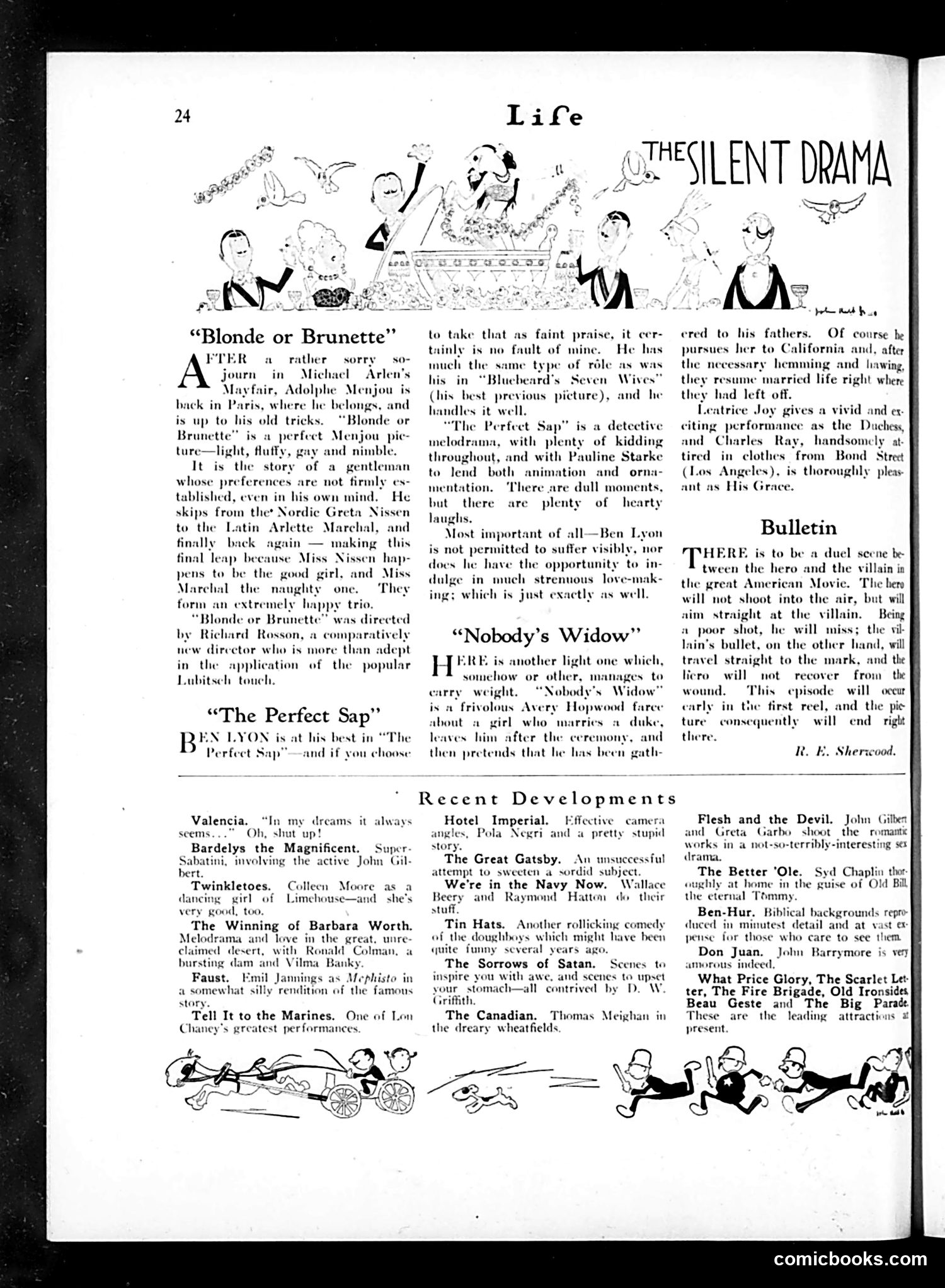
This page reviews contemporary silent films, primarily focusing on romantic comedies and melodramas popular in the 1920s. The reviews discuss stars like Adolphe Menjou, Ben Lyon, and Leatrice Joy in films such as "Blonde or Brunette" and "Nobody's Widow." The humor is primarily **plot-based satire** rather than political commentary. The magazine mocks the formulaic nature of 1920s cinema—particularly the frivolous romantic plots and predictable character types. For example, "Nobody's Widow" is described as a "frivolous" farce about a woman who marries and immediately abandons a duke, then pretends otherwise. The "Bulletin" section humorously critiques the absurdity of duel scenes in American films, where heroes shoot straight at villains (rather than honorably shooting into the air) yet somehow miss, allowing the villain's bullet to fatally strike them instead. The cartoons at the bottom appear decorative rather than satirical. This is primarily **entertainment criticism** reflecting Jazz Age attitudes toward cinema as lightweight escapism.
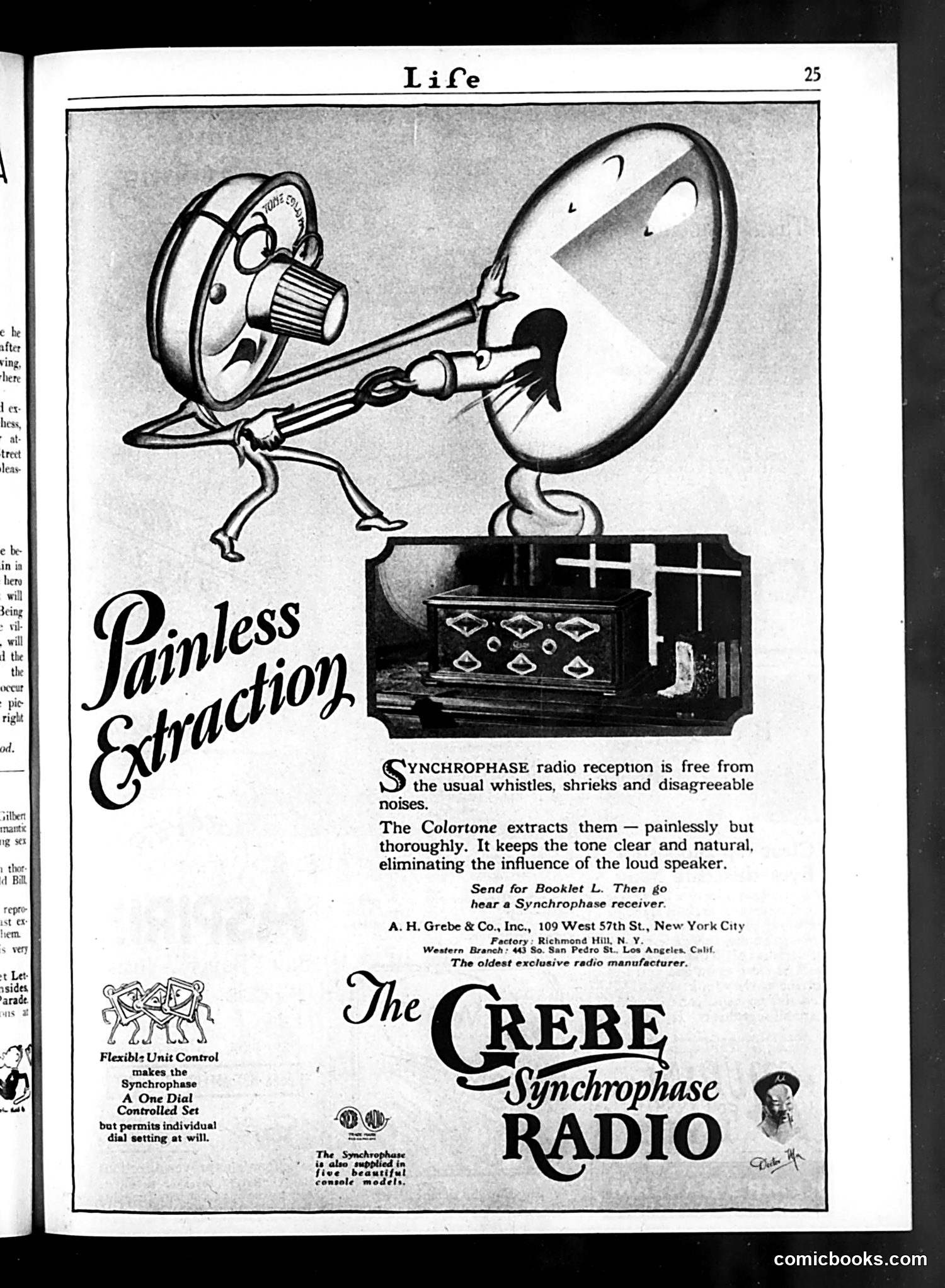
This is **not satire or political commentary**—it's a vintage radio advertisement from approximately the 1920s. The cartoon depicts anthropomorphized radio components (a tuning dial character and a speaker character) to humorously illustrate the Grebe Synchrophase radio's technical benefit: eliminating unwanted noise and interference from broadcasts. The "painless extraction" language playfully compares noise removal to a medical procedure. The ad promotes the Colortone filter technology and emphasizes that Grebe manufactures "the oldest exclusive radio manufacturer." It highlights features like flexible unit control and multiple console models available. For modern readers: this reflects early radio's significant technical problems—static, whistles, and distortion were genuine consumer complaints. The whimsical cartoon approach was typical period advertising meant to make tedious technical specifications entertaining and memorable.
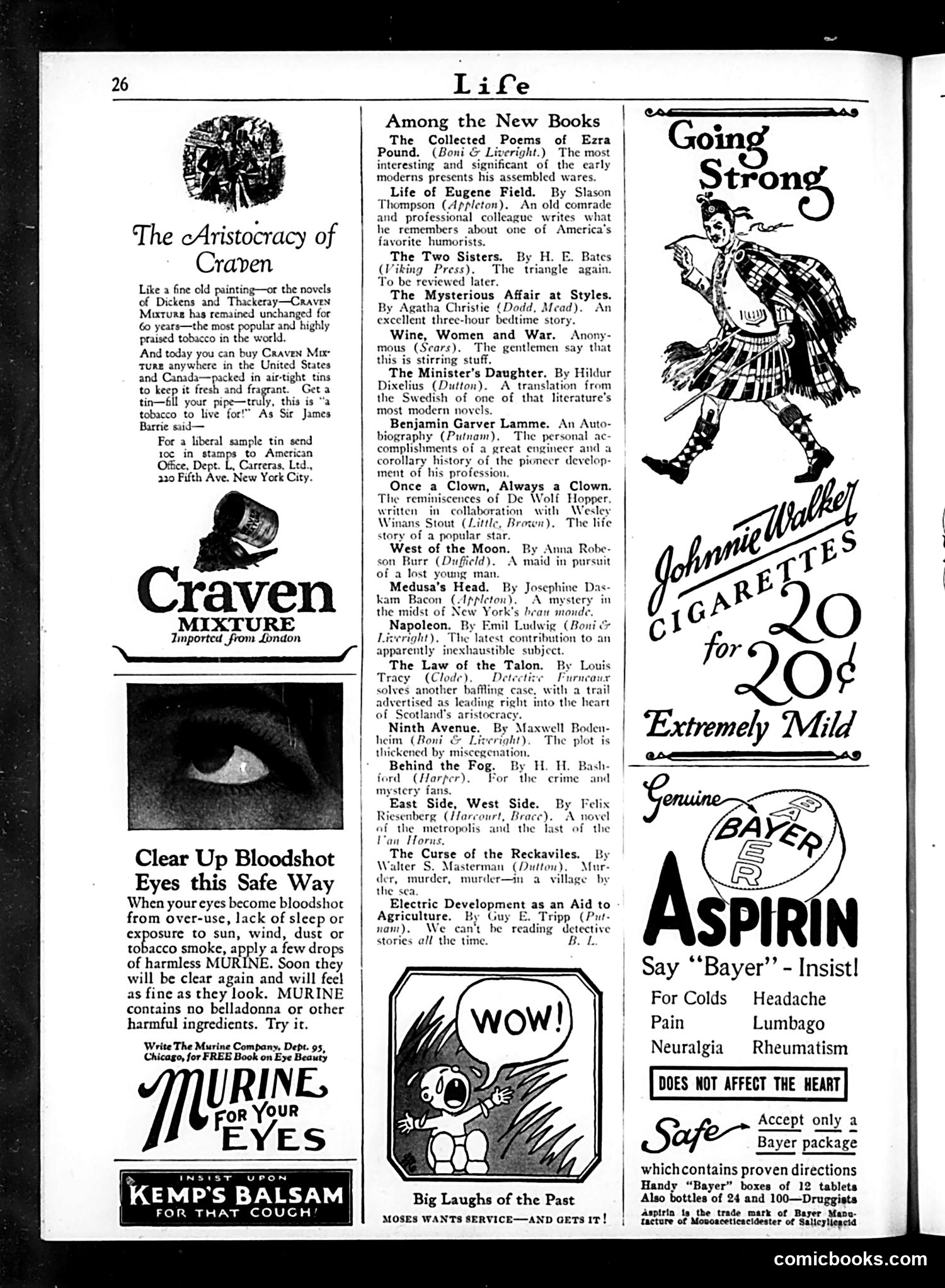
This page is primarily **advertising and book reviews**, not political satire. The cartoons present are commercial advertisements rather than editorial content. The notable visual element is a small cartoon titled "Big Laughs of the Past" captioned "Moses Wants Service—and Gets It!" This appears to be a reprinted humor piece (the caption suggests it's vintage), likely depicting a comedic scenario involving Moses as a customer receiving service, though the specific joke is unclear without seeing the full cartoon details. The page's main content consists of: - Product advertisements (Craven tobacco, Murine eyedrops, Kemp's Balsam cough remedy, Bayer Aspirin, Johnny Walker cigarettes) - A book review section listing recent publications from 1920-1921 There is **no political satire** on this page. It represents typical 1920s *Life* magazine content mixing consumer advertising with literary commentary.
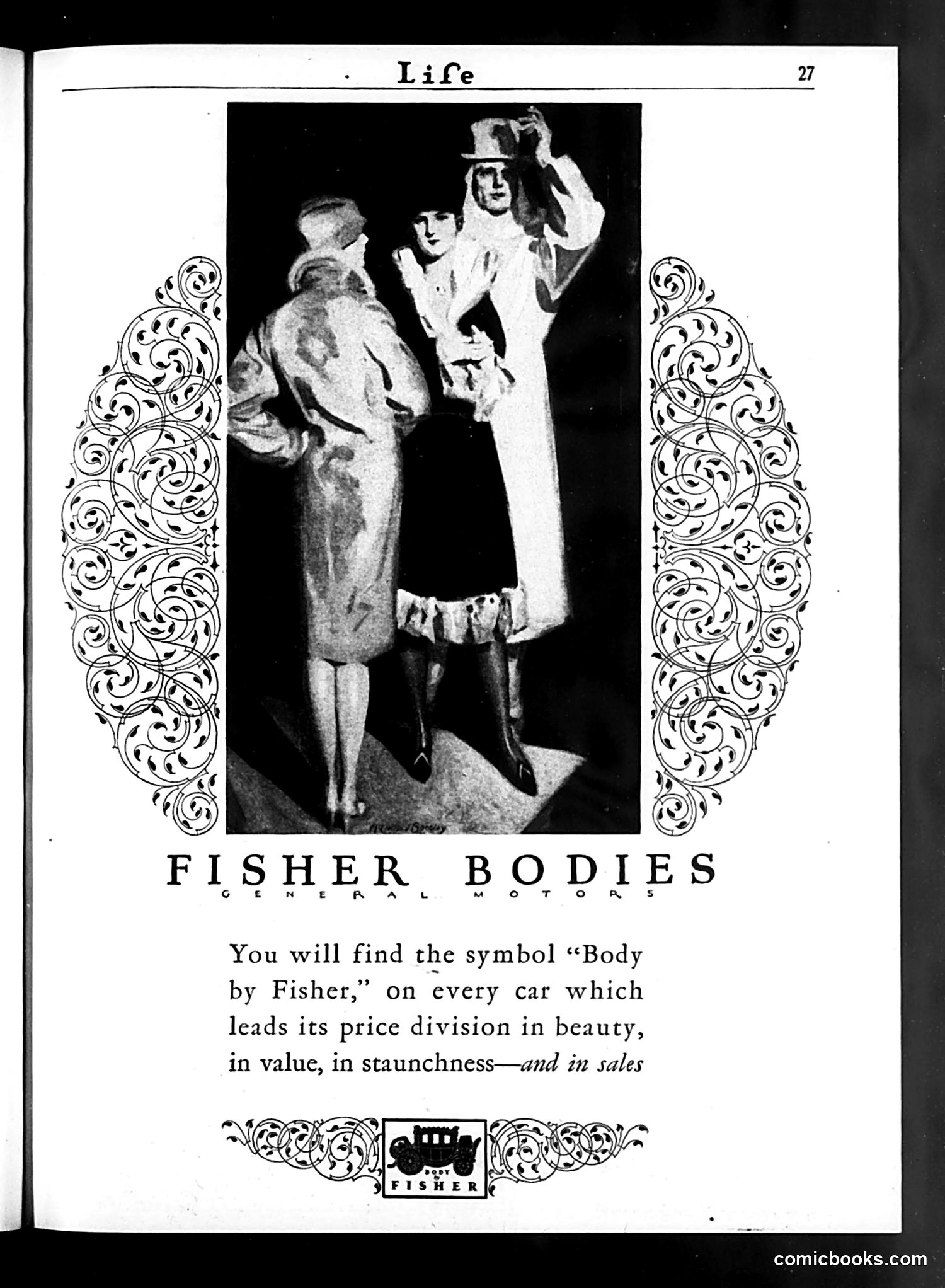
This is a **General Motors advertisement**, not political satire. The page promotes Fisher Body Company, GM's body manufacturing division. The image shows two women in 1920s attire examining an automobile. The ad claims that "Body by Fisher" appears on every car leading its price class in beauty, value, durability, and sales. The ornamental borders and formal layout are typical of 1920s advertising design. The message emphasizes Fisher Body's reputation for quality craftsmanship as a selling point—essentially arguing that superior car bodies (the chassis and exterior) were key to market dominance. This reflects the era when automobile bodies were still distinct components, before full integration of body and frame became standard.
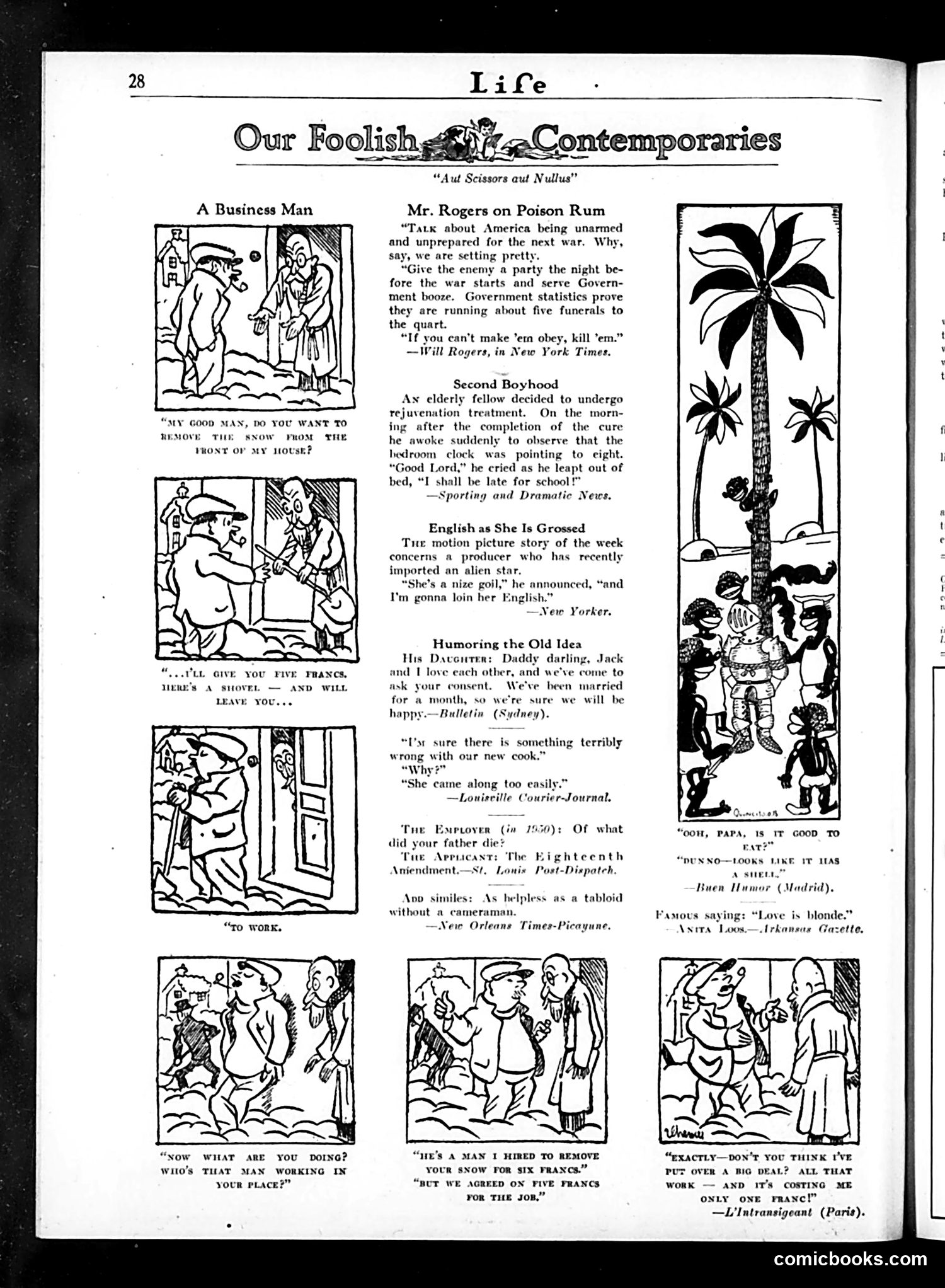
This page collects international humorous anecdotes and comic strips satirizing everyday human folly. The cartoons mock common social situations: **"A Business Man"** shows a employer hiring someone to remove snow for five francs, then discovering the worker hired a subcontractor for six francs—satirizing poor negotiation and the absurd chain of middlemen inflating costs. **Other sections** include Will Rogers' commentary on American preparedness (likely pre-WWII), a joke about an elderly man rejuvenating so much he thinks it's a school day, and humor about an alien actress learning English. **"Humoring the Old Idea"** ridicules a couple already married asking parental consent—mocking outdated social conventions. The page's title "Aut Scissors aut Nullus" (Latin: "Either scissors or nothing") appears decorative. These are mostly mild, workplace and domestic satire reflecting 1920s-30s preoccupations with modernity, social propriety, and international quirks—compiled from various newspapers to demonstrate human foolishness across cultures.
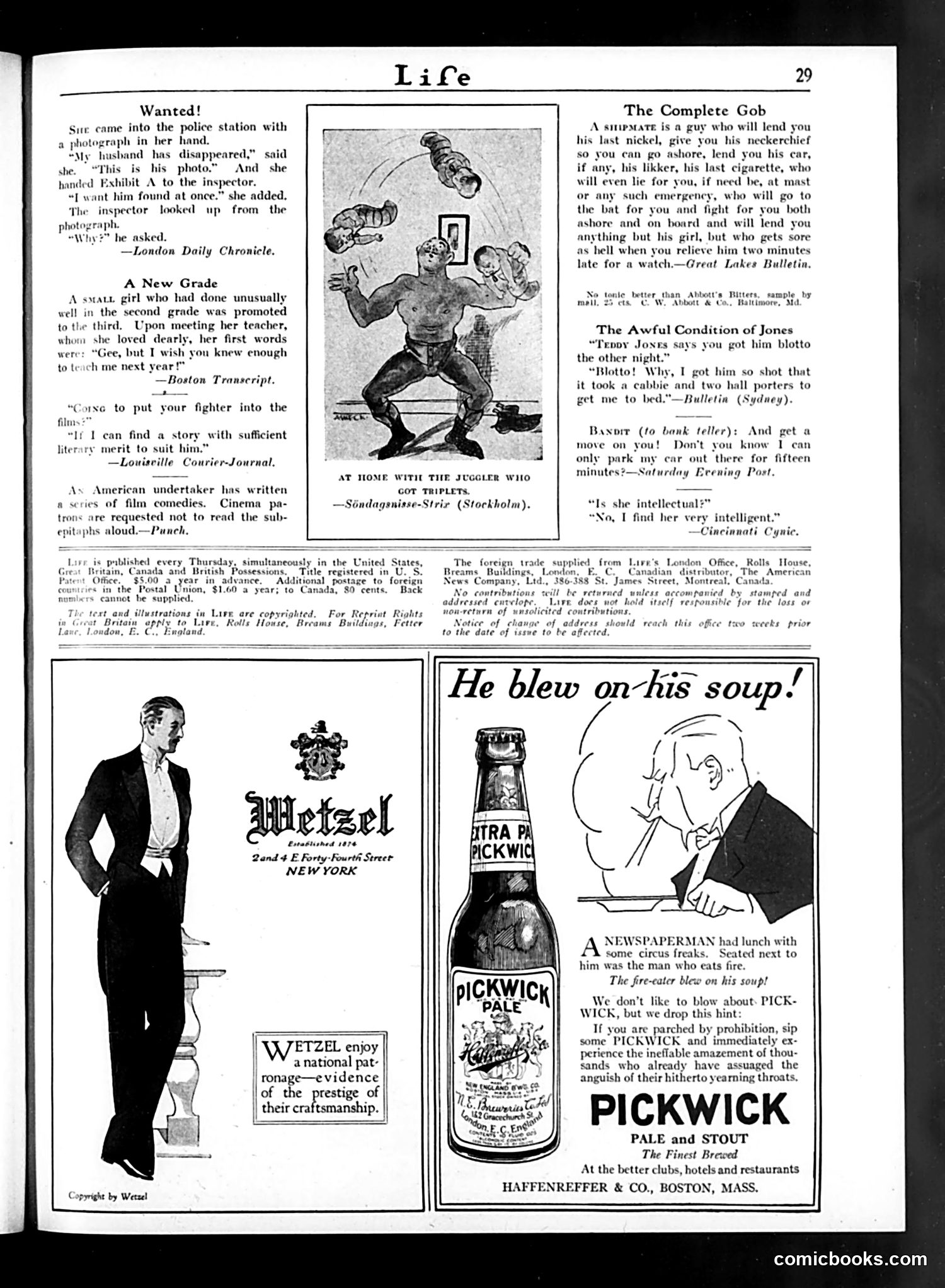
This page contains several brief humorous anecdotes typical of *Life*'s satirical format, plus advertisements. The cartoons mock everyday situations: a woman reporting her husband missing (the joke being the inspector's skepticism upon seeing the photo), a promoted student wishing her beloved old teacher knew enough to teach her advanced material, and various workplace absurdities. "The Complete Gob" defines sailor slang—a "gob" will lend everything except his girlfriend and resents being relieved late from watch duty. It satirizes masculine camaraderie and working-class priorities. The Pickwick beer advertisement uses dark humor: a fire-eating circus performer blows on his soup, which the ad awkwardly connects to Prohibition-era drinking. The implication is that despite legal alcohol bans, Pickwick beer delivers satisfaction to those "yearning" for it—a transparent wink at circumventing Prohibition laws through beer consumption. The Wetzel pretzel ad occupies the lower left, emphasizing craftsmanship.
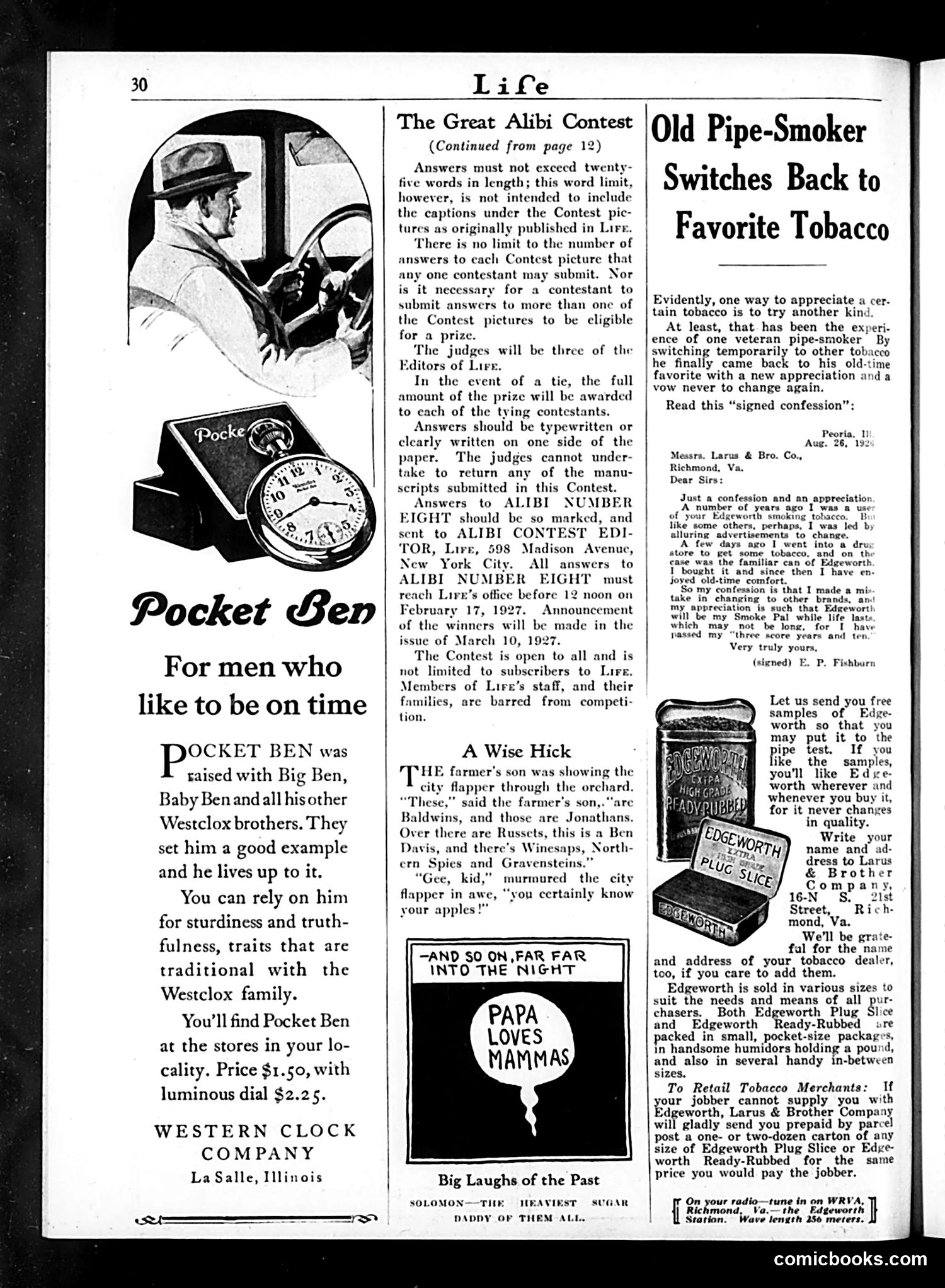
This page contains **mostly advertising** with one satirical cartoon. **The Cartoon ("A Wise Hick"):** A farmer's son impresses a young city woman ("flapper"—a 1920s term for modern, fashionable women) by knowledgeably naming apple varieties in an orchard. Her impressed response ("you certainly know your apples!") plays on the double meaning: she's genuinely impressed by his agricultural knowledge, but the joke suggests she's superficially charmed. The satire gently mocks both the city flapper's naiveté and rural stereotypes—the "hick" proves unexpectedly knowledgeable. **The Advertisements:** - **Pocket Ben**: A Westclox pocket watch marketed to punctual men, playing on the name "Big Ben" - **Edgeworth Tobacco**: A testimonial ad where an elderly pipe-smoker admits he abandoned the brand for competitors' advertising but has returned, appreciating it anew The page reflects 1920s consumer culture and the era's urban-rural cultural divide.
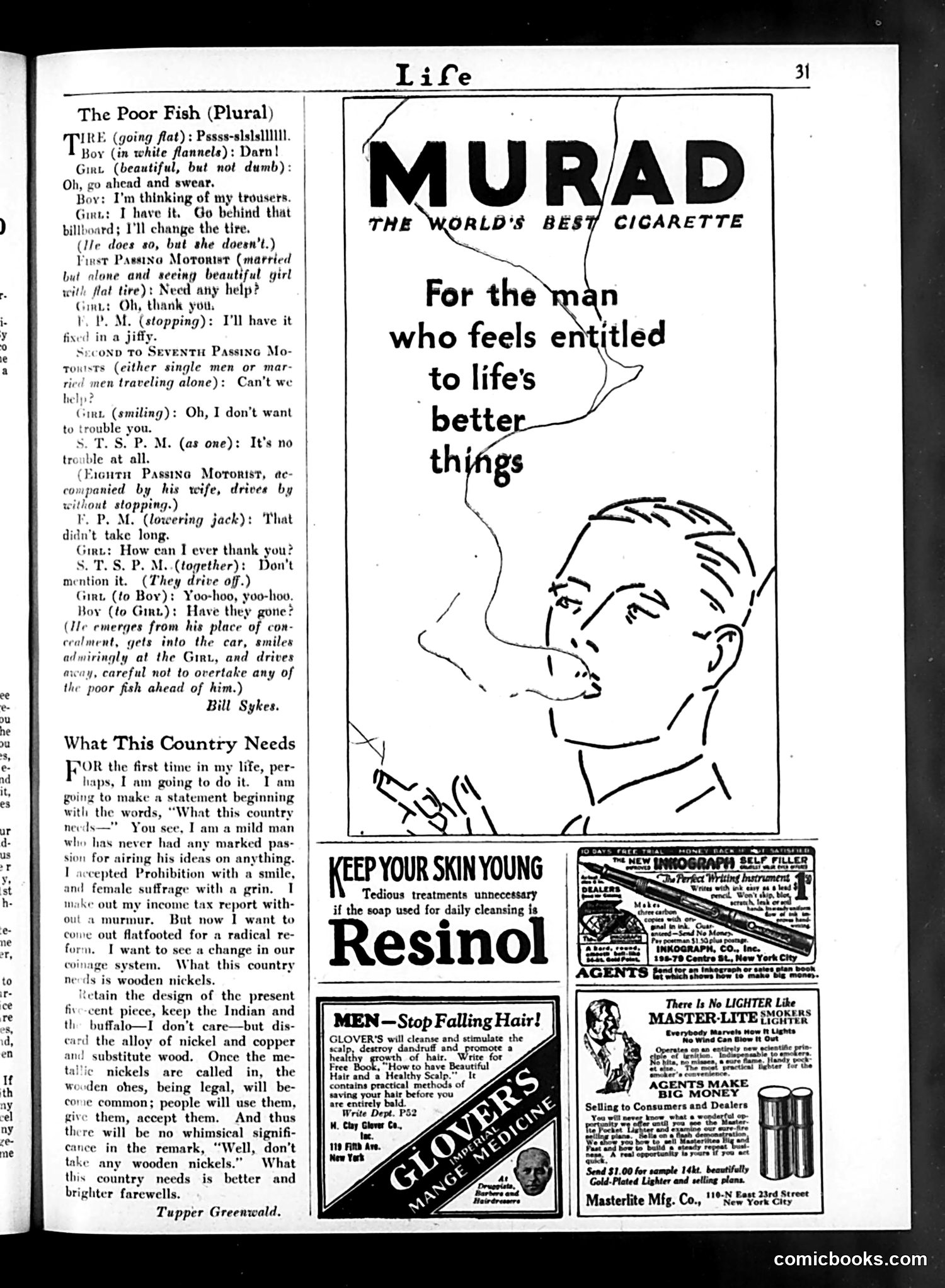
This page contains a satirical cartoon titled "The Poor Fish" by Bill Sykes, depicting a social commentary on male behavior and chivalry. **The Cartoon's Point:** A woman with a flat tire receives help from multiple passing motorists—except the first one (accompanied by his wife), who pretends not to notice. The woman and her male companion hide behind a billboard while strangers assist. The joke satirizes male hypocrisy: men readily help an attractive woman in distress, yet the one man who *should* help (her actual companion) shamefully avoids the work, letting strangers do it while he hides. **The Satire:** It mocks masculine pride and the performative nature of chivalry—men help to appear noble, but avoid genuine responsibility. The woman's refusal to let the first motorist help suggests she's complicit in or amused by the deception. The page also includes a humorous essay "What This Country Needs" about replacing nickels with wooden ones, plus period advertisements for cigarettes, soap, and hair treatment products—typical Life magazine content.
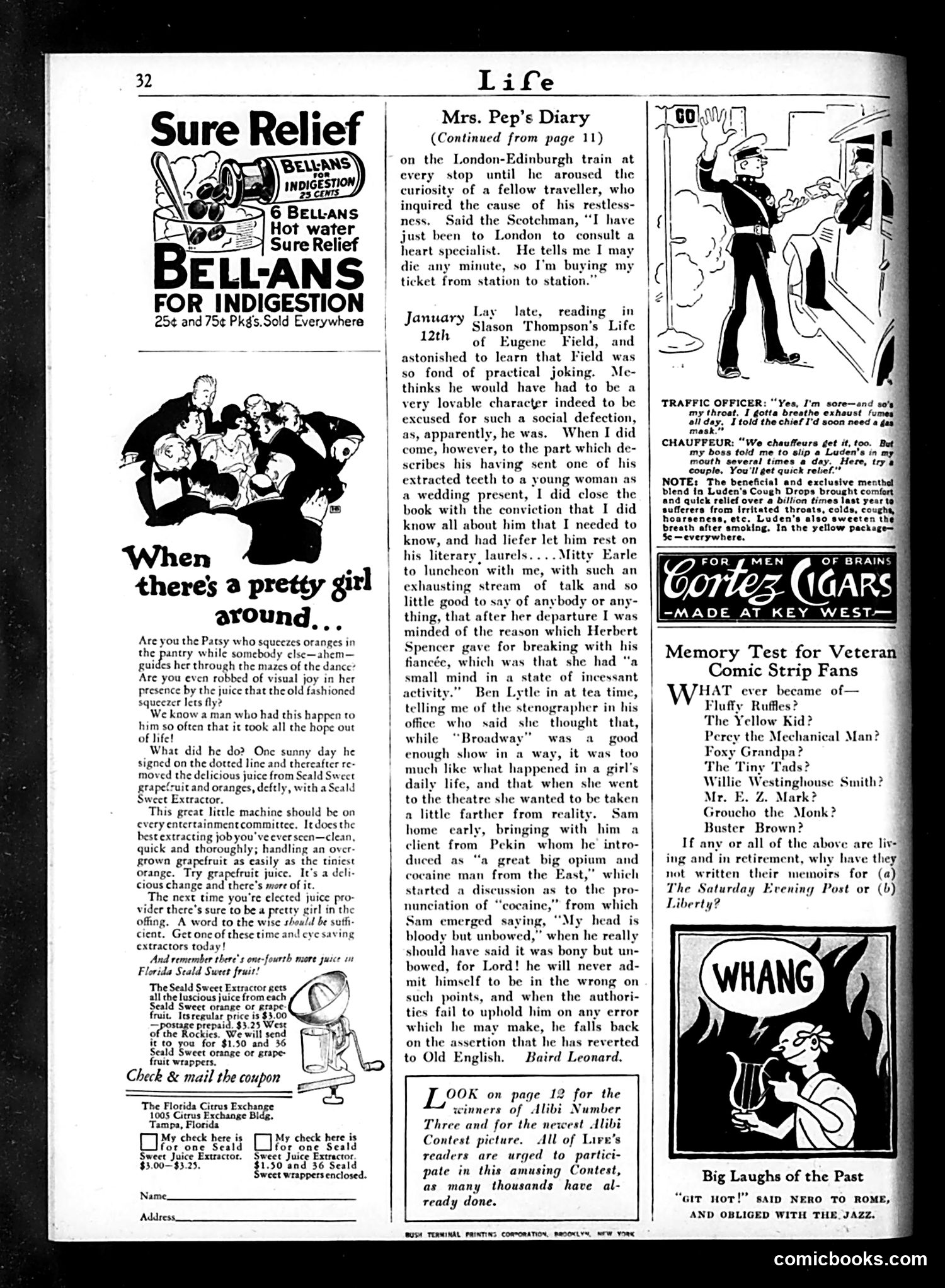
This page contains primarily **advertisements and miscellaneous content** rather than political cartoons requiring historical context. The main cartoon ("When there's a pretty girl around") depicts a domestic humor scenario: a man repeatedly gets assigned the task of squeezing orange juice at parties while his female companion dances with others. The joke plays on dated gender role expectations—men performing menial kitchen tasks while missing social opportunities. The ad promotes a mechanical juice extractor as the solution, positioning it as a labor-saving device that would free men from this undesirable duty. **Mrs. Pep's Diary** is a gossip column recounting social observations and anecdotes, including a story about Eugene Field (a 19th-century American writer known for practical jokes) and discussions about theater and social behavior among the writer's acquaintances. The other content consists of advertisements for Bell-Ans indigestion remedy, Cortez cigars, and the Seald Sweet juice extractor. There are no significant political references or satirical commentary on this particular page.

I can see this is a page from Life magazine with "comicbooks.com" visible at the bottom, but the image quality is too degraded for me to reliably make out specific cartoon content, figures, or text details. The page appears mostly black with some lighter areas that might contain illustrations or text, but I cannot discern them clearly enough to identify particular caricatures, political references, or the satirical intent. To provide an accurate explanation of what this cartoon means—which requires identifying specific figures and historical context—I would need a clearer image where the illustrations and text are legible. I cannot responsibly guess at details I cannot see.