
Life, 1927-02-03 · page 16 of 35
Life — February 3, 1927 — page 16: what you’re looking at
What you’re looking at
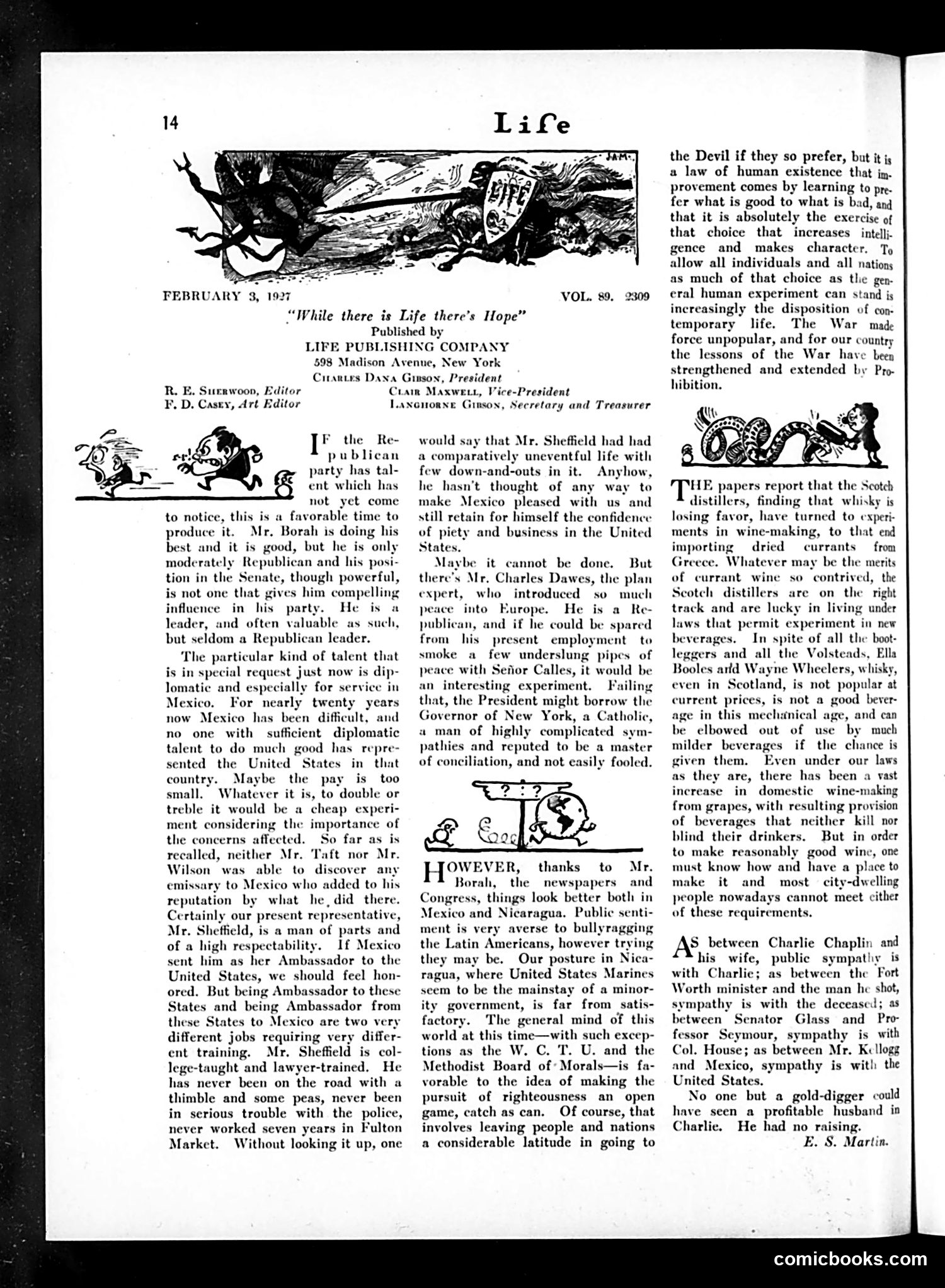
This page contains editorial commentary on diplomatic and political matters rather than standalone cartoons. The small decorative illustrations (dancing figures, cherubs) are ornamental rather than satirical. The text discusses Mr. Sheffield as a potential U.S. Ambassador to Mexico, praising his diplomatic skills while noting Mexico's complicated political situation. It also comments on Prohibition-era whisky experimentation in Scotland and domestic wine-making, suggesting Americans are frustrated by alcohol restrictions. A final section addresses Charlie Chaplin's marital troubles, noting public sympathy is divided among various political figures depending on their personal allegiances—a commentary on how Americans' political loyalties influenced their response to celebrity scandals. The page reflects 1920s concerns: diplomatic relations with Mexico, Prohibition enforcement, and celebrity culture's intersection with politics.
📄 Transcribed text from this page (OCR, searchable)
Machine-transcribed from the original scan — historical spelling and the odd misread are preserved.
FEBRUARY 3, 1927 VOL. 89. “While there is Life there’s Hope” Published by LIFE PUBLISHING COMPANY 598 Madison Avenue, New York Crantes Dana Gunso: Crain } Laxouoaxe Ginson, Secretary and Treasurer R. E. Surrwoon, Editor F, D. Casry, Art Editor F the Re- publican party has tal- ent which has not yet come to notice, this is a favorable time to produce it. Mr. Borah is doing his best and it is good, but he is only moderately Republican and his posi- tion in the Senate, though powerful, is not one that gives him compelling influence in his party. He is a leader, and often valuable as such, but seldom a Republican leader. The particular kind of talent that is in special request just now is dip- lomatic and especially for service in Mexi For nearly twenty years xico has been difficult, and no one with sufficient diplomatic talent to do much good has repre- sented the United States in that country. Maybe the pay is too small. Whatever it is, to double or treble it would be a cheap experi- ment considering the importance of the concerns affected. So far as is recalled, neither Mr. Taft nor Mr. Wilson was able to discover any emissary to Mexico who added to his reputation by what he, did there. Certainly our present representative, Mr. Sheffield, is a man of parts and of a high respectability. If Mexico sent him as her Ambassador to the United States, we should feel hon- ored. But being Ambassador to these States and being Ambassador from these States to Mexico are two very different jobs requiring very differ- ent training. Mr. Sheffield is col- lege-taught and lawyer-trained, He has never been on the road with a thimble and some peas, never been in serious trouble with the police, never worked seven years in Fulton Market. Without looking it up, one President axwett, Vice-President would say that Mr. Sheffield had had a comparatively uneventful life with few down-and-outs in it. Anyhow, he hasn’t thought of any way to make Mexico pleased with us and still retain for himself the confidence of and business in the United y 2 it cannot be done. But there's Mr, Charles Dawes, the plan expert, who introduced so much peace into Europe. He is a Re- publican, and if he could be spared from his present employment to smoke a few underslung pipes of peace with Senor Calles, it would be an interesting experiment. Failing that, the President might borrow the Governor of New York, a Catholic, a man of highly complicated sym- pathies and reputed to be a master of conciliation, and not easily fooled. ER, thanks to Mr. Borah, the newspapers and Congress, things look better both in Mexico and Nicaragua, Public senti- ment is very averse to bullyragging the Latin Americans, however trying they may be. Our posture in Nica- ragua, where United States Marines seem to be the mainstay of a minor- ity government, is far from satis- factory. The general mind of this world at this time—with such excep- tions as the W. C. T. U. and the Methodist Board of: Morals—is fa- vorable to the idea of making the pursuit of righteousness an open game, catch as can. Of course, that involves leaving people and nations a considerable latitude in going to the Devil if they so prefer, but it js a law of human existence that im. provement comes by learning to pre. fer what is good to what is bad, and that it is absolutely the exercise of that choice that increases intelli. gence and makes character. To allow all individuals and all nations as much of that choice as the gen- eral human experiment can stand js increasingly the disposition of con- temporary life. The War made force unpopular, and for our country the lessons of the War have been strengthened and extended by Pro- hibition. tits HE, papers report that the Scotch distillers, finding that whisky is losing favor, have turned to experi- ments in wine-making, to that end importing dried currants from Greece. Whatever may be the merits of currant wine so contrived, the Scotch distillers are on the right track and are lucky in living under laws that permit experiment in new beverages. In spite of all the boot- leggers and all the Volsteads, Ella Booles arld Wayne Wheelers, whisky, even in Scotland, is not popular at current prices, is not a good bever- age in this mechinical age, and can be elbowed out of use by much ilder beverages if the chance is given them. Even under our laws as they are, there has been a vast increase in domestic wine-making from grapes, with resulting provision of beverages that neither kill nor blind their drinkers. But in order to make reasonably good wine, one must know how and have a place to make it and most city-dwelling people nowadays cannot meet cither of these requirements. AS between Charlie Chaplin and his wife, public sympathy is with Charlie; as between the Fort Worth minister and the man he shot, sympathy is with the deceased; as between Senator Glass and Pro- fessor Seymour, sympathy is with Col. House; as between Mr. Kellogg and Mexico, sympathy is with the United States. No one but a gold-digger could have seen a profitable husband in Charlie. He had no raising. E. S. Martin. comicbooks.com