
Life, 1927-02-03 · page 21 of 35
Life — February 3, 1927 — page 21: what you’re looking at
What you’re looking at
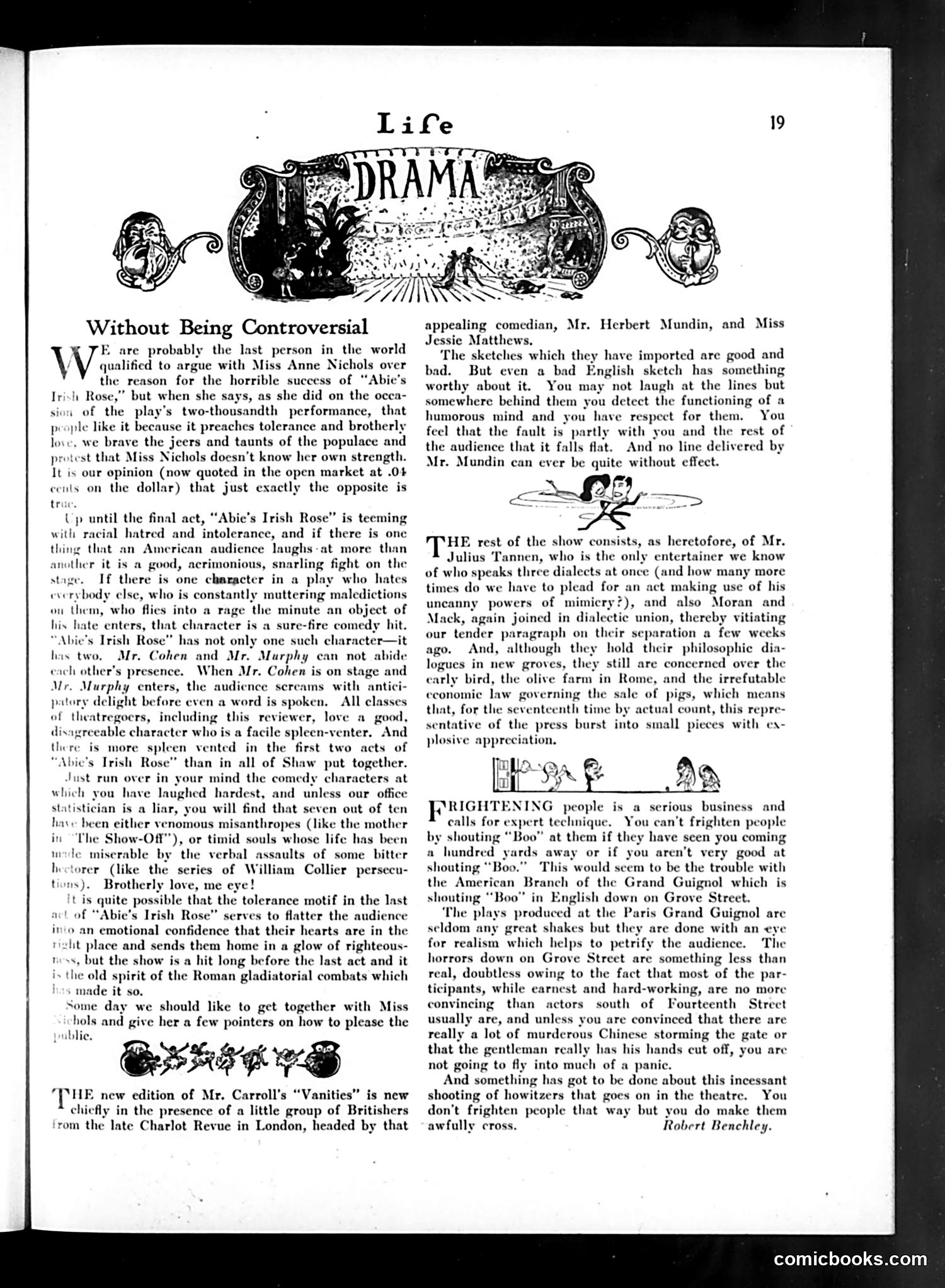
This page critiques the Broadway hit "Abie's Irish Rose," a play about Irish-Jewish relations that had reached its two-thousandth performance. The author argues that the play's actual appeal contradicts creator Anne Nichols's claim that it succeeds through preaching tolerance and brotherhood. Instead, the critic contends the play works because audiences enjoy the **racial antagonism** between characters Mr. Cohen and Mr. Murphy—both ethnic stereotypes who constantly insult each other. The author suggests people laugh hardest at acrimonious, spiteful characters, and that the play's final act's "tolerance message" merely flatters audiences morally while the real entertainment comes from ethnic conflict. The page also reviews Carroll's "Vanities," praising British performers Herbert Mundin and Jessie Matthews, and comedian Julius Tannen's dialect work. The satire reveals early 1920s attitudes: ethnic stereotyping was mainstream entertainment, and social criticism operated by mocking both the plays and audiences who enjoyed them.
📄 Transcribed text from this page (OCR, searchable)
Machine-transcribed from the original scan — historical spelling and the odd misread are preserved.
Without Being C Controversial are probably the last person in the world W vid to argue with Miss Anne Nichols over the reason for the horrible success of “Abie’s Trisli Rose,” but when she says, as she did on the occa- sion of the play’s two-thousandth performance, that people like it because it preaches tolerance and brotherly love, we brave the jeers and taunts of the populace and protest that Miss hols doesn’t know her own strength. It is our opinion (now quoted in the open market at .0+ eculs on the dollar) that just exactly the opposite is trac, Up until the final act, “Abie’s Irish Rose” is teeming with racial hatred and intolerance, and if there is one thing that an American audience laughs:at more than another it is a good, acrimonious, snarling fight on the stage. If there is one character in a play who hates everybody else, who is constantly muttering maledictions ou them, who flies into a rage the minute an object of his hate enters, that character is a sure-fire “Abie’s Irish Rose” has not only one such has two, Mr. Cohen and Mr. Murphy cach other’s presence. When Mr. Cohen is on stage and Mr. Murphy enters, the audience sereams with antici- patory delight before even a word is spoken, All classes of theatregoers, including this reviewer, love a good, ceable character who is a facile spleen-venter. And is more spleen vented in the first two acts of “Abic'’s Trish Rose” than in all of Shaw put together. lust run over in your mind the comedy characters at which you have laughed hardest, and unless our office statistician is a liar, you will find that seven out of ten have been either venomous misanthropes (like the mother in “The Show-Off”), or timid souls whose life has been uede miserable by the verbal assaults of some bitter hectorer (like the series of William Collier persecu- tions). Brotherly love, me eye! t is quite possible that the tolerance motif in the last act of “Abie’s Irish Rose” serves to flatter the audience in'o an emotional confidence that their hearts are in the rizht place and sends them home in a glow of righteous- ness, but the show is a hit long before the last act and it iy the old spirit of the Roman gladiatorial combats which made it so, some day we should like to get together with Miss hols and give her a few pointers on how to please the BERK e®™ n not abide is new THE new edition of Mr. Carroll's “Vanities” chiefly in the presence of a little group of Britishers irom the late Charlot Revue in London, headed by that appealing comedian, Mr. Herbert Mundin, and Miss Jessie Matthews, The sketches which they have imported are good and bad. But even a bad English sketch has something worthy about it. You may not laugh at the lines but somewhere behind them you detect the functioning of a humorous mind and you have respect for them. You feel that the fault is partly with you and the rest of the audience that it falls flat. And no line delivered by Mr. Mundin can ever be quite without effect. HE rest of the show consists, as heretofore, of Mr. Julius Tannen, who is the only entertainer we know of who speaks three dialects at once (and how many more times do we have to plead for an act making use of his uncanny powers of mimicry?), and also Moran and Mack, again joined in dialectic union, thereby vitiating our tender paragraph on their separation a few weeks ago. And, although they hold their philosophic dia- logues in new groves, they still are concerned over the early bird, the olive farm in Rome, and the irrefutable economic law governing the sale of pigs, which means that, for the seventeenth time by actual count, this repre- sentative of the press burst into small pieces with ea- plosive appreciation, AM FPRIGHTE .NING people is a serious business and calls for expert technique. You can’t frighten people by shouting “Boo” at them if they have seen you coming a hundred yards away or if you aren't very good at shouting “B. This would seem to be the trouble with the American Branch of the Grand Guignol which is shouting “Boo” in English down on Grove Street. The plays produced at the Paris Grand Guignol are seldom any great shakes but they are done with an eye for realism which helps to petrify the audience. The horrors down on Grove Street are something less than real, doubtless owing to the fact that most of the par- ticipants, while earnest and hard-working, are no more convincing than actors south of Fourteenth Strect usually are, and unless you are convinced that there are really a lot of murderous Chinese storming the gate or that the gentleman really has his hands cut off, you are not going to fly into much of a panic. And something has got to be done about this incessant shooting of howitzers that goes on in the theatre. You don’t frighten people that way but you do make them awfully cross. Robert Benchley. comicbooks.com