
Life, 1927-02-03 · page 8 of 35
Life — February 3, 1927 — page 8: what you’re looking at
What you’re looking at
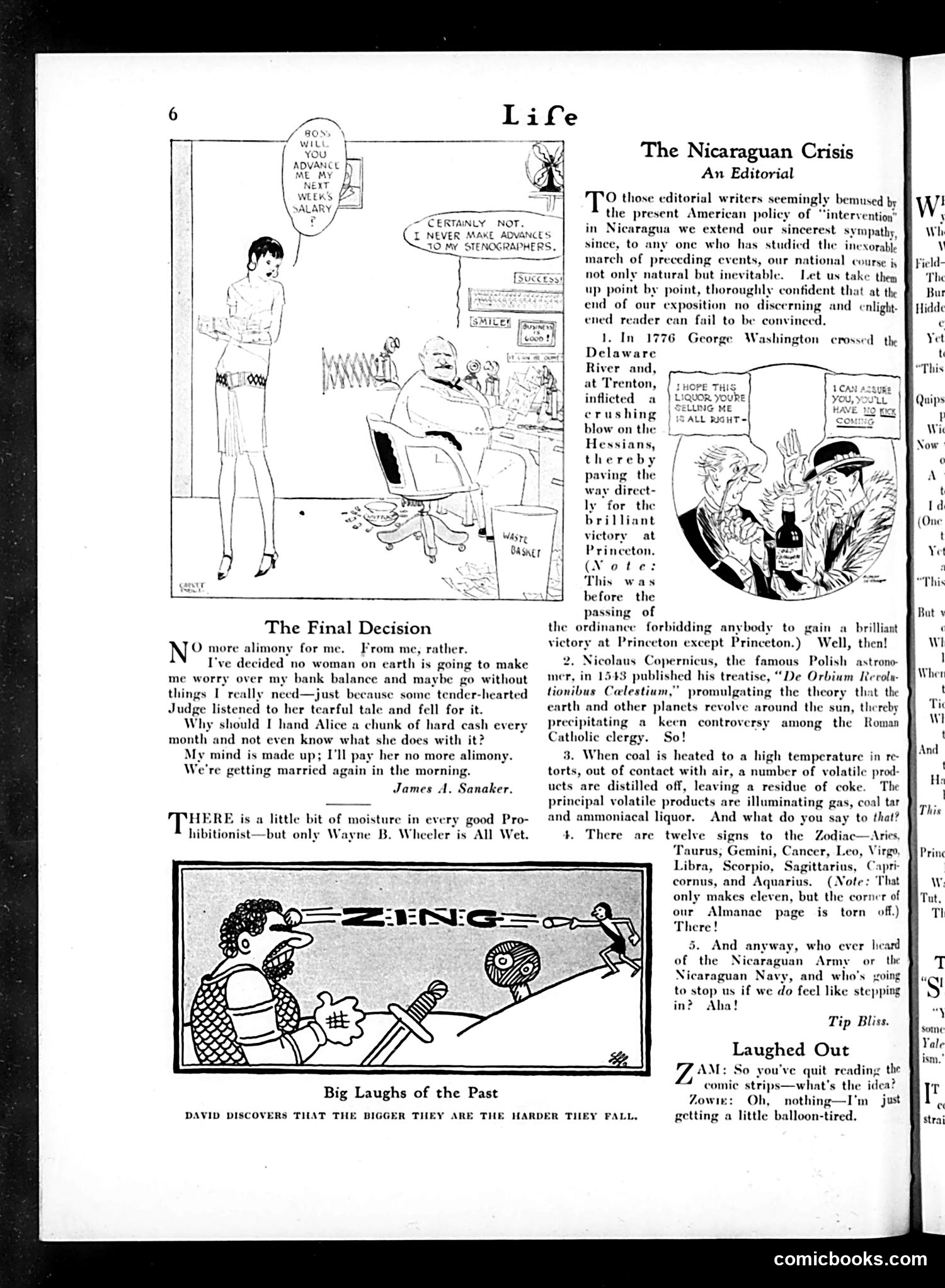
This cartoon satirizes a woman rejecting alimony upon remarriage. The humor targets wealthy women's financial independence, a progressive but controversial topic in this era. The woman declares she'll no longer burden her ex with support payments, viewing it as incompatible with her new marriage. The accompanying editorial piece discusses the Nicaraguan Crisis, offering sympathy to Americans confused by U.S. foreign policy interventions. It presents historical precedents (Washington's Delaware crossing, Copernicus, coal chemistry) as intellectual context for understanding complex geopolitical situations—suggesting editorial readers deserve clearer explanations of America's involvement. The page juxtaposes domestic comedy with serious foreign policy critique, typical of *Life* magazine's mixed satirical approach.
📄 Transcribed text from this page (OCR, searchable)
Machine-transcribed from the original scan — historical spelling and the odd misread are preserved.
“BOS) ai wit if YOu ADVANCE A] CERTAINLY NOT. NEVER MA RAPHE F The Final Decision O more alimony for me. * I've decided no woman on earth is going to make me worry over my bank balance and maybe go without things I really need—just because some tender-hearted Judge listened to her tearful tale and fell for it. should I hand Alice a chunk of hard cash every nd not even know what she does with it? My mind is made up; I'll pay her no more alimony. We're getting married again in the morning. From me, rather. James A. Sanaker. HERE is a little bit of moisture in every good Pro- hibitionist—but only Wayne B. Wheeler is All Wet. Big Laughs of the Past DAVID DISCOVERS THAT THE BIGGER THEY ARE THE MARDER TILEY FALL. ADVANCES The Nicaraguan Crisis An Editorial T° those editorial writers seemingly bemused by the present American policy of “intervention” in Nicaragua we extend our sincerest sympathy, since, to any one who has studied the inexorable march of preceding events, our national course jy not only natural but inevitable. Let us take them up point by point, thoroughly confident that at the end of our exposition no discerning and enlight- ened reader can fail to be convinced. 1. In 177 Delaware River and, at Trenton, inflicted a crushing | blow on the Hessians, thereby paving the way direct- ly for the brilliant victory Princeton, (Note: This was before the passing of the ordinance forbidding anybody to gain a_ brilliant victory at Princeton except Princeton.) Well, then! 2. Nicolaus Copernicus, the famous Polish astrono- mer, in 1543 published his treatise, “De Orbium Revola- tionibus Calestium,” promulgating the theory that the earth and other planets revolve around the sun, thereby precipitating a keen controversy among the Roman Catholic clergy. So! 3. When coal is heated to a high temperature in re- torts, out of contact with air, a number of volatile prod- ucts are distilled off, leaving a residue of coke. The principal volatile products are illuminating gas, coal tar and ammoniacal liquor. And what do you say to that? George Washington crossed th. 4. There are twelve signs to the Zodiac—Aries, Taurus, Gemini, Cancer, Leo, Virgo, Libra, Scorpio, Sagittarius, Capri- cornus, and Aquarius. (Note: That only makes cleven, but the corner of our Almanac page is torn off.) There! 5. And anyway, who ever heard of the Nicaraguan Army the Nicaraguan Navy, and who's yoing to stop us if we do feel like stepping in? Aha! or Tip Bliss. Laughed Out ZAM: So you've quit reading the 4 comic strips—what's the idea? Zowie: Oh, nothing—I'm just getting a little balloon-tired. (One t Yet : “This But \ WI | Wher t Tic Wl t And Princ W: Tut, Ti comicbooks.com