
A complete issue · 44 pages · 1926
Life — November 25, 1926
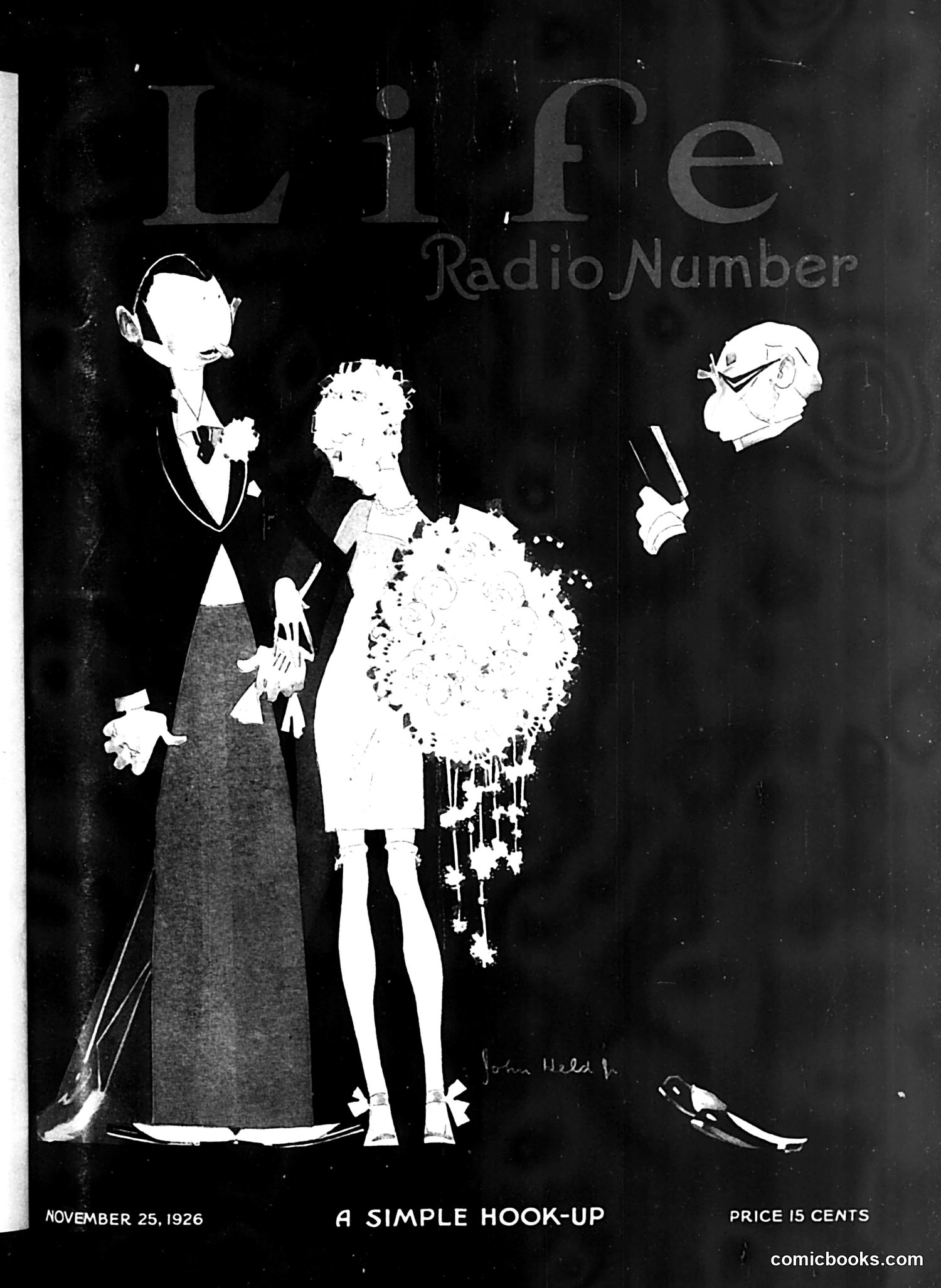
This satirical cartoon depicts three figures in what appears to be a dating or romantic scenario. The illustration shows two well-dressed men flanking a woman in an elaborate, feathered dress. The title "A Simple Hook-Up" suggests commentary on casual romantic arrangements or matchmaking of the era. The 1926 date places this in the Jazz Age, when modern dating practices were becoming more relaxed and controversial by Victorian standards. The exaggerated, stylized art style is characteristic of Life's social satire during this period. Without additional context, the specific identities of these figures remain unclear, though the cartoon likely satirizes contemporary attitudes toward courtship, romance, or possibly the emerging "companionate marriage" trend that scandalized conservative society in the 1920s.
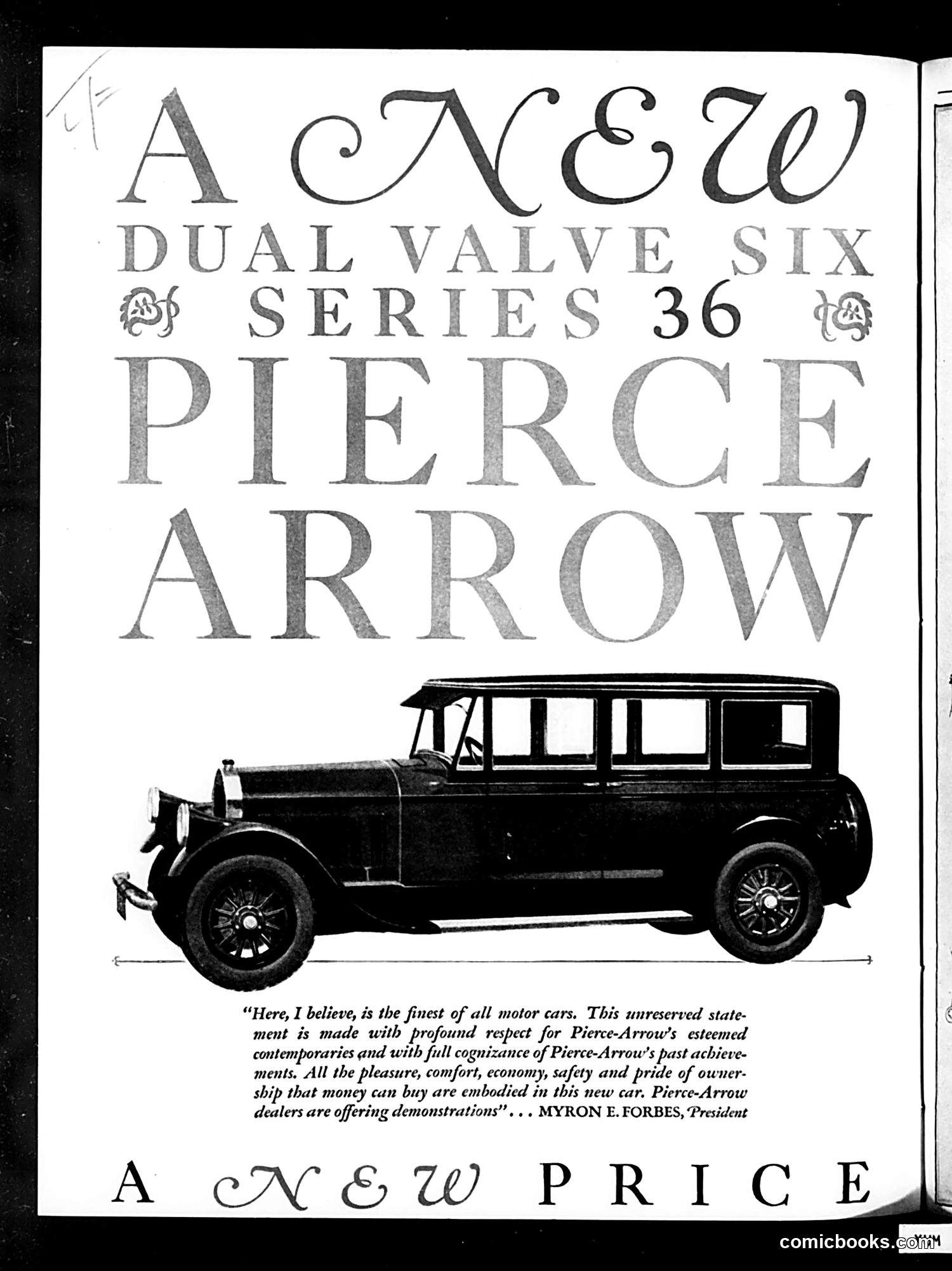
This is **primarily an advertisement**, not satire or political commentary. It promotes the Pierce-Arrow automobile, specifically the "Series 36" dual-valve six-cylinder model. The page features an elegant car illustration with a testimonial quote attributed to "Myron E. Forbes, President" praising the Pierce-Arrow as "the finest of all motor cars," emphasizing its pleasure, comfort, economy, safety, and pride of ownership. The sophisticated typography and formal language reflect 1920s advertising style, targeting wealthy consumers. Pierce-Arrow was a luxury automobile brand. The quote—attributed to what appears to be a company executive—serves as endorsement marketing rather than satire. There is no political cartoon or joke; this is straightforward commercial advertising from an era when Life magazine carried such promotions.
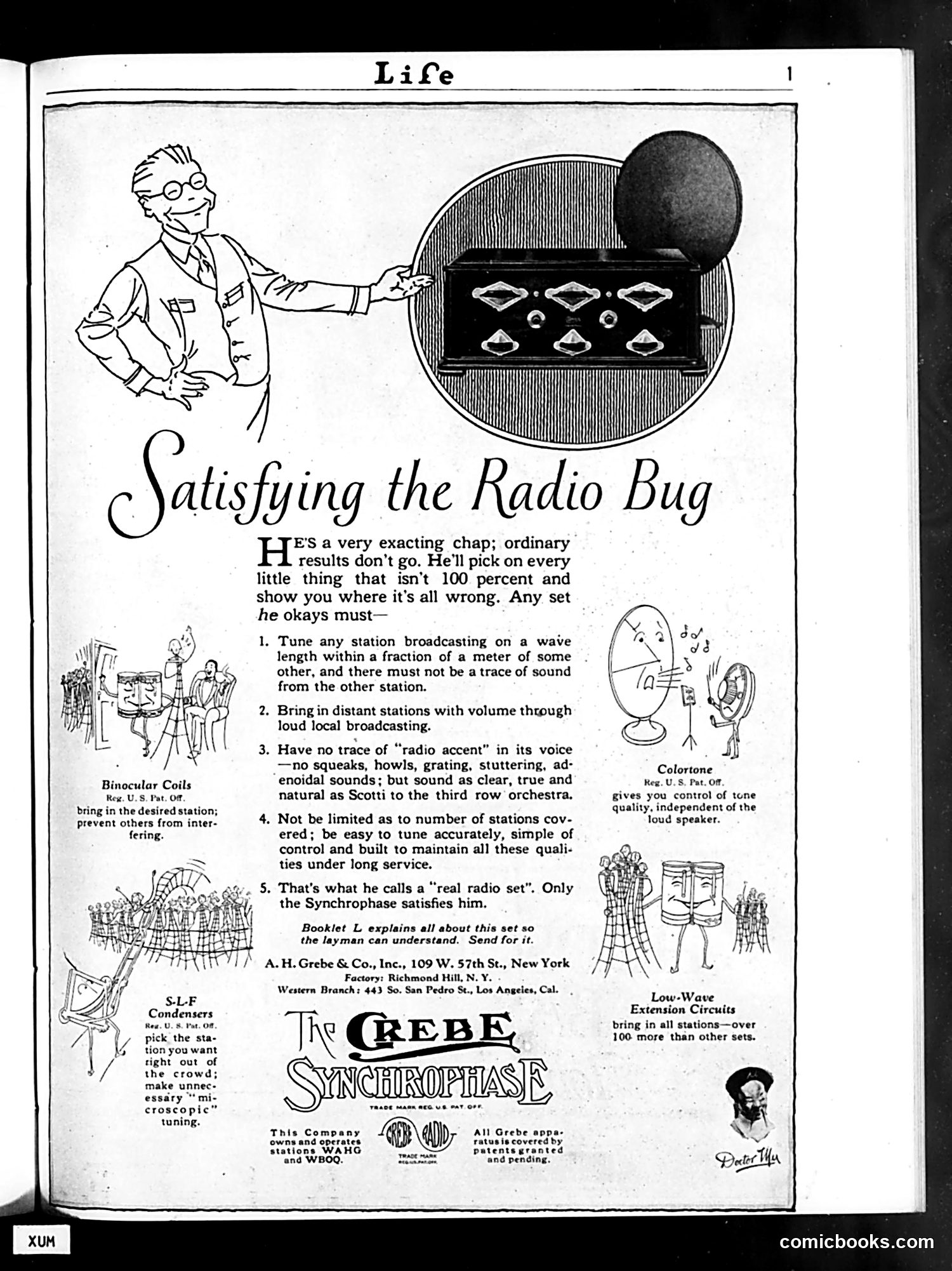
This is primarily a **Crebe Synchrophase radio advertisement** from Life magazine, disguised as humorous editorial content about radio enthusiasts. The cartoon satirizes the demanding "radio bug"—an obsessive early radio hobbyist who nitpicks every aspect of receiver performance. The five requirements mock this perfectionism: precise tuning, powerful distant reception, clear audio without artifacts, broad station coverage, and overall quality. The joke positions the Synchrophase as the only radio satisfying such an exacting enthusiast. Various components are labeled (binocular coils, condensers, colorione, low-wave circuits) to establish technical credibility. This advertisement strategy—embedding product promotion within satirical commentary on consumer types—was common in 1920s-era Life magazine. The "radio bug" persona reflects contemporary fascination with the then-novel technology of radio broadcasting.
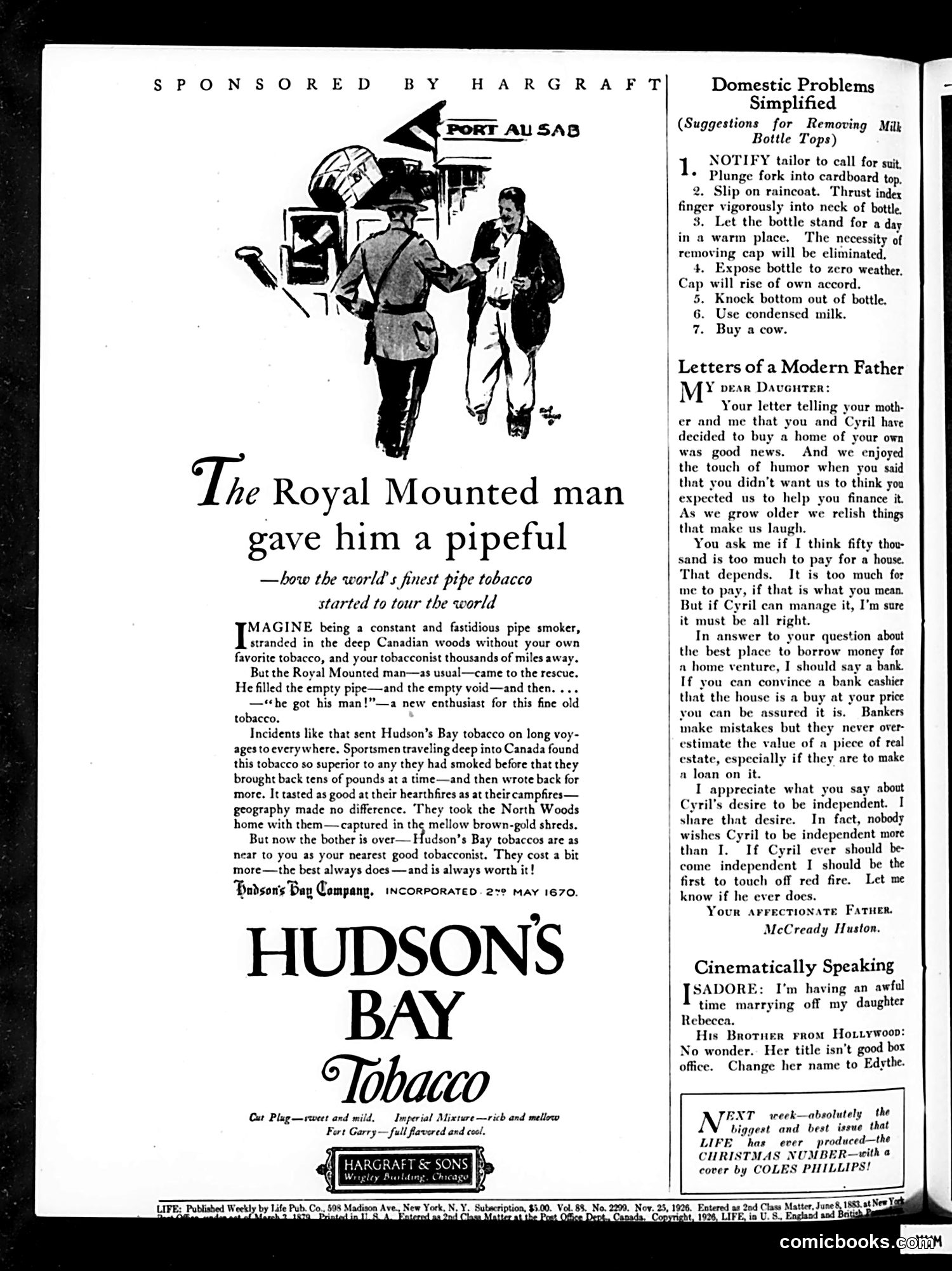
This page is primarily **advertising**, not editorial content or political satire. The main feature is a Hudson's Bay Tobacco advertisement sponsored by Hargraft, depicting a Royal Canadian Mounted Police officer offering pipe tobacco to a man in the woods. The ad's narrative emphasizes the tobacco's quality and appeal to outdoorsmen—specifically mentioning Hudson's Bay tobacco's superior reputation among Canadian sportsmen and its use during long voyages. The "rescue" scenario suggests ruggedness and reliability. The right column contains unrelated domestic advice ("Milk Bottle Tops"), a personal letter about home purchases, and brief entertainment gossip about actress Isadore's marriage. This is a typical Life magazine page from 1928, mixing advertisements with humor columns and advice.
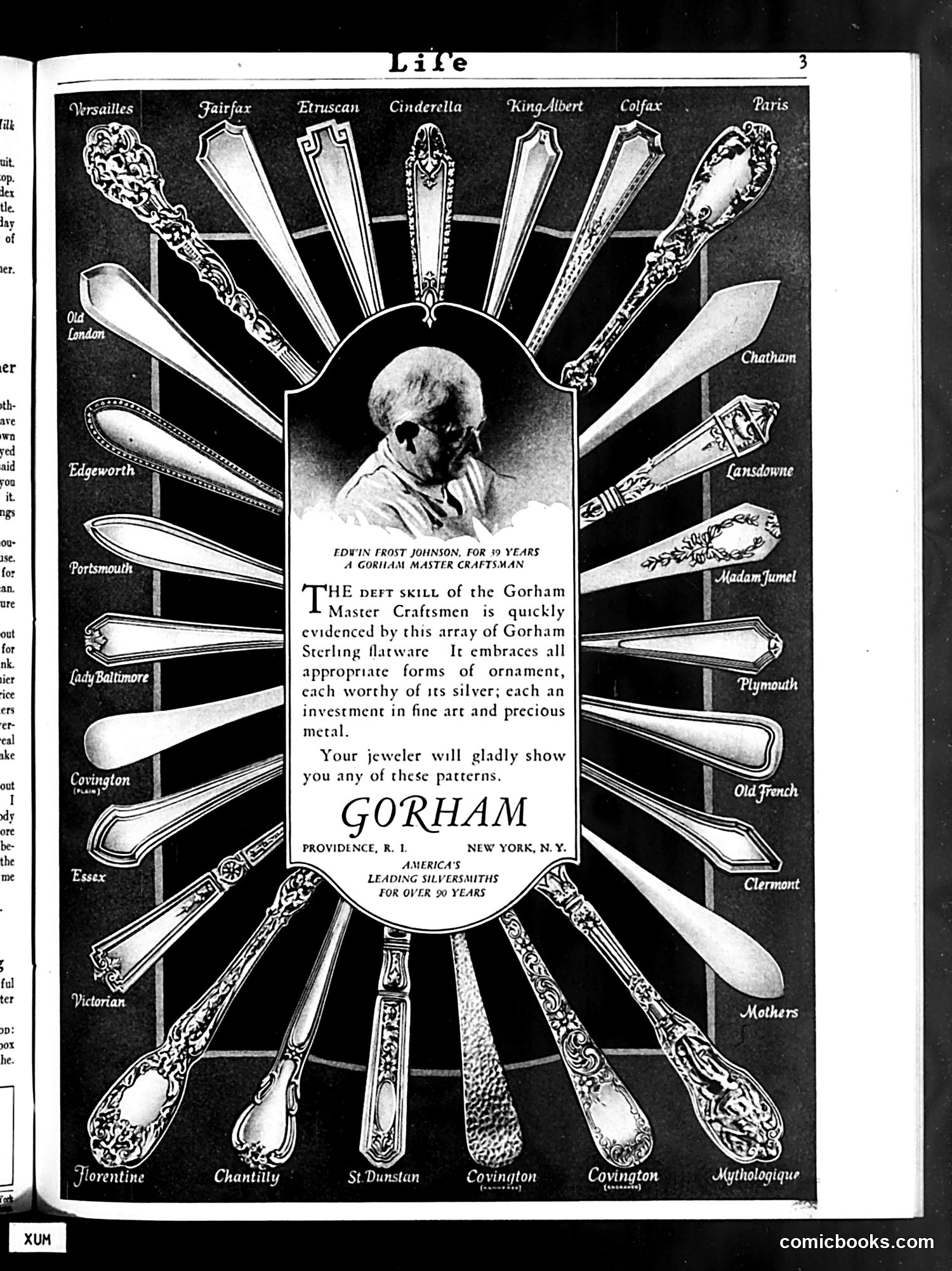
This is primarily an **advertisement, not satire or political cartoon**. The page features Gorham Sterling flatware displayed in a radial pattern around a portrait of **Edwin Frost Johnson, identified as a "Gorham Master Craftsman" of 19 years**. The various utensil patterns bear names like "Versailles," "Fairfax," "Paris," and "Old London"—likely referencing elegant European design traditions to suggest sophistication. The accompanying text emphasizes the "deft skill" of Gorham's craftsmen and positions their silverware as "an investment in fine art and precious metal." This targets affluent consumers during what appears to be the early 20th century, when such flatware represented both luxury goods and status symbols. The jeweler reference suggests this appeared in a publication aimed at upscale readers.
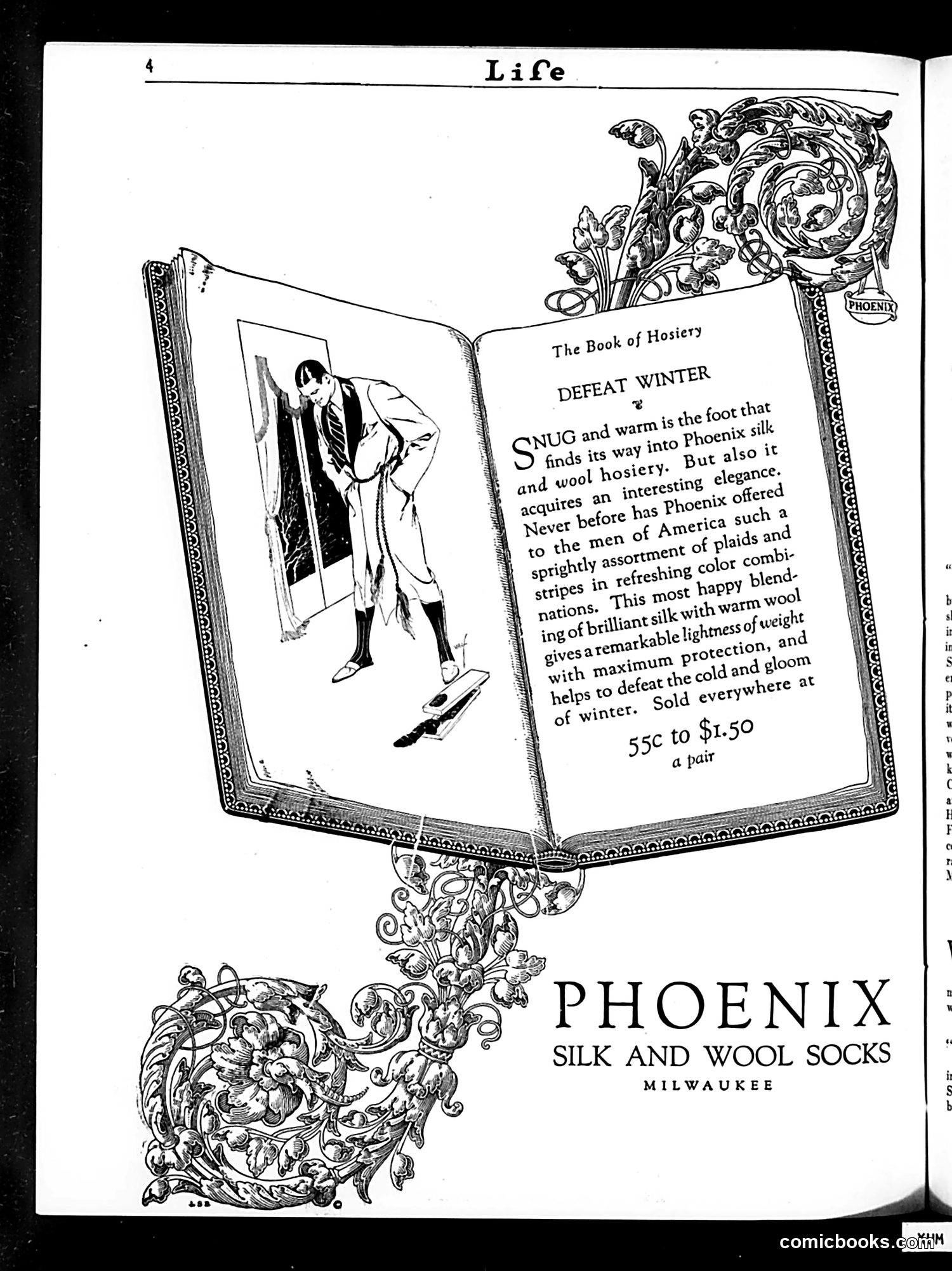
This page is primarily **advertising**, not political satire. It features "The Book of Hosiery" section promoting Phoenix brand silk and wool socks from Milwaukee. The advertisement uses a humorous illustration of a man in formal attire examining or pulling on a sock, paired with marketing copy titled "DEFEAT WINTER." The text emphasizes the socks' elegant appearance—featuring plaids and stripes in refreshing colors—while highlighting their practical benefits: lightweight warmth, maximum protection, and comfort against cold weather. The ornamental book design and "Book of Hosiery" framing give the ad a sophisticated, literary quality typical of early 20th-century magazine advertising, attempting to elevate mundane merchandise into aspirational lifestyle products. Price: 55¢ to $1.50 per pair.
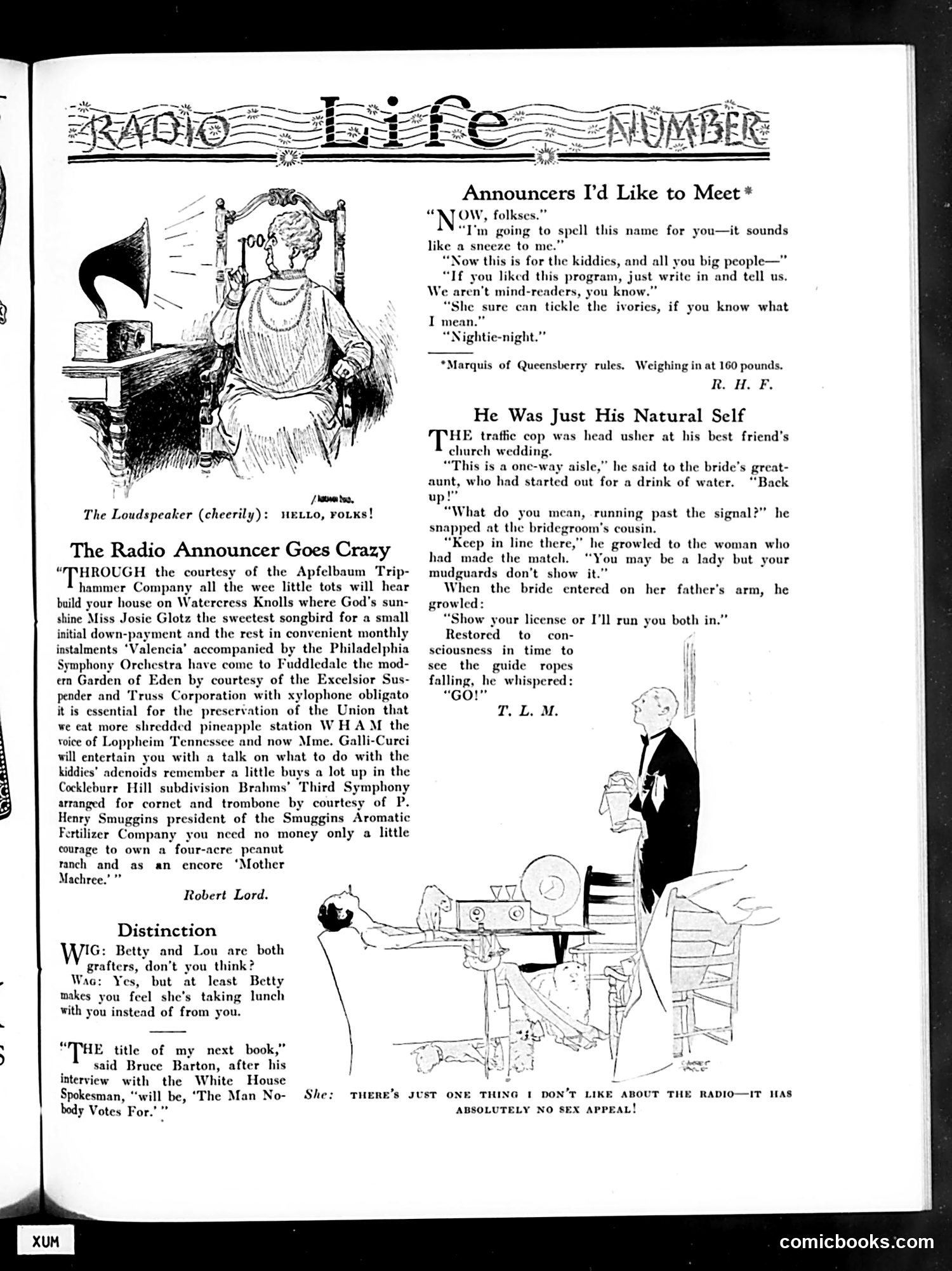
This page satirizes early radio broadcasting and its personalities. The main cartoon shows a traffic cop at a church wedding behaving like a radio announcer—demanding to "see your license" from the bride and groom like he's checking credentials for air time, treating the sacred ceremony as a broadcast performance. The humor targets radio announcers' perceived pretentiousness and their tendency to inject themselves into situations inappropriately. The caption "She: there's just one thing I don't like about the radio—it has absolutely no sex appeal!" suggests contemporary criticism that radio personalities, despite their fame, lacked the visual charisma of stage performers. The page also includes jokes about radio call letters, fictional radio shows, and the medium's growing cultural prominence in what appears to be the 1920s-early 1930s.
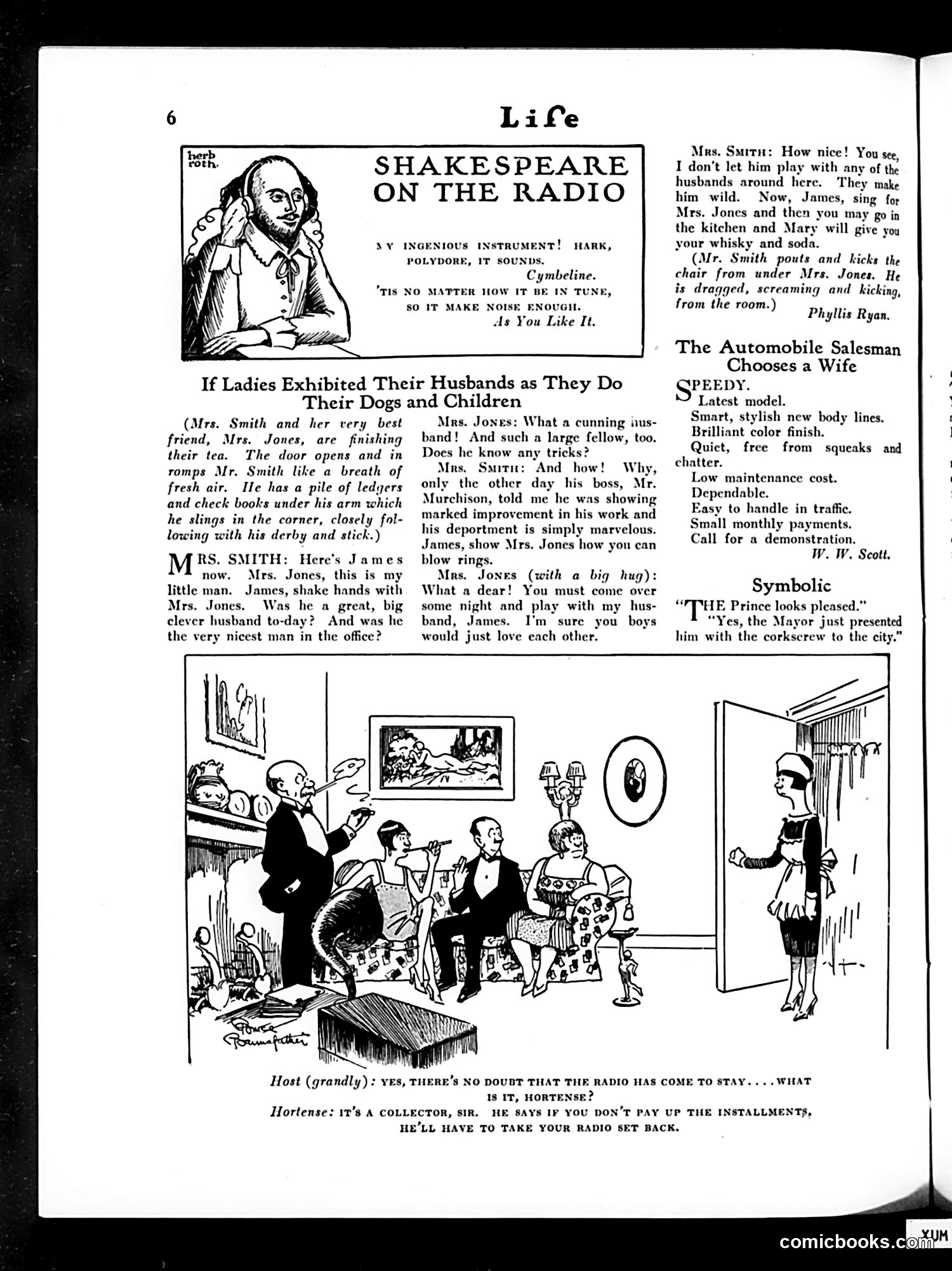
This 1920s *Life* magazine page contains two satirical pieces: **Top:** "Shakespeare on the Radio" mocks radio as a noisy nuisance, using Shakespeare's famous quote to suggest the medium makes listening pointless. **Main cartoon:** "If Ladies Exhibited Their Husbands as They Do Their Dogs and Children" satirizes how women publicly display and brag about their husbands' professional accomplishments. Mrs. Smith boasts that her husband James is "a great, big little man" and "the very nicest man in the office"—reducing him to a trophy-like possession, much as women might show off prize dogs or children. The humor targets how wives publicly perform their husbands' worth rather than recognizing them as independent individuals. **Right side:** Advertisements for automobiles and a joke about radio debt collectors.
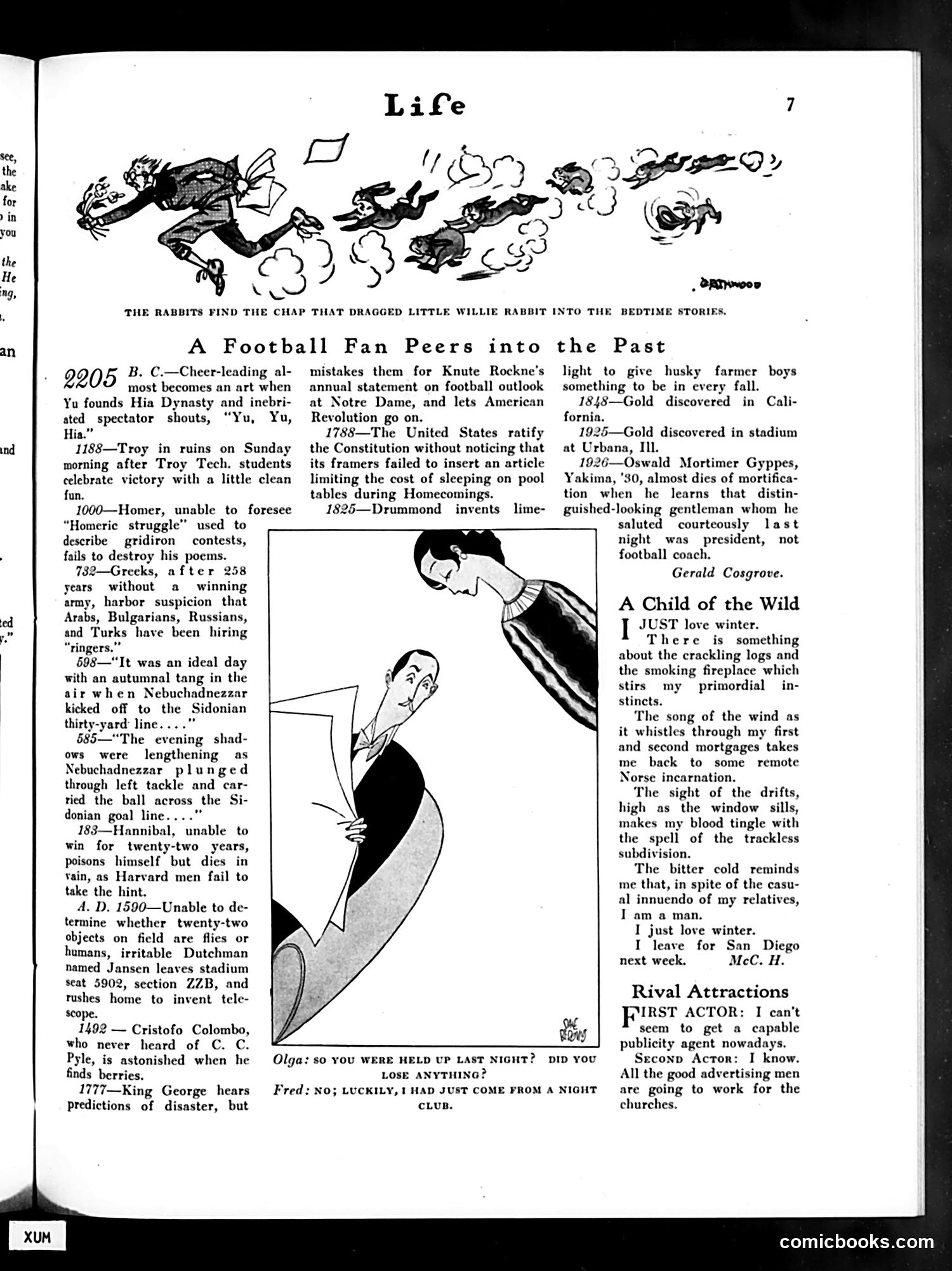
This page contains three distinct sections: **"A Football Fan Peers into the Past"** — A humorous timeline mixing actual historical events with absurd football references, satirizing how obsessed sports fans rewrite history through their passion for the game. **The cartoon** shows two men in conversation. One (labeled "Olga") asks if the other was "held up last night" and lost anything. The other ("Fred") responds he just came from a night club—a joke about the Prohibition era, when "night clubs" were speakeasies (illegal bars), implying he narrowly avoided trouble from gangsters or police raids. **"A Child of the Wild"** and **"Rival Attractions"** are brief humorous prose pieces about winter nostalgia and actors competing for publicity, typical of Life's satirical short-form content. The page exemplifies Life's style: topical humor mixing sports mania, Prohibition-era references, and theatrical gossip.
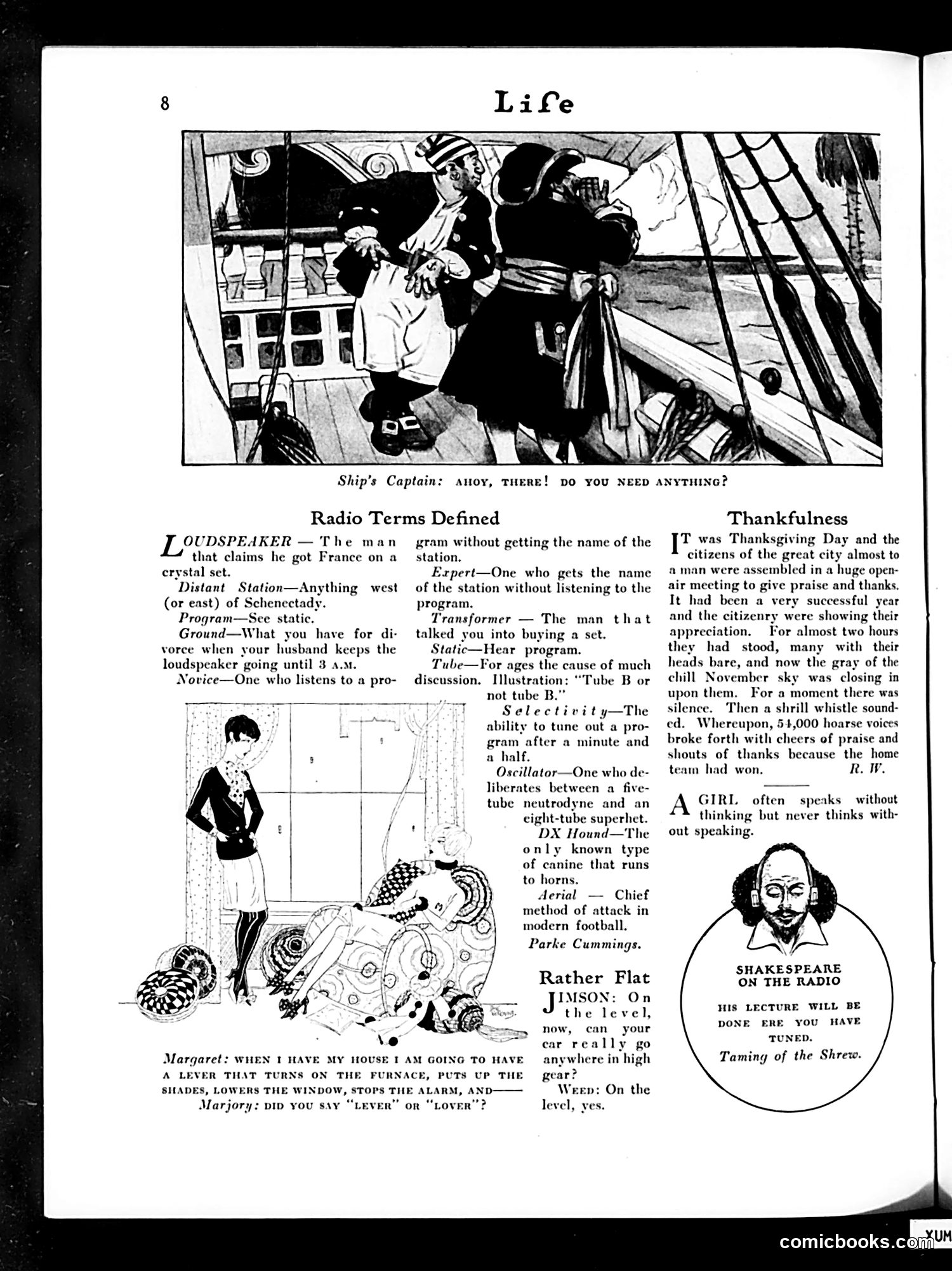
This page contains three separate satirical pieces: 1. **Top cartoon**: A ship's captain asks a passenger if they need anything, depicting leisure travel humor. 2. **"Radio Terms Defined"**: A humorous glossary mocking early radio technology and listener behavior—terms like "Loudspeaker" (man claiming to own France on crystal set) and "Notice" (one who listens without permission). This satirizes both radio's novelty and common domestic annoyances of the era. 3. **"Rather Flat" dialogue**: A brief joke about car mechanics and "high gear," playing on double meanings. 4. **Shakespeare advertisement**: Announces a radio lecture on Shakespeare's "Taming of the Shrew," reflecting 1920s-30s cultural programming on emerging broadcast media. The page overall satirizes early radio culture and its social impact on American households.
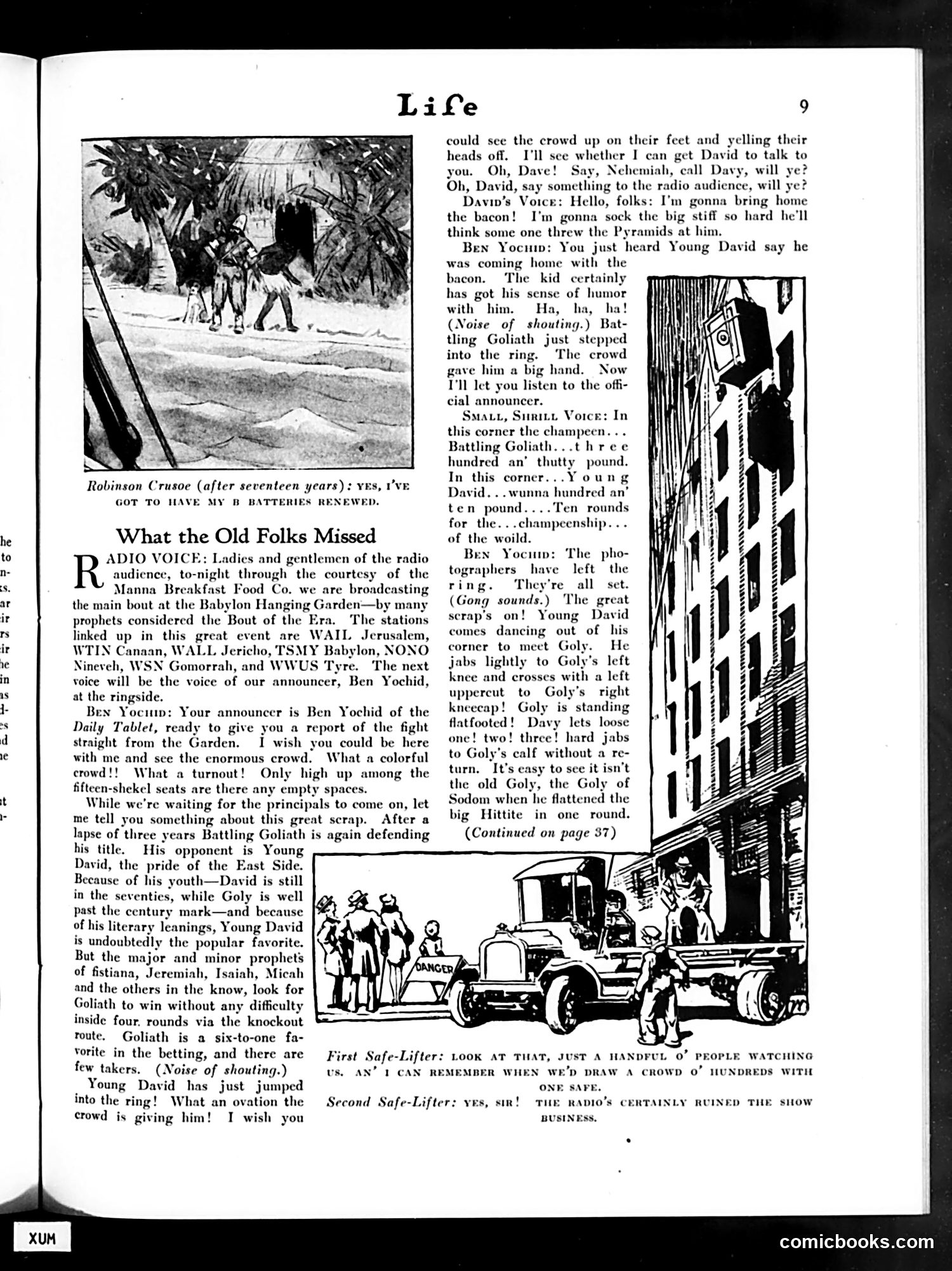
This page satirizes radio broadcasting of a boxing match between "Battling Goliath" and "Young David." The setup is humorous: radio announcers dramatically hype a fight while admitting the actual crowd is tiny—only "a handful of people." The satire targets **radio's power to create artificial excitement**. By broadcasting to a wide audience, radio transforms what would be an obscure, poorly-attended local boxing event into a major entertainment spectacle. The announcers inflate the importance of a sparse gathering into something supposedly momentous. The cartoon also gently mocks **radio's novelty** in this era (likely 1920s-30s), showing how the medium could fabricate drama and grandeur through sheer descriptive hype, regardless of actual events.
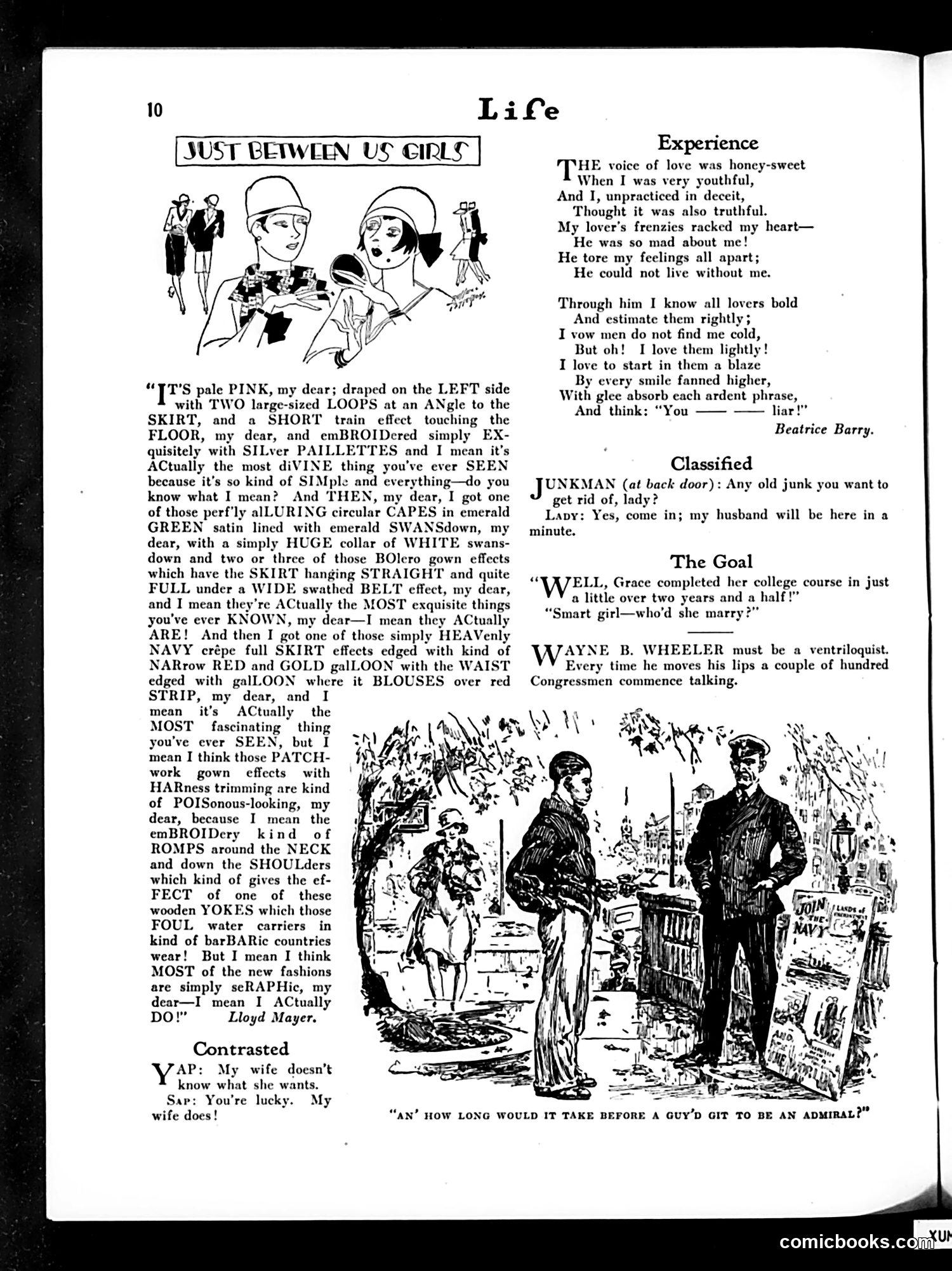
This page contains fashion and social satire typical of Life magazine's "Just Between Us Girls" column. The left section mocks overly elaborate women's fashion, with Lloyd Mayer sarcastically praising absurdly complicated garment construction—layered skirts, multiple collars, beleros, paillettes, and corseting effects. The humor lies in the exaggerated, breathless description of garments that are "Actually the MOST fascinating thing," satirizing both fashion industry excess and women's uncritical enthusiasm for impractical clothing. The right cartoons present brief social humor: "Experience" (a poem by Beatrice Barry about romantic disappointment), "The Goal" (joking that a woman completed college to marry), and "Wayne B. Wheeler" (referencing a temperance advocate). The bottom cartoon appears to satirize military recruitment or Navy admiration. The overall tone mocks consumer culture and women's fashion obsession.
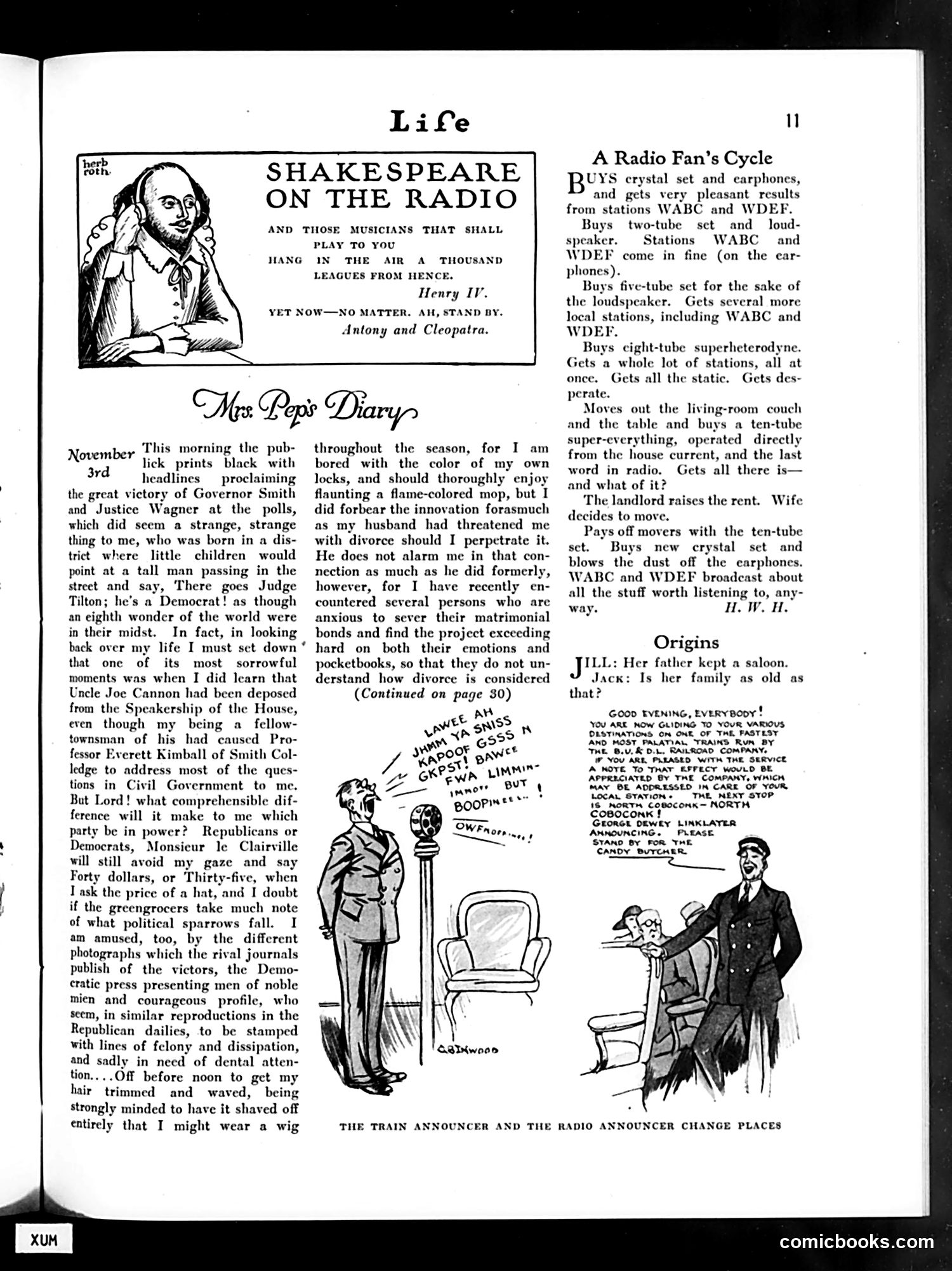
This page from *Life* magazine contains satirical commentary on 1920s radio culture and politics. **"Shakespeare on the Radio"** (top): Mocks the broadcasting of classical drama, suggesting even Shakespeare's plays become tedious when transmitted via radio. **"Mrs. Pep's Diary"** (left column): A woman's diary entry from November 3rd discusses Governor Smith and Justice Wagner at the polls—likely referencing a 1920s election. She satirizes the political establishment by comparing Democratic politicians unfavorably to Republican figures. The entry mocks both the pretentiousness of political discourse and the trivial concerns of society women. **"A Radio Fan's Cycle"** (right): Humorously traces an enthusiast's escalating radio purchases—from crystal sets to increasingly expensive tubes—culminating in financial ruin and domestic conflict. **"The Train Announcer and Radio Announcer Change Places"** (bottom): A cartoon showing the absurdity of professional role confusion in communications. The overall theme critiques radio's cultural dominance and commercialization in 1920s America.
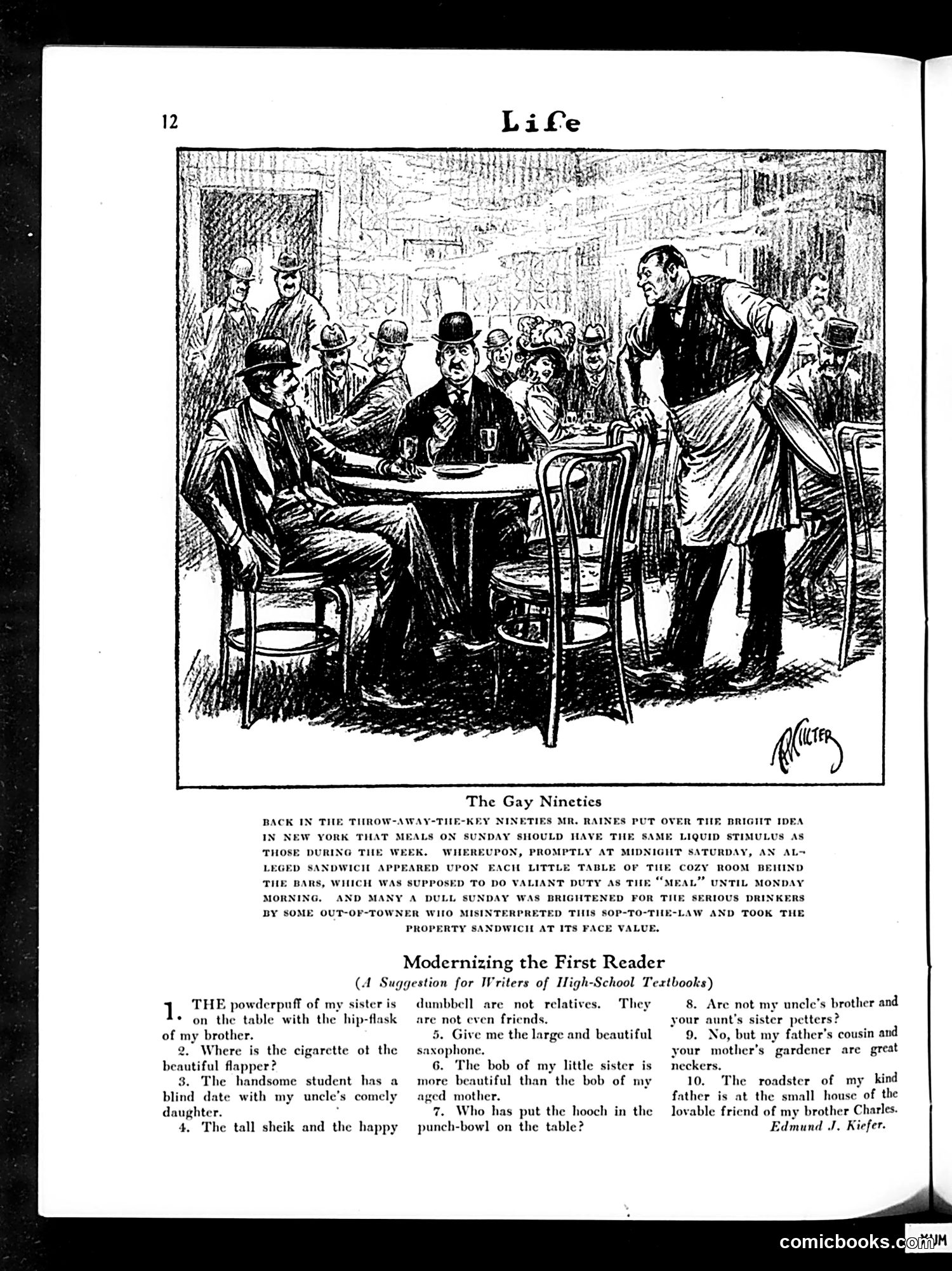
This illustration satirizes a 1890s New York dining trend. The caption explains that Mr. Raines (a recognizable figure of the era, likely a politician or public official) promoted "Sunday meals" with alcoholic beverages in restaurants—a way to circumvent laws restricting alcohol sales on Sundays. The cartoon shows a crowded establishment where sandwiches appear on each table, ostensibly making the alcohol a secondary accompaniment to food, thereby technically legal. The satire targets both the transparent loophole and the "dull Sunday" drinkers who exploited it, with some patrons apparently misinterpreting or abusing the arrangement. The page also includes a separate humor section titled "Modernizing the First Reader," offering absurdist questions (like "The handsome student has a blind date with my uncle's comely daughter") parodying old schoolbook exercises.
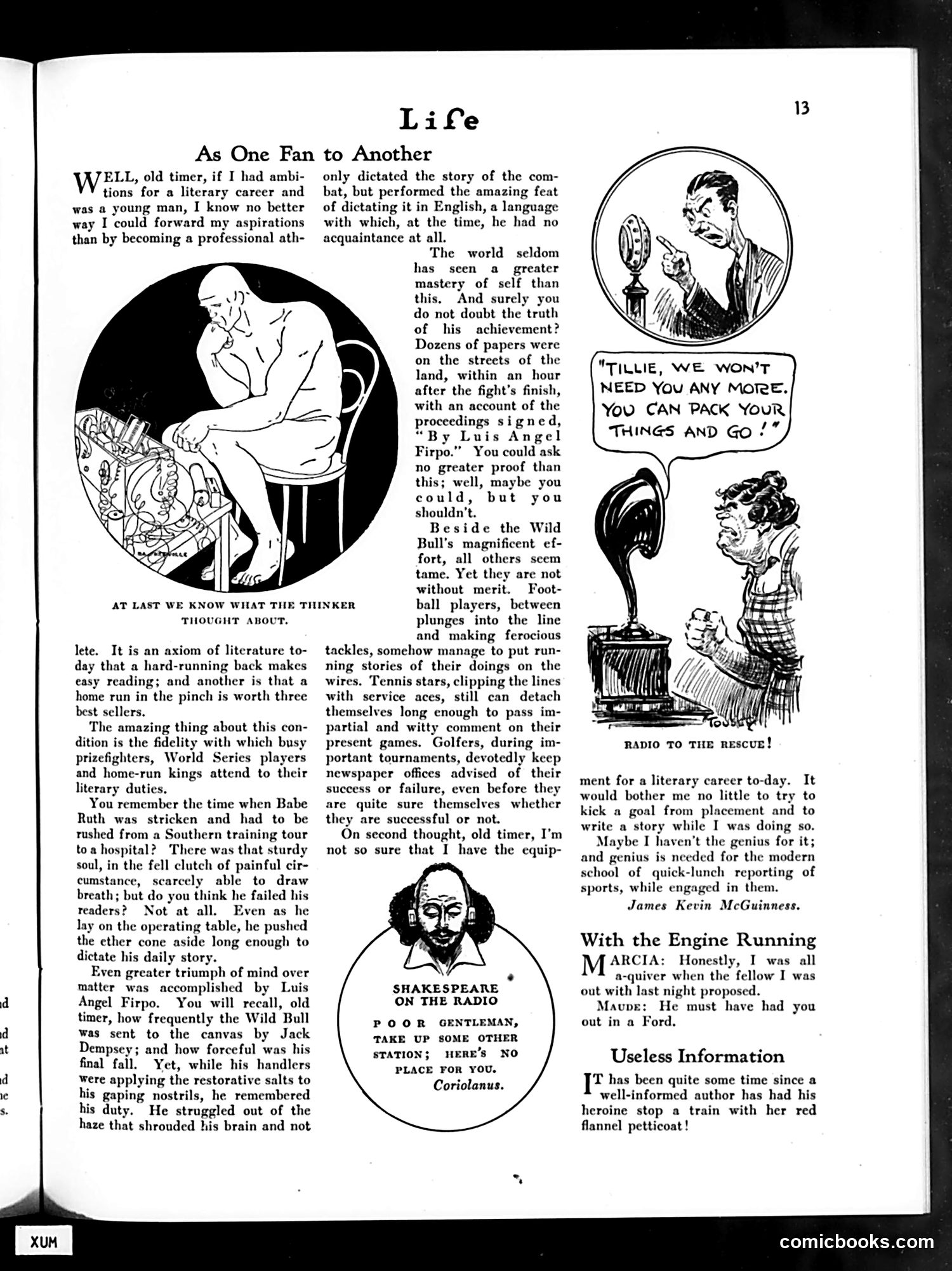
This page satirizes sports journalists' literary pretensions. The main article, "As One Fan to Another," mocks sportswriters who claim literary ambitions while covering athletic events. The cartoons illustrate the absurdity: one shows a thinker contemplating sports (labeled "AT LAST WE KNOW WHAT THE THINKER THOUGHT ABOUT"), and another depicts a radio announcer being told to "pack your things and go"—suggesting sports broadcasting requires no particular skill or permanence. A Shakespeare quote appears in a circular vignette, perhaps ironically contrasting "high" literature with sports reportage. The final section, "With the Engine Running," begins a dialogue between characters named Marcia and Maude discussing a marriage proposal involving a Ford automobile—satirizing consumer culture and romantic clichés of the era.
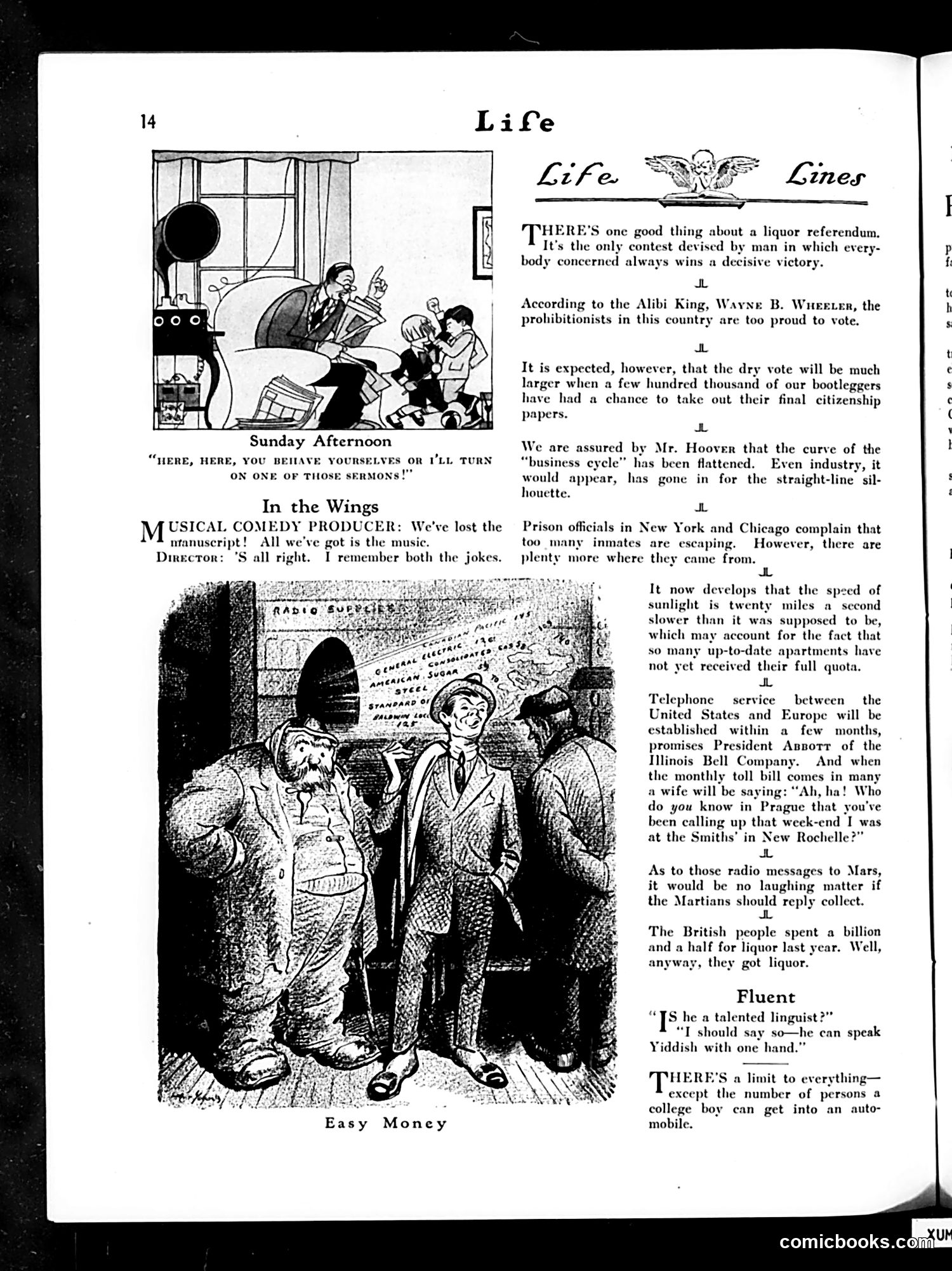
This page contains several short satirical pieces typical of 1920s Life magazine humor: **"Sunday Afternoon" cartoon** mocks domestic scenes where husbands endure wives' complaints about their behavior. **"In the Wings"** is a brief joke about lost musical comedy manuscripts, playing on theatrical mishaps. **"Easy Money"** cartoon depicts what appears to be radio or electrical equipment salesmen, likely satirizing the 1920s technology boom and speculative business schemes targeting ordinary people. The **"Life Lines"** column comments on contemporary issues: liquor referendums (Prohibition-era), prison escapes, sunlight speed, European telephone service expansion, Mars radio messages, and British alcohol spending. **"Fluent"** is a short joke about linguistic ability. The humor reflects post-WWI American concerns about technology, regulation, and consumer culture.
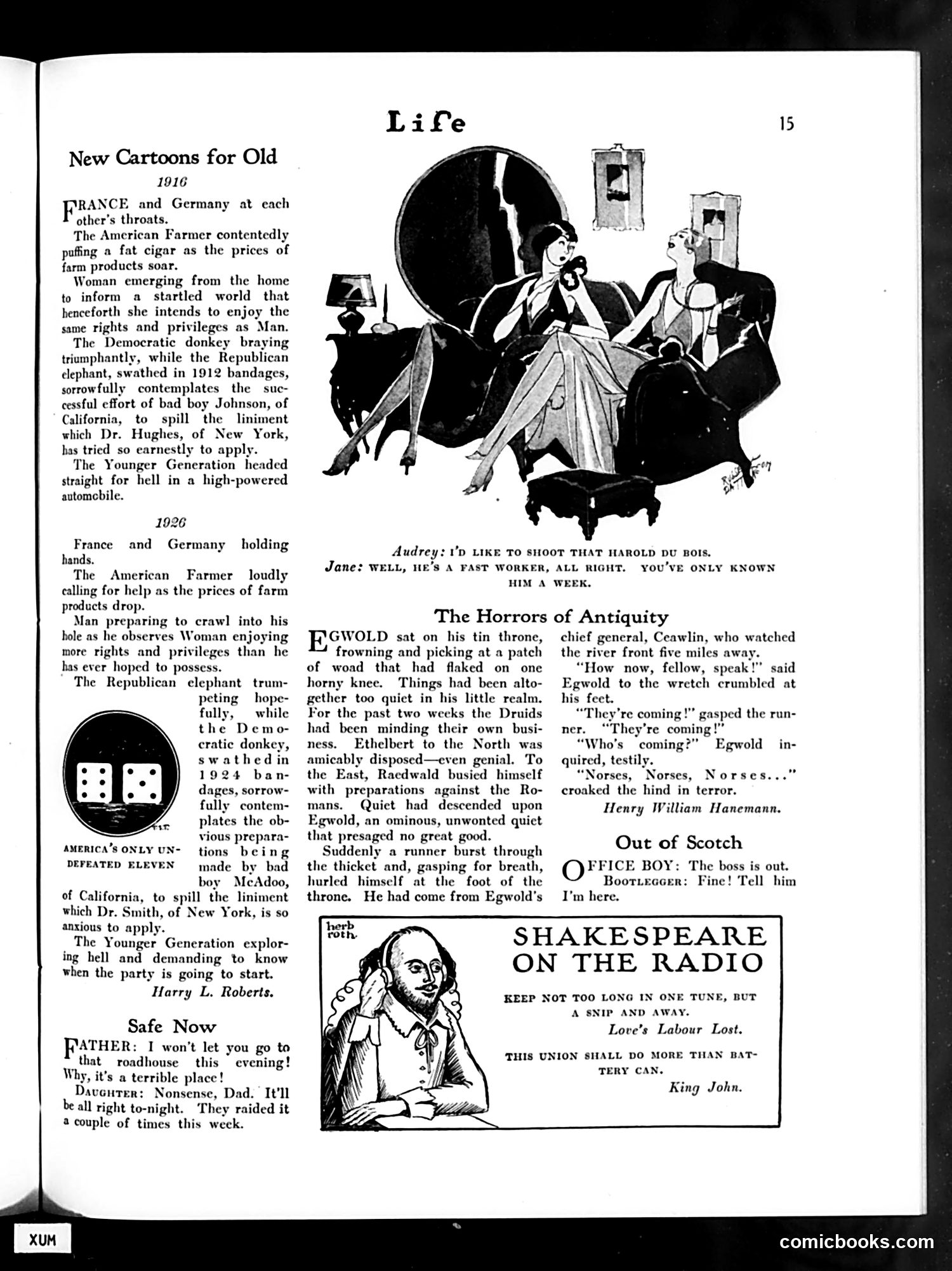
The top cartoon satirizes women's suffrage and evolving gender roles. A woman emerges from her home declaring she'll enjoy "the same rights and privileges as a Man," while political donkeys and elephants (Democratic and Republican parties) react with alarm. The text contrasts 1916 (pre-suffrage) with 1926 (post-suffrage), mocking male anxiety about women's equality. Below, "The Horrors of Antiquity" humorously depicts the ancient Druid invasion through a modern lens—a Roman general named Ewgold watches approaching forces with exaggerated panic. The page also includes brief comedic sketches: "Safe Now" jokes about parental authority over daughters, while "Out of Scotch" and "Shakespeare on the Radio" offer quick satirical quips about Prohibition-era shortages and mass media.
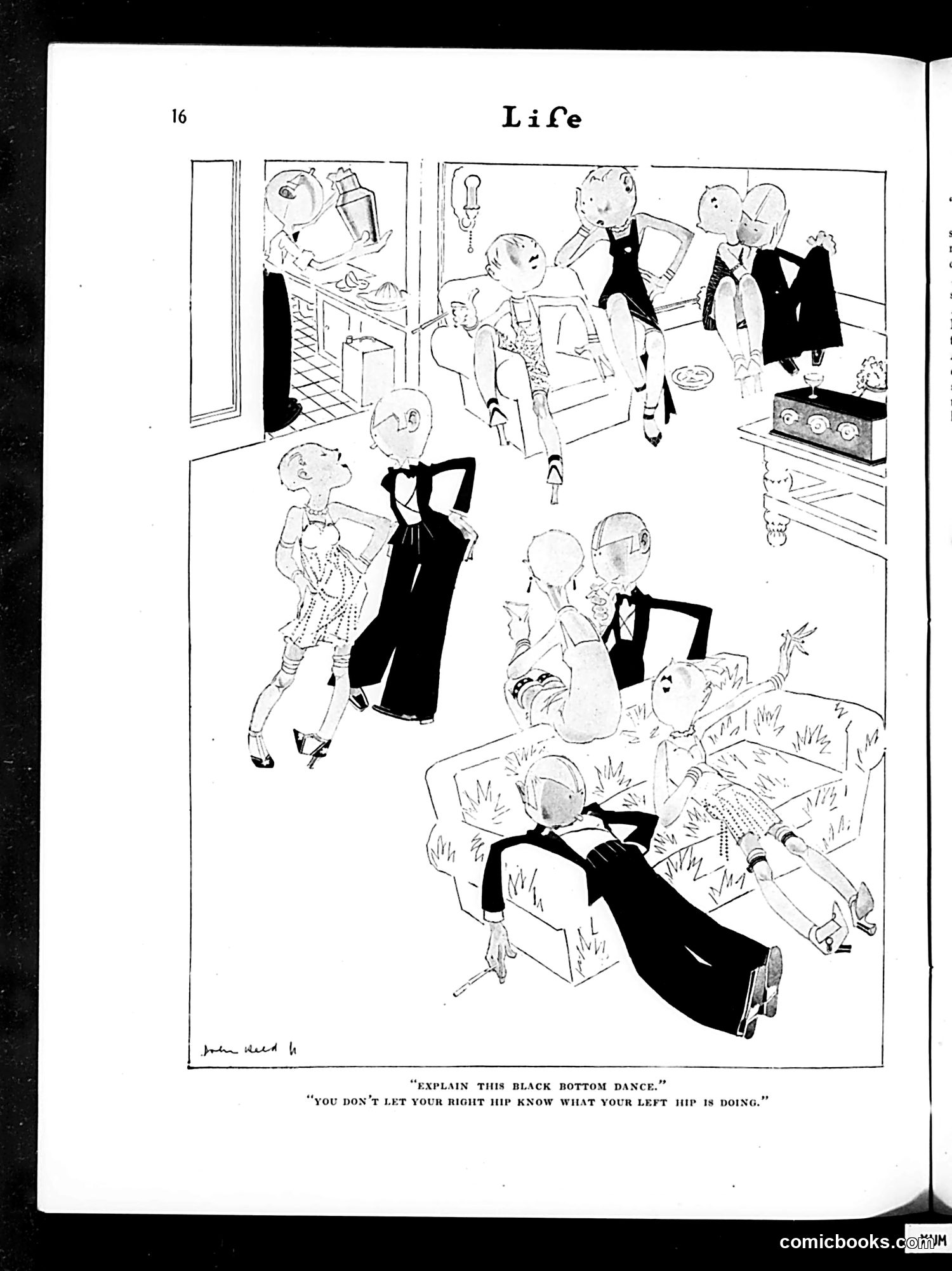
This satirical illustration depicts a chaotic domestic scene titled "Explain This Black Bottom Dance," referencing a popular 1920s dance craze. The caption jokes: "You don't let your right hip know what your left hip is doing." The cartoon mocks the "Black Bottom" dance—an African American-originated dance that scandalized conservative society for its suggestive hip movements. The illustration shows multiple figures in formal attire attempting (or observing) this dance in a home setting, with exaggerated physical contortions. The humor targets both the dance's perceived impropriety and the difficulty respectable people had explaining or executing such "modern" movements. The satirical point critiques 1920s cultural anxiety about new dances and changing social norms regarding movement and propriety.
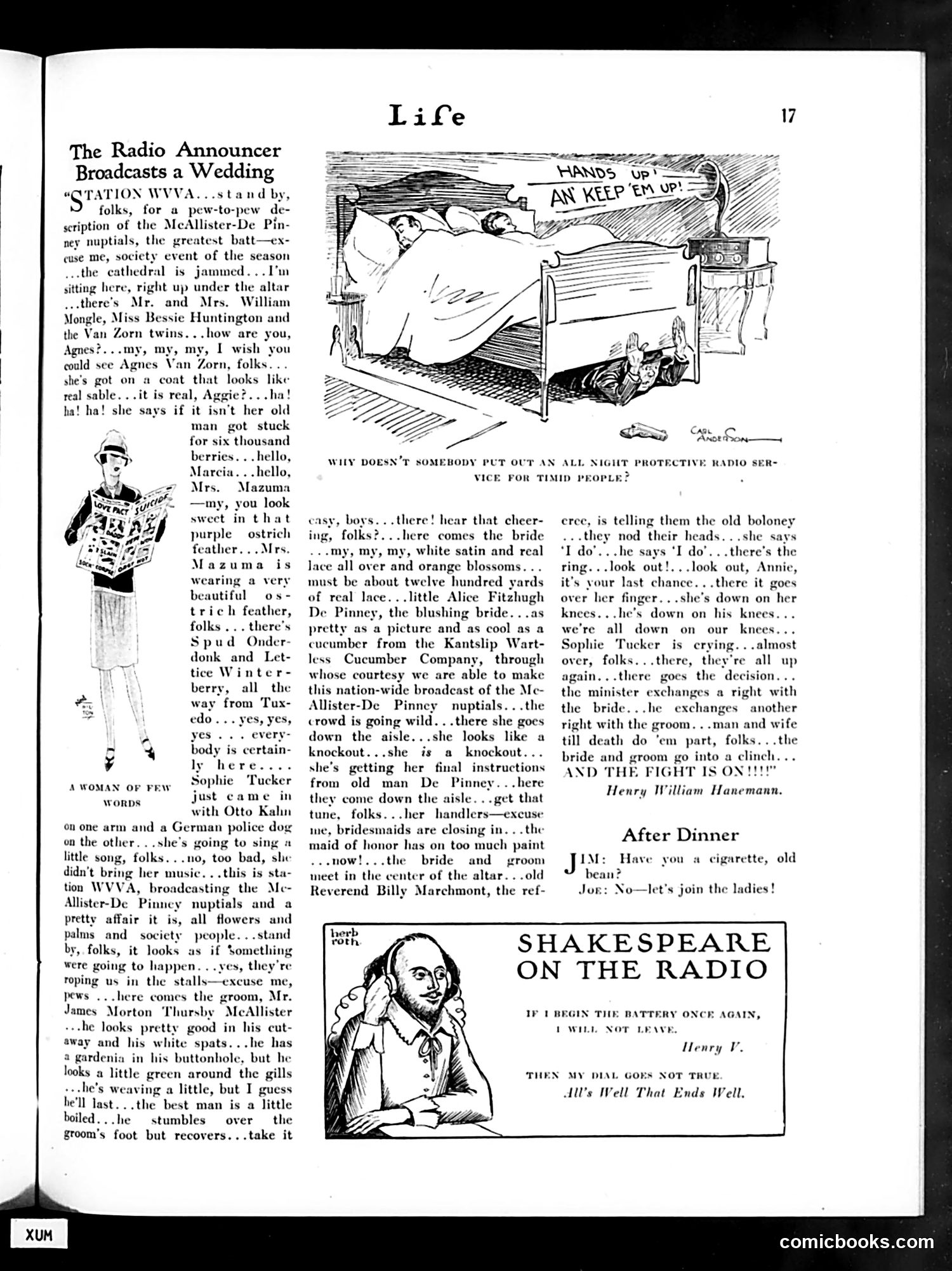
**Main Cartoon**: The large illustration shows a couple in bed with a radio broadcasting their wedding. The caption asks: "Why doesn't somebody put out an all night protective radio service for timid people?" This satirizes the radio announcer's intrusive live broadcast of a McAllister-De Pinney wedding. The joke mocks the era's enthusiasm for broadcasting every public event over radio, suggesting that anxious people need "protection" from such invasive media coverage. **Side Content**: "The Radio Announcer Broadcasts a Wedding" is a humorous monologue mimicking the breathless, overly detailed radio commentary style of the 1920s-30s, describing wedding details with exaggerated enthusiasm. **Context**: This reflects early radio's novelty and the public's mixed reaction to broadcasting becoming ubiquitous in American life—amusing to some, intrusive to others.
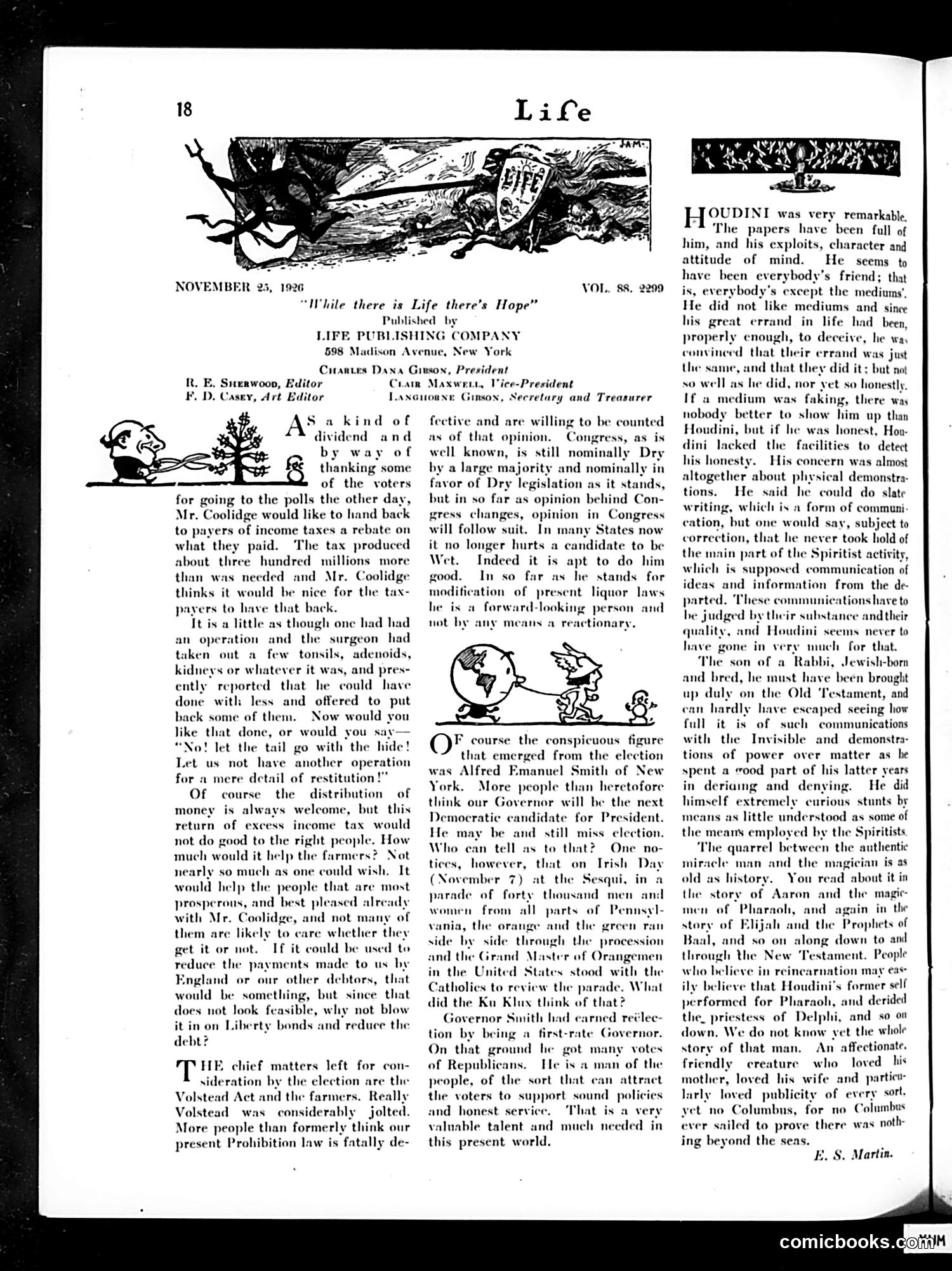
This page contains political editorial commentary rather than cartoons. The main topics are: **Coolidge's Tax Rebate**: The editor criticizes President Coolidge's proposal to return surplus income tax revenue to taxpayers, arguing it would primarily benefit the wealthy and prosperous rather than farmers or those truly in need. **Prohibition**: The piece notes that the 1926 election revealed growing public opposition to the Volstead Act (Prohibition law). Congress remains nominally "Dry," but public opinion is shifting, and candidates can now safely advocate for modification of liquor laws without political damage. **Alfred E. Smith**: The editors discuss New York Governor Smith as an emerging Democratic presidential prospect. They praise his competence and ability to attract voters. A notable anecdote: at a Pennsylvania parade on Irish Day (November 7), Catholic and Orange (Protestant) marchers processed together with the Grand Master of Orangemen—suggesting Smith's appeal transcends traditional religious divisions that the Ku Klux Klan exploited. The page also briefly mentions magician Houdini's death and his campaign against fraudulent spiritualist mediums.
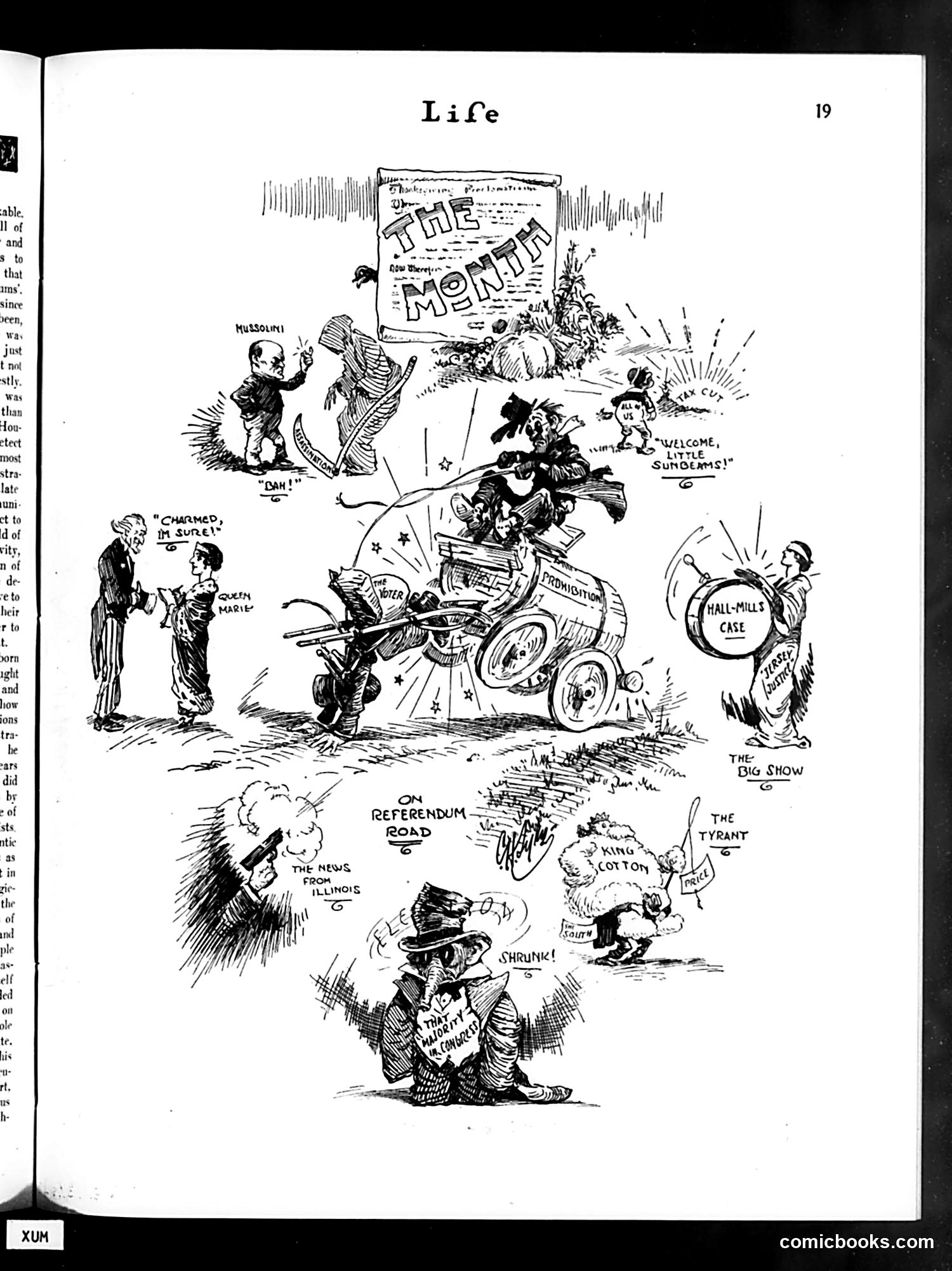
This is a satirical cartoon from *Life* magazine depicting various American political and social issues of its era. The central scene shows "The Money" as a chaotic vehicle driven by multiple figures representing different interests—likely politicians and special interests—careening down "Referendum Road." Around this core image are smaller vignettes: "Hubboun" and "Dan" appear to reference political figures or scandals; "The Hall-Mills Case" and "The Big Show" suggest contemporary legal proceedings or entertainment scandals; "The Tyrant King Cotton" critiques agricultural power; and "The News from Illinois" indicates state-level political controversy. The overall message satirizes American democracy as chaotic, driven by competing money interests and sensational scandals rather than principled governance. The specific references require historical context to identify precisely, but the satire's target—corruption and disorder in American politics—is clear.
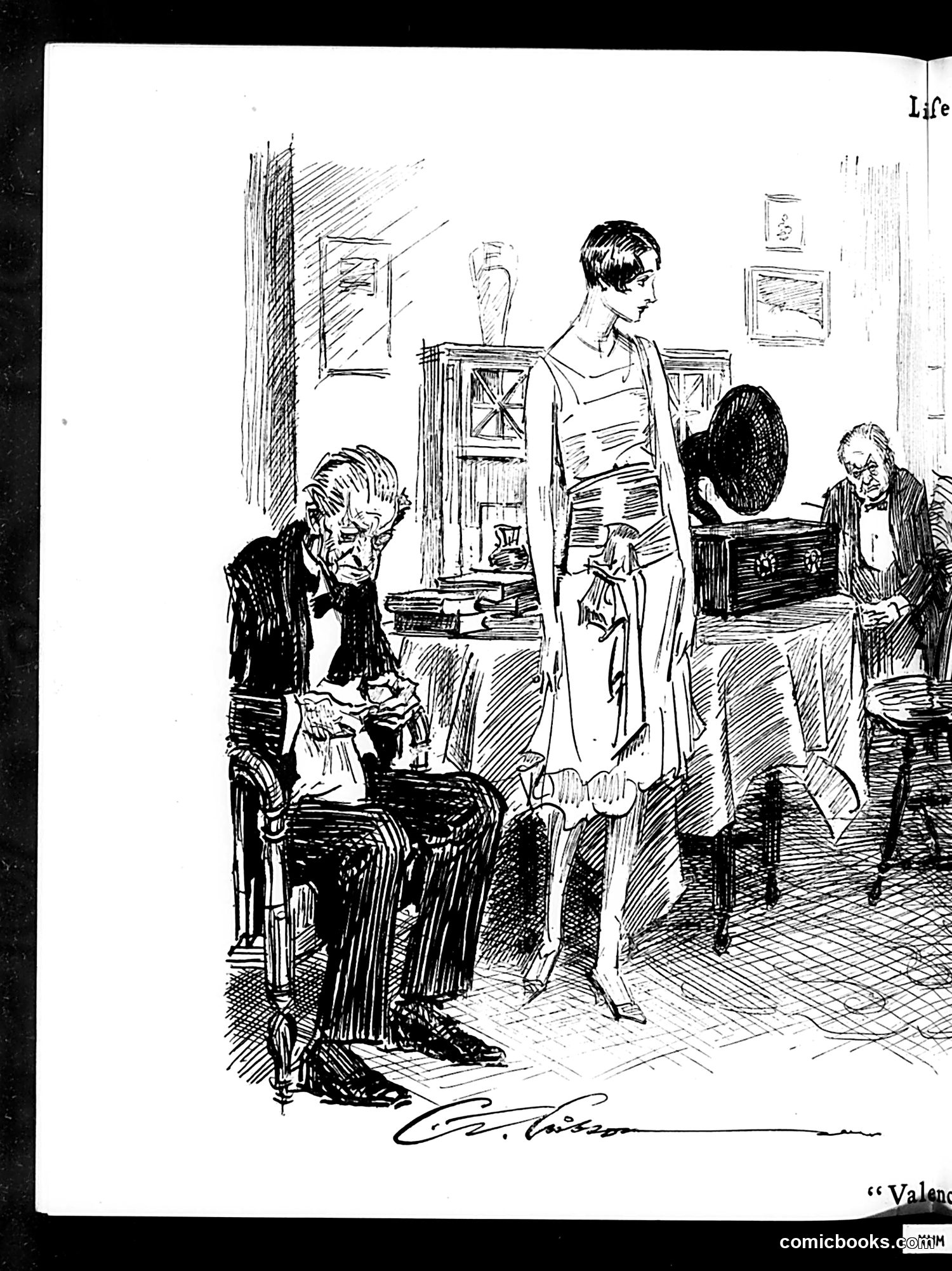
The OCR text appears corrupted and unreadable. However, the image shows a pen-and-ink illustration (signed, likely by the artist) depicting what appears to be a social or domestic scene. A tall woman in a long dress stands prominently in the center, while an older man seated on the left appears to be examining or addressing a small child. Another older man stands on the right. The interior setting includes furniture, a mirror, and framed pictures on walls. Without legible text or caption, I cannot definitively identify the specific satirical point, the historical figures referenced, or the social commentary intended. The style and technique suggest early-to-mid 20th century Life magazine humor, likely concerning family dynamics, class relations, or social mores of that era, but further details cannot be reliably determined from the corrupted OCR alone.
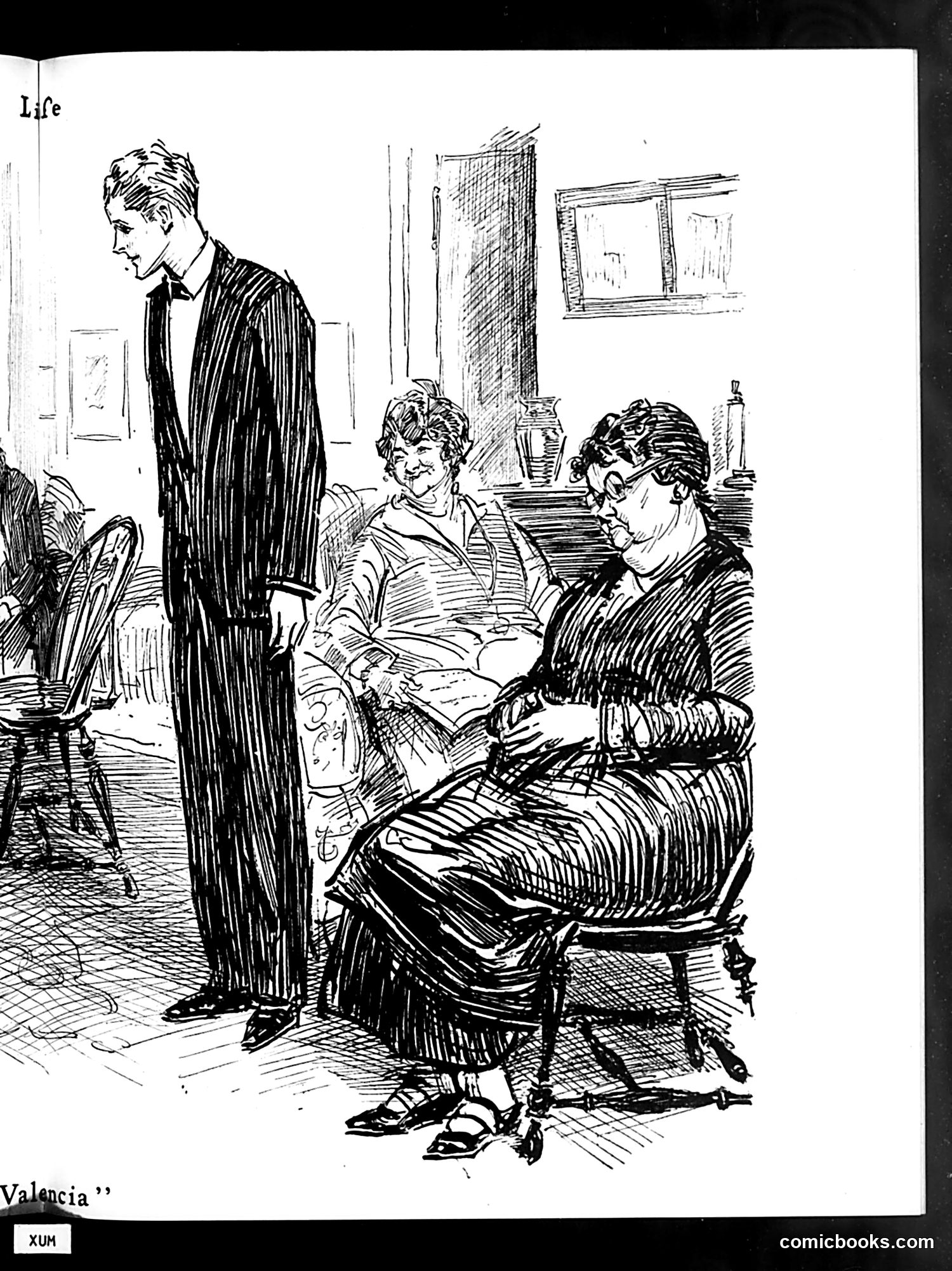
This page features a single ink sketch signed "Valencia" depicting what appears to be a domestic or social scene. A tall man in a pinstriped suit stands conversing with two seated women in an interior setting with visible windows and furnishings. The drawing style and composition suggest this is likely satirical commentary on social interaction or class dynamics typical of *Life* magazine's humor. However, the OCR text provided is largely illegible—appearing as scattered characters and symbols rather than readable content. Without clear accompanying text or captions, I cannot definitively identify the specific figures, historical context, or the intended satirical point. The image alone shows skilled period illustration but requires legible text to determine its actual subject matter and social commentary.
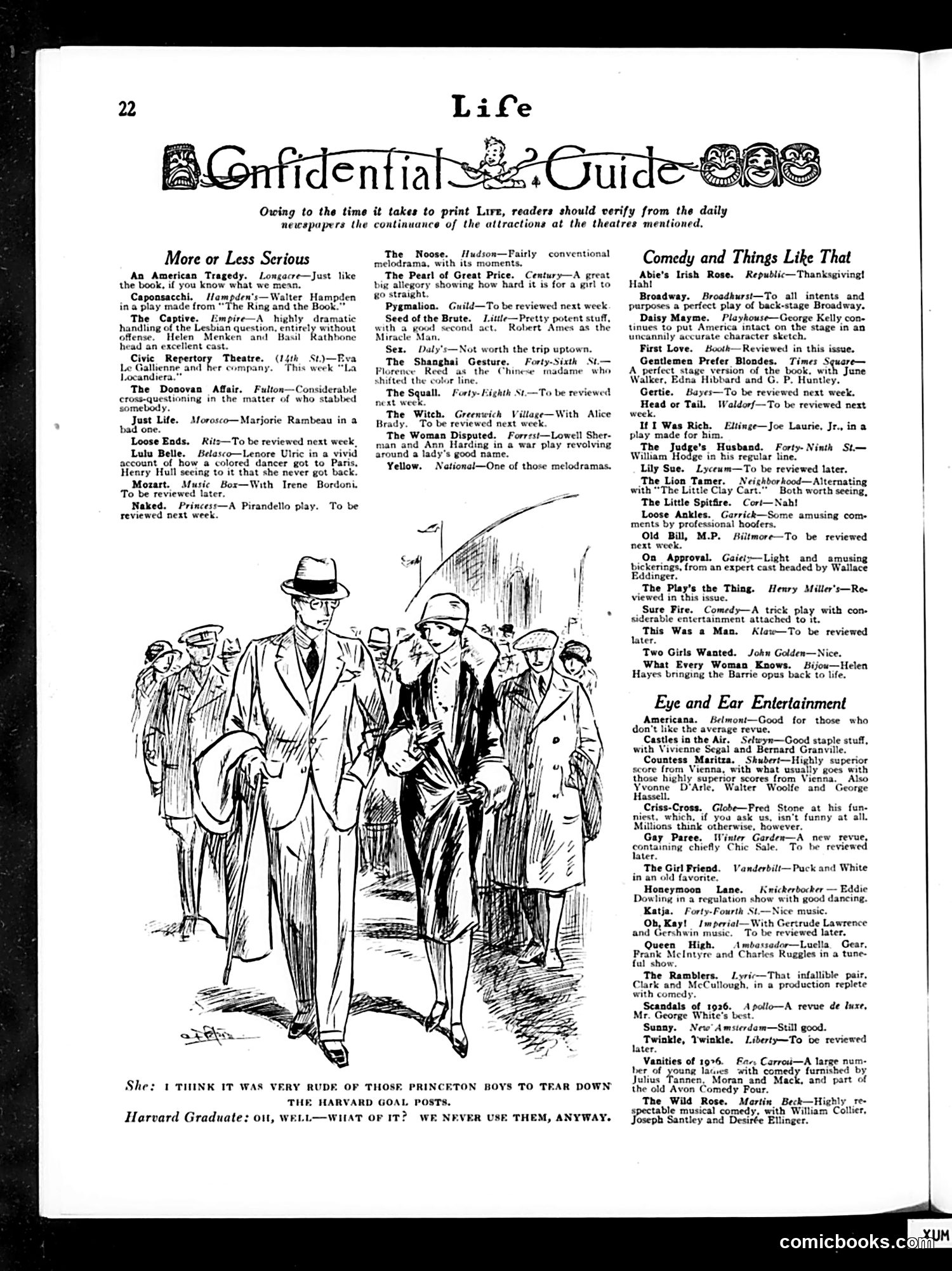
This is a theater review page from Life magazine listing current Broadway productions. The single cartoon depicts two men in overcoats and hats (appearing to be college students or young men) in conversation. The dialogue reveals a Harvard-Princeton rivalry joke: A woman comments that it was "rude" of Princeton boys to tear down Harvard's goal posts. The Harvard graduate responds dismissively: "Oh, well—what of it? We never use them, anyway," implying Harvard doesn't need goal posts because they don't play football or are uncompetitive athletically. This satirizes the era's intense Ivy League rivalry and masculine athletic pride. The "rude" vandalism of goal posts was apparently a real occurrence between these schools. The Harvard man's response mocks his own institution through false bravado—claiming indifference to something clearly important to college identity. The page itself is primarily a theater guide with brief synopses of 1920s Broadway shows.
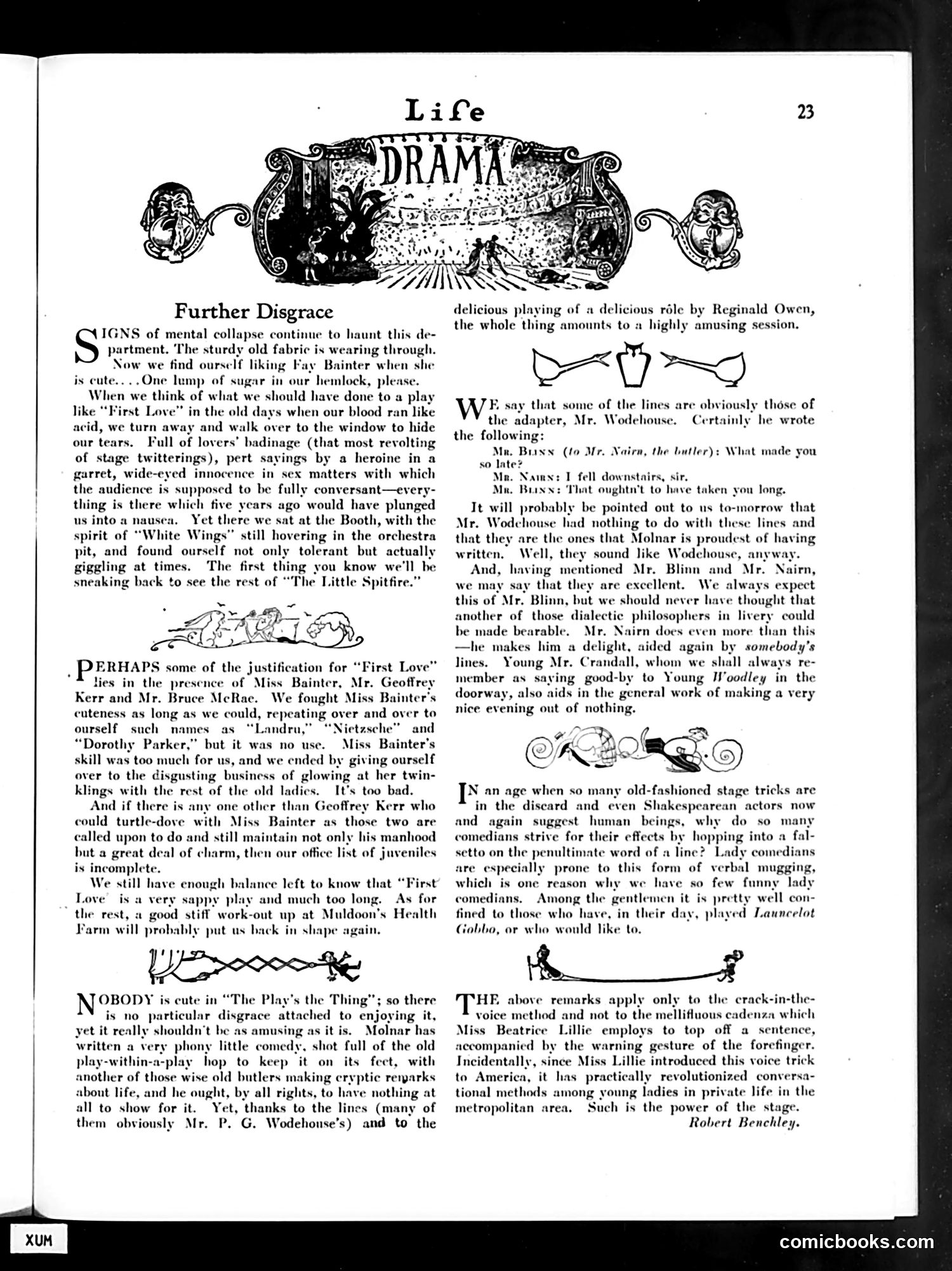
This is a theatrical review column critiquing Broadway productions. The author expresses mock dismay at their own softening critical standards—they're embarrassed to admit they *enjoyed* sentimental plays like "First Love" starring Fay Bainter, which they would have despised years earlier. The satire targets the reviewer's fading cynicism: they invoke names like "Landru" (a serial killer) and "Nietzsche" to steel themselves against Bainter's charm, but fail. They joke about needing a "health farm" to recover their moral rigor. The column also praises "The Play's the Thing" (a Molnár comedy adapted by P.G. Wodehouse), with particular appreciation for the witty dialogue and Reginald Owen's performance. The humor lies in the reviewer's self-aware recognition that they're becoming a sentimental "old lady" rather than the acid-tongued critic they once were—a decline they treat as both amusing and slightly shameful.
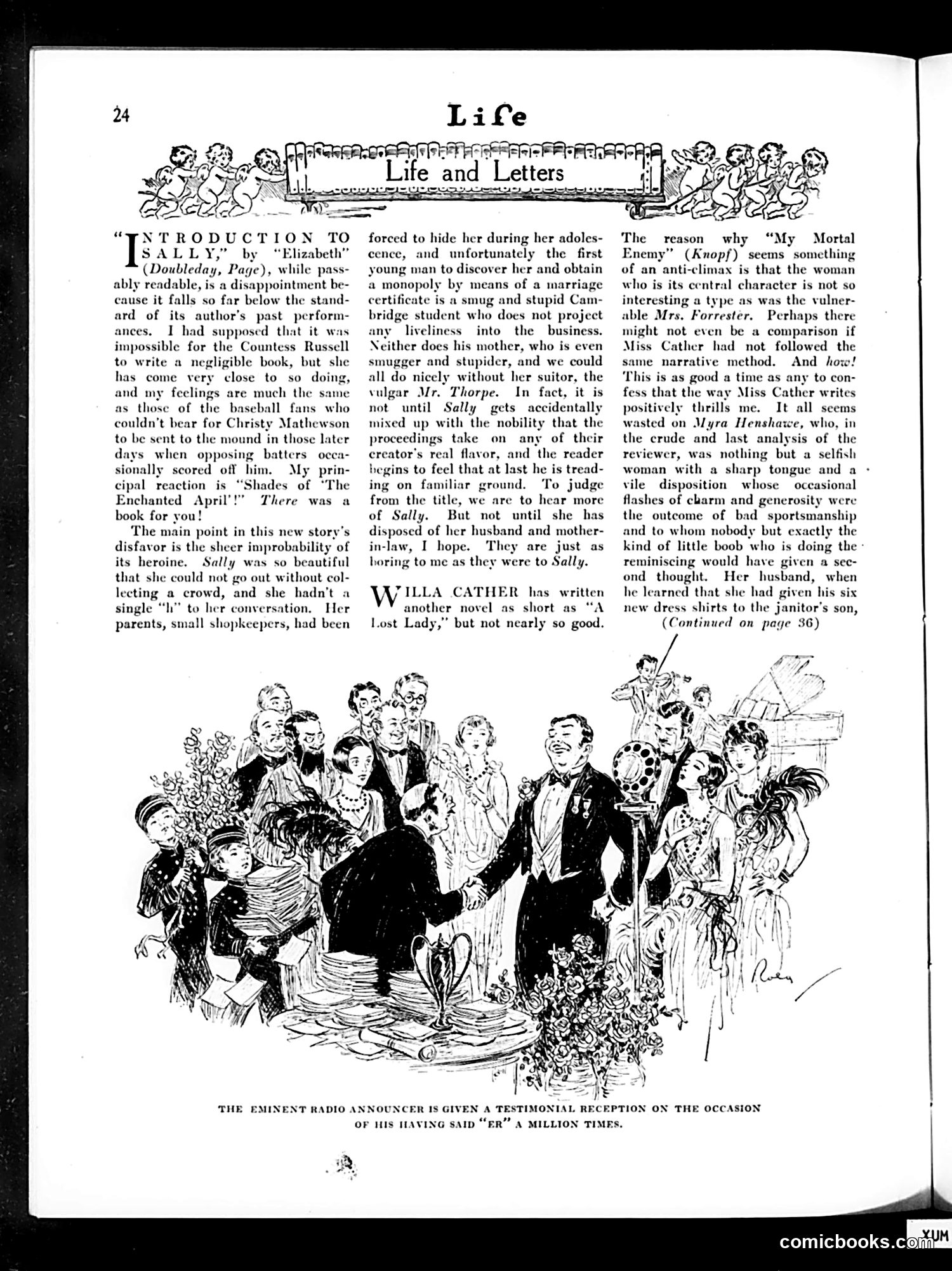
This page presents **book reviews** rather than political cartoons. The content critiques two contemporary novels: 1. **"Introduction to Sally"** by Elizabeth (Countess Russell) — The reviewer finds it disappointing compared to her earlier work "The Enchanted April." The heroine Sally is criticized as implausibly beautiful and inarticulate, with an uninteresting husband who is a "smug and stupid Cambridge student." 2. **"My Mortal Enemy"** by Willa Cather — The reviewer admires Cather's writing style but finds the protagonist Myra Henshawe less compelling than her previous character Mrs. Forrester. Henshawe is described as fundamentally selfish and sharp-tongued. The **illustration** at bottom depicts a formal testimonial reception, likely satirizing the radio announcer who has said "er" a million times — a joke about verbal tics and broadcasting conventions of the era.
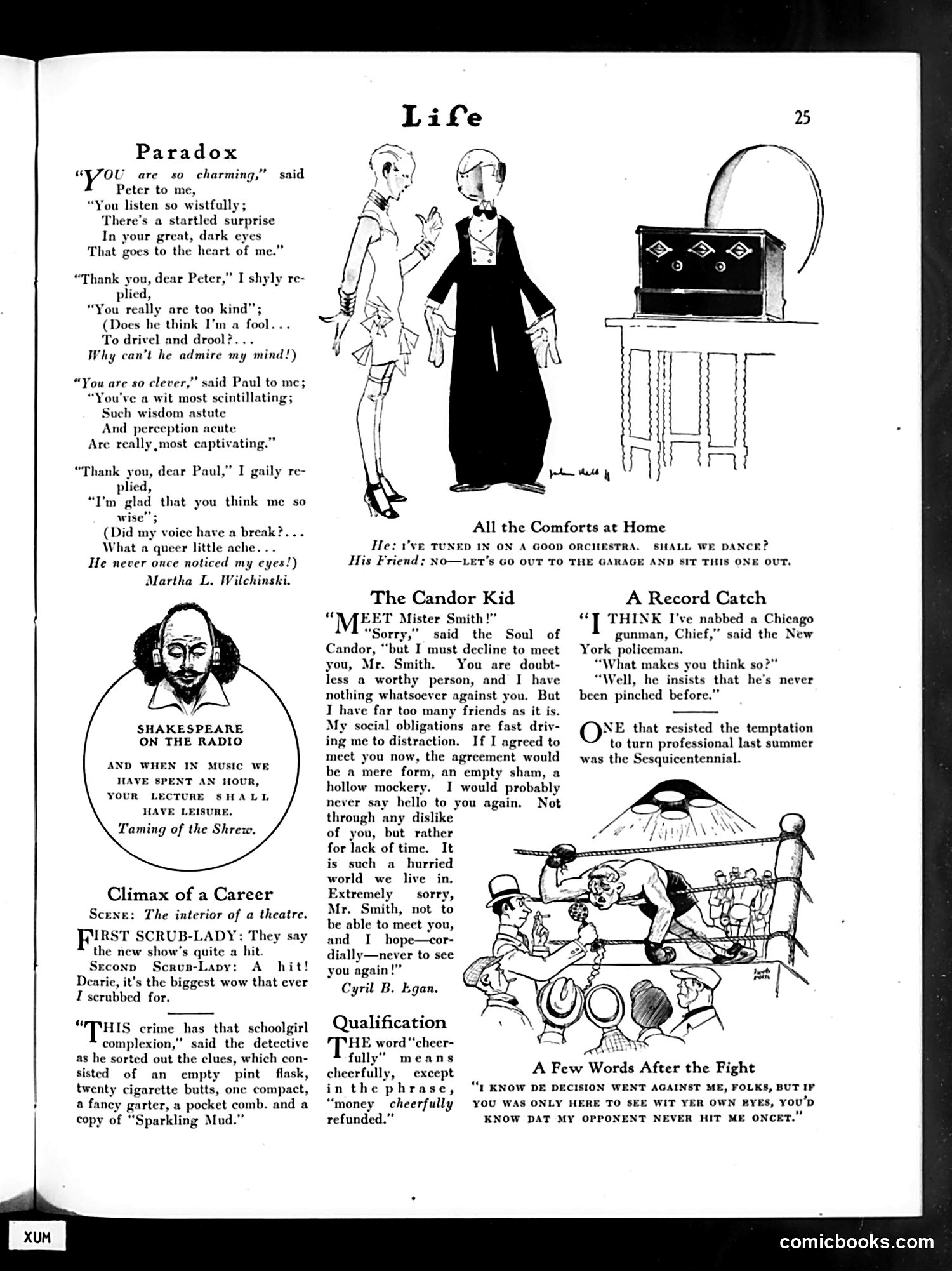
This page from *Life* magazine contains multiple short humorous pieces satirizing early 20th-century American social conventions and culture. **"Paradox"** mocks gender expectations: a woman receives compliments on her charm and cleverness, but privately resents being appreciated for appearance rather than intellect, and intellect rather than beauty—suggesting women faced contradictory, impossible standards. **"The Candor Kid"** satirizes excessive frankness as social rudeness: a character refuses a meeting with brutal honesty about having too many friends, inverting normal politeness. **"All the Comforts at Home"** jokes that radio entertainment is so poor, guests prefer sitting in a garage over listening indoors. **"A Record Catch"** plays on criminal stereotypes: a policeman assumes a man is a gangster because he claims never being arrested—implying Chicago criminals were so common, innocence seemed suspicious. The **Shakespeare quote** about women's lectures needing "leisure" suggests period attitudes toward women's education. These pieces reflect 1920s anxieties about changing social roles, technology, and urban crime.
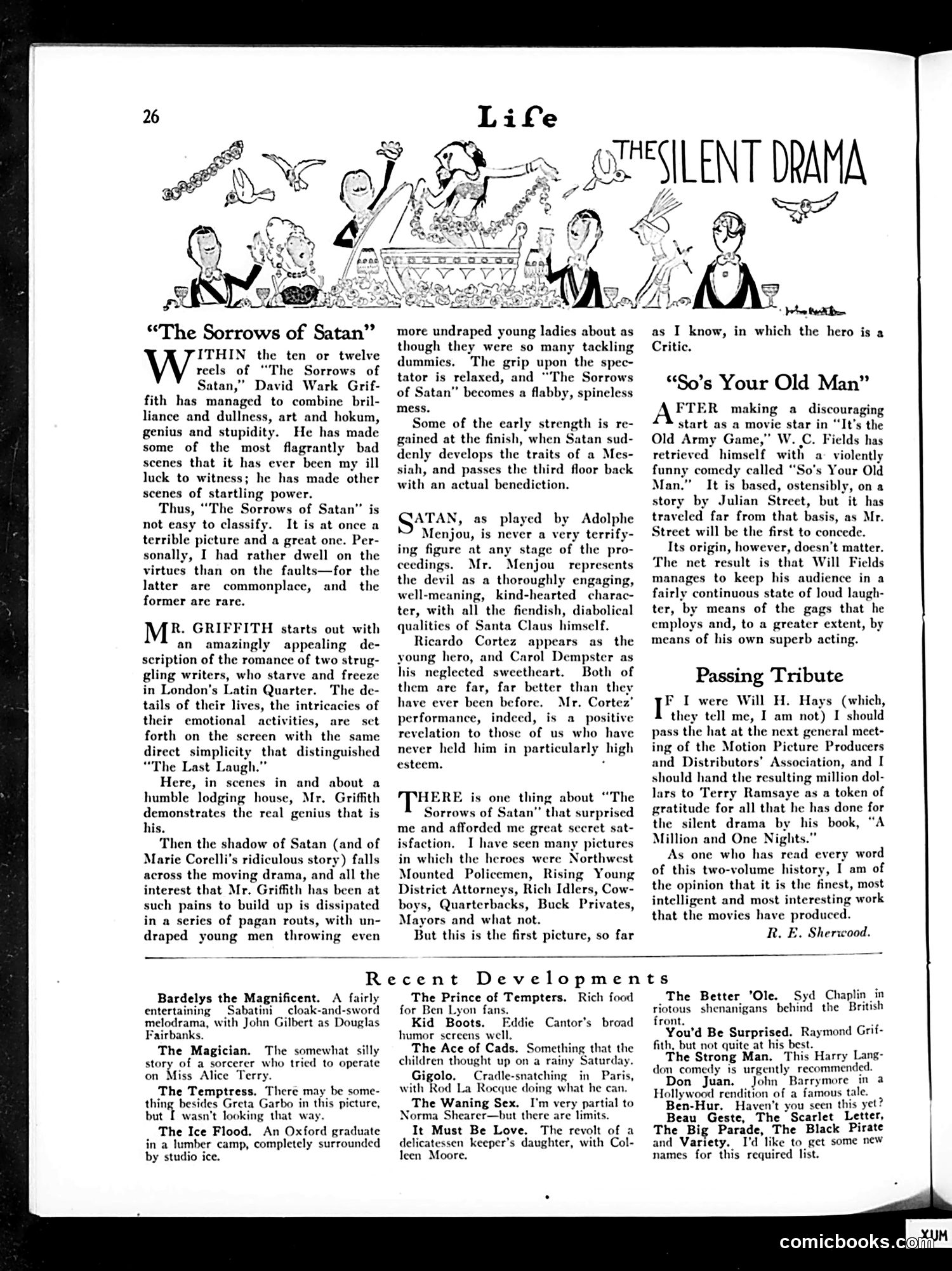
This page contains film criticism from Life magazine's entertainment section. The main review critiques D.W. Griffith's "The Sorrows of Satan," a silent film adaptation of Marie Corelli's novel featuring actor Adolphe Menjou as Satan. The critic praises Griffith's early scenes depicting struggling writers in London but faults the film's descent into "pagan routs" with undraped actors—dismissing these sequences as "flabby" spectacle that undermines the narrative. Notably, the reviewer celebrates that this film's hero is a *critic*, a rarity in Hollywood. A secondary review praises W.C. Fields' comedy "So's Your Old Man," crediting Fields' "superb acting" and gags for sustained laughs despite the thin plot. The page reflects 1920s cinema debates: the tension between artistic ambition and commercial entertainment, and the emerging legitimacy of film criticism as a cultural institution.
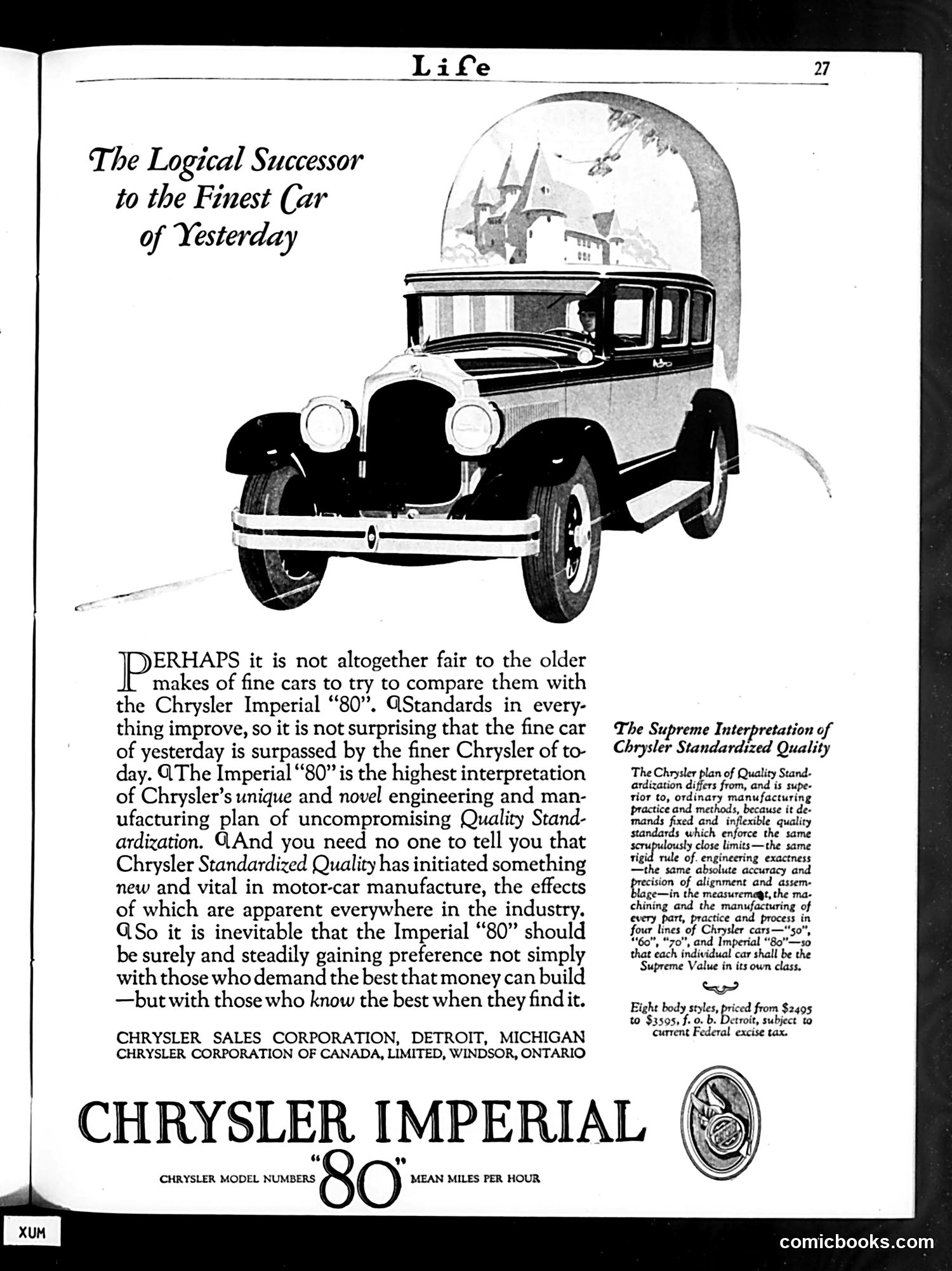
This is primarily a **car advertisement**, not political satire. It's a full-page Chrysler Imperial "80" advertisement from Life magazine. The ad's rhetorical strategy is to position the Imperial "80" as the inevitable successor to older luxury cars by claiming that manufacturing standards have improved across the industry. It emphasizes "Standardized Quality"—Chrysler's manufacturing approach of maintaining identical precision across all car models ("30," "60," "70," and Imperial "80"). The illustration shows a 1920s-era automobile (the Imperial "80") beneath an arch framing a European castle, suggesting heritage and refinement. The "80" in the model number refers to its top speed of 80 miles per hour—a notable achievement for the era. The ad targets affluent buyers who "know the best when they find it," positioning the car as both technologically advanced and a status symbol. Rather than satire, this exemplifies period advertising's earnest appeals to progress and quality standardization as selling points.
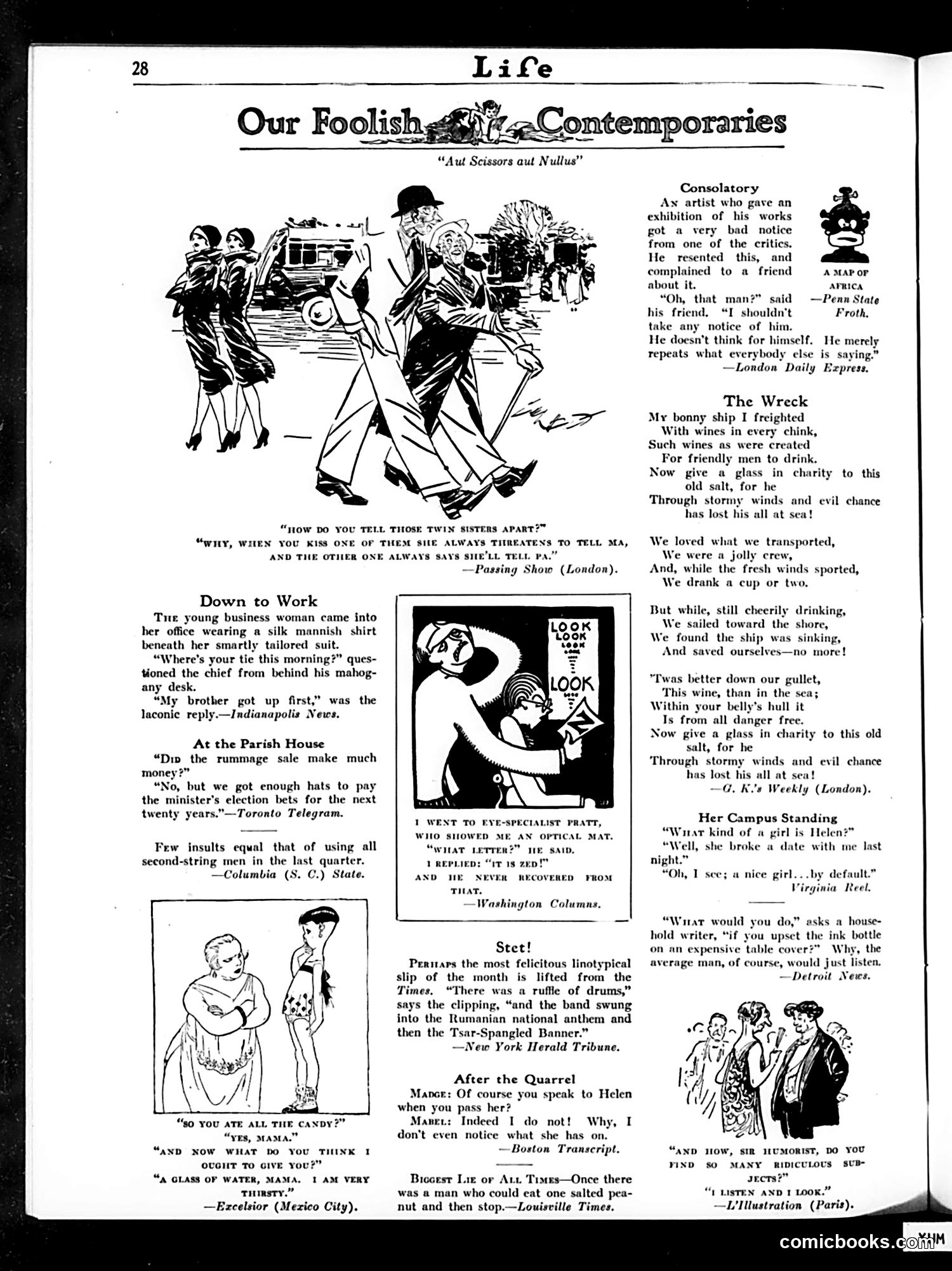
This page collects humorous anecdotes and light satirical cartoons typical of Life's format. The content mocks social conventions and human foibles: **Main cartoons:** Top illustration shows young women in 1920s dress, joking about distinguishing identical twins by their behavior when kissed—one threatens to tell mother, the other promises secrecy. This satirizes flirtation customs and parental control. **"Down to Work"** jokes about a businesswoman wearing a mannish silk shirt (referencing the era's androgynous fashion shifts) and her boss's surprise. **"At the Parish House"** mocks both rummage sales and clergy, suggesting the church uses donation proceeds for ministers' gambling debts. Other brief items satirize: pretentious art critics who lack original thought, typographical errors in newspapers, women's social posturing, and human weakness (eating all candy, breaking dates). **Context:** This represents 1920s-era lighthearted social commentary—genteel satire targeting gender norms, religious hypocrisy, and modern manners rather than hard political critique. The humor assumes readers recognize these social situations as recognizable absurdities.
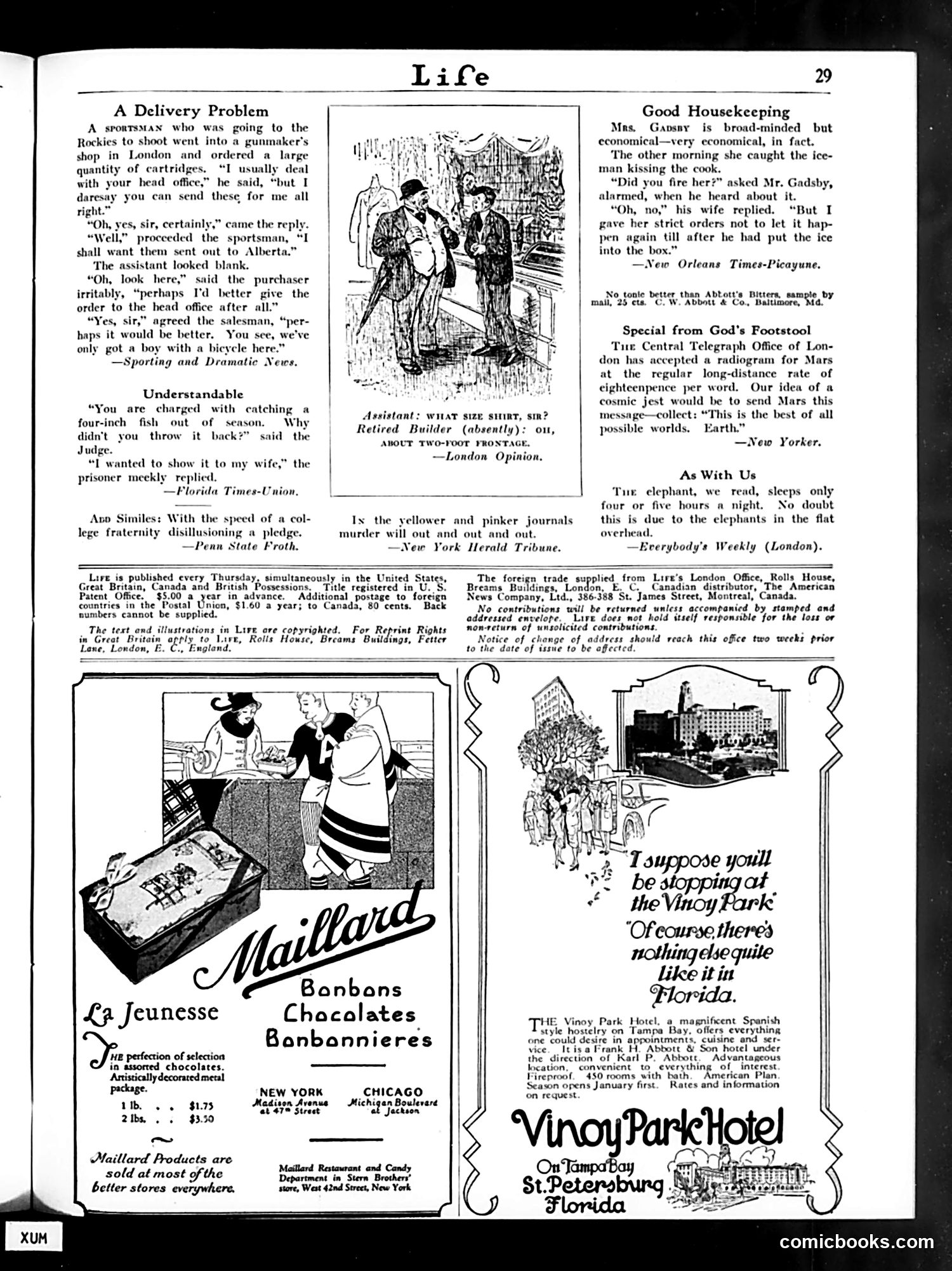
This page is primarily **advertising and humor miscellany** rather than political content. The main items are brief satirical anecdotes from various publications: - **"A Delivery Problem"**: A London gunsmith clerk doesn't know where Alberta is, suggesting British ignorance of Canadian geography. - **"Good Housekeeping" joke**: A wife catches the iceman kissing the cook but doesn't fire her—only demands he wait until after delivering the ice, satirizing extreme frugality. - **"As With Us"**: An elephant sleeps poorly because of noisy upstairs neighbors—a relatable urban complaint. The **advertisements** occupy significant space: Maillard chocolates (with illustration of women examining a box) and the Vinoy Park Hotel in Florida. These represent typical 1920s-era luxury goods marketing. The page reflects Life's format as a satirical magazine mixing short jokes with advertising, targeting middle-class readers with gentle humor about domestic life, class conventions, and everyday annoyances.
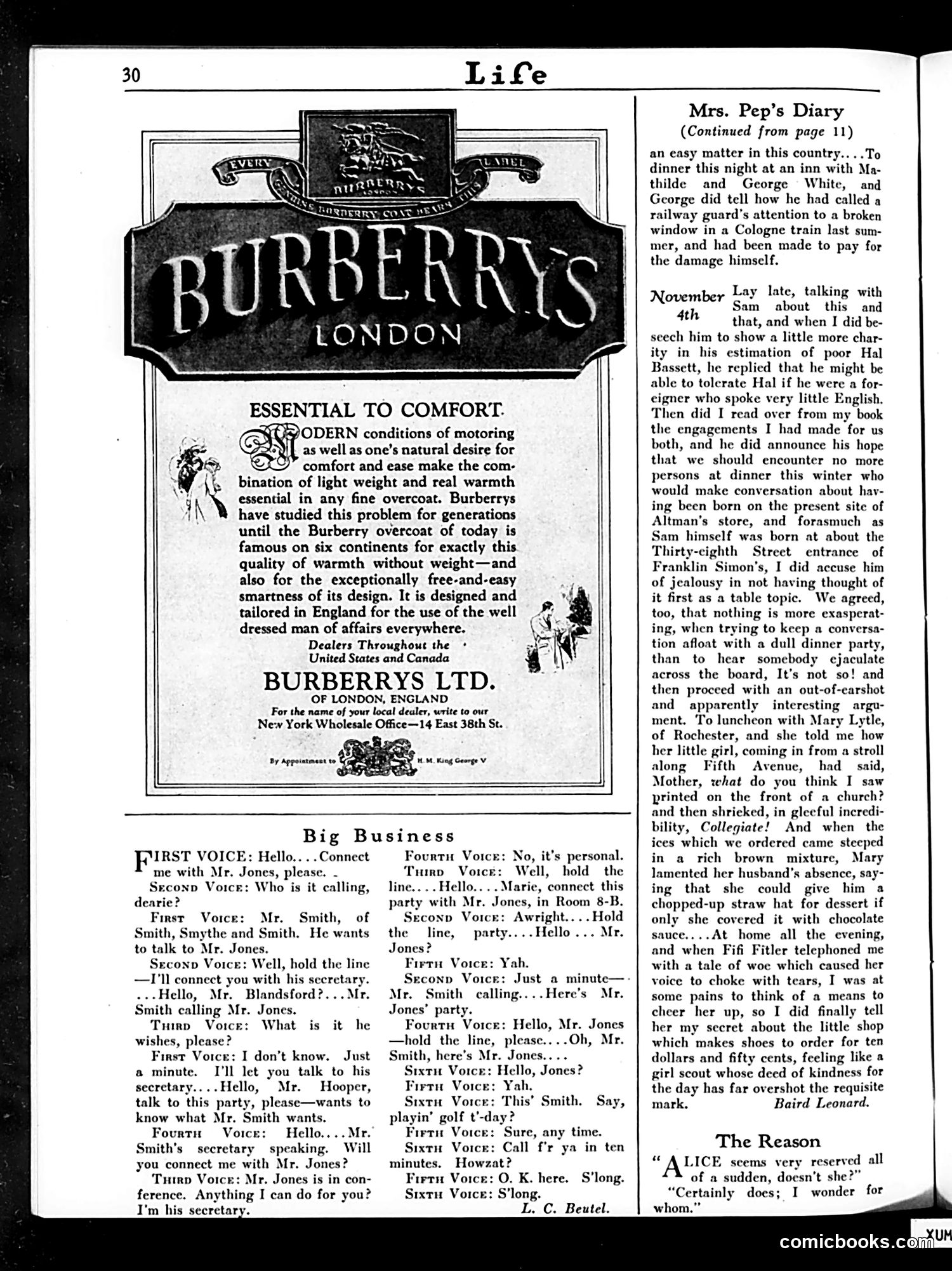
This page contains three distinct elements: **1. Burberrys Advertisement (top):** A luxury overcoat ad emphasizing "warmth without weight"—appealing to well-dressed men during the era of early automobiles when motoring required practical yet refined clothing. **2. "Big Business" Satire (center):** A comedic phone conversation lampooning corporate bureaucracy. A simple call to "Mr. Jones" requires navigating multiple secretaries and intermediaries (Blandsford, Hooper, etc.), each screening the call through layers of office hierarchy. The joke: business has become absurdly complicated by administrative gatekeeping, with the caller eventually reaching Jones only for casual golf plans. This satirizes the inefficiency of modern corporate structure. **3. "Mrs. Pep's Diary" (right):** A society diary column poking fun at upper-class dinner party pretensions—guests boring others by mentioning being born near famous department stores (Altman's, Franklin Simon's), and the irritation of conversational disputes that trail off mid-sentence. All three sections mock different aspects of contemporary American life: consumer aspiration, corporate red tape, and social affectation.
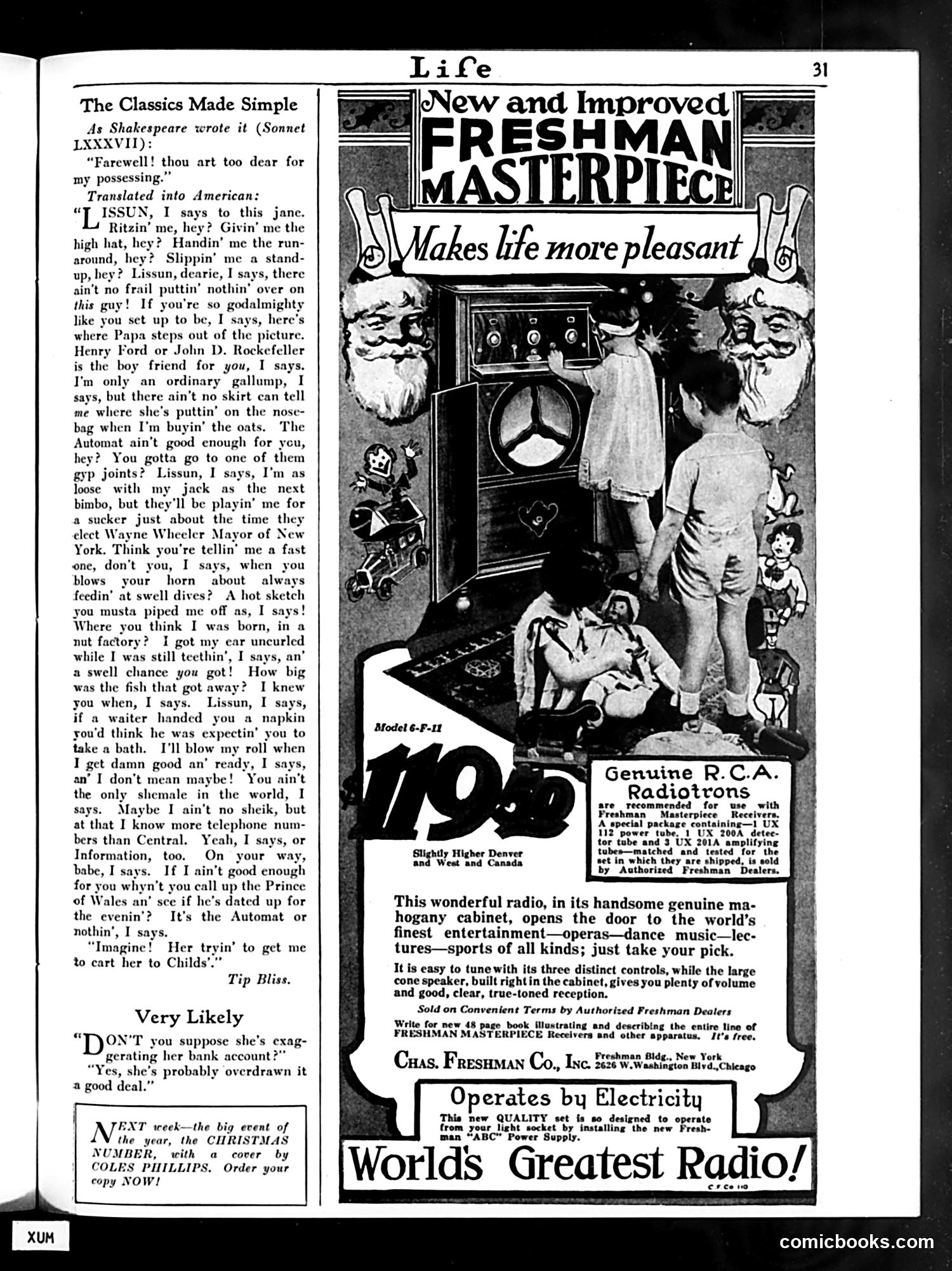
This page primarily contains satirical humor and period advertising rather than political cartoons. **"The Classics Made Simple"** is a comedy piece that translates Shakespeare's Sonnet 87 into 1920s American slang. The joke mocks both high literature and contemporary working-class speech—it presents an ordinary man's breakup rant using crude, colorful vernacular ("jane," "bimbo," "shemale") peppered with references to then-current figures like Henry Ford, John D. Rockefeller, and Wayne Wheeler (a Prohibition advocate). The humor lies in the violent contrast between Shakespeare's elegant melancholy and this crude, boastful rejection. **"Very Likely"** is a brief joke about a woman exaggerating her wealth. The page is dominated by a **Freshman Masterpiece Radio advertisement**, featuring illustrations of jovial gnomes/elves promoting the radio as bringing "fine entertainment" into homes. This reflects the 1920s technological optimism around radio as a revolutionary household device. The ad emphasizes convenience and quality reception—typical marketing for the era's exciting new medium.
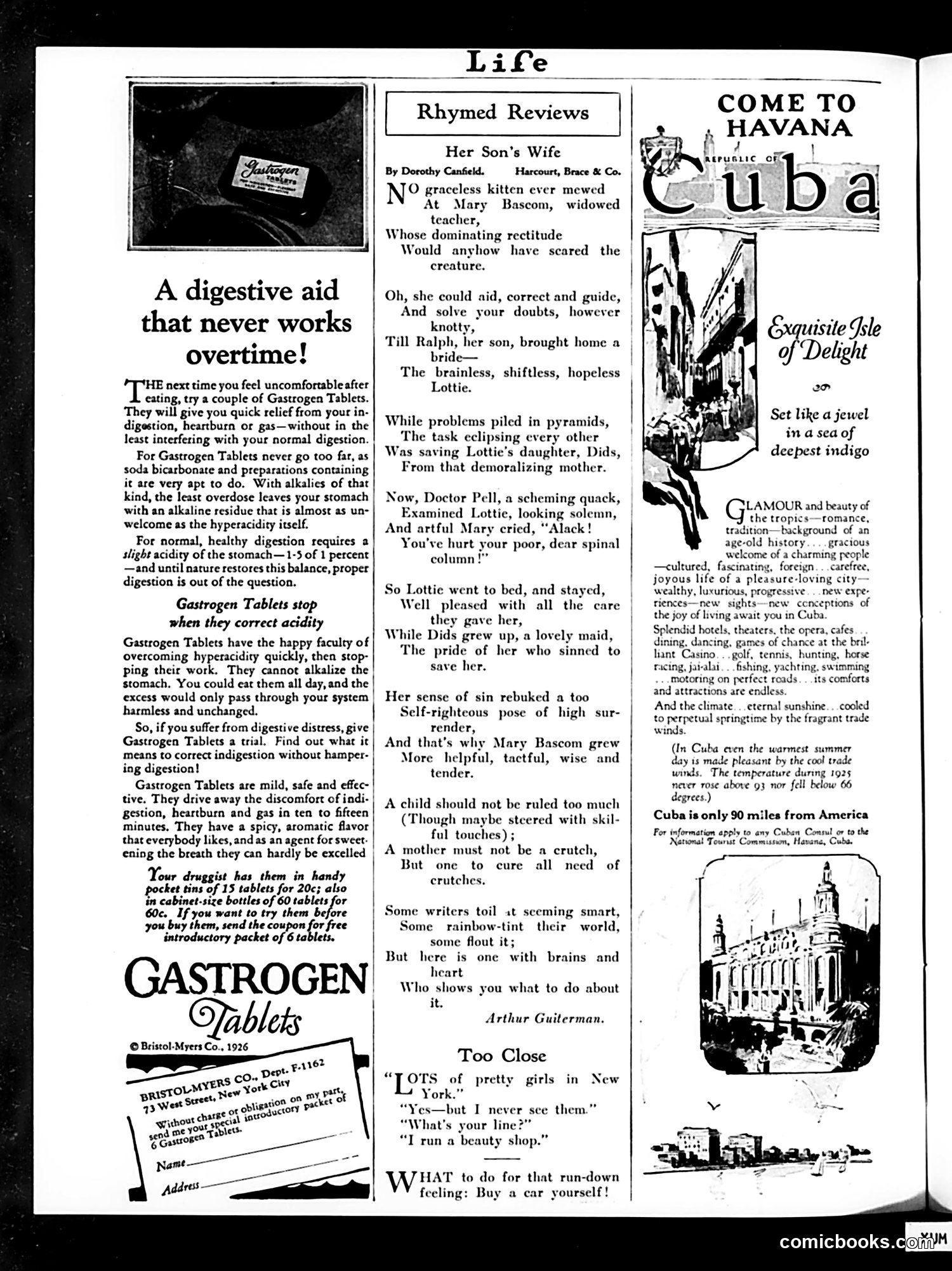
This page comprises primarily **advertisements and book reviews** rather than political cartoons. The **Gastrogen Tablets ad** (left) humorously claims the product "never works overtime"—a self-deprecating sales pitch arguing its mild formula won't overcorrect stomach acidity like competing products. The joke is the counterintuitive advertising approach. The **"Her Son's Wife" book review** (center) summarizes Dorothy Canfield's novel in rhyming verse. It describes a domineering mother-in-law (Mary Bascom) who manipulates her daughter-in-law Lottie through deception, eventually learning humility. The review's concluding moral praises the author for showing genuine wisdom about parenting and family relationships. The **"Too Close" joke** (lower center) is a brief dialogue making a mild social observation: a man sees many pretty girls in New York but never actually meets them because he runs a beauty shop—suggesting limited romantic opportunity despite urban proximity. The **Cuba tourism advertisement** (right) promotes Havana as an exotic Caribbean destination featuring luxury, culture, and perpetual sunshine. The page reflects 1920s consumer culture and literary interests.
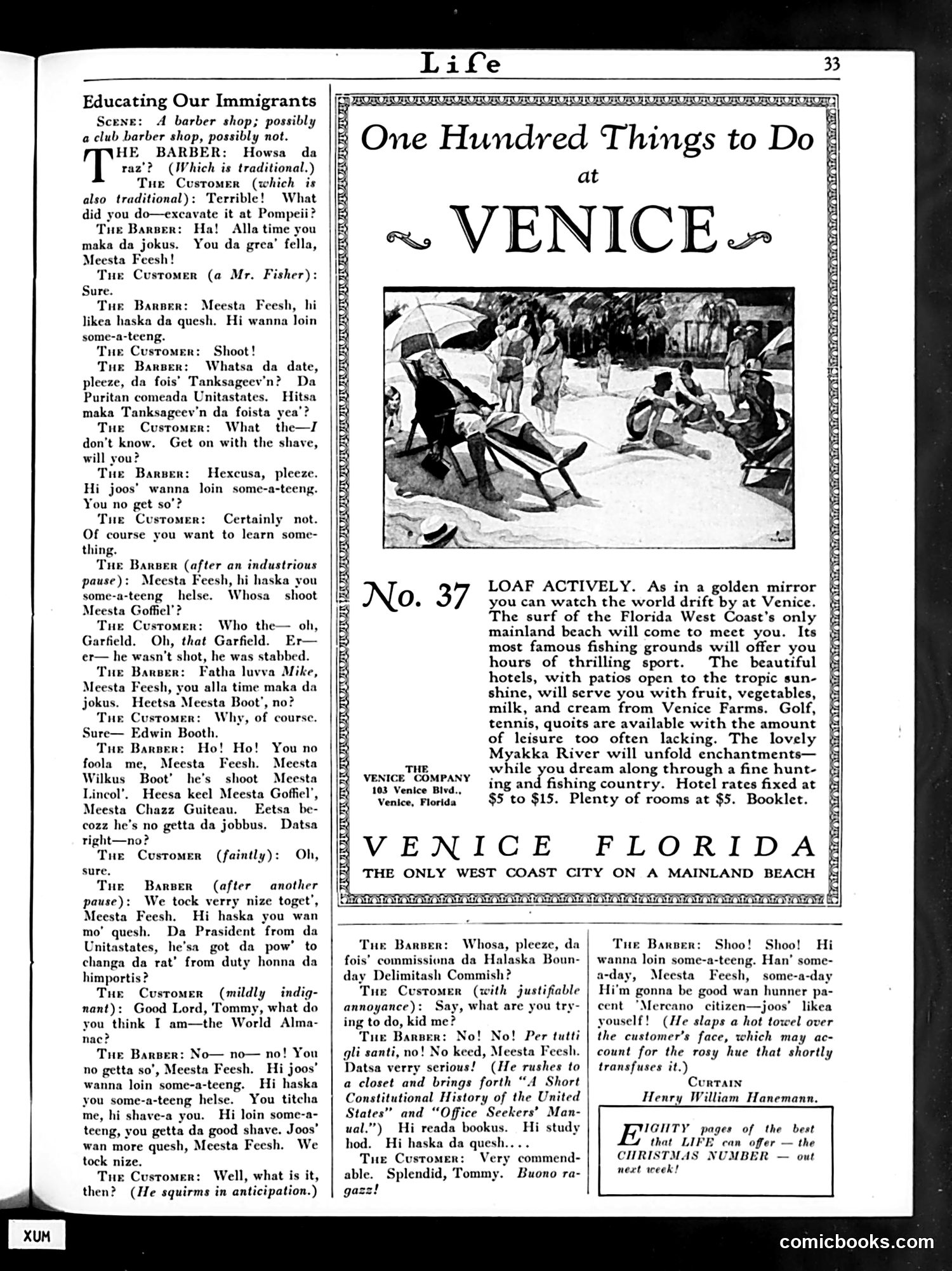
This is a satirical sketch about immigrant assimilation in early 20th-century America. A barber with a heavy Italian accent (represented phonetically as "Meesta Feesh," "haska," "whosa") repeatedly interrupts a customer's shave to ask questions about American history and civics—Thanksgiving, President Garfield's assassination, Edwin Booth, tariff policy, the Alaska Boundary Commission. The humor operates on multiple levels: the barber's malapropisms and broken English are played for comedy, but the sketch's real point is satirizing both the immigrant's earnest desire to become an "American citizen" through self-education and the absurdity of his questions. The barber studies history books but misunderstands what he's learning, confusing assassinations and confusing basic facts. The title "Educating Our Immigrants" is ironic—the sketch suggests immigrants' efforts to self-educate often produce confused results, while mocking both immigrant ambition and American complacency about integration.
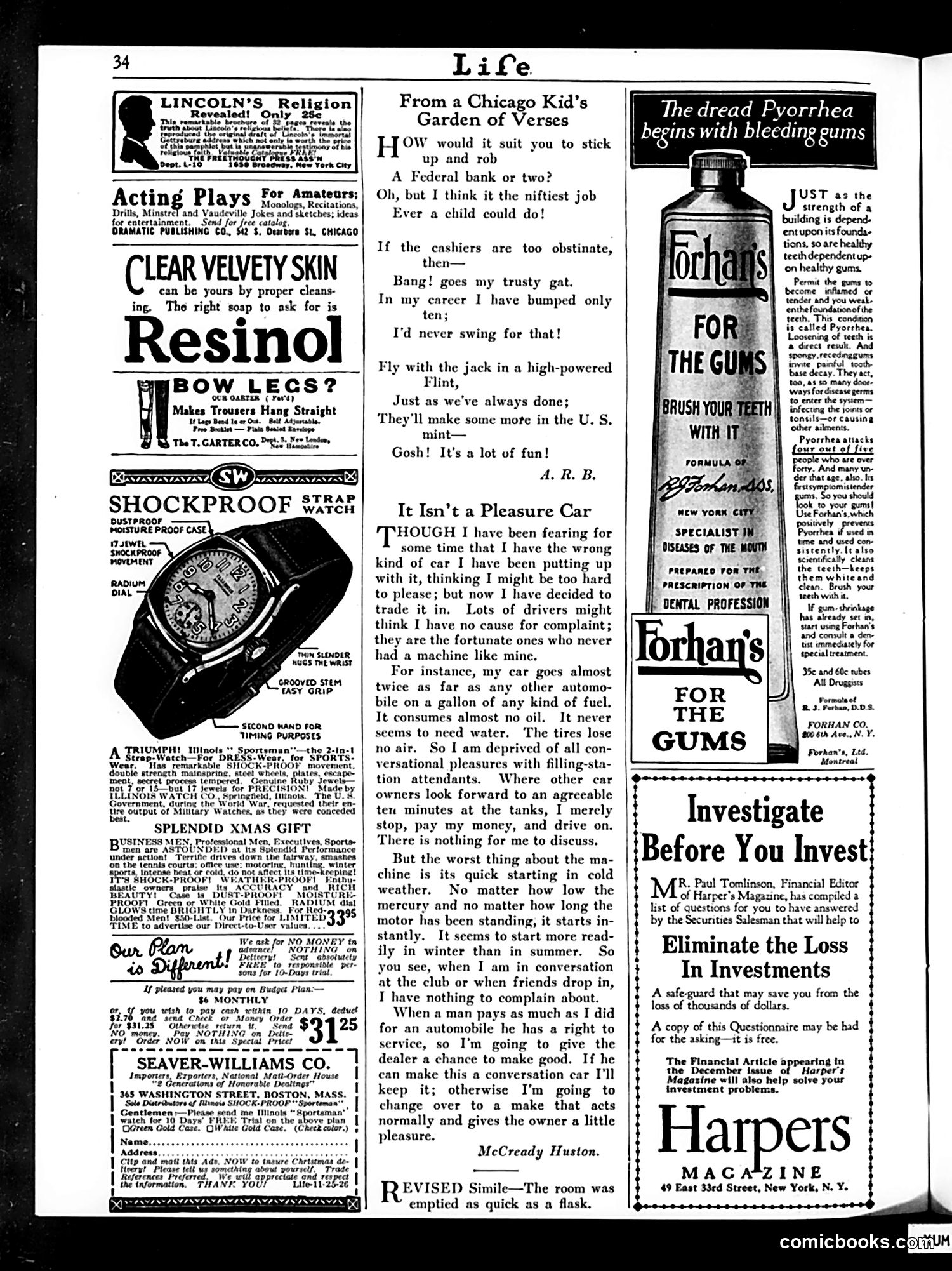
This page is primarily **advertising and light satirical verse**, not political cartooning. The main content includes: **"From a Chicago Kid's Garden of Verses"** — Two humorous poems satirizing American society through a child's innocent voice: 1. The first poem jokes darkly about bank robbery as an appealing career, mocking both criminal audacity and the era's lawlessness (likely referencing Prohibition-era crime). 2. The second, "It Isn't a Pleasure Car," satirizes consumerism and social status—a wealthy car owner *complains* his vehicle works too well, denies him conversation topics at filling stations, and lacks mechanical problems to discuss. It mocks upper-class preoccupation with leisure complaints. **The advertisements** hawk period products: Resinol soap, Illinois watches, Forhan's toothpaste, and investment guides—typical Life magazine fare. The satire reflects 1920s anxieties: organized crime, consumer culture, and the artificial social rituals of the wealthy.
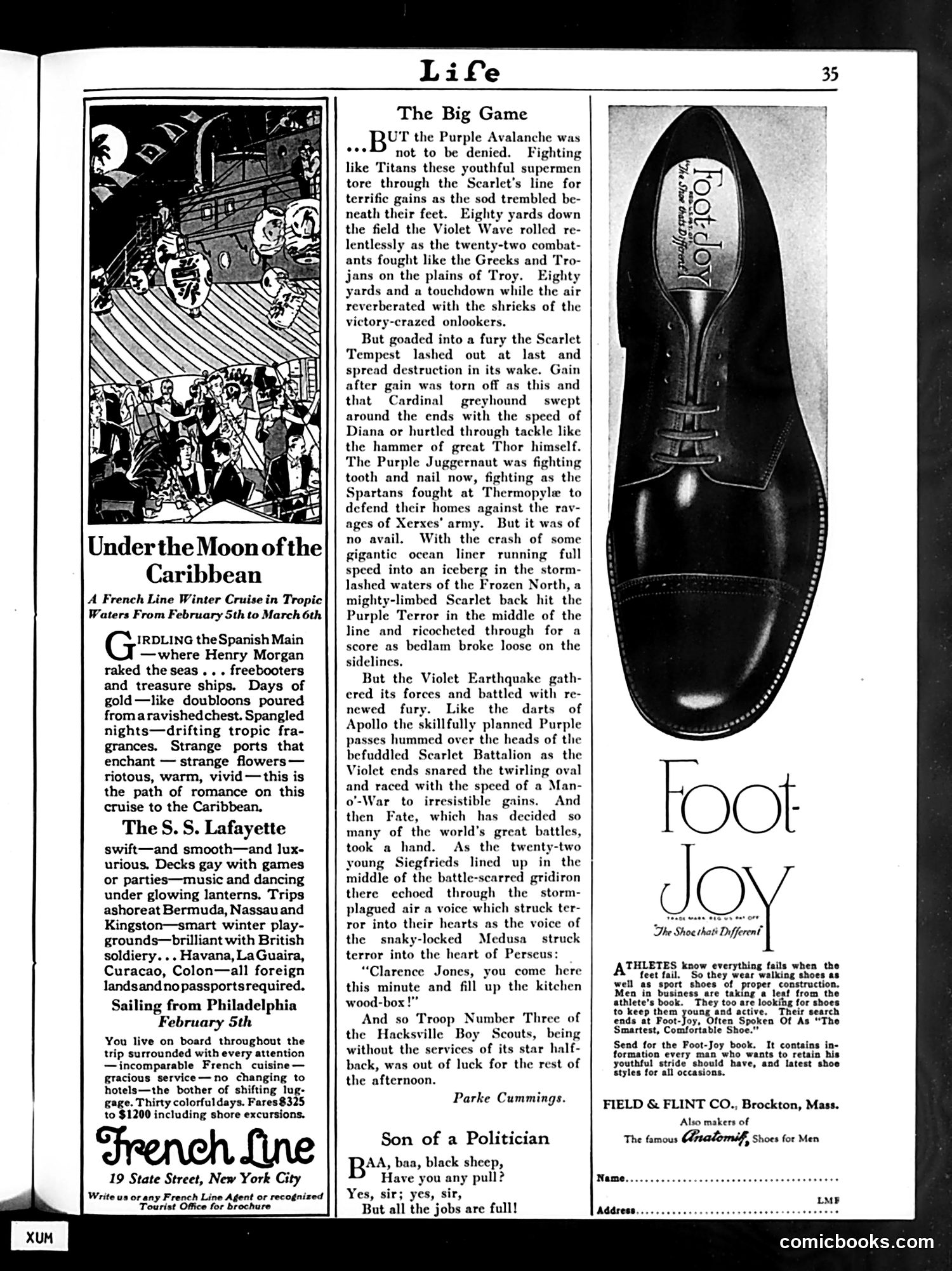
This is a humorous sports satire by cartoonist Parke Cummings. The text mockingly describes a college football game between the "Purple" and "Scarlet" teams using grandiose, epic language—comparing players to Greek warriors at Troy, Thor, Apollo, and Siegfried. The prose is deliberately overwrought, treating a simple football match as world-historical combat. The joke's punchline: all this epic struggle means nothing when Clarence Jones, the star halfback, is called away by his mother to fill the kitchen wood-box. The entire battle suddenly ends because a Boy Scout must do chores. The satire targets the overwrought sports journalism and fan enthusiasm of the era, mocking how Americans elevated college football to mythic importance while ignoring mundane domestic reality. A mother's practical demand deflates the grandiose masculine spectacle instantly.
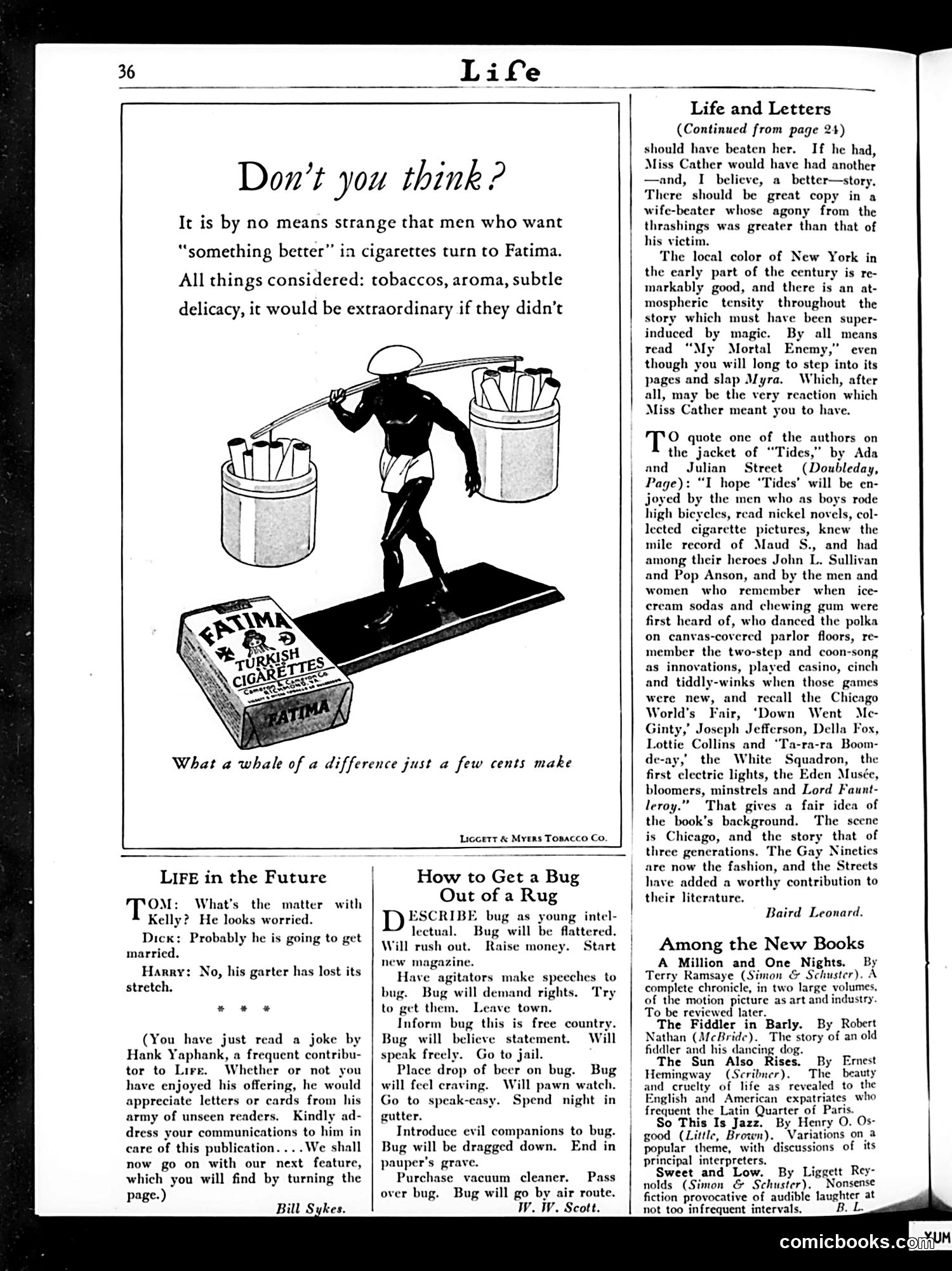
This page contains **advertising and humor**, not political cartoons. The **Fatima cigarette ad** (top) uses a silhouette figure balancing cigarette packages, promoting the brand's quality with the tagline "What a whale of a difference just a few cents make." It's straightforward product advertising. Below are two **joke sections**: "Life in the Future" presents brief one-liners about a character named Kelly worried about marriage and losing garter stretch—simple vaudeville-style humor. "How to Get a Bug Out of a Rug" is satirical social commentary dressed as practical advice, mocking young intellectuals and radical agitators by describing how a "bug" (likely an anarchist or communist sympathizer) becomes corrupted through exposure to vice and poor influences—reflecting 1920s anxiety about radicalism. The right column contains **book reviews** and literary commentary, including discussion of Willa Cather's work. This is primarily a **humor and literary magazine page**, not political satire in the modern sense.
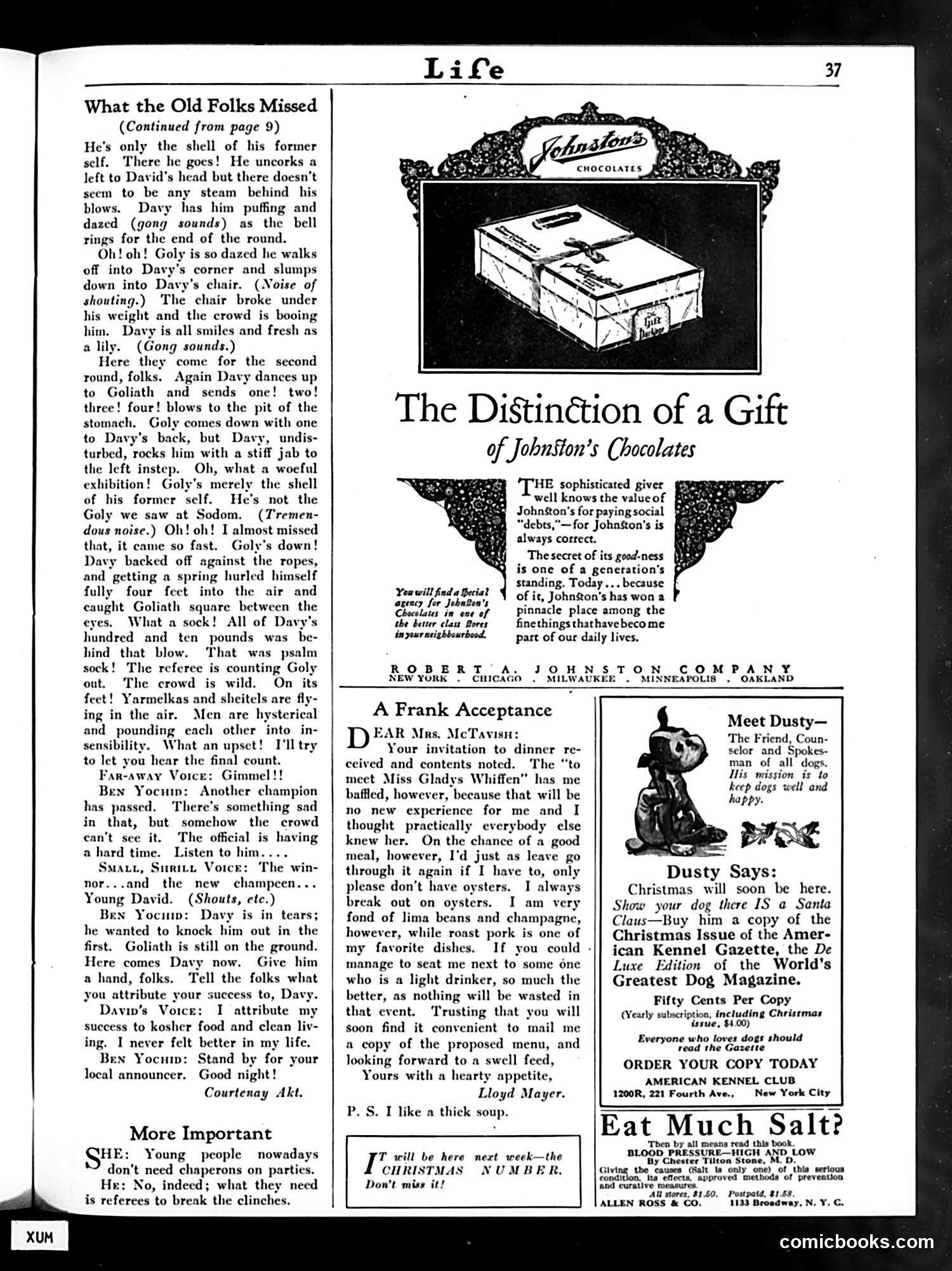
This page contains a serialized sports narrative and advertisements from early 20th-century Life magazine. **"What the Old Folks Missed"** is a radio-style play-by-play commentary of a boxing match between **David and Goliath**—a biblical reference reimagined as a modern prizefight. The humor relies on treating the famous biblical story as contemporary sports entertainment, with Jewish audience members (indicated by "yarmelkas and sheitels"—Jewish head coverings) enthusiastically watching. The joke is that modern entertainment has replaced traditional religious narratives. **"More Important"** is a brief joke about young people and dating: without chaperones at parties, they need "referees to break the clinches"—meaning referees to separate couples kissing/embracing. **The remaining content** consists primarily of advertisements (Johnston's Chocolates, dog magazines, medical products) and a humorous letter declining a dinner invitation with petty complaints about oysters and seating arrangements. The page reflects 1920s-era humor and consumer culture rather than political satire.
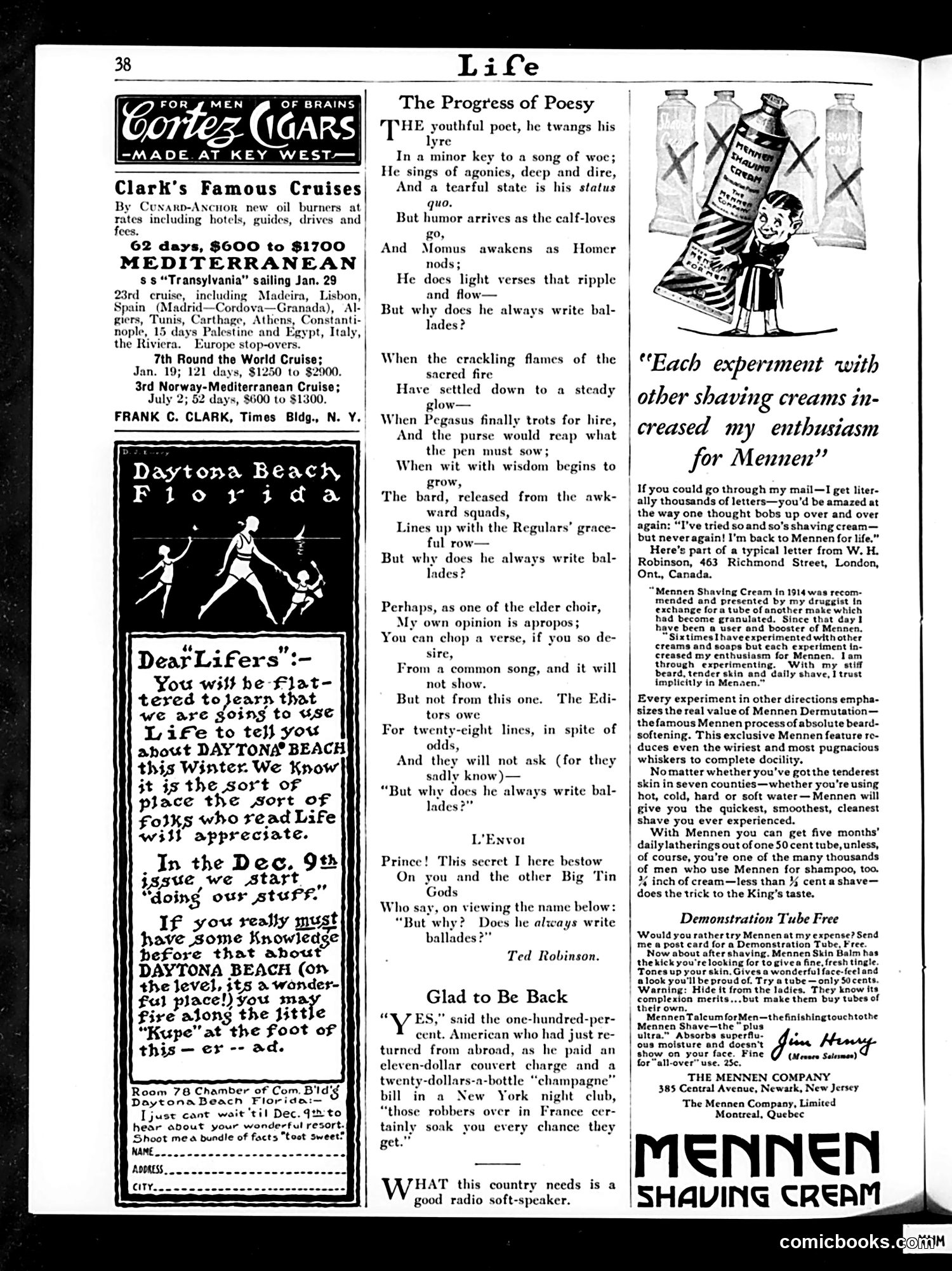
**"The Progress of Poesy"** (center) is a humorous poem by Ted Robinson tracking a poet's career arc: starting with angst-ridden, minor-key verses; progressing to lighter, witty work; finally achieving Homer-like mastery. The joke, revealed in the envoi (closing), is that regardless of the poet's development, he "always write[s] ballades"—a rigid, formal verse structure. The satire mocks poets' tendency toward predictable formality despite claims of artistic evolution. **"Glad to Be Back"** (lower right) satirizes American hypocrisy. A returned traveler complains that French establishments "soak you every chance they get"—while simultaneously paying inflated prices ($11 cover, $20 champagne) at a New York nightclub. The joke exposes how Americans criticize foreign exploitation while accepting identical gouging at home.
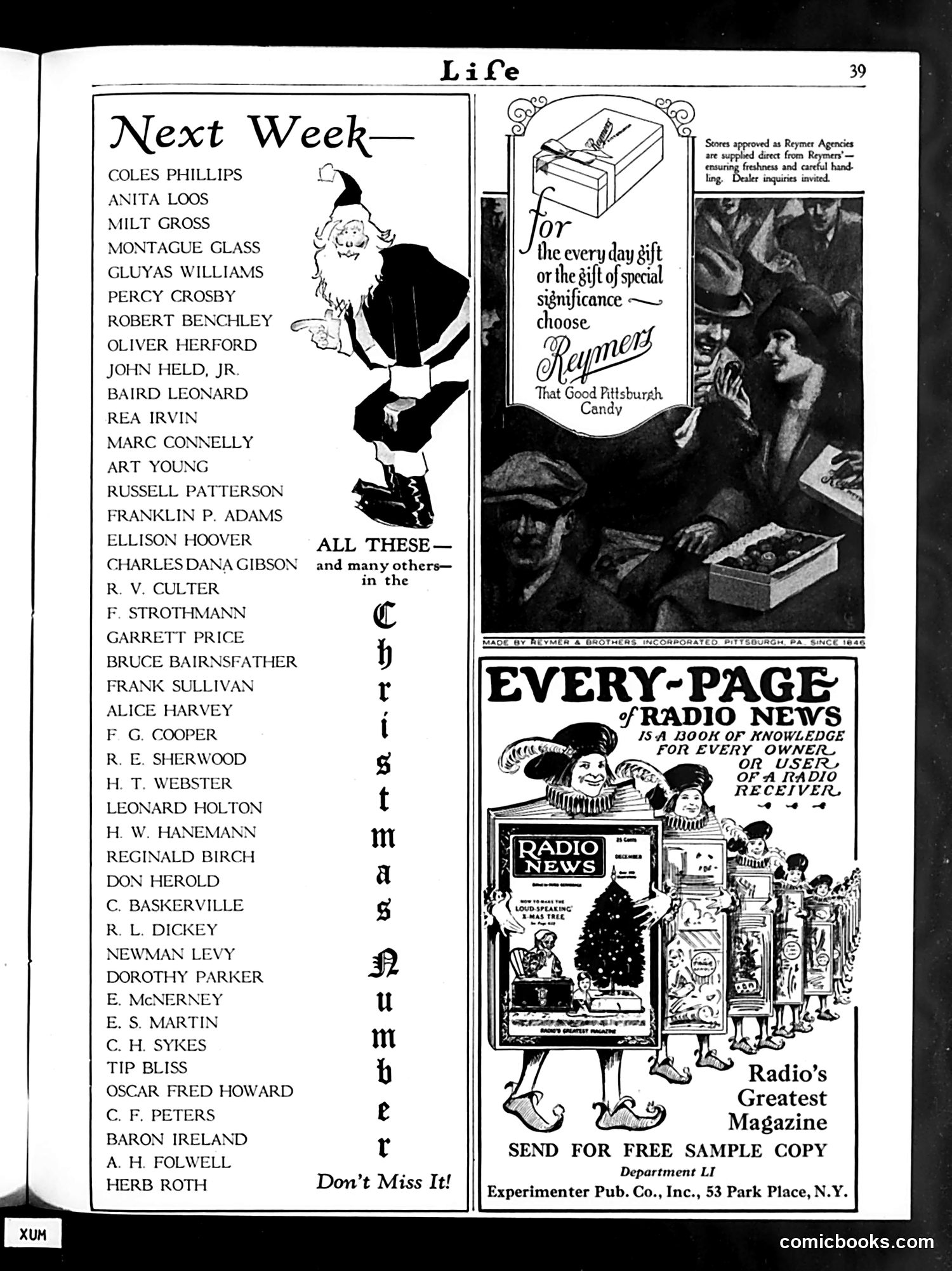
This is primarily a **table of contents/preview page** rather than editorial content. The left side lists major contributors appearing "Next Week" in Life—prominent humorists, cartoonists, and writers of the era including Dorothy Parker, Robert Benchley, and John Held Jr. The right side contains **two advertisements**: 1. **Raymers Candy** (Pittsburgh-based): Promotes their candy as an appropriate gift, using a gnome illustration. The ad emphasizes quality packaging. 2. **Every-Page of Radio News**: Advertises a radio magazine as essential reading for radio set owners. The illustration shows caroler-like figures distributing copies, positioning radio knowledge as universally important during the early radio era. **Historical context**: This appears from approximately the 1920s, when radio was new technology and Life magazine was at peak influence as American satirical literature. The page primarily serves a **promotional/navigational function** rather than containing satire.
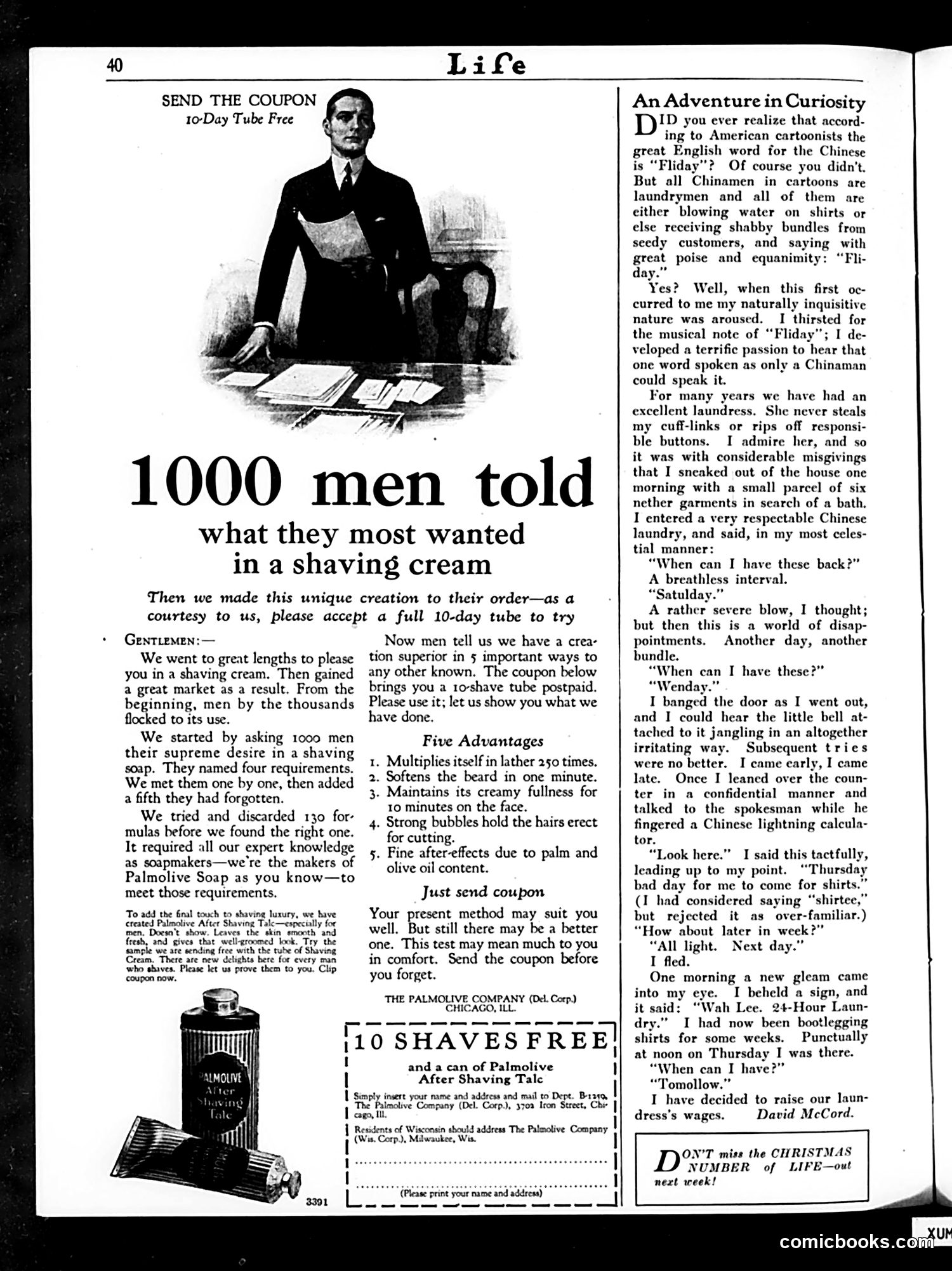
This page combines a **Palmolive shaving cream advertisement** with a **satirical essay** about racial stereotypes. The ad features a well-dressed businessman and promotes a new shaving cream developed after surveying 1,000 men about their preferences. It emphasizes five advantages and offers a free 10-day tube. The accompanying essay, "An Adventure in Curiosity," mocks American cartoonists' reliance on a tired stereotype: depicting all Chinese people as laundrymen who say "Flyday" (Friday) with an exaggerated accent. The author describes deliberately visiting Chinese laundries to hear this pronunciation, experiencing comical disappointment when workers say "Saturday" and "Wednesday" instead—revealing the absurdity of the stereotype itself. The juxtaposition is notable: a glossy consumer advertisement alongside content that critiques how Americans reduce entire ethnic groups to caricatured speech patterns and occupations. The satire targets not Chinese people, but American cartoonists and their lazy, repetitive stereotyping.
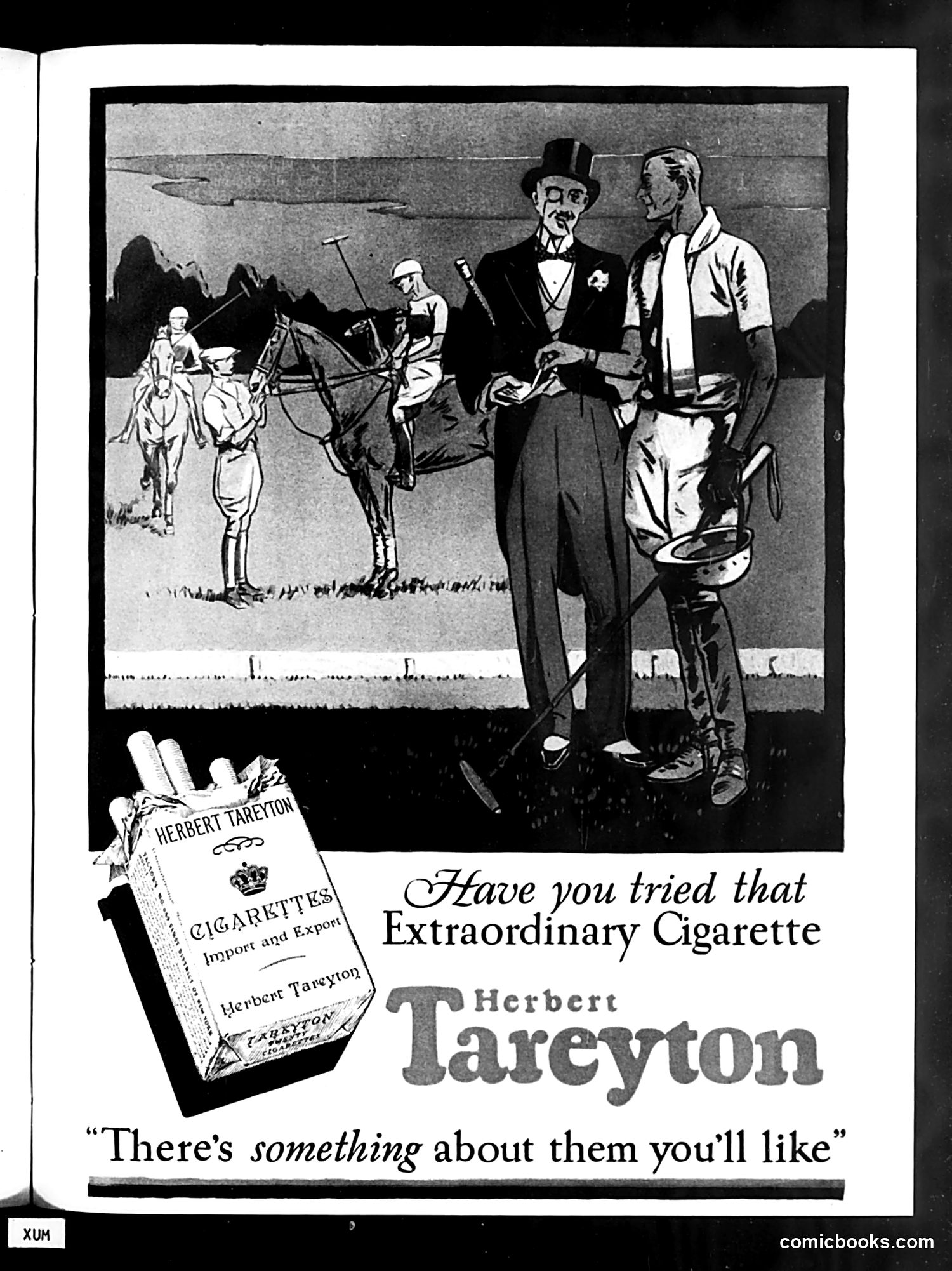
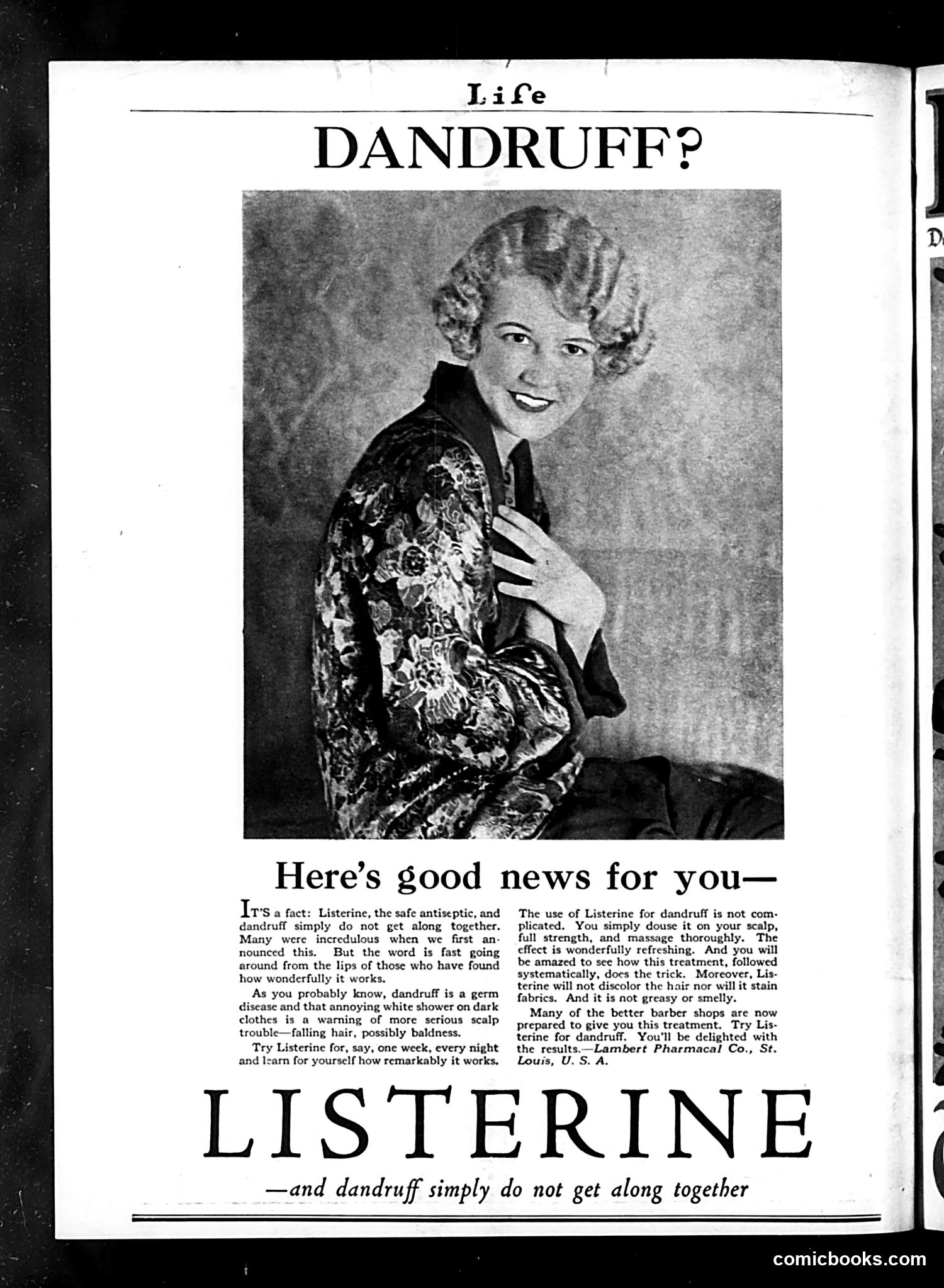
This is **not a cartoon or satire**—it's a straightforward **advertisement for Listerine mouthwash**, repurposed as a dandruff treatment. The page features a portrait photograph of a smiling woman with 1920s-style wavy hair, positioned to showcase healthy scalp appearance. The ad's humor is mild and era-appropriate: the headline "DANDRUFF?" presents the problem as shocking news, then promises relief through Listerine. The advertisement reflects early-20th-century medical marketing practices: Listerine was originally an antiseptic mouthwash but was being marketed for multiple uses (dandruff, as shown here). The copy emphasizes scientific language ("germ disease") and social anxiety (white flakes on dark clothes, baldness fears) to drive consumer purchase. This represents how companies expanded product applications and how consumer anxieties about appearance were leveraged for sales—practices that would seem quaint or aggressive to modern readers.