
Life, 1926-11-25 · page 38 of 44
Life — November 25, 1926 — page 38: what you’re looking at
What you’re looking at
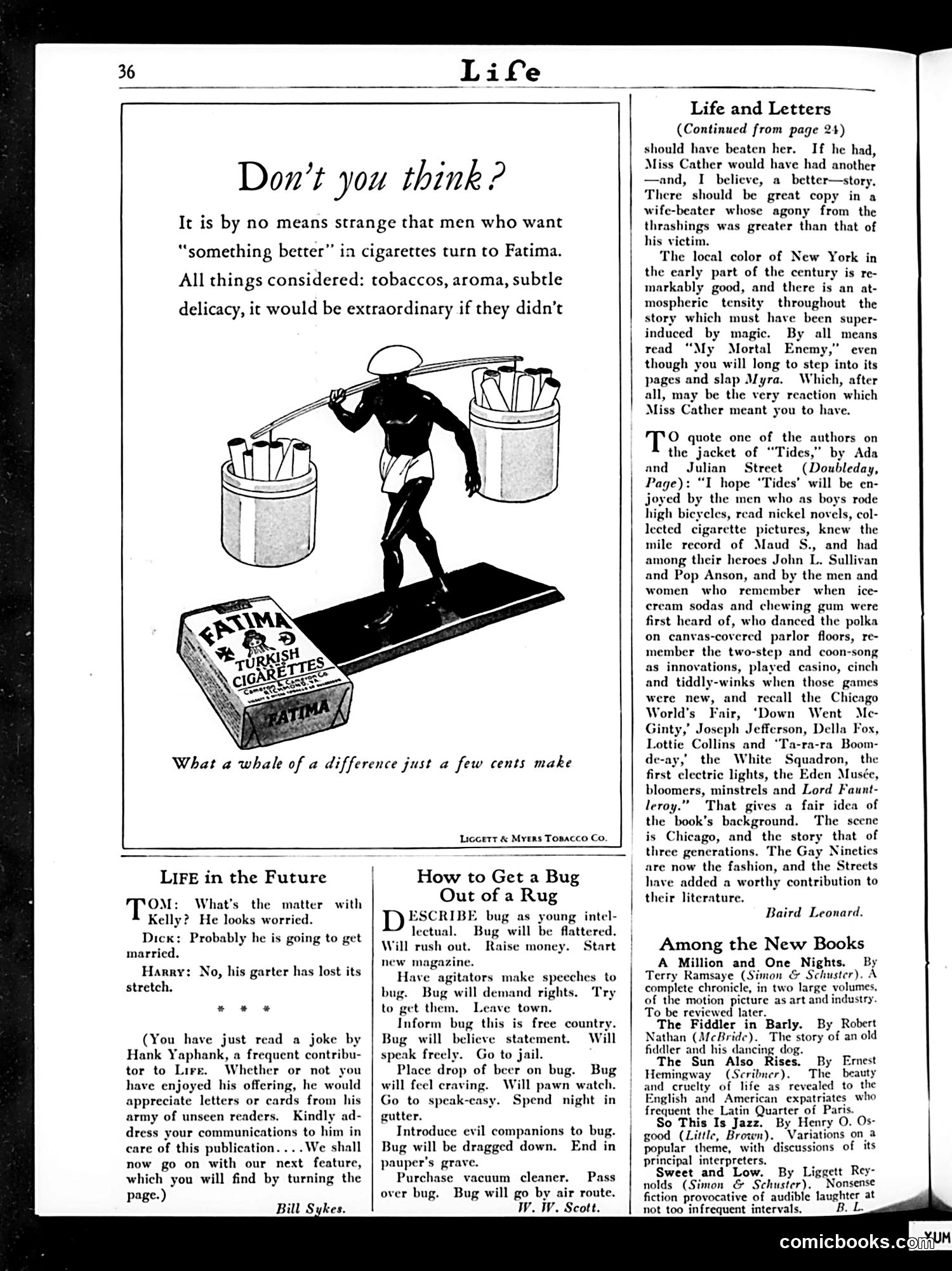
This page contains **advertising and humor**, not political cartoons. The **Fatima cigarette ad** (top) uses a silhouette figure balancing cigarette packages, promoting the brand's quality with the tagline "What a whale of a difference just a few cents make." It's straightforward product advertising. Below are two **joke sections**: "Life in the Future" presents brief one-liners about a character named Kelly worried about marriage and losing garter stretch—simple vaudeville-style humor. "How to Get a Bug Out of a Rug" is satirical social commentary dressed as practical advice, mocking young intellectuals and radical agitators by describing how a "bug" (likely an anarchist or communist sympathizer) becomes corrupted through exposure to vice and poor influences—reflecting 1920s anxiety about radicalism. The right column contains **book reviews** and literary commentary, including discussion of Willa Cather's work. This is primarily a **humor and literary magazine page**, not political satire in the modern sense.
📄 Transcribed text from this page (OCR, searchable)
Machine-transcribed from the original scan — historical spelling and the odd misread are preserved.
Don’t you think? It is by no means strange that men who want “something better” in cigarettes turn to Fatima. All things considered: tobaccos, aroma, subtle delicacy, it would be extraordinary if they didn’t What a whale of a difference just a few cents make Liccett & Myers Tosacco Co. LIFE in the Future OM: What's the matter Kelly? He looks worried. Dick: Probably he is going to get married. Harry: No, his garter has lost its stretch, with * & & (You have just read a joke by Hank Yaphank, a frequent contribu- tor to Lire. Whether or not you have enjoyed his offering, he would appreciate letters or cards from his army of unseen readers. Kindly ad- dress your communications to him in care of this publication. ...We shall now go on with our next feature, which you will find by turning the page.) Bill Sykes. How to Get a Bug Out of a Rug ESCRIBE. bug as young intel- lectual. Will rush out. Raise mone new magazii Have agitators make speeches to bug. Bug will demand rights. Try to get them. I town. Inform bug this is free country. Bug will believe statement. Will speak free Go to jail. Place drop of beer on bug. Bug will feel craving. Will pawn watch. Go to speak-easy. Spend night in gutter. Introduce evil companions to bug. Bug will be dragged down. End in pauper’s grave. Purchase vacuum cleaner. Pass over bug. Bug will go by air route. W. W. Scott. Bug will be flattered. Start Life and Letters (Continued from page 24) should have beaten her. If he had, Miss Cather would have had another —and, I believe, a better—story, There should be great copy in a wife-beater whose agony from the thrashings was greater than that of his victim. The local color of New York in the early part of the century is re- markably good, and there is an at- mospheric tensity throughout the story which must have been super- induced by magic. By all means read “My Mortal Enemy,” even though you will long to step into its pages and slap Myra. Which, after all, may be the very reaction which Miss Cather meant you to have. T° quote one of the authors on the jacket of “Tides,” by Ada and Julian Street (Doubleday, Page): “I hope ‘Tides’ will be en- joyed by the men who as boys rode high bicycles, read nickel novels, col- lected cigarette pictures, knew the mile record of Maud S., and had among their heroes John L. Sullivan and Pop Anson, and by the men and women who remember when _ ice- cream sodas and chewing gum were first heard of, who danced the polka on canvas-covered parlor floors, re- member the two-step and coon-song as innovations, played casino, cinch and tiddly-winks when those games were new, and recall the Chicago World's Fair, ‘Down Went Me- Ginty,’ Joseph Jefferson, Della Fox, Lottie Collins and ‘Ta-ra-ra Boom- de-ay,’ the White Squadron, the first electric lights, the Eden Musée, bloomers, minstrels and Lord Faunt- leroy.” That gives a fair idea of the book’s background. The scene is Chicago, and the story that of three generations. The Gay Nineties are now the fashion, and the Streets have added a worthy contribution to their literature. Baird Leonard. Among the New Books A Million and One Nights. By Terry Rams (Simon & Schuster). A complete chronicle, in two large volumes, of the motion picture as art and industry. To be reviewed later. The Fiddler in Barly. By Robert Nathan (McBride). The story of an old fiddler and his dancing dog. The Sun Also Rises. By Ernest Hemingway (Scribner). The beauty and cruelty of life as revealed to the English and American expatriates who frequent the Latin Quarter of Paris. So This Is Jazz. By Henry O. Os- good (Little, Brown). Variations on a popular theme, with discussions of its principal interpreters. Sweet and Low. By Liggett Rey- nolds (Simon & Schuster). Nonsense fiction provocative of audible laughter at not too infrequent intervals. L comicbooks.comas